

1. Introduction
Sandstones are preferentially sampled for detrital zircon age and provenance studies (e.g., Gehrels, Reference Gehrels, Busby and Azor Pérez2011). The grain-size distribution of a sandstone is the product of a combination of sand grain production at the sources, including grain-size inheritance, potential grain-size diminution during sediment transport, mixing and sorting during transport and deposition, and diagenesis (e.g., Folk & Ward, Reference Folk and Ward1957; Dickinson, Reference Dickinson1970; Galloway, Reference Galloway1974; Pettijohn et al., Reference Pettijohn, Potter and Siever1989; Feil et al., Reference Feil, Eynatten, Dunkl, Schönig and Lünsdorf2024). Sorting is governed by depositional environment and thus facies (e.g., Friedman & Sanders, Reference Friedman and Sanders1978). Given the resilience of zircon, the grain-size distribution of detrital zircon within a sandstone sample, and by implication the distribution and variability of detrital zircon ages, depends therefore on the variable interplay of all of these factors. This has been demonstrated to be the case on the large scale of sedimentary sections and formations (DeGraaff-Surpless et al., Reference Degraaff-surpless, Mahoney, Wooden and Mcwilliams2003; Zimmermann et al., Reference Zimmermann, Andersen, Madland and Skipenes Larsen2015) and on the small scale of meter-scale fluvial bedforms (Lawrence et al., Reference Lawrence, Cox, Mapes and Coleman2011). The assessment of the factors controlling the grain-size distribution of detrital zircon is complicated, however, by the often unknown zircon grain size of the zircon-supplying source rocks. The grain-size distribution of zircon and other heavy minerals, if not the entire grain-size spectrum, of a sandstone sample is therefore predetermined partially or completely by grain-size inheritance from the source lithologies.
In many cases, sandstone detrital zircon age data are reported with only scant consideration of sedimentary facies, grain size and potential sorting effects. This looseness is frequently combined with a lack of consideration of the representativity of a sample or a group of samples for a studied section or formation. In an ideal case, one would aim to analyse a statistically representative number of samples for both a given thickness and lateral bed variation of a target section. Usually, available funds, availability of analytical facilities and time preclude this. However, new technical developments permitting high-throughput, random sampling approaches of large-n datasets (Sundell et al., Reference Sundell, Gehrels, D. Blum, Saylor, Pecha and Hundley2024) will hopefully mitigate this problem in the future. Still, accepting the mentioned limitations as unavoidable, we as authors could at least acknowledge the uncertainty caused by them when drawing conclusions from a given data set.
1.a. Aims of this study
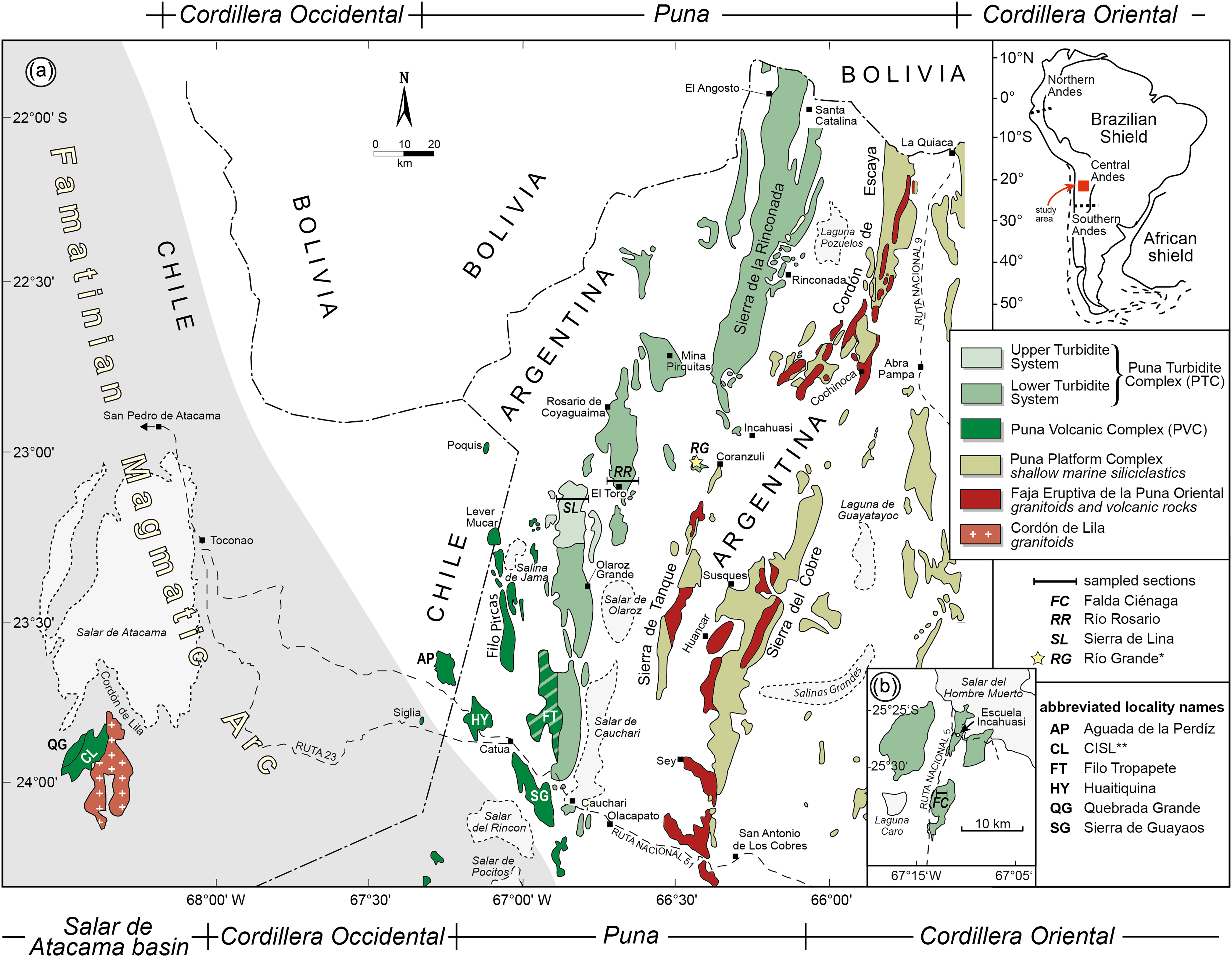
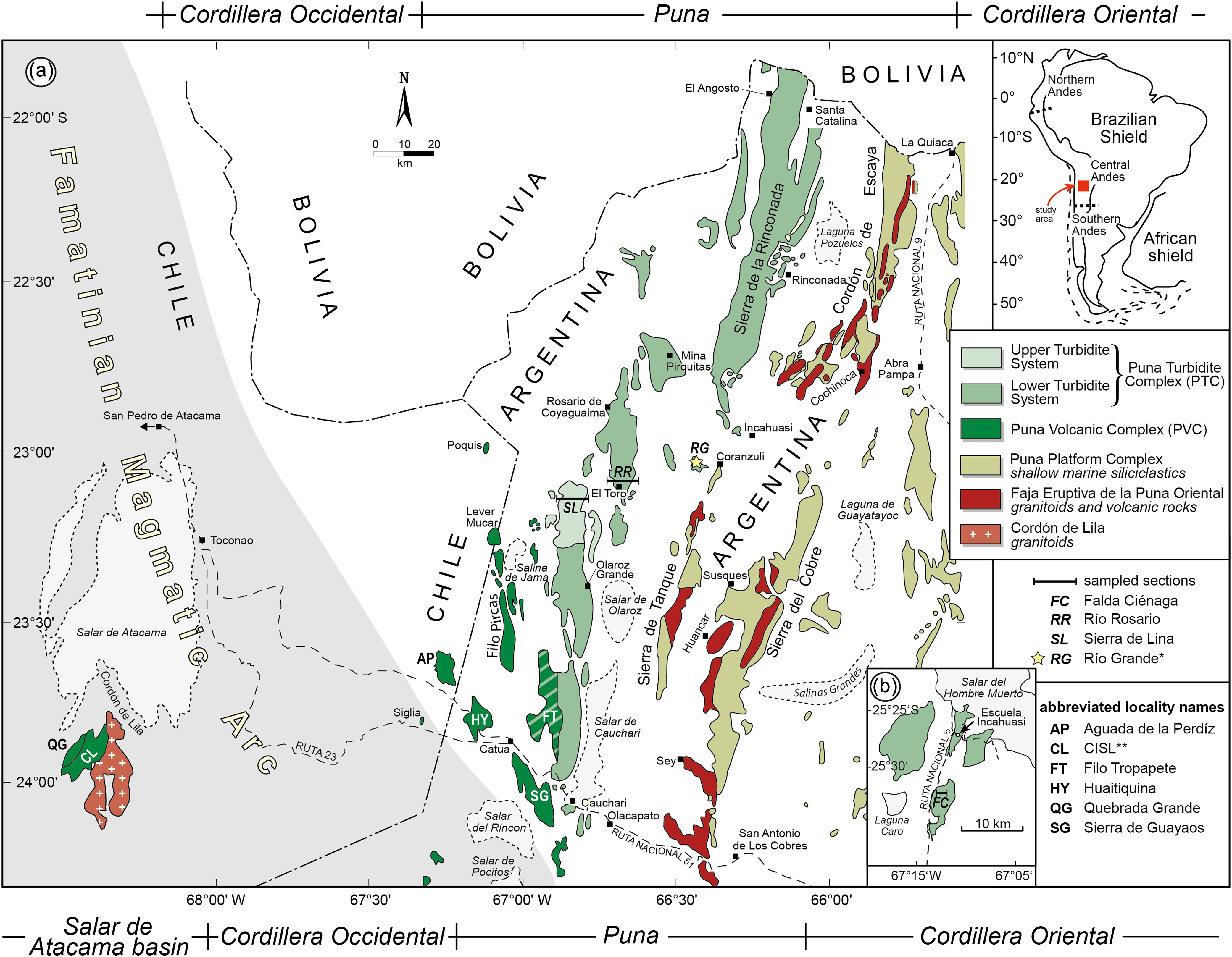
In this study, we present detrital zircon age spectra of eight turbidite sandstone samples from the middle and upper Ordovician Puna Turbidite Complex (PTC) in the Puna highlands of northwestern Argentina (Figures 1, 2, 3). This complex has a maximum thickness of 3500 m and was deposited in a retroarc foreland basin from the late Darriwilian to the Sandbian, i.e., in the course of c. 15 Myr (Figure 3, Middle to lower Upper Ordovician; Bahlburg, Reference Bahlburg and Macdonald1991; Bahlburg et al., Reference Bahlburg, Breitkreuz, Maletz, Moya and Salfity1990; Bahlburg & Breitkreuz, Reference Bahlburg and Breitkreuzin press). We will use the data of three sample pairs to assess differences and similarities between the detrital zircon age distributions of samples with medium and fine sand grain sizes. The provenance analysis will combine these six samples with two more samples, one new and one from the literature (Augustsson et al., Reference Augustsson, Rüsing, Niemeyer, Kooijman, Berndt, Bahlburg and Zimmermann2015). We will also consider Lu-Hf and O isotope data of the new samples already included in Bahlburg et al. (Reference Bahlburg, Kemp, Fanning and Martin2025) to enter into a discussion of the crustal evolution reflected by the analysed samples and their sources.
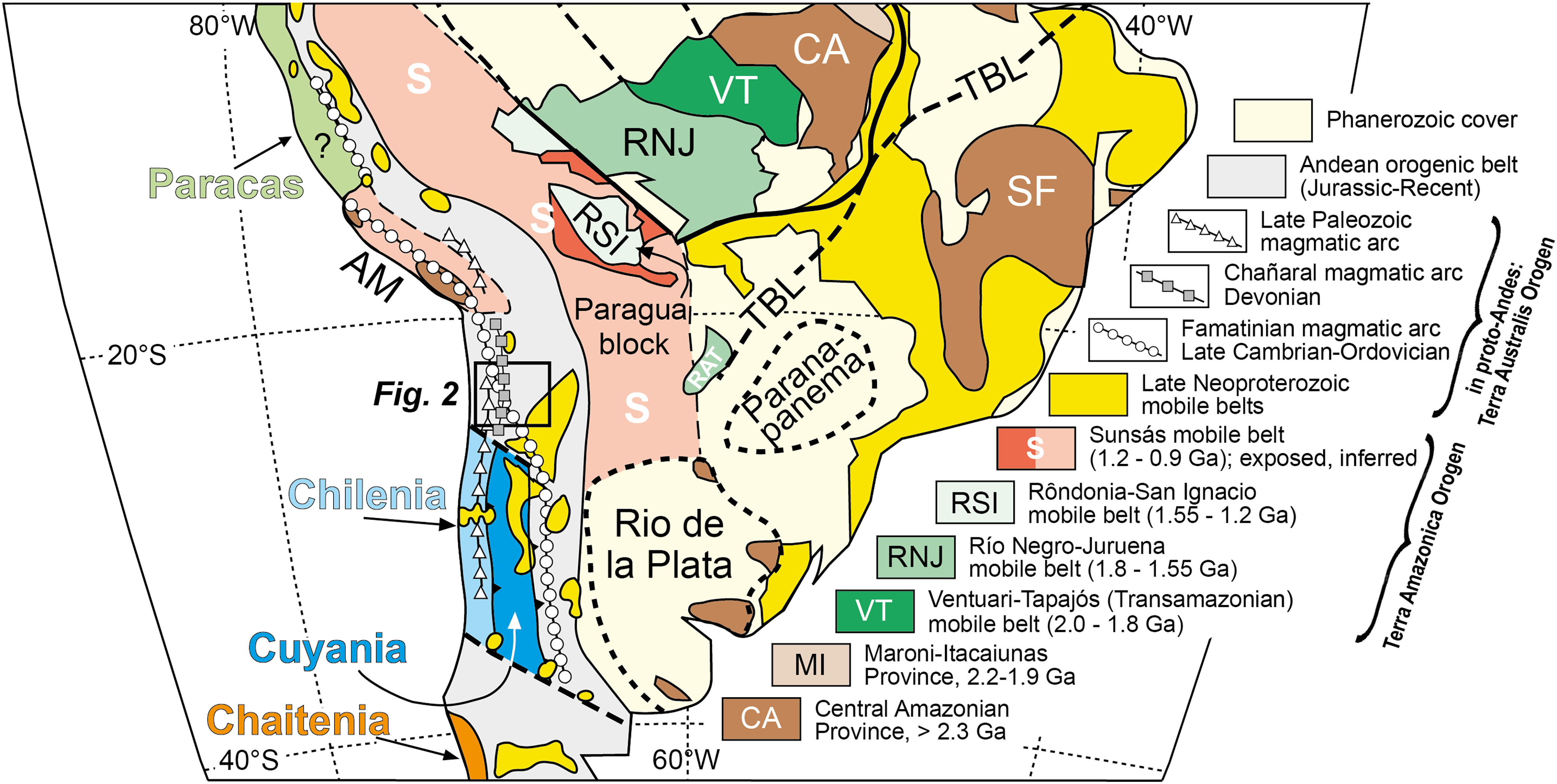
Orogenic provinces of South America (modified from Bahlburg et al., Reference Bahlburg, Kemp, Fanning and Martin2025 and references therein). AM, Arequipa Massif; RAT: Río Apa Terrane; SF, Sao Francisco craton; TBL: Trans Brazilian Lineament.

Outcrop map of Ordovician units in the Puna of northern Chile and northwestern Argentina and in the Salar de Atacama Basin of northern Chile (modified from Bahlburg, Reference Bahlburg1990; Augustsson et al., Reference Augustsson, Rüsing, Niemeyer, Kooijman, Berndt, Bahlburg and Zimmermann2015; Bahlburg and Breitkreuz, Reference Bahlburg and Breitkreuzin press). *, Río Grande sample from Augustsson et al. (Reference Augustsson, Rüsing, Niemeyer, Kooijman, Berndt, Bahlburg and Zimmermann2015); **, sedimentary units of the Complejo Ígneo-Sedimentario del Cordón de Lila (CISL, Niemeyer, Reference Niemeyer1989). The FC sampling locality is the graptolite locality of Aceñolaza et al. (Reference Aceñolaza, Toselli and Gonzalez1976). Area occupied in the study area by the Famatinian magmatic arc according to Niemeyer et al. (Reference Niemeyer, Götze, Sanhueza and Portilla2018) and Ramos (Reference Ramos and Folguera2018).
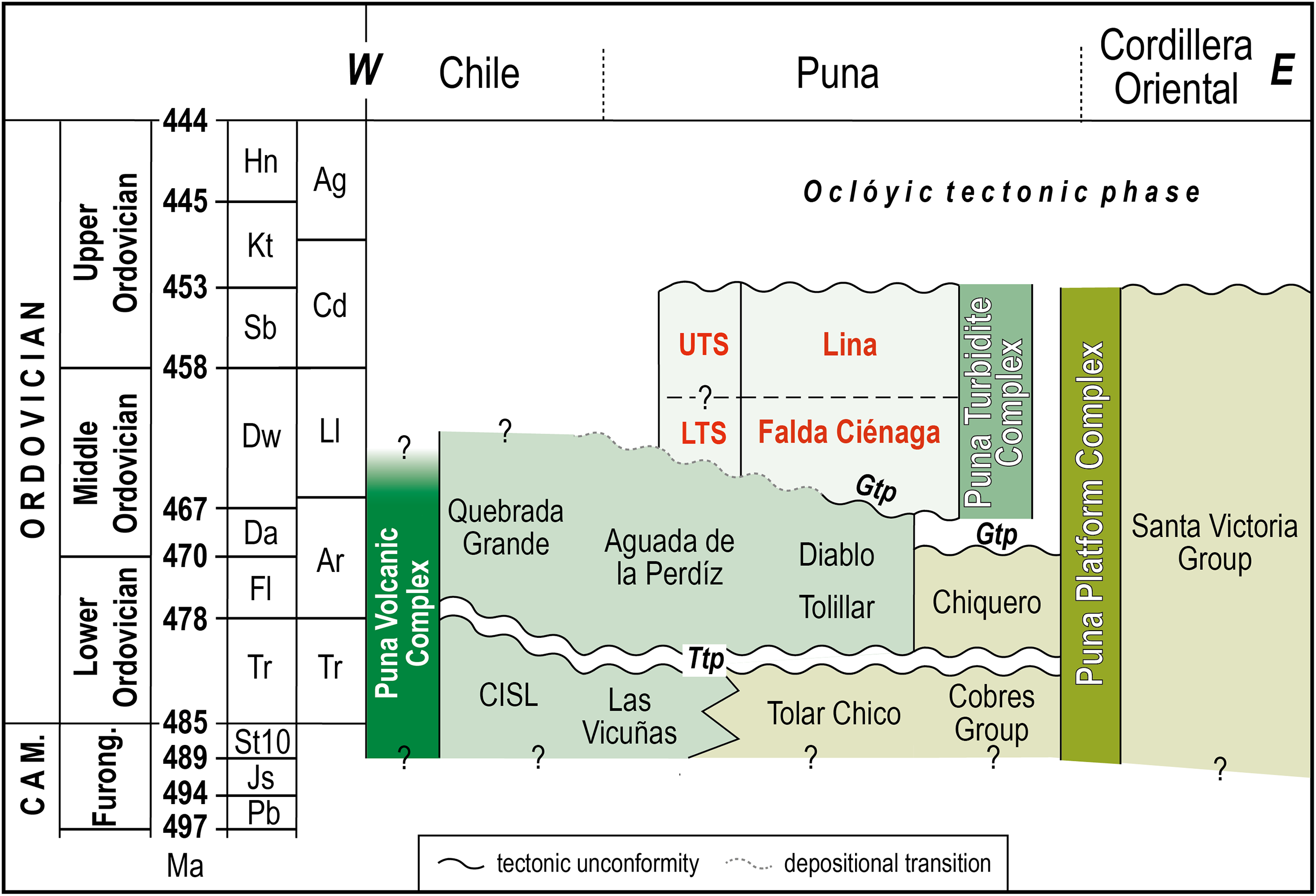
Uppermost Cambrian and Ordovician stratigraphic framework and formations of the Puna of northern Chile and northwestern Argentina (Bahlburg and Breitkreuz, Reference Bahlburg and Breitkreuzin press and references therein). IUGS chronostratigraphy according to Cohen et al. (Reference Cohen, Finney, Gibbard and FAN2013, updated). CAM, Cambrian; Pb, Paibian; Js, Jiangshanian; ST10, unnamed Stage 10; Tr, Tremadocian; Fl, Floian; Da, Dapingian; Dw, Darriwillian; Sb, Sandbian; Kt, Katian; Hn, Hirnantian. Ar, Arenig; Ll, Llanvirn; Cd, Caradoc; Ag, Ashgill. Ttp, Tilcara tectonic phase; Gtp, Guandacol tectonic phase.

2. Geological framework
The middle Cambrian to Silurian/Early Devonian accretionary Famatinian Arc Orogen (520–410 Ma) extends along the present western margin of South America from c. 36°S to the Merida Andes of northern Venezuela at c. 10°N (Ramos, Reference Ramos and Folguera2018). It includes large intrusive bodies that formed a calc-alkaline magmatic arc on thickened continental crust, mostly of Mesoproterozoic age, during the period between about 490 and 460 Ma (Pankhurst et al., Reference Pankhurst, Rapela, Saavedra, Baldo, Dahlquist, Pascua, Fanning, Pankhurst and Rapela1998; Rapela et al., Reference Rapela, Pankhurst, Casquet, Baldo, Saavedra, Galindo, Fanning, Pankhurst and Rapela1998; Kleine et al., Reference Kleine, Mezger, Zimmermann, Münker and Bahlburg2004; Bahlburg et al., Reference Bahlburg, Berndt and Gerdes2016; Weinberg et al., Reference Weinberg, Becchio, Farias, Suzaño and Sola2018; Ramos, Reference Ramos and Folguera2018; Zimmermann et al., Reference Zimmermann, Quenardelle, Poma, Tait, Larionov and Presnyakov2019). Metamorphic rocks reflecting variable depths of metamorphism are abundant and mirror a strong tectonic segmentation into exposures of different crustal levels (e.g., Ramos, Reference Ramos and Folguera2018; Alasino et al., Reference Alasino, Larrovere, Ratschbacher, Casquet and Paterson2024). Non-metamorphic or only slightly metamorphosed volcanic and siliciclastic sedimentary rocks are accessible only in those segments where upper crustal levels are exposed. Exemplary exposures of such volcaniclastic and volcanic units occur in the Puna of northern Chile and northwestern Argentina (Figures 1, 2; Schwab, Reference Schwab1973; Bahlburg, Reference Bahlburg1990, Reference Bahlburg, Pankhurst and Rapela1998; Zimmermann & Bahlburg, Reference Zimmermann and Bahlburg2003; Coira et al., Reference Coira, Kay, Peréz, Woll, Hanning, Flores, Ramos and Keppie1999, Reference Coira, Kirschbaum, Hongn, Pérez and Menegatti2009a,b; Bahlburg & Breitkreuz, Reference Bahlburg and Breitkreuzin press).
After an initial late Cambrian and Early Ordovician back-arc stage (Bahlburg, Reference Bahlburg1990; Coira et al., Reference Coira, Kay, Peréz, Woll, Hanning, Flores, Ramos and Keppie1999) which did not extend sufficiently to generate oceanic crust (Zimmermann et al., Reference Zimmermann, Bahlburg, Mezger and Kay2014), the Ordovician Puna basin in northern Chile, northwestern Argentina and southern Bolivia evolved subsequently as a retroarc foreland basin east of the Famatinian arc (Bahlburg, Reference Bahlburg1990; Sempere, Reference Sempere, Tankard, Suarez-Soruco and Welsink1995; Bahlburg & Hervé, Reference Bahlburg and Hervé1997; Egenhoff, Reference Egenhoff2007; Figures 1, 2). Folding of the foreland basin fill occurred during the late Ordovician Oclóyic tectonic phase (Figure 3) and was followed in Argentina by the intrusion of post-tectonic S-type granitoids of the Faja Eruptiva de la Puna Oriental (Figure 2; Méndez et al., Reference Méndez, Navarini, Plaza and Viera1973; Moya, Reference Moya2015; Bahlburg et al., Reference Bahlburg, Berndt and Gerdes2016; Ortíz et al., Reference Ortíz, Suzaño, Hauser, Becchio and Nieves2019).
The Puna retroarc foreland basin was filled in the Middle and early Late Ordovician by thick turbidite successions now exposed at altitudes between 4000 and 4700 m altitude. The rocks are assigned to the PTC composed of the Lower and Upper Turbidite systems (Figures 3, 4, 5; Mutti & Normark, Reference Mutti, Normark, Leggett and Zuffa1987; Bahlburg, Reference Bahlburg1990; Bahlburg et al., Reference Bahlburg, Breitkreuz, Maletz, Moya and Salfity1990; Moya, Reference Moya2015). The turbidite successions attain a maximum thickness of c. 3500 m in a basin that, in the northern Puna, extended between ca. 22° and 24°S for more than 260 km in the N-S direction (Figure 2a). It follows from a numerical model of lithospheric flexure of this foreland basin (Bahlburg & Furlong, Reference Bahlburg and Furlong1996) that it accommodated in excess of 110 km3 of turbidite sediment at subsidence rates averaging 280 m Ma-1 over c. 15 Myr, i.e., during the Middle and early Late Ordovician. Paleocurrent data and turbidite channel scour geometries permit the reconstruction of mainly northward axial sediment transport with main feeder systems supplying detritus from the westward-lying magmatic arc (Bahlburg, Reference Bahlburg1990, Reference Bahlburg, Pankhurst and Rapela1998; Zimmermann et al., Reference Zimmermann, Luna Tula, Marchioli, Narváez, Olima and Ramírez2002; Zimmermann & Bahlburg, Reference Zimmermann and Bahlburg2003). Petrographic compositions and detrital zircon age distributions indicate that erosion of the volcanic edifices of the magmatic arc broached the Neoproterozoic magmatic arc basement at least locally (Bahlburg, Reference Bahlburg1990; Bahlburg & Breitkreuz, Reference Bahlburg and Breitkreuzin press). The samples studied for this contribution represent the Lower and Upper Turbidite systems of the PTC (Figures 3, 4, 5) in the Puna foreland basin.
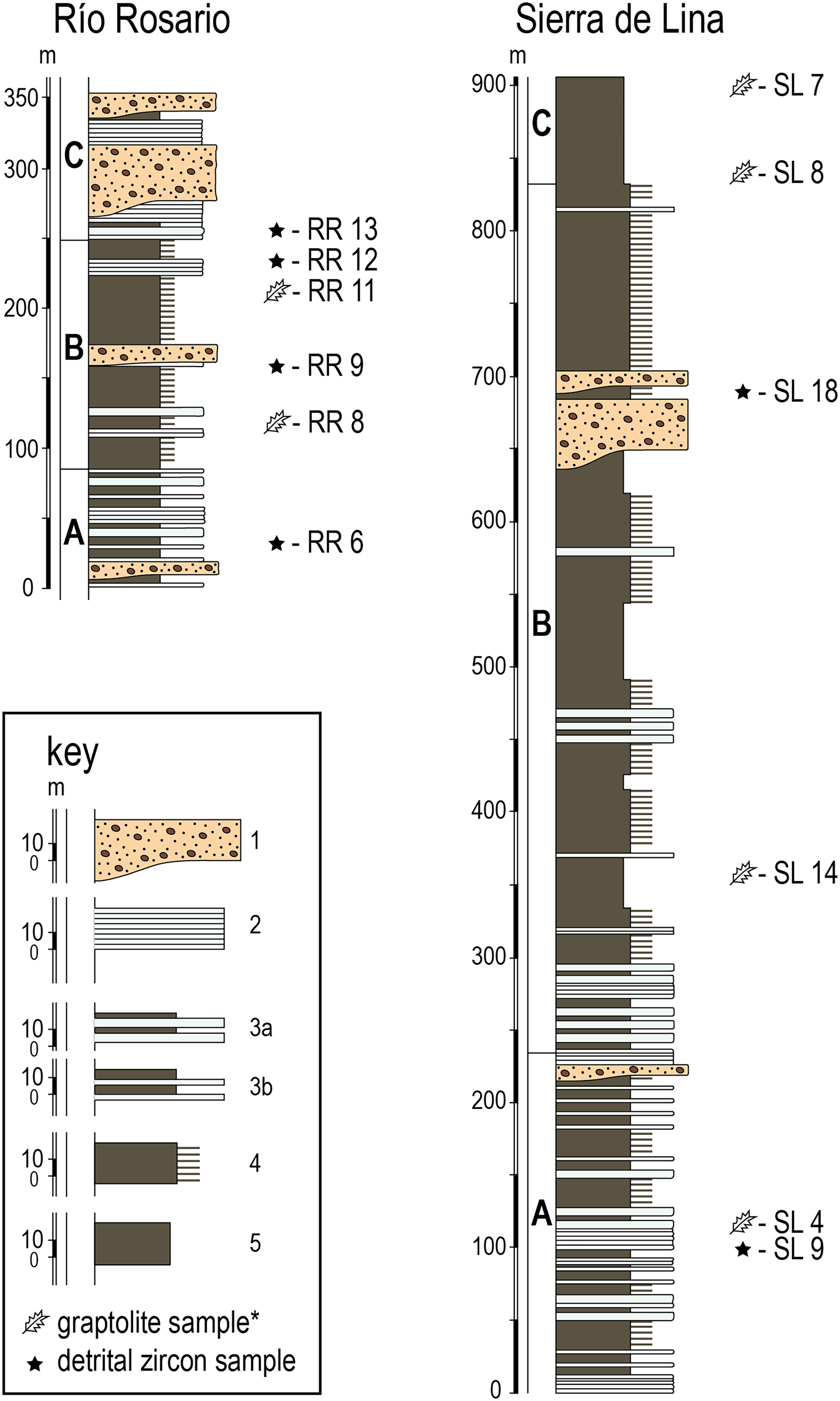
Sedimentary logs with sampling levels of the Río Rosario and Sierra de Lina sections, adapted from Bahlburg (Reference Bahlburg1990). *graptolite samples of Bahlburg et al. (Reference Bahlburg, Breitkreuz, Maletz, Moya and Salfity1990). Key to turbidite facies associations according to Bahlburg (Reference Bahlburg and Macdonald1991): 1, a group of sediments composed of (very) coarse sandy or gravelly sandstones and conglomerates deposited by high-density turbidity currents (Lowe Reference Lowe1982), interpreted to represent channel-fill sediments; 2, successions of relatively even-bedded (very) coarse and medium sand turbidites and pebbly sandstones. Bed thicknesses are in the range of 10–100 cm. Deposits are attributed to the hydraulic jump that occurs when sand-rich turbidity currents emerge from the confines of a channel in the channe!-lobe transition zone (Mutti and Normark, Reference Mutti, Normark, Leggett and Zuffa1987; Dorell et al., Reference Dorell, Peakall, Sumner, Parsons, Darby, Wynn, Özsoy and Tezcan2016); 3, turbidites consisting of successions of 15–60 cm thick Ta-c of the Bouma sequence (facies association 3a), and sequences of up to 70 cm thick, base-absent Tb-(d)e and rare Ta-(d)e or Ta-c(d)e turbidites (facies association 3b), interpreted as sediments of proximal (3a) and more distal (3b) depositional lobes and levees; 4, a group of fine sand and mud turbidites consisting of Tc(d)e sequences assigned to lobe fringe and overbank/levee environments; 5, structureless shales up to 80 m thick interpreted as shales of (hemi)pelagic origin representing background sedimentation.

Outcrop photographies of the turbidite successions studied in the Río Rosario (a, b), Sierra de Lina (c, d), Falda Ciénaga (e, f) and Rio Grande (g, h) sections (Figure 2).

3. Samples and methods
We have obtained new data from six samples from the Río Rosario and Sierra de Lina sections (Figures 2a, 4, 5a-d). They represent pairs of samples from medium sand (samples RR6, RR13, SL9) and fine sand turbidites (samples RR9, RR12, SL18; Figure 4). We determined the grain size visually in the outcrop when taking a sample. We checked this determination using thin sections and the cut samples. The Lu-Hf and O isotope data for samples RR6 and SL18 are from Bahlburg et al. (Reference Bahlburg, Kemp, Fanning and Martin2025).
For the provenance discussion, we added new detrital zircon age data from sample FC14 from the Falda Ciénaga locality (Figures 2b, 5e,f) in the southern Puna, which pertains to the Lower Turbidite System (Figures 2b, 3). We also included the detrital zircon age and Lu-Hf isotope data of the Río Grande sample 87RG3 of Augustsson et al. (Reference Augustsson, Rüsing, Niemeyer, Kooijman, Berndt, Bahlburg and Zimmermann2015, Reference Augustsson, Willner, Rüsing, Niemeyer, Gerdes, Adams and Miller2016; Figures 2a, 5g, h).
Samples were crushed in a jaw crusher, then nut-sized fragments were crushed by hand with a stainless steel mortar and pestle and split into <250 and 250–500 μm grain-size fractions. The larger fraction did not yield any zircon grains; the fraction <250 μm was subjected to magnetic separation using a Frantz LB1. Heavy minerals were separated using sodium polytungstate heavy liquid with a density of 2.9 g cm−3. Zircon concentrates were mounted in bulk to avoid operator-induced selection bias (Košler et al., Reference Košler, Sláma, Belousova, Corfu, Gehrels, Gerdes, Horstwood, Sircombe, Sylvester, Tiepolo, Whitehouse and Woodhead2013; Dröllner et al., Reference Dröllner, Barham, Kirkland and Ware2021).
The new U-Pb detrital zircon U-Pb age data of samples RR6, RR9, RR12, RR13, SL9, SL18 and FC14 were analysed by LA-ICP-MS at the Institute for Mineralogy at the University of Münster using a ThermoFisher Element2 mass spectrometer coupled to a Photon Machines Analyte G2 Excimer laser and a laser spot size of 25 μm. We monitored precision and accuracy over the course of this study, analysing the 91500 reference zircon (1065 Ma, 206Pb/238U age, Wiedenbeck et al., Reference Wiedenbeck, Allé, Corfu, Griffin, Meier, Oberli, Quadt, Roddick and Spiegel1995) as an unknown. Results of repeat analyses yielded a mean average 206Pb/238U age of 1064.0 ± 2.4 Ma (n = 32), which matches the reference value within error (esFigure 1). Further procedural details are reported in a large number of studies, including Kooijman et al. (Reference Kooijman, Berndt and Mezger2012) and Bahlburg et al. (Reference Bahlburg, Berndt and Gerdes2016).
Zircon of all samples consists predominantly of hypidiomorphic, subrounded and rounded grains commonly shorter than 200 μm in length. Euhedral or only slightly rounded elongate or short prismatic grains are common and may be longer than 200 μm (esFigure 2a, b). The cathodoluminescence patterns of the analysed detrital zircon predominantly show oscillatory zoning and are interpreted as of magmatic origin (esFigure 2c); unzoned grains or those with irregular and round zoning are scarce and considered to be of metamorphic origin (Vavra et al., Reference Vavra, Schmid and Gebauer1999). Zircon rims were preferentially analysed to date the last growth stage of each zircon.
Data reduction was performed with an in-house program using Microsoft Excel (Kooijman et al., Reference Kooijman, Berndt and Mezger2012), including common 204Pb-based correction after Stacey & Kramers (Reference Stacey and Kramers1975) where required. We uniformly apply a combined 207Pb/206Pb and 206Pb/238U concordance filter of 90 and 101% to all our data, with between 87 and 163 U-Pb ages per sample fulfilling this criterion (electronic supplement esTab. 1). Dates have an average 2σ error of 1.6%. Sample FC14 yielded only 42 concordant U-Pb ages with an average 2σ error of 2.6%, of a total of 119 analysed grains (esTab. 1). For zircon older than 1.5 Ga, the 207Pb/206Pb ages are used, and for those younger than 1.5 Ga, preference is assigned to the 206Pb/238U ages. Here, we follow Spencer et al. (Reference Spencer, Kirkland and Taylor2016), who evaluated the error dimensions of 38000 published zircon ages and recommended the cross over point from 207Pb/206Pb ages to 206Pb/238U ages be placed at 1.5 Ga.
Kernel density estimates (KDE) were performed using the provenance software package (Vermeesch et al., Reference Vermeesch, Resentini and Garzanti2016). We calculated maximum likelihood ages of deposition (MLA) according to Vermeesch (Reference Vermeesch2021). For the statistical evaluation of zircon age distributions, and particularly the similarity and likeness coefficients, we used DZstats (Sundell & Saylor, Reference Sundell and Saylor2017). Similarity and likeness express the degree of similarity of the proportions of similar ages between samples and quantify the degree of overlap between samples’ age distributions, respectively (Gehrels, Reference Gehrels, Soreghan and Gehrels2000; Satkoski et al., Reference Satkoski, Wilkinson and Hietpas2013; Saylor & Sundell, Reference Saylor and Sundell2016). These coefficients do not offer proof but reasonable indications of a similar or dissimilar provenance. For the geochronological analysis, we applied Isoplot/Ex 3.76 (Ludwig, Reference Ludwig2012). Based on the combination of concordance and equivalence, we calculated the mean square weighted deviation (MSWD) and probability in concordia plots using Isoplot/Ex 3.76 (Ludwig, Reference Ludwig2012, Tab. 1).
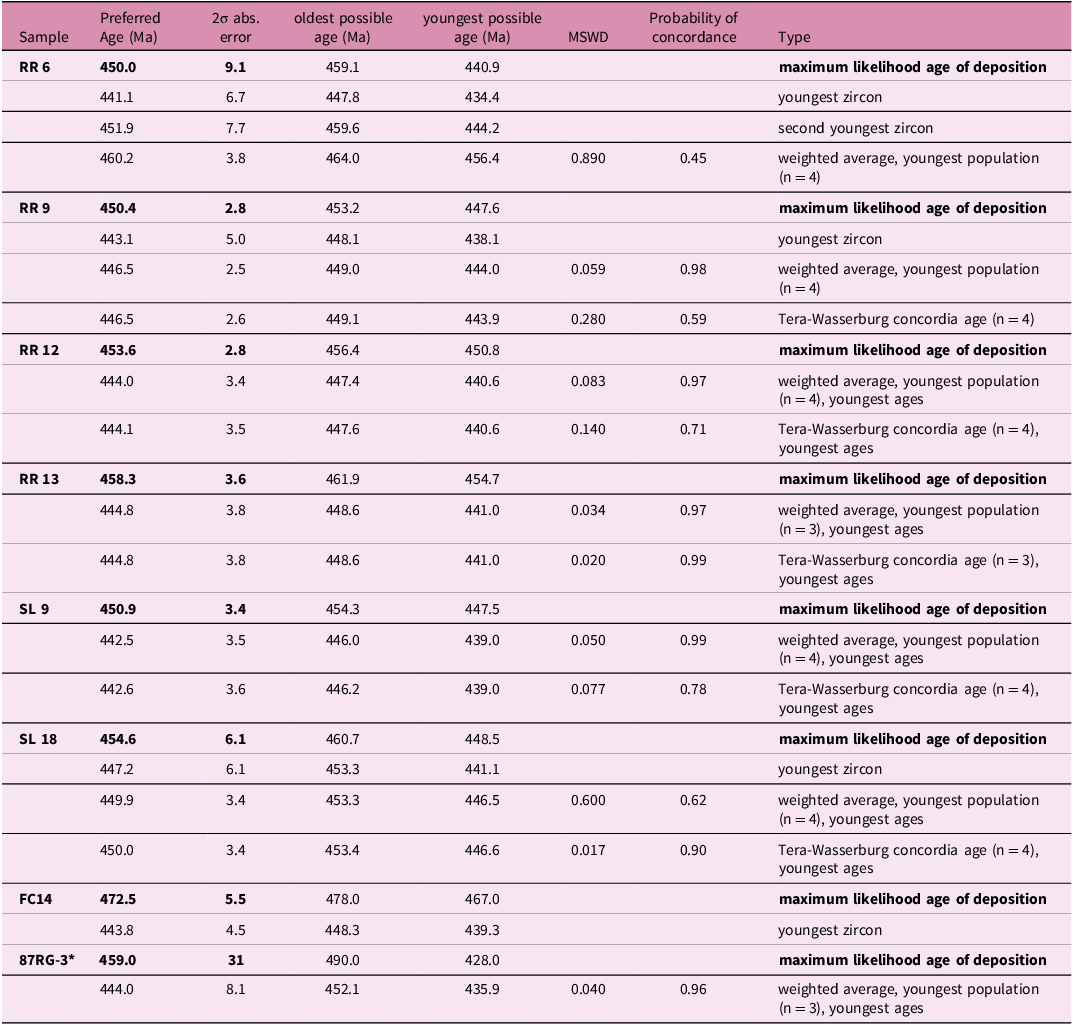
Table of maximum likelihood ages of deposition (MLA, Vermeesch, Reference Vermeesch2021), and weighted average and concordia ages calculated according to Ludwig (Reference Ludwig2012) for the detrital zircon age samples from the Ordovician units in the Puna of northwestern Argentina. *Sample 87RG-3 from Augustsson et al. (Reference Augustsson, Rüsing, Niemeyer, Kooijman, Berndt, Bahlburg and Zimmermann2015)

4. Results
4.a. U-Pb detrital zircon age data
Zircon of fine-sand and medium-sand turbidites from the PTC essentially have similar grain sizes between 100 and 200 μm (esFigure 2a, b). For both cases of medium- and fine-sand turbidites, the zircon populations are not in hydraulic equivalence, as there is no size shift of 0.8 phi units to smaller zircon grain sizes (Malusà et al., Reference Malusà, Resentini and Garzanti2016). This indicates the absence of significant sorting effects of zircon and points to the zircon size distributions, and thus the zircon U-Pb age distributions, being a signal inherited from the source lithologies.
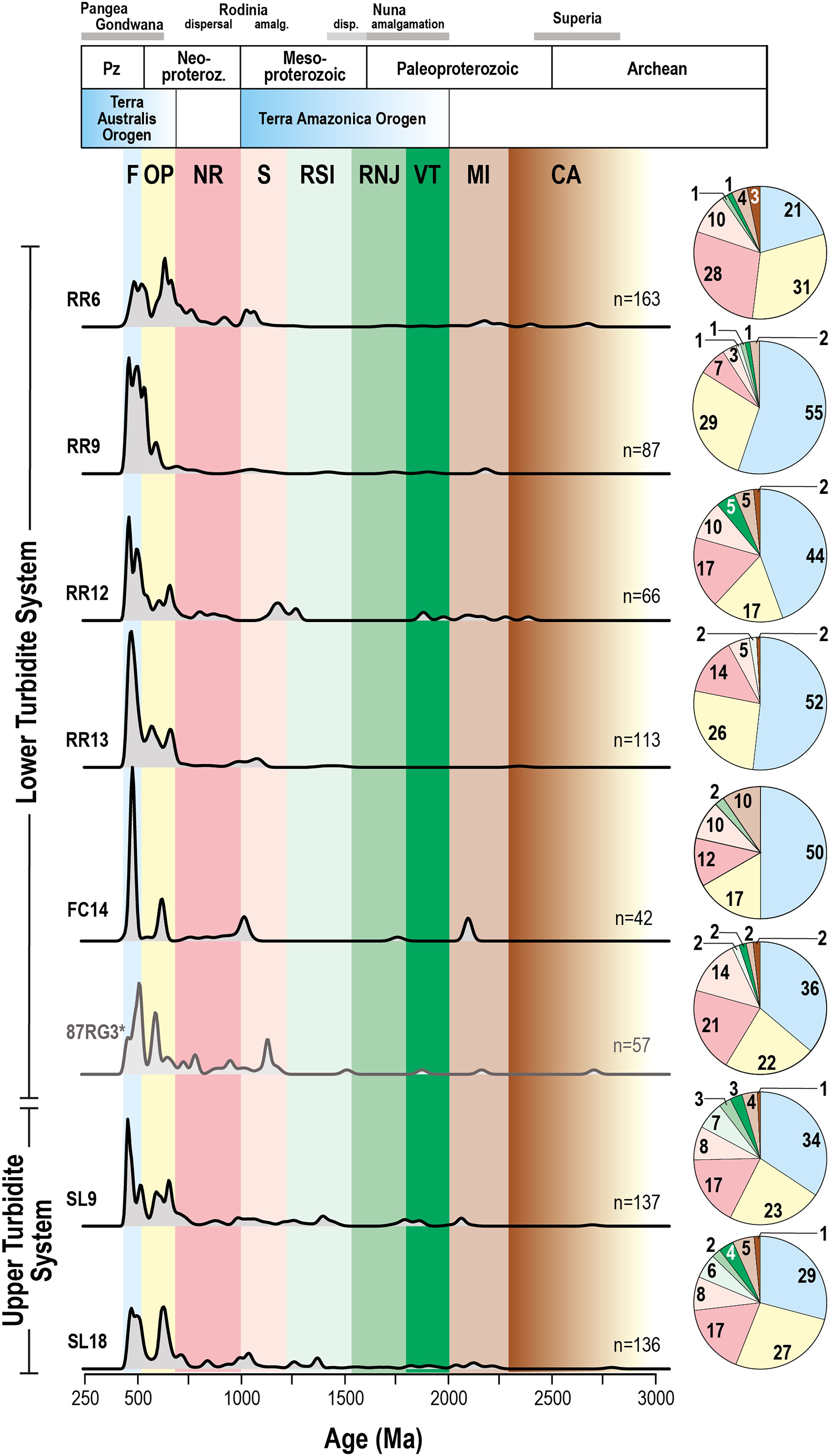
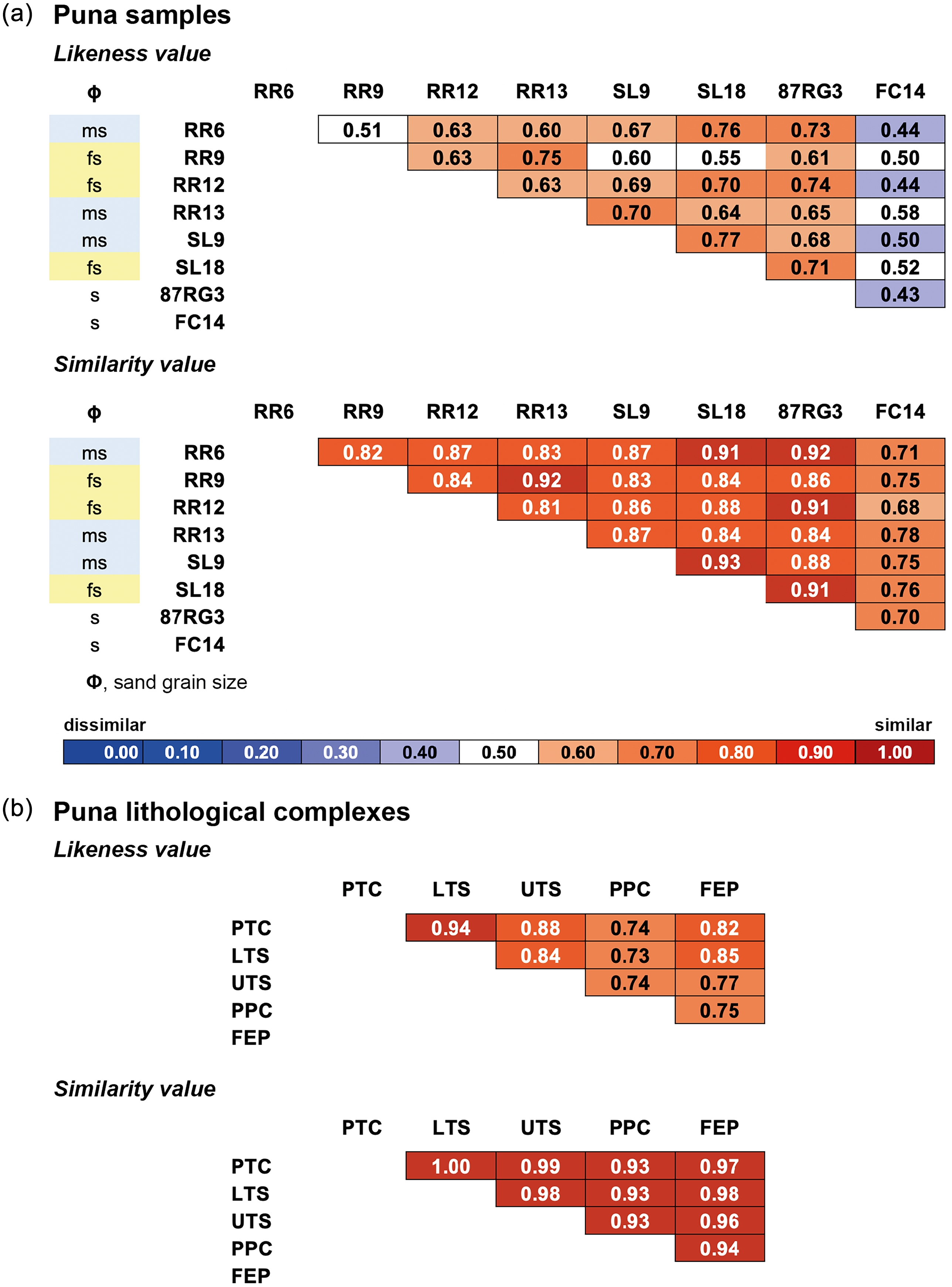
The oldest U-Pb detrital zircon age is 2786 ± 13.1 Ma of all samples of the PTC considered here; the youngest is 441 ± 4.1 Ma (Figure 6; esTab. 1). The age distributions between the samples are relatively similar (Figure 6). Correlation matrices show relatively high values between 0.5 and 0.8 of likeness and very high ones of similarity between 0.8 and 1.0 for all samples except FC14 (Figure 8). Sample FC14 has generally lower values, very likely due to the significantly lower number of ages in the sample (Figure 6; esTab. 1). Excepting sample FC14, the likeness correlation of sample RR9 with samples SL9 and SL18 is the weakest, with values between 0.5 and 0.6 (Figure 7). The similarity correlation is significantly stronger with values between 0.8 and 0.9.
Normalised kernel density estimates obtained from samples of the Puna Turbidite Complex. Pie charts give age distributions in percent of the major contributing source provinces; see Figure 1. Samples: RR, Río Rosario; SL, Sierra de Lina; RG, Río Grande; FC, Falda Ciénaga (Figure 2). Lettering indicates main orogenic cycles of the Terra Amazonica and early Terra Australis orogens, as in Figure 1, and NR, Neoproterozoic rifting; OP, Olmos-Pampean orogenic cycle (Bahlburg et. al., Reference Bahlburg, Kemp, Fanning and Martin2025); F, Famatinian orogenic cycle. Pz, Paleozoic. *sample 87RG3 from Augustsson et al. (Reference Augustsson, Rüsing, Niemeyer, Kooijman, Berndt, Bahlburg and Zimmermann2015).

Dissimilarity matrices of likeness (Satkosky et al., 2013) and similarity (Gehrels, Reference Gehrels, Soreghan and Gehrels2000) values of the studied units. Values calculated with DZstats (Sundell and Saylor, Reference Sundell and Saylor2017). Samples in a): RR, Río Rosario; SL, Sierra de Lina; RG, Río Grande; FC, Falda Ciénaga (Figure 2). Lithological complexes in b): FEP, Faja Eruptiva de la Puna Oriental; LTS, Lower Turbidite System; PPC, Puna Platform Complex; PTC, Puna Turbidite Complex; UTS, Upper Turbidite System (Figure 3).

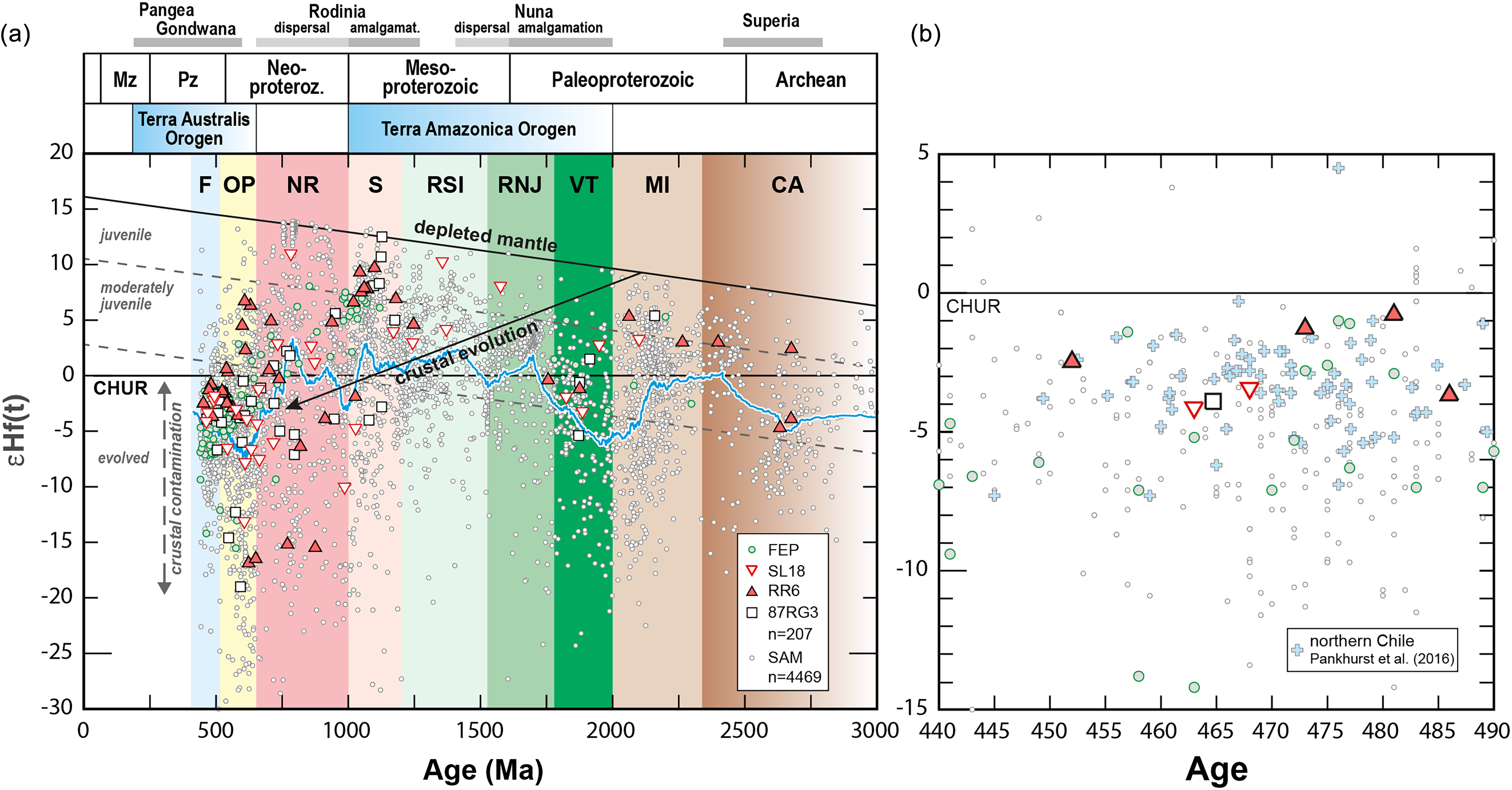
Age vs ϵHf(t) diagrams. a) The assignment of ϵHf(t) values as juvenile, moderately juvenile and evolved follows the approach introduced by Reimann et al. (Reference Reimann, Bahlburg, Kooijman, Gerdes, Carlotto and Lopez2010). Mz, Mesozoic; Pz, Paleozoic. Additional lettering indicates main orogenic cycles of the Terra Amazonica and early Terra Australis orogens, as in Figure 1, and NR, Neoproterozoic rifting; OP, Olmos-Pampean orogenic cycle; F, Famatinian orogenic cycle. Duration of supercontinents from Bahlburg et al. (Reference Bahlburg, Kemp, Fanning and Martin2025). Sample 87RG3 from Augustsson et al. (Reference Augustsson, Rüsing, Niemeyer, Kooijman, Berndt, Bahlburg and Zimmermann2015). Hf isotope database for South America (SAM) and running mean 150 of ϵHf(t) values for South America (blue line) from Bahlburg et al. (Reference Bahlburg, Kemp, Fanning and Martin2025). b) Age vs ϵHf(t) diagram for Ordovician samples of (a). The U-Pb age uncertainty of all samples is given in the source publications included in the database of Bahlburg et al. (Reference Bahlburg, Kemp, Fanning and Martin2025 and references therein). Filtered U-Pb age dates have an average 2σ error of 3.1%. Internal 2σ uncertainties of ϵHf(t) values for the samples of the Puna Turbidite Complex in panel (b) are below 2 epsilon units (Bahlburg et al., Reference Bahlburg, Kemp, Fanning and Martin2025 and references therein).

Multiple geochemical and detrital zircon provenance studies have demonstrated an Amazonian and proto-Andean origin of the detritus constituting the (early) Paleozoic sedimentary rocks of the Andean region (e.g., Bock et al., Reference Bock, Bahlburg, Wörner and Zimmermann2000; Zimmermann & Bahlburg, Reference Zimmermann and Bahlburg2003; Willner et al., Reference Willner, Gerdes and Masonne2008; Bahlburg et al., Reference Bahlburg, Vervoort, Du Frane, Bock and Augustsson2009, Reference Bahlburg, Kemp, Fanning and Martin2025; Augustsson et al., Reference Augustsson, Rüsing, Niemeyer, Kooijman, Berndt, Bahlburg and Zimmermann2015; Einhorn et al., Reference Einhorn, Gehrels, Vernon, Decelles, DeCelles, Ducea, Carrapa and Kapp2015; Pankhurst et al., Reference Pankhurst, Hervé, Fanning, Calderón, Niemeyer, Griem-klee and Soto2016). Within this regional provenance context, the detrital zircon age abundance maxima can thus be assigned to the major orogenic and tectonic cycles reflecting the crustal evolution of Amazonia since the beginning of the Paleoproterozoic (e.g., Cordani & Teixeira, Reference Cordani, Teixeira, Hatcher, Carlson, McBride and Martínez Catalán2007; Cawood, Reference Cawood2005; Bahlburg et al., Reference Bahlburg, Kemp, Fanning and Martin2025), with individual zircon ages extending back to the Paleoarchean (Figure 6).
The most abundant age group reflected in the data (29–55%; Figure 6) represents the Famatinian orogenic cycle (520–410 Ma), of which the studied sedimentary rocks form a syntectonic deposit. The single exception is sample RR6, where this cycle takes up only 21% of the data, with the most abundant fraction belonging to the Olmos-Pampean orogenic cycle (650–520; 49%), which comes second in all other samples (17–27%; Figure 6). This is followed by the data representing the preceding Neoproterozoic rifting phase (1000–650 Ma) connected to the dispersal of Rodina with 7–28% and the data representing the Sunsás orogenic cycle (1200–1000 Ma) with 12–28% (Figure 6). The remaining data are distributed with varying small abundances between the older orogenic cycles of the Terra Amazonica Orogen and older events in Amazonia (Figure 6, Bahlburg et al., Reference Bahlburg, Kemp, Fanning and Martin2025). Considering averages representing the named tectonic cycles, ca. 62% of the data represent the two youngest accretionary orogenic cycles, the Olmos-Pampean and Famatinian (Figure 6).
4.b Detrital zircon Lu-Hf isotope data
Hf isotope data for our detrital zircon samples are included in the Hf isotope database for South America of Bahlburg et al. (Reference Bahlburg, Kemp, Fanning and Martin2025); the data of the crustally strongly contaminated igneous rocks of the Faja Eruptiva de la Puna Oriental (FEP) are from Bahlburg et al. (Reference Bahlburg, Berndt and Gerdes2016). The sandstone data comprise 82 values and range in age from 2678 Ma to 452 Ma; the FEP is represented by 89 values ranging from 2298 Ma to 440 Ma (Figure 8a). The distribution of data in an age vs ϵHf(t) diagram is characterised by relatively well-defined vertical arrays conforming to the ages of all individual orogenic cycles of the Terra Australis and Terra Amazonica and older orogens (Figure 8a). Significant numbers of data are subchondritic in all vertical arrays, indicating prolonged but variable crustal contamination, recycling and reworking (sensu Kemp & Hawkesworth, Reference Kemp and Hawkesworth2014; Bahlburg et al., Reference Bahlburg, Kemp, Fanning and Martin2025).
Most of the data representing the Archean and the Siderian to Rhyacian precursors of the Terra Amazonica Orogen have juvenile and moderately juvenile, mostly suprachondritic ϵHf(t) values. In the course of the Terra Amazonica Orogen, a first-order mean trend to more juvenile data culminating in the Sunsás orogenic cycle is established (Figure 8a; Ribeiro et al., Reference Ribeiro, Cawood, Faleiros, Mulder, Martin, Finch, Raveggi, Teixeira, Cordani and Pavan2020; Bahlburg et al., Reference Bahlburg, Kemp, Fanning and Martin2025). Neoproterozoic rifting and dispersal of Rodinia led into the Ordovician to increasingly subchondritic ϵHf(t) values between −2 and −10, with some data clustering between −12 and −20 (Figure 8a).
The evolved subchondritic ϵHf(t) values between −14 and −1.3 of detrital zircon derived from Famatinian magmatic rocks coincide with the regional South American data for this interval (Figure 8a,b; Pankhurst et al., Reference Pankhurst, Hervé, Fanning, Calderón, Niemeyer, Griem-klee and Soto2016; Rapela et al., Reference Rapela, Pankhurst, Casquet, Dahlquist, Fanning, Baldo, Galindo, Alasino, Ramacciotti, Verdecchia, Murra and Basei2018; Alasino et al., Reference Alasino, Casquet, Galindo, Pankhurst, Rapela, Dahlquist, Recio, Baldo, Larrovere and Ramacciotti2020, Reference Alasino, Larrovere, Ratschbacher, Casquet and Paterson2024; Bahlburg et al., Reference Bahlburg, Kemp, Fanning and Martin2025). The ϵHf(t) values of sample SL18 from the Upper Turbidite System (Figures 3, 6) are on average lower than those of sample RR6 from the Lower Turbidite System (Figure 8a). Sample 87RG3 from Augustsson et al. (Reference Augustsson, Willner, Rüsing, Niemeyer, Gerdes, Adams and Miller2016) straddles the data of both systems.
The inherited zircon grains included in the magmatic rocks of the Faja Eruptiva de la Puna Oriental have ϵHf(t) values between −16 and +8 (Figure 8). Suprachondritic values are mostly moderately juvenile and relate mainly to the Sunsás orogenic cycle. The syndepositional Famatinian age zircons of this suite are all subchondritic, between −14 and −1, and have a distribution similar to the magmatic and orthometamorphic rocks of the Famatinian magmatic arc in northern Chile and the Faja Eruptiva de la Puna Oriental in northwestern Argentina (Figure 8a,b; Bahlburg et al., Reference Bahlburg, Berndt and Gerdes2016).
Most of the Late Neoproterozoic and early Paleozoic zircon has two-stage Hf model ages (HfTDM2) falling into the time bracket of the Rȏndonia-San Ignacio and Sunsás orogenic cycles between c. 1500 and 1000 Ma, i.e., the second half of the Terra Amazonica Orogeny (Figure 8a). These are also the only cycles where juvenile ϵHf(t) values are prominent in our data set and in the South American data in general (Willner et al., Reference Willner, Gerdes and Masonne2008; Bahlburg et al., Reference Bahlburg, Vervoort, Du Frane, Bock and Augustsson2009, Reference Bahlburg, Kemp, Fanning and Martin2025; Augustsson et al., Reference Augustsson, Willner, Rüsing, Niemeyer, Gerdes, Adams and Miller2016; Bahlburg et al., Reference Bahlburg, Kemp, Fanning and Martin2025). They reflect a period of preferred juvenile crust production and preservation.
4.c. Detrital zircon O isotope data
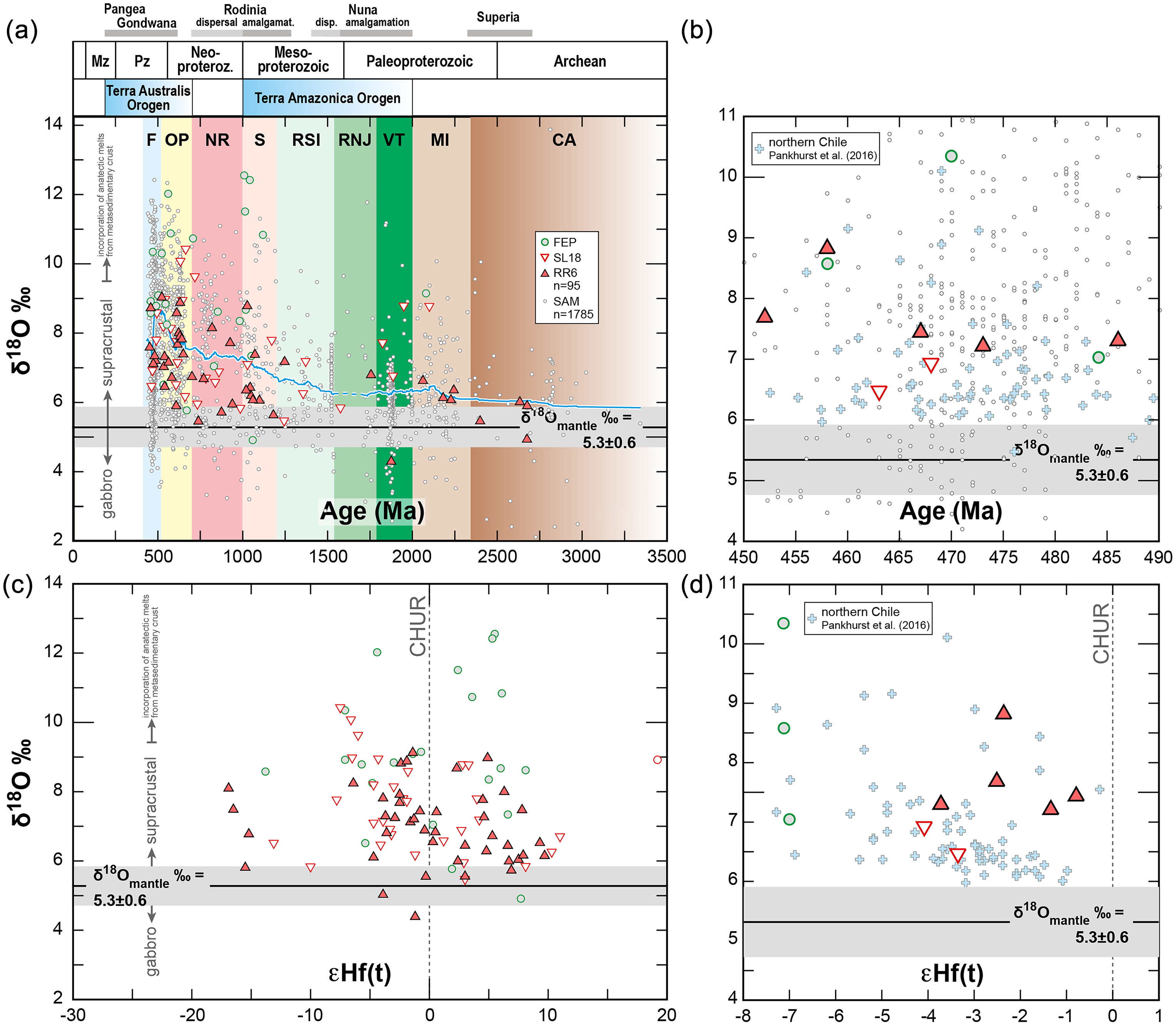
Of 76 zircon grains analysed from the samples of the PTC for their O isotope characteristics, only 8 (11%) have δ18O values equivalent to those in mantle zircon within the range of 5.3 ± 0.6‰ (mantle-like, Valley et al., Reference Valley, Lackey, Cavosie, Clechenko, Spicuzza, Basei, Bindeman, Ferreira, Sial, King, Peck, Sinha and Wei2005). All of these are older than 600 Ma (Figure 9a). The bulk of the values representing the sedimentary rocks are elevated and mainly between 6 and 11‰. The values >5.9‰ indicate that the respective zircons crystallised from magma having incorporated significant volumes of supracrustal rocks (Hawkesworth & Kemp, Reference Hawkesworth and Kemp2006).
a) Age vs δ18O diagram of data from Paleozoic and Triassic siliciclastic sedimentary rocks from the central proto-Andes of northern Chile, northwestern Argentina, and southern Peru recently compiled by Bahlburg et al. (Reference Bahlburg, Kemp, Fanning and Martin2025). δ18O mantle value of 5.3‰ and 2σ error from Valley et al. (Reference Valley, Lackey, Cavosie, Clechenko, Spicuzza, Basei, Bindeman, Ferreira, Sial, King, Peck, Sinha and Wei2005). Main orogenic cycles and supercontinents as in Figures 1 and 7. δ18O and ϵHf(t) values of named samples from Bahlburg et al. (Reference Bahlburg, Kemp, Fanning and Martin2025). O isotope database for South America (SAM) and running mean 150 of δ18O values for South America (blue line) from Bahlburg et al. (Reference Bahlburg, Kemp, Fanning and Martin2025). b) Age vs δ18O diagram for Ordovician data. c) ϵHf(t) vs δ18O diagram for the samples of (a). Sample key in (a). d) ϵHf(t) vs δ18O diagram for Ordovician data. Internal 2σ uncertainties of δ18O values for the samples of the Puna Turbidite Complex in panel (b) are 3.9% on average (Bahlburg et al., Reference Bahlburg, Kemp, Fanning and Martin2025 and references therein).

This is mirrored when the data are shown in ϵHf(t) vs δ18O space, which shows that subchondritic ϵHf(t) values are more abundant than suprachondritic ones and that δ18O values are predominantly elevated (Figure 9c). When focusing on the data comprising the period of deposition of the Puna Volcanic Complex (PVC) and the PTC in the Ordovician, the δ18O zircon data are uniformly elevated (Figures 3, 9b). The same is valid for the coeval intrusive rocks (FEP, Figure 9a,c). When considered in ϵHf(t) vs δ18O space, zircon from the Ordovician sedimentary and intrusive units have subchondritic ϵHf(t) and elevated δ18O values, marking the incorporation of a major volume of evolved supracrustal lithologies into the melts from which the zircons crystallised (Figure 9d). Finally, the data from the medium- and fine-grained turbidite sandstones of the Lower and Upper Turbidite systems (RR6, SL18, Figure 9) have similar δ18O data patterns independent of grain size and stratigraphic age within the Ordovician.
5. Discussion
The grain-size distribution of heavy minerals in siliciclastic rocks, including turbidites, may be a predetermined feature inherited from the source lithologies (Feil et al., Reference Feil, Eynatten, Dunkl, Schönig and Lünsdorf2024). The relatively uniform grain size of the detrital zircon is predominantly between ca. 100 and 150 μm and indicates the absence of significant sorting effects leading to hydraulic equivalence. This suggests that the zircon size distributions, and thus the zircon U-Pb age distributions, represent a signal inherited from the source lithologies.
The different stratigraphic and facies units of the Middle Ordovician Puna basin fill, and thus their corresponding detrital zircon age data, can be grouped into the deeper marine PTC consisting of the Lower and Upper Turbidite System (LTS and UTS, respectively; Bahlburg, Reference Bahlburg1990; Figure 3). East of these units the shallow marine Puna Platform Complex (PPC) is located in what is now the eastern Puna and the Cordillera Oriental (Figures 2, 3). Deposition of the PTC was preceded in the western Puna and in northern Chile by the Early Ordovician PVC (Figures 2, 3). In the transition zone between PTC and PPC, the magmatic rocks of the FEP evolved syndepositionally (Figure 2).
5.a Implications of the U-Pb detrital zircon age data
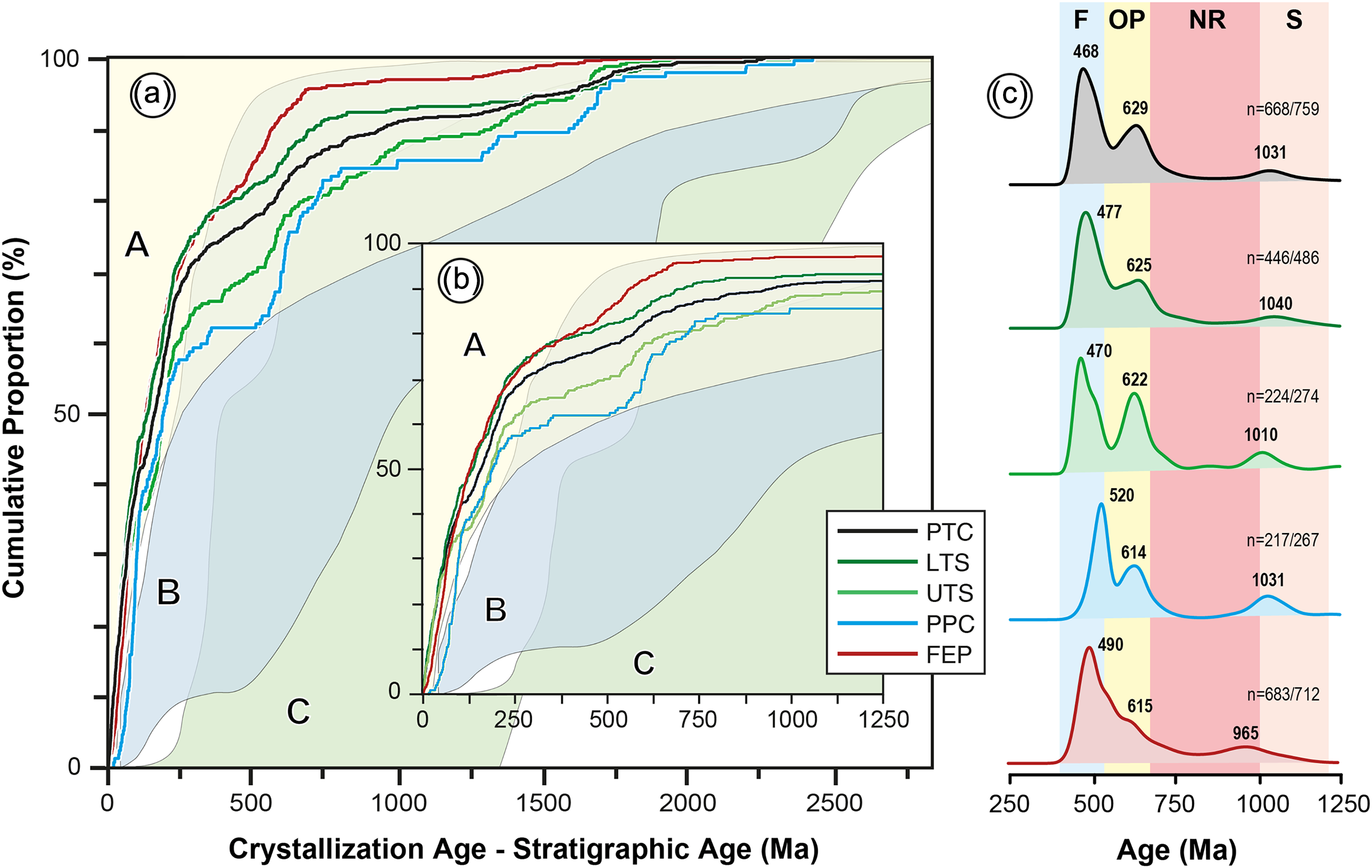
The detrital zircon age distributions of medium sand (samples RR6, RR13, SL9) and fine sand turbidites (samples RR9, RR12, SL18) are notably similar. Values of likeness and similarity between the different grain sizes are relatively high, between 0.5 and 0.8 and between 0.8 and 1.0, respectively (Figure 7). They are also similar to the same degree within their grain-size groups. Lawrence et al. (Reference Lawrence, Cox, Mapes and Coleman2011) showed that detrital zircon age distributions may vary perceivably at small scales between laminae of different grain sizes in a large fluvial ripple bedform in the Amazon River. This is considered due to hydrodynamic fractionation (sorting) during sediment transport over the surface of the bedform. Overall, the detrital zircon age distributions of 5 sampled laminae consistently indicate a similar provenance with values of likeness and similarity between 0.82 and 1.00 and 0.95 and 1.00, respectively (esTab. 2). Similar sorting effects appear to be smaller or insignificant in turbidites as far as zircon grain sizes are concerned because of rapid deposition from a well-mixed turbidity current by a combination of frictional freezing and settling from suspension (Lowe, Reference Lowe1982; DeGraaff-Surpless et al., Reference Degraaff-surpless, Mahoney, Wooden and Mcwilliams2003). Additionally, Leary et al. (Reference Leary, Smith and Umhoefer2020) found that zircon age distributions appear to be independent of a sample’s grain size, very likely because of inheritance (Feil et al., Reference Feil, Eynatten, Dunkl, Schönig and Lünsdorf2024). Larger data variability can be expected from turbidites as they average a wider source region and may potentially also record variations in provenance itself. However, when comparing the single bedform Amazon data to our turbidite data, the range of likeness and similarity values are largely equivalent, between 0.51 and 0.77 and 0.70 and 0.93, respectively (Figure 7; esTab. 2). This encourages us in our inference of a similar provenance for the sampled turbidites. On the level of the lithological complexes (Figures 3, 8), these indications are still better constrained with values of likeness and similarity between 0.73 and 0.94 and 0.93 and 1.0, respectively.
All samples individually (Figure 6) and when grouped according to the main lithological and lithotectonic complexes constituting the record of the Ordovician Puna basin (Figure 10a,b,c) have a relatively high proportion of Ordovician detrital zircon ages reflecting the syndepositional Famatinian magmatism, for example, represented by the PVC and the FEP. The absence of a lag time between the biostratigraphically defined depositional age and the youngest detrital zircon ages satisfies the criteria of the Cawood et al. (Reference Cawood, Hawkesworth and Dhuime2012) classification scheme of tectonic setting, which assigns the presented data to a convergent margin tectonic setting (Figure 10a,b). This is in accordance with established plate-tectonic interpretations of the Ordovician Puna basin based on sedimentological, petrographic, geochemical and Nd isotope geochemical data (e.g., Bahlburg, Reference Bahlburg1990; Coira et al., Reference Coira, Kay, Peréz, Woll, Hanning, Flores, Ramos and Keppie1999; Zimmermann & Bahlburg, Reference Zimmermann and Bahlburg2003; Zimmermann et al., Reference Zimmermann, Niemeyer and Meffre2010; Niemeyer et al., Reference Niemeyer, Götze, Sanhueza and Portilla2018; Ramos, Reference Ramos and Folguera2018).
a) Age vs cumulative probability plot of detrital zircon age spectra from Cordillera Oriental and Puna of northwestern Argentina grouped according to larger stratigraphic and regional units, according to Cawood et al. (Reference Cawood, Hawkesworth and Dhuime2012). FEP, Faja Eruptiva de la Puna Oriental (Bahlburg et al., Reference Bahlburg, Berndt and Gerdes2016); LTS, Lower Turbidite System (this contribution and Augustsson et al., Reference Augustsson, Rüsing, Niemeyer, Kooijman, Berndt, Bahlburg and Zimmermann2015); UTS, Upper Turbidite System (this contribution); Tectonic setting: A, convergent; B, collisional; C, extensional. b) Detail of (a). c) Kernel density estimates and peak ages for considered lithological complexes, ages younger than 1250 Ma. PTC, Puna Turbidite Complex, combining LTS, Lower Turbidite System and UTS, Upper Turbidite System; PPC, Puna Platform Complex (Hauser et al., Reference Hauser, Matteini, Omarini and Pimentel2011; Aparicio González et al., Reference Aparicio gonzález, Hauser, De oliveira cavalho, De morrisson valeriano, Cayo, Barrientos, Impiccini, Reimold, Heilbron and Pimentel2020); FEP, Faja Eruptiva de la Puna Oriental (Figure 1; Bahlburg et al., Reference Bahlburg, Berndt and Gerdes2016).

The absence of a lag time between the depositional age and the youngest detrital zircon ages of the studied samples implies a rapid transfer of detritus from (volcanic) source to sink. The syndepositional nature of zircon-producing magmatism and thus the coincidence of the isotope-geochemical age record (Figure 7) with the biostratigraphic age assignments (Figure 3) can be tested by the determination of maximum likelihood ages of deposition (MLA, Vermeesch, Reference Vermeesch2021; Tab. 1). These calculations show that the datasets coincide within error.
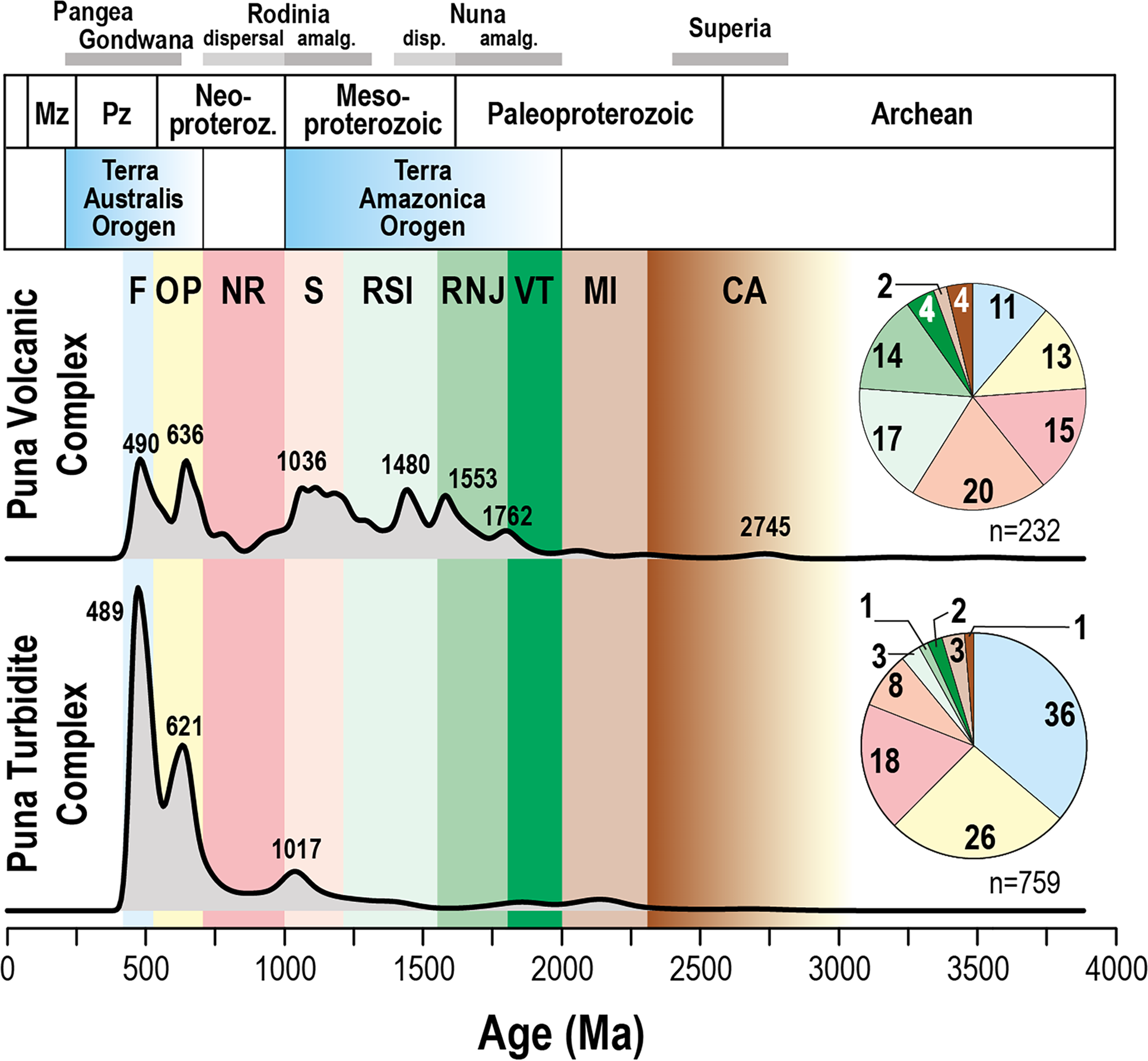
A comparison between the detrital zircon age distributions of the PVC and the PTC suggests an unexpected relative scarcity of Ordovician (Famatinian) volcanic input into the coeval sedimentary rocks of the PVC (Figure 11). In the PVC, Early Ordovician zircon is present in the Aguada de la Perdíz locality (Figure 2; Einhorn et al., Reference Einhorn, Gehrels, Vernon, Decelles, DeCelles, Ducea, Carrapa and Kapp2015) and abundant in the slightly older Early Ordovician Complejo Ígneo-Sedimentario del Cordón de Lila (CISL) farther west in northern Chile (Figure 2; Zimmermann et al., Reference Zimmermann, Niemeyer and Meffre2010; Bahlburg & Breitkreuz, Reference Bahlburg and Breitkreuzin press). However, Ordovician zircon ages are absent at the Huaitquina locality of the PVC (Figure 2; Bahlburg & Breitkreuz, Reference Bahlburg and Breitkreuzin press).
Synopsis of normalized kernel density estimates for the early Ordovician Puna Volcanic and Puna Turbidite Complexes. Data of the Puna Volcanic Complex from Augustsson et al. (Reference Augustsson, Rüsing, Niemeyer, Kooijman, Berndt, Bahlburg and Zimmermann2015) and Bahlburg and Breitkreuz (Reference Bahlburg and Breitkreuzin press). Pie charts give age distributions in percent of major contributing source provinces, see Figure 1.

Famatinian zircon ages are the dominant signal preserved in the deposits of the PTC. The abundance of ages pertaining to the previous Olmos-Pampean orogenic cycle in deposits of both the Puna Volcanic and the Puna Turbidite complexes indicates that the erosion of the basement of the Famatinian magmatic arc had progressed sufficiently to cut into the older basement, likely accounting for the significantly larger abundance of Mesoproterozoic zircon ages in the PVC (Figure 11). Erosion progressing down to this basement may have also created the relief which permitted the bypass of Famatinian detritus at some localities, including Huaitiquina (Figure 2; Bahlburg & Breitkreuz, Reference Bahlburg and Breitkreuzin press).
5.b. Implications of the detrital zircon Lu-Hf and O isotope data
The recognition that syndepositional Famatinian zircon is generally subchondritic is the most relevant information supplied by the ϵHf(t) data for the present study of synorogenic deposition in the Ordovician Puna foreland basin (Figure 8b,c). The ϵHf(t) signatures of coeval zircon from Ordovician intrusive and orthometamorphic rocks of the Famatinian arc in northern Chile and the intrusive Faja Eruptiva de la Puna Oriental in northwestern Argentina show similar characteristics (Figure 8a,c; Hauser et al., Reference Hauser, Matteini, Omarini and Pimentel2011; Bahlburg et al., Reference Bahlburg, Berndt and Gerdes2016).
The subchondritic ϵHf(t) values of the detrital zircon of the PTC are between −1 and −4 (Figure 9b) and exemplify the evolving trend to increasingly negative subchondritic values registered in the early stages of the Terra Australis Orogen during the Olmos-Pampean and Famatinian orogenic cycles (Figure 8; Bahlburg et al., Reference Bahlburg, Kemp, Fanning and Martin2025). Whole rock ϵNd(t) values of the PTC are between −9 and −5 (Bahlburg, Reference Bahlburg, Pankhurst and Rapela1998; Bock et al., Reference Bock, Bahlburg, Wörner and Zimmermann2000). ϵNd(t) data for the Falda Ciénaga Formation in the southern Puna are equally subchondritic between −4.8 and −6.3 (Figures 1, 3; Lower Tubidite System; Zimmermann et al., Reference Zimmermann, Luna Tula, Marchioli, Narváez, Olima and Ramírez2002; Zimmermann & Bahlburg, Reference Zimmermann and Bahlburg2003). The underlying and in its upper parts coeval PVC (Figure 3) sees a larger spread of ϵNd(t) values between −8 and −1.1 (Bock et al., Reference Bock, Bahlburg, Wörner and Zimmermann2000; Zimmermann & Bahlburg, Reference Zimmermann and Bahlburg2003). The widespread and voluminous sedimentary fill of the Puna basin with subchondritic whole-rock ϵNd(t) and zircon ϵHf(t) values overwhelms potential local supply from likely Neoproterozoic to Cambrian mafic and ultramafic rocks with positive ϵNd(t) between +0.1 and +7.4 (Lucassen et al., Reference Lucassen, Becchio, Wilke, Franz, Thirlwall, Viramonte and Wemmer2000, Reference Lucassen, Becchio and Franz2003; Zimmermann et al., Reference Zimmermann, Bahlburg, Mezger and Kay2014) and of early Ordovician mantle-derived monzodioritic to monzogranitic arc intrusives with ϵNd(t) values between 0 and +2.7 and 87Sr/86Sr(t) values of 0.704 (Kleine et al., Reference Kleine, Mezger, Zimmermann, Münker and Bahlburg2004). In the Ordovician basin fill, ϵNd(t) and geochemical signatures show a decrease of volcanic and an increase of basement input with increasing distance from the arc (Zimmermann et al., Reference Zimmermann, Niemeyer and Meffre2010; Bock et al., Reference Bock, Bahlburg, Wörner and Zimmermann2000).
The mean ϵHf(t) trend for the Terra Australis Orogen shows a decrease of the subchondritic values in zircon from −7 in the Olmos-Pampean orogenic cycle to c. −5 in the Famatinian cycle (Figure 8a; Bahlburg et al., Reference Bahlburg, Kemp, Fanning and Martin2025). The samples of the present study follow this trend (Figure 8a). The dominance of subchondritic ϵHf(t) values of detrital zircon with an Ordovician age conforms to respective data from coeval magmatic and orthometamorphic rocks, indicating that Famatinian magmatism supplied zircon recording large-scale crustal recycling and reworking of originally juvenile melts (Pankhurst et al., Reference Pankhurst, Hervé, Fanning, Calderón, Niemeyer, Griem-klee and Soto2016; Rapela et al., Reference Rapela, Toselli, Heaman, Saavedra, Mahlburg Kay and Rapela1990, Reference Rapela, Pankhurst, Casquet, Dahlquist, Fanning, Baldo, Galindo, Alasino, Ramacciotti, Verdecchia, Murra and Basei2018; Alasino et al., Reference Alasino, Casquet, Galindo, Pankhurst, Rapela, Dahlquist, Recio, Baldo, Larrovere and Ramacciotti2020; Bahlburg et al., Reference Bahlburg, Kemp, Fanning and Martin2025), and that coeval synorogenic sedimentary reworking also of older crustal domains produced polycyclic sedimentary basin fills similarly characterised by relatively low subchondritic ϵNd(t) values (Bock et al., Reference Bock, Bahlburg, Wörner and Zimmermann2000; Zimmermann & Bahlburg, Reference Zimmermann and Bahlburg2003).
Our data are in agreement with all available data indicating that the originally juvenile melts of the Olmos-Pampean and Famatinian orogenic cycles in the central Andes experienced the large-scale incorporation of recycled and reworked older crust, albeit at a decreasing rate from the Late Neoproterozoic into the Ordovician (Figure 8; Rapela et al., Reference Rapela, Toselli, Heaman, Saavedra, Mahlburg Kay and Rapela1990, Reference Rapela, Pankhurst, Casquet, Baldo, Saavedra, Galindo, Fanning, Pankhurst and Rapela1998, Reference Rapela, Pankhurst, Casquet, Dahlquist, Fanning, Baldo, Galindo, Alasino, Ramacciotti, Verdecchia, Murra and Basei2018; Willner et al., Reference Willner, Gerdes and Masonne2008; Bahlburg et al., Reference Bahlburg, Vervoort, Du Frane, Bock and Augustsson2009, Reference Bahlburg, Kemp, Fanning and Martin2025; Augustsson et al., Reference Augustsson, Willner, Rüsing, Niemeyer, Gerdes, Adams and Miller2016; Pankhurst et al., Reference Pankhurst, Hervé, Fanning, Calderón, Niemeyer, Griem-klee and Soto2016; Alasino et al., Reference Alasino, Casquet, Galindo, Pankhurst, Rapela, Dahlquist, Recio, Baldo, Larrovere and Ramacciotti2020, Reference Alasino, Larrovere, Ratschbacher, Casquet and Paterson2024). The respective detrital zircon Hf(TDM2) and whole rock Nd(TDM2) model ages project back to the time of the Mesoproterozoic Rȏndonia-San Ignacio and Sunsás orogenic cycles of the Terra Amazonica Orogen between 1550 and 1000 Ma (Bock et al., Reference Bock, Bahlburg, Wörner and Zimmermann2000; Zimmermann and Bahlburg, Reference Zimmermann and Bahlburg2003; Willner et al., Reference Willner, Gerdes and Masonne2008; Augustsson et al., Reference Augustsson, Willner, Rüsing, Niemeyer, Gerdes, Adams and Miller2016; Bahlburg et al., Reference Bahlburg, Vervoort, Du Frane, Bock and Augustsson2009, Reference Bahlburg, Berndt and Gerdes2016, Reference Bahlburg, Kemp, Fanning and Martin2025). The zircon ϵHf(t) record representing the second half of the Terra Amazonica orogeny between 1550 and 1000 Ma is itself characterised by a prominent concentration of suprachondritic and, in fact, juvenile detrital zircon ϵHf(t) data (Figures 1, 8; Willner et al., Reference Willner, Gerdes and Masonne2008; Bahlburg et al., Reference Bahlburg, Vervoort, Du Frane, Bock and Augustsson2009, Reference Bahlburg, Kemp, Fanning and Martin2025; Augustsson et al., Reference Augustsson, Willner, Rüsing, Niemeyer, Gerdes, Adams and Miller2016), indicating major pulses of juvenile magmatism at this time (Bettencourt et al., Reference Bettencourt, Barbosa Leite, Salina Ruiz, Matos, Payolla and Tosdal2010; Bahlburg et al., Reference Bahlburg, Kemp, Fanning and Martin2025).
δ18O signatures of Ordovician zircon are elevated with values between 6.5 and 8.8‰ (Figure 9c). They form part of a general pattern of almost exclusively elevated δ18O values found in zircon throughout intrusive and orthometamorphic rocks in northern Chile and northern Argentina (Pankhurst et al., Reference Pankhurst, Hervé, Fanning, Calderón, Niemeyer, Griem-klee and Soto2016; Bahlburg et al., Reference Bahlburg, Kemp, Fanning and Martin2025; Figure 9b). This reflects the dominance of crustal recycling and reworking of supracrustal rocks and older basement with subchondritic zircon during the Ordovician Famatinian orogenic cycle (Figure 9d). This pattern is common in the central Andean part of the Terra Australis Orogen at this time (Bahlburg et al., Reference Bahlburg, Kemp, Fanning and Martin2025). Considering the wider Terra Australis orogen, the zircon δ18O isotope values of Famatinian rocks display a wide spread between 12 and 4‰, with elevated values being most abundant and running mean values being between 9 and 7‰ (Figure 9a). In the course of the Famatinian orogeny, however, mean δ18O values register a marked drop by two units from c. 9 to 7‰. This indicates that the contribution from mantle-like components was steadily increasing in the course of the Famatinian orogenic cycle.
6. Conclusions
New detrital zircon age distributions obtained from seven medium- and fine-sand turbidite layers of the Ordovician Puna Turbidite Complex in the northern Puna retroarc foreland basin of northwestern Argentina are similar to previously reported distributions and reflect a provenance from source rocks involved in the construction of the Terra Amazonica and the early Terra Australis orogens between 2000 Ma and 440 Ma. Contributions from even older orogenic cycles are scarce (e.g., Willner et al., Reference Willner, Gerdes and Masonne2008; Bahlburg et al., Reference Bahlburg, Vervoort, Du Frane, Bock and Augustsson2009, Reference Bahlburg, Kemp, Fanning and Martin2025; Augustsson et al., Reference Augustsson, Rüsing, Niemeyer, Kooijman, Berndt, Bahlburg and Zimmermann2015; Einhorn et al., Reference Einhorn, Gehrels, Vernon, Decelles, DeCelles, Ducea, Carrapa and Kapp2015; Pankhurst et al., Reference Pankhurst, Hervé, Fanning, Calderón, Niemeyer, Griem-klee and Soto2016). The most abundant and prominent detrital zircon age group consists of Ordovician ages representing the coeval Famatinian orogenic cycle (520 − 410 Ma), followed by those of the preceding Olmos-Pampean orogenic cycle (650 − 520 Ma; Figure 6). The Famatinian detritus was mostly derived from the westward-lying Famatinian magmatic arc (Figures 1, 2).
The detrital zircon age distributions of fine and medium sand turbidite layers are statistically almost quantitatively identical and do not display significant effects of sorting between them (Figure 7). Maximum likelihood ages of deposition of the different stratigraphic units coincide, within error, with biostratigraphic ages of deposition in the Early and Middle Ordovician (Tab. 1).
The predominance of subchondritic ϵHf(t) values of Ordovician zircon emphasises crustal recycling and reworking as the most significant processes during the Famatinian Orogenic cycle. The abundance of Mesoproterozoic Hf(TDM2) indicates that preserved juvenile crustal material mostly formed as juvenile crust in Mesoproterozoic time, mainly during the Rȏndonia-San Ignacio and the Súnsas orogenic cycles (Figure 8).
Detrital zircon δ18O values obtained from Ordovician zircon are elevated and range between 6.5 and 8.8‰ (Figure 9). Together with similar data from the literature on intrusive and orthometamorphic rocks of the Famatinian magmatic arc in northern Chile (Pankhurst et al., Reference Pankhurst, Hervé, Fanning, Calderón, Niemeyer, Griem-klee and Soto2016), these data give further evidence of the dominance of crustal recycling and reworking of supracrustal rocks in the evolution of the Famatinian orogenic cycle in the southern central Andes.
Supplementary material
The supplementary material for this article can be found at https://doi.org/10.1017/S001675682510037X.
Acknowledgement
The analysis of detrital zircon U-Pb ages was aided by J. Berndt and B. Schmitte at the Institut für Mineralogie, Universität Münster, and was made possible by grants BA 1011/45-1 and BA 1011/47-1 of the German Research Foundation (DFG) to HB. We appreciate comments, suggestions and ideas offered by two anonymous reviewers and editor Jan Schönig, which improved the manuscript.
Competing interests
The author(s) declare none.


 Open access

