


1 INTRODUCTION
Cygnus OB2 (Cyg OB2), a stellar association discovered by Münch and Morgan in Reference Münch and Morgan1953 (Münch & Morgan Reference Münch and Morgan1953), is now one of the leaders in number of massive stars among Galactic OB-associations. According to the estimates of Knödlseder (Reference Knödlseder2000), it includes 2600 ± 400 stars and about 100 of them are O-stars located in the 1 deg2 region (Comerón et al., Reference Comerón2002; Wright et al. Reference Wright, Drake, Drew and Vink2010; Wright, Drew, & Mohr-Smith Reference Wright, Drew and Mohr-Smith2015). Due to it, the central part of association is the region with the highest concentration of hot stars in the Galaxy. The interest of researchers to individual stars and to the association as a whole is not fading. A lot of papers dedicated to the investigation of Cyg OB2 stellar population [like Drew et al. (Reference Drew, Greimel, Irwin and Sale2008); Comerón & Pasquali (Reference Comerón and Pasquali2012)], estimation of interstellar extinction [like Guarcello et al. (Reference Guarcello, Wright, Drake, García-Alvarez, Drew, Aldcroft and Kashyap2012)], history of star formation [like Wright et al. (Reference Wright, Parker, Goodwin and Drake2014, Reference Wright, Drew and Mohr-Smith2015)] have already been published and continue to appear.
Modelling of atmospheres of the stars belonging to an association is an important area of investigation, since it both gives the parameters of individual stars and allows to construct an association Hertzsprung–Russell (H–R) diagram as a whole. The H–R diagram in turn provides the information about stellar ages, masses, and history of star formation. Main works devoted to the numerical modelling of stellar atmospheres in Cyg OB2 association are Herrero et al. (Reference Herrero, Corral, Villamariz and Martín1999); Herrero, Puls, & Najarro (Reference Herrero, Puls and Najarro2002); Negueruela et al. (Reference Negueruela, Marco, Herrero and Clark2008). Moreover, individual supergiants were studied by Najarro, Hanson, & Puls (Reference Najarro, Hanson and Puls2011); Maryeva, Klochkova, & Chentsov (Reference Maryeva, Klochkova and Chentsov2013); Maryeva, Zhuchkov, & Malogolovets (Reference Maryeva, Zhuchkov and Malogolovets2014).
In the present work, we model the stellar atmospheres of five stars initially assumed to have V luminosity class (dwarfs). Star #6 or MT317Footnote 1 may be called the native resident of association Cyg OB2. It belongs to the first dozen of blue stars noticed by Münch & Morgan (Reference Münch and Morgan1953). Based on spatial closeness of these objects, Münch and Morgan have suggested the existence of OB-association in about 2° around γ Cygni. Johnson & Morgan (Reference Johnson and Morgan1954) classified MT317 as O8 (V). The contemporary researchers (Kiminki et al. Reference Kiminki2007; Chentsov et al. Reference Chentsov, Klochkova, Panchuk, Yushkin and Nasonov2013) also consider that MT317 is O8 V. Morgan, Meinel, & Johnson (Reference Morgan, Meinel and Johnson1954) suggested that star #16 (MT299) is probably the faint member of the association Cyg OB2. Then, Schulte (Reference Schulte1956) included the star #21 (MT259) into the association. Chentsov et al. (Reference Chentsov, Klochkova, Panchuk, Yushkin and Nasonov2013) classified MT299 as O7.5 V, while MT259 as B0 V. Massey & Thompson (Reference Massey and Thompson1991) also included MT282 and MT343 stars into the association. The latter was subsequently classified by Kiminki et al. (Reference Kiminki2007) as B1 V, while the first spectrum of MT282 was obtained only recently on the Russian 6-m telescope, and MT282 was classified as B1 IV–V (Maryeva et al. Reference Maryeva, Chentsov, Goranskij and Karpov2016). Among these five stars only the MT259 had previously been studied by Herrero et al. (Reference Herrero, Corral, Villamariz and Martín1999) using stellar atmosphere models.
The paper is organised as follows. Observational data and main steps of data reduction are described in the next section. Data analysis and determination of different stellar parameters are in Section 3. The Section 4 presents the results of modelling, while in Section 5, we will discuss the locations of the stars on the H–R diagram and the estimated masses, ages, and mass loss rates. In the Section 6, short conclusions are given. The testing of the method of automatic determination of effective temperature and surface gravity is presented in appendices.
2 OBSERVATIONAL DATA
The high resolution spectra of 13 stars in Cyg OB2 had been thoroughly described by Chentsov et al. (Reference Chentsov, Klochkova, Panchuk, Yushkin and Nasonov2013), who also studied spectral variability of the MT304 (Schulte #12) hypergiant. In our work, we analysed all three stars MT317, MT299, and MT259 classified by Chentsov et al. (Reference Chentsov, Klochkova, Panchuk, Yushkin and Nasonov2013) as dwarfs and we used the same spectral data. These data were obtained with the high-resolution Nasmyth Echelle Spectrograph (NES) (Panchuk et al. Reference Panchuk, Klochkova, Yushkin and Naidenov2009) on the Russian 6-m telescope. The observations were conducted using the image slicer (Panchuk et al. Reference Panchuk, Klochkova, Yushkin and Naidenov2009) and a 2048 × 2048 CCD. The extraction of one-dimensional vectors from the two-dimensional echelle spectra was performed with the aid of the echelle context of the midas software package, modified by Yushkin & Klochkova (Reference Yushkin and Klochkova2005). The removal of the traces of cosmic ray particles was done by means of median filtration of image sequences using standard midas routines. Wavelength calibration was carried out using the spectra of a Th-Ar hollow cathode lamp. Continuum normalisation of spectra was performed manually using dech software package (Galazutdinov Reference Galazutdinov1996).
Spectra of MT282 and MT343 were also obtained on the Russian 6-m telescope, but with Spectral Camera with Optical Reducer for Photometric and Interferometric Observations (SCORPIO) in the long-slit mode (Afanasiev & Moiseev Reference Afanasiev and Moiseev2005). VPHG1200G grism was used providing the spectral range of 4 050–5 850 ÅÅ. All SCORPIO spectra were reduced using the ScoRe packageFootnote 2 . ScoRe was written by Maryeva and Abolmasov in idl language for SCORPIO long-slit data reduction. Package includes all the standard stages of long-slit data reduction process. The final spectra of MT282 and MT343 have spectral resolution ~ 6 Å (weakly dependent on wavelength) and signal-to-noise ratio (S/N) per resolution element in continuum near 4 900 Å ~ 50 and ~ 70, correspondingly. The data used in this work is summarised in Table 1.
Observational log for the spectral data obtained on the Russian 6-m telescope used in the work. The Column 1 quotes the names of the objects from the catalogue of Schulte (Reference Schulte1956), while the Column 2—the ones from Massey & Thompson (Reference Massey and Thompson1991). The penultimate column lists the signal-to-noise ratio (S/N) in the vicinity of HeI λ5876 line (for NES data) or near 4 900 Å (for SCORPIO).

a Spestral types are taken from literature (see the text).
b Photometric data mV and AV are taken from 1—Kiminki et al. (Reference Kiminki2007), 2—Maryeva et al. (Reference Maryeva, Chentsov, Goranskij and Karpov2016).
3 METHODS OF DATA ANALYSIS
For estimation of physical parameters of the sample stars, we used two atmospheric modelling codes—tlusty (Hubeny & Lanz Reference Hubeny and Lanz1995; Lanz & Hubeny Reference Lanz and Hubeny2003) and cmfgen (Hillier & Miller Reference Hillier and Miller1998).
Effective temperature T eff, surface gravity log g, and projected rotation velocities vsini were estimated using stellar atmosphere models computed with tlusty. tlusty is the code for computing plane-parallel, horizontally homogeneous model stellar atmospheres in radiative and hydrostatic equilibrium, developed by Hubeny & Lanz (Reference Hubeny and Lanz1995); Lanz & Hubeny (Reference Lanz and Hubeny2003). Departures from local thermodynamic equilibrium (LTE) are allowed for a set of occupation numbers of selected atomic and ionic energy levels. Latest version of the program accounts for a fully consistent, non-LTE metal line blanketing, as well as convection (http://nova.astro.umd.edu/index.html). For the analysis, we used the grids of tlusty stellar atmosphere models and synthetic spectra computed by us and two pre-computed grids. These pre-computed grids are ostar2002 grid with solar metallicity and microturbulent velocity v turb = 10kms−1 (Lanz & Hubeny Reference Lanz and Hubeny2003) and bstar2006 grid with solar metallicity and v turb = 2kms−1 (Lanz & Hubeny Reference Lanz and Hubeny2007).
For determination of wind parameters, bolometric luminosity and chemical composition we used cmfgen code (Hillier & Miller Reference Hillier and Miller1998). This code is modelling spherically symmetric extended outflows using the full comoving-frame solution of the radiative transfer equation. cmfgen incorporates line blanketing, the effects of Auger ionisation and clumping. The level populations are calculated through the rate equations. A super-level approach is used to reduce the scale of the problem (and thus the computing time).
3.1. Determination of projected rotational velocities
For estimation of rotational velocities vsini, we used synthetic spectra from the tlusty grids mentioned above. From these grids, we chose the spectrum computed for the effective temperature T eff and surface gravity log g corresponding to the spectral type and luminosity class of the considered star. Values of T eff and log g for a given spectral type were obtained from calibration of Martins, Schaerer, & Hillier (Reference Martins, Schaerer and Hillier2005a) for O-stars and from Humphreys & McElroy (Reference Humphreys and McElroy1984) for B-stars. The chosen spectrum was convolved with the instrumental profile and rotational profile computed with different values of vsini. The convolution of spectra was performed using the rotin3 program (distributed together with tlusty).
The projected rotational velocity and its uncertainty were then estimated by visual comparison of shapes of the observed spectral line profiles of metals and helium with the ones in the convolved synthetic spectra. These estimates are independent on the microturbulent velocity v turb that only affects the equivalent width of line and not line profile shape.
3.2. Determination of effective temperature and surface gravity
To estimate T eff and log g, we used the automatic method. The method is based on the comparison of the observed and synthetic spectra. Synthetic spectra for different values of T eff, log g, v turb, and helium abundance He/H had been computed for the models from the tlusty grids using synspec48 code (Hubeny & Lanz Reference Hubeny and Lanz1992) and then convolved with rotational profile for the given value of vsini and with the instrumental profile. To characterise how well the observed spectral lines or regions are approximated by model spectra, the χ2 quantity was evaluated as
 $$\begin{equation}
\chi ^2=\frac{1}{N_\mathrm{lines}}\,\sum _{i=1}^{N_\mathrm{lines}} \frac{1}{N_{\nu }^i}\,\sum ^{N_{\nu }^i}_{j=1}\left(\frac{F_j^i-F^i_{j\,\mathrm{obs}}}{\sigma ^i}\right) ^{2},
\end{equation}$$
$$\begin{equation}
\chi ^2=\frac{1}{N_\mathrm{lines}}\,\sum _{i=1}^{N_\mathrm{lines}} \frac{1}{N_{\nu }^i}\,\sum ^{N_{\nu }^i}_{j=1}\left(\frac{F_j^i-F^i_{j\,\mathrm{obs}}}{\sigma ^i}\right) ^{2},
\end{equation}$$
where Ni ν is the number of wavelength points in the spectral line i, N lines is the number of spectral lines used in the analysis, Fi jobs is the observed normalised flux in the j-th point of the spectral line i, Fi j is the synthetic normalised flux, and σ i = (S/N)−1 accounts for the S/N for the spectral line i. The S/N had been calculated as the mean flux divided by the standard deviation of the flux in the manually selected continuum region close to a given line.
Initial estimates of T eff, log g, He/H, and v turb were obtained as parameters of the model with the minimal χ2 value. The synthetic spectrum computed with these initial parameters was used to manually refine the continuum (as the initial continuum estimation is being done manually and is prone to errors due to its ill-defined nature) and to check the previously estimated vsini value. To refine the continuum, we also used the T eff-log g diagnostic diagram [see e.g. Herrero et al. (Reference Herrero, Kudritzki, Vilchez, Kunze, Butler and Haser1992)] plotted automatically on the basis of χ2 values of the models with fixed He/H and v turb equal to their initial estimates.
The ostar2002 and bstar2006 grids has a relatively rough step on T eff and log g (2 500 K on T eff and 0.25 dex on log g) that could lead to relatively large uncertainty of estimated T eff and log g values. To refine T eff and log g estimates obtained at the previous step, we computed the grid of stellar atmosphere models with varied values of T eff and log g and with fixed He/H and v turb values. These fixed values were close to those obtained on the previous step. The new grid had steps of 1 000 K and 0.1 dex on T eff and log g, respectively. Computations of the new grid were performed with the tlusty200 code that was slightly modified to allow using of Kurucz (Reference Kurucz1994) line data for nickel (Ni). Atomic models were the same as for stellar atmosphere models from the ostar2002 grid. To save computer time, all stellar atmosphere models for the new grid were computed with the smaller number of lines of iron-peak elements, with smaller wavelength range and smaller maximum number of global iterations compared with those used by Lanz & Hubeny (Reference Lanz and Hubeny2003).
The new atmosphere models grid was used to compute a number of synthetic spectra for different values of T eff, log g, He/H, and v turb. These synthetic spectra were compared with observed ones using the χ2 quantity. To obtain resulting estimates of the varied stellar parameters, we have selected all models with χ2 smaller than the threshold value χ2 t:
 $$\begin{equation}
\chi ^2_{\mathrm{t}}=\chi ^2_{\mathrm{min}} + 0.3\chi ^2_{\mathrm{min}},
\end{equation}$$
$$\begin{equation}
\chi ^2_{\mathrm{t}}=\chi ^2_{\mathrm{min}} + 0.3\chi ^2_{\mathrm{min}},
\end{equation}$$
where χ2 min is the minimal χ2 value. A very similar criterion for the selection of models, with a bit different threshold value, was used by Castro et al. (Reference Castro2012) for the analysis of their low resolution spectra. Our choice of χ2 t threshold is discussed in the Appendix A. Resulting values of T eff, log g, He/H, and v turb were obtained by averaging parameters of selected models weighted by exp(− 0.5χ2). Application of such weights implies normal distribution of χ2 that is the good assumption when the number of degrees of freedom is large. Errors of stellar parameters were obtained as weighted standard deviations of parameters of selected models. The spectrum computed with parameters closest to resulting ones was then used again to check the continuum and to verify vsini value. If needed, we repeated the estimation of parameters with the stellar atmospheres grid computed earlier.
The method of automatic determination of T eff and log g was common for both high and low resolution observed spectra. In case of low resolution model spectra were convolved with instrumental profile only, neglecting vsini, since instrumental broadening dominates over rotational broadening. Moreover, stellar atmosphere models with smaller steps on T eff and log g were not computed. The testing of the method for both high- and low-resolution spectra is presented in the Appendix B.
3.3. Determination of bolometric luminosity and mass-loss rate
As mentioned above, for determination of wind parameters and bolometric luminosity, we used models computed with cmfgen code (Hillier & Miller Reference Hillier and Miller1998). Every model is defined by a hydrostatic stellar radius R
*, luminosity L
*, mass-loss rate $\dot{M}$
, filling factor f, wind terminal velocity V
∞, stellar mass M
*, and by the abundances Zi
of contained elementary species. We included H, He, C, N, O, Si, S, P, Mg, Al, and Fe in calculations.
$\dot{M}$
, filling factor f, wind terminal velocity V
∞, stellar mass M
*, and by the abundances Zi
of contained elementary species. We included H, He, C, N, O, Si, S, P, Mg, Al, and Fe in calculations.
For the photospheric density structure, we used the hydrostatic density structure computed with wind_hyd program (one of cmfgen utilities). For the wind, we used a standard β-velocity law $(V=V_{\infty }(1-\frac{R_*}{r})^\beta )$
that is connected to the hydrostatic density structure just above the sonic point. We chose β = 1.0 as the default value for our calculation since it turns out to be typical for O-dwarfs [e.g. Massa et al. (Reference Massa, Fullerton, Sonneborn and Hutchings2003); Martins et al. (Reference Martins, Schaerer, Hillier, Meynadier, Heydari-Malayeri and Walborn2005b)]. We did not incorporate the clumping into our models, as the spectra we use lack wind emission lines.
$(V=V_{\infty }(1-\frac{R_*}{r})^\beta )$
that is connected to the hydrostatic density structure just above the sonic point. We chose β = 1.0 as the default value for our calculation since it turns out to be typical for O-dwarfs [e.g. Massa et al. (Reference Massa, Fullerton, Sonneborn and Hutchings2003); Martins et al. (Reference Martins, Schaerer, Hillier, Meynadier, Heydari-Malayeri and Walborn2005b)]. We did not incorporate the clumping into our models, as the spectra we use lack wind emission lines.
The first important step is the determination of a bolometric luminosity. Due to the fact that the stars belong to Cyg OB2 association, distance for which is known, we were able to estimate their luminosities. Distance to Cyg OB2 was estimated in various works using different methods. For example, spectrophotometric distance measurements span a range that includes 1.5 kpc (Johnson & Morgan Reference Johnson and Morgan1954), 2.1 kpc (Reddish, Lawrence, & Pratt Reference Reddish, Lawrence and Pratt1966), 1.7 kpc (Massey & Thompson Reference Massey and Thompson1991; Torres-Dodgen, Carroll, & Tapia Reference Torres-Dodgen, Carroll and Tapia1991), and 1.45 kpc (Hanson Reference Hanson2003). Using double-lined eclipsing binaries, Kiminki et al. (2015) found that the distance is 1.33 kpc. In this work as well as in previous studies (Maryeva et al. Reference Maryeva, Klochkova and Chentsov2013, Reference Maryeva, Zhuchkov and Malogolovets2014), we used an estimation of distance d = 1.5 kpc from Mel’nik & Dambis (Reference Mel’nik and Dambis2009), who acquired it from the analysis of line-of-sight velocities and proper motions of OB-associations. Note that the uncertainty of distance of 0.1kpc results in uncertainty of model stellar magnitude of about 0.14 mag, which is comparable to the errors of apparent stellar magnitudes.
For each sample star, we took model from ‘A grid of O star cmfgen Models’Footnote 3 closest to the star in T eff and log g. We changed bolometric luminosities and iteratively refined the model in a such way that model photometry matched the observational data (mV from Table 1). Model photometry means magnitude in V filter derived from model spectrum, recalculated for the distance to the Cyg OB2 association and corrected for the interstellar extinction. The values of the interstellar extinction were taken from Kiminki et al. (Reference Kiminki2007) and Maryeva et al. (Reference Maryeva, Chentsov, Goranskij and Karpov2016), they are listed in Table 1. On the next step, the resulted model was used as the seed model. Then, we adjusted the parameters of model including temperature by means of qualitative comparison of computed spectra with observations.
For measuring T eff with cmfgen, we compared intensities of different ion (CII,III,IV; NII,III, HeI,II) lines, i.e. we used the traditional ionisation-balance method. cmfgen measurements of T eff are in a good agreement with tlusty estimations.
For all sample stars, there are no estimations of V ∞. Therefore for each stars, we set the value of V ∞ = 2.65V esc (Kudritzki & Puls Reference Kudritzki and Puls2000) and measured an upper limit of mass-loss rate by visual comparison of model spectra with observational data.
4 RESULTS
Projected rotational velocities vsini of studied stars have not been estimated previously. The exception is MT259 for which Herrero et al. (Reference Herrero, Corral, Villamariz and Martín1999) estimated vsini = 30 kms−1. High resolution spectra of MT259, MT299, and MT317 allowed us to measure the vsini of these stars. Table 2 gives measured values of vsini which were used for determination of other parameters and shows that our estimate is well consistent with one by Herrero et al. (Reference Herrero, Corral, Villamariz and Martín1999).
Physical parameters and wind properties of the studied Cyg OB2 stars. R 2/3 is the radius where the Rosseland optical depth is equal to 2/3, T eff is the effective temperature at R 2/3. The last column gives values of upper limits for mass-loss rate.

a Spectral types according to our estimations of luminosities.
b Data are taken from Herrero et al. (Reference Herrero, Corral, Villamariz and Martín1999).
We determined T eff, log g, L *, and other parameters of the sample stars using the methods described in Sections 3.2 and 3.3. Spectral lines used to estimate T eff and log g of MT259, MT299, and MT317 with tlusty are listed in Table 3. On the other hand, for the determination of parameters with cmfgen we compared the overall shape of the model spectra with observational one, not just the separate lines. Figures 1–3 show the comparison of several lines from the spectra of MT259, MT299, and MT317 with model ones. They also demonstrate that both cmfgen and tlusty successfully describe observed lines. We do not list metal lines used to estimate vsini in Table 3 but show some of these lines in the figures.
Modelling of MT259 (B0 V). The solid line shows the observed profile, the blue-dotted line—the TLUSTY-model and the red-dashed line – the CMFGEN-model.

Modelling of MT299 (O7.5 V). The solid line shows the observed profile, the blue-dotted line—the TLUSTY-model and the red-dashed line—the CMFGEN-model.

Modelling of MT317 (O8 IV). Comparison of the profiles of selected lines with the best model spectra. The solid line shows the observed profile, the blue-dotted line—the TLUSTY-model and the red-dashed line—the CMFGEN-model.

Spectral lines and regions used to estimate T eff and log g of considered Cyg OB2 stars with tlusty atmosphere models.

Due to the low-spectral resolution of our spectra for MT282 and MT343, we were unable to estimate their vsini. Moreover, in our spectra of MT282 and MT343 there are no lines of ionised helium, and the silicon lines are not well resolved. Thus, it is problematic to constrain the effective temperature simultaneously along with other parameters using the automatic method. To avoid such problems, we varied only T eff and log g. We also considered not only spectral lines but spectral regions which contains lines useful to constrain T eff. In this study, we selected the region λλ4547–4591 containing SiIII lines and the region λλ4665–4731 around HeII λ4686 line (see Table 3). The values of T eff and log g determined with tlusty became starting parameters for cmfgen calculations, results of which are presented in Figure 4. For calculation of their V ∞, we supposed that log g = 3.9 and M * are 20.6 M⊙ and 13 M⊙ for MT282 and MT343 accordingly.
Comparison of the observed continuum normalised spectra of MT282 (top) and MT343 (bottom) with the cmfgen-model (dashed line).

The derived parameters are presented in Table 2. For comparison, Table 2 also gives the parameters of MT259 estimated by Herrero et al. (Reference Herrero, Corral, Villamariz and Martín1999). The value of T eff obtained in this study (31.2 kK) is lower than the one given by Herrero et al. (Reference Herrero, Corral, Villamariz and Martín1999) (34.5 kK), and we will discuss it below. The other parameters of MT259 do agree with results of Herrero et al. (Reference Herrero, Corral, Villamariz and Martín1999).
All optical helium lines falling into the observed spectral range were used to constrain the relative He to H abundance. As a result, all Cyg OB2 stars studied in this work demonstrate nearly solar helium abundanceFootnote 4 He ≃ 26% (He/H = 0.09 ± 0.01).
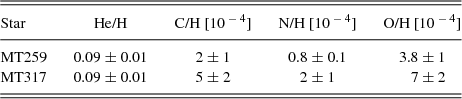
We determined the C, N, and O abundances for MT259 and MT317 using CII λλ6578, 6583, CIII λ5826, CIV λλ5801.3, 5812, NII λλ5666, 5676, 5680, 5686, OIII λ5592.25 for the first star, and CIV λλ5801.3, 5812, NIII λλ4511, 4515, 4634.0, 4640.6, OIII λ5592.25 for the second. Calculated abundances of the elements are given in Table 4. Figure 5 shows the locations of MT259 and MT317 on log(N/C)/log(N/O) diagram, taken from Martins et al. (Reference Martins2015) (the figure 10 in the original paper). Although MT259 and MT317 are members of the association and lie farther from us than stars considered in the study of Martins et al. (Reference Martins2015), they do not show any anomalies of chemical composition.
log(N/C) as a function of log(N/O) for dwarfs stars. Circles are the studied stars; filled triangles are Galactic stars from Martins et al. (Reference Martins2015); open triangles are SMC dwarfs from Bouret et al. (Reference Bouret, Lanz, Martins, Marcolino, Hillier, Depagne and Hubeny2013). The black cross in right lower corner displays typical errors of estimated abundances.

The abundances of chemical elements estimated with CMFGEN atmosphere models.
For MT282, MT343, and MT299, however, we were not able to derive the chemical composition from our spectra due to limited spectral range of our data not including all the necessary diagnostic lines together. Due to that, for the estimation of physical parameters we assumed that chemical composition of MT282 and MT343 is the same as of MT259, while C, N, and O abundances in MT299 is equal to one of MT317.
5 DISCUSSION
5.1. Temperatures and luminosities
As it was mentioned in Section 4, the value of T eff obtained in this study for MT259 is lower than the one given by Herrero et al. (Reference Herrero, Corral, Villamariz and Martín1999), although it is close to estimate of Humphreys & McElroy (Reference Humphreys and McElroy1984) and calibration of Crowther (Reference Crowther, Bedding, Booth and Davis1997) for B0 V spectral type. This may be related to the difference of stellar atmosphere models used by us and used by Herrero et al. (Reference Herrero, Corral, Villamariz and Martín1999)—our models, for example, do account for line blanketing. As it was shown by Repolust, Puls, & Herrero (Reference Repolust, Puls and Herrero2004), T eff values obtained with line-blanketed models are lower than values obtained with unblanketed stellar atmosphere models.
Martins et al. (Reference Martins, Schaerer and Hillier2005a) presented new calibrations of stellar parameters of O-stars as a function of spectral type based on atmosphere models computed with the cmfgen code. They derived two types of effective temperature scales: an observational one from the results of modelling of individual O-stars and a theoretical one based on the grid of models. We compared our O-stars MT299 (O7.5 V) and MT317 (O8 IV) with these scales. Values of T eff estimated by us for MT299 and MT317 are slightly lower than the values that could be obtained from spectral classification of these stars and observational T eff scale of Martins et al. (Reference Martins, Schaerer and Hillier2005a). If we use theoretical T eff scale of Martins et al. (Reference Martins, Schaerer and Hillier2005a) then our T eff estimates are in better agreement with spectral class.
The modelling we performed allows us to refine the luminosity classes of studied stars. There is uncertainty in luminosity class of MT259. Kiminki et al. (Reference Kiminki2007) estimated that MT259 is a supergiant (B0 Ib) while Chentsov et al. (Reference Chentsov, Klochkova, Panchuk, Yushkin and Nasonov2013) claims that this star is a dwarf (B0 V). Our estimates of log g and L * for this star confirm the classification of Chentsov et al. (Reference Chentsov, Klochkova, Panchuk, Yushkin and Nasonov2013). Luminosity of MT317 is a bit higher than the tabulated value of luminosity for O8 V class, according to Martins et al. (Reference Martins, Schaerer and Hillier2005a). Probably MT317 should be classified as O8 IV. Maryeva et al. (Reference Maryeva, Chentsov, Goranskij and Karpov2016) claimed that the absorption lines in the spectrum of MT282 are not so deep as ones in the spectrum of MT343 (classified as B1 V dwarf), and probably the stars differ in luminosity class. Our modelling also demonstrated that MT282 is brighter than MT343, and argued in favour of MT282 being the star of B1 IV type. Tables 2 and 5 give the refined luminosity classes.
Derived masses, luminosities, and ages of stars considered in this study, *—spectroscopic, evol—evolutionary. Spectral classes are according to our estimations of luminosities.
$\dot{M}$
are upper limits for mass-loss rate.

5.2. Ages and masses
Estimations of masses and ages are important for reconstruction of star-formation history in the Cyg OB2 region, they are also necessary to define the initial mass function (IMF). Accurate determination of mass and age requires knowing precise location of the star on H–R diagram, which is often being done based on the tabulated values for a given spectral class in Morgan–Keenan (M–K) system. This leads to uncertainties due to inevitable difference between tabulated data and intrinsic luminosities and temperatures of stars. According to Wright et al. (Reference Wright, Drew and Mohr-Smith2015), for O-type stars these uncertainties are typically small, ~ 0.02 dex in logTeff and ~ 0.1 dex in logL*/L⊙. However for the B-type stars, the errors rise significantly to ~ 0.07 dex in logTeff and ~ 0.2 dex in logL*/L⊙ due to classification uncertainties and the larger difference in T eff between spectral subclasses. Our uncertainties obtained as result of modelling are significantly smaller: < 0.014 dex in logTeff and < 0.04 dex in logL*/L⊙ for O-type stars; < 0.02 dex in logTeff and < 0.04 dex in logL*/L⊙ for the B-type stars. Table 5 clearly demonstrates that the uncertainties in logL*/L⊙ and logTeff obtained with modelling are smaller than the ones obtained with M–K classification (Wright et al. Reference Wright, Drew and Mohr-Smith2015).
Figures 6 and 7 show the location of studied stars in the H–R diagram and logg−T eff diagram as well as evolutionary tracks and isochrones from the Geneva database (Ekström et al. Reference Ekström2012), constructed using the online calculatorFootnote 5 taking into account the effects of rotation. The rotation rate is V ini/V crit = 0.4.
H–R diagram for the stars of the present study (filled circles) and the OB-dwarfs A26 (O9.5 V), A33 (B0.2 V), and A38 (O8 V) from Negueruela et al. (Reference Negueruela, Marco, Herrero and Clark2008) (open circles). Evolutionary tracks (solid lines) and isochrones (dashed-dotted lines) are from Ekström et al. (Reference Ekström2012).

logg,T eff diagram for the stars of the present study (filled circles) and the OB-dwarfs A26 (O9.5 V), A33 (B0.2 V) and A38 (O8 V) from Negueruela et al. (Reference Negueruela, Marco, Herrero and Clark2008) (open circles). Evolutionary tracks (solid lines) and isochrones (dashed-dotted lines) are from Ekström et al. (Reference Ekström2012).

Table 5 gives the comparison of the values of mass, luminosity, and age for each star, estimated using the diagrams and from the spectral modelling. The index ‘evol’ means that the quantity is measured using the H–R or logg−T eff diagram and evolutionary tracks. Also Table 5 gives the same parameters obtained from the H–R diagram according to M–K classification (Wright et al. Reference Wright, Drew and Mohr-Smith2015). As we can see from the table, the H–R and logg−T eff diagrams provide similar values of masses and close values of ages. The luminosities estimated with cmfgen L * and with logg−T eff diagram L evol are relatively close. It once again shows that logg−T eff together with the current models of stellar evolution is very useful instrument for determination of masses and ages of stars with unknown distances. The logg−T eff diagram combined with isochrones provides ages, and together with evolution tracks—gives stellar mass, and therefore stellar luminosity L evol.
From the Table 5, we also can see that M * is equal to M evol within the errors. It is also seen that M * tends to be lower than M evol. This tendency can be due to the so-called mass discrepancy—systematic overestimate of evolutionary masses M evol compared to spectroscopically derived masses M * [see e.g. Herrero et al. (Reference Herrero, Kudritzki, Vilchez, Kunze, Butler and Haser1992)]. Markova & Puls (Reference Markova and Puls2015) suggested that the reason for this effect is the neglection of turbulent pressure in fastwind and cmfgen atmospheric models. Moreover, in our case the tendency is less pronounced for the stars with higher masses. This can be consistent with trends founded by Markova & Puls (Reference Markova and Puls2015). But it is hard to make any certain conclusions taking into account that the uncertainties in M * are significantly higher than ones in M evol. The uncertainties in M * result from uncertainties in logg (about 0.2 dex), which are linked with narrow spectra range and, therefore, small number of spectral lines, in particular, hydrogen lines used in our analysis. The increase of analysed spectral range is the way to improve the accuracy.
Massey & Thompson (Reference Massey and Thompson1991); Hanson (Reference Hanson2003) have noted that the star formation in Cyg OB2 is non-coeval. Drew et al. (Reference Drew, Greimel, Irwin and Sale2008) found clustering of A-type stars at distance of 20 arcmin south of the centre of Cyg OB2 using data from the INT/WFC Photometric Hα Survey (IPHAS). One of the interpretations is that the cluster of A-type stars and the already known OB-star concentration are parts of the same association. And probably there were two main episodes of star formation, or there is a substantial age spread (Drew et al. Reference Drew, Greimel, Irwin and Sale2008). Wright et al. (Reference Wright, Drake, Drew and Vink2010) analysed the properties of stars in two fields in Cyg OB2 using deep Chandra X-ray point sources catalogue and found that these two fields are different by age of star generation. Comerón & Pasquali (Reference Comerón and Pasquali2012) concluded that members of the association display a mixture of ages ranging from less than 3 Myr to over 10 Myr, indicating a long sustained rate of star formation. Also Comerón & Pasquali (Reference Comerón and Pasquali2012) claimed that Cyg OB2 extends beyond the area occupied by the youngest and hottest stars and that the southern part of the association is clearly older. Wright et al. (Reference Wright, Drew and Mohr-Smith2015) presented list of massive stars in Cyg OB2 which is most complete as of now. The age distribution of stars more massive than 20 ⊙ and down to ~B0.5 V spectral type showed that star formation process started at least ~6–8 Myr ago. Between 1 and 7 Myr ago, star formation occurred more or less continuously with probable excess between 4–5 Myr ago (Wright et al. Reference Wright, Drew and Mohr-Smith2015). Cyg OB2 occupies a much larger region than typical young compact star clusters or associations. Based on spatial size of Cyg OB2 and observed age spread, Wright et al. (Reference Wright, Drew and Mohr-Smith2015) suggested that Cyg OB2 was not born as a single star cluster but as a ‘distribution’ of smaller groups or clusters of stars with a range of stellar ages.
According to the H–R diagram, the ages of MT299 and MT317 stars lie in the range between 5 and 6 Myr (see Table 5), while MT259 is younger than 5 Myr, and MT282 and MT343 belong to older population of Cyg OB2. In log g − T eff diagram, MT259 lies in the same area as MT299 and MT317 stars (5–6 Myr), while MT282 and MT343 stars are still in >10 Myr region. The ages estimated by Wright et al. (Reference Wright, Drew and Mohr-Smith2015) are consistent with our estimates within the two standard errors. Thus, comparing our results with results of previous studies we can conclude that the studied stars belong to different subclusters of Cyg OB2: MT259 (B0 V), MT299 (O7.5 V), and MT317 (O8 V) are 4–6 Myr, MT282 (B1 IV) and MT343 (B1 V) are older cluster with 12–14 Myr age.
In addition to the studied stars, in Figures 6 and 7 we marked the A26 (O9.5 V), A33 (B0.2 V), and A38 (O8 V) OB-dwarfs from Negueruela et al. (Reference Negueruela, Marco, Herrero and Clark2008). On the one hand, this shows that the number of studied dwarfs belonging to Cyg OB2 is quite small. Before our work, among the dwarf stars of Cyg OB2 association, only these three stars, as well as MT259 (B0 V) and MT29 (O7 V) studied by Herrero et al. (Reference Herrero, Corral, Villamariz and Martín1999), were modelled. On the other hand, the locations of A26 and A38 together with MT299 and MT317 stars demonstrates the continuity of star-formation process in the association.
5.3. Mass-loss rate
O-dwarfs show spectral lines with P-Cyg profiles only in the ultraviolet (UV) range. Therefore, UV spectra are necessary for an accurate assessment of their mass-loss rates. Marcolino (Reference Marcolino, Bouret, Martins, Hillier and Escolano2009) demonstrated that when
$\dot{M}$
falls below 10−7M⊙yr−1 the profile of H
α line becomes insensitive to its further reduction. Thus, our estimates of
$\dot{M}$
obtained based on optical spectra are just upper limits. As an example, the upper panel of Figure 8 demonstrates changes of H
α line profile in model spectra with the decrease of mass-loss rate. The lower panel also shows the example of fitting of H
α line in the spectum of MT317 (O8 IV) with the model spectra calculated for different values of mass-loss rate.
Upper panel: changes of profile of H α line with the decrease of mass loss rate. Model luminosity is 1.2 · 105L⊙, terminal velocity is V ∞ = 1000kms−1. Lower panel: comparison of H α line profile from the spectrum of MT317 (O8 IV) with models computed for different mass loss rates. Mass-loss rate is in units of M⊙yr−1.

Tables 5 shows
$\dot{M}$
predicted by the theory (Vink, de Koter, & Lamers Reference Vink, de Koter and Lamers2000, Reference Vink, de Koter and Lamers2001), marked as $\dot{M}_{\text{Vink}}$
. The measured mass loss rates are consistent with
$\dot{M}_{\text{Vink}}$
predicted.
$\dot{M}_{\text{Vink}}$
. The measured mass loss rates are consistent with
$\dot{M}_{\text{Vink}}$
predicted.
6 CONCLUSIONS
We investigated five stars—MT259 (B0 V), MT282 (B1 IV), MT299 (O7.5 V), MT317 (O8 V), and MT343 (B1 V)—belonging to Cyg OB2 association. Using tlusty and cmfgen codes, we estimated their physical parameters, including luminosity, mass-loss rate, projected rotation velocity, and chemical composition of the atmospheres. According to our modelling, we reclassify MT282 and MT317 from dwarfs to subgiants owing to their higher luminosities. H–R and logg−T eff diagrams show that the ages of MT259, MT299, and MT317 are between 4 and 6 Myr like the ones of most part of Cyg OB2 stars. On the other hand, MT282 and MT343 belong to the older population of the association, their ages > 10 Myr.
In the paper, we examined in detail the method of automatic comparison of observed spectra with tlusty model. We demonstrated that the method works well and it can be used for a simple estimations of stellar parameters of OB-stars based on both high- and low-resolution spectra.
We hope that this study will be useful for calibration of the spectral class—luminosity—effective temperature ratio, as the numbers of OB-stars with known distance are still small.
ACKNOWLEDGEMENTS
The observations at the Russian 6-m telescope were carried out with the financial support of the Ministry of Education and Science of the Russian Federation (agreement No. 14.619.21.0004, project ID RFMEFI61914X0004). We used spectral data retrieved from the ELODIE archive at Observatoire de Haute-Provence (OHP) and database of stellar evolution group at the Geneva Observatory. The study was supported by the Russian Foundation for Basic Research (projects no. 14-02-31247,14-02-00291). Olga Maryeva thanks the grant of Dynasty Foundation. AS was supported by The Ministry of Education and Science of the Russian Federation within the framework of the research activities (project no. 3.1781.2014/K). Also we would like to thank the anonymous referee for valuable comments.
A ESTIMATION OF χ2 t
The choice of χ2 t given by Equation (2) in Section 3.2 is based on the analysis of spectra of O-stars ALS 8476 (O9 V) and BD+35°1201 (O9.5 V). Spectra of ALS 8476 and BD+35°1201 were obtained on the Russian 6-m telescope with the high-resolution NES (Panchuk et al. Reference Panchuk, Klochkova, Yushkin and Naidenov2009), spectral resolution is R = 60 000. Continuum normalisation of these spectra had been performed manually with dech program (Galazutdinov Reference Galazutdinov1996). The S/N of these spectra in the vicinity of HeI λ5876 line is 80 and 110 for the ALS 8476 and BD+35°1201 spectra, respectively. But S/N is significantly lower (~ 30) in the blue region of spectra resulting in relatively high parameter errors of ALS 8476 and BD+35°1201.
The projected rotational velocities vsini of ALS 8476 and BD+35°1201 were estimated with Full Width at Half Maximum (FWHM) method (see e.g. Herrero et al. Reference Herrero, Kudritzki, Vilchez, Kunze, Butler and Haser1992). The metal lines were used in the case of ALS 8476 while in the case of BD+35°1201 we used He lines. The obtained values are vsini = 18 ± 4 and 217 ± 16 kms−1for ALS 8476 and BD+35°1201, respectively.
The effective temperature and surface gravity of ALS 8476 and BD+35°1201 were initially estimated by us using the method based on the T eff-log g diagnostic diagram [see e.g. Herrero et al. (Reference Herrero, Kudritzki, Vilchez, Kunze, Butler and Haser1992)] with hydrogen and helium lines. The estimated values are T eff = 32000 ± 1500 K and log g = 4.1 ± 0.2 dex for ALS 8476 and T eff = 32000 ± 1500 K and log g = 3.9 ± 0.2 dex for BD+35°1201. Then, the parameters of these two stars were refined using the method for high-resolution spectra described in Section 3.2 with different χ2 t values. The final χ2 t was chosen to provide the values of parameter errors comparable to the ones obtained with the method based on the T eff-log g diagnostic diagram. With this chosen value of χ2 t, the refined parameters are T eff = 32000 ± 1000 K and log g = 4.2 ± 0.2 dex for ALS 8 476 and T eff = 32500 ± 1100 K and log g = 4.1 ± 0.2 dex for BD+35°1201. This estimates are consistent with those obtained with T eff-log g diagnostic diagram.
B TESTING THE METHOD OF EFFECTIVE TEMPERATURE AND SURFACE GRAVITY DETERMINATION
To test the method of automatic spectral analysis described in the Section 3.2, we used spectra of the following stars: HD 15629 [O5 V((f))], HD 34078 (O9.5 V). Moreover, to test the applicability of this method for low-resolution spectra of B-stars we used the spectra of HD 36591 (B1 V) and HD 42597 (B1 V). The parameters of HD 15629, HD 34078, and HD 36591 are known from the literature (Martins et al. Reference Martins, Schaerer, Hillier, Meynadier, Heydari-Malayeri and Walborn2005b; Lefever et al. Reference Lefever, Puls, Morel, Aerts, Decin and Briquet2010) while the spectrum of HD 42597 had not previously been modelled.
The spectra of HD 15629, HD 42597, and HD 36591 were acquired from Elodie archive of Observatoire de Haute-Provence (http://atlas.obs-hp.fr/elodie/intro.html) (Prugniel & Soubiran Reference Prugniel and Soubiran2001). The spectrum of HD 34078 obtained on the 1.2-m telescope of the Kourovka Astronomical Observatory of the Ural Federal University with the fiber-fed high-resolution echelle spectrograph (UFES) (Panchuk, Yushkin, & Yakopov Reference Panchuk, Yushkin and Yakopov2011). Continuum normalisation of all spectra had been performed manually with dech program (Galazutdinov Reference Galazutdinov1996). The spectral resolutions of Elodie and UFES spectra are 42 000 and 30 000, correspondingly. S/N of Elodie spectra in the vicinity of HeI λ5876 line is higher than 100, while for the UFES spectrum it is 75.
vsini values for HD 15629, HD 36591, and HD 42597 were adopted to be the same as in Martins et al. (Reference Martins, Schaerer, Hillier, Meynadier, Heydari-Malayeri and Walborn2005b); Simón-Díaz & Herrero (Reference Simón-Díaz and Herrero2014) and Bragança et al. (Reference Bragança, Daflon, Cunha, Bensby, Oey and Walth2012), and equal to 90, 9, and 87 kms−1 correspondingly. There are several different estimates of vsini for HD 34078—Herrero et al. (Reference Herrero, Kudritzki, Vilchez, Kunze, Butler and Haser1992) give vsini = 40kms−1, while Gies (Reference Gies1987) obtained vsini = 27kms−1, Martins et al. (Reference Martins, Schaerer, Hillier, Meynadier, Heydari-Malayeri and Walborn2005b) adopted vsini = 40kms−1. We obtained vsini = 21 ± 3kms−1 from the Fourier transform of the profiles of metal lines [see e.g. Simón-Díaz & Herrero (Reference Simón-Díaz and Herrero2007)] and used this value in the analysis.
We estimated the parameters of HD 15629 and HD 34078 with method given in Section 3.2 using 9 and 18 spectral lines, correspondingly. We also estimated their parameters with the smaller number of lines which is equal to the number of lines used to estimate parameters of MT259. From Table A1, it is clear that parameters estimated with different number of spectral lines are in good agreement with each other and with the parameters obtained by Martins et al. (Reference Martins, Schaerer, Hillier, Meynadier, Heydari-Malayeri and Walborn2005b) who used tlusty and cmfgen codes. Moreover, we estimated He/H = 0.08 ± 0.02 for HD 15629 that is in agreement with He/H = 0.08 obtained by Repolust et al. (Reference Repolust, Puls and Herrero2004). Figures A1 and A2 show the results of fitting of HD 15629 and HD 34078 observed spectra with the best model.
Testing of the spectral analysis method. Modelling of HD 15629 [05 V ((f))]. Comparison of the profiles of selected lines with the best model spectra. The solid line shows the observed profile, and the dashed-dotted line—the TLUSTY-model. The spectrum was obtained with Elodie echelle spectrograph.

Testing of the spectral analysis method. Modelling of HD 34078 (O9.5 V). Comparison of the profiles of selected lines with the best model spectra. The solid line shows the observed profile, and the dashed-dotted line—the TLUSTY-model. The spectrum was obtained with UFES spectrograph.

Testing of the spectral analysis method. The comparison of estimated parameters of HD 15629 [O5 V((f))], HD 34078 (O9.5 V), HD 36591 (B1V), HD 42597 (B1V) with the literature data.

To test the method for low resolution spectra, we initially estimated T eff and log g of HD 42597 and HD 36591 with the procedure described in Section 3.2 and synthetic spectra computed using stellar atmosphere models from the bstar2006 (Lanz & Hubeny Reference Lanz and Hubeny2007). The synthetic spectra were computed with different values of Teff, logg, v turb, and He/H. The final values of T eff and log g are given in Table A1. The parameters of HD 36591 are well consistent with the estimates of other authors summarised in Table A1. Then, we estimated T eff and log g of HD 42597 and HD 36591 using low-resolution spectra of these stars. These low-resolution spectra were obtained from high-resolution spectra by convolving with the instrumental profile with the width corresponding to SCORPIO resolution. We also had added Poisson noise in these low resolution spectra to make their S/N comparable to S/N of our spectra of MT282 and MT343 stars. Estimates of T eff and log g obtained with the same lines and spectral regions as were used for MT343 are presented in Table A1. These estimates are well consistent with those obtained for high resolution spectra. Thus, the method described in Section 3.2 allows to obtain reliable estimates of T eff and log g in the case of low spectral resolution. But the parameter errors obtained from low-resolution spectra are relatively high that is mostly due to lower S/N of these spectra. These errors are consistent with those that can be estimated comparing the observed and synthetic spectra by eye. Thus, for the analysis of low resolution spectra we used the same value of χ2 t that was found for high-resolution spectra.



