





Introduction
One of the most significant facets of archaeological research has been chronological studies, which are crucial for understanding the ideological, political, and social dimensions of the past. Throughout the latter half of the 20th century, Latin American research has been increasingly integrated with a variety of archaeometric dating methods, including paleomagnetism, archaeomagnetism (Sternberg Reference Sternberg, Eighmy and Sternberg1990; Urrutia Fucugauchi Reference Urrutia Fucugauchi1975), thermoluminescence (Aitken Reference Aitken1970; Aitken et al. Reference Aitken, Tite and Reid1964), obsidian hydration (Dixon Reference Dixon1966; García Bárcena Reference García Bárcena1974), dendrochronology and radiocarbon (14C). These techniques have substantially enhanced the accuracy of historical timelines and contributed to a deeper interpretation of ancient events and processes.
Following global advancements in radiocarbon dating, Latin America, and specifically Mexico, saw significant developments from the 1950s through to the 1980s with key figures like José Luis Lorenzo, Luis Aveleyra de Anda, Richard MacNeish, Charles Di Peso and William Sanders spearheading archaeological-chronological projects (Alcántara Reference Alcántara2021b; Solís et al. Reference Solís, Chávez, Huerta, Ortiz, Alcántara, Rodríguez-Ceja and Carrillo2022). The 1990s marked a pivotal expansion in local capabilities; the National Institute of Anthropology and History (INAH) established a 14C laboratory complemented with new facilities for thermoluminescence (Ramirez Luna Reference Ramírez Luna2001) and archaeomagnetism (Soler Arechalde Reference Soler Arechalde2014) at the National Autonomous University of Mexico (UNAM) Institute of Geophysics. Further advancements included the inception of a low-level 14C liquid scintillation counting (LSC) laboratory at UNAM’s Institute of Anthropological Research in 2004 (Beramendi-Orosco et al. Reference Beramendi-Orosco, González-Hernández, Urrutia-Fucugauchi and Morton-Bermea2006), and the introduction of an accelerator mass spectrometer (AMS) at the UNAM Institute of Physics in 2013 (Solís et al. Reference Solís, Chávez-Lomelí, Ortiz, Huerta, Andrade and Barrios2014).
Mirroring advancements in Mexico, Brazil also significantly contributed to the region’s archaeological dating capabilities. In 1990, the Center for Nuclear Energy in Agriculture (CENA) at the University of São Paulo (USP) in Piracicaba established a low-level 14C LSC laboratory. This development was further bolstered in 2012 with the inauguration of the first AMS laboratory in Latin America, located at the Institute of Physics of the Federal University of the State of Rio de Janeiro (UFF), in Niter (Macario et al. Reference Macario, Gomes, Anjos, Carvalho, Linares, Alves, Oliveira, Castro, Chanca, Silveira, Pessenda, Moraes, Campos and Cherkinsky2013). These initiatives show a growing emphasis on enhancing precise archaeological methodologies throughout Latin America.
Since the 1950s, significant advancements in radiocarbon dating and other archaeometric techniques have generated a vast array of data from numerous archaeological sites across Latin America. However, this wealth of information is widely dispersed among various scholarly outputs including articles, dissertations, books, and technical reports. This fragmentation poses a significant challenge to researchers, as synthesizing the complete scope of findings necessitates extensive bibliographic searches and reviews. Moreover, the lack of centralized databases or cohesive digital archiving practices hampers the full utilization and integration of this data within ongoing research. Addressing these issues through the development of comprehensive data management systems and standardized digital repositories could dramatically enhance accessibility and foster deeper, more collaborative studies in the field of archaeology.
This article conducts a review of the application of databases for chronological research, with a particular emphasis on radiocarbon dating practices in Latin America. It examines the range of existing databases that are accessible via the internet, aiming to provide a comprehensive overview of these initiatives. The analysis focuses on how these Latin American projects compare to their European and North American counterparts in terms of their structure, accessibility, and the integration of data. The datasets used for this analysis can be explored and downloaded from GitHub (2024). By doing so, it seeks to highlight the unique challenges and innovations within the Latin American context, and to propose solutions for enhancing data interoperability and collaborative research across global archaeological communities.
Databases in academic archaeological research
The compilation of radiocarbon dating data has been an essential endeavor since the technique’s inception in the late 1940s. Initially, special issues of the journal Science were devoted to presenting tables of results from various laboratories (Arnold and Libby Reference Arnold and Libby1951; Brannon et al. Reference Brannon, Daughtry, Perry, Simons, Whitaker and Williams1957; Libby et al. Reference Libby, Anderson and Arnold1949). In 1959, the journal Radiocarbon was established specifically to oversee this task (Barker and Mackey Reference Barker and Mackey1959). Since 1990, there has been a noticeable shift: the number of laboratories contributing to these compilations has decreased, while publications utilizing the 14C technique have significantly increased, reflecting a broader adoption and integration of this method in scientific research.
Building on the foundational work in radiocarbon dating publications, the advent of computing in the 1990s introduced significant innovations in database creation (Gándara Reference Gándara2017; Jiménez Badillo Reference Jiménez Badillo1997). Despite the potential for transformative research, Latin American archaeology initially engaged minimally with these technological advancements (Michczyński et al. Reference Michczyński, Krzanowski, Pazdur and Ziołkowski1995). The introduction of the internet, however, broadened the scope dramatically, unlocking new possibilities for sharing and accessing information (Barceló and Bogdanovi Reference Barceló and Bogdanovi2012). Towards the end of the twentieth century, this digital expansion facilitated the publication of articles featuring accessible radiocarbon databases, predominantly through tables in scholarly papers (De los Ríos 2019; Punzo Diaz Reference Punzo Diaz2016) and datasets (Hoggarth et al. Reference Hoggarth, Ebert and Castelazo-Calva2021), marking a notable shift towards enhancing digital accessibility in archaeological research.
Compared to some countries that have their own databases, Mexican archaeology has not focused on creating tools that favor research work. The only attempt is the Google My Maps work of De los Ríos (2015) which provides the localization and bibliographic references for more than 500 archaeological sites dated in the INAH laboratory since 1990. But in many cases, the hyperlinks no longer exist. Some were PDF files and cannot be accessed using the internet archive’s Way Back Machine tool. This problem makes us reflect on the expiration of digital data, the need for national and institutional web archives (Schroeder and Brügger Reference Schroeder and Brügger2017), the use of open-source software (Shahamati et al. Reference Shahamati, Denieul-Pinsky, Baumann, Shaw and Caquard2022), and better methodological strategies for the safeguarding of information (Rogers Reference Rogers2013).
Continuing the discussion on digital data management challenges, a parallel issue exists with 14C dating in Mexican archaeology. Many archaeological projects neglect to report their dating results in accessible publications such as articles or books. Instead, these findings are often relegated to appendix sections of technical reports, which are consigned to the Technical Archive of Archaeology of INAH (ATA). Regrettably, the ATA does not offer a digital platform for the public consultation of these archives, limiting their availability to archaeologists who are physically present in Mexico City. This localized access further compounds the previously discussed issues of data preservation and accessibility, highlighting a significant barrier to broadening scholarly engagement and collaborative research.
Addressing the challenges of accessibility and data management, the development of specialized software for radiocarbon calibration stems primarily from the mathematical complexity inherent in the calibration process, rather than the sheer abundance of published dates. Tools such as OxCal (Ramsey Reference Ramsey1995) and ChronoModel (Lanos and Philippe Reference Lanos and Philippe2018) have been instrumental in simplifying the calibration and modeling of radiocarbon data, enabling researchers to build robust chronological frameworks. Other software like BCal focuses on Bayesian calibration, CalPal offers tools for calibrating and visualizing dates within paleoclimatic contexts, and BChron specializes in flexible Bayesian modeling of radiocarbon dates. Programming packages like “clam” (Blaauw Reference Blaauw2010) in R and the Python-based “iosacal” library (Costa et al. Reference Costa, Sidky and Creel2022) provide additional options for calibration tailored to specific research needs.
While the increase in radiocarbon results has not directly driven the creation of calibration software, it has led to the proliferation of datasets and databases, which in turn depend on such tools for processing and analysis. Notable examples of radiocarbon databases include MesoRAD, AndesC14, and CARD, each of which highlights the growing need for tools that can bridge the gap between data compilation and calibration. However, interoperability between databases and calibration tools remains limited. Exceptions include IntChron and OxCal; the first is a metadata standard and indexing service for radiocarbon dates, providing access to OxCal, a widely used calibration and chronological modeling tool (Bronk Ramsey et al. Reference Bronk Ramsey, Blaauw, Kearney and Staff2019). While both were developed by the same author, they are independent systems: IntChron focuses on organizing and indexing radiocarbon data, whereas OxCal is designed for calibrating dates and creating chronological models.
This underscores the importance of developing more interoperable software and standards to integrate radiocarbon datasets and enhance their usability across different platforms, ultimately fostering more collaborative and comprehensive archaeological research.
The web space: Databases as web applications
As we transition discussing technological advancements, it is important to understand the fundamental nature of web applications. A web application is a computer system designed to run natively over a network, enabling multiple users to interact with it via the web without the need for local installation (Ceri et al. Reference Ceri, Brambilla and Fraternali2009). This architecture allows applications to reside on a central server, while users access and interact with them via the internet from various locations.
The transformative capabilities of the internet, particularly evident by the late 1990s, gave rise to Web 2.0. This new phase of the internet was marked by blogs and a more interactive exchange of knowledge among users (Allen Reference Allen2013). As technology progressed into the early twenty-first century, Web 3.0 emerged, driven by advances in computing technology. This era saw the proliferation of social applications such as YouTube, Facebook and Twitter, which collectively fostered an unprecedented environment for information exchange across the globe (Rudman and Bruwer Reference Rudman and Bruwer2016).
Despite the progress in web technologies, significant limitations still exist in terms of access to information technologies, particularly in many parts of Latin America. Recognizing these challenges, it is crucial to acknowledge that sharing research information involves more than just open disclosure. It also necessitates the sharing of data and metadata among colleagues to enrich the diversity of interpretations, ensure transparency, and enable reproducibility (Marwick et al. Reference Marwick, Barton, Bates, Bollwerk, Bocinsky, Carter, Conrad, Costa, Crema, Davies, Drake, Dye, Giusti, Graham, Hawks, Huffer, Madsen, Neiman and Opitz2017). This comprehensive approach to information sharing is essential for advancing the field and fostering collaborative research across regions.
In recent years, the adoption of the FAIR principles (findability, accessibility, interoperability, reusability) has become crucial for managing archaeological data, making it more accessible, understandable, and reusable. While these principles aim to enhance data reuse, they also address challenges in data governance and ethics (Nicholson et al. Reference Nicholson, Kansa, Gupta and Fernandez2023). FAIR principles promote systematic data reuse across scientific domains while balancing open access and sensitive information protection (Wilkinson et al. Reference Wilkinson, Dumontier, Aalbersberg, Appleton, Axton, Baak, Blomberg, Boiten, da Silva Santos, Bourne, Bouwman, Brookes, Clark, Crosas, Dillo, Dumon, Edmunds, Evelo and Finkers2016). They support the integration of archaeological data into broader research frameworks, fostering a collaborative and transparent research environment (May Reference May2020; Moody et al. Reference Moody, Dye, May, Wright and Buck2021). Foundational to linked open data and open access initiatives, FAIR principles facilitate the integration of diverse databases and enhance collaborative research globally (Lamprecht et al. Reference Lamprecht, Garcia, Kuzak, Martinez, Arcila, Martin Del Pico, Dominguez Del Angel, van de Sandt, Ison, Martinez, McQuilton, Valencia, Harrow, Psomopoulos, Gelpi, Chue Hong, Goble and Capella-Gutierrez2020).
Web applications, in conjunction with FAIR principles, facilitate significant interoperability among diverse databases through the utilization of web services technology (Pierce et al. Reference Pierce, Fox, Youn, Mock, Mueller and Balsoy2002). Furthermore, these technologies enable interactions between different systems via application programming interfaces (API). An API consists of functions and routines that process queries from a database through a uniform resource identifier (URI) using standard tagging formats such as XML or JSON (Lamothe et al. Reference Lamothe, Guéhéneuc and Shang2021). This architecture allows systems or applications to communicate seamlessly without requiring a deep understanding of each other’s internal mechanisms, thereby enhancing the efficiency and effectiveness of data exchanges.
Traditional methods for sharing information in academic research often involve downloading datasets in formats such as CSV or TXT and using web applications for direct database access. Notable Latin American examples include AndesC14 (Michczyński et al. Reference Michczyński, Krzanowski, Pazdur and Ziołkowski1995), BRC14 (Brazilian Radiocarbon Database, (Bueno and Gilson Reference Bueno and Gilson2021), MesoRAD (Mesoamerican Radiocarbon Database (Hoggarth et al. Reference Hoggarth, Ebert and Castelazo-Calva2021), and ArqueoData (Alcántara Reference Alcántara2021a). These platforms enhance data accessibility, fostering broader scholarly analysis and collaboration.
International projects also exemplify efforts to improve data accessibility. For example: IntChron (University of Oxford) and The Canadian Archaeological Radiocarbon Database (CARD) primarily cover North America and Europe (Gajewski et al. Reference Gajewski, Muñoz, Peros, Viau, Morlan and Betts2011), and P3k14c compiles international radiocarbon dates into a single dataset (Bird et al. Reference Bird, Miranda, Vander Linden, Robinson, Bocinsky, Nicholson, Capriles, Finley, Gayo, Gil, d’Alpoim Guedes, Hoggarth, Kay, Loftus, Lombardo, Mackie, Palmisano, Solheim, Kelly and Freeman2022). These initiatives facilitate data sharing, standardization, and global research collaboration.
There are numerous other radiocarbon databases and datasets available globally. However, this article focuses on comparing the major databases that categorize themselves as global and examining the presence of Latin American data within them. While including additional databases would undoubtedly enhance the overall understanding of global radiocarbon data, it falls outside the scope of this study. Our primary aim is to assess the representation and integration of Latin American data in these prominent global repositories, thereby highlighting the contributions and gaps in the current landscape of radiocarbon dating research.
Methodology and dataset exploration
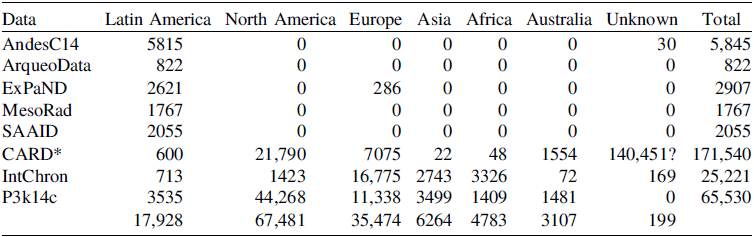
In this article, we include a comprehensive review of the following databases: ArqueoData, MesoRAD, AndesC14, BRC14, SAAID, project ExPaND, CARD, IntChron, and p3k14c. The last three are categorized as global databases. For example, the Chronological Database of Quaternary Dune Fields and Sand Seas (INQUA), which contains over 20,000 records, excludes any data pertinent to the Latin American region, rendering it unsuitable for studies investigating the status of databases there. Similarly, databases like Radon 14C are omitted because they do not include records from this region. Our selection aims to provide a targeted comparison between major global databases and those representing Latin American contributions. Although these limitations also represent gaps in regions outside Latin America, the study of most datasets and databases on the subject would constitute an even broader analysis. In Table 1, we quantitatively represent the number of samples by dataset obtained. We can observe that the datasets labeled as “global” point, in the case of p3k14c, to the USA, and in the case of IntChron, to Europe, more specifically to samples from England.
Radiocarbon samples per database and continent.

* In the case of CARD, it is only a sample estimation and is not included in the visualization map of Figure 1.
In the case of ArqueoData, this database provides a public API that allows users to extract records in either JSON or CSV format for further analysis. Conversely, AndesC14 does not offer an option to download or export the data directly. Therefore, for this article, we employed web scraping techniques to compile a dataset from all the records available in the database.
The MesoRAD dataset is available for download on the Digital Archaeological Record (tDAR) in CSV format; however, the coordinates are not provided in the downloadable dataset. This dataset contains a total of 1769 registered samples, which are associated with 121 archaeological sites. To visualize the spatial distribution of the samples provided by this dataset in a geographic information system, a search for site coordinates was conducted.
In the case of BRC14, although we attempted to use web scraping, the website was not operational during June and July of 2024 when these methodologies were applied. Consequently, for this study, we could only retrieve the total number of samples for Latin America contained in the database. However, it will not be possible to visualize these samples on the generated maps.
The South American Archaeological Isotopic Database (SAAID) is a comprehensive open access resource that aggregates all available bioarchaeological stable and radiogenic isotope measurements across South America. This dataset is provided in XLS, ODS, and CSV formats for download and includes the coordinates of the archaeological sites where the samples originated.
The ExPaND Project contains a dataset with 2907 radiocarbon dates from sites in lowland South America. This dataset, provided in CSV format, includes geolocation data for each sample, representing archaeological cultures related to the spread of polyculture agroforestry and ceramics.
The CARD database does not allow direct export of results, and sample locations are only accessible to accredited research accounts. It lacks public statistical information by country or region, so we used its API service and implemented a script to extract data, inferring approximately 171,540 samples from the total number of pages. However, country-specific searches yielded 31,174 samples, which we used for analysis and visualization.
The IntChron database offers a public API, which we used to extract country-specific information, archaeological sites, and associated samples, including geolocation data for GIS visualization.
The p3k14c project offers a downloadable CSV file that includes samples from 23 distinct databases. The project team has meticulously cleaned and standardized the data according to their specified criteria, thereby producing a unified dataset that is prepared for analytical purposes. Additionally, our search revealed that this project is also integrated into the dissemination provided by Open Context.
XRONOS is another project, undoubtedly one of the most comprehensive in terms of interface design and the development of a collaborative site aimed at sharing information. While this database also compiles data from various datasets, it uniquely includes duplicate laboratory key records and their locations across different data sources, which is a significant advantage. However, we did not include it in the results presented because it already encompasses the p3k14c project, and the other indexed databases are not relevant to Latin America.
Given this landscape, the availability of downloadable information is crucial for conducting local analyses on a computer. However, the ability to obtain data through an API, such as those provided by IntChron or ArqueoData, significantly enhances the efficiency of mass data downloads when using programming languages like Python, PHP, JavaScript, or R. Downloading datasets remains a viable option, allowing for version control of repositories, although version control can also be managed via an API.
A major challenge with AndesC14 was the lack of a downloadable database, requiring web scraping to obtain data. BRC14’s server outage further hindered data access, as its reliance on AJAX for web requests exceeded the capabilities of standard web archiving tools. Data standardization was another critical issue, with databases differing in entry fields. While all include site names, laboratory codes, radiocarbon age and error margins, not all provide latitude, longitude or detailed archaeological context. This variability underscores the urgent need for standardized fields across all radiocarbon databases, and potentially for other dating techniques. Although some efforts have been made to implement the CIDOC-CRM ontology in archaeology, standardizing chronometric information remains unaddressed.
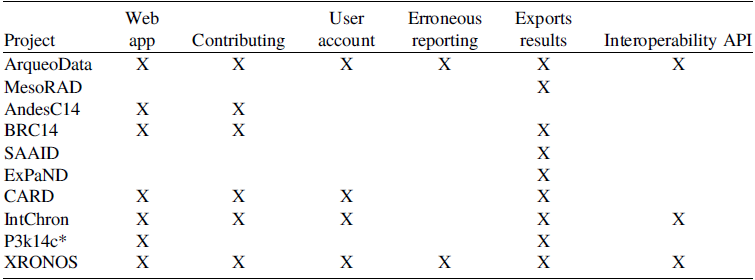
Table 2 presents an overview of the structural and accessibility issues across the different databases and datasets we explored. This table aims to provide a clearer understanding of the current state of data management in radiocarbon databases and underscores the necessity for improved standardization and data access protocols.
Projects with Latin American Information and major features

* In the case of the web app for p3k14c, it is only available in an open-context platform and downable dataset (Bird et al. Reference Bird, Miranda, Vander Linden, Robinson, Bocinsky, Nicholson, Capriles, Finley, Gayo, Gil, d’Alpoim Guedes, Hoggarth, Kay, Loftus, Lombardo, Mackie, Palmisano, Solheim, Kelly and Freeman2024).
The “Web app” field identifies whether a project has an interactive web application for data exploration. The “Contributing” field indicates if users can add samples; many projects only offer datasets for local download and visualization, lacking a collaborative web interface. This is related to the “User account” field. For example, MesoRAD and P3k14c are downloadable via the tDAR platform but do not have dedicated user accounts for database interaction, unlike CARD, which allows registered researchers to access site coordinates and request data additions. Conversely, AndesC14 and BRC14 lack user registration, requiring data contributions to be submitted via email to the administrators.
We propose that this step should be streamlined to facilitate contributions to databases. A web application should allow free registration for users associated with research institutions, accelerating the growth of information. However, we acknowledge the reasons behind these projects’ decision to filter contributions, as they must maintain certain standards and parameters for database entries. This process could be automated to allow users to upload standardized information directly to the databases.
The above discussion highlights the need for standardized fields, the generation of APIs to create interoperability between existing databases, and the shift from an academic environment of downloadable datasets to the use of online databases. This paradigm shift is necessary as the digital world and massive data challenges require solutions previously unconsidered by academics. The use of downloadable datasets falls short as we need to cross-reference various projects to achieve comprehensive results.
Results and discussion
After processing the nine datasets, we have achieved a more comprehensive visualization of the state of radiocarbon dating in Latin America. Figure 1 presents a global map integrating the seven datasets, displaying their distribution worldwide and quantifying samples by continent, distinguishing Latin America from North America (USA and Canada). This visualization reveals that so-called “global” databases like IntChron and p3k14c have limited representation from Latin America, with similarly sparse data from Africa and Oceania. Although we can also note that in the case of Europe, IntChron’s information is potentially greater in England than in the rest of Europe, where we could perhaps include some other databases to complement the view of the European space.

Sample distribution discrepancies are frequently attributed to geopolitical divisions between the Global North and South, as noted by scholars such as Fiormonte (Reference Fiormonte2017), Collyer (Reference Collyer2018), and Riande and Fiormonte (Reference Riande and Fiormonte2021). Initiatives like ArqueoData, AndesC14 and MesoRad are tailored to meet the research needs of Latin America while adhering to the standards established by the Global North.
In contrast, older global projects like IntChron and CARD differ from newer Latin American initiatives, which prioritize publishing specific datasets in academic articles over creating large, unified databases. This trend highlights a significant issue: databases deemed “global” often predominantly feature datasets from the United States and the European Union, marginalizing other regions such as Latin America, Africa, Oceania, and Asia. These regions are compelled to initiate their own projects to accumulate data independently. In Latin America, local projects are focused on regional needs but remain isolated from global database projects. Rather than viewing this as a mere problem, it should be understood as a regional challenge that necessitates engagement and dialogue with other projects from the Global North.
The p3k14c sources are mainly English-language articles, whereas Latin American research is often published in regional journals and reports. The p3k14c dataset includes 268 records from MesoRAD, despite MesoRAD having 1767 samples, and only 4 samples from AndesC14, while we obtained 5817 through web scraping. This discrepancy may be due to duplicate sample removal in the global dataset, yet several MesoRAD samples were entirely absent from p3k14c.
The primary objective of these databases is to disseminate radiocarbon results within the Latin American community. While aligning with Global North standards for data standardization is crucial (Morales del Castillo et al. Reference Morales del Castillo, Ángeles Jiménez and Molina Salinas2019), the distinct contexts and research needs in Latin America make direct adoption impractical. Few Latin American projects focus on radiocarbon dating or propose unified databases. For example, AndesC14, with over 5000 samples, is managed by researchers in Poland. Brazilian records are not easily accessible, and Mexico’s INAH only provides site locations via Google My Maps without exact sample counts.
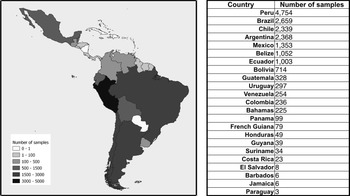
From the analysis of two global databases (p3k14c, CARD, Intchron) and Latin American data (AndesC14, ArqueoData, ExPaND, MesoRad and SAAID) we can see in Figure 2 that the highest concentration of data are found in Peru and are those from AndesC14 obtained through webscraping since this site does not have a function to export results in CSV. This is followed by Brazil, Chile and Argentina which are mostly concentrated in the SAAID and ExPaND databases, while Mexico samples come from the ArqueoData and MesoRad databases. The remaining countries are present in ExPaND, AndesC14 and SAAID.
Radiocarbon sample counts by country in Latin America data (AndesC14, ArqueoData, ExPaND, MesoRad and SAAID). Created in QGIS by Alberto Alcántara. More information on GitHub (2024).

The solution lies in creating Latin American projects to develop databases, establish standards for data management, and foster collaboration. ArqueoData is Mexico’s proposal to generate these initiatives, but it remains separate from governmental archaeological institutions and lacks sufficient interest from the archaeological community. Furthermore, archaeological data and artifacts are often seen as the property of specific projects and individuals rather than public information belonging to humanity. However, ensuring that these initiatives are embedded within stable, local institutions is critical to preventing them from becoming outdated as soon as they are published.
Despite these challenges, Latin American efforts in compiling datasets have increased significantly over the past five years. However, unlike the Global North, Latin America lacks technological and economic access, requiring considerable communal effort to sustain large radiocarbon projects. Building bridges within Latin America and with other regions is crucial for advancing archaeological research in the region.
Conclusions
Datasets provide an overview of radiocarbon studies at an international level from the perspective of the Global North. However, they are often hindered by repetitive samples, lack of updates, and insufficient interaction. This results in long lists of data that, rather than being preserved in libraries and archives, remain lost amidst the vastness of existing data on the web.
From this review of the state of radiocarbon databases in Latin America, we propose that more attention must be given to creating such projects independently or through institutions. Projects should shift from a dataset-centric vision to a web application perspective that can retrieve information via APIs, enabling the comparison of large amounts of data. This requires not only interdisciplinary work between archaeologists and computer scientists but also an interest from archaeologists in the technical aspects of informatics to understand how databases and APIs are more effective than downloadable datasets.
Nevertheless, the utility of datasets should not be underestimated. Even for the study presented, a combination of information obtained through APIs and downloadable datasets was utilized. A recurring issue, however, is the lack of international vocabularies or standards for these databases and datasets. Only the basic fields related to the dating technique (e.g., r14, error, lab code) are standardized, while archaeological context information, and sometimes interpretative data, vary significantly across cases. It may be necessary to consider not only the interoperable context but also the open data framework, which demands improved controls for archaeological information management.
There is a need for Latin American groups to discuss the necessity of classification standards not only for dates but also for the archaeological contexts associated with each sample. Despite differences between the Global North and South, particularly in access to technology and support for such projects, it is essential that we address these challenges from our perspective to create our own resources. These resources should facilitate dialogue within Latin America and engage with major U.S. and European projects that have been reflecting on and developing these initiatives for years.
The web is designed to implement not only datasets but also other technologies that enable true interoperability between data, ensuring better resource utilization. While datasets can aid individual work, academic collaboration on the web has the potential to create new dynamics of interoperability. This can only be achieved through the creation of robust databases, classification standards, and controlled vocabularies. We must join forces to develop APIs that allow application developers and archaeologists to collaboratively create better tools, guiding us towards new questions and interpretations of human past processes.
In conclusion, enhancing radiocarbon data management in Latin America involves a paradigm shift towards web-based applications, fostering interdisciplinary collaboration, and establishing standardized methodologies. By doing so, we can not only improve our own regional research capabilities but also contribute meaningfully to the global archaeological community.


 Open access

