

What is Innovation?
Impactful problem-solving. Individually, corporately, and society-wide we face increasingly critical and complex problems. We long for new solutions that will generate meaningful and lasting positive change – not just solutions that are new or creative, but those that are impactful. While there are many definitions of “innovation” (Reference SchaverSchaver, 2014) – the word is unfortunately on the brink of becoming a meaningless buzzword – the definition used throughout this book is impactful problem-solving that leverages a product or service or approach that is new, or at least perceived as new by the adopter (Reference AnthonyAnthony, 2012).
An innovation must solve a problem for someone. People, individually or organizationally, have problems. There is no problem without someone who is suffering from it. It is similar to a tree falling in the woods. If a tree falls in the empty woods, will it be heard? No. The falling tree will certainly produce sound waves, but there needs to be someone or something there for the sound to be “heard.” Problems are analogous. Without people (individuals, groups, or organizations) who are directly or indirectly affected by a problem, then there really is no issue that needs to be resolved. For a solution to be impactful, it must both address a real problem and be adopted by the person, individually or corporately, who has the problem. That adoption could be widespread, as in the global adoption of smart phones, or that adoption could be narrow, as when our friend adopts our innovative solution to their relationship issue. No adoption, no impact. No impact, no innovation.
Innovation is therefore, by its very nature, outward facing. It encompasses two separate points of view (POVs). One POV is that of the adopter. An innovation must align with the needs of an adopting individual, group, or organization. The second POV is that of the creator of the innovation. That creator could be an individual, group, or organization. The two POVs could be one and the same if the innovation creator is creating a new solution to a problem of their own, but the two POVs are typically different.
By solving a problem for someone, an innovation creates impact. But impact can be measured in a number of different ways. For corporations, it may be measured in financial terms (reduced cost or increased profits) or in market terms (increased sales or market share). In government, the impact may be raising constituents above the poverty line or increasing their satisfaction index. In our personal lives, impact may be having a stronger relationship with our loved ones or a more satisfying career. It is not important how the impact is measured; what is important is that there is an impact.
An innovation must be new. However, an innovation does not necessarily need to be “a-brand-new-concept-to-the-universe” new, but rather it must be perceived as new by the adopter (Reference RogersRogers, 1995). Indeed many innovations take something that is known in one field and apply it to another. Henry Ford's (Reference Ford2013) automobile manufacturing assembly line had its roots in the slaughter houses of Chicago. But the application of the automated “disassembly” processes (“Assembly,” n.d.) was new to the manufacturing of goods like automobiles. While the concept of an assembly line was not a “brand new” concept, its application to the problem of automobile manufacturing certainly was new and impactful, and therefore an innovation.
Innovation is not an invention or a discovery. An invention is typically something that is novel, useful, and nonobvious. Flash memory was an invention. An invention can become an innovation, but only when it is adopted. Flash memory's use in digital cameras, for example, is an innovation. Similarly, discovery is also not an innovation, although it could certainly lead to one. A discovery is typically insight into how things work. Electrons flow freely down a copper wire. OK, so what? But that insight can be leveraged into something that is adopted to solve a problem – electric lights.
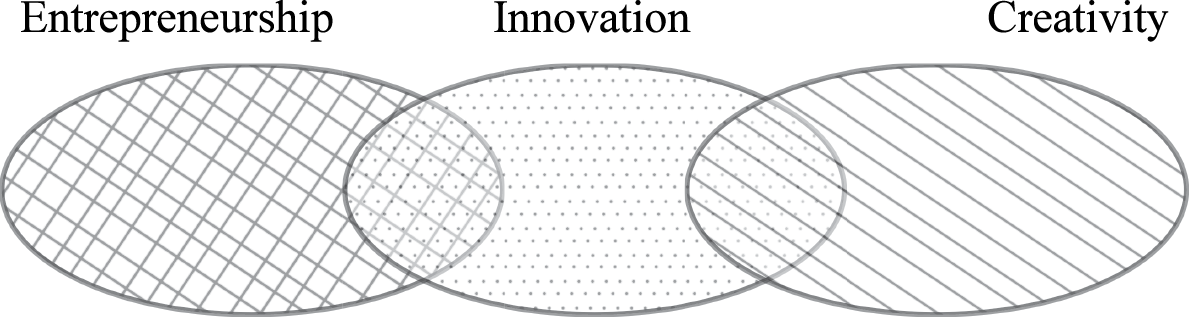
Innovation is not entrepreneurship. An innovation creates value for the adopter by solving a specific problem for them. That's half the entrepreneurship equation of creating and capturing value (Reference FaleyFaley, 2015a). Thought of in this way, innovation is part of the continuum of entrepreneurship. Put another way, as Peter Reference DruckerDrucker (1985) stated it, innovation is a tool of entrepreneurship. The two are part of one value-creation/value-capture continuum, although entrepreneurship is often taught solely from a value-capture perspective. There can also be entrepreneurship without innovation and innovation without entrepreneurship. We can create and capture value for a customer without creating something new. A franchise business does that. That's entrepreneurship without innovation. Alternatively, we can innovatively solve a personal problem for a friend. The friend's adoption of our new alternative and the impact it has on our friend makes it an innovation. But there is no “value-capture” portion, so no “entrepreneurship.” Figure 1.1 shows the overlap of the entrepreneurship and innovation. There is certainly overlap between the two, but not complete overlap.
Creativity, innovation, and entrepreneurship continuum.
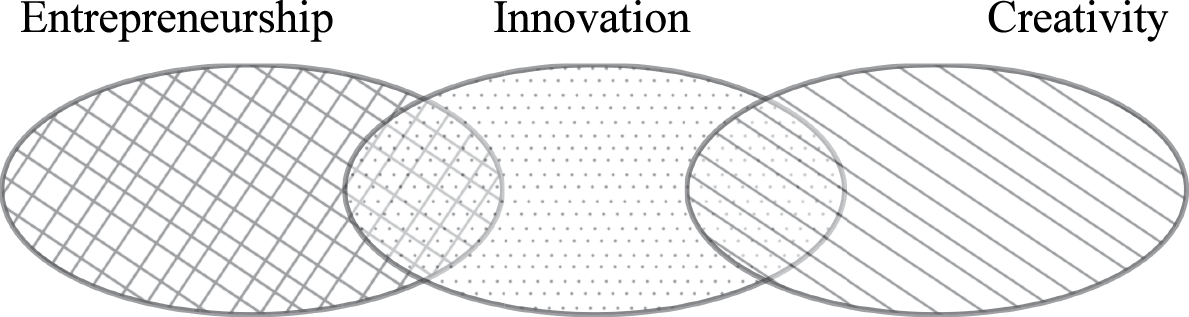
Innovation is also not creativity. Similar to innovation being the tool of the entrepreneur, creativity is the tool of the innovator. Creative thinking is the catalyst of innovation (Foursight, n.d.). We can do something “creative” that solves no problem and has no impact. As a result, we can be creative and not innovative as innovation is focused on problem-solving. Even a creative new product or service idea is not an innovation because the idea alone does not solve a problem. That idea could certainly lead to an innovation, but it is not a complete innovation. That idea must target a specific problem. No problem, no adoption. No adoption, no impact. No impact, no innovation. The identification of the real, underlying problem that needs resolving is part of the innovation process, but not necessarily part of being creative. Then there is the execution side of innovation which is not part of creativity. For a solution to be adopted, it must exist and be available to the adopter. In other words, that innovation concept must be created and delivered to the adopter. Those actions are part of innovation, but not part of creativity. While there is significant overlap between the two, as Figure 1.1 illustrates, innovation and creativity do not completely overlap.
In short, innovation is impactful problem-solving that leverages something “new.” Innovation overlaps with both creativity and entrepreneurship, but is not wholly either. The development of an innovation is a process of discovery; it is nonlinear, iterative, and knowledge-based. The Innovation Pyramid is a visual representation of a design thinking-based repeatable, learnable, nonlinear, iterative methodology that leverages the tools of creativity for its execution.
Why is Innovation Important?
We need critical thinkers who can uncover the underlying root causes of our present situations amidst the vast noise of information that inundates us. We need these thinkers to analyze the facts in an objective manner so that a rational judgment can be reached (Reference SchusterSchuster, 2018). And finally, we need them in all aspects of our life: in business, in government, in education, and in our personal lives. In short, we need impactful problem-solvers. We need innovators.
Impactful problem-solving – innovation – is necessary when stasis is no longer dominating or when incremental improvements on today's solutions will not get us where we want to be. We need new, impactful solutions that directly address today's problems, not simply polish yesterday's legacies. There are reasons the old solutions are not working today. The challenge is often not that the “solution” is outdated, but that the underlying cause of the problem has shifted. If the new underlying cause is not addressed, the desired impact will simply not be obtained.
For communities and individuals, innovation represents real change: not just window-dressing on old situations but something new that generates real, significant impact. The world is changing rapidly. We face, or will soon face – individually and corporately – new problems that will need data-supported solutions. We need a systematic way of approaching those problems, gathering the appropriate information, and creating those impactful solutions we long for.
While the need for innovations is in every aspect of our lives, the need is most easily measured in business. While we could certainly use innovations to address our personal issues, and on a larger scale, our societal issues, the corporate world needs them to survive. Innovation is consistently a top-five concern among CEOs according to TEC's Annual Global CEO Survey (TEC, 2018). Why?
Effect of competition-driven markets is, over time, to commoditize any differentiation a company has and thereby diminish its ability to win customers and win capital and to win sales at attractive margins; to create attractive returns. The only way to respond to that is to continually to come up with new differentiation and to do that you have to innovate.
Peter Reference DruckerDrucker (1985) puts it more succinctly. “Businesses must be able to innovate or else their competitors will render them obsolete.”
Innovation determines the firm's ability to create future cash flows through new products, services, and ways of operating (business models). Future cash flows determine a firm's market value. It should be of no surprise then that a corporate CEO, whose variable pay is tied to the value of their firm's stock, is focused on innovation.
Given its importance to business, one would think that they would have the innovation process down to a science, but they are not even close. According to the NSF report, of all manufacturing firms only 23 percent have introduced new or significantly improved products/services between 2012 and 2014. It ranged from a high of 56.3 percent for communications equipment companies to a low of 10 percent for wood product firms (Reference Kindlon and JankowskiKindlon, 2017).
The story is even worse for nonmanufacturing industries (i.e. services). Only 8.2 percent of firms have introduced new or significantly improved products or services during that period. Software firms led the way with 61.1 percent of firms introducing a new or significantly improved products or services during the 2012–2014 timeframe. The industry laggers were real estate or leasing firms at 4.7 percent.
While these numbers are dismal, the story is actually worse. There is “no correlation between the amount of money a company spends on research and development (R&D) and its overall financial results” (PWC, 2018). That strongly suggests that the conversion of discoveries and/or inventions to innovations is completely ad hoc at best. There appears to be no system for a firm – whose future is dependent on innovations – to become a serial innovator. Innovations occasionally occur, but randomly.
Why is it so Difficult to be A Serial Innovator?
Why is it so hard? Innovation requires three elements: people, place, process (Hasso, n.d.), or more generally, people, environment, and methodology.
People
There are actually two groups of people involved in generating impactful solutions: those creating the proposed innovation (the innovators) and those who have an issue they long to resolve (the adopters). While the innovator and adopter can be the same person, say if we are solving a problem for ourselves, would-be innovators too often project themselves as the “adopter” when they are not the ones suffering from the issue. Empathy is critical. The would-be innovator must have empathy for the adopter. The innovator must understand the would-be adopter's general issue and be able to drive that down to a specific need, want, or desire. That requires the innovator to see the world from the adopter's POV. The features of the innovator's proposed solution must align with the adopter's needs, wants, or desires. That requires that the innovator consider both what they can create and how that creation will align with the adopter's needs. That, in turn, requires multiple POV shifts throughout the innovation's development. This alone would make innovating difficult; as F. Scott Fitzgerald puts it, “The test of a first-rate intelligence is the ability to hold two opposed ideas in mind at the same time and still retain the ability to function.”
Unfortunately, while this duality of POVs is critical, the focus of innovation training is too often innovator-centric. While creating innovation teams with diverse thinking sets is absolutely necessary, it is simply not sufficient to become a repeatable innovator. “Putting the right people in a room” is not a replicable process. The method element is missing. If we wanted to build a house for someone and were going to put a group of people together that had never built a house before, it would make sense to get a diverse set of skills on the team: carpenters, plumbers, masons, electricians, etc. If the people are clever, they may eventually figure it out. The process would be neither efficient nor predictable, but they could accomplish the task sometimes. Sounds a bit like the noncorrelation between R&D spending and innovation, doesn't it?
Environment
The second piece of the innovation puzzle is the environment. There are actually two environments that matter: the environment of the innovators (often the environment inside the organization in which they work) and that of the potential adopters. For the innovator, knowing what to do and having the right people but not having a supportive environment will not lead to a positive result. “You cannot grow roses in concrete” (Reference MunroMunro, 2018). Let's say that we desire to drive from New York to California. We have a map and a car. We have people who know how to drive and can work together. What we do not have are the necessary fuel stations along the way, as our automobile operates on hydrogen. It is a nonsupportive environment for our trip. Some environments can be supportive, some neutral, while some are simply counterproductive to repetitive innovating. Does the culture of the organization treat failure as a part of the learning process or as a career-ending event? The former is the bare minimum requirement for a supportive innovation-development environment, while the latter is a toxic environment for would-be innovators.
The would-be adopter's environment is also critical. There must be a pathway for the would-be adopter to obtain the proposed innovation. There is no innovation without adoption. If there are significant barriers that separate the target adopter from the would-be innovation, then there will be no adoption. This is true even if every other part of the innovation development was performed perfectly. The adopter-impacting environment ranges from local laws or customs that prohibit or discourage the adoption of the potential innovation to financial or physical access barriers to the would-be innovation.
Methodology
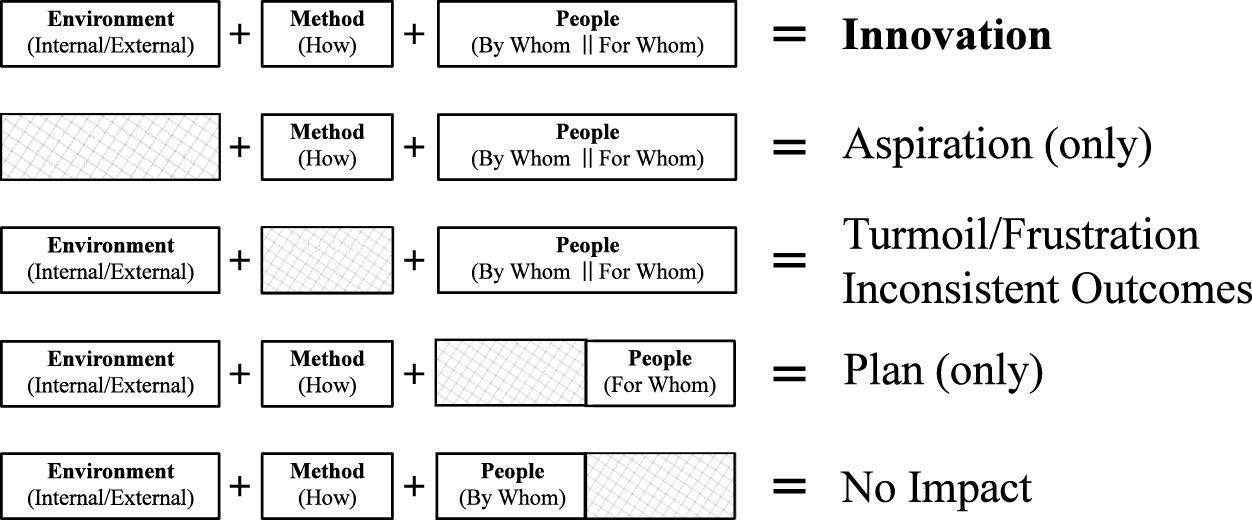
While the other two legs of the stool (people and environment) are definitely challenging, it is often the lack of a methodology that makes or breaks our ability to repeatedly create and deliver new impactful solutions. Figure 1.2 summarizes the impact of the lack of each of these elements on the desired outcome of creating an authentic innovation. Note that an inconsistent output is predicted by a lack of a repeatable methodology. That inconsistency sounds eerily familiar to the previously mentioned lack of a correlation between an organization's R&D spending and its ability to create innovations. Other common organizational outcomes are also identified in Figure 1.2.
Impacts of missing key factors of innovation.
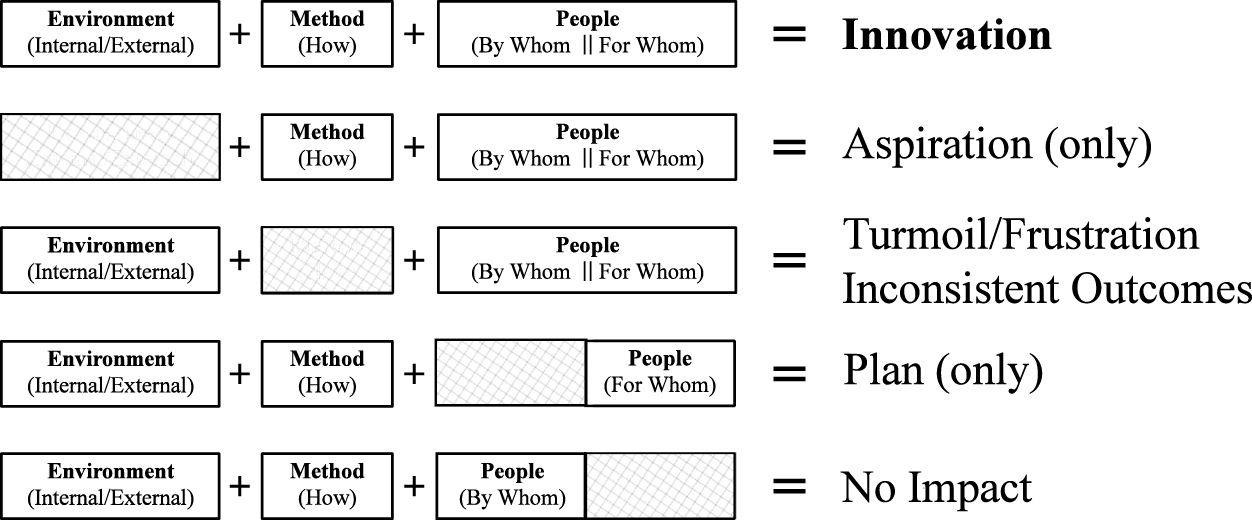
A method is not a guarantee for reaching an impactful solution. If we correctly follow a recipe, we will end up with a predictable result. This not the case for a methodology, as will be further explained in Chapter 2. A methodology is a system of procedures and/or techniques that allow the accomplishment of a set of tasks without guarantee of a specific outcome. A repeatable method controls a number of innovation-project variables, but not all of them. Those variables not controlled for will require our judgment. Judgment remains an important element in innovation development. Repeatable use of a consistent method provides a means to improve our judgment and therefore improve on our ability to become serial innovators.
The focus of this book is describing a learnable, repeatable, nonlinear, iterative, knowledge-based methodology for generating innovations. The method's description will seem foreign to some and obvious to others. Naturally gifted serial innovators operate on instinct. They just “know” things should be done a certain way and a certain order. They are very intuitive. That's great. For them. Some do not even realize they are following a methodology, but they are. They may even argue that it cannot be “taught” as they are “born” with this ability. That is simply not true; any method, once identified, can be codified and learned. The methodology described in this book is a codification of methods practiced by successful intuitives. The method presented is certainly not the only viable method, but it is one that works.
The design thinking-based Innovation Pyramid, which is detailed in Part I of this book, describes this needed overarching guide. This part presents the macro-level view of innovation development. Those that prefer to learn from the general-to-specific should begin reading here. The second section of the book (Part II) details the creativity-based Diverge–Organize–Converge (DOC) Process essential to implementing The Pyramid methodology. This is the micro-level view. Those that prefer to learn from specific-to-general could read this part first, and then read Part I. The order of the reading does not matter. The Innovation Pyramid can be thought of as the assembly instructions while the DOC Process provides the toolset necessary to perform the assembly. Together they create a learnable, implementable, repeatable means for developing true innovations. Innovations that will generate real, positive impact.
Unique Aspects of the Innovation Pyramid Methodology
The Innovation Pyramid book differentiates itself from other offerings on innovation in several distinct ways. First and foremost, this book is focused on a methodology for innovating. Most other books on innovation target the people side of innovation. They either focus on assembling an innovation team with the right combination of innate abilities or they focus on developing an individual's creativity skillset.
The Innovation Pyramid is a visual representation of a strategic approach for developing impactful solutions to real problems, or in other words, to create innovations. The user-centric, design thinking-based Innovation Pyramid is a physical representation of a repeatable overarching guide, or roadmap for producing innovations. The overarching methodology is articulated in Part I of this book. The methodology leverages the creativity-based DOC Process detailed in Part II of this book. The DOC Process can be used on its own to improve our problem-solving ability, but more importantly, is essential to reducing The Innovation Pyramid to practice. Think of the DOC Process as a set of tools that helps us implement the overarching methodology, similar to a wrench set being the specific tools which allow us to rebuild an engine. The tools alone are not enough. Simply having a set of tools, and having no other knowledge about engine reconstruction, would not allow us to get the job done. On the other hand, if we had a step-by-step guide for rebuilding an engine, but had no tools or understanding of their use, then that guide would be nothing more than a theoretical construct. Together the two parts get us there. The Innovation Pyramid is the overarching pathway for developing an innovation and the DOC Process provides the means to transform that construct into reality. The book can be read in any order. Detail-oriented readers may want to read Part II before moving on to Part I, while those that prefer the big-picture before the details can read it as presented.
The Innovation Pyramid methodology distinguishes itself through its bifurcation of the innovation process. It first separates the innovation's design from its execution. The top two levels of The Pyramid represent the design, while the lower half represents the execution stages. The design and execution levels are each further bifurcated. In the design half, the identification of the problem is separated from the creation of a solution. This requires the recognition and balancing of a number of POVs. In the execution portion of The Pyramid, the planning and resourcing of the innovation project are separated from the plan's implementation. Finally, The Pyramid has built-in assessment at each of the design and execution stages, in addition to providing a structure for reviewing and learning from the entire innovation project.
Design/Execution Separation
One differentiating approach of The Innovation Pyramid methodology is separating design from execution. There are two parts to developing anything. Design it first, then execute it. Or put another way, “All things are created twice. There's a mental, or first creation, and a physical or second creation to all things” (Reference CoveyCovey, 2008). The activities of “design” and “execution” are often inadvertently intertwined so as to confuse the two. They, of course, flow back and forth, but design first, then execute. The Innovation Pyramid methodology is segmented into four levels, two design and two execution. Both design and execution transition from a broad purview, to ensure that nothing is overlooked, to a zoomed-in detailed implementable view. Delineating these steps allows for both straightforward innovation development and post-project review.
Problem/Solution Separation
Within the design stages, the method separates the problem from the solution. Other offerings muddle the two or in other ways short-change the identification of the core problem. It is impossible to generate a perfect solution to an ill-defined problem. The reality is that focusing on Problem Identification (i.e. working in the “problem space”) for an extended period of time is, however, difficult and unnatural. We human beings think in terms of actions. Those actions are solutions to situations. It likely goes back to our “fight or flight” response. When that saber tooth tiger was charging at our ancient ancestors, they did not pause to consider the root of the problem by asking “why” this tiger may be attacking them. Was the tiger hungry? Did our ancestor inadvertently threaten it? No. They went into action … they fought it or ran from it to survive. But today's problems are more complex. Just tossing random answers at them no longer works. We need to really understand the problem we are trying to solve before attempting to solve it. That seems obvious, but it is much easier said than done.
Most of us are so solution-oriented that we actually think our proposed solution describes the problem. It does not. The proposed solution is only the mirror image of the problem. When we examine something only by looking at in in a mirror we lose depth. We have to retrain ourselves to “transition” to the other side to get the full immersive experience; to understand the know-how and know-what of the problem before attempting to develop solutions for it. That will be unnatural and feel uncomfortable. We will make excuses to avoid doing it. Excuses like “this is a waste of time; we already know what the problem is.” Go slow to go fast. That's the facilitator's axiom and it fully applies here. To avoid a lot of false starts and solutions that do not create the desired impact, we must learn to stay in the problem space as long as we can stand to do so. That will take patience and plenty of empathy for the would-be adopter of the innovation. Without empathy, we will not be able to remain in the problem space long enough to dig down to the root of the real issue. Without empathy we will prematurely jump to “solution space” – start to propose solutions. Without empathy we will not create impact. Diagnose before prescribing. The Innovation Pyramid methodology will keep us in the problem space long enough to fully understand the root-cause issue before moving onto creating solutions.
Plan/Implement Separation
Similar to the design stages, the execution section of The Pyramid is also bifurcated. Execution is separated into Plan and Perform. This separation increases efficiency by focusing us on the activities we need to perform when we need to perform them. It also aids in diagnosis. The implementation team is often vilified when the innovation project fails. Was it really an implementation issue or was it a poor plan? Separating the two makes this diagnosis possible.
Multiple Points-of-View
Yet another differentiator of the approach described in this book is the consideration of multiple POVs. Both the would-be innovator and the would-be adopter POVs, as well as their unique environments, are considered. Generating impact is not just about those creating the innovation, we must also deliver it to the innovator. It must also create value for the adopter. That value-creation is from the adopter's POV, not the innovation creator's. The method of creating an innovation that is laid out in this book requires going back-and-forth between those two POVs at each of the four levels of The Innovation Pyramid, not just during the two design levels. In addition to these two POVs, there may be collaborators inside and outside the innovation-creation organization that will be involved in the project. Their POVs must also be taken into account.
Assessment Throughout
The final differentiator of The Innovation Pyramid methodology is that assessment is performed at each Pyramid level. Each of the two design and each of the two execution stages have evaluative conditions to meet. The assessments start as very qualitative, but increase in rigor as we descend down The Pyramid. This approach allows for quick pivots at the early stages and increasing more rigorous ones as we approach implementation.
Since this is a methodology and not a recipe, even though assessment is performed at each level of the methodology to determine if rational and reasonable choices are being made, the overall outcome may still end up not being what was desired at the start. The final project assessment is a systematic review of each layer of The Pyramid, revealing how choices made at each layer may have resulted in the nondesired outcome. Once the root-issue is uncovered, the innovator iterates back to the appropriate level, alters their original choice, and proceeds again from that point. This is particularly important when utilizing The Pyramid in creating a prototype or pilot program. While it is not uncommon to traverse through The Pyramid multiple times in the development of an innovation, it is guaranteed in the development of a prototype or pilot program. In these cases, all levels of The Innovation Pyramid will be completed during the completion of a prototype or pilot program. After their implementation, a systemic review of the project, utilizing the method of Chapter 7 should be performed. This additional insight gained from the review, plus the knowledge gained from the pilot (or prototype), is then utilized in traversing The Pyramid a second time for the development of the final innovation.
Organization of the Book
This book reflects the nonlinear iterative nature of innovating by not being laid out in a linear fashion. Rather, the book is organized into two integrated, but stand-alone sections. The reader can benefit from reading either section of the book, but combined they constitute a serious step toward becoming a serial innovator. The sections can be read in any order.
The first of the two sections (Part I) lays out the overarching innovation methodology of the design thinking-based Innovation Pyramid. The Innovation Pyramid is the overarching, zoomed-out pathway; it is a project's assembly instructions. The second section (Part II) describes the use of the creativity-based DOC Process. The DOC Process has multiple uses on its own, but more importantly, is essential to reducing The Innovation Pyramid to practice. The DOC Process is a zoomed-in toolset required to complete the assembly described in the first part of the book. Finally, the book's appendixes highlight detailed DOC Process techniques for use in both the problem space and the solution space. The remainder of this chapter highlights the key concepts of the remaining chapters and appendices.
Part I: Innovation Design and Execution
Chapter 2 – Introduction to The Innovation Pyramid
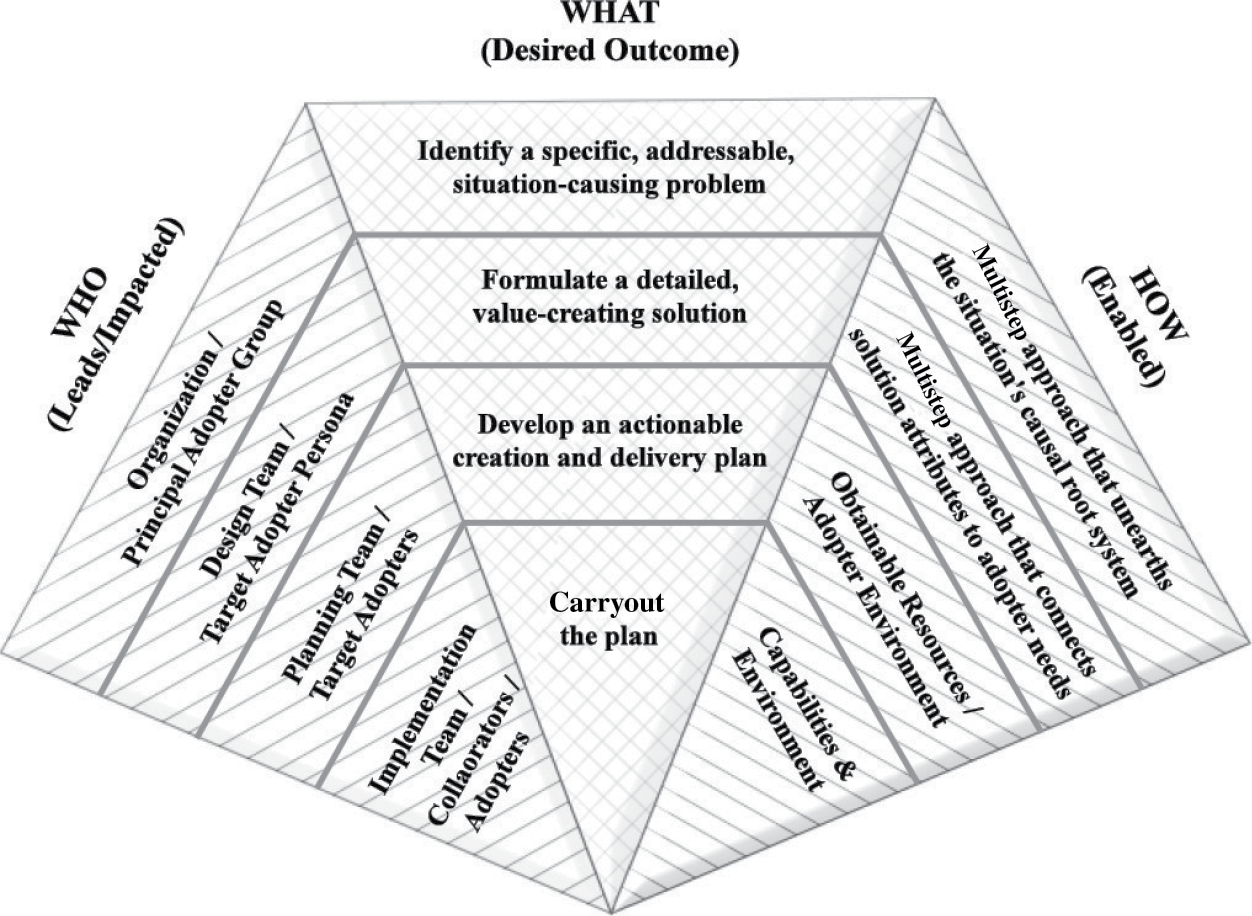
Key Concept: Part I of the book, starts with Chapter 2, an overview of The Innovation Pyramid methodology. The chapter describes the overall approach to using The Innovation Pyramid. The overarching method is visually encompassed as The Innovation Pyramid, an inverted triangular pyramid that is sliced into four layers (see Figure 1.3). The three sides of The Pyramid represent the “What” (desired outcome for that level), the “Who” (those who are leading and/or impacted by the activities at this stage), and the “How” (how the desired outcome of each layer is achieved). Each layer of this section incorporates at least two POVs (the innovation creator and its adopter). The interior of The Pyramid is assessment, which occurs at each level. The top two levels of The Pyramid focus on the innovation's design, while the bottom two layers concentrate on the innovation's execution.
The Innovation Pyramid laid flat.
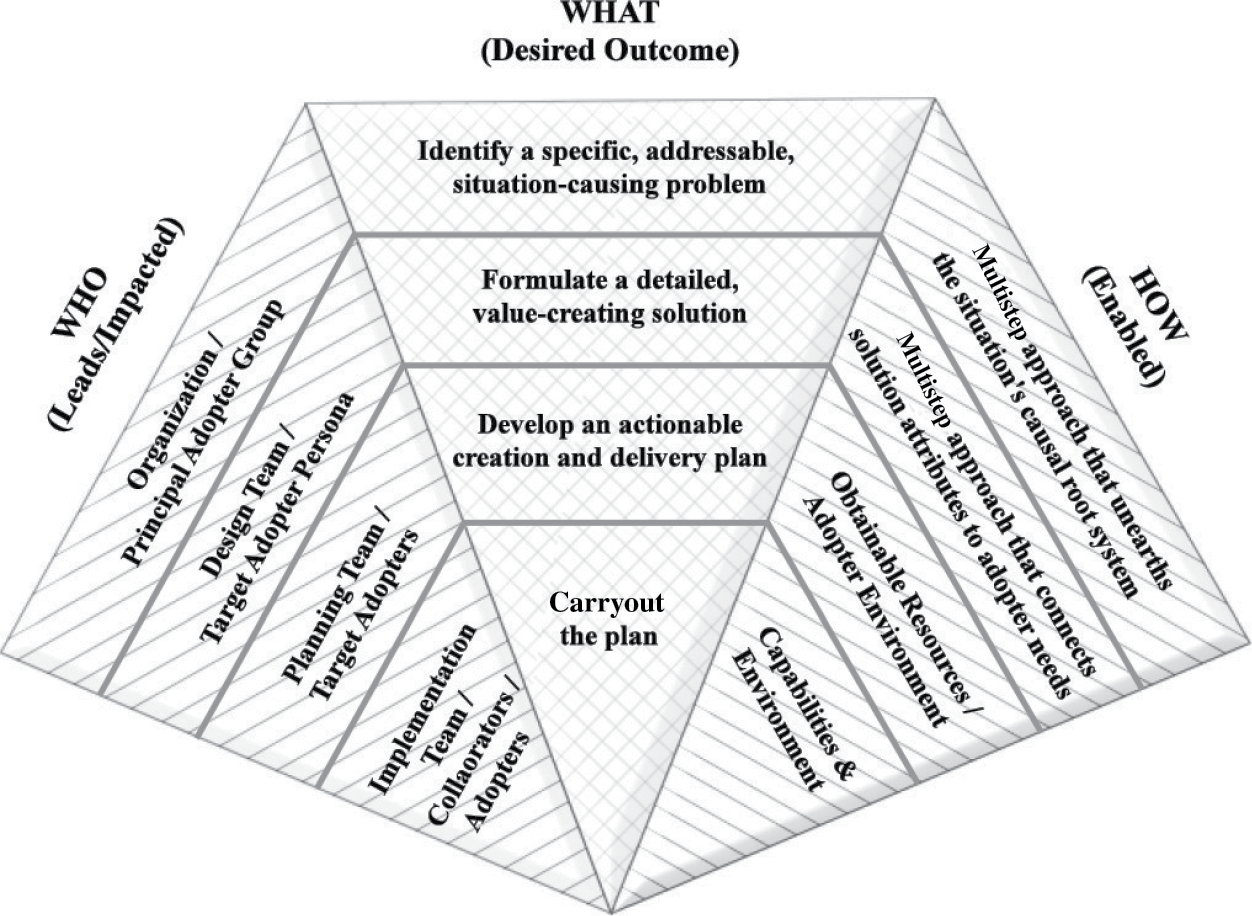
This chapter additionally describes the overall layer-by-layer flow necessary to move from the original situation we find ourselves in to implementing a new impactful solution. Given The Pyramid describes a nonlinear process, while there is a general “flow” through The Pyramid, there is no sequential step-by-step checklist to follow. The order is not as important as completing every segment of The Pyramid. Chapters 4–6 detail each layer of The Pyramid. Each of those chapters concludes with a “Common Mistakes” section describing the common errors incurred at that level of the methodology. While each chapter describes specific techniques and examples, one overarching example transcends the design levels of The Pyramid illustrating how the method flows from level to level for a specific project.
Chapter 3 – Level 1: Problem Identification
Key Concept: The Innovation Pyramid segments the innovation's design from its execution. The design stage is further segmented into Problem Identification and Solution Formulation. The first level of The Pyramid, which is the first stage of the innovation's design, describes a procedure for identifying and defining root causes of larger situations. Like The Innovation Pyramid itself, this five-step procedure for Problem Identification is a nonlinear and iterative process of discovery. These steps also incorporate a core tenet of The Pyramid which is: diverge before converge. The methodology consistently prompts us to broaden our purview before narrowing it.
Chapter 4 – Level 2: Solution Formulation
Key Concept: The second design stage focuses on creating an impactful solution. The first step is to narrow The Principal Adopter group, the general group for whom the innovation is being created, identified at the end of Level 1, to a Target Adopter persona with specific needs, wants, and/or desires. The Target Adopter is the specific group for whom the innovation is designed and creates value. The five-step guideline for completing this stage is as follows:
Step 1: Describe a specific Target Adopter persona.
Step 2: Determine a solution approach.
Step 3: Craft a detailed solution.
Step 4: Establish a clear value proposition.
Step 5: Quantify the Target Adopter group size.
The final step in this stage is to quantify the size of this Target Adopter group. This step may be temporarily skipped until that specific information is needed in Level 3. The objective is to keep the design detailed, but qualitative until it is understood that it can be successfully executed.
Chapter 5 – Level 3: Plan
Key Concept: This chapter transitions from the innovation's design to its execution. The purpose of this level is to develop a creation and delivery plan. The plan must include how the innovation will actually be created, of course, but it must additionally articulate how that created innovation will be delivered to the adopter. The complete plan identifies the implementation team as well as the resources required to execute the plan. If those resources are unobtainable, then the plan must be modified. This creation and delivery plan will also be utilized as a “sales” document necessary to pitch this concept to potential supporters or detractors.
Chapter 6 – Level 4: Perform
Key Concept: This chapter is about implementation – getting it done. This level focuses on assessing the performance of the plan; the team and the environment associated with both the innovation's creation and its delivery to the adopter. Too often implementation focuses on the people alone; it must also examine both the innovator's “internal” environment in addition to externalities that may impact the innovation creators or its adopters.
Chapter 7 – Systematic Pyramid Review
Key Concept: The overall methodology described in this book is both nonlinear and iterative. There are many choices that must be made along the way. While assessment is performed at each level to ensure that rational and reasonable choices are being made, the overall outcome may still end up not being what was desired at the start. The plan's implementation team is typically unfairly vilified when this occurs. This chapter lays out a systematic review of each layer of The Pyramid, revealing how choices made at each layer may have contributed to the nondesired outcome. Once the root-issue is uncovered, the innovator iterates back to the appropriate level, alters their original choice, and proceeds again from that point. This is particularly important when utilizing The Pyramid in creating a prototype or pilot program. In those cases it is known that The Pyramid will be traversed more than once. Once for the development of the prototype and a second time for the development of the final innovation.
Part II: The Diverge–Organize–Converge Process
Chapter 8 – Diverge–Organize–Converge Process Overview
Key Concept: This second part provides details of the creativity-based DOC Process. The DOC Process can be used on its own to improve our problem-solving ability, but more importantly, is essential to reducing The Innovation Pyramid to practice. The DOC Process has three steps: Diverge, Organize, and Converge. This chapter provides an overview of those three steps and how this process can be applied to either the problem space (identifying a root-cause problem) or its more common application to the solution space (generating new solution concepts). Similar to the design chapters, one overarching example transcends all three steps of the DOC Process illustrating how the method flows step to step.
Chapter 9 – Diverge
Key Concept: This chapter describes in detail how to use the first step in the DOC Process – Diverge. As with every step of the DOC Process, Diverge applies to both Problem Identification and Solution Formulation. Most often this technique is used to “brainstorm” new solutions to problems. Rarely is it used to actually identify the problems which these solutions hypothetically fix. Both, however, are necessary. This chapter illuminates the subtle differences between how to apply the technique to the problem space as well as the solution space.
Chapter 10 – Organize
Key Concept. The Organize step, the second step of the DOC Process, is the transition step between the divergent-thinking process of step one and the convergent-thinking process of step three. This important Organize step has characteristics of both the divergent and convergent steps. The Organize step may cause us to return to the Diverge step before proceeding to the Converge step of Chapter 11. This makes the DOC Process a nonlinear process inside the nonlinear methodology that is The Innovation Pyramid. Creative-thinking sessions tend to break down after the divergent-thinking step. This chapter describes how the proper use of the Organize step will resolve this common issue.
Chapter 11 – Converge
Key Concept: This chapter describes the function and use of the third step of the DOC Process, Converge. The ultimate desired outcome for the Converge step of the DOC Process is to make a choice; choose the “best.” This is true whether we are working in the problem or solution space. An important element of this step, therefore, is to consciously define the criteria by which we will be selecting the “best” so as to create a “level evaluation field” for all concepts that are being judged. As with the Organize step, the criteria definition may cause us to return to either the Diverge or the Organize step. Despite the number of iterations through the steps, the DOC Process ultimately ends with a single choice.
Chapter 12 – Book Summary
Key Concept: This chapter wraps up the entire book and provides final insights. This book is for innovators, individuals, and corporations who want to become serial innovators. Innovation is a learnable skill that virtually everyone needs today. In various aspects of our lives, we are all confronted with new and challenging problems where the “tried and true” approaches of yesteryear no longer yield the longed-for result. To resolve that dilemma, we must innovate. In both small and large ways, we all need to improve our abilities to innovate. This chapter summarizes the book's methodology for innovating.
Appendices
Appendix A: Interviewing for Insight and Persona Development
Key Concept: Interviewing for Insight (IFI) and Persona Development are unique techniques for applying the DOC Process. Uncovering adopter group's needs/wants/desires is an exercise in tacit knowledge discovery. This appendix provides detailed instructions on how to implement the IFI technique to uncover adopter needs, wants, and/or desires. Once a plethora of needs/wants/desires are uncovered, the second half of this appendix illustrates how that information is shaped into personas – arch-type adopters that make choices based on a specific and unique combination of needs, wants, and/or desires. Overall, this appendix describes an alternative implementation of the DOC Process. The needs identification via the IFIs is the Diverge step. Persona creation is the Organize step and the selection of one persona to target, the Target Adopter, is the Converge step of that process.
Appendix B: Divergent-thinking prompts
Key Concept: Tools, like a screwdriver, are useful to have and know how to use. In-and-of-themselves, however, tools alone do not fix anything. Once armed with an innovation methodology, however, having a wide assortment of tools can expand our ability to innovate. This appendix reviews a number of tools and techniques aimed at expanding divergent thinking. These tools generally fall into two categories: ones that coax us to shift our POV and others that help us alter our perspective.