

ἀρχαῖος (old) + λόγος (study)
Archaeological sites are of potential value to a wide range of disciplines other than archaeology when they provide orderly chronologies. In this contribution, I discuss examples including geophysics (the Mount Carmel caves), palaeomagnetism (Lake Mungo) and DNA analysis (New Zealand).
The close association between archaeology and the natural sciences dates from 1837, when Boucher de Perthes discovered artefacts in Somme gravels containing the bones of extinct animals. The bonds have grown progressively closer. Archaeologists have added isotope geochemistry and genetics to geology, botany and zoology in their scientific armoury, and the existence of journals devoted to archaeological science suggests that the process of assimilation is by no means over.
The main beneficiary of this trade would thus seem to be archaeology. But the imbalance is not as pronounced as my bald equation suggests. To begin with, the non-archaeologists have found interesting applications for their skills and doubtless gained insights into their own fields from their foreign adventures. Consider the revelations of primate archaeology (Reference WhitenWhiten 2013) and palaeopathology or the controversies raised by archaeoastronomy. Then there is archaeological dating in the sense of using artefacts or other archaeological indicators to date geological or other events: often derided, it remains a powerful tool if handled expertly. For example, the closing date for the Pleistocene Lisan lake that occupied the Jordan rift—14 kyr—obtained by exhaustive U-Th isotope analysis (Torfstein et al. 2013) is in fair agreement with the date of 20–14 kyr derived from a flint bladelet of Kebaran type found in situ which was matched by Lorraine Copeland with carbon-dated counterparts in the region (Copeland & Vita-Finzi 1978).
But the issue I wish to highlight is the contribution made by archaeologists to a wide range of disciplines simply by providing an orderly and trustworthy dated archive. I came to realise this when re-examining the Mount Carmel cave sites in Israel four decades after working on their prehistoric economy with Eric Higgs (Vita-Finzi & Higgs 1970). The realisation was prompted by the publication of several ESR, TL and mass spectrometric 230Th/234U dates on artefacts and bones from the caves (e.g. Stringer et al. 1989; Grün & Stringer 2000).
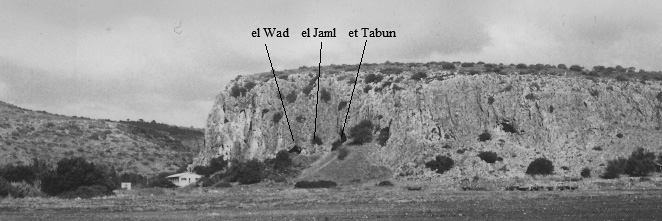
Mount Carmel, showing the locations of El Wad, El Jaml and Et Tabun.

The original excavations by Dorothy Garrod and her colleagues took place in the 1930s and were therefore innocent of radiometric dating. The final reports (Garrod & Bate 1937) referred to abraded Levalloiso-Mousterian artefacts from El Wad and Es Skhul (respectively in layers F and C) at about the same elevation (44.5m). Garrod argued that the artefacts in El Wad had been rolled by an intermittent spring at the rear of the cave but this seemed to me implausible. It was simpler to accept that the two layers had been subject to the action of marine waves. Et Tabun, which lies somewhat higher, is full of windblown sand, so that its stratigraphy—though inherently messy—is consistent with a location above a shoreline (Figure 1).
In 1970, Higgs and I accepted the prevailing view, based on the available 14C dates (from Et Tabun) that the Levalloiso-Mousterian of Mount Carmel dated from about 35–40 kyr BP (Reference WeinsteinWeinstein 1984). This seemed to rule out the shoreline hypothesis as sea levels at the time were perhaps 120m lower than today; to attain their present elevation, the caves thus had to have been uplifted by some 150m since the deposits accumulated—and away from tectonic plate margins prolonged uplift at an average rate of 4mm/yr is unusual. Nevertheless I put the shoreline on the published map to stimulate discussion. (No one seemed to notice.) The new dates, which were of course obtained with palaeoanthropology in mind, were in the range 100–135 kyr for layer B (immediately above C) in Skhul. The crucial deposits thus accumulated when global marine (interglacial, isotope stage 5e) levels were about 5–6m above the present level in the eastern Mediterranean (Vita-Finzi & Stringer 2007).
The equivalent uplift rate would now be a modest 0.4mm/yr. Even so there were strenuous objections from archaeologists and geologists familiar with the region (e.g. Ronen et al. 2007; Zviely et al. 2009) over the marine interpretation of the deposits and the notion of vigorous uplift at Carmel, but it is the geophysical implications that concern us here. Mount Carmel is bordered by a fault which branches north-west from the Dead Sea Rift and heads towards Haifa. The fault has been the site of historical earthquakes (Hofstetter et al. 1996) and some geodesists have detected evidence along its course of uplift at 5mm/yr (Reference Even-Tsur, Stiros and PytharouliEven-Tsur 2003). At all events the cave evidence shows that Picard & Kashai (1958) were right to view the Mount Carmel block as highly unstable and it quantifies the instability more fully than any geophysical or geodetic sources have hitherto managed.
Naturally sites are not normally excavated for the benefit of all comers and most excavations have a very specific client in mind. Consider a Roman fort, or a medieval midden: the procedures adopted, though they doubtless accord with the standards prevailing in the archaeological community, will have been tweaked to answer specific questions or perhaps to illuminate a range of topical issues. In any case, considerations of personnel and funding will tend to rule out catering speculatively for some future enquiry.
My thesis seems all the more fragile when the site does not boast conventional stratigraphy, as at Lake Mungo, in Australia, where erosion has removed much sediment which was windblown in the first place, leading to what has been termed horizontal stratigraphy. The age of the cremated Mungo skeleton was put at 24,500–26,500 yr BP by reference to 14C ages on shells and charcoal from sediments bordering the fossil Lake Mungo, as well as on bone fragments (Bowler et al. 1972). The sites yielded various hearths from which Mike Barbetti was able to show that the geomagnetic field between c. 30,780 and 28,140 yr BP departed from its present orientation by 120° and had a field strength much greater than the present (Barbetti & McElhinny 1976). The relevant 14C dates on charcoal were later supported by TL ages on quartz grains in the baked clay with an average of c. 35,000 yr BP (Huxtable & Aitken 1977).
Some investigators think the excursion was in fact the product of a lightning strike and thus has no global significance, but the archaeological context suggests that we are dealing with a thermoremanent effect and not one due to diagenesis or sedimentology (Reference JacobsJacobs 1994). Excursions, like full blown magnetic reversals, are of great significance as they reflect events within the Earth's core. Moreover, changes in the field strength influence the flux of cosmic rays, which bear on 14C generation and perhaps also mutation rates. Quite apart from its bearing on site history and the peopling of Australia, the Lake Mungo evidence appears to supply a secure marker for a phenomenon for which the field data are generally open to challenge (Reference VerosubVerosub 1982).
My final illustration of the value inherent in excavated sites bears on the vexed question of DNA degradation. Insects in amber and dinosaur bones are among the more spectacular subjects of DNA analysis, but genome information bears on numerous aspects of evolutionary and ecological research where antiquity is not necessarily the primary issue.
Work based on 158 bones of the extinct flightless bird, the moa, from sites in New Zealand within a restricted area and with a burial temperature of 13.1°C has yielded a half-life of 521 years for a DNA mitochondrial sequence dating from 242 BP (Allentoft et al. 2012). Nuclear DNA degrades at least twice as fast. Although the range of post-mortem environments was limited, the results displayed substantial variance between the sites which the authors attributed to differences in taphonomy and bone diagenesis.
Yet 2013 saw the publication of a draft genome sequence for Equusremains recovered from a site in the Yukon dated to 560,000–780,000 BP (Orlando et al. 2013) where permafrost conditions had persisted since deposition. The study concluded that a significant fraction (6.0–13.3 per cent) of short DNA fragments can survive over a million years, opening the door to useful analysis of material hitherto considered too old. It also reinforces the need for even more stringent environmental calibration of DNA degradation, ideally at a single stratified site insulated from misleading departures from the chosen temperature and humidity.
Mortimer Reference WheelerWheeler (1954) complained that vertical excavation amounted to timetables without trains. We have plenty of trains but have not always sorted out the timetables.
Acknowledgements
I thank the Department of Archaeology, University of Western Australia, for hosting the talk on which this note is based, and Mike Barbetti, Adrian Lister, Chris Stringer and Karl-Heinz Wyrwoll for discussions.