

Introduction
The concept of animal welfare is continually evolving to go beyond the prevention of negative welfare to include opportunities for positive experiences, and providing animals with agency is a fundamental component of promoting positive animal welfare (Rault et al. Reference Rault, Bateson, Boissy, Forkman, Grinde, Gygax, Harfeld, Hintze, Keeling, Kostal, Lawrence, Mendl, Miele, Newberry, Sandøe, Špinka, Taylor, Webb, Whalin and Jensen2025). An animal has agency when they can act on their will; animal welfare scientists generally define agency as the ability or propensity of an animal to engage with the environment in a manner beyond what is required to satisfy their immediate needs, and rather to pursue goals, develop skills, or acquire information on a voluntary basis (Špinka & Wemelsfelder Reference Špinka and Wemelsfelder2011; Špinka Reference Špinka2019; Mellor et al. Reference Mellor, Beausoleil, Littlewood, McLean, McGreevy, Jones and Wilkins2020; Englund & Cronin Reference Englund and Cronin2023; Littlewood et al. Reference Littlewood, Heslop and Cobb2023). Many welfare scholars refer to the ‘three Cs’ of agency, which are choice, control, and challenge; that is, the ability to choose between options, to effectively control outcomes, and to engage in challenging opportunities that require skill to achieve a goal. Some authors also refer to a fourth C, competence, which an animal can achieve when they have developed the skills to manage novel challenges; increased competence is one way in which exercising agency can improve an animal’s welfare (Badihi Reference Badihi2006; Englund & Cronin Reference Englund and Cronin2023; Littlewood et al. Reference Littlewood, Heslop and Cobb2023). Studies in many species, including humans, have demonstrated that agency and control are inherently rewarding and even that acting on a responsive environment is a biological necessity (Moon & Lodahl Reference Moon and Lodahl1956; Badihi Reference Badihi2006; Leotti & Delgado Reference Leotti and Delgado2011; Buchanan-Smith & Badihi Reference Buchanan-Smith and Badihi2012; Perdue et al. Reference Perdue, Evans, Washburn, Rumbaugh and Beran2014; Špinka Reference Špinka2019; Cussen & Reid Reference Cussen and Reid2020; Mellor et al. Reference Mellor, Beausoleil, Littlewood, McLean, McGreevy, Jones and Wilkins2020; Browning & Veit Reference Browning and Veit2021; Littlewood et al. Reference Littlewood, Heslop and Cobb2023). There has been an increased interest in the use of ‘choice and control’ as welfare measures for captive animals; in their scoping review on the topic, Rust et al. (Reference Rust, Clegg and Fernandez2024) identified papers that assessed the welfare effects of choice on animals in many species, including mammals, birds, and fish.
In addition to species considerations, keeping in mind an individual animal’s unique and distinct needs, wants, and preferences is also vital to ensuring positive welfare. One reason that it is important to provide animals with an ability to choose is that there is substantial individual variation in preferences (for conspecific affiliates, human interaction, dietary components, etc.), coping styles (behavioural and physiological responses to stressors), and physical needs (Smith et al. Reference Smith, Jones, Carlson and Pascoe1994; Scheibe et al. Reference Scheibe, Eichhorn, Kalz, Streich and Scheibe1998; Pedersen et al. Reference Pedersen, Søndergaard and Ladewig2004; Napolitano et al. Reference Napolitano, De Rosa, Braghieri, Grasso, Bordi and Wemelsfelder2008; Budzyńska Reference Budzyńska2014; Squibb et al. Reference Squibb, Griffin, Favier and Ijichi2018; Kieson et al. Reference Kieson, Felix, Webb and Abramson2020, Reference Kieson, Goma and Radi2023; Hartmann et al. Reference Hartmann, Rehn, Christensen, Nielsen and McGreevy2021; Kelemen et al. Reference Kelemen, Grimm, Vogl, Long, Cavalleri, Auer and Jenner2021; Pearson Reference Pearson2022; Rankins & Wickens Reference Rankins and Wickens2020; Torres Borda et al. Reference Torres Borda, Auer and Jenner2023; Merkies et al. Reference Merkies, Visneski, Danel, Carson, Elu and Fritsch2024; Loftus et al. Reference Loftus, Newman, Leach and Asher2025; Wolframm et al. Reference Wolframm, Engels, Lindström and Forssman2025). Individuals within the same management system may experience very different animal welfare states (Marchant-Forde Reference Marchant-Forde2015); one way to address this challenge is to provide animals the opportunity to make choices and to have a degree of control over their own lives.
Provision of choice, along with control over the environment and opportunities that challenge the animal, are of course primarily of concern in captive animals because most aspects of their lives are directly controlled by humans (Badihi Reference Badihi2006; Browning & Veit Reference Browning and Veit2021; Englund & Cronin Reference Englund and Cronin2023; Littlewood et al. Reference Littlewood, Heslop and Cobb2023). Domestic captive animals generally have reduced freedom as compared to their wild counterparts, with a trade-off of human provision of resources (DeSilvey & Bartolini Reference DeSilvey and Bartolini2019; Browning & Veit Reference Browning and Veit2021). In horses, this has meant a switch from their natural environment to settings that are convenient for caretakers and owners, such as being kept in stalls, eating discrete meals of concentrate, and having limited conspecific contact (Pedersen et al. Reference Pedersen, Søndergaard and Ladewig2004; Dierendonck & Goodwin Reference Dierendonck and Goodwin2005; Goodwin Reference Goodwin and Waran2007; Hemsworth et al. Reference Hemsworth, Jongman and Coleman2015). Horses evolved as free-ranging herbivores who live in herds and spend the majority of their daily time budget grazing; indeed, feral and extensively managed populations of horses live in much the same manner today as the horses of over 6,000 years ago did before humans domesticated them (Waran Reference Waran1997; Goodwin Reference Goodwin and Waran2007; Taylor et al. Reference Taylor, Lancaster and Ellis2025). That is to say, domestication has had little effect on inherent equine behaviour and, when given the opportunity, horses tend to choose to live in a way that reflects their evolutionary history and needs (Waran Reference Waran1997; Søndergaard et al. Reference Søndergaard, Jensen and Nicol2011; Taylor et al. Reference Taylor, Lancaster and Ellis2025). Colloquially, horses are said to require the “Three Fs,” or “Friends, Forage, and Freedom” to have good welfare (Fraser Reference Fraser2012), which aligns with the aforementioned evolutionary needs of the species. Indeed, Krueger et al. (Reference Krueger, Esch, Farmer and Marr2021) conducted a meta-analysis of studies that investigated the effects of restricting these behavioural needs, and concluded that there is sufficient evidence to define social contact, access to roughage, and freedom of movement as basic needs in horses. A study by Phelipon et al. (Reference Phelipon, Hennes, Ruet, Bret-Morel, Górecka-Bruzda and Lansade2024) demonstrated that horses with fewer restrictions in the 3Fs had more indicators of positive welfare, and a meta-analysis of time-activity budgets in horses found that management that promotes social interaction, foraging opportunities, and locomotion is associated with improved welfare (Lamanna et al. Reference Lamanna, Buonaiuto, Colleluori, Raspa, Valle and Cavallini2025).
In addition to the species’ evolutionary needs, horses’ function in society also has a substantial impact on their welfare. Horses have a unique role in society in that they are considered livestock both legally and practically in many cultures, but are also viewed or treated as companion animals by many owners (Hemsworth et al. Reference Hemsworth, Jongman and Coleman2015; Fletcher et al. Reference Fletcher, Cameron and Freeman2021; Carroll et al. Reference Carroll, Sykes and Mills2022). Still others would place horses in a separate category of ‘sport’ animals, and view horses as serving a function related to entertainment or competition (Endenburg Reference Endenburg1999; Dierendonck & Goodwin Reference Dierendonck and Goodwin2005; Hemsworth et al. Reference Hemsworth, Jongman and Coleman2015; Dashper Reference Dashper2017; Phelipon et al. Reference Phelipon, Hennes, Ruet, Bret-Morel, Górecka-Bruzda and Lansade2024). Therefore an individual horse’s management is largely reliant both on that horse’s current use (Endenburg Reference Endenburg1999; Goodwin et al. Reference Goodwin, Davidson and Harris2002) as well as the viewpoints, education, and experience of the horse’s owner or caretaker (Birke Reference Birke2008; Birke & Thompson Reference Birke and Thompson2017; Dashper Reference Dashper2017; Carroll et al. Reference Carroll, Sykes and Mills2022). Regardless of a horse’s use or its owner’s experience, however, it is essential that each horse can meet their species-specific and individual needs.
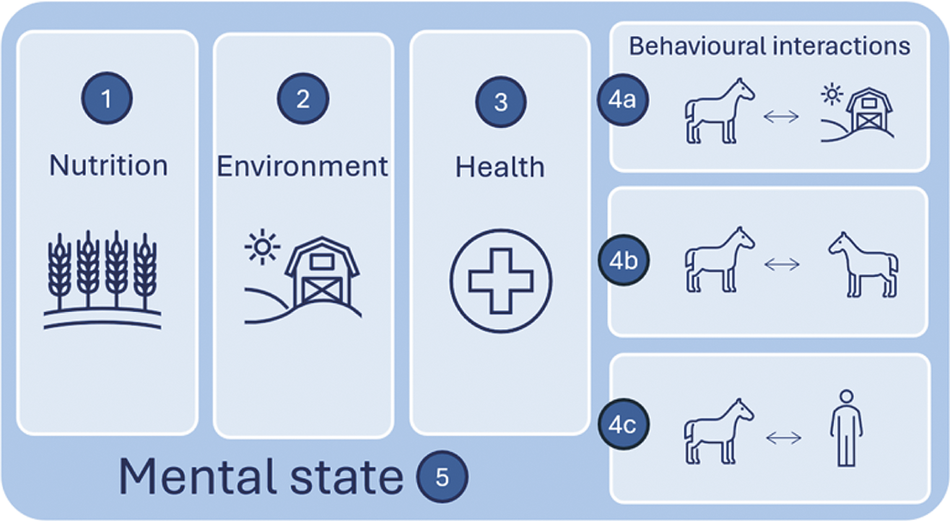
Given our increasing understanding that agency is a vital component of animal welfare, it is imperative that we endeavour to maximise choice, control, and challenge in all captive animals (Leotti & Delgado Reference Leotti and Delgado2011; Špinka Reference Špinka2019; Littlewood et al. Reference Littlewood, Heslop and Cobb2023). This paper describes the challenges of and opportunities for increasing the agency of domestic horses through the lens of a common framework for assessing animal welfare, the Five Domains model (see Figure 1). This framework divides factors that can impact an animal’s welfare into five categories; the first four categories are nutrition, the physical environment, health, and behavioural interactions (with the environment, other animals, and humans). These four domains have a collective effect on the animal’s mental or affective state, which is the fifth domain (Mellor & Beausoleil Reference Mellor and Beausoleil2015; Mellor Reference Mellor2017; Mellor et al. Reference Mellor, Beausoleil, Littlewood, McLean, McGreevy, Jones and Wilkins2020; Littlewood et al. Reference Littlewood, Heslop and Cobb2023). The focus of this text will be on the fourth ‘behavioural interactions’ domain, alternatively called the ‘agency domain’, and will centre on some common obstacles to and opportunities for providing agency in each of these behavioural interactions that horses have: with the environment, other horses, and humans.
The current version of the Five Domains model of animal welfare (Mellor et al. Reference Mellor, Beausoleil, Littlewood, McLean, McGreevy, Jones and Wilkins2020; Littlewood et al. Reference Littlewood, Heslop and Cobb2023) proposes that an animal’s welfare is determined by its mental state (the fifth domain), which is itself affected by four domains: Domain 1, Nutrition; Domain 2, Environment; Domain 3, Health; and Domain 4, Behavioural interactions with (a) the environment, (b) other animals and (c) people.
Interactions with the environment
Challenges
Domestic horses are often housed in conditions that do not align with the behavioural or physical needs of their species (Goodwin Reference Goodwin and Waran2007; Henderson Reference Henderson2018; Krueger et al. Reference Krueger, Esch, Farmer and Marr2021). Approximately 30–90% of horses are housed in individual stalls depending on the country (Ruet et al. Reference Ruet, Lemarchand, Parias, Mach, Moisan, Foury, Briant and Lansade2019) and single stall housing is the most prevalent housing type for sport and riding school horses (Lesimple et al. Reference Lesimple, Gautier, Benhajali, Rochais, Lunel, Bensaïd, Khalloufi, Henry and Hausberger2019, Reference Lesimple, Reverchon-Billot, Galloux, Stomp, Boichot, Coste, Henry and Hausberger2020). Many horse owners and equine facility managers are aware of horses’ need for ample turnout but do not or are unable to provide it for a variety of reasons, including the cost of land, increasing urbanisation of rural areas, and owner concern regarding the potential for injury (Hartmann et al. Reference Hartmann, Bøe, Christensen, Hyyppä, Jansson, Jørgensen, Ladewig, Mejdell, Norling, Rundgren, Särkijärvi, Søndergaard and Keeling2015; Henderson Reference Henderson2018). Some of these concerns are unfounded, for example increased turnout time is associated with a decreased risk (not increased) of ‘pasture accidents’ or injury incurred while turned out, as more turnout reduces rebound increases in activity (Chaya et al. Reference Chaya, Cowan and McGuire2006; Chaplin & Gretgrix Reference Chaplin and Gretgrix2010; Reilly & Bryk-Lucy Reference Reilly and Bryk-Lucy2021; Mouncey et al. Reference Mouncey, Arango-Sabogal, de Mestre and Verheyen2024). Even when owners are aware of management practices that can compromise equine welfare, such as limited turnout, many fail to act on it. For example, a study by Visser and Van Wijk-Jansen (Reference Visser and Van Wijk-Jansen2012) found that, although most horse owner survey respondents thought that horses preferred to be outside in group housing, only 2.7% of respondents kept their horses in group housing. Inherent in this restricted environment is some degree of decreased agency. Stabling is a significant barrier to increasing agency in horses, since keeping horses in individual stalls decreases variety and makes the horses completely dependent on humans for access to resources, including food, exercise, and social contact (Jones & McGreevy Reference Jones and McGreevy2010; Henderson Reference Henderson2018; Pearson Reference Pearson2024; Ellis & Hall Reference Ellis, Hall and Koch2025). Controlled exercise or ridden work, which limit equine agency, are not sufficient on their own to replace free movement for horses, an important distinction when comparing the agentic needs of the horse as opposed to the strict requirement for any movement (Lee et al. Reference Lee, Floyd, Erb and Houpt2011; Werhahn et al. Reference Werhahn, Hessel, Schulze and Van den Weghe2011). Feral horses travel many kilometers a day; in one study, free-ranging horses travelled 18 km per day, compared to 7.2 km per day for horses in a 16-ha paddock and 1 km per day for horses in a small yard (Hampson et al. Reference Hampson, Morton, Mills, Trotter, Lamb and Pollitt2010). In general, increased time spent in individual housing results in poorer welfare over time for horses (Hoffmann et al. Reference Hoffmann, Wagels and Kraft2012; Ruet et al. Reference Ruet, Lemarchand, Parias, Mach, Moisan, Foury, Briant and Lansade2019, Reference Ruet, Lemarchand, Briant, Arnould and Lansade2024; Krueger et al. Reference Krueger, Esch, Farmer and Marr2021).
Some horses, especially sport horses that may be transported regularly to events, have a marked lack of control over their frequently changing surroundings. This can have a noticeable effect on equine welfare, similar to the ‘first night effect’ seen in humans who experience poor sleep in novel locations, an effect magnified by horses’ status as social prey animals who are typically distressed by separation from familiar conspecifics (Ruckebusch Reference Ruckebusch1975; McAfee et al. Reference McAfee, Mills and Cooper2002; Ruet et al. Reference Ruet, Lemarchand, Parias, Mach, Moisan, Foury, Briant and Lansade2019). Although this negative experience can be diminished in humans by their ability to modify stress-inducing factors in the environment, this option is generally not available to horses (Greening & McBride Reference Greening and McBride2022). Additional welfare challenges for competition horses include individual stabling and long-distance travel, sometimes to international events (Campbell Reference Campbell2016), both of which can limit or prevent natural behaviours and decrease the horse’s agency (Dierendonck & Goodwin Reference Dierendonck and Goodwin2005).
Domesticated horses are also often provided a relatively homogenous diet that does not allow for browsing or a high degree of selectivity or expression of preferences, in contrast to the highly varied diet of free-roaming horses that may include grasses, sedges, rushes, and browse (Goodwin Reference Goodwin and Waran2007; Harvey et al. Reference Harvey, Ramp and Mellor2022). The options available to domestic horses as well as the sometimes restricted access to forage limit choice as well as complexity, thereby reducing agency around their diet (Dierendonck & Goodwin Reference Dierendonck and Goodwin2005; Elia et al. Reference Elia, Erb and Houpt2010; Galinelli et al. Reference Galinelli, Wambacq, Broeckx and Hesta2021). Because many horses are housed singly in stables, they are often reliant on humans for the provision of every part of their diet, which removes the horse’s choices related to timing of ingestion, feed type, and volume eaten (Hemsworth et al. Reference Hemsworth, Jongman and Coleman2015; Mazzola et al. Reference Mazzola, Colombani, Pizzamiglio, Cannas, Palestrini, Costa, Gazzonis, Bionda and Crepaldi2021). Dietary choices made by humans for horses may not align with horses’ preferences. Indeed, one study found no correlation between the hay preferred by horses and the hay selected by the owners (Holzer et al. Reference Holzer, Herholz, Tanadini, Ineichen and Julliand2022); the researchers concluded that, rather than assuming preference, it is instead best to offer dietary choice to horses whenever possible.
Although humans generally take for granted the ability to thermoregulate by altering their environment or changing their clothing, horses are often managed in such a way that they are not in full control of their own body temperature. Horses may not have access to a varied environment that might provide choices between shade and sun, breezy and sheltered areas, or cooling opportunities such as bodies of water, all of which offer choice and control and have been found to be utilised by horses when available (McDonnell Reference McDonnell2003; Jorgensen et al. Reference Jorgensen, Mejdell and Boe2019; Christensen et al. Reference Christensen, Andersen, Skovbo and Skovgard2022). In addition, many horses in cold climates are clipped and/or blanketed by their owners, a practice that could limit their control over their body temperature and thereby increase stress (Jørgensen et al. Reference Jørgensen, Aanensen, Mejdell and Bøe2016; Mejdell et al. Reference Mejdell, Bøe and Jørgensen2020; Mazzola et al. Reference Mazzola, Colombani, Pizzamiglio, Cannas, Palestrini, Costa, Gazzonis, Bionda and Crepaldi2021; Daw et al. Reference Daw, Burn, Y-M and Nicol2025).
Finally, resources may be limited in some equine housing arrangements, for example discrete feeding stations may be insufficient to allow horses to avoid agonistic interactions, thereby reducing some horses’ control over their ingestive behaviours or time budget (Dierendonck & Goodwin Reference Dierendonck and Goodwin2005). Captive animals may often live in “monotonous and predictable” environments (barren environments being the extreme); in these cases they have little opportunity to engage in meeting their needs (Špinka & Wemelsfelder Reference Špinka and Wemelsfelder2011). In such settings, hypostimulation and boredom can become a serious welfare concern (Greening & McBride Reference Greening and McBride2022). Some horse owners or managers attempt to mitigate these environmental challenges by providing devices intended for enrichment, some of which can instead increase frustration, for example certain toy-like objects that dispense food or triple-layered hay nets that make forage difficult to access (Ellis & Hall Reference Ellis, Hall and Koch2025). In the most extreme cases of environmental conditions that severely limit agency, horses can experience learned helplessness, a condition in which individuals learn that they have no control over their negative conditions or experiences and so stop trying to change their circumstances (Hall et al. Reference Hall, Goodwin, Heleski, Randle and Waran2008).
Opportunities
It is important to keep in mind that not all aspects of the complexity of a wild animal’s environment are positive (for example, extreme weather or predators); in domestic animals we should aim to increase only the aspects of environmental complexity that are positive and therefore can improve welfare (e.g. a varied environment) (Badihi Reference Badihi2006; Mazzola et al. Reference Mazzola, Colombani, Pizzamiglio, Cannas, Palestrini, Costa, Gazzonis, Bionda and Crepaldi2021). In addition, some authors call into question the validity of utilising time budgets of feral, free-ranging horses as the gold standard we should use to determine whether a domestic horse has good welfare; instead, perhaps the time budgets of some domestic horses demonstrate appropriate adaptations to the environment (Kelemen et al. Reference Kelemen, Grimm, Vogl, Long, Cavalleri, Auer and Jenner2021). With those considerations in mind, however, a strong ethical argument can be made that, because we are in control of domestic animals’ environments, we have a moral responsibility to meet their psychological and physiological needs (Henderson Reference Henderson2018). As discussed previously, the opportunity to exercise agency is considered by some to be an ethological need.
Wherever possible, one of the primary opportunities to allow increased agency in horses is to provide them access to well-managed pasture. A healthy and varied pasture provides horses with freedom to move, a diverse diet, and sufficient resources (Fraser Reference Fraser2012; Ruet et al. Reference Ruet, Arnould, Levray, Lemarchand, Mach, Moisan, Foury, Briant and Lansade2020; Dai et al. Reference Dai, Costa, Minero and Briant2023; Harvey et al. Reference Harvey, Beausoleil, Ramp and Mellor2023). Providing enough space to allow free movement increases agency (Lee et al. Reference Lee, Floyd, Erb and Houpt2011; Gorecka-Bruzda et al. Reference Gorecka-Bruzda, Jastrzebska, Muszynska, Jedrzejewska, Jaworski, Jezierski and Murphy2013; Boyer et al. Reference Boyer, Shepley, McPherson, St John, Vasseur and Haskell2023; Littlewood et al. Reference Littlewood, Heslop and Cobb2023) and sufficient time in turnout also reduces risk of injury (Chaya et al. Reference Chaya, Cowan and McGuire2006; Reilly & Bryk-Lucy Reference Reilly and Bryk-Lucy2021; Mouncey et al. Reference Mouncey, Arango-Sabogal, de Mestre and Verheyen2024). In horses, sufficient space for free movement translates to, at a minimum, an area that is large enough for them to achieve all three gaits (walk, trot, and canter) so that each movement is available to them and they are not behaviourally restricted (Werhahn et al. Reference Werhahn, Hessel, Schulze and Van den Weghe2011). Sports horses allowed access to paddocks (vs individual stalls) had decreased stereotypic behaviours and increased oxytocin during paddock release periods (Lesimple et al. Reference Lesimple, Reverchon-Billot, Galloux, Stomp, Boichot, Coste, Henry and Hausberger2020). In addition, because horses have been shown to utilise different parts of a pasture at different times of day and depending on season, providing choices for grazing and a varied pasture environment are optimal for increasing agency (Taylor et al. Reference Taylor, Lancaster and Ellis2025). Horses choose different landscapes depending on the season based on variations in, for example, the presence of predators, pests, windbreaks, etc. Therefore, providing a variety of substrates, types of cover, and vegetation can allow the horses to choose where to spend their time based on their current needs and desires (Girard et al. Reference Girard, Bork, Neilsen and Alexander2013). In general, providing a complex and heterogeneous environment helps animals to increase their competence and welfare (Špinka & Wemelsfelder Reference Špinka and Wemelsfelder2011).
The varied diet provided by pasture is also a major factor contributing to horses’ choice as well as their competence. In free-roaming horses, it is common for their diets to vary, especially with season, and may include grasses, sedges, rushes, and browse (Harvey et al. Reference Harvey, Ramp and Mellor2022). Horses have been shown to be capable of selecting diets appropriate for themselves when presented with suitable options (Redgate et al. Reference Redgate, Cooper, Hall, Eady and Harris2014) and, although horses generally prefer to graze, many free-ranging horses also browse (Goodwin Reference Goodwin and Waran2007). The opportunity to explore a complex environment and perform “focused and engaged selective foraging” is rewarding for horses and promotes positive welfare (Harvey et al. Reference Harvey, Beausoleil, Ramp and Mellor2023) and there is evidence that horses are motivated to eat forage from a variety of sources (Goodwin et al. Reference Goodwin, Davidson and Harris2002). Horses that were provided a diet with multiple forages (vs a single forage, hay) performed more foraging behaviour and did not perform stereotypic weaving (which only occurred in the single forage treatment) (Thorne et al. Reference Thorne, Goodwin, Kennedy, Davidson and Harris2005). In addition, because horses have individual taste preferences, providing a variety of options, even with treats, can increase a horse’s choice and control (Janczarek et al. Reference Janczarek, Wilk, Pietrzak, Liss and Tkaczyk2018). In one study, the provision of forages other than hay resulted in decreased odds of displaying abnormal behaviours as compared to providing hay only; the authors hypothesised that this may have been due to the provision of a variety of forage types, which increased choice and so was inherently rewarding (McGreevy et al. Reference McGreevy, Cripps, French, Green and Nicol1995).
In horses whose diet must be restricted for medical reasons (e.g. Equine Metabolic Syndrome), they can still be offered a variety of forage options, including hay that is less energy dense or soaked hay to decrease calories while still providing the opportunity to forage (Fraser Reference Fraser2012). For horses on medically required stall rest, offering varied forages and novel food textures can act as environmental enrichment (Pearson Reference Pearson2024). Other approaches include offering feed additive flavours, different types of straw, and variation in feed delivery method, e.g. feed bucket, container with removable lid, scattered on ground in straw (Lansade et al. Reference Lansade, Valenchon, Foury, Neveux, Cole, Layé, Cardinaud, Lévy and Moisan2014). In addition, track grazing systems, which utilise circular fenced tracks rather than paddocks, offer a potential solution for horses that need to lose weight or limit non-structural carbohydrate (NSC) intake for medical reasons while still maintaining the ‘Three Fs’ (Cameron et al. Reference Cameron, Challinor, Armstrong, Kennedy, Hollister and Fletcher2025). One study found evidence of increased vigilance behaviour of horses on a track system when compared to those housed in a central paddock, although the authors also observed increased group cohesion and more natural movement patterns in the track system (Winwright et al. Reference Winwright, Elston, Hall, Hall and Krueger2015). A recent study found more movement and fewer agonistic interactions in a track grazing system as compared to strip grazing (Kirton et al. Reference Kirton, Sandford, Raffan, Hallsworth, Burman and Morgan2025). Because there are limited studies on the effects of track systems on equine health and welfare, further study is needed.
In stables or equine operations with limited space or grazing opportunities, group housing in ‘active stables’ offers choice and the opportunity to move more freely than in individual stalls (Rose-Meierhöfer et al. Reference Rose-Meierhöfer, Klaer, Ammon, Brunsch and Hoffmann2010; Hildebrandt et al. Reference Hildebrandt, Büttner, Salau, Krieter and Czycholl2021); HIT Active Stables® are one branded application of this concept. There is evidence that it is important to carefully plan the locations of resources in these systems to reduce agonistic interactions and promote equitable use by all members of the herd (Puttkammer et al. Reference Puttkammer, Hildebrandt, Krieter and Czycholl2024). In general, however, active stables appear to encourage movement by placing resources, such as water, lying areas, and feed, in separate locations (Hildebrandt et al. Reference Hildebrandt, Büttner, Salau, Krieter and Czycholl2021). Housing can also be designed to allow horses some control over their environment (Hall et al. Reference Hall, Goodwin, Heleski, Randle and Waran2008). For example, Houpt and Houpt (Reference Houpt and Houpt1988) trained horses to turn on the lights in their stable utilising operant conditioning; this offered the horses some control over the illumination of their environment, and also elucidated their lighting preferences (they turned on the lights most often in the early morning). A more common approach to offering choice in housing design is to allow outdoor access via run-outs attaching individual stalls to paddocks or pastures; in most cases horses demonstrate a preference for being outdoors over stabling, even in winter (Schatzmann Reference Schatzmann1998). Paired with these housing approaches, novel feeding techniques such as supply of roughage via automated roughage feeders or time-controlled automatic feeders could help to satisfy the horses’ behavioural needs when their access to pasture is limited (Baumgartner et al. Reference Baumgartner, Boisson, Erhard and Zeitler-Feicht2020). Implementing strategies to maintain horses’ choice of food and the timing of ingestion are especially important as, in the wild, horses rarely fast voluntarily for more than two to four hours at a time (Benhajali et al. Reference Benhajali, Richard-Yris, Ezzaouia, Charfi and Hausberger2009). A study of horses on pasture found that “non-feeding periods” lasted less than two hours (Taylor et al. Reference Taylor, Lancaster and Ellis2025) and a study of stalled horses determined that the “maximum tolerable feed intake pause” was four hours (Baumgartner et al. Reference Baumgartner, Boisson, Erhard and Zeitler-Feicht2020). Even offering a variety of forage presentation methods can increase agency; horses have been shown to have individual preferences in regards to feeding trough heights, location of hay nets in a stall, and proximity to watering stations (Lansade et al. Reference Lansade, Valenchon, Foury, Neveux, Cole, Layé, Cardinaud, Lévy and Moisan2014; Clarke Reference Clarke2017; Luz et al. Reference Luz, Maia, Arruda, Delagracia and Filho2019).
Offering opportunities for horses to regulate their own body temperature can increase agency. Because there is substantial variation in individual preference for wearing blankets or not, even at the same environmental temperature, ideal management would allow for this variation by giving the horses agency to choose (Mejdell et al. Reference Mejdell, Jørgensen, Buvik, Torp and Bøe2019). Mejdell et al. (Reference Mejdell, Buvik, Jørgensen and Bøe2016) established a training paradigm for just this purpose; they determined that horses were able to communicate their blanketing preferences by touching the appropriate symbol to indicate their choice (blanket on or off). Although this approach requires the understanding and appropriate application of positive reinforcement training, it is a prime example of the possibilities for increasing agency in horses. A less time-intensive way to increase agency around thermoregulation in horses can be to provide varied substrates; several studies have shown that individual horses prefer to roll (Da Luz et al. Reference Da Luz, Maia and Puoli Filho2024) or lie down on different substrates (Hunter & Houpt Reference Hunter and Houpt1989; Pedersen et al. Reference Pedersen, Søndergaard and Ladewig2004; Ellis & Hall Reference Ellis, Hall and Koch2025). Preferences can vary by individual as well as by environmental conditions such as temperature and climate, so providing choice by offering a variety of substrates is optimal (Boyd et al. Reference Boyd, Carbonaro and Houpt1988; Wolframm et al. Reference Wolframm, Engels, Lindström and Forssman2025). In addition, providing shade and shelter for use at their own discretion improves horses’ ability to regulate their own body temperature. Horses will utilise field shelters even if they are wearing blankets, so it seems the option to utilise shelter is valued by horses (Jorgensen et al. Reference Jorgensen, Mejdell and Boe2019). There is evidence that horses often elect to utilise shade more during the morning hours rather than at the sunniest times of day, which indicates that what we might think to provide for them (e.g. stabling during the hottest part of the day) is not necessarily what they would choose (Holcomb & Stull Reference Holcomb and Stull2016). There was also a high degree of individual variability in the chosen method of cooling that horses utilise when allowed to choose between insulated, shaded, or water-sprayed areas (Janczarek et al. Reference Janczarek, Stachurska, Wilk, Wisniewska, Rozanska-Boczula, Kaczmarek, Luszczynski and Kedzierski2021). Provision of field shelters can also have the added benefit of providing the opportunity for horses to escape biting insects when insect numbers and activity are high (Christensen et al. Reference Christensen, Andersen, Skovbo and Skovgard2022).
There are many more minor examples of horses demonstrating individual preferences that would seem to indicate that, whenever possible, it is best to provide horses with choice so that they can increase their agency. For example, one study found that individual horses have preferences for the directions they face during road transport; having the horses untethered in a stock trailer allowed them to stand in their preferred position (Smith et al. Reference Smith, Jones, Carlson and Pascoe1994). Importantly, even in horses that do not demonstrate a detectable preference, although it may be that they are indifferent to their position in the trailer, it may also be that the horse has a “positive choice for both positions” (Smith et al. Reference Smith, Jones, Carlson and Pascoe1994). This alludes to a broader concept that the provision of choice alone can be valuable, even when the welfare benefit may not be immediately obvious. As stated by Littlewood et al. (Reference Littlewood, Heslop and Cobb2023) “an animal not interacting with an opportunity provided to them is still exercising agency through choice and control”. The active use of environmental enrichment is not required for enrichments to have welfare value; the mere presence of options and the ability to choose can increase welfare (Leotti et al. Reference Leotti, Iyengar and Ochsner2010; Leotti & Delgado Reference Leotti and Delgado2011; Decker et al. Reference Decker, Lavery and Mason2023).
Interactions with other animals
Challenges
Horses highly value interaction with conspecifics; horses that are able to interact socially with other horses, even just one hour per day compared to zero, have more positive emotional states than isolated horses (Flamand et al. Reference Flamand, Robinet, Raskin, Braconnier, Bouhamidi, Derolez, Lochin, Helleu and Petit2025). Therefore, one of the most significant limitations to a horse’s welfare is having limited or no access to conspecifics. As stated previously, most horses are stabled singly (Hartmann et al. Reference Hartmann, Søndergaard and Keeling2012, Reference Hartmann, Bøe, Christensen, Hyyppä, Jansson, Jørgensen, Ladewig, Mejdell, Norling, Rundgren, Särkijärvi, Søndergaard and Keeling2015; Hockenhull & Creighton Reference Hockenhull and Creighton2014) despite ample evidence that horses prioritise access to conspecifics very highly (Schatzmann Reference Schatzmann1998; Dierendonck & Goodwin Reference Dierendonck and Goodwin2005; Lee et al. Reference Lee, Floyd, Erb and Houpt2011; Søndergaard et al. Reference Søndergaard, Jensen and Nicol2011). The welfare consequences of limiting access to conspecifics are well-established, and include increased aggression and frustration, self-directed aggression, stereotypic behaviours, changes in blood counts, and increases in faecal glucocorticoids (Christensen et al. Reference Christensen, Ladewig, Søndergaard and Malmkvist2002; Hockenhull & Creighton Reference Hockenhull and Creighton2014; Yarnell et al. Reference Yarnell, Hall, Royle and Walker2015; Schmucker et al. Reference Schmucker, Preisler, Marr, Krüger and Stefanski2022; Flamand et al. Reference Flamand, Robinet, Raskin, Braconnier, Bouhamidi, Derolez, Lochin, Helleu and Petit2025).
In particular with regards to agency, modern housing often limits horses’ ability to spend time with preferred herdmates (Dierendonck & Goodwin Reference Dierendonck and Goodwin2005). Domestic horses are unable to choose their social group and so may not be housed with the individuals they would elect to spend time with if given the choice (Ellis & Hall Reference Ellis, Hall and Koch2025). In addition, because space may be limited, horses might have a reduced ability to escape threats or agonistic interactions. In free-ranging horses, “aggressive injurious behaviour” is rare because there is generally ample space to avoid unwanted interactions (Knubben et al. Reference Knubben, Fürst, Gygax and Stauffacher2008), whereas domestic horses with limited space often cannot escape dominant conspecifics (Torres Borda et al. Reference Torres Borda, Auer and Jenner2023). When space is limited, low-ranking horses have reduced lying times and may not lie down for several days (Fader & Sambraus Reference Fader and Sambraus2004; Hartmann et al. Reference Hartmann, Søndergaard and Keeling2012). Indeed, horses with the least space per animal have the highest number of aggressive interactions (Jørgensen et al. Reference Jørgensen, Borsheim, Mejdell, Søndergaard and Bøe2009) and, when stocking density is high, even close associates (friends) have more agonistic interactions (Torres Borda et al. Reference Torres Borda, Auer and Jenner2025). When stalled, forced proximity to horses in adjacent stalls can cause frustration, especially when physical contact is not possible (Ellis & Hall Reference Ellis, Hall and Koch2025). Even when social housing is provided, many domestic horses may change ownership or facilities several times in their life, and so frequent mixing or introduction of new horses to groups, requiring a re-establishment of the social hierarchy, can increase stress in horses by limiting their agency (Goodwin Reference Goodwin and Waran2007; Jørgensen et al. Reference Jørgensen, Borsheim, Mejdell, Søndergaard and Bøe2009; Christensen et al. Reference Christensen, Søndergaard, Thodberg and Halekoh2011; Hockenhull & Creighton Reference Hockenhull and Creighton2014; Torres Borda et al. Reference Torres Borda, Auer and Jenner2023; Puttkammer et al. Reference Puttkammer, Hildebrandt, Krieter and Czycholl2024).
Lastly, but importantly, human-controlled weaning of foals from their dams differs greatly from ‘natural’ weaning in free-ranging horses. Abrupt weaning of domestic horses was ranked by experts as the equine industry practice with the most severe impact on equine welfare (McGreevy et al. Reference McGreevy, Berger, De Brauwere, Doherty, Harrison, Fiedler, Jones, McDonnell, McLean, Nakonechny, Nicol, Preshaw, Thomson, Tzioumis, Webster, Wolfensohn, Yeates and Jones2018), and is a key example of an agency-limiting practice that is commonplace in the lives of domestic horses.
Opportunities
One of the strongest determinants of a horse’s welfare is whether they have access to conspecifics and their control of those interactions is vital to increasing agency. The main approaches by which we can offer horses choice and control in their interactions with other horses are through: (1) innovations in stable and housing design; (2) grouping horses in stable herds in a sufficiently large space; (3) promoting peaceful interactions between pasture-mates, including the formation of pair bonds; and (4) by allowing ‘natural’ weaning.
As discussed previously, there are many reasons horses may not all have continuous access to group living in large, well-managed pastures. When that ideal is not possible, there are several alterations to stable housing and design that can provide increased opportunities for agency. In general, allowing physical contact (that is escapable if desired) improves horses’ welfare; even horses that are only stabled for about an hour at a time will have better welfare when they can have physical contact with conspecifics (Borthwick et al. Reference Borthwick, Preshaw, Wheeler-Launder, Challinor, Housby-Skeggs, Boalch, Brown and Pearson2023). Stables that allowed social contact between stallions improved the horses’ welfare, and no “grievous injuries” were recorded in the “social boxes” condition (Zollinger et al. Reference Zollinger, Wyss, Bardou and Bachmann2023). Importantly, horses were able to escape interaction with the neighbouring horse if desired as only one shared wall allowed some physical contact. It is vital that horses are able to manage their interactions with conspecifics to allow for maximum choice and control. One common example is stalls with some outdoor access that have half-walls between the turn-out areas and therefore allow for some physical contact with neighbours but also enable the horse to retreat or choose not to interact (Ellis & Hall Reference Ellis, Hall and Koch2025). Allowing some physical contact between stalled horses, even if just nibbling, may be better than both just visual or visual and sniffing contact when considering abnormal behaviours as the outcome measure (Phelipon et al. Reference Phelipon, Hennes, Ruet, Bret-Morel, Górecka-Bruzda and Lansade2024). As mentioned in the Environment section of this paper, group stables are increasingly common (Hildebrandt et al. Reference Hildebrandt, Büttner, Salau, Krieter and Czycholl2021) and, with careful consideration of type and spacing of resources, can allow horses to interact with each other without being forced to approach aggressors (Hartmann et al. Reference Hartmann, Søndergaard and Keeling2012; Puttkammer et al. Reference Puttkammer, Hildebrandt, Krieter and Czycholl2024). Shaded areas in group housing should be large enough for multiple horses or be next to the shade in adjacent paddocks, as horses may forego using shade in favour of social interaction with neighbouring horses even in hot, sunny environments (Holcomb et al. Reference Holcomb, Tucker and Stull2015).
Horses have the most control over their interactions with conspecifics when they are grouped in a stable herd in a sufficiently large space. Stable social groups promote group cohesion and affiliative behaviours (Christensen et al. Reference Christensen, Søndergaard, Thodberg and Halekoh2011; Van Dierendonck & Spruijt Reference Van Dierendonck and Spruijt2012; Hall et al. Reference Hall, Randle, Pearson, Preshaw and Waran2018; Torres Borda et al. Reference Torres Borda, Auer and Jenner2023); even stallions can be successfully housed together when adequate space and resources are provided (Briefer Freymond et al. Reference Briefer Freymond, Briefer, Von Niederhäusern and Bachmann2013). Optimal group housing provides sufficient space for horses to escape aggression and should not have any dead-end areas where subordinate horses may get trapped (Goodwin Reference Goodwin1999; Hall et al. Reference Hall, Goodwin, Heleski, Randle and Waran2008; Ellis & Hall Reference Ellis, Hall and Koch2025; Torres Borda et al. Reference Torres Borda, Auer and Jenner2025). In general, decreasing stocking density reduces unnaturally high resting times (in a 24-h time budget) and increases locomotion, playing, and self-grooming (Auer et al. Reference Auer, Kelemen, Engl and Jenner2021). When given the choice of individual stables vs paddock or pasture, horses almost always chose eating hay outside in company over eating in an individual stall; the highest priority seems to be the company of other horses (Schatzmann Reference Schatzmann1998). Van Dierendonck and Spruijt (Reference Van Dierendonck and Spruijt2012) propose that allogrooming and play, as examples of affiliative behaviour, can even be seen as ethological needs insofar as they allow horses to cope with stressors and meet the criteria for a behavioural need (e.g. self-rewarding, have a rebound effect, etc.). As long as horses are able to escape agonistic interactions, social housing is one of the primary ways in which we can improve horses’ welfare and increase their agency.
Humans can also manage social housing of horses in ways that promote peaceful interactions between pasture-mates and the formation of pair bonds. Carefully and safely socialising horses to conspecifics increases their social competence, the fourth ‘C’ of agency, and when animals achieve competence, they generally have an increased ability to manage novel challenges. By observing a horse’s social affinities, spatial proximity to other horses, and the type of interactions they have with other conspecifics, we can identify preferred social partners and, in doing so, increase the chances of forming strong social groups (Fureix et al. Reference Fureix, Jego, Henry, Lansade and Hausberger2012). Starting this process young has been shown to be beneficial; two-year-old horses that had opportunities for social contact had less aggression when later mixed with other horses compared to those that were deprived of social contact before mixing (Christensen et al. Reference Christensen, Ladewig, Søndergaard and Malmkvist2002). Pre-exposing young horses in adjacent stalls might reduce aggression when they are later introduced in a paddock (Hartmann et al. Reference Hartmann, Christensen and Keeling2009). Although many horse owners are hesitant to keep horses in groups because of fear of injury (Hartmann et al. Reference Hartmann, Bøe, Christensen, Hyyppä, Jansson, Jørgensen, Ladewig, Mejdell, Norling, Rundgren, Särkijärvi, Søndergaard and Keeling2015), a stable group hierarchy and sufficient space help to prevent kick and bite injuries (Knubben et al. Reference Knubben, Fürst, Gygax and Stauffacher2008). There is also ample evidence that carefully considering herd make-up and size of groups can have a significant impact on affiliative interactions such as allogrooming (Sigurjónsdóttir et al. Reference Sigurjónsdóttir, van Dierendonck, Snorrason and Thórhallsdóttir2003; Hall et al. Reference Hall, Randle, Pearson, Preshaw and Waran2018; Sigurjónsdóttir & Haraldsson Reference Sigurjónsdóttir and Haraldsson2019). Large group sizes with high stocking densities generally demonstrate an increase in agonistic behaviours and decrease in affiliative behaviours as compared to smaller groups with lower stocking density (Hartmann et al. Reference Hartmann, Søndergaard and Keeling2012). More than absolute group size, however, it seems that careful social management of the herd is most important in promoting positive welfare. In particular, allowing the formation of pair bonds by maintaining social groups and limiting changes or mixing so that horses can choose affiliates and maintain those relationships promotes positive welfare in horses (Goodwin Reference Goodwin1999). In one study, horses demonstrated a clear preference for particular herdmates, with each horse having only one allogrooming partner (Kieson et al. Reference Kieson, Goma and Radi2023). Weaned horses, especially females, still preferred their dam over other horses after five months of separation (Lansade et al. Reference Lansade, Lévy, Parias, Reigner and Górecka-Bruzda2022). In feral horse groups, familiar individuals spent much more time in proximity to each other and groomed each other more often, but affiliation was not predicted by genetic relatedness, and similar-ranked horses were more likely to be in proximity to each other in new groups (Mendonça et al. Reference Mendonça, Pinto, Inoue, Ringhofer, Godinho and Hirata2021). Because of this evidence of individual horse preferences for particular social partners, it is important to provide choice to horses in their conspecific interactions. We can do so by allowing them to live in groups, giving them some degree of control over their interactions, and by promoting positive interactions by managing them appropriately.
Lastly, allowing horses to have some control over the weaning process is likely to improve their welfare. In free-roaming horses, weaning occurs gradually and many yearlings and two-year-olds still nurse from their dam occasionally (McDonnell Reference McDonnell2003). ‘Natural’ weaning, which is led by the mare and, to a lesser degree, the foal, avoids the stress of abrupt separation and allows the animals to exercise some control over their interactions with each other (Goodwin Reference Goodwin1999). In a study by Henry et al. (Reference Henry, Sigurjónsdóttir, Klapper, Joubert, Montier and Hausberger2020), mare-foal pairs were weaned with minimal human interference and most foals were spontaneously weaned when they were 9–10 months old with no observed stress response. It seems that domestic horses, when given the choice, elect to maintain contact with their dam and wean by a gradual process, and so, whenever feasible, this practice should be considered as a management approach to increase agency in domestic horses.
Interactions with humans
Challenges
One of the biggest hurdles to changing practices in the horse care realm is the equestrian culture, which has been shown to minimise and even normalise common management and training approaches that have negative effects on the horse’s welfare (Cheung et al. Reference Cheung, Mills and Ventura2025). Visser and Van Wijk-Jansen (Reference Visser and Van Wijk-Jansen2012) found that, in the Netherlands, even when most respondents were aware of management practices that have a negative effect on welfare, many did not understand the appropriate solution to the problem. The industry is dominated by practices that are based on tradition but that may not adequately consider the welfare of the horse (Waran et al. Reference Waran, McGreevy, Casey and Waran2007).
Horses often have little agency during training; one common reason given for limiting horses’ autonomy during human interactions is safety considerations (McGreevy et al. Reference McGreevy, Oddie, Burton and McLean2009; Hartmann et al. Reference Hartmann, Christensen and McGreevy2017). Paradoxically, limiting agency by preventing avoidance or fear responses in horses can often have the opposite effect of increasing the danger of the interaction (Christensen Reference Christensen2013). In other cases, a horse’s agency is curtailed when being ridden or handled because the complete control over the horse’s actions is what is desired (Hemsworth et al. Reference Hemsworth, Jongman and Coleman2015). In Fédération Equestre Internationale (FEI) dressage competition, for example, performance is scored in part based on the horse’s “submission” to the rider’s cues (Hawson et al. Reference Hawson, McLean and McGreevy2010). Horses ridden with hyperflexion of the neck, a position that has been shown to be aversive for horses (König vonBorstel et al. Reference König von Borstel, Kienapfel, McLean, Wilkins and McGreevy2024), also received higher scores in FEI competition than those with more open poll angles (Jones & McGreevy Reference Jones and McGreevy2010; Kienapfel et al. Reference Kienapfel, Piccolo, Cockburn, Gmel, Rueß and Bachmann2024).
Horses are also generally given little choice as to when or whether they are ridden (Dashper Reference Dashper2017). Dashper explains the horse-human dynamic as such: “even when the human partner explicitly tries to consider his or her horse’s welfare, personality, agency, and personhood within their interspecies interactions, ultimately, the master-servant relationship positions the horse in a less powerful, potentially vulnerable position and places additional obligations and responsibilities on the human to safeguard the horse and try to act with his or her interests in mind” (Dashper Reference Dashper2017). Multiple studies have shown that horses prefer to spend time with conspecifics or obtain feed rather than be ridden (McGreevy et al. Reference McGreevy, Oddie, Burton and McLean2009; Jones & McGreevy Reference Jones and McGreevy2010; Lee et al. Reference Lee, Floyd, Erb and Houpt2011; König von Borstel & Keil Reference König von Borstel and Keil2012). When given the choice, horses generally chose not to jump above 50 cm, a height that is routinely exceeded in ridden work (Gorecka-Bruzda et al. Reference Gorecka-Bruzda, Jastrzebska, Muszynska, Jedrzejewska, Jaworski, Jezierski and Murphy2013).
In addition, some tack, equipment, and training methods reduce agency for horses. During routine handling, some restraint methods, such as the lip twitch, severely limit agency (Hall et al. Reference Hall, Goodwin, Heleski, Randle and Waran2008) and were shown to induce behavioural inhibition (Kellershohn et al. Reference Kellershohn, Blum, Montavon, De Sales, Costa and Spadavecchia2025). Similar effects are seen with dually headcollars, draw reins, tight nosebands, bits, and many other commonly used tools (Mellor & Beausoleil Reference Mellor and Beausoleil2015; Doherty et al. Reference Doherty, McGreevy and Pearson2017; Fenner et al. Reference Fenner, Mclean and McGreevy2019; Scofield Reference Scofield2020). Training methods that rely on agonistic behaviour and negative reinforcement, such as round pen and ‘natural horsemanship’ training, hot walkers, and flooding are prime examples of the negative welfare effects of reducing agency (McLean Reference McLean2008; McLean & McGreevy Reference McLean and McGreevy2010; Henshall & McGreevy Reference Henshall and McGreevy2014; McLean & Christensen Reference McLean and Christensen2017; Fenner et al. Reference Fenner, Mclean and McGreevy2019). For example, ‘natural horsemanship’ training methods emphasise the importance of asserting the human’s dominance over the horse and often include round pen training techniques that elicit flight responses in the horse (Henshall & McGreevy Reference Henshall and McGreevy2014). Perhaps the most stark example of the negative welfare effects of a lack of control is a previously mentioned condition termed ‘learned helplessness’ which occurs when an animal realises that they have no control over the outcome of an aversive situation (Hall et al. Reference Hall, Goodwin, Heleski, Randle and Waran2008). Learned helplessness has been demonstrated in horses, especially those exposed to training methods that involve highly aversive stimuli, such as those mentioned above (McGreevy & McLean Reference McGreevy and McLean2009). Horse owners and trainers generally have a limited understanding of equine learning theory (Dierendonck & Goodwin Reference Dierendonck and Goodwin2005; Warren-Smith & McGreevy Reference Warren-Smith and McGreevy2008; Hothersall & Casey Reference Hothersall and Casey2012; Doherty et al. Reference Doherty, McGreevy and Pearson2017; Fenner et al. Reference Fenner, Mclean and McGreevy2019; Dyson et al. Reference Dyson, Bondi, Routh, Pollard, Preston, McConnell and Kydd2022), and this disconnect limits horses’ agency when interacting with humans. Conflicting signals used in training (e.g. simultaneous acceleration and deceleration cues) can create situations where horses are both frustrated and experiencing inescapable unpleasant or painful stimuli (Hall et al. Reference Hall, Goodwin, Heleski, Randle and Waran2008; McGreevy & McLean Reference McGreevy and McLean2009; McLean & Christensen Reference McLean and Christensen2017).
Another major limitation to providing domestic horses with agency is the inability of many horse owners to detect equine pain and interpret their horses’ behaviours. Horse owners overestimated their equine-related knowledge (Marlin et al. Reference Marlin, Randle, Pal and Williams2018) and many studies have demonstrated that equestrians typically fail to identify behavioural signals of fear and pain in horses and may underestimate how much pain horses are likely to be experiencing (Hothersall & Casey Reference Hothersall and Casey2012; Lesimple & Hausberger Reference Lesimple and Hausberger2014; Mellor & Beausoleil Reference Mellor and Beausoleil2015; Yarnell et al. Reference Yarnell, Hall, Royle and Walker2015; Bell et al. Reference Bell, Rogers, Taylor and Busby2019; Rioja-Lang et al. Reference Rioja-Lang, Connor, Bacon and Dwyer2020; Kjærulff & Lindegaard Reference Kjærulff and Lindegaard2022; Musial & Weiss Reference Musial and Weiss2025). In addition, horses may routinely be pushed beyond their psychological or physical limitations when in regular ridden work; Ijichi et al. (Reference Ijichi, Wilkinson, Riva, Sobrero and Dalla Costa2023) showed that horses experiencing ‘hard’ work (3–4 h of ridden work in a day) demonstrated increased pain relative to those resting or in mild work using the horse grimace scale, a pain classification system that utilises facial expression evaluation.
Finally, husbandry and veterinary procedures (HVPs) rarely prioritise the horse’s agency (Carroll et al. Reference Carroll, Sykes and Mills2022, Reference Carroll, Sykes and Mills2023). Horses are generally not given the option to consent to or withdraw from the interaction, even temporarily (Mills Reference Mills2017). Because even experts often disagree on the stress being experienced by horses undergoing veterinary procedures, limiting the horse’s choice during these interactions presents a significant risk of negative welfare (Pearson et al. Reference Pearson, Waran, Reardon, Keen and Dwyer2021).
Opportunities
There are many ways to enhance horses’ agency during their interactions with humans. These include: (1) optimising horse-human relationships for positive experiences; (2) integrating cooperative care into HVPs; and (3) utilising reward-based training; as well as (4) training methods that allow the horse to exercise agency. Although there is a culture in the equestrian world that often normalises interactions with horses that have negative welfare consequences, Cheung et al. (Reference Cheung, Mills and Ventura2025) demonstrated that some individuals were open to changing their practices and attitudes. In particular, recognising the sentience of horses is likely critical for people to change their views and actions regarding horse welfare (Fiedler et al. Reference Fiedler, Ayre, Rosanowski and Slater2025), and recognising that horses have agency can be an important part of that process.
Promoting positive human-animal relationships increases animals’ competence in interspecific social interactions by helping them to adapt more readily to training, thereby decreasing stress and increasing safety for both humans and animals (Badihi Reference Badihi2006). One central concept inherent in this dynamic is the idea of requesting vs demanding, the former being preferable whenever possible to improve the horse’s welfare by increasing their agency (Coulter Reference Coulter2019). The idea of ‘listening to’ a horse’s behavioural cues during ridden performance is increasingly common (König von Borstel & Keil Reference König von Borstel and Keil2012; Kjærulff & Lindegaard Reference Kjærulff and Lindegaard2022). It is clear that, in order for horses to be able to exercise agency, they must be able to communicate their needs and desires to an understanding and educated set of caretakers that are willing to listen to them (Lesimple & Hausberger Reference Lesimple and Hausberger2014). When comparing forced touch vs free-choice touch by humans in horses used in equine-assisted services (EAS), the horses perceived free-choice touch (in which they could choose to be touched by the person or not) more positively than forced (tethered) touch (Sarrafchi et al. Reference Sarrafchi, Lassallette and Merkies2025). These findings demonstrate the importance of allowing horses to exert choice and control during their interactions with humans to maintain positive relationships.
There are a variety of management approaches that can benefit the horse-human relationship. Exercise, especially turn-out, reduced unwanted behaviour and handler commands during routine handling (Freire et al. Reference Freire, Buckley and Cooper2009), and ‘field-kept’ horses were more likely to display behaviour that was considered desirable by handlers (Losonci et al. Reference Losonci, Berry and Paddison2016). Generally speaking, riders are more satisfied with their riding experience when their horse has better welfare and vice versa: a horse has better welfare when riders are more satisfied with their riding experience (Luke et al. Reference Luke, McAdie, Warren-Smith and Smith2023). In addition, studies that demonstrate which human behaviours or qualities horses respond well to can provide horse owners with information that can increase the likelihood of horses electing to interact with them. For example, Smith et al. (Reference Smith, Wilson, McComb and Proops2018) demonstrated that horses prefer to approach humans displaying submissive rather than dominant body postures.
Cooperative care, an approach to HVPs that allows an animal to be an “active, willing participant” in their care (Joshua 2018), allows animals to have a high degree of choice and control (Littlewood et al. Reference Littlewood, Beausoleil, Mellor and Koch2025). Having some degree of control over aversive stimuli has been shown to decrease the stress associated with the experience (Thompson Reference Thompson1981). Cooperative care has been used for decades in zoo animals and other species, and is increasingly being used in equine husbandry also (Carroll et al. Reference Carroll, Sykes and Mills2022, Reference Carroll, Sykes and Mills2023; Sydänheimo et al. Reference Sydänheimo, Freeman and Hunt2023).
One of the most accessible ways to increase agency in horse-human interactions is to utilise reward-based training. More broadly, an understanding of equine learning theory should be a “fundamental principle in equestrian education” to improve equine welfare (McLean & Christensen Reference McLean and Christensen2017). Fenner et al. (Reference Fenner, Mclean and McGreevy2019) suggest including learning theory in national coaching examinations to improve equine welfare. Reward-based training can serve as enrichment for animals, depending on their individual preference, and can expand behaviour repertoires (Fernandez Reference Fernandez2022). Horses have been shown to spend more time with individuals with whom they have a positive association (Henderson Reference Henderson and Koch2025), and positive reinforcement training in particular was associated with increased interest in humans (Kelly et al. Reference Kelly, McDuffee and Mears2021). Positive reinforcement training along with systematic desensitisation and counter-conditioning have been successfully used to rehabilitate aversions to healthcare procedures in horses (Torcivia & McDonnell Reference Torcivia and McDonnell2018). Taken together, these findings indicate that reward-based training can not only increase equine agency but also improve horse-human relationships.
Many training approaches allow for the horse to exercise some degree of agency, in particular the use of operant conditioning. Operant conditioning provides predictable outcomes based on the horse’s behaviour, allowing them to perform goal-directed behaviours that are inherently motivating. Because positive reinforcement training (one type of operant conditioning) promotes behaviours that are associated with a positive affective state, its use can greatly improve equine welfare during training (Littlewood et al. Reference Littlewood, Beausoleil, Mellor and Koch2025). Allowing the animal to ‘opt out’ of training is increasingly discussed in the equestrian context (Harrison Reference Harrison2019; von Essen & Bornemark Reference von Essen and Bornemark2019; Ellis & Hall Reference Ellis, Hall and Koch2025). To maximise agency during training, it is important to allow the horse the opportunity to discontinue the training session if desired (Carroll et al. Reference Carroll, Sykes and Mills2022). Allowing voluntary approach to a frightening stimulus, as opposed to utilising negative reinforcement to encourage approach, was found to be less stressful for horses (Christensen Reference Christensen2013). Mejdell et al. (Reference Mejdell, Buvik, Jørgensen and Bøe2016) argue that appropriately training a free choice behaviour allows the animal to demonstrate that they are making their choice based on their own inherent motivation rather than being pressured by the trainer’s motives.
Animal welfare implications
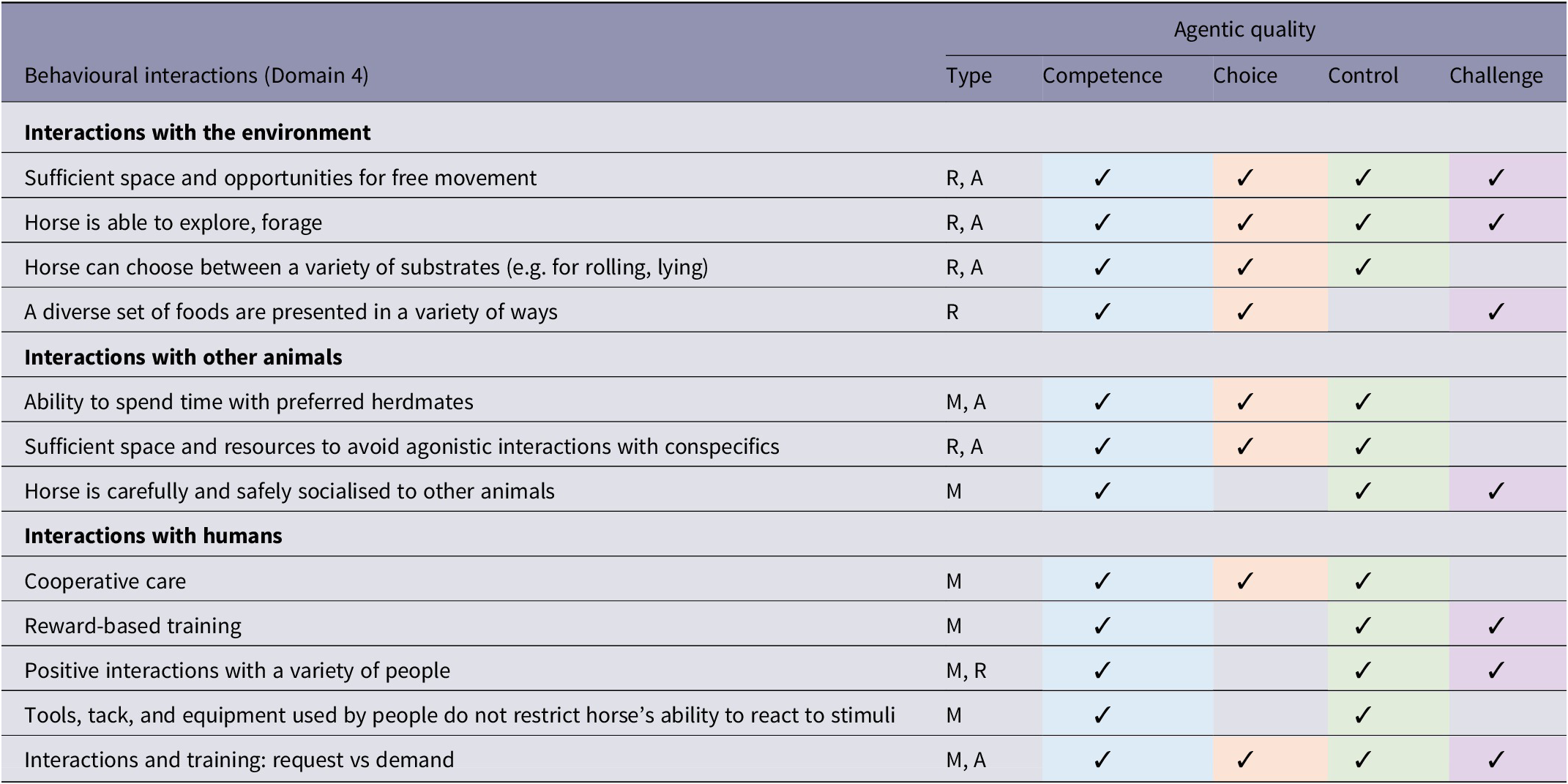
Increasing agency has great potential for improving welfare in horses. One useful method to visualise some of the key takeaways from this paper is to utilise the organisational approach put forth by Littlewood et al. (Reference Littlewood, Heslop and Cobb2023) that focuses on the details of the behavioural interactions in Domain 4. For Table 1, each welfare indicator or opportunity (e.g. reward-based training) is evaluated through each of four agentic qualities: competence, choice, control, and challenge. Using this approach, we can also see whether the welfare indicators are resource-based, management-based, or animal-based, which allows us to consider all indicators together for a more complete picture of the potential impact on an animal’s welfare. For example, if there are many opportunities for behavioural interactions listed that are only resource-based measures, we are less likely to be assessing whether the individual animal is actually experiencing good welfare than if it merely has the potential to have good welfare given the resources available to them.
Examples of behavioural interactions (Domain 4) that can be provided to domestic horses that allow them to experience positive affective engagement (Domain 5), with the corresponding agentic qualities. Type: R = resource-based indicator; A = animal-based indicator; M = management-based indicator. Adapted from Littlewood et al. (Reference Littlewood, Heslop and Cobb2023).
Conclusion
As societal views of animals change, we are increasingly seeing animals as subjects with a will and feelings of their own. Because current husbandry and training practices present challenges to equine agency and welfare, we need to consider the subjectivity of domestic horses and, in this light, rethink our systems (von Essen & Bornemark Reference von Essen and Bornemark2019). One overarching challenge is in making broad recommendations for an entire species when, as we have discussed, there is so much individual variation in needs and desires. Considering the individual’s affective state allows for recognition of individual preferences, which enables us to focus on a “best fit” approach instead of a strict “best practice” approach (Bradshaw-Wiley & Randle Reference Bradshaw-Wiley and Randle2023; Noble Reference Noble2023; Ellis & Hall Reference Ellis, Hall and Koch2025). To advance this important issue with many ethical implications, additional work is needed both in terms of scientific inquiry and collaboration with the humanities and social sciences (Mills Reference Mills2017; Karkulehto & Schuurman Reference Karkulehto and Schuurman2021). As society seeks to move beyond simply preventing negative welfare states and towards providing opportunities for positive animal welfare, considering how we can increase agency in domestic animals is an essential part of this effort.
Acknowledgements
Thank you to Meghann Pierdon and Kat Littlewood for providing guidance on the content and structure of this paper.
Competing interests
None.


 Open access

