1 INTRODUCTION
The study of planetary nebulae (PNe) and their central stars (CSs) provides valuable constraints on the evolution of both low and intermediate mass stars from the asymptotic giant branch (AGB) to the white dwarf phase of evolution. Almost all spectroscopic studies of PNe, up to now, have applied long-slit spectroscopic technique in the analysis. Such measurements are confined to a small portion of the entire nebula depending on the slit size and position. By contrast, measurements using the integrated field unit (IFU) technique cover the entire nebula (assuming that its angular size is smaller than the instrument field of view).
In this paper, we continue our journey to analyse the IFU spectra for southern Galactic PNe using the Wide Field Spectrograph (WiFeS) instrument mounted on the 2.3-m ANU telescope at Siding Spring Observatory. Precise nebular analysis and modelling depend on an understanding of their integrated spectra and spatial structures. The data cubes generated by the WiFeS device help us not only to study the PNe physical and kinematical properties, but also to explain the internal flux distributions, ionisation structures, and overall morphologies. More details regarding the advantages of using the IFU spectroscopy compared to the long-slit spectroscopy have been presented in earlier papers, see Ali et al. (Reference Ali, Dopita, Basurah, Amer, Alsulami and Alruhaili2016) and Basurah et al. (Reference Basurah, Ali, Dopita, Alsulami, Amer and Alruhaili2016).
The first use of the IFU spectroscopy in this field was by Monreal-Ibero et al. (Reference Monreal-Ibero, Roth, Schönberner, Steffen and Böhm2005) and, a little later by Tsamis et al. (Reference Tsamis, Walsh, Pequignot, Barlow, Liu and Danziger2007). More recently, Ali et al. (Reference Ali, Dopita, Basurah, Amer, Alsulami and Alruhaili2016) have used the WiFeS instrument to extract integrated spectra of the Galactic PNe: M3-4, M 3–6, Hen 2–29, and Hen 2–37. These observations allowed extraction of the spectrum of the CS in the M 3–6 nebula. This was revealed to be H-rich and of the spectral type O3 I(f*). Further, they found most of the recombination lines which used previously to classify the CS as a weak-emission line star (WELS) type arise from the nebula rather than from its CS. Basurah et al. (Reference Basurah, Ali, Dopita, Alsulami, Amer and Alruhaili2016) found another four examples of such misclassification of PNe CSs as WELS type, and provided detailed nebular analysis and modelling for the highly excited PNe: NGC 3211, NGC 5979, My 60, and M 4-2. Ali et al. (Reference Ali, Amer, Dopita, Vogt and Basurah2015) extracted the integrated spectrum of the large, evolved, and interacting planetary nebula (PN) PNG342.0 − 01.7. The full spatial extent of the object required a mosaic of nine observing WiFeS frames.
The present paper sheds light on the morphology and spectroscopy of another four southern PNe that are associated with the presence of low-ionisation structures (LISs) ‘knots’. Small-scale, low-ionisation features in PNe has been considered by Balick et al. (Reference Balick, Alexander, Hajian, Terzian, Perinotto and Patriarchi1998). Goncalves (Reference Goncalves, Meixner, Kastner, Balick and Soker2004) estimated that 10% of the Galactic PNe have associated LISs. In an earlier paper, Goncalves, Corradi, & Mampaso (Reference Goncalves, Corradi and Mampaso2001) listed that 50 PNe occupy different kinds of small-scale LISs such as jets, tails, filaments, and knots. From the observation of these LISs, Goncalves (Reference Goncalves, Meixner, Kastner, Balick and Soker2004) summarise their characteristics as follows:
-
1. There is no preferred distribution for LISs amongst the different PNe morphological classes.
-
2. These structures do not display a density contrast with respect to the main nebular shell, suggesting that both are at the same pressure.
-
3. Most of the LISs studied until 2004 are photoionised.
-
4. Sometimes, they show faster expansion than the main PNe components, but sometimes expand with the same velocity.
-
5. LISs appear as pair of jets, jet-like features, knots, filaments, or as isolated systems.
In the specific case of fast, bipolar, or jet-like ejection of LISs, these were termed fast-moving low-ionisation emission regions or FLIERs by Balick and co-workers (Balick, Preston, & Icke Reference Balick, Preston and Icke1987; Balick et al. Reference Balick, Rugers, Terzian and Chengalur1993, Reference Balick, Perinotto, Maccioni, Terzian and Hajian1994), and these have variously been interpreted as jet shocks in a photoionised medium (Dopita Reference Dopita1997), recombination regions in a mass-loaded jet (Dyson & Redman Reference Dyson, Redman, Kastner, Soker and Rappaport2000), or as ‘stagnation knots’ (Steffen, López, & Lim Reference Steffen, López, Lim, Henney, Steffen, Binette and Raga2002). However, in other cases, the origin of the knots is more likely to be found in the late AGB mass ejection phase. Miszalski (Reference Miszalski2009) found LISs appear to be quite common amongst post common-envelope PNe and hence they strongly suggest binary origin of LISs. Recently, Akras & Goncalves (Reference Akras and Goncalves2016) showed that the electron temperatures and chemical abundances of LISs observed in five PNe are comparable to all nebular components, whereas the electron density is systematically lower in LISs. They argue that the main excitation mechanism of LISs is due to shocks, while that of the other nebular components is due to photoionisation.
The main goal of this paper is to study the physical conditions, chemical composition, kinematical characteristics, ionisation structures, and morphologies of four Galactic PNe: Hen 2-141 (PN G325.4-04.0), NGC 5307 (PN G312.3+10.5), IC 2553 (PN G285.4-05.3), and PB 6 (PN G278.8+04.9), and their associated knots, with the aim of helping to elucidate the origin of the knots, and their relationship with the main nebular structures.
The morphologies and structures of these PNe have been previously described in a number of papers. Narrow-band images of Hen2-141, in Hα, [N ii] and [O iii] emission lines, show a bipolar morphology with the presence of two symmetrical knots along its polar axis (Corradi et al. Reference Corradi, Manso, Mampaso and Schwarz1996). Livio (Reference Livio1997) assign a point symmetric morphological class for NGC 5307. The morphology of IC 2553 was described as elongated inner shell, surrounded by a group of knots, with almost a spherical outer shell (Corradi et al. Reference Corradi, Goncalves, Villaver, Mampaso and Perinotto2000). Finally, PB 6 reveals a relatively circular double shells in which internal structures appear as a set of knots (Dufour et al. Reference Dufour, Kwitter, Shaw, Henry and Corradi2015).
There have been few previous spectroscopic studies of these PNe, and almost all rely on the long-silt and échelle techniques. Costa et al. (Reference Costa, Chiappini, Maciel and de Freitas Pacheco1996) have determined physical conditions and chemical composition for Hen 2-141. Milingo et al. (Reference Milingo, Kwitter, Henry and Cohen2002a) and Milingo, Henry, & Kwitter (Reference Milingo, Henry and Kwitter2002b) provide detailed spectroscopic study for Hen 2-141 using a long-slit spectrum covering the range from 3 600 to 9 600 Å. Ruiz et al. (Reference Ruiz, Peimbert, Peimbert and Esteban2003) have analysed the physical conditions and chemical abundances for NGC 5307 using échelle observations in the spectral range 3 100–10 360 Å. Line fluxes and some nebular parameters of IC 2553 were determined by Gutierrez-Moreno, Cortes, & Moreno (Reference Gutierrez-Moreno, Cortes and Moreno1985). Later, Perinotto (Reference Perinotto1991) analysed the chemical composition of IC 2553 and determined its elemental abundances. Pena et al. (Reference Pena, Stasińska, Esteban, Koesterke, Medina and Kingsburgh1998) have presented spatially resolved long-slit spectra for PB 6 to construct a photoionisation model for the object. Further, deep échelle spectra in the range 3 250–9 400 Å have been used to study the physical conditions, chemical composition, and abundance discrepancy problem in PB6 by García-Rojas, Peña, & Peimbert (Reference García-Rojas, Peña and Peimbert2009). Finally, Henry et al. (Reference Henry, Balick, Dufour, Kwitter, Shaw, Miller, Buell and Corradi2015) have used the HST/STIS spectra to study PB 6 and constructing photoionisation model to predict the mass of its parent star.
This paper is structured as follows. The observations and data reduction are given in Section 2. Line fluxes, excitation properties, discussion of the excitation mechanism of the knots, and their derived chemical abundances are discussed in Section 3. The kinematical characteristics are explored in Section 4. Section 5 provides the morphologies as well as a general discussion for the results of the four nebulae and their knots. The misclassification of the CS of IC 2553 as a WELS is demonstrated in Section 6, and the conclusions are given in the final Section 7.
2 OBSERVATIONS AND DATA REDUCTION
The IFU data cubes of the southern PNe Hen 2-141, NGC 5307, IC 2553, and PB 6 were obtained over two nights of 2013 March 28 and 30 using WiFeS instrument mounted on the 2.3-m ANU telescope at Siding Spring Observatory. This dual-beam image slicing integral field spectrograph and its on-telescope performance are described by Dopita et al. (Reference Dopita, Hart, McGregor, Oates, Bloxham and Jones2007); Dopita et al. (Reference Dopita2010). It provides a 25 arcsec × 38 arcsec field of view at spatial resolution of 1.0 arcsec × 0.5 arcsec or 1.0 arcsec × 1.0 arcsec. The observed data provides low spectral resolution (R ~ 3 000) that corresponds to a full width at half-maximum (FWHM) of ~100 km s−1 (~1.5 Å) for the blue spectral region 3 400–5 700 Å, and high spectral resolution (R ~ 7 000) that corresponds to an FWHM of ~45 km s−1 (~ 0.9 Å) for the red spectral region 5 500–7 000 Å. A summary of the spectroscopic observations is given in Table 1.
A summary of the observing log.

All the data cubes were reduced using the PYWIFES data reduction pipeline (Childress et al. Reference Childress, Vogt, Nielsen and Sharp2014). The STIS spectrophotometric standard stars HD 111980 and HD 074000 were used to calibrate the flux intensities, while the Cu–Ar arc lamp, with 40 s exposures during the night, was used to calibrate the wavelength scale. The telluric absorption features arise from atmospheric oxygen and water vapour molecules were removed from the observations utilising the B-type telluric standard HIP 54970 and HIP 66957 with the spectrophotometric stars as a secondary standard. The final data cubes were treated from the effects of cosmic rays, sky background, and instrumental sensitivity in both the spectral and spatial directions.
3 OBSERVATIONS AND DATA REDUCTION
3.1. Line fluxes and excitation properties
The global spectra of the PNe set were extracted from their specific data cubes using QfitsView software (which is a fits file viewer using the QT widget library developed at the Max Planck Institute for Extraterrestrial Physics by Thomas Ott). The red spectra were re-scaled, by a factor ~1–2% to compensate the continuum level of blue spectra using the emission lines in the common spectral region (5 500–5 700 Å). Emission-line fluxes and their uncertainties were measured, from the final combined, flux-calibrated blue and red spectra, using the alfa code (Wesson Reference Wesson2016). This code uses a group of emission lines which are expected to be present to construct a synthetic spectrum. The parameters used to build the synthetic spectrum are developed by a genetic algorithm. Uncertainties are estimated using the noise structure of the residuals.
The Nebular Empirical Abundance Tool (NEAT; Wesson, Stock, & Scicluna (Reference Wesson, Stock and Scicluna2012)) was applied to derive the interstellar reddening coefficients and subsequent plasma diagnoses. The line intensities were corrected for reddening applying the extinction law of Howarth (Reference Howarth1983). The reddening coefficient c(Hβ) was determined from the ratios of the Hydrogen Balmer lines (assuming Case B at T e = 104 K), in an iterative method. In Table 2, we compare the derived reddening coefficients and Hα and Hβ fluxes, on a log scale, with those given in the literature. In general, our results agree well with other studies, except slightly higher reddening coefficients derived for Hen 2-141 and PB 6.
Reddening coefficients, observed Hβ and Hα fluxes, and excitation class.

(1) Tylenda et al. (Reference Tylenda, Acker, Stenholm and Koeppen1992); (2) Costa et al. (Reference Costa, Chiappini, Maciel and de Freitas Pacheco1996); (3) Cahn, Kaler, & Stanghellini (Reference Cahn, Kaler and Stanghellini1992); (4) Milingo et al. (Reference Milingo, Kwitter, Henry and Cohen2002a); (5) Frew, Bojičić, & Parker (Reference Frew, Bojičić and Parker2013); (6) Martin (Reference Martin1981); (7) Kaler et al. (Reference Kaler, Shaw, Feibelman and Imhoff1991); (8) Milingo et al. (Reference Milingo, Kwitter, Henry and Souza2010).
In addition to the global spectra of the PNe sample, we are able to extract the integrated spectra of six knots, three belong to NGC 5307 (K NW, K SW, K SE), two belong to IC 2553 (K NE and K SW), and one associated with PB 6 (K SE). In subsequent discussions, we will consider only these knots. Results relating to the knots should be taken with caution because their extracted spectra may be contaminated by the surrounding nebular gas. A rough estimate was made to the probable effect of the surrounding nebular emission to the knots emission that were studied in the paper. The results show that the contamination of the surrounding gas to NGC 5307 knots are in the range 10–17%, in IC 2553 knots 14–19%, and in PB6 knot 15–18%. In all knots, we see enhancement of the low-ionisation line fluxes of ([O i], [O ii], [N ii], and [S ii]) and a diminishing of the relative He ii 4 685 Å compared with their parent nebulae. The list of PNe line fluxes and their associated knots are given in the Tables A1 and A2 in the Appendix.
PNe excitation classes (ECs) were determined following the Reid & Parker (Reference Reid and Parker2010) scheme. He ii λ4686/Hβ line ratio probably provides the best indication for the nebular EC. The He iiλ4686 line disappears completely in the spectra of low excitation PN (EC <5). Reid & Parker (Reference Reid and Parker2010) remarked that at EC ⩾ 5 [O iii]/Hβ line ratio increasing to some degree with nebular excitation, therefore, they incorporate this ratio with the He iiλ4686/Hβ line ratio in classifying PNe with EC ⩾ 5. The results show very high ECs for PB 6 and Hen 2-141 and mid to high ECs for IC 2553 and NGC 5307 (Table 2).
3.2. Excitation mechanism of LISs
In order to examine the excitation mechanisms of the LISs studied here, we have used the diagnostics technique given by Raga et al. (Reference Raga, Riera, Mellema, Esquivel and Velázquez2008). The purpose of these diagnostic diagrams is to discriminate photoionised nebulae from shock-excited regions. Figure 1 shows that the position of all knots are compatible with them lying in the regime of photoionised plasmas. Thus, all the knots studied here are likely to be excited by their CSs. Raga et al. (Reference Raga, Riera, Mellema, Esquivel and Velázquez2008) proposed that the CS of PN is capable of producing emission line ratios analogous to those of shocked-excited nebulae provided that the local ionisation parameter is sufficiently low. These results are also consistent with the conclusion given by Goncalves (Reference Goncalves, Meixner, Kastner, Balick and Soker2004) which also reported that most LISs systems are mainly photoionised. The other common diagnostic diagram produced by Sabbadin, Minello, & Bianchini (Reference Sabbadin, Minello and Bianchini1977) also gives similar results to those given above. In addition, we found that almost all knots occupy the empirical zone of fast FLIERS in the Raga et al. (Reference Raga, Riera, Mellema, Esquivel and Velázquez2008) diagnostic diagrams.
The locations of the knots on the diagnostic diagrams proposed by Raga et al. (Reference Raga, Riera, Mellema, Esquivel and Velázquez2008) designed to distinguish the shock-excited and photoionised regions. The empty symbols refer to the knots associated with PB 6 (triangle), IC 2553 (squares), and NGC 5307 (circles). The rectangle in each diagram refers to the shock region. The filled symbols represent the predicted emission line ratios by Raga et al. (Reference Raga, Riera, Mellema, Esquivel and Velázquez2008); filled circles = models a/b/c/100 (t = 200 yr); filled triangles = models A/B/C/100 (t = 200 yr); filled squares = models A/B/C/150 (t = 200 yr). All knots are far away from the shock-excited regions. This implies that the excitation mechanism responsible for producing these LISs is more likely to be photoionisation from the CSs of their nebulae.

3.3. Temperatures and densities
The collisional excitation lines (CELs) and optical recombination lines (ORLs) identified in the PNe spectra are convenient for their use in both plasma diagnosis and for elemental abundances determination. The NEAT code uses the Monte Carlo technique to propagate the statistical uncertainties of the line fluxes to all other quantities, e.g. temperatures, densities, and ionic and elemental abundances. The emission lines detected in each PN spectrum cover a wide range of ionisation states covering neutral species up to the fourth ionised species, e.g. [O i], [O ii], [O iii], [Ne iv], and [Ar v].
The electron temperatures and densities were determined from the NEAT code. The variety of spectral lines shown in the PNe spectra permitted us to determine the electron temperatures and densities from the low- and intermediate-ionisation zones. The nebular temperatures were determined from the line ratios [N ii] (λ6548 + λ6584)/λ5754 and [O iii] (λ4959 + λ5007)/λ4363, while nebular densities were determined from the line ratios [S ii] λ6716/λ6731 and [O ii] λ3727/λ3729, [Cl iii] λ 5517/λ 5537, and [Ar iv] λ4711/λ4740. In Table 3, we list the densities, temperatures, and their uncertainties for the PNe and their associated knots.
Temperatures and densities of the sample.

3.4. Ionic and elemental abundances
Applying the NEAT code, the ionic abundances of nitrogen, oxygen, neon, argon, sulfur, and chlorine can be derived from the CELs, while helium and carbon were calculated from the ORLs using the temperature and density relevant to their ionisation zone. When several lines are observed for the same ion, the average abundance was adopted. The total elemental abundances were determined from the ionic abundances using the ionisation correction factors (ICFs) given by Delgado-Inglada, Morisset, & Stasińska (Reference Delgado-Inglada, Morisset and Stasińska2014). The ionic and total abundances for the PNe as well as knots studied in this paper are presented in Tables A3 and A4 in the Appendix.
The elemental abundances of the sample, in the form of log(X/H)+12 are presented in Table 4 and compared with those found in the literature. This comparison reveals good agreement with previous studies. The slight differences remaining can possibly explained due to the differences in observed line fluxes, as expected between long-slit and integral field datasets, as well as the different ICFs and different sources of fundamental atomic data.
The total abundances, in the form of log(X/H)+12, of the sample and their knots compared with previous studies.

References: (1) Holovatyy & Havrilova (Reference Holovatyy and Havrilova2005); (2) Milingo et al. (Reference Milingo, Henry and Kwitter2002b); (3) Ruiz et al. (Reference Ruiz, Peimbert, Peimbert and Esteban2003); (4) Perinotto (Reference Perinotto1991); (5) Henry et al. (Reference Henry, Balick, Dufour, Kwitter, Shaw, Miller, Buell and Corradi2015); (6) Perinotto, Morbidelli, & Scatarzi (Reference Perinotto, Morbidelli and Scatarzi2004).
The PN PB 6 is the only object in our sample is rich in helium (He/H ⩾ 0.125) and nitrogen (log(N/H $\c {\hphantom{0}}$
)+12 ⩾ 8.0). It also has an N/O ratio ⩾ 0.5. Therefore, it is classified as Type I according to the original classification scheme proposed by Peimbert (Reference Peimbert and Terzian1978), which probably indicates that the progenitor star of initial mass ⩾4M⊙. Hen 2-141 and IC 2553 both show an excess in nitrogen abundances (log(N/H)+12 ⩾ 8.0) and have N/O ⩾ 0.25. Applying the Peimbert criteria as modified by Quireza, Rocha-Pinto, & Maciel (Reference Quireza, Rocha-Pinto and Maciel2007), both objects can be classified as Type IIa. The elemental abundances of NGC 5307 show that this object is both helium and nitrogen poor. Hence, the object is classified as being of Type IIb/III.
$\c {\hphantom{0}}$
)+12 ⩾ 8.0). It also has an N/O ratio ⩾ 0.5. Therefore, it is classified as Type I according to the original classification scheme proposed by Peimbert (Reference Peimbert and Terzian1978), which probably indicates that the progenitor star of initial mass ⩾4M⊙. Hen 2-141 and IC 2553 both show an excess in nitrogen abundances (log(N/H)+12 ⩾ 8.0) and have N/O ⩾ 0.25. Applying the Peimbert criteria as modified by Quireza, Rocha-Pinto, & Maciel (Reference Quireza, Rocha-Pinto and Maciel2007), both objects can be classified as Type IIa. The elemental abundances of NGC 5307 show that this object is both helium and nitrogen poor. Hence, the object is classified as being of Type IIb/III.
4 KINEMATICAL CHARACTERISTICS
The systemic velocities RV sys of the sample were determined using the IRAF external package RVSAO (emsao task). Weighted mean systemic velocities were calculated from the seven emission lines: Hα, [N ii] λ6548, [N ii] λ6583, [S ii] λ6716, [S ii] λ6731, He i λ6678, and [O i] λ6300. These lines lie in the red spectral region of high spectral resolution. The Heliocentric radial velocities RV Hel, were calculated by correcting the RV sys for the effect of Earth’s motion, using the heliocentric correction factor given in the fits image header. In Table 5, we present our results compared with that of literature. The measurements of Hen 2-141 and NGC 5307 show good agreement with Durand et al. (Reference Durand, Acker and Zijlstra1998) within the error range, while IC 2553 and PB 6 are slightly lower. The RV Hel of IC 2553 shows better agreement with the value derived by Corradi et al. (Reference Corradi, Goncalves, Villaver, Mampaso and Perinotto2000). The small differences appear in case of IC 2553 and PB 6 compared to the values of Durand et al. (Reference Durand, Acker and Zijlstra1998) may be attributed to the different spectral resolutions as well as the fact that our measurements were extracted from integrated spectra. We also determined the RV Hel for all knots. In general, the knots show lower velocities compared to their associated nebulae, except the knot SE knot of PB 6 which has a higher velocity. The RV Hel of the SW and SE knots of NGC 5307 have much lower velocity relative to the entire nebula. These results tend to suggest that the knots are best seen when they lie on the far side of the expanding nebula (and therefore seen with a redshift), which is consistent with them being dense partially ionised structures photoionised on the side nearest to the CS.
Radial and expansion velocities of the sample.

1 Durand, Acker, & Zijlstra (Reference Durand, Acker and Zijlstra1998); 2Corradi et al. (Reference Corradi, Goncalves, Villaver, Mampaso and Perinotto2000); 3Gesicki, Acker, & Zijlstra (Reference Gesicki, Acker and Zijlstra2003); 4García-Rojas et al. (Reference García-Rojas, Peña and Peimbert2009).
The expansion velocity is a key parameter in studying the PN evolution. The average expansion velocities of the sample were measured from the following emission lines: Hα, [N ii] λ6548, [N ii] λ6583, [S ii] λ6716, [S ii] λ6731 and He i λ6678 following Gieseking, Hippelein, & Weinberger (Reference Gieseking, Hippelein and Weinberger1986). Results are given in Table 5. Two measurements were also found in literature regarding the average expansion velocity of PB 6. Both are slightly larger than our measurement.
5 MORPHOLOGIES
All objects in our sample reveal prominent low-ionisation regions in their nebular shells. To study these features and the PNe morphologies in general, we extract emission-line maps in species of differing ionisation potential from their WiFeS data cubes using the QfitsView software. In general, the ionisation strength decreases outward from the CS due to the dilution and absorption of the stellar ionising radiation field. Thus, to reveal the ionisation structures of these PNe, we build a composite colour image for every PN by combining three lines of different ionisation potential into one RGB image.
5.1. Hen 2-141
Corradi et al. (Reference Corradi, Manso, Mampaso and Schwarz1996) have detected two radially symmetrical knots along the nebular polar axis and two symmetrical ansae along the major axis of Hen 2-141. This pair of ansae lies outside the WiFeS field of view. In Figure 2, we present two emission-line maps of Hen 2-141 in the lines of Hα (left panel) and [O ii] 3 726 + 3 728 Å (middle panel). The colour bar on the right side of each map refers to the relative surface brightness of emission line depicted. The PN images in this figure and subsequent figures are oriented with north up and east to the left. The overall morphology of the object reveals a bipolar shape where the two lobes appear as two condensations of gas on the opposite sides of the nebular centre, seen best in [O ii] at the top and bottom of the image. There is also a pair of lower excitation knots at P.A. ~134° associated with the boundary of the inner elliptical shell.
Two emission-line maps in different ionisation states and composite colour image for Hen 2-141. The left and middle panels show the maps of Hen 2-141 in Hα and [O ii] 3 726 + 3 728 Å lines, respectively. The colour bar in each figure refers to the intensity of emission line through the entire nebula. The top and bottom labels on the colour bar represent that the maximum and minimum emission values and the scale is linear. The right panel shows a [S ii]–[S iii]-Hα RGB colour image of the object. In this and subsequent figures, north is up and east is on the left. This figure shows a bipolar morphology for the object with two knots to the north and to the south which barely appear in magenta (R + B) colour (right panel) at the outer limb of the two lobes. The low-ionisation knots are bi-symmetric with respect to the nebular centre.

In Figure 2 (right panel), we present a composite colour image of the nebula in the RGB colour system ([S ii] (red channel), [S iii] (green channel), and Hα (Blue channel). The purpose of this image is to probe the pair of knots and the overall ionisation structures of the nebula. It is obvious that the hydrogen gas (blue) is distributed throughout the PN and extends to the outer region. The two knots barely appear in magenta (R + B) colour at the outer edges of the two lobes. The white (R + G + B) colour of the two lobes are due to the combination of neutral hydrogen with singly and doubly ionised sulfur gases. The lowest excitation regions appear red in this image.
The elemental abundances of the nebula agree well with the results of Holovatyy & Havrilova (Reference Holovatyy and Havrilova2005) and Milingo et al. (Reference Milingo, Henry and Kwitter2002b), except the argon and sulfur elements which show slightly lower and higher abundances, respectively (Table 4). The determined N/O ratio are consistent with other works. The calculated radial velocity of the object agrees well with the value of Durand et al. (Reference Durand, Acker and Zijlstra1998).
5.2. NGC 5307
NGC 5307 nebula has been classified as belonging to the point symmetric class: ‘the morphological components show point reflection symmetry about the centre’ (Livio Reference Livio1997), based on the HST image taken by Bond et al. (Reference Bond, Schaefer, Fullton, Ciardullo, Butler and Muhleman1995). The same morphology was assigned by Gorny, Stasińska, & Tylenda (Reference Gorny, Stasińska and Tylenda1997).
The [S iii] and [S ii] emission-line maps (Figure 3, left and right panels) of NGC 5307 reveal an overall rectangular shape with two symmetric pairs of knots on either side of the nebular centre at P.A. ~30° and at P.A. ~163°.
As Figure 2, but for NGC 5307. The left and middle panels show the maps of NGC 5307 in [S iii] and [S ii] lines, respectively. The right panel shows an [O ii]–He ii–He i RGB colour image of the object. This object shows a bi-symmetric shape with two pairs of knots on either sides of the nebular centre. These four knots are very pronounced in magenta colour ([O ii] + He i) in the composite RGB image (right panel).

The two pairs of knots which appear in Figure 3 are clearly visible in the HST image [Figure 6, Livio (Reference Livio1997)]. The four knots are very clear in magenta colour of the composite RGB image (Figure 3, right panel). The NW and SE pair of knots are much brighter than the NE and SW pair of knots. The ionisation stratification is evident in this image where the high-ionisation helium gas (green colour) is distributed in the centre of the nebula, the neutral helium (blue colour) lies throughout the nebula except the inner region, and the low-ionisation oxygen (red colour) is confined to the outer region of the nebula.
The plasma diagnostics given in Table 3 show consistency between the temperature of NW, SW, and SE knots and the nebula as a whole. However, the electron densities, N e[O ii] and N e[S ii], of the knots are somewhat lower than the nebula. Furthermore, the spectroscopy of the knots suggest an enhancement in the nitrogen abundances compared to the nebula. The elemental abundances of NGC 5307 are compared with the results of Milingo et al. (Reference Milingo, Henry and Kwitter2002b) and Ruiz et al. (Reference Ruiz, Peimbert, Peimbert and Esteban2003) in Table 4. It is appropriate to mention here that the nebular spectra observed by those authors are much deeper than our IFU spectra, and cover the optical and near IR spectral range from 3 100 to 10 360 Å. Our derived abundances of almost all elements nearly match that derived by those authors, except for Cl, which has lower abundances (Table 4). The derived N/O ratio is higher than Milingo et al. (Reference Milingo, Henry and Kwitter2002b) but lower than Ruiz et al. (Reference Ruiz, Peimbert, Peimbert and Esteban2003). The radial velocity determined from IFU spectra is fully consistent with that of Durand et al. (Reference Durand, Acker and Zijlstra1998).
5.3. IC 2553
A spatio-kinematic model was constructed for IC 2553 by Corradi et al. (Reference Corradi, Goncalves, Villaver, Mampaso and Perinotto2000). It reveals an elongated inner shell and a roughly spherical outer shell expanding with higher velocity relative to the inner one. They provide two narrow band images for IC 2553. The [O iii] image delineates a roughly rectangular inner shell with two bulges along the short axis encircled by a faint outer shell, while the [N ii] image shows the inner shell is surrounded by few low-ionisation knots, a pair of which are located symmetrically to the CS.
Our emission-line maps of IC 2553 in Hα and [N ii] 6 583 Å lines were given in Figure 4. Both images reveal an overall elliptical morphology. The [N ii] emission is more extended than Hα map with two protruberences at both sides of the minor axis. Further, this image revealed the presence of two knots which lie symmetrically along the major axis of the object at P.A.~32°. In the right panel of Figure 4, we present a composite RGB colour image ([O ii] (red channel), Hβ (green channel), and He ii (blue channel). The two symmetrical knots are more evident here than in the [N ii] map. Both knots (in red colour) appear to be nearly isolated from the central region. We also note the presence of a faint LIS located on the outer edge of the spherical region in the north-westerly direction.
As Figure 2, but for IC 2553. The left and middle panels show the maps of IC2553 in the Hα and [N ii] 3 726+3 728 Å lines, respectively. The right panel shows a [O ii]–Hβ–He ii RGB composite colour image of the object. The object shows an elliptical morphology with two isolated knots (in red colour—right panel) lie symmetrically along the major axis. Further, there is another remarkable low-excitation knot (seen in red) on the outer limb of the central spherical region in the north-west direction.

The temperatures of NE and SW knots are both compatible with the entire nebula, while their densities are lower than the nebula. In general, the elemental abundances of IC 2553 agree well with the results of Perinotto (Reference Perinotto1991), except for the N/O ratio which appears much higher here. This is consistent with the fact that we include all of the [N ii]—emitting zone in our observations. Furthermore, the abundances of the two knots are consistent with the nebula as a whole. As noted above, the radial velocities of both knots are smaller than the main shell.
5.4. PB 6
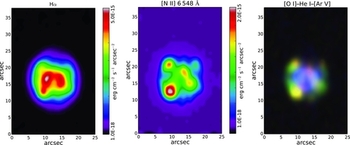
The ground-based narrow-band image of PB 6 in [O iii] filter (Dufour et al. Reference Dufour, Kwitter, Shaw, Henry and Corradi2015), shows two concentric nearly circular shells. These authors also present a higher resolution STIS/HST image which shows a complex system of knots inside the nebula. Figure 5 shows the morphology of PB 6 as a roughly circular PN with faint extended halo appearing in the [N ii] emission-line map (middle panel). This map reveals also three non-symmetric knots inside the main ionised shell of the nebula. One of the knots has a tail-like extension. The [O i]–He i–[Ar v] composite RGB colour image (right panel) shows the same features seen in the [N ii] image. The [Ar v] emission (blue colour) fills the central region of the PN, while the He i emission (green colour) is distributed at the outer region and partially extends into the inner region. Two bright knots are pronounced on the E side of the nebula in yellow (R + G) colour. These seem to have fainter counterparts on the W side. In addition, another knot appears N of the nebular centre in magenta (R + B) colour with a tail of magenta and green colours.
As Figure 2, but for PB 6. The left and middle panels show the maps of the nebula in Hα and [N ii] lines, respectively. The right panel shows an [O i]–He i–[Ar v] RGB colour image of the object. A roughly circular PN morphology with faint extended halo (appears in [N ii] maps) and three non-symmetric knots appear inside the nebula. Two bright knots are pronounced in yellow (R + G) colour and the third knot appears in magenta (R + B) colour with a tail of magenta and green colours.

The expansion velocity of the entire nebula are slightly smaller than the values in literature (Table 5). The temperatures of the SE knot are slightly lower than the nebula as a whole. The densities of SE knot are marginally smaller than the nebula (Table 3). The total abundances of PB 6 are fully consistent with SE knot as well as the previous studies (Henry et al. Reference Henry, Balick, Dufour, Kwitter, Shaw, Miller, Buell and Corradi2015; Perinotto et al. Reference Perinotto, Morbidelli and Scatarzi2004).
6 MISCLASSIFICATION OF IC 2553 CENTRAL STAR
Miszalski (Reference Miszalski2009) and Miszalski et al. (Reference Miszalski, Corradi, Boffin, Jones, Sabin, Santander-García, Rodríguez-Gil and Rubio-Díez2011) claim that many of the weak-emission line CSs type are probably misclassified close binaries and their characteristic lines (C ii at 4 267 Å, N iii at 4 634 and 4 641 Å, C iii at 4 650 Å, C iv at 5801 and 5 811 Å) originate from the irradiated zone on the side of the companion facing the primary. The first evidence for the nebular origin of most key lines characterise the WELS type was given by Górny (Reference Górny2014) when he found these lines appear in a spatially extended region in the 2D spectra of NGC 5979. Basurah et al. (Reference Basurah, Ali, Dopita, Alsulami, Amer and Alruhaili2016) declared that, for many objects, the WELS type may well be spurious. From WiFeS data of NGC 5979, M4-2, and My60, they showed that the characteristic CS recombination lines of WELS type are of nebular origin. They were reclassified the CSs of these nebulae as hydrogen rich O(H)-type. Ali et al. (Reference Ali, Dopita, Basurah, Amer, Alsulami and Alruhaili2016) found a further example (M3-6) that further indicates the unreliability of the WELS classification. From a careful nebular subtracted spectrum of the CS in M3-6, they revised its classification as H-rich star of spectral type O3 i(f*). In addition, they show the emission of almost all proposed CS recombination lines as WELS type are spatially distributed over a large nebular area. Here, we present yet another example of misclassification of WELS type which raises the probability that most genuine cases of WELS originate from irradiation effects in close binary CSs.
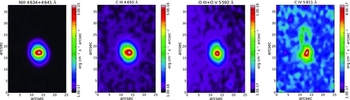
The CS of IC 2553 has been classified as of the WELS type by Weidmann & Gamen (Reference Weidmann and Gamen2011). However, in Figure 6, we present emission-line maps of IC 2553 in four CELs (N iii 4 631 + 4 641 Å, C iii 4 650 Å, O iii + O v 5 592 Å, and C iv 5 811 Å) which are supposed to be of CS origin according to the definition of the WELS type. It is clear that the emission in all of these lines are spatially distributed over a large area of the PN, except for the C iv 5 811 Å line which may truly be of CS origin. Unfortunately, we were unable to extract the CS spectrum from the available data cube of this PN, but it is clear that the WELS type classification is erroneous for this nebula.
Emission-line maps of IC 2553 in the recombination lines: N iii 4 634 + 4 641 Å, C iii 4 650 Å, O iii + O v 5 592 Å, and C iv 5 801 Å. These lines are supposed to be of CS origin according to the WELS type. However, all emission lines are spatially distributed over a large area of the nebula, and hence are certainly of nebular rather than central star origin.

7 CONCLUSIONS
We have studied the four southern PNe Hen 2-141, NGC 5307, IC 2553, and PB 6 using the integral field unit spectroscopy technique. We performed emission-line maps as well as composite colour images to study the morphologies and ionisation structures of these objects. The maps reveal the presence of low-ionisation knots in all objects. Two knots appear in Hen 2-141, four in NGC 5307, two in IC 2553, and three in PB6. Furthermore, for the first time, we shed the light to the spectroscopy of six knots associated with NGC 5307, IC 2553, and PB 6. The derived physical and kinematical properties of these knots should be taken with caution due to the probable contamination of these knots with their surrounding nebular gases. However, in general, the physical conditions and elemental abundances of the knots are agree with their accompanying nebulae, except the electron densities in the knots are systematically lower. Furthermore, we noticed a slightly higher nitrogen abundances in the knots of NGC 5307 compared to the entire nebula. Those knots also have lower radial velocities than their parent nebulae, suggesting that they are dense part-ionised structures lying on the far side of the expanding nebula (and therefore seen with a redshift), and have ionisation fronts photoionised on the side which lies nearest the CS.
The physical analysis of the entire nebulae indicates a medium to high EC for NGC 5307 and IC 2553 and very high ECs for Hen 2-141 and PB6. Their elemental abundances compare relatively well with those previously published in literature.
Another example for the misclassification of WELS type CSs was given here. The demonstrated emission-line maps of IC 2553 in the collisional characteristic lines of WELS type show that these spectral lines are spatially distributed over a wide nebular area and therefore are not of CS origin but arise from within the nebula.
ACKNOWLEDGEMENTS
This paper is a result of a project introduced by the Deanship of Scientific Research (DSR) at King Abdulaziz University, Jeddah, under grant no. (G-662-130-37). The authors, therefore, acknowledge with thanks DSR for technical and financial support. The authors thank the anonymous referee for his/her valuable comments.
APPENDIX: EMISSION LINE FLUXES AND IONIC ABUNDANCES
The observed and de-reddened line fluxes (relative to Hβ = 100), log F(Hβ), and c(Hβ) of Hen 2-141, NGC 5307, IC 2553, and PB 6 as well as their studied knots were given in Tables A1 and A2. The [O iii] line at λ5007 is saturated in NGC 5307 and IC 2553 nebulae. The values of both lines were determined applying the theoretical line ratio [O iii] λ5007/[O iii] λ4959 of 2.89 (Storey & Zeippen Reference Storey and Zeippen2000). Both of the [O iii] lines at λ5007 and λ4959 are saturated in Hen 2-141, therefore, we adopted their values as the averages of available values in literatures. Columns (1) and (2) give the laboratory wavelength and identification of observed lines, while other columns show the observed and de-reddened line fluxes of the PNe and their associated knots.
Integrated line fluxes and de-reddened intensities, relative to Hβ = 100, of Hen 2-141 and NGC 5307.

Integrated line fluxes and de-reddened intensities, relative to Hβ = 100, of IC 2553 and PB6.

The total helium abundances for all objects were determined from He+/H and He2 +/H ions using atomic data from Porter et al. (Reference Porter, Ferland, Storey and Detisch2012) and Porter et al. (Reference Porter, Ferland, Storey and Detisch2013). The total carbon abundances are determined from C2 +/H and C3 +/H ions in all objects, except Hen 2-141 which is determined from the C2 +/H ion only. The ionic abundances of the four PNe and the knots were given in Tables A3 and A4.
Ionic and total abundances of Hen 2-141 and NGC 5307.

Ionic and total abundances of IC 2553 and PB6.