


1. Introduction
Today, the relationship established between the user and the product is shaped not only in functional or aesthetic levels but also in emotional and psychological dimensions, and approaches to product design have transformed significantly. Design is no longer just a process of giving shape; it is a meaningful and interaction-oriented communication tool that responds to users’ needs with sensitivity. In this context, both emotional design models and holistic approaches such as CMF (Colour–Material–Finish) design come to the forefront in research in order to enrich the user experience and strengthen the bond established with the product. In this study, the effect of CMF design on the emotional experience that users establish with products is evaluated according to Norman’s model. Over-ear headphones targeting different user profiles are examined through a comparative case study, and it is revealed how CMF decisions shape the user experience not only visually but also functionally and symbolically.
2. Emotional design levels and the role of CMF in product design
Emotional design adds a multi-layered perspective to design understanding by interpreting the interaction between users and a product not only in terms of functionality but also on an emotional level. Reference NormanNorman (2004, pp. 37-41) explains this interaction on three basic levels: visceral, behavioural and reflective. The visceral level focuses on the aesthetic characteristics of the product and the instinctive reactions it elicits in the user at first glance; the colour, form, or surface texture of an object can create a pleasant or unpleasant impression in the user. The behavioural level concerns how usable the product is and whether it provides the user with a functional experience. Ease of use, interaction speed, and intuitive interfaces are key elements of this level. Finally, the reflective level relates to the personal meaning of the product and the long-term emotional impression it leaves on the user; at this level, the user establishes an identity, memory, or sense of belonging with the product. Designs that balance these three levels can leave a lasting impression by not only being functional but also providing the user with aesthetic pleasure and emotional satisfaction. In this context, addressing both the cognitive and emotional aspects of product design is of great importance for a deep understanding of the user experience (Reference NormanNorman, 2004, pp. 37-49). Emotional processes, which underlie effective functioning in human behaviour, are shaped not only by conscious emotions but also by automatic and reflexive responses. Reference Ortony, Norman, Revelle, Fellous and ArbibOrtony et al. (2005, pp. 174-175) explain this structure with a two-layered model: proto-affect and affect. Proto-affect refers to primitive evolutionary responses that operate without the need for evaluation and are directly linked to neurological systems. In contrast, emotions are defined as higher-level responses shaped by cognitive evaluation, context analysis, and experience. This distinction is particularly valuable in the context of product design and user experience, as the initial contact with a product (e.g., through colour, texture, or shape) triggers proto-emotions, while long-term satisfaction and meaning develop at the level of emotions. Therefore, both visceral and reflective design levels serve different layers of emotional processing (Reference Ortony, Norman, Revelle, Fellous and ArbibOrtony et al., 2005, pp. 185-187).
CMF design is a subfield of industrial design that comprehensively addresses the emotional, aesthetic, and environmental impacts of decisions regarding a product’s colour, material, and surface finish. CMF design is a comprehensive design approach that evaluates decisions regarding a product’s colour, material, and surface finish in conjunction with their emotional, aesthetic, and environmental impacts. Reference Crilly, Moultrie and ClarksonCrilly et al. (2004) note that these elements are critical not only visually but also in terms of user perception, experience, and the symbolic relationship established with the product.
CMF is a fundamental component that shapes how users perceive, understand, and experience a product, going beyond merely defining its aesthetic characteristics in industrial design processes. It has three core elements:
-
• Colour: Creates emotional associations; influences cultural, psychological, and aesthetic perceptions. Through colour psychology, the persuasiveness and market positioning of a product design can be enhanced.
-
• Material: Determines both visual quality and tactile experience. The origin, sustainability, and performance of the material influence the perceived value of the product.
-
• Finish: Defines the final form of the product; encompasses surface characteristics such as gloss, pattern, texture, and tactility. It also affects usability and durability.
These three components shape both the aesthetic identity of the product and the sensory relationship it establishes with the user, forming the first physical and emotional connection between the product and the user. They also directly affect the perceived quality of the product, its lifespan, and its potential to form an emotional bond. Reference Piselli, Alfano and TomesaniPiselli et al. (2018) argue that both technical and sensory-based criteria should be evaluated together, bridging the gap between engineering and aesthetics. In industrial design, material selection is not only about durability but also about feel and perception.
Reference Liu and KimLiu and Kim (2023) note that CMF is no longer just a design preference but also a strategic tool for creating brand value, while Reference LiuLiu (2020) emphasises that CMF has broken away from traditional industrial design patterns to become a separate discipline in terms of user experience, production process, and brand strategy. Colour, material, and coating decisions directly influence consumer preference and should be customised according to user perception. Reference Kim and NahKim and Nah (2014) note that enhancing sensory experiences is directly related to CMF design and that, in this context, the production of ‘emotional materials’ through the senses represents a new direction of development for the design industry.
CMF design lies at the intersection of many design goals, such as user satisfaction, sustainability, and brand perception, and forms the basis of trend research. According to Reference BecerraBecerra (2017), trend analysis is not only about identifying what is ‘interesting’ but also about transforming it into applicable design opportunities, and ‘CMF design is the visual and tactile embodiment of trend-based design research. Reference Liu and KimLiu and Kim (2023) state that CMF plays a critical role in the emotional visualisation of the product and the strengthening of brand value, and that CMF-focused design is a breakthrough for the consumer market.
Reference Liu and KimLiu and Kim (2023) note that CMF is a multifaceted design tool in terms of the product’s semantic family identity and the connection it establishes with the user, while Reference IsoahoIsoaho (2016, pp. 36-39) emphasises that CMF components are used to contribute to more accurate and user-focused determinations, reflect brand identity through selections, and directly address the target audience. This aspect of CMF shows that product decisions are shaped not only by technical data but also by psychological and emotional data, resulting in a holistic decision-making process.
Reference Kato, Botella-Carrubi and Ribeiro-NavarreteKato et al. (2023) state that CMF has influenced product development processes as a new approach in the technical industrial design process and has become one of the key factors in increasing the competitiveness of products. It is stated that CMF has replaced stylisation in many sectors in the field of industrial design, from automotive to home appliances, clothing to electronic products, and that it has a direct impact on purchasing decisions (Reference Crilly, Moultrie and ClarksonCrilly et al., 2004).
CMF design stands out as a distinctive design power for brands in highly competitive sectors such as fashion, automotive and consumer electronics. Decisions regarding colour, material, and surface finish go beyond mere aesthetic preferences, serving strategic functions such as expressing brand identity, establishing an emotional connection with the user, enhancing perceived quality, and creating sustainable differentiation in the market. For example, Reference KatoKato (2023) has shown that surface coating (especially matte and gloss levels) has a significant impact on product appeal. Matte surfaces are generally perceived as ‘sophisticated,’ while light reflection enhances the image of quality.
CMF elements, which determine the first physical and emotional touchpoints between the product and the user, also play a direct role in the product’s environmental impact, user experience, and symbolic value. This multi-layered effect transforms CMF design into a powerful design approach not only in terms of form but also in terms of function and emotion. How a product looks, feels, and communicates is an integral part of the user experience. CMF decisions express the product’s story through visual and sensory means, making qualities such as craftsmanship, innovation, and brand essence visible and lasting.
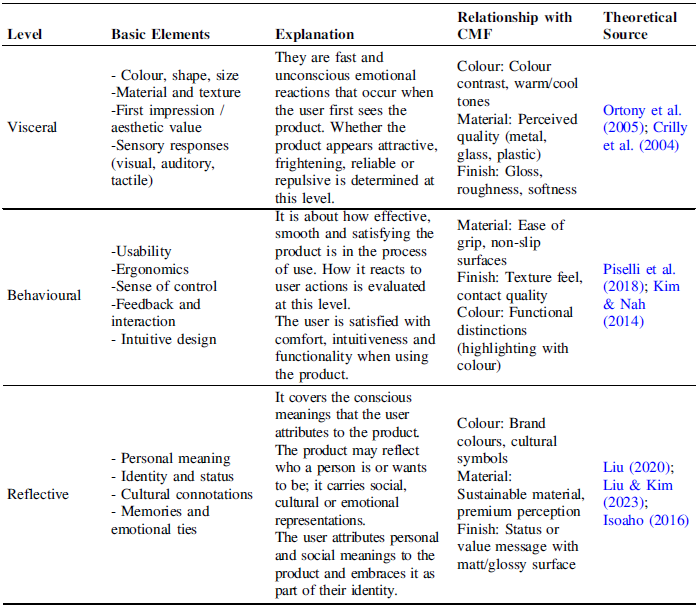
A review of the existing literature reveals that emotional design theory (Reference NormanNorman, 2004; Reference Ortony, Norman, Revelle, Fellous and ArbibOrtony et al., 2005) and the perceptual, strategic and technical dimensions of CMF design (Reference Crilly, Moultrie and ClarksonCrilly et al., 2004; Reference Piselli, Alfano and TomesaniPiselli et al., 2018; Reference LiuLiu, 2020; Reference Liu and KimLiu & Kim, 2023) tend to be considered within distinct disciplinary contexts. While emotional design studies focus on the cognitive and emotional aspects of the user experience, CMF research has primarily evaluated these aspects in the context of aesthetic perception, material selection, brand strategy and market positioning. However, there are few studies that systematically integrate these two areas and directly link CMF components (colour, material, and surface finish) to the intuitive, behavioural, and reflective levels of emotional design. In particular, comparative analyses using real product examples that reveal how specific CMF decisions correspond to different layers of emotional experience are lacking in the literature. This indicates a need for a clearer, more analytical and applicable connection between emotional design theory and CMF-based design decisions. This study aims to fill this gap. The study offers three main contributions. Firstly, it proposes a holistic framework that is lacking in the literature by mapping Norman’s three-level emotional design model onto the components of CMF. Secondly, it operationalises this theoretical framework through a comparative case analysis using examples of over-ear headphones. Thirdly, it provides an analytical model that enables industrial designers to evaluate the emotional impact of CMF decisions more consciously and strategically. The theoretical relationship between the levels of emotional design and the components of CMF is presented systematically in Table 1 below.
Table 1 was developed through a structured conceptual synthesis of the emotional design framework proposed by Reference NormanNorman (2004) and CMF-related perceptual, sensory and strategic design literature (Reference Crilly, Moultrie and ClarksonCrilly et al., 2004; Reference Piselli, Alfano and TomesaniPiselli et al., 2018; Reference LiuLiu, 2020; Reference Liu and KimLiu & Kim, 2023; Reference IsoahoIsoaho, 2016; Reference Kim and NahKim & Nah, 2014). Rather than being intuitively constructed, the table represents a theoretical mapping between the three levels of emotional processing (visceral, behavioural and reflective) and CMF components (colour, material and finish) as discussed in prior research. Each level and its associated CMF attributes were aligned based on documented relationships between sensory perception, usability factors, symbolic meaning construction and design strategy. This literature-based mapping establishes the conceptual framework of the study and clarifies how the analytic categories used in this work are theoretically derived.
The three levels of emotional design and their relationship with CMF design (developed through literature-based conceptual synthesis)

The three levels of affective design—visceral, behavioural, and reflective—shape how users respond to products. Visceral design triggers immediate visual reactions, like bright red headphones evoking energy and youth. Behavioural design focuses on functionality and comfort, as in ergonomic, non-slip surfaces that enhance satisfaction. Reflective design adds symbolic meaning, such as a recycled laptop with a matte finish representing mindfulness and sustainability. Thus, products become both practical tools and expressions of identity.
3. Methodology
In this study, qualitative research design was preferred in order to understand the research problem comprehensively. The research is structured on three main qualitative methods: case study, content analysis and visual analysis. Over-ear headphone designs of different brands were used as a sample and each product design was evaluated within the scope of CMF components and emotional design theory. Content analysis was applied to systematically identify the CMF elements in the designs. Data were obtained from visual and verbal sources such as official product images, brand descriptions, design details and user comments. To increase methodological transparency, all data sources were cross-checked across at least two independent sources (brand website, design review platforms or technical product pages).
Comparative analysis method was used to reveal how emotional design levels correspond to each CMF decision. In line with the data obtained from the literature, the level of emotional experience provided by the design features was evaluated and the contributions to the user were defined through an analysis table. The comparative framework was structured according to predefined CMF parameters and emotional design indicators derived from literature, ensuring consistency across case evaluations.
Visual analysis method was applied by supporting the findings of the study with graphical representations. Visual analysis enabled the findings obtained from the content analysis to be concretised at the conceptual level and demonstrated how design decisions overlap with emotional effects. Visual analysis followed a structured interpretation protocol focusing on colour perception, material perception, surface reflectivity and perceived quality. Through this methodological framework, the relationship of CMF elements such as colour, material and surface finish with the three levels of emotional design has been systematically analysed.
In this research, in order to evaluate Don Norman’s emotional design theory and CMF design elements, products representing different brands and design approaches in the over-ear headphone category were selected as a sample. The sample selection was carried out using purposeful sampling method based on the following criteria:
-
1. Providing Layered Interaction in terms of Emotional Design
The selected models were required to relate to at least two of Norman’s three emotional levels (visceral, behavioural, reflective). Products offering aesthetic differentiation, user experience quality and symbolic meaning were prioritised.
-
2. Having Significant Elements in terms of CMF Design
Products were required to demonstrate distinctive colour, material and surface finish applications associated with brand identity.
-
3. Representation of Different Brand Positioning
Within this framework, three cases were selected:
Case 1, Urbanears Zinken was selected to represent young, budget-conscious, and environmentally aware users. Its lightweight structure and vibrant color palette aim to convey a sense of youthfulness and energy (Figure 1).
Selected case 1

Case 2, Marshall Major IV, was chosen to embody nostalgia and deep-rooted connections with music culture. Its retro-inspired design, matte black finish, and vinyl-like surface texture evoke a sense of authenticity and emotional attachment to music heritage (Figure 2).
Selected case 2

Case 3, Bang & Olufsen Beoplay H95, represents luxury, minimalism, and exclusivity in the high-end market. Its refined use of premium materials such as brushed metal and natural leather reflects sophistication, status, and a modern lifestyle (Figure 3).
Selected case 3

-
4. Being Recognised in the Market and Accessible Visual/Open-Source Information
The accessibility of user reviews, technical documents, visuals and design descriptions of the selected models facilitated the evaluation in terms of both content and visual analysis.
-
5. Representation of Different Aesthetic, Ergonomic and Semantic Values
Representing different value systems in terms of aesthetic appearance (e.g. minimal/retro), ergonomic structure (foldability, softness, surface control) and symbolic meanings (luxury, subculture, youth) ensured the diversity of the sample for comparative analysis.
These criteria allowed for a holistic analysis of not only the physical aspects of the products, but also their aesthetic value, their relationship with the user and the emotional effects of the design language.
This study involved evaluating each product using a three-stage analysis process. First, the CMF components relating to the products’ colour, material and surface finish were systematically defined. These were defined using product images, technical descriptions and design information provided by the brand. In the second stage, each identified CMF component was conceptually matched according to Reference NormanNorman’s (2004) emotional design levels: instinctive, behavioural, and reflective. The matching process considered the perceptual (first impression), use-based (ergonomics and functionality) and meaning-making (identity and symbolic value) dimensions as defined in the literature. Comparative analysis was then used to reveal the relationship between CMF decisions and emotional design levels. The effectiveness of CMF elements at visceral, behavioural, and reflective levels was evaluated separately and compared across products. To increase analytical reliability, evaluation criteria were applied consistently to all cases using a standardised analysis matrix.
Findings were supported by tables and schematic visual representations illustrating conceptual mapping. These visualisations were not used as primary data, but as analytical support tools to strengthen interpretability. In the third stage, a comparative analysis was conducted among the three products to determine which CMF decisions had a dominant effect at which emotional level, with similarities and differences presented systematically.
The comparative analysis revealed the relationship between each product’s CMF decisions and emotional design levels. During the analysis, the effectiveness of CMF elements at the visceral, behavioural and reflective levels was evaluated separately for each product, and these elements were then compared across products. This method performed intra-product analysis and revealed the impact of different brand positioning on emotional design strategies. The findings were supported by tables and schematic visual representations to illustrate conceptual mapping. These visualisations were not used as primary data, but rather as analytical support tools to enhance interpretability.
4. Results
The findings for the three designs selected in line with the conceptual background created by the literature review are given under separate headings.
Case 1 -Urbanears Zinken Over-Ear Headphone Design
Urbanears Zinken is a portable and foldable over-ear headphone design that appeals to a young, urban and creative user profile. This product has been developed especially for users who are sensitive to street fashion, adopt a mobile lifestyle and have an active relationship with music.
The visceral level of the Zinken model shapes the aesthetic response of the user when they first see the product. The headphones are presented in a vibrant colour scheme (matte black, red, yellow), which increases their attractiveness and responds to young users’ need for self-expression. The matt plastic surface and concealed metal details combine aesthetic simplicity with a sense of confidence. The non-glare surfaces offer a minimal design language and at the same time reinforce the modern and simple character of the product. CMF decisions at this level allow the product to create a positive first impression on an unconscious level with connotations of youth, energy and modernity.
In terms of ergonomics of use, Zinken demonstrates a strong performance at the behavioural level. Soft PU leather covering and memory foam fillings preferred in the ear cushions provide comfort for long-term use. The foldable mechanism provides ease of transportation, while the connection point on both headphones of the product allows users to share music. In addition, the physical control buttons offer the user an intuitive interaction opportunity; the user can perform operations quickly, accurately and with minimum effort during this interaction. These features position the product as “easy, comfortable and user-friendly” and show that the CMF elements directly shape the physical experience.
The CMF elements in the Zinken model also support the identity and cultural meanings established with the product at a reflective level. The simple, timeless design of the product offers consumers not only an audio device but also a style element. While the variety of colours opens up a symbolic space for users to express themselves; simple surface transitions and understated logo placement create a design perception that is far from ostentation but conscious. At this level, the product becomes an element that reflects the identity rather than an aesthetic object for the individual.
The Urbanears Zinken stands out as an example where CMF design decisions are holistically associated with the three levels of emotional design. It has been observed that CMF elements are used as strategic tools at every stage from the first impression to the user experience and the production of personal meaning. This shows that the product is designed not only functionally but also to establish a meaningful connection with the user. Thus, Zinken offers a design solution that makes the user experience satisfying at both aesthetic, functional and identity levels.
Case 2 - Marshall Major IV Over-Ear Headphones Design
Marshall Major IV headphone model is a product that combines the brand’s deep-rooted identity based on rock music culture with a retro design approach. It has a strong visual identity that attracts attention with its retro aesthetics at first glance. The use of classic matte black colour, enriched with gold details, is a direct reference to the iconic Marshall amplifiers. The vinyl-coated surface also evokes a nostalgic tactile sensation, allowing the user to quickly establish an emotional connection with the product on an unconscious level. On first impression, the product evokes a ‘classic, authentic and stage-appropriate’ connotation, offering aesthetic appeal, especially for music enthusiasts and users with a connection to alternative culture.
During use, the product’s behavioural CMF solutions are characterised by functionality and durability. Physical control buttons provide intuitive and fast operation, while the soft material used in the ear pads creates comfort in the ear during long-term use. The foldable structure and flexible connection points provide ease of transport and give the product a sense of durability. These features stand out as an ergonomic solution especially for users who prefer to listen to music on the go and give the product the perception of ‘practical, durable and comfortable’.
The cult identity and historical position of the Marshall brand deepens the symbolic meaning of the headphones. CMF decisions in the design are structured to serve this identity. In particular, the vinyl surface’s inspiration from the amp jackets and the prominent placement of the embossed Marshall logo in a characteristic font transform the product beyond an audio device into a lifestyle icon. Users choose these headphones not only for their sound quality, but also because they associate them with ‘dedication to music, independence, character and loyalty’. In this way, the product functions as ‘a tool that represents my own style’ on a reflective level for the user.
These findings suggest that the Marshall Major IV model’s CMF design decisions overlap holistically with the three-level affective design framework and create strong user engagement, particularly in terms of identity, culture and experience.
Case 3 - Bang & Olufsen Beoplay H95 Over-Ear Headphones Design
The Bang & Olufsen Beoplay H95 model targets premium segment users with its use of high-quality materials and refined design language. This headphone design creates a powerful emotional experience for the user through CMF components and effectively structures layers of meaning corresponding to the visceral, behavioural and reflective levels.
At first impression, the design stands out for its aesthetic integrity. The colour palette in natural tones (e.g. sand beige, fog grey, charcoal black) and the brushed aluminium body create a minimal and elegant look. The genuine leather finish and smooth surface transitions create a feeling of high quality on both a visual and tactile level. As soon as the user sees the product, they make a quick unconscious assessment of qualities such as ‘sophisticated, balanced, elegant’. These visceral reactions allow a strong bond to be established, especially with a user base with high aesthetic sensitivity.
The behavioural experience of the product is directly related to the CMF elements. Leather cushions with memory foam cushioning reduce pressure around the ear and provide isolation during prolonged use. The highly tactile circular metal control area integrated into the earcup surface allows you to perform functions such as increasing/decreasing volume with a natural finger movement. The surface’s fingerprint-resistant matt finish provides a clean feel. The combination of these features provides the user with a quiet, refined and highly intuitive operating experience. The product thus creates a feeling of ‘high function in simplicity’.
One of the strongest strengths of Beoplay H95 is the meaningful relationship it establishes with the user on a reflective level. The high-quality natural materials used in the product, the simplicity of design and the elegant details create not only aesthetic but also social status associations. All CMF decisions, from the packaging design to the headphone case, are unified by the concept of luxury. The prestigious position of the Bang & Olufsen brand and its design language position the product not only as functional but also as a ‘means of identity expression’. By adopting this headset, the user expresses a lifestyle that is ‘minimalist yet exclusive’ and ‘integrates technology with aesthetics’.
This analysis reveals that the CMF design strategies of the Beoplay H95 model overlap holistically with Norman’s affective design theory and that the product offers a conscious emotional experience design at all levels. Especially at the reflective level, it is very successful in creating layers of meaning that reinforce user identity and coincide with lifestyle.
5. Discussion and conclusion
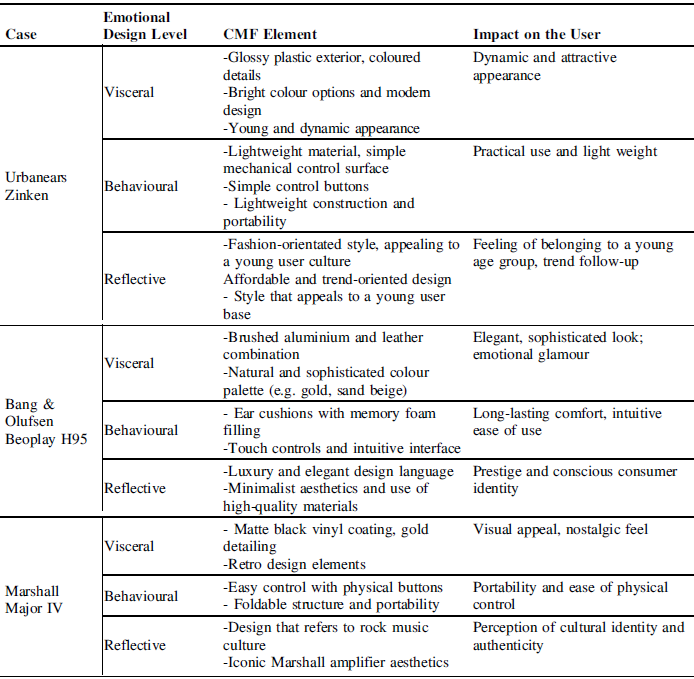
Over-ear headphone designs of three different brands were comparatively analysed through CMF design elements based on the three levels of emotional design. Table 2 provides a summary of the three case studies analysed within the scope of the research.
Three levels of emotional design, CMF design elements and contribution of the designs to the user

With this table, the characteristics of emotional design levels for each product and the emotion it gives are given. In this table, where emotional levels are associated with CMF design elements, the multi-layered structure of emotional experience and how CMF decisions support this structure are revealed through these products that appeal to different user profiles. The analyses show that each emotional level assigns a different role to design and CMF elements function in a way specific to these levels.
At the visceral level, the influence of colour, material and surface finish on first impressions was clearly observed. For example, at Urbanears Zinken, bright colours and lightweight materials created a sense of youth and dynamism; at Marshall, the retro vinyl finish and matte black look created a nostalgic connotation; and at B&O, brushed metal and natural tones provided an elegant and understated aesthetic. This shows that CMF decisions appeal not only to visual but also to emotional triggers.
At the behavioural level, ease of use, ergonomics and material comfort stood out. Ear cushion materials and surface coatings supported user experience across all models, while tactile feedback and intuitive control areas contributed to behavioural satisfaction. At this level, CMF functions as a key factor determining the physical quality of user–product interaction rather than acting solely as an aesthetic layer.
At the reflective level, symbolic meaning, identity overlap and social positioning became more prominent. Urbanears Zinken connects with personal values through environmental messaging and youth-oriented accessibility; Marshall reinforces identity construction through nostalgia and brand culture; Bang & Olufsen represents status and elegance through premium materials and minimal aesthetic language. At this level, CMF elements become part of the lifestyle and social meaning represented by the product.
These findings reveal that CMF design is not limited to superficial product qualities; instead, it acts as a multi-layered tool constructing emotional experience. The comparative analysis shows how designers differentiate CMF strategies according to target user groups. Material texture, surface transitions and symbolic use of colour act as functional interfaces in the process of emotional connection.
CMF decisions addressing all three emotional design levels allow products to carry psychological, cultural and social values in addition to aesthetic and technical qualities. This multi-layered design approach suggests that CMF should be evaluated more holistically as a strategic component in user-oriented product development.
When positioned within the broader design research field, these findings support and extend Don Norman’s emotional design framework by demonstrating how specific CMF parameters operationalize emotional design levels in real product cases (Reference NormanNorman, 2004). While previous research often discusses emotional design conceptually, this study contributes by linking theoretical emotional design levels directly to observable CMF decisions.
In parallel with studies on material-driven product perception and design meaning (Ashby & Johnson, 2014; Karana et al., 2015), the findings show that colour and surface finish primarily influence visceral perception, whereas material quality and tactile properties are more strongly associated with behavioural experience. Reflective-level responses were found to be strongly connected to brand symbolism, cultural references and perceived product value.
Another important contribution of this study is demonstrating how CMF strategies differ depending on brand positioning and target user identity. This supports the argument that CMF is not only an aesthetic finishing layer but also a strategic communication tool that conveys brand narrative and user identity.
Therefore, this research contributes to the literature by proposing an integrated analytical perspective combining CMF design and emotional design theory within a comparative product analysis framework. This perspective can support designers in evaluating emotional impact during early design decision-making stages.
Despite these contributions, the study has limitations. It is based on a limited number of case products and secondary visual and textual data sources.
Future studies could increase the sample size and incorporate user-based empirical methods, such as interviews, sensory testing and measurement of emotional responses, to validate CMF–emotion relationships more directly. Based on the findings, the following suggestions can be made to industrial designers:
-
• Emotional levels should be evaluated holistically throughout the design process, with CMF decisions being integrated at an early stage.
-
• User research should be employed to gain insight into aesthetic expectations, cultural symbolism and emotional needs.
-
• CMF design should address the ergonomic, sensory and symbolic dimensions simultaneously.
-
• Emotional design strategies should vary according to product segment and target user group.
-
• Sustainability can create reflective-level meaning through environmentally responsible material choices.
Consequently, CMF decisions function as strategic tools that shape how users perceive, use and interpret products. This study highlights the potential of CMF as a design strategy, providing an applicable theoretical and analytical framework for developing products that are both emotionally engaging and user-oriented.



 Open access

