


Introduction
Our society is suffering from increasingly complex and entrenched challenges (George et al., Reference George, Howard-Grenville, Joshi and Tihanyi2016), such as for example climate change, food insecurity, freedom and human rights, international migration, and socio-economic inequalities. A specific category of these problems, or even a consequence of the interweaving of them, is the welfare state crisis with the related reforms that have happened in the last 50 years in the attempt to deal with it (e.g., Baglioni, Reference Baglioni2017; Nicholls et al., Reference Nicholls, Simon and Gabriel2015). Indeed, after the 1970s with the increased demand and the widening of the variety of social needs from the population and specific demographic changes,Footnote 1 there has been a huge amount of pressure and demands on national and supranational entities in reforming the welfare state and in the provision of existing social services (e.g., Pestoff, Reference Pestoff2012). One solution provided by several countries has been to decentralize the welfare state while simultaneously recurring to the market for the provision of a wide array of social services (e.g., Henriksen et al., Reference Henriksen, Rathgeb Smith and Zimmer2012). However, these New Public Management (NPM) reforms have in many cases weakened the capacity of civil society and the public sector to deal with wicked issues, especially in terms of not only delivering, but also innovating and finding new social relations and solutions, with the effect of often generating losses of perceived legitimacy of government action by the citizens (Dey &Teasdale, Reference Dey and Teasdale2016).
Against this backdrop, this essay starts with a relevant and urgent problem (Carboni et al., Reference Carboni, Dickey, Moulton, O’keefe, O’leary, Piotrowski and Sandfort2019), namely the reform of the welfare state to deal with increasingly complex social protection needs, and embraces a notion of critical scholarship as concerned with proposing normative and actionable alternatives that can create more sustainable societies (Coule et al., Reference Coule, Dodge and Eikenberry2022). Specifically, we advance the idea that institutionalizing and connecting experimental places for inclusive social innovation can be a bottom-up strategic response to the welfare state crisis, specifically a democratizing response that conceives social innovation as an inclusive and collective practice of democratic learning and deliberation with marginalized citizens and relevant publics, rather than merely being a practice led by empowered and heroic actors.
Engaging with debates occurring in this journal on the emancipatory potential of social innovation beyond neo-liberal governmentalities (Lachapelle, Reference Lachapelle2021) and on the technocratic vs. democratic approach to social innovation (Montgomery, Reference Montgomery2016), we follow a critical performative stance (Alvesson & Spicer, Reference Alvesson and Spicer2012) where through a tactic of progressive pragmatism we engage with present potentialities ‘to create a sense of what could be’ (Alvesson & Spicer, Reference Alvesson and Spicer2012, p. 377). Inspired by Lachapelle (Reference Lachapelle2021) and Mazzei et al. (Reference Mazzei, Montgomery and Dey2021), we illustrate how institutionalizing and connecting places for inclusive social innovation requires a move from utopias to everyday civic opportunities for allowing different publics to experience social innovation. By mobilizing the notion of utopias and heterotopias in Foucault, we shed light on the opportunity to move from policy utopias to democratic heterotopias discussing the politics embedded in this cognitive change and bringing up, as recently pointed out by Mair et al. (Reference Mair, Kindt and Mena2023) and by Battilana and Casciaro (Reference Battilana and Casciaro2021), the political nature of social innovation. The notion of heterotopias is important to make a cognitive shift where social innovation is not anchored in binary paradigms, but co-existing with other governmentalities and paradigms emerging from post-capitalistic and neo-democratic features (Zanoni et al., Reference Zanoni, Contu, Healy and Mir2017), and potentially creating new hybrid and democratic proto institutions (e.g., Lawrence et al., Reference Lawrence, Hardy and Phillips2002; Skelcher et al., Reference Skelcher, Sullivan and Jeffares2013).
Our proposed alternative is that of a partnership between the state and civil society and third sector (Macmillan, Reference Macmillan2020), with social innovation becoming a problem oriented permanent operational programme located in a hybrid space characterized by ‘complex interactions that cut across sectors’ (Dekker & Evers, Reference Dekker and Evers2009, p. 219).
The idea for this essay came from conversations among the co-authors (comprising an international team of scholars engaged in the social innovation literature and one professional policy expert) about the actual state of social innovation institutions, the actual barriers to democratic institutionalization and the possible instruments to enact. The result of these discussions has been a collective essay of critical scholarship about social innovation inclusiveness and institutionalization that combines the theoretical knowledge developed by the academic side of the authors and the key insights stemming from the challenges, successes, and backlashes experienced by the policy expert over many years devoted to design and implement effective policy measures to make social innovation flourishing in the European Union institutions. Therefore, in the spirit of increased exchange of ideas between policy and academia, this collective essay is structured as follows.
The next section provides a conceptual backdrop where we define some key terms, such as institutionalization, experimental places, publics, utopia and heterotopia as well as our positional approach and perspective to social innovation. After having clarified our thesis/position, methodologically we proceed with an antithesis and synthesis approach grounded in the Greek philosophical tradition, so the third section discusses some obstacles that may hamper the institutionalization of experimental spaces for inclusive social innovation (antithesis), while the fourth section, symmetrically, highlights several mechanisms for overcoming these obstacles (synthesis). Finally, the last section provides some concluding remarks where we also discuss some managerial implications for public and social purpose organizations in terms of moving from policy utopias to democratic heterotopias.
Theoretical Backdrop: Institutionalizing Social Innovation Between Utopias and Heterotopias
The issue of if and how institutionalize social innovation is not new and has generated a rich debate (e.g., Brandsen et al., Reference Brandsen, Trommel and Verschuere2017). Drawing from Hjelmar (Reference Hjelmar2021, p. 55) ‘institutionalization is viewed as the process in which assumed ideas are transformed into operational programmes that are accepted as effective ways to achieve the agreed objectives’; as written by Agostini et al., (Reference Agostini2017, p. 389) citing Cajaiba-Santana (Reference Cajaiba-Santana2014) ‘the institutional perspective sees social innovation as a result of the exchanges and application of knowledge and resources by agents mobilized through legitimization activities.’
According to the TRANSIT (“TRANSIT—TRANSformative Social Innovation Theory”) research project,Footnote 2 institutionalizing social innovation deals with how ‘social innovation as perceived by key governance actors and its associated practices is institutionalized, either anchored through newly established institutions or embedded in existing ones’ (Pel & Bauler, Reference Pel and Bauler2014, p. 2). This stream of research focused explicitly on the institutionalization of social innovation and defined Transformative Social Innovation as ‘social innovation that challenges, alters or replaces dominant institutions in the social context’ (Avelino et al., Reference Avelino, Wittmayer, Pel, Weaver, Dumitru, Haxeltine, Kemp, Jørgensen, Bauler, Ruijsink and O’Riordan2019, p. 206). Other scholars, such as for example van Wijk et al. in a special issue in business and society, have pointed out that ‘innovations are able to address a persistent problem only insofar as they gain permanence through their institutional embedding (van Wijk et al., Reference Van Wijk, Zietsma, Dorado, De Bakker and Martí2019, p. 890).’
Clearly, being social innovation an umbrella concept and a “deeply political boundary object” (Pel & Bauler, Reference Pel and Bauler2014), it is important to clarify the position and perspective taken to social innovation. Here, we consider social innovation as ‘new ways of doing (practices, technologies, material commitments), organizing (rules, decision-making, modes of governance), framing (meaning, visions, imaginaries, discursive commitments) and knowing (cognitive resources, competence, learning, appraisal)’ (Pel et al., Reference Pel, Haxeltine, Avelino, Dumitru, Kemp, Bauler, Kunze and Jørgensen2020, p. 3)’ that occurs ‘through an open process of participation, exchange and collaboration with relevant stakeholders, including end users, thereby crossing organizational boundaries and jurisdictions’ (Voorberg et al., Reference Voorberg, Bekkers and Tummers2015, p. 1334). According to Marques et al., (Reference Marques, Morgan and Richardson2018, p. 501), there are at least four meanings of social innovation: (i) structural social innovation which results in a wide socio-economic-political change; (ii) targeted radical social innovation which radically reshapes how goods and services are delivered and power relations; (iii) targeted complementary social innovation which generate new processes and relationships for inclusive solutions to social challenges; (iv) instrumental social innovation which is basically about rebranding of existing practices/endeavours.
Overall, like Agostini et al., (Reference Agostini2017, p. 385) we take a pragmatic view of social innovation as ‘a way to mitigate social problems, resulting in new or improved solution for a specific community’ which should generate new social and governance relations. Indeed, social innovation can be considered as such if ‘contribute to changing social relations’ (Pel et al., Reference Pel, Haxeltine, Avelino, Dumitru, Kemp, Bauler, Kunze and Jørgensen2020, p. 3) and governance relations that ‘include the interaction with and the embedding into the politico-administrative system of the democratic states of the countries to which the communities belong (Moulaert et al., Reference Moulaert, Martinelli, Swyngedouw and Gonzalez2005, p. 1973, cited in Tello-Rozas, Reference Tello-Rozas2016).’ In this paper, we take a mixed position between the targeted radical and complementary view of social innovation, but also considering the structural social innovation with a bottom-up approach that aims to produce structural social innovation by way of accumulation of institutionalized and connected experimental practices/endeavours that change social and governance relations interacting with the politico-administrative systems.
This perspective to social innovation brings in especially the role of public sector institutions and civil society in experimenting with social innovations. This is usually a neglected focus, especially from scholars within organization and management studies with a main focus on the commercial sector, which has the merit of overcoming a rigid separation between state, market and civil society (Domanski et al., Reference Domanski, Howaldt and Kaletka2020). Most importantly, it connects with recent developments and debates on social innovation and democracy and on collaborative forms of open social innovation (e.g., Mair & Gegenhuber, Reference Mair and Gegenhuber2021). To this regard, the notion of publics we believe is particularly important here and we introduce it now.
Publics are ‘forums gathering together groups of citizens to deliberate on a particular issue…where participants are recruited through specific methods that ensure the representation of different societal groups or viewpoints’ (Setälä, Reference Setälä2017, p. 846). According to Fung, a publics ‘is made up of citizens who come together to reflect upon collective affairs and state actions in to jointly discover and create new, more effective approaches and possibilities’ (Fung, Reference Fung2002, p. 68).
Thus, designing, institutionalizing, and connecting experimental places for inclusive social innovation with publics and relevant stakeholders becomes a practice aimed at understanding social innovation from a democratic learning and civic capabilities development point of view (Sancino, Reference Sancino2016), rather from the perspective of profitization through market logics. This perspective questions also the idea of “scaling up” as superior form of social innovation as opposed to “scaling out” (see on this for example Westley et al. Reference Westley, Antadze, Riddell, Robinson and Geobey2014, p. 236 and Zuckerman, Reference Zuckerman2020), where scaling—in any of its forms—should be assessed against a “philosophy of evolutionary learning”(e.g. Ansell, Reference Ansell2011)’.
The focus on interactions between public sector institutions and interactions with publics brings in ideas around policy utopias (Mazzei et al., Reference Mazzei, Montgomery and Dey2021) and instrumental/complementary social innovation for keeping public services running through co-production within a regime of austerity. For example, Mazzei et al. (Reference Mazzei, Montgomery and Dey2021, p. 1636) have illustrated how ‘SE in the UK policy context has been mobilized as a superior model of social provision’ that may result ‘in the discursive construction of a utopian programme ‘consigned to the role of a ‘wish-fantasy’ (Levitas, Reference Levitas1979), rather than a catalyst of hope and, possibly, change’ (pp. 1637–1638).
Mobilizing Foucault (Vidler et al., Reference Vidler, Foucault and Johnston2014), we embrace here a distinction between utopias and heterotopias. Utopias, as Foucault explained, are imaginary places that represent an ideal or perfect society. They are often meant to inspire the creation of a better society, but never feasible, with the main function to provide an ideal image of society. Symmetrically, heterotopias are real spaces that have the capacity to contain different meanings and functions simultaneously. Foucault cites examples such as museums, prisons, theatres, and gardens as examples of heterotopias. These places are spaces where the rules and functions of society are suspended or mixed in a way that does not happen elsewhere, creating a sort of "elsewhere" in our world. If we think about social innovation initiatives, it is tellingly how the examples of heterotopias just made have been often fertile grounds for the spread of myriad of social innovations (e.g., restaurants run by incarcerated people, cultural museums owned by local population, theatral performances as cultural sites for democratic mobilization, urban gardens, etc.).
Accordingly, the concept of institutionalizing and connecting heterotopias as experimental places for inclusive social innovation seems particularly important for answering at demands of concreteness against utopian expectations (Pel & Bauler, Reference Pel and Bauler2014), because virtually any public purpose organizations could activate heterotopia places even within existing institutional arrangements. Clearly, there are issues in terms of the redistribution of power among the actors involved to be considered, but at least the moving from a utopian to a heterotopia imaginary gives back the power for agency (Battilana & Casciaro, Reference Battilana and Casciaro2021) to all the public purpose organizations to work concretely with different publics to develop social innovation capacity. In the next section, we illustrate some obstacles and some mechanisms to foster this transition.
Institutionalizing Social Innovation as a Response to Welfare State Crisis: Several Obstacles
Social Innovation as Entrepreneurial Micro Problem-Solving
Despite a growing interest for social innovation initiatives, which have seen an increasing amount of available funding from national and supranational governmental bodies, the idea of social innovation as an attractive or even pursuable way of dealing with the broader rethinking of the welfare state (Ewert & Evers, Reference Ewert and Evers2014), and more generally as a practice of democratic active citizenship, has not often being considered. Indeed, policymakers are often more interested in economic approaches to deal with the social needs of the different societal stakeholders. The evidence is in the wave of NPM reforms from the 1980s that rolled over several national welfare systems by recurring to the privatization and/or the marketization of providing social services.
A certain notion of social innovation, mainly shaped by the pragmatic and managerial schools (e.g. Mulgan et al., Reference Mulgan, Tucker, Ali and Sanders2007; Phills et al., Reference Phills, Deiglmeier and Miller2008), has prevailed among the many available, such as for example the systemic and critical ones (e.g. Moulaert et al., Reference Moulaert, Martinelli, Swyngedouw and Gonzalez2005; Westley et al., Reference Westley and McGowan2017). Indeed, the definitional focus on the micro problem-solving and presentist nature of social innovation has shed a shadow on other and potentially more system-change features of social innovation (Busacca, Reference Busacca2013), such as the process of “empowerment and political mobilisation” (e.g. Moulaert et al., Reference Moulaert, Martinelli, Swyngedouw and Gonzalez2005) and the role of social innovation in building resilience through transitions (e.g., Westley et al., Reference Westley and McGowan2017).
The Embeddedness Paradox: Fighting Their Own Institutions
Another challenge on the institutionalization journey is the embeddedness paradox inherent to the social innovation approach, characterized by a combination of path discontinuity and path dependency from the existing institutions (Avelino et al., Reference Avelino, Wittmayer, Pel, Weaver, Dumitru, Haxeltine, Kemp, Jørgensen, Bauler, Ruijsink and O’Riordan2019). As we have said above, social innovation approaches are being designed and implemented often because of the crisis that the welfare state is experiencing and of the difficulty in providing the social needs that citizens and other societal stakeholders ask for (Parthasarathy et al., Reference Parthasarathy, Dey and Gupta2021). The innovation side of the social innovation approach is intended to innovate existing practices that do not fulfil their promises. This means that social innovation initiatives aim to fill a void left by the existing institutions by trying to implement a new and discontinue approach from the past (Cajaiba-Santana, Reference Cajaiba-Santana2014).
However, we must take into consideration that any social innovation initiative does not happen in an institutional vacuum, but it is rather surrounded by a universe of already present norms and practices (Pel et al., Reference Pel, Wittmayer, Avelino and Bauler2019). Thus, existing institutions may act as exogenous enabling factors that prevent the possible paths of social innovation initiatives (Jensen & Fersch, Reference Jensen and Fersch2019). These factors could be budget restraints, constitutional norms, or place-based constraints of various natures such as a culture adverse to collaboration, high power distance, low civic capacity, and more broadly diverse relational assets (Mazzei, Reference Mazzei2017). In addition to that, existing institutions may try to resist from the path discontinuity initiatives that social innovation approaches try to implement.
Public Institutions Paradox: A New Role?
Another barrier to the thriving of social innovation approach as an institutional way to deal with welfare state reforms is how and what presence is needed from the public sector institutions. Indeed, as we have said before, a social innovation approach is usually taken to provide social needs that have been unmet by the existing welfare state (Phillips et al., Reference Phillips, Lee, Ghobadian, O’Regan and James2015). So, a lack of public sector actor action is a fundamental trigger for the rise of social innovation initiatives, reconnecting to the path discontinuity approach explained above. However, social innovation may need some resources from the public institutions, ranging from financial instruments to facilitating environment in which this approach could take form. So, too much lack of public institutions presence could severely affect the outcomes and a successful impact of social innovation initiatives. This is why public and social purpose organizations could open up spaces and redesign themselves and the environment around them in order to help by facilitating social innovation to satisfy those unmet social needs (Austin, Reference Austin2003; Lenz & Shier, Reference Lenz and Shier2021).
Social Innovation: A Difficult Definition and a Plethora of Perspectives
Another barrier on the way to institutionalize social innovation as a strategic approach to deal with the wickedness of welfare state crisis is the difficulty on defining it (Solis-Navarrete et al., Reference Solis-Navarrete, Bucio-Mendoza and Paneque-Gálvez2021). When public and social purpose organizations are attempting at implementing social innovation initiatives, they often do not have a clear definition in mind, undermining the possibility of success and impact of them. Indeed, while heterotopias could be considered as constructive discursive places in which different perspectives should thrive and coexist, an excess of conceptual ambiguity could trigger a deep ontological crisis of social innovation and its institutions (Gruber, Reference Gruber1995). Drawing from the social innovation literature, we have been able to identify three definitional challenges through which the concept has passed and is still dealing with (Marques et al., Reference Marques, Morgan and Richardson2018; Ayob et al., Reference Ayob, Teasdale and Fagan2016).
The first ambiguous element of the definition is in what could be defined innovation and what not (Baptista et al., Reference Baptista, Pereira, Moreira and Matos2019). To this regard, an initiative could be considered innovative if it develops a completely new approach or implement an innovative solution developed in another context through a process of adaptation. In this respect, while commercial innovation enjoys some regulatory protection at global scale, this does not exist for social innovation. Also, while commercial innovation is often realized once for all (kind of accumulation process), this does not apply to social innovation (Teasdale, Reference Teasdale2012). This peculiar nature of social innovation shows that social innovation is extremely context-dependent: what in a given space could be considered a social innovation does not necessarily need to be in another context (Moulaert & MacCallum, Reference Moulaert and MacCallum2019; Van Dyck & Van Den Broeck, Reference Dyck and den Broeck2013; Moulaert et al., Reference Moulaert, Hillier and Vicari Haddock2009).
The second ambiguous element is the social character of these initiatives. Indeed, the innovation concept has been traditionally connected to the market sector with the aim of producing profit for the stakeholders involved. However, social innovation initiatives, regardless of the different approaches taken, are usually implemented to satisfy unmet social needs not necessarily related to monetary or financial aspects (Nicholls et al., Reference Nicholls, Simon and Gabriel2015). This aspect does not imply that social innovation initiatives should not take into consideration financial sustainability. Indeed, when stakeholders aim for a long-term impactful social innovation initiative, they have to make compatible the social and the financial aspect of their approach (Mazzei et al., Reference Mazzei, Montgomery and Dey2021; Teasdale, Reference Teasdale2012). Nevertheless, they must not overlook on the fact that their main goal is to provide new solutions to social problems and not just make profit with an innovative solution.
A third element at the base of social innovation definitional ambiguity is the conflation with other innovation approaches (Solis-Navarrete et al., Reference Solis-Navarrete, Bucio-Mendoza and Paneque-Gálvez2021). Indeed, as said above, social innovation is a specific approach with specific goals that must be precisely distinguished from others. There are several examples of what social innovation is not: traditional innovations that are strictly business-oriented; social entrepreneurship which often lacks of scaling up capabilities and involvement of actors outside the business sector; frugal innovations which are more oriented to reducing the cost of a specific product or process; or environmental innovations which regardless of their social impact are mostly implemented to deal with economic issues.
Coordinating Actors: Different Perceptions and Different Governance Games
Another fundamental challenge to design, implement, or simply facilitate a social innovation approach stands in the difficulty of coordinating different societal stakeholders. Indeed, wicked problems need wicked adaptations, such as a social innovation response (Zivkovic, Reference Zivkovic2018). However, these kinds of adaptations require the involvement of all the publics and stakeholders that are affected by the problem, which in the case of the welfare state crisis and attempts to reform it are all the sectors of society (Misuraca et al., Reference Misuraca, Pasi and Viscusi2018). Indeed, the difficulties in dealing with wicked problems impede a single actor from solely dealing with them and ask for the pooling of the resources of a Quadruple/Quintuple Helix model of actors’ involvement, which is the production of knowledge and innovation with the participation of organized stakeholders coming from all the different societal sectors (Carayannis et al., Reference Carayannis, Grigoroudis, Campbell, Meissner and Stamati2018), as well as the relevant publics of citizens which already exist or might come to exist because of called into being by a convening act (Moulaert et al., Reference Moulaert, Mehmood, MacCallum and Leubolt2017; Sancino et al., Reference Sancino, Garavaglia, Sicilia and Braga2021).
From the necessary involvement of all these different actors follows a predictable difficulty in coordinating them. Indeed, the lack of capability from the actor that promotes a social innovation approach in dealing with such a wide array of actors could lead to either the exclusion of some of the societal stakeholders with all the consequences in loss of efficacy and legitimacy or the derailing of the social innovation to an inevitable failure. Drawing from the network governance literature, we have identified three interrelated coordination challenges that affects social innovation institutions (Klijn & Koppenjan, Reference Klijn and Koppenjan2016).
The first coordination challenge concerns the difference in perceptions of the different publics and stakeholders (Avelino et al., Reference Avelino, Wittmayer, Pel, Weaver, Dumitru, Haxeltine, Kemp, Jørgensen, Bauler, Ruijsink and O’Riordan2019). Indeed, the necessity of involving actors coming from different sectors of society results in a plethora on different perspectives on how to design, how to implement, what are the instruments or the goals that a social innovation initiative must have. It is not unusual that social innovation initiatives spend a lot of resources in managing the different actors’ perceptions, with also the risk of failing before implementing due to a lack of shared intentions.
The second coordination challenge lies in the difficulty of managing different publics and stakeholders on a daily basis (Källström et al., Reference Källström, Mauro, Sancino and Grossi2021; Nicholls et al., Reference Nicholls, Simon and Gabriel2015). Indeed, a social innovation initiative is a difficult strategic game that could not be planned in advance due to frequent upheavals. The third coordination challenge has been already analysed above and concerns the institutional complexity in which social innovation initiatives take place (Ewert & Evers, Reference Ewert and Evers2014). Indeed, as we have already observed, the clash between existing norms and routines and new institutional settings proposed by social innovation calls for a necessary institutional managing of this transition (Borzaga & Bodini, Reference Borzaga and Bodini2014). Indeed, recognizing that social innovation initiatives are usually implemented at the expenses of specific actors implies a whole set of consideration on how to set a self-sufficient subsequent institutional equilibrium that does not punish the old institutional actors.
Challenges in Measuring an Ambiguous Concept
Social innovation as a concept has been traditionally afflicted by the problem on how to measure the impact on society (Unceta et al., Reference Unceta, Castro-Spila and García Fronti2016). In particular, the road to institutionalize such an approach necessarily passes through the evidence that these initiatives are capable of achieving their goals of fulfilling unmet social needs and have a significant impact on the society.
The first problem for a more institutionalized measurement system is in the struggle of defining what is social innovation and what are its goals (Pel et al., Reference Pel, Wittmayer, Avelino and Bauler2019). Indeed, the definitional divergence due to the ambiguity of the concept but also the involvement of different publics and stakeholders with often conflicting perspectives represents a key obstacle for policymakers on finding a common measurement approach.
The second challenge is represented by an objective and subjective lack of data (Mihci, Reference Mihci2020). It is not unusual that social innovation initiatives impact lack of a serious and well-defined measurement system with the consequence of an absence of reliable sources of data both for researchers but also for policymakers.
The third challenge faced in defining a measurement system for the social innovation is at which level we should measure the impact of social innovation initiatives (Dyck & Broeck, Reference Dyck and den Broeck2013). Indeed, a long-standing debate within the social innovation community is to decide what is the most appropriate level at which set the indicators and measure the impact and the outcomes of a social innovation initiatives (Mihci, Reference Mihci2020).
Institutionalizing Experimental Spaces for Inclusive Social Innovation: Several Governance Mechanisms
Widening Through Information Sharing and Co-creation
The path for the institutionalization of social innovation as a heterotopic concept must pass through a purposeful widening of the actors involved into social innovation initiatives. Indeed, while specialization by academics and practitioners in both theoretical and empirical aspects of social innovation has been necessary for the foundation of the concept, now it might still have a scarce acquaintance outside specialists of what is social innovation and its value. What we propose here is a combination of reactive and proactive involvement of publics in a renovated, heterotopic social innovation through information sharing from specialists and the involvement of a variety of societal stakeholders through open social innovation approaches.
The information sharing approach consists into the popularization of social innovation knowledge beyond the usual places. Indeed, a more proactive approach from stakeholders, lay actors and ordinary citizens must pass through the acknowledging of both existence and importance of social innovation from a multitude of publics. For example, academics and practitioners could include a necessary activity of dissemination and engagement with the educational system, starting from the early stages in school to transform social innovation as a familiar institution for citizens. Secondly, public and social purpose organizations could develop specific knowledge creating organizations for social innovation education. These activities will lay the foundation for a citizens’ empowerment in the social innovation institutionalization to deal with the welfare crisis, framing them not only as users or consumers of services but rather as civic and community actors caring for an increasing relational welfare.
The second widening approach that public and social purposes organizations could undertake is inspired by the Open Social Innovation conceptual framework (e.g., Chesbrough & Di Minin, Reference Chesbrough and Di Minin2014). A plausible governance mechanism for public and social purpose organizations to involve a wider range of publics is through co-creation processes, with a distributed rather than single agency driven interaction and with the participation of lay rather than only organized actors and with a focus on innovation rather than merely on alignment (Sørensen & Torfing, Reference Sørensen and Torfing2019; Torfing et al., Reference Torfing, Sørensen and Røiseland2019).
Layering and Redesigning for Institutionalization
As we have seen above, the institutionalization of social innovation puts potentially an important load on the actors coming from the public sector. In this regard, the two paradoxes outlined in “The Embeddedness paradox: Fighting Their Own Institutions” and “Public Institutions Paradox: A New Role?” sections could be intertwined generating two fundamental challenges for the public sector in dealing with the institutionalization of social innovation. The path discontinuity highlighted as one side of the embeddedness paradox goes hand in hand with the lack of public sector action as a trigger for social innovation; moreover, the path dependency from the institutional context in which social innovation institutionalization takes place could be coupled to the necessary number of resources provided by the public sector institutions to activate social innovation initiatives.
However, a possibility of contemporary dealing with both these two obstacles could come from the capability of the public sector actor to combine different institutional logics and achieve an institutional layering equilibrium, namely a public sector capable of transforming its institutions by adding new capabilities through an incremental evolution process (Hartley, Reference Hartley2005; Mahoney & Thelen, Reference Mahoney, Thelen, Mahoney and Thelen2010). What we propose here is an observation of what is already ongoing in the public sector, namely the awareness from the public sector of the unsustainability of its traditional governance and institutions in the fiscal and welfare crisis of the last three decades. These collective problems are too multifaceted and complex to be solved by a public administration built on the industrial paradigm of the machine (hence the metaphors of the administrative machine or bureaucratic machine).
Public administration systems were indeed built to give (standardized) answers implemented by hierarchical mechanisms to a world now grappling with complex and wicked challenges. Thus, increasingly, the new collective social problems are now dealt with by the intervention of multiple actors (profit, non-profit, or social entrepreneurs). The examples are endless and cover many issues: car sharing, neighbourhood social networks, corporate welfare, garbage collection, commons care, co-working, etc. Embracing a multi-actor perspective (e.g., Bryson et al., Reference Bryson, Crosby and Bloomberg2014) means putting the welfare of communities at the centre and starting from there to organize the functioning of public and social value chains. It means putting at the centre the public and social value missions (e.g., Mazzucato, Reference Mazzucato2021) and calling stakeholders and publics to contribute; it means that at the heart of collective action, there are the problems/aspirations of the community and their solutions.
In addition to a more mission-oriented public administration, we highlight the central role that municipalities are taking and should take into the institutionalization of the social innovation approach (Brandsen et al., Reference Brandsen, Cattacin, Evers and Zimmer2016). Indeed, municipalities, as the democratic pivot of place-based governance, can institutionalize experimental places for social innovation initiatives, considering experimentation as a fundamental value of pragmatism and democratic experimentalism as a distributed learning architecture (Dorf & Sabel, Reference Dorf and Sabel1998).
Municipalities are the most context-aware level among the public sector institutions, helping the layering transition dealing with the path dependency of existing institutions. Indeed, in their relation with the other societal stakeholders and publics for innovation purposes, local authorities could cover a wide range of role, ranging from the network formation and collaboration, narrative construction and communication, bridging agency (Lenz & Shier, Reference Lenz and Shier2021) and/or promoter, enabler or partner of innovative arrangements (Kronsell & Mukhtar-Landgren, Reference Kronsell and Mukhtar-Landgren2018). Municipal meta-governance (Sørensen, Reference Sørensen2006) may be important for social innovation initiatives which often require public support to being enabled and to flourish. A concrete example is the “Citizen’s Agreement for an Inclusive Barcelona”, a social innovation proposed by the municipality that promotes the creation of several urban independent networks of different societal stakeholders and publics with the common aim of developing inclusive social welfare policies (Montagut et al., Reference Montagut, Vilà and Riutort2016).
A convener and a Facilitator: Two Different Capabilities
As we have underlined in the “Social Innovation as Entrepreneurial Micro Problem-Solving” and “Social Innovation: a Difficult Definition and a Plethora of Perspectives” sections, the institutionalization of social innovation as a heterotopia passes through the challenges of avoiding an ontological crisis of the concept and coordinating possibly conflicting actors involved in the institutionalization processes. What we suggest in this sub-section is a set of governance tools and mechanisms that could help public and social purpose organizations to acquire new capabilities and be ready to successfully implement social innovation approaches for welfare state reforms. Creating a favourable environment for the societal stakeholders to design, discuss, implement, and measure social innovation initiatives requires a wide array of capabilities and governance tools to be combined in a creative way (Pel et al., Reference Pel, Haxeltine, Avelino, Dumitru, Kemp, Bauler, Kunze and Jørgensen2020).
The first issue that we deal with is the convener role, namely the capacity of bringing together all the actors that are considered fundamental to make social innovation initiatives successful (e.g., Nicholls et al., Reference Nicholls, Simon and Gabriel2015; Sancino, Reference Sancino2022). Indeed, as we have underlined in the section dedicated to the layering institutionalization, complex solutions as a social innovation approach require a vast range of resources that any actor solely possesses. Public and social purpose organisations must be able to identify the necessary resources to deal with the problems spilling from the welfare crisis and be able to convene those actors possessing these resources (Kania et al., Reference Kania, Hanleybrown and Splansky Juster2014). Another fundamental issue for conveners is to make the stakeholders and publics involved aware of their mutual resource dependency (Roy et al., Reference Roy, Donaldson, Baker and Kerr2014). This explaining role must be implemented at the beginning of social innovation initiatives for its propaedeutic nature for the future collaboration and to build mutual trust relationships among all the stakeholders involved into the process.
Besides the involvement and the bounding of actors, public and social purpose organizations should use a series of governance mechanisms to make the stakeholders and publics involved collaborating. Without claiming to be exhaustive, what follows are several examples of governance mechanisms that have proved to be successful in social innovation practices and that public and social purpose organizations could recur to by adapting to their specific social innovation approach. The first governance mechanism concerns the reinforcement of existing partnerships. Indeed, building new collaborations among stakeholders unknown to each other is often an expensive and time-consuming activity. If and when present, public and social purpose organizations should take advantage of the existing trust between stakeholders, a fundamental resource to deal with conflicts and tensions arising while tackling wicked problems. This is especially relevant when the contextual conditions change abruptly and there is necessity of recurring to existing long-term partnerships to concentrate relevant resources for dealing with external problems (Pel et al., Reference Pel, Wittmayer, Avelino and Bauler2019). However, this mechanism must be used with particular attention due to the risk of reproducing existing institutions and act as gatekeepers towards new but relevant stakeholders (Ruddat & Schönauer, Reference Ruddat and Schönauer2014).
Another particular governance mechanism is emotional responses from stakeholders and publics (e.g., Garcia-Orosa & Pérez-Seijo, Reference Garcia-Orosa and Pérez-Seijo2020). Indeed, the proactivity and the willingness to collaborate with other actors into social innovation processes are expected to be higher when stakeholders are not only rationally, but also emotionally involved in the issue that is dealt with. An example could be during COVID-19 where multi-stakeholders social innovation processes happened in unexpectedly rapid and consistent ways due to the turbulence of the pandemic (e.g., Ansell et al., Reference Ansell, Sørensen and Torfing2021). This is not a governance mechanism appliable for every social innovation process so it must be implemented only within specific contexts.
As we have seen in different sections above, definition issues in social innovation processes cover a fundamental position. At this regard, public and social purpose organizations could have an important facilitating role when the perceptions conflicts arise to avoid that social innovation processes end up in a quagmire (Avelino et al., Reference Avelino, Wittmayer, Pel, Weaver, Dumitru, Haxeltine, Kemp, Jørgensen, Bauler, Ruijsink and O’Riordan2019). Indeed, as facilitators, they should set some knowledge boundaries acceptable for all the stakeholders involved and where they could discuss about the direction of the social innovation process (Baptista et al., Reference Baptista, Pereira, Moreira and Matos2019). These knowledge boundaries represent the common ground in which stakeholders must remain to not compromise the social mission of the process. In summary, the capability of public and social purpose organizations to establish a sustainable discourse formation and its sustainability is a fundamental prerequisite for the success of any social innovation initiative.
Drawing Boundaries and Measuring Social Innovation
The different barriers that challenge social innovation as both an approach and as an institution affect the possibility of measuring its outputs, outcomes, and impact, as we have seen in the “Coordinating Actors: Different Perceptions and Different Governance Games” section. This is an issue common to all magic concepts or buzzwords, such as sustainability (Bock, Reference Bock2012), circular economy (Friant et al., Reference Friant, Vermeulen and Salomone2020), or sharing economy (Henry et al., Reference Henry, Schraven, Bocken, Frenken, Hekkert and Kirchherr2021). In this regard, public and social purpose organisations have at their disposal several mechanisms.
A preliminary step is to clarify what are the theoretical and empirical boundaries of social innovation. Indeed, to deal with the challenges spilling from a variety of perspectives within a heterotopic social innovation, public and social purpose organizations must acquire and improve their ability to recognize social innovation practices that are implemented only for window dressing purposes and/or for profit maximization. Window dressing is becoming increasingly frequent, with several programmes often masked as social innovation practices towards “efficiency” or “freedom of choice” of citizens treated as customer (Baptista et al., Reference Baptista, Pereira, Moreira and Matos2019). These initiatives are often only a revival of already failed NPM reforms which try to get a second life by dressing it as social innovation practices. One of the consequences of this phenomenon is the profit maximization that certain stakeholders involved into social innovation practices aspire to. Indeed, we must distinguish traditional economic innovations, which have profit as their final goal, and social innovation initiatives that try to satisfy the unmet social needs that are often the result of efficiency-seeking and profit-safeguard marketization and privatization welfare state reforms.
However, distinguishing social innovation from other kind of approaches does not equate with a clarified measurement system. One of the main challenges for a measurement system is the objective and subjective lack of high-quality data (Ewert & Evers, Reference Ewert and Evers2014). Indeed, as we have seen in the “Coordinating Actors: Different Perceptions and Different Governance Games” section, the road for the implementation of an assessment and measurement system is paved with a multitude of challenges (Mihci, Reference Mihci2020). In this regard, a sustainable and open for lesson drawing measurement system must be created to be open and easily accessible not only to specialists but also to the widened spectrum of lay actors involved, following the approach behind the mechanism “Widening through Information sharing and Co-creation” section.
To this end, policymakers have different resources to implement an information system that could support social innovators. Examples are integrated electronic databases to avoid the fragmentation of data collection and storage. These databases could also be coupled with search services and malleable platforms by taking advantage of the platformization of our society (e.g., Ansell & Miura, Reference Ansell and Miura2020). In an individualized and network society, the platform can indeed become the dominant paradigm for a modern open co-governance (Meijer et al., Reference Meijer, Lips and Chen2019) of welfare, where technology is a key resource as are cooperation, trust and relationships. Platforms can foster pooling between demand and supply of welfare services, with tools such as marketplaces, including digital ones, that may encourage both the aggregation of demand as much as the qualification of supply in an integrated system of open co-governance of "community portfolios", overcoming the rigidities of the current system of supply bureaucratic "silos" that are not communicating (IFEL/ANCI-Cariplo, 2022).
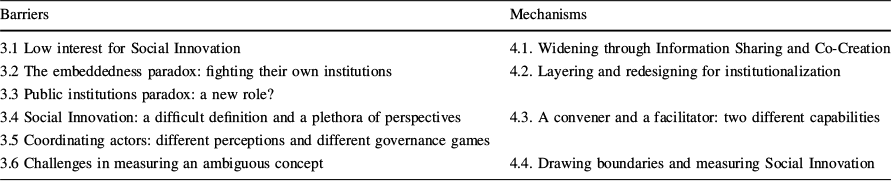
In addition to that, an open measurement system must be known to be useful, with the necessity for policymakers of advertising the existence of such services, employing a network of information brokers, maintaining them by adjourning it frequently, and making them open to feedback from citizens to guarantee their usefulness (Table 1).
A Summary of the barriers and the related mechanisms identified

Barriers |
Mechanisms |
|---|---|
3.1 Low interest for Social Innovation |
4.1. Widening through Information Sharing and Co-Creation |
3.2 The embeddedness paradox: fighting their own institutions 3.3 Public institutions paradox: a new role? |
4.2. Layering and redesigning for institutionalization |
3.4 Social Innovation: a difficult definition and a plethora of perspectives 3.5 Coordinating actors: different perceptions and different governance games |
4.3. A convener and a facilitator: two different capabilities |
3.6 Challenges in measuring an ambiguous concept |
4.4. Drawing boundaries and measuring Social Innovation |
Discussion and Conclusions
A welfare originally designed to guarantee social rights to citizens by the state and managed through indebtedness and privatization may not be any more sustainable in the future considering the current demographic trends in Western societies. The public sector is no longer able on its own to respond to complex needs for social protection and is increasingly resorting to collaborations and partnerships with non-public actors that are embedded in the territories and that know people's needs closely (e.g., Rees et al., Reference Rees, Sancino, Jacklin-Jarvis and Pagani2022). Both the crisis of capitalism and the crisis of the welfare state call for a better use of the different types of resources available in the whole economic system with a view to true sustainability capable of ensuring that the needs of current and future generations are met. A new vision could view welfare as an instrument for support, insurance and human flourishing which is aimed at an individual citizen who is in a relationship with a community of reference (circle in the words of Cottam, Reference Cottam2016), and no longer considered merely as an individual client entitled to a set of individualized benefits. However, this vision could seem a kind of romantic policy utopia never achievable or rather a democratic heterotopia where multiple experimental places are offered to publics and stakeholders for inclusive social innovation to deal with the welfare problems and social needs emerging from circumstances.
Against this backdrop, this essay tried to deal with the issue of institutionalizing social innovation as a bottom-up strategic response to the welfare state crisis by taking the perspective of inclusive social innovation as a complementary and pragmatic democratic exercise characterized by working with key publics and stakeholders to develop deliberation, learning and socially innovative capacity. Moreover, by focusing primarily on institutions that may result from interactions between the state and civil society actors, the paper mobilized the concepts of utopias and heterotopias from Foucault to promote a cognitive shift in the way the issue of institutionalizing social innovation is observed, interpreted, and implemented by public purpose organizations. The originality of our perspective aims to be the understanding of the public purpose organization (for example municipalities) as potentially with resources with a transformative capacity for inclusive social innovation and in linking more clearly social innovation to democratic, rather than market logics, with implications on the way social innovation is assessed and scaled.
Specifically, we have highlighted some obstacles to institutionalizing social innovation and some key governance mechanisms that can be activated either by public and/or social purpose organizations to foster that endeavour. The public sector has indeed an important democratic role in organizing the network society, even if it means changing its own paradigm, such as for example combining commons-based peer production with the neo-Weberian state (Kostakis, Reference Kostakis2011). In this respect, we believe it will be crucial to study how the municipality, as the democratic pivot of place-based governance, can design, convene, and facilitate experimental places for social innovation focused on problem solving and opportunities generating through deliberation, sedimentation of experiences, design and re-imagination. Similarly, social purpose organizations have a key role for social reintermediation (e.g., Elstub, Reference Elstub2006; Pestoff, Reference Pestoff2012) to participate in those arenas or to devise even counter-governance arenas to make pressure on existing public sector institutions to favour experimental places for inclusive social innovation.
The link between social innovation as emancipatory deliberation, dialogue and experimentation by publics and stakeholders connects with the development and practice of socio-political capability and participation (Moulaert et al., Reference Moulaert, Martinelli, Swyngedouw and Gonzalez2005), thus understanding inclusive social innovation as an antecedent for societal resilience and as an advanced practice of participatory democracy and of citizenship blending political and economic values. Clearly, there are risks of capture by existing institutions, power dynamics related to delegating power to decide from traditional democratic actors as well as issues regarding ‘the endowment of social capital available for creating a space for collective reflection (Tello-Rozas, Reference Tello-Rozas2016, p. 81).’
However, the main idea is that social innovation can become a political force for manufacturing new democratic institutions and for reforming the welfare state and the capitalistic order through digitally connected bottom-up social innovation initiatives (e.g., Kostakis, Reference Kostakis2011). We believe that this civic culture of social innovation could help to inform existing experimentation with radical democratic community building around the world, opening up the possibility for digital and place-based networking and civic activism inspired by global human advancement and by a new humanism (e.g., Tang, Reference Tang2019). The institutionalization either in public and/or social purpose organization of everyday practices and opportunities for inclusive social innovation may serve to ‘symbolize what is possible, and what not, within the limit of the politico-economic context in which they operate’ (Mazzei et al., Reference Mazzei, Montgomery and Dey2021, p. 1638).
Institutionalizing heterotopia experimental places in public and social purpose organizations for inclusive social innovation as much as existing theatres, prisons, gardens, and museums do exist and function in our cities, villages and communities can ultimately promote “human flourishing and democratic engagement beyond instrumentalism”(Ansell, Reference Ansell2011). The question is bringing in through inclusive social innovation more experimental places as a deliberative and civic alternative to elitist conception of democracy, transforming unorganized groups of citizens and stakeholders into active ‘publics’ providing a web of support for dealing with increasingly emerging and evolving welfare needs. This is not a matter of utopias, but of designing and experimenting these possibilities as heterotopias within existing institutions, something that is a political choice to be done (or not) by public and social purpose organizations.
Funding
Open access funding provided by Università degli Studi di Milano - Bicocca within the CRUI-CARE Agreement.

 Open access

