




Impact statement
This review explores the challenge of groundwater governance in Iran, Saudi Arabia, Mexico, China, Bangladesh and India – which together account for over two-thirds of the world’s groundwater use in irrigation. Global groundwater economy comprises three sub-economies: (a) diesel-powered unregulated, where use-specific energy subsidies are impractical; (b) electricity-powered regulated, where grid-connected electric tubewells are authorized, metered and subject to consumption-linked energy charges; and (c) electricity-powered unregulated, as in all geographies of our review – barring Bangladesh, Bengal and China – where electricity subsidies have created an unruly, bloated groundwater economy. This last sub-economy represents the heartland of global groundwater malgovernance, least prepared to meet the sustainability challenge. In (a) and (b), groundwater scarcity stimulates water-saving behavior via increased energy cost of pumping; not so in sub-economy (c). This is home to the water-energy-food-environment (WEFE) nexus at its most perverse since users are immune to energy costs and impervious to groundwater depletion. The nexus approach is prodigious in technical research but has ignored the realpolitik of groundwater reforms, especially in overcoming farmer resistance to legalizing and metering tubewells, and collecting energy-water charges based on metered use. Our review captures several workarounds to do this. A good example is a recent large pilot in Gujarat, India, which showcases how a smart transition to solar irrigation can transform a perverse WEFE nexus into a virtuous one, paving the way from (c) to (b). During 2018–2019, Gujarat solarized 4,215 existing grid-connected tubewells of 5–150 hp, net-metered them and gave their owners a 25-year remunerative solar power purchase guarantee. Today (a) all tubewells solarized are metered; (b) farmers willingly surrendered the energy subsidies they enjoyed for decades; (c) most earn from ‘growing’ solar energy and selling their surplus; and (d) solar power feed-in-tariff acts as a surrogate for water price. The pilot established preconditions necessary for proactive groundwater governance.
Water-energy-food-environment nexus: A new water governance paradigm?
Recent decades have witnessed unprecedented concern globally about water scarcity and its many fallouts. For centuries, silo thinking of water bureaucracies and their top-down, supply-side solutions dominated water management and governance. Irrigation-at-any-cost has been viewed as the answer to food security and agrarian livelihoods. But with burgeoning populations, urbanization, changing lifestyles and agricultural intensification, this approach proved unable to deal with absolute water scarcity in many parts of the world (Seckler et al., Reference Seckler, Barker and Amarasinghe1999; Jaeger et al., Reference Jaeger, Plantinga, Chang, Chang, Dello, Grant, Hulse, McDonnell, Lancaster, Moradkhani, Morzillo, Mote, Nolin, Santelmann and Wu2013). Climate change is all set to make matters worse (Hoff, Reference Hoff2011), signifying the limits of insular, infrastructure-based water governance (GWP, 2000; World Economic Forum, 2011; Shah, Reference Shah2016). This realization has led to growing clamor for a more holistic approach that accounts for intersectoral externalities and combines infrastructure creation with demand-side management.
Integrated Water Resources Management (IWRM) emerged during the 1990s as a paradigmatic response to this need. The IWRM philosophy envisioned a holistic “process which promotes coordinated development and management of water, land and related resources, in order to maximize the resultant economic and social welfare in an equitable manner without compromising the sustainability of vital ecosystems” (GWP, 2000).
As a philosophy, there is hardly gainsaying the tenets of IWRM. Had it permeated gradually on its own in emerging countries, it might well have transformed water governance. However, throughout the 1990s and beyond, IWRM was aggressively promoted as a package of practices, often as conditionalities of loans/grants by donor countries and global financial institutions. In implementation, many practices on the IWRM template – such as registration and licensing of water users, issue of water permits, pricing of water and water services – faced vigorous resistance and pushback from people, civil society and governments (Muller, Reference Muller2010; Shah, Reference Shah2016). As a result, enthusiasm for IWRM began to ebb in the new Millennium (Biswas, Reference Biswas2008). However, global concern about limits to supply-side solutions persisted. Climate change and Anthropocene gave rise to renewed clamor for shifting from “productivity first to sustainability first… in agricultural systems that operate within planetary boundaries to safeguard the Earth system” (Rockström et al., Reference Rockström, Williams and Daily2017, p. 5). Thinking about the interplay between water, energy, food and environment (WEFE) as a nexus presented an even more integral paradigm for water policymaking than IWRM (Hoff, Reference Hoff2011; World Economic Forum, 2011). Nexus thinking, the argument went, “can uncover synergies and detect trade-offs among sectors” (Liu et al., Reference Liu, Hull, Godfray, Tilman, Gleick, Hoff, Pahl- Wostl, Xu, Chung, Sun and Li2018). Maximizing multi-sectoral system optima rather than sectoral maxima emerged as the nexus ideal that addresses externalities across sectors and seeks to achieve, all at once, “water, energy and food security by increasing efficiency, reducing trade-offs, building synergies and improving governance across sectors” (Hoff, Reference Hoff2011, p. 4). Managing the WEFE nexus can maximize human well-being while minimizing environmental risks, ecological scarcities, carbon output and pollution (Hoff, Reference Hoff2011; Shah et al., Reference Shah, Rajan, Rai, Verma and Durga2018).
The WEFE nexus has produced an explosion of research on engineering efficiency, supply-chains, soil–plant–water relationships, and input–output-based models of cross-sectoral impacts of sectoral policies (Vats, Reference Vats2019). However, “Although our technical understanding of … nexus dynamics continues to improve, this knowledge has not yet been translated into effective and implementable policy” (van Gevelt, Reference Van Gevelt2020, p. 6). This article explores why. We focus on the nexus between energy, groundwater, food, and the environment. Groundwater over-exploitation has emerged as the defining marker of water scarcity and insecurity around the world (Shah, Reference Shah2009); and energy policies are at the root of this crisis. Vaux (Reference Vaux2011) asserted that “[p]ersistent (groundwater) overdraft is always self-terminating” since increasing pumping depth makes energy use in irrigation unprofitable. However, groundwater overdraft has persisted in many countries, thanks to persistently rising and uncontrolled energy subsidies. Together, the geographies we have reviewed account for over two-thirds of the global groundwater-irrigated agricultural area (Shah, Reference Shah2009; Siebert et al., Reference Siebert, Burke, Faures, Frenken, Hoogeveen, Döll and Portmann2010: Table 2). The key question we ask is how and to what extent the WEFE nexus thinking has informed water governance here and, going forward, how can it balance the play of water, energy and food policies at local, national and regional scales. Sections ‘Iran: International sanctions drive groundwater depletion’–‘India: Indirect approaches to nexus governance’ present country studies of Iran, Saudi Arabia, Mexico, China, Bangladesh and India. I synthesize their lessons in ‘Synthesis and discussion’ and conclude this review in the ‘Conclusion’.
Iran: International sanctions drive groundwater depletion
As a country racing toward ‘water bankruptcy’ (Collins, Reference Collins2017), Iran is today growing its food by overexploiting its groundwater. As happened with canals and ancient tanks in India, private tubewell irrigation has cannibalized public and age-old qanat irrigation in Iran, too (Shah, Reference Shah2009). Despite massive investments in dams and canals, Iran’s canal-irrigated area shrank by 15%, while groundwater area increased by 39% during 1993–2007 (Nabavi, Reference Nabavi2018). Tubewells increased from under 50,000 around 1970 to over 546,000 by 2006 and over a million by 2015 (Jaghdani and Kartiuk, Reference Jamali Jaghdani, Kartiuk, Hülsmann and Jampani2021; Noori et al., Reference Noori, Maghrebi, Mirchi, Tang, Bhattarai, Sadegh, Nouri, Haghighi, Clove and Madani2021). Iran’s wheat output rapidly increased but groundwater levels depleted in many parts by 1 m/year, resulting in extensive soil and water salinization, dereliction of thousands of qanat irrigation systems and shrinking of canal command (Collins, Reference Collins2017).
Iran’s groundwater crisis has roots in its geopolitics. Since the Islamic Revolution, food self- sufficiency became a national obsession, intensified further by international sanctions. A three-pronged policy of (a)government wheat purchase at a guaranteed price above global prices, (b) heavy import duty on grains and (c) subsidized energy for tubewells has ensured national food self-sufficiency (Hogan, Reference Hogan2015). Tubewell irrigators, mostly unmetered, pay just 5% of the electricity cost (Collins, Reference Collins2017, p. 16). And despite a system of tubewell licensing, over 800,000 unlicensed wells contribute to 50 Billion Cubic Meters (BCM) of Iran’s annual groundwater draft (ibid).
Sustainability has been an old policy concern. Iran made strong laws to preserve qanats in the 1940s (Nabavi, Reference Nabavi2018). But land reforms during the 1960s disrupted traditional qanat institutions much as Zamindari abolition disrupted South Bihar’s Ahar-Pyne systems in India (Shah, Reference Shah2009). New laws made all water property of the state. Under dasht-e-momno (prohibited plain), Energy Ministry was empowered to issue well permits, and regulate water consumption, irrigated acreage, well depths, pump horsepower and annual hours of operation, besides decommissioning countless unlicensed wells (Nabavi, Reference Nabavi2018). This was a foolproof mandate; but enforcing it remained an anathema.
In a renewed regulatory thrust in 2009, the Northern Khorasan provincial government installed, as a pilot, 1,250 Intelligent Energy and Water Meters (IEWM) in the groundwater-stressed Esfarayen basin to meter energy consumption and enforce water quota. Meter-tampering attracted heavy penalty. Meters were programmed to shut off pumping outside the irrigation season (Vaseteh and Nazarboland, Reference Vaseteh and Nazarboland2010). Vigorous enforcement and relentless monitoring by the Water Authority increased water use efficiency (Jafary and Bradley, Reference Jaeger and Bradley2018). Annual overdraft in the Esfarayen basin decreased from 30 MCM in 2008 to 10 MCM in 2011 and, in that period, rate of water level decline fell from 75 cm/year to 28 cm/year and further to 6 dm in 2013 (Nabavi, Reference Nabavi2018). The cropping pattern shifted from barley, wheat and watermelon to high-value pistachio, Persian walnuts, pomegranates, peaches, spinach and tulips, all increasingly under micro-irrigation. Encouraged, in 2014, Iran’s Supreme Council mandated ‘smart meters’ in all irrigation wells and ordered the deployment of hundreds of troops for patrolling tubewells. These policing mechanisms formed Iran’s core strategy of groundwater regulation (Nabavi, Reference Nabavi2018).
However, sustaining reform remained a concern from the start (Vaseteh and Nazarboland, Reference Vaseteh and Nazarboland2010). Farmers resisted smart meters installed without their participation. Groundwater quotas issued by the Agricultural Jihad Agency violated historical qanat-water rights that farmers exercised over centuries (Jafary and Bradley, Reference Jaeger and Bradley2018). Agencies were blamed for penalizing wrongdoers but not rewarding water savers. Political support remained uncertain; “lack of political will prevails generally, … (Moreover,) punishing illegal water pumping, and closing or destroying wells…come with high political costs, and have no short-term benefit for politicians” (Nabavi, Reference Nabavi2018, pp. 716–717). Financial penalties may lose some of their potency as farmers move to high-value crops, making water demand price inelastic.
Collins (Reference Collins2017) hints that the hardening of international sanctions may dampen enthusiasm for groundwater rule enforcement. A large-scale shift to high-value crops away from wheat may rekindle demand for food security “because…mining of groundwater… is acceptable if it yields the impression of food security…even though it leaves a much more serious set of problems for future generations of political leaders” (p. 7). No wonder a “blanket issuance of permits (in 2010) for the illegally bored wells (upwards of 190,000, countrywide), (was) decided by the majority vote in the House, (and) is tantamount to rewarding the lawbreakers” (Rahnemaei et al., Reference Rahnemaei, Boustani and Kowsar2013, p. 4).
In 2020, the government had to reduce wheat purchase prices to cope with currency depreciation, making wheat unprofitable. But this may undermine food security without easing pressure on groundwater. Farmers are now reducing wheat areas but irrigating larger areas of high-value crops with water saved by micro-irrigation. This aggravates the tension between water-energy authorities aiming to conserve groundwater and agricultural Jihad agencies targeting food security. In sum, Iran’s search for its nexus solution is far from over. Even when one is found, ‘embargo geopolitics’ may impede action thanks to the “extreme political costs of enforcing restrictions… which force farmers to live within hydrological limits” (Nabavi, Reference Nabavi2018, p. 715).
Saudi Arabia: Food embargo against oil embargo
With scant rainfall and meager surface water, Saudi agriculture always depended on traditional irrigation from its non-renewable aquifers, believed hundreds of millions of years old (Chowdhury and Al-Zahrani Reference Chowdhury and Al-Zahrani2015, p. 69). The global oil crisis of the 1970s exposed Saudi vulnerability and heightened food security concerns. Following the 1973 OPEC oil embargo and the quadrupling of oil prices, international media was rife with reports about fighting the oil embargo with a food embargo. Since then, food trade remained a key factor in global diplomacy and, given its position in global oil trade, food self-sufficiency remains paramount for arid Saudi Arabia, what with its population growing at 3.5%/year.
For long, Saudi aquifers remained unexplored for want of resources, men and machines. But aggressive hydrogeological investigations during the 1980s, financed by oil dollars, discovered 500 BCM of mostly non-renewable groundwater, far more than previously known. With this surprise find, the Saudi government launched an aggressive campaign to develop irrigated agriculture. The aims were two: national food self-sufficiency and the settlement of poor Bedouin communities in productive agriculture (Elhadj, Reference Elhadj2004).
The same Iranian policy triad – of wheat purchase at above world prices, high grain import tariffs and subsidies on irrigation equipment and energy – made Saudi Arabia too food self-sufficient. Indeed, for a while, it became the world’s sixth-largest wheat exporter (Plumer, Reference Plumer2015). Between 1984 and 2000, Saudis doubled irrigated area to 1.12 million hectares. Deep tubewells increased from 26,000 to 86,000. The kingdom’s annual precipitation is under 2 BCM, but its extraction of groundwater, only partially renewable, climbed four-fold from 3.2 BCM in 1980 to 14.3 BCM in 1993 (Elhadj, Reference Elhadj2004).
The strategy proved an economic disaster. Elhadj (Reference Elhadj2004) estimated that between 1984 and 2000, Saudis invested US$83.6 billion in locally producing foodstuff that could have been imported for less than half that cost. New irrigation was to benefit poor Bedouins. But companies owning massive farms captured two-thirds of irrigated land with good groundwater, while Bedouin beneficiaries got only one-third (FAO, 2009). With just 8% of people dependent on farming livelihoods, the kingdom arguably had more effective ways to support its poor (Collins, Reference Collins2017).
The strategy was a worse environmental disaster. Between 1997 and 2001, Saudi Arabia exported, in the form of cereals, meat, fruit and vegetables, 12.4 BCM of virtual water, six times its domestic water use of 2.1 BCM/year. Much of Saudi Arabia’s fossil water got used up to support the 20-year agricultural boom ending in 2000 when most Saudi aquifers were in a precarious state of depletion, and the country had to build 31 massive sea-water desalination plants to meet half of its domestic water demand (FAO, 2009). Live natural springs in eastern parts had all dried up by 2000 as water levels fell to 40–60 m (ibid). Saline intrusion became endemic and serious in coastal aquifers, and water quality declined in large areas. In Al Hassa Oasis, for example, the irrigated area declined from 16,000 ha to 8,000 ha due to salinization (FAO, 2009).
By 2000, policy reversal began. New ministries and comprehensive rules were made to manage water, desalination plants and irrigation projects. But “… despite the existence of regulations and decrees to control excessive groundwater use, the government has had limited success” (FAO, 2009), thanks to strong vested interests in irrigated farming. Government wheat purchase was reduced, and after 2016 all wheat was imported (Collins, Reference Collins2017). However, like in Iran, while irrigation areas fell, water use was less responsive. Between 1994 and 1999, irrigated areas declined by 23%, but water abstraction for irrigation fell by only 9% (Elhadj, Reference Elhadj2004). Thanks to the ban on wheat, wheat irrigation dropped from 1.1 m ha in 1993 (Elhadj, Reference Elhadj2004) to just 10,000 ha in 2018 (Reidy, Reference Reidy2019). But then, farmers took to livestock farming and alfalfa cultivation which consumed 5–6 times more water than wheat. In 2019, alfalfa irrigation was forcibly reduced by 40% and wheat was allowed on 90,000 ha to help small farmers (Reidy, Reference Reidy2019). Farmers also took to irrigating fruit trees instead of wheat; this only transferred today’s problem to tomorrow since as trees grew, they would become groundwater guzzlers (FAO, 2009). Even if the kingdom succeeded in reining in overdraft, geopolitics would keep alive the Saudi quest for food self-sufficiency and, like in Iran, frustrate groundwater regulation.
Mexico: Governments propose, farmers dispose
Mexico has experienced severe groundwater depletion over decades. Well depths of 200–400 m and pump sizes of 75–300 HP are now common. Agriculture accounts for 18.91 BCM/year out of a total of 31.2 BCM/year of Mexico’s groundwater use. In states like Guanajuato, annual abstractions exceed recharge by 40%, with water levels falling by 1.22–3.30 m/year and annual land subsidence of 2–3 cm in Bahio (Scott, Reference Scott2013).
The driver of Mexico’s groundwater stress is neither geopolitics nor food self-sufficiency, but lucrative agricultural exports to North American markets. Land reforms of the 1960s gave small plots to poor ejidatarios, former tenants. Also offered was a 66% subsidy on energy costs to incentivize ejidatarios to irrigate. But hijacked by elite farmers, the subsidy went out of control, approaching US $ 592 million, i.e., US $ 1,600/ha in 2000. The subsidy led to an export boom in poultry, beef, fruits and vegetables but also increased the stress on aquifers. Land leveling, drip irrigation and fertigation promoted by the government reduced water application, but farmers quickly used water saved to expand irrigation, leaving aquifers as stressed as before (ibid).
Mexico was among the earliest to pioneer demand-side management of groundwater through laws, tradable water quotas, aquifer user organizations and energy pricing (Hoogesteger and Wester, Reference Hoogesteger and Wester2017). A 1948 law – strengthened in 1972 – had earmarked groundwater-stressed prohibited areas, called vedas, in which drilling permits were required. But its enforcement remained lax and patchy (Scott, Reference Scott2013). Under pressure from the farming lobby, unauthorized wells were repeatedly reprieved by frequent presidential amnesties. The entire state of Guanajuato was put under strict veda; yet its (mostly illegal) wells increased from 2,000 in 1960 to 19,600 by 2000. Farming interests bypassed groundwater regulation and governments announced veda decrees in the same breath as subsidies for drilling new tubewells. The 1992 Law of the Nation’s Waters mandated registration of water users drawing above 1,080 m3/year. This was to give teeth to veda, but illegal tubewells proliferated unabated.
To promote a ‘new water culture’, the federal government mandated technical water councils (COTAS) to enjoin users for community management of aquifers. The hope was that these would reduce groundwater depletion voluntarily. COTAS grew and helped members access government assistance, groundwater concessions and micro-irrigation subsidies. But they did little to reduce depletion. COTAS membership was dominated by municipalities and companies which dealt directly with authorities and under-represented farmers who used 80% of groundwater. Dependent on state funding, COTAS failed to become autonomous user organizations that would usher in a ‘new water culture’ (Shah, Reference Shah2014).
In another bold experiment, the Mexican water authority began buying up concession titles from willing sellers to create a market in water rights. The aim was noble, but its impact was perverse. Many owners of dry wells sold their concessions and used proceeds to deepen other wells; some sold part of their concession and continued pumping as before. Realters purchased concessions from farmers who continued to pump their wells still.
Energy policies then began controlling groundwater drafts in ways COTAS and tradable quotas could not. During 1989–1992, a steep increase in farm electricity tariff sharply reduced tubewell energy consumption from 72 GWh/year to 57 GWh/year (Hoogesteger and Wester, Reference Hoogesteger and Wester2017). Moreover, under the 2002 New Rural Energy Law, valid concessions became a prerequisite for electricity connections for wells. With this, illegal wells declined. Concessions became the passport to 66% subsidy on electricity for new applicants and 33% for existing users. This made it difficult and expensive, if not impossible, to drill new wells in the veda areas. However, ensuring that farmers pumped within their quota remained a challenge until the Electricity Commission began charging farmers at commercial rates for all consumption more than their ‘concession equivalent’ of electricity use. This created a powerful incentive to reduce excess pumping.
This powerful effect was, however, undone by a new 20% energy subsidy on night irrigation, which encouraged runaway pumping for irrigation during the nights. Moreover, since 2000, farmers had organized into Comité Pro-Mejoramiento del Agro Nacional Guanajuatense (CPANG), a powerful interest group to resist increases in electricity prices. CPANG members refused to pay electricity bills (Hoogesteger and Wester, Reference Hoogesteger and Wester2017). The government kept issuing periodic waivers of unpaid dues and, in 2009, wrote off US $ 200 million as drought relief. This made energy pricing impotent as a water demand management tool (Hoogesteger and Wester, Reference Hoogesteger and Wester2017). On paper, between 2009 and 2013, agricultural groundwater concession volumes in Mexico decreased by 1.96 BCM/year, but abstraction and unauthorized tubewells kept soaring. In 2009, estimated groundwater pumping across the country was 1.36 times greater than concession volumes (Hoogesteger and Wester, Reference Hoogesteger and Wester2017). Without foolproof monitoring of pumping by titleholders, the long-term outlook points to continued depletion (Scott, Reference Scott2013).
China: “Close the wells, abandon the land”
North China has just 30% of China’s water but delivers two-thirds of its food, mostly by overexploiting groundwater. Unlike Iran, Saudi Arabia, Mexico and India, subsidies do not drive China’s groundwater demand as do high agricultural water productivity, cheap equipment and population pressure on farmland. Arguably, the privatization of collective tubewells under the Household Responsibility System did most to induce farmers to move to high-value tubewell-irrigated crops and drive groundwater depletion (Shah, Reference Shah2014; Wang et al., Reference Wang, Zhu, Sun, Huang, Zhang, Guan and Huang2019).
China successfully kept the water-energy-food interplay from degenerating into a perverse nexus through the vigorous collection of energy and water costs (Shah, Reference Shah2014); but this helped little. Elsewhere, rising pumping costs would have reined in pumping; not so in north China, where farmers continued depleting aquifers, thanks to high water productivity (Wang et al., Reference Wang, Zhu, Sun, Huang, Zhang, Guan and Huang2019).
To arrest the declining water levels and deteriorating quality, China piloted, like Mexico, tradable water permits and Water User Associations (WUAs). China’s 2002 Water Law provided tradable water quotas. Despite renewed vigor to enforce these since 2016, however, markets in water permits remain non-existent in China, though not perverse as in Mexico. Similarly, China claims 834,000 registered WUAs covering 30% of irrigated areas; but these are closely supervised by Village Committees of the communist party. The spearhead of the Chinese approach to sustainable water governance is the design bid mechanism for outcome-linked-direct-funding of projects to local governments by Beijing bypassing provincial governments (Yao et al., Reference Yao, Zhao and Xu2017). Strapped for funds since the abolition of the agricultural tax in 2006, local governments have aggressively competed for federal funds and used these to pilot high-tech approaches to water demand management (Leshan et al., Reference Leshan, He, Ying and Dan2017; Li et al., Reference Li, Kinzelbach, Hou, Wang and Yu2018).
One such ‘showcase’ project is the water short Shiyang basin (Gansu). During 1950–2003, growing surface water diversions upstream reduced inflows into Minguin oasis downstream by 80%. In response, Minguin farmers went on a tubewell drilling spree causing a serious groundwater crisis. In 2006, Beijing approved a Comprehensive Water Management Plan (CWMP) to (a) reduce by 2020 Shiyang basin’s water consumption by 31.6%, (b) increase three-fold surface water flow to Minguin oasis, and (c) reduce groundwater abstraction by 85% in Minguin and 45% in Shiyang basin. Beijing allocated 5 billion Yuan for CWMP. It financed canal lining, piped water distribution and micro-irrigation subsidies while the Sino-Israel Financial Cooperation paid to demonstrate high-tech automated irrigation systems.
Shiyang’s CWMP exemplifies vigorous direct regulation of water withdrawals. 3,318 tubewells were closed; and 663,000 mu (44,200 ha) were taken out of irrigation. Water-intensive onion, corn and wheat were forbidden. A water permit of 415 m3/mu was allowed for up to 2.5 mu/household. Above the permit, a ‘water price ladder’ imposed a steeply rising penalty over the base price. Smart cards ensured real-time monitoring of abstraction against permits. Canal water price, vigorously collected, rose 2.5 times in 7 years. Groundwater price was collected in two parts – Yuan 2/mu and Yuan 0.174/m3 of water drawn. Greenhouses and drip-irrigated farms enjoyed 20 and 50% discounts, respectively (Yao et al., Reference Yao, Zhao and Xu2017).
Elaborate organization down to the village was incentivized to produce verifiable outcomes. In 2014, 874 WUAs deployed 2,517 water managers and ‘served’ 308,000 households operating 2.37 million mu (158,000 ha) of irrigated farmland. WUAs’ key role was fee collection and water allocation. Besides fixed salaries, leaders and staff got a profit share tied to water fees collected, irrigated area and irrigation performance. 70% of the profit share went to WUA directors who increased fee collection from 60% earlier to 90%, and reduced water conflicts from 10 per village to zero (Aarnoudse et al., Reference Aarnoudse, Bluemling, Wester and Qu2012; He and Perret, Reference He and Perret2012).
This experiment became China’s showcase because the Shiyang basin achieved CWMP objectives in 2014, well ahead of the 2020 deadline. Basin-wide, agricultural water-use efficiency increased from 0.53 to 0.58; irrigation water use reduced from 1.71 BCM to 1.39 BCM in total, and from 626.72 m3 to 430.25 m3 per acre. Water productivity jumped five-fold from 1.93 Yuan/m3 in 2009 to 9.33 Yuan/m3 in 2015 (Leshan et al., Reference Leshan, He, Ying and Dan2017; Yao et al., Reference Yao, Zhao and Xu2017). Liu et al. (Reference Liu, Hu, Sun, Yang, Sun and Yin2021) used remote sensing techniques to show that groundwater storage in middle and lower Shiyang rebounded since 2014, while crop area declined.
On the downside, CWMP created an army of ‘ecological refugees’. Between 2007 and 2014, 60% of the working-age farmers left for off-farm livelihoods; and those who stayed derived 43% of their income from off-farm sources, up from 26% in 2007. The declared policy of ‘close the wells, abandon the land’ successfully reduced farming area by 40% since 2007. Minguin farmers surveyed by researchers had lost on average 0.231 ha/household of farmland (Aarnoudse et al., Reference Aarnoudse, Bluemling, Wester and Qu2012; He and Perret, Reference He and Perret2012).
Barind, Bangladesh: Centrally managed decentralized irrigation
Outside China, the Barind project of Bangladesh represents arguably the only large-scale effort at proactive, direct groundwater governance. The region has hard red soil and heavy monsoonal rainfall of 1,600 mm. But post-monsoon, the landscape dries up with mud cracks sometimes 15 m deep. Before the spread of irrigation, Barind’s 1.44 million hectares of farming areas remained unproductive. Scattered private tubewell owners made hay by trading summer (boro) rice irrigation for one-third or one-fourth crop share. No wonder that the Barind region always lagged behind the rest of Bangladesh in agricultural growth and rural development (Boyce, Reference Boyce1988). But the Barind project changed all that.
In 1985, the Bangladesh government established the Barind Multipurpose Development Authority (BMDA) to promote all-round development of the region. However, among all its initiatives, by far the most impactful has been the BMDA’s experimentation with centrally managed tubewell irrigation. By the mid-1980s, government tubewell programs tried by India, Pakistan and Bangladesh had all failed thanks to bureaucratic lethargy and poor operation and maintenance (O&M) (Shah, Reference Shah2009). But Barind proved an exception because it evolved a distinct participatory irrigation management model with the following features:
Demand-led Intervention: Instead of choosing groundwater-rich sites for constructing tubewells, the BMDA followed demand. Farmers desiring a BMDA tubewell must form a WUA with a minimum command of 30 acres, pay a membership fee, and apply for a tubewell. Thereupon BMDA staff assess resource availability and install a tubewell appropriate to groundwater conditions. WUA becomes responsible for water distribution and O&M.
Prepaid metering and full cost recovery: Farmers must use prepaid smartcards on Chinese-made meters (or in earlier years, prepaid coupons) to buy required irrigation; the price covers the full cost of energy, O&M and establishment (while capital costs are covered by the government), but is still 40–60% lower than private water sellers.
Incentivized operators: Of the water price collected, 55% goes to electricity cost, 10% to operator remuneration, 2.5% toward the commission paid to operators of Mobile Vendor Units (MBU) and 32.5% toward BMDA establishment cost. Operators as well as MBU are largely rural women. BMDA officials daily monitor meters to record pump usage and tally it with the electricity meter reading. Evaluations suggest that the system is vigorously managed.
Technical Backstopping: To ensure the full utilization of irrigation assets, BIADP’s bevy of technicians remain available on call for maintenance and repair to maximize the uptime of tubewells.
Technical Innovation: To capture groundwater from Barind’s peculiar geology, BIADP technicians innovated an ‘inverted tubewell’ to tap water-bearing formations between two impermeable layers.
Efficient service: To minimize conveyance losses, BIADP replaced open channel distribution with buried pipe networks that effectively reduce irrigation costs to farmers; moreover, all BIADP tubewells have overhead storage tanks to ensure domestic water security for households.
Sustainable Resource Management: Rapid expansion, especially in boro irrigation due to BMDA tubewells, created pockets of groundwater depletion in hard Barind areas. Here, BMDA stopped new tubewell construction; instead, it invested in the rehabilitation of old canals, afforestation, rainwater harvesting and reviving derelict ponds to promote conjunctive use of ground and surface water. It also launched extensive campaigns to wean farmers away from water-guzzling boro rice to water-saving crops and fruit orchards. BMDA promoted an Alternate Wetting and Drying (AWD) method for rice cultivation and trained farmers to irrigate just-in-time. Banerjee (Reference Banerjee2018) met farmers who had reduced boro irrigation frequency from three to two times a month.
Groundwater Governance Regime: Bangladesh’s 1985 Groundwater Management Ordinance to regulate groundwater abstraction remained on paper. Local politicians got 1987 tubewell siting rules too annulled in 1992. But in 2008, BMDA issued its own irrigation policy which prohibited private tubewells in the command of BMDA tubewells. This enhanced its power to enforce sustainability and O&M norms. Since 2016, BMDA successfully controlled the proliferation of private tubewells because of its better service, lower price and goodwill with farmers.
Frugal Organization and Tight Management: In 2016–2017, BMDA had 1,200 strong technical and managerial staff on regular salaries, besides 15,000 operators and 650 MBUs on commission. The staff cost was 18–20% of BMDA’s budget; but these managed deep tubewells, undertook rehabilitation of ponds, canals and check dams, trained farmers, afforested wastelands, constructed roads and undertook other activities. Thanks to the full recovery of irrigation service fee (ISF), BMDA tubewells still made a surplus of 15–17% of gross revenue (Banerjee, Reference Banerjee2018). No government irrigation program in South Asia has done so well financially.
The Barind project has been prodigious in output, outcomes and impact. In 2015–2016, BMDA’s 15,813 deep tube wells served irrigation to 496,200 ha; 66% of Barind’s irrigated area was cultivated by 250,000 smart card-owning farmers, who formed 56% of Barind’s irrigators (Banerjee, Reference Banerjee2018). Kang (Reference Kang2013) marveled at ‘Barind’s Three Crop Revolution’, and Zaman (Reference Zaman1983) called the prepaid metering system ‘A Revolutionary Change’. BMDA tubewells increased Barind’s cropping intensity from 117 to 200%, while Bangladesh’s national average was 174.6% (Jahan et al., Reference Jahan, Mazumder, Islam and Adham2010). Bangladesh’s 2016 Yearbook of Agricultural Statistics reports higher paddy yield/ha in aus, aman and boro seasons in the Rajshahi and Rangpur divisions of Barind than Bangladesh for 2014–2015. Barind’s institutional arrangement created supplementary jobs, mostly for women farmers who double up as tubewell operators and/or MBU and earn supplementary income through commissions.
Unlike elsewhere, Barind’s politicians have helped BMDA to pursue the triple bottom line of productivity, equity and sustainability. BMDA board is chaired generally by a farmer politician. One recent chairman that Banerjee (Reference Banerjee2018) interviewed wanted BMDA to pursue even more vigorously the mandate of environmental sustainability while promoting pro-poor irrigation.
India: Indirect approaches to nexus governance
If Barind showcases proactive and direct groundwater governance, most states in India exemplify passive, even reactive, indirect approaches to the governance of the WEFE nexus. Since the 1960s, western India emerged as the grand theater where the perverse nexus between energy subsidies and groundwater depletion has played out. What appeared initially a harmless policy to exploit unused aquifer storage to expand smallholder irrigation created some years later an insidious political economy with economy-wide ripple effects (Shah et al., Reference Shah, Rajan, Rai, Verma and Durga2018). The nexus impacts in India, positive and negative, turned out much larger in scale than Iran, Saudi Arabia, Barind and Mexico combined. Initially, electricity subsidies catalyzed explosive growth in pro-poor groundwater irrigation; they made India food secure and consigned famines to history; they catalyzed vibrant water markets making irrigation democratic (Shah, Reference Shah2009). However, from trickle, subsidies became an uncontrollable deluge and, by 2000, led to pervasive groundwater depletion and quality deterioration, disrupted the finances of electricity utilities, increased the carbon-footprint of irrigation, undermined public and community irrigation and created a political gridlock that made it prohibitively costly for elected leaders to rationalize subsidies (ibid). Federal government policies made matters worse by offering farmers guaranteed purchase, at their door-step, of water-intensive crops like wheat and rice at higher than global prices. Guaranteed procurement, fertilizer subsidies and free power locked north-western India in a rice–wheat rut (Shah et al., Reference Shah, Giordano and Mukherji2012).
Frontal attack on the nexus would require metering tubewells, recovering consumption-based power tariffs (even if subsidized), disincentivizing water-intensive crops in water-stressed areas and limiting the density of tubewells based on hydrogeology. Most Indian states eschewed this hard path due to bureaucratic sloth and political myopia; instead many, like Punjab, even consciously pursued policies that worsened the nexus.
Since 2000, some states devised indirect approaches directed at two objectives: first, preserving the ‘buffer value’ of aquifers to ensure minimal domestic water security during droughts; and second, reducing subsidy deadweight that drove electricity utilities to bankruptcy. Gujarat did more than most other states: in a three-year campaign, Gujarat separated agricultural feeders and imposed an 8 h daily day-and-night weekly roaster in farm power supply (Shah, Reference Shah2009, Reference Shah2014; Shah et al., Reference Shah, Rajan, Rai, Verma and Durga2018). The state vigorously promoted micro-irrigation (Shah, Reference Shah2014). On the supply side, the Gujarat government constructed Narmada canals on a war footing; it supported village communities to build and revive thousands of check dams, percolation ponds and sub-surface dykes to augment groundwater recharge (Shah, Reference Shah2009, Reference Shah2014 (box 10)). It also connected thousands of seasonal village tanks and irrigation dams with perennial dams and public canals. Gujarat ended the last Millennium with depleted aquifers and a near-bankrupt electricity utility. But by 2008, the state had become more water-secure, and its electricity utilities were among the most profitable in India (Shah et al., Reference Shah, Rajan, Rai, Verma and Durga2018).
While Gujarat’s experiments of feeder separation and water harvesting were emulated by other states, results on the ground remained piecemeal and patchy, thanks to the failure to synergize demand- and supply-side measures (Table 1). Madhya Pradesh mimicked Gujarat’s demand-side as well as supply-side measures and recreated Gujarat’s success. But Punjab, facing by far the most lethal ‘nexus impact’, did the least to counter it. Karnataka separated agricultural feeders but did little to stop rural power theft. Telangana implemented the highly successful Mission Kakatiya to rehabilitate its 48,000 irrigation tanks; but its beneficial ‘nexus impact’ was undone by round-the-clock free power supply to farmers. Maharashtra too launched an ambitious program to augment groundwater recharge but did nothing to rein in burgeoning farm power subsidies. Rajasthan aggressively promoted off-grid solar pumps; these may ease the power subsidy burden but may aggravate the groundwater situation (Shah et al., Reference Shah, Giordano and Mukherji2012, Reference Shah, Rajan, Rai, Verma and Durga2018).
Variety of indirect responses to WEFE nexus in Indian states

Source: Created by the author. Number of + signs indicate the level of activity: + refers to low, ++ refers to moderate, +++ suggests high.
The arrival of solar power has created powerful new opportunities to rewrite the rules of the WEFE nexus. With a steady fall in global PV prices, during the 2010s, Indian electricity companies began providing heavily subsidized solar irrigation pumps (SIPs) in lieu of grid power to reduce the recurrent power subsidy burden. Between 2013 and 2022, SIP numbers in India soared from 12,000 to over 300,000. A new concern, however, was that with their free, uninterrupted, reliable, daytime power, SIPs will exacerbate India’s groundwater crisis. Inspired by a small action research experiment in the village Dhundi (Shah and Rai, Reference Shah and Rai2021), in 2018 the Gujarat government launched SKY,Footnote 1 a state-wide pilot project that replaced 4,215 grid-powered irrigation pumps with net-metered SIPs with a Power Purchase Guarantee. This done, the government began paying SKY farmers for their surplus solar energy under a 25-year contract. The results were spectacular. A major concern was if SKY would be able to onboard legacy unmetered tubewells – which were 40% of Gujarat’s tubewells but accounted for 49% of agricultural load, 71% of energy use in irrigation and 90% of farm power subsidies around 2015 (Shah and Rai, Reference Shah and Rai2021) – and whose owners had fiercely resisted metering for over 20 years. But unmetered farmers onboarded SKY as enthusiastically as metered ones; moreover, three years later, previously unmetered SKY tubewells had significantly reduced their energy consumption/HP to increase earnings from energy sales (ibid). Thus, SKY exemplifies a feasible and promising ‘nexus solution’ for achieving multi-sectoral system optima because it overcomes farmer resistance to nexus reform and promises rewards to political entrepreneurs steering such reform. No wonder that the Government of India has incorporated SKY lessons in a new KUSUMFootnote 2 scheme to invest US $ 60 billion over 10 years to promote solar irrigation including through net-metered SIPs with power purchase guarantees (Bhati, Reference Bhati2022).
Synthesis and discussion
If IWRM was excessively prescriptive, the nexus approach remains highly descriptive and aloof from the realpolitik of policy change, which is driven by local context, contingencies and constituencies. It offers no meaningful guidance, for example, to (i) Iran and Saudi Arabia, where the geopolitics of global food trade remains the defining contextual driver of food policies; or (ii) India, which is food surplus and yet its vast constituency of smallholders veto any move to curtail energy subsidies responsible for groundwater crisis; or (iii) Mexico, Morocco, Jordan, Tunisia and Algeria, where the same outcome is achieved by a much smaller but powerful constituency of farmers, thriving on lucrative high-value farm exports. The nexus approach turns a blind eye to the political constraints decision-makers in these countries face in reforming subsidies or implementing a ‘Close the wells, abandon the land’ campaign as the Chinese have done.
From the governance viewpoint, the global groundwater economy consists of three distinct sub-economies:
(a) Diesel-powered Unregulated: These include geographies where groundwater is extracted mainly using diesel/petrol/kerosene/butane, which offer little scope for use-specific subsidies. Pakistan Punjab, Bangladesh, eastern India and Nepal terai, much of Sub-Saharan and some of north Africa exemplify these. The Vaux (Reference Vaux2011) dictum that “Persistent overdraft is always self-terminating” applies here with full force.
(b) Electricity-powered Regulated: Here, groundwater irrigation is energized by grid electricity; but users are all registered, authorized and metered; electricity charges are levied at or near the cost-to-serve and are vigorously collected. North America, Europe, China, Bangladesh and West Bengal (in India) exemplify these. In (a) and (b), groundwater scarcity inspires water-energy saving behavior via increased energy cost of pumping. These have necessary preconditions for advanced demand management approaches to achieve system optima – such as community aquifer governance, administrative regulation, allocation of water permits and such like.
(c) Electricity-powered Unregulated: Groundwater governance becomes infinitely more difficult in this sub-economy where output-side incentives (such as guaranteed wheat/rice procurement at higher than global prices as in Iran, Saudi Arabia, Indian Punjab or lucrative export markets as in the case of Mexico and Morocco) combine with unmeasured energy subsidies that attract massive private irrigation investment to create a groundwater bubble economy. India, Pakistan’s Baluchistan and Khyber Pakhtunwa, Iran, Saudi Arabia, Mexico, Morocco, Tunisia, Algeria – have an estimated 300 million horsepower (HP) of grid-electricity-driven water pumping capacity (Supplementary Table S1) that irrigates 50–52 million hectares, around half of the global groundwater-irrigated area. These represent the heartland of global groundwater malgovernance. Here, groundwater users can be any, some or all of the following: (a) unauthorized users pilfering grid power (Mexico, Iran, Morocco); (b) authorized but unmetered users of free, rationed grid power (Indian Punjab, Karnataka); (c) authorized but unmetered users of rationed power paying a nominal fixed charge unlinked to consumption (Madhya Pradesh; 500,000 flat tariff tubewells in Gujarat); (d) authorized and metered tubewell owners who receive rationed supply and pay nominal fixed charge unrelated to energy consumption (Maharashtra; Rajasthan); (e) authorized but unmetered users of free, round-the-clock power for irrigation (Telangana); (f) authorized and metered users of rationed power supply who pay a consumption-linked tariff but at a heavily subsidized rate (Gujarat’s 1.3 million metered tubewell owners that pay 10% of cost-to-serve electricity).
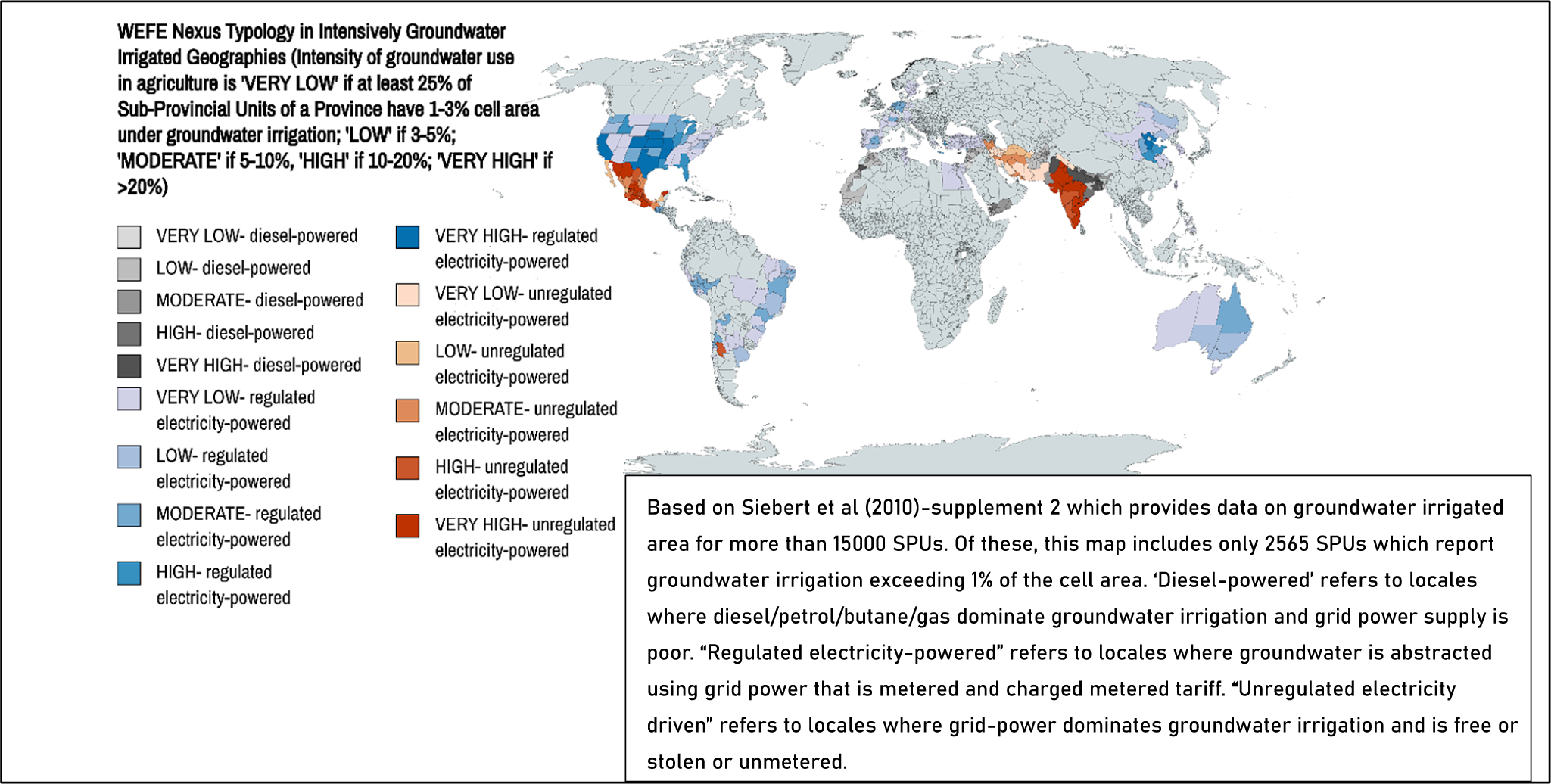
Figure 1 maps the three sub-economies using the dataset from Siebert et al. (Reference Siebert, Burke, Faures, Frenken, Hoogeveen, Döll and Portmann2010)-supplement 2 on groundwater-irrigated area for more than 15,000 Sub-Provincial Administrative Units (SPAUs) globally. Of these, this map includes only 2,565 SPAUs, which report groundwater irrigation exceeding 1% of their cell area.
Three groundwater sub-economies of the world.

Metering tubewells is resisted and frustrated by farmers everywhere including United States, Australia, France, Greece, Italy, Chile and elsewhere (Molle and Closas, Reference Molle and Closas2021); but energy-water managers in industrialized countries have established ground rules of accountability that are largely absent in the electricity-powered unregulated sub-economies. Here, the WEFE nexus operates in its most perverse form. Rationalizing energy pricing and supply policies here can establish these ground rules and resolve myriad problems all at once, namely, reducing the subsidy burden on electricity utilities, improving the working of the rural electricity network, incentivizing sustainable groundwater use, encouraging conjunctive use of surface and groundwater and reducing carbon-footprint of irrigation. Yet, rationalizing energy subsidies has proved an intractable political challenge here.
Years ago, when they were a trickle, energy subsidies seemed a benign policy to promote irrigated agriculture. But as pumping soared, groundwater receded and farmers invested in chasing declining water levels assuming subsidies will continue forever. Now energy subsidies are a deluge; and subsidy reforms meet with strident opposition by farmers, including toppling elected governments, as in India. For politicians in these geographies, messing with energy subsidies is committing political hara-kiri.
Nexus thinking has steered clear of this irrigation realpolitik. Its preoccupation with techno-economic, engineering, value-chain models keeps the debate from acknowledging its political underpinnings and exploring practical workarounds that may not be perfect but inch toward the system optima that Hoff (Reference Hoff2011) wrote about. Centralized governance of distributed irrigation in Barind, Bangladesh, is an example of such a workaround. Gujarat’s policy to separate agricultural feeders to limit energy and groundwater use in irrigation by intelligent rationing of power supply to tubewells is another example. Iran’s use of smart meters on tubewells presents the platform on which demand management can be built. Reviving Iran’s qanats and integrating them with tubewells can conserve water and energy. Vigorous conjunctive management of canal and groundwater irrigation in command areas of large canal irrigation systems and millions of legacy irrigation tanks can be a step toward system optima. None of these workarounds, however, can make energy prices signal groundwater depletion in this sub-economy. This requires a workaround of a kind recently exemplified in Gujarat, India.
Every new technology brings in its wake opportunities to rewrite institutional rules. Solar irrigation pumps(SIPs), which are now spreading fast, may well present just such an opportunity to incentivize farmers to farm solar power as a remunerative crop. Replacing grid-powered irrigation pumps in electricity-powered unregulated sub-economy by net-metered SIPs with a power purchase guarantee from the utility can legalize illegal tubewells, meter unmetered ones and wean farmers away from perverse grid power subsidies. If resolving the nexus is finding a key that opens several doors at once, this pattern of solarizing tubewell irrigation promises such a key. SKY, a large-scale pilot project in Gujarat, India, highlights this promise. During 2018–2019, Gujarat’s SKY project replaced 4,215 existing grid-powered tubewells with net-metered SIPs, giving their owners a 25-year power purchase guarantee. SKY has demonstrated multiple ‘nexus gains’: (a) all unmetered tubewells that solarized got metered with active farmer cooperation; (b) their owners willingly let go of grid-power subsidy they had enjoyed for decades; (c) SKY farmers now enjoy year-round, daytime quality power instead of unreliable, nightly power they had suffered all along; (d) majority of SKY farmers turned from net energy buyers to sellers and began earning significantly from energy sales; (e) power purchase at remunerative price incentivized energy-water conservation; (f) power utilities gained because payout on solar energy purchase from farmers is a fraction of savings in extant grid-power subsidy; (g) they were also happy because power distribution losses declined significantly and distributed solar generation got a boost; (h) CO2 emissions from irrigation reduced to zero as solar energy replaced coal-based grid power; and (i) while 2/3rd of solar generation by off-grid SIPs goes waste, all energy generated by SKY tubewells gets fully utilized by farmers or other consumers on the grid (Shah and Rai, Reference Shah and Rai2021).Footnote 3 SKY exemplifies a win-win pathway to transform an electricity-powered unregulated groundwater sub-economy into a solar-powered regulated one and establish necessary preconditions for achieving the ‘nexus optima’.
Conclusion
The question we began this review with is how and to what extent the WEFE nexus thinking has informed groundwater governance and, going forward, how it can balance the play of water, energy and food policies in water-stressed geographies. A corollary to these is, Have these geographies created the necessary preconditions for moving in the direction of system optima, and if so, at what pace?
Our explorations found that despite increasing awareness of intersectoral externalities, silo thinking still dominates policymaking. Water, energy and food-agriculture policymakers continue to chase sectoral goals and work at cross purposes, except in our Chinese case where a basin organization dominates the proceedings and in Bangladesh’s Barind region where a Special Purpose Vehicle (SPV) presides over irrigation infrastructure creation and management. Elsewhere, IWRM failed to break silos because it promoted policies that failed to find favor with people, civil society and governments. The Chinese case we covered is inspiring but is so dependent on the unique nature of the Chinese state as to make it unreplicable elsewhere. Barind’s lessons are highly relevant but for geographies at early stages of groundwater development, such as Sub-Saharan Africa that present a relatively clean slate. In electricity-powered-unregulated groundwater sub-economies, rationalizing energy subsidies is the necessary, if not sufficient, condition for realizing the nexus vision. To drive policy action here, the nexus approach needs to engage with the realpolitik of policymaking and support politically acceptable workarounds to rationalize perverse subsidies.
While receiving the 2008 World Water Prize, late John Briscoe had said,
Every water solution is a local solution. Moreover, every solution is provisional and contains the seed of a future problem; it works for a time…(necessitating) new kinds of water management interventions which are hard to implement when income levels are low….
The workarounds we explored are Briscoe’s ‘pragmatic but principled’ solutions – rather than a formulaic approach to nexus governance that is agnostic towards contexts, contingencies and constituencies.
Open peer review
To view the open peer review materials for this article, please visit http://doi.org/10.1017/wat.2023.6.
Supplementary material
The supplementary material for this article can be found at https://doi.org/10.1017/wat.2023.6.
Data availability statement
The author confirms that the data supporting the findings of this review paper are within the article or in published material cited in the article as well as in Supplementary Table S1.
Acknowledgments
This review draws heavily on a larger report the author prepared in 2020 for FAO as input to their SOLAO 2021 report. Earlier versions of the present paper benefited from comments by Michael Clark, Sasha Koo, Olcay Unver, Feras Ziadat, Rosalud DeLaRosa, Mark MGuireClark, Shilp Verma and Phillip Kuriachen. The author thanks Asad Qureshi and Azeem Shah for recent information and consultation on Pakistan, Christopher Scott on Mexico and Marcel Kuper on Morocco, Algeria and Tunisia. The author also thanks P. Reghu for excellent editorial support as well as help in the literature search.
Author contribution
Tushaar Shah is responsible for the conception and design of the work, literature search, analysis and drafting of this work. He will also be solely responsible for its revision and preparation for final publication. Tushaar Shah alone will be accountable for all aspects of the work and for the accuracy and integrity of the information analyzed.
Financial support
This research received no specific grant from any funding agency, commercial or not-for-profit sectors.
Competing interest
The author declares none.


 Open access


Comments
Please find attached the manuscript entitle “Water-Energy-Food-Environment (WEFE) Nexus in Action: Global Review of Precepts and Practice” as an invited overview review.
Tushaar Shah