




Introduction
The Heidelberg Radiocarbon Laboratory at the Institute of Environmental Physics (Heidelberg, Germany) has been investigating various carbonate climate archives for many years with a main focus on stalagmites (Therre Reference Therre2020; Therre et al. Reference Therre, Fohlmeister, Fleitmann, Matter, Burns, Arps, Schröder-Ritzrau, Friedrich and Frank2020; Voarintsoa and Therre Reference Voarintsoa and Therre2022) and cold-water corals (CWCs) (Beisel et al. Reference Beisel, Frank, Robinson, Lausecker, Friedrich, Therre, Schröder-Ritzrau and Butzin2023; Hemsing Reference Hemsing2017; Raddatz et al. Reference Raddatz, Beisel, Butzin, Schröder-Ritzrau, Betzler, Friedrich and Frank2023). By combining radiocarbon (14C) measurements with absolute age determinations, such as the 230Th/U method (Kerber et al. Reference Kerber, Arps, Eichstädter, Kontor, Dornick, Schröder-Ritzrau, Babu, Warken and Frank2023), complex reconstructions of the temporal evolution of reservoir ages can be derived (Beisel et al. Reference Beisel, Frank, Robinson, Lausecker, Friedrich, Therre, Schröder-Ritzrau and Butzin2023; Raddatz et al. Reference Raddatz, Beisel, Butzin, Schröder-Ritzrau, Betzler, Friedrich and Frank2023; Therre et al. Reference Therre, Fohlmeister, Fleitmann, Matter, Burns, Arps, Schröder-Ritzrau, Friedrich and Frank2020). In 2018, a new extraction line based on a semi-automated system presented in Tisnérat-Laborde et al. (Reference Tisnérat-Laborde, Poupeau, Tannau and Paterne2001) was installed at the Heidelberg Radiocarbon Laboratory. A first characterization and quality assessment has been introduced by Therre et al. (Reference Therre, Proß, Friedrich, Trüssel and Frank2021). We present here a status update, focusing on the application of this line for the investigation of CWCs and the long-term reproducibility. Furthermore, current quality control parameters, such as blanks, standards and, for the first time, duplicates are presented.
In an application of the quality-assessed method, we complement recent findings by Beisel et al. (Reference Beisel, Frank, Robinson, Lausecker, Friedrich, Therre, Schröder-Ritzrau and Butzin2023) on the ventilation of the eastern tropical north Atlantic based on paired 230Th/U and 14C dating obtained from CWCs collected off Mauritania at 517 m depth. Located near the Cap Verde Frontal Zone (CVFZ), they are part of one of the largest coherent CWC mound provinces in the Atlantic Ocean (Wienberg et al. Reference Wienberg, Titschack, Freiwald, Frank, Lundälv, Taviani, Beuck, Schröder-Ritzrau, Krengel and Hebbeln2018). The state of the thermocline and intermediate depths of the Atlantic have only been sparsely studied via 14C for the period prior to and during the onset of the Last Glacial Maximum (LGM) (e.g. Beisel et al. Reference Beisel, Frank, Robinson, Lausecker, Friedrich, Therre, Schröder-Ritzrau and Butzin2023; Hines et al. Reference Hines, Eiler, Southon and Adkins2019; Robinson et al. Reference Robinson, Adkins, Keigwin, Southon, Fernandez, Wang and Scheirer2005). Mauritanian CWCs showed a high variability in the benthic-atmosphere (Batm) age signal, consistent with northern and southern Batm age records, indicating a high sensitivity to variations in the CVFZ position (Beisel et al. Reference Beisel, Frank, Robinson, Lausecker, Friedrich, Therre, Schröder-Ritzrau and Butzin2023).
Previous studies proposed a southern shift of the CVFZ between 23 and 19 kyr BP (Huang et al. Reference Huang, Mulitza, Paul, Groeneveld, Steinke and Schulz2012; Wienberg et al. Reference Wienberg, Titschack, Freiwald, Frank, Lundälv, Taviani, Beuck, Schröder-Ritzrau, Krengel and Hebbeln2018), which has been supported by the agreement of the Batm age signal with a North Atlantic record (Beisel et al. Reference Beisel, Frank, Robinson, Lausecker, Friedrich, Therre, Schröder-Ritzrau and Butzin2023). Here, we extend the temporal resolution and provide data over the last 30 kyr BP, to improve our understanding of water mass distribution and carbon storage at intermediate depths during the last glacial period and subsequent deglaciation, leading to new insights into frontal movement.
Methods
The method described here was developed to prepare samples consisting of calcium carbonate (CaCO3) for accelerator mass spectrometer (AMS) 14C measurements. The setup was recently built, and the method and initial results have been described in detail by Therre et al. (Reference Therre, Proß, Friedrich, Trüssel and Frank2021). Here, a brief summary of that method with some complementary information is given, with a focus on the special treatment of CWC samples.
Sample preparation
Depending on the material, various preparation steps must be carried out before CO2 extraction can take place.
Cold-water corals
Analogous to the preparation for other isotope measurements, such as 230Th/U (Frank et al. Reference Frank, Paterne, Ayliffe, van Weering, Henriet and Blamart2004; Kerber et al. Reference Kerber, Arps, Eichstädter, Kontor, Dornick, Schröder-Ritzrau, Babu, Warken and Frank2023; Wefing et al. Reference Wefing, Arps, Blaser, Wienberg, Hebbeln and Frank2017), CWCs require mechanical cleaning to exclude diagenesis and contamination with secondary organic material. First, the corals are thoroughly cleaned with water to remove sediment residues. This is done first mechanically with a brush and then in an ultrasonic bath. A visual inspection will first note the preservation state of the coral material, focusing on heavily contaminated sections of the skeleton that could contain reprecipitation of CaCO3. This includes coatings, bioerosion, and secondary organic material such as calcified tubes of Eunice spp., serpulids, etc., as well as other forms of organic material such as sponges and bryozoans. To exclude distortion of the actual isotopic signal, the large, calcified Eunice-tubes should be generously avoided. Smaller impurities and coatings (e.g. organic carbon-rich crusts (Cheng et al. Reference Cheng, Adkins, Edwards and Boyle2000)) are removed mechanically with a Dremel tool. For this purpose, several micrometers to even millimeters of the surface are ground off, depending on the state of preservation of the coral. Afterwards, the coral branch is cut in half to continue the cleaning inside and to remove organic residue between septa. This is followed by a visual inspection under a binocular microscope to ensure that any secondary organic or other non-carbonate coating and signs of bioerosion (e.g., borings of sponges) have been removed. A subsample of 15–20 mg of the mechanically cleaned carbonate material is collected and leached in 4% HCl for at least 30 seconds, to remove absorbed modern CO2 (Adkins et al. Reference Adkins, Griffin, Kashgarian, Cheng, Druffel, Boyle, Edwards and Shen2002). The sample is subsequently dried at 60°C for 1.5 hours, the goal weight after leaching is 8–12 mg.
Blanks
Carbonates such as marble (in-house secondary standard and the IAEA C1 standard (Rozanski et al. Reference Rozanski, Stichler, Gonfiantini, Scott, Beukens, Kromer and van der Plicht1992)) are used as blank material for background determination. They are treated like the remaining samples to provide a realistic estimate of the background signal. Additionally, they are used for further identification of contamination during sample processing.
Standards
The IAEA-C2 standard, a freshwater travertine deposit (Rozanski et al. Reference Rozanski, Stichler, Gonfiantini, Scott, Beukens, Kromer and van der Plicht1992), is measured regularly to ensure the accuracy and judge the level of reproducibility of the measurements. This standard comes as a powder, therefore leaching prior to extraction is not possible. Approximately 8–12 mg of the material is weighted directly before extraction. An antistatic device is used to ensure that all material in the sample vial reacts and is used for CO2 extraction.
In addition, the Oxalic Acid II standard (NIST 1983; Stuiver Reference Stuiver1983) is used to calibrate the AMS measurements. This standard is available in gas form, hence only graphitization is carried out here.
Extraction
The extraction line has been introduced and described in detail by Therre et al. (Reference Therre, Proß, Friedrich, Trüssel and Frank2021) and is based on the design of the semi-automated extraction line described by Tisnérat-Laborde et al. (Reference Tisnérat-Laborde, Poupeau, Tannau and Paterne2001). Before the extraction procedure can start, the setup is evacuated for at least three hours to obtain pressure levels below 10−5 mbar. It has proven useful to prepare the setup the day before extraction and evacuate it overnight, allowing pressure levels up to 10−6 mbar to be achieved.
Custom-made glass vials are used for the samples. One side contains the sample, and the other side is filled with 0.5 mL of 10% hydrochloric acid, which acts as a hydrolyzing agent (Therre et al. Reference Therre, Proß, Friedrich, Trüssel and Frank2021). The vials prepared in this way are successively connected to the extraction line and evacuated to a pressure below 10−4 mbar. To exclude contamination with ambient air, the isolation of the system is checked after connecting the sample vials. If this check was successful, the reaction is started by turning the glass vials, allowing the acid to flow to the sample (Therre et al. Reference Therre, Proß, Friedrich, Trüssel and Frank2021). The resulting gas mixture, consisting of CO2 and H2O, is passed over a freezing trap, which uses a dry ice and acetone mixture to remove the resulting water at about −78°C (Therre et al. Reference Therre, Proß, Friedrich, Trüssel and Frank2021). Subsequently, the remaining CO2 is directed into the calibration volume using liquid nitrogen. Measuring the pressure under lab conditions in the calibration volume allows determining the efficiency of the reaction. It also provides an additional control for any contamination with ambient air. Finally, the CO2 is directed into a gas container using liquid nitrogen again. In this way, six samples can be extracted in one day. Between each run, the extraction line is evacuated for approximately 5–10 minutes to prevent memory effects (Therre et al. Reference Therre, Proß, Friedrich, Trüssel and Frank2021). During a cycle, pressure levels between each step are monitored and documented to quickly identify any discrepancies.
Graphitization
The graphitization setup was built by Unkel (Reference Unkel2006), and further details are available in Unkel (Reference Unkel2006) and Therre et al. (Reference Therre, Proß, Friedrich, Trüssel and Frank2021). Before starting the graphitization, 3–4 mg of iron powder, which serves as a catalyst for the Bosch reaction, is filled into the reactor tubes. After a leakage check, the catalyst is chemically purified by oxidization with ambient air and subsequent two-fold reduction with hydrogen gas at 400°C (Therre et al. Reference Therre, Proß, Friedrich, Trüssel and Frank2021). The system is subsequently evacuated to a pressure of 10−4 mbar.
The glass containers with the extracted CO2 are connected to the graphitization setup. The CO2 is loaded into the reaction containers using liquid nitrogen. The reduction to graphite requires hydrogen gas, which is also loaded into the containers. The reactors are then heated to 575°C. The following Bosch reaction takes approximately 3–4 hours, depending on the amount of sample. Constant pressure levels mark the completion of the reaction. Afterwards, the iron-graphite mixture is stored in glass tubes until the measurement on the AMS can take place.
AMS measurement
The 14C measurements were performed on accelerator mass spectrometers of type “Mini-Carbon-Dating-System” (MICADAS; Synal et al. Reference Synal, Stocker and Suter2007) at the Curt-Engelhorn-Center Archaeometry (CEZA) in Mannheim, Germany (Kromer et al. Reference Kromer, Lindauer, Synal and Wacker2013; Synal et al. Reference Synal, Stocker and Suter2007). The graphitized iron-graphite compound gets compressed into aluminum targets by a pneumatic press. One set of measurements consists of 39 samples, including 5 blanks, 5 oxalic-acid II standards, 2–3 IAEA-C2 standards and 26–27 samples, measured using a bracketing pattern. Standards are interspersed between samples in regular intervals to accurately track the sensitivity and background of the AMS system throughout the measurement procedure. The conventional 14C-ages are normalized to δ13C = −25 ‰. The analytical precision is calculated using the error propagation of the uncertainties of standards and blanks. An additional error of 0.1% is added onto the 14C/12C ratio to account for uncertainties that are not covered by pure counting statistics and uncertainty of the measured standards at that time.
Coupled 230Th/U and 14C measurements on Mauritanian cold-water corals
CWCs from Mauritania were recently investigated using coupled 230Th/U and 14C measurements by Beisel et al. (Reference Beisel, Frank, Robinson, Lausecker, Friedrich, Therre, Schröder-Ritzrau and Butzin2023). Here we complement the previous data set obtained from the coral-bearing sediment core GeoB 14904-2 (17°32.558’N, 16°39.806’W, 517 m depth). The core was retrieved with a gravity corer during the RV Maria S. Merian expedition MSM16-3 “Phaeton” (Westphal et al. (Reference Westphal, Beuck, Braun, Freiwald, Hanebuth, Hetzinger, Klicpera, Kudrass, Lantzsch, Lundälv, Vicens, Preto, Reumont Jv, Taviani and Wienberg2014)) and coral fragments of the species Desmophyllum pertusum (formerly known as Lophelia pertusa) were collected at various core depths. 230Th/U measurements (method described in great detail in Kerber et al. (Reference Kerber, Arps, Eichstädter, Kontor, Dornick, Schröder-Ritzrau, Babu, Warken and Frank2023) and Wefing et al. (Reference Wefing, Arps, Blaser, Wienberg, Hebbeln and Frank2017)) revealed coral ages of up to 30 kyr BP (Beisel et al. Reference Beisel, Frank, Robinson, Lausecker, Friedrich, Therre, Schröder-Ritzrau and Butzin2023; Wienberg et al. Reference Wienberg, Titschack, Freiwald, Frank, Lundälv, Taviani, Beuck, Schröder-Ritzrau, Krengel and Hebbeln2018). We extend the existing coral age dataset by 18 new coupled 230Th/U measurements and 14C measurements and estimated the benthic-atmosphere (Batm) age, which is calculated via 14Cage, coral– 14Cage, atmosphere. The current atmospheric radiocarbon calibration curve for the Northern Hemisphere, IntCal20 (Reimer et al. Reference Reimer, Austin, Bard, Bayliss, Blackwell, Ramsey, Butzin, Cheng, Edwards and Friedrich2020), was used as atmospheric reference to calculate Batm ages. The data set was filtered according to the following criteria. Measurements with 232Th concentrations above 2 ppb were discarded. The 234U/238U ratio is allowed within a ±7‰ boundary around the modern ocean value (δ234Ui = 146.8 ‰; Andersen et al. Reference Andersen, Stirling, Zimmermann and Halliday2010). Furthermore, we used the stratigraphic order of the ages as an additional criterion and discarded pronounced age-depth inversions and corals located in the hiatus of the sediment core.
Results and discussion
14C quality control
Blanks
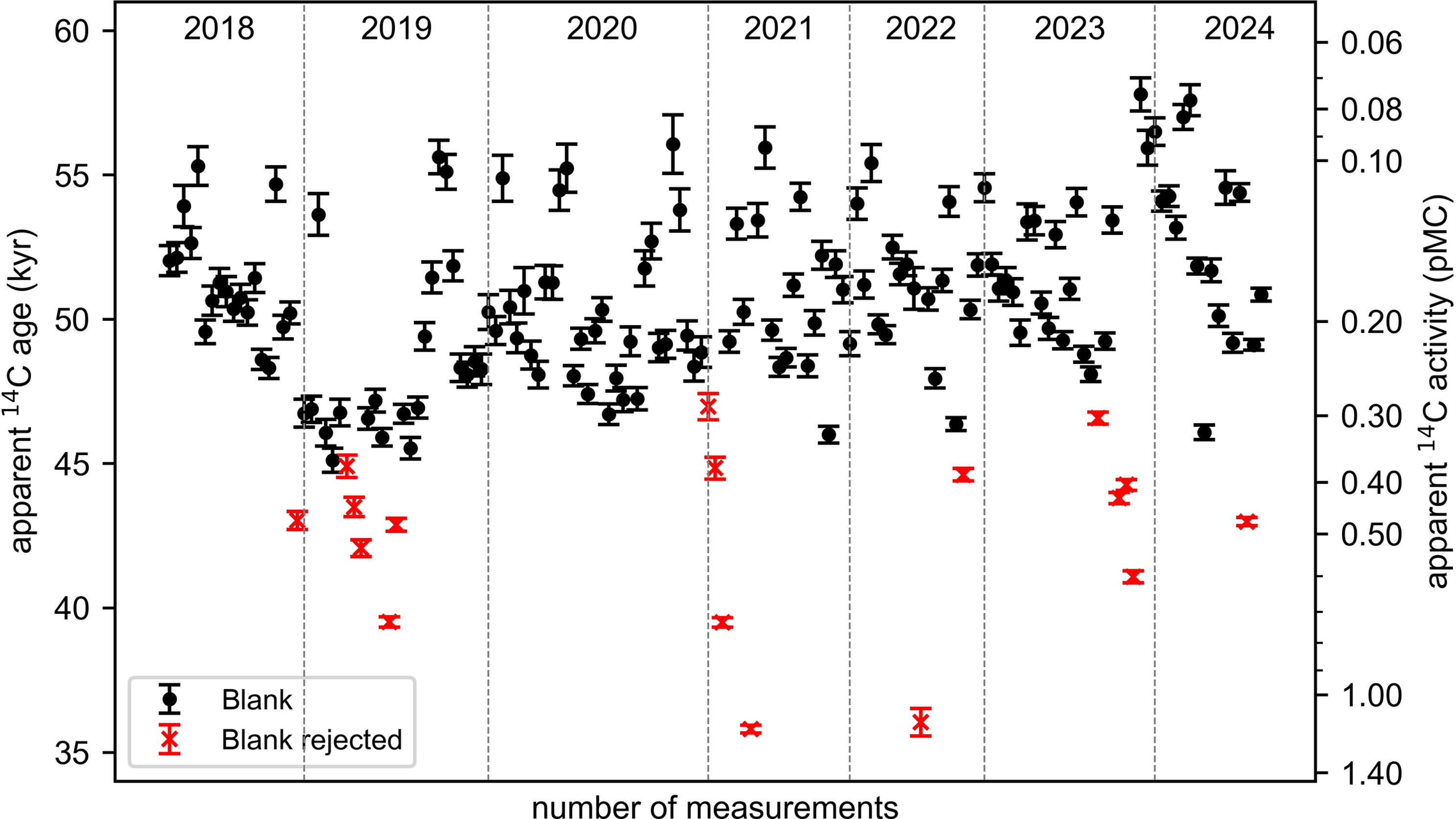
Blank results are essential to determine the background signal and to detect and exclude any memory effects and contamination that might occur during sample processing, graphitization, or measurement. Overall, 155 blanks have been measured since commissioning of the new extraction setup in 2018, extending the results presented in Therre et al. (Reference Therre, Proß, Friedrich, Trüssel and Frank2021) (n = 67), of which, 17 (11%) were rejected due to assumed contamination (Figure 1). Reasons for possible contamination include insufficient leaching time and leakage in the setup (verifiable by monitoring pressures during a run). In addition, contamination could occur during processing (no organic material should come in contact with the sample). The storage time, the time between graphitization and measurement when graphite is exposed to air, on the other hand, should only have a minor effect on the blanks. In other laboratories, the influence of storage time of the iron-graphite sample is considered to be small (Dumoulin et al. Reference Dumoulin, Comby-Zerbino, Delqué-Količ, Moreau, Caffy, Hain, Perron, Thellier, Setti and Berthier2017) or not relevant (Steinhof et al. Reference Steinhof, Altenburg and Machts2017). We found no correlation between the storage time and the absolute blank value. Our updated value for the long-term blank is 0.190 ± 0.064 pMC (50.794 ± 2.813 kyr) with a median of 0.184 pMC (50.594 kyr).
Blank results (n = 155; this study (n = 88) and Therre et al. (Reference Therre, Proß, Friedrich, Trüssel and Frank2021) (n = 67)) since commissioning of the new extraction setup in the year 2018. Rejected blanks due to contamination (n = 17) have been marked in red.
Reproducibility: IAEA-C2 standard
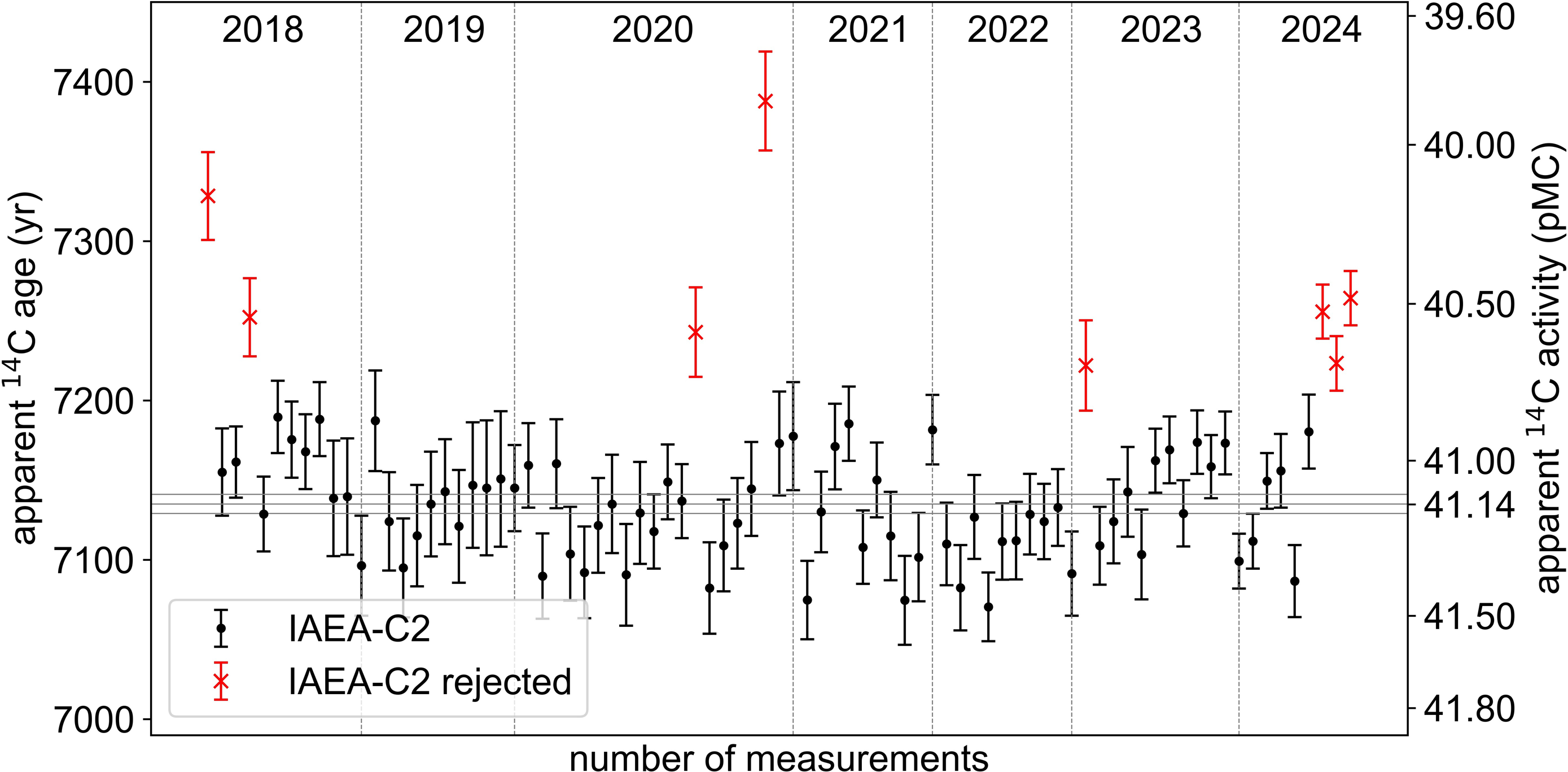
IAEA-C2 standards are measured regularly to check the accuracy and reproducibility of the measurements. Since commissioning of the new extraction setup, a total of 83 IAEA-C2 standards have been measured (Figure 2), of which 8 (∼9%) were rejected due to contamination with 14C depleted CO2. Overall, we obtain a mean of 41.15 ± 0.16 pMC (7.132 ± 0.031 kyr) and a median of 41.16 pMC (7.130 kyr) in agreement with the reference value of 41.14 ± 0.03 pMC (Rozanski et al. Reference Rozanski, Stichler, Gonfiantini, Scott, Beukens, Kromer and van der Plicht1992).
IAEA-C2 results (n = 83; this study (n = 45) and Therre et al. (Reference Therre, Proß, Friedrich, Trüssel and Frank2021) (n = 38)) since commissioning of the new extraction setup in the year 2018. The individual values are shown with 1σ uncertainty. The horizontal grey lines show the literature value of 41.14 ± 0.03 pMC (Rozanski et al. Reference Rozanski, Stichler, Gonfiantini, Scott, Beukens, Kromer and van der Plicht1992), including 1σ uncertainty. Eight data points marked in red were rejected due to contamination. The last three data points were measured in one magazine and discarded due to contamination. The reproducibility was checked by duplicate CWC measurements in the magazine, in which the preparation was carried out without any noticeable incidents (n = 3).
Reproducibility: Duplicates
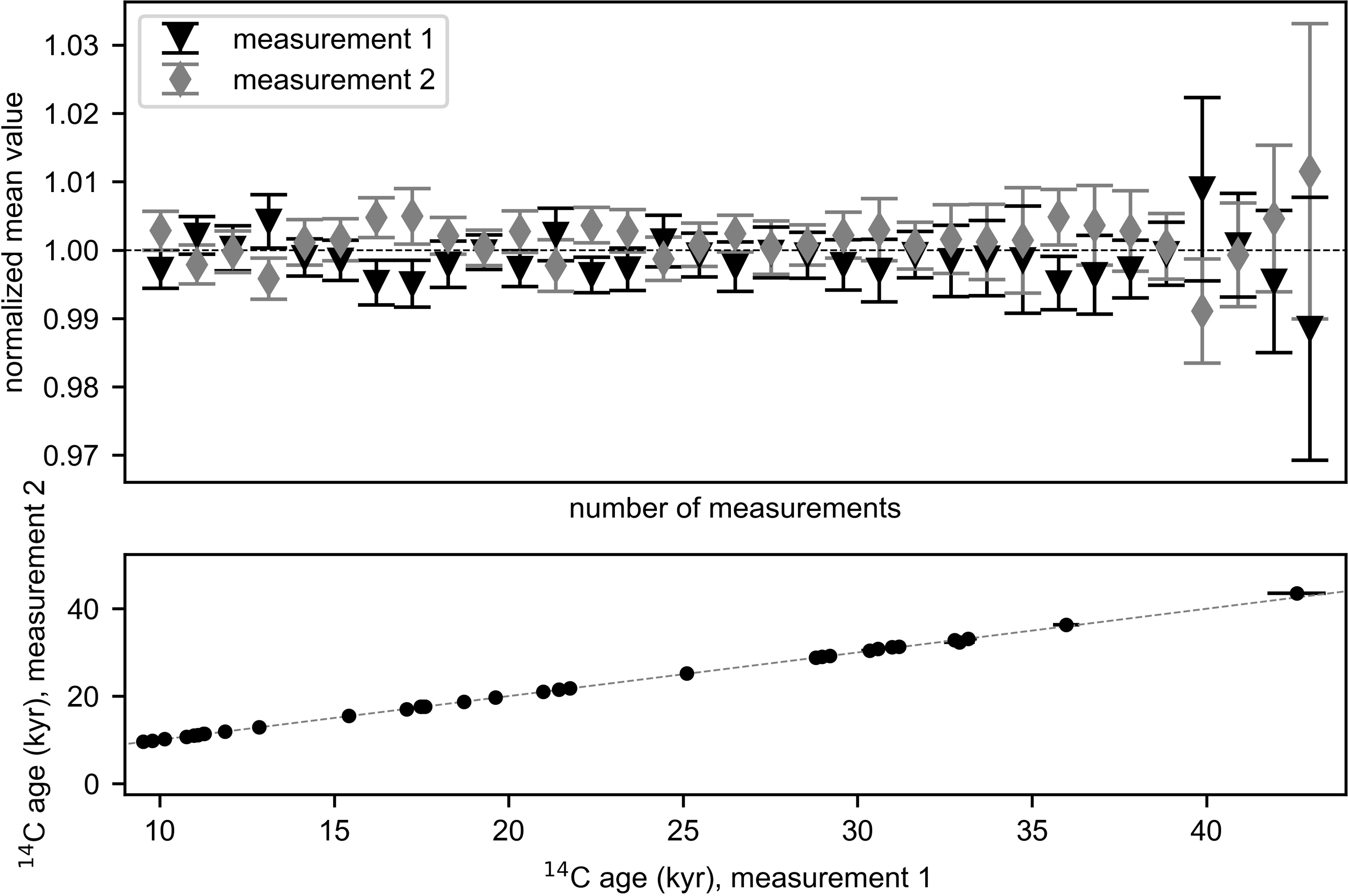
In addition to the regular measurements of the IAEA-C2 standard, we regularly performed duplicate measurements of CWCs to ensure reproducibility (Figure 3). In total, 33 CWCs with ages between 9.5 and 43 kyr BP (uncalibrated 14C age) were measured twice, of which 13 measurements have already been published in Beisel et al. (Reference Beisel, Frank, Robinson, Lausecker, Friedrich, Therre, Schröder-Ritzrau and Butzin2023) and one in Raddatz et al. (Reference Raddatz, Beisel, Butzin, Schröder-Ritzrau, Betzler, Friedrich and Frank2023). All measurements agree within 2σ and 85% of the measurements even in the 1σ range (Figure 3). This shows that the uncertainties of the 14C ages reported by the AMS laboratory are slightly overestimated.
Duplicate 14C measurements (n = 33; this study [n = 20] and Beisel et al. [Reference Beisel, Frank, Robinson, Lausecker, Friedrich, Therre, Schröder-Ritzrau and Butzin2023] [n = 13]). The top panel shows the two measurements plotted against their respective normalized mean values with 1σ uncertainties. Older samples (>32 kyr) show a larger apparent difference due to large measurement uncertainty. However, there are no significant offsets. The lower panel shows the same duplicates, this time plotted against the uncalibrated 14C age to illustrate the age range.
Ventilation age record from Mauritania
Previous studies based on coral-bearing sediment cores collected from Mauritanian CWC mounds indicated distinct and temporally restricted reef growth interrupted by clear hiatuses. These hiatuses cover time intervals of several thousand years and correspond to non-reef periods in which CWCs occurred only as small, scattered colonies or have been entirely absent from the region due to environmental conditions that prevented CWC growth (Eisele et al. Reference Eisele, Frank, Wienberg, Hebbeln, Correa, Douville and Freiwald2011; Wienberg et al. Reference Wienberg, Titschack, Freiwald, Frank, Lundälv, Taviani, Beuck, Schröder-Ritzrau, Krengel and Hebbeln2018). For core GeoB 14904-2, three reef growth phases are evident, limiting the time frame of our ventilation record to 30–25 kyr BP, 20.5–18.5 kyr BP and 14–13.5 kyr BP. Common to all these episodes is that the Batm ages show a trend with well-ventilated waters (low Batm ages) at the beginning of the reef growth period and less ventilated, high Batm ages at the end of the coral growth period (Figure 4). However, the relative changes in age and the time span in which the change in ventilation occurs differ within each period.
Benthic-atmosphere (Batm) ages obtained from CWCs of core GeoB 14904-2 collected on the Mauritania slope (purple stars). Also shown are previously published Batm ages from CWC sites off Mauritania and Angola (Beisel et al. Reference Beisel, Frank, Robinson, Lausecker, Friedrich, Therre, Schröder-Ritzrau and Butzin2023), from the Tropic Seamount (de Carvalho Ferreira Reference de Carvalho Ferreira2022) and the equatorial Atlantic (Chen et al. Reference Chen, Robinson, Burke, Southon, Spooner, Morris and Ng2015, Reference Chen, Robinson, Burke, Claxton, Hain, Li, Rae, Stewart, Knowles, Fornari and Harpp2020). Previously published data are indicated by gray error ellipses, new data (n=18) from GeoB 14904-2 are indicated by red error ellipses, displaying 2σ uncertainties. The foraminifera Batm age record from the Brazilian margin was published by (Skinner et al. Reference Skinner, Freeman, Hodell, Waelbroeck, Vazquez Riveiros and Scrivner2021), 1σ uncertainties are shown. The grey bars indicate the duration of the Younger Dryas (YD) cold period and the Last Glacial Maximum. Map of investigated sites, including major surface currents, was created with Ocean Data View (Schlitzer Reference Schlitzer2023).
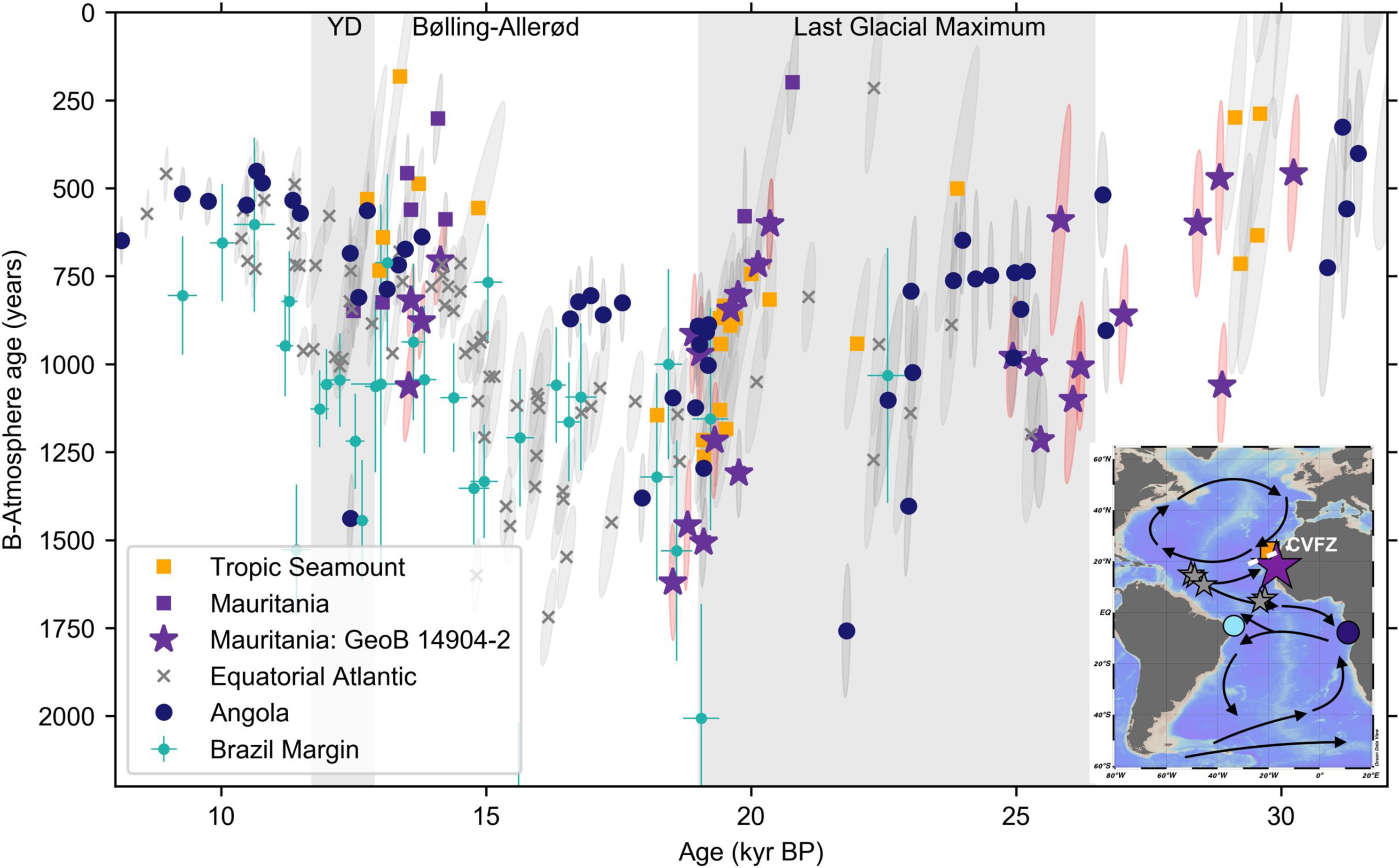
During the last glacial, ventilation decreased continuously, probably due to a combination of processes, such as increasing sea ice cover and limited gas exchange in the polar regions. Here, we provide further evidence for continuously decreasing ventilation during the last glacial period (e.g. Beisel et al. Reference Beisel, Frank, Robinson, Lausecker, Friedrich, Therre, Schröder-Ritzrau and Butzin2023; Skinner et al. Reference Skinner, Fallon, Waelbroeck, Michel and Barker2010, Reference Skinner, Muschitiello and Scrivner2019, Reference Skinner, Freeman, Hodell, Waelbroeck, Vazquez Riveiros and Scrivner2021). Ventilation age records during that time are very limited, our record is the first to show the progression towards a less ventilated state. The Batm age record off Mauritania displays between 30 and 25 kyr BP a decrease from 500 to 1000 yr Batm age (Figure 4).
The initial reservoir age of 500 yr at 30 kyr BP coincides with the reservoir age observed southwards off Angola at 31 kyr BP (340 m depth, Beisel et al. [Reference Beisel, Frank, Robinson, Lausecker, Friedrich, Therre, Schröder-Ritzrau and Butzin2023]) and northwards from the Tropic Seamount at 29 kyr BP (995 m depth, de Carvalho Ferreira [Reference de Carvalho Ferreira2022]). At a first glance, this might suggest similar water mass influence. Since ventilation records from the North Atlantic are very limited during this time span (compilation by Rafter et al. [Reference Rafter, Gray, Hines, Burke, Costa, Gottschalk, Hain, Rae, Southon and Walczak2022]), statements regarding the origin of this water mass via 14C are limited as well. From radiocarbon alone, a well-ventilated, northern influence would be imaginable, as observed later in the LGM (Beisel et al. Reference Beisel, Frank, Robinson, Lausecker, Friedrich, Therre, Schröder-Ritzrau and Butzin2023), as well as a southern influence, since Angola corals showed similar ventilation ranges (Beisel et al. Reference Beisel, Frank, Robinson, Lausecker, Friedrich, Therre, Schröder-Ritzrau and Butzin2023).
A northern water mass influence would imply a southward displacement of the CVFZ, allowing the same waters that influenced the Tropic Seamount to progress towards Mauritania and upwell there. Since the Batm age signal shows gradually aging water, this in turn would imply a significant aging of the North Atlantic subtropical gyre. As data indicate a rather well-ventilated North Atlantic during the LGM (e.g. Beisel et al. Reference Beisel, Frank, Robinson, Lausecker, Friedrich, Therre, Schröder-Ritzrau and Butzin2023; Freeman et al. Reference Freeman, Skinner, Waelbroeck and Hodell2016), we do not favor this hypothesis. A more likely scenario would be that the CVFZ stayed at its current position. This would allow southern-sourced water to reach Mauritania CWCs, just as today. This is in agreement with the Batm ages, displaying the same range as southern records such as Angola (Beisel et al. Reference Beisel, Frank, Robinson, Lausecker, Friedrich, Therre, Schröder-Ritzrau and Butzin2023). The accordance with the Tropic Seamount around 29 kyr could indicate a short northward displacement of the CFVZ, or very similar, well-ventilated radiocarbon signatures.
Overall, we thus confirm the ventilation signal off Angola and the observation of the same ventilation state around 25 kyr BP (Beisel et al. Reference Beisel, Frank, Robinson, Lausecker, Friedrich, Therre, Schröder-Ritzrau and Butzin2023). Increased temporal resolution confirms large fluctuations in the overall ventilation signal. During the period of absent CWC growth from 25 to 21 kyr BP, Batm ages decreased from 1500 yr to as low as 200 yr. As the Batm age signal between 21 and 20 kyr BP is presumed to reflect a northern-sourced water signal (Beisel et al. Reference Beisel, Frank, Robinson, Lausecker, Friedrich, Therre, Schröder-Ritzrau and Butzin2023), a southward shift of the CVFZ must have occurred in the time period between 25 and 21 kyr BP. This agrees well with previous studies suggesting a southward shift of the CVFZ between 23 and 19 kyr BP (Huang et al. Reference Huang, Mulitza, Paul, Groeneveld, Steinke and Schulz2012; Wienberg et al. Reference Wienberg, Titschack, Freiwald, Frank, Lundälv, Taviani, Beuck, Schröder-Ritzrau, Krengel and Hebbeln2018).
The most pronounced changes in ventilation are recorded around the end of the LGM. Here, the Batm age increased by 1000 yr over a time span of only 1500 yr (Beisel et al. Reference Beisel, Frank, Robinson, Lausecker, Friedrich, Therre, Schröder-Ritzrau and Butzin2023). Note that Batm age values oscillate between 600 and 1500 yr between 19 and 20 kyr BP on time scales of centuries (Beisel et al. Reference Beisel, Frank, Robinson, Lausecker, Friedrich, Therre, Schröder-Ritzrau and Butzin2023). Increased temporal resolution reveals Batm ages for the Mauritanian CWCs in perfect agreement with CWCs from Tropic Seamount, Angola, Brazil, and the Drake Passage (Beisel et al. Reference Beisel, Frank, Robinson, Lausecker, Friedrich, Therre, Schröder-Ritzrau and Butzin2023; Chen et al. Reference Chen, Robinson, Burke, Southon, Spooner, Morris and Ng2015; de Carvalho Ferreira Reference de Carvalho Ferreira2022; Li et al. Reference Li, Robinson, Chen, Wang, Burke, Rae, Pegrum-Haram, Knowles, Li and Chen2020; Skinner et al. Reference Skinner, Freeman, Hodell, Waelbroeck, Vazquez Riveiros and Scrivner2021), confirming the previously observed punctual high ventilation ages of around 1500 yr (Beisel et al. Reference Beisel, Frank, Robinson, Lausecker, Friedrich, Therre, Schröder-Ritzrau and Butzin2023). The drop in Batm ages from 800 yr to 1600 yr roughly within 1000 years occurred within period of global sea-level rise by 10–15 m (Lambeck et al. Reference Lambeck, Rouby, Purcell, Sun and Sambridge2014) and presumed weakening of the Atlantic meridional overturning circulation (AMOC). The correlation with the Batm age signal from Angola was attributed to lateral shifts in the CVFZ towards the end of the LGM (Beisel et al. Reference Beisel, Frank, Robinson, Lausecker, Friedrich, Therre, Schröder-Ritzrau and Butzin2023). The weakened AMOC could have allowed old waters originating from the south, such as AAIW, to advect further north (Pahnke et al. Reference Pahnke, Goldstein and Hemming2008). Since the CWCs from the Tropic Seamount indicate the same ventilation signal, we hypothesize that the frontal displacement has advanced further north than the current position. The increased temporal resolution of the records off Mauritania and Tropic Seamount allows tracking such enormous ventilation changes over short periods of time. Presumably old, southern water is advancing, as the ventilation signal coincides with Brazil (Skinner et al. Reference Skinner, Freeman, Hodell, Waelbroeck, Vazquez Riveiros and Scrivner2021) and the Drake Passage (Burke and Robinson Reference Burke and Robinson2012; Chen et al. Reference Chen, Robinson, Burke, Southon, Spooner, Morris and Ng2015; Li et al. Reference Li, Robinson, Chen, Wang, Burke, Rae, Pegrum-Haram, Knowles, Li and Chen2020). However, we are aware that there is an ongoing debate about the extent to which the Atlantic was influenced with poorly ventilated, southern-sourced water during the LGM (e.g. Howe et al. Reference Howe, Huang, Oppo, Chiessi, Mulitza, Blusztajn and Piotrowski2018; Oppo et al. Reference Oppo, Gebbie, Huang, Curry, Marchitto and Pietro2018; Pöppelmeier et al. Reference Pöppelmeier, Blaser, Gutjahr, Jaccard, Frank, Max and Lippold2020). The poorly ventilated signal may have been caused by an accumulation of respired organic matter due to slow overturning rather than advance of southern-sourced water (Howe et al. Reference Howe, Huang, Oppo, Chiessi, Mulitza, Blusztajn and Piotrowski2018). However, in case of 14C, the records from Mauritania (this study and Beisel et al. [Reference Beisel, Frank, Robinson, Lausecker, Friedrich, Therre, Schröder-Ritzrau and Butzin2023]) and the Tropic Seamount (de Carvalho Ferreira Reference de Carvalho Ferreira2022) suggest a greater contribution of southern-sourced water, as they coincide with the old water from Angola, Brazil and the Drake Passage (Beisel et al. Reference Beisel, Frank, Robinson, Lausecker, Friedrich, Therre, Schröder-Ritzrau and Butzin2023; Burke and Robinson Reference Burke and Robinson2012; Chen et al. Reference Chen, Robinson, Burke, Southon, Spooner, Morris and Ng2015; Li et al. Reference Li, Robinson, Chen, Wang, Burke, Rae, Pegrum-Haram, Knowles, Li and Chen2020; Skinner et al. Reference Skinner, Freeman, Hodell, Waelbroeck, Vazquez Riveiros and Scrivner2021), while a 14C record from the Azores and Great Meteor Seamount region clearly indicates well-ventilated water (Beisel et al. Reference Beisel, Frank, Robinson, Lausecker, Friedrich, Therre, Schröder-Ritzrau and Butzin2023). An expansion of southern-sourced water like AAIW (Pahnke et al. Reference Pahnke, Goldstein and Hemming2008) would allow aged, southern-sourced water to spread into the subtropical North Atlantic.
Furthermore, we have improved the temporal resolution of the previous Batm age record during the Bølling-Allerød (B/A) warm period. In general, the B/A is known for well-ventilated conditions in the Atlantic (Skinner and Bard Reference Skinner and Bard2022). Overall, we confirm the previously observed ventilation state (Beisel et al. Reference Beisel, Frank, Robinson, Lausecker, Friedrich, Therre, Schröder-Ritzrau and Butzin2023; Burke and Robinson Reference Burke and Robinson2012; Chen et al. Reference Chen, Robinson, Burke, Southon, Spooner, Morris and Ng2015; Li et al. Reference Li, Robinson, Chen, Wang, Burke, Rae, Pegrum-Haram, Knowles, Li and Chen2020; Skinner et al. Reference Skinner, Freeman, Hodell, Waelbroeck, Vazquez Riveiros and Scrivner2021). Three new data points between 13.6 and 13.8 kyr BP (between 800 and 1000 yr Batm age) could indicate a slightly stronger variation of the ventilation signal of Mauritania. They show an offset to earlier measurements in Mauritania and Angola of about 250 to 500 yr, which may just be an artifact of the higher resolution. The ventilation ages are still within range of a southern-sourced ventilation signal. The correspondence with the Drake Passage (Burke and Robinson Reference Burke and Robinson2012; Chen et al. Reference Chen, Robinson, Burke, Southon, Spooner, Morris and Ng2015; Li et al. Reference Li, Robinson, Chen, Wang, Burke, Rae, Pegrum-Haram, Knowles, Li and Chen2020) and Brazil (Skinner et al. Reference Skinner, Freeman, Hodell, Waelbroeck, Vazquez Riveiros and Scrivner2021) would indicate a similar state of ventilation over a large depth and latitudinal range.
Conclusion
In this study, we have provided an updated overview of the performance of the radiocarbon laboratory at the Heidelberg Institute of Environmental Physics and the AMS facility of the Curt-Engelhorn-Center Archaeometry. The laboratory maintains a long-term blank value of 0.190 ± 0.064 pMC (n = 138) and is able to reproduce the international IAEA-C2 standard (41.15 ± 0.16 pMC, n = 75) and internal CWC duplicates (n = 33) excellently. This testifies to the consistently high quality of 14C dating to date, which is ensured by ongoing quality controls.
In addition, we presented detailed 230Th/U and 14C analyses of the coral-bearing sediment core GeoB 14904-2 off Mauritania. The resulting ventilation age record off Mauritania revealed continuous aging of thermocline waters between 30 and 25 kyr BP, consistent with previous studies and presumably reflecting southern-sourced water influence. Between 25 and 21 kyr BP, the ventilation state jumps from a southern sourced, to a northern sourced signal. Hence, the former suggested southward shift of the CVFZ must have occurred in between this time period. At the end of the LGM, CWCs from Mauritania show the same ventilation signal as CWCs from the Tropic Seamount, Angola, and the Drake Passage, as well as foraminifera from Brazil. Therefore, we favor an intrusion of old water originating from the south, probably triggered by a weakened AMOC.
Moreover, we have improved the temporal resolution during the B/A warm period. Three data points indicate large fluctuations in the overall well-ventilated state. In line with southern-sourced waters, this could indicate a state of ventilation throughout a large area within the Atlantic.
Data availability statement
Data associated to this article can be found at PANGAEA: https://doi.pangaea.de/10.1594/PANGAEA.971115
Acknowledgments
We would like to express our gratitude to Rainer Stadler and Ursula Scheurich for their help in constructing the glass setup and the necessary hand-build additional parts. We also thank Markus Miltner and Carl Kindermann for their help with the 14C lab work, as well as Athulya Babu, Julia Meissner and René Eichstädter for coral sample processing, 230Th/U chemistry and mass spectrometry. Furthermore, we thank Marleen Lausecker and Andrea Schröder-Ritzrau for their help in collecting the coral samples from sediment cores and providing advice during sample selection and preparation. Sample material has been provided by the GeoB Core Repository at the MARUM–Center for Marine Environmental Sciences, University of Bremen, Germany. We thank the nautical and scientific teams for their support in collecting cold-water coral material on the Mauritanian slope during the RV Maria S. Merian expedition MSM16-3 “Phaeton” (PI: Hildegard Westphal). We acknowledge funding by the DFG via grant N°325099762 and N°256561558.


 Open access

