Introduction
In this book I explore the phenomenon of the “group mind.” By group mind I mean (roughly speaking) the personality and cognitive capacities of a collective mind that are generated by a collection of individuals assembled for some purpose in a group. The concept of a “group mind” is often used by biologists to describe the collective behavior of hyper-social or eusocial organisms, such as some species of ants and bees, or by social scientists to describe a sense of collective consciousness or a collective personality among human groups. It has become increasingly clear to most behavioral scientists that you cannot understand emergent group phenomena/behaviors from looking solely at individual behaviors of members of the group. The collective behavior and conduct of apparently independent individuals does not make sense and cannot be understood unless you evaluate them as parts of a group that itself operates and moves as a single entity. In addition, you cannot understand an individual’s behavior without considering his/her behaviors in reference to the groups he/she is invested in. Individuals within a group can sometimes cooperate so closely as to become indistinguishable from a single organism with a single set of intentions and actions, that is, with a single mind. These kinds of groups are called by different names such as task-oriented, purpose-driven, or problem-solving groups. I prefer the name “enterprise associations,” which the philosopher Michael Oakeshott utilized to characterize similar group types in the political arena.
The observation that some human groups (such as enterprise associations) undergo these sorts of transformations from mere aggregates of individuals into a new entity or organism that operates, at least for some period of time, as a single autonomous entity with a single mind is now, in my view, a well-established fact. I suspect, however, my readers aren’t as convinced as I am, so I will, in this book, particularly in this first chapter, discuss some of the evidence for this claim. Once you entertain the possibility of the reality of group minds, the next important question is about the implications of this fact for various areas of human experience. That is the purpose of this book. While I will focus on implications of group mind phenomena for various areas of human experience, I will nevertheless keep presenting some of the evidence that group minds actually exist and have real effects in the world.
Given my background and areas of expertise, I am particularly interested in effects of group mind phenomena on religious cognitions and experience, but I realize that religion may be of marginal interest for many readers, so I examine several other topic areas as well. In all cases I evaluate the key issues in group mind phenomena within both evolutionary and neurocognitive frameworks.
“Strong” versus “Weak” Group Minds
I will argue in this book that group mind-related phenomena are real and they affect a range of fundamentally important social factors such as cooperation among persons and groups, inter-group conflict and war, organizational performance and competitiveness, leadership effectiveness, mass influence and propaganda campaigns, political sovereignties and power, mass hysteria and stampedes, virality, fads, fashions and reputations, religion and its supernatural agents, individual and group inspiration and creativity, and the extremes of human achievement (genius) and failures, including individual maladies and psychopathologies. We cannot understand ourselves and the human predicament without understanding collective mental phenomena, and specifically group minds. In addition, I argue that we will not be able to understand and control emerging technologies such as superintelligent AI machines and the internet without a better understanding of collective mentality. This book is one attempt to contribute to the great effort of many scholars and scientists to understand collective minds.
Many scholars and scientists have now studied collective mentalities of all kinds, with several compendiums, expert reviews, handbooks, and monographs on the issue available for the interested reader (Acar et al., Reference Acar, Tuncdogan, van Knippenberg and Lakhani2024; Arima, Reference Arima2022; Aunger & Greenland, Reference Aunger and Greenland2024; Centola, Reference Centola2022; Feinerman & Korman, Reference Feinerman and Korman2017; Francis, Reference Francis2007; Hodgkinson & Healey, Reference Hodgkinson and Healey2008; Ioannou & Laskowski, Reference Ioannou and Laskowski2023; Kameda et al., Reference Kameda, Toyokawa and Tindale2022; Krall, Reference Krall2023; Malone & Bernstein, Reference Malone and Bernstein2015; McDougall, Reference McDougall1920; Momennejad, Reference Momennejad2022; Müller et al., Reference Müller, Ohström and Lindenberger2021; Sasaki & Pratt, Reference Sasaki and Pratt2018; Shteynberg et al., Reference Shteynberg, Hirsh and Wolf2023; Steyvers & Miller, Reference Steyvers and Miller2015; Wilson & Sober, Reference Wilson and Sober1989; Woolley & Gupta, Reference Woolley and Gupta2024). What, if anything, new can be said about this stuff? What I try to offer in this book is an examination of a neglected aspect of this work on collective mentalities – namely the case in which collective minds seem to operate autonomously and independently of the judgments, decisions, wills, and desires of the members of the group that generated the group mind in the first place. I take evolutionary and neuroscience approaches to these questions as I believe such approaches help to illuminate the conditions under which we can expect autonomously operating collective minds.
If, as I noted earlier, we define group mind as the personality, intelligence, and actions of a group and if these factors transcend the experiences of the group’s individual members such that they produce something in the form of mentation or cognition that enables quasi-rational actions, then, at one level, this is simply an example of the well-known process in physics and biology of “emergence.” Emergence refers to a phenomenon where the interaction of the parts of a dynamical system exhibits sufficient complexity such that novel properties or behaviors arise that cannot be reduced to, or fully explained by, the properties and interactions of its individual components. Emergence describes those gestalt situations in which the whole is greater than the sum of its parts, and the system’s effects, functional behaviors, and evolutionary trajectories can only be understood by looking at the gestalt whole and not merely at the constituent parts. One needs to look at the system as if it were a single entity. That gestalt whole is indeed a new entity with its own content, operating principles, and causal effects. These causal effects are both vertical and horizontal/lateral in nature. There are downward causation (vertical) effects that the entity has on its own constituent parts; and there are horizontal/lateral causal effects when the entity interacts with other entities external to its own system.
But I will argue in this book that what makes group mind in the human sphere a possibly unique form of emergence is that the new gestalt entity often takes on a life of its own with rich internal cognitive content and behaviors that appear to facilitate its own growth and reproduction regardless of the wishes of its human creators. Some of these group minds are harmless, some do great good, but some can only be considered destructive and even monstrous. These group minds often operate like superorganisms or semi-conscious invisible machines that are either oblivious to human needs or are actively hostile to them.
I call this sort of group mind (one in which the group mind operates independently of the wills of members of the group) “strong group mind” as opposed to “weak group mind,” which simply reflects the cognitions of the members of the group considered in aggregate form. Decisions, votes, judgments, intentions, and so on can be aggregated in a group in many different ways. When those aggregation procedures or decision-making processes move beyond mere tallying-up of votes or mere reflection of the vote in aggregate, and when those decision-making processes are in service to some overriding group problem-solving or group purpose, and furthermore, when those decision-making cognitions eventuate in group actions that are then used as feedback to adjust the actions such that a cumulative learning process is involved, we get conditions for higher-order mental content that sometimes yields strong group mind effects. At that point, some group minds can begin to operate independently of the wills of their members, and then we get conditions for extreme effects of groups, both good and bad. The burden of this introductory chapter is to rehearse some of the evidence that cases of strong group mind might exist and are worth investigating.
So why do I believe strong group mind effects occur?
Our Bodies and Brains Expect Group Contexts and Group Minds
Humans evolved in groups, and our minds expect to operate within groups (Vugt & Kameda, Reference Vugt, Kameda, Mikulincer and Shaver2014). Our bodies and brains assume and expect to function within group contexts. Our brains/minds are specialized to bond with others, to learn via imitation of others, and to be suspicious of, and hostile to, strangers. We direct our altruistic and cooperative behaviors toward our in-groups and our suspicions toward out-groups. We automatically monitor our social environments for free-riders and feel satisfied and rewarded when free-riders are punished. Group living is literally written into our flesh, blood, and brains. If an ancestral human could not have read the temperament of his/her reference group, the dispositions of the group, and the evaluations of the group about him/her, that ancestor could not have survived or thrived within such contexts. Our ancestors had to become expert at reading the minds of the groups they were a part of – or they would have been cast out of those groups. Instead, we inherited the genes of the people who became expert at reading group intentions. To become better able to accomplish that group-level mind reading, group minds had to be “invented” or modeled. Our ancestors needed to become experts at gauging group emotions, intentions, decisions, and actions. To reduce those excessively complex computations, we (and the groups we were members of) began to condense them all into heuristic decision-making around a single entity we now call group mind. An individual who depended on others to read the mind of the group or to learn about group intentions did not survive or did not pass his/her genes onto the next generation. Whereas those individuals who excelled at reading the mind of the group increased their fitness because they could anticipate group decisions, insert themselves into leadership roles, and then benefit from the members of the group directing their altruistic intentions and resources toward that especially valuable member. As members became more expert at reading group minds, group minds became more attuned to the cognitive needs of group members, and thus the two processes co-evolved over time.
Group Emotions Imply Group Consciousness and Likely Require Group Minds
Our emotional repertoire consists almost entirely of emotions that are responses to other persons. A very intense and motivating class of emotions are group-related emotions, that is, those that are subjectively experienced as especially intense when elicited in a group context. These group mind-related emotions are feelings such as suspicion, trust, anxiety, shame, guilt, embarrassment, scorn, outrage, pity, empathy, and so on. Group-level emotions occur most often and most intensely when groups perform some action that deeply affects an observer. Or conversely, such emotions occur when most members of a group begin to react to something occurring at the group level (in the group mind), which then spreads by contagion through all members of the group. In that sense, group emotions often occur in response to events in group minds.
Group emotions also play a role in the development and maintenance of interpersonal bonds among group members, group cohesion, and group identity; the division of responsibilities and the negotiation of power roles among group members; the development of effective responses to free-riders; and the coordination of collective efforts toward the achievement of shared goals (Van Kleef & Fischer, Reference Van Kleef and Fischer2016). When group membership becomes a salient part of the self, one can come to feel emotions on behalf of the group rather than as an individual. Group-based emotions are distinct from and can vary independently of individual emotions. There are now efficient AI algorithms and systems that can detect and classify group-level emotions (e.g. in the faces of people in crowds) and distinguish them from emotions felt by individual members of that group (Veltmeijer et al., Reference Veltmeijer, Gerritsen and Hindriks2021). Individual persons also apparently utilize distinct cognitive systems to detect group-level emotions. Sanchez-Burks et al. (Reference Sanchez-Burks, Bartel, Rees and Huy2015) developed the so-called Emotional Aperture Measure (EAM) to assess perception of group emotions and demonstrated that collective affect recognition requires a different (i.e. more holistic) processing style than individual emotion recognition.
According to Thonhauser (Reference Thonhauser2022), group emotions involve four structural features: (1) a collective evaluative perspective that leads to a shared focus of the emotion; (2) a collective appraisal of the eliciting object or event, leading to the same (or sufficiently similar) emotional responses among participants; (3) a sense of togetherness, meaning that collective emotions come with first-person plural awareness of the emotion being our emotion; and (4) self and other awareness, meaning that the involved individuals are related to each other as co-subjects of the collective experience. These structural criteria for group emotions seem to imply that some group minds experience some form of phenomenal experience or “consciousness.” Take, for example, a group performance in a competition. Let’s say that the group lost the competition. Everyone in the group is disappointed with the collective performance; thus there is a collective evaluative state regarding the performance of the group and a shared focus on the emotion (disappointment). There is also a collective appraisal of the eliciting event: the poor performance of the group. There is a sense of togetherness in the experience of the relevant emotions – we feel disappointed, we feel ashamed, we feel frustrated, and so on – and the members of the group are sharing the social relation of being co-subjects of the collective experience.
Or take the case of laughter. Laughter is a universal human behavior (Dunbar, Reference Dunbar2022b). It emerges spontaneously in children as young as seventeen days old and occurs mostly in response to unexpected social faux pas, that is, semi-ridiculous social situations. It is often socially contagious. When one person laughs, others tend to smile and then laugh as well. We – not merely the individuals present – are all experiencing the same emotion at the same time, in the same place, and in relation to the same intentional object or shared social reality. Laughter appears to generate and then synchronize the emotional states of individuals, thus creating a group experience and a group mind as to what is funny and why, and requires a collective response. Laughter increases filiative feelings, thus enabling individuals to better identify with one another and act as a single entity. But does laughter evoke something like phenomenal consciousness in the group’s mind? Maybe. When a stand-up comic really works the room and brings it to a high pitch of hysterical laughing, one can get a sense that something invisible in the room has been created and is lifting everyone’s spirits in a direction of transient but positive unity.
An even stronger case for phenomenal conscious states in a group mind comes from musical collectives or groups who produce a performance of a piece that is so excellent and extraordinary that the musicians report that they were simply vessels for something larger than themselves. Yet they can describe the experience in detail. This ability to describe such experiences in detail suggests that experiences of a group mind that involve, but are separate from, individual members of the group are objective facts that can be studied. Musicians and other creative artists often report that during the creative process they were channeling something that to them seemed otherworldly or divine. But it could have also been, at least in part, the group mind they were channeling. Their performances transcended their normal capacities such that everyone present experienced a kind of emotional flow state or high as a single entity that was also inspirational and awe-ful.
The most extreme form of social emotion may be social stigma and exclusion, and the special emotion of “affliction” felt when social exclusion occurs. As noted earlier, we evolved in groups and have a pervasive need to belong to a social group. Social exclusion takes place whenever outright rejection by a group occurs, and it is related to a perceived deficit in worthiness or belongingness. Social exclusion is associated with profound cognitive, affective, and physical disorder and dysfunction. To be outcast can literally be a fate worse than death. Social exclusion also reduces one’s intrinsic sense of worth or value, which is the belief that one is a moral being acting on socially approved motivations. To be socially excluded apparently indicates loss of human status itself. The feeling is that your reference group (the group you care about) has condemned you, and that your social reputation is destroyed. But note: it is the mind of the reference group that has condemned you, not the mere individuals in the group. There are always at least one or two individuals who don’t agree with the group mind, or who could not care less about ostracizing you. It is not one or two individuals’ opinions within the group that can socially exclude you – that can inflict literal physical pain on you. It is the group mind that was offended by you and that condemns you. Only a group mind can inflict that kind of social exclusion on an individual. This example once again demonstrates that group minds induce real measurable effects on people.
Group Regulatory Phenomena (Rituals, Norms, Morals, and So on) Require Group Minds
To enter a human community, and to attain good standing within that community, one needs to signal willingness to direct one’s altruistic acts toward that group. To do so, one needs to engage that group’s socially sanctioned group rituals, including any initiation rituals it may require. Once again it is the group mind that imposes those requirements. It may be that everyone in the group hates those initiation rituals, but they remain “on the books” because that is the mind or custom of the group. We experience internal endogenous release of dopaminergic pulses and opiate-based rewards when we are in collective ritual settings where manifestations of social synchrony (e.g. dance, prayer, marching, music-making, and sport) can occur. The vast literature (e.g. a recent review: Legros & Cislaghi, Reference Legros and Cislaghi2020) on social norms shows that people tend to organize their social interactions around cultural scripts and regulatory schemas that govern what is morally OK for the group and what is outside the boundaries of normality and morality. Indeed, every group uses these social scripts and builds upon them to establish its own cultural scripts and moral norms to govern its own operating procedures and identity. That group identity is a large part of its personality and therefore its group mind.
Group Identities Require Group Minds
Each of us acquires membership in several types of groups as we go through life. We adopt multiple group identities. I am a US citizen, a member of my local city, community, and neighborhood … a musician in the xyz group, a Christian, a club member, a manager in xyz corporation, and so on. These current group minds are built upon ancestral group minds I inherited with my ancestral genes and culture. These would be group minds that are experienced as distant traces or resonances such as “the McNamara clan,” the “scribal guild,” the “fisherman’s guild,” and so on. When I am a member of a group I do not typically experience it as an entirely external entity. Group identities are instead represented in our minds within the same affective, motivational, and belief networks as our very selves. The group mind becomes internalized as a level, or portion, of the overall self-model. In that strategic position the group mind can, under the right triggering conditions, assert control over the agency of the individual guiding his/her decision-making processes and shaping his/her actions. Take, for example, crowd manias. When destructive behaviors occur in a crowd setting, such as stampedes, manias, fads, market crashes, and so on, very often these group identities or group minds shape the behaviors of the individuals in the crowds rather than individual rational choices. Drury (Reference Drury2020) showed that in such situations, individuals don’t always just lose themselves in the crowd but they actually switch from operating out of their individual identities to operating out of their most contextually relevant group identities. The group mind does their thinking for them in such situations. Immersion in the crowd reinforces a process of either depersonalization or, at least, deindividuation per se, that is, of seeing oneself and others in group terms rather than as other rational autonomous individuals.
Language Facilitates and Assumes Not Just Groups but Group Minds
Language facilitates the development of groups and group minds in a thousand ways. Key elements of language are acquired from infancy into childhood; but, of course, language presupposes a collective of human beings who speak and understand those elements. The entire world is viewed through the filter of language, and our very conceptual apparatus is rooted in linguistic elements, that is, social representations, and requires these to work. Our very thought ontologies automatically attempt to identify and compute subjects, verbs, and objects (SVO), that is, “who did what to whom” – a social ontology. In short, we are adapted to group living and thus our brains and cognitive systems are designed to operate in groups. Indeed, any account of a cognitive phenomenon that neglects its linguistic and social-ecologic context is likely to be incomplete, partial, and misleading. But language, in addition, nudges us into expecting group minds in the sense that all languages have grammatical and semantic markers to refer to actions, intentions, and mental states of groups. For example, some grammatical items (such as plural pronouns and some modal verbs) can be used to refer to group mental states, expressing collective beliefs, emotions, or attitudes shared by a group of people.
Collective Action Requires Collective “We” Representations and Group Mind
Shteynberg et al. (Reference Shteynberg, Hirsh and Wolf2023) discuss collective consciousness and action as well as “we” representations, which I think are indicative of a group mind. They argue that the group bonding and organizing effects of social norms, collective rituals, and shared understandings (i.e. social customs, institutions, and moralities) are enabled by representations of collective agency. Such representations bias and calibrate our attention and emotions toward group-level intentions. They adjust and update our attitudes and beliefs to include group-level cognitions. They assign personal and collective responsibility, publicly cement dyadic and communal affiliative bonds, and synchronize our cognition and motivation, thus allowing for collective action. They do so by broadcasting and tracking information that is common knowledge in the group, particularly when that information is strategic for that group. Such representations reach the meta-cognitive level in that the information is not only known by the collective but is also known to be collectively understood by the collective. When “we” see, feel, plan, and do something, we are really saying that the group mind is the agent in that action.
Group-Level Intelligence Can Be Objectively Measured
We can measure the intelligence, information content, actions, and personality of a group. Riedl et al. (Reference Riedl, Kim, Gupta, Malone and Woolley2021) analyzed data on group performance from twenty-two studies, including 5,279 individuals in 1,356 groups. They ran standard meta-analytic analyses as well as multivariate factor analyses on their datasets and found that a robust collective intelligence, or CI, factor characterized a group’s ability to solve a diverse set of tasks and problems. For every one-unit increase in a group’s CI, that group’s task performance increased by 18 percent. Significantly for the group mind idea, the authors also found that a group’s CI was correlated with group-level performance metrics. The group collaboration process turned out to be more important in predicting CI than the skill of individual members.
Group-Level Personality Traits Can Be Objectively Measured
Wright et al. (Reference Wright, Lichtenstein and Doering2019) reviewed laboratory and field studies of personality traits in social insects and found that personalities of specific colonies and superorganisms do in fact exist and can be measured objectively. They defined group personalities as referring to temporally consistent behavioral differences between distinct social groups. They noted that distinctive personalities are a ubiquitous, recurring feature of these collectives, with virtually every study conducted to date documenting repeatable between-group differences in collective personality traits, as well as ongoing selection on these traits in both the laboratory and the field environments. The fitness of the organism in question is significantly predicted by overall personality. They further argued that ten major behaviors of these organisms accounted for their collective personalities: division of labor, foraging, exploration, boldness, defensive behavior, aggressiveness, decision-making, cognition, learning, and nest construction. Personalities have also been objectively measured in many other animal groups across the animal kingdom from fishes to the great apes.
Human groups and collectives also display distinctive personalities. In their integrative review of the literature, Halfhill et al. (Reference Halfhill, Sundstrom, Lahner, Calderone and Nielsen2005) concluded that group personality (as operationalized in various ways in terms of the Big Five model of individual human personality) was indeed significantly correlated with a variety of group performance measures. The Big Five model identifies five major dimensions of personality: neuroticism, extraversion, openness to experience, agreeableness, and conscientiousness. Though not often discussed, if we consider these traits from a group mind framework, they can be construed as roles an individual might play within a group. Theoretically, every human group would benefit from a mix of individuals who load high on one or more of these specific traits, with some members being very open to interacting with out-group individuals (e.g. those with extraversion and openness) while other members are suspicious of such interactions (neuroticism). You would also want in your group some members who load high on agreeableness and conscientiousness (but low on extraversion), while others load high on neuroticism and low on agreeableness, and so on. Specifically, conscientiousness and agreeableness should facilitate communication and cooperation among group members so that group decision-making can proceed efficiently, while individuals who load high on neuroticism or extraversion would function as gatekeepers or monitors of interactions with other groups, members low on agreeableness would constitute the group’s aggressive tendencies, and so on. There are now many papers that have measured personality characteristics of every kind of human group from small problem-solving teams, to sports teams, business firms, and, as we will see in a later chapter, even nation-states.
Group-Level Decision-Making Processes Can Be Objectively Measured
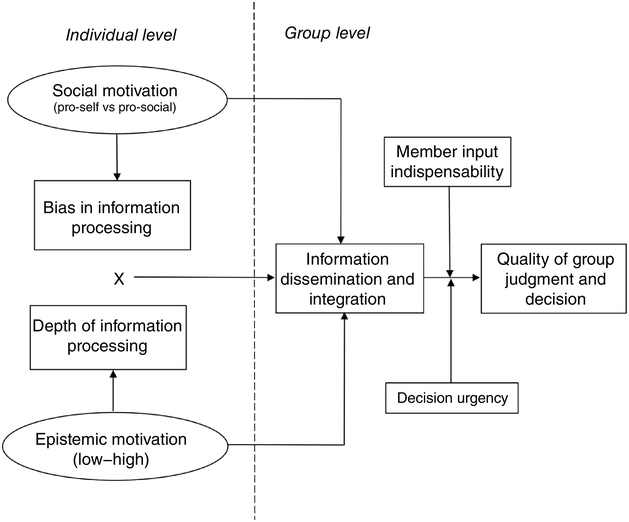
We can also objectively measure group decision-making processes within human groups. We are interested here primarily in problem-solving or purpose-oriented groups in which people get together to generate solutions to some challenge. Assuming there are individuals who are motivated to cooperate and to solve some problem, we can use the motivated information-processing in groups (MIP-G) model to discuss the relevant group-level decision-making processes in such groups. The MIP-G model was developed by De Dreu et al. (Reference De Dreu, Nijstad and Van Knippenberg2008) after reviewing the massive literature on group-level decision-making processing. The empirical findings on information-processing in these kinds of groups suggested that we distinguish between two types of motivation: epistemic (knowledge-seeking) and social (social approval, social conflict, etc.). Group members could be classified as high or low on these two motivating factors, but the data suggested that the combination of social and epistemic motivations predicted better group performance and creativity outcomes. Specifically, you get the best group-level performance when you have highly pro-social members who are also highly interested in solving the problem (epistemic motivation). Conversely, you get poor performance if group members do not interact well (pro-self motivation) and are not that interested in the knowledge the group can produce. In addition, individual-level contributions (member indispensability) and decision urgency also affect outcomes. The model is graphically depicted in Figure 1.1.
Heuristic overview of the MIP-G model.
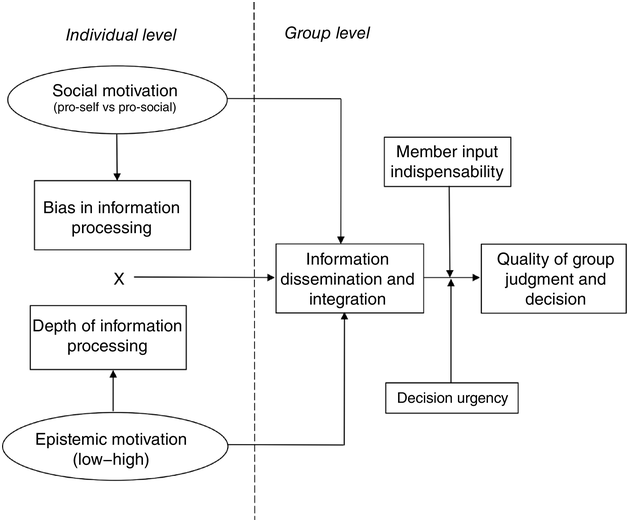
The MIP-G model recognizes also that the data suggest that some groups process the available facts and information pretty extensively while others do not. The epistemic motivations of group members determine a fair amount of that level of processing effect, but of course epistemic motivation depends on a host of individual difference variables such as dispositional traits and contextual or situational factors (such as time pressures to complete the decision-making process, etc.). The important point for the group mind idea is that group-level information-processing is routinely and objectively measured in these kinds of social psychology studies such that we now have a fairly well-tested set of models (such as MIP-G) on decision-making processes in groups that are both data-constrained and regularly yielding new testable predictions. I will have more to say about group decision-making processes in further chapters.
Group-Level Information Content Can Be Objectively Measured
We can also measure higher-order group traits using game-theoretic measures. For example, the notion of “Shapley values” provides a game-theoretic view on the contribution to task performance of a coalition of “players” beyond the sum of individual players’ contributions. Use of these values in game-theoretic calculations determines each player’s contribution by considering how much the overall outcome changes when players join each possible combination of other players, and then averaging across the total gains or losses associated with these various combinations of group compositions to yield an estimate of group consensus that manifests over and above all of these other group entities. The Shapley calculations yield the quantity that represents the persistent whole gain/loss that cannot be accounted for via individual contributions alone. We can also estimate such wholes via Shapley value regression, which statistically quantifies the contribution of individual predictors in a regression model. In this context, the “players” are the individual predictors or variables in the model, and the “gain” is the total explained variance or predictive power of the model.
We can also measure group mind phenomena using information-theoretical measures. Engel and Malone (Reference Engel and Malone2018) used “integrated information,” or “Phi” as originally proposed by Tononi and colleagues, to calculate changes in levels of consciousness. Essentially, Phi captures the amount of information that is “integrated” in a system – that is, the amount of information generated by the system as a whole that cannot be decomposed into parts of the system. Information theory defines information as the reduction of uncertainty produced when one event occurs out of many possible events that might have occurred. The more parts a system has, the more possible ways those parts can be combined and the more possible information the system can exhibit. The parts of the system and their possible combinations are described as the extent to which the system is differentiated. A system with many different parts could produce a great deal of information, but if the different parts were completely independent of each other, and did not combine in any way, then the information would not be integrated at all, and the value of Phi would be zero. For a system to be integrated, the events in some parts of the system need to associate with and depend on events in other parts of the system. And the stronger and more widespread these interdependencies are, the greater the degree of integration. Thus, Phi is high if there is a large amount of entropy that cannot be explained by looking at the subsystems separately but is clarified by looking at the system as a whole. Engel and Malone showed that Phi is correlated with various measures of group performance. In four-person work groups, Phi correlated with the groups’ collective intelligence, for example.
Luppi et al. (Reference Luppi, Rosas, Mediano, Menon and Stamatakis2024) have pioneered the use of other information-theoretic measures of higher-order emergent phenomena in human brain activity and cognition. Their measure of “synergistic information” quantitatively captures some portion of group mind phenomena. They have developed multivariate techniques of partial information decomposition (PID) that make it possible to disentangle information that occurs only at the level of the whole system (i.e. synergistic information) from redundant and unique sources of information. Unique information comes from one source alone (e.g. one eye). Redundant information may be carried equally by each of several sources (two eyes working separately). And information carried by multiple sources working together is synergistic information (two eyes working together to yield three-dimensional information about depth, revealing that the square is in fact a cube). Synergistic information allows the system’s joint information sources (in group mind contexts this would be calculated across many different brains) to exceed the sum of its individual parts’ contributions, so that synergy grows faster than other information types with the number of sources it is rooted in. Synergy and redundancy contribute to information integration in different ways. Synergistic information accomplishes integration via interactions between itself and a system’s elements. But redundant information accomplishes a kind of integration simply by aggregating the system’s elements. Interestingly, at the individual brain level and in terms of brain mediation of differing types of information, Luppi et al. have presented data that suggest that redundancy predominates at the unimodal end of the cortical hierarchy – primary visual, somatomotor, and auditory cortices – while synergy predominates in frontal and parietal multimodal association cortices. These regions overlap with executive control neural networks and mediate fluid intelligence. If synergy does indeed capture information that the whole produces versus what is produced by the parts, then it may be that group mind phenomena are differentially dependent on synergistic information that is mediated by frontal-parietal networks.
Memory and Decision-Making Processes Require Group Mind
The mental processes, scripts, simulations, and models that the individual brain uses to compress and represent information do not sit solely in an individual’s mind, but are rather held as well in the minds of the people the individual is working with. Each individual handles only a small part of the information for any given problem encountered by that individual and the group. When we attempt to encode a memory, we are biased to encode only partial, self-centered elements of the event because we expect others to capture other aspects of it. Our very problem-solving abilities and categorization algorithms presuppose the existence of group minds that allow for complex problem-solving abilities. We off-load memory tasks to others around us and to our machines. For example, Greeley et al. (Reference Greeley, Chan, Choi and Rajaram2024) asked volunteers to recall a set of unrelated words within differing group contexts. All participants attempted to organize the to-be-remembered word lists into different logical categories related to group capacities, but the amount of organization that developed over recall attempts was the same regardless of the individual composition of groups, thus demonstrating that the ability to successfully organize the categories within the word lists belonged to the collective, not to individual group members. The very process of logical reasoning itself appears to be strongly group-dependent. That is because most of the logical moves one can make when given a reasoning problem dramatically depend on starting assumptions or logical commitments. But these assumptions and a priori commitments derive largely from group commitments, that is, the content (norms, cultural scripts, expectancies, etc.) of the group mind. Henrich and Muthukrishna (Reference Henrich and Muthukrishna2024) note that collective mental commitments and information-processing routines can explain unusual social phenomena such as the fact that “geniuses” seem to appear in historical clusters, as do scientific discoveries and artistic and technical innovations. There is “something in the air” when multiple discoveries or advances occur in clusters in a culture. That something in the air is, in my view, the socially shared content concerning pressing issues in group minds.
Evolutionary Theory Is Arguably Consistent with Group Mind Phenomena
Several mid-level evolutionary theories that concern themselves with group behaviors may be consistent with the development of group minds (unless otherwise indicated, I will henceforth use the phrase “group minds” for “strong group minds”). Take, for example, multi-level selection (MLS) theory. Smaldino’s (Reference Smaldino2014) use and extrapolation from principles of MLS noted that for some human groups (collaborative problem-solving groups), selection occurs at the level of emergent group-level traits. Among these emergent traits are mental or cognitive capacities. Now if selection can operate on these group-level effects, then such effects are real. Within these emergent group-level cultural traits is the information content that creates fitness differences among groups. These traits produce between-group differences in genetic and cultural capacities that are heritable through cultural transmission. Complete group-level traits are not expressed by any single individual in the group but emerge only from the structured organization of differentiated individuals (cells, genes, physiologic systems, neurodevelopmental body plans, human beings, cognitive capacities and content, human groups, organizations, nation-states, etc.) in the target group (or structured differences between groups within the larger superorganism), who vary in their abilities when a group is engaged in a common endeavor. This implies that selection on group-level traits is qualitatively different from selection on groups themselves as defined by traditional MLS theory, which does not account for emergent traits based on group organization. Therefore, the information content upon which selection operates to generate emergent-level group or cultural traits at the superorganism level is precisely these higher-order emergent traits.
Another example of evolutionary theory consistent with or even predicting group mind phenomena is “group phenotypic composition,” or GPC, theory (Farine et al., Reference Farine, Montiglio and Spiegel2015). The basic idea here is that the average phenotype in a population or sample of individuals is a key unit of selection. We can measure the extent to which selection is using an ideal phenotype to assess fitness of individuals in a population as individuals over time who are far from the ideal phenotype get eliminated from the population. If individuals in the population approximate the ideal or group-level phenotype in a population, and those individuals objectively evidence increased fitness levels, then selection is indeed using the ideal phenotype. The ideal phenotype acts like a group mind for that population as it influences or determines the behaviors of individual members as well as a range of population characteristics. Behavioral ecologists and other evolutionary biologists have demonstrated that the presence of keystone individuals who closely embody the ideal phenotype affects a range of group behaviors (e.g. mating, foraging, decision-making) over a wide range of temporal and spatial scales. Remarkably, the mathematical measure GPC (the ideal phenotype) can impact these behaviors and individual fitness levels long after the initial group members who gave rise to the prototype are gone, especially if fitness-relevant behaviors are culturally transmitted. That fact suggests that something invisible to human eyes yet material – namely an ideal form or phenotype – is being utilized by natural selection in its selective processes. Selective pressures that move all group members toward an ideal phenotype will tend to produce groups of phenotypically highly similar individuals. Individuals who look alike can benefit from lower predation pressure by making it difficult for predators to track individuals (the confusion effect). Confusion effects, in turn, begin to select against rare phenotypes because individuals who look different will be more likely to be taken by predators (the oddity effect). Interestingly, selection arising from GPC can lead to phenotypic traits that allow individuals to manipulate the group-level characteristics of their population. Such manipulations of higher-order group-level traits attempt to directly modify the covariance between individual and group phenotypes through the removal of particular phenotypes within and across generations. These manipulative individuals may, for example, seek to create cultural traditions that extend across generations that favor one lineage over another and facilitate adjustments in group-level ideals. We will see in a future chapter that another evolutionary theory that is consistent with GPC theory and group mind phenomena – namely lineage fitness theory (LFT – Nichols, Reference Nichols2023), directly addresses this issue of the manipulation of cultural traditions across generations to influence fitness levels of co-descendants. LFT, too, predicts the generation of ideal cultural norms, prototypes, as well as symbols and totems that represent the essence of a given familial lineage to which co-descendants in that lineage direct their resources and support.
The Evolution of Cooperation Requires the Evolution of Morality, and Morality/Community Norms Require Group Mind
Group mind in the form of “morality” can arise from neutral third-party punishment norms in cooperative groups and in superorganisms. For example, Powell (Reference Powell2023) has noted that human societies are built upon social norms and customs. Humans stand out among the world’s other animals because we are ultra-cooperative with one another, and may even be (or are becoming) a “eusocial” species. How did we become an ultra-social species? We did so by partially solving coordination and cooperation problems. We innovated moral codes and social norms to enable trust between cooperators and stabilization of cooperative regimes in human groups and societies. The key ingredient in stabilizing trust and cooperative arrangements is to identify free-riders and cheats who try to infiltrate cooperative groups to reap the benefits of the group without contributing anything to it. Once identification of free-riders occurs, punishment of the culprit must follow. But that punishment cannot be inflicted by the injured party. Instead, for long-term trust and cooperation to work, the punishment must be done by neutral third parties or “the community.” The culprit and everyone in the community must realize that the culprit’s punishment comes from the group mind, that is, the law, social norms, and social morality. Punishment won’t work to stabilize group- or community-wide trust unless the “community” inflicts the punishment. As Powell points out, communal enforcement is what gives norms their normative force. Social rules are designed to bring about certain states of affairs in a community of actors, and the actualizing power of enforcement is essential to achieving these goals. Laws and norms are of course enforced by individuals, but for social rules to have an actualizing power of their own, they must be institutionalized. Enforcement/punishment of free-riders must not be conditioned on self-interest, rank, or relatedness to the violator, as this would imply that punishment depends not on norms but on sheer power or self-interest. It is third-party/group mind disapproval of an action (rather than the injured party) that distinguishes socially normative behavior from self-interested behavior.
How does ultra-cooperation arise and work in superorganisms such as honeybee colonies and other social hymenopterans? The most salient act of unselfish, cooperative behavior in honeybee colonies comes in the form of myriad daughters of the queen bee who forsake their own reproductive opportunities in favor of assisting the queen bee at birthing yet more sisters, or other sterile workers assisting at the brood nest. If we use inclusive fitness theory, the extraordinary altruism of these worker bees follows from their unique haplodiploid genetics. Females develop from fertilized diploid eggs and males from unfertilized haploid eggs. Consequently, in colonies with a single, once-mated queen, workers are three-quarters-related (r) to their sisters, whereas they are only half-related to their own diploid male and female offspring and half-related to their own haploid (unfertilized) sons. In short, sterile workers are so altruistic simply because they are more closely related to the queen’s offspring then they are to the haploid offspring of their fellow workers. However, it turns out that the assumption of a once-mated queen (one male impregnates the queen) isn’t what really happens in the real-world colony. It turns out that many queens are multiply-mated and many colonies have multiple, distantly related queens, resulting in uneven patterns of inheritance among colony members that render kin relatedness much less of an influence in stabilizing cooperative regimes inside the colony. Instead, these colonies (like human communities) use a variety of third-party punishment schemes to enforce punishment for selfish behaviors. For example, colonies often employ a subcaste of worker bees to continuously wander the colony to attack, destroy, or remove intruders, free-rider bees, or those not identified as performing a service for the colony.
Summary
To summarize this initial chapter, I have defined group mind as essentially the personality and intelligence of a group. It is that phenomenon that occurs when a group seems to transcend the experiences of its individual members and produces something in the form of mentation or cognition that cannot be reduced to the separate mental contributions of these members. I have argued it is a measureable, real phenomenon, and it is worth studying. I noted that several mid-level evolutionary theories predict group mind effects (see Table 1.1). For example, collaborative problem-solving groups produce cognitive content that cannot be reduced to any single member of the group, and therefore that cognitive content is an emergent group-level trait. Selection occurs at the level of these emergent group-level traits. For example, according to GPC theory, selection occurs according to virtual or ideal phenotypes, to the extent that an individual diverges from the virtual phenotype, is subject to predation, fails to find mates, and so on. While none of these sorts of considerations prove that group minds exist, they do show that group mind effects are consistent with evolutionary theory. Attributes of group minds that emerge from problem-solving or collaborative, purpose-oriented groups can be rigorously measured. Collective IQs, collective personalities, collective memories, collective decision-making processes, and so on are regularly measured in social psychology, and higher-order cognitive content of group minds (content that cannot be reduced to any single member of the group) can be measured using various versions of integrated information theory or Shapley values in game-theoretic contexts.
Now that I have provided some reasons for the reader to entertain the possibility that group minds are real, measurable, and worth studying, I turn next to laying out some of the scientific assumptions and definitions I work with in the rest of this book. Once those preliminaries are out of the way, I will go into some depth on various aspects of group mind effects.