

Introduction
Perhaps the fastest-growing and evolving subfield since the establishment of State Politics & Policy Quarterly (SPPQ) in 2001 has been that of state courts. At the journal’s founding, the law and courts literature was only just beginning to adopt rational choice theory and institutionalism in widespread applications. This paradigm shift marked a break with earlier scholarly emphases on attitudinalism (Segal and Spaeth Reference Segal and Spaeth2002) in favor of theories stressing utility maximization. This emergent “strategic model” emphasized the constraining role that institutions such as the system of checks and balances, voting rules, or social norms have upon judicial behavior (e.g., Epstein and Knight Reference Epstein and Knight1998).
At about the same time, the state courts subfield was beginning to address the emergence of the so-called new-style campaign – characterized, as it was, by loud, expensive, and churlish elections that cost the odd incumbent their judicial seat. Scholars reacting to this trend were badly fractured over a debate regarding the normative value of judicial elections. From the parallel developments of institutionalism and new-style judicial campaigns, a convergence occurred that transformed state courts research during the twenty-first century.
In the last field essay on state courts research, Brace, Hall, and Langer (Reference Brace, Hall and Langer2001) encouraged scholars to leverage the institutional differences found throughout state courts, as well as varying state environments, to study courts comparatively. This, along with the formation of SPPQ, helped state courts scholars embark on a diverse range of topics. Notable contributions published in SPPQ have given rise to an evolution of state courts scholarship on topics such as causes of campaign spending (Bonneau Reference Bonneau2005a), the link between contributions and judicial decision-making (Cann Reference Cann2007), diversity among state court judges (Gill and Eugenis Reference Gill and Eugenis2019; Hurwitz and Lanier Reference Hurwitz and Lanier2003), and electoral competition (Rock and Baum Reference Rock and Baum2010), among many other areas of research.
Below, we present a broad overview of the origins of state courts research, including the contributions of neo-institutionalist scholars at the turn of the century and theoretical advancements in the subfield. We then discuss efforts to explain the emergence of new-style judicial campaigns, including a focus on the attributes that drive voter turnout and causal forces associated with vote choice, as well as the defense of judicial elections that emerged in the early 2000s. From there, we address the current state of the subfield. We conclude by identifying areas of state courts research that remain in need of attention. Throughout, we highlight notable contributions published in SPPQ.
Foundations in state courts research
Early public law research into state courts emerged in the late 1960s, 1970s, and 1980s. Watson and Downing (Reference Watson and Downing1969) discovered that judges selected under the Missouri Plan, where a commission handles the nomination for judicial vacancies, were more open-minded but ultimately reflected the partisan composition of the state. Philip Dubois’ (Reference Dubois1979) pioneering studies examined increased electoral competition and citizen awareness of judicial elections. Kermit Hall’s research explored the changing political tone of judicial elections (K. Hall Reference Hall1984), along with their histories (K. Hall Reference Hall1983).Footnote 1
James Gibson’s scholarship on the effect of judicial background characteristics on decision-making and sentencing provided insights into how lived experiences shape the judiciary (Gibson Reference Gibson1978a, Reference Gibson1978b, Reference Gibson1981). Gregory Caldeira’s research unveiled the reputational impact of state supreme courts (Reference Caldeira1983) and the transmission of legal precedents on other courts (Reference Caldeira1985). Henry Glick’s (Reference Glick, Gates and Johnson1991) wide-ranging state courts research studied state supreme court policy making, patterns of judicial dissent (Glick and Pruet Reference Glick, Pruet, Goldman and Charles M.1986), and the connection between judicial selection systems and the characteristics of judges (Glick and Emmert Reference Glick and Emmert1987). Additional research by G. Alan Tarr, Charles Sheldon, Lawrence Baum, and many others contributed to an improved understanding of state court decisions and controversies surrounding the selection of state judges.
The state courts subfield made significant strides with the contributions of Paul Brace and Melinda Gann Hall beginning in the late 1980s and 1990s. Their attention to the operation of state supreme courts and the political processes that structured the decisions of courts and judges moved the focus of state courts beyond how they developed historically. Brace and M. G. Hall’s scholarship energized research on state courts by utilizing the nuances of cross-state variation to study state courts comparatively (Brace and Hall Reference Brace and Hall1995). Using death penalty cases with heightened political saliency and mandatory review of capital cases by most state supreme courts, Brace and M. G. Hall exploited the unique state contextual and institutional environments to evaluate judicial decision-making among the state high courts.
Brace and M. G. Hall initially applied the cross-section variation in state court designs and state political environments to evaluate court-level patterns of dissent (Brace and Hall Reference Brace and Hall1990) and evolved to consider judge-level explanations of dissent (Brace and Hall Reference Brace and Hall1993). Their collaborative (Brace and Hall Reference Brace and Hall1997) and separate attention (Brace and Boyea Reference Brace and Boyea2008; Hall Reference Hall1987) to the conditions that lead individual judges to affirm or reverse lower court decisions produced sophisticated models of judicial behavior. Beyond their research publications, Brace and Hall contributed to the state courts subfield with their collection of case and judge-level data for all 52 state supreme courts between 1995 and 1998 (Brace and Butler Reference Brace and Butler2001). Their State Supreme Court Data Project remains the most extensive collection of state supreme court decisions available to state courts scholars.
Leading into the 2000s, M. G. Hall’s individual and collaborative research with Chris Bonneau further advanced the subfield toward a refined and widely accepted understanding of how state supreme court elections operate. M. G. Hall’s research on electoral competition and voter participation in judicial elections confronted long-standing criticisms about how judicial elections operate. Her examination of competition in judicial elections (Hall Reference Hall2001a), including patterns of contestation, incumbent vote share, and incumbent defeat across different methods of judicial elections, confirmed an important, ongoing change among judicial elections. M. G. Hall’s focus on judicial elections and electoral accountability evolved over the next decade (Bonneau and Hall Reference Bonneau and Hall2009; Hall Reference Hall2007, Reference Hall2015; Hall and Bonneau Reference Hall and Bonneau2006, Reference Hall and Bonneau2013), creating the foundation for contemporary state courts research on judicial elections.
After the creation of SPPQ, a scholarly emphasis developed to connect the causal position of institutions on political choices in state courts research. Scholars active around this time witnessed the emergence of neo-institutionalist theory and were influenced by emerging applications. Theories of the conditioning effect of political institutions seeped into judicial politics.
New-style campaigns and the entrenchment of state courts research
As law and courts scholars were embracing rational choice and neo-institutional paradigms, a concomitant phenomenon arose to help fuel scholarly interest in state courts – the emergence of the so-called “new-style” state supreme court campaign (Hojnacki and Baum Reference Hojnacki and Baum1992). Up until the late 1980s and 1990s, state judicial elections had typically been sleepy affairs. During this period, however, candidates, parties, and special interests began raising and spending significant sums of money as part of their campaigns. According to data compiled by Kritzer (Reference Kritzer2015, 137), in 1990 candidates for state supreme courts spent approximately $10 million. In 2000, that figure reached nearly $60 million (a roughly 500% increase). New-style campaign messages for judicial office often took on policy-based and even churlish tones as attack advertising became more commonplace. This trend toward openly politicized judicial campaigns was amplified by the US Supreme Court in Republican Party of Minnesota v. White Footnote 2 in 2002, when the nation’s high court invalidated state bans on judicial candidates from taking positions on political issues.
The emergence of the new-style campaign attracted its share of critics. For those in the field of law, elections amplified concerns about the administration of justice and, specifically, campaign fundraising (Geyh Reference Geyh2003; Schotland Reference Schotland1985), spending by special interests (Jamieson and Hennessy Reference Jamieson and Hennessy2007), the ability of voters to make informed decisions (Geyh Reference Geyh2003), and whether elections diminished public confidence in state court systems (Geyh Reference Geyh2003). While judicial elections were used early in the republic’s history, the adoption of partisan elections intensified during the mid-nineteenth century (Tarr Reference Tarr2012). While the shift to judicial elections sought to make judges accountable to the public, tension developed over whether judges should be judicially independent or accountable.
Among critics, a common refrain was that judicial elections did not achieve political accountability, yet they did politicize state judiciaries. Critics applied anecdotal evidence to describe voters as insufficiently informed to make reasoned choices about candidates due to their “ignorance, apathy, and incapacity” (Geyh Reference Geyh2003, 63). Moreover, deteriorating electoral environments marked by increasingly competitive elections were thought to politicize state courts (Geyh Reference Geyh2003; Sheldon Reference Sheldon1988).
For critics concerned about the harmful effects of judicial elections, these campaigns challenged legal community norms that encouraged judicial independence and impartiality (Geyh Reference Geyh2016). Alternatively, the democratic values of elections emphasized representation and accountability to the public, likely leading to judges who share the political and policy preferences of their constituents. As such, a long impasse has existed between those who favor independent judges and those who favor judges politically accountable to their constituents (Tarr Reference Tarr2012).
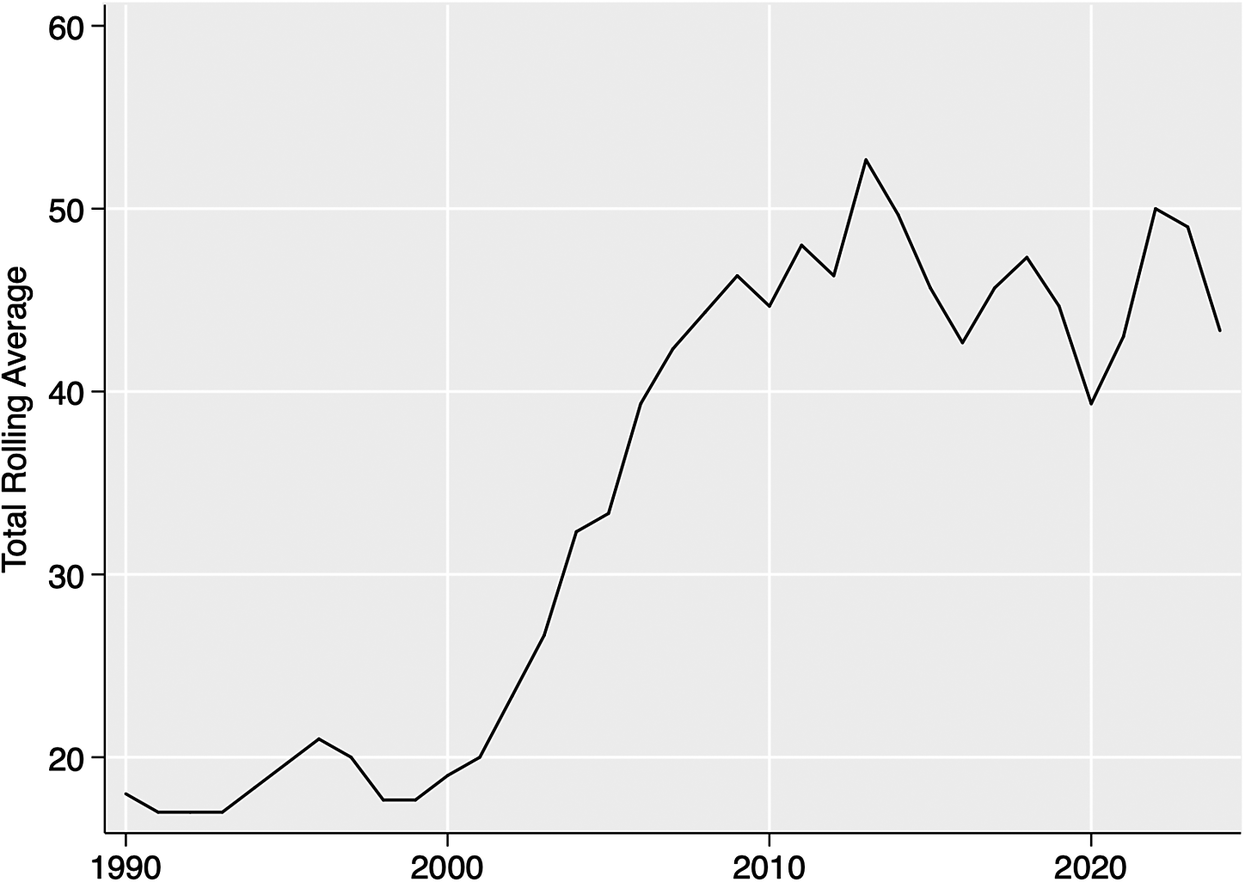
With the controversy over new-style campaigns, political scientists invested significant resources in the study of state courts. An examination of the written record underscores the dramatic evolution of American state courts scholarship that occurred in tandem with the onset of new-style campaigns. In Figure 1, we provide a graphical depiction of the volume of scholarship related to state courts.Footnote 3 The time series in Figure 1 represents the average annual number of journal articles among six peer-reviewed journals that included key terms related to state courts. According to the estimates in Figure 1, between 1990 and 1999, there was an annual total average of 18.3 published journal articles in our sample discussing state courts. Between 2000 and 2009, however, there was an average annual number of 32.7 – an impressive 78.7% increase.
Average number of journal articles mentioning state courts among six political science journals (1990 to 2024).

By 2007, the American state courts subdiscipline reached an important milestone – the publication of its first major edited volume of state courts research (Streb Reference Streb2007). Contributors included political scientists and legal scholars alike, and entries touched on themes such as the history of judicial elections and the role of political intermediaries in state courts. The text reflected the ambivalence scholars held at this point with respect to judicial elections, especially the new-style campaign. For example, Schaffner and Diascro (Reference Schaffner, Diascro and Streb2007) argued that the informational environment surrounding state supreme court elections is insufficient to justify the goal of accountability in judicial elections.
In defense of judicial elections
Gradually, a consensus emerged amongst political scientists surrounding the nature of judicial elections. As Brandenburg and Caufield (Reference Brandenburg and Caufield2009, 80) note, studies before 2000 reflect a “bygone era.” The new paradigm coordinated a defense of judicial elections. State courts scholars countered those in the legal profession by applying new empirical tests of judicial elections data. M. G. Hall and Bonneau were especially important contributors to this debate. M. G. Hall’s (Reference Hall2001a) research found voters in state supreme court elections kept judges accountable through more competitive elections. Judicial races from 1980 through the mid-1990s were increasingly contested, competitive, and subject to incumbent defeat – developments that were illustrated most strongly in states with partisan ballots.
Challenging critics of judicial elections
For all the concerns courts-reformers have identified with respect to judicial elections and accountability, surprisingly few of their concerns have been borne out by the scientific literature (Gibson Reference Gibson2008).Footnote 4 For example, some critics allege that popular selection methods for judges tend to result in a predominantly white and male bench (e.g., Henry et al. Reference Henry, Koslow, Soffer and Furey1985). The lion’s share of political science research investigating this assertion, however, lends it little support (Hurwitz and Lanier Reference Hurwitz and Lanier2003, Reference Hurwitz, Lanier, Bonneau and Hall2016). While the question of judicial institutions and diversity has drawn substantial interest, Goelzhauser (Reference Goelzhauser2011, 765) perhaps best sums up the literature: “The results are mixed, but much of this work finds little if any relationship between selection institutions and diversity.”
Critics of judicial elections also allege that voters lack the requisite knowledge or interest to produce a qualified bench. For example, Geyh (Reference Geyh2003, 55) argues, “[w]idespread voter ignorance and apathy…undercut the likelihood that judges will be held accountable to the public in any meaningful way.” M. G. Hall’s research challenged existing notions of voter ineptitude, including the ability of voters to assess candidates. M. G. Hall, Bonneau, and their co-authors observed that voters evaluate a candidate’s professional experience, pathway to the court, and history of electoral success. Challengers with lower court experience perform better against incumbents than those without experience (Bonneau and Cann Reference Bonneau and Cann2011; Hall Reference Hall2015; Hall and Bonneau Reference Hall and Bonneau2006, Reference Hall and Bonneau2013); untested incumbents selected by interim appointments are disadvantaged compared to elected incumbents (Bonneau and Hall Reference Bonneau and Hall2009; Hall Reference Hall2015); and an incumbent’s record of strong victories enhance their performance in later elections (Hall Reference Hall2015). Others note that while elected state supreme court judges are less likely to have attended an elite law school or served on the editorial board of a law review compared to appointed judges, they are no less likely to have attended a locally prestigious law school or served as a lower court judge and are more likely to have held some major office prior to their judgeships compared to judges selected via merit selection processes (Goelzhauser Reference Goelzhauser2016).
Evolving judicial elections: understanding the effects of electoral design, campaign money, and attack advertisements
Adding to the complexity of judicial elections, M. G. Hall and Bonneau highlighted how election outcomes and voter participation are conditioned by institutions that structure the performance of judicial elections. Among their central findings is the effect of partisan elections on both incumbent success (Baum Reference Baum2003; Hall Reference Hall2001a, Reference Hall2015; Frederick and Streb Reference Frederick and Streb2008) and voter participation (Hall Reference Hall2007; Hall and Bonneau Reference Hall and Bonneau2013). Such findings confirm the longstanding speculation that voters in judicial elections rely upon a candidate’s party affiliation on the ballot or inferred party affiliation to structure their voting behavior in a consistent manner (Baum Reference Baum1987; Bonneau and Cann Reference Bonneau and Cann2015b; Dubois Reference Dubois1979). Other scholars have confirmed that voters are substantially influenced by partisan affiliation when they vote (Bonneau and Cann Reference Bonneau and Cann2015a) and that partisan labels on ballots decrease roll-off (Kritzer Reference Kritzer2016). Research also underscores the importance of alternative election designs. For example, state rules that allow statewide or local constituencies are frequently connected to incumbent performance (Bonneau and Cann Reference Bonneau and Cann2011) and voter participation (Hall Reference Hall2007).
M. G. Hall and Bonneau also tied voter responsiveness to the level of campaign spending and campaign advertising in a judicial campaign (Bonneau and Hall Reference Bonneau and Hall2009; Hall Reference Hall2015). They noted that where spending differences favor the incumbent, incumbent judges perform better, but challengers may reduce the incumbency advantage by outspending incumbents (Bonneau Reference Bonneau2005b; Hall Reference Hall2015). Most notably, for every 1% increase a challenger spends on his or her campaign, support for the incumbent decreases by 1.8% (Bonneau Reference Bonneau2007). It is also well-documented that judicial campaign spending (Bonneau Reference Bonneau2005a) and fundraising (Boyea Reference Boyea2017) are tied to the characteristics of elections, institutional arrangements, and political environments.
Addressing the increased politicization of judicial campaigns, election research demonstrates that judicial campaign advertisements, including attack advertisements, are no longer rare events, with nonpartisan elections more likely than partisan races to produce attack advertisements (Hall Reference Hall2015). Advertising from the candidates themselves and interest groups has become more prevalent in recent years, especially in states with high-profile, contentious, and nonpartisan elections, where attacks against a candidate can be used as a vessel to infer information on the race more broadly (Baum, Klein, and Streb Reference Baum, Klein and Streb2017; Hall Reference Hall2015; Hughes Reference Hughes2019; Rock and Baum Reference Rock and Baum2010; Shieh et al. Reference Shieh, Munir, Catalano and Henceroth2025). Research confirms that attack advertisements diminish support for incumbents (Hall Reference Hall2015) and increase participation by voters (Hall Reference Hall2015; Hall and Bonneau Reference Hall and Bonneau2013) – yet with noticeably strong effects in nonpartisan races.
Judicial legitimacy
Another common critique of judicial elections has been that judicial electioneering undermines judicial legitimacy, or broad public support for courts, by portraying judges as little different from run-of-the-mill politicians in the eyes of the public. Barnhizer (Reference Barnhizer2001, 371) offers a characteristic example of this perspective:
Judges are the last defense of the Rule of Law’s integrity. When judicial decisions are seen as politicized rather than independent, or as done in the service of a special interest group or to advance judges’ self-interest rather than in a neutral and independent spirit, the sense of fairness and justice that is the binding force of the Rule of Law becomes exhausted and the system is weakened.
In a pathbreaking series of scholarship that leveraged randomized experiments to understand the causal link between political institutions and judicial legitimacy, Gibson evaluated whether judicial elections erode legitimacy (Gibson Reference Gibson2008, Reference Gibson2012). His results turned the conventional wisdom on its head – judicial elections, rather than diminishing, tend to enhance legitimacy, “by reminding citizens that their courts are accountable to their constituencies, the people” (Gibson Reference Gibson2012, 130).
Campaign activities help to establish democratic linkages with voters, and while campaign contributions from potential parties to future cases can undermine legitimacy (Gibson Reference Gibson2008), policy pronouncements and even attack advertisements typically do not (Gibson Reference Gibson2012).Footnote 5 Additionally, Gibson’s (Reference Gibson2008) study of judicial races in Kentucky finds that policy pronouncements have no effect on the legitimacy of courts and judges. When looking at state high courts in a post-Dobbs v. Jackson Women’s Health Organization Footnote 6 context relating to reproductive rights, Gibson and Nelson (Reference Gibson and Nelson2025) find that salient abortion rulings like the Dobbs decision diminish specific support (i.e., performance satisfaction), but do not affect diffuse support (i.e., institutional loyalty).
Representation by elected and nonelected judges
Perhaps the most important critique of judicial elections has been that they undermine judicial independence. Judges who wish to maintain their positions might be tempted to make decisions with an eye toward reelection rather than to rule strictly on the facts of the case and relevant law. An extensive body of political science research finds that electoral vulnerability leads to more popular decision-making, especially in salient policy areas such as death penalty cases (e.g., Brace and Boyea Reference Brace and Boyea2008; Hall Reference Hall1987).
Recent scholarship, however, has called into question just how distinct judicial elections are when it comes to promoting pandering behavior. After all, not every type of judicial election is created equal – some feature partisan labels; some are nonpartisan; and some do not even allow challengers. Consequently, recent works have found that nonpartisan and retention elections can encourage pandering behavior comparable to or exceeding partisan ones because judges must demonstrate their partisanship to voters through their actions and not via the ballot (Caldarone, Canes-Wrone, and Clark Reference Caldarone, Canes-Wrone and Clark2009; Canes-Wrone, Clark, and Kelly Reference Canes-Wrone, Clark and Kelly2014).
What is more, simply because a judgeship is not directly tied to her constituents does not mean that she is unaccountable. States like New Jersey, which utilize appointive methods of selection, require their supreme court justices to win reappointment by the governor. Others, like South Carolina, require justices to win reappointment by the legislature. Theoretically, it should be significantly easier for a judge to face retribution for an unpopular decision when her retention is up to one politician (or even a handful of them). Indeed, Shepherd (Reference Shepherd2009) finds that judges facing reappointment vote just as strategically – if not more – compared to their colleagues who are accountable to the electorate.
Not only might elected judges be tempted to make decisions considering popular preferences, but, perhaps even more worryingly, they might be tempted to make decisions with respect to the preferences of campaign donors. The empirical record on this point is mixed, however, and drawing causal linkages is difficult.Footnote 7 For example, Cann (Reference Cann2007) and McCall and McCall (Reference McCall and McCall2007) find evidence for a “dollars-for-votes” relationship in a handful of states but an absence in others. One of the more rigorous studies in this area that attempts to deal with the issue of endogeneity finds mixed results, uncovering a relationship between votes and contributions in one state but no such relationship in two others (Cann, Bonneau, and Boyea Reference Cann, Bonneau, Boyea and McGuire2012).
The contributions by M. G. Hall, Bonneau, and other scholars connected to the operation of judicial elections and their effects on public attitudes illustrate the success of rigorous studies that apply comparative data. While debate lingers over whether it is normatively good or bad that judicial elections have changed and are now more politicized, M. G. Hall and Bonneau’s early defense of judicial elections successfully challenged prevailing negative assumptions about electoral competition and voter performance in judicial elections.
Other state courts applications
While the state courts’ literature was fiercely debating the issue of judicial elections, another strain of research emerged that leveraged state courts’ unique institutional contexts to test and expand upon hypotheses largely developed to explain the federal courts and their judges. Federal courts scholars, for example, have identified numerous reasons why judges leave the bench, and judicial scholars have only begun to scratch the surface on the state level. Scholars find that elected judges are more likely to retire voluntarily due to factors tied to state institutional design, level of competition, age, and eligibility for a pension.
Two central articles have addressed how institutional design influences voluntary retirement. Hall (Reference Hall2001b) focused on elective systems and found that there are strategic incentives for retirement in states with partisan and retention elections, though not in nonpartisan elective states. Curry and Hurwitz (Reference Curry and Hurwitz2016) evaluated both elective and appointive systems and found that justices across selection systems engage in strategic retirement behavior. While elected judges are more likely to retire when electorally vulnerable, appointed justices consider the ideology of the sitting governor to ensure their ideological preferences continue on the court after they retire.
Subsequently, Hughes (Reference Hughes2021) finds that both elected and appointive judges retire based on their eligibility for receiving a pension. Appointed judges stay on the bench to maximize their retirement benefits, while elected judges do not. However, accounting for retirement benefits diminishes the effect of ideological reasons or competition on retirement decisions (Hughes Reference Hughes2021). State court scholars have yet to fully comprehend a state judges’ decision to retire rather than request senior status – an area ripe for further research, as there are three states (Iowa, Pennsylvania, and Virginia) that provide for senior status.
Similar to opinion assignment research in the federal courts literature, judicial scholars have evaluated how opinions are assigned at the state level. To account for the variation in court administration in all 50 states, McConkie (Reference McConkie1976) contacted chief justices, sitting justices, administrative assistants to chief justices in the 1976 term to understand the rules and norms in each of the state courts of last resort, an information gathering method that was followed by subsequent scholars (Hall Reference Hall1990; Hughes, Wilhelm, and Vining Reference Hughes, Wilhelm and Vining2015). Scholars observe that courts generally assign opinions randomly or in a rotating manner to ensure that justices get to write numerous opinions but update these procedures over time (Hall Reference Hall1990; Hughes, Wilhelm, and Vining Reference Hughes, Wilhelm and Vining2015).
In recent years, the chief justice role has evolved into that of an elevated administrator who advocates for the needs of the entire state judiciary (Vining and Wilhelm Reference Vining and Wilhelm2023). Chief justices are now successful advocates for their state courts when they, or the court median, are ideologically similar to their state legislatures (Vining and Wilhelm Reference Vining and Wilhelm2023; Wilhelm et al. Reference Wilhelm, Vining, Boldt and Black2020). State legislatures are thus more receptive to the chief justice’s administrative and funding requests when their policy goals align. Throughout the states, chief justices are selected for their posts through a variety of methods, including gubernatorial appointments, popular elections, rotation, promotion of the most senior judge, and peer vote. Several patterns have emerged relating to the attributes of chief justices. Where chief justices are appointed or elected, they tend to be more conservative; however, where selected by their peers, chief justices are more likely to be women or minorities (Goelzhauser Reference Goelzhauser2016; Vining and Wilhelm Reference Vining and Wilhelm2023).
Inter-institutional dynamics have long been a standard in studies of the federal courts (Clark Reference Clark2009) but have not received the same scholarly attention in the state context. Existing research, however, shows little indication that elective courts are institutionally weaker than appointive courts. For example, Leonard (Reference Leonard2016) finds no evidence that state legislatures engage in greater court-curbing efforts for elective versus appointive courts. Court curbing in state legislatures is often politically motivated rather than influenced by judicial selection methods. Leonard (Reference Leonard2022) also finds no evidence that elective courts are any more or less cowed by court-curbing efforts than appointive ones. Langer and Wilhelm (Reference Langer, Wilhelm and Miller2008) find that state lawmakers typically believe elective state supreme courts to be more combative and retaliatory compared to appointive systems – hardly the mark of a judiciary deprived of its independence.
We also acknowledge the important contributions of single-state studies to the advancement of the subdiscipline. Single-state studies have used the complexities of state court systems to produce information about how state courts operate – frequently leading to multi-state applications. For example, M. G. Hall’s (Reference Hall1987) early examination of justices in the Louisiana Supreme Court provided a springboard for her later research on the representational roles of elected judges. More recently, Gibson (Reference Gibson2008) used judicial races in Kentucky to test whether the legitimacy of state courts is threatened by politicized judicial campaigns. That study led to an essential line of inquiry that provides much of our understanding about how campaign activities affect public perceptions of courts (Gibson Reference Gibson2012). Other single-state studies have explored how money influences judges, including Cann’s (Reference Cann2007) analysis of how campaign contributions affect decisions by judges in Georgia and Hazelton, Montgomery, and Nyhan’s (Reference Hazelton, Montgomery and Nyhan2016) study of how the public finance system in North Carolina affects the responsiveness of judges to donors. These single-state studies and others (e.g., Rock and Baum Reference Rock and Baum2010) have benefited from unique state environments and state policy experimentation, including North Carolina’s public finance system.
The state of the state courts literature
As we consider the current and future state of the state courts subfield, we must first discuss the importance of SPPQ as a primary venue for state courts research and, second, identify the direction of recent and ongoing research. With the formation of SPPQ in 2001, state courts scholars were fortunate to have a journal amenable to questions about state courts and the themes outlined throughout this article. That central space for state courts research in SPPQ was made only more important with changes among journals in the law and courts subfield. Beginning with the altered focus of Judicature after 2014 and followed by the closure of The Justice System Journal in 2022, scholars engaged in state courts research had fewer places to publish their research.Footnote 8 Both journals had served as important venues for state courts research (see Figure 1), and without Judicature and The Justice System Journal, SPPQ became an obvious home for state courts research.Footnote 9 As such, significant growth in the number of recent state court articles is observed in Figure 2, which identifies state court articles in SPPQ from 2001 to 2025.
Number of law and courts articles in SPPQ (2001 to 2025).
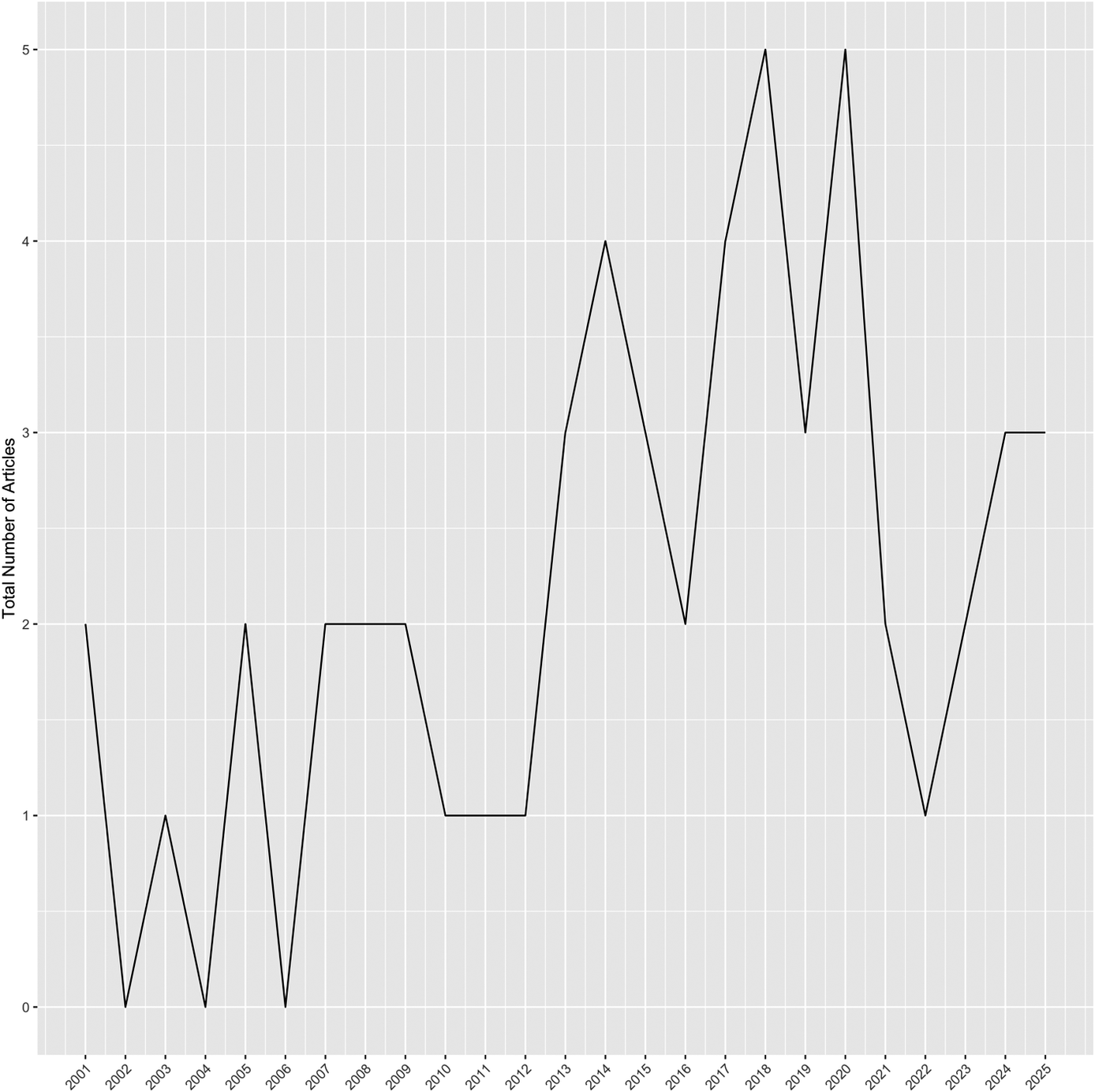
Noting the increasingly important role of SPPQ as a venue for state courts research, 30% of the state courts articles in SPPQ have been published since 2020. Such a rapid development during the most recent five-year period suggests a progression for SPPQ as a primary outlet for state courts research. Moreover, law and courts articles in SPPQ since 2020 have dealt with essential topics related to our discussion. Recent topics have connected to studies of state court legitimacy (Barwick and Dawkins Reference Barwick and Dawkins2020), policy diffusion by state supreme courts (Matthews Reference Matthews2024), how judges use social media (Curry, Fix, and Romano Reference Curry, Fix and Romano2024), and a growing literature on state chief justices (Fife, Goelzhauser, and Loertscher Reference Fife, Goelzhauser and Loertscher2021; Wilhelm, Vining, and Hughes Reference Wilhelm, Vining and Hughes2023; Wilhelm et al. Reference Wilhelm, Vining, Boldt and Black2020).
Considering the full range of articles in SPPQ since its creation, SPPQ has published 54 articles connected to law and courts research. Those articles have evaluated decisional and litigation attributes, including amici activity before state supreme courts (Kane Reference Kane2017), decision-making in state supreme courts (Cann Reference Cann2007; Gray Reference Gray2017), judicial review in state supreme courts (Crabtree and Nelson Reference Crabtree and Nelson2019), and judicial deference to administrative agencies (Johnson Reference Johnson2014). Articles have also covered topics connected to judicial elections and selection, including studies of electoral competition (Hughes Reference Hughes2019; Peters Reference Peters2009), incentives for individual contributions to state court campaigns (Boyea Reference Boyea2017), campaign spending (Bonneau Reference Bonneau2005a; Frederick and Streb Reference Frederick and Streb2008), and studies of judicial selection systems (Goelzhauser Reference Goelzhauser2018; Kritzer Reference Kritzer2024). Lastly, two well-cited areas of research include media attention to state courts (Vining, Wilhelm, and Collens Reference Vining, Wilhelm and Collens2015) and the professionalization of state supreme courts (Squire and Butcher Reference Squire and Butcher2021). The collective and recent body of law and courts research in SPPQ has made advancements toward a more complete understanding of how state courts operate and the forces driving the selection of state judges.
While the formation of SPPQ was essential for providing a venue for scholarly articles, the last two decades have coincided with several books centered on state courts. Notable contributions include an examination of the historical and contemporary performance of judicial elections (Kritzer Reference Kritzer2015), the effectiveness of campaign attack advertisements (Hall Reference Hall2015), and the factors that weigh on voters’ decisions in state supreme court elections (Bonneau and Cann Reference Bonneau and Cann2015a). Other books have documented public attitudes about state courts, including how judicial elections shape perceptions of fairness, impartiality, and legitimacy (Gibson Reference Gibson2012) and how public knowledge about state courts affects public attitudes toward their state judiciaries (Cann and Yates Reference Cann and Yates2016).
With the policymaking role of state supreme courts, books on state courts have explored how judicial institutions and the background of state judges shape social inequality policy (Gibson and Nelson Reference Gibson and Nelson2021), as well as the role of state high courts in implementing (or not implementing) policy created by the US Supreme Court (Fix and Kassow Reference Fix and Kassow2020). Further, the characteristics and extrajudicial responsibilities of state chief justices have been analyzed to better understand the role of state high court leaders (Vining and Wilhelm Reference Vining and Wilhelm2023).
We note the recognition that the state politics subfield has directed to books on state courts. Since 2016, two books have received the State Politics and Policy section’s Virginia Gray Best Book Award – first, Voters’ Verdicts: Citizens, Campaigns, and Institutions in State Supreme Court Elections by Chris Bonneau and Damon Cann in 2016, and, second, Judging Inequality: State Supreme Courts and the Inequality Crisis by James Gibson and Michael Nelson in 2022. Such accolades suggest that state courts research has risen to an important position within the broader subfield.
Directions for future state courts research
As we consider the direction of state courts research, changing and emerging technologies are likely to play a prominent role. Though scholars are well-versed in the positive effects of local journalism coverage on voter participation in state court elections (Hughes Reference Hughes2020), the types of state court cases that receive front page coverage of the most circulated state newspapers (Vining and Wilhelm Reference Vining and Wilhelm2011; Vining, Wilhelm, and Hendricks-Benton Reference Vining, Wilhelm and Hendricks-Benton2025), the relationship between state high court death penalty cases and front page newspaper coverage (Vining, Wilhelm, and Collens Reference Vining, Wilhelm and Collens2015), and the effects of newspaper reports of scandal on incumbent electoral performance (Canelo, Boyea, and Myers Reference Canelo, Boyea and N. Myers2025), new media and direct interactions between judges and citizens will likely become more important. State judges use social media, like Twitter (now X), to directly engage the public (Curry and Fix Reference Curry and Fix2019) and build social networks (Curry et al. Reference Curry, Fix and Romano2024).
With the rapid growth of artificial intelligence (AI) comes a growing need to understand the role of AI for the next frontier of state courts research. To date, SPPQ has played an essential role through contributions that provide both original (M. E.K. Hall and Windett Reference Hall and Windett2013; Hinkle and Nelson Reference Hinkle and Nelson2016; Leonard Reference Leonard2022; Squire Reference Squire2008) and updated datasets for state courts scholars (Hughes et al. Reference Hughes, Wilhelm and Wang2023; Squire and Butcher Reference Squire and Butcher2021). However, data collection is a perennial problem. For example, data on decisional behavior in the state supreme courts (Brace and Butler Reference Brace and Butler2001; M. E.K. Hall and Windett Reference Hall and Windett2013) have been essential to the growth of the subfield but is costly and time-consuming to collect. Similarly, research on lower courts, prosecutors, and prosecutorial elections is data-intensive and, as a result, those important areas remain understudied. We anticipate that access to AI may accelerate advancements with data collection to alleviate those challenges, including AI-facilitated code designed for web scraping and data processing.
Changes in the electoral environments of the states provide further opportunities for innovative research. One important development is the postpartisan realignment in the South, an area where the end of Democratic one-party domination led to prominent changes in electoral competition (Kritzer Reference Kritzer2015). Throughout the states, we see both growing levels of electoral competition (e.g., Rust Belt states like Ohio, Pennsylvania, and Wisconsin) and a shift toward one-party dominance in several states with judicial elections, resulting in systems with increasingly competitive primary elections and less competitive general elections (e.g., Alabama, Oregon, Texas, and Washington).
These changes in electoral competition allow scholars to dedicate attention to election outcomes, fundraising, and spending in primary elections, since existing judicial election scholarship has prioritized general elections. Further, as partisan cues have changed in one-party dominated states, scholars should consider the effects on voter turnout in this context, including the effect of information from various partisan factions. To follow that path allows an opportunity to consider whether Dubois’ (Reference Dubois1979) conclusions about the effect of partisan ballots on voting behavior still hold.
The nationalization of state supreme court elections (Weinschenk et al. Reference Weinschenk, Baker, Betancourt, Depies, Erck, Herolt and Loehrke2020) offers scholars an opportunity to determine its impact on voter participation and other forms of citizen engagement. These high-profile races, where letter-writing campaigns and campaign contributions come from out of the state, might also be particularly polarized. This is especially important since partisan polarization has negative consequences for citizen evaluations of state courts (Barwick and Dawkins Reference Barwick and Dawkins2020). Polarization is a pressing issue for American politics, but remains understudied in the context of state courts.
The U.S. Supreme Court has recently crafted free speech decisions that have implications for judicial elections. Citizens United v. Federal Election Commission Footnote 10 and McCutcheon v. Federal Election Commission Footnote 11 loosened campaign finance restrictions with the potential to increase the amount of money spent in judicial elections. Boyea’s (Reference Boyea2020) evaluation of Citizens United’s impact on independent expenditures in state supreme court elections found that spending by outside groups increased after the US Supreme Court’s decision, yet outside spending increased most prominently in states that lifted their bans in response to the decision. Future research should continue to examine the implications of recent campaign finance decisions on judicial elections.
Furthermore, state court scholars should continue incorporating theories from federal court research to discern whether they hold in state institutions and under what contexts. State court scholarship still has much to disentangle when it comes to how the chief justice role, bargaining, accommodations, collegiality, and policy preferences shape opinion assignments and decision-making, for example. However, the data available to operationalize these behaviors on the state level are limited.
Scholars should also extend theories from federal courts research that examine the role of judge identity on political ambition (Fox and Lawless Reference Fox and Lawless2011), qualification standards (Moyer, Harris, and Solberg Reference Moyer, Harris and Solberg2022), and decision-making (Boyd, Martin, and Epstein Reference Boyd, Epstein and Martin2010). This is especially important given that state supreme courts play an important role in policymaking. These extensions can expand our understanding of how minority groups are represented and the role of judge identity in shaping election outcomes and diffuse support.
The connection between judge ideology and decision-making continues to be a pressing consideration for judicial politics (Gibson and Nelson Reference Gibson and Nelson2021; Martin and Quinn Reference Martin and Quinn2002; Segal and Cover Reference Segal and Cover1989) and research on state courts. However, more attention to improving the measurement of state supreme court justice ideology is warranted, given existing limitations. Brace, Langer, and Hall (Reference Brace, Langer and Hall2000) opened the subfield to examining this line of research with their party-adjusted surrogate ideology measures (PAJID) of state supreme court justices, which consider a judge’s party affiliation and judicial selection method at the time of a judge’s ascension to the bench (Brace, Langer, and Hall Reference Brace, Langer and Hall2000). Their measure, including the updated scores by Hughes, Wilhelm, and Wang (Reference Hughes, Wilhelm and Wang2023), relied on state citizen and elite ideology scores from Berry et al. (Reference Berry, Ringquist, Fording and Hanson1998) to approximate justice ideology.
Addressing well-documented concerns about PAJID relating to the measure’s failure to address ideological change and its predictive power, Bonica and Woodruff (Reference Bonica and Woodruff2015) used campaign donations to create common space scores for both incumbents and challengers in judicial elections. However, electronic campaign finance data are not widely available before 1990, limiting the number of judges whose ideological preferences can be estimated. Windett, Harden, and M. E.K. Hall (Reference Windett, Harden and Hall2015) used item response theory (IRT) to generate dynamic estimates that allow the justices’ ideological locations to change over time and mapped state-specific ideal points into the interstate common space estimated by Bonica and Woodruff’s (Reference Bonica and Woodruff2015) scores, meaning their scores also do not precede 1990. As such, PAJID scores remain the most comprehensive measure of state supreme court justice ideology, covering 1970 to 2019. These many avenues of future scholarship will contribute to the continued growth of the state courts subfield.
Conclusion
State courts research has become an amalgamation of attitudinalism and strategic choice within the judicial subfield, and of institutional and behavioralism within political science more broadly. Foundational works provided early insights into how electoral competition and institutional contexts could shape the selection of state judges and voters’ perceptions of the process. Scholarly understanding of the state courts has come a long way since their origins as a mere offshoot of federal courts research. By the 2000s, state courts scholarship was increasingly published in the top political science journals and primary conferences in the discipline included state courts panels, where previously they were infrequent. The founding of SPPQ in 2001 opened a new venue for state courts research and has played a significant role ever since, with 50 law and courts articles since its founding.
With the emergence of new-style campaigns, state court scholars were eager to announce to the broader political science community that state court judges can be as ideological as their federally appointed counterparts, and judicial elections can be as cynical and brutish as congressional elections. With the state-level variation inherent in elective state courts and the environmental dynamics that loom large in the judge-constituent relationship, state courts scholars developed a behavioralist mindset to their inquiries.
As rational choice began to dominate state courts research, concerns about the politicization, and thus legitimacy, of judicial elections sparked discourse. Conventional wisdom insists that the judiciary should be an independent, impartial arbiter, but what happens when competitive elections shatter that perception, with mudslinging and campaign contributions? State court scholars soon discovered that, like public opinion on federal courts, citizens might be responsive to state court decisions in the short-term, but their perception of the institution does not easily waver.
State courts scholars have sought inspiration from research on federal courts when building their data arsenal and research agendas. In addition to studies on inter-institutional dynamics, judicial behavior, and media coverage, works on judicial ideology and judicial voting have positioned themselves closely with the underlying datasets that support federal courts research and have the potential to benefit from the growing suite of AI tools. While state court scholars have created a foundation for grasping the mechanisms that underlie state courts, often thanks to notable contributions from SPPQ, this foundation encourages future scholars to cultivate new pathways for understanding the contemporary state courts landscape as these elections become more nationalized, politicized, competitive, and expensive.
Data availability statement
Replication materials are available on SPPQ Dataverse at https://doi.org/10.7910/DVN/4CAPRB.
Funding statement
The authors received no financial support for the research, authorship, and/or publication of this article.
Competing interests
The authors declared no potential conflicts of interest with respect to the research, authorship, and/or publication of this article.
Author biographies
Brent D. Boyea is a Professor of Political Science at the University of Texas at Arlington.
David Hughes is an Associate Professor and Anthony Moroux Endowed Professor in the University of Louisiana at Lafayette’s Department of Political Science.
Marcy Shieh is an Assistant Professor in the Department of Political Science at Miami University.
Kayla S. Canelo is an Assistant Professor of Political Science at the University of Texas at Arlington.


 Open access

