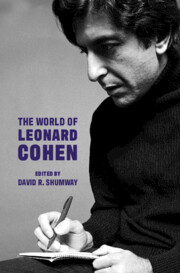


Who is Leonard Cohen? As the chapters in the present volume demonstrate, this remains a question despite his enormous following. That Cohen remains a mystery may be surprising given that in many respects he was remarkably unchanged over the course of his career. His appearance, for example, changed little, his well-tailored suits and short hair apparent in 1967 and 2009. The themes and concerns of his songs – sex, love, death, religion – are also consistent from start to finish. While his voice deepened as he aged, his singing style remained largely the same. Moreover, a strong part of Leonard’s appeal was that we as his audience felt that he was baring his soul to us. There is an intimacy in his self-presentation that made us feel that we knew him. And yet, more than Dylan or anyone else in popular music, he remains a mystery because he doesn’t fit any of the usual categories. Almost any statement you can make about him must immediately be qualified or be met with a contrary. He is so multifaceted that it is almost as if he were many different people all at the same time. The many sides of Leonard Cohen are on display in the essays that follow. While we cannot claim to have solved his mysteries, we do offer a starting place for understanding this enormously complex and powerful artist.
Cohen’s anomalies begin with the fact that he grew up in an upper-middle-class household, but rebelled by running off to become a writer. Yet unlike many other young rebels of the period, he retained much from his upbringing, including his conservative dress and religion, as Ira Nadel’s chapter on Cohen’s biography explains. He was already a poetry star in Canada and an accomplished fiction writer when he launched his career as a songwriter and singer. While the link between lyric poetry and song lyrics is very old, going back at least to the troubadours of the late Middle Ages, the gulf between poetry and popular song has been largely unbridgeable since the nineteenth century. Some songwriters, including Dylan and Joni Mitchell, published a few poems after they became established musically, but not stand-alone books of poetry. Cohen continued to publish poetry, and those books of poems typically include his song lyrics, sometimes slightly modified, sometimes not. As Julian Stannard makes clear in his chapter on poetry and prose, Cohen’s writing constitutes a significant achievement apart from this songwriting. And he wasn’t just a poet, having also published two novels, one of which, Beautiful Losers, was treated by Linda Hutcheon as foundational to Canadian postmodernism.Footnote 1 Stannard places Cohen’s poetry in the context of modernism and a longer poetic tradition, but he also shows how the themes of Cohen’s poems and novels are consistent with those of his songs. Stannard also suggests that “his status as a singer-songwriter eclipses the poetry” in the late collections Book of Longing and The Flame.
If most of Cohen’s fans may not be familiar with his poetry and prose, they probably think they know his musical output well. Cohen is certainly best known today as a songwriter, with “Hallelujah” having become nearly ubiquitous in contemporary culture. But I suspect that most people focus on Cohen’s lyrics, and don’t give a lot of thought to the music. In his chapter on Cohen’s songwriting, Alan Light reminds us of the importance of Cohen’s tunes, insisting that Cohen’s greatness rests on more than just his deservedly celebrated lyrics and noting that Cohen said, “Usually, the tunes were completed before the lyric.” Cohen is much better recognized as a maker of songs than of albums, as Anthony DeCurtis acknowledges in his chapter, noting how many of Cohen’s album titles incorporate the word “songs.” But DeCurtis shows that many of the albums are much more successful works than is usually recognized. For example, he calls Songs of Leonard Cohen “one of the most stunning debut albums in history.”
When Cohen first began writing and recording songs, he was associated with folk music. Gillian Mitchell shows how Cohen’s music is related to this genre, asserting that “his early career as a professional musician certainly illustrated the lingering, complex and pervasive influence of folk – as a musical form and as a set of broad artistic ideals – upon the wider popular music world of the later 1960s.” Folk music provides the context for Cohen’s early reception, but he would soon be connected with an emergent group of performers known as singer-songwriters. In my chapter on that musical formation, I observe that Cohen is not only the earliest artist to be considered a part of it, but also a major influence on its most representative figure, Joni Mitchell. Yet despite being there at the creation, Cohen is not typical of the singer-songwriters because he is not, in the main, confessional. If Cohen’s music doesn’t fit the definitions of folk or singer-songwriter exactly, then his connection to rock & roll must seem even more remote. And yet, as Eric Weisbard notes, he was a “rock icon.” Cohen’s musical career began at a moment when rock was the dominant form of popular music, and he willy-nilly found himself in it. But Weisbard asserts a more essential role: “With ‘Avalanche’ and other songs like it, Cohen created classic examples of a form unknown to 1950s rock & roll but central to post-Dylan rock: war horses.”
Cohen’s impact has been felt beyond the world of popular music. His songs, poems, and novels have a significant presence as literature. While Dylan’s fans understood his lyrics as poetry in the 1960s, among the literary establishment popular songs were long regarded as subliterary. Dylan’s winning the Nobel Prize for Literature in 2016 has called that long-standing prejudice into question. And because Cohen continued to publish books of poetry after he became a singer and songwriter, he is better suited even than Dylan to break down this hierarchy. Ian Rae and Francis Mus in their contributions place Leonard’s work in the context of Canadian literature and world literature respectively. Rae observes the artist’s continuing connection to his homeland and hometown expressed in his writing despite his having lived much of his life elsewhere. These connections are literary rather than merely personal, and Cohen continued to the end of his life to acknowledge his mentors and friends of the Montreal literary world. Mus points out that Cohen’s career in music, which was from quite early on international, is what has made his poems and novels of interest beyond the anglophone world. Mus also demonstrates that Cohen’s work is itself influenced by the work of writers from Europe such as Lorca and Baudelaire.
While Leonard Cohen did not write film scores, and he did not compose a song specifically for use in a movie, he did have a significant impact on cinema. We are not mainly here talking about Cohen’s actual creation of movies, although he did cowrite and star in I Am a Hotel (1983), a Canadian television production based around his music. But more important, his songs have played major roles in important films since the early 1970s. While the compiled score has become increasingly common and much popular music has found its way onto soundtracks, Cohen’s music has usually been more than just background. Robert Altman’s McCabe & Mrs. Miller (1971), as Laura Cameron and Jim Shedden discuss in their chapter, features a number of cuts from Songs of Leonard Cohen, and Altman remarked that it was as if the songs and script were written together, the songs having been etched in the director’s subconscious. Many other directors have made prominent use of Cohen’s songs, and in one case, John Cale’s cover of “Hallelujah” in Andrew Adamson and Vicky Jenson’s Shrek (2001), the use seems to have propelled the song into the cultural firmament. But the song, as Cameron and Shedden show, also adds an important dimension to the film, likening it to a deus ex machina, which does “what the dialogue, action, and mise-en-scène of the film cannot: it makes space for feeling and holds us there with the characters.”
Cohen’s deep roots in Canada and Montreal in particular are apparent, but his relationship to the city of his birth is more complicated than it might at first seem. This relationship is explored movingly by Erin MacLeod here, using her own experience of the city as a lens through which to view Montreal’s embrace of Cohen and his more ambivalent feelings about it. As she argues, “It is not that Cohen’s songs are about or set in Montreal, but rather his relationship to the city seems paramount, as does the city’s relationship to him.” She notes that for Montreal, Cohen is a “selling point,” a kind of tourist attraction even if he himself is no longer one of its residents. Montrealers are fond of quoting Cohen’s famous assertion that that he had to keep “coming back to Montreal to renew my neurotic affiliations,” but MacLeod demonstrates that that statement is even more ambivalent when its source, a blurb from The Spice-Box of Earth, is quoted in full. On Montreal’s side, its strong embrace of Cohen as “a great uniter” obscures both the history of colonialism (French and English) and a history of virulent anti-Semitism.
Several chapters in this volume quote boygenius’s song “Leonard Cohen,” a track on their album, The Record (2023), which describes Cohen as “an old man … writing horny poetry.” This raises the question about why Cohen’s reputation as a “ladies’ man” didn’t seem to be a problem during the “Me Too” era. Two chapters in the volume throw light on this conundrum from different angles. One could argue that Cohen expressed the world through sex, which figures more prominently in his songs than in those of most of his contemporaries. As David Yaffe puts it in his chapter, “coitus was half of his grand theme … the thing that haunts you when you don’t meditate, or ponder the abyss, or seduce, or fail to seduce, or still feel the hunger when the body inevitably fails.” It’s not, as Yaffe notes, that Cohen’s lyrics are particularly explicit, “Don’t Go Home with Your Hard-On” being the exception that proves the rule. Rather, it’s that “wanting is everywhere … Desire is where a poem begins.”
We have usually thought of popular music stars as appealing either to preadolescent girls or postadolescent boys, perhaps the original distinction in the Beatles–Stones opposition, usually understood as soft versus hard expressions of male sexuality. But who do girls like after they grow up? All of the evidence seems to suggest that many of them liked Leonard Cohen. Perhaps Leonard’s focus on desire, on wanting rather than having, enhanced his appeal to women. Heather Arnet, in her chapter titled “For the Matriarchy,” explains Leonard’s appeal to women in other ways. She thinks that it’s Cohen’s representations of women’s desire that make his songs so appealing to female listeners. Arnet’s title comes from something Cohen said in 1968, “I wish the women would hurry up and take over … I really am for the matriarchy.” She shows that his songs express this point by giving us female characters who have agency. Arnet notes the way numerous great women artists, from Judy Collins, to Nina Simone, to Tori Amos, have recorded Cohen’s songs and in various ways made them their own.
Cohen emerged as a recording artist in 1967, the year of the “summer of love,” and yet no one looked less like a hippie than he did. As Sarah Hill shows, the 1960s counterculture is an important context for understanding Cohen and his songs. She notes that even though Cohen was thirty-three when Songs of Leonard Cohen appeared, he was younger than other leading figures such as Allen Ginsberg and Timothy Leary. Hill observes that the counterculture was strongly identified with changing consciousness: “The ultimate countercultural text, however, was The Psychedelic Experience (1964), written by Timothy Leary, Ralph Metzner, and Richard Alpert, a guide to the process of ego loss and spiritual rebirth associated with an acid trip. Although for many people acid consumption was simply recreational, for many other people it was the first step on a quest for higher consciousness.” Hill shows that Cohen was pursing these ends on the island of Hydra, where he seems to have first learned something of Eastern modes of thought, and where he lived the hippie life avant la lettre. While Cohen’s poetry was self-consciously traditional, his novel, Beautiful Losers, reflects the changes in literary form and social reality of that cultural moment: “Eschewing any traditional sense of storyline, narrative voice, or structural coherence, in Beautiful Losers Cohen explores many of the themes that later emerged in his songwriting – love, ecstasy, spiritual connection … It was an experimentation in form and style, written in two intensive periods with the aid of amphetamines.” In other words, appearances to the contrary, Cohen’s concerns rhyme with those of the counterculture, even if they also are not contained by it.
While the politics of the counterculture were debatable in the 1960s – those in New Left organizations such as Students for a Democratic Society sometimes finding this new consciousness not productive of the changes they hoped to see – the counterculture is typically associated with the anti-war movement and other left-leaning political manifestations of the 1960s. Unlike Bob Dylan or Joni Mitchell, Leonard Cohen didn’t write protest songs, but he did write some songs, such as “Everybody Knows” and “Democracy,” that seem to articulate a left critique of the social order. David Boucher’s chapter, however, makes us wonder if these interpretations are correct. “In his public persona, and to a considerable degree with his friends and lovers, Cohen refused to express strong political opinions, or he would equivocate to the extent that it wasn’t clear which side he was on.” Boucher observes, as I have been emphasizing here, that Cohen was a man of many contradictions, and that these are nowhere more apparent than in his politics. In his politics, at least, Cohen is in Boucher’s view insincere, the opposite of what he seemed in almost every other aspect. Indeed, it is hard to think of another popular musician who embodies authenticity as Cohen does.
Issues of sincerity and authenticity are also raised in several of the chapters in the volume’s last section, on reception and legacy. We normally look askance at artists who seem to be overly concerned with image, something that we take to compromise their authenticity. Cohen’s consistency of self-presentation and his seriousness mitigate against us paying much attention to any active shaping of his image, but he was acutely conscious of the way he appeared to the public and was actively engaged in defining how he would be represented in the media. Chapters 19 and 20 call attention to Cohen’s subtle mastery of the machinery of celebrity. After movie stars, rock stars, and social media influencers, we may forget that literary celebrities came first. At the turn of the twentieth century, Mark Twain might have been the biggest celebrity on earth. Thus, we shouldn’t dismiss the fact that Leonard Cohen was presented to Canada as a celebrity before he had begun his music career, as Loren Glass details in his chapter. The documentary Ladies and Gentleman, Mr. Leonard Cohen, released in 1965 by the National Film Board of Canada, “profiles Cohen on the brink of his transition from marginal Canadian writer to major international rockstar, in the process both revealing and constructing the celebrity persona that would facilitate the shift.” Glass suggests that the persona of celebrity poet allowed for an almost seamless transition to the role of rock star. Both Glass and Robert de Young, in his chapter on documentaries, call attention to the way in which Cohen is carefully managing his representation in Ladies and Gentleman and elsewhere. Both mention the following scene, as described by Glass:
The film concludes in a screening room, with Cohen sitting beside director Don Brittain watching a scene of himself pretending to sleep in the hotel bed, and then taking a bath. “A man has invited a group of strangers to watch him cleaning his body,” Cohen says. And then, as we watch alongside him, he writes on the bathroom wall in soap above the bathtub: “CAVEAT EMPTOR.” Asked by Brittain to explain what he means he answers that he’s acting as a “double agent for the filmmakers and the public … This is not entirely devoid of the con.” This sly combination of intimacy and misdirection, of “confidence” in its multiple meanings, crystallizes Cohen’s emerging sense of his public persona as a complex confluence of sincerity, sexuality, and sleight of hand.
De Young reads the scene as revealing “Cohen’s skillful and playful management of his textualized life … Cohen is already, very early in his career, exercising a complex agency in the service of an equally complex persona.” He goes on to show that Cohen would take an active role in the making of other documentaries, especially Bird on a Wire (1974), which Cohen spent six months re-editing, and in the end still felt it did not present him as he wanted to be seen. It is perhaps ironic that the documentary that best represents the artist, Hallelujah: Leonard Cohen, a Journey, a Song, is one that he could not directly control, since it was largely produced after his death.
This introduction began with the observation about how Leonard Cohen seemed to have remained largely the same throughout his career. In “I’ll Wear a Mask for You,” Lucy J. Boucher calls that assumption into question by detailing three successive personae that Cohen adopted over the course of his career. Boucher is not really arguing that Cohen’s persona changed radically but rather that, at different moments, different elements came to the fore. The first persona Boucher identifies, “The Poet of Rock ’n’ Roll,” fits nicely with the trajectory Glass describes. The second one, which itself has two aspects, the “Ladies’ Man” and “Depressive Lothario,” Boucher associates with Cohen’s struggles in achieving critical and commercial success in the 1970s. It isn’t so much a rejection of the first persona, as it is a specification of it, bringing out elements that had long been lurking. The final mask, the “High Priest of the Heart,” emerges as dominant in the 1990s and, in Boucher’s view, remains so through the end of Cohen’s life. It relies in part on his becoming a Buddhist monk, a role seemingly at odds with that of a “Lothario,” but which also relies on continuities that go back as far as his early 1960s poetry. My own chapter, “How to Be an Aged Rock Star,” argues for a different conception of Cohen’s late-life persona, though one that is not necessarily incompatible with Boucher’s. I describe this late persona as simply “Old Leonard Cohen,” calling attention to the fact that Cohen embraced his age during his triumphant late tours and on his prolific late recordings. While most rock stars do their best to appear not to have lost their youth, Cohen looked every one of his seventy-four years when he took the stage again after a long hiatus from live performance. This persona worked in part because Cohen had been calling attention to his aging at least since 1988’s “Tower of Song,” and death had always been one of his concerns. By openly performing as an old man, Cohen challenged the ageism that remains the last acceptable prejudice in our culture.
The many important recordings by other artists of Leonard Cohen’s songs represent one of the most important parts of his legacy. Ray Padgett discusses this phenomenon in his chapter on “Covers.” He details the enormous number of these recordings – 649 of “Hallelujah” alone – but also their reach and their impact. Cohen’s career as a songwriter began with Judy Collins recording “Susanne,” which wasn’t a cover, since Cohen himself had not yet recorded his own version. While “Susanne” and other early Cohen songs were covered, the cover phenomenon really takes off later in his career. “Hallelujah” was first released on Various Positions, the album Columbia declined to distribute, and thus was hardly heard in its original form. John Cale’s cover, which was used in part in the movie Shrek, was key in making this song widely known. Bob Dylan likened Cohen to Irving Berlin, and even though Dylan does not give a reason for this, the comparison does seem apt, given the range of people who have performed Cohen’s songs. Finally, Robert de Young, who was at the time he wrote the chapter on the Leonard Cohen archives the film and audio archivist for the Leonard Cohen Family Trust, makes us aware of the wealth of unpublished and unreleased materials that Leonard left behind. This includes the notebooks that he had been keeping his entire life. These contain germs and early drafts of his poems and songs, but also random jottings and images, often Cohen’s own drawings. Besides the notebooks, there are video and audio materials, loose manuscript pages, and correspondence. The archives promise to be a major resource for scholars and fans alike. As they are explored, they may resolve some of the questions raised here, but they may also generate more. In any event, Leonard Cohen will remain a compelling figure in part because he cannot be pinned down.
