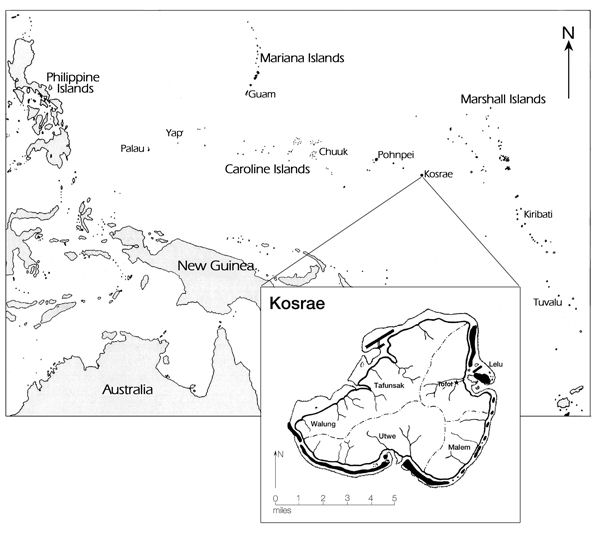


Map of the western Pacific showing the location of Kosrae and the site of Finol Tokosra in the upper Tofol River drainage, on the eastern side of the island.

Introduction
On the island of Kosrae, eastern Micronesia, a number of stone figures were recovered during a 2006 field season at the Finol Tokosra site. While it may not be unusual to identify and recover statues, idols or other kinds of carvings in the islands throughout this part of the Pacific, for Kosrae the discovery represents a paradigm shift in our knowledge of the island's past. Kosrae's culture was reported to have no images, no statues or figurative arts, and no knowledge of sculptural endeavours in ancient times, at least according to the few surviving oral histories and historical narratives, ships' logs, missionary diaries and early archaeological and ethnographic reports (Reference SarfertSarfert 1919; 1920; Reference ChristianChristian 1899; Ritter & Ritter 1982). So, the appearance of carved stone figures within an archaeological context was wholly unexpected. Yet, there were fragments of shapes possibly representing manta rays, turtles, fish and anthropomorphic beings, as well as more abstract and highly eroded forms with surface carvings and decorative motifs. The presence of these objects in the archaeological record raises a number of questions about the nature of Kosrae's cultural heritage, particularly as it has been defined by the absence of a tradition in the figurative arts.
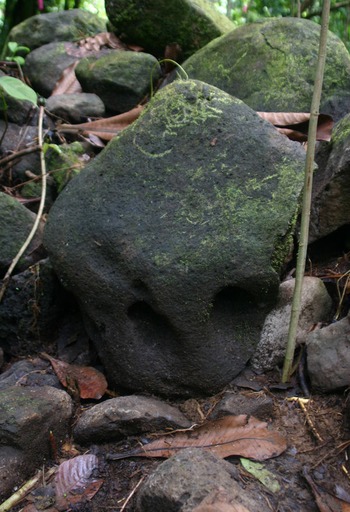
This figure was initially identified as a stingray, although it may be a manta ray. It stands 80cm tall, and was positioned to overlook an enclosed bathing area. Initial interpretation suggests the figure may represent a clan symbol.

Archaeological background
The site of Finol Tokosra (Ko-A11-32) is located at the junction of Kosrae's coastal plain and the foothills of its mountainous interior (Figure 1). It is adjacent to the Tofol River and is centrally positioned at a bottleneck that links the lower and upper reaches of the river drainage. Finol Tokosra was one of several sites identified during a field survey carried out in 2004; this survey was concerned with identifying a specific site referred to in one of the more important oral histories on the island. The site was ground-truthed in 2006.
The 2006 excavations opened 14 of the 9184m2 occupied by the site and exposed a hastily dug pit that appeared to be a mass grave (the link to the oral history) and an area we labelled the stone carvers' compound. Stratigraphy indicated a single continuous occupation, with abandonment of the site prior to the advent of the historic era, supported by radiocarbon dates. According to these, initial occupation appears around cal AD 650 and abandonment around cal AD 1650. Of importance here is the stone carvers' compound, which produced a sequence of clean dates that covered the entire period of occupation (cal AD 650-940, Wk-20593; cal AD 660-778, Wk-20594 AMS; cal AD 810-1160, Wk-20598; cal AD 1440-1650, Wk-20595).
Artefacts recovered include an assortment of carved stone figures as well as composite figures composed of stone cores covered with a low-fired ceramic shaped to 'flesh out' the figure. Up to now, neither carved stone figures nor ceramic-augmented figures have been identified in Kosrae's archaeological record. In fact, ceramics generally are not considered part of the island's archaeological record, with the exception of an isolated occurrence in which pottery fragments were recovered from deeply buried marine sediments off the shoreline of Kosrae's lagoon islet, Leluh. But these pottery fragments are limited to the period between cal 108 BC to cal AD 244 (Reference AthensAthens 1990; 1995) and confined to this off-shore islet.
The stone figures
The stone figures from Finol Tokosra reflect a well-developed on-site stone working industry. Each figure is shaped and carved from basalt; some are painted with a red pigment, while others consist of a carved basalt core further covered with a low-fired red clay. The figures range in size from over 1m in size to less than 10cm in diameter. There are shapes reminiscent of manta rays (Figure 2), turtles (Figure 3), fish, anthropomorphic beings, geometric and torus-like shapes, and more amorphous forms. Some figure surfaces display elaborate decorations, such as engravings or raised motifs, others are smoothed and highly polished. Most of the figures are fragmentary and appear to have been smashed or deliberately broken; they display spalling and flake fractures that interrupt finished, polished, painted, engraved or patinated surfaces.
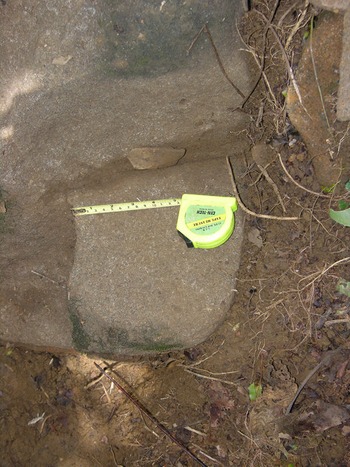
All components of a stone-working industry are present on-site, including a stockpile of basalt boulders along with several boulders that have been systematically reduced. In one instance, a small rough-textured cutting tool was observed in situ, resting upright within a grooved separation cut (Figure 4). Each figure appears to have been produced in similar fashion, beginning with a roughed out block of basalt. From that point, the figure would emerge through a combination of drilling, cutting, chipping, filing, and finally abrading to create a smoothed and polished finished surface. Small features such as eyes, even the pupils within eyes, were carved and/or abraded into the surface of the figure. Composite figures followed this same process, with the supporting stone core displaying the features of the thing it was intended to represent, after which ceramic was added to augment the form and add additional surface texture.
Of the stone working tools recovered from the site, abrader fragments were by far the most numerous; their sheer number testifies to the effort spent in the finishing stages of figure production. Other types of stone tools included chisels, burins, scrapers and cutting tools, drills and hammers, spatulas, agitators for mixing the ceramic, and tools to crush pigments.
Turtle head showing eye detail and battering damage.

Basalt boulder with blocks of stone removed; the in situ cutting tool stands upright in a separation groove.

The red paint (Figure 5) visible within the crevices or protected pockets on the surfaces of some figures is probably lap, a red ochre-like pigment known in the ethnographic literature (Reference SarfertSarfert 1919; 1920; Ritter & Ritter 1982). During the historic era, lap was used to paint important items like canoes, high ranking houses or structures and ceremonial objects.
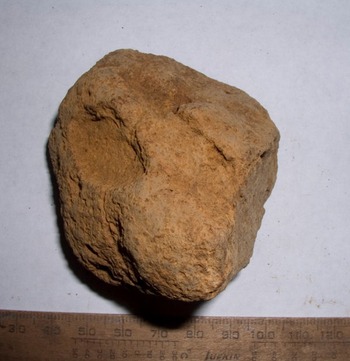
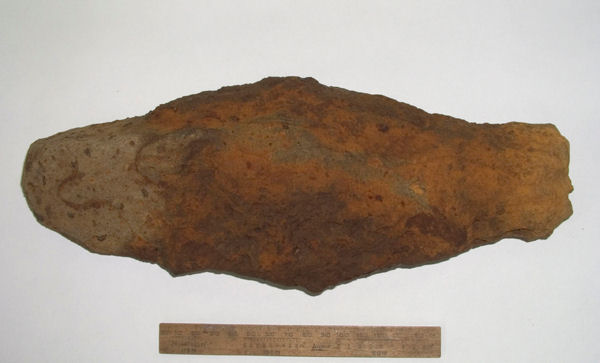
The ceramic used on the composite figures was mixed with fragments of a hardpan lateritic soil and appears to have been hardened through a low fire process. Its surface seemed to break down and go into solution when the artefacts were washed prior to laboratory examination; although the thicker portion of the ceramic remained intact. On one composite figure, a fish-shaped stone axe (Figure 6), wear patterns impressed on the surface of the ceramic suggested that the tail had been wrapped with a fibrous cordage; more importantly, this clarified that the ceramic covering was part of the artefact design and not adhering burial matrix.
Figure fragment with remnants of red paint in depressions across the surface.

Discussion
The stone figures from Finol Tokosra should be considered part of a region-wide industry in the figurative arts. That a figurative arts industry should not be present on Kosrae from the earliest periods of occupation seemed unusual, though remained unquestioned given the island's more recent history dominated by Christian missionaries. Ethnographers who visited the island dismissed even the briefest suggestion that there were once stone idols on the island, because they never saw evidence of such imagery, the majority of their informants knew nothing about sculpture or the possible sculptural endeavours of their ancestors, and the lone voice that may have intimated the existence of idols in ancient times was easily discredited as lacking scholarly merit.
To his credit, Sarfert (1919; 1920) makes brief reference to a crude basalt figure in the shape of a human head recovered during Hambruch's 1910 archaeological survey of Leluh, but provides no further description. The figure itself was too heavy and unwieldy to remove from the site, so it was left behind when the German South Seas research vessel left the island. No subsequent archaeological project has encountered the stone figure, nor tried to locate it.
Compared to the other islands in Micronesia, only Palau retains one of the better documented stone statue industries. Palau's stone figures are produced in similar fashion to those in Kosrae. Many of the figures consist of stone heads and faces, though a few are abstract forms (Reference OsborneOsborne 1966; 1979). According to Reference HijikataHijikata (1995), the stone idols represent gods, mythic beings, guardians of restricted places, deities associated with weather or storms or curses, symbolic representations of figures in important oral histories, fetishes, phalli or genitalia, captured icons from vanquished states, or some-thing so old that its meaning is utterly forgotten.
Fish-shaped stone axe with clay body affixed to a basalt core. The ceramic covering is part of the design of the artefact.

Closer to Kosrae, the island of Pohnpei is said to have carved stone images over eight feet high (Reference FewkesFewkes 1916), although no actual observations of these figures have ever been reported or confirmed. What Pohnpei does have is petroglyphs, at least at one site. The symbolic imagery carved into the boulder field of Pohnpaid includes motifs such as human foot and hand prints, anthropomorphic figures, fishhooks, dots and circles, swords or daggers (maybe fishing lures) and an enveloped cross (Reference RainbirdRainbird 1999; 2004; Rainbird & Wilson 2002).
As for ceramic figures or composite stone and ceramic figures, no mention is made of any similar products in the region's figurative arts (historic or ancient) or for that matter in any western Pacific archaeological assemblage. Even in ethnographic collections, it is difficult to find anything comparable. Historic era figurative arts from Palau, the outer islands of Pohnpei, or the southern reaches of the region produce elaborate images carved from wood. But, nowhere in the region are there reports of composite figurines that combine a clay body moulded onto a stone (or non-stone) core. In this form, the figures from Kosrae are unique.
Conclusion
The stone figures of Finol Tokosra are a new component in Kosrae's archaeological record. But the role these figures played in that ancient society remains enigmatic. With no historic reference to such imagery, explanations remain in the realm of conjecture. If parallels can be drawn from other societies, quite possibly these images are a form of communication that reflect social identity, perhaps a visual display of group membership in the form of a clan totem, perhaps reference to an ancient story or a symbol of power and authority, or perhaps a reflection of some other esoteric connection to the seen or unseen world.
Acknowledgements
This project was supported by the Historic Preservation Funds from the National Park Service, US Department of the Interior, and administered by the Kosrae Office of Culture History; by the University of La Verne's Faculty Professional Support Fund, Research Fund, and College of Arts and Sciences Summer Research Fund; by the Kosrae Village Resort; and by Joanne and Jerry Bonura at Lazy Faire Ranch. The contents, opinions and interpretations expressed are mine alone and do not reflect the views or policies of the US Department of the Interior, University of La Verne, Kosrae Village Resort, or the Bonuras. This project was financed in part by the US National Park Service and Kosrae Office of Culture History; University of La Verne's Faculty Research Funds; Kosrae Village Resort; and Joanne and Jerry Bonura. The contents and interpretations expressed are mine alone and do not reflect the views or policies of project funders.