

Teaching and public engagement with the results and implications of bioarchaeological research have increasingly attracted more varied and social media-savvy audiences. Since 2010, the social media platform Instagram has also flourished, with millions of users forming untold numbers of communities of practice. Here, I seek to address the intersection of bioarchaeology and the virtual “stage” that social media represents. How is the discipline of bioarchaeology and the act of being a bioarchaeologist represented on Instagram? How do practicing bioarchaeologists (and enthusiastic supporters of the field) communicate about their own and others’ research, fieldwork, laboratory work, et cetera? With ever-greater amounts of scientific communication and public outreach conducted over social media (e.g., Gura Reference Gura2013; Kling and McKim Reference Kling and McKim2000; Wheat et al. Reference Wheat, Wang, Byrnes and Ranganathan2013), it is worth investigating how the living who study the dead interact with each other, form community, and engage online audiences that increasingly contain descendants of the dead being studied. The review below is short; hence, the nature and depth of inquiry is restricted. Nevertheless, enough data are available to allow broader speculation and to suggest that there is space for more concerted future research.
BIOARCHAEOLOGY AS A COMMUNITY OF PRACTICE
Today, human bioarchaeology (also known as osteoarchaeology within the United Kingdom and Continental Europe) contains an ever-growing number of subdisciplines, research methods, analytical techniques, and theoretical perspectives, with hundreds of peer-reviewed books, articles, and excavation reports published each year (e.g., Agarwal and Glencross Reference Agarwal and Glencross2011; Knudson and Stojanowski Reference Knudson and Stojanowski2009; Larsen Reference Larsen2015). As the number of students and avocational enthusiasts receiving undergraduate and graduate-level training increases each year, these social media-savvy individuals turn to the diverse platforms they know well (e.g., Instagram, Twitter, Facebook, etc.) to offer each other research and study support, ask questions about in-progress research, or seek opportunities that can advance their education or careers. The expanded networking opportunities afforded by social media, beyond those possible in person at conferences, in field schools, or in the classroom, can be crucial to personal decisions regarding continuing in the field. The public presentation of new discoveries, whether by researchers themselves or as reported by journalists, is also increasingly done on social media and thus plays a role in cementing this community of practice—experts expect their colleagues to present their own and others’ work accurately, and the ways in which databases are managed and public outreach conducted increasingly influence funding decisions.
The use of these new platforms by the bioarchaeological community itself, writing in multiple languages, also provides another means for practitioners to directly influence the perception of the field within “the public imagination” (sensu Stojanowski and Duncan Reference Stojanowski and Duncan2014). As social media platforms go, Instagram has seen exponential growth since its launch in October 2010, adding, as an example, approximately 200 million users between November 2015 and November 2016 (Huffer and Graham Reference Huffer and Graham2017). It allows for the posting of unmodified or modified photographs, video, music, and text-based, time-stamped discussion and the supporting of others’ content through “liking” material. It also allows users to “direct message” anyone else, whether their profiles are linked (whether they “follow” each other) or not. As a taste-maker for users of all ages, a forum for diverse subcultures (Burke Reference Burke2016), and the site of a new subfield of scholarly research on oftentimes disturbing topics (e.g., Brown et al. Reference Brown, Fischer, Goldwich, Keller, Young and Plener2018; Gibbs et al. Reference Gibbs, Meese, Arnold, Nansen and Carter2015; Huffer and Graham Reference Huffer and Graham2017; Sheldon and Bryant Reference Sheldon and Bryant2016; Yang and Luo Reference Yang and Luo2017), how Instagram is used or exploited for networking, marketing, or research purposes continues to expand. While the presence of bioarchaeologists (professionals and students alike) is expected to be relatively small, examining how the living people behind the study of the dead have adapted Instagram for their purposes is worth investigating further.
#BIOARCHAEOLOGY: WHO, WHERE, WHY, HOW?
I examine here how students and professional practitioners of human bioarchaeology use and form community on Instagram—where members are located, their diversity of identities and roles within the discipline, and what they reveal on social media about why they do the work they do. This section presents qualitative information gleaned from an exploration of the use of the #bioarchaeology hashtag (including several variations on the term, as well as #paleopathology and #osteoarchaeology). This initial review is offered as a pilot test in advance of a planned, more in-depth exploration of this community. Analysis took place over approximately one week during late March 2018. How representative data collected during this period are of the long-term use of these hashtags is unknown. The observation period selected was chosen for convenience but based on ongoing observations seems consistent with posts made at other times. Taking into account spelling differences between languages, typos, and additional descriptors and emojis, 30 separate hashtags related to the subdiscipline were recorded and ranked according to the number of associated posts. Table 1 presents the number of likes and comments the posts under each hashtag received, given as a range. In terms of the content and diversity of images posted and distribution between hashtags, Table 2 suggests a generally wide range of categories of image content or, in other words, reasons that each hashtag is used.
Number of Observed Posts Using #bioarchaeology and Related Hashtags, March 25–31, 2018.

Image Content Distribution of #bioarchaeology and Related Hashtags during Observing Period.

In general, the average number of comments most posts received is very low. Indeed, the number of comments on any one post, regardless of hashtag, rarely enters double digits. The number of likes that a given post receives appears more variable and not correlated to specific hashtags. In the current observation period, very few posts (less than five) received more than 500 likes, and not many others fell between 100 and 400. Especially among the topmost five or six hashtags (Table 1), images posted depict living individuals (selfies and group photographs) at conferences or engaged in research or fieldwork, as well as human remains in the field, laboratory, and museum; notes; books/articles; and isolated photographs of, for example, the sun setting over a medieval European town taken while doing fieldwork. #Bioarchaeology and related hashtags are also sometimes used to advertise field schools and conferences and to show off personal artwork, tattoos, and so on, related to skeletons, death, or the dead. The “miscellaneous” category includes everything that does not fit elsewhere, from a photograph of a cake with frosting resembling a skull to a close-up of the beer one user was progressively consuming in the course of preparing a poster for an upcoming conference. While Table 2 currently records only presence/absence of each category of image posted under a given hashtag, an expanded analysis would quantify this in more detail.
Determining the correlation between individuals’ use of each hashtag and their probable role within the bioarchaeological community as selectively displayed by themselves is more difficult. At present, it appears that almost all commenters are bioarchaeologists themselves (in what capacity, it is hard to say). Investigating whether the hashtags, and the community formed through their use, are used primarily by practicing professionals based at a university, museum, or archaeological consulting company, students, or enthusiasts is a worthwhile question. However, it would require more thorough investigation of user social media or web presence beyond Instagram to effectively answer. At first glance, it seems that use of #bioarcheaology (and related hashtags) on Instagram is “circular”; that is, students and practitioners speaking to each other with public engagement more “accidental” than not.
THE LIVING AND THE DEAD TOGETHER IN VIRTUAL SPACE
The section above begins to quantify and qualify the “dimensions” of the bioarchaeological community on Instagram. This section focusses more on how bioarchaeologists specifically use Instagram to interact with each other and communicate about their work between themselves and with the public. Comments from posts are provided in the form of illustrative case studies. The five figures selected highlight the various ways these hashtags are used. Figure 1 depicts the epitome of the idea that Instagram is a venue in which the living and dead, figuratively, form community together.
Please note: figure is not reproduced here because it contains an image of a human skeleton. See: https://osf.io/d3xn5/?view_only=642efb9f5eef4b448c22d21d418ae497. A mother and child conducting a bioarchaeological analysis of a subadult together on the Transylvania Bioarchaeology project (@transylvania_bioarchaeology, December 13, 2017). Found using the #bioarcheology hashtag. Credit to Kori Fillipik.
Figures 2 and 3 speak to Instagram as a stage on which bioarchaeologists can display the general feeling of respect felt when allowed to excavate or research the dead, and how the majority of users of these hashtags, students who actively speak about or display the artifacts of study (i.e., books, exam papers, laptops with reports in progress), learn to balance their scientific education and their newfound ethical responsibility. Most of these individuals are younger or appear as such in the images and text they post and thus fit the expected demographic profile of Instagram users (Jang Reference Jang, Kyungsik Han, Shih and Dongwon2015).
Please note: figure is not reproduced here because it contains an image of a human skeleton. See: https://osf.io/gq9dy/?view_only=56e8e1bac3404a229ed6bf9ff0df36aa. A bioarchaeology student's evolving perceptions (@at0ncebecoming, January 17, 2018). Found using the #bioarchaeology hashtag. Credit to Hannah Bedwell.
Please note: figure is not reproduced here because it contains an image of a human skeleton. See: https://osf.io/fk2ep/?view_only=176a8cc547ff475cbec4a8ef9e54956c. Contentment with daily work as a bioarchaeologist working with Anglo Saxon bones (@leahdamman, October 19, 2017). Found using the #osteoarchaeology hashtag. Credit to Leah Damman.
Figure 4 is just one of many examples of the sense of humor pervasive to the bioarchaeological community on Instagram. Pictures and text that capture the “lighter side” of the field appear most often to be associated with individuals seeking to alleviate the pressures of busy academic schedules or communicate their “passion” for the field in a more indirect manner. The affiliation of posts such as these has not yet been observed to be disrespectful in nature, and while research equipment or articles and books might be included, along with food, drinks, et cetera, no actual human remains were encountered in any such photo.
How a bioarchaeologist might celebrate (@danee_with_an_e, January 25, 2018). Found using the #bioarcheology hashtag. Credit to Dannee Wilson.

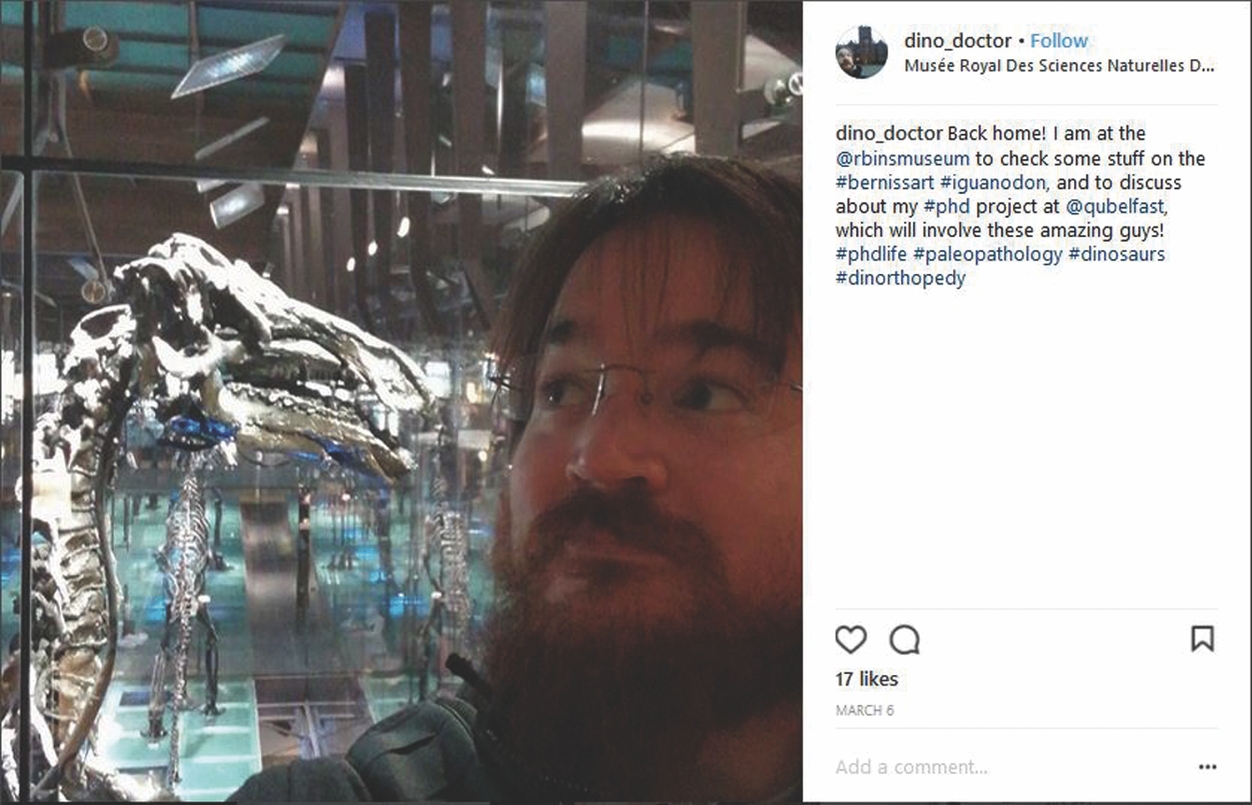
Finally, Figure 5 is but one example of the at least occasional use of the #paleopathology (and related) and #osteoarchaeology (and related) hashtags for posts related to non-human remains. In the majority of the few such posts encountered, common domestic animals from archaeological contexts, such as sheep or horse burials, are being shared. However, the figure selected demonstrates the range of use of these hashtags and, indirectly at least, that the geographic division between how bioarchaeology, osteoarchaeology, and paleopathology are defined and taught (i.e., generally human only in North America, human and animal elsewhere) continues in virtual space.
#Paleopathology on Instagram encompasses a wide range of topics (@dino_doctor, March 6, 2018). Found using the #paleopathology hashtag. Credit to Filippo Bertozzo.
The majority of posts analyzed in this review also stress the importance of the support networks formed between practitioners, such as students attending a field school or working in the laboratory together, or students and faculty. They share the excitement of participating in one's first conference, or a post getting “liked” by a professional researcher or author the user is currently reading. Instagram is especially suited to sharing these sentiments, and through this, the platform is used to encourage others to not abandon their studies and push through challenges. However, in one instance at least, use of Instagram by practicing professionals to display their active research attracted attention from at least one dealer/collector of antiquities. The dealer in question may be relatively “low level” and, when their profile was examined, did not appear to be actively selling or seeking human remains in the manner of many other members of the collecting community who use Instagram (Huffer and Graham Reference Huffer and Graham2017). Instagram's self-identified bioarchaeologists do not seem to be actively approached by members of this human remains collecting community seeking professional advice or “authentications,” as has happened in Facebook groups devoted to paleopathology and dental anthropology. As to why this is, I suspect it is more due to the human remains collecting community not being aware of #bioarchaeology (and related hashtags), or suspicion on the part of collectors that practicing bioarchaeologists would not readily engage with them on such a “public” forum. If bioarchaeology develops a larger multimedia presence on Instagram in the future, I do not expect it will attract more attention from collectors, as the diametrically opposed viewpoints regarding how to treat the dead will remain.
CONCLUSIONS
The analysis presented here suggests that the 30 hashtags recorded are not being used for specialized purposes by that proportion of the global bioarchaeological community that uses Instagram. The number of posts for even the three most commonly used hashtags is relatively small, and there is frequent post overlap between. At first glance, use of Instagram by the bioarchaeological community seems mostly to be the domain of students, but evidence for faculty or practicing professionals can be seen in advertisements for conferences, field schools, and the occasional “liking” or commenting on a student's post by, for example, the author of a textbook or work of popular fiction. Very little evidence for interaction between nonpracticing members of the public and students or professionals is apparent.
Why Instagram?
Instagram seems to have potential beyond that of other platforms such as Facebook; also, it is a platform on which bioarchaeologists can and do interact. On Facebook, aside from personal profiles of individuals who self-identify as practicing bioarchaeologists (the author included) on which news, publications, job opportunities, et cetera, can be shared publicly or privately, most public groups are specific to a course, field school, or university department and have memberships no greater than a few hundred. While individual users of both Facebook and Instagram might frequently cross-post, Instagram's reliance on hashtags gives the platform even more potential for fostering links between disparate individuals. However, at present it seems this potential is unrealized. Instagram posts appear to be limited to static photographs and drawings, although a small number of time-lapse or real-time videos of research or excavations in action were also observed. Those categories of posts most useful in reaching and educating the social media–using public (namely, examples of research “in action”) are much less frequent than expected. Admittedly, this could in part be related to research or field school participants not having permission to share certain things, or to the time of year, with posts from the laboratory or field becoming more common in the summer months. However, the effect of the paucity of such “research in action” posts is a muting of the relevance of Instagram (and to some extent Facebook) as a means for science communication.
Personal use and the anecdotes of colleagues suggest that Twitter is much more actively used by the bioarchaeological community for all the purposes that Instagram (and its parent company Facebook) could itself be used for. Neither Instagram, Facebook, nor Twitter have enforced restrictions on individuals describing, sharing images of, or even selling human remains (see Huffer and Graham Reference Huffer and Graham2017). However, no human remains have been observed for sale solely via Twitter without also cross-posting to Instagram via hashtags. The barrier to full realization of the potential of such a ubiquitous platform as Instagram for bioarchaeological community formation and knowledge sharing may be an ethical one: students who fear reprisal or researchers operating under specific terms and conditions set by museums, for example. While these concerns are valid and need to be negotiated in advance of public outreach, in time, perhaps new and different multimedia tools will be more readily utilized. As Instagram use continues to expand, and/or other platforms begin to challenge it for dominance or merge with it (e.g., the controversy around whether or not Instagram copied Snapchat in the development of its new “Stories” app [Harbison Reference Harbison2016]), the living communities who represent the dead online will continue to adapt, and in so doing, give the dead new ways to speak.



