




Introduction: breaking archival silences or accepting enigmas?
In this article I follow the thread of intimacy in an archive of photographs taken by the Cameroonian photographer Jacques Toussele in the 1970s,Footnote 1 a period during and just after ‘a time of troubles’ in OuestFootnote 2 Cameroon: the armed struggle of the Union des Populations du Cameroun (UPC), which was violently suppressed by the newly independent government with help from the French, the former colonial power in the area.Footnote 3 The article is based on the work undertaken to create the Jacques Toussele archive, which included many discussions with Toussele and other photographers as well as with some of the people depicted, a few of the original clients, when they could be identified and traced. As I show, the photographic archive apparently has no trace of the armed struggle that formed the backdrop to the lives of Toussele’s customers depicted in his images. This may be an instance of what Pumla Gqola calls ‘unremembering’, ‘a calculated act of exclusion and erasure inscribed by power hierarchies’ (Reference Gqola2010: 8), as discussed by Shanaaz Hoosain in this issue. However, although Jacques Toussele’s work may be a case of an archival silence or invisibility,Footnote 4 it is not one created by colonial administrators. And, as we shall see, echoes of the silence can be transcribed. Photographs from the period can be read as celebrating the achievement of types of ‘ordinary modernity’,Footnote 5 the minidress and flared trousers fashionable in Mbouda as well as Paris, for all the violence nearby.Footnote 6 Before discussing this in detail, I first return to the topic of archival silence and then introduce the specifics of the archival material I am considering.
All archives have silences, gaps, voids. A considerable amount of work has now shown that there are ways in which careful and painstaking research can begin to identify (more or less approximately) the zones of silence and, in various ways, make the silences resonate even if they may never speak (Zeitlyn Reference Zeitlyn2012). What is unsaid and what is unsayable may be understood and appreciated even if never enunciated so never heard. If silence is thought to be inappropriate in a discussion of visual evidence, then we could think of the invisible in ways that return us to Michel-Rolph Trouillot’s original argument (Reference Trouillot1995) about the incompleteness of archives from and about the Caribbean: they are silent about slavery, saying almost nothing about the slaves (neither naming them nor showing or depicting them). The idea of ‘archival silence’ stands for a general archival exclusion.
Yet close reading and assiduous research (‘mining the archive’ and reading archival sources in different ways) can allow us to ‘excavate’ hidden or silenced voices, such as that of the parricide of Pierre Rivière, allowing ‘an insurrection of subjugated knowledges’ (Foucault Reference Foucault1982; Sheringham Reference Sheringham2011). This suggests that we are not complete prisoners of the archive and that we can sometimes recover (or ‘hear’) other voices or see other faces. For example, from archives we can excavate and recover subjugated voices of women (Davies Reference Davies1987; Burton Reference Burton2003), the insane (Foucault Reference Foucault1967), and religious dissidents (Ladurie Reference Ladurie1978). Such arguments suggest that there is no fundamental difference between colonial archives and any other government or administrative archives: the unequal relationship between those in power and those governed is what matters.
Considering material from the Caribbean, Trouillot encourages us to think about the power plays affecting silences, determining which stories get told and which leave traces (Reference Trouillot1995). Recognizing this, we can ‘read’ the silences, visualize the emptiness: reading archival absences both ‘against the grain’ and ‘along the grain’ is a way of making silence speak or of seeing faces in the darkness (Pels Reference Pels1997: 166; Stoler Reference Stoler2009). However, this process is not always possible. Ballantyne is doubtful about the project of ‘recovery’ (Reference Ballantyne2001: 94). The answer to Spivak’s (Reference Spivak, Nelson and Grossberg1988) question, ‘Can the subaltern speak?’ (at least for women), is sadly all too often ‘no’. Discussing images of slaves, Best concludes that ‘the archival disfiguration of any record of the enslaved may have been so intense … as to bar any hope of recovery and render the enslaved all but irretrievable’ (Reference Best2010: 158). Sometimes the past is truly lost. That said, we cannot know a priori what is fully lost without trying to find it. Susan Stewart closes her book about museums and the desire to collect with the thought that names on labels are an attempt to belie mortality (Reference Stewart1993 [1984]). We must ask if names alone are enough. Perhaps we should accept that often we are left only with enigma, although we try for more than that.Footnote 7
Working in the politically sensitive context of South African archives, Carolyn Hamilton and Pippa Skotnes (Reference Hamilton, Skotnes, Pippa and Carolyn2014) consider how artistic interventions (that allow images to fade or blacken) can point to what is not visible. They introduce the idea of ‘anarchives’ to think about archival absences (which again returns us to Trouillot’s work). As Carine Zaayman (Reference Zaayman, Skotnes and Hamilton2014) puts it, this is a way of ‘picturing absence’: we are invited to imagine and visualize what is literally not there but which can yet be inferred or otherwise invoked. A parallel can also be found in Nicolas Argenti’s work (Reference Argenti2007) from Oku, a Cameroonian chiefdom not far from Mbouda, which is where the images I consider come from. Argenti’s time period is far greater than the one that I engage with: he explores how something of the unspeakable, unshowable, undiscussable horrors of the transatlantic slave trade can be excavated from Oku by means of masquerading – how the singing and dancing by masked figures can be made to speak about an undiscussed past in which older men sold younger men and women down to the coast and eventually to the Americas. The material I consider contains a parallel set of silences and visual lacunae. As I argue below, in the context of Mbouda and Ouest Cameroon, such silences and visual absences emphasize fashion and intimacy as achievements worthy of celebration in photographs.
To enable readers to understand the case study presented below I need to provide several different background introductions. I am very conscious that the background risks overwhelming the material I wish to put in the foreground. Still, the historiography of photography in Cameroon and the troubled history of that countryFootnote 8 cannot be taken for granted.
Background 1: Cameroon and photography in Cameroon
The notion of cultural biography – and of social biography – has been used in photographic studies as a shorthand for the way in which the image is not a static entity to which viewers bring a variety of interpretations of ‘what can be seen’. Rather, images are more fruitfully and accurately construed as dynamic cultural constructions, which, just like ‘people’, are simultaneously produced as objects and agents in the social world. In other words, photographs are transformed by being in a collection in, variously, the Cameroon National Archives or the university archives or a photographer’s shop. There is a dynamic of appropriation: for older identity card photographs, the negatives were held by commercial photographers or the sitters (see below). Now ID cards are digitized so there are no negatives and only the government representatives can make and ‘own’ these important images.
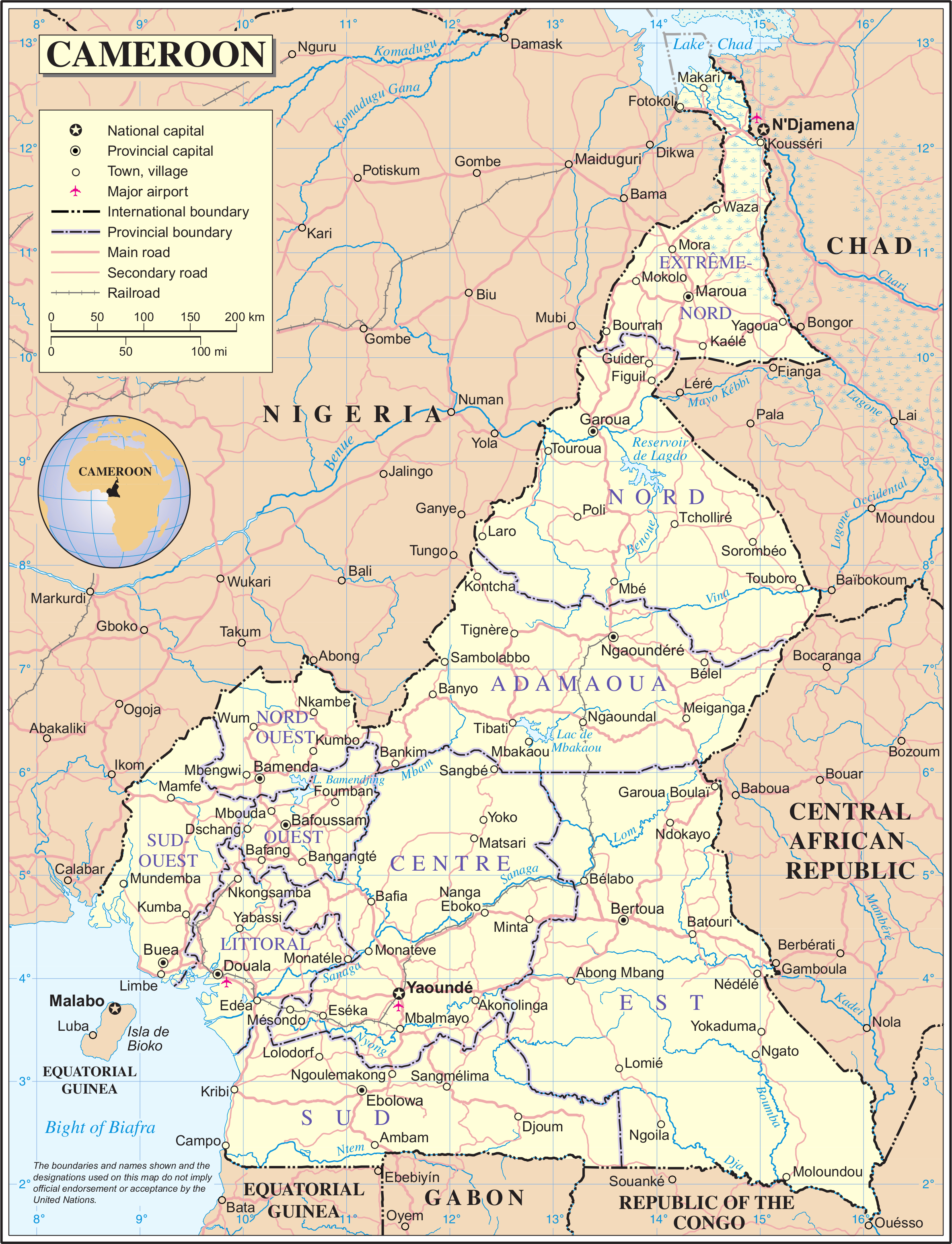
The history of Cameroon has complexities that affect how we must discuss the path to independence.Footnote 9 After World War One, the relatively short-lived German colony of Kamerun was divided up, with the parts being administered by France and Britain under League of Nation mandates, which later became United Nations trusteeships, until independence in 1960–61. The area I am considering was under French administration (see Figure 1). Inland, it had not been very much affected by German administration and was in effect brought under colonial administration under the French soon after World War One. A local administrative centre subdivision was created only in 1950 (Zeitlyn Reference Zeitlyn2018); before that, Mbouda was administered from the long-established centre of Dschang, some 50 kilometres away by road. It is not entirely by coincidence that this date was only slightly before the armed struggle that preceded independence and the introduction of identity cards with photographs (in about 1955; see below). The latter requirement brought into being a widespread network of photographers throughout Cameroon (Zeitlyn Reference Zeitlyn2019).
By the 1980s, professional black and white photography in Cameroon was under threat from colour photography. It all but disappeared following the introduction of new identity cards in 1998, which were issued complete with instant photographs, removing the need for ‘passport photographs’. These had been produced easily using plates and 120 format film since solar contact prints could be made of the correct size for identity card photographs. Rural photographers could process and print the film without needing access to electricity. A small supporting industry of photographersFootnote 10 was destroyed by the arrival of cheaper colour 35 millimetre processing in the cities and then the computerization of the national identity cards.Footnote 11 Jacques Toussele (his studio is shown in Figure 2 while Figure 3 shows the location of Mbouda) was among the many photographers who lost their livelihood (Zeitlyn Reference Zeitlyn2019).
Cameroon (Mbouda is between Bamenda and Bafoussam).
Source: UN Mapping Service open license, <https://upload.wikimedia.org/wikipedia/commons/9/99/Un-cameroon.png>.

Studio Photo Jacques in Mbouda, c.1975–80. EAP054_1_125_181.
Source: Photograph © Jacques Toussele.

Mbouda area detail.
Source: Champaud (Reference Champaud1973), IRD open licence, <http://sphaera.cartographie.ird.fr/carte.php?num=2202&pays=CAMEROUN&iso=CMR>.

I have worked in collaboration with the Cameroon National Archives and the Endangered Archive Programme at the British Library to archive the work of Jacques Toussele.Footnote 12 To give a more concrete idea of the relative frequency of the different kinds of photographs in the archive, from a total of 46,504Footnote 13 images, just over half are passport-style photographs for national identity cards (see Figure 5). Recreational images (by which I mean those not taken for administrative purposes; see Figure 4) include many groups of family or friends – almost 8 per cent (3,522) contain more than two people – as well as photographs of babies. I note that there are almost as many images of road traffic accidents (191) as there are of (Christian or civilFootnote 14 ) weddings (212). There is also a small number of images taken in hospital showing bandaged patients recovering after surgery.Footnote 15 I have done such counts with other Cameroonian contemporaries of Toussele, and the relative percentages are similar.Footnote 16
A street seller. EAP054_1_54_58.
Source: Photograph © Jacques Toussele.

Portrait for an ID card. EAP054_1_177_24.
Source: Photograph © Jacques Toussele.

It must also be noted that even identity card photographs are of considerable interest, especially when one examines the entire negative, not just the head and shoulders printed for the 4 x 4 centimetre passport-style images required for identity cards (see below).
Between client and photographer, a delicate negotiation, often unspoken, took place about props, backcloth and pose. Jacques Toussele and the other photographers I have interviewed are insistent that although they made suggestions and delicate adjustments, the choices of poses and of props were made by the clients (who, as Toussele saw it, were in charge since they were paying). There are many different conventions that become visible when one compares similar images taken by different photographers. That similar poses are found in photographs taken in Banyo (in the cultural north) and in Mbouda (in the cultural south) is significant. The local traditions of display and posing available from masquerades and wood carving (most prominently on the outside walls of chiefs’ palaces in the cultural zone of the wider Grassfields) seem not to have influenced how clients in Mbouda present themselves to the camera.Footnote 17 In the remainder of this article, I discuss the reuse of administrative photographs and the uses, transformations and appropriation of Western fashions, for example as transmitted through copies of Paris Match, producing displays of intimacy among both young and old. Such uses are expressions of modernity and aspirations for material success.Footnote 18
Background 2: the photographer Jacques Toussele and the UPC insurrection
The Cameroonian photographer Jacques Toussele took images between 1960 and 1985 against a background of violence: the uprising of the UPC. This was based in Ouest Cameroun and the town of Mbouda where Toussele was located. Indeed, in 1960, in the immediate aftermath of independence, Jacques Toussele moved to the comparative quiet of Bamenda (some 50 kilometres away) and worked there for a year.
Militants from the UPC started their armed struggle in 1956, before independence (which for Cameroun under French administration occurred in 1960). They continued long afterwards since the leaders of the UPC argued that France continued to rule in all but name. This argument was seen to be corroborated by the continuing role of the French army in ‘anti-terrorist’ activity that lasted for more than a decade after independence.
The emergency formally came to an end in 1972Footnote 19 but the area continued to be very tightly policed for many years after that (at least until the founding president Ahidjo stepped down in 1982). During the emergency, many villages that traditionally had been spread out over the landscape were forcibly resettled, so they could be more easily policed, in small nucleated settlements (Socpa Reference Socpa1990).
The UPC insurrection in the late 1950s marked the run-up to independence. Among many other things, it was an impetus for the introduction of compulsory ID cards containing ID photographs. The key date was 24 September 1953,Footnote 20 when an ID card with a compulsory photograph became required in French Cameroon. This was imposed over the entire country in the years 1954–57. This was a very important economic spur for the development of studio photography in Cameroon and photographers such as Jacques Toussele (Zeitlyn Reference Zeitlyn2019) benefited from it. A further refinement was that, in the areas where the insurrection was concentrated, an additional document, also with an ID-style photograph, was required in order to travel within the country, a ‘laissez-passer’. Failure by an adult to produce an ID card and travelling without a laissez-passer were both grounds for arrest.Footnote 21 Checks by police (and other officials) of these documents were some of the most prevalent and most commonplace forms through which the weight of the state was experienced by ordinary Cameroonians.
The fight by the Cameroonian state with the help of the French army against UPC ‘terrorists’ was marked by violence and savagery on all sides: for example, heads were taken by both sides and severed heads were photographed (but not by Toussele). The use of such theatrics of violence exemplifies Teresa Koloma Beck’s triadic theory of violence in which the third pole is the observer (Beck Reference Beck2011). Violence in the time of the UPC maquis in Cameroon was, at least in part, exemplary and intended for wider audiences than those immediately present. Examples of such imagery have been published (e.g. in Deltombe et al. Reference Deltombe, Domergue and Tatsitsa2011), but I will not include them here. I must emphasize that there is no evidence at all of the insurrection in the archive of Jacques Toussele’s work. However, a local reading makes it clear that the violence is ever present for its very absence and in its repudiation or denial: to hold a wedding, to celebrate a birth, to have a gathering of friends was no small achievement and one to be celebrated and marked by photography. Intimacy was achieved against the odds, and celebrated as such, a point I return to in the conclusion. Moreover, some forms of intimacy and their display could be seen as being as revolutionary (threatening the established order) as the violence of the UPC. Modernity, as exemplified by displays of intimacy between girlfriends and boyfriends, was a challenge to traditional sociality (traditional power structures in families, controlling the arrangement of marriages) and as such potentially revolutionary. Two further aspects are worthy of note: the photographs mark a form of resilience in the face of violence, in which the everyday becomes noteworthy. And second, this archive functions on a small scale, showing the ‘micro-space’ of a town in which the colony and resistance to it are externalized (in the sense that the armed conflict between the state forces and the UPC took place in the bush outside the towns).Footnote 22
Uses of photographs
Photographs had many uses and these often changed with time (as mentioned in the comments on cultural biography above). If the single most common reason for commissioning a photograph from one of the studio photographers was to get a passport-style print for the national identity card (or for school cards for secondary school pupils), then there were also many casual or recreational uses. Photographs of family groups, of babies, weddings and groups of friends were taken for display or for storage and discussion when albums were passed round.Footnote 23 Weddings, funerals,Footnote 24 official meetings and traffic accidents are among the different sorts of images found in the negative collections of the photographers.Footnote 25
In some cases, a single print or image could have different uses at different points in time: the ID photos of the elderly are in many cases the only surviving photographs of grandparents. After their death, the image from an ID card was copied so an enlarged print could be made for display on the wall and in processions at funérailles (post-mortem celebrations). Photographs were sent from the village to relatives in the towns (e.g. for secondary education). Those at school together in the towns exchanged photographs between groups of friends before they graduated and then scattered, some returning to their villages of origin, others moving to other cities and other relatives in search of employment.
When Cameroonian citizens went to a local studio photographer to have photographs taken for their national identity cards, they were literally inscribing themselves into the nation state.Footnote 26 As has been mentioned, the representation was at times changed post-mortem: the children of the deceased would often take the ID cards to another photographer (or an anthropologist) to have the photograph copied for display on the wall – it was often the only image of a deceased parent or grandparent. But uses changed before that: a photograph made for a civil marriage certificate would sometimes be put in an album or a large copy printed for display on the wall. Once taken, these images have different lives of their own. Once the negative exists in the photographer’s archive, and if spare prints are held by individuals, then for all their role in state bureaucracies, the images may have a life beyond their bureaucratic uses.Footnote 27 The social lives of photographs are even more complicated than those of other things, since they are often multiple: in the case of a photograph taken for a marriage certificate (see Figure 6), the image may have many different lives in parallel (what happened in the 1960s continues in the 2010s and 2020s). One copy lives in the administrative archives, stapled to the official register copy of the marriage certificate, a duplicate of which will be held by the couple possibly along with the large print on display as already mentioned (see Figure 7), alongside or instead of photographs of church weddings. In some cases, homemade Christmas cards are made in which the couple (represented by the marriage certificate photograph) are surrounded by photographs of their children.
Photograph for a marriage certificate, 1 March 1986. EAP054_1_96_78.
Source: Photograph © Jacques Toussele.

A framed and captioned marriage certificate photograph on the wall of a house.
Source: Used with permission. Original photograph © Jacques Toussele.

I should explain that, in Cameroon, many different forms of marriage are possible: most people undergo what are called ‘traditional’ marriages, governed by local customs and not (much) recognized by the state. The world religions and the state also administer forms of marriage, and the state requires a civil marriage before a ceremony in a world religion takes place. In other words, civil marriage certificates are required by Christian churches before church marriage services are performed. My impression is that in the north of Cameroon, there was and still is less stringency for Islamic marriages about having the civil certificate before the religious ceremony, but this may apply only in the countryside. As illustrated below, Cameroonian civil marriage certificates include a photograph showing the heads of the husband and wife; they also state whether the marriage is monogamous or polygamous.
It may be helpful to consider the biographies of administrative documents and the photographs that are attached to them: they have lives and indeed they may have afterlives – both at the funérailles and now in archives.
Aspiring to Mbouda Match and looking stylish (looking French while fighting the French)
And so, finally, I want to turn to a discussion of intimacy and the lack of depiction of violence in the Toussele archive. In one way, this raises the question of why people in Mbouda lauded French culture, given the history of state repression of the UPC with its anti-colonial and anti-French policy.Footnote 28
In broad terms, the UPC was opposed to and was fighting against the French colonial state from about 1955. Furthermore, this became part of the Cold War: the UPC was seen as part of the radical left. By the mid-1960s, it was fighting the Cameroonian state and the French, and although by the mid-1970s the UPC had all but ceased to exist, its supporters remained opposed to the Cameroonian neocolonial state (a state in which the French had left in name only and continued to exert influence and extract wealth from the nominally independent country).
Long before 1980, the young people seen in Toussele’s photographs did not feel the animus towards the French that some of their parents and grandparents did. I do not want to get involved in hypotheticals or worse. ‘Should’ they have felt more hostile to the French and French fashion than they did? This is not a good question. By the time these photographs were taken, the worst of the fighting was over, and for the young people getting their pictures taken, the enmity of their parents towards the French might have seemed a very different thing from their aspirations to be cool like Johnny Hallyday, or to wear short skirts like Brigitte Bardot. Exploring why French fashion was trendy in Cameroon in the 1970s reveals a disconnect between being cool and being anti-colonial. Perhaps the best response is to say that hip fashion was trendy everywhere, so ‘Why not in Cameroon?’ – or rather, ‘So of course in Cameroon.’ The people in the photographs were actively responding to world fashion, not passively consuming it: the dresses, suits and flared trousers demonstrated hipsterness. They were a Cameroonian formFootnote 29 of what Ferguson, discussing the Zambian Copperbelt, calls a ‘cosmopolitan’ style (Reference Ferguson1999: 90).
As Achille Mbembe put it in the course of a discussion on the oracular dreams of one of the UPC leaders, Ruben Um Nyobè, ‘there was no economic struggle in the colony that was not simultaneously a struggle over meaning’ (Reference Mbembe1991: 97). These ‘struggles for representation’ (ibid.: 101) or ‘for the control of the networks of indigenous imaginary’ (ibid.: 104) were complex, and, as Mbembe argues (ibid.: 106), traditional morality was manifold and cannot be reduced to a single position. Wearing miniskirts or minidresses was controversial in 1960s Cameroon as it was at the time in France, and indeed the conflict between the young – ‘youth’ as a category – and older generations was perhaps even more pointed in Cameroon than it was in Europe.
The period of the UPC insurrection coincided with an epidemic of royal palace burnings across Ouest Cameroon. These were the results not only of generational conflict but also of discontent with chiefs siding with the government (against the UPC) as well as their arrogation of power during the colonial period (see Malaquais Reference Malaquais2002; Warnier Reference Warnier, Fowler and Zeitlyn1996; Reference Warnier2005). Mike Rowlands (Reference Rowlands and Miller1995) situates this in a wider context (and over a far longer time period) of disempowered youth using the effects and by-products of colonialism to challenge the established holders of power. Indeed, the chiefs and senior men had benefited from colonial rule: their power had increased because the administration stifled opposition. This suggests that perhaps it was less a case of wanting to look French than of young people wanting not to look ‘traditional’,Footnote 30 and looking French (then a paradigmatic way of looking modern) was a good way to do this. A display of ‘modern intimacy’ in a photograph was a sort of challenge to the colonial status quo.Footnote 31 There is, of course, a profound irony in this: as Hannah Feldman has argued (principally discussing Algeria but encompassing all of France’s colonies), the wars for independence had an important cultural reflex and a visual one to boot. Miniskirts in Paris were not as disconnected from postcolonial struggles far from the metropole as they might seem, or as might be claimed for them.Footnote 32 Jacob Tatsitsa, a historian of the UPC insurrection says:
The fight against imperial France, in my view, was above all against political and economic domination. I did not find in the archives a slogan of the nationalist party demanding the rejection of the French dress style. If there was even such a slogan, these young people, at that time, would not have followed it openly for fear of falling under the anti-subversion (counterinsurgency) laws of 1962.Footnote 33
What this meant for ordinary people was that to carry on everyday life was itself a struggle.Footnote 34 As I have said above, to perform a Christian wedding, baptism, a burial or a post-mortem celebration was not easy or straightforward, as gatherings were policed. If one succeeded in participating then a visual record of the event was indeed a record of achievement, an achievement in more senses than one.
Another response was to cast one’s eyes to the wider horizon and in defiance of the misery at home, to aspire to and to display oneself as a fashionista,Footnote 35 a member of the modern world as at home in Paris as in, say, Bamenjinda (Mbouda). If Mbouda was a part of the global village, then the town was Paris. The advert for ‘33’ beer said ‘Comme à Paris’ (see Figure 8). At the risk of reading too much into an advertising slogan, I think in Ouest Cameroon in the early 1970s this was taken to mean that we should all be, we should all aspire to be, we should all appear to be ‘comme à Paris’. For many of Toussele’s younger clients, their displays of intimacy were a modernist challenge to traditional power structures, and I suspect that was part of their attraction.
Detail, Comme à Paris. EAP054_1_182_383.
Source: Photograph © Jacques Toussele.

Meredith Terretta’s account of political violence in Cameroon considers this too. She discusses the political repertoire formed from ‘gestures, music, clothing, and performance’ (Reference Terretta2013: 97) and other elements of ‘colonial modernity’, describing them in Nicolas Argenti’s words as the tools of the colonizer used against them (Argenti Reference Argenti2007: 163). On this account, it was deeply political to dress as the French did; freedom meant the freedom to dress in modern ways.
This finds some confirmation in Jennifer Bajorek’s recent discussion of photography in Senegal and Benin (considering a time that, I note, coincides with the main period of UPC violence). As she puts it:
Without a doubt, cultural factors played a significant role in the democratization of photography in Francophone west Africa in the middle decades of the twentieth century. The medium had become associated, at this moment, with radios, telephones … and James Brown; motorcycles, movie going, and miniskirts; romantic love, state formation, and long-distance travel – hence the many studio portraits featuring cars and scooters, backdrops depicting jet planes, and the ubiquitous hitchhiker pose. (Bajorek Reference Bajorek2020: 5)
This raises some wider questions about comparison between Jacques Toussele and other photographers in Cameroon and beyond (see Figures 9 and 10). Comparison with contemporary studio photographs, not only photographers from other parts of Cameroon not affected by the UPC uprising (e.g. Kameni Michel in Yaoundé (see Roberts Reference Roberts2019)) but also those in West and Central Africa, reveals a very similar set of tropes. Even the work of photographers in Ghana and Mali who had no direct connection with Jacques Toussele show very clear affinities. In part, this is through the widespread circulation of magazines such as Vogue (and associated cultural imperialisms). According to my informants, the fashion magazine titles circulating in Cameroon in the 1970s included Vogue, Paris Match, Elle, Marie-Claire, Amina (after 1972), Marie-France and Modes et Travaux, as well as the make-it-yourself magazine 100 Idées and the music and pop culture title Salut les Copains.
Posing with the photographer’s motorbike. This image was used as an example on display in the studio. EAP054_1_111_20.
Source: Photograph © Jacques Toussele.

Jacques Toussele on a motorcycle with baby Annie (born c.1984). EAP054_1_123_197.
Source: Photograph © Jacques Toussele.

Also read in Mbouda was the African-published Bingo!, which features in an image Jacques Toussele took in Mbouda in around 1977. Indeed, in 1968, he published a letter in Bingo! asking for correspondents to discuss photography.Footnote 36 Thus, working without the immediate pressures of an insurgency, many African photographers took images very similar to those taken by Jacques Toussele. The difference lies not in the images themselves but in how they were (and still are) understood by local viewers. Even well into the 2000s, people in Mbouda will hint at the context when looking at these sorts of images. Others, more like Argenti’s informants in Oku, do not say as much. Saying nothing produces a different sort of silence from the archival silence already considered. Cases such as Oku, as considered by Argenti, and now Mbouda, via the Toussele archive, raise important issues of evidence and interpretation. These can be summarized by the old truism ‘absence of evidence is not evidence of absence’. More tellingly, we must ask how a reader can tell if we are wrong. What sorts of evidence can be adduced to help decide one way or another? Reflecting on how the Toussele photographs are or were seen in Mbouda has made me realize that my evidence for this article comes not as much from the images as from the discussions I have had when trying to document them, and from talking about family albums with people in Mbouda and neighbouring villages. Here, I have been struck by contrasts with conversations I have had about similar photographs 200 kilometres further north on the Tikar plain when documenting the work of the photographers Samuel Finlak and Joseph Chila (a former pupil of Toussele), where the local population was relatively unaffected by the UPC troubles. On the Tikar plain, people seemed happier to talk about the memories elicited by old photographs, in terms of both the specific stories associated with an individual image and the wider social context that a photograph or an album might evoke.
Dealing with contrasting experiences of photo elicitation, trying to decide if a lacuna is ‘evidence of absence’ or not, puts considerable pressure on the analyst about how to be fair to the material and how to produce a reasoned and reasonable interpretation. Absences have implications even when only the analyst wants to take the steps needed to draw them out. The important thing is to be clear and honest about who is making the inference on the basis of what material.
But let us return to the material under consideration here. Working on fertility concerns among Bamiléké women (which are often discussed in terms evoking the period of the UPC ‘troubles’), Feldman-Savelsberg, Ndonko and Yang report profound distrust of Western-style medical practices and a simultaneous desire for their choice of its benefits: ‘Several women interviewed in 2002 described seeking out “important” vaccinations for their children at the clinic attached to the Centre Pasteur, “the source of all vaccinations”, while expressing a refusal to participate in vaccination campaigns conducted by public health outreach workers’ (Feldman-Savelsberg et al. Reference Feldman-Savelsberg, Ndonko and Yang2005: 17). At the risk of seeming too fanciful, I see a parallel between this and the attitudes revealed in the photographs: they were fighting the French while admiring and sometimes wearing French fashion.
Where is the city for the global village?
At a theoretical level, I find encouragement in an eclectic mix of Bruno Latour’s wholism and attentiveness to the social role of objects, which sits well with Kendall Walton’s idea of props for mimesis (Reference Walton1990) and Zerubavel’s powerful notion of ‘mnemonic others’ (Reference Zerubavel2003). A photograph (and the stories people tell of it and in response to it, at different points in time, in different places) is a part of the social lives of people.
Hence, an image taken for an official document (e.g. a marriage certificate, where it is not inappropriate to read it as a portrait of affection and intimacy) can take on a different role when reproduced on a greetings card (where the reading of affection may be appropriate). That magazines such as Paris Match, Vogue and Modes et Travaux were important players in 1970s Mbouda can be seen in the fashions adopted and the poses struck in the photographs. This was what modernity looked like!
Discussing forms of African modernity in nearby Bamenda (less than 50 kilometres from Mbouda) and writing of a period when Jacques Toussele was still active as a photographer, Mike Rowlands said:
people will display their mobility and wealth in the acquisition of Western style clothes and shows. Imported clothes from France and shoes from Italy are the most favoured at present because, although they are more expensive than clothes imported from Nigeria they are considered more elegant and distinctive. (Rowlands Reference Rowlands, Arnoldi, Geary and Hardin1996: 204)
Conclusions
Kristin Ross discusses the speed of French modernization after World War Two in her book Fast Cars, Clean Bodies. She makes it clear that it is not a coincidence that ideas of a ‘modern life’ took hold in France in the 1950s at the same time as decolonization.
She wants us to take
seriously the catchphrase popularized by Lefebvre and the Situationists in the early 1960s: ‘the colonization of everyday life.’ In the case of France, in other words, it means considering the various ways in which the practice of colonialism outlived its history. With the waning of its empire, France turned to a form of interior colonialism; rational administrative techniques developed in the colonies were brought home and put to use side by side with new technological innovations such as advertising in reordering metropolitan, domestic society, the ‘everyday life’ of its citizens. (Ross Reference Ross1994: 7)
By the 1960s and 1970s, citizens in Francophone Mbouda shared these aspirations, and these are visible in some of the imagery produced by local photographers such as Jacques Toussele.
As this article has made clear, the Jacques Toussele archive has no direct reference to the UPC insurrection and emergency. There are no images of the sort we know were taken during the period.Footnote 37 There are no severed heads, or the bodies of combatants exposed at crossroads or outside police stations. Nor are there photographs of UPC members taken during clandestine visits to their families that other photographers from Mbouda, such as the late ‘Louis National’, said they took. Jacques Toussele was not a political actor and did not take risks with the state (unlike him, at least one other contemporary photographer in Mbouda took images for UPC members). Nor can one retrieve from his archive anything about the social upheavals as a consequence of the forced moves to the artificially created and controlled ‘camps de regroupement’ (Socpa Reference Socpa1990). Jacques Toussele and his archive are silent about all of this (in visual terms masking or hiding, more or less consciously choosing not to depict it). What this silence does, however, is put more emphasis on fashion and intimacy as an achievement and sometimes as a playfully provocative achievement at that. In images such as those considered here, intimacy and affection are being staged, or, as Jess Auerbach would have it, ‘rebranded’ as modern (Reference Auerbach2020: 151ff.). They challenge traditional sociality, just as the UPC challenged traditional authorities who colluded with the colonial and postcolonial powers. Playing at or staging intimacy can indeed create the intimacy depicted.
Looking at the photographs today, and from somewhere other than Ouest Cameroun, we have to do work to recognize what we are seeing. For what may now seem like a somewhat quaint (damaged) old print in an ageing photo album was in fact a pointed piece of bravura (see Figure 11): the performance of ‘modern’ friendship or of being a modern cosmopolitan in the face of a repressive state. Although perhaps never stated as such, the freedom to be modern, and to be modern in their own terms, was, of course, what they had always been fighting for.
Jacques Toussele posing with a client. EAP054_1_51_62.
Source: Photograph © Jacques Toussele.

Acknowledgements
Excellent and very helpful feedback came from the workshop participants and convenors as well as from the Africa journal reviewers, for which I am very grateful. I would also like to thank Franck Beuvier, Patrice Nganang, Meredith Terretta and Jacob Tatsitsa for comments on drafts of this article. The work to create the Jacques Toussele archive was generously supported by the British Library Endangered Archives Programme ‘Archiving a Cameroonian Photographic Studio’ under grant EAP054. Work in Cameroon was done in collaboration with Jacques Toussele and his family; I am very grateful to them for all their help and cooperation. The work in Cameroon was institutionally supported by the Cameroon National Archives, the British Council and Adonis Milol at AAREF.
David Zeitlyn is Professor of Social Anthropology at the University of Oxford and conseil technique to the chief of Somié in Cameroon. He is an initiated ŋgam dù Spider diviner. He has been working with Mambila in Cameroon since 1985. Recent publications include An Anthropological Toolkit: sixty useful concepts (2022) and Mambila Divination: framing questions, constructing answers (2020).


 Open access