

Introduction
Depression, a mental health condition characterised by low mood and lack of interest or pleasure (World Health Organization, 2017), is estimated to affect around one in six adults (17%) in the UK, which is higher than pre-pandemic rates of approximately 10% (Office for National Statistics, 2021). Depression has a significant impact quality of life (Fernandes et al., Reference Fernandes, Mendonça, Da Silva, Noll, De Abreu and Noll2023; Pyne et al., Reference Pyne, Patterson, Kaplan, Gillin, Koch and Grant1997; Sivertsen et al., Reference Sivertsen, Bjørkløf, Engedal, Selbæk and Helvik2015) and levels of self-harm and suicide (Brådvik, Reference Brådvik2018; Singhal et al., Reference Singhal, Ross, Seminog, Hawton and Goldacre2014). Due to the high prevalence, particularly since the apparent decrease in mental wellbeing since COVID, and the impact depression has on those experiencing such difficulties, improving the quality, efficacy and efficiency of treatments for depression is vital.
Cognitive behavioural therapy (CBT) has been found to be effective in the treatment of depression, and is recommended for the treatment of depression across all severity levels (National Institute for Health and Care Excellence, 2022). CBT consists of various components that are primarily the cognitive and behavioural elements of therapy. Cognitive components aim to support the recipient in identifying and challenging negative thoughts or ‘dysfunctional’ beliefs, while behavioural components involve changing or reducing behaviours that may occur as a result of these thoughts and beliefs (Fenn and Byrne, Reference Fenn and Byrne2013). However, when viewed holistically, there are many important elements of therapy that fall outside of delivered therapeutic content. Process components, such as how the therapy is delivered, and therapist components – referring to the ways in which the clinician can impact therapy, all play a role in the overall experience of CBT.
While CBT is widely considered to be a gold standard psychotherapy (David et al., Reference David, Cristea and Hofmann2018), there is room for improvement. CBT has been critiqued as failing to take the ‘whole person’ into account (Gaudiano, Reference Gaudiano2008). This is due in part to what some critics of the therapy feel is a ‘one size fits all’ approach (Dalal, Reference Dalal2018), with recipients feeling their experiences of CBT were too generalised and ‘not designed to the person’ (Omylinska-Thurston et al., Reference Omylinska-Thurston, McMeekin, Walton and Proctor2019; p. 459). In the UK, CBT has been the most common form of therapy offered, although people have been found to feel they have little choice in the type of therapy they receive (Mind, Reference Mind2013). CBT accounts for 41.3% of all therapy provided by the NHS Talking Therapies service, with guided self-help via book being the second most utilised at 29.6% (NHS England, Reference NHS2024). Current provision of CBT has been felt by some therapists to have ‘left behind some of its own principles’ in favour of interventions that are required to be quantifiable and cost-effective (Bruun, Reference Bruun2024; p. 323). One such example is a lack of individualisation by assessing outcomes in a way that do not reflect user priorities, specifically a measurement of symptoms, not client-preferred outcomes (McPherson et al., Reference McPherson, Wicks and Tercelli2020). Service users have felt such outcomes are too focused on negativity rather than positive change, finding them ‘disheartening’ and that they did not reflect the nuances of their difficulties (Omylinska-Thurston et al., Reference Omylinska-Thurston, McMeekin, Walton and Proctor2019; p. 459). Despite the significant evidence supporting its efficacy, there is room for reflection on the ways CBT, and its current provision, can be improved to better support recipients. One way this can be achieved is through greater inclusion of therapy recipients in the evaluation process of therapeutic interventions.
Service-user voices are important when considering the evaluation of a therapy. When reviewing research, there is an evident gap in the literature asking service users their thoughts and beliefs about how well therapy served them. While there is no clear definition for an ‘expert’ in the context of a Delphi study (Baker et al., Reference Baker, Lovell and Harris2006), the role has traditionally been those with specialised training such as academics, medical doctors, or scientists (Donohoe and Needham, Reference Donohoe and Needham2009). However, it is not enough to only consider the perspectives of professionals in how well a therapy is received. A majority of people with experience of mental health difficulties feel that their experiences could only be understood by someone else with experience of mental ill-health (Lester et al., Reference Lester, Tait, England and Tritter2006). Modern research has begun to place a greater emphasis on the involvement of those with lived experience (Hawke et al., Reference Hawke, Sheikhan, Jones, Slade, Soklaridis, Wells and Castle2022). Service-user involvement in the provision of mental health treatment can improve the quality of care, as well as contributing to empowerment, quality of life, and satisfaction of service users (Tambuyzer et al., Reference Tambuyzer, Pieters and Van Audenhove2014). A study by Millar et al. (Reference Millar, Chambers and Giles2016) identified three facets of consequences to service-user involvement in mental health care, which included numerous positive results including decreased feeling of powerlessness, improved quality of services, and reduced stigma.
This study used a modified Delphi method to obtain a consensus on the most important components of CBT for depression in adults. Some recent research published includes Morrison & Barratt’s (Reference Morrison and Barratt2010) identification of the components of CBT for psychosis, and Spain and Happé’s (Reference Spain and Happé2020) and Spain et al.’s (Reference Spain, Milner, Mason, Iannelli, Attoe, Ampegama, Kenny, Saunders, Happé and Marshall-Tate2023) Delphi research aiming to improve CBT for autistic individuals. Most notably, Taylor et al. (Reference Taylor, Tallon, Kessler, Peters, Shafran, Williams and Wiles2020) aimed to identify the most effective components of CBT for depression, identifying nine content components and three process components. The current study aims to further research in this area by building upon previous research which has aimed to evaluate the importance of CBT components. This has been achieved through the addition of surveying experts by experience (EbEs) – adults with lived experience of CBT for depression. The inclusion of EbEs in addition to therapists will provide an important comparison between what deliverers and recipients of CBT feel are important, with a view towards improving acceptability. As such, this research contributes to existing literature which works towards better outcomes and reduced drop-out of therapy treatment, as well as greater efficiency – allowing for more people to access services.
Methods
Study design
The Delphi technique refers to a method which elicits a consensus of group opinion (Dalkey and Helmer, Reference Dalkey and Helmer1963). The Delphi method has been used for a wide variety of purposes within mental health research (Jorm, Reference Jorm2015), primarily to gather the views of experts with the aim of establishing a consensus regarding best practice for treatment (Spain and Happé, Reference Spain and Happé2020). The method involves the distribution of surveys over the course of multiple ‘rounds’. In these surveys, participants rate items anonymously, receive feedback, and re-rate items until a consensus is achieved, or all rounds have been completed.
A modified Delphi method was chosen for this study. This refers to a Delphi study in which the first round consists of closed items as opposed to open-ended prompts for participants to generate the list of components (Avella, Reference Avella2016). This is appropriate when information concerning the topic is available (Kerlinger, Reference Kerlinger1973, as cited in Hsu and Sandford, Reference Hsu and Sandford2019). In this case information on CBT components was available. Due to the use of a modified Delphi method in which items have already been generated, two rounds were deemed to be sufficient.
Participants
Two panels were recruited for the study for the comparative Delphi method. Both expert panels were volunteers and were not paid/renumerated for their participation in the study.
Therapists
Therapists were required to be actively practising in the UK, have experience in the delivery of CBT for depression, and to belong to a professional governing body. Clinicians were recruited through social media, governing body websites with listed therapists, word of mouth, and through existing networks. Due to details of these lists not being directly accessible to the authors, it is impossible to determine the exact reach or representativeness of recruitment.
Experts by experience
Experts by experience were sought who received clinician-delivered CBT for depression in the UK as an adult (age 18 and above). No other inclusion or exclusion criteria were presented, and no evidence of diagnosis or therapy was required. EbEs were recruited via study a recruitment website (Call for Participants, Reference Blackburn, James, Milne, Baker, Standart, Garland and Reicheltn.d.), social media, and charity Depression UK. Due to the possibility of posts being shared by other organisations and websites, only monitoring those who express interest in the study, it is impossible to determine the exact reach or representativeness of recruitment.
Survey development
Components were identified through research, including Taylor et al. (Reference Taylor, Tallon, Kessler, Peters, Shafran, Williams and Wiles2020) and Yarwood et al. (Reference Yarwood, Taylor and Angelakis2024), and frameworks including The Revised Cognitive Therapy Scale (Blackburn et al., Reference Blackburn, James, Milne, Baker, Standart, Garland and Reichelt2001) and Roth and Pilling’s (Reference Roth and Pilling2007) CBT competence framework. These components were categorised into three groups, which are documented in Appendix A in the Supplementary material: content components (CBT modules and client activities), process components (format and delivery methods), and therapist components (skills and competencies of the therapist). Once the list of components was generated, it was randomised using online software (Haahr, Reference Haahr2024) to eliminate any potential bias in the order of presentation. This finalised, randomised list was then used uniformly across all participant conditions.
A Participant and Patient Involvement (PPI) panel was formed for the study. Patient and public involvement is important in making sure the voice of people with lived experience is prominent in research, and increasing the relevance and quality of research. The panel was recruited for via the People in Research website (National Institute for Health and Care Research, n.d.) and used a separate sample to the main study. The PPI panel consisted of five adults in the UK with experience of receiving clinician-delivered CBT for depression in the UK. No further demographic information was taken. The meeting involved discussion regarding the development of the study. This resulted in changes and improvements to the study, including the amendment of items on the questionnaire such as changing wording and terminology to be more accessible, addition of items such as mindfulness, and the implementation of a 7-point Likert scale. PPI members felt that the distinction between a 5-point and 7-point Likert scale was meaningful to them to allow for slightly more flexibility in their responses, which was the ultimate deciding factor. There is no universal scale size for Delphi studies. Similarly to Likert scale size, there is no standardised method for determining consensus percentage, and the number for consensus and means of determining consensus varies across Delphi studies.
Procedure
Two rounds were completed, with each participant group completing a separate questionnaire. The component list was identical for both samples. The therapist and EbE sample were recruited simultaneously. Recruitment took place between June and September 2023. The survey for each round was open for 2.5 months, and the second round occurred two weeks after the first round. Following Round 1, participants were provided with the overall group results of the items from the previous round which required re-rating.
Each component was rated in terms of how important in terms of inclusion in a CBT intervention and participants used a 7-point Likert scale (1 – do not include, 2 – very unimportant, 3 – unimportant, 4 – unsure/do not know, 5 – important, 6 – very important, 7 – essential). This was based on their experience as deliverers or recipients of the therapy. The use of a Likert scale is strongly favoured (Hsu and Sandford, Reference Hsu and Sandford2019) and well-established (Lange et al., Reference Lange, Kopkow, Lützner, Günther, Gravius, Scharf, Stöve, Wagner and Schmitt2020) in Delphi studies.
Two rounds were completed, which all took place using an online survey platform with the first survey being accessible via an online link attached to the study advertisement. The following round was emailed to participants to access via an enclosed link to ensure only participants who took part in the prior phases were able to respond to the survey. Unique identifiers were assigned to participants to track answers across the rounds while maintaining anonymity.
In all rounds, participants completed the survey by rating aspects/components of CBT based on their experience as a provider or recipient of the therapy. Round 1 differed from Round 2 in that it also included one free-text box option to suggest any components they felt were missing. These suggestions were then considered for inclusion in the second round if they were appropriate and suggested by at least 10% of participants.
Descriptive statistics were used to summarise the ratings of CBT components as follows. Statements which were rated as either important, very important, or essential by at least 80% of panellists were deemed to be integral components of CBT for depression, and were not included in Round 2 to reduce time burden and participant fatigue re-rating items which had already achieved consensus. Statements that were rated as important, very important, or essential by 60–79% of panellists were re-rated in Round 2. Statements that did not meet the above criteria were deemed to not be important components of CBT for depression, and were removed from Round 2.
In Round 2, participants were provided with the mean percentage ratings of importance for each item from their participant group from Round 1. Following the second round, items that achieved consensus, following the same criteria as Round 1, were considered as integral components of CBT for depression. Items were viewed comparatively to identify similar beliefs, or points of discord, between the two sample groups.
Results
Participant characteristics
Therapists
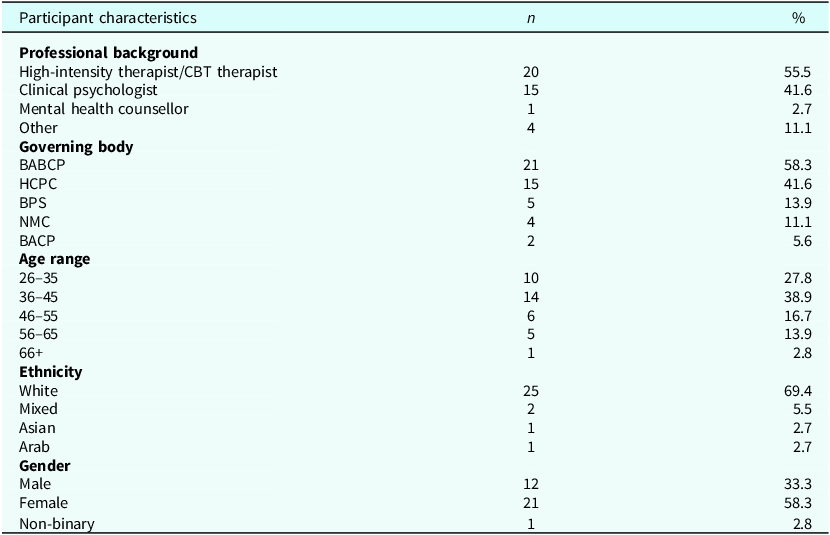
Thirty-six participants took part in Round 1, and 24 took part in Round 2. Twenty participants were high-intensity CBT therapists, 15 were clinical psychologists, and four chose ‘other’, three of which was an addition to selection of one other selection. Twenty-one participants belonged to the BABCP, 15 to HCPC, five to BPS, four to NMC, and two to BACP. Many participants reported belonging to two or more governing bodies and having experience delivering CBT in more than one role. Ten participants were aged between 26 and 35, 14 were aged between 36 and 45, six were aged between 46 and 55, five were aged between 56 and 65, and one participant was age 66 or above. Twenty-five participants identified as White, four participants identified as mixed, one participant identified as Asian, and one identified as Arab. The sample consisted of 12 male participants, 21 female participants, and one non-binary participant. Detailed characteristics of provided demographic data taken at Round 1 is displayed in Table 1.
Therapist characteristics
Experts by experience
Forty participants took part in Round 1, and 31 took part in Round 2. Four participants were aged between 18 and 25, 11 were aged between 26 and 35, 10 were aged between 36 and 45, seven were aged between 46 and 55, seven were aged between 56 and 65, and one participant was aged 66 or above. Twenty-five participants identified as White, and one identified as mixed. Data from one participant was removed following Round 1 prior to analysis due to their answering the inclusion criteria question that indicated they received the intervention as a minor. Some demographic information relating to ethnicity was invalid or missing due to demographic reporting being optional and as such does not total to the number of participants in the study. The sample consisted of 10 male participants, 28 female participants, one non-binary participant, and one participant who listed their gender as ‘other’. Detailed provided participant characteristics taken at Round 1 can be found in Table 2.
Expert by experience characteristics

Round 1
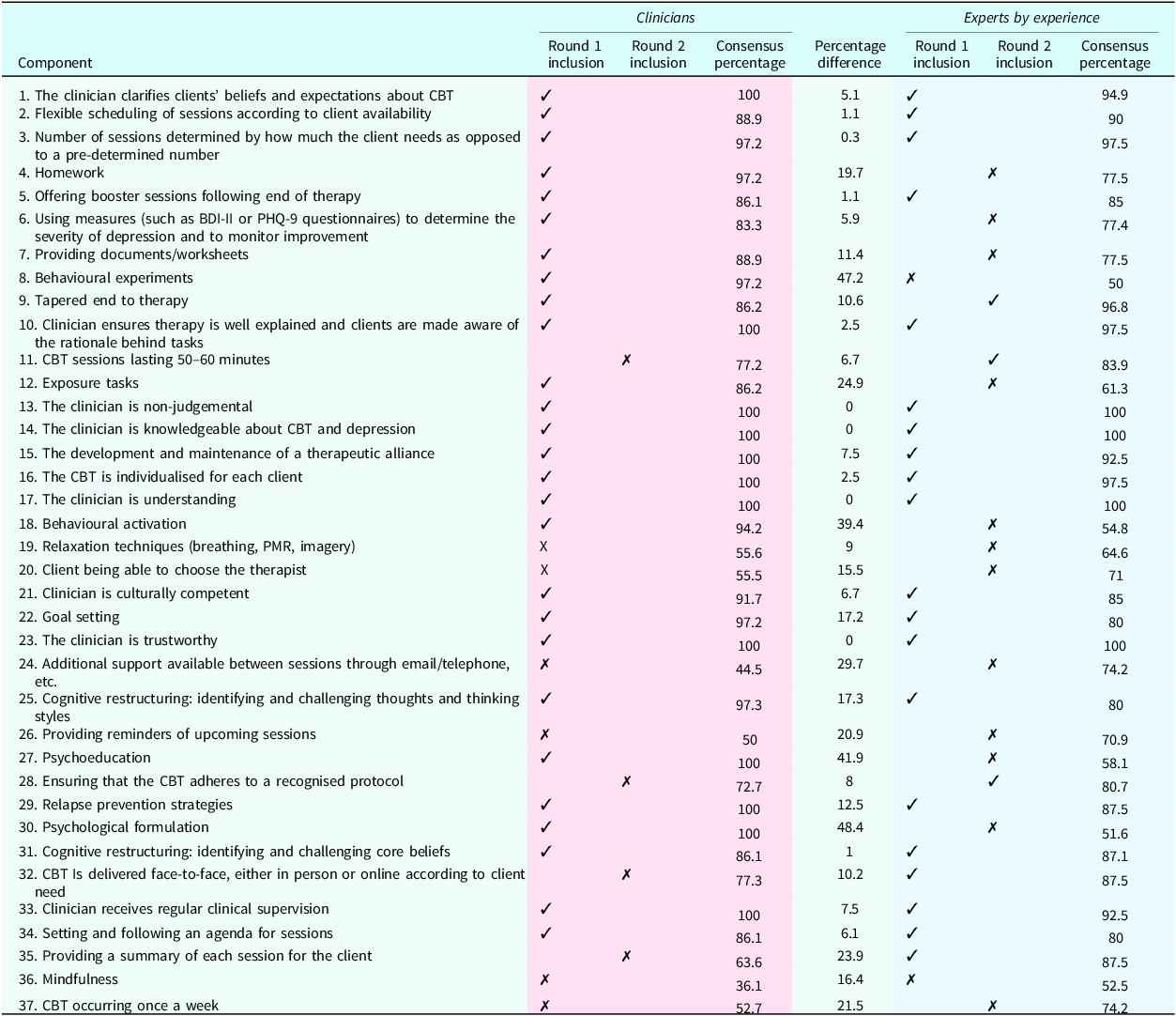
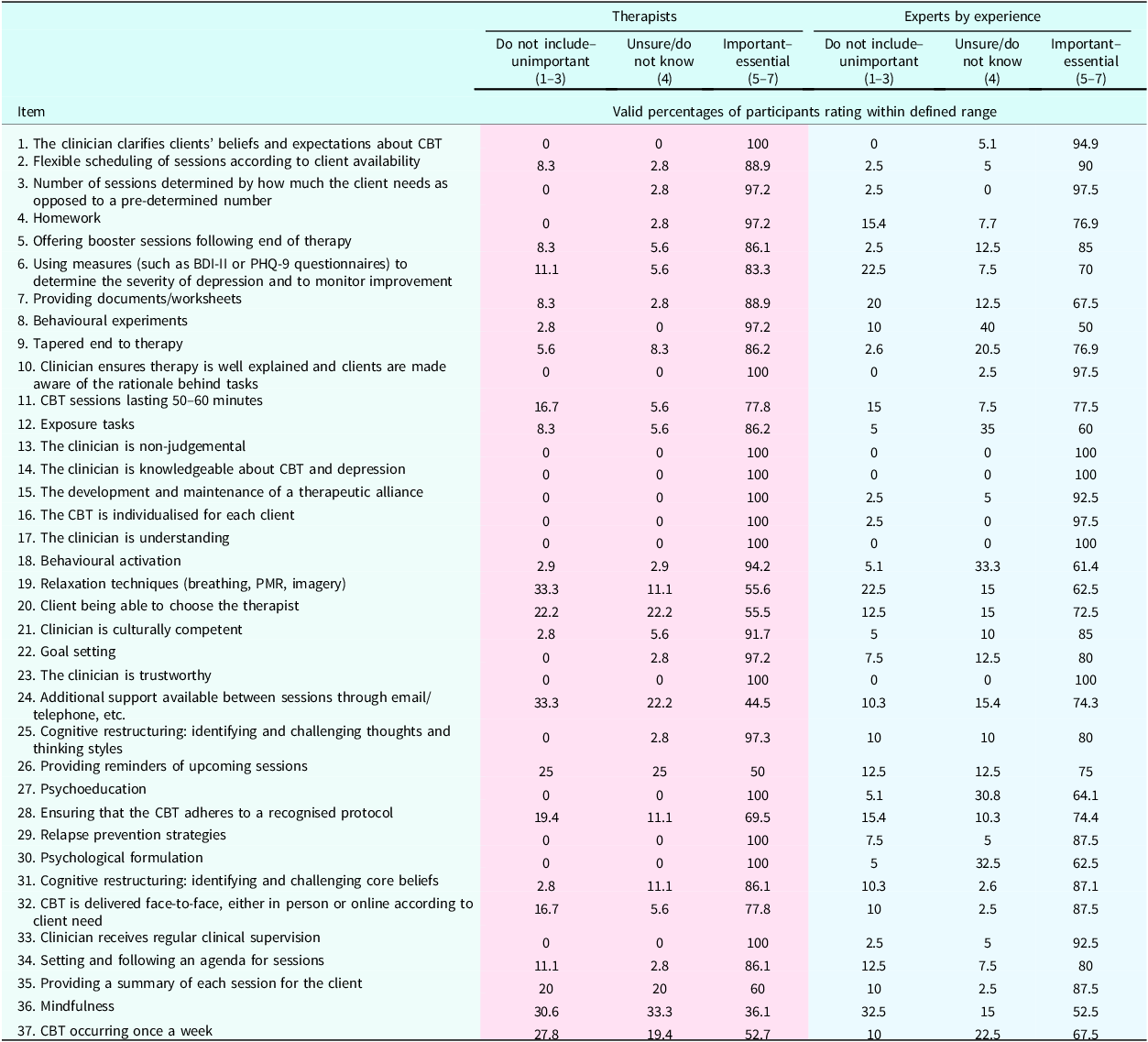
A total of 37 items were included in Round 1. Of these, 27 were deemed important by therapists, and 20 by experts by experience (Table 3). Six items by therapists and two items by EbEs were excluded in Round 1.
Summary of results
Round 2
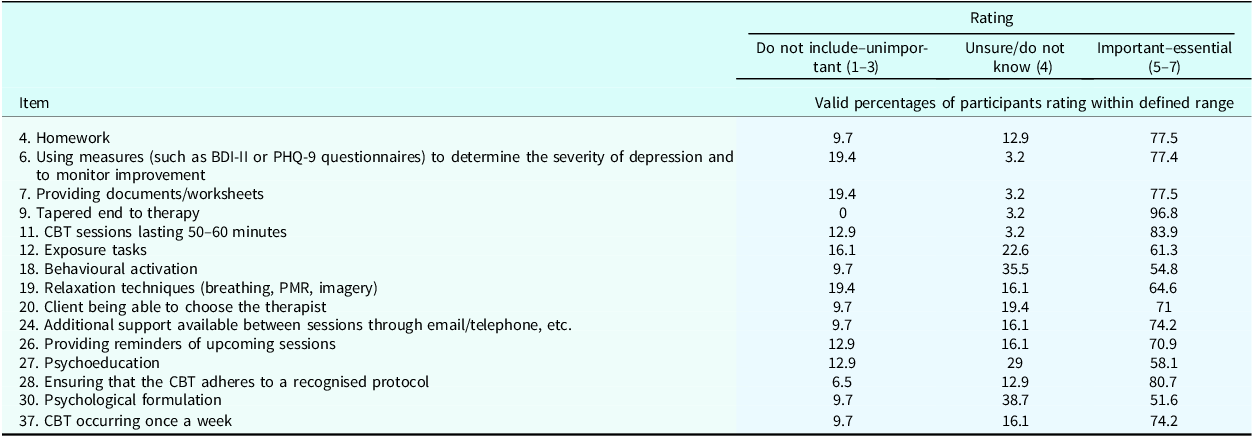
In Round 2, four items were rerated by therapists and 15 items were re-rated by EbEs due to a lack of consensus in Round 1 due to either exclusion due to low rating, or not reaching consensus. No individual free-text responses reached a suggestion rate of 10% and as such no additional items were introduced in Round 2.
Table 3 is a representation of the rating of each component for both groups. If consensus was achieved for a group, a tick symbol (✓) is noted in the appropriate column representing the Round in which it achieved consensus. If a component did not achieve consensus for a group, it is noted by a cross symbol (✗) in the relevant column representing the Round in which it failed to meet consensus. No entry in a cell indicates that consensus was not achieved, but met the minimum criteria to be re-rated in Round 2. As a comparison between the two groups, the middle column shows the percentage difference of the final consensus level achieved between the therapist and EbE sample.
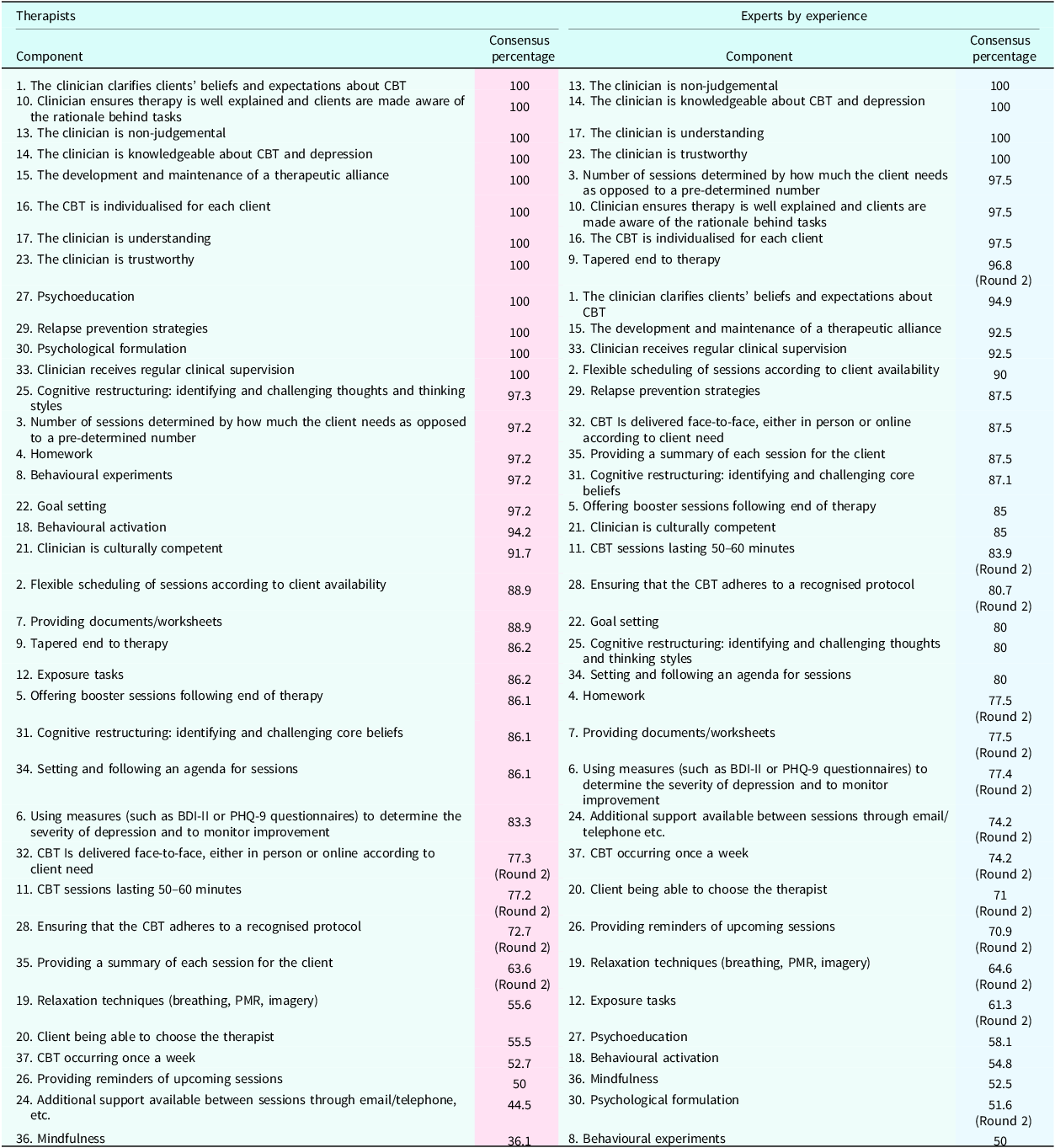
Table 4 depicts the descending order of percentage consensus of items from each group. Items which were re-rated in Round 2 are noted. Table 5 provides the full rating distribution across both groups for Round 1. Table 6 and Table 7 depict the full rating distribution for Round 2 for therapists and EbEs, respectively.
Ranked descending order of consensus
Rating distribution of Round 1
Therapist rating distribution of Round 2

Expert by experience rating distribution of Round 2
Discussion
Summary of main findings
Therapists overall rated most components higher than service users, with only four items being excluded and four items being re-rated at Round 2, compared with 13 exclusions and 15 items being re-rated by the EbE group. There was disparity in perceived importance of numerous components between the groups.
Behavioural activation is a component considered to be a well-established part of the treatment of depression (Mazzucchelli et al., Reference Mazzucchelli, Kane and Rees2009) and has demonstrated efficacy (Parikh et al., Reference Parikh, Quilty, Ravitz, Rosenbluth, Pavlova, Grigoriadis, Velyvis, Kennedy, Lam, MacQueen, Milev, Ravindran and Uher2016). The aim of behavioural activation is to increase user engagement in positively reinforcing activities, with the initial behavioural model being based upon the assumptions that low levels of response-contingent positive reinforcement can contribute to and maintain depression (Dimidjian et al., Reference Dimidjian, Barrera, Martell, Muñoz and Lewinsohn2011). While therapists considered this component important, EbEs did not. The clinical utility, importance, and acceptability of behavioural activation have been confirmed in various studies (Simmonds-Buckley et al., Reference Simmonds-Buckley, Kellett and Waller2019). This could suggest that a clearer rationale for its purpose and effectiveness could be needed at the start of therapy in order to support engagement. However, it is possible that this result is due to the nature of the strategy itself, designed to put the client into situations they may feel unable to engage with naturalistically. Stressful components such as behavioural activation can result in departures from treatment plans, due to either the client’s negative feelings towards the component or from the clinician in the form of therapist drift (Waller, Reference Waller2009). Findings such as this raise important discussions about the difference between outcome and acceptability, weighing the applied real-life value of components that have established clinical efficacy, but may have lower acceptability with users.
Homework was another component that reached consensus in therapist panel but did not in the EbE panel. Homework has been found to be a useful component of CBT, with homework compliance found to be a positive predictor of therapy outcome, and homework assignments producing significant positive effects on therapeutic outcomes (Kazantzis et al., Reference Kazantzis, Lampropoulos and Deane2005). However, Helbig and Fehm (Reference Helbig and Fehm2004) described problems with homework in CBT as ‘rather the rule than the exception’ (p. 298), with therapists reporting problems relating to user completion and compliance in more than 50% of cases, most frequently with users doubting their ability to manage the task and worrying about the difficulty. CBT can be perceived by users to be difficult and demanding (Yarwood et al., Reference Yarwood, Taylor and Angelakis2023). For many, particularly those experiencing more severe difficulties, or for those with limited energy or time due to many factors such as disability, work, or family responsibilities, homework tasks may be challenging to adhere to. Given how useful this component is to therapeutic outcomes, it is important to consider the reasons why recipients may feel unable to regularly complete homework tasks, or may feel homework is unhelpful or unpleasant to them.
There was further disparity with components that ≥80% of therapists rated as important, but did not reach consensus threshold for EbEs. These included: using measures to determine severity of depression and to monitor improvement, exposure tasks, providing documents/worksheets, behavioural experiments, and psychological formulation. The most significant disparity in therapist and EbE rating was behavioural experiments at 97.2% and 50%, respectively. Although they are primarily utilised in the treatment of anxiety disorders, there is some evidence to support the usefulness for behavioural experiments in the treatment of depression (Skilbeck et al., Reference Skilbeck, Spanton and Roylance2020).
Inversely, there were differences that EbEs found important, but therapists did not. Session summaries, for example, help to ensure that key components of the session have been highlighted and understood (Sadeh-Sharvit et al., Reference Sadeh-Sharvit, Rego, Jefroykin, Peretz and Kupershmidt2022), but interestingly their provision was not deemed important by therapists in this sample. This may be due to therapists’ belief of its unimportance, or perhaps its impact is believed to be relatively low when viewed within the context of the additional time needed for clinicians to provide for each client. Remaining differences in perceived importance included: CBT following a recognised protocol, sessions being delivered face-to-face online or in person, and sessions lasting 50–60 minutes. These components are notably all in the hands of the clinician or wider health service, and are not often an option that a recipient can advocate for themselves and their needs. This perhaps speaks to a lack of choice and agency available to therapy users, and consideration of their inclusion could be an important factor in engagement and acceptability. A clear first step for future research is therefore to understand the basis of these differences by establishing why EbEs find certain elements to be more or less important. Qualitative interview studies with those who have received CBT would provide further insights here. Following this, research should establish whether these differences are based on factors such as knowledge, perceived ability to complete certain components or perceptions about therapeutic benefits and whether targeted psychoeducation impacts on EbE views.
There were multiple items which both EbEs and therapists agreed upon; notably, items relating to the content component of cognitive restructuring. This term refers to the collection of strategies aiming to support recipients in identifying, evaluating, and modifying maladaptive thoughts and beliefs (Wenzel, 2017). These strategies are emphasised as a core element in the treatment of many mental health difficulties such as depression, and when utilised in CBT are typically integrated with behavioural methods (Ezawa and Hollon, Reference Ezawa and Hollon2023). However, in this study, receivers of CBT placed less emphasis on importance of behavioural strategies, showing preference towards cognitive components.
All items categorised as clinician factors achieved consensus in both groups. Several of the most highly rated components by both therapists and EbEs related to clinician traits: being trustworthy, understanding, and non-judgemental were rated as important by 100% of participants in both sample groups. These findings mirror evidence from previous research. The synthesising of qualitative data of CBT experiences has found that positive therapist traits and their role in the development and maintenance of the therapeutic alliance were important factors in therapeutic recovery (Yarwood et al., Reference Yarwood, Taylor and Angelakis2024). Therapist knowledge was also rated at 100% by both therapists and EbEs. While this finding might be somewhat unsurprising, establishing the level of consensus systematically was important. Furthermore, findings highlight the relative importance of therapist qualities, as EbEs rated these items higher than any others, including items relating to therapeutic content. The overall consensus ratings highlight the high level of perceived importance of the clinician as a therapeutic factor of CBT.
Mindfulness did not reach consensus for EbEs or therapists; it was the lowest rated component for therapists, and the third lowest rated component for EbEs. While mindfulness is traditionally a feature of third wave therapies, it has become a common feature of therapeutic practice (Arthington, Reference Arthington2016). While there are no data to support direct reasoning for this, two possibilities for this agreed lack of importance may firstly be the belief that it is not a traditional feature of second-wave CBT, or perhaps a belief in its inefficacy in the treatment of depression. There is much research supporting the efficacy of mindfulness in the treatment of depression (Hofmann et al., Reference Hofmann, Sawyer, Witt and Oh2010; McCarney et al., Reference McCarney, Schulz and Grey2012); however, both therapy recipients and therapists in our study did not reach a consensus on its importance. One reason for this might be that mindfulness techniques often take time to learn, appreciate, or to incorporate into regular practice, even if the exercises themselves are short in duration. Mindfulness is often misperceived as a simple technique, which belies both the skills and complexity needed to benefit from mindfulness (Russell and Siegmund, Reference Russell and Siegmund2016). In short-term therapies, there may simply not be enough time to properly introduce, practise, and integrate mindfulness into the process. As a result, both therapists and clients might view mindfulness as less impactful when the therapy is so brief. England’s Talking Therapies service provided on average only 8.3 sessions for CBT in 2022–2023 (NHS England, Reference NHS2024), leaving little time for mindfulness. However, more research is needed to explore these hypotheses, and would benefit from additional qualitative inquiry in order to better understand context and experiences behind the quantitative data.
Comparison with similar research on treatment components
A randomised optimisation trial based on 767 adults with depressive symptoms found no significant differences among six groups of participants receiving different components of internet-delivered CBT for depression at both post-treatment and 6-month follow-up (Watkins et al., Reference Watkins, Newbold, Tester-Jones and Collins2023). The only active CBT component that showed a small but significant reduction in depression at 6 months was absorption training, which focuses on enhancing engagement with activities. This was the first large-scale study to examine the effectiveness of CBT components that were delivered online using a factorial design. Furthermore, the study’s findings suggested that internet-delivered CBT could be as effective as traditional CBT.
Complementing these findings, a network meta-analysis (Angelakis et al., Reference Angelakis, Huggett, Gooding, Panagioti and Hodkinson2022) compared core, complex, and ultra-complex CBT protocols, demonstrating that while all treatments were effective in reducing depression post-treatment, only complex and ultra-complex protocols, incorporating additional components to cognitive restructuring and behavioural activation, maintained their benefits beyond 26 weeks. Ultra-complex CBT, which was based on at least four different therapeutic components, was particularly beneficial for individuals with co-morbid conditions and those from lower socioeconomic backgrounds, and its benefits persisted over time.
Our findings, examining both therapist and expert by experience perspectives on CBT, also highlighted the importance of therapists’ qualities, such as being knowledgeable and trustworthy. A notable difference between our findings and those of Watkins et al. (Reference Watkins, Newbold, Tester-Jones and Collins2023) was that, although absorption training was found to be the only significant treatment component (sharing similarities with mindfulness, as both focus on engagement in specific tasks occurring in the present moment), mindfulness in our study was judged as less important by both therapists and experts by experience. This is an interesting finding, and more research is needed to determine whether absorption training and mindfulness could be both important and acceptable therapeutic components, in addition to being effective in treating depression.
When juxtaposed with our study’s findings, the Angelakis et al. (Reference Angelakis, Huggett, Gooding, Panagioti and Hodkinson2022) results emphasised an important distinction: while therapists prioritised established core components like behavioural activation, recipient perspectives from our study indicated that these elements may not be viewed as essential. This raises questions about whether traditional CBT components, such as homework and behavioural activation, are always the most impactful or whether their effectiveness is context-dependent, particularly for recipients with varying levels of engagement or specific socioeconomic challenges. Furthermore, the findings from Angelakis et al. (Reference Angelakis, Huggett, Gooding, Panagioti and Hodkinson2022) reinforce the importance of broadening CBT frameworks to include more diverse and context-sensitive therapeutic components, ultimately improving the acceptability and long-term efficacy of CBT interventions.
Strengths and weaknesses
The Delphi method itself typically utilises professional experts in seeking to gain a consensus. This research is important in that it contributes to a comparatively small existing literature pool of Delphi studies which value the perspective and knowledge of individuals with lived experience of the topic such as Law and Morrison’s (Reference Law and Morrison2014) recovery in psychosis study, and Ropaj et al.’s (Reference Ropaj, Haddock and Pratt2023) recovery from suicidal ideations study. Furthermore, this study is one of very few to deviate from the traditional utilisation of the method in order to obtain one consensus, but rather views the findings comparatively in order to better understand the perspectives of people with lived experience against those of professional experts. This includes Richards et al. (Reference Richards, Woolrych, Allen and Schmidt2022) who compared the perspectives of people with lived experience of eating disorders and clinicians on priorities for eating disorder services, and Krysinska et al. (Reference Krysinska, Ozols, Ross, Andriessen, Banfield, McGrath, Edwards, Hawgood, Kõlves, Ross and Pirkis2023) who explored best practice for involvement of people with lived experience of suicide in suicide research, including both suicide researchers and individuals who themselves had lived experience of suicide.
The first weakness to consider is inherent to the Delphi approach itself. While the method has clear value, there is no one standardised way to measure consensus, and it has been criticised as being unscientific (Yousuf, Reference Yousuf2007). This is displayed through the literature through varying percentage cut-offs and analysis methods, with almost no single modified Delphi being conducted the same way (Shang, Reference Shang2023). Analysis and consensus measurement for this study were carefully considered based upon multiple factors including the nature of the topic, previous published literature, and PPI contributions. While there are methodological issues with the Delphi method as a whole, the process has inherent value. The Delphi method is a format that enables anonymity, creativity and honesty, which can contribute to the understanding and resolution of problems (Fink-Hafner et al., Reference Fink-Hafner, Dagen, Doušak, Novak and Hafner-Fink2019). Similarly, there is no encompassing definition of the essential components of CBT for depression. Efforts were made to capture a comprehensive range of key depression-focused CBT practices while keeping the item list minimal in order to reduce participant fatigue and time burden. However, in doing so, this may have resulted in components that may be important being omitted from the list. This was accounted for by providing both groups of participants an open text response to suggest missing components, although none were identified this way.
The study would be strengthened with more detailed characteristics of therapist practice including time as a therapist and how many clients with depression they have treated, as well as additional EbE information pertaining to the length and nature of the intervention received. The therapist sample may skew towards those who work within private practice due to the amount of recruitment from independent therapists who listed their practice publicly. As it was not possible to determine the exact reach or representativeness of recruitment for either the therapists or the EbEs, this is a potential source of bias. Selection bias was reduced through a lack of incentives to take part, with all respondents in both panels being volunteers who were not renumerated for their participation. A suggested area of future research would be to explore the similarities and differences in perceived importance of therapeutic components in those working within private and public health settings; additionally, examination of the difference between those self-funding CBT and those receiving National Health Service (NHS) delivered therapy. The difference between the UK’s public health delivery and other countries may also make these results less generalisable to other countries for which CBT is prescribed differently.
Related to this is the fact that EbEs themselves could have had diverse experiences of CBT. For practical reasons connected to recruitment, details of participants’ own experiences were not gathered. While participants were asked to focus on their perspective as either a deliverer or recipient to account for those who may have met the inclusion criteria for both samples, the dual ‘patient–therapist’ identity may be difficult to separate. Future Delphi studies could include this type of information, and other forms of research such as qualitative interviews would be ideal to explore this in depth.
The findings of the study leave room for interpretation. While participants were asked to rate items by importance based on their personal beliefs and experiences, importance can mean different things to different people. A lack of agreement on importance does not in and of itself mean a component is unacceptable, nor does an opinion on importance tell us how well a component was understood. The use of participants selecting ‘unsure/do not know’ on several questions made interpretation of the analysis on those items difficult, particularly responses from EbEs. This could be attributed to participants being unsure about or having mixed feelings about the component (such as ‘I hated doing it, but it helped me’, for example), or being unfamiliar with an item due to lack of inclusion in their own intervention. Understanding of CBT components and terminology was supported through the inclusion of a plain-English glossary of terms (Appendix B in the Supplementary material). Additionally, items with therapeutic terminology such as CBT following a recognised protocol, relapse prevention, clinical supervision, and therapeutic alliance met consensus when rated by EbEs, indicating a strong understanding of the terminology and components. These are further justifications for future research in this area to utilise qualitative inquiry.
Conclusion
Opinions of therapists and experts by experience were identical in some areas, namely the very high importance of positively regarded therapist qualities such as being knowledgeable, non-judgemental, understanding, and trustworthy. Both EbEs and therapists agreed on the importance of cognitive restructuring strategies. In other areas, opinions on importance of components differed greatly. Notably, two major CBT for depression components, homework and behavioural activation, were not deemed important by CBT recipients but were by therapists. Items that met consensus for inclusion by EbEs which were not perceived as important by therapists such as face-to-face contact, 50–60 minute sessions, and summaries being provided to clients should be considered as ways in which to improve quality and acceptability of CBT for users. Mindfulness did not reach consensus in either group. Further qualitative research in the area is recommend in order to better understand exactly why these components were perceived as they were. This study was an important step towards greater inclusion and acceptance of people with mental health difficulties being regarded as experts of their own experience.
Key practice points
-
(1) Recipients of CBT have similar beliefs to deliverers of CBT in the importance of positive therapist qualities in the treatment of depression, as well as both groups being in agreement on the importance of the core components of cognitive restructuring thoughts and core beliefs.
-
(2) Opinions of recipients and therapists varied in multiple areas including the importance content components such as psychoeducation, behavioural activation, behavioural experiments, exposure tasks, and homework as well as on multiple process components such as session summaries, session length, and delivery format.
-
(3) Differences should be considered with the view towards improving the delivery of CBT to better support recipients to encourage engagement, acceptability, and ultimately improve treatment outcomes.
Supplementary material
The supplementary material for this article can be found at https://doi.org/10.1017/S1754470X25000091
Data availability statement
Data that supports the findings of this research are available from B.Y., the corresponding author, upon request.
Acknowledgements
Thank you to all the participants who took part in this research, and to the people and organisations who supported recruitment.
Author contributions
Becky Yarwood: Conceptualization (lead), Data curation (lead), Formal analysis (lead), Methodology (lead), Visualization (lead), Writing - original draft (lead), Writing - review & editing (lead); Ioannis Angelakis: Conceptualization (supporting), Methodology (supporting), Supervision (supporting), Writing - review & editing (supporting); Rachel Taylor: Conceptualization (supporting), Methodology (supporting), Supervision (supporting), Writing - review & editing (supporting).
Financial support
This research received no specific grant from any funding agency, commercial or not-for-profit sectors.
Competing interests
The authors declare none.
Ethical standards
Authors abided by the Ethical Principles of Psychologists and Code of Conduct as set out by the BABCP and BPS. Ethical approval for this research study was granted by the University of South Wales (130304HR). Participants provided consent to take part and for the results of the research study to be published.


 Open access


Comments
No Comments have been published for this article.