


Introduction
Indonesia’s banking sector represents one of Southeast Asia’s most dynamic financial ecosystems, comprising 91 commercial banks serving a population of approximately 270 million people (Qomariyah & Priandoyo, Reference Qomariyah and Priandoyo2023; Sumarta, Prabowo & Saputro, Reference Sumarta, Prabowo and Saputro2022). The sector’s digital transformation has accelerated dramatically, with mobile banking transactions projected to grow 52% in 2025 and QRIS transactions surging 170.1% year-over-year (CNBC Indonesia, 2025). This transformation occurs within a complex regulatory framework governed by the Otoritas Jasa Keuangan (OJK), which has mandated annual digital maturity assessments and launched initiatives such as the Indonesia Anti-Scam Center to ensure secure digital banking adoption (OJK, 2025). However, this rapid digitalization unfolds against significant cultural and infrastructural challenges, with Indonesia’s Financial Literacy index standing at only 49.68% and pronounced digital divides between urban areas (75% adoption) and rural communities (42% adoption), creating disparate workforce readiness levels across the archipelago’s diverse landscape (Fitriyanti & Setiorini, Reference Fitriyanti and Setiorini2024; PSHK, 2024).
The digital transformation in Indonesian banking extends beyond simple technology adoption, necessitating comprehensive rethinking of business models, operational processes, and workforce capabilities (Kitsios, Giatsidis & Kamariotou, Reference Kitsios, Giatsidis and Kamariotou2021). Mobile banking has fundamentally altered customer expectations, with 78% of consumers now actively using digital banking services compared to 57% in 2017, pushing banks to deliver seamless experiences while maintaining robust cybersecurity measures (AASMR, 2022). This technological shift creates significant workforce displacement concerns, as automation and artificial intelligence increasingly substitute routine banking tasks, generating skill gaps between employees who can adapt to digital competencies and those who struggle with technological proficiency (Seppänen, Ukko & Saunila, Reference Seppänen, Ukko and Saunila2025; Wu & Deng, Reference Wu and Deng2024). Employee engagement challenges emerge from resistance to change driven by fears of job loss and stress associated with learning complex new technologies, requiring comprehensive strategies to mitigate resistance and maintain organizational commitment (Valtonen & Holopainen, Reference Valtonen and Holopainen2025).
Most critically, these pressures threaten the meaningfulness of work itself, as digital transformation can diminish employees’ sense of purpose when automation reduces the scope of human action and personal connection that traditionally characterized banking relationships (Hardering, Reference Hardering2021). The shift from relationship-based banking to automated digital services particularly challenges employees who built careers on personal customer interactions, potentially creating disengagement as the human element becomes increasingly secondary to technological efficiency (Arora & Garg, Reference Arora and Garg2025). Meaningful work, characterized by a sense of purpose, value, and connection to tasks, serves as the foundation of job satisfaction and employee motivation, which are essential components in maintaining organizational commitment amidst digital transformation (Albort-Morant, Leal-Rodríguez, Fernández-Rodríguez & Ariza-Montes, Reference Albort-Morant, Leal-Rodríguez, Fernández-Rodríguez and Ariza-Montes2018).
Leadership emerges as crucial in bridging the gap between technological advancement and human engagement within banking organizations (McCarthy, Sammon & Alhassan, Reference McCarthy, Sammon and Alhassan2021). Bank leaders must actively shape organizational cultures that value employee contributions while fostering belonging and purpose amid rapid technological change, emphasizing collaboration, continuous learning, and empowerment to enable employees to embrace transformation and take ownership of evolving roles (Ajayi-Nifise, Reference Ajayi-Nifise2024; Winasis, Djumarno, Riyanto & Ariyanto, Reference Winasis, Djumarno, Riyanto and Ariyanto2021). However, existing research on digital banking transformation predominantly focuses on operational and technological dimensions while neglecting human-centric leadership approaches specific to emerging market contexts like Indonesia, where unique socio-cultural dynamics – including archipelago logistics, multilingual workforce requirements, and Islamic banking principles – create leadership requirements that warrant context-specific exploration beyond conventional Western frameworks.
While Winasis et al. (Reference Winasis, Djumarno, Riyanto and Ariyanto2021) examined transformational leadership climate in Indonesian banking, their focus remained on general employee engagement rather than meaningful work creation during digital transformation. International studies such as Frémeaux and Pavageau (Reference Frémeaux and Pavageau2022) provide frameworks for meaningful leadership but lack contextual adaptation for Indonesia’s unique regulatory environment under OJK oversight, cultural factors including collectivism in digital adoption, and institutional differences between state-owned and private banks. This gap is particularly significant given that only 12% of Indonesian digital leadership studies incorporate local cultural parameters compared to 61% in Singaporean research, highlighting the need for leadership frameworks addressing Indonesia’s specific contextual requirements (Migration Letters, 2023).
This study addresses three critical gaps: (1) the absence of Indonesian-specific research on meaningful work creation during digital banking transformation, (2) limited integration of human-centric leadership approaches with technological implementation in emerging market contexts, and (3) insufficient understanding of how cultural and regulatory contexts shape leadership practices for employee engagement during digital transformation. The research explores three key questions: examining fundamental factors that sustain banks with cutting-edge technology (RQ1), investigating workforce readiness characteristics in digitally transformed Indonesian banks (RQ2), and exploring factors necessary for expediting workforce growth while sustaining business operations (RQ3).
This paper argues that Indonesian bank leaders play a pivotal role in fostering meaningful work during digital transformation by integrating strategies such as tech-forward leadership, collaborative organizational design, and learning ecosystem creation that account for local cultural and regulatory contexts. The research explores how leadership can ensure that as Indonesian banks embrace technological advancements, they preserve human factors that drive motivation, satisfaction, and ultimately successful digital transformation within the archipelago’s unique socio-economic landscape.
Theoretical framework
Future of work in digital banking
The Future of Work paradigm fundamentally reshapes how banking operations are conceived, executed, and experienced by employees. Digital transformation has accelerated the shift toward intelligent digital systems that simplify and enrich customer journeys while introducing new functional, experiential, and intelligent capabilities (Dutta, Pramanik, Datta & Kirtania, Reference Dutta, Pramanik, Datta and Kirtania2023). This transformation extends beyond technological adoption to encompass comprehensive restructuring of business models, processes, and workforce dynamics, creating both opportunities and challenges for meaningful work creation.
Human–technology collaboration emerges as a critical component in this evolving landscape, where, despite increasing automation, human skills remain essential for supervision, adjustment, maintenance, and improvement of new technologies (Das & Chaudhuri, Reference Das and Chaudhuri2020). Skills evolution requirements in digital banking demand both technical competencies, such as coding, data analysis, and AI literacy, alongside enhanced non-digital skills, including communication, problem-solving, adaptability, and teamwork (Subrahmanyam, Reference Subrahmanyam2025). This evolution creates opportunities for leaders to foster meaningful work by providing continuous learning pathways that align with employees’ career aspirations while meeting organizational needs.
HI-TOP framework application
The human–individual–technology–organization–process (HI-TOP) model provides a structured approach for understanding how leadership integrates multiple dimensions to create meaningful work environments during digital transformation. This framework is particularly relevant for analyzing how Indonesian bank leaders navigate the complex interactions between technological advancement and human engagement across different organizational levels. The human dimension emphasizes human–computer interaction in mobile banking, where effective customer service delivery requires employees to meaningfully engage with both technology and customers, while the individual dimension focuses on phygital banking integration that combines physical and digital services to ensure positive customer journeys (Bouzari, Gholampour & Ebrahimi, Reference Bouzari, Gholampour and Ebrahimi2020; Santosh, Reference Santosh2019).
Technology integration within the HI-TOP framework involves adopting advanced technologies such as AI and blockchain to enhance operational efficiency, while the organization dimension addresses how new technology-enabled products transform existing structures in ways that preserve employee engagement (Almustafa, Assaf & Allahham, Reference Almustafa, Assaf and Allahham2023; Bada, Omojokun, Adekoya, Adesoji & Quaye, Reference Bada, Omojokun, Adekoya, Adesoji and Quaye2004). Process optimization creates efficiency improvements while requiring leaders to ensure that streamlined processes still provide opportunities for employee growth and meaningful contribution. Leadership plays a critical role across all dimensions through top management support for fostering data-driven cultures and technology adoption that directly impacts how employees experience their work as meaningful and purposeful (Horani, Khatibi, AL-Soud, Haque & Azam, Reference Horani, Khatibi, AL-Soud, Haque and Azam2023).
Meaningful work theory
Meaningful work theory provides the psychological foundation for understanding how employees experience purpose and significance in their roles during digital transformation. Psychological meaningfulness, rooted in self-determination theory, emphasizes the satisfaction of basic psychological needs including autonomy, competence, relatedness, and beneficence, with autonomy and beneficence emerging as particularly strong predictors of meaningful work (Martela et al., Reference Martela, Gómez, Unanue, Araya, Bravo and Espejo2021; Martela & Riekki, Reference Martela and Riekki2018). This theoretical foundation is crucial for understanding how Indonesian bank leaders can maintain employee engagement while implementing digital transformation initiatives that might otherwise threaten traditional sources of work meaning.
Purpose, significance, and growth constitute the core dimensions through which employees experience meaningful work, where purpose provides direction and intentionality, significance involves producing something of lasting value, and growth fosters personal development and resilience (Batuchina, Iždonaitė-Medžiūnienė & Lecaj, Reference Batuchina, Iždonaitė-Medžiūnienė and Lecaj2025; Martela & Pessi, Reference Martela and Pessi2018). Digital context adaptations address how digitization affects work routines and autonomy, with digital work categorized into digital-enabled, digital-engaged, and digital-embedded work, each requiring specific leadership approaches to preserve meaningfulness. The digital era introduces new pathways to meaningful work through self-agency and other-agency, which become crucial in technology-enhanced workspaces and require leaders to be intentional about preserving opportunities for meaningful engagement (Arora & Garg, Reference Arora and Garg2025; Coetzee, Ferreira & Potgieter, Reference Coetzee, Ferreira and Potgieter2023).
Digital leadership typologies
Digital leadership typologies provide the behavioral and strategic frameworks through which leaders can implement the theoretical principles to create meaningful work environments during digital transformation. Agile leadership emphasizes adaptive capability through open communication, shared goals, and mutual accountability, enabling swift decision-making and organizational adaptability while supporting team autonomy and psychological safety (Bhardwaj & Mahida, Reference Bhardwaj and Mahida2024). Tech-forward leadership involves integrating disruptive technologies such as AI, blockchain, and IoT into business strategies while fostering cultures that embrace innovation, requiring digital literacy, strategic vision, and data-driven decision-making skills to help employees connect their evolving roles to organizational purposes (Kaiyai, Kenaphoom & Pommarang, Reference Kaiyai, Kenaphoom and Pommarang2024; Mishra & Kaurav, Reference Mishra and Kaurav2024).
Emotional intelligence leadership focuses on self-awareness, self-regulation, motivation, empathy, and social skills to create positive work environments and improve job satisfaction, which is crucial for managing virtual teams and maintaining human connections in digital work environments (Li & Zahran, Reference Li and Zahran2014; Thawabieh, Reference Thawabieh2024). Inclusive leadership ensures equity during digital transition by promoting open communication and addressing challenges such as digital literacy gaps, which is particularly relevant for Indonesian banks given the diverse technological proficiency levels across the archipelago (Uzorka & Kalabuki, Reference Uzorka and Kalabuki2025). These four leadership approaches work synergistically to address the complex requirements of digital transformation while preserving and enhancing meaningful work experiences for employees.
Previous studies on integrated leadership frameworks
Existing research on integrated leadership frameworks in digital transformation highlights the growing need for multifaceted leadership approaches that balance technological advancement with human-centered outcomes (Table 1). Živković (Reference Živković2022) introduced an integrative leadership competency framework emphasizing vision, innovation, flexibility, and digital technology understanding as essential competencies, laying the groundwork for recognizing the role of multiple intelligences, continuous learning, and cross-boundary collaboration in effective digital leadership. Building on this, studies have identified leadership styles such as transformational leadership as key to fostering creativity and innovation, particularly in high-engagement sectors (Londono-Proano, Reference Londono-Proano2022; Prince, Reference Prince2017). The competing values framework (CVF) has been adapted for digital contexts, requiring leaders to modify traditional roles to navigate transformation effectively (Weber, Krehl & Büttgen, Reference Weber, Krehl and Büttgen2022), while digital maturity models support organizations in assessing readiness and guiding adaptable leadership (Kokot, Kokotec & Calopa, Reference Kokot, Kokotec and Calopa2021; Nilkant, Kumar, Kiran & Sreenath, Reference Nilkant, Kumar, Kiran and Sreenath2025).
Integrated leadership frameworks

However, existing frameworks demonstrate significant limitations when applied to emerging market contexts, particularly regarding meaningful work creation during digital transformation. While Winasis et al. (Reference Winasis, Djumarno, Riyanto and Ariyanto2021) examined transformational leadership climate in Indonesian banking, their focus remained on general employee engagement rather than the specific mechanisms through which leaders create meaningful work experiences. Similarly, international frameworks such as those proposed by Weber et al. (Reference Weber, Krehl and Büttgen2022) and Schiuma et al. (Reference Schiuma, Santarsiero, Carlucci and Jarrar2024) provide comprehensive competency models but lack contextual adaptation for unique regulatory environments, cultural factors, and digital literacy disparities characteristic of Indonesian banking. The gap between technological capability development and meaningful work preservation represents a critical area where existing integrated frameworks require enhancement, particularly in addressing how leaders can simultaneously drive digital advancement while ensuring employees continue to experience purpose, significance, and growth in their evolving roles.
Theoretical integration
The integration of four theoretical perspectives creates a comprehensive framework for understanding leadership-mediated meaningful work creation in Indonesian banking digital transformation, as illustrated in Fig. 1. The conceptual model demonstrates how future framework theory provides the foundational context for technology–human collaboration, skills evolution, work transformation, and organizational adaptation. The HI-TOP framework offers a multi-dimensional integration approach encompassing HI-TOP interactions that structure how leaders navigate complex digital environments. Digital leadership theory contributes agile and tech-forward leadership capabilities, emotional intelligence, inclusive leadership practices, and adaptive capability development. Meaningful work theory provides the psychological foundation through purpose and significance, autonomy and growth, competence and mastery, beneficence, and psychological safety dimensions. The convergence of these four theoretical domains at the center creates leadership-mediated meaningful work creation specifically adapted for Indonesian banking contexts.
Theoretical integration framework for leadership-mediated meaningful work creation in Indonesian banking digital transformation.

This conceptual model proposes a sequential pathway where effective leadership practices directly influence employees’ experience of meaningful work, which subsequently drives positive organizational outcomes. Leadership practices characterized by the integration of agile responsiveness, technological proficiency, emotional intelligence, and inclusive approaches create work environments where employees experience enhanced autonomy, competence, relatedness, and beneficence. When employees perceive their work as meaningful through a clear purpose, significant contribution, and growth opportunities, they demonstrate increased engagement, innovation, and adaptability that directly contribute to successful digital transformation outcomes. This leadership → meaningful work → organizational outcomes pathway suggests that sustainable digital transformation in banking requires leaders who can simultaneously drive technological advancement while preserving and enhancing the human elements that make work purposeful and engaging for employees.
Indonesian contextual factors serve as critical moderating variables that shape how this leadership-meaningful work outcomes pathway operates in practice. The unique regulatory environment governed by OJK, characterized by specific digital banking requirements and Islamic banking principles, influences how leaders implement technological innovations while maintaining meaningful work experiences. Cultural factors, including collectivism in decision-making and relationship-oriented work preferences, require leadership approaches that balance individual autonomy with communal values. The significant digital literacy gaps (49.68% financial literacy index) and urban–rural digital divides (75% vs. 42% adoption rates) necessitate inclusive leadership practices that ensure equitable access to meaningful digital work opportunities across Indonesia’s diverse archipelago. Geographic challenges related to archipelago logistics and multilingual workforce requirements further require leaders to adapt their meaningful work creation strategies to local contexts while maintaining organizational coherence and transformation momentum.
Methodology
This study employs qualitative research methods to investigate how bank leaders foster meaningful work during digital transformation in Indonesian banking, specifically addressing the three research questions regarding fundamental technology factors, workforce readiness characteristics, and growth acceleration strategies. The qualitative approach is particularly suited for this investigation as it enables in-depth exploration of complex leadership phenomena that require a nuanced understanding of both technological and human dynamics. Following Daft and Lewin’s (Reference Daft and Lewin1993) prescription for research on organizational forms in transformation contexts, this study employs grounded research methods that allow for theory development rather than hypothesis testing, enabling the emergence of contextually relevant insights about leadership practices in Indonesian banking digital transformation.
Data collection
The choice of qualitative methodology is justified by the exploratory nature of this research and the need to understand the complex interplay between leadership practices and meaningful work creation in digitally transforming organizations. The research seeks to generate rich, detailed insights into the strategic considerations and leadership approaches necessary for Indonesian banks to successfully balance digital advancement with employee engagement. The complexity of digital transformation in Indonesian banking, characterized by unique regulatory requirements under OJK oversight, diverse digital literacy levels across the archipelago, and cultural factors influencing workplace dynamics, necessitates an inductive approach that can accommodate emerging themes and unexpected insights.
The study employs purposive sampling combined with snowball techniques to identify senior banking leaders who possess specialized knowledge and experience directly relevant to digital transformation and meaningful work creation. The sampling approach follows established qualitative research principles that prioritize information richness over statistical representativeness, ensuring that participants can provide valuable insights into the phenomena under investigation. Participants are selected based on three primary criteria: strategic management expertise requiring senior leadership positions with a comprehensive understanding of digital transformation; experience in digital transformation mandating employment in banks actively transitioning from traditional to digital service models; and industry leadership ensuring representation from organizations at the forefront of digital banking innovations in Indonesia.
Data collection centers on semi-structured interviews with senior banking executives, designed to explore leadership strategies for maintaining meaningful work while implementing digital transformation initiatives. The semi-structured format combines the advantages of structured interviews with the adaptability needed to delve deeper into specific topics based on participants’ responses and emerging themes. Interview protocols were developed focusing on how leaders address workforce readiness, technology integration, and sustainable growth while preserving employee engagement and work meaningfulness. Interviews were conducted between December 2022 and February 2023, with sessions lasting 60–90 min each, conducted both on-site and online to accommodate the senior level and geographical distribution of participants across Indonesia.
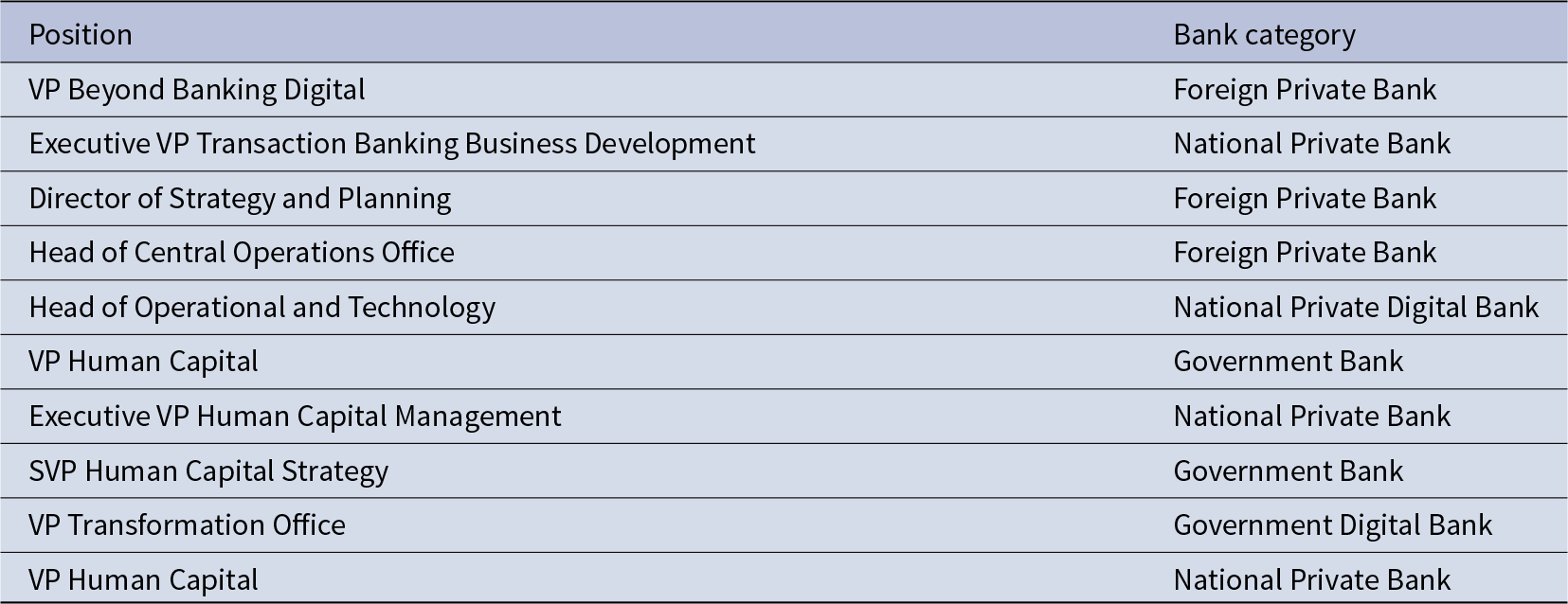
The final sample comprises 10 senior executives from 8 prominent Indonesian banks, representing a mix of government-owned, national private, foreign private, and digital bank categories (Table 2). This diversity ensures the capture of different organizational contexts, regulatory environments, and transformation approaches while maintaining focus on leadership practices for meaningful work creation. The sample size aligns with established standards for qualitative research saturation, as empirical guidance suggests that 9–17 interviews are typically sufficient to reach thematic saturation in studies with relatively homogeneous participant groups (Wutich, Beresford & Bernard, Reference Wutich, Beresford and Bernard2024), while data saturation typically occurs around the 10–15-interview mark when new data do not add meaningful or significantly new insights (Turner-Bowker et al., Reference Turner-Bowker, Lamoureux, Stokes, Litcher-Kelly, Galipeau, Yaworsky and Shields2018). Theoretical saturation was achieved when subsequent interviews yielded no new themes or insights regarding leadership approaches to fostering meaningful work during digital transformation. To enhance data credibility and reliability, triangulation was employed through multiple data sources, including interview transcripts, organizational documents such as digital transformation strategies and HR policies, and industry reports about Indonesian banking digital initiatives.
Interview participants
Data analysis process
The data analysis follows the Gioia methodology (Gioia, Corley & Hamilton, Reference Gioia, Corley and Hamilton2013), a systematic approach to inductive concept development that demonstrates clear connections between data and emergent theory while preserving informant authenticity. The analysis progressed through three main analytical phases: first-order analysis using informant-centric terms, second-order analysis developing theory-centric themes, and aggregate dimension formation creating overarching theoretical constructs. This progression, as illustrated in Fig. 2, enables systematic movement from raw interview data to theoretical insights while maintaining qualitative rigor.
Data structure.

The analysis began with a comprehensive examination of interview transcripts, field notes, and organizational documents to build a narrative database of leadership practices during digital transformation. Following the Gioia methodology’s emphasis on giving extraordinary voice to informants as knowledgeable agents, the first-order analysis preserved the integrity of informant terminology without imposing prior theoretical constructs, allowing discovery of new concepts rather than affirmation of existing ones (Gioia, Corley & Hamilton, Reference Gioia, Corley and Hamilton2013). Initial first-order codes captured concrete leadership practices such as experimentation encouragement, AI integration strategies, virtual team management approaches, and regulatory compliance balancing using informants’ own language. These codes were then systematically organized into second-order theory-centric themes through iterative analysis that searched for similarities and differences among first-order categories, eventually identifying six primary themes: agile leadership, tech-forward leadership, emotional intelligence, co-creation approaches, recognition and empowerment, and regulatory–ethical leadership balance. The analysis revealed that leadership practices occurred at three distinct organizational levels, constituting aggregate dimensions – micro level (individual behaviors), meso level (team/departmental leadership), and macro level (organizational-wide strategic leadership) – with each level associated with particular meaningful work outcomes.
The analytical process culminated in assembling all first-order terms, second-order themes, and aggregate dimensions into a comprehensive data structure, which serves as the pivotal step in the Gioia methodology for demonstrating progression from raw data to theoretical insights. This static data structure was then transformed into a dynamic grounded theory model by formulating relationships among second-order concepts, examining how the six leadership themes interconnect to create meaningful work experiences during digital transformation. Framework validation occurred through member checking with three senior executives and cycling between emergent themes and relevant literature to confirm theoretical insights. The analysis continued until theoretical saturation was achieved, with the final framework representing complete integration of all identified patterns and their relationships to meaningful work creation in Indonesian banking digital transformation contexts.
Result
RQ1: Fundamental factors for digital banking success
The first research question examined the fundamental factors that sustain banks with cutting-edge technology in the Indonesian context. Analysis of interview data revealed that successful digital banking transformation rests on four interconnected pillars that must work in harmony to create a sustainable competitive advantage.
Technology infrastructure emerges as the foundational requirement, where leading Indonesian banks prioritize comprehensive AI integration rather than piecemeal adoption. As articulated by the Director of Strategy and Planning from a foreign private bank: ‘We are not just adopting AI; we are integrating it into every layer of our operations. It’s about using data strategically, and leaders must ensure that our digital transformation aligns with customer needs.’ This strategic approach extends beyond simple automation to include machine learning for fraud detection, AI-powered customer service enhancement, and data analytics for personalized banking services. The Head of Operational and Technology from a national private digital bank emphasized this comprehensive approach: ‘AI helps us understand our customers in ways we couldn’t before. With data analytics, we can offer personalized services, and that makes a huge difference in customer satisfaction.’
Regulatory compliance frameworks represent the second critical pillar, particularly given Indonesia’s complex banking environment governed by OJK oversight. Successful banks demonstrate that innovation and compliance are not opposing forces but complementary strategies. The SVP Human Capital Strategy from a government bank explained: ‘The key is to balance regulatory requirements with innovation. We need to push boundaries while staying within the legal framework.’ This balance requires embedding regulatory considerations into every technological decision, ensuring that digital initiatives enhance rather than compromise compliance capabilities. Banks that excel in this area proactively engage with regulators, maintain transparency in algorithmic decision-making, and ensure that digital services align with Islamic banking principles where applicable.
Cultural adaptation strategies form the third pillar, recognizing that digital transformation must accommodate Indonesia’s unique socio-cultural context. Successful banks understand that technology adoption occurs within a collectivist culture that values relationship-based interactions and collaborative decision-making. This cultural awareness influences how banks design digital workflows, maintain human elements in customer service, and structure internal collaboration processes during digital transformation initiatives.
Organizational capability development represents the fourth and integrating pillar, encompassing the systematic building of both technical competencies and adaptive leadership capabilities. The VP Beyond Banking Digital captured this holistic approach: ‘A leader’s role in banking is to envision a business model that adapts to the demands of digital transformation, ensuring the institution stays relevant and competitive in the financial landscape.’ This involves creating learning ecosystems that support continuous skill development, establishing innovation labs for experimentation, and developing leadership capabilities that can navigate the complex intersection of technology, regulation, and culture that characterizes Indonesian digital banking.
These four pillars work synergistically to create the foundation for sustainable digital banking success. Technology infrastructure provides the tools, regulatory frameworks ensure sustainable operations, cultural adaptation ensures market acceptance, and organizational capability development ensures continuous evolution. Banks that successfully integrate all four elements demonstrate superior performance in digital transformation initiatives and maintain competitive advantage in Indonesia’s rapidly evolving banking landscape.
RQ2: Workforce readiness in digital banking
The second research question investigated workforce readiness characteristics that enable successful digital transformation in Indonesian banks. The analysis reveals that workforce readiness extends far beyond technical skills to encompass psychological, behavioral, and cultural dimensions that determine how effectively employees can contribute to and thrive in digitally transformed banking environments.
Digital competency requirements form the visible dimension of workforce readiness, encompassing both technical skills such as data analysis, AI literacy, and digital process management, alongside enhanced soft skills including adaptability, creative problem-solving, and virtual collaboration capabilities. However, the research reveals that technical competency alone is insufficient for meaningful workforce readiness. The Executive VP Human Capital Management from a national private bank noted: ‘We’ve built a system where digital initiatives are celebrated. Employees are motivated to innovate because they know their efforts are recognized and rewarded.’ This suggests that competency development must be coupled with recognition systems that motivate continuous learning and innovation.
Adaptability characteristics emerge as the psychological foundation of workforce readiness, representing employees’ capacity to thrive amid continuous technological change. The Executive VP Transaction Banking Business Development from a national private bank emphasized: ‘In an agile leadership environment, we encourage experimentation. It’s not about getting it perfect every time—it’s about learning quickly and adapting to the fast-paced changes in digital banking.’ Ready workforces demonstrate comfort with experimentation, resilience in facing technological challenges, and willingness to continuously update their skills. This adaptability is fostered through organizational cultures that reframe failure as learning opportunities and encourage employees to propose disruptive ideas without fear of negative consequences.
Learning orientation factors represent the behavioral dimension of workforce readiness, characterized by curiosity about new technologies, proactive skill development, and collaborative knowledge sharing. Ready workforces demonstrate strong learning orientations that drive continuous development and knowledge exchange across organizational levels. The VP Human Capital from a national private bank highlighted this dimension: ‘Resourcefulness in tackling digital challenges is key. Leaders must empower their teams to think creatively and adapt to change quickly.’ This resourcefulness emerges from learning-oriented cultures that encourage creative problem-solving and rapid adaptation to technological changes.
Psychological readiness indicators constitute the often-overlooked emotional dimension of workforce preparedness, including comfort with technological change, confidence in adapting to new digital processes, and psychological safety to experiment with new approaches. The VP Human Capital from a government bank emphasized this critical dimension: ‘Managing a virtual team is all about trust. You have to be emotionally aware to keep everyone connected, motivated, and moving toward a common goal.’ Psychological readiness requires supportive leadership that creates trust and psychological safety in digital work environments, enabling employees to embrace rather than resist technological change.
The integration of these four dimensions creates comprehensive workforce readiness that enables successful digital transformation. Banks with highly ready workforces demonstrate superior adoption rates for new technologies, higher levels of innovation in digital processes, and greater employee satisfaction during transformation initiatives. This readiness emerges not from individual employee characteristics alone but from the interaction between employee capabilities and organizational cultures that support digital adaptation and meaningful work creation.
RQ3: Growth acceleration factors
The third research question explored factors necessary for expediting workforce growth while sustaining business operations during digital transformation. The analysis identifies four critical acceleration factors that enable rapid capability development without compromising operational stability or employee engagement.
Scalable capability development represents the structural foundation for growth acceleration, requiring systematic approaches that can enhance workforce competencies across large organizations simultaneously. Successful banks implement structured learning pathways, mentorship programs, and digital learning platforms that enable parallel skill development across multiple organizational levels. This scalability is achieved through technology-enabled learning systems that can deliver consistent training experiences while accommodating diverse learning styles and geographic distributions across Indonesia’s archipelago structure.
Sustainable transformation strategies form the temporal dimension of growth acceleration, balancing the urgency of digital transformation with the need for operational continuity and employee well-being. Leading banks implement phased transformation approaches that allow for gradual capability building while maintaining service quality and employee engagement. This sustainability requires careful attention to change management, ensuring that acceleration efforts do not overwhelm employees or compromise the meaningful work experiences that drive long-term success.
Innovation ecosystem creation provides the collaborative infrastructure for accelerated growth, establishing environments that encourage experimentation and rapid learning. This includes innovation labs, cross-functional project teams, and collaborative spaces that enable employees to experiment with new technologies and approaches. The VP Transformation Office emphasized this collaborative approach: ‘Customer feedback is crucial to our innovation process. Involving them in product development ensures relevance and fosters loyalty.’ Innovation ecosystems extend beyond internal collaboration to include customer co-creation processes that accelerate learning and ensure market relevance.
Performance measurement systems enable the feedback loops necessary for continuous acceleration, tracking both individual capability development and organizational transformation progress. Successful banks implement balanced scorecards that measure technical skill acquisition, innovation contributions, and meaningful work indicators. These measurement systems provide real-time feedback that enables rapid adjustments to acceleration strategies and ensures that growth efforts align with both operational requirements and employee development needs.
The synergy among these four acceleration factors creates multiplicative effects that enable banks to achieve rapid workforce development without sacrificing operational stability or employee engagement. Banks that successfully integrate scalable development, sustainable strategies, innovation ecosystems, and performance measurement demonstrate superior transformation velocities while maintaining high levels of employee satisfaction and meaningful work experiences.
Leadership practices for meaningful work creation
The integration of findings across all three research questions reveals six critical leadership practices that enable meaningful work creation during digital transformation. These practices emerge from systematic analysis of interview data using the Gioia methodology, demonstrating clear progression from informant voices to theoretical insights about leadership-mediated meaningful work creation.
The data structure analysis (Fig. 3) reveals how raw interview data systematically developed into theoretical insights through three analytical levels. First-order informant-centric concepts preserved authentic voices of banking leaders, capturing concrete examples of leadership practices during digital transformation. Second-order theory-centric themes organized these concepts into six leadership approaches: agile leadership, tech-forward leadership, emotional intelligence, recognition and empowerment, regulatory–ethical balance, and co-creation with customers. Aggregate dimensions integrated these themes into three organizational levels – micro (individual behaviors), meso (team/departmental leadership), and macro (organizational-wide strategic leadership) – each associated with specific meaningful work outcomes.
Data structure for leadership practices in digital banking transformation.

Agile leadership emerges as the foundational practice for meaningful work creation, characterized by fostering experimentation cultures and psychological safety that enable employees to engage meaningfully with technological change. Leaders practicing agile approaches encourage teams to test new digital solutions, prototype innovative services, and engage in creative problem-solving without fear of failure. This psychological safety enables breakthrough innovations while maintaining employee engagement during periods of rapid technological change. The practice operates primarily at the micro level, influencing individual leader behaviors that promote experimentation, learning, and psychological safety.
Tech-forward leadership involves strategic integration of advanced technologies while ensuring that technological advancement enhances rather than replaces meaningful human work. Leaders demonstrating tech-forward approaches integrate AI, automation, and machine learning into operations while maintaining focus on how these technologies can augment human capabilities rather than simply replace human tasks. This approach enables employees to engage meaningfully with technology as a tool for enhanced customer service and operational effectiveness. Tech-forward leadership operates primarily at the meso level, balancing technological advancement with human-centered approaches in team and departmental contexts.
Emotional intelligence leadership focuses on creating meaningful human connections in increasingly digital work environments, enabling leaders to successfully manage virtual teams, maintain interpersonal relationships across digital platforms, and foster trust in dispersed work settings. Emotionally intelligent leaders create psychologically safe digital workplaces where employees feel comfortable sharing ideas, collaborating across digital platforms, and maintaining meaningful connections despite physical separation. This practice operates at the micro level, influencing individual leader behaviors that promote trust, empathy, and human connection.
Recognition and empowerment practices establish formal systems for acknowledging digital innovation contributions while providing employees with autonomy in digital processes. Leaders implementing effective recognition systems align rewards with organizational digital transformation goals while empowering employees through skill development opportunities and decision-making authority at operational levels. These practices operate at the meso level, creating team and departmental cultures that celebrate innovation while providing meaningful opportunities for employee contribution and growth.
Regulatory–ethical balance leadership ensures that digital transformation initiatives maintain ethical standards while driving technological advancement. Leaders practicing regulatory balance stay informed about evolving regulations while creating innovation spaces within legal frameworks, ensuring that digital innovation enhances rather than compromises compliance capabilities. This practice is particularly critical in Indonesian banking, where OJK oversight requires a careful balance between digital innovation and regulatory compliance. Regulatory–ethical leadership operates primarily at the macro level, providing organizational-wide strategic guidance for sustainable transformation.
Co-creation leadership involves customers as key stakeholders in the innovation process, enabling employees to engage meaningfully in developing solutions that directly address customer needs. Leaders practicing co-creation approaches facilitate customer involvement in digital product development, ensuring that employee efforts result in tangible value creation and customer satisfaction. This practice enables employees to experience a direct connection between their work and customer outcomes, enhancing the meaningfulness of their contributions to digital transformation initiatives. Co-creation leadership operates at the meso level, structuring team and departmental approaches to collaborative innovation.
Integrated leadership framework for meaningful work creation
The convergence of findings across all research questions reveals an integrated leadership framework that synthesizes technological advancement with meaningful work creation in Indonesian banking digital transformation (Fig. 4). This framework demonstrates how leadership practices mediate the relationship between digital transformation requirements and meaningful work outcomes through multi-level organizational interventions.
Framework of meaningful leadership in digital banking transformation.

The framework integration shows how the six leadership practices interconnect to create comprehensive approaches to meaningful work during digital transformation. Agile leadership provides the foundational culture for experimentation and learning, enabling psychological safety that supports all other leadership practices. Tech-forward leadership ensures strategic technology integration that enhances rather than threatens meaningful work. Emotional intelligence enables human connection in digital environments, supporting both agile experimentation and recognition systems. Co-creation approaches ensure customer-centered innovation that provides purpose and significance for employee contributions. Recognition systems motivate continuous improvement while empowering employee autonomy. Regulatory balance maintains ethical and legal compliance while enabling innovation within appropriate boundaries.
Indonesian-specific adaptations address the unique contextual factors that shape leadership effectiveness in the archipelago’s banking sector. The framework incorporates OJK regulatory requirements and Islamic banking principles into regulatory–ethical leadership practices. Cultural factors including collectivist values and relationship-oriented work preferences influence how agile leadership and co-creation approaches are implemented. Digital literacy disparities across Indonesia’s diverse workforce require inclusive recognition and empowerment practices that ensure equitable access to meaningful digital work opportunities. Geographic challenges related to archipelago logistics and multilingual workforce requirements shape how emotional intelligence leadership maintains human connection across distributed teams.
The framework produces meaningful work outcomes across three organizational levels that correspond to the aggregate dimensions identified in the data structure analysis. At the micro level, adaptive leadership capability through agile leadership and emotional intelligence creates individual psychological safety, personal empowerment, and skill development opportunities. At the meso level, technology–human integration leadership through tech-forward practices, recognition systems, and co-creation approaches generates team cohesion, collaborative innovation, and shared purpose. At the macro level, strategic governance leadership through regulatory–ethical balance ensures organizational purpose alignment, sustainable transformation, and strategic coherence.
This integrated framework provides practical guidance for Indonesian bank leaders navigating digital transformation while maintaining workforce engagement and organizational effectiveness. The framework’s strength lies in its integration of multiple theoretical perspectives adapted for Indonesian contexts, providing both conceptual rigor and practical applicability. By addressing fundamental technology factors, workforce readiness characteristics, and growth acceleration requirements through coordinated leadership practices, the framework offers comprehensive guidance for creating meaningful work during digital transformation in Indonesian banking. The framework demonstrates that sustainable digital transformation requires leadership approaches that simultaneously drive technological advancement while preserving and enhancing the human elements that make work purposeful and engaging for employees in Indonesia’s unique cultural and regulatory context.
Discussion
Our objective was to understand how bank leaders foster meaningful work during digital transformation in Indonesian banking, exploring fundamental technology factors, workforce readiness characteristics, and growth acceleration strategies. Through analysis of interviews with 10 senior banking executives across 8 Indonesian banks, we found that leadership-mediated meaningful work creation involves six distinct practices: agile leadership promoting experimentation and psychological safety, tech-forward leadership integrating AI strategically, emotional intelligence managing virtual teams, recognition systems celebrating innovation, regulatory–ethical balance maintaining compliance, and co-creation involving customers collaboratively. A second finding reveals this as a multilevel process: micro-level adaptive leadership influencing individual behaviors, meso-level technology–human integration balancing advancement with human-centered approaches, and macro-level strategic governance providing organizational guidance. Leadership practices at each level play complementary roles, with effective leaders moving iteratively among different practices depending on transformation requirements and contextual demands.
Theoretical contributions
This study advances theoretical knowledge through four primary contributions. First, the extension of the HI-TOP framework for Indonesian banking contexts reveals that universal frameworks require substantial contextual adaptation. While the original HI-TOP model provides structured technology integration (Almustafa, Assaf & Allahham Reference Almustafa, Assaf and Allahham2023), a successful Indonesian application requires modifications for Islamic banking principles, archipelago logistics, and multilingual workforce dynamics. The human dimension must accommodate collectivist values, prioritizing relationship-based interactions, while the technology dimension incorporates OJK regulatory compliance as foundational rather than afterthought. This demonstrates that emerging market contexts demand framework customization beyond surface-level adaptations.
Second, the refinement of meaningful work theory for digital contexts extends Martela et al.’s (Reference Martela, Gómez, Unanue, Araya, Bravo and Espejo2021) conceptualization by identifying technology-mediated meaningfulness as a distinct construct. While existing literature focuses on purpose, autonomy, competence, and beneficence (Martela & Riekki, Reference Martela and Riekki2018), this study reveals that technological advancement can either enhance or diminish work meaningfulness depending on leadership implementation. When technology augments human capabilities, employees experience enhanced competence and autonomy; when it replaces human judgment, employees experience diminished purpose and beneficence. This finding addresses a critical gap in meaningful work literature regarding rapid technological change effects. Third, the integrated leadership typology synthesizes multiple approaches into a coherent framework specifically for meaningful work creation during digital transformation. Unlike existing literature treating agile, tech-forward, and emotional intelligence leadership as separate constructs (Bhardwaj & Mahida, Reference Bhardwaj and Mahida2024; Mishra & Kaurav, Reference Mishra and Kaurav2024), this study demonstrates that these must work synergistically across organizational levels. This multi-level integration addresses limitations in leadership literature that typically focuses on single styles without considering coordination requirements for complex organizational outcomes.
Fourth, comparison with existing studies reveals both convergent and divergent findings. While building upon Winasis et al.’s (Reference Winasis, Djumarno, Riyanto and Ariyanto2021) transformational leadership research in Indonesian banking, this study extends beyond general employee engagement to specific meaningful work mechanisms. The research demonstrates that transformational approaches alone are insufficient for digital contexts, requiring additional capabilities including technological proficiency and virtual team management. Similarly, while Frémeaux and Pavageau (Reference Frémeaux and Pavageau2022) provide valuable meaningful leadership frameworks, their Western-centric approach requires significant adaptation for Indonesian contexts where collectivist values and regulatory complexity create unique requirements.
This study’s distinct contribution lies in identifying how leadership practices must be orchestrated differently in emerging market contexts compared to Western frameworks. Unlike previous studies that examine leadership styles in isolation, our research reveals that meaningful work creation in Indonesian banking requires the simultaneous integration of six practices across three organizational levels – a multilevel orchestration approach not captured in existing literature. Furthermore, while Winasis et al. (Reference Winasis, Djumarno, Riyanto and Ariyanto2021) focused on transformational leadership’s general impact on engagement, this study specifically identifies the mechanisms through which leaders create meaningful work during digital transformation, revealing that traditional transformational approaches must be augmented with technological proficiency and regulatory navigation capabilities unique to Indonesian banking contexts.
Indonesian contextual insights
Indonesia’s unique contextual factors fundamentally shape leadership practices and meaningful work creation, requiring adapted approaches rather than imported international best practices. The OJK regulatory environment creates both opportunities and constraints that shape digital transformation implementation. OJK’s stringent oversight, including mandatory digital maturity assessments, requires leaders to embed compliance into technological advancement rather than treating regulation separately (OJK, 2025). This regulatory intensity creates meaningful work opportunities by requiring human oversight of automated processes, but it can also create challenges when compliance becomes bureaucratically burdensome (Fitriyanti & Setiorini, Reference Fitriyanti and Setiorini2024).
Cultural factors, particularly collectivist orientation, create unique dynamics affecting digital transformation (Hofstede, Hofstede & Minkov, Reference Hofstede, Hofstede and Minkov2010). Indonesian employees derive meaning from work contributing to group success and maintaining harmonious relationships, requiring leaders to frame digital transformation as collective advancement rather than individual efficiency. This facilitates collaborative technology adoption but can create resistance when technological change threatens established social hierarchies or reduces face-to-face interaction patterns valued in relationship-oriented cultures (Sumarta, Prabowo & Saputro, Reference Sumarta, Prabowo and Saputro2022). Digital literacy disparities across Indonesia’s workforce create complex challenges requiring sophisticated leadership responses. Indonesia’s 49.68% financial literacy rate and urban–rural digital divides (75% vs. 42% adoption) necessitate differentiated approaches maintaining engagement for both digitally proficient and challenged employees (PSHK, 2024). This creates opportunities for peer mentoring and collaborative learning but can also generate tensions between inclusion and advancement goals.
Institutional differences between state-owned, private, and foreign banks create distinct contexts requiring adapted leadership approaches. State-owned banks operate under additional regulatory scrutiny creating meaningful work opportunities through public service orientation but face bureaucratic constraints limiting innovation (Qomariyah & Priandoyo, Reference Qomariyah and Priandoyo2023). Despite institutional differences, successful leaders across all bank types demonstrate similar core competencies, including agile responsiveness, technological integration, and regulatory navigation.
Ethical considerations in AI implementation represent an emerging challenge requiring sophisticated leadership responses in Indonesian banking (McCarthy, Sammo, & Alhassan, Reference McCarthy, Sammon and Alhassan2021). Leaders must navigate complex ethical dilemmas, including algorithmic bias in credit decisions, data privacy protection under Indonesia’s Personal Data Protection Law, and ensuring AI transparency while maintaining competitive advantage (OJK, 2025). The regulatory–ethical balance identified in this study becomes particularly critical when implementing AI systems that could perpetuate discrimination against rural customers with limited digital literacy (PSHK, 2024) or when deploying automated decision-making that reduces human oversight in customer interactions traditionally valued in Indonesian relationship-oriented banking culture (Hofstede, Hofstede & Minkov, Reference Hofstede, Hofstede and Minkov2010; Sumarta, Prabowo & Saputro, Reference Sumarta, Prabowo and Saputro2022). Leaders practicing effective regulatory–ethical balance demonstrate that meaningful work can be enhanced when employees understand their roles as guardians of ethical AI implementation rather than merely technical operators, aligning with findings that purpose-driven work emerges when employees connect their tasks to broader societal benefits (Martela et al., Reference Martela, Gómez, Unanue, Araya, Bravo and Espejo2021).
Practical implications, limitations, and future research
The findings generate concrete implications for multiple stakeholders while acknowledging important limitations. For HR officers, the study provides frameworks for competency models integrating technical skills with meaningful work dimensions, requiring multi-track development programs accommodating varying digital literacy levels. For transformation officers, the research offers implementation roadmaps integrating technological advancement with human-centered change management, emphasizing parallel attention to system capabilities and workforce readiness. For bank leaders, the study demonstrates how digital transformation investments can enhance meaningful work experiences when implemented with appropriate leadership approaches, requiring leadership development alongside technological infrastructure investments.
Specifically, HR officers should implement competency assessment matrices that measure both technical capabilities (AI literacy and data analytics proficiency) and meaningful work indicators (autonomy scores, purpose alignment metrics, and psychological safety indices) with quarterly evaluation cycles. Transformation officers can operationalize the six-practice framework through structured implementation roadmaps that include agile leadership training modules with experimentation protocols, tech-forward integration checklists for AI deployment, emotional intelligence development programs for virtual team management, formal recognition systems with innovation reward mechanisms, regulatory compliance dashboards that enable innovation within legal boundaries, and co-creation workshops that systematically involve customers in product development. Bank leaders should establish leadership development programs that rotate executives through all six practices with performance metrics tied to meaningful work outcomes across micro, meso, and macro organizational levels.
This study acknowledges several limitations shaping interpretation and generalizability. The focus on senior banking executives creates potential elite bias that may not capture mid-level and front-line employee experiences. The single-country focus limits generalizability to other emerging markets with different regulatory frameworks and cultural contexts. The cross-sectional design captures practices at one time point but cannot track relationship evolution as transformation progresses.
Most critically, the exclusive focus on senior executives creates an elite bias that limits our understanding of how leadership practices are experienced by frontline employees, mid-level managers, and customers who directly interact with digital banking services. This top-down perspective may not fully capture resistance patterns, implementation challenges, or meaningful work experiences at operational levels where digital transformation is actually executed. The study’s reliance on snowball sampling among senior leaders may have amplified this bias by connecting to similar elite networks rather than capturing diverse organizational perspectives. Future research should address these limitations through multi-stakeholder approaches, including diverse organizational levels, comparative studies across countries identifying universal versus context-specific elements, and longitudinal designs revealing how leadership effectiveness develops over time. Additionally, future studies should investigate how artificial intelligence and blockchain will reshape leadership requirements and meaningful work possibilities, whether Indonesian framework adaptations provide insights for other emerging markets, and how regulatory environments can enhance rather than constrain meaningful work creation during technological advancement.
Conclusion
This study reveals that successful digital transformation in Indonesian banking depends fundamentally on leadership practices that create meaningful work experiences while navigating technological advancement, regulatory compliance, and cultural adaptation simultaneously. Through analysis of leadership approaches across diverse banking institutions, the research identifies six critical practices – agile leadership, tech-forward integration, emotional intelligence, recognition systems, regulatory–ethical balance, and co-creation – that operate synergistically across micro, meso, and macro-organizational levels to foster employee engagement during digital transformation. These findings demonstrate that sustainable digital banking transformation requires sophisticated leadership orchestration rather than simple technology adoption, with leaders serving as crucial mediators between technological capabilities and human meaningfulness. The study’s theoretical contributions extend existing frameworks by adapting the HI-TOP model for Indonesian contexts, refining meaningful work theory for digital environments, and developing an integrated leadership typology that addresses the multilevel complexity of digital transformation while accounting for Indonesia’s unique regulatory environment under OJK oversight, collectivist cultural values, and significant digital literacy disparities across the archipelago.
The practical value of this research lies in providing evidence-based guidance for Indonesian banking leaders, HR professionals, and transformation officers seeking to implement digital initiatives that enhance rather than diminish employee engagement and work meaningfulness. By demonstrating how leadership practices can bridge the gap between technological advancement and human fulfillment, this study offers a roadmap for creating competitive advantage through human-centered digital transformation that preserves the relationship-oriented values central to Indonesian workplace culture while enabling technological innovation within regulatory frameworks. The research implications extend beyond Indonesian banking to contribute to the broader understanding of leadership effectiveness in emerging market digital transformations, challenging Western-centric leadership models and providing contextually adapted frameworks that account for local regulatory, cultural, and institutional factors, thereby advancing the decolonization of management theory while offering practical insights for organizations navigating similar transformation challenges in collectivist, heavily regulated environments.
Data availability statement
The data supporting the findings of this study are available from the corresponding author upon reasonable request.
Acknowledgements
The authors would like to express their sincere gratitude to all individuals and organizations that contributed to this research. Special appreciation goes to our colleagues and mentors at the School of Business and Management, Institut Teknologi Bandung, for their invaluable support, insightful feedback, and constructive guidance throughout the research process.
Funding statement
This research received no specific grant from any funding agency in the public, commercial, or not-for-profit sectors.
Competing interests
The author(s) declare none.
Consent to publish
All participants who may be identifiable in this manuscript have reviewed the final version and provided verbal consent for publication.
Yessie Fransiska Lydiana is an experienced professional specializing in strategic planning, people development, and organizational transformation. Currently serving as the Head of Strategic Planning, People, and Culture at DBS Bank since November 2024, she brings over five years of experience in people transformation to the role. Prior to this, Yessie worked at PT Bank Danamon Indonesia, Tbk., for over 11 years, where she played key roles in organizational development, HR transformation, and HR business partnering. Her expertise includes HR metrics, manpower planning, job analysis, and organizational design implementation. She has also worked as a GM of Corporate Consulting and Training at Adam Khoo Learning Technologies Group and has experience in corporate consulting and training. Yessie holds a strong background in HR transformation, people analytics, and workforce readiness, equipping her to drive impactful changes in the organizations she serves.
Prof. Aurik Gustomo is a Professor of People Development at the School of Business and Management, Institut Teknologi Bandung (SBM-ITB), Indonesia. His research interests include People Development, Human Capital Management, Entrepreneurial Behavior, Leadership, and Organizational Culture. He earned his Doctorate in Business Management from IPB University in 2012, a Master’s degree in Industrial Engineering & Management from ITB in 1999, and a Bachelor’s degree in Industrial Engineering from ITB in 1996. Prof. Gustomo began his academic career as a lecturer in the Industrial Engineering Department at ITB in 1996 before joining SBM-ITB in 2003. He has held key leadership positions, serving as Vice Dean for Resources (2013–2020) and Vice Dean for Academic Affairs (2020–2022). His extensive experience in academia and management contributes to his expertise in human capital development and organizational performance.
Dr. Yuni Ros Bangun, MBA is a lecturer at the School of Business and Management, Institut Teknologi Bandung (SBM-ITB), Indonesia. She earned her Bachelor's degree from IPB University, completed her Master’s degree at Oklahoma University, and obtained her Doctorate from the School of Business and Management at IPB University. Before entering academia, Dr. Bangun gained extensive industry experience, having served as General Manager at OMETRACO Corporation and Executive Vice President at Bank Ekonomi Raharja. She joined SBM-ITB as a faculty member in 2011 and currently serves as the Head of Capacity Building and Career Development at ITB’s Human Resource Development Unit. Her expertise spans business strategy, entrepreneurship, and organizational development.




 Open access

