




Introduction
Advanced cancer and its associated life changes impact not only the patient but also their informal caregivers. Such caregivers are typically family members or close associates who play an integral role in the care and wellbeing of the patient. The caregiver is important in their role supporting the patient and also in themselves as a human being. In the context of a trial involving a novel and often stigmatised drug (lysergic acid diethylamide – LSD), understanding the experience and perspectives of the caregiver is important.
The caregiver’s responsibilities are diverse and complex, varying amongst patient support needs (Romito et al. Reference Romito, Goldzweig and Cormio2013). Caregivers are an integral socio-emotional support for the cancer patient, influencing their treatment decision-making and acceptance of care (Kent et al. Reference Kent, Rowland and Northouse2016). Caregiver perspectives are often overlooked by healthcare systems, including the degree of essential support they provide (Wang et al. Reference Wang, Molassiotis and Chung2018; Chong et al. Reference Chong, Crowe and Mentor2023). Over recent decades, it has been recognized that the views and experiences of caregivers have been historically disregarded, with literature now showing the importance of recognizing the caregiver perspective in influencing engagement of patient participation in treatment and trials (Thomas et al. Reference Thomas, Campbell and Lee2021; Reblin et al. Reference Reblin, Ketcher and Vadaparampil2022). Garnering the caregiver’s perspective of treatment modalities is important as their input can influence patient decisions and experiences of taking part in trials.
The caregiver perspective and their influence on patient behavior are pivotal in the context of novel treatment modalities. Psychedelic-assisted treatments, such as LSD microdosing, are often stigmatized due to misconceptions and beliefs about the drug (McGruddy et al. Reference McGruddy, Whelan and Mills2024). Psychedelic drugs have deeply rooted societal stigma through association with counter-culture movements perpetuated by hostile mass media representations (Orsini Reference Orsini2017; Williams Reference Williams2018) and reports of risk (Orsini Reference Orsini2017). Alongside historical ties with counter-culture, psychedelics are classified by law in many countries as substances of abuse with no medicinal value (Misuse of Drugs Act 1975). In the context of cancer, societal misconceptions about psychedelic-assisted treatment may contribute to opposition by patients and their caregivers (Viña Reference Viña2024). Especially significant within clinical trials of psychedelic-assisted therapy, is the prevalence of caregivers’ perceptions of LSD as they shape patients’ decision-making and willingness, or unwillingness, to participate.
Although research about psychedelic-assisted psychotherapy is still in its preliminary stages, there is promising evidence for the efficacy of psychedelic medicines alongside psychotherapies for conditions that have ceased responding to treatment (Cavarra et al. Reference Cavarra, Falzone and Ramaekers2022; Schipper et al. Reference Schipper, Nigam and Schmid2024). Cancer patients have reported sustained long-term effects from LSD-assisted therapy for anxiety (Holze et al. Reference Holze, Gasser and Müller2024). Furthermore, evidence that microdoses of LSD are largely safe and non-addictive (Murphy et al. Reference Murphy, Sumner and Evans2023) might alleviate some of the anxiety potential patients and caregivers feel.
Meaning-centered psychotherapy (MCP) has proven effective in reducing psychological distress and improving quality of life, social relationships, self-efficacy, and levels of hope amongst people with cancer (Vos and Vitali Reference Vos and Vitali2018). Recent evidence suggests that combined with psychological intervention, psychedelic substances are viable pharmacotherapy contenders in making therapies such as MCP work more effectively (Kamenov et al. Reference Kamenov, Twomey and Cabello2016; Siegel et al. Reference Siegel, Meshkat and Benitah2021). The current research investigated the hopes, beliefs, perceptions, and experiences of caregivers to advanced cancer patients who were undergoing a randomized-controlled feasibility trial investigating microdoses of LSD alongside MCP. This research aimed to investigate the caregiver perspective of supporting a patient within an intervention trial.
Methods
The current research was secondary to a larger study (Psychedelic-Assisted Meaning-Centered Psychotherapy; PAM trial) investigating the feasibility, acceptability, and safety of LSD microdosing alongside MCP in advanced stage cancer patients. Further information about the PAM trial is reported elsewhere (Wells et al. Reference Wells, Muthukumaraswamy and Morunga2024). In brief, participants in the PAM trial received individual MCP weekly for 7 weeks (Breitbart and Poppito Reference Breitbart and Poppito2014), and were randomly assigned to receive either 13 microdoses of LSD, or the same number of placebo doses. The PAM study was double-blinded, so neither the participants, caregivers, researchers, or MCP therapists knew whether participants had received LSD or placebo.
Participants
The purpose of the current work was to understand the caregiver’s experience of supporting a patient going through the PAM trial. Participants were caregivers nominated by the PAM trial participant as a person closely associated with them, upon whom they may rely for personal care, emotional support, and/or domestic arrangements in an informal (i.e., unpaid) role. Participants also needed to speak English fluently and be over the age of 18 years.
Materials
Interviews were semi-structured with a set of questions that elicited information about the caregiver’s experiences and attitudes. The semi-structured nature of the interview meant that a conversational tone was established, encouraging the caregiver to talk freely about their experience. It allowed probing by the interviewer in order to collect greater detail about the effect of the trial on the caregiver and allow clarification or further exploration when needed.
Caregiver participants completed a demographic questionnaire prior to involvement in the interviews, collecting information on their age, ethnicity, and relationship to the patient participant.
Procedure
Caregiver participants of the current work took part in two interviews: (1) a baseline interview timed alongside the PAM trial participant’s first treatment session, and (2) a follow-up interview, held approximately 1 month after the PAM participant’s final treatment. Interviews were conducted by the researcher F.C.
Interviews were transcribed verbatim using Microsoft Word and amended according to the notation system described in Braun and Clarke (Reference Braun and Clarke2013). Reflexive thematic analysis was chosen due to its flexibility in epistemological approach and because it allowed details of the data to provide a rich interpretation of experience (Braun and Clarke Reference Braun and Clarke2006). The primary researcher (F.C.) identified preliminary codes and themes in interview transcripts, which were reviewed through an iterative process with L.R., A.W., and C.C. Through this iterative process, themes were adjusted to accurately reflect caregiver perspectives of supporting a patient taking part in the PAM trial. The topics that held most salience for participants (for more detail see Byrne Reference Byrne2022) signaled the themes underlying the experience of being a caregiver of a participant in the PAM trial. All researchers and participants were blinded to the condition to which PAM participants had been randomized throughout the process of interviewing, analysis, theme generation, and manuscript production; therefore, this study did not assess differences in caregiver perspective between placebo and LSD-microdosing patients in the PAM trial.
Results
Each caregiver participant in this study corresponded to 1 of 15 unique cancer patients participating in the PAM trial. They were mostly spouses or long-term partners of cancer patients who had participated in the PAM trial (n = 13), as well as one who was a parent, and one who was a daughter. The sample included a wide range of ages from mid-30s to mid-80s and most participants were NZ European (n = 12), and female (n = 9).
Five themes were identified including: (1) The oppression of the illness; (2) Supporting the trial experience; (3) Making the most of now, ideally; (4) Hope is an antidote to desperation; and (5) The primacy of relationships. The first theme contextualizes the experience of the caregiver. The second, third, and fourth themes are in response to this context, and the fifth theme is a response to the issues presented by the previous themes.
Theme 1. The oppression of the illness sets the context for this work by capturing the breadth and depth of the impact of advanced cancer on the life of the caregiver. Participants reported multiple impositions on their lives. Usually, the shock of a diagnosis of advanced cancer marked the first significant emotional impact and, for some, the shock did not diminish over time. Ongoing impositions included the time and energy required to attend medical appointments and care for the patient in practical ways. Participants also reported how organising broader family demands can also be required and create a greater load because of the fragility of the patient. Managing communications to, and visits by, well-wishers and external agencies also required a lot from caregivers. For some, especially those with children, the loss of the patient’s salary meant increased financial pressure and the requirement to sometimes work longer hours. Such pressure was often compounded when financial decisions around medications required weighing up cost and potential benefit of treatment. There were also psychological demands such as supporting their close associate through existential anxiety and, for themselves, their own grief about the uncertain but expected death of their close associate. These pressures could lead to feelings of isolation for the caregiver. See Table 1 for representative quotes.
Participant Quotes Supporting Theme 1

Importantly, as much as patient needs and wellbeing influenced the caregiver, so too did caregiver needs and wellbeing influence the patient, thus demonstrating their mutual vulnerability.
Theme 2. Supporting the trial experience channeled the caregiver’s experience of watching the patient go through a trial investigating psychedelic-assisted MCP. This theme reflected numerous aspects of the trial progression, including decision-making in enrolling in the PAM trial, supporting someone whilst on the trial, and what they hoped would be lasting positive effects of the trial. Caregivers described being supportive in the decision to participate in the trial, with some encouraging participation with the expectation it would increase the patient’s feeling of being useful. Others admitted hesitancy about patients participating in a trial that used a psychedelic substance and first time therapy experiences. Caregivers also described watching their close associate find a broader sense of purpose in helping others by participating in the trial. After witnessing the patient show positive changes through MCP, including enhanced communication, caregivers expressed hope that the trial would enhance their dyad’s overall happiness. Lastly, caregivers highlighted the impact the experience of the trial had on them personally, and described challenges associated with having a close associate participate, such as carrying out the tasks required of them and disruption to usual life. See Table 2 for representative quotes.
Participant quotes supporting Theme 2

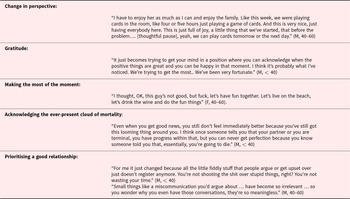
Theme 3. In the context of the challenges noted in the theme 1, caregivers reported a desire to make the most of now… ideally. This theme highlights the expressed desire to do whatever might improve the quality of life for the patient in the time remaining to them. The oppression of the illness led to changes in perspective such that making the most of the present moment became a priority that helped them both manage the enormity of the advanced diagnosis. This meant acknowledging good things that happened and trying to arrange activities that would be enjoyable for them both. Keeping a wider perspective and not arguing about matters that are not important was commonly expressed as part of a desire to prioritise relationships and ensure that the time left was high quality. Caregivers also reported how taking part in a novel research trial was a way for them both to make the most of their time and to find meaning in paying it forward to people in the future who might find themselves in similar situations. They wanted to “try to live the best life you can now” (M, 40–60; see Table 3 for representative quotes).
Participant quotes supporting Theme 3

The last 2 quotes in Table 3 indicate the conscious change in thinking by the caregiver, which inspired them to change their response as a means of improving the patient’s existential peace.
Theme 4. Hope is an antidote to desperation describes how hope can give caregivers a degree of optimism that can counter feelings of desperation. Caregivers explained how hope helped keep them from feeling overwhelmed by the demands of the cancer and its treatments and by the misery of uncertainty and grief. Caregivers described how taking part in a novel research trial was a means of accessing hope either through the patient’s participation in the trial or their own. Such hopes were frequently associated with better health and good relationships. Often, sentiments were aspirational in hoping the trial would continue and would benefit others in the future. There was also the hope that they seemed to barely want to admit, that participation in the trial might somehow provide a miracle cure for their cancer. See Table 4 for representative quotes.
Participant quotes supporting Theme 4

Theme 5. The primacy of relationships conveyed the precedence given to good relationships by caregivers after the diagnosis of advanced cancer. Caregivers observed that the terminal nature of the illness changed their relationship with the patient in several ways, sharpening its importance. The patient’s need for connection intensified, impacting the caregiver’s feelings towards the patient, and leading to the caregiver finding meaning in the relationship with the patient. One insight that changed the behavior of those who were caregivers to PAM participants was the realization that the relationship with the advanced cancer patient was of the utmost importance and that negative interactions were detrimental to the wellbeing of both. Largely, caregivers reported this realization followed the patient’s diagnosis. Patients seemed to report this realization after participation in the trial. It became apparent that the experience of participating in the trial heightened most patients’ awareness of the salience of good relationships in terms of their existential wellbeing. See Table 5 for representative quotes.
Participant quotes supporting Theme 5

Through their involvement in the PAM trial, caregivers reported how they had reshaped their responses with the person they were supporting and had generally attempted to reject interactions that were not constructive.
Discussion
The current research is the first to explore caregiver experiences of supporting a patient undergoing a trial investigating LSD microdosing alongside MCP and has implications more broadly. Our findings highlight the bidirectional relationship between caregiver and patient, where influence on one becomes an influence on both. This research reinforces that caregiving pervades almost every aspect of the caregiver’s life, with their wellbeing closely aligned with that of the patient. We found that caregivers were generally supportive of their close associate participating in the trial, with some highlighting the impact it had on them personally. Caregivers described a desire to make the most of now and referred to the role of MCP as a means of accessing hope, improving the dyad relationship, and reducing existential distress. This study extends the literature by demonstrating that the caregiver experience is influenced by the patient experience of placebo or psychedelic-assisted talk therapy, reaffirming the importance of holistic cancer care.
The present findings confirm the bidirectional impacts on patient and caregiver wellbeing that has been shown in previous research. Such impacts include emotional strain, practical load, financial pressure, and psychological demands. Similar research has shown the significant physical and psychological impact an advanced cancer diagnosis has, not only on the patient, but also on their informal caregiver (Williams Reference Williams and Goerling2014; Pedreira et al. Reference Pedreira, Mitchell, Ting and Applebaum2019). Likewise, the caregiver also impacts patient experience (Augeraud-Véron and Leandri Reference Augeraud-Véron and Leandri2024). In the context of the PAM trial, the relationship between caregiver and patient played a significant role in the outcomes for both because of their close partnership and mutual influence.
Caregivers in the present study described varying degrees of influence in the decision to participate in a trial investigating psychedelic-assisted MCP, with some offering encouragement and others admitting hesitancy about microdosing due to concern related to psychedelics. Despite an escalating interest in the potential for psychedelics to be of benefit in various clinical contexts, stigma, and misconceptions remain (Viña Reference Viña2024). So while this finding is unsurprising, it has important implications for clinical trials administering psychedelic drugs. Caregivers influence patient decisions and if fearful of what participation might mean, may dissuade their close associates from taking part. Research has found that greater awareness of psychedelic drugs by cancer patients (Best et al. Reference Best, Morunga and Wells2024), healthcare clinicians (Nuha et al. Reference Nuha, Reynolds and Fia’Ali’I2025), and cancer clinicians (Reynolds et al. Reference Reynolds, Barnett and Weleff2024) increases openness to the idea of their therapeutic potential. Education about psychedelic drugs has the potential to support informed decision-making that is based on fact rather than misconceptions.
In the current work, caregivers described how the patient’s participation gave both patient and caregiver the opportunity to make altruistic contributions to cancer research. This finding fits with other research that shows altruism is a primary motivator for participation in cancer clinical trials (Nielsen and Berthelsen Reference Nielsen and Berthelsen2019), and that participation in research can increase altruistic behavior (Williams et al. Reference Williams, Entwistle and Haddow2008). Increases in altruism can provide a sense of meaning, purpose, and greater pro-social behavior for patients and caregivers (Hawley Reference Hawley, Padilla-Walker and Carlo2014), particularly in patients with poor cancer prognoses (Nielsen and Berthelsen Reference Nielsen and Berthelsen2019). The talk therapy utilized in the PAM trial (MCP) has been shown to be effective in reducing psychological distress, increasing meaning, and improving social relationships in cancer populations (Vos and Vitali Reference Vos and Vitali2018; Shen et al. Reference Shen, Liu and Zhou2025). In line with previous research (Pedreira et al. Reference Pedreira, Mitchell, Ting and Applebaum2019), caregivers reported greater wellbeing when their close associate experienced positive outcomes of the trial. Thus, participation in the PAM trial appeared to provide an avenue to increase meaning and channel altruistic feelings for both patient and caregiver.
Caregivers in this study also described a desire to make the most of now, doing whatever might improve the quality of life for the patient in their remaining time. Many were explicit in articulating the idea of not wasting time on negative interactions as a crucial means of improving relationships and quality of life for the patient. Other research suggests that increasing openness and communication is likely to enhance relationships with those most closely associated with the advanced cancer patient (Otto et al. Reference Otto, Ketcher and Heyman2021). Because psychedelic therapies can enhance empathy, relatedness to others, and meaning-making which is associated with greater wellbeing (Cavarra et al. Reference Cavarra, Falzone and Ramaekers2022; McManus et al. Reference McManus, Patrick and Striepe2022), microdoses of LSD may be a means to that end. It is possible, too, that the benefit may be broader than the patient and also benefit the caregiver through greater empathy and communication, enhancing quality of life for both members of the dyad.
Caregivers described how hope can counteract feelings of demoralisation, and many saw taking part in the PAM trial as a means of accessing hope. Demoralization, characterized as hopelessness and helplessness due to loss of meaning in life, is a common presentation in cancer patients (Bobevski et al. Reference Bobevski, Kissane and Vehling2022), with 13–18% of cancer patients experiencing clinically significant demoralization (Robinson et al. Reference Robinson, Kissane and Brooker2015). Similar to other research showing that participation in clinical trials can provide hope in patients (Godskesen et al. Reference Godskesen, Hansson and Nygren2015), taking part in the PAM trial appeared to also offer hope for caregivers. As the PAM trial was a feasibility trial, it was not powered to detect statistically significant changes in demoralisation, however, caregivers reported that participating in the trial provided them means to access hope.
Most striking was the universality of caregivers’ reports that there was no time to waste with negative communications within the dyad. Knowing that life may be time-limited can cause shifts in perspectives, consequently making patient–caregiver dyads less focused on small negatives (Otto et al. Reference Otto, Ketcher and Heyman2021). Caregivers reported consciously altering their communications in positive ways, which strengthened their relationships and contributed to a greater sense of existential peace in the patient. However, it is also important to note that the pressure of valuing every detail and not addressing disagreements can cultivate unrealistic pressures within the relationship (Thomson et al. Reference Thomson, Wilson-Genderson and Siminoff2024). Cancer is inevitably stressful, and stress inherently brings about disagreements (Siminoff et al. Reference Siminoff, Dorflinger and Agyemang2012). While open communication has been shown to improve caregiver–patient congruence (Li and Loke Reference Li and Loke2014), expectations around maintaining positive communications should remain grounded and achievable for cancer dyads.
Caregivers in the current study reported that taking part in the clinical trial improved their relationships which benefited both caregiver and patient. In some cases that was achieved through greater honesty and willingness to discuss difficult topics after the patient had participated in the psychotherapy. Previous research has recommended that relationship quality be included in investigations of end-of-life care as it can predict caregiver burden (Reblin et al. Reference Reblin, Donaldson and Ellington2016) and help understand how cancer communication can benefit both caregiver and patient (Otto et al. Reference Otto, Ketcher and Heyman2021). The current qualitative work provides further evidence that enhancing relationships through trial participation has potential to improve outcomes for both the caregiver and patient.
Clinical implications
This research confirms the significant emotional, social, physical, and practical stress that cancer patients and their caregivers face. However, the limited effectiveness and overall lack of interventions addressing existential distress among patients is a significant unmet need in palliative care (Ross et al. Reference Ross, Agrawal and Griffiths2022). Attending to existential distress in cancer patients at the later stages of life should be a priority in improving quality of life in this population (Breitbart Reference Breitbart2002; Ross et al. Reference Ross, Agrawal and Griffiths2022). The current research evidenced that caregivers perceived positive changes in patients participating in a trial investigating LSD-microdosing alongside MCP, suggesting that it might be a useful approach in reducing distress for patients. The current qualitative research also suggests support for trial participation in improving the wellbeing of caregivers. Future clinical trials should ensure caregivers are included alongside patients so that the breadth and depth of the cancer experience is captured.
Pertinent to the current work is research showing that psychedelic-assisted or placebo-assisted psychotherapy might mitigate existential distress as well as improve relationships. It had been suggested that psychedelic-assisted psychotherapy has the potential to target biopsychosocial-spiritual dimensions of caregiver distress (Gold et al. Reference Gold, Podrebarac and White2023). While most cancer care focuses on patient wellbeing, caregiver wellbeing should also be prioritized, not least because their care duties are underrecognized and undervalued as essential work (Williams Reference Williams and Goerling2014). In combination with the personal benefit to the caregiver, improved caregiver wellbeing is also beneficial for the dyad: a stressed caregiver is less able to provide effective assistance to the cancer patient and stress-laden caregiving is likely to have deleterious effects on the physical and psychological health of the caregiver (Pedreira et al. Reference Pedreira, Mitchell, Ting and Applebaum2019). Delivering MCP to caregivers has already shown benefit (Applebaum et al. Reference Applebaum, Baser and Roberts2022), and it is important to consider the potential benefits in offering novel psychological interventions to both patient and caregiver because of their mutual vulnerability. Further clinical trials are needed that investigate psychedelic-assisted interventions that support caregivers as well as the patient.
Conclusion
The potency of the patient–caregiver relationship means that the benefits of interventions supporting patients will be enhanced by also including the caregiver. In this study, caregivers described the value of MCP in helping patients to talk honestly and openly about matters relating to death that were previously too uncomfortable to broach. Reports from caregivers suggested that participation in a trial investigating MCP alongside LSD microdosing seemed to help address existential distress in advanced cancer patients although noting that the qualitative design of the current study precludes definitive conclusions on this. Further research could include similar interventions specifically for the caregivers themselves. In holistically caring for cancer patients, the caregiver, and the wider family should have access to hope, support, and relationship-enhancing interventions.
Data availability statement
The dataset used and analyzed during the current study is available from the corresponding author on reasonable request.
Funding
No funding was received for conducting this study or preparing this manuscript.
Competing interests
There are no perceived or actual conflicts of interest with any other parties.
Ethical approval
Ethics approval was obtained from the Health and Disability Ethics committee (HDEC) on 19/10/2023 (Ethics committee ref: 2022FUL13074), and research was conducted in accordance with the Declaration of Helsinki. Written informed consent was obtained from participants.




 Open access

