


1. Introduction
The early stage of design is characterized by an iterative development and refinement of problem framings and solution ideas (Reference Dorst and CrossDorst & Cross, 2001; Reference Stempfle and Badke-SchaubStempfle & Badke-Schaub, 2002). The early design process presents various difficulties, as design practitioners encounter dilemmas and bottlenecks (Reference Hölzle and RhinowHölzle & Rhinow, 2019; Reference Rekonen and HassiRekonen & Hassi, 2018). Reflection is essential for successful design processes (Reference SchönSchön, 1983, Reference Schön1987), and has therefore attracted sustained attention from many researchers (Reference Ammersdörfer, Tartler, Kauffeld and InkermanAmmersdörfer et al., 2022; Reference Inkermann, Gürtler and SeegrünInkermann et al., 2020; Reference Ito, Taoka, Wan, Sadek, Mougenot and SaitoIto et al., 2024). Reflection-on-action conducted at milestones of an iterative design cycle is a key activity in which designers reconsider their recent actions, identify problems in the process, and formulate improvements (Reference Reymen, Folkeson, Gralen, Norell and SellgrenReymen, 2003; Reference SchönSchön, 1983; Reference Tan, Kocsis and BurryTan et al., 2023). Reflection intensity, the extent to which the issue is scrutinised in the reflection process, varies at four levels from unproductive (Level 0) to critical (Level 3): Level 0: Revisiting, Level 1: Descriptive reflection, Level 2: Dialogic reflection, and Level 3: Critical reflection (Reference Hartmann, Vinke-de Kruijf and van WeesepHartmann et al., 2023). Reflection, however, is a professional skill, and several studies have reported that novices do not always engage in it at a critical level (Reference Hong and ChoiHong & Choi, 2015; Reference Lousberg, Rooij, Jansen, van Dooren, Heintz and van der ZaagLousberg et al., 2020). It is known that cognitive biases, design fixation (Reference Crilly and CardosoCrilly & Cardoso, 2017) or confirmation bias (Reference NickersonNickerson, 1998), skew consideration of options and hinder process improvement. Therefore, questioning previous assumptions–known as critical reflection–is essential, and support to encourage reconsideration of prior understanding or evaluation is required.
To encourage critical reflection on process activities among novice designers, we propose employing duality (which we refer to as Dual-Advocate ) in reflection. Dual-Advocate has been described with terms such as “paradox,” “dichotomy,” or “dialectic” to reduce bias, facilitate the safe expression of dissenting views, and support more critical or even falsification-oriented thinking (Reference Lord, Lepper and PrestonLord et al., 1984; Reference Smith and LewisSmith & Lewis, 2011). Based on this conceptual grounding, we ask whether reflection can be facilitated through such duality and thereby lead to more multifaceted and critical forms of reflection.
This exploratory study focuses on how presenting the Dual-Advocate inherent in design situations can support novice reflection. Drawing on existing studies, we developed a card-based tool designed to support reflection-on-action in design at a more multifaceted and critical level. This study aims to evaluate the effect of the Dual-Advocate on reflection. This paper addresses the following question: What is the relationship between Dual-Advocate and the intensity of reflection in discussion during reflection sessions? How was the content of the cards utilised for discussions?
2. Development of Dual-Adcoate Reflection Card (DARC)
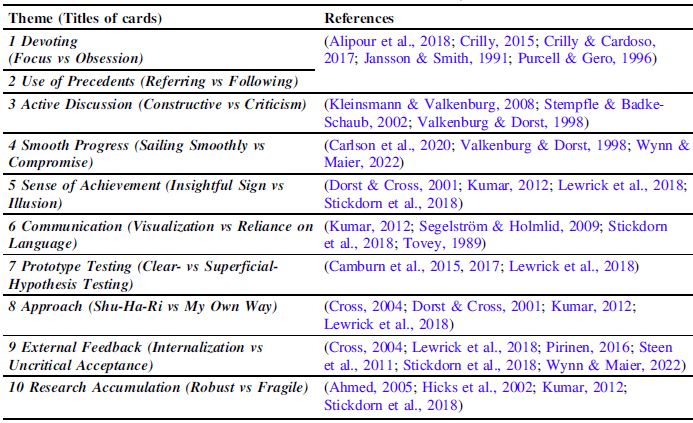
A card-based support tool named Dual-Advocate Reflection Card (DARC) is designed to facilitate collaborative reflection processes, proposed by Reference Hartmann, Vinke-de Kruijf and van WeesepHartmann et al. (2023). The collaborative reflection follows four steps: articulating experience, developing an understanding of experience, re-evaluating understanding of experience, and drawing reflection outcome. The cards are designated to be used during the collaborative evaluation stage: the front sides are intended for clustering experiences, while the reverse sides are intended for analyzing and evaluating the experiences. The card was designed through a literature review and a thematic analysis. First, we collected literature that describes the characteristics of design processes. Then, the characteristics of processes perceived as positive and negative were extracted throughout a thematic analysis. Finally, we consolidated them into ten cards. Table 1 presents the themes (the titles of each card) and their corresponding references. Figure 1 shows the DARC image. The DARC features typical situations observed in design processes on its front side and two opposing aspects that describe how the same situation can be interpreted in either a positive or negative way on its reverse side.
Results from thematic analysis

Image of the DARC

3. Evaluation of DARC
3.1. Experiment
We conducted an empirical dyad experiment to investigate the influence of the DARC on the multifaceted and critical reflection of novice design practitioners engaged in design activities. We recruited participants from students enrolled in a five-month design thinking project offered at the authors’ university. In the project, teams conduct user interviews, define problems, generate ideas, and develop a tangible, functional prototype of a novel product under the given open-ended design theme. At the time of the experiment, the design project was underway, having progressed for two to three weeks since it began. The participants were either first-year master’s students in engineering or third-year undergraduate students in art from another university participating in the project. In the experiment, pairs were formed, and each pair consisted of participants from different teams in the ongoing project. A total of 18 students agreed to participate in the study, and nine pairs were formed (designated as Pair A-I). Since they were participating in the same course, they were already acquainted with one another in some cases. All participants gave their consent to participate in the experiment.
The experiment proceeded as follows (see Figure 2): (1) Each participant individually elicited their experiences in his or her design team project. The participants wrote their experiences on sticky notes corresponding to the four prompts: what they had worked on individually, what they had worked on as a team, what they felt was successful, and what they had questions about or thought needed improvement. (2) The participant pairs shared the written experiences. The participants showed the sticky notes in turn and provided detailed explanations. (3) The participants looked at the front side of the cards and clustered sticky notes. For each sticky note, the card most closely related to the written experience was selected, and a cluster was formed. (4) The explanation about the back side of the cards was given, and an evaluation and analysis of the experiences using the back side of the cards was conducted. Using the clustering results, the participants analyzed the experiences on each sticky note based on the positive and negative aspects (Dual-Advocate) written on the reverse side of the relevant cards. For each sticky note, discussions were held to determine which of the two aspects each card corresponded to and whether the experience could be considered positive or negative. In this phase, participants were asked to write down the discussion on sticky notes and add it to the clusters. (5) Each participant individually reflected on what they learned from the discussion or what they should do when faced with a similar situation next time. The participants filled in, according to the framework, the related experiences that were written on a sticky note, the cards used, and the strategies or plans for the next time or learning.
Procedure of the experiment

3.2. Data collection and analysis
This experiment collected audio and video recordings of the discussions, as well as the outcomes of the tasks. All audio recordings were transcribed. The video recordings and task outcomes were used as supplemental materials to understand the context of a conversation. The task outcomes included the sticky notes written by the participants during the reflection session and the notes written on the worksheets.
To clarify the level of reflection intensity induced by the introduction of the DARC, the transcripts were qualitatively analyzed. First, we identified the cards used in discussions and split and classified the transcripts accordingly. Next, we divided the segmented transcript into segments depending on the experience under discussion. Then, for the utterances within each segment, the level of reflection intensity was coded according to Reference Hartmann, Vinke-de Kruijf and van WeesepHartmann et al. (2023). The coding process follows a qualitative content analysis with a deductive approach (Reference MayringMayring, 2021), utilizing four-level coding categories. Finally, we counted the number of segments that contained utterances of a specific level of reflective intensity. In other words, for discussions related to a particular card (e.g., Dedication), we counted how many discussions contained utterances of a specific level of reflective intensity (e.g., Level 3). A higher reflection intensity does not always mean better reflection than a lower level, and the reflection intensity depends on the experience of the design process to reflect (Reference Hartmann, Vinke-de Kruijf and van WeesepHartmann et al., 2023). In addition, to identify whether cards’ contents were directly used or not, the discussion segments were classified into two groups: those with explicit mentions of cards’ content and those without. The entire analysis was conducted by the first author.
4. Results
4.1. Frequency of card use and reflection intensity
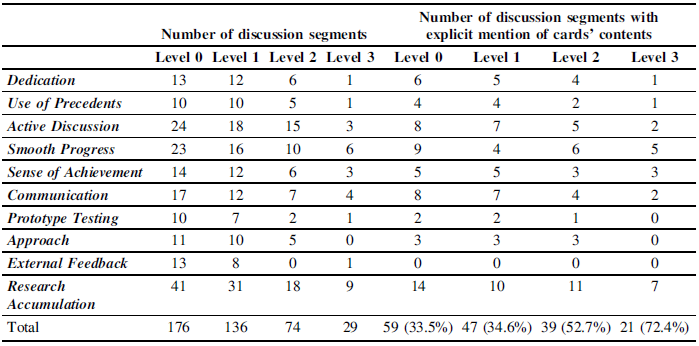
This section describes the relationship between the number of discussion segments and the reflection intensity. Table 2 shows the total number of discussion segments and the number of discussion segments with explicit mentions of the cards’ contents, corresponding to each level of reflection intensity and each card type. Additionally, totals for each level of reflection intensity are shown at the bottom.
Number of discussion segments related to each card and number of discussion segments with explicit mention of cards’ contents

There are distributions in the number of discussion segments related to each card. Research Accumulation is the most frequently used, followed by Active Discussion and Smooth Progress. Conversely, Prototype Testing, Use of Precedents, Approach, or External Feedback are less used.
The number of discussion segments that included utterances at each level of reflection intensity is also distributed. Discussion segments that included Level 0 and Level 1 utterances are frequently observed. The utterances at Levels 2 and 3 appear most frequently in segments related to Research Accumulation, followed by Active Discussion and Smooth Progress. Level 2 utterances are not observed in discussion segments related to External Feedback, while Level 3 utterances are not observed in segments related to Approach.
In terms of discussions with explicit mention of cards’ contents, there are distributions in the number of discussion segments. Explicit mentions are frequently observed in discussion segments related to cards such as Research Accumulation, Active Discussion, Smooth Progress, or Communication. On the other hand, for External Feedback, there are no explicit mentions of the card content. Similarly, for Prototype Testing and Approach, explicit mentions are rare. Focusing on the level 2 and 3 utterances, it is shown that explicit mentions of the cards’ contents often accompany these utterances. Among the discussion segments that included level 2 utterances, 52.7% included explicit mentions of the cards’ contents, and among the discussion segments that included level 3 utterances, 72.4% included mentions of the cards’ contents.
4.2. How Dual-Advocate affects the discussion
In this section, concrete examples are provided that illustrate how duality has influenced the discussion. In utterances at each of the reflection intensity Levels 1, 2, and 3, the content of the cards is explicitly mentioned. The way in which the cards are utilized in discussions varies according to the level of reflection intensity of the utterances. First, in utterances at reflection intensity Level 1, when the content of the cards is mentioned, no reframing of understanding occurred; instead, they are used to justify one’s own experience or to reinforce ideas already held. For example, Pair C mentions the card’s contents (Sense of Achievement) and makes a justification without conducting a detailed analysis of the experience (Table 3).
A case where Sense of Achievement was mentioned in pair C’s Level 1 reflection intensity (RI) utterance; the underlined section refers to the card’s content

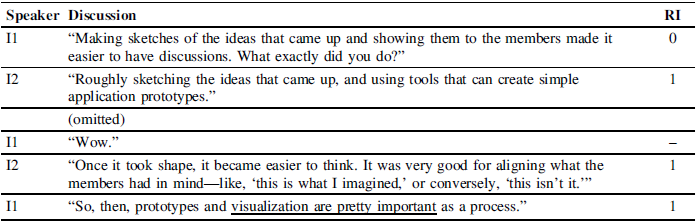
Pair I also mentions the card’s content in the utterance at reflection intensity Level 1. After providing a detailed description of the experience, one of the speakers mentions the card’s content (Communication) and uses it to reinforce what they had already been thinking through the experience (Table 4).
A case where Communication was mentioned in pair I’s Level 1 reflection intensity (RI) utterance. The underlined section refers to the card’s content

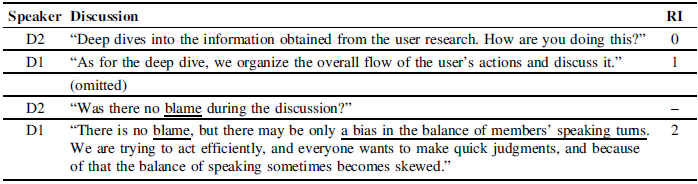
When the content of the card is mentioned at the utterances at reflection intensity Level 2, new perspectives are introduced through the card’s content, and the discussion is facilitated. Even in this case, however, no shift in understanding occurred; instead, they are used to reinforce originally held ideas from a different viewpoint. For example, Pair D looks back on the experience from another perspective, based on the content of the cards (Active Discussion), and provides an alternative explanation from a different perspective (Table 5).
A case where Active Discussion was mentioned in pair D’s Level 2 reflection intensity (RI) utterance. The underlined section refers to the card’s content

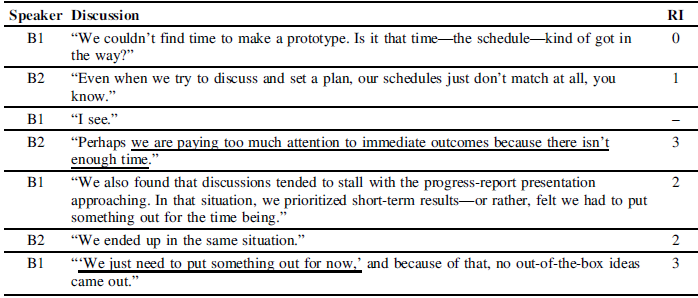
When the Dual-Advocate is used at the utterances at reflection intensity Level 3, the cards’ contents facilitate the reframing of an understanding of the experience. In this case, utterances are observed that bring about a shift in the evaluation held towards the experience. Within the discussion, participants make utterances where they realize an experience they thought was positive might actually be perceived negatively, or vice versa. For example, Pair B, by mentioning the content of the cards (Smooth Progress), engaged in a reconsideration that their activities might be perceived negatively (Table 6).
A case where Smooth Progress was mentioned in pair B’s Level 3 reflection intensity (RI) utterance; the underlined section refers to the card’s content

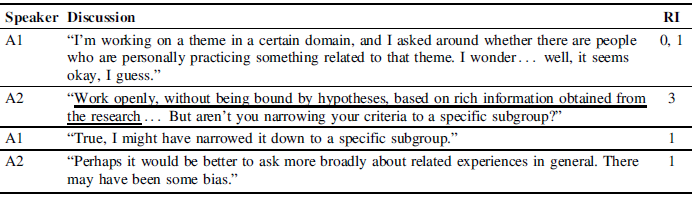
Similarly, Pair A also engaged in a discussion that reinterpreted experiences. They initially evaluated the experience as positive but changed their evaluation to negative after analyzing the experience, citing the card’s content (Research Accumulation) (Table 7).
A case where Research Accumulation was mentioned in pair A’s Level 3 reflection intensity (RI) utterance; the underlined section refers to the card’s content

5. Discussion
5.1. Effect of the DARC on multifaceted and critical reflection
The analysis revealed the following three points: (i) the number of discussion segments varies depending on the card type, (ii) in discussion segments that included utterances at multifaceted or critical levels (Level 2, 3), the cards’ contents are mentioned in many cases, and (iii) the way cards are utilized in discussions differs according to the level of reflection intensity of the utterances that mention the card content. Based on these findings, we deepen the discussion on the effect of the DARC on reflection.
First, DARC appeared to be enacted in three modes. One mode often observed in Level 1 utterances is “justification,” where participants use a card as a label or warrant to endorse their existing evaluations without questioning underlying assumptions. In this descriptive mode, the card content merely reinforces prior beliefs or justifies a practice as “good,” often resulting in a confirmatory rather than a critical reflection. This might reinforce tendencies such as confirmation bias (Reference NickersonNickerson, 1998) or design fixation (Reference CrillyCrilly, 2015; Reference Jansson and SmithJansson & Smith, 1991), so further research is required. A second mode, typically associated with Level 2, involves “perspective expansion without reframing.” Here, the card serves as a stimulus to introduce additional viewpoints or alternative causal stories, broadening the explanation of an experience while maintaining the overall evaluation. Finally, the third mode corresponds to Level 3 and is characterized by “assumption questioning and evaluation reversal.” In this most critical form of reflection, participants use the cards to explicitly interrogate implicit assumptions, often reversing the evaluation of an experience, such as reinterpreting smooth progress as a potential risk, thereby transforming their meaning structures through a critical assessment of consequences. Since such reflective thought is considered a core component of design creativity (Reference Dorst and CrossDorst & Cross, 2001), further investigation will be expected to reveal the best way to improve creativity.
Second, Level 3 utterances appeared to arise under two conditions. One condition involved explicit engagement with the card contents when questioning or reframing an assumption. Notably, 72.4% of Level 3 utterances included direct references to the card contents, suggesting that the Dual-Advocate format, in which both positive and negative perspectives are made concurrently available, may lower the threshold for articulating an opposing view. A second condition concerned situational relevance. Level 3 utterances were more likely when the card topics aligned with participants’ immediate activities, project stage, or salient challenges. Consistent with this interpretation, the distribution of Level 3 utterances across topics broadly mirrored patterns of card use, and card use itself appeared to track the issues participants were actively encountering.
Third, DARC might facilitate critical reflection. Dual-Advocate represents both positive and negative sides on the desk; it may make it easier to stand on the opposite side in reflection, as described in the existing studies (e.g., Reference Lord, Lepper and PrestonLord et al., 1984; Reference Smith and LewisSmith & Lewis, 2011). Facilitators have taken on a role to promote reframing or supplement perspectives (Reference Marshall, Keville, Cain and AdlerMarshall et al., 2022; Reference Mosely, Markauskaite, Lodge and WrigleyMosely et al., 2025); however, it is expected that DARC will instead facilitate discussions, enabling novice practitioners themselves to engage in multifaceted and critical reflection. While previous research indicates that novice design teams often face impediments in experimentation and critical thinking (Reference Rekonen and HassiRekonen & Hassi, 2018), DARC appears to mitigate these barriers by externalizing conflicting perspectives. Accordingly, it is expected to support the appropriate identification of issues and formulation of plans and strategies for the next design cycle through the reflection-on-action during the design process (Reference SchönSchön, 1983; Reference Tan, Kocsis and BurryTan et al., 2023).
5.2. Implementation in practice and education
The DARC proposed in this study is recommended for use in practical and educational settings. Existing reflection tools are mainly provided as templates or canvases (e.g., Reference Ammersdörfer, Tartler, Kauffeld and InkermanAmmersdörfer et al., 2022; Reference Inkermann, Gürtler and SeegrünInkermann et al., 2020), and they are good at helping practitioners to reflect and organize past experience or facts; however, there is a gap between those tools and practice since they are weak at encouraging analysis or considering plans or strategies for the next cycle (Reference Ito, Taoka, Wan, Sadek, Mougenot and SaitoIto et al., 2024). In this respect, DARC will contribute to enhancing practitioners’ multifaceted and critical reflection in multiple ways.
Specifically, during reflection on the design process, the use of the cards would be effective for re-examining assumptions and encouraging critical thinking. In practical settings, DARC can be applied in open-ended problem-solving situations where flexible task setup is possible, and teams or individuals independently determine the process, primarily when it is conducted iteratively. By conducting a reflection session lasting about one hour, in which implicit assumptions are questioned, problems are identified, and plans for the next steps are made, process improvement is likely to occur. In educational settings, the effect serves as a tool to strengthen the outcomes of experiential learning. By reflecting on and evaluating practical experiences, awareness of reflection points and areas for improvement is fostered. Unlike simply consulting a textbook or checking a list, engaging in critical thinking related to one’s own experience will help prepare for the next learning cycle.
5.3. Limitations and future research
This study includes limitations. First, the characteristics of the sample limit the impact of the findings. In this study, we employed participants from a specific grade, discipline, or cultural background. This might affect the tendency of the discussion. It is required to validate the effect of the DARC in multiple conditions, such as different countries, institutes, or levels of mastery, in future research.
Second, the small number of cases may limit the impact of the findings. Since discussion segments that included utterances at reflection intensity Levels 2 and 3 were few relative to the total number, whether card use increased multifaceted and critical utterances should be investigated more cautiously. However, in this study, multiple cases were identified in which utterances of multifaceted and critical reflection were facilitated by Dual-Advocate. Further investigation with participants who have accumulated more experience in the project could enable enriched discussions.
For future research, the undesirable uses of Dual-Advocate should be examined. In utterance at reflection intensity Level 1, no questioning of assumptions occurred, and justifications of one’s own experience or reinforcement of one’s thinking were conducted. If participants have reflectively analyzed and evaluated their own design process, they may engage in justification based on the rationale provided by the cards. Alternatively, without noticing their own biases, they may proceed to justify without reframing. In this experiment, bias justification might have occurred because the participants were students in the early stages of the project, whose understanding of the process had not yet deepened.
6. Conclusion
This exploratory study focuses on how presenting the Dual-Advocate inherent in design situations can support novice reflection. We developed Dual-Advocate Reflection Card (DARC) based on the literature review. To evaluate the effect of DARC, we conducted an empirical experiment of a collaborative reflection session with nine pairs of students who participated in the design thinking project. The analysis revealed the strong relation between card usage and utterances of multifaceted and critical reflection. In addition, it was suggested that Dual-Advocate encourage reframing of the evaluation or understanding of the design process. The DARC is expected to be utilized in practical or educational settings to encourage multifaceted and critical reflection during iterative design cycles. In future research, it is expected to investigate participants under different situations to enrich the discussions.
Acknowledgement
This study is funded by the SECOM Science and Technology Foundation, Tobemaki Scholarship Foundation, and Sumitomo Electric Group Philanthropy Foundation. This work was also supported by JST SPRING, Japan Grant Number JPMJSP2180. The authors would like to thank the Academy of Super Smart Society, Science Tokyo and Amano Institute of Technology for their financial support.
Appendix. Images of DARC





 Open access

