


1. Introduction
In numerous democracies, the prevalence of political distrust has become a salient feature of contemporary public opinion (Bertsou, Reference Bertsou2019). Japan is not an exception to this phenomenon. Despite its frequent characterisation as politically stable, Japan has historically demonstrated pervasive public discontent with politics and a dearth of confidence in political institutions. As early as the 1970s, comparative research on advanced industrial democracies had already identified Japan as a country with exceptionally low levels of political trust (Pharr, Reference Pharr, Nye, Zelikow and King1997). Survey data from that period demonstrated that between one-half and two-thirds of Japanese respondents expressed dissatisfaction with politics, despite Japan’s sustained economic growth at the time.
Following the collapse of the economic bubble in the early 1990s, a series of political scandals, policy gridlock, and party realignments has further eroded political trust in Japan (Krauss et al., Reference Krauss, Nemoto, Pekkanen and Tanaka2017). For instance, a 2000 wave of the World Values Survey (WVS) revealed that nearly 70% of Japanese respondents expressed distrust in their government, placing Japan among one of the most distrustful publics in advanced democracies during that time. The 2023 fundraising scandal involving senior members of the ruling Liberal Democratic Party (LDP) is the most serious credibility crisis the party has faced since the postwar era. A national poll conducted by the Mainichi Shimbun in February 2024 found that only 25% of respondents expressed even partial trust in political institutions.Footnote 1
However, while there is widespread distrust of politics, its effects vary considerably across different contexts. In certain societies, distrust has been observed to give rise to heightened polarisation and political mobilisation, frequently in support of populist movements (Butzlaff and Messinger-Zimmer, Reference Butzlaff and Messinger-Zimmer2020; Grande and Gonzatti, Reference Grande and Gonzatti2025). In other cases, it primarily results in withdrawal from public life, reduced civic participation, and lower voter turnout (Hooghe et al., Reference Hooghe, Marien and Pauwels2011). This divergence raises a critical question: what factors motivate individuals to either withdraw from political life due to distrust or to engage in more active, often populist, forms of political participation?
The present study investigates the aforementioned question by examining two contrasting political responses under conditions of political distrust: political passivityFootnote 2 and support for populism, both attitudinally and behaviourally. Japan offers a particularly intriguing case study in this regard. Despite its reputation for political disengagement (Kabashima et al., Reference Kabashima, Marshall, Uekami and Hyun2000), recent years have witnessed a modest but notable rise in populist parties such as the right-leaning Japan Innovation Party (JIP), Sanseitō, and the Conservative Party of Japan (CPJ), as well as the left-wing Reiwa Shinsengumi (Reiwa). Understanding the factors that encourage citizens to adopt passive attitudes or engage in support for populist movements is essential to evaluating Japan’s democracy and analysing evolving trends in Japanese voting behaviour.
Building on existing literature that links political distrust with both disengagement and anti-establishment protest, this study examines whether two individual-level factors, economic insecurity and sense of nationalism, help explain the divergent paths taken by distrustful citizens. The core assumption is that political distrust alone does not determine whether individuals disengage from politics or become mobilised. Instead, the nature of the grievance, used here to refer to individuals’ subjective perceptions of economic or identity-based disadvantage, moderates the manner in which political distrust is expressed. Economic insecurity can profoundly influence individual behaviour, potentially resulting in withdrawal, especially when accompanied by a sense of powerlessness. Conversely, in circumstances where individuals perceive a deficiency in the system’s capacity to address their fundamental material needs, economic insecurity may also be associated with higher levels of political engagement. Nationalist sentiment, by comparison, is often linked to a sense of collective identity and a perceived need for political action, which can lead to increased engagement, particularly through populist channels that present themselves as advocates for the national interest.
Using data from multiple waves of the Japanese Election Study (JES), including two newly released surveys conducted before and after the 2024 House of Representatives election, this paper conducts a two-part empirical analysis. First, the study distinguishes between attitudinal political passivity and populist attitudes, examining how economic insecurity and nationalism are associated with these political orientations, both independently and in interaction with political distrust. Second, the study analyses voting behaviour by distinguishing between nonvoting, mainstream voting, and populist voting, thereby assessing whether economic or identity-based grievances, when combined with distrust, are linked to political withdrawal or populist mobilisation.
The results reveal a clear asymmetry. While economic insecurity is associated with increased support for populist attitudes, it does not significantly predict support for populist parties. Its marginal association with lower abstention suggests that economic concerns may, under certain conditions, motivate turnout, though not necessarily for populist alternatives. In contrast, nationalist sentiment emerges as a more consistent mobilising force. It is associated with reduced passivity and abstention and increased populist engagement. These findings suggest that economic insecurity generates discontent, but nationalism more reliably channels that discontent into political engagement rather than withdrawal.
This study makes three key contributions. First, it provides a pooled cross-sectional analysis using multiple survey waves of the JES data to examine the association between political distrust, related grievances, and individual political attitudes and behaviours in a context of widespread distrust. By pooling multiple survey waves, the analysis reduces reliance on any single political moment and allows the findings to reflect structural patterns of political distrust and grievance expression across different institutional and economic contexts. Second, while previous research has examined the rise of populism or political apathy separately, few studies have directly compared the factors leading citizens to adopt either a passive or populist response to political distrust. By offering a comparative framework that accounts for both attitudinal and behavioural expressions of discontent, this study contributes to a more integrated understanding of how democracies absorb or redirect political grievances. Third, the study challenges the prevailing notion of Japan as an outlier in global populism literature (Lind, Reference Lind2018). The findings suggest that identity-based mobilisation is a relevant force in Japan, aligning the country more closely with global patterns of democratic dissatisfaction. This is demonstrated by the finding that nationalism is consistently associated with both attitudinal and behavioural engagement, despite varying levels of political distrust.
The remainder of this article proceeds as follows. First, the next section establishes the theoretical foundation for the study. Then, there is a discussion of the key explanatory variables and the statistical model used to analyse the determinants of political passivity and populism. Subsequent sections present the results of the attitudinal and behavioural analyses. Finally, the article concludes with a discussion of the implications for understanding the dynamics of populism in contemporary Japan.
2. Theoretical foundation
2.1. Political distrust as the catalyst of political passivity and political polarisation
Political distrust has long been recognised as a symptom and a driver of democratic malaise. Although a degree of scepticism can serve as a healthy check on authority, persistent and widespread distrust undermines institutional legitimacy by eroding citizens’ confidence in the fairness, effectiveness, and responsiveness of democratic institutions (Citrin and Stoker, Reference Citrin and Stoker2018; Valgarðsson et al., Reference Valgarðsson, Jennings, Stoker, Bunting, Devine, McKay and Klassen2025).
As stated earlier, political distrust has been a constant feature of public opinion in Japan since at least the 1970s (Pharr, Reference Pharr, Nye, Zelikow and King1997). Across years, it has been exacerbated by recurring political scandals, perceptions of governmental inefficiency, and a growing sense that political elites are unresponsive to the concerns of ordinary citizens. As Pharr (Reference Pharr, Pharr and Putnam2000) notes, official misconduct has consistently been the strongest predictor of declining public trust in Japan. Similarly, Murayama (Reference Murayama1994) argues that political distrust among Japanese citizens reflects dissatisfaction with not merely their own political influence but more strongly with the policies and conduct of the state itself.
Although the causes of political distrust are well-documented, its political consequences remain the subject of ongoing debate (Grande and Gonzatti, Reference Grande and Gonzatti2025). Some studies suggest that distrust leads to withdrawal from institutional politics, contributing to lower voter turnout and reduced civic engagement (Bélanger and Nadeau, Reference Bélanger and Nadeau2005; Hooghe et al., Reference Hooghe, Marien and Pauwels2011; Marien and Hooghe, Reference Marien and Hooghe2011). However, others argue that political distrust may instead mobilise citizens to participate in non-institutional forms of political action, such as protests, social movements, or support for anti-establishment parties (Kaase, Reference Kaase1999; Norris, Reference Norris2011). These divergent views reflect the notion that distrust is neither inherently demobilising nor activating; rather, it functions as a background condition whose effects depend on how individuals interpret their political environment.
In this study, political distrust is conceptualised as an individual-level attitudinal condition that functions as a subjective interpretive context, rather than as a macro- or meso-level environmental factor. In this sense, ‘context’ refers to a cognitive framework through which individuals evaluate political conditions and interpret subsequent grievances, as opposed to an objective institutional or structural setting. Political distrust thus conditions how discontent is expressed, shaping whether grievances are translated into political withdrawal or mobilisation. Rather than treating participation as a binary outcome, the study focuses on how different grievances are differentially articulated under conditions of distrust.
2.2. Conceptual linkages between passivity and populism
Before examining the sources of political passivity and populism, it is necessary to establish their conceptual comparability. Although they are often treated as distinct phenomena, both can be understood as subjective responses to political distrust. Political passivity reflects not only the behavioural dimension of disengagement, such as abstaining from voting, but also a psychological withdrawal rooted in the belief that political participation is futile or ineffective (Hooghe and Marien, Reference Hooghe and Marien2013; Amnå and Ekman, Reference Amnå and Ekman2014). Similarly, populism encompasses both attitudinal and behavioural elements, combining anti-elite sentiment and belief in the primacy of ‘the people’ with support for outsider candidates or anti-establishment parties (Akkerman et al., Reference Akkerman, Mudde and Zaslove2014; Mudde and Kaltwasser, Reference Mudde and Kaltwasser2017). Beyond this core ideational definition, existing research has emphasised that populist appeals may take different forms depending on the types of grievances mobilised and the channels through which they are expressed (Gidron and Bonikowski, Reference Gidron and Bonikowski2013; Guriev and Papaioannou, Reference Guriev and Papaioannou2022). For instance, some studies highlight economic populism centred on redistribution and opposition to economic elites (Gidron and Hall, Reference Gidron and Hall2017), while others focus on cultural or identity-based populism drawing on nationalism and perceived threats to collective identity (Noury and Roland, Reference Noury and Roland2020) or on media-oriented populism that emphasises style, personalisation, and anti-institutional communication (Mazzoleni, Reference Mazzoleni, Albertazzi and McDonnell2008; Krämer, Reference Krämer2014). Taken together, these strands of the literature underscore that populism is not a uniform phenomenon but rather a flexible mode of political expression that can channel political dissatisfaction into different forms of mobilisation. What unites the two is their shared origin in a perceived failure of democratic representation and responsiveness. In this sense, passivity and populism represent different expressions of disaffection: one marked by resignation and retreat, the other by confrontation and mobilisation.
Given these conceptual parallels, this study treats political passivity and populism as alternative responses to a shared underlying condition, political distrust. Both are multidimensional constructs that combine attitudinal and behavioural elements. To capture this complexity, the empirical analysis in this study includes both attitudinal measures (psychological disengagement and populist sentiment) and behavioural indicators (voting patterns). This approach enables a deeper understanding of the mechanisms that steer disaffected individuals toward political withdrawal or radical engagement.
2.3. Economic and identity-based grievances as moderators of divergent responses
While political distrust provides a shared backdrop for political passivity and populist engagement, it does not, on its own, explain why some individuals withdraw from politics while others become more politically active. A substantial body of literature has identified personal and contextual variables that influence political engagement, including political efficacy (Finkel, Reference Finkel1985; Oser et al., Reference Oser, Grinson, Boulianne and Halperin2022), social networks (McClurg, Reference McClurg2003; Ikeda and Rickey, Reference Ikeda and Richey2005; Campbell, Reference Campbell2013), and education (Mayer, Reference Mayer2011; Persson, Reference Persson2015). Building on this foundation, this study focuses on two forms of perceived grievance that are both theoretically grounded and empirically salient in the Japanese context: economic insecurity and nationalist sentiment. Building on the conceptual discussion above, this study defines ‘grievance’ as a subjective sense of disadvantage or discontent that motivates individuals to question the responsiveness or legitimacy of existing political institutions.
These variables were selected for two key reasons. First, they represent distinct dimensions of political discontent: economic insecurity captures material and structural grievances, and nationalism reflects identity-based concerns tied to collective belonging and cultural recognition. While constructs such as political efficacy or alienation capture broader orientations toward politics, they are less suited to distinguishing between withdrawal and populist engagement as alternative response patterns under conditions of distrust. Second, these variables are particularly relevant to Japan’s post-1990s political landscape, which has been shaped by prolonged economic stagnation, growing inequality, and increasing debates about national identity and sovereignty (Carroll, Reference Carroll2023). These dynamics render economic insecurity and nationalism relevant variables for analysing the ways in which political distrust manifests as either passivity or populist engagement.
2.3.1. Economic insecurity
Economic hardship has long been associated with both psychological stress and political alienation. Those experiencing personal or national-level economic insecurity often report lower political efficacy and a sense of marginalisation from the political system (Anderson and Beramendi, Reference Anderson, Beramendi, Beramendi and Anderson2008; Cicatiello et al., Reference Cicatiello, Ercolano and Gaeta2015). These conditions may lead to passivity, particularly among those who also harbour distrust toward political elites. Prior studies have demonstrated a consistent link between income and political engagement, with low-income citizens participating less in democratic processes (Marx and Nguyen, Reference Marx and Nguyen2016; Filetti and Janmaat, Reference Filetti and Janmaat2018). Uslaner and Brown (Reference Uslaner and Brown2003) also argue that economic insecurity, when combined with low political trust, amplifies political disengagement by reinforcing the belief that participation yields no personal or societal benefit.
However, economic grievances can also drive populist mobilisation. According to Inglehart and Norris (Reference Inglehart and Norris2016), economic insecurity, especially when coupled with cultural backlash, significantly increases support for populist parties that pledge to restore economic justice and confront established elites. Similarly, Gidron and Bonikowski (Reference Gidron and Bonikowski2013) contend that economic deprivation fuels resentment toward mainstream institutions, a sentiment that populist leaders can leverage by presenting themselves as champions of the economically excluded. These findings suggest that economic insecurity does not inevitably lead to disengagement; instead, it can also serve as a catalyst for political activation when individuals perceive populist movements as offering meaningful solutions to their material concerns.
In the Japanese context, three decades of economic stagnation, rising inequality, and job precarity have created fertile ground for such grievances (Tachibanaki, Reference Tachibanaki2009). While research shows that low-income Japanese citizens are less likely to vote (Cho, Reference Cho, Park and Eric2020), indicating that economical vulnerability leads to disengagement from politics, little is known about whether economic insecurity also contributes to populist sentiment. This study addresses this gap by examining how economic insecurity, in combination with political distrust, pushes individuals toward passivity or populist alignment.
2.3.2. Nationalist sentiment
Nationalism is another potential factor that moderates the effect of political distrust. Defined as a strong identification with and pride in one’s nation, research generally shows that nationalist sentiment increases political engagement, especially when rooted in what scholars call ‘constructive’ national pride (Schatz et al., Reference Schatz, Staub and Lavine1999; Huddy and Khatib, Reference Huddy and Khatib2007). In comparison, ‘blind’ or exclusionary nationalism, which is characterised by unquestioning loyalty and intolerance of criticism, may reduce participation or fuel anti-democratic attitudes. For instance, among marginalised groups excluded from nationalist narratives, such rhetoric may encourage disengagement or feelings of political alienation (Chan and Jasso, Reference Chan and Jasso2023). However, in many political contexts, nationalist appeals are a powerful force for mobilisation. Populist movements often draw on nationalist sentiment to frame their agenda as a fight to reclaim national sovereignty and cultural authenticity (Mudde and Kaltwasser, Reference Mudde and Kaltwasser2013). In doing so, they provide emotionally compelling narratives that transform dissatisfaction into a call for action (Varshney, Reference Varshney2021).
In Japan, populist politicians and parties have increasingly mobilised nationalism to attract disillusioned voters, positioning themselves as defenders of Japan’s national pride and political renewal (Matsutani, Reference Matsutani2022). More broadly, comparative research suggests that nationalist narratives can provide a powerful lens through which political distrust is converted into political action, particularly by framing elites as betrayers of national identity (Ding et al., Reference Ding, Slater and Zengin2021). However, the relationship between nationalism and populism in Japan may be more complex than in Western democracies, given the country’s unique historical legacies and patterns of civic engagement. According to recent research by Hieda et al. (Reference Hieda, Zenkyo and Nishikawa2021), while Japanese respondents exhibit attitudes associated with populism, such as anti-elitism, popular sovereignty, and belief in national homogeneity, the electoral success of populist actors in Japan is not necessarily driven by demand-side populist sentiment. Yet, despite this disconnect, nationalist rhetoric remains a potent channel for political activation.
While this study treats nationalist sentiment as a moderating factor that conditions the political effects of distrust, it is important to recognise that nationalism may itself be shaped by broader patterns of political disillusionment. In times of institutional uncertainty, national identity can offer a sense of symbolic reassurance, transforming diffuse dissatisfaction into emotionally resonant collective narratives. From this perspective, nationalism and distrust may reinforce one another, forming a mutually constitutive relationship rather than a strictly unidirectional one. The analysis does not seek to adjudicate this complex causal relationship but instead focuses on how their interaction contributes to divergent modes of political engagement.
3. Japanese political context: from passivity to populist mobilisation
Japan offers a distinctive political landscape where long-standing political disengagement and the recent rise of populist movements coexist. One of the most visible manifestations of this disengagement in Japan is the persistently low voter turnout. In national elections, turnout has hovered between 50% and 60% over the past decade. The 49th House of Representatives election in 2021 had a mere 52.1% turnout, and the 26th House of Councillors election in 2022 only reached 55.9%. Turnout in local elections is often even lower. In the 2023 unified local elections, turnout rates ranged from 41.8% to 55.5%, depending on the level of government.Footnote 3 Scholars have identified political distrust as a primary cause of this disengagement, which is often rooted in a perceived lack of political efficacy and disillusionment with the dominant LDP (Zenkyo, Reference Zenkyo2012).
Concurrently, Japan has also witnessed the gradual rise of populist figures and parties, reflecting a parallel trend of political activation among those disenchanted with the political mainstream. Since the early 2000s, leaders such as Junichiro Koizumi and Shintaro Ishihara have employed populist rhetoric and media-savvy strategies to bypass traditional party structures and connect directly with voters (Klein, Reference Klein2023). More recently, figures such as Toru Hashimoto and Takashi Kawamura have advanced similar anti-establishment appeals, often presenting their campaigns as insurgent movements against the entrenched ruling elite (Yoshida, Reference Yoshida2020; Matsutani, Reference Matsutani2022).
The formation and growth of new populist parties further illustrate the shifting political landscape. The JIP, a centre-right party based in Osaka has emerged as the third-largest party in the Diet, advocating for political reform, administrative efficiency, and elite accountability. While often described as populist due to its rhetorical style and the charismatic leadership of founder Toru Hashimoto, this label remains contested. Zenkyo (Reference Zenkyo2018) argues that JIP supporters are driven more by strategic issue alignment and local governance concerns than by populist appeals. Nonetheless, many scholars recognise the JIP as exhibiting populist tendencies in its messaging and mobilisation (Fahey et al., Reference Fahey, Hino and Pekkanen2021).
The Reiwa, a left-wing populist party founded by actor-turned-politician Taro Yamamoto, has attracted support from younger and economically insecure voters by advocating for anti-austerity policies and social protections, aligning itself with the left-wing populist category (Eder-Ramsauer and Matsutani, Reference Eder-Ramsauer, Matsutani and Wang2024). Two other right-wing populist parties, the CPJ and Sanseitō, have gained traction more recently. In the April 2024 House of Representatives by-election, Akari Iiyama, a CPJ candidate, obtained fourth place with 14.2% of the vote, narrowly trailing the second- and third-place finishers. Sanseitō also saw a significant rise in parliamentary presence during the 2025 House of Councillors election, expanding its seat share and solidifying its position as a growing force on the populist right. These parties frequently emphasise national identity, traditional values, and scepticism toward the political establishment, appealing to disillusioned and ideologically mobilised voters.Footnote 4
Taken together, existing scholarship highlights two distinct trajectories through which political distrust may be expressed: withdrawal from political engagement due to feelings of powerlessness or alienation and mobilisation via populist channels that offer alternative narratives of representation. Yet, much of this research is rooted in Western contexts, and how these mechanisms unfold in Japan remains understudied. In particular, Japan’s relatively low levels of political trust and the limited success of institutionalised populist actors raise important questions about the forms of political (dis)engagement that emerge in response to distrust.
To provide greater theoretical clarity and empirical direction, this study proposes three hypotheses that guide the analysis of how political distrust and various grievances shape political engagement. Conceptually, the analysis is centred on the relationship between political distrust and divergent political responses. Political distrust constitutes the underlying attitudinal condition, while economic insecurity and nationalist sentiment are treated as moderating grievances that shape how distrust is expressed. Rather than specifying a strict causal sequence among all variables, the framework adopts a hierarchical analytical structure in which distrust provides the background condition, grievances condition its expression, and political passivity and populist engagement represent alternative response patterns. This structure allows the analysis to assess both main and interaction effects, offering insight into how similar levels of political distrust are translated into divergent forms of disengagement or mobilisation.
Figure 1 summarises the conceptual framework of the study, illustrating how political distrust, as an underlying attitudinal condition, interacts with economic and identity-based grievances to produce divergent political responses.
Conceptual framework of political distrust, grievance, and alternative political responses.

Figure 1 Long description
A conceptual framework diagram illustrating the relationships between economic insecurity, nationalist sentiment, political distrust, political passivity, and populist attitudes/voting. Economic insecurity and nationalist sentiment moderate grievance and the expression of distrust. Political distrust, which is the underlying interpretive context, is influenced by these factors. Political distrust leads to two main outcomes: political passivity and populist attitudes/voting. The diagram shows arrows indicating the flow from economic insecurity and nationalist sentiment to political distrust, and from political distrust to political passivity and populist attitudes/voting.
Hypothesis 1 (Passivity Hypothesis): Individuals with higher levels of political distrust are more likely to exhibit passive political attitudes. This tendency is especially pronounced when distrust is accompanied by high levels of economic insecurity or low levels of nationalist sentiment.
Hypothesis 2 (Populism Hypothesis): Individuals with higher levels of political distrust are more likely to hold populist political attitudes. This association strengthens when distrust is accompanied by strong nationalist sentiment but weakens when coupled with economic insecurity.
Hypothesis 3 (Behavioural Divergence Hypothesis): Political distrust is associated with divergent behavioural outcomes depending on its interaction with other factors: when combined with economic insecurity, it is linked to a higher likelihood of political abstention; when paired with strong nationalist sentiment, it boosts support for populist voting.
4. Data, variables, and methods
The empirical analysis aims to examine the underlying causes of political passivity and political populism among individuals with low political trust. To this end, the study draws on data from the JES (https://jesproject.wixsite.com/jesproject), a series of repeated cross-sectional surveys covering a wide range of topics, such as voting behaviour, political attitudes, party identification, and political participation.
The analysis proceeds in two parts. The first part, which focuses on attitudinal orientations, uses pooled data from JES IV (Waves 2–3), JES V (Waves 1 and 10–11), and JES VI (Waves 1–3), covering the period from 2009 to 2019. These waves were selected because they contain consistent items measuring political trust, participation, and populist attitudes. The starting point of 2009 is analytically significant, as it coincides with the rise to power of the Democratic Party of Japan (DPJ), a moment that marked both heightened expectations for political change and growing public engagement. The subsequent decline of the DPJ and the return of the LDP under Shinzo Abe set the stage for increasing political frustration, as well as the emergence of new political actors and discourses. The final year of 2019 was chosen to avoid potential disruptions associated with the COVID-19 pandemic, allowing for a clearer analysis of trends shaped by political rather than public health dynamics.
The second part, which centres on voting behaviour, draws on data from the JES VII survey conducted in 2024. This survey is unique in that it includes explicit options for newly emergent populist parties. Using a multistage stratified random sampling strategy, the JES surveys a random sample of residents aged 20 and above (JES IV–V) or 18 and above (JES VI and VII), reflecting the 2016 voting age reform. After excluding cases with missing values, the attitudinal analysis included 9,303 respondents, and the behavioural analysis included 2,998 respondents from the 2024 survey.
The two-stage design enables the study to address both long-term attitudinal trends and recent developments in political behaviour. The pooled dataset from 2009 to 2019 increases statistical power and ensures comparability of key measures, while the 2024 data offer insight into how newer forms of political engagement are expressed in the current electoral context. Although the two parts rely on data from different time periods, together they provide a comprehensive picture of how distrust and grievances translate into either disengagement or mobilisation within Japan’s evolving democratic landscape.
4.1. Dependent variables
The dependent variables in this study gauge respondents’ levels of political passivity or populistic tendencies.
4.1.1. Political passivity
This study operationalises political passivity through four survey items chosen for their relevance to two established dimensions of disengagement: internal political efficacy and civic duty norms. Three of the items measure internal political efficacy, or the belief in one’s own capacity to understand and influence politics, which is widely recognised in the literature as a strong predictor of participation (e.g., Blais, Reference Blais, LeDuc, Niemi and Norris2010; Moeller et al., Reference Moeller, De Vreese, Esser and Kunz2014). The items are (1) ‘Since many people vote in elections, it doesn’t matter whether I vote or not’, (2) ‘I have no power to influence the government’s actions’, and (3) ‘Politics and government are so complicated that sometimes I have no idea what is going on’. Each uses a 5-point Likert scale from ‘strongly disagree’ to ‘strongly agree’, with higher scores indicating greater feelings of political inefficacy. The fourth item addresses civic duty norms: respondents chose between ‘Citizens are not obliged to vote’, ‘Voting in elections is a citizen’s duty, and all citizens are obliged to vote’, and ‘Voting in elections is something that a citizen should really do’. Those selecting the first option were coded as 1 (indicating optional voting); those selecting the latter two were coded as 0.
The decision to use these items stems from practical constraints: ideally, one would measure a broader array of disengagement indicators (such as affective apathy, withdrawal from both institutional, and non-institutional participation), but the existing survey waves did not include such items. Nonetheless, the focus on internal efficacy and civic duty is theoretically justified: research consistently finds that individuals with low internal political efficacy feel powerless in the political process and are significantly less likely to participate (Reichert, Reference Reichert2016; Prats and Meunier, Reference Prats and Meunier2021). Meanwhile, weakening of normative commitment to voting is also linked to non-voting behaviour and overall political passivity, as civic duty has long been understood as a key driver of electoral turnout (Blais and Achen, Reference Blais and Achen2010; Robison, Reference Robison2023).
Because the items employ different scales, they were standardised and then averaged into a single passivity index (Cronbach’s α = 0.60). While this index does not capture every aspect of political passivity, it combines both motivational inefficacy and normative disengagement, thus offering a theoretically coherent and empirically defensible approximation of passive political orientation in the context of available data.
4.1.2. Political populism
Next, I turn to the measurement of populist attitudes. Populism is commonly conceptualised as a multidimensional construct encompassing anti-elitism, people-centrism, and a Manichean moral distinction between ‘the pure people’ and ‘the corrupt elite’ (Mudde, Reference Mudde2004; Mudde and Kaltwasser, Reference Mudde and Kaltwasser2017). Due to data constraints, the present study does not capture the full ideational triad of populism, particularly the moral dualism and strong claims to popular sovereignty emphasised in ideational definitions. Instead, this study draws on survey items that capture core elements of anti-elitist sentiment, perceptions of elite unresponsiveness, scepticism toward formal representative institutions, and openness to political mobilisation outside conventional parliamentary channels – dimensions that have been shown to be closely associated with populist orientations in prior research (Akkerman et al., Reference Akkerman, Mudde and Zaslove2014).
To operationalise populist tendencies, the following items were used:
-
1. In today’s Japan, politicians do not think much about the people.
-
2. Political parties facilitate the expression of people’s voices in politics.
-
3. The National Diet provides a platform for people to express their views in politics.
-
4. Once elected, members of parliament often lose touch with the concerns of the people.
-
5. When an extremely perilous bill is introduced in the parliament, I can participate in various forms of opposition activities to influence the outcome rather than relying solely on parliamentary deliberation.
All items were coded so that higher values indicate stronger populist attitudes. Due to variation in scale formats, items were standardised and averaged into a single index (Cronbach’s alpha = 0.60). Political passivity and populist attitudes are treated as dependent variables in the analysis.
4.2. Independent variables
Two variables, confidence in the national and personal economic situations, as well as a sense of nationalism, are used to investigate their impacts on political passivity and populism among individuals with low levels of political trust.
4.2.1. Political distrust
This variable measures individuals’ trust in four key political institutions using a four-point Likert scale ranging from ‘considerable trust’ to ‘almost no trust’. Respondents evaluated their level of trust in the following: (1) the ruling party, (2) mainstream opposition parties, (3) politicians in general, and (4) elections as a representation mechanism. The political distrust index is constructed by calculating the average score across these items, with higher values indicating greater distrust (Cronbach’s alpha = 0.84).
4.2.2. Economic insecurity
To assess respondents’ confidence in the national economy and their personal economic situation, two questions were asked about their views on Japan’s current economic climate and their family’s financial condition. While some prior research uses structural indicators, such as unemployment status or income volatility, to capture economic hardship (Helgason and Mérola, Reference Helgason and Mérola2017), self-assessed economic conditions offer a more immediate gauge of how individuals experience and internalise economic risk. As Margalit (Reference Margalit2013) argues, political attitudes are shaped not merely by the presence of economic shocks but by the personal relevance and perceived threat of those events. Moreover, in contexts like Japan, where unemployment rates remain relatively low,Footnote 5 objective indicators may underestimate the prevalence of economic anxiety. Therefore, this study prioritises individual-level perceptions as a more nuanced and behaviourally relevant measure of economic insecurity.
Respondents rated their perceptions of the national economy and their personal financial situation on five-point scales ranging from ‘very good’ to ‘very bad’. These two items capture evaluations at different levels but reflect closely related dimensions of perceived economic insecurity. The two measures show strong internal consistency (Cronbach’s alpha = 0.78) and were therefore combined into a single economic insecurity index, with higher values indicating greater perceived insecurity.
4.2.3. Civic-oriented nationalist sentiment
Due to the limitations of the survey data, more nuanced indicators of nationalism, such as beliefs about cultural superiority, outgroup exclusion, and ethnic purity, could not be included. Therefore, this study relies on the two available items that most closely reflect nationalist sentiment. Since both items emphasise civic attachment and national pride rather than exclusionary or ethnonationalist views, the measure best captures civic-oriented nationalism rather than nationalism in a broader ideological sense.
The first item asks respondents to rate their pride in being Japanese on a four-point scale ranging from ‘not at all proud’ to ‘very proud’, gauging affective attachment to the nation. The second item asks respondents to choose between promoting patriotism through civic education and leaving national attachment to individual discretion. This item reflects support for the state’s normative role in cultivating civic identity, aligning with the cultural and normative dimensions of nationalism discussed in prior research (Indelicato and Martín, Reference Indelicato and Martín2024). A composite index was constructed by averaging the standardised scores of the two items, yielding a practical and interpretable measure of civic-oriented nationalist sentiment available in the survey data.
Several socio-demographic factors were considered for the control variables: gender (coded as 1 for male), age, educational attainment, occupational status (including categories for salaried worker, self-employed, family worker, student, homemaker, and unemployed), and household income level, which was categorised into three income brackets: less than 4 million yen per year, 4–8 million yen per year, and more than 8 million yen per year. To adjust for potential shifts in demographic composition across survey years, a series of dummy variables was created, with 2009 serving as the reference year, and the other years (2013, 2017, and 2019) included as separate indicators to account for aggregate differences across survey waves rather than within-individual longitudinal dynamics. Full item wording and descriptive statistics are reported in the Appendix Table A1.
Once all the variables were created, I examined the interactions between economic insecurity and sense of nationalism with the variable of political distrust. The goal of this analysis is to identify the primary drivers that influence respondents to adopt either political passivity or political populism.
4.3. Distributional patterns of political distrust, grievances, and political responses
Before turning to the multivariate analyses, it is important to situate the key variables within their broader distributional context. Understanding the prevalence of political distrust, economic insecurity, nationalist sentiment, political passivity, and populist attitudes helps us assess the substantive relevance of the findings and determine whether the observed interaction effects apply to specific subgroups or reflect broader social patterns within the Japanese electorate.
Political distrust is widely diffused across the pooled sample from 2009 to 2019. Rather than being concentrated at the extremes, distrust is clustered in the upper-middle range of the scale. Nearly half of the respondents score at or above three on the four-point distrust index, while only a small minority report low levels of distrust (scores below two). Scores cluster most densely around values close to three, with approximately 30% of observations exactly at three. This distribution indicates that scepticism toward political institutions is a common background condition rather than a fringe or episodic attitude.
Economic insecurity is distributed more heterogeneously. While extreme levels of perceived insecurity are relatively rare, moderate levels are widespread. Most respondents cluster around the middle of the five-point scale, gradually tapering toward the higher end. This pattern suggests diffuse but uneven economic anxiety rather than generalised hardship. While only a small minority report severe insecurity, a significant proportion of respondents express moderate concern about either the national economy or their personal financial situation. This distribution suggests that economic anxiety is unevenly experienced across the electorate, which cautions against treating its political effects as uniform.
Nationalist sentiment, as measured in this study, is both prevalent and moderate. Indicators of national pride show that approximately 80% of respondents report being ‘rather proud’ or ‘very proud’ to be Japanese, while low levels of pride are rarely reported. Similarly, the majority supports promoting patriotism through civic education rather than leaving national attachment entirely to individual discretion. When these indicators are combined into a composite index, more than 70% of respondents score at or above the midpoint, whereas fewer than 10% fall into the lowest categories. These patterns suggest that the measure captures a form of civic-oriented nationalism that is widely shared by the electorate, rather than an exclusionary or highly polarising ideology.
Turning to political responses, political passivity exhibits a markedly skewed distribution. The standardised passivity index shows that most respondents cluster around low-to-moderate levels, while a relatively small subset displays very high passivity. This right-skewed pattern indicates that political withdrawal is concentrated among a minority rather than being evenly distributed across society. Despite Japan’s reputation for widespread political disengagement, the distribution suggests that most citizens are at least minimally connected to electoral participation, partisan attachment, or civic norms of voting.
Populist attitudes display a different distribution profile. The standardised populism index is more tightly clustered around the mean, indicating moderate variance and relatively limited polarisation. At the item level, scepticism toward elite responsiveness and representative institutions is widespread, with large proportions of respondents expressing neutral or negative evaluations of whether politicians, parties, and the Diet adequately represent the public voice. Conversely, attitudes toward active or confrontational political mobilisation are considerably weaker, with most respondents adopting neutral positions. Taken together, these patterns suggest that populist orientations in Japan are primarily characterised by diffuse institutional scepticism rather than by strongly articulated demands for radical political action.
Overall, these distributional patterns indicate that the key variables examined in this study are neither marginal nor extreme but reflect widely shared orientations within the Japanese electorate. This provides an empirical baseline for the multivariate analyses that follow.
5. Results of analysis 1: the influence of economic insecurity and nationalism on political attitudes under conditions of political distrust
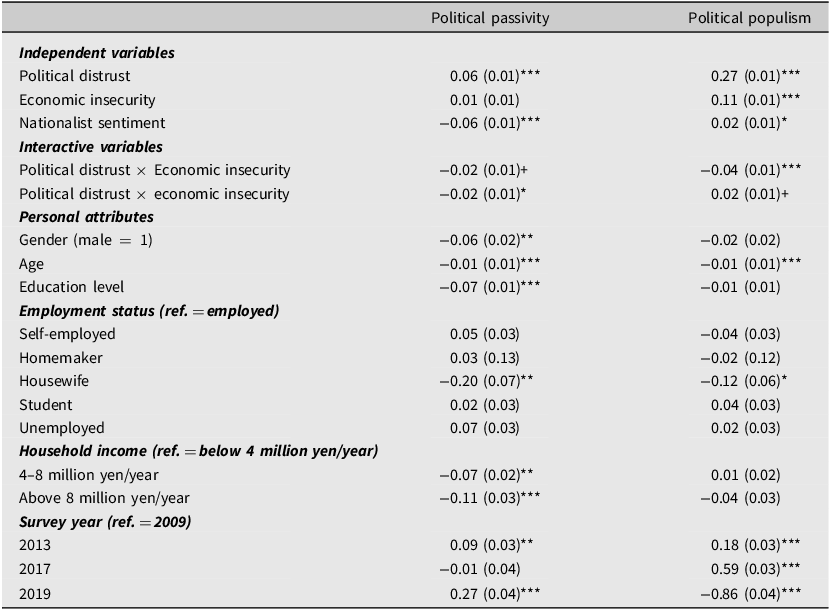
This study employs Ordinary Least Squares (OLS) regression to examine the associations between political distrust, economic insecurity, and nationalism on two continuous dependent variables: political passivity and political populism. The results are presented in Table 1.
OLS regression analysis of the determinants of political passivity and populist attitudes in Japan (2009–2019)

Table 1 Long description
A table with regression analysis results showing the determinants of political passivity and populist attitudes in Japan from 2009 to 2019. The table has 30 rows and 3 columns. Column headers are Political passivity, Political populism. Row labels include Independent variables, Interactive variables, Personal attributes, Employment status, Household income, and Survey year. Each row contains values for the coefficients and standard errors of the variables. Notable variables include Political distrust, Economic insecurity, Nationalist sentiment, and various personal attributes and employment statuses. The table provides coefficients and standard errors for each variable's impact on political passivity and political populism.
Note: Model A (DV = political passivity): N = 7, 229, Adjusted R 2 = 0.24. Model B (DV = political populism): N = 7, 248, Adjusted R 2 = 0.33. Robust standard errors are in parentheses. Ref. = reference category.
+p < .10. *p < .05. ** p < .01. ***p < .001.
The analysis begins by confirming that political distrust is strongly and positively associated with both political passivity and populist attitudes. Individuals who express greater distrust toward political institutions are significantly more likely to disengage from political participation and to endorse anti-establishment beliefs. This finding aligns with the study’s premise and is consistent with the argument that political distrust is systematically associated with divergent forms of political discontent.
Looking more closely at the primary predictors, economic insecurity and nationalism (here understood as civic-oriented nationalism) exhibit contrasting patterns. Economic insecurity is positively associated with populist attitudes and, to a marginal extent, with political passivity. This suggests that economic grievances, when experienced alone, may primarily channel discontent into support for populist views as measured in this study rather than disengagement. Nationalism, on the other hand, shows a clear negative association with political passivity, indicating that individuals with stronger national pride sentiments are generally more politically engaged. It also shows a statistically significant positive relationship with populist attitudes. While the association is modest in size, it suggests that nationalistic orientations may contribute slightly to populist sentiment, which is partially in line with Hypothesis 2.
The interaction effects provide more direct insight into how political distrust is translated into different attitudinal responses. The interaction between political distrust and economic insecurity is negative for both political passivity and populist attitudes, indicating that the attitudinal consequences of distrust are weaker under conditions of economic insecurity. Substantively, among economically secure respondents, moving from low to high political distrust is associated with a pronounced increase in predicted populist attitudes (from approximately −0.32 to 0.32 on the standardised scale). Among economically insecure respondents, however, the corresponding increase is much smaller, rising only from about −0.01 to 0.05. A similar dampening pattern is observed for political passivity: distrust is strongly associated with higher passivity among the economically secure (from −0.12 to 0.08), but only weakly so among those experiencing higher insecurity. These patterns suggest that, rather than amplifying political expression in either direction – withdrawal or radical support – economic insecurity may foster resignation or fatalism, thereby reducing both passive disengagement and populist mobilisation.
The interaction between political distrust and nationalist sentiment displays a contrasting pattern. For political passivity, the interaction term is negative, indicating that nationalist sentiment weakens the disengaging effect of distrust. Substantively, among respondents with weaker nationalist sentiment, moving from low to high political distrust is associated with a sharp increase in predicted passivity, rising from approximately 0.01 to 0.17 on the standardised scale. Among those with stronger nationalist sentiment, however, the same increase in distrust corresponds to little change and even a slight decline in passivity, from about −0.14 to −0.04. A related but distinct pattern emerges for populist attitudes. Political distrust is positively associated with populist attitudes across levels of nationalist sentiment, but the level and trajectory differ. Among respondents with stronger nationalist sentiment, predicted populist attitudes remain consistently high at around 0.41 regardless of distrust. By contrast, among those with weaker nationalist sentiment, populist attitudes increase more steeply with distrust, rising from approximately −0.12 to 0.42. Together, these patterns suggest that nationalist sentiment does not simply amplify the effects of distrust but redirects them – reducing political withdrawal while sustaining comparatively higher levels of oppositional, populist-oriented attitudes.
Taken together, the results show that responses to political distrust vary systematically with the type of grievance through which distrust is interpreted. Economic insecurity consistently dampens the attitudinal consequences of distrust, weakening its association with both political passivity and populist attitudes. By contrast, nationalist sentiment reshapes the expression of distrust more directionally: higher distrust is associated with reduced withdrawal and comparatively higher levels of populist-oriented attitudes among respondents with stronger nationalist sentiment. These patterns indicate that political distrust does not translate mechanically into disengagement or mobilisation. Instead, its attitudinal consequences depend on whether dissatisfaction is framed primarily in material or identity-based terms, a distinction that corresponds closely to the expectations outlined in Hypotheses 1 and 2.
Several control variables display meaningful patterns in relation to political passivity and populism. Gender and age are particularly salient: women are more likely to exhibit political disengagement, while older individuals consistently show lower levels of both passivity and populist attitudes. Socioeconomic status also plays a role: those with higher levels of education and household income are significantly less likely to disengage from politics. However, these variables show no consistent association with populist sentiment. Among occupational groups, students stand out as being significantly less inclined toward both passivity and populism, though other categories reveal no clear or stable trends. Lastly, the year dummies reveal notable shifts across years: levels of political passivity rose moderately in 2013 and spiked significantly in 2019. Meanwhile, populist attitudes peaked in 2017, then declined sharply in the final wave. While this study does not attempt to identify the causal events behind these fluctuations, the patterns align with the broader perspective in political behaviour research that public attitudes are sensitive to shifting political climates, cues from political elites, and evolving institutional trust. The marked rise in political passivity in 2019, in particular, may be indicative of the cumulative effects of long-term disaffection, voter fatigue, or a perceived dearth of electoral alternatives, which necessitates further qualitative or contextual inquiry.
6. Analysis 2: the effects of political distrust, nationalism, and economic insecurity on populist voting in Japan
The second stage of the analysis builds directly on the attitudinal patterns identified in Analysis 1 and examines whether these orientations translate into observable political behaviour. While the two analyses rely on different datasets and outcome measures, they are analytically connected through a common theoretical framework. As previously mentioned, political distrust is conceptualised as an underlying attitudinal condition, while economic insecurity and nationalist sentiment shape how that condition is expressed – either through withdrawal, attitudinal opposition, or electoral choice.
Importantly, the purpose of this second analysis is not to establish a direct causal pathway from specific attitudes measured between 2009 and 2019 to individual vote choices in 2024. Rather, it assesses whether the same configuration of grievances identified at the attitudinal level is associated with comparable patterns of political engagement when the outcome shifts from orientations to behaviour. In this sense, the two analyses should be understood as complementary rather than sequential: together, they evaluate the consistency of grievance-based mechanisms across different stages of political expression.
To test this, I used data from the sixth and seventh waves of the JES VII, conducted in October and November 2024. As stated earlier, these surveys are especially suitable because they ask detailed questions about voting choices, including those for several parties widely regarded as populist. To capture respondents’ behavioural responses in the 2024 election, I created a three-category dependent variable that indicates their voting behaviour. This variable is based on respondents’ reported vote choices in both the single-member district and the proportional representation district. In this study, parties considered populistic include the Reiwa, the JIP, the CPJ, and Sanseitō.Footnote 6 Respondents who voted for any of these parties in either or both districts were coded as 2 (voted for a populist party). Those who voted for any non-populist party in either district were coded as 1 (voted for a mainstream party). Respondents who did not vote in either district were coded as 0 (nonvoter). This trichotomous variable was used as the dependent variable in a multinomial logistic regression analysis to examine the distinct drivers of populist voting, mainstream voting, and political disengagement.
The independent variables mirror those used in the first analysis: political distrust, economic insecurity, and nationalist sentiment. Due to the absence of a direct measure of political trust in the 2024 dataset, this study employs dissatisfaction with politics as an approximation of political distrust. Although these two concepts are not identical – dissatisfaction often targets specific political outcomes or actors, whereas distrust involves deeper scepticism toward institutional legitimacy – they are closely related in theory and measurement. Studies have shown that persistent political dissatisfaction is often associated with broader institutional disaffection and reduced confidence in the responsiveness and efficacy of democracy (Torcal and Montero, Reference Torcal and Montero2006; Bertsou, Reference Bertsou2019). Although dissatisfaction may not capture all dimensions of political trust, it is a reasonable proxy in empirical models that seek to gauge citizens’ alienation from the political system. In this study, dissatisfaction is measured using responses to the following question: ‘To what extent are you satisfied with current politics in Japan?’
Interaction terms are included between political dissatisfaction and economic insecurity and between political dissatisfaction and nationalism. Control variables include gender, age, education, employment status, and income. Table 2 reports the results of the multinomial logistic regression, and substantive effects are summarised using predicted probabilities (see Appendix Table A2).
Multinomial logistic regression analysis of the voting behaviour in the 2024 House of Representatives Election
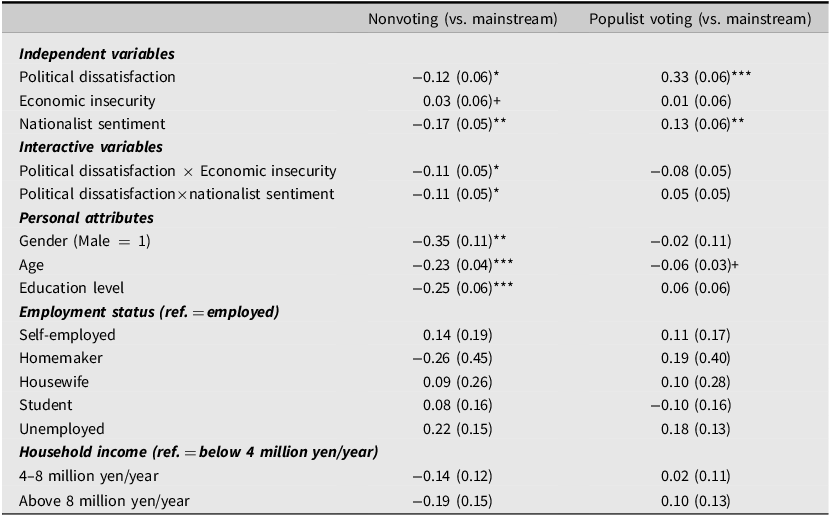
Table 2 Long description
A table comparing voting behavior in the 2024 House of Representatives Election. The table has 18 rows and 3 columns. The columns are labeled 'Nonvoting (vs. mainstream)', 'Populist voting (vs. mainstream)', and 'Independent variables', 'Interactive variables', 'Personal attributes', 'Employment status (ref. = employed)', 'Household income (ref. = below 4 million yen/year)'. Row 1: Political dissatisfaction, -0.12 (0.06)*, 0.33 (0.06)***. Row 2: Economic insecurity, 0.03 (0.06)+, 0.01 (0.06). Row 3: Nationalist sentiment, -0.17 (0.05)**, 0.13 (0.06)**. Row 4: Political dissatisfaction × Economic insecurity, -0.11 (0.05)*, -0.08 (0.05). Row 5: Political dissatisfaction × nationalist sentiment, -0.11 (0.05)*, 0.05 (0.05). Row 6: Gender (Male = 1), -0.35 (0.11)**, -0.02 (0.11). Row 7: Age, -0.23 (0.04)***, -0.06 (0.03)+. Row 8: Education level, -0.25 (0.06)***, 0.06 (0.06). Row 9: Self-employed, 0.14 (0.19), 0.11 (0.17). Row 10: Homemaker, -0.26 (0.45), 0.19 (0.40). Row 11: Housewife, 0.09 (0.26), 0.10 (0.28). Row 12: Student, 0.08 (0.16), -0.10 (0.16). Row 13: Unemployed, 0.22 (0.15), 0.18 (0.13). Row 14: 4–8 million yen/year, -0.14 (0.12), 0.02 (0.11). Row 15: Above 8 million yen/year, -0.19 (0.15), 0.10 (0.13).
Note: Multinomial logistic regression with 2,928 observations. Log-likelihood = −2698.68; LR χ 2 (30) = 219.31, p < 0.001. AIC = 5457.35; BIC = 5664.71. McFadden’s pseudo R 2 = 0.039 (reported for reference only). Robust standard errors in parentheses. Ref. = reference category.
+p < .10, *p < .05, **p < .01, ***p < .001.
6.1. Results
6.1.1. Nonvoting vs. mainstream voting
The analysis reveals that people experiencing greater economic insecurity are more likely to abstain from voting than to support mainstream political parties, although this main effect is marginally significant. The association becomes more meaningful when political dissatisfaction is considered: the interaction between dissatisfaction and economic insecurity is negative and statistically significant. This implies that economic insecurity alone may increase passivity, but among the highly disillusioned, it can instead reduce abstention.
This conditional effect is clarified further in substantive terms. Among individuals who are both dissatisfied and economically secure, the predicted probability of not voting is approximately 15.3%. However, among those who are both dissatisfied and economically insecure, this probability increases only slightly to 16.1%, indicating a reduced effect. Conversely, among those who are politically satisfied, economic insecurity increases the probability of abstention from 19.1% to 25.8%, suggesting that dissatisfaction may offset the demobilising impact of economic hardship.
Nationalism (again, primarily capturing civic-oriented attachment and national pride in this dataset) emerges as a consistently mobilising force. Its main effect is strongly negative and statistically significant, indicating that individuals with stronger nationalist sentiments are less likely to abstain from voting. Moreover, the negative and significant interaction between nationalism and political dissatisfaction suggests that nationalism becomes even more activating under conditions of disillusionment. Substantively, the probability of nonvoting declines from 27.2% among dissatisfied individuals with low nationalism to just 14.1% among those high in both nationalism and dissatisfaction. In short, nationalism is associated with greater participation even among the disenchanted.
Control variables are also informative. Women are more likely to abstain than men, and abstention is more common among older and less-educated individuals. These demographic factors appear to have a stronger association with nonvoting than with support for populist parties.
6.1.2. Populist voting vs. mainstream voting
When comparing populist voters to supporters of mainstream parties, political dissatisfaction and nationalist sentiment are both positively and significantly associated with populist voting. Dissatisfaction has a particularly strong effect, with a one-standard-deviation increase raising the probability of voting for a populist party from 17.1% (low dissatisfaction) to 30.0% (high dissatisfaction), holding other variables constant.
Nationalism also plays a significant role. Substantively, individuals with high nationalism have a 26.0% predicted probability of voting for a populist party, compared to 20.1% among those with low nationalism. Interestingly, the interaction between nationalism and dissatisfaction is not statistically significant, suggesting that their effects are largely additive rather than conditional.
In contrast, economic insecurity does not significantly predict voting for populist parties, nor does its interaction with political dissatisfaction yield meaningful effects. The predicted probability of voting for a populist party remains relatively stable across levels of economic insecurity (e.g., 23.8% at low insecurity vs. 22.9% at high insecurity), suggesting no meaningful behavioural shift. This pattern reinforces the notion that, while economic hardship may contribute to populist attitudes (see Table 1), it does not necessarily translate into populist voting – at least within the Japanese context.
Overall, these findings partially support Hypothesis 3. Nationalist sentiment reduces abstention and increases support for populist parties, which is consistent with the hypothesis that identity-based attachments mobilise the politically dissatisfied. However, the interaction between nationalist sentiment and dissatisfaction is significant only for abstention, not populist voting. Economic insecurity, meanwhile, does not operate as expected, as it lowers abstention among the disillusioned rather than reinforcing withdrawal and shows no significant effect on populist voting.
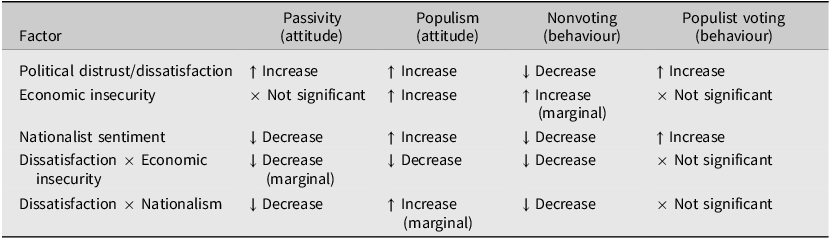
To clarify and visualise the points of convergence and divergence across the two stages of analysis, Table 3 provides a summary of the main effects and interaction terms across all four dependent variables. This table shows that ideological factors are more consistently associated with engagement, while economic grievances vary by context.
Summary of main and interaction effects of economic insecurity, nationalist sentiment, and political distrust on attitudinal and behavioural outcomes
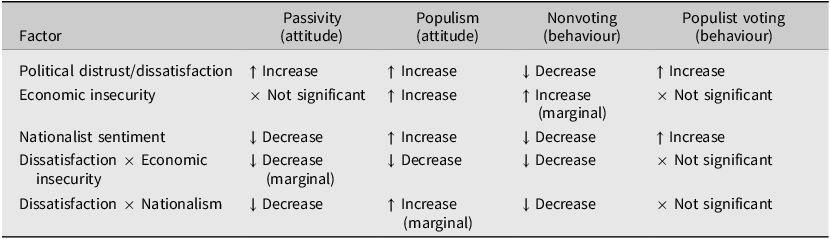
Table 3 Long description
A table with four columns and six rows. The columns are labeled Passivity (attitude), Populism (attitude), Nonvoting (behaviour), and Populist voting (behaviour). The rows are labeled Political distrust/dissatisfaction, Economic insecurity, Nationalist sentiment, Dissatisfaction x Economic insecurity, and Dissatisfaction x Nationalism. Row 1: Political distrust/dissatisfaction, Passivity (attitude) Increase, Populism (attitude) Increase, Nonvoting (behaviour) Decrease, Populist voting (behaviour) Increase. Row 2: Economic insecurity, Passivity (attitude) Not significant, Populism (attitude) Increase, Nonvoting (behaviour) Increase (marginal), Populist voting (behaviour) Not significant. Row 3: Nationalist sentiment, Passivity (attitude) Decrease, Populism (attitude) Increase, Nonvoting (behaviour) Decrease, Populist voting (behaviour) Increase. Row 4: Dissatisfaction x Economic insecurity, Passivity (attitude) Decrease (marginal), Populism (attitude) Decrease, Nonvoting (behaviour) Decrease, Populist voting (behaviour) Not significant. Row 5: Dissatisfaction x Nationalism, Passivity (attitude) Decrease, Populism (attitude) Increase (marginal), Nonvoting (behaviour) Decrease, Populist voting (behaviour) Not significant.
Taken together, Analyses 1 and 2 provide a coherent empirical account of how political distrust interacts with both economic and identity-based grievances to influence citizens’ political attitudes and behaviours. While attitudinal and behavioural outcomes differ in their specific correlates, the analyses converge in underscoring the consistent role of nationalist sentiment as a mobilising factor – reducing political passivity and nonvoting while boosting both populist attitudes and populist voting. Economic insecurity, by contrast, exerts a more limited and conditional influence. It contributes to populist attitudes and marginally increases participation among the politically disaffected but does not significantly impact electoral support for populist parties. This pattern emphasises the crucial role of ideological and identity-driven narratives in shaping political engagement during Japan’s era of distrust. Ultimately, economic hardship alone does not determine whether citizens withdraw from or become galvanised by politics. Rather, it is the lens through which discontent is interpreted, particularly in nationalist terms, that matters. Understanding these dynamics is essential to explaining the uneven landscape of political mobilisation in contemporary Japan and potentially other advanced democracies facing similar crises of trust.
7. Concluding remarks
This study set out to examine why individuals with high levels of political distrust take divergent political paths – some retreating into passivity, while others embrace populist sentiments and behaviours. Drawing on data from the JES, it investigated how economic insecurity and nationalism interact with distrust to shape patterns of political engagement, both attitudinally (2009–2019) and behaviourally (2024).
The findings reveal a significant asymmetry. Nationalist sentiment consistently emerges as the most robust mobilising force. Individuals with stronger nationalist attitudes are significantly less likely to disengage from politics and are more likely to support populist parties, regardless of their level of political distrust. In contrast, economic insecurity exerts weaker and more context-dependent effects: it elevates populist attitudes to a degree but does not translate into populist voting behaviour. Unexpectedly, economic insecurity even appears to reduce abstention among the most politically dissatisfied individuals, possibly reflecting a pragmatic impulse to seek change rather than withdraw entirely.
Importantly, the interaction between nationalism and political dissatisfaction did not significantly affect populist voting, which challenges the notion that nationalism directly transforms disillusionment into populist support. Nevertheless, nationalism remains independently associated with both attitudinal and behavioural engagement, indicating that identity-based concerns, rather than material ones, are politically potent. While not reliant on distrust to exert influence, nationalism provides an ideological framework that resonates with dissatisfaction, especially when mainstream alternatives appear unresponsive.
These patterns complicate the conventional view of Japan as an outlier of democratic apathy. Although the country is often characterised by low voter turnout and weak civic activism (Lind, Reference Lind2018), the evidence here suggests a latent capacity for political mobilisation, especially when identity-based narratives are prominent. The increase in nationalist participation indicates that discontent is not absent but rather dormant, awaiting channels to transform it into action.
Another key implication is the interdependence of material and identity-based grievances. Economic insecurity appears to be associated with higher levels of civic-oriented nationalist sentiment, which is also linked to greater political engagement. If this relationship intensifies amid mounting economic uncertainty, it could be conducive to a more cohesive populist movement. Should future political actors succeed in combining economic discontent and identity-based appeals into a compelling anti-establishment narrative, Japan, which is often viewed as resistant to such changes, may face genuine political realignment.
The findings presented in this article suggest promising avenues for future research. First, given the variation in the expression and reception of populism, future work could examine the supply side of populism in Japan, such as how political parties and leaders use rhetoric and the media to frame economic and identity-based grievances. Second, more research is needed on generational differences in political distrust and populist engagement, particularly in light of evidence indicating that younger voters are more politically disillusioned and more responsive to outsider candidates (Snell, Reference Snell2010). Third, cross-national studies could examine how institutional settings, such as electoral systems and party structures, mediate the relationship between political distrust and different behavioural responses.
Ultimately, Japan’s democratic future may hinge less on the depth of political distrust than on how that distrust is channelled. While some citizens withdraw, others are increasingly drawn to identity-based alternatives. The challenge for mainstream institutions is not merely to restore trust but to offer compelling responses to grievances before discontent hardens into polarisation. Recognising the political significance of civic-oriented nationalist sentiment and its role in shaping engagement is essential to understanding – and perhaps guiding – Japan’s evolving democratic landscape.
Supplementary material
The supplementary material for this article can be found at https://doi.org/10.1017/S1468109926100292.
Competing interests
I, Yue Yin, hereby provide the following Conflict of Interest Statement regarding the research and paper titled ‘Divergent paths of political distrust: A pooled cross-sectional analysis of the underlying causes of political passivity and populism in Japan’. I am an assistant professor at the Center for Japanese Studies, Shanghai Jiao Tong University, involved in the research and preparation of this paper. I confirm that I have no financial relationships, personal relationships, or professional relationships that could be perceived as potential conflicts of interest with regard to this research. This Conflict of Interest Statement is provided to ensure transparency and maintain the integrity of the review process.
Author Biography
Yue Yin is an assistant professor at the Center for Japanese Studies, Shanghai Jiao Tong University. She specialises in Japanese politics, political psychology, and political participation.


 Open access

