


Introduction
The phenomenon of vote switching, i.e., when voters switch their vote choice between elections, has received growing attention in recent years. Vote switching relates to an inherent tension between accountability and stability within democratic political systems. On one hand, it can be the voters’ way to signal dissatisfaction with the government or with the party they voted for in previous elections (Carrubba and Timpone Reference Carrubba and Timpone2005; Dassonneville et al. Reference Dassonneville, Blais and Dejaeghere2015). In that sense, vote switching is an important tool for voters to hold their representatives accountable (Söderlund Reference Söderlund2008). In addition, without vote switching, voting patterns are doomed to be inflexible, frozen and rigid, as are the party systems in such cases. On the other hand, vote switching is a major source of electoral change and volatility, and has been increasing in importance (Gomez Reference Gomez2015; Mellon Reference Mellon2021). Electoral volatility is connected to the destabilization of party systems, the decline of party identification, and the weakening role of parties as political institutions (Dalton and Wattenberg Reference Dalton and Wattenberg2002; Mair Reference Mair2013; Rahat and Kenig Reference Rahat and Kenig2018). It is important, therefore, to study what motivates voters to switch their vote and the conditions under which vote switching is more likely.
One factor affecting voters when making their choice, besides their evaluation of their preferred party, is strategic considerations of maximizing their vote. Ample evidence show that voters consider the context of the political competition in a way that sometimes results in voting for another party instead of the one they prefer the most (e.g., Abramson et al. Reference Abramson, Aldrich, Blais, Diamond, Diskin, Indridason, Lee and Levine2010). But what about the effect of strategic considerations on the likelihood of switching between elections? Presumably, strategic considerations may cause voters to switch their vote between elections due to a change in the electoral conditions such as the viable set of choices and the degree of competitiveness. Indeed, the relationship between strategic incentives and electoral volatility has been demonstrated in a macro-level comparative setup (Bischoff Reference Bischoff2013). However, to the best of our knowledge, this relationship has yet to be studied at the individual level. While there is ample literature on strategic coalition voting, we lack evidence about the effect of voters’ strategic considerations on the likelihood that they will switch their vote. Our article addresses this lacuna.
We focus on a form of strategic voting that prevails in parliamentary systems with coalition governments – coalition-directed voting. In this form of voting, voters consider not only the viability of the competing parties, but also their evaluations and expectations regarding the coalitions that are likely to be formed after the elections. Our theory deals with the effect of voter expectations regarding the composition of the coalition and the candidates for formateur, the prospective prime minister, on vote switching. We base our theory on two strategic behaviors established in the literature: policy balancing and formateur optimization (Cox Reference Cox, Herron, Pekkanen and Shugart2018). The former concerns voters who aim at influencing the allocation of portfolios within the coalition by changing the seat-shares of the parties forming it. The second is the attempt to affect the identity of the government formateur. We use Cox’s framework regarding the conditions in which each of these strategies is more likely to occur, focusing on formateur uncertainty, namely, how uncertain is the identity of the next formateur. In our study, this uncertainty is measured at the individual level, using voters’ perceptions of the likely formateur outcome. While acknowledging that voters’ expectations might be endogenous to their preferences and are affected by them (Meffert et al. Reference Meffert, Huber, Gschwend and Pappi2011), we follow previous literature in examining how voters’ expectations – whatever their sources are – affect voting behavior. Thus, we construct hypotheses regarding the relationship between voters’ expectations regarding the electoral outcome and their likelihood to switch their vote. We first hypothesize that, due to the policy balancing mechanism, the likelihood of switching increases for voters who expect that the party they voted for in the previous elections is not going to be part of the next government. We also propose that for voters of non-formateur parties, this effect depends on their perception of formateur uncertainty. Then, we hypothesize that formateur optimization should be more likely among voters who are uncertain about the identity of the formateur compared to those who are certain. Yet, we also explore a more nuanced version of formateur optimization by incorporating voters’ preferences for the government formateur, and distinguishing between those who are certain that their preferred candidate is going to win and those who are certain that their preferred candidate is going to lose.
To test our propositions, we utilize data from a case in which coalitions dominated the agenda of electoral campaigns and voters: the case of repeat elections following a failed attempt to form a government, which took place in Israel in 2019–2020. In this case, voters went to the polls only a few months after the previous elections, with no change in the composition of the coalition between elections. Due to the short period that had passed since the last elections, the odds of the parties changing their policy positions were quite low. Since most parliamentary activity was suspended during this period and no government had been formed, there was also no real parliamentary or governmental performance to be evaluated. Hence, voters were less likely to change their vote due to substantive considerations about the party’s characteristics or performance.
Our results support both the effect of policy balancing on vote switching and the role of formateur uncertainty in conditioning this effect. We also show that differences in formateur optimization are significant between voters with high formateur uncertainty and voters who assume that their preferred candidate will win. We explain this finding by addressing the incentives facing voters who assume that their preferred candidate is going to lose.
This paper contributes to research in several areas. First, it provides new insights into how voters’ strategic considerations affect the likelihood of switching their vote between elections, connecting theories on coalition-directed voting with vote switching and its determinants. Second, it expands the limited literature on the role of the government formateur in shaping voters’ decisions. We demonstrate the role of formateur uncertainty as an important condition for the effect of formateur and coalition considerations on voting, pointing to varying levels of strategic behavior within a highly informed case. Lastly, the paper sheds light on the dynamics of voting behavior in repeat elections. Previous studies have considered repeat elections as unique, outlier cases. However, the number of political and electoral crises in established democracies has increased recently, attracting increased attention to this type of case and to what it can tell us about voters’ considerations and behavior during political crises.
Portfolio-maximizing strategic voting
Vast literature has demonstrated that coalition-based considerations affect vote choice in multi-party systems – sometimes even more than party-based considerations (Blais et al. Reference Blais, Aldrich, Indridason and Levine2006; McCuen and Morton Reference McCuen and Morton2010). We devote this section to analyzing this literature and linking coalition-based considerations to vote switching.
In most parliamentary democracies, elections are the first of two stages determining the composition of the government, followed by negotiations and the formation of a (coalition) government. Therefore, voters are likely to consider not only which party they prefer and whether it has a chance of entering parliament, but also which formateur and which government they prefer and how realistic a chance it has of being formed. These considerations resonate with Cox’s (Reference Cox, Herron, Pekkanen and Shugart2018, Reference Cox1997) and Hobolt and Karp’s (Reference Hobolt and Karp2010) distinction between seat-maximizing and portfolio-maximizing voting.Footnote 1 Whereas seat-maximizing voters want their vote to influence the seat allocation in parliament and will therefore refrain from voting for a party that is not expected to win seats, portfolio-maximizing voters focus on a different post-election result – that of forming a government. Duch et al. (Reference Duch, May and Armstrong2010) showed empirically that most respondents make their voting decisions based on portfolio-maximizing considerations rather than seat-maximizing calculations.
The literature on the effects of coalition considerations on voting has identified several channels through which voters aim at affecting portfolio allocation. Cox (Reference Cox, Herron, Pekkanen and Shugart2018) summarized these as three possible ways in which portfolio-maximizing voters engage in strategic voting.Footnote 2 In this paper, we focus on two of these, which can be directly linked to vote switching behavior: Policy balancing and formateur optimization.Footnote 3 While policy balancing refers to coalition expectations that can affect all voters, formateur optimization is a strategy usually pushing voters of non-formateur parties towards parties of expected formateurs. We, therefore, begin with policy balancing, and then move to the more specific case of formateur optimization strategy among voters of non-formateur parties.
Policy balancing
Policy balancing is a strategy used by voters who assume the makeup of the next coalition is a done-deal, therefore attempting to influence the allocation of portfolios within the coalition by changing the seat shares of the parties forming it. It is also often referred to as ‘coalition-targeted Duvergerian voting’ (Bargsted and Kedar Reference Bargsted and Kedar2009). More specifically, policy balancing suggests that the desire to influence the upcoming coalition formation can make voters refrain from voting for parties that are unlikely to enter the coalition (Gschwend and Meffert Reference Gschwend, Meffert, Arzheimer, Evans and Lewis-Beck2016). The implicit assumption here is, of course, that voters seek to influence policy by voting for a party that will acquire ministerial power and influence.
Several studies attest to the existence of such strategic voting behavior. For instance, Bowler et al. (Reference Bowler, Karp and Donovan2010) showed that voters tend to desert their preferred party the less likely it is to enter the expected coalition, and Herrmann (Reference Herrmann2008) documented a similar pattern in Austria. Bargsted and Kedar (Reference Bargsted and Kedar2009) showed that when Israeli voters think that their favorite party has little chance of entering the post-election coalition, they are likely to desert it and support the ‘lesser of evils’ among those parties they believe will form the coalition. Cox (Reference Cox, Herron, Pekkanen and Shugart2018: 268) calls it ‘policy balancing by out voters’.Footnote 4
Formateur optimization
Also referred to as strategic sequencing (Cox Reference Cox1997), this voting strategy is meant to affect the identity of the next prime minister by voting for the party which will get the first opportunity to form a government. In coalition governments, the ruling party and its leader – the prime minister – have a crucial effect on parliamentary democracy (Warwick and Druckman Reference Warwick and Druckman2006; Glasgow et al. Reference Glasgow, Golder and Golder2011). They affect the structure of the coalition formed and have far-reaching consequences for policy making (Poguntke and Webb Reference Poguntke and Webb2007). Moreover, formateurs themselves have substantial power over portfolio allocation (Indridason and Kam Reference Indridason and Kam2008). Therefore, voters might engage in voting in order to affect the identity of the government formateur (Indridason Reference Indridason2011).
The most straightforward way to influence the identity of the formateur is by voting for his/her party, under the assumption that the larger the party’s seat share, the greater the likelihood that its leader will be appointed as formateur. Indeed, in many cases the formateur is the leader of the largest party in parliament (Martin and Stevenson Reference Martin and Stevenson2001). However, despite the formateur’s central role in parliamentarian systems, empirical evidence about the effect of his/her identity on vote choice is scarce. Studies that do exist on this subject often focus on Israel as an especially suitable case study to demonstrate the existence of formateur optimization strategic voting (see for example: Felsenthal and Brichta Reference Felsenthal and Brichta1985; Nachmias and Sened Reference Nachmias, Sened, Arian and Shamir1999). We, therefore, seek to contribute to this literature.
The role of formateur uncertainty
According to Cox (Reference Cox, Herron, Pekkanen and Shugart2018), two conditions make formateur optimization more likely, both of which concern the level of uncertainty in elections. The first is the level of uncertainty regarding the identity of the formateur, whereas the second is the level of uncertainty concerning the partners with which each formateur can choose to ally. The latter is affected, of course, by the existence of coalition signaling or lack-there-of. For formateur optimization to be likely, a delicate balance should be kept between parties signaling to voters which formateurs are possible allies (and which are not) and avoiding forming strict pre-electoral alliances. Thus, formateur optimization becomes most likely when there is some uncertainty regarding the identity of the formateur, but little uncertainty regarding the possible future coalition compositions.
The level of uncertainty regarding the identity of the formateur and his/her potential allies can be measured using both external information and the subjective assessment of voters. While election polls, media reports and other information can be used to extract the level of uncertainty at the system level for given elections, the degree to which different voters perceive the situation as uncertain can vary within electoral campaigns. Some voters can predict a competitive race between the potential formateurs, while others may evaluate one candidate as being more likely to win than the other. Thus, to explore the mechanism leading individuals to engage – or not – in formateur optimization within a specific case, it is important to assess their subjective evaluations. This individual-level measurement approach relies on previous studies which have established that voters’ expectations regarding the electoral results affect their voting decisions.Footnote 5 While acknowledging that voters’ expectations might be endogenous to their preferences and are affected by them (Meffert et al. Reference Meffert, Huber, Gschwend and Pappi2011), we follow previous literature in examining how voters’ expectations – whatever their sources are – affect voting behavior (Bargsted and Kedar Reference Bargsted and Kedar2009; Bowler et al. Reference Bowler, Karp and Donovan2010; Meffert et al. Reference Meffert, Huber, Gschwend and Pappi2011). Thus, we treat voters’ expectations as our point of departure, that is, as the independent variable. Having said that, we also include a hypothesis which takes into account voters’ preferences in shaping expectations’ effects on vote switching.
The setup described above assists us in evaluating when and why voters desert their non-former party due to formateur-oriented considerations. Voters of non-formateur parties are most likely to switch their vote and support their preferred formateur party when they evaluate the race for formateur as competitive and close (i.e., evaluate high formateur uncertainty).
What about the voters of non-formateur parties who do not predict a close race between formateurs and therefore are less likely to engage in formateur optimization? Are they more likely to engage in policy balancing instead? Indeed, Cox (Reference Cox, Herron, Pekkanen and Shugart2018: 270) suggests that policy balancing (as well as partner optimization, which we do not discuss here) is more likely to occur when the levels of formateur uncertainty are low. Therefore, only when voters think they know who the next formateur will be, are they likely to engage with considerations regarding later phases of coalition formation. Put simply, since formateur optimization considerations come first in the coalition formation sequence (Gschwend and Meffert Reference Gschwend, Meffert, Arzheimer, Evans and Lewis-Beck2016), only voters who are ‘free’ from weighing such considerations – since they believe the race for formateur has already been settled – consider additional factors, such as those related to policy balancing. This means that among voters who previously voted for non-formateur parties, the likelihood of policy balancing will depend on their level of certainty regarding the identity of the formateur.
Vote switching and its electoral strategic incentives
The literature on vote switching suggests that both the context in which elections are held and the individual characteristics of voters affect vote switching.Footnote 6 Some contexts are associated with more vote switching, such as a large number of parties (Dassonneville et al. Reference Dassonneville, Blais and Dejaeghere2015), changes in party positions (Ferland and Dassonneville Reference Ferland and Dassonneville2021), particularly of mainstream parties (Spoon and Klüver Reference Spoon and Klüver2019), and second-order elections (Carrubba and Timpone Reference Carrubba and Timpone2005). On the individual level, voters who are dissatisfied with democracy and less satisfied with their party are more likely to switch their vote (Dassonneville et al. Reference Dassonneville, Blais and Dejaeghere2015). Personality traits, such as openness to experience and extroversion, have also been associated with vote switching at the individual level (Bakker et al. Reference Bakker, Klemmensen, Nørgaard and Schumacher2016).
While the literature on vote switching and its predictors is vast, it lacks attention to a set of well-established considerations which can lead to changes in voting decisions: strategic considerations and specifically coalition-based strategic considerations, as discussed above. The above-mentioned literature on strategic voting has thoroughly described how strategic incentives affect vote choice. Next, we build on this research in order to shed light on the strategic mechanisms for vote switching.
When strategic incentives are absent, voters may switch their vote based on party-related factors such as changes in their evaluation of the party, shifts in party positions over time or changes in their own preferences from one election to another. Strategic considerations add another layer of voting considerations, which are based on the changing conditions of the electoral competition in which the elections are held, such as the viability of parties (Bartolini and Mair Reference Bartolini and Mair1990). Because strategic voting – more than ideologically ‘sincere’ voting – is very dependent on time-varying factors such as the expected seat distribution and signaled coalition options, voters are more likely to strategically switch their vote as circumstances change.
The relationship between strategic considerations and vote switching has yet to be systematically studied at the individual level. However, at the system level, Bischoff (Reference Bischoff2013) shows that electoral systems with strong incentives for strategic voting have significantly greater voter volatility. Bischoff’s work raises questions about the micro-mechanisms that account for the macro-level correlation between strategic incentives and higher levels of vote switching. Therefore, we are prompted to explore how voters’ evaluations of the electoral competition between parties and candidates in current elections affect their likelihood of switching from the party they previously voted for.
Theoretical expectations on the effect of portfolio-maximizing strategic voting on vote switching
Based on the combination of the two strands of literature we engage with, we adapt the logic of strategic voting to the framework of vote switching, yielding three main theoretical expectations. The first addresses the effect of policy balancing on vote switching, the second on how policy balancing and formateur uncertainty interact, and the third deals with formateur optimization.
Our hypotheses in this study are as follows. Given what we know of policy balancing portfolio-maximizing voting, we argue that voters should be more likely to switch their vote between elections when they expect the party for which they voted in the previous coalition is not going to be part of the next government. Such voters will switch their vote to influence the balance of power in the government most likely to form. Hence, they are likely to switch their vote to a party which they believe will have higher chances of participating in the next coalition, in order to maximize the benefits of their vote.
H1: Voters who expect the party they voted for in the previous elections will not enter the governing coalition in the following elections are more likely to switch their vote.
Yet, policy balancing, according to Cox (Reference Cox, Herron, Pekkanen and Shugart2018), will take place when voters hold high levels of certainty regarding the formateur’s identity. Thus, when voters evaluate high levels of formateur uncertainty (a close race between the potential formateurs), policy balancing is less likely. This is because in such scenarios voters would be motivated to use their vote in order to affect the identity of the next formateur. Therefore, coalition expectations regarding their previously voted-for party should not affect their likelihood of vote switching. In contrast, when voters evaluate low levels of formateur uncertainty – and believe the race for formateur is not competitive – they are free to address other strategic voting considerations, such as those relating to the balance of power in the government most likely to form. In such cases, coalition expectations, which drive policy balancing, are expected to affect the likelihood of vote switching. We test this hypothesis on a subset of voters – those who previously voted for a non-formateur party – as they are the ones able to distinctively choose between formateur optimization and policy balancing.
H2: Among voters who previously voted for a non-formateur party, coalition expectations affect those who are certain about the identity of the formateur, and not those who are uncertain about his/her identity.
Our last hypothesis aims at testing for formateur optimization directly. Again, we test this mechanism among those who previously voted for non-formateur parties, speculating that voters who perceive high formateur uncertainty will be more likely to engage in formateur optimization – and switch their vote from a non-formateur party to a formateur party – compared to those who are certain about the identity of the next formateur. As mentioned above, the rationale for this expectation is quite intuitive – voters who feel the identity of the formateur is uncertain have a greater incentive to switch their vote and support a formateur’s party in hopes of affecting who the next formateur will be. Voters who feel that the formateur’s identity is quite certain do not experience such pressure.
Nonetheless, the dynamics of the competition between candidates for formateur coupled with voters’ preferences, we believe, might lead some voters to engage in formateur optimization even when perceiving the outcome as certain. Here we distinguish between certainty that a voter’s preferred formateur candidate will win and certainty that her preferred candidate will lose. This more nuanced approach incorporates voters’ individual preferences for the government formateur with their expectations regarding the outcome of the race. We chose to follow this path as it enables us to address the possibility that the effect of expectations on voting may be contingent on preferences. As such, it assists us in presenting a more accurate account of the conditions under which voters are likely to engage in formateur optimization.
Let us clarify. Voters of non-formateur parties who prefer a given formateur candidate and believe she will win the race have little-to-no incentive to switch their vote to that candidate’s party. In a way, such voters can have the best of both worlds: they can vote sincerely for the party they feel closest to and have their preferred candidate as formateur. These conditions make switching highly unlikely. In contrast, those who prefer a given formateur but are uncertain of her chances of winning are most likely to switch their vote to support their preferred formateur, using their vote where it counts the most. In between those two contrasts are voters who prefer a given formateur and believe she will lose the race. Such voters do not have a strong incentive to switch their vote as those who expect a highly competitive race, but their incentive to keep their vote and not switch is not as strong as those who are certain their candidate will win. They might disregard high chances for their preferred formateur to lose and still attempt to affect the elections’ results by switching their vote to their preferred candidate’s party, thus engaging in formateur optimization, as a kind of wishful thinking.
Therefore, we formulate two hypotheses. H3 follows Cox’s conceptualization which puts formateur uncertainty as a major condition for the occurrence of formateur optimization. To that, we add the more nuanced H3a, which assumes that even among voters who are certain about the identity of the formateur, some will be more likely to calculate formateur considerations into their voting decision – based on their preferences.
H3: For voters who previously voted for a non-formateur party, those who are uncertain about the identity of the formateur are more likely to engage in formateur optimization than those who are certain about the formateur’s identity.
H3a: Among voters who are certain of the formateur’s identity, formateur optimization will be more likely for those who expect their preferred candidate to lose compared to voters who expect their preferred candidate to win.
The Israeli case: 2019–2020 election cycles and coalition signaling
Our theory is relevant to multi-party systems with coalition governments in which coalition-directed voting is quite common (Duch et al. Reference Duch, May and Armstrong2010). Specifically, in this study we focus on the Israeli case and take advantage of a particular instance of three election cycles within one year in which coalition politics was particularly salient. Since coalitions are a fundamental principle of Israeli politics, it is not uncommon to find Israel as a leading case in the abovementioned literature on coalition-directed voting. In this section we elaborate on the Israeli political system, in general, and on the specific conditions of the 2019–2020 elections.
The Israeli electoral system
Israel is a highly fragmented political system due to a combination of a fragmented society and a proportional representation system with a single national district (Rahat et al. Reference Rahat, Hazan and Ben-Nun Bloom2016). The Israeli parliament, the Knesset, is usually comprised of 9–12 parties, with an average effective number of parties of 6.4 since 2009. Consequently, Israeli governments have always relied on multi-party coalitions (Hazan Reference Hazan, Hazan, Dowty, Hofnung and Rahat2021). As such, coalition related issues are very salient in Israeli politics. There is substantial media coverage of coalition dynamics among parties and politicians, starting early in the period of election campaigns and continuing all the way until the formation of the coalition. Indeed, even after the government is formed, there is considerable public attention dedicated to the relationships between the prime minister, her party and other coalition partners and their level of cooperation or lack thereof.
The Israeli elections 2019–2020
Our study focuses on a case in which no coalition was formed after the elections, leading to repeat elections within several months, with this scenario being replicated in the following elections. The April 2019 elections were held after a stable term of four full years. The incumbent right-wing Likud party was led by Benjamin Netanyahu with 10 straight years of prime-ministership behind him. The center-left bloc was led by the Blue-White party, a new merger of three parties, with Benny Gantz as the candidate for prime minister. The two parties ran neck-and-neck throughout most of the campaign. Indeed, the election results saw both receiving exactly the same number of seats in the Knesset with 35 (29%) each. The right bloc overall, however, had the upper hand with 65 of the 120 seats, and Netanyahu was given the role of formateur by Israel’s figurehead President Reuven Rivlin. Surprisingly, though, Netanyahu failed to form a coalition. Israel’s Basic Law holds that: The Government indicates that in such a scenario the mandate should have gone back to President Rivlin, who presumably would have given Gantz the opportunity to form a coalition. However, a sufficient number of Knesset MPs supported the dissolution of parliament and new elections were called, scheduled for September 2019.
The September 2019 elections saw almost no change in the seat distribution. Again, Blue-White and Likud tied, with 33 and 32 seats respectively. Neither side had a clear majority and a grand coalition seemed like the only possible outcome. However, Blue-White and Likud could not reach an agreement. This time, Gantz received the first opportunity to form a government. After he failed, Netanyahu was given an opportunity but failed as well. Finally, pursuant to the Basic Law, the Knesset was dissolved and new elections, the third round within a year, were scheduled for March 2020.
For our study, the three election cycles of 2019–2020 provide two interesting vote switching opportunities: between April 2019 and September 2019, and then between September 2019 and March 2020. Due to the short period between elections, and since no government was formed, voters’ evaluations of government performance were unlikely to change significantly between elections, nor did party positions on various issues.Footnote 7 There were almost no changes in the lists of party candidates. Instead, the media and the public debate focused on the potential resulting coalitions. Indeed, our case is one in which vote switching is less likely compared to regular election cycles (Bischoff Reference Bischoff2013), but the voters who do switch their vote are more likely to do so due to coalition considerations.
The role of information
As during this entire period no new government was formed, the parties’ future intentions with regard to joining or eliminating certain coalitions (i.e., coalition signaling) became focal for voters and parties alike. Recent studies on coalition signaling show that such signals reduce the importance of party considerations in voters’ decisions and lead some voters to change their vote (Herrmann Reference Herrmann2014; Gschwend et al. Reference Gschwend, Meffert and Stoetzer2017). In line with these studies, our electoral context, in which no coalition was formed post-elections, increased the importance of coalition-based considerations and made coalition signaling central in all parties’ campaigns. Media outlets also focused mainly on questions of possible coalition compositions, instead of policy issues or government performance. Indeed, this is a case of a high-information context, in which ample pre-election information is available, which greatly reduces the level of partner uncertainty as described in Cox’s theory mentioned above. Pre-electoral coalitions were ubiquitous in the Israeli case studied here. Both formateurs signaled to voters which parties they would like to form a coalition with. Parties made sure to clearly indicate to voters which coalition(s) they wanted to form, and which were undesirable. Junior coalition parties even took the liberty of publishing campaign ads with a picture of their desired formateur along with their own party leaders.
Not all elections are characterized by such clear pictures of who would ally with which formateur, or which coalition compositions are more likely than others (Golder Reference Golder2005). Even the Israeli case is not always that clear. Therefore, we consider this study as an opportunity to learn about formateur optimization and policy balancing under conditions of low partner uncertainty. This empirical framework can be further adjusted to other cases, by adding varying levels of partner uncertainty to the research design. Nonetheless, our study serves as a case with high-profile formateur competition with non-definite results, which allows testing for the role of perceptions of formateur uncertainty at the individual level in a context where potential contravening factors – partner uncertainty, individual status changes, reaction to party ideological shifts, evaluations of party or government performance, et cetera – are expected to be muted.
Data and measures
We conducted a three-wave online panel survey in Israel, a week before each of the three election cycles in 2019–2020. The survey was conducted using Panels Politics, one of Israel’s largest online polling firms, using quota sampling representing Israel’s adult Jewish population.Footnote 8 The number of respondents in the original sample was 1,206 in the first wave (April 2019), 909 in the second wave (September 2019) and 801 in the third wave (March 2020). Statistical tests show that attrition did not change the demographic composition of the samples between the three waves.Footnote 9 We excluded respondents who reported that they had not decided whom to vote for. We also excluded nonvoters from the analysis (37 observations in total, see Footnote 6).
We focused on the two possible switches that each respondent could make: between wave 1 and wave 2 (April and September 2019) and between wave 2 and wave 3 (September 2019 and March 2020), consequently reshaping the data to represent two switching opportunities. While some voters had data for the two switching opportunities, we also included in our analyses those voters with data available for one switching opportunity only.Footnote 10 Our final sample contains 1,104 observations based on 655 unique respondents.
Dependent variable
We first operationalize vote switching as a binary variable, which equals 0 if the respondent reports the same voting intentions in the current wave as s/he did in the previous wave. This variable equals 1 if the respondent reported his/her intentions of voting for a different party in a subsequent wave.Footnote 11 Using vote intentions has its drawbacks, as respondents might change their minds in the week between the time of the survey and the actual elections. However, the alternative was to rely on retrospective reports (e.g., asking in wave 2 what the respondent’s vote choice was in wave 1), which has its own substantial, and we believe greater, drawbacks. According to this operationalization, 23.7% of the sample (both switching opportunities) reported switching parties. We then created a second operationalization for vote switching, this time as a categorical variable. Concentrating on non-formateur party voters, we distinguish between non-switching, switching to a formateur’s party,Footnote 12 and switching to other non-formateur parties.
Independent variables
Coalition expectations
We measured the respondents’ current expectations regarding the chances that the party they voted for in the previous elections was going to be in the eventual post-election coalition. We asked the respondents to answer the question, ‘What is the chance that [party X] will be in the next coalition?’, on a scale from 0 to 10. We asked this question about all parties in wave 2 and wave 3. We relied on the respondents’ vote intentions in the previous wave to determine which party’s chances of coalition participation to use in our analyses. The mean score for this variable is 7.46, with a standard deviation of 2.45.
Formateur uncertainty
We asked the respondents, ‘Regardless of your political position, who do you think will be the prime minister after the elections?’ with three response options: Netanyahu, Gantz or ‘both have the same chance.’ We then constructed two variables. First, we constructed a binary uncertainty variable that receives a value of 1 for those who responded ‘both have the same chance’ and 0 otherwise. Second, based on the respondents’ answer to a preference question (‘Who would you prefer to see as prime minister after the elections?’), we computed a three-categories variable, with one category denoting an expectation that the respondent’s preferred candidate would win the race and be the prime minister (61.9%), a second category denoting that the other candidate was expected to become the prime minister (13.6%), and a third category denoting a close race between candidates (24.6%).
Control variables
We control for several individual-level characteristics. First, we measured insincere voting in the previous election based on the question: ‘To which party do you feel closest?’. Respondents who, in the previous elections, reported intentions of voting for a party different from the one to which they felt closest received a value of 1 (‘insincere’). All others (including 21.4% of respondents who gave no party as an answer) received a value of zero. Thus, 13.5% of the responses were coded as insincere in previous elections.
Second, we measured the ideological distance between the respondent and the party s/he voted for in the previous elections, on an 11-point left-right scale, based on the absolute difference between the respondent’s self-placement and her placement of that party at the current time. Presumably, voters will more readily switch when they regard their previously voted-for party as more ideologically distant from them.
Third, we measured political knowledge as the correct answer to a single political knowledge question, tapping the respondent’s knowledge in the current wave. The respondents were asked in wave 2 who was the Minister of Homeland Security (71.8% answered correctly), and in wave 3 who was the Minister of Education (83.9% answered correctly).
Fourth, we controlled for the respondents’ age using a continuous measure (M = 47.7, SD = 16.4), and their gender (46.5% female). Finally, we controlled for ‘switching opportunity,’ with 1 corresponding to switching between April and September 2019 and 2 corresponding to switching between September 2019 and March 2020.
Results
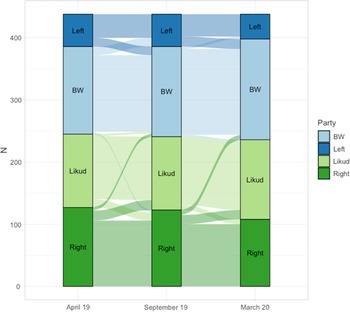
We begin by presenting a descriptive graphical depiction of the respondents’ movements between formateur and non-formateur parties for all three election cycles. For presentation purposes (Figure 1), we include in this analysis only respondents who gave valid vote intentions in all three waves. We grouped respondents’ vote choices in four groups: a group for each formateur party (Likud or Blue-White), a group of left-wing parties including Labor, Meretz, Gesher and the Arab parties, and a group of right-wing parties including Shas, Yahadut HaTorah, Israel Beitenu, Kulanu and other small right-wing parties.Footnote 13
Vote switching between the three election cycles.
Note. Bars represent the number of respondents voting for each party/group of parties. BW = Blue-White party; Likud = Likud party; Left = Other left parties; Right = Other right parties.

This birds-eye graphic description provides a number of interesting insights. First, in total 8.6% of the respondents switched from a non-formateur to a formateur party, while 7.5% switched between non-formateur parties. Further 6.8% switched from a formateur to non-formateur party, and a negligible 0.8% switched between the two formateur parties, Likud and Blue-White. Furthermore, relatively few have switched across the blocs (left and right). Second, the figure reveals stark differences between the two switch opportunities. In the first, 28.5% of the respondents switched their vote. This number dropped to 18.1% in the second switch opportunity. The composition of these switches also changed, as the second switch opportunity saw more moves from non-formateur to formateur parties (10.2% compared to 7.2%) and much fewer moves to non-formateur parties, either from formateur or other non-formateur parties (6.9% compared to 20.6%). This is probably the result of stronger pressures toward formateur-maximizing voting and the reduction of the number of relevant parties between the election cycles.
We now turn to test our hypotheses. In Table 1, we test Hypothesis 1 which deals with the assumed tendency of voters to switch their vote when they do not expect their previously voted-for party to be part of the next coalition. We use logistic regression models with our binary vote-switching variable as a dependent variable. Model 1 includes only the coalition expectation variable and demographic controls on the right-hand side. In Model 2 we add two further controls related to vote choice – past insincere vote and the respondent’s perceived ideological distance to their previous vote choice. Finally, we add formateur uncertainty as control in Model 3.
The effect of coalition and formateur uncertainty on vote switching

Note. Logistic regression models. Dependent variable: vote switching (1), non-switching (0). Robust standard errors in parentheses, clustered by respondent.
*** P < 0.01,
** P < 0.05,
*P < 0.1.
The findings in Table 1 are consistent across all models, with a negative and statistically significant coefficient for coalition expectations. Figure 2 presents the result based on Model 3 (holding all control variables to their observed values), showing the probabilities of vote switching as a function of coalition expectations. The figure clearly shows that the greater the expectation that their previously voted-for party is going to be part of the future coalition, the less likely the voters are to switch their vote. Looking at this result from the other side, when voters suspect that the party they voted for in the previous elections will not participate in the next coalition, they are more likely to switch their vote and desert that party. This effect is quite substantial. Respondents who think that the party they voted for is unlikely to enter the next coalition (0–2 on the 0–10 expectations’ scale) are roughly 4 to 5 times more likely to switch their vote (47–58% predicted probability of switching) compared to those who are certain (10 on the expectations’ scale) their party will enter the coalition (13% predicted probability of switching). This shows that when voters fear their vote choice will not be able to provide them with the benefits associated with participation in the coalition, they have a stronger incentive to switch their vote.
Vote switching probabilities by coalition expectations.
Note. Probabilities calculated based on Model 3 in Table 1, with control variables set to their observed values. Capped vertical lines represent 95% confidence intervals. Gray bars represent density of the independent variable in the data.

Among our control variables, insincere past-vote and ideological distance increase the likelihood of switching, as expected. Also, the second switching opportunity reduces the odds of switching compared to the first switching opportunity, as was already noted looking at the descriptive graph above.
To further highlight how coalition expectations figure into voters’ decisions about switching their vote, we explore voters’ coalition expectations regarding the parties to which they switch their vote. Do voters switch to parties that they believe have a greater chance to be in the next coalition than the ones they deserted? Based on our theoretical logic, the answer should be ‘yes’. Figure 3, which includes vote switchers only, presents the median coalition expectation (marked by the square markers) for the current (new) vote choice on the y-axis, scattered against the coalition expectation for the previous vote choice on the x-axis. The vertical lines represent the range between the 25th and 75th percentiles of expectations regarding the current vote choice. The diagonal is the 45-degree line. In this composition if voters evaluate that their new vote choice – the party to which they switched their vote to – has higher chances of being in the next coalition compared to their old vote choice – the party from which they switch – the observation will be plotted above the diagonal line. If they expect the opposite, the observation will be plotted beneath it. Our expectation is that most observations will be placed above the diagonal 45-degrees line, as voters are expected to switch their vote to parties with higher chances of participating in the next coalition. As evident from the figure, this is true for most cases. The vast majority of voters who ranked their previous vote choice’s likelihood of participating in the next coalition as 6 or below switched to a party which they deem has better chances of entering the next coalition. Only those who voted for parties which they perceive as having a likelihood score of 7 and above to be in the next coalition, tend to switch to parties which they evaluate as having similar or lower chances of getting into the next coalition, on average, possibly for other reasons not explored here.
Difference in coalition expectations for switchers.
Note. Markers represent median current coalition expectation among voters with previous party’s coalition expectation of the relevant value on the x-axis. Vertical lines represent the range between the 25th and 75th percentiles. Solid diagonal line is the 45-degree line.

We now turn to test the effect of formateur uncertainty on non-formateur voters’ behavior. Table 2 includes three models: the first (column 1) uses logistic regression while the other two are multinomial (columns 2a through 3b). All models include all control variables as well as the coalition expectations variable.
The effect of formateur expectations on vote switching

Note. Model 1 is logistic. Dependent variable: vote switching (1), non-switching (0). Models 2 and 3 are multinomial logistic. Dependent variable: non-switching (0, base category), switching to formateur party (1), switching to non-formateur party (2). Expected formateur base category: Preferred candidate wins. Robust standard errors in parentheses.
*** P < 0.01,
** P < 0.05,
* P < 0.1.
Model 1 tests hypothesis H2, which stipulates that the effect of coalition expectations (which motivate policy balancing) will be pronounced only among those who are certain about the identity of the next formateur. Figure 4 presents the marginal effects of coalition expectation on the likelihood of vote switching, conditional on the certainty regarding the formateur race outcome. In line with hypothesis H2, the effect of coalition expectations is significant only among those who are certain about the formateur race outcome. Voters who are uncertain about the formateur race outcome are less likely to engage in policy balancing, compared to those who are certain regarding the formateur race outcome and therefore free to engage in this type of coalition directed strategic voting.
Effect of coalition expectations on vote switching, by formateur uncertainty.
Note. Average marginal effects of coalition expectations on vote switching interacted with formateur expectations, based on Model 1 in Table 2. Analysis includes voters for non-formateur parties only. Control variables set to their observed values. Capped vertical lines represent 95% confidence intervals.

Model 2 (columns 2a and 2b) tests Hypothesis 3. We expected to find that uncertainty about the formateur will increase the likelihood of formateur optimization among voters of non-formateur parties. Therefore, we would expect to see a significant and positive uncertainty coefficient in column 2a (switch to a formateur party) but not necessarily in column 2b (switch to other non-formateur party). While the effect in column 2a is indeed positive, it is statistically insignificant.
To understand why, we continue in Model 3 according to hypothesis H3a. In this model we distinguish between certainty that a voter’s preferred formateur candidate will win and certainty that her preferred candidate will lose. Here we address the possibility that the effect of expectations on voting may be contingent on preferences. As such, it assists us in presenting a more accurate account of the conditions under which voters are likely to engage in formateur optimization.
Figure 5 presents the predicted probabilities for a formateur maximizing switch, based on column 3a in Table 2, for each of the three formateur race expectations. It shows that non-formateur party voters who are uncertain about the formateur race outcome are significantly more likely to switch their vote to a formateur party compared to those who expect their preferred candidate to win. Differences between those who expect their preferred candidate to lose and those who expect their preferred candidate to win/those who are uncertain about the race outcome are statistically insignificant. These different effects lend support to the rationale of breaking down the group of certain voters based on their formateur preference, as it enables us to flesh out significant differences between two groups of interest and point at the conditions under which formateur optimization is more likely to happen. Whereas being certain of your preferred formateur’s chances of winning creates no incentives for vote switching, being certain of your preferred formateur’s chances of losing may still incentivize switching, to some extent. The empirical analysis of H3 and H3a shows that it is less accurate to predict formateur optimization based on a differentiation between voters who see the race as competitive and those who do not. Rather, it is more accurate to differentiate between voters who see the race as competitive and those who see themselves as part of the winning team with great certainty.
Effect of formateur uncertainty and preferences on vote switching.
Note. Predicted probabilities of vote switching to a formateur party, based on Model 3 in Table 2. Analysis includes voters for non-formateur parties only. Control variables set to their observed values. Capped vertical lines represent 95% confidence intervals.

Robustness
For robustness we estimated all models using a multilevel model with the individual respondent as the higher level (Table A1 in the online Appendix). Our findings hold. We also estimated our models using bootstrapping on random subsamples of our data (450 unique respondents for Table 1’s models, 200 respondents Table 2’s models) repeated 500 times for each model. The coefficient for expected formateur in Table 2 Model 3a loses its significance while retaining its size. All other results hold (see Tables A2 and A3 in the online Appendix).
In a further analysis, we tested whether the effect of coalition expectations is more or less pronounced for specific voters (Table A4 in the online Appendix). To that end, we ran models with interactions between the coalition expectations variable and political knowledge, age, gender and the survey wave. All these demographic variables had no significant interaction effect, suggesting that these coalition-directed strategic considerations apply to people from all walks of life.
Furthermore, we excluded respondents who voted for the Israel Our Home (IOH) party. This party switched its coalition commitments after the April 2019 elections, moving from being a steadfast partner in right-wing, Likud-led coalitions to a proponent of grand coalitions. Accordingly, IOH is the only party whose average ideological placement by our respondents changed substantially between the elections, with its aggregated perceived position moving 1.5 points toward the left between the first and second waves. If voters decided to switch from or to IOH because they saw it as more left-wing than before the first wave, this perception might skew our results. However, even when we excluded the respondents in our panel who at some point voted for IOH, the results remained (see Table A5 in the online Appendix).
Conclusion
How do voters’ strategic considerations affect their likelihood of switching their vote between elections? In this study we presented an individual-level analysis of the effect of voters’ expectations regarding the composition of the coalition and the race for prime minister on their likelihood of switching their choice of party. We followed a typology of portfolio-maximizing voting (Cox Reference Cox, Herron, Pekkanen and Shugart2018) and provided empirical evidence for two types of such voting: policy balancing and formateur optimization. Delving into the effect of policy balancing, our analysis confirms that voters who anticipate that the party which they voted for in the previous elections is not going to be part of the expected coalition are more likely to switch their vote. These voters switch their vote to a party which they evaluate as having higher chances of being in the next coalition. Moreover, we show that voters’ uncertainty regarding the identity of the next formateur affect voters’ decisions to switch their vote. When those who voted for non-formateur parties are uncertain regarding the next formateur’s identity, they are more likely to desert these parties and vote for a formateur party. This is true mostly compared to voters who expect their preferred formateur to win.
The findings contribute to our understanding of why voters switch parties between elections by highlighting the role of individual-level strategic considerations when making electoral decisions. We show that voters take into account which coalition is going to be formed, whether the party they previously voted for is going to be part of it, and their assessments regarding the identity of the formateur. The last factor, in particular, has received only little attention as an explanatory variable for voting behavior. By distinguishing between potential formateur and non-formateur parties, and the switches that voters can make between different types of parties, we hope to stimulate further research on the different pressures that the race between expected formateurs can have on voters before elections.
In this study, we took advantage of a situation, when three consecutive election cycles took place in Israel within a year, without a government being formed between each election. While this scenario is undoubtedly unique, we believe that it is helpful in revealing the coalition-directed strategic considerations that, under normal conditions, are muddled by other factors voters taken into account, such as economic conditions, the offer of new parties, and policy promises, all of which tend to change between one regularly held election and another. Therefore, while the generalizability of our results may be limited in the sense that under regular conditions the effects of coalition-directed considerations will be smaller, we would argue that such considerations exist generally, nonetheless. The multi-party, two-bloc structure of the Israeli party system also enabled us to discern the existence of formateur-directed considerations. In some systems it may be hard to distinguish between formateur-directed voting and other kinds of strategies. Yet, we argue that the existence of such an incentive to change one’s vote in order to influence the identity of the future prime minister is generalizable. Overall, given the fact that coalition-directed voting proved to be influential when it comes to vote switching, and considering that coalition politics is prevalent in many parliamentary democracies, our study highlights the importance of incorporating strategic considerations into the study of electoral volatility.
Supplementary material
To view supplementary material for this article, please visit https://doi.org/10.1017/S1755773922000455.
Acknowledgements
We thank Thomas Gschwend, the EPSR editors and the reviewers for their helpful comments and suggestions. We also thank Guy Mor for his technical assistance. Earlier versions of this paper were presented at the Research Chair in Electoral Studies’ seminar, Université de Montréal (2020), the Political Behaviour Colloquium at the EUI (2021), and at the annual meetings of the Midwest Political Science Association (2021) and the European Political Science Association (2021).
Financial support
This research was supported by the Israel Science Foundation (ISF grant 2976/21 allotted to Liran Harsgor).
Conflict of interest
The authors declare that they have no conflict of interest.


 Open access

