

Introduction
While policy slogans within the European Union (EU) routinely champion a seamless synergy of the ‘twin transitions’, awareness of the heavy environmental costs of the digital revolution is steadily mounting, prompting the emergence of principles addressing digital sustainability.Footnote 1 To map and assess this phenomenon, this paper introduces the concept of ‘eco-digital constitutionalism’. Serving as a distinct analytical lens, eco-digital constitutionalism synthesises the environmental and digital dimensions to address the specific constitutional challenges at their intersection: a convergence often overlooked by environmental or digital constitutionalism in isolation. Ultimately, this framework moves beyond high-level policy rhetoric to provide the precise theoretical grounding needed to understand how to position the burgeoning digital sustainability discourse within broader constitutional theory.
The article leverages this new concept to investigate the emergence of digital sustainability principles within the EU, proposing the Declaration on Digital Rights and Principles as a catalytic normative blueprint. The idea of adopting a similar declaration was first announced by the EU Commission in March 2021 within the so-called Digital Decade communication, a document aimed at outlining the EU plans for the digital transformation between the years 2020 and 2030 and establishing concrete objectives and targets, with a focus on empowering individuals and achieving technological leadership.Footnote 2 Within this context, the Commission intended to draft the Declaration as an instrument to make its core digital rights and principles explicit and collect them in one single text to be used as a policy guideline both for intra-EU and external decision-makers.Footnote 3
Solemnly adopted in 2022, the Declaration does not possess a legally binding nature but is a programmatic, political document.Footnote 4 It does not merely represent a recollection of existing rights and principles that are dispersed in different EU law instruments. It goes beyond that, by ‘spelling out’ what it calls ‘shared political intentions and commitments’.Footnote 5 This exercise of articulation of policy undertakings at times leads to innovative results, stating principles that are not explicit into existing EU law, but that would retrospectively justify the adoption of specific regulatory provisions. In prior works, we have spoken of a phenomenon of ‘normative retrofitting’: the EU Commission is ex post making explicit a series of principles that would guide its policy and regulatory strategy.Footnote 6 Metaphorically speaking, the Declaration would be a mechanism to finally put the ‘horses’ (EU guiding principles) back in front of the ‘cart’ (EU policy and regulatory instruments).
The principles and commitments enshrined in Chapter VI of the Declaration, which focuses on digital ‘sustainability’, represent an emblematic example of this phenomenon.Footnote 7 They are not explicitly mentioned in any primary or secondary sources of EU law, and their ‘analogue’ – that is, non-digital homologue – principles are not explicitly recognised either.Footnote 8 They are simply ‘latent’ as implicit principles in a number of EU directives and regulations and can be broadly seen as a corollary of Article 37 of the EU Charter of Fundamental Rights, which enshrines the principle of environmental protection.Footnote 9
In other works, we analysed in detail the potential ‘genealogy’ of these principles within EU law, focusing, in particular, on the principle of sustainable digital products and services.Footnote 10 In this paper, we propose a more comprehensive and logical categorisation of these principles as a parameter that can be used in future comparative analyses (Section “The new EU digital sustainability principles: A categorisation”). While the Declaration’s original text lacks a coherent logical structure and presents its principles as a fragmented patchwork, this paper develops a more systematic typology to serve as an effective analytical framework. We reconstruct the digital sustainability discourse around three pillars: a dual-faceted overarching principle of sustainable digital technology – which implies supporting both what we call the ‘green in’ and the ‘green by digital’ – and two more specific corollaries – namely, the principle of sustainable digital products and services, and the mandate for environmental impact disclosure.
We then leverage this new typology to explore to what extent these principles have emerged in the legal frameworks of EU member states, carrying out a socio-legal analysis combining the study of constitutions, ordinary law, policy documents and digital bills of rights (Section “Constitutionalising digital sustainability in EU member states: An incipient process”). Our findings show a process of constitutionalisation which is still in its infancy. No formal constitutional provisions have surfaced, being this constitutional discourse relegated to rare ordinary laws, with a higher sensibility showed in Germany and France. Conversely, policy documents remain the laboratory of digital sustainability, and interestingly, a set of institutional digital charters display an effort to shift from principles to rights.
Lastly, we offer a study of the positioning of these principles within existing constitutional theory, analysing to what extent ‘eco-digital constitutionalism’ may offer an analytical tool to examine the contemporary layer of constitutionalism designed to address the sustainability issues of the digital society (Section “Eco-digital constitutionalism: Rationale and theoretical framing”). The paper posits that eco-digital constitutionalism does not constitute a new constitutional paradigm. Building on principles of environmental constitutionalism, it represents one of the latest offsprings of digital constitutionalism that articulates rights and principles to face the environmental challenges generated by the digital revolution. In this context, we argue that the EU Declaration offers an innovative blueprint of eco-digital constitutionalism, which has the potential to drive the constitutionalisation of digital sustainability principles at member state level and beyond.
The new EU digital sustainability principles: A categorisation
Deconstructing the declaration
From May to September 2021, a public consultation was run by the EU Commission to assess the perceived importance of nine areas of principles, including one focusing on digital sustainability aspects: namely, ‘Access to digital devices, systems and services that respect the climate and environment’.Footnote 11 The results released in November 2021 showed that producing and using digital products and services with the lowest environmental impact possible is a concern for Europeans: 58% of respondents considered it ‘very important’, while 26% considered it ‘important’.Footnote 12 Besides, having the possibility to get environmental information on their environmental footprint is considered ‘very important’ by 45% of respondents and ‘important’ by 30% of them.Footnote 13 These rates were lower in comparison with other proposed areas of principlesFootnote 14 but sufficiently high to convince the EU Commission to dedicate one chapter of the Declaration, Chapter VI, on ‘Sustainability’,Footnote 15 enshrining a series of principles and commitments related to the sustainability of digital products and services.Footnote 16
Chapter VI is composed of two main articles (Articles 23 and 24) and five commitments (a–d). Articles 23 and 24 are expressed using the modal verb ‘should’ and can be, therefore, interpreted as principles rather than as subjective rights. While other provisions of the Declaration employ the present tense or are preceded by the expression ‘everyone has the right to’, the use of the modal verb in the case of these two articles distinguishes their normative character.Footnote 17 Their classification as principles does not imply their factual irrelevance. These provisions rather function as interpretative benchmarks and teleological guides for courts, lawmakers and policymakers, without, however, providing a direct basis for individual claims. The four commitments conversely represent political statements that should guide the EU and member states’ policymakers when developing their digital agenda.Footnote 18 They are clearly distinguishable as they are introduced by the expression ‘We commit to’.
In relation to its substantive content, Chapter VI logically outlines three digital sustainability principles: an overarching one as well as two more specific. Unfortunately, they are not located in three distinct provisions, nor do they follow a logical order from generality to specificity. Chapter VI includes an overarching ‘principle of sustainable development, deployment and use of digital technologies’. The principle is not explicitly stated in one provision, but it appears scattered in the text of Chapter VI, specifically at the level of political commitments. Letters a) and c) map out its two core facets: the principle of ‘green in digital’ and ‘green by digital’.Footnote 19
Letter a) encourages the ‘development and use’ of technologies that exert minimal adverse effects on the environment and society.Footnote 20 We speak of a principle of ‘green in digital’ as it promotes technologies that are inherently green. The use of the terms ‘development’ and ‘use’ implies a comprehensive approach that spans from inception − including design, manufacturing and programming − to practical application − encompassing implementation and operation by individuals, organisations or governments. Moreover, ‘minimal’ impact on the environment and society denotes the need to reduce such adverse effects to the lowest level possible.
Letter c) promotes the ‘development, deployment and active use of innovative digital technologies’ that yield positive environmental outcomes, enabling the green transition.Footnote 21 In this case, we speak of ‘green by digital’ as the green transition is facilitated or accelerated by digital technologies. The focus is thus on digital innovations that can be harnessed for positive environmental impact. In this case, the commitment does not only mention digital technologies’ development and use but also ‘deployment’. The word ‘deployment’ specifically emphasises the structured rollout or integration of these technologies. This may reflect a recognition that, in order to reach the intended goals, digital technologies should be actively implemented and scaled in particular economic sectors, embedded into systems or infrastructures, and made operational in real-world contexts. This approach would thus address potential gaps between innovation and its application. In sum, while the first facet (green in digital) of this overarching principle is in line with the efforts to address the environmental impacts of digital technologies, the second (green by digital) reflects the efforts to twin and to mutually reinforce the digital and the green transitions in the EU.
On top of this overarching principle, two additional, more specific principles can be identified in the text of the Declaration. Article 23 enshrines the ‘principle of sustainable digital products and services’, which aims to prevent significant environmental harm by promoting sustainable digital products and services.Footnote 22 Letter b) complements this principle by promoting sustainable business architectures as well as sustainability and accountability in corporate operations spanning the global supply chains of digital goods and services.Footnote 23 The principle thus adopts a systemic approach, which not only encourages a greener digital environment but also addresses the broader economic and governance structures that shape the production, distribution and lifecycle impacts of digital products and services.
The second specific principle is represented by the ‘principle of environmental impact disclosure for digital products and services’. It is enshrined in Article 24, which asserts the possibility for individuals to access clear and plain-language information on the environmental effects, energy usage, ease of repair and product lifespan and in letters b) and d), which, respectively, drive consumers towards sustainable options and promote standardisation and the use of labels.Footnote 24 The underlying principle of these provisions highlights that equipping individual consumers with accessible and reliable information about digital products and services is a prerequisite for meaningful participation in the green transition. By making sustainability-related data more visible and comparable, these measures are designed not only to guide individual choices but also to incentivise manufacturers to prioritise sustainability in product design and communication.
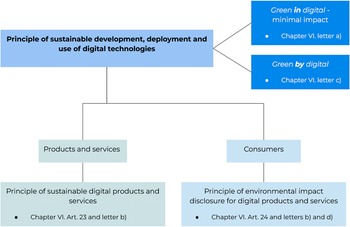
Figure 1 visualises our proposed categorisation. The top-left element illustrates the overarching principle of ‘sustainable development, deployment and use of digital technologies’. Arrows extending to the right indicate its two facets, while downward arrows connect to the two specific principles outlined above. Additional notes are included to reference the corresponding provisions in the Declaration for each element.
Emerging EU digital sustainability principles.
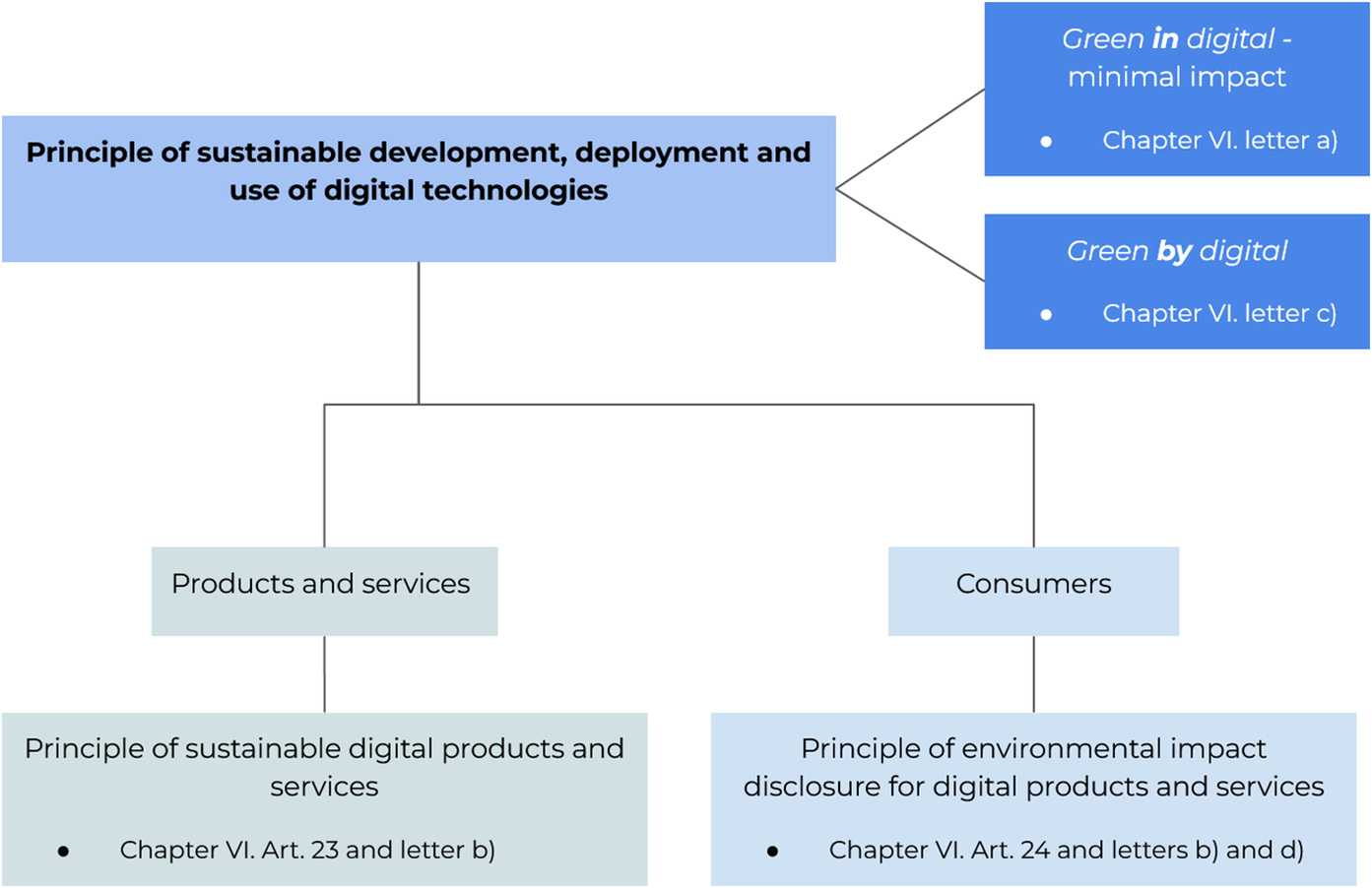
Figure 1. Long description
A flowchart organized into three main branches originating from a central blue header.
1. Central Header: Principle of sustainable development, deployment and use of digital technologies.
2. Right Branch: Two blue boxes connected by diagonal lines.
• Top box: Green in digital - minimal impact, referencing Chapter V I. letter a.
• Bottom box: Green by digital, referencing Chapter V I. letter c.
3. Bottom-Left Branch:
• Intermediate node: Products and services.
• Terminal node: Principle of sustainable digital products and services, referencing Chapter V I. Art. 23 and letter b.
4. Bottom-Right Branch:
• Intermediate node: Consumers.
• Terminal node: Principle of environmental impact disclosure for digital products and services, referencing Chapter V I. Art. 24 and letters b and d.
Beyond environmental sustainability
These three principles have been so far analysed from an environmental sustainability perspective. However, Chapter VI is entitled ‘Sustainability’ and not ‘environmental sustainability’. These two concepts shall not be confused as they are indeed recognised separately in EU primary law.
Sustainability − or more specifically, ‘sustainable development’ – is a broad and multidimensional concept grounded in three interdependent pillars: social, environmental and economic.Footnote 25 The environmental dimension, while crucial, represents only one facet of a more comprehensive framework. It interacts with, and is often conditioned by, social and economic considerations, reinforcing the need for an integrated approach when evaluating sustainability in policy and practice.Footnote 26 This approach is also upheld by EU primary law. For instance, Article 11 of the Treaty on the Functioning of the European Union asserts that environmental protection must be integrated ‘with a view to promoting sustainable development’. Similarly, Article 37 of the Charter of Fundamental Rights emphasises that environmental protection should be ensured ‘in accordance with the principle of sustainable development’. Therefore, these provisions denote that environmental protection should not be equated with sustainability itself. Environmental considerations rather constitute one essential component within the broader framework of sustainable development.
Although we emphasised the environmental dimension of sustainability in Chapter VI of the Declaration, one could argue that the economic pillar implicitly impregnates it. In this sense, sustainable digital technologies would support economic development. Likewise, Article 23 particularly accounts for the social impact of digital technologies, and letter b) includes a reference to fighting against forced labour. Therefore, sustainable digital technologies also seek to mitigate their impact on societal and human well-being.
While acknowledging the broader scope of the concept of sustainability, this paper focuses specifically on the environmental, green or ecological dimension, which will be the primary lens of our analysis moving forward. Thus, in what follows, the framework of the three EU digital sustainability principles just identified is used as an analytical lens through which we examine the legal frameworks of EU member states.
Constitutionalising digital sustainability in EU member states: An incipient process
In another work, we investigated the genealogy of the digital sustainability principles included in the Declaration, looking specifically at EU law.Footnote 27 Our results showed that the Commission performed what we called an action of ‘normative retrofitting’, making explicit a series of principles that can only be found in an implicit way in a conglomerate of different pieces of EU law. In this paper, given that digital sustainability principles do not have clear roots in EU law principles, we widen our research by looking at EU member states’ legal frameworks. Our analysis aims to understand whether the new EU digital sustainability principles emerge as an original effort or are rather backed by a broader constitutionalisation movement at the member state level.
From a methodological point of view, we use the three digital sustainability principles identified in the Declaration as a parameter to assess the emergence of an eco-digital discourse in the legal framework of EU member states. We analyse four types of legal sources: constitutions, ordinary law, policy documents, and digital bills of rights. In this way, we adopt a functional, socio-legal approach to the constitutional ecosystem, not limiting our investigation to what in the traditional legal hierarchy is qualified as constitutional law.Footnote 28 We rather explore to what extent constitutional principles are emerging across the pyramid of legal sources, including instruments that are not legally binding. In order to select relevant texts, we use existing databases, and, by default, we cross-check our results by performing an online search. Given the diverse nature of the sources analysed, we employ different databases and search methods, as presented in more detail at the beginning of each section below.
This analysis acknowledges that it does not exhaust all socio-legal pathways of constitutionalisation. Despite a cursory overview suggests that digital sustainability principles have not yet coherently permeated courts or national regulators’ practices, this paper aims to provide a first contribution to the field focused specifically on textual constitutionalisation in the four sources mentioned above, leaving open the possibility to expand this analysis in future works.
Our results suggest that the normative conversation on digital sustainability principles is still fermenting at the level of policy documents. As we will show in the next sections, constitutions retain a siloed approach that keeps digital and environmental aspects separate. Only a few ordinary laws that include digital sustainability principles have been enacted so far, showing a limited interest of national legislators. In contrast, policy documents have been bolder in upholding these principles, even if environmental impact disclosure remains a rarer element. Finally, the analysis of digital bills of rights demonstrates that even social movements and civil society initiatives have yet to fully internalise this discourse, despite their innovative framing of digital sustainability principles as individual rights.
Constitutions: A phenomenon of insularity
At constitutional level, we conducted an analysis of the texts included in the Constitute Project database,Footnote 29 applying country and topic filtering (Country: ‘Europe’; Topic: ‘Protection of the environment’) and keywords (Keywords: ‘digital’, ‘information society’, ‘personal data’). Of the 38 results including environmental protection principles, none of them referred to the digital context. Of the 15 results including digital principles, none of them referred to the environmental concerns.
This finding exposes a phenomenon of insularity between digital and environmental constitutional principles. Constitutional norms on environmental and digital matters reflect the siloed approach characterising the regulation of these two key societal transformations, despite the political willingness to ‘twin’ them at national and supranational level.Footnote 30 The higher number of provisions found to be related to environmental matters shows the more rooted nature of these principles in comparison with norms dealing with digital matters. Indeed, as will be explained later, the attention of constitutional law to environmental protection predates that to phenomena generated by the digital revolution.
The absence of specific provisions on digital sustainability might also be related to the degree of ‘elasticity’ of existing constitutional provisions. Provisions recognising digital rights and principles are relatively specific and do not offer room to interpret them as encompassing the principle of digital sustainability. However, norms enshrining the principles of environmental protection and sustainable development might be interpreted as being sufficiently elastic to incorporate an eco-friendly development and use of digital technologies. This breadth might justify the lack of interest of the national constitutional legislator in adding specific provisions on digital sustainability.
Ordinary law: The French REEN Act as a legislative benchmark
Traditionally, ordinary laws do not possess constitutional character. However, they can play a constitutional function when they enshrine principles that might articulate or complement constitutional sources.Footnote 31 To identify ordinary law from EU member states incorporating EU digital sustainability principles, we employed a combined methodology. In order to narrow down our data set, we focused on a sample of countries for which we had already identified policy documents related to digital sustainability (i.e., Germany, the Netherlands, France, Belgium and Spain). We conducted Google searches by using prompts such as ‘name of the country’; ‘sustainable digitalisation’; ‘digital sustainability’; ‘digital*’; ‘environment*’; ‘law’; or ‘regulation’. Second, we cross-checked our results using the Climate Change Laws database to systematically identify laws specifically targeting the digital sector and its impact on climate change.Footnote 32 To do this, we searched the database by country and analysed the results by looking for the keyword ‘digital’ within each document. We thus identified a set of four relevant laws: one from Spain and three from France.
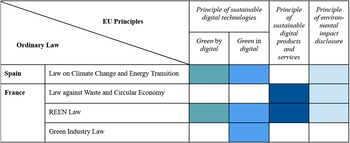
On Spain’s end, we observed digital sustainability principles in Law 7/2021 on climate change and energy transition,Footnote 33 which supports the shift to a low-carbon, circular economy by using resources fairly, adapting to climate change and promoting sustainable development.Footnote 34 In the case of France, these principles were seen in Law n. 2020-105 of February 10, 2020, on the fight against waste and on the circular economy;Footnote 35 Law No. 2021-1485 of November 15, 2021, aimed at reducing the environmental footprint of digital technology in France (the ‘REEN Act’);Footnote 36 and Law No. 2023-973 of October 23, 2023, relating to the green industry (‘Green Industry Law’).Footnote 37 Figure 2 visualises the recognition of EU digital sustainability principles across these four pieces of legislation.
Presence of EU digital sustainability principles in Member states’ ordinary law.
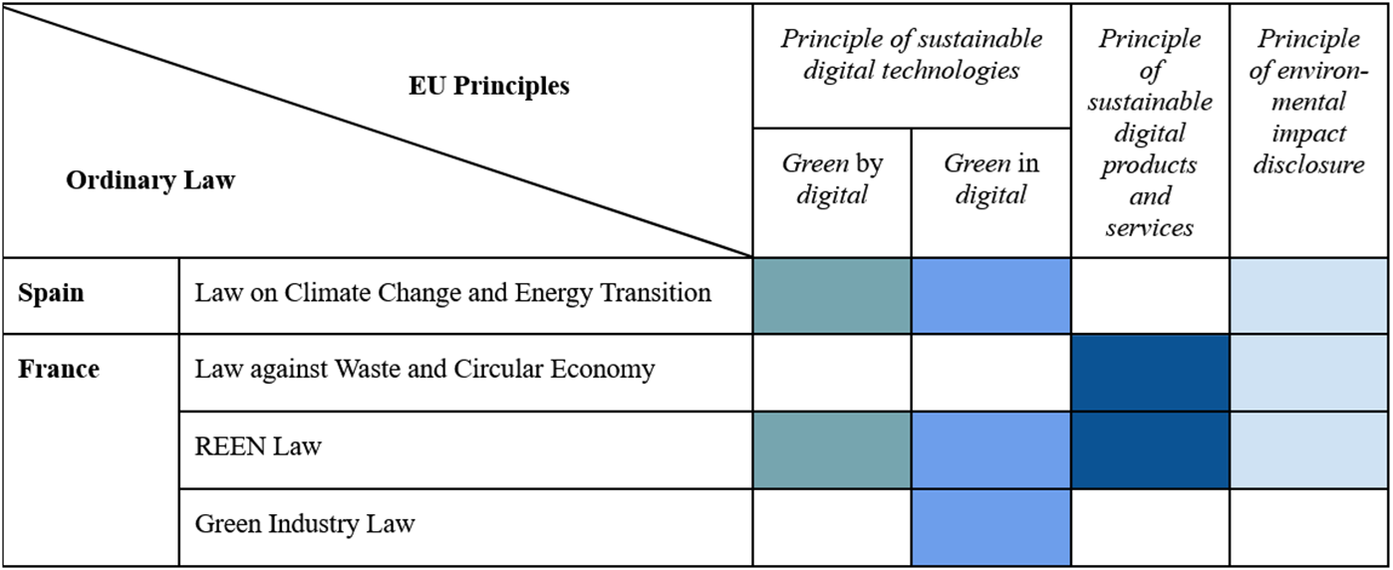
Figure 2. Long description
A table with four main columns representing E U Principles and four rows representing national Ordinary Law.
The columns are categorized as follows:
1. Principle of sustainable digital technologies, subdivided into Green by digital and Green in digital.
2. Principle of sustainable digital products and services.
3. Principle of environmental impact disclosure.
The rows and their corresponding data intersections are:
* Spain - Law on Climate Change and Energy Transition: Intersects with Green by digital, Green in digital, and Principle of environmental impact disclosure.
* France - Law against Waste and Circular Economy: Intersects with Principle of sustainable digital products and services and Principle of environmental impact disclosure.
* France - R E E N Law: Intersects with Green by digital, Green in digital, Principle of sustainable digital products and services, and Principle of environmental impact disclosure.
* France - Green Industry Law: Intersects with Green in digital.
Intersections are indicated by colored cells, while empty white cells indicate no presence of the principle in that specific law.
The REEN Act calls for closer attention, as it is the only one that encompasses all three digital sustainability principles identified in the previous section. First, the Act directly addresses the negative environmental consequences of digital technologies, thus reflecting the first facet of the principle of sustainable digital technologies, what we called ‘green in digital’. Indeed, the law draws its inspiration from a Senate commission report on the digital’s environmental footprint, which warned that, if no action is taken, the digital sector would contribute 24 million tonnes of CO₂ equivalent by 2040 − around 7% of France’s total emissions, compared to 2% today.Footnote 38 Among other measures, the concept of ‘digital sobriety’ is mentioned four times across the REEN Law,Footnote 39 a framework to define sustainable design criteria for digital services in order to reduce their environmental footprint is established,Footnote 40 and municipalities with over 50,000 residents are required to adopt a responsible digital strategy that sets targets for reducing the digital environmental impacts, outlining actions to meet these goals.Footnote 41 Second, the ‘green by digital’ facet of the principle of sustainable digital technologies is also present in the law, despite more loosely. An observatory of digital environmental impact is envisaged with the objective of analysing the ‘contribution of digital technologies, particularly artificial intelligence, to the ecological and social transition’.Footnote 42
In addition, the REEN Act also incorporates the two specific digital sustainability principles identified above.Footnote 43 First, it includes the principle of sustainable digital products and services. Notably, Chapter II seeks to limit the replacement of digital devices by setting, for instance, goals for recycling, reuse and repair, and compatibility.Footnote 44 The law also delves into particular products and services, such as cryptocurrencies,Footnote 45 and data centres − to which, remarkably, an entire chapter is dedicated.Footnote 46 For example, the Act establishes that data centres shall recover waste heat or comply with a quantified indicator on power use efficiency, as well as meet a specific metric on water use for cooling purposes.Footnote 47 Second, the REEN Act aims to raise user awareness of the environmental impact of digital technologies, thus embedding the principle of environmental impact disclosure. Chapter I incorporates education on the environmental footprint of digital tools, as well as on digital sobriety, in schools and universities,Footnote 48 mandating that the abovementioned observatory’s work be made public.Footnote 49 Information on the environmental impact of digital technologies, and on best practices, shall also be provided by sellers, lessors and distributors to consumers,Footnote 50 along with recommendations issued by French authorities.Footnote 51
Policy documents: German and French leadership
To pinpoint EU member states’ policy documents including digital sustainability principles, we conducted Google searches by using prompts such as ‘sustainable digitalisation’; ‘digital sustainability’; ‘digital*’; ‘environment*’; ‘strategy’; ‘agenda’; and ‘plan’. We thus identified 9 policy documents from 4 Member states (Germany, the Netherlands, France and Spain) adopted between 2020 and 2025, and which, while prioritising their national digitalisation strategy, also incorporate measures for environmental sustainability. Four of these documents are specifically tailored to the environmental impact of the digital.
In March 2020, the German government adopted its ‘Digital Agenda for the Environment’, defining digitalisation strategic principles and objectives with a strong focus on environmental sustainability.Footnote 52 In February 2021, the French government published the ‘Roadmap on the Environment and Digital Technology’, with 50 measures addressing more sustainable and responsible use of digital technologies;Footnote 53 as well as the ‘Proposal for a Roadmap for Decarbonization of the Digital Sector’ and the ‘Eco-responsible Digital Acceleration Strategy’, respectively, in March and July 2023.Footnote 54 Though with a less strong focus on the environment, the Netherlands adopted the Dutch Digitalisation Strategy in June 2021,Footnote 55 as well as the Value-Driven Digitalisation Work Agenda, first published in November 2022 and updated in February 2024.Footnote 56 The Spanish digitalisation strategy is set in ‘Digital Spain 2025’, which was updated by ‘Digital Spain 2026’.Footnote 57 In addition, later in this section, we examine EU national AI strategies. While these are also policy documents, they are more narrowly focused, addressing a single digital technology within the broader digital context and, notably, nearly all EU member states have adopted such a strategy.
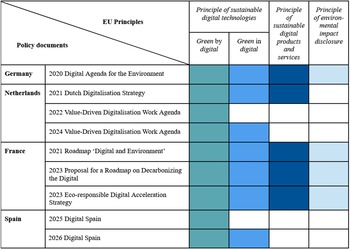
Figure 3 visualises to what extent the selected policy documents incorporate the EU digital sustainability principles identified above.
Presence of EU digital sustainability principles in member states’ policy documents.
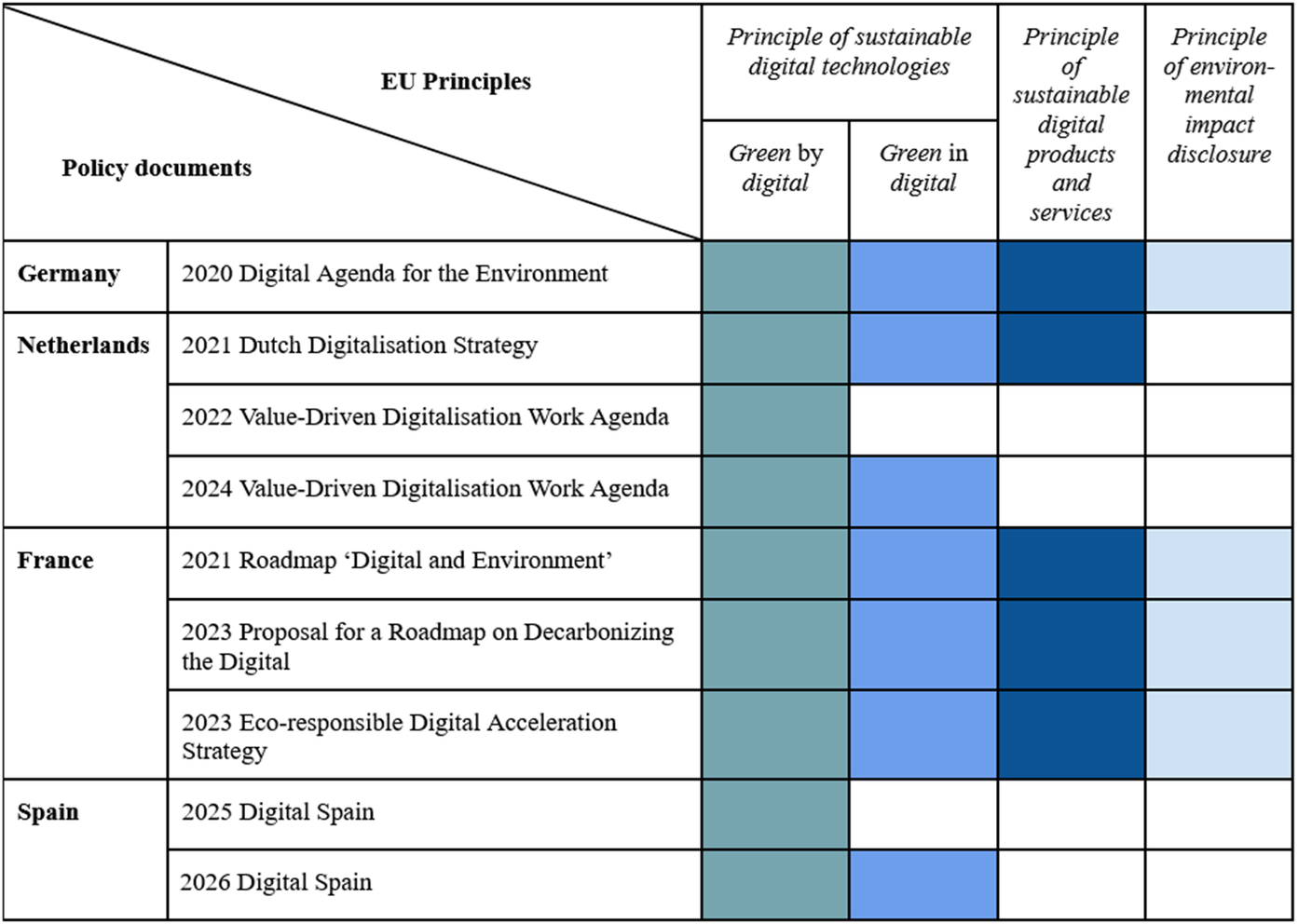
Figure 3. Long description
The table cross-references policy documents by country against four EU Principles. The columns are Principle of sustainable digital technologies (subdivided into Green by digital and Green in digital), Principle of sustainable digital products and services, and Principle of environmental impact disclosure. Presence is indicated by colored cells.
* Germany: 2020 Digital Agenda for the Environment includes Green by digital, Green in digital, and Principle of sustainable digital products and services.
* Netherlands: 2021 Dutch Digitalisation Strategy includes Green by digital, Green in digital, and Principle of sustainable digital products and services. 2022 Value-Driven Digitalisation Work Agenda includes only Green by digital. 2024 Value-Driven Digitalisation Work Agenda includes Green by digital and Green in digital.
* France: 2021 Roadmap Digital and Environment, 2023 Proposal for a Roadmap on Decarbonizing the Digital, and 2023 Eco-responsible Digital Acceleration Strategy all include all four principles: Green by digital, Green in digital, Principle of sustainable digital products and services, and Principle of environmental impact disclosure.
* Spain: 2025 Digital Spain includes only Green by digital. 2026 Digital Spain includes Green by digital and Green in digital.
The three EU digital sustainability principles are only clearly reflected in the German and the three French policy documents analysed, which represent initiatives primarily aimed at addressing the ecological challenges and opportunities of digital technologies. The two distinct facets of the principle of sustainable digital technologies permeate these four documents. First, the principles of green in digital is embodied in the German Agenda since it acknowledges the ‘significant and growing ecological footprint’ of the digital.Footnote 58 In France, that aspect is also evident in the 2021 Roadmap Digital and Environment: of the three pillars, two focus on increasing awareness of the digital sector’s environmental footprint and promoting more ‘sober’ digital practices, respectively.Footnote 59 The Roadmap for Decarbonization of the Digital Sector draws on the digital sector environmental impact, not only in terms of carbon emissions but also through its effects on water usage, biodiversity, natural resource depletion and land artificialisation.Footnote 60 Finally, the Eco-responsible Digital Acceleration Strategy proposes three measures aimed at raising awareness of the digital sector’s environmental footprint and promoting digital sobriety.Footnote 61
Second, the green by digital aspect is reflected in the German Strategy as it establishes that ‘shaping digitalisation sustainably can significantly support socio-ecological transformation’.Footnote 62 The same applies to the French policy documents, with a dedicated working group focused on identifying the positive contributions of digital technologies to accelerating or enabling the ecological transition;Footnote 63 several initiatives aimed at leveraging digital tools as drivers of the ecological transition;Footnote 64 and a call for projects to demonstrate practical applications of digital solutions in advancing the ecological transition.Footnote 65
The principle of sustainable digital products and services is also well included in these documents. It is manifested through measures tackling energy requirements and resource consumption of hardware, software and cloud services,Footnote 66 and the development of a competitive offer of ‘eco-responsible digital products and services’,Footnote 67 ‘low tech’ and ‘slow-tech’ solutions.Footnote 68 Finally, all policy documents integrate the need to guide actors in the digital context by establishing mandatory environmental reporting requirements, thus supporting the principle of environmental impact disclosure. In Germany, one of the three packages of measures is dedicated to the ‘Transparency Initiative’.Footnote 69 In France, an ‘environmental barometer of digital actors’ is foreseen, aiming to enhance transparency by making environmental information about digital technologies publicly accessible.Footnote 70 Moreover, a yearly disclosure of corporate carbon footprints and the publication of life cycle assessments for digital products and their components are envisaged,Footnote 71 and various measures are proposed to raise awareness and, in turn, provide consumers with relevant environmental information.Footnote 72
Concerns regarding the environmental impact of digital technologies are particularly relevant in relation to AI.Footnote 73 In this regard, national AI strategies – which all member states agreed to adopt in the 2018 Coordinate Plan on AI –Footnote 74 are worth considering. Given the number of strategies and the plurality of languages across the EU, our analysis focused on a 2021 report published by the Directorate-General for Internal Policies of the Union. Since the strategies are not thoroughly examined in this report, we only assessed them in relation to the two facets of the broad principle of sustainable digital technologies. According to the study, 15 member states had included climate and environmental considerations into their national AI strategies.Footnote 75 Among them, nine strategies focus on using AI applications to manage environmental concerns: primarily in agriculture, but also in transport, energy efficiency or management, and sustainable urban development.Footnote 76 This perspective on AI reflects the green by digital facet of the principle of sustainable digital technologies, articulating it for a particular digital technology (green by AI) and exploiting its unique potential for environmental sustainability.Footnote 77
In this context, too, the national AI strategies of both France and Germany are notably distinct. They not only commit to taking advantage of AI solutions for environmental purposes but also tackle the potential negative impacts of AI on the environment, putting forward initiatives to systematically measure them.Footnote 78 This is also the case of Ireland, whose strategy was published after the aforementioned report, and pinpoints the high energy use of data centres.Footnote 79
Digital charters: From principles to rights
Lastly, our analysis focused on digital charters, non-legally binding instruments that have emerged in significant numbers over the past few decades to articulate rights and principles for the digital society.Footnote 80 The scholarship spoke of a phenomenon of ‘digital constitutionalism’.Footnote 81 These documents can be considered a hybrid source displaying characteristics of advocacy, policy and even constitutional documents. Indeed, they do not have any legal force, but they do advance concrete formulations of digital rights and principles. In many cases, they are promoted by civil society actors;Footnote 82 if adopted by an institutional subject, they might play a policy function. Lastly, they are often characterised by a constitutional tone, using the traditional jargon of constitutions to join the normative conversation on which rights and principles suit the challenges of the digital revolution. They represent a particularly interesting source in the context of our analysis, as they might be interpreted as a link between the advocacy/policy and constitutional dimensions. Not being subject to the political or formal constraints of legal texts, they are often freer to innovate and experiment: they can be considered as a constitutional laboratory.Footnote 83
For the purposes of this paper, the Digital Constitutionalism Network database was employed to systematically identify digital charters containing provisions related to environmental sustainability, using prompts such as ‘environment*’, ‘green’ or ‘sustainab*’.Footnote 84 This search did not return any applicable results.Footnote 85 Consequently, we carried out a series of Google searches in English, using prompts such as ‘sustainability’; ‘digital’; ‘rights’; ‘charter’; ‘bill’, to explore other relevant initiatives. We thus identified five charters of digital rights and principles that incorporate provisions on environmental sustainability. Interestingly, all stem from institutional actors – from national to local governments – signalling how the eco-digital discourse has not yet permeated civil society-led initiatives.
At the supranational level, a digital charter of the Community of Portuguese Language Countries (CPLP) reflects these green ambitions.Footnote 86 At the national level, charters of digital rights and principles including sustainability provisions have emerged in Spain − ‘Spanish Charter of Digital Rights’ (Carta de Derechos Digitales)Footnote 87 – and Belgium − ‘Responsible Digital Charter’ (Charte Numérique Responsable).Footnote 88 Relevant initiatives can likewise be identified at the regional level in Catalonia − ‘Charter for Digital Rights and Responsibilities from Catalonia’ (Carta de Drets i Responsabilitats Digitals)Footnote 89 – and at municipal level in Brussels − ‘Digital rights charter of the city of Brussels’.Footnote 90
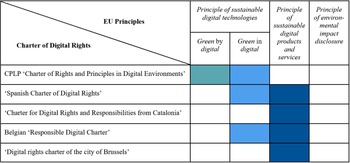
As visualised in Figure 4, none of them includes all the digital sustainability principles identified in the previous section. Conversely, the principles of sustainable digital technologies − both in its green in digital and green by digital facets − and of sustainable digital products and services are identified throughout these documents.
Presence of EU digital sustainability principles in digital charters.
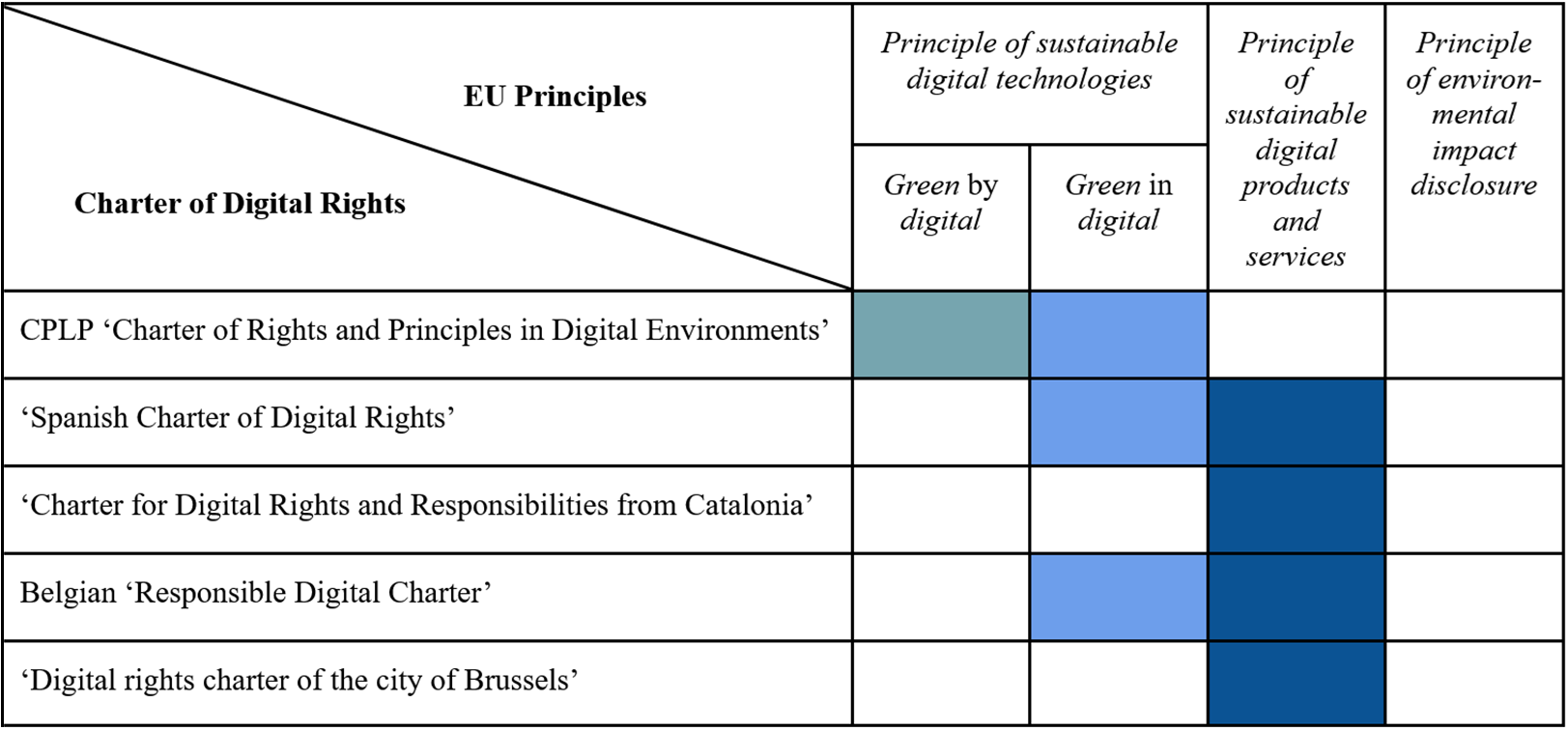
Figure 4. Long description
The table features a diagonal split header in the top-left corner with EU Principles on the top-right and Charter of Digital Rights on the bottom-left.
The columns represent four principles:
1. Principle of sustainable digital technologies, subdivided into Green by digital and Green in digital.
2. Principle of sustainable digital products and services.
3. Principle of environmental impact disclosure.
The rows list five charters with the following data points:
* CPLP Charter of Rights and Principles in Digital Environments: Marked for Green by digital (teal) and Green in digital (light blue).
* Spanish Charter of Digital Rights: Marked for Green in digital (light blue) and Principle of sustainable digital products and services (dark blue).
* Charter for Digital Rights and Responsibilities from Catalonia: Marked for Principle of sustainable digital products and services (dark blue).
* Belgian Responsible Digital Charter: Marked for Green in digital (light blue) and Principle of sustainable digital products and services (dark blue).
* Digital rights charter of the city of Brussels: Marked for Principle of sustainable digital products and services (dark blue).
The Principle of environmental impact disclosure column is empty for all listed charters.
The principle of sustainable digital technologies is explicitly mentioned in the CPLP, the Spanish and the Belgian charters. In this regard, the Spanish government has gone so far as to declare not only the principle but also the ‘right to sustainable technological development and to a sustainable digital environment’.Footnote 91 All three charters mentioned above include provisions that refer to the green in digital facet of such principle, claiming that digital development and digital technologies shall be sustainable and have the least possible impact on the environment.Footnote 92 Moreover, both the CPLP and the Spanish charters refer to safeguarding the needs of ‘future generations’,Footnote 93 while the Belgian charter sets the most stringent stance by defining the digital as ‘a major contributor to greenhouse gas emissions, resource depletion, and biodiversity loss, actively participating in climate change’.Footnote 94 Despite this, the green by digital facet of the principle of sustainable digital technologies is only explicit in the CPLP Charter, which states that information and communication technologies should be fully leveraged to achieve sustainable development goals.Footnote 95
The Brussels, Spanish, Belgian and Catalan charters declare the principle of sustainable digital products and services. In this regard, the Brussels charter closely mirrors the European Declaration on Digital Rights and Principles, using nearly identical wording.Footnote 96 The Spanish charter is also quite similar to the Declaration, and it refers to the enhancement of ‘sustainability, durability, reparability and backward compatibility of devices and systems’, as well as to the avoidance of entirely replacing products and of deliberately shortening their lifespan (planned obsolescence).Footnote 97 By contrast, the initiative adopted in Belgium is more detailed, and it is presented in a slightly longer format that includes bullet points for relevant cases.Footnote 98 Finally, the Catalan charter interestingly promotes sustainable and environmentally respectful Internet access,Footnote 99 which can be considered a sustainable digital service.
Eco-digital constitutionalism: Rationale and theoretical framing
The process of constitutionalisation of digital sustainability principles at the level of EU member states is still in its infancy. Most of the normative efforts are still concentrated in policy documents or in non-legally binding sources. Only a handful of member states have invested in an explicit constitutionalisation of these principles at the level of ordinary law. Against this scenario, the EU Declaration on Digital Rights and Principles, despite its relatively low-key profile and scarce level of systematisation, emerges as an innovative document spelling out in a comprehensive way three digital sustainability principles underpinning recent EU regulatory and policy strategies in the digital sector. The Declaration not only possesses an internal political role but also explicitly aims to showcase the ‘EU way for the digital transformation’ to third countries.Footnote 100 We, therefore, argue that this document might act as a propeller of the constitutionalisation of digital sustainability principles both at the member state level and beyond.
Such a potential is not merely aspirational; it follows a well-documented trajectory in both the domain of environmental and digital rights. Specifically, literature on norm diffusion indicates that non-legally binding instruments can act as a potent source of constitutional norms through three distinct mechanisms: legislative uptake, judicial assimilation and transnational legal ordering. While it remains to be seen which primary pathway the Declaration will take, these channels are not mutually exclusive and often operate in tandem to reinforce one another. First, legislative uptake occurs when national parliaments translate international soft law into formal constitutional text. As Boyd demonstrates, instruments like the 1972 Stockholm and 1992 Rio Declarations ‘normalised’ environmental principles, providing a template that national legislatures eventually translated into formal constitutional amendments.Footnote 101 This migration was historically enabled by windows of political transition, such as the drafting of new constitutions in post-authoritarian Spain and Portugal in the 1970s, though it was occasionally hindered by domestic economic resistance or vague statutory definitions.Footnote 102 Similarly, scholarship on digital bills of rights highlights that constitutionalisation in the digital age is a bottom-up process of cross-fertilisation of norms between various societal sub-sectors.Footnote 103 Non-binding charters served as focal points for civil society mobilisation, pushing domestic actors to internalise these principles, even before they are formally codified in a national constitution.Footnote 104 Second, judicial assimilation allows courts to use non-binding charters to further articulate the meaning of existing constitutional rights. This pathway may be heavily enabled by strategic litigation from civil society groups, who can leverage these declarations as normative focal points to pressure courts into internalising or unpacking new constitutional principles.Footnote 105 Third, by positioning these digital sustainability principles as the ‘EU way for the digital transformation’, the Union engages in what Halliday and Shaffer term ‘transnational legal ordering’.Footnote 106 The Declaration provides the interpretative guidance for EU institutions and national authorities to mobilise digital sustainability principles in their decision-making. This triggers a process where, through institutional practice, the Declaration’s principles become effectively binding. In these ways, the EU Declaration might act as a structured normative blueprint, offering member states, courts and civil society actors a pre-negotiated language for ‘digital sustainability’ that can be integrated into their initatives, decisions and practices.
In order to offer a theoretical tool for studying the process of constitutionalisation of digital sustainability principles in the EU and beyond and to position their emergence within existing constitutional theory, we propose adopting the notion of ‘eco-digital constitutionalism’ as an analytical lens. Recent constitutional law scholarship analysed both an ‘environmental’ and a ‘digital’ constitutionalism.Footnote 107 The digital sustainability principles analysed in this paper can be thematically linked to both these concepts. In light of this, we propose a syncretic denomination that would encapsulate a reference both to the environmental dimension – here rendered through the use of the prefix ‘eco’ – and to the digital dimension.
By synthesising digital and environmental dimensions, eco-digital constitutionalism functions as a specialised analytical framework. It provides unique scholarly value by addressing jointly the specific constitutional intersections that remain largely unexamined when environmental and digital constitutionalism are treated as isolated fields.Footnote 108 Moving beyond these thematic perimeters, it provides a more holistic perspective by focusing specifically on the unique constitutional tensions emerging at the heart of the twin transitions, where the green potential of digitalisation is challenged by the physical reality of its significant ecological footprint. Concretely, this lens exposes the systemic clash between resource-intensive digital expansion and ecological limits, the absence of an obligation to embed sustainability ‘by design’ in digital products and services and the limited capability of users to assess the sustainability of the digital tools they employ. These tensions and deficiencies are addressed through an overarching principle of sustainable development, deployment and use of digital technology, further operationalised through more specific constitutional parameters which are overlooked by the parent fields of digital and environmental constitutionalism. By adopting the notion of ‘eco-digital constitutionalism’, we do not aim to advocate for the establishment of a revolutionary form of constitutionalism. In line with the concepts of environmental and digital constitutionalism, our objective is to denote a layer of contemporary constitutionalism that articulates rights and principles to face the environmental challenges generated by the digital revolution.
Eco-digital constitutionalism does not represent a siloed facet of contemporary constitutionalism: it builds on and grows within the existing strands of environmental and digital constitutionalism. The last section of this paper thus investigates how it is possible to position the emergence of digital sustainability principles within these existing constitutional theories. To this end, we assess similarities and differences between these two recently emerged strands of contemporary constitutionalism. We conclude that eco-digital constitutionalism represents a branch of digital constitutionalism, which borrows foundational principles from environmental constitutionalism.
Reacting to societal transformations: Environmental threats and digital revolution
The rationale underlying the theorisation of environmental and digital constitutionalism can be traced to the need of the constitutional ecosystem to react to specific societal transformations. Environmental constitutionalism is framed as a response to the environmental harms of contemporary society, with specific attention to climate change – some scholars have thus referred to ‘climate constitutionalism’.Footnote 109 Conversely, digital constitutionalism emerges as a reaction to the challenges generated by the digital revolution.Footnote 110 Both societal transformations have implications for individuals at the constitutional level, as they give rise to new and evolving threats to fundamental rights. Contemporary constitutionalism thus develops a series of normative counteractions whose number and significance have led scholars to isolate strands of environmental and digital constitutionalism.Footnote 111
Despite the attention devoted by the scholarship, neither digital constitutionalism nor environmental constitutionalism have been afforded commonly agreed definitions. For the purposes of this article, we will refer to environmental constitutionalism as a ‘transformative approach’ aimed at embedding environmental governance frameworks within constitutionsFootnote 112 and to digital constitutionalism as the ideology that aims to articulate values and principles of contemporary constitutionalism to address the challenges of the digital revolution.Footnote 113 Both types of constitutionalism refer to an evolutionary effort: contemporary constitutionalism is not disrupted but is adapted to face new societal challenges. The digital sustainability principles analysed in this paper share this approach: they aim to leverage the positive and limit the negative environmental effects of digitalisation.
In light of this commonality, these principles might be equally connected to both environmental and digital constitutionalism. However, other factors, such as the normative framework that digital and environmental constitutionalism target, the constitutional moment they refer to and their geographical epicentre, lead us to ascribe digital sustainability principles more closely to digital constitutionalism.
Diverging normative frameworks: constitutions versus constitutional ecosystem
Environmental constitutionalism unfolds within the perimeter of national legal systems. In particular, it envisions the recognition of environmental protection at the constitutional level, either through constitutional provisions – that is, by introducing environmental rights or duties in national constitutionsFootnote 114 – or through jurisprudential development – which is carried out by national courts when interpreting existing rights.Footnote 115 However, not all scholars agree that environmental constitutionalism is achieved through judicial activism. Notably, Weis argued that the focus of environmental constitutionalism literature on judicial enforcement is misleading and that responsibilities should instead be entrusted to political branches.Footnote 116 He thus set forth a ‘contrajudicative model’, whereby ‘contrajudicative provisions’ (i.e., constitutional directive principles) are given effect by the executive and legislative branches.Footnote 117
Moreover, while the study of a ‘global environmental constitutionalism’ has been envisioned,Footnote 118 this approach remained anchored to the analysis of individual domestic constitutions that exhibit parallel developments or tendencies, rather than reflecting the emergence of a supranational constitutional framework. Notwithstanding the role of global actors, the issues at stake persist in being primarily situated within the domain of ‘domestic environmental governance’.Footnote 119 Efforts to address environmental threats thus keep being embedded in conventional constitutional law sources. Accordingly, the normative framework targeted by environmental constitutionalism remains characterised by traditional forms of constitutional responses.Footnote 120
Conversely, the normative counteractions related to digital constitutionalism started to emerge in unconventional constitutional sources: not only beyond the state but also in the realm of private actors.Footnote 121 In contrast to environmental constitutionalism, traditional constitutional sources are not the only ones addressing the challenges of the digital revolution. Online platforms’ terms of service, decisions of online dispute settlement bodies and digital bills of rights are examples of the breadth of the normative framework related to digital constitutionalism.Footnote 122 In relation to digital constitutionalism, we also speak of a ‘movement’ in light of the input given by non-institutional actors.Footnote 123 Its process of constitutionalisation is not limited to national constitutions but encompasses a larger constitutional ecosystem that transcends the pyramid of legal sources as well as national boundaries. Borrowing – and slightly twisting – two expressions recently used by Tusseau with reference to digital constitutionalism, we could say that environmental constitutionalism involves a ‘thin’ process of constitutionalisation, which is limited to traditional legal sources, while digital constitutionalism triggers a ‘thicker’ one, which encompasses private sources and actors.Footnote 124
The digital revolution generates constitutional issues that cannot be tackled uniquely within the perimeter of the nation state. The process of constitutionalisation of the digital society is necessarily multi-layered.Footnote 125 Online virtual worlds go beyond national frontiers, and the constitutional counteractions that emerge in the legal frameworks of the private actors managing these spaces are transnational too.Footnote 126 The identification of this enlarged constitutional ecosystem thus implies the adoption of a socio-legal constitutional approach.Footnote 127 The question is not which constitutional sources react to the challenges of the digital revolution, but, more in general, which sources provide a constitutional answer to these societal changes, regardless of the formal qualification of a normative instrument as belonging to constitutional law or not. This explains why the concept of digital constitutionalism, and in particular the broader scope of the normative sources it analyses, has been subject to criticism in contrast to the more traditional notion of environmental constitutionalism.Footnote 128 The vision of ‘eco-digital constitutionalism’ proposed in this paper embraces a similar socio-legal constitutional approach. Yet, this thesis does not equate to support a form of ‘pan-constitutionalism’, where all counteractions to the challenges of the digital revolution would become intrinsically constitutional. The constitutional dimension is rather used as a ‘lens’ to analyse the function of instruments that traditionally lie outside of the constitutional law perimeter, without however changing their legal nature.
Different temporalities: Retracing constitutional moments
The conceptual foundation of environmental constitutionalism is often associated with the incorporation of environmental protection provisions in U.S. state constitutions.Footnote 129 This original constitutional moment is usually traced back to the momentum generated by the 1972 UN Stockholm Declaration, which for the first time emphasised the importance of environmental protection at international level and led to the constitutionalisation of environmental provisions in the following years.Footnote 130 Although the discussion became particularly heated during the environmental movements of the 1960s and 1970s, the 2013 decision by the Pennsylvania Supreme Court in the Robinson Township caseFootnote 131 reignited scholarly and public debate.Footnote 132 The Court struck down key provisions of Pennsylvania’s Act 13,Footnote 133 aimed at promoting natural gas development, on the grounds that they violated the state’s constitutional ‘Environmental Rights Amendment’.Footnote 134 The literature contended that a constitutional safeguard had served to limit the exploitation of natural resources, which had previously been largely unrestrained.Footnote 135 Furthermore, the case was considered a compelling argument for deeming that a constitutional environmental right can not only reshape the outcome of a case but also influence legislation and shift public views on environmental rights.Footnote 136
As will be seen below, the discussion of environmental constitutionalism in Latin America also followed the widespread adoption of constitutional provisions in the late 2000s.Footnote 137 In the legal literature, the concept of environmental constitutionalism thus reached its apex in the 2010s.Footnote 138 While it remains a topic of discussion today,Footnote 139 the debate appears to have plateaued. This halt may stem from the widespread constitutional recognition of environmental protection across numerous jurisdictions. A paradigmatic example of that is the increasing recognition of the right to a healthy environment in national constitutions, which has been subject to extensive analysis elsewhere.Footnote 140
The temporalities of digital constitutionalism are substantially different. Once again, it is relevant to distinguish the scholarship on digital constitutionalism from its object of study, that is the initiatives of digital constitutionalism. Digital charters represent one of the main documents analysed by scholars of digital constitutionalism.Footnote 141 In the various data sets collecting these texts, the most dated charters emerged at the beginning of the 1990s and span until today – with the EU Declaration on Digital Rights and Principles often mentioned as one of these instruments.Footnote 142 Terms of service of online platforms, mainly adopted in the decade from 2005 onwards, also attracted scholarly attention.Footnote 143 Lastly, scholars of digital constitutionalism also looked at the regulatory strategies of specific jurisdictions, in particular, the EU: in this case, what Floridi called the ‘hexagram’Footnote 144 of digital constitutionalism – the six core pieces of regulation representing the pillars of EU digital law – was adopted between 2016 and 2024.Footnote 145
Focusing now on the academic production, the first generation of scholars studying digital constitutionalism published works in the decade from 2009 to 2018.Footnote 146 They focused on the less traditional constitutional sources, such as social media’s terms of service and digital charters. A second layer of works appeared between 2019 and 2024, aimed at systematising the existing scholarship and at reconnecting the atypical constitutional sources studied until then with more traditional ones.Footnote 147 Finally, as anticipated, a number of works that are critical to digital constitutionalism emerged from 2023 onwards.Footnote 148
The emergence of digital sustainability principles in the EU could certainly represent a timid, yet new wave of environmental constitutionalism: a third wave, after its first one in the 1970s and its second one in the 2000s. However, the niche nature of digital sustainability concerns and the relative flexibility of environmental constitutional principles might lead to the hypothesis that the environmental threats of digital technologies are not perceived as requiring a specification of existing environmental constitutional law. Digital sustainability principles would rather be conceived as a response to concerns related to the development of digital technologies. In this way, these principles could be seen as a new offspring of the ongoing process of constitutionalisation of the digital society and as a part of the constitutional moment that is characterising the current movement of digital constitutionalism.
Distinct geographical epicentres: Global South versus North
Lastly, environmental and digital constitutionalism focused on processes of constitutionalisation having distinct geographical epicentres. Phenomena of environmental constitutionalism have been identified in relation to U.S. State Constitutions,Footnote 149 Indonesia,Footnote 150 India,Footnote 151 South Africa,Footnote 152 Ecuador, New Zealand and India,Footnote 153 Brazil,Footnote 154 NigeriaFootnote 155 and the Bahamas,Footnote 156 among others. As is apparent, the gravitational centre of these processes lies in the Global South. A significant number of works studied trends of constitucionalismo ambiental (environmental constitutionalism) in Latin-American countries, mainly driven by the new Equatorian and the Bolivian constitutions.Footnote 157 The so-called nuevo constitucionalismo latinoamericano (new Latin-American constitutionalism) generated a shift in the legal consideration and status of the environment,Footnote 158 including the perspective of indigenous minorities.Footnote 159 Other than the introduction of new rights in relation to the environment, this ‘new’ strand of constitutionalism recognised ‘Nature’ as a subject of rights, based on the Amerindian principles of the buen vivir – ‘good living’, enshrined in the 2008 Equatorian Constitution – or vivir bien – ‘living well’, recognised in the 2009 Bolivian Constitution.Footnote 160 In this regard, Iacovino speaks of a ‘constitucionalismo verde profundo’ (deep green constitutionalism) to refer to the shift from a right to nature to a right of Nature, whereby Nature acquires legal personality.Footnote 161
Pluri-nationality and interculturality also deeply shaped the abovementioned transformation.Footnote 162 Ochoa Rodriguez claimed that nuevo constitutionalismo latinoamericano encompasses ‘democratic ecology’ as a key element.Footnote 163 While linking environmental ethics with politics and law, democratic ecology asserts a model that advocates for a deliberative and participatory approach within a sustainability framework. Yet, despite these elements of plurality and diversity and notwithstanding the transnational nature of environmental threats, processes of environmental constitutionalism are still anchored to the state dimension.
Conversely, digital constitutionalism emerges at multiple societal levels, thus also beyond the nation-state.Footnote 164 Digital industry actors define individual affordances in their terms of services;Footnote 165 civil society organisations advocate for digital rights and principles in online bills of rights;Footnote 166 regional legislators shape regulatory frameworks for different digital sectors, products and services.Footnote 167 Yet, despite the apparently more global approach characterising these constitutional responses, digital constitutionalism has so far predominantly be propelled by Global North’s initiatives. As for environmental constitutionalism, the challenges of digital constitutionalism are cross-border. However, the counteractions to these issues mainly came from actors from Europe and North America, as exemplified by the geographical distribution of digital bills of rights.Footnote 168 Two the main elements that can be proposed to explain this geographical orientation: first, the regulatory activism of the EU in the digital field, and second, the fact that most of the top digital companies are based in the United States.Footnote 169 These two factors are of course interlinked as EU legislation often intervened as a response to US companies’ innovations. Moreover, the role of civil society organisations from the Global North, revindicating the respect of digital rights against the malpractices of states and private companies, reinforces this geographical rooting of digital constitutionalism.
Our research on digital sustainability principles so far has focused on the EU and its member states, showing a limited spread even within the Union. At this stage, it would not be possible to define with certainty if these principles display a specific geographical epicentre at the global level. The analysis of the Constitute project was originally carried out on a global scale but did not produce results about constitutions including digital sustainability principles. Nevertheless, given their closer link to digital constitutionalism and the prominence of digital constitutionalism phenomena in the Global North as a response to a more intense and pervasive digitalisation process, we hypothesise that digital sustainability principles mainly emerge as a concern in similar geographical areas, despite the heavy material contribution of Global South to the digitalisation process of countries from the northern hemisphere.Footnote 170
Conclusion
The EU Declaration on Digital Rights and Principles represents a key document in the field of digital sustainability. First, our analysis has confirmed that it offers one of the most comprehensive blueprints of digital sustainability principles at EU level. Only limited policy and regulatory initiatives from France and Germany possess a similar breadth and degree of detail. Second, the Declaration aims not only to provide internal guidance but also explicitly seeks to influence policy making in third countries.
The Declaration can thus be used as a parameter to assess the degree of constitutionalisation of digital sustainability principles within the EU and beyond. Regrettably, the text of the Declaration does not spell out these principles in a logical and coherent order, requiring the reader to recompose a patchwork of substantive provisions and political commitments. In order to offer an effective investigation tool, this paper has offered a more logical categorisation of three digital sustainability principles enshrined in the Declaration: namely, an overarching principle of sustainable development, deployment and use of digital technology, and two more specific principles, respectively, of sustainable digital products and services and of environmental impact disclosure of digital products and services.
While in previous works we have demonstrated that these principles make explicit latent assumptions of EU regulatory and policy instruments – what we called ‘normative retrofitting’, in this paper, we questioned to what extent these principles are emerging at member state level. The analysis of the constitutionalisation process at national level did not reveal any particular divergence from the EU model. However, the overall picture is that of a phenomenon still in its infancy. Digital sustainability principles have not permeated national constitutions yet. Only a limited number of regulatory and policy instruments, concentrated in France and Germany, include all the EU principles. Interestingly, digital charters display an effort to generate a shift from principles to rights.
Despite being a still incipient trend, we believe that the Declaration might act as a propeller of a process of constitutionalisation of digital sustainability principles within the EU and beyond, building on similar experiences in the field of environmental and digital rights. In order to offer a useful theoretical lens to read this phenomenon, we have proposed the concept of ‘eco-digital constitutionalism’. Indeed, digital sustainability principles seem to be thematically connected to two recent strands of contemporary constitutionalism that have attracted significant scholarly interest: namely, environmental and digital constitutionalism. The paper has offered an original investigation of the similarities and differences of these two types of constitutionalism.
Digital sustainability principles appear to be more closely connected to digital constitutionalism. First, in terms of breadth of constitutional responses, digital sustainability principles engage a broad array of sources, which, akin to phenomena of digital constitutionalism, are not limited to traditional constitutional instruments. Second, in terms of temporality of constitutional moments, digital sustainability principles emerge in sync with ongoing constitutionalisation processes related to digital constitutionalism. Yet, thematically, it is undeniable that digital sustainability principles are influenced by environmental constitutionalism concerns. We have, therefore, concluded that digital sustainability principles are emerging as one of the latest offsprings of digital constitutionalism, which capitalises on and is deeply inspired by the environmental constitutionalism’s normative acquis.
Ultimately, this paper argues that synthesising digital and environmental dimensions into a single ‘eco-digital’ lens provides unique value for contemporary constitutional theory. By proposing this concept, we aim to offer an analytical tool to examine the contemporary layer of constitutionalism designed to address the digital revolution’s environmental consequences. This framework moves beyond separate thematic silos to study the constitutional challenge of the twin transitions: articulating rights and principles to confront the environmental cost of our digitalised society.
Acknowledgements
We would like to thank the colleagues who attended the panel on ‘(Re)interpreting theories of rights for the digital age’ at the 2025 ICON-S Conference (Brasilia, 28–30 July 2025) for their questions and constructive feedback on an earlier draft of this paper. We also acknowledge that the feedback from the anonymous reviewers was extremely helpful and allowed us to significantly clarify and streamline the paper. The text of this article was refined for clarity, syntax and grammatical accuracy using Gemini 3 Flash. All AI-assisted suggestions were manually reviewed and validated by the authors to ensure linguistic and conceptual integrity.
Funding statement
The authors received funding by the ADAPT Centre, with the financial support of Research Ireland under Grant Agreement No. 13/RC/2106_P2. ADAPT, the Research Ireland Centre for AI-Driven Digital Content Technology, is funded through the Research Ireland Centres Programme.
Competing interest
The authors declare none.

 Open access

