


The period between the two world wars was, perhaps, the most prosperous time for Yugoslavia. Entering the twentieth century independent from the centuries-old rule of the Ottoman Empire,Footnote 1 gaining territory lost in the First (1912–1913) and Second (1913) Balkan Wars,Footnote 2 and emerging victorious after the First World WarFootnote 3 – no longer under the rule of the Austro-Hungarian EmpireFootnote 4 – brought a period of unusual stability and opulence. The Kingdom of Serbia united with the Kingdom of Montenegro and the newly formed State of Slovenes, Croats, and Serbs to form the Kingdom of Serbs, Croats, and Slovenes in 1918. In 1929, the alliance was renamed the Kingdom of Yugoslavia, establishing Belgrade as its capital.Footnote 5
The new, strong coalition within the kingdom, now with a larger territory and free from external imperialistic forces, was eager to shed its past under Ottoman rule. Ready to modernize, the kingdom turned toward Western European culture. At the beginning of the century, Belgrade introduced telephones, electric lights, and electric trams, which were among the first electric streetcars in Europe.Footnote 6 In 1921, Yugoslavia announced an international competition for a plan to urbanize Belgrade. In 1923, the plan, under the leadership of architect Đorđe Kovaljevski, was finalized,Footnote 7 and Belgrade, on par with other European centers, was growing into a metropolis during the interwar period.
The Kingdom of Yugoslavia was also blossoming culturally with the founding of cultural institutions (theaters, concert halls, and opera houses), the formation of professional orchestras and ensembles, and the establishment of music schools. The National Theater in Belgrade, home of the opera, was established in 1868, and the first philharmonic orchestra in the kingdom was founded in Subotica (present-day Vojvodina, Serbia) in 1908. Soon after, by the early 1920s, the first philharmonic, ballet, and opera ensembles were created in Belgrade. Music schools in the region had already been established in the nineteenth century: the Music School of the Slovene Philharmonic Society, a descendant of the Ljubljana Philharmonic Academy of Johann Berthold von Höffer (which was founded in 1701), opened in 1821, and Glazbena matica of Ljubljana in 1872; in 1827, the Croatian Music Institute, then called Musikverein, became a significant concert hall, and two years later the Academy of Music in Zagreb, Croatia’s oldest music school, was instituted; the music school in Subotica (Vojvodina), then part of the Austro-Hungarian Empire, opened in 1868; and the first music school in Serbia, the Serbian Music School, opened in Belgrade on September 21, 1899. The Music Academy in Belgrade, renamed the Faculty of Music of the University of Arts in 1973, was founded in 1937, and it became the first higher music education institution in the Kingdom of Yugoslavia.Footnote 8 Although all these activities across the kingdom ceased during the First World War, musical life continued to thrive during the interwar period, with young artists and intellectuals traveling to study abroad.
Yugoslav music history is relatively young. The first professional composers emerged in the nineteenth century, and throughout the first decades of the twentieth century, they continued to compose in the Romantic tradition. Musicologist Sonja Marinković suggests that the development of Yugoslav music can be examined through three stages of Romanticism: pre-Romantic (1830s–1880s), Romantic (1880s–1914), and late Romantic (until the 1950s), which slowly paved the way for modernism.Footnote 9 Thus, while one group of composers – the first generation of Yugoslav composers, including Josif Marinković (1851–1931) and Stevan Mokranjac (1856–1914), as well as the second generation, including Stanislav Binički (1872–1942), Petar Krstić (1877–1957), and Kosta Manojlović (1890–1949) – rigorously maintained the course of the Romantic tradition, a new generation of composers, those who traveled and were educated abroad during the interwar period, followed modernist tendencies, especially expressionism, quarter-tone systems (i.e., microtonality), and twelve-tone composition.
Since the first music institution of higher education in the Kingdom of Yugoslavia was not established until 1937, composers who wished to pursue a formal study of composition during the interwar period traveled to other European centers. This was not an uncommon trend – the most educated parts of the new Kingdom of Yugoslavia were regions under the rule of the Austro-Hungarian Empire. Living in an urban and modern kingdom that was seeking to adapt Western cultural models following its emancipation from the Ottoman and Austro-Hungarian empires, Yugoslav composers, mostly from Serbia and Slovenia, traveled across Western and Central Europe to study. For example, even before the First World War, Binički, Krstić, Milenko Paunović (1889–1924), and Vladimir Đorđević (1869–1938) honed their compositional skills at the leading music centers in Europe at the time – Munich, Prague, and Vienna. Right before the First World War, Petar Konjović (1883–1970), Stevan Hristić (1885–1958), and Miloje Milojević (1884–1946) – the “three giants” of Serbian music – studied in Prague, Leipzig, and Munich, respectively.Footnote 10 Slovene composer Marij Kogoj (1892–1956) studied in Vienna, while Slavko Osterc (1892–1956) went to Prague and Danilo Švara (1902–1981) to Frankfurt. A Croatian composer, Josip Štolcer-Slavenski (1896–1955), began his studies before the war in Budapest with Zoltán Kodály, Albert Siklós, and Béla Bartók and, like many others, continued at the Prague Conservatory during the interwar period. Most of these composers’ music, still written in the late Romantic style, was now enriched with elements of impressionism and expressionism, a musical aesthetic they brought back and taught in Yugoslavia (first at the Music Academy in Belgrade) upon their return. Among them, Slavenski’s music of the 1920s and 1930s stands out as more experimental, featuring a synthesis of folk, vernacular, and the avant-garde.Footnote 11
Prague became a prime destination during the interwar period for most Yugoslav composers, who flocked there to study with Alois Hába (1893–1973). A Czech composer known for his experimentation with microtonal music, Hába defended his approach to composition as an “anti-Germanic phenomenon” and an “embodiment of the modern pan-Slavic idea.”Footnote 12 In his work on the reception of microtonal music in Slovenia, musicologist Leon Stefanija notes how Hába justified his work within this system: “The Romans have musically taken joy in diatonics, the Germans have devised great musical works in chromaticism. To us Slavs belongs the future and the task of quarter-tone music.”Footnote 13 It is not surprising that Yugoslav composers found Hába’s method practical and appealing. Seeking to free classical music from the constraints of Western tonality, Hába’s microtonal approach, which the composer derived from folk tunes of his native Moravia, offered an alternative modernist thinking to the Austrian/Germanic teachings of Arnold Schoenberg and his new twelve-tone system. Thus, for Slavs, an approach that drew on microtones – a tuning system inherent in their traditional folk musicFootnote 14 – and stood in contrast to yet another Germanic system following the region’s emancipation from Austro-Hungarian rule, Hába’s teachings were the answer. His theories were translated into Serbo-Croatian and published in the prominent music journal Zvuk in 1933,Footnote 15 allowing even those who could not afford to travel abroad to become familiar with the newest musical trends.
Composers from Yugoslavia rushed in droves to the Prague Conservatory, earning them the moniker “Prague students” [Praški đaci]. Most notably, young composers from Slovenia (Osterc, Franc Šturm [1912–1943], Demetrij Žebre [1912–1970], and Ivan Pučnik [1915–1991]) and Serbia (Vojislav Vučković [1910–1942], Ljubica Marić [1909–2003], Dragutin Čolić [1907–1987], Milan Ristić [1908–1982], and Stanojlo Rajičić [1910–2000]), among others, went to study with Hába, whose courses on microtonality were one of the very few higher education courses on the subject in Europe before the Second World War. Such experience allowed them to be in step with the newest avant-garde methods and teachings, a rare circumstance in Yugoslav history. These young “Prague” composers studied, learned, and assimilated the latest compositional techniques of that time in their works – atonality, expressionism, and microtonality. For instance, compositions by Osterc and other “hypermodernists” from Slovenia (including Matija Bravničar [1897–1977], Šturm, and Švara), featured polytonality, atonality, and athematicism. They often combined these techniques with dodecaphonic and quarter-tone procedures, as evident in Osterc’s ballet Maska rdeče smrti [Mask of the red death] (1930) or his piano piece Aforizmi [Aphorisms] (1936). The achievements of these interwar composers illustrate their use of both German expressionism and the avant-garde methods that were taught in Prague during this period.
However, with the looming Second World War, they all returned home, where the war, once again, obliterated cultural life in the country. After the war, these once avant-garde composers either fully abandoned or greatly softened their modernist tendencies, as the once vibrant, energetic, and growing kingdom was now a very different place. Postwar Yugoslavia was now a communist state that had adopted socialist realism, an ideology that directly resisted modernization and progress.
Postwar Yugoslavia: Communism and Socialist Realism
After more than twenty years of growth and relative political stability in the Kingdom of Yugoslavia, the country was once again at war following the swift attack and occupation by the Axis forces on April 6, 1941. Surrounded on all sides by the Axis powers – Italy, Germany, Hungary, Romania, and Bulgaria – Yugoslavia was once again partitioned. Germany annexed northern Slovenia, formed a puppet state of Nazi Germany in the Independent State of Croatia (present-day Croatia and Bosnia and Herzegovina), and occupied most of Serbia. Italy claimed the rest of Slovenia, most of the Adriatic Coast (Croatia and Montenegro), and Kosovo. Bulgaria occupied Macedonia and eastern Serbia, while Hungary took hold of Vojvodina (the northern province of Serbia). The Yugoslav Partisans, the communist-led antifascist resistance headed by Josip Broz Tito (1892–1980), fought not only the Axis forces but also guerillas and fascists inside the country: Chetniks, the Serbian nationalists, Yugoslav royalists, and guerilla forces, who also collaborated with the Axis forces in their mission to form an ethnically pure Greater Serbia, and Ustashe, the Croatian fascists and Roman Catholic ultranationalists whose ideology was framed on the premise of creating an ethnically pure Greater Croatia.Footnote 16 The Partisan resistance ultimately prevailed, and Yugoslavia was once again liberated from the Axis powers, internally and externally, on May 25, 1945.Footnote 17
In the immediate aftermath of the Second World War, Yugoslavia, now under the leadership of Tito – their communist Partisan hero – emerged as a newly formed socialist state with a communist regime: the Federal People’s Republic of Yugoslavia.Footnote 18 In postwar Europe, politically divided into Eastern and Western Blocs, Yugoslavia aligned with the Soviet Union – its ally and joint liberator in the Second World War – in 1946. Already by 1948, however, Yugoslavia had severed its alliance with the Soviet Union and the Eastern Bloc following the Tito–Stalin split – a major geopolitical rift between the two leadersFootnote 19 – and established a new social and economic model of self-management socialism. This model, instituted in 1950, aimed to “eliminate any domination of nonproducers in the economy and society (the liberation of labor) through a decision-making structure that is neither a compromise nor a mixture of Western-type and Soviet-type industrial relations.”Footnote 20 It would prove to be a powerful tool in promoting and strengthening socialist and communist values in Yugoslavia.Footnote 21
In 1963, Yugoslavia was renamed the Socialist Federal Republic of Yugoslavia – a self-managed, one-party socialist federation governed by the League of Communists of Yugoslavia – comprising six constituent republics: Bosnia and Herzegovina, Croatia, Macedonia, Montenegro, Serbia (including two autonomous provinces, Kosovo and Metohija, and Vojvodina), and Slovenia. Tito, who had already led Yugoslavia since 1945 as prime minister, was now appointed president for life (de facto, a dictator). Tito held the fragile country together and initiated a series of new constitutions and economic reforms that steadily shifted power from the federal level down to economic enterprises, municipalities, and republic-level apparatuses of the Communist Party.Footnote 22 This socioeconomic and political model resulted in Yugoslavia’s remarkable growth between 1953 and 1965, followed by a substantial slowdown thereafter.Footnote 23 Yet the strong and still-prevalent ethnic and religious divisions, now swept under the rug and kept “in check” during Tito’s presidency, would continue to show cracks, penetrating the surface and coming on full display in the 1990s.
These ethnic and religious (i.e., nationalist) tensions played a pivotal role in the politics of national identity in Yugoslavia. The notion of identity implies the existence of some individual or collective characteristic by which a certain person or social group is recognizable. For a continuously unstable multiethnic and multireligious country that had changed its borders, names, and political systems several times since the beginning of the twentieth century, such volatility has inevitably affected all aspects of life in Yugoslavia, including its cultural production.Footnote 24 For composers, these incessant changes have posed challenges in seeking to define, position, and identify themselves musically as Yugoslavs but also according to their distinct ethnicity. The latter had to be subdued and revealed in moderation, so as not to stoke any notions of nationalism.Footnote 25
Yugoslavia’s initial political reordering with the Soviet Union had a profound effect on the country’s relationship and communication with the West. However, its defection from the Soviet Bloc in 1948 strained its relations with all countries of the communist Eastern Bloc, which even threatened to invade.Footnote 26 Yugoslavia was beginning to open communication channels with the West, particularly with the United States, which was cautiously warming up to the only country to defect from the Eastern Bloc (and even provided financial support),Footnote 27 and to repair its relations with the Soviet Union in 1955 (following Stalin’s death in 1953). Nonetheless, Yugoslavia endured a period of deep political, economic, and cultural isolation during the first decade of the Cold War, which lasted until about 1960.Footnote 28 This grave isolation resulted in a significant stifling of cultural creativity and progress.
These first fifteen postwar years were particularly challenging for composers in the politically unstable new state. Left economically destitute and cut off from alliances on both sides of the Iron Curtain, composers had to fend for themselves at a pivotal time of new musical and technological innovations. Travel was difficult, if not impossible. Needing to control all political, economic, social, and cultural processes in the country, the authorities of the newly formed communist states imposed harsh conditions on their citizens traveling to the West, fearing massive migration.Footnote 29 Acquiring any cultural goods, such as books, music scores, articles, and recordings, was likewise difficult.Footnote 30 Not only was it challenging to obtain musical scores of contemporary works, but new music was neither performed in concerts nor played on the radio.Footnote 31
Such simplification of the lack of modern music in Yugoslavia during this period makes a sound argument. That is, the indisputable Yugoslav narrative illustrates an environment in which Yugoslav composers, who just a few years earlier were studying the newest musical techniques in the finest institutions across Europe, were now cut off from any happenings outside of Yugoslavia. The little information that allowed them to learn about new music came mostly from secondhand reports provided by those who attended musical festivals abroad. However, the exchange of information still existed during the 1950s, albeit scarcely. A number of composers attended notable music festivals across Europe and the US at the time, such as the Eleventh International Summer Course for New Music at Darmstadt (1957), Warsaw Autumn (in 1956), International Society for Contemporary Music (ISCM) festivals in Brussels (1950) and Rome (1959), and several other festivals in Paris, London, Salzburg, Edinburgh, and even the US.Footnote 32 Further, composers from abroad were occasionally invited to present their works in Yugoslavia. For instance, in 1958, the Union of Composers of Serbia invited Zbigniew Wiszniewski to give a talk in Belgrade about his electronic music.Footnote 33
In addition to the burdens arising from Yugoslavia’s global cultural isolation, Yugoslav composers had to confront challenges from within. In the immediate years after the war, Yugoslavia’s newly established Communist Party, along with prominent members of the arts establishments, adopted socialist realism as a dominant feature of the country’s cultural policy. Socialist realism originated in the Soviet Union in the 1930s, constraining artists to present a “faithful image of reality, firmly rooted in history, in the course of revolutionary transformations,”Footnote 34 so that they could be used in propaganda campaigns, spreading an ideology that was in line with the ideals of the communist regime (Figure 1.1). After 1945, its principles were imposed on artists in all domains and across the Eastern Bloc. According to the doctrine, “art had to actively participate in building a socialist society, and … to that end it should be easily understood by the masses.”Footnote 35 For composers, this meant that their works were expected to cultivate the national character of society, optimism, and comprehensibility and to avoid experimentation.Footnote 36 Thus, at the time when expressionism and avant-garde were practiced by composers in Serbia and Slovenia, other music communities in Yugoslavia, including in Croatia, were more concerned with the “revival and appreciation of the national image.”Footnote 37
Boža Ilić, Сондирање терена на Новом Београду [Drilling of the terrain in New Belgrade] (1948). Oil on canvas, 4.5 m x 2.5 m. This work is a prime example of socialist realism in Yugoslavia, depicting the rebuilding of the nation after the war. Such images conveyed a collective sense of pride, patriotism, brotherhood, and unity, showing men and women taking part in such voluntary youth actions.
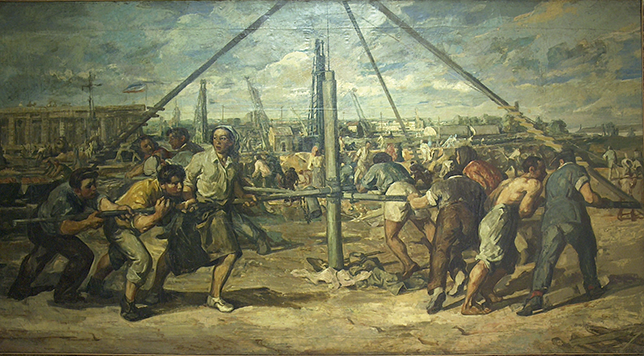
Figure 1.1 Long description
The artwork celebrates young workers and their hardworking activities in rebuilding the postwar nation. The painting depicts a scene in the building of the new neighborhood, New Belgrade, in the capital city of Belgrade. Specifically, the painting depicts the drilling of the terrain. The background is an industrial building site that spreads far into the horizon. A group of young workers in the foreground, both male and female, are turning the handles of the drilling probe. The composition is closed, with the drilling probe in the middle and two groups of workers to the left and right. The painting’s background is busy depicting more workers, cranes, drills, and other heavy equipment. A sense of movement is achieved by arranging the two main groups of workers. The workers are young, healthy-looking, and serious. Each person is pictured pushing the drill, pensive, and seemingly without acknowledging the presence of the others. The three workers on the left facing the viewer lead us into the action. Their large, round bodies are pushing against the wooden handle of the drill. The young woman close to the center is the focal point of the group. Her tall, powerful body creates a strong vertical movement, making her the symbolic core of the painting: an ideal worker full of health and energy. Although the workers’ backs are bent into their task, there are no signs of physical strain on their faces as they do this backbreaking work.
In music, populist mass songs that celebrate communism, socialism, brotherhood, unity, and state-building are the definitive examples of socialist realism. Originating from Soviet-style mass culture (when the USSR first implemented the doctrine), the phenomenon spilled over to the West and East in the 1930s and 1940s. In the US, Clement Greenberg and Dwight Macdonald wrote critical essays about mass culture, which they saw as a threat to “high” culture – namely, elitism and academicism of modernist aesthetics. Greenberg referred to mass songs as “kitsch” art,Footnote 38 while Macdonald described mass culture as a “dynamic, revolutionary force, breaking down the old barriers of class tradition, taste, dissolving all cultural distinctions,” and in the process producing a “homogenized culture.”Footnote 39 Thus, while the West sought to foster modernism, a marker of cultural scientism that distinguished art from socialist realism,Footnote 40 postwar Yugoslavia aimed to connect musical arts to the working class.Footnote 41
Slavenski notably stands out as a composer who – presumably willingly – embraced the populist mass song genre in Yugoslavia, signaling a drastic shift in style from his former experimental works. Even though he was not a member of the Communist Party, Slavenski wrote around thirty mass songs between 1944 and 1950, about half of them harmonizations of traditional Partisan songs and the other half originals.Footnote 42 These songs celebrate Tito, the Partisans, the Red Army, Stalin, the USSR, the youth, and the work ethic of nation-building. They bear titles such as Drug Tito [Comrade Tito], Heroj Tito [Hero Tito], Pesma o Lenjinu [Song about Lenin], Pesma o Staljinu [Song about Stalin], Staljin–Tito [Stalin–Tito], Da nam živi rad [Long Live Work], and Narodne partizanke pesme [Traditional Partisan songs] (Figure 1.2). Submitting his entry in 1947, Slavenski entered a competition for the national anthem of the new Federal People’s Republic of Yugoslavia, perhaps the ultimate feat of mass song genre and socialist realism. Even though his song did not win, it nonetheless signified the composer’s dedication to the socialist and communist cause.
Josip Štolcer-Slavenski, Херој Тито [Hero Tito] (1944), autograph score, SATB and piano, from a symphonic cantata, A Battle for Yugoslavia. Slavenski composed music and text. The text reads: Hero Tito / a freedom fighter / leads the nation/ […]. Original text in Serbian: Херој Тито / борац за слободу / води народ […] (The Faculty of Music Archive.
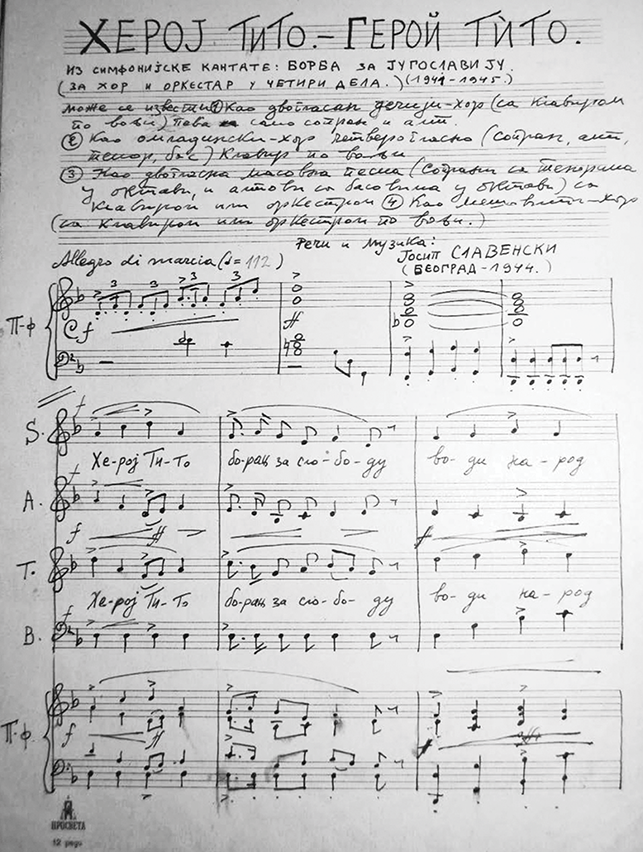
Figure 1.2 Long description
The text reads: Hero Tito, a freedom fighter, leads the nation. The song is in 4/4 meter with a march-like tempo, Allegro con marcia, and bombastic chords and octaves in forte dynamics.
For Slavenski, mass songs were a continuation of folk art, a characteristic trait of the composer’s oeuvre. The Croatian composer embraced the notion of pan-Yugoslavia immediately after the creation of the Kingdom of Yugoslavia following the First World War and imbued his music with folk motives from all parts of the region. Such folklorism is evident in his works like Jugoslovenska svita [Yugoslav suite] (1921) and Балканофонија [Balkanophonia] (1927), a work that comprises seven movements featuring dances and songs from all regions of Yugoslavia – Serbian Dance, Albanian Song, Turkish Dance, Greek Dance, Romanian Dance, My Song [Croatia],Footnote 43 and Bulgarian Dance. Many of Slavenski’s mass songs incorporate folk elements from around the country, illustrating that the composer truly saw himself not as a Croatian but as a Yugoslav composer and a faithful representative of socialist realism.
Socialist realism was not applied in Yugoslavia as extensively as in other communist states in the Eastern Bloc and was technically abandoned following the country’s split from the Soviet Union in 1948. However, its ramifications were overwhelmingly present in all cultural and artistic spheres throughout the 1950s. As composers whose works displayed modern techniques and technologies were scrutinized, shunned, and sometimes blacklisted, Yugoslav composers continued to practice and favor traditional (i.e., “neoclassical”) aesthetics. Thus, even those composers who had previously studied abroad the newest approaches to composition, such as microtonality, serialism, and expressionism, now either fully rejected avant-garde techniques or succumbed to the pressure of composing in a more subdued modernism. Musicologist Ivana Medić describes this phenomenon as “moderated modernism” – a style situated between the avant-garde and tradition, denoting a “politically neutral, socially acceptable, non-avant-garde, non-challenging form of modernism, whose most obvious feature was the artists’ desire to make peace between modern and traditional and between regional and international.”Footnote 44 Croatian writer Miroslav Krleža positioned this need for a moderated approach to modernist art to make it fit within the communist, specifically Marxist, ideology. Such art was both “localized,” given its particular formulation in Yugoslav history, and “international,” since the Marxist scope was international.Footnote 45 Thus, “moderated modernism” stood in direct opposition to both modernist aesthetic and socialist realism, situating Yugoslavia “on the ‘margins’ of Europe.”Footnote 46
Clearly, in postwar Yugoslavia, aesthetics and politics were inseparable, even though the Communist Party generally sought to avoid “direct meddling” in the theory and criticism of art.Footnote 47 Since “moderated modernists” held prominent positions as professors, music critics, concert organizers, and heads of cultural institutions, which, de facto, implied their association and standing within the Communist Party, they were in a strong position to push forth the Party’s agenda. Thus, the postwar generation of composers, including the once-progressive “Prague students,” abandoned nearly all avant-garde styles and ensured that the new generations of composers did not veer too much outside tradition. The common justification for this reasoning points to pressures from the Communist Party. While true to a certain degree, another factor also played a significant role: Many Yugoslav composers simply did not like the modernist aesthetic, and in order to maintain their powerful positions and not have to subject themselves to any change or challenge, or risk losing their grip on control and power, they ensured that their view was the dominant one.
The Postwar “Avant-Garde”: Moderated Modernism
During the Second World War, once again, all music activity in Yugoslavia almost came to a stop. While the Music Academy in Belgrade, the only higher institution for music studies in the country at the time, did not officially close during the war, activity was minimal, at best. Most of its faculty and students were drafted to fight in the war, captured as prisoners of war, or killed. Regular studies resumed in 1945, with Petar Konjović appointed as the Rector of the Academy and Stevan Hristić as the first composer on the faculty.Footnote 48 Other composers joined soon after – Milenko Živković, Stanojlo Rajičić, Predrag Milošević, Mihovil Logar, and Miloje Milojević (Figure 1.3). They all abandoned their prewar expressionism in favor of neoclassicism (except for Logar, who occasionally shifted between tonal and atonal language in his music) upon their return from Prague. Rajičić, notoriously, became the firmest critic of modernism and staunchest supporter of socialist realism, holding back the progress of musical development in Serbia (and by extension, Yugoslavia) until his retirement in 1977.
Music Academy in Belgrade, Composition Department faculty and students during the 1950s: (top row, left to right) Mihovil Logar, Marko Tajčević, Mihajlo Vukdragović, Milenko Živković, Stanojlo Rajičić, Predrag Milošević; (bottom row, from left to right) Zlatan Vauda, Borivoje Simić, Aleksandar Obradović, Dejan Despić, Dušan Radić, Vasilije Mokranjac, Dragutin Gostuški, Vlastimir Peričić, Dušan Trbojević, Lambra Dimitrijević. The banner above them reads: “With success in our professional work, we manifest our trust in the Party and Tito” [Успесима у стручном раду манифестујемо своје поверење Партији и Титу]. The Faculty of Music Archive.
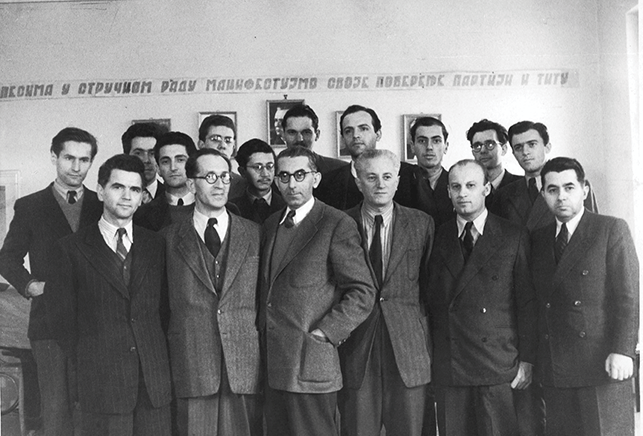
Figure 1.3 Long description
The photograph is telling as it only shows sixteen men, even though women were employed at the Academy at this time, most notably, Ljubica Marić. They are clad in formal suits and ties, looking straight at the camera. In the front row, pictured from left to right are Mihovil Logar, Marko Tajčević, Mihajlo Vukdragović, Milenko Živković, Stanojlo Rajičić, Predrag Milošević. In the top row, from left to right are Zlatan Vauda, Borivoje Simić, Aleksandar Obradović, Dejan Despić, Dušan Radić, Vasilije Mokranjac, Dragutin Gostuški, Vlastimir Peričić, Dušan Trbojević, Lambra Dimitrijević. They are standing in the hallway of the building. The banner above them on the wall reads, With success in our professional work, we manifest our trust in the Party and Tito.
Several other composers, who served as prominent music critics or repositioned themselves as musicologists, significantly contributed to the spread of socialist realism in Yugoslav cultural life. Viewing music as needing to be easily accessible and digestible by the masses, composers and critics largely favored Romantic/neoclassical aesthetics and thus advocated for moderated modernism, at best. Even during the interwar period, there was certain resistance toward avant-garde techniques. For instance, Stefanija notes that in Slovenia, the attitude concerning microtonal music changed only during the 1960s with the growing popularity of electronic music.Footnote 49 Before then, microtonal music was associated with Hába’s teachings. While many of those who studied with Hába during the interwar period, such as Osterc, regarded microtonality as “pragmatic and vital,” others were far more critical of the method.Footnote 50 For instance, in Slovenia, Srečko Koporc remarked that Hába’s theory, presented in his Neue Harmonielehre (1927),Footnote 51 was “primitive,” as it was based on the principle of “multiplication of the intervals from the current tonal system.”Footnote 52 Even those who publicly defended the new aesthetic were skeptical in private. Bravničar confessed that even though Hába’s students respected him and appreciated the consistency of his method, “no one would swear with both hands on quarter-tones.”Footnote 53
In Serbia, Miloje Milojević was a prominent critic for the respected journal Srpski književni glasnik [Serbian literary courier]. While the journal played a pivotal role in introducing European modernist tendencies to its readership, critics clearly voiced their preference for tonality and moderated modernism.Footnote 54 More specifically, as musicologist Aleksandar Vasić reveals, critics stepped into the realm of twentieth-century modernism with “only one foot” – very selectively, favoring Romanticism above all and also impressionism, with expressionism and other modernist aesthetics only in moderation and in specific cases.Footnote 55 For instance, Milojević understood Schoenberg’s music as valuable in terms of its “sensationalism” and devised purely for its “effect,” while his views on Stravinsky changed drastically from “genius” to “bizarre and incomprehensible.”Footnote 56 Regarding Yugoslav composers, Milojević showed mild support for the protagonists of modernism: Slavenski, Oskar Jozefović (1890–1941), Božidar Širola (1889–1956), and a few others. But as Vasić points out, Milojević’s writings about Slavenski, one of the most notable Yugoslav composers, can be characterized as largely neglected, lacking any clear support, and at times even questioning his aesthetic.Footnote 57
Dragutin Gostuški, who started his career as a composer but, after graduating from the Music Academy, joined the Musicology Institute of the Serbian Academy of Sciences and Arts in 1952, enjoyed a reputation as an esteemed critic and scholar. Gostuški held a particular disdain toward avant-garde music. In his 1959 critical essay, he noted that twelve-tone music was merely a “glitch” in music history, devised as a “forced attempt toward solving inner creative crisis.”Footnote 58 As for Yugoslav composers who still pursued avant-garde approaches in the face of socialist realism, Gostuški was even less sympathetic, describing them as “reactionaries.”
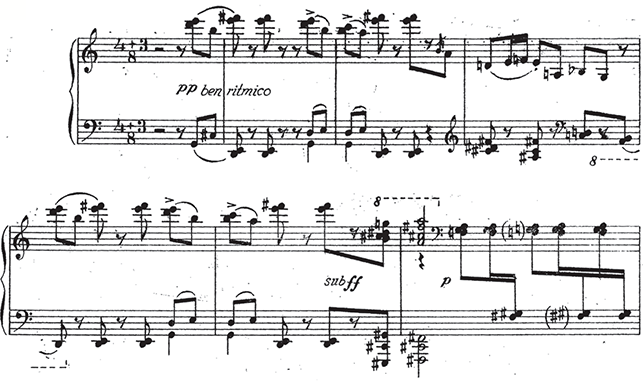
Predictably, Gostuški’s music, representative of Yugoslav modernism during the 1950s, displayed a toned-down modernist aesthetic, with (modal) folk melodies and occasional dissonant/cluster chords, as illustrated in his Two Dances for piano from 1954 (Example 1.1). The musical element in which Gostuški departed from classical tradition the most is rhythm, although not in an innovative way. As seen in the Two Dances, Gostuški notates both pieces in additive meter, which is one prominent characteristic of Yugoslav folk music, Dance No. 1 in (4+3)/8 and Dance No. 2 in (2+3+2)/8. The second dance is rhythmically less ambitious – Gostuški adheres to a regular grouping of 2+3+2 in both hands throughout the piece. In technique, style, and aesthetics, this work evokes Bartók’s dances from decades earlier. The first dance employs some more complex ideas. For instance, the perception of the 4+3 temporal organization is distorted from the very start with an awkward anacrusis, as well as irregular grouping patterns, placement of rests, and phenomenological accents that are constantly at odds with the metrical organization of the dance.Footnote 59 Nonetheless, both works feature folk motives and mostly chordal harmonies with some mild dissonances, characteristic of his entire oeuvre.
Dragutin Gostuški, Dve Igre za klavir (1954) [Two dances for piano] (Savez kompozitora Jugoslavije, Edicija udruženja kompozitora Srbije [Composers’ Association of Serbia]).
Igra Br. 1 [Dance No. 1], mm. 1–6.
Example 1.1a Long description
Written in an additive meter of 4+3 eighth notes, it shows some modernist rhythmic characteristics and also some dissonance with tritones and seconds. The piece is evocative of Bartók’s expression.
Igra Br. 2 [Dance No. 2], mm. 1–6.
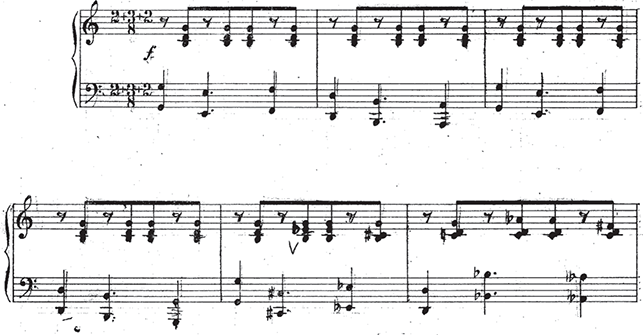
Example 1.1b Long description
Written in an additive meter of 2+3+2 eighth notes, this grouping is maintained throughout the piece, with the left hand playing octaves on the downbeat of each grouping and the right hand playing trichords on each grouping off-beat; hence, the two hands do not coincide.
With well-positioned guardians of socialist realism in all spheres of cultural life, well after Yugoslavia’s official abandonment of the doctrine in 1948, the new generation of students, those born in the interwar period, for the most part, followed the trajectories of their professors. The most radical ones – Vinko Globokar (b. 1934), Ivo Malec (1925–2019), and Milko Kelemen (1924–2018) – left Yugoslavia by the mid 1950s. The few exceptions among those who remained included Dušan Radić (1929–2010), Enriko Josif (1924–2003), and Ljubica Marić, all of whose music of the late 1950s was perceived as “avant-garde” and “unconventional” at the time,Footnote 60 especially Marić’s quarter-tone compositions. Vladan Radovanović (1932–2023) – foremost Yugoslav avant-gardist and innovator – succinctly summarized the “moderated” modernism of the 1950s as a “mixture of European music romanticism and our folklore plus occasional and moderate dissonance.”Footnote 61
But even Radovanović experimented with a moderated style during this decade. His Sonata for two pianos, celesta, and percussion (1953) is evocative of Bartók with tritone leaps, octaves with added dissonance, pitch-centric passages that shift between modal and nontonal motives, changing meters, and instrumentation.
Toward the late 1950s, Radovanović started developing his distinct, intricate style of dissonant polyphony, which he first worked out in Devetoglas [Nine-part] (1958–1959), a piece written in nine-part dissonant counterpoint. Soon after, he formulated this approach into a technique he called “hyperpolyphony” (or polyphony of polyphonies) – a texturally dense style in which individual lines and also groups of instruments are polyphonically related, with controlled aleatory. He debuted this style in 1964 with his radically avant-garde radiophonic work Sferoön (1960–1964).Footnote 62
By 1960, Yugoslav composers had reestablished a regular conversation with the West. Already by 1961, Yugoslavia was home to the Music Biennale Zagreb international festival of contemporary music, which gathered some of the most recognizable and prominent names from both sides of the Iron Curtain – from Stockhausen, Lutosławski, Kagel, Pierre Schaeffer, and David Tudor at its inaugural event in 1961, to Stravinsky, Hába, Nono, and Cage in 1963. By 1965, the avant-garde was again becoming the dominant mode of musical expression for many young Yugoslav composers of the new generations, a reaction to the restrictions and rigidity of moderated modernism and folklorism that were regarded as offshoots of the dogmatic socialist realism of the postwar decade.
Conclusion
Postwar Yugoslavia underwent a crucial political (and geographical) reordering, with the abolition of the monarchy and the implementation of a socialist structure, governed by the Communist Party and based on the economic premise of self-management. The drastic change caused cultural shock for the artists who saw their country suddenly shift from a growing, modern, urban nation, on par with major European centers at the time, to a rigid communist state with socialist realism, a dogma that directly opposed modernism. The avant-garde was now associated with elitism, which stood at odds with the principal aims of socialist realism, seeking to erase (at least superficially) the difference between social and economic classes and any prejudices based on value. While a handful of composers stayed the course and continued to experiment with new musical trends, even if in a subdued (“moderated”) format, most Yugoslav composers succumbed to the pressures of socialist realism, defending and insisting on the continuation of the neoclassical and neo-Romantic aesthetic. The avant-garde was seen as an incomprehensible style with a diminished capacity for communication. As Mirjana Veselinović-Hofman observes, the avant-garde represented a “social surplus”Footnote 63 that had no place in a country celebrating the working class.
Even though Yugoslavia officially abandoned socialist realism in 1948, the doctrine continued to be willfully implemented and guarded by composers throughout the 1950s, with its remnants visible until the 1980s. However, the opening of communication with the West in the early 1960s, the founding of the incredibly significant and renowned international festival of new music in 1961 – Music Biennale Zagreb – and the establishment of the Third Program of Radio Belgrade in 1965, a radio program dedicated to the promotion of experimental and avant-garde music, created room for avant-garde trends in Yugoslavia, which had not been experienced in the country since the interwar period.
In the late sixth century, about a century after the first Slavs settled in the Balkans, the region encountered the Byzantine Empire.Footnote 1 Although Serbian medieval states waged several wars against Byzantium, by the ninth century, the Empire’s dominance was spreading throughout the Balkan region, politically, culturally, and religiously. Byzantium played a central role in shaping Christian Orthodoxy, societies, and culture in the Balkan region. However, in 1453, with the fall of its center, Constantinople, to the Ottoman Empire, Byzantium ceased to exist. During the next 600 years, much of the Balkan region was under Ottoman rule.
As the Ottomans’ hold on the Balkans was starting to weaken in the nineteenth century, nostalgia for Byzantium was awakening in the public and cultural spheres. For the majority of the newly formed states after the fall of the Ottoman Empire – Serbia, Montenegro, Greece, Romania, and Bulgaria – Byzantium represented the national heritage of these new nations, and Christian Orthodoxy defined their national identity. At the turn of the twentieth century, artists, poets, and composers across the region drew on Byzantine tradition and practice for their artistic expression. In music, Croatian composer Josip Slavenski and Serbian composer Stevan Stojanović Mokranjac were notably inspired by the Byzantine tradition during the interwar period. Slavenski, an exemplary pan-Yugoslav composer at the time the new union of the States of Slovenes, Croats, and Serbs formed in 1918, dutifully and eagerly embraced the notion of Yugoslavia. His music is imbued with folk motives from the entire region of Yugoslavia. Some of the earliest references to Byzantium are present in his seven-movement composition Religiofonija [Religiophony] (1934), for vocalists, choir, and symphony. The first five movements are dedicated to distinct religions of Yugoslav peoples – Pagani [Pagans], Jevreji [Jews], Budisti [Buddhists], Hrišćani [Christians], Muslimani [Muslims] – while the last two movements are titled Muzika [Music] and Rad [Work]. As evident from the concept of the piece, the work is based on stereotypical clichés. The first movement starts with the sound of drum-like rhythms and offensive “pagan” tribal shouts, while pentatonic scales on xylophones characterize the “Buddhists” movement, and imitations of a call for prayer with the text “Allahu Akbar” feature in the “Muslims” movement. The work culminates in the final movement, representing the grand vision of a newly formed, unified, multicultural, multireligious, and multiethnic nation, the type of nation-building that can only be achieved through unity and hard work.
The text of each “religious” movement is sung in the language associated with the particular tradition. For instance, the fourth movement, “Christians,” features the Orthodox Christian hymn text in Greek, “Kyrie eleison / Christe eleison.” To clarify the origin of Christian heritage, Slavenski added the word “Bizantia” in the description of this movement in his manuscript.Footnote 2 However, despite the title and the text, Slavenski’s musical treatment of the material does not resemble Byzantine church music practice, but rather the Western practice of imitative polyphony. Slavenski renamed Religiofonija to Symphony of the Orient after the Second World War, with Yugoslavia’s implementation of the communist regime and the subsequent near-prohibition of any religious practice in the country.
On the other hand, Mokranjac, who grew up in the Orthodox Christian tradition and attended church as a child, was intimately familiar with Byzantine music. Byzantine church music is based on Octoechos – a book of Christian Orthodox liturgy and a collection of hymns about the resurrection of Christ.Footnote 3 The hymns are organized according to the system of eight tonoi, a system of Greek scales in various transpositions, as described by Aristoxenus and his followers.Footnote 4 The Byzantine neumatic system was transmitted orally in the region of Yugoslavia until the second half of the nineteenth century, with the first transcriptions tracing back to the Karlovci Seminary.Footnote 5 Along with Kornelije Stanković (1831–1865), Mokranjac was among the most prominent Yugoslav transcribers of Byzantine chants in Western notation and one of the first composers to inherit this tradition in his music.
Mokranjac, who was familiar with Orthodox Christian chants and their performance practice, such as ornaments, melismas, and rhythm, preserved that tradition in his transcriptions, which he first published in 1908 under the title of Српско народно црквено појање: Осмогласник [Serbian National Folk Chant: Octoechos], a collection of 328 chants.Footnote 6 While some scholars are critical of Mokranjac’s choice to preserve the practice in Western musical notation, thus “contaminating” the centuries-long Byzantine tradition,Footnote 7 his Octoechos served as one of the most significant documents for the rediscovery of traditional Byzantine practice and for reaffirming Yugoslav, and especially Serbian, musical national identity. In the first decades of the twentieth century, the composition of sacred musical works was burgeoning across Yugoslavia – Orthodox liturgy in Serbia and Catholic in Croatia and Slovenia, both in public and religious spheres. However, such artistic expression came to a sudden halt with the implementation of the communist political system in Yugoslavia after the Second World War.
Although the communist regime in postwar Yugoslavia did not formally ban religion, it was not looked upon favorably by the government, which was seeking to promote the ideals of brotherhood, unity, and nation-building. In a country with multiple ethnicities and religious practices, which made the region rife with tension, religion was viewed as an obstacle to achieving the ideological vision of the new unified state. Yet, simultaneously, there was a collective national awakening in the interest of the country’s medieval past. Mokranjac’s strong impulse to connect to the distant past arose from the nation’s need to understand the value of tradition and establish its continuity into the present time,Footnote 8 especially after a 500-year rule by the Ottomans. The awakening was triggered by the 1950 exhibition in Paris, titled L’art médiéval yougoslave,Footnote 9 which proved to play a significant role in the cultural diplomacy of the Cold War period. Because the exhibition brought positive attention to Yugoslavia from the Western nations, which was desirable following Yugoslavia’s defection from the Soviet Bloc, the Yugoslav communist government became more tolerant of sacred art in the public domain.Footnote 10
Consequently, this new lenience toward religious expression initiated not only the influx of sacred choral works in the public sphere but also a new trend among Yugoslav modernist composers: incorporating Orthodox musical elements, such as Byzantine chant and Octoechos, with other modernist techniques of the time.Footnote 11 The result was an identifiably unique avant-garde aesthetic in postwar Yugoslavia, first applied by Ljubica Marić, the first professional woman composer in the country and an early experimentalist, who during the interwar period had studied with Josef Suk and Hába at the Prague Conservatory.Footnote 12 Marić set the stage for the new modernist expression, inspiring her contemporaries and new generations of Yugoslav composers to embrace the country’s Byzantine heritage.
Ljubica Marić: Looking into the Byzantine Past to Create the Future
As the first higher institution for music studies in Yugoslavia was not established until 1937, Marić, like many of her peers during the interwar period, continued her education abroad. After completing her studies with Josip Slavenski at the Serbian Music School in 1929,Footnote 13 Marić went to the Prague Conservatory to study with Josef Suk (1874–1935). Even though Suk was a traditional composer, he was supportive of Marić’s modernist tendencies. At that time, Marić was particularly drawn to Schoenberg’s expressionism and athematicism but not toward the twelve-tone technique, which she found too systematic. For instance, she described Schoenberg’s Serenade Op. 24 as a “senseless example of l’art pour l’art” and noted that Berg merely followed Schoenberg’s (pointless) “mathematical” approach in his Chamber Concerto.Footnote 14
Only two works survive from Marić’s Prague period (and her entire interwar opus): Wind Quintet (1931) and Music for Orchestra (1932). Both works, clearly influenced by Schoenberg, are written in a free atonal and expressionist style, devoid of thematicism. However, from her correspondence, we learn that Marić experimented with and thought about other methods. Encouraged by Suk, Marić took classes with Hába, and, in her letters, she refers to her recent works that are based on quarter tones (none of which survive). It is likely that Marić also studied the twelve-tone method since some of her later works are based on some principles of quasi-serialism.
Marić was perhaps the most up-to-date modernist composer from Yugoslavia, encountering and experimenting with the newest musical trends. She lived and studied in Prague, Berlin, Strasbourg, and Paris, traveled extensively to attend music festivals around Europe, and moved within intellectual and avant-garde artistic circles. She enjoyed moderate success abroad with some notable performances, including the presentation of her Wind Quintet at the International Society for Contemporary Music (ICSM) in Amsterdam in 1931 and her Music for Orchestra in Strasbourg under the baton of Hermann Scherchen.Footnote 15
Marić returned to Yugoslavia in 1933, first to Belgrade and then to Zagreb, but after not being able to find a job in either city, she returned to Prague, with intermittent visits back to Yugoslavia and other cities around Europe. During this period, Marić became sympathetic to the communist cause and the doctrine of socialist realism. She was even arrested in 1933 at her residence in Zagreb for her ideological inclinations (along with her peers from Prague who had returned to Belgrade, Vojislav Vučković and Dragutin Čolić).Footnote 16 Not only did Marić support the notion of writing music aimed at the “masses,” evident also from her descriptions of Kurt Weill’s The Threepenny Opera as “appealing” and “fresh,” but she also ridiculed her teacher, Hába, for writing impenetrable music.Footnote 17 Marić also greatly admired the music of Bartók and Stravinsky for their use of folklore, singling out the former’s Piano Concerto No. 2 as an exemplary mastery of incorporating folk material in modernist music.Footnote 18
With the looming Second World War and the military occupation of Czechoslovakia in 1938, Marić returned permanently to Belgrade and welcomed Yugoslavia’s postwar communist political organization and the adoption of socialist realism. She wrote several neoclassical works bearing the titles of sonatas, etudes, and preludes, but also nationalist, folk, and partisan “songs for the masses.” However, this period of Marić’s compositions for the masses was short-lived, and she stopped writing music in 1950 for six years and focused on teaching. With the help of her friends, Marić was hired in 1938 as a teacher of music history and solfeggio at the Stanković Music School, and after the war, in 1945, she was hired as Assistant Professor at the Music Academy in Belgrade (now the Faculty of Music), where she remained until her retirement in 1968.
In 1956, Ljubica Marić returned to the craft of composition with her cantata Песме простора [Songs of space], written several months after attending the Venice Biennale, where she heard Stravinsky’s Canticum Sacrum conducted by Stravinsky himself. With this work, Marić resumed her modernist expression, debuting a new style in Yugoslavia – avant-garde music imbued with Byzantine and folk motives. It is not so surprising that Marić was drawn to folk motives; after all, before Prague, she studied music with Slavenski, a composer celebrated for his use of folklore. Also, Marić admired the music of Bartók and Stravinsky, whose influence is undoubtedly present in this cantata (and many of her subsequent works). However, the principal inspiration for Songs of Space came from the inscriptions on stećak tombstones from Bosnia and Herzegovina, from which Marić derived the text for her cantata.Footnote 19 Milin suggests that Marić likely attended the Zagreb exhibition on Yugoslav medieval art, where stećaks were featured artifacts, and was drawn to the messages carved in stone – not from a religious standpoint, but rather owing to their “simple” yet “philosophically tainted and laconically expressed thoughts on life and death.”Footnote 20 Marić enjoyed several notable performances of the cantata in Belgrade, Brussels, Prague, and Vienna, among other cities around Europe, as well as at the inaugural Music Biennale Zagreb in 1961.
Marić’s most significant venture into the Byzantine tradition is illustrated by her unfinished cycle Музика Октоиха [Music of the Octoechos], which she envisioned as a multigenre work comprising six compositions (Octoechos), all of which are based on the eight modes of the Octoechos as transcribed by Mokranjac in his Осмогласник. Marić completed only the first four works:
1. Октоиха 1 [Octoicha 1] for symphony orchestra (1958–1959; rev. 1998) is based on the first mode of Осмогласник.
2. Византијски концерт [Byzantine concerto] for piano and orchestra (1959), also referred to as Octoicha 2, is based on the second, third, and fourth modes of the Octoechos – one mode for each movement of the concerto.
3. Праг сна [Threshold of dreams], a chamber cantata (1961), is based on the fifth mode.
4. Ostinato super thema octoicha for chamber ensemble (1963) is also based on the fifth mode; together with Threshold of Dreams, the two works are also referred to as Octoicha 3.
However, the last two remain unfinished due to Marić’s withdrawal from public life and a twenty-year break in creativity.Footnote 21 Only the title page of the finale, Симфонија октоиха / Музика октоиха бр. 6 [Symphony of the Octoechos / Music of the Octoechos No. 6] and a handful of sketches exist, in which the composer indicated that she intended the last two pieces to be based on modes six, seven, and eight of Осмогласник.Footnote 22
Rather than just alluding to Byzantine music as her teacher Slavenski did in his works, Marić adhered to the original transcriptions found in Mokranjac’s Осмогласник, using the various transpositions of each mode as building blocks of her work and synthesizing them together with modernist techniques for a new expression. For instance, in Octoicha 1, Marić derives the material from the third melodic pattern of the first octoecho (Example 2.1). Yet the influence of both Stravinsky and Bartók resonates throughout the cycle with the use of techniques she learned in Prague – Marić subjects Byzantine modes to segmentation, stratification, metrical displacement, and polymodality with the superimposition of various statements of Octoechos, resulting in clashing dissonances. Chord sonorities are built on fourths, seconds, and sevenths, derived from different pitch centers. The overall percussiveness of the piano is evocative of both Stravinsky and Bartók (Example 2.2).Footnote 23
Stevan Stojanović Mokranjac, Осмогласник [Octoechos], the third melodic pattern of the first mode (octoecho).
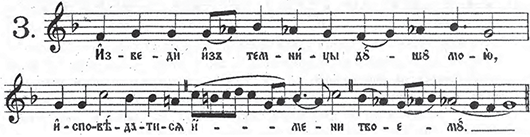
Example 2.1a Long description
This is an ametric melody in two lines, with a B flat in the key signature. The top line is one phrase long, featuring quarter notes and eighth notes in conjunct stepwise motion, and only four pitches, F, G, A flat, and B flat, with a phrase ending on a half note G. The second line has more variety. It features leaps, a wider range of rhythms. It contains two phrases, the first one centers on C with A and B, while the second phrase returns to the flattened pitches, ending on G.
Ljubica Marić, Октоиха 1 [Octoicha 1] for symphony orchestra (1958–1959), the first movement (Improvisation), the clarinet part.

Example 2.1b Long description
This excerpt shows Marić using the same pattern of the first mode, albeit starting on C, hence, the four pitches are C, D, E flat, and F, with the phrase ending on D. Marić’s excerpt is notated in three measures, each one in a different meter, 6/4, 3/4, and 5/4, showing some of her modernist traits.
Ljubica Marić, Византијски концерт [Byzantine concerto] (1959), the third movement, piano part in mm. 25–26.
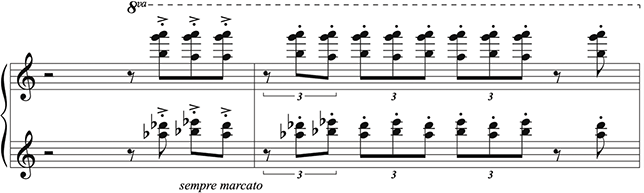
Example 2.2 Long description
This short excerpt features the two hands playing polychords: right hand alternating B flat, G, and A, and A, G, A trichords, and left hand alternating two pairs of fourths, A flat and D flat, and B flat and G flat. The repeated dissonant polychords with irregularly placed rests and accents evoke Stravinsky’s style.
Marić obtained a copy of Mokranjac’s Осмогласник in 1947, and her notes reveal that at this time she was already thinking about incorporating Byzantine modes in her music.Footnote 24 It would take Marić a decade to start this endeavor, but by the time she completed Octoicha 1, her musical language, technique, and modernist aesthetic were fully formed and showed little change for the rest of her oeuvre.
Marić enjoyed great success with her octoecho-based music across Yugoslavia, with notable performances of Octoicha 1 in Belgrade under the baton of André Cluytens and at the 1963 Music Biennale Zagreb. Her Byzantine Concerto was also performed in Dublin and across the USSR, while her Ostinato was presented at the Warsaw Autumn in 1963. Of course, writing modernist music in postwar Yugoslavia came with many obstacles. Even with an official abandonment of the doctrine of socialist realism in 1948, composers, professors, critics, and music directors continued to push for a traditional aesthetic that supported the government’s communist ideology. For instance, following the premiere of Octoicha 1 in Belgrade, composer and music critic Dragutin Gostuški described the piece as “an attempt” at reintroducing Serbian religious music in a new context with more diverse means. He continued: “Unfortunately, although worthy of attention, this idea failed to illustrate the composer’s full creative ability. Neither by its inspirational values nor by technical approaches is this work a representative of our country’s musical output, let alone did it justify engaging a conductor of Cluytens’s caliber to battle this raw sound material.”Footnote 25
Eventually, with much struggle and lobbying by Pavle Stefanović (1901–1985), a close friend of the composer and a distinguished music critic dedicated to the promotion of avant-garde music in Yugoslavia, Marić eventually received notable awards in Yugoslavia. She also caught the attention of figures such as Stravinsky and Dmitri Shostakovich during their visits to Yugoslavia. In the fall of 1961, Marić had the opportunity to meet Stravinsky during his one-week residency in Belgrade (September 30–October 7) for the performances of his Oedipus Rex and Perséphone (Figure 2.1). On one occasion, Marić revealed to Stravinsky that whenever she is faced with a compositional dilemma, she turns to his music for a solution. With a witty retort, Stravinsky responded that he does the same, except that he seeks advice from better composers.Footnote 26 Marić also met Shostakovich in Belgrade in 1964, who later stated that one of the most wonderful impressions left on him during his visit to Yugoslavia was hearing Marić’s Songs of Space, admiring her talent for her use of the “entire arsenal of modern music” in this work, which to Shostakovich illustrated “a clear, yet persuasive expression that derives from the depth of her soul.”Footnote 27
Ljubica Marić with Igor Stravinsky, October 1961, Belgrade: (from left to right) Predrag Milošević, Ljubica Marić, Igor Stravinsky, Vojislav Kostić, Milenko Živković. Serbian Academy of Sciences and Arts Archive.
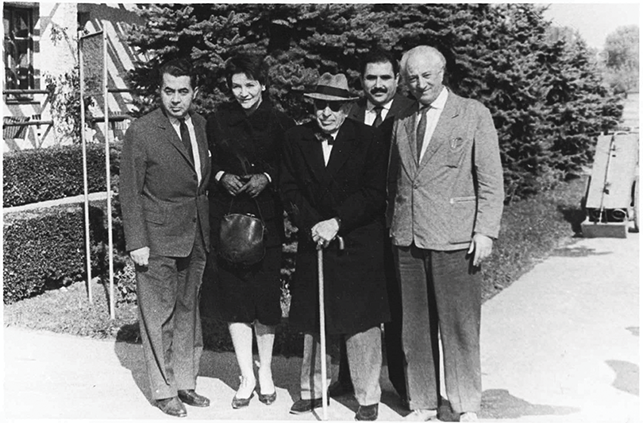
Figure 2.1 Long description
Photographed standing on the sidewalk: Predrag Milošević in a suit and tie, Ljubica Marić in a black stylish coat and holding a black purse, Igor Stravinsky in a hat, dark sunglasses, black coat over his suit, leaning on his cane, Vojislav Kostić in a suit and tie, and Milenko Živković in a suit and tie.
As the first woman composer in Yugoslavia, a professor at the Faculty of Music, and a member of the Composers’ Society, Marić opened the door for the next generation of women composers across the country. Interestingly, Marić and those who knew her claim that she never considered herself a woman composer, but just a composer who enjoyed the same privileges as her peers, who were all men, and that being a woman never imposed any professional hardships on her. Marić explains that being a woman had no bearing on the character or value of her music. For instance, she notes that many of the letters she had received while living abroad were addressed to “Mr. Marić,” which to her indicated that her creativity was seen on an equal par to her peers.Footnote 28 Pavle Stefanović regarded the composer as “a person,” “an artist,” and “a genius,” but never a woman.Footnote 29 However, this idealistic portrayal of Marić may not be entirely accurate. For one, unlike her peers, Marić was not able to secure a teaching job for several years despite her remarkable training and accolades. Further, even though she was more accomplished than most of her colleagues, Marić was not appointed a professor of composition; rather, she taught music theory, harmony, counterpoint, and solfeggio. The photograph of postwar composers at the Music Academy – both faculty and students – taken in the 1950s notably featured sixteen men and did not include Marić, nor any other woman (Figure 1.3). Nonetheless, Marić remained on faculty at the Academy of Music in Belgrade until 1968, never having taught a single class (or student) in composition, while continuing to inspire new generations of composers who incorporated Byzantine elements in their music.
Miloš Petrović: East Meets West
The trend of imbuing modernist art music with Byzantine elements continued for decades after Ljubica Marić first introduced it in her works. The movement gained momentum from the 1980s onward, as multiethnic Yugoslavia was experiencing a rise in nationalism and composers were seeking ways to assert their national identity. For the parts of the country that were once under Byzantine rule, implementing sacred Orthodox Christian elements became a desirable trait. However, the 1980s also signified an era of weakening communism and the opening of Yugoslavia toward the West. Miloš Petrović (1952–2010), a composer, pianist, harpsichordist, and writer/novelist effectively synthesized both phenomena and produced some of the most original works that blend Eastern (Byzantine) and Western (jazz) styles in his two remarkable suites, Историја Византије 1 & 2 [The history of Byzantium 1 & 2], both recorded in 1991.
Petrović first burst onto the music scene in 1972 as a jazz pianist, not typical for a student at the conservative Faculty of Music in Belgrade. A self-taught composer, he displayed an affinity for electronic and avant-garde music, first collaborating with the experimental minimalist group Ensemble for Different New Music and then taking courses with Vladan Radovanović and Paul Pignon at the Electronic Music Studio Radio Belgrade.Footnote 30 At the Studio, he realized three works, Електронска студија 4 [Electronic study 4] (1978), Lei parla italiano? [Do you speak Italian?] (1978), and Anton with/without Webern (1980); the last of these was performed at the Music Biennale Zagreb in 1981. Although none of these works survive in either written or realized form, Radovanović attests to Petrović’s versatility, talent, and innovation, referring to his oeuvre as “musical music.”Footnote 31 Radovanović further notes that Petrović had also written one of the earliest examples of multimedia work in Yugoslavia at the time – Body Music for three performers (1981–1982). Influenced by Cage’s experimentalism, performance, and conceptual art, trends that were sweeping Yugoslavia (and Eastern Europe) at the time, Petrović’s Body Music calls for the performers to move about – the action then producing the sound, either with performers changing their position in space or with their speed of change.Footnote 32
An active musician interested in any type of music he encountered, Petrović traveled within and outside Yugoslavia and attended music concerts and festivals, where he absorbed a rich variety of genres and styles. Even the composer himself notes that his opus may appear incoherent at first. He wrote experimental electroacoustic music, multimedia works, chamber operas, neo-Baroque harpsichord suites, a cycle of pop songs, and “ethno-jazz” themes and improvisations,Footnote 33 and he performed as a classically trained harpsichordist but also as a pianist in the jazz ensembles Interaction and Jazzy, and later with the Balkan Big Band Orchestra.
Petrović’s aesthetic took a sharp turn in 1990, a change musicologist Zorica Premate cynically describes as moving from “avant-garde” to “retro-grade.”Footnote 34 His first work in this new style was the First Harpsichord Suite, which he initially attributed to the “newly discovered” seventeenth-century Baroque composer Mihajlo from the town of Peć (in present-day Kosovo). Eventually, the work proved to be Petrović’s own composition that he had attributed to a fictional character he invented. Had it been true, “Mihajlo” would have been the first and only known composer in the Yugoslav region dating from the Baroque period. The truth was revealed to the great displeasure of his peers and critics, who considered this practical joke by Petrović, himself a professor at the Faculty of Music at the time, to be mocking the establishment. The suite combines the style of the seventeenth-century French school of harpsichord since “Mihajlo from Peć” supposedly studied with a renowned French composer, harpsichordist, and organist, Jean-Henri d’Anglebert. Further, the piece is infused with folk idioms from the eastern Mediterranean region, Mihajlo’s assumed native land.
From this point on, Petrović continued to compose and perform in a style that combines the Eastern (Eastern Roman, i.e., Byzantine) and Western, particularly jazz, elements. As a self-taught composer and improviser in the jazz style, Petrović realized that all aspects of his traditional and nontraditional training and interests were compatible – both Byzantine and jazz styles are based on non-Western modes, and both his harpsichord practice and jazz performance are grounded in the notion of improvisation.
Petrović’s most substantial projects in this cross-genre style, which he called “ethno-jazz,” are the two suites that he recorded in 1991 and released as two albums, the History of Byzantium 1 and 2.Footnote 35 Entirely improvisatory in nature, as are his subsequent works in this style, these suites have practically no record of music notation. All tracks bear descriptive names of Byzantine historical places, figures, or events – for instance, the first album opens with the track “Ararat! Neither God nor a Mountain” and ends with “The Last View of Tzar Konstantin XI Dragaš and the Fall of Byzantium.”Footnote 36 Each track features a mix of styles, with both traditional and standard Western instruments, and classical elements combined with jazz improvisations, folk, and pop idioms. These improvisatory and pop/folk elements often appear unexpectedly. For example, a prolonged improvisatory passage on a traditional stringed instrument, such as oud or Turkish saz, featuring modal and quarter-tonal scales, is immediately followed by a strong pop/rock beat supported by the electric bass, a drum set, and a synthesizer. Milin posits that such abrupt changes are indicators of Petrović’s fascination with the diversity of Byzantine musical traditions and their intersecting identities.Footnote 37
Petrović wrote around sixty works in different styles – electroacoustic and multimedia, neo-Baroque, art, pop, and jazz. His unique blend of all of these modes of expression, especially the progressive way of combining sacred Byzantine music with secular is one of the most original contributions to the Yugoslav avant-garde scene. Yet both Petrović and his music have been largely forgotten. There are several reasons for the lack of recognition and the absence of scholarship on Petrović, even within the region of Yugoslavia. First, the music “elite” in Belgrade did not take Petrović’s practical joke regarding his fictional alter ego lightly – while some of his peers immediately realized that the moment Petrović stepped on the stage and claimed that he was holding a breakthrough in music history in his hands he was pulling an obvious prank, many took him quite seriously. As the truth was eventually revealed, Petrović lost credibility among many in the music community. Second, Petrović’s “ethno-jazz” was a new aesthetic in Yugoslavia at the time, a style that the audiences and critics could not quite comprehend. Third, while it was not uncommon for composers to add folk and pop elements to their music, Petrović’s intercultural approach was confusing because the changes in his musical styles throughout his career were so abrupt and unusual – his practice in composition started in the domain of electroacoustic music, and then as a neo-Baroque harpsichord performer-turned-jazz improviser, he became an indefinable “world music” composer. Fourth, shortly after Petrović released his two albums, Yugoslavia was immersed in a series of conflicts that would last for a decade. Petrović and his music, along with all other artistic creativity in the country, simply vanished. Lastly, Petrović was a composer-performer-improviser, and most of his compositions/improvisations were not intended to be preserved in written form. As such, his music is difficult to reenact. Conceivably, Petrović’s music was not meant to be recreated by anyone else – he was the sole artist, creator, and executor.
Petrović was evidently drawn to the two musical styles – Byzantine and jazz – because he recognized their inherent similarities of modal structure, improvisatory nature, historic practice, and oral transmission. That is, neither music was traditionally written down in notation but was rather diffused and taught as part of one’s culture. Thus, just as a century earlier Mokranjac had transcribed Byzantine chants into notation, enabling their dispersion into modern practice, perhaps Petrović’s History of Byzantium warrants the same approach so that it can be reimagined in the new cultural context.
Conclusion
Postwar Yugoslavia underwent a drastic shift in its political organization – it traded its system of monarchy for communism, swiftly joined the Eastern Bloc, and even more quickly left it. Yugoslavia was simultaneously a communist and a socialist country, but also a “liberal” country, at least in comparison to other communist states, open and welcoming to the free-market economy. It was a multicultural and multiethnic nation that boasted unity and brotherhood, but it also allowed for “controlled” expressions of nationalism. Religion was one of those allowances; while the Communist Party did not support a public display of religion, and generally looked quite unfavorably on any mode of organized religion, artists, for instance, could depict religious elements in their works. For composers, this exception meant that they could look back into Byzantine musical practice, including its religious rites, and present it as Yugoslav national heritage – even though it was not necessarily the history or tradition for all Yugoslavs, but only those who were under the Eastern Roman Empire and identified as Orthodox Christians.
It is peculiar that Yugoslavia so acutely objected to being subjected to Ottoman rule but chose to identify so strongly with Byzantine rule. The region certainly waged numerous wars and battles to rid itself of both empires and fought for independence. Ivan Moody suggests that for Yugoslavia (and the Balkan region in general), Byzantium signified a strong sense of identity because these ancestral ties functioned as a “delineator” not only against “Western” identity but also against “Ottoman and Slavic-communist” identities.Footnote 38 While in the West the reference to Byzantium may have signified some sort of “otherness,”Footnote 39 it gave Yugoslavia an incredibly rich trove of cultural heritage material from which artists drew inspiration and creativity that was identifiably original, unique, and raw.
The political and cultural isolation of postwar Yugoslavia posed unprecedented challenges for composers who sought to continue pursuing the newest trends and innovations in their music. While the majority of Yugoslav composers, either with open arms or out of necessity, accepted socialist realism – the official doctrine of the new communist state – its negative effects on those whose artistic expression did not fit the boundaries delineated by the doctrine were tremendous. Croatian composer Milko Kelemen succinctly explains the dilemma composers like him – caught in the political division of Cold War Europe and the experimentation with new ideologies – were facing: “I was very dissatisfied with the state of affairs, particularly as my own work as a composer was in a state of crisis: I was not prepared to accept the ideology of the Eastern Bloc, nor had I had an opportunity to acquaint myself with the pluralistic tendencies of the West.”Footnote 1
Traveling outside of Yugoslavia was virtually impossible during the 1950s; like many other countries of the Eastern Bloc, the Yugoslav government imposed harsh travel restrictions on its citizens in order to prevent massive migration. In an opportunity afforded to a small number of citizens, Kelemen was able to secure a scholarship in 1954 to study with Olivier Messiaen and Darius Milhaud in Paris and with Wolfgang Fortner in Freiburg and to attend major international music festivals in Darmstadt. Upon his return to Yugoslavia in 1960, Kelemen found it even more unbearable to compose, noting that after “returning from the ‘outside world,’” he grew more frustrated because “it had become obvious that music in Yugoslavia lagged at least 80 years behind that of Europe.”Footnote 2 Rather than succumbing to the conditions imposed by socialist realism, including a compromise to seriously moderate his modernist tendencies, Kelemen had an entirely different idea. Taking advantage of Cold War tensions, he devised a plan that would establish Zagreb as the center of new music in Yugoslavia. Kelemen envisioned the founding of an international music festival of new music, the first of its kind in the Balkan region, which would attract composers and performers from both sides of the Iron Curtain. His vision came to full fruition in May 1961 with the launching of the spectacularly successful inaugural Music Biennale Zagreb (MBZ), which immediately became one of the most significant festivals of new music in Europe and would drastically change the trajectory of music expression and aesthetics in Yugoslavia.
1961: The Inaugural Music Biennale Zagreb
The division of Europe into the Eastern and Western Blocs may be an oversimplification of the postwar rivalries of the sociopolitical and economic models. Still, the cultural binary opposition of the two worlds seems apt. The West was guided by modernist, avant-garde explorations and technological innovations, while the East adhered to traditional forms and music that sought to appeal to the masses. In such a partitioned world, festivals of new music served a special role of enabling the exchange of ideas from both ideological worlds, making the Iron Curtain less impermeable. While a handful of notable festivals specializing in new music were formed in Europe before the Second World War – including the Donaueschingen Festival (launched in 1921), the International Society for Contemporary Music (ISCM) (1923), and the Venice Biennale (1930) – those that emerged during the Cold War, such as concert series at Darmstadt, Paris, London, and Rome, played a pivotal role in cultural diplomacy. The most exceptional of them was the Warsaw Autumn International Festival of Contemporary Music in Poland, inaugurated in 1956 during the Khrushchev Thaw.Footnote 3 For Poland, a country that had joined the Communist Bloc after the war and officially adopted socialist realism in 1949, staging a state-sponsored event specializing in new music was a symbolic display of opposing aesthetics.Footnote 4
Yugoslavia’s position during the Cold War was uniquely advantageous. The country had initially joined the Eastern Bloc in 1946 and adopted the doctrine of socialist realism. However, a geopolitical dispute concerning Yugoslavia’s support of the communist insurgency in Greece, as well as its quest to add Albania into the Yugoslav federation despite Stalin’s objections, led to the Yugoslav–Soviet split, also referred to as the Tito–Stalin split, in 1948. The hostile dispute resulted in Yugoslavia severing its ties with the Soviet Union and also severely damaging its relationship (especially economically) with the communist Eastern Bloc, which had even threatened to attack Yugoslavia. As the only country to successfully flee the Soviet Bloc, Yugoslavia caught the attention of the Western Bloc, including the United States, which started to develop economic ties with the communist country. Tito’s new Communist government introduced a new “third way” economic model of self-management and social ownership, thus creating a distinct type of market socialism.
Abandoning socialist realism as the official aesthetic principle, Tito’s “avant-garde” communism was short-lived. Tanja Zimmermann maintains that pseudo-avant-garde forms in art appeared only during the interim period of Tito’s promotion of the “third way” in 1948. As soon as it was adopted, social and cultural models went back to the origins of communism – the ideologies of Karl Marx and Friedrich Engels, rather than Lenin or Stalin – and thus took inspiration from Russian constructivism.Footnote 5 Already by 1948, the avant-garde had been forcefully disappeared and was immediately replaced by a new “local canon” of folklore and appeal to the masses.Footnote 6
Upon his return from the West, Kelemen concocted a plan that would take advantage of Yugoslavia’s unique political position as a communist country yet a liberal one, not belonging to either bloc. With an economic model that had elements of both socialism and a Western market economy, Yugoslavia had the capacity to lure composers and performers from both sides of the divide. Thus, establishing a new festival in a “neutral” country had the potential to not only establish Zagreb as the new cultural center in Yugoslavia but also become a crucial point of cultural exchange between the East and the West. Playing on the tensions between the two worlds, Kelemen first traveled to Moscow to meet with Yekaterina Furtseva, the Soviet minister of culture, a staunch communist, and Stalin’s good friend. Kelemen told her that Yugoslavia was at a political crossroads and that with ever-stronger influences from the United States and the West, he would like to see Soviet composers and ensembles represented at his envisioned festival. Furtseva, on the spot, offered to send the Bolshoi Ballet and the Moscow Philharmonic to the inaugural Music Biennale Zagreb, with all expenses paid.Footnote 7 After securing the participation of the leading Soviet ensembles, Kelemen traveled to Washington, DC to meet with a representative from the Department of State, informing them that the Soviet Union instantly took interest in participating in his festival and on their own initiative even insisted on sending their best musicians with full expenses paid. Amplifying the Cold War rivalry between the two powers, Kelemen urged the US to send their top ensembles, such as the Chicago Symphony Orchestra and the San Francisco Ballet, or risk exposing volatile Yugoslavia to a strong Soviet presence. Such pressure would likely have huge ramifications on the country’s relationship with the West. Kelemen recalls how his script played out with such ease, just as he had imagined it:
When I told [the US Department of State] that artists from the Soviet Union would be giving guest performances in Zagreb, they agreed at once to provide financial assistance for the participation by the United States. In the given political situation, it was a matter of prestige. The other projects then took off on their own accord. When I arrived in Bonn and told the competent politicians that the Soviet Union and the United States would be taking part, I was immediately informed that West Germany would also be present with the Hamburg Staatsoper, a program costing DM 350.000. We were to be treated to wonderful performances of the operas Lulu and Wozzeck by Alban Berg … In Paris, the first question from the Association Française d’Action Artistique was whether West Germany would be present in Zagreb. Upon my affirmative answer, they agreed to the participation by a major French ensemble.Footnote 8
Kelemen concludes, “Once I managed to secure the Russians and the Americans, the rest was a relatively easy task. They don’t call me the musical politician for no reason.”Footnote 9 Although Cage’s attendance, the performances by the San Francisco Ballet, the Moscow Philharmonic, and the productions of Berg’s operas would not occur until the second edition of the festival in 1963, Kelemen’s plan, for the most part, worked. The biggest obstacle to his scheme came not from abroad but from within Yugoslavia. Upon his return from his trips to the USSR and the US, Kelemen was arrested and questioned for two days about the intent of his travels. Even after his release, the Central Committee of the League of Communists, the country’s highest ruling body, called for a ban on the festival, fearing that bringing guests from both the East and the West would expose Yugoslavia to the “decline and decadence of bourgeois Western society,” which the Communist Party saw as “detrimental to the development of socialist culture.”Footnote 10 The Central Committee in Slovenia came to Zagreb to meet with Kelemen and specifically inquire about Cage, who was scheduled to appear at the inaugural event. They had heard that the American composer was known for “crawling under the piano” and “making a circus” out of music concerts, and if that were his plan in Zagreb, they assured Kelemen that the festival would certainly be banned. Alas, Cage did not make it to the 1961 festival, and Kelemen, together with the festival’s promoter and director, worked tirelessly to appease the Yugoslav government and organize one of the most revolutionary musical events at the time.
The inaugural MBZ was perhaps more than Kelemen or anyone else could have imagined. The event spanned one week, May 17–24, 1961, and featured multiple concerts per day with concurrent workshops, symposia, lectures, film presentations, and exhibitions. The festival’s ambitious program included all styles and aesthetics of the twentieth century, covering the repertoire ranging from Debussy and Ravel to Schoenberg and Berg, but also Soviet “traditionalists” like Prokofiev, the Darmstadt serialists, the “Polish School” aleatoric composers, electronic music, and Cage’s experimentation.Footnote 11 Those in attendance included Kagel, who conducted the Cologne Ensemble für Neue Musik, Lutosławski, Pierre Schaeffer, Petrassi, and Stockhausen, among many others. Yugoslav composers, especially those from Croatia (Milo Cipra, Natko Devčić, Krešimir Fribec, Kelemen, Fran Lhotka, Mihovil Logar, Ivo Malec, Boris Papandopulo, Branimir Sakač, Josip Štolcer-Slavenski, and Stjepan Šulek) and Slovenia (Josip Kalčić, Slavko Osterc, Primož Ramovš, and Alojz Srebotnjak) were strongly represented, with only two Serbian composers included in the program (Ljubica Marić and Dušan Radić).
Writing for the New York Times, Everett Helm noted that the “wide diversity of styles, techniques, and aesthetic approaches displayed by living Yugoslav composers” was striking at the inaugural event.Footnote 12 However, the critic also observed that, unlike Yugoslav visual arts, which had kept in tandem with the West and produced abstract works that had received international acclaim, music was much more conservative. He wrote, “Only a few composers, such as Milko Kelemen, the enfant terrible of Yugoslav music, have experimented with those post-Webern forms and techniques that have emerged in postwar Western Europe.”Footnote 13 Helm continued, “For the majority, tonality forms the indispensable basis of composition, but within the framework of tonality there are many gradations observable.” He specifically pointed out Šulek’s opera, Coriolanus, as being “unabashedly romantic,” which to him recalled the music of Wagner, Strauss, and Mussorgsky and of Papandopulo’s Third Piano Concerto as rooted in tonality with occasional excursions into dissonance and the jazz idiom. Cipra’s Three Encounters was recognized for his affinity to French music, with Helm describing these pieces as “short, clear, unpretentious, and pleasant,” while Radić’s “pseudo-surrealistic” ballet The Ballad of the Vagabond Moon was a work that unsuccessfully combines elements of Prokofiev and Bartók with jazz. The most notable Yugoslav works for the New York Times critic were Malec’s orchestral piece, Movements in Color, which he found harmonically adventurous for “abounding in strong dissonance and bordering in atonality,” and Kelemen’s “excellent” serial work, Skolion for Orchestra.
Helm was also fascinated by the display of Yugoslav “exceedingly rich” folk music, evident in Devčić’s opera The Witch of Labin, in which the composer integrated Istrian folk into a “nonschematic texture of freely dissonant tonality,” and also in Marić’s Songs of Space, which the critic described as “perhaps the festival’s most successful work [of this nature]” and an “impressive piece for chorus and orchestra that develops a truly original atmosphere.”Footnote 14
However, under the subheading “Avant-Garde,” Helm did not refer to any Yugoslav composers. He accurately asserted that the two appearances by the Cologne New Music Ensemble, conducted by Kagel, provided the Yugoslav composers, performers, and audiences with their first opportunity to hear the most “advanced” trends coming from Western Europe and the US. The reactions were certainly mixed. While the Parrenin Quartet’s interpretations of Martinet, Schoenberg, Maderna, and Bartók received a well-deserved standing ovation, the audience was left “bewildered” and listened only out of politeness to Cage’s Piano Concerto performed by David Tudor. The audience was also not receptive toward the Ensemble für Neue Musik, conducted by Kagel, or to electronic music by Ligeti, Eimert, and Koenig. Undoubtedly, the most unbearable experience for the audience was Stockhausen’s forty-minute Kontakte for piano, percussion, and tape recorder, which caused a “moderate storm of protests.”
Certain composers, most of them from Serbia, such as Aleksandar Obradović (1927–2001), but also a Croat Petar Bergamo (1930–2022), and a Slovene Marijan Lipovšek (1910–1995), criticized the selection of Yugoslav composers who were chosen to represent “Yugoslav music” at the Biennale. They argued that those works did not accurately represent either Yugoslav music or the “most advanced” Yugoslav music at the time. As such, in their view, the programming committee did little good for their country and only created a total “disorientation” of the status of Yugoslav composers.Footnote 15 But the presentation of the Yugoslav aesthetic on a big international stage was accurate, and the criticism was necessary. Bergamo put it succinctly by noting that music Yugoslavia had thus far considered “advanced” was nothing more than music written in the style of Stravinsky, Bartók, Webern, and similar.Footnote 16 The Biennale finally forced Yugoslav composers to face the uncomfortable truth.
The First Music Biennale Zagreb left Yugoslav composers “bewildered” and disheartened. It was a shattering and life-changing experience for many. This reaction was not entirely unforeseen. As Milin points out, except for Malec and Kelemen, who had been living in Paris since the mid 1950s, only a handful of Yugoslav composers had a chance to travel abroad and learn about new musical techniques. In Serbia, they were Enriko Josif and Radić, in Croatia, Devčić and Stanko Horvat, and in Slovenia, Janez Matičič and Alojz Srebotnjak, with no composers from other republics.Footnote 17 Thus, for most Yugoslav composers who were educated in the postwar period, the Zagreb festival was their first exposure to actual avant-garde music. Musicologist Ivana Medić aptly sums up the aftermath of the inaugural MBZ, writing that many composers went through “creative crises,” causing some to completely abandon composition and others to try to “modernize” their aesthetic.Footnote 18 But for Kelemen, his festival achieved exactly what he set out to do: It brought avant-garde artists from both blocs to Yugoslavia, exposed his peers and audiences to the newest achievements in modern music, and provided Yugoslav composers with the affirmation they sought on one of the largest international scenes.
The 1960s: The Post-Biennale Avant-Garde Scene and the Influence of the Polish School
For young Yugoslav composers, who were eager to hear the newest musical styles and learn about avant-garde techniques, which were impossible to acquire at their traditionally oriented home institutions, the inaugural MBZ was a true spectacle and the opportunity of a lifetime. Rajko Maksimović (1935–2024), still an undergraduate student of composition at the Music Academy in Belgrade in 1961, recalls how he and his friends from the Academy flocked to Zagreb “en masse” to experience this valuable exchange of information and to witness the “affirmation” of Yugoslav composers, especially of his professors.Footnote 19
In his review of the concert, published in a special issue of the journal Zvuk dedicated to the impressions from Zagreb that were written by Yugoslav composers, critics, and musicologists, Maksimović relays his enthusiasm and excitement about the festival. But he also reveals his implicit and explicit prejudices and limitations owing to the circumstances of his overpoweringly conservative education in Belgrade. The fact that he dismissively refers to nonconventional music as “events” or as “music” in scare quotes is telling:
The concepts of “contemporary” and “music” are broadly construed, because some of the “contemporary” concerts we saw featured works by Ravel, Debussy, and early works by Schoenberg and Webern. … On the other hand, the notion of “music” is expanded to include “events” that have nothing in common with music, at least not currently. Nonetheless, it was useful to see and hear the ensemble from Cologne, so that we can take a position toward this type of creativity. We simply witnessed the making of new and unusual sounds, but that’s about it. That kind of “music” seems completely empty and cold, and when you watch it, even laughable.Footnote 20
Maksimović offered harsh criticism of Western avant-garde music that “rejects all compositional principles, even the aesthetics of traditional music,” especially the kind he heard in the works by Boulez and Stockhausen, which he described as music that lacked any positive value, a step backward in the progress of music, and music created out of mere interest in the experimentation with new acoustical means. The works by Messiaen and Nono, who, according to him, achieved “true art” with their explorations of new sounds and technologies, stood out. Even though Maksimović did not even comment on Cage, likely because it was not “worth it” in a “serious critique,” other reviews reveal that, unsurprisingly, Tudor’s performance of Cage’s Concert for Piano and Orchestra, despite its “exhibitionism,” was the most talked about and attended event at the Biennale.Footnote 21 The works of Cage were, at the time, incomprehensible for Yugoslav composers and audiences alike and would remain so for another decade and a half.
Other musical trends presented at the concert had a profound effect on the course of Yugoslav music. Although Yugoslavia did not have the means for electroacoustical explorations in the early 1960s, the festival inspired a handful of composers to travel abroad and work in the newly established electronic music studios in Europe and the US. While Kelemen continued to live abroad, studying at the Siemens Studio for Electronic Music in Munich, Maksimović, Devčić, and Obradović went to the Columbia-Princeton Electronic Music Center in New York City in the mid 1960s. Ludmila Frajt and Josip Kalčič headed to the Experimental Music Studio of Czechoslovak Radio Plzeň, and Vladan Radovanović worked at the Polish Radio Experimental Studio in Warsaw.
Serialism, let alone integral serialism, was never fully accepted in Yugoslavia. At the Inaugural Biennale, the Italian group of composers – Luigi Dallapiccola, Alfredo Casella, Giorgio Federico Ghedini, and Goffredo Petrassi – merely showed Yugoslav composers that “strict serialism” can nonetheless elicit a “true inspiration as the means of expression.”Footnote 22 However, in his introductory speech for the Second Biennale, Kelemen explicitly noted that there was a certain hostility among Yugoslav composers toward serialism, alongside different kinds of biases toward the new, which he had been trying to correct with the founding of the festival.Footnote 23 Nonetheless, even in the decades to come, only a small number of Yugoslav composers experimented with quasi-serial techniques, and very few attended the Darmstadt Summer Courses.
However, aleatoric and sonoristic techniques, presented by Polish composers at the 1961 Biennale, left Yugoslav composers in awe. Maksimović wrote the following glowing impression in his review:
The Polish group, presented by [Witold] Lutosławski, left the most convincing impression on me at the entire Biennale. [Kazimierz] Serocki, [Tadeusz] Baird, [Henryk] Górecki, [Krzysztof] Penderecki, [Włodzimierz] Kotoński, and [Bogusław] Schaeffer, although different from each other, appear as a strong phalanx of gifted musicians. They dealt fiercely with tradition and destroyed everything old, yet managed to create significant works full of artistic power and juice. Their works abound with new thoughts and aspirations, new sounds and rhythms. Their art is rich and suggestively announces the transformation of music. I feel that these people have the most strength to sustain their musical style and make the farthest reach.
If there were a battle between made and constructed music, on the one hand, and inspired music on the other, then I have no doubt in the victory of Messiaen, Baird, Serocki, and others, whose music is truly i n s p i r e d.Footnote 24
Radovanović similarly emphasized that Górecki’s piece was a work that left the deepest impression on him because it resembled the aesthetic and expression that he was, at that time, developing in his own style of composing – hyperpolyphony: “Henryk Górecki’s piece Scontri left the strongest impression on me at the first MBZ. I remember thinking how that piece is somehow similar to Sferoön, which I had already been working on by then.”Footnote 25 The aesthetic of the “Polish School composers,” as Yugoslav composers referred to them, who at the time were considered leaders of the postwar avant-garde, was pitted against Soviet music, heavily constricted by socialist realism. The critics took advantage of this polarization as a metaphor for the current political situation in Yugoslavia – a country that was open to and collaborated with both the East and the West.Footnote 26 It was also a reality in which Yugoslav composers operated: While a small number were fascinated and influenced by the avant-garde music they heard at the Biennale, most composers, critics, musicologists, and music directors, especially those in Belgrade, heavily guarded traditionalism and stood as gatekeepers for any movement toward the avant-garde. However, for a handful of young composers from Belgrade, MBZ was the beginning of a musical revolution. Upon their return to Belgrade, perceiving the Polish School as a “true direction of contemporary music” unlike the Cage-style experimentation,Footnote 27 they began exploring and applying new avant-garde procedures in their own works.
The modernization of Yugoslav music still lagged behind contemporary trends in the West and the East, which came to a full display at the second edition of the Biennale, held May 8–16, 1963. While the presence of Yugoslav composers (mostly Croatian and Slovenian, who were more open to modernism and musical contacts from abroad) was notably programmed more heavily, with nearly two dozen appearances, their music was still perceived as anything but avant-garde. American composer Gunther Schuller, whose work was also performed in Zagreb, summed up his impressions in his review for the New York Times: “Yugoslav music was featured heavily in the concerts but was uniformly unable to rise above a well embedded ‘epic,’ bombastic, national style, irrespective of whether the language was diatonic or serial.”Footnote 28
Serbian composer Obradović yet again criticized the selection of Yugoslav composers programmed at the Second Biennale, fittingly asking whether the Biennale was an event for only Croatian composers from Zagreb, or whether it ought to represent a real overview of new music from across Yugoslavia. He further questioned what kind of music ought to be represented at the Biennale – music that exhibits all current Yugoslav trends, including folklore (i.e., nationalism), or only music that follows the newest avant-garde currents.Footnote 29 Nonetheless, there were works by seven Serbian composers performed at the Second Biennale, which featured a variety of styles, ranging from electronic music by Ernö Király, Marić’s Octoicha 1 based on Byzantine church chants, traditional chamber music by Maksimović, choral music by Radić, a ballet by Gostuški, and avant-garde chamber music by Radovanović. Still, the music presented by all Yugoslav composers, whose aesthetic was comparable to Stravinsky and Berg (the two featured composers at the 1963 Biennale), paled in comparison to the contemporary avant-garde currents on both sides of the Curtain. The festival’s conception was structured around highlighting one living and one nonliving “master” of the twentieth century. For Schuller, the performances of Stravinsky, Webern, and the Polish avant-garde by the Kraków Philharmonic, under the baton of Andrzej Markowski, stood out, while the productions of Berg’s Wozzeck and Lulu fell somewhat flat. Stravinsky, a guest of honor at the festival, took part in conducting his Symphony in Three Movements at one of the concerts dedicated entirely to his music.
The 1963 Biennale brought many notable composers, including Stravinsky, Robert Craft, Lutosławski, Penderecki, Nono, Berio, Maderna, Luc Ferrari, Pierre Schaeffer, and Bogusław Schaeffer. The most talked-about and controversial figure, yet again, was Cage, whose presence in Zagreb, together with Tudor and the San Francisco Dancers’ Workshop Company, nearly caused the authorities to cancel the festival. Kelemen recalls going to Cage’s hotel room the night before the concert and begging him not to crawl under the piano, as such behavior would risk shutting down the entire event. According to Kelemen, Cage promised not to do it. Kelemen continues describing Cage’s performance, which was scheduled to start at midnight:
I was standing in the corner of the concert hall, thinking how only five or six people would show up. But so many people came, we couldn’t fit everyone inside the hall. During this period [in Yugoslavia], anything American was banned, yet here was a concert by an American avant-garde artist. It was so unbelievably sensational. The first thing Cage did at the beginning of the concert was to crawl under the piano. The crowd went wild, and he received a big round of applause. From today’s perspective, it is clear that [Yugoslav] people were so poor [at the time] and lacked freedom – freedom to do something unconventional. I could cry now just thinking about it.Footnote 30
Cage and Tudor made two appearances at the 1963 Biennale – in a lecture and a concert, which Schuller described as a “dance-pantomime … in conception very close to a ‘happening’ through more consequentially and cohesively organized.”Footnote 31 For the critic, Cage was “regretfully” a representative of “American music” to an average Biennale visitor, and despite being amusing or titillating, his presence gave the impression that American music could hardly be construed as “serious.”Footnote 32
However, it was the Polish School of avant-gardists that once again made the strongest impact on Yugoslav composers, many of whom immediately adopted aleatoric and sonoristic techniques.Footnote 33 The Kraków Philharmonic Chamber Orchestra, conducted by Markowski, performed Górecki’s Canti strumentali, Kotoński’s Canto, Penderecki’s Violin Concerto, Serocki’s Segmenti, Schaeffer’s S’alto, and Lutosławski’s Trois poèmes d’Henri Michaux. For instance, Ludmila Frajt was particularly drawn to Lutosławski’s aleatory textures, Penderecki’s use of clusters and the nonstandard treatment of instruments, and Ligeti’s micropolyphony, which form the basis of the expression of her subsequent oeuvre. Lutosławski inspired Maksimović to write Tri Haiku [Three haiku] for two female choirs and twenty-three instruments in 1967, which Maksimović premiered at the Fourth (1967) Biennale. And for a group of Yugoslav avant-garde composers from Belgrade – Petar Ozgijan [Oshgian] (1932–1979), Petar Bergamo, Berislav Popović (1931–2002), and Zoran Hristić (1938–2019) – their venture into modernism was illustrated by the implementation of quasi-serial and aleatory techniques in their works.
New (Subdued) Currents in 1960s Yugoslav Music
In his 1971 discussion of “Contemporary Trends in Yugoslav Music,” a Bosnian music historian and critic, Zija Kučukalić, realistically portrayed the situation of modernist trends in the country, noting that Yugoslav composers rejected their Indigenous folk elements and eagerly turned to European (i.e., “foreign”) influences:
In undertaking an analysis of movements in contemporary Yugoslav music, one of the first areas that comes to the fore is that of folk music and its role in artistic creation. Folk music was the support on which all Yugoslav nationalities relied when they began to undertake musical composition. Representatives of contemporary Yugoslav music included in their anti-romantic and anti-realist attitude an aloofness from folk music, regarding its presence as one of the indications of stylistic backwardness. Turning their attention to the music of Europe, Yugoslav composers joined international movements during this period, attempting to affirm their nation’s musical capacity in the world of universal music culture. What, then, were the possibilities for contemporary Yugoslav composers also to express the national spirit and not be lost in musical universals?Footnote 34
Assessing modernist trends across each republic of the federation, he observes that Slovenian composers (such as Uroš Krek, Primož Ramovš, and Janez Matičič, and then Jakob Jež, Pavle Merku, Milan Stibilj, Ivo Petrić, and Alojz Srebotnjak, and later Darijan Božič, Vinko Globokar, and Lojze Lebič), because of their geographical proximity to the West, were the first to encounter contemporary trends, which is the reason their musical palette was wider and more fertile. Speaking of Croatian trends, he notes the deep Romantic tradition in the republic and the presence of socialist realism and nationalism. However, he argues that the postwar generation made great strides toward modernism. He especially highlights an inclination toward experimenting with sound in the works by Kelemen and Malec, but also compliments Devčić, Sakač, Kresimir Fribec, Stanko Horvat, Ruben Radica, Zlatko Pibernik, Adalbert Marković, and Dubravko Detoni. While Serbian music still relied heavily on tradition and neoclassicism, Kučukalić points out that several stylistic trends were fully developing side by side, though none can truly be described as “avant-garde”:
Enriko Josif seems to bring back to life Serbian epic and medieval frescoes by the special dignity and grandeur of tones in his music. Dragutin Gostuški and Dušan Radić are following neo-classicism in music. … Rudolf Bruči, Aleksandar Obradović, and Rajko Maksimović gravitate toward larger forms in which one can trace the inclination towards vocal and instrumental sound masses and a specific affinity for coloring. Vojislav Kostić nourishes a style of special expressiveness conveyed by simple means as well as by modern, socially engaged music, particularly for stage films. Vladan Radovanović is completely absorbed by the expressiveness of non-traditional sound and by the interesting application of the sound quality of electrical-acoustic devices to traditional instruments.Footnote 35
Kučukalić’s overview of modern trends in Macedonia and Bosnia and Herzegovina is more significant because composers from these smaller republics have been historically marginalized and seldom recognized (or programmed). For Macedonian composers, he observes their “rich folk inheritance” as evident in the works by Vlastimir Nikolovski (1925–2001). Toma Zografski (1934–2000), on the other hand, is “freer in accepting the influence of the West,” while Toma Prošev (1931–1996) “moves away from tradition most persistently and consistently.”Footnote 36 Kučukalić positions contemporary music aesthetics in Bosnia and Herzegovina within three categories:
The first one is completely attached to realistic nationalism and the rich folk tradition, and its most prominent representative is Vlado Milošević. The second stylistic trend relies on late romanticism and the expressionistic tradition, with Miroslav Špiler in the first place. The third trend is most consistently followed by Vojin Komadina, who deviates from tradition and tries to catch up with the trends of modern musical development.Footnote 37
Kučukalić’s realistic assessment of not-so-advanced tendencies among Yugoslav composers explains why the Third Biennale, held on May 12–23, 1965, featured a heavily reduced presence by the nation’s composers: only one work from Serbia (Marić’s Byzantine Concerto), one composer from Macedonia (Prošev), a handful of composers from Slovenia (Horvat, Petrić, Ramovš, Srebotnjak, and Stibilj), and seven composers from Croatia, most prominently Kelemen and Malec, were programmed.Footnote 38 With notable guests participating in the Biennale, including Stockhausen, Maderna, Lukas Foss, Pierre Schaeffer, Messiaen, Cathy Berberian, and Shostakovich, among others, the reviews of works by Yugoslav composers, once again, were disappointing. In his review for the New York Times, Helm generously complimented Kelemen’s two stage-works, although likely out of courtesy. He promptly observed that Kelemen’s language did not depart from the aesthetic of the early twentieth century and even referred to Kelemen’s techniques as “advanced” in scare quotes:
In the highly erotic “Abbandonate,” based on a poem by A. B. Simić, the somewhat crass choreography by Ivan Sertić left too little to the imagination. Kelemen’s highly effective music, however, maintained the dramatic tension from start to finish. The score is a successful synthesis of post-Webern techniques and more traditional practices relatable in particular to Alban Berg. It is expertly written and displays in fine advantage the typically Yugoslav tendency to think melodically, even when writing in an “advanced” idiom.Footnote 39
For Kelemen’s other work, a short opera, The New Tenant, Helm wrote that it “contained some interesting moments but was musically a bit on the thin side.” Helm then noted that calling this work “opera” is “perhaps the wrong word, for much of the dialogue was spoken or half-sung to an accompaniment that was more in the nature of background music.”Footnote 40 Overall, Helm generously remarked that compositions representing Yugoslavia at the Third Biennale showed that the composers have made a strong effort to keep in step with Western European trends when considering that the country, until recently, was strongly inclined toward traditionalism. Nonetheless, Helm singled out Radica’s 19 and 10, Interferences as a particularly unsuccessful piece, describing it as “a hysterical work” with which the composer illustrated that he had “not digested the materials with which he was working.”Footnote 41
German critic Ulrich Dibelius offered a blunt assessment of Yugoslav modernism displayed at the first three editions of the MBZ. In stark comparison to the Warsaw Autumn, Dibelius stated that the third rendition of the festival in Zagreb clearly showed that modernism had not grown or developed any further in Yugoslavia since the festival’s debut, and that the general capacity of composers in Yugoslavia was evidently lesser than in Poland.Footnote 42 Dibelius was partly correct – Yugoslav composers had no capacity for growth in their modernist expression by 1965 because they could not. For one, the stronghold of those composers and critics preserving the aesthetic of socialist realism was almost impenetrable. Composers teaching at the Music Academy in Belgrade were hired during the postwar period, a period during which socialist realism was implemented. Many of them were either members of the Communist Party or strict followers of the socialist message of unity and brotherhood and thus believed in writing music that was accessible to the audiences. This approach allowed them to maintain their powerful positions and have their music performed. Others, like Vlastimir Peričić or Dragutin Gostuški, stopped composing and focused on writing pedagogical textbooks and critiques, further cementing the traditional canon. For instance, following the Fourth Biennale, Gostuški wrote a critique titled “A Crisis of False Progress,” which may be regarded as the author’s anti-avant-garde manifesto.Footnote 43 In it, without concealing his contempt for the avant-garde, Gostuški stated that, as a music critic, he felt “swindled” by the direction of music in Yugoslavia – instead of “evolving,” it was moving “backward” into the realm of pure academicism and becoming nothing more than “legalized terror.”Footnote 44 Considering the mindset of traditionalist composers and those in power, it was unrealistic to expect the new postwar generation of composers to either embrace or understand modernism – modern music was not taught in institutions in many parts of the country, most notably Belgrade, the capital of Yugoslavia. Rather, these young composers spent their formative years under the strict guidance of their conservative professors (like Stanojlo Rajičić), who imposed their narrow scope of what music is and impressed their own biases on future generations. It would take more than a decade – until the late 1970s – before a young group of students would even dare defy their teachers and stand up for their own convictions and interests.Footnote 45
Further, by 1961, the year of the inaugural Biennale, Yugoslavia was just starting to open to the West and repair its ties with the Eastern Bloc. While the break with the USSR in 1948 brought on a gradual liberalization of cultural activities, the change was slow. For instance, traveling outside the country was possible, but it was still far from easy, and securing the funds to do so was quite a challenge. Acquiring music scores, records, or books from abroad was almost impossible; there was one shop in Belgrade that had a limited selection of “modern” music, such as scores by Stravinsky and Bartók. There were no ensembles in Yugoslavia yet that specialized in playing new music, and it was not until 1965 that the Third Program of Radio Belgrade – a station that specialized in new music – was established.
While there were pockets of resistance by those composers who truly pursued the exploration of avant-garde music, they were few, and many of them no longer lived in Yugoslavia. Most notably, Croatian composer Malec left for Paris in 1955 and worked in the domain of electronic music with Pierre Schaeffer and the Groupe de Recherche de Musique Concrète. Franco-Slovenian composer Vinko Globokar, who made his debut at the Zagreb Biennale in 1967, had also been living in Paris since 1955, where he studied with René Leibowitz and, the following decade, in Berlin with Luciano Berio.Footnote 46 In Serbia in the 1960s, while several composers had studied in Darmstadt and electronic music studios in Poland, Plzeň, and the Columbia-Princeton Electronic Music Center in New York – including Maksimović, Obradović, Frajt, and Radovanović – all but Radovanović abandoned electronic music and avant-garde aesthetics upon their return. Radovanović, regarded as a “rogue” composer who was never embraced by the Music Academy in Belgrade nor by his peers or critics, eventually founded his own institution in 1972, the Electronic Studio of the Third Program of Radio Belgrade, where he could continue pursuing his interests. However, at that point, electronic music in Yugoslavia was lagging at least a decade behind electronic music trends in the West. Further, Radovanović’s style of dense polyphony – hyperpolyphony – which he had been developing since 1960 and debuted in 1964 with his radiophonic work Sferoön, was not an entirely new or innovative idea; it was similar in aesthetic to Ligeti’s and Lutosławski’s sound mass compositions from years prior.Footnote 47
Other avant-gardists working in Belgrade were either writing in a subdued form of moderated modernism or they imitated the styles they had encountered at the Biennale. For instance, Maksimović’s Three Haiku features similar instrumentation, notation, and aleatoric techniques to those he heard in Lutosławski’s Trois poèmes d’Henri Michaux at the 1963 MBZ. Maksimović analyzed how the Polish composer used aleatoric techniques effectively, which influenced his own approach: first, aleatory freed the performers from the constraints of technical challenges; second, it opened up the possibilities for achieving richer polyrhythmic textures; and third, it made each performance of the work sound different.Footnote 48 Further, Lutosławski developed several distinct notational markings for his techniques, such as down-arrows, which are also evident in Maksimović’s score. He also adapted and implemented notational aspects by other Polish composers into his score, such as Serocki’s beamed accelerando and ritardando markings, Penderecki’s style of denoting the highest possible sounds, and a general Polish School style of music organized not metrically but durationally by time segments and featuring aleatory musical motives, as Iwona Lindstedt illustrates (Example 3.1).Footnote 49
Rajko Maksimović, Three Haiku, I. On the Sandy Beach (1967), depicting aleatoric techniques, two measures before section E.
Other Yugoslav composers explored a combination of the Polish School techniques, namely aleatory, which they also combined with Messiaen’s modes, basic serial techniques, and chordal clusters, as well as Stravinsky-style polychords to try to create their “distinct” style of modernist expression. For instance, the music of Ozgijan, among other Belgrade-based composers during the 1960s, illustrates this approach. His Meditations for two pianos, strings, and percussion (1962) exemplifies techniques that are illustrative of the kind of modernist aesthetic practiced in Belgrade during this period. The work is primarily structured on two distinct hexachords that the composer uses in all four basic forms (prime, inversion, retrograde, and retrograde inversion) and combines to achieve the chromatic aggregate, but not in a strict or consistent serial manner. In addition to the quasi-serial treatment of the two hexachords, Ozgijan also uses a variety of modes, including octatonic collections and even tonal passages, alongside dissonant polychords that often repeat in an irregular rhythmic pattern and hence evoke both Stravinsky and Bartók.
The first generation of Croatian avant-garde composers – Milo Cipra (1906–1985), Natko Devčić (1914–1997), and Branimir Sakač (1918–1979) – employed the full array of avant-garde tools that were known in Yugoslavia at the time. For instance, Devčić relied on atonality and athematicism in his piano work Mikrosuite (1965), dodecaphony in a chamber piece Odrazi [Reflections] (1965), and electronics in Columbia 68 (1968). Sakač used concrete music in Tri sintetske poeme [Three synthetic poems] (1959), concrete and electronic sounds in Jahači Apokalipse [The riders of the Apocalypse] (1961), and a combination of serialism, aleatory, clusters, and graphic notation in works such as Prizme [Prisms] for piano (1961), Epizode [Episodes] for orchestra, and Strukture I [Structures I] for chamber ensemble (1966). Explorations of avant-garde methods continued with the next generation of Croatian composers, such as Kelemen, Malec, Ruben Radica (1931–2021), and Dubravko Detoni. Radica and Kelemen worked with serialism, and the latter even combined folk material within the method, as in his Pet eseja [Five essays] for string quartet (1959). Malec implemented aleatory methods, using both improvisational and strictly composed passages. However, he is most notable in the domain of electronic music, as discussed in later chapters.Footnote 50 Detoni, the foremost Croatian avant-gardist, explored the notions of sound and noise (as in his work Likovi i plohe [Figures and planes] for orchestra [1967]), improvisation and graphic notation (as in Šifre [Codes] for piano and four loudspeakers [1967]), and electronic and concrete music (such as Phonomorphia 1–4 [1967–1974]).Footnote 51
In Slovenia, composers like Primož Ramovš (1921–1999) and Lojze Lebič (b. 1934) also worked with aleatorics, but it was Globokar who brought radical avant-garde improvisation to Yugoslavia as a “composing cornerstone” and means of communication in contemporary music.Footnote 52 Generally speaking, music created during the 1960s indicates that Yugoslav composers explored all of the techniques they had heard at the Biennale, such as the use of clusters, texturally dense sound masses, aleatory, use of electronics, and even, to an extent, serialism and integral serialism. On the one hand, this experimentation is indicative of the Yugoslav composers’ affinity toward the new, which was strengthening with each subsequent edition of the Biennale. On the other hand, collectively, Yugoslav modernist expression was quite mild, and it lacked originality. That is, the result was an attempt at inserting something that had already existed, in some cases almost like a patchwork of many different styles and techniques, while trying to frame these aesthetics and techniques as authentic. Hence, their music was hardly ever discerned as original or new outside of Yugoslavia, and often not even within the country. The one composer whom the critics from abroad typically praised as noteworthy was Kelemen – the founder, director, and organizer of the festival – which is hard to comprehend in any other way than just out of courtesy.
It would take a few years before a composer of Yugoslav heritage would truly catch everyone’s attention and gain critical acclaim, especially in Europe: Vinko Globokar. Although Globokar’s first appearance at the Zagreb Biennale was in 1967, the young composer and trombonist was already known in the prominent avant-garde circles in Europe. He premiered works by many notable figures, such as Berio (whose Sequenza V for solo trombone Globokar premiered at Carnegie Hall in 1966), Stockhausen (in whose group Globokar played during his time in Cologne), Leibowitz, Kagel, and Tōru Takemitsu, alongside his own. Globokar’s experimental style (both in his performances and compositions) was imbued with extended techniques and unconventionality, improvisation, theatricality, and elements of avant-garde, free jazz, and Yugoslav idioms, which was striking, innovative, creative, and, at the time, unique (Figure 3.1).
Vinko Globokar performing at the Music Biennale Zagreb, May 8–14, 1977 (Music Biennale Zagreb Archive).
While Miloš Petrović’s marriage of Byzantine and jazz style would emerge (in Serbia) in the early 1980s,Footnote 53 Globokar’s style of combining avant-garde, jazz, and Yugoslav folk idioms was well known outside of Yugoslavia (especially in Germany and France) a decade or more earlier. For instance, motives in his Études pour folklora I and II (1969) are derived from Globokar’s memories of the traditional music from Macedonia and Bosnia and Herzegovina – not so much the actual music, but musical gestures, choreography, and improvisation, as he explains:
Étude pour folklora II is a subjective interpretation, almost a kind of self-psycho-analysis of my memories of Yugoslav folk music, especially of Bosnia and Macedonia. They are recollections of certain musical and choreographic situations in which I have at one time or another taken part. What I unconsciously remember is not so much melodies and rhythms (although I do use two short thematic quotations which are in fact almost imperceptible) but rather the manner of the players or singers, how they communicate with each other, how they treat their instruments, how they react and respond to each other (one player beginning and the others gradually joining in one by one), almost their “physical” manner of making music, or again how they “improvise” or rather “adapt” according to the mood of the moment.Footnote 54
It was Globokar’s refusal to “pit avant-garde claims of one (contemporary music) against the other (free jazz)” that allowed him to carve a distinct, unique, and genre-defying path, as Jonathan Goldman posits.Footnote 55 Globokar, along with just a handful of other composers, stands out as a truly experimental avant-gardist who pushed the boundaries of expression and innovation. Such a radical departure from convention was not fully accepted in Yugoslavia at this time, a country that was predominantly guided by convention and moderation of modernism. However, the advances of the 1960s prepared the stage for the extraordinary avant-garde movements that would emerge in Yugoslavia in the 1970s and 1980s.
Conclusion
The founding of the MBZ was arguably the most significant cultural event in Yugoslavia of the 1960s. With the adaptation of socialist realism immediately after the war and a push for an audience-friendly musical aesthetic throughout the 1950s, the period when the exchange of information or travel outside the communist country was practically impossible, the Biennale could not have happened any earlier than it did. Kelemen’s vision for such a festival of new music was born in the right place and at the right time. By 1960, Yugoslavia was starting to open to the West economically, politically, and culturally, and the relationship with the Eastern Bloc was being repaired. Artists from abroad were intrigued by the country’s unique political position of not belonging to either bloc. In his review of the inaugural festival for the New York Times, Helm noted that “it was not by chance that this festival took place in Yugoslavia, for along with Poland, Yugoslavia is the most open-minded of the Communist countries in artistic matters.”Footnote 56 Schuller expanded on this notion in his review of the second installment of the event: “Because of the special ambivalent position of Yugoslavia in the ideological struggle between East and West, the Zagreb Music Biennale is perhaps the only contemporary music festival where the opposing camps can confront each other artistically, at least in theory, on an equal footing.”Footnote 57 Thus, the Zagreb Biennale put Yugoslavia on the (cultural) map and made the nation one of the most essential points where East and West could meet.
For Yugoslav composers, such weighty international attention was a major turning point. While, for some, hearing the avant-garde trends resulted in crises, for many, it opened a whole new world of possibilities. Composers of all generations and from across the region tried finding different ways to modernize their music. A select few were able to learn the newest techniques at Darmstadt or the electronic music studios across Europe and the US. However, for an overwhelming majority, these explorations were done on their own and without any support from their peers, professors, or institutions, who were still promoting traditional aesthetics and tolerated modernism only in small doses. This resistance to the new by the powerful few is the reason why, overall, the modernist aesthetic in Yugoslavia lagged behind other countries. It is not necessarily that composers themselves lacked the capacity for innovation, as Dibelius suggested; the country lacked such capacity because it was strongly asserting limitations on what level of modernism was acceptable and tolerated by the institutions, critics, and composers who held power.
The formation of the Third Program of Radio Belgrade in 1965 played a significant role in the accessibility and dissemination of modern and experimental music in Yugoslavia. Modeled after similar “third programs” of the British Broadcasting Corporation (BBC) in London and the Westdeutscher Rundfunk in Cologne, the Belgrade station was structured around the promotion of new music through broadcasts, organization of concerts with ensembles (mostly from abroad) that specialized in new music, and panel discussions organized by a notable critic and philosopher, Pavle Stefanović. As Ivana Medić presents in her study of the history of the Third Program, the creation of the station, regarded as an “island of free expression,”Footnote 58 was a crucial factor in the modernization of Yugoslav music and the development of critical and theoretical thought.Footnote 59 It eventually led to the founding of the first electronic music studio in the nation (and the Balkan region) in 1972.
Because of the Zagreb Biennale’s close interrelation with other arts from its inaugural meeting – the festival also featured other artistic events and exhibitions – the proliferation of new art was thriving. Three months after the Biennale, Zagreb hosted the vibrant “New Tendencies” International Art Movement in August 1961, which brought together twenty-eight contemporary visual artists and architects from Italy, France, Germany, Switzerland, Argentina, and Venezuela, three of whom were from Croatia (Ivan Picelj, Vjenceslav Richter, and Julije Knifer).Footnote 60 Other institutions dedicated to the promotion of new arts in Yugoslavia flourished: The Museum of Contemporary Art opened in Belgrade in 1965 (although some of its activities began in 1958), the Belgrade International Theater Festival (BITEF) in 1967, and the Belgrade Music Festival (BEMUS) in 1969.
Another festival of new music – the Review of Yugoslav Music (Tribina muzičkog stvaralaštva Jugoslavije) – was founded in Opatija, Croatia, in 1963. Since the Biennale had quickly become the prime scene for the most revered “superstars” from abroad, the inclusion of Yugoslav composers in the festival was quite competitive and difficult. Even among Yugoslav composers presented at the Biennale, critics from other republics immediately noted that the festival organizers disproportionately featured composers from Croatia and Slovenia, while the presence of Serbian composers was scarce. Hence, the festival in Opatija was founded as a venue where composers from all six republics were programmed in accordance with the values of socialist Yugoslavia, and it subsequently became the most significant national event for Yugoslav composers.Footnote 61
Despite numerous political challenges – traditionalists holding on steadfastly to their power and obstructing development, the Communist Party’s behind-the-scenes propagation of traditional ideals, and the criticism and bickering among composers and festival organizers arising from nationalism, including disagreements about which ethnicities were disproportionately programmed at the Biennale – nonetheless it was clear that by 1960 Yugoslavia was on a steady route to progress and modernization. Perhaps these earliest attempts to catch up with the West (and East) were trivial compared to the advances made in other countries, but Music Biennale Zagreb turned Yugoslavia into a center of exchange of contemporary art in the 1960s and set the stage for its remarkable new avant-gardes that were to emerge only a few years later.
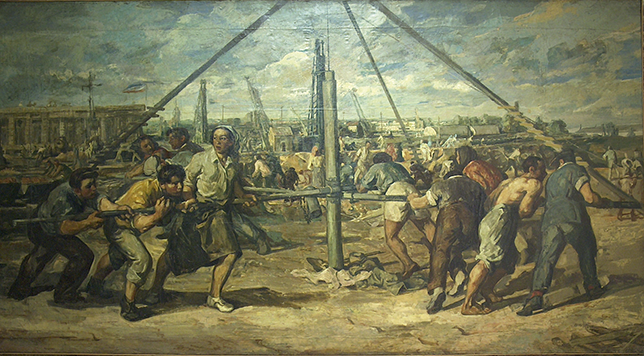
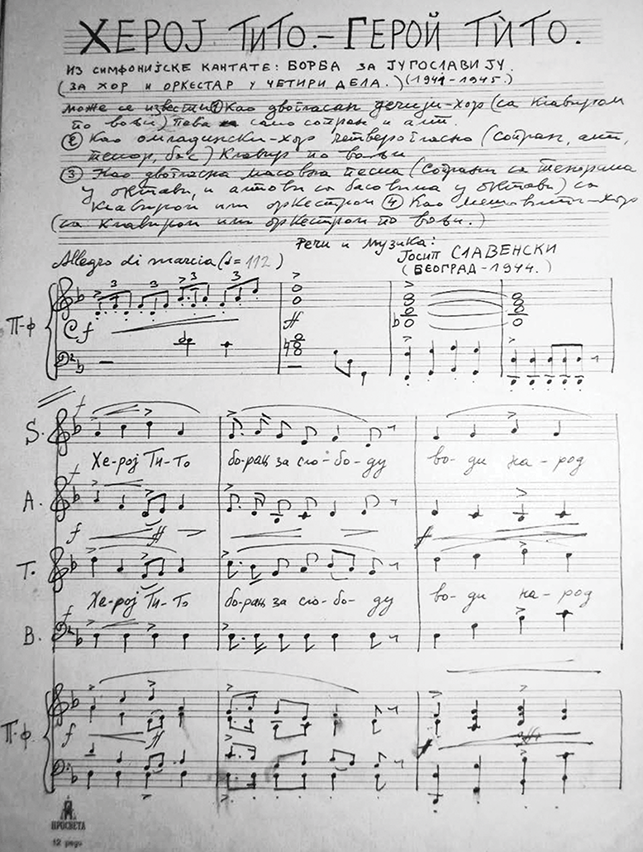
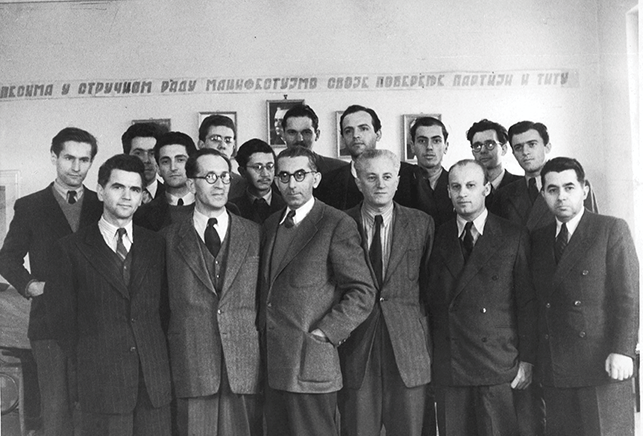
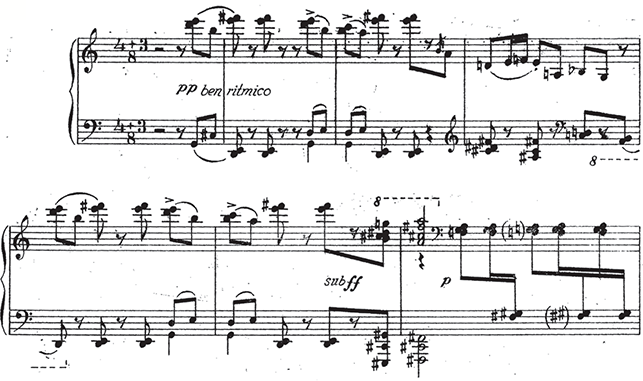
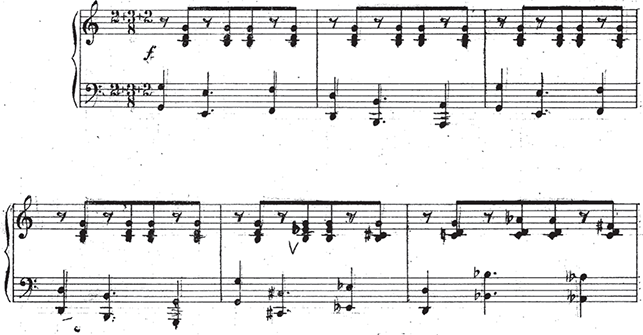
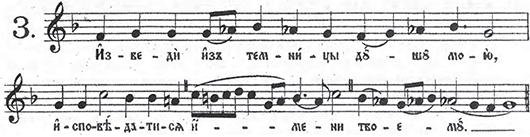

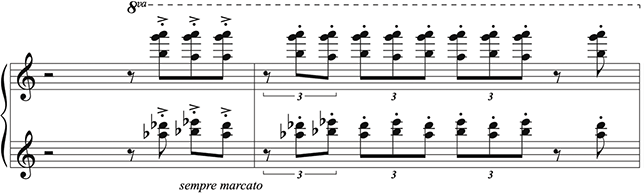
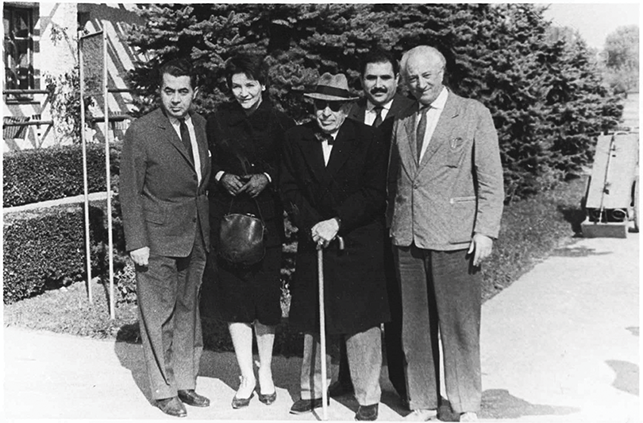
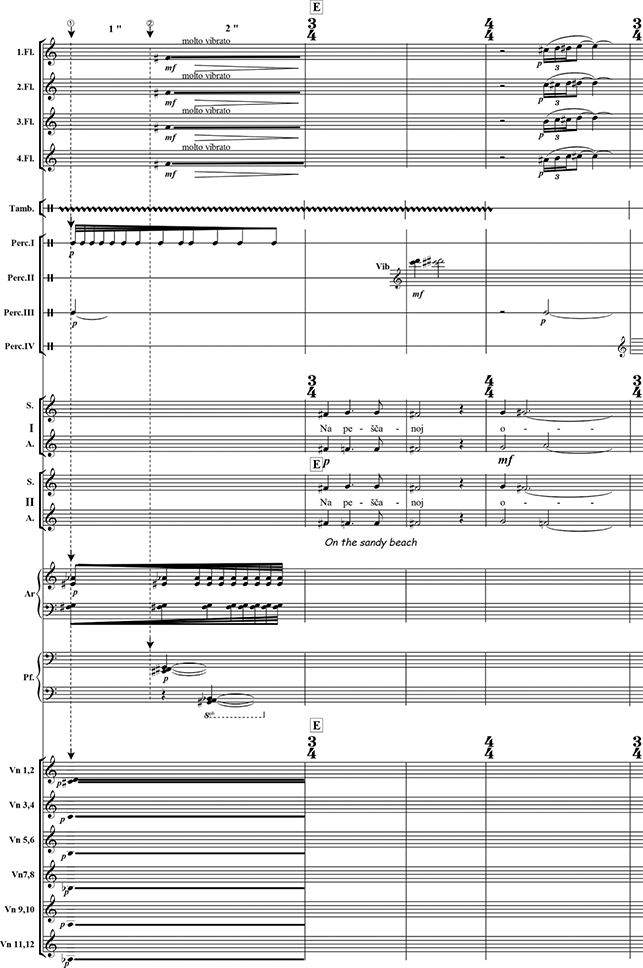
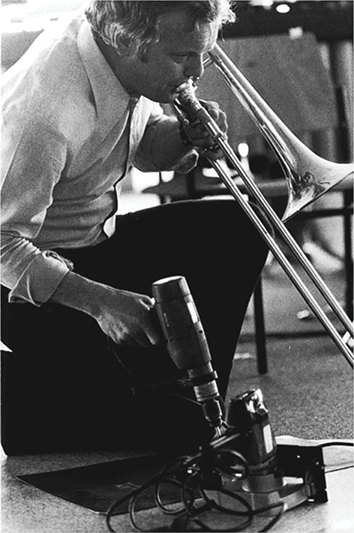

 Open access