

Introduction
Kymlicka (Reference Kymlicka2015, p. 4) has shown that welfare states are based on an “ethic of social membership,” which means that social agreements promise to take care of citizens’ welfare to a certain extent, but those agreements do not promise to account for the humanitarian responsibility of outsiders, except under the conditions stipulated by international human rights law (IHRL). The deservingness of citizens and immigrants has been studied for decades in many perspectives (e.g., Crepaz, Reference Crepaz2022; Diermeier and Niehues, Reference Diermeier and Niehues2022; Eger and Breznau, Reference Eger and Breznau2017; Mau and Burkhardt, Reference Mau and Burkhardt2009; Reeskens and Van der Meer, Reference Reeskens and Van der Meer2019; Reeskens and van Oorschot, Reference Reeskens and van Oorschot2012), and the literature has shown that immigrants are undoubtedly among the most undeserving groups in European societies (Van Oorschot, Reference Van Oorschot2005, Reference Van Oorschot2006; Heuer and Zimmermann, Reference Heuer and Zimmermann2020).
Deservingness is a crucial issue when it comes to immigration, as public attitudes toward immigrants often depend on whether they are seen as deserving of support (Ratzmann and Sahraoui, Reference Ratzmann and Sahraoui2021). Perceptions of deservingness influence how policies are implemented at the local level. For example, social service providers may prioritize or deprioritize certain groups based on their perceived deservingness (Noble and Ottmann, Reference Noble, Ottmann, Noble and Ottmann2021; Knotz et al., Reference Knotz, Gandenberger, Fossati and Bonoli2022). Perceptions of deservingness may also affect immigrants’ social integration and acceptance within the host community (Theiss, Reference Theiss2023). The concept of deservingness raises important moral and ethical questions about who should receive support and why. This led to broader debates about justice and equity in society (Reeskens and Van der Meer, Reference Reeskens and Van der Meer2019). In this sense, understanding these perceptions can help researchers and policymakers design more effective and equitable migration policies.
Citizens have given the welfare state the task of producing welfare services, and welfare states use social policy to determine how, what, to whom, and to what extent welfare services are produced. In elections, citizens vote for politicians with whom they share similar views on social issues. It has been observed that Europeans have diverse attitudes against immigration in terms of political orientation (Goodhart, Reference Goodhart2004; Alonso and Fonseca, Reference Alonso and Fonseca2012; Bohman and Hjerm, Reference Bohman and Hjerm2016). Moreover, political parties and political ideologies from the political left versus the political right have taken on the role of influencing the social rights of immigrants from opposing perspectives (e.g., Givens and Luedtke, Reference Givens and Luedtke2005; Eger and Breznau, Reference Eger and Breznau2017; Attewell, Reference Attewell2021; Deimantas, Reference Deimantas2021; Eick and Larsen, Reference Eick and Larsen2022; Chueri, Reference Chueri2023). In many European countries, right-wing governments have contributed to a deterioration in the provision of social services to immigrants (Edwards et al., Reference Edwards, Mendes, Flynn, Noble and Ottmann2021; Fazzi and Nothdurfter, Reference Fazzi, Nothdurfter, Noble and Ottmann2021; Turtiainen and Kokkonen, Reference Turtiainen, Kokkonen, Noble and Ottmann2021). Among right-wing citizens, deservingness has been found to apply more often to natives (e.g., Alonso and Fonseca, Reference Alonso and Fonseca2012; Attewell, Reference Attewell2021; Deimantas, Reference Deimantas2021). On the other hand, the traditional left-wing support for the welfare state seems to be, at least, partially crumbling, and left-wing governments can be as strict on immigration policy as right-wing governments (Givens and Luedtke, Reference Givens and Luedtke2005; Schmitt and Teney, Reference Schmitt and Teney2019).
The present study addresses the question of how perceptions of deservingness affect Europeans’ attitudes toward immigration and, in particular, whether this relationship, at the individual level, is conditional on the political orientation at the country level. We hypothesize that the country-level political orientation is an important factor in explaining the division among Europeans: While many policies are decided at the European Union (EU) level, social policies remain largely national. Economic conditions vary considerably between European countries, and this variation influences political attitudes. Of course, social patterns are not so simple because there is always the gray area of different opinions on different situations, and there is a tendency for the majority of people not to identify overtly with political extremism. To the best of our knowledge, only a few studies have explored how a country’s political orientation influences the relationship between the attitudes toward deservingness and immigration. To answer our research question, we have used data from the eighth round of the European Social Survey (ESS), 2016, covering 21 European countries and 39,400 respondents. We have conducted our analyses using multilevel linear regression (linear mixed methods) to determine our linear model.
Literature review
Immigration and deservingness
Immigration is a prominent topic in public discussion and research. Studies examine various aspects, of immigration, such as the legitimacy of the welfare state (e.g., Mau and Burkhardt, Reference Mau and Burkhardt2009; Cappelen and Peters, Reference Cappelen and Peters2018), political parties (Cochrane, Reference Cochrane2011; Eger and Bohman, Reference Eger and Bohman2016; Edo et al., Reference Edo, Giesing, Öztunc and Poutvaara2019; Carvalho and Ruedin, Reference Carvalho and Ruedin2020), public opinion (e.g., Meuleman et al., Reference Meuleman, Davidov and Billiet2009; Deimantas, Reference Deimantas2021), and media salience (e.g., Givens and Luedtke, Reference Givens and Luedtke2005; Atwell Seate and Mastro, Reference Atwell Seate and Mastro2016Kondor et al., Reference Kondor, Mihelj, Štětka and Tóth2022). Despite more positive attitudes toward immigration, immigrants are the most undeserving group (Van Oorschot, Reference Van Oorschot2005, Reference Van Oorschot2006; Heuer and Zimmermann, Reference Heuer and Zimmermann2020). Further, there are gaps in deservingness perceptions between immigrants and natives (Reeskens and Van der Meer, Reference Reeskens and Van der Meer2019; Magni, Reference Magni2020). People relying on social protection and having low socioeconomic status are more likely to exclude other groups from social protection (Van Oorschot, Reference Van Oorschot2000; Meuleman et al., Reference Meuleman, Roosma and Abts2020), but those people support measures for themselves (Meuleman et al., Reference Meuleman, Roosma and Abts2020). Also, generally, the elderly are viewed as the most deserving group (Van Oorschot, Reference Van Oorschot2006; Heuer and Zimmermann, Reference Heuer and Zimmermann2020; Meuleman et al., Reference Meuleman, Roosma and Abts2020).
Individual level better predicts perceptions of immigrants’ deservingness than contextual factors (Mau and Burkhardt, Reference Mau and Burkhardt2009). People with lower education levels (Mau and Burkhardt, Reference Mau and Burkhardt2009; Reeskens and van Oorschot, Reference Reeskens and van Oorschot2012; Brady and Finnigan, Reference Brady and Finnigan2014; Eger and Breznau, Reference Eger and Breznau2017; Diermeier et al., Reference Diermeier, Niehues and Reinecke2021; Gugushvili et al., Reference Gugushvili, Ravazzini, Ochsner, Lukac, Lelkes, Fink, Grand and van Oorschot2021; Bell et al., Reference Bell, Valenta and Strabac2023), financial insecurity (Brady and Finnigan, Reference Brady and Finnigan2014; Gugushvili et al., Reference Gugushvili, Ravazzini, Ochsner, Lukac, Lelkes, Fink, Grand and van Oorschot2021), low-income level (Brady and Finnigan, Reference Brady and Finnigan2014), less satisfaction with their situation (Bell et al., Reference Bell, Valenta and Strabac2023), older age (Mau and Burkhardt, Reference Mau and Burkhardt2009; De Coninck and Matthijs, Reference De Coninck and Matthijs2020; Bell et al., Reference Bell, Valenta and Strabac2023), and male gender (Eger and Breznau, Reference Eger and Breznau2017; De Coninck and Matthijs, Reference De Coninck and Matthijs2020; Diermeier et al., Reference Diermeier, Niehues and Reinecke2021; Bell et al., Reference Bell, Valenta and Strabac2023) tend to view immigrants as less deserving. Unemployment has a dual effect: The unemployed can be both more and less solidarity-driven toward immigrants (Reeskens and van Oorschot, Reference Reeskens and van Oorschot2012; Brady and Finnigan, Reference Brady and Finnigan2014). According to the self-interest theory, individuals’ attitudes toward immigration are influenced by their personal economic interests. In this sense, a vulnerable socioeconomic status leads to the opposition of immigration (Green, Reference Green2007; Deimantas, Reference Deimantas2021; Cooper and Burchardt, Reference Cooper and Burchardt2022; Seewann, Reference Seewann2022; Ziller, Reference Ziller2022), especially if the welfare state has exclusive immigration policies (Nagayoshi and Hjerm, Reference Nagayoshi and Hjerm2015). Education and perceptions of immigrants’ working skills influence attitudes; lower-educated individuals who view immigrants’ skills as weak may view them as a threat, leading to stronger negative (Pardos-Prado and Xena, Reference Pardos-Prado and Xena2019).
Country-level factors like unemployment rate, unemployment benefits, social expenditures, and poverty risk influence restrictive views on immigrants’ social rights (Martín-Artiles and Meardi, Reference Martín-Artiles and Meardi2014). However, social expenditures do not affect anti-deservingness views (Van Oorschot, Reference Van Oorschot2005). Gross domestic product (GDP) growth can lead to stricter immigration policies (Givens and Luedtke, Reference Givens and Luedtke2005) or support for the welfare state rather than immigrant deservingness (Mau and Burkhardt, Reference Mau and Burkhardt2009). Southern and eastern European welfare states support stricter social protection for immigrants (Green, Reference Green2007; Mau and Burkhardt, Reference Mau and Burkhardt2009; Van der Waal et al., Reference Van der Waal, De Koster and Van Oorschot2013; Bell et al., Reference Bell, Valenta and Strabac2023), while northern Europe views immigrants as a burden on the welfare state (Goerres et al., Reference Goerres, Karlsen and Kumlin2020). Nonetheless, more comprehensive welfare states foster greater solidarity toward immigrants (Crepaz and Damron, Reference Crepaz and Damron2009; Martín-Artiles and Meardi, Reference Martín-Artiles and Meardi2014; Römer, Reference Römer2017), even with increased immigration (Schmitt and Teney, Reference Schmitt and Teney2019).
The present study is focused on the association between deservingness perceptions and immigration attitudes. Moral judgments determine who is seen as deserving of benefits and support. Immigrants perceived as hardworking, law-abiding, and contributing to society are generally viewed as more deserving, while those seen as not contributing or as a burden may face negative attitudes (Ratzmann and Sahraoui, Reference Ratzmann and Sahraoui2021). Economic contributions, such as paying taxes and filling labor shortages, can positively influence attitudes. Conversely, if immigrants are seen as job competitors or resource strainers, attitudes can become negative (Knotz et al., Reference Knotz, Gandenberger, Fossati and Bonoli2022). Reciprocity also matters; immigrants who give back to the community are viewed as more deserving. Cultural or ethnic similarity can also lead to more positive attitudes (Ravn et al., Reference Ravn, Mahieu, Belloni, Timmerman, Glorius and Doomernik2020). These perceptions shape public opinion and policy decisions on immigration.
The impact of political orientation
Political ideology significantly influences attitudes toward immigration and deservingness. Individuals with right-wing political views are more likely to attribute poverty to personal failings (Kallio and Niemelä, Reference Kallio and Niemelä2014) and demand conditionality for social protection (Van Oorschot, Reference Van Oorschot2006). Conversely, those individuals with political left are, generally, more supportive of income redistribution, regardless of socioeconomic status (Wulfgramm and Starke, Reference Wulfgramm and Starke2017), and they favor need-based redistribution (Reeskens and Van Oorschot, Reference Reeskens and Van Oorschot2013). Right-wing individuals tend to oppose immigration and view immigrants as undeserving (Mau and Burkhardt, Reference Mau and Burkhardt2009; Alonso and Fonseca, Reference Alonso and Fonseca2012; Thomsen and Rafiqi, Reference Thomsen and Rafiqi2019; Attewell, Reference Attewell2021; Deimantas, Reference Deimantas2021). This negative attitude toward immigration has intensified in the twenty-first century (Semyonov et al., Reference Semyonov, Raijman and Gorodzeisky2006; Alonso and Fonseca, Reference Alonso and Fonseca2012; Breznau, Reference Breznau2018).
The political left is not monolithic in its views on immigration. While left-wing political groups are generally more supportive of immigrants, this support can lead to exclusive attitudes within left-wing parties (Eger and Breznau, Reference Eger and Breznau2017; Koning, Reference Koning2017). This division is often referred to as progressive’s dilemma, where individuals struggle to support both liberal social welfare and liberal immigration policies simultaneously (Goodhart, Reference Goodhart2004). For instance, people may support redistribution, but they do not extend this support to immigrants’ access to social welfare (Murard, Reference Murard and Crepaz2022). Evidence suggests that liberal immigration attitudes do not always align with liberal social welfare attitudes (i.e., promoting redistribution generally), thus creating a challenge for left-wing parties (Eger and Kulin, Reference Eger, Kulin and Crepaz2022). Supporters of social democratic parties (SDPs) in Europe often do not advocate strongly for immigration, indicating that linking redistribution with immigration may not be beneficial for SDPs (Lefkofridi and Rhein, Reference Lefkofridi, Rhein and Crepaz2022, 269).
The political orientation at the country level also shapes perceptions of deservingness and immigration. In more conservative countries, there is a stronger emphasis on individual responsibility and a skeptical view of welfare recipients and immigrants (Kreitzer et al., 2022). In contrast, liberal countries emphasize social equality and support for marginalized groups, leading to more positive perceptions of deservingness for immigrants and welfare recipients. Countries with inclusive economic policies and multicultural values are more likely to foster positive perceptions of deservingness among diverse groups, including immigrants (Watkins-Hayes and Kovalsky, Reference Watkins-Hayes, Kovalsky, Burton and Brady2016).
The present study examines whether public opinions on deservingness and immigration are conditional on a country’s political orientation, which can be classified along a political spectrum ranging from left wing to right wing. The political orientation of a country is often reflected in its policies on social issues such as deservingness. For example, a country with a left-wing orientation might prioritize social welfare programs and progressive taxation, while a right-wing country might focus on free-market policies and reduced government intervention (cf. Kreitzer et al., Reference Kreitzer, Maltby and Smith2022). Political orientation also encompasses the cultural and social values that are promoted and upheld within the country. This includes attitudes toward issues like immigration, human rights, and national identity (cf. Attewell, Reference Attewell2021).
Data and methodology
In the present study, we aim to investigate how perceptions of deservingness would affect Europeans’ attitudes toward immigration and, in particular, whether this relationship at the individual level is conditional on political orientation at the country level. To answer the research question, we chose the data from Round 8 of ESS (2016).
The entire database was gathered in 2016 and includes 23 countries (44,387 respondents). The survey contains strict random probability sampling, a minimum target response rate of 70%, and rigorous translation protocols and was conducted by face-to-face interviews. For the present study, we used data from 21 countries (N = 39,400): Austria, Belgium, Czechia, Estonia, Finland, France, Germany, Hungary, Ireland, Iceland, Italy, Lithuania, Netherlands, Norway, Poland, Portugal, Spain, Sweden, Switzerland, Slovenia, and the United Kingdom. We chose the data from the year 2016, based on the nature of its questions about deservingness, the types of which are not included in the more recent questionnaires.
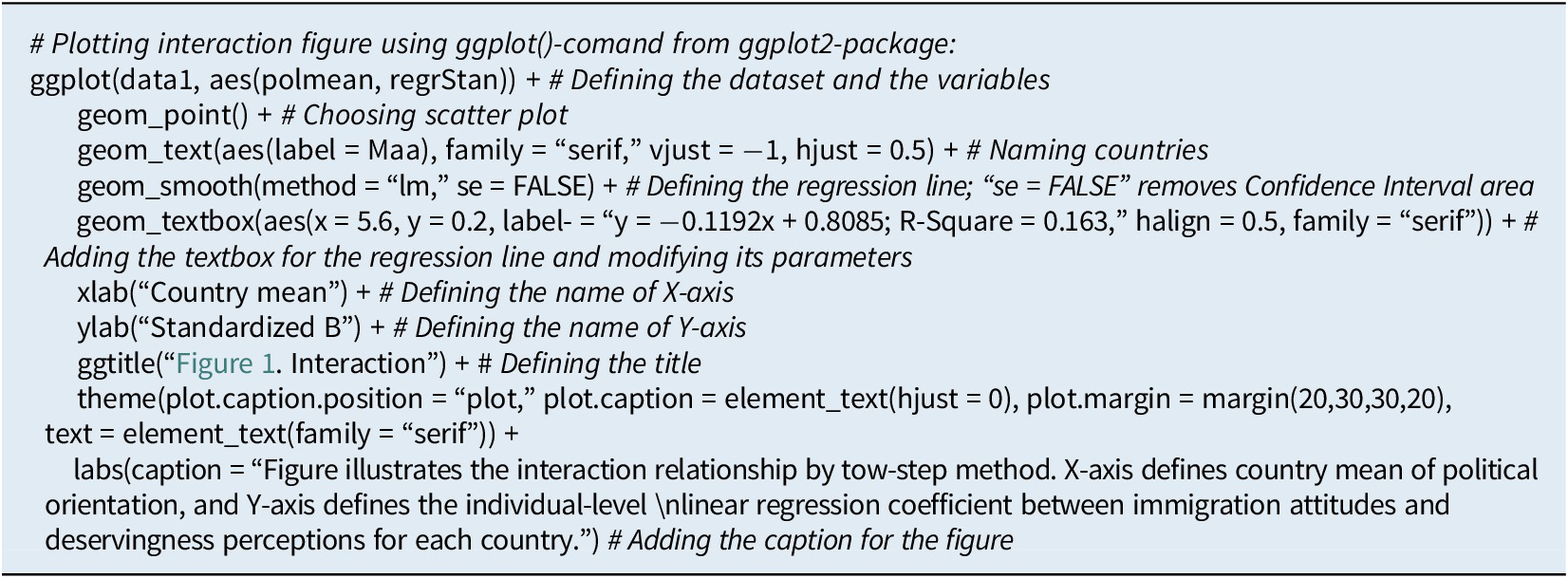
The main analysis was performed by using a multilevel linear regression (linear mixed methods), and all analyses were made in the Statistical Package for the Social Sciences (SPSS) 27 program (SPSS® 27 for Windows, n.d.). We have recoded variables using the SPSS 27 program (SPSS® 27 for Windows, n.d.) before the descriptive analyses and the main analyses; hence, certain extra categories (e.g., “Refusal,” “Don’t know,” and “No answer”) were dropped and appeared as the missing values (in SPSS, this is called “System-missing” when recoding, that is, NULL values in databases). Figure 1 is constructed in R software (R Core Team, 2022; see R codes in Table A2).
Interaction.
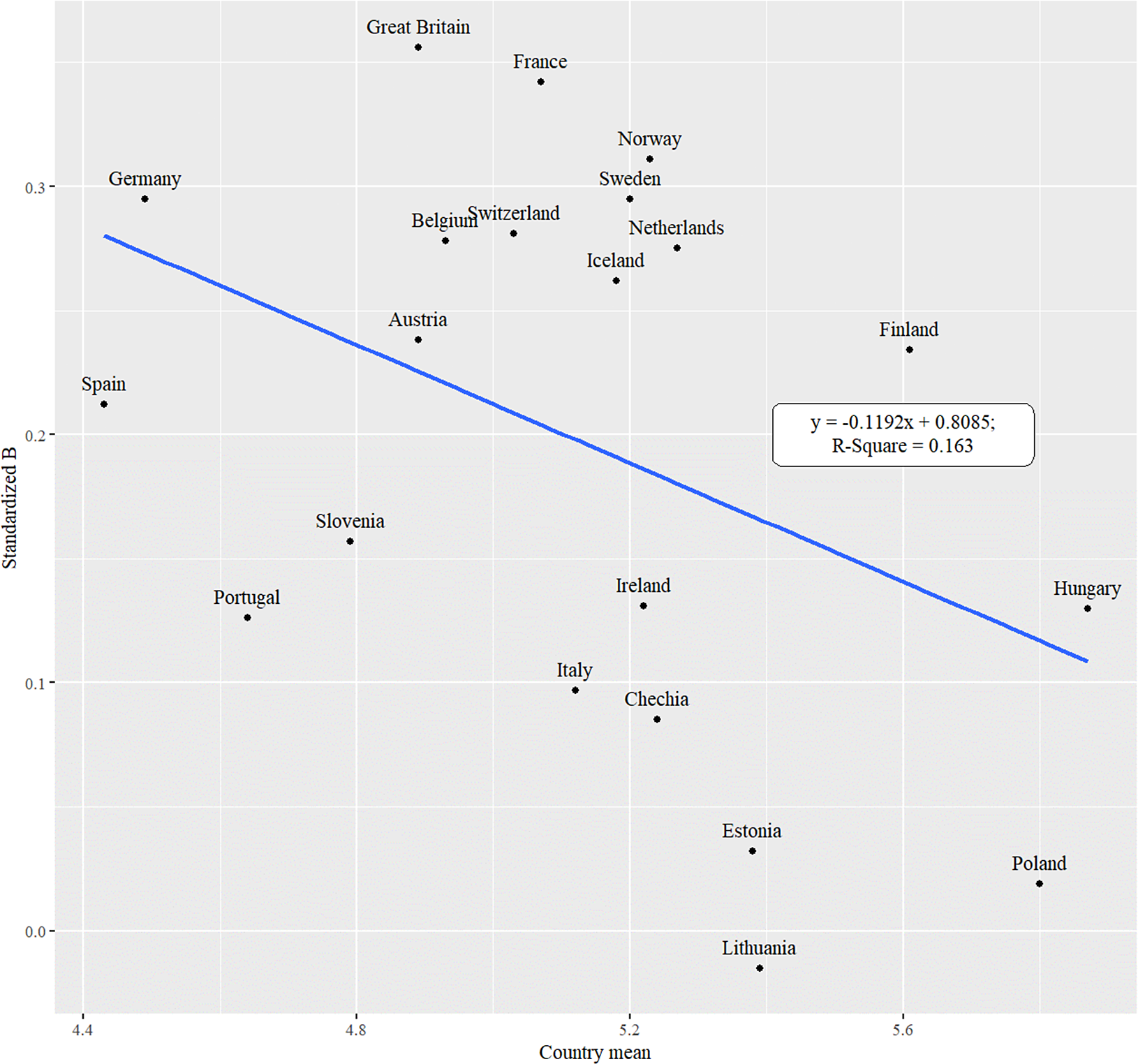
Figure illustrates the interaction relationship by tow-step method. X-axis defines country mean of political orientation, and Y-axis defines the individual-level linear regression coefficient between immigration attitudes and deservingness perceptions for each country.
The dependent variable, immigration attitudes, includes the following three questions based on their identical scales: (1) “Would you say it is generally bad or good for [country]’s economy that people come to live here from other countries?” (Question B41), (2) “Would you say that [country]’s cultural life is generally undermined or enriched by people coming to live here from other countries?” (Question B42), and (3) “Is [country] made a worse or a better place to live by people coming to live here from other countries?” (Question B43). The scales of these three variables go from 0 to 10. We changed the direction of the scales from positive to negative since we studied negative immigration attitudes. The value of Cronbach’s alpha for the dependent variable was 0.873. The sum variable is created by a mean of three variables; hence, the scale is comparable with the original scales.
The main explanatory variable measures deservingness perceptions. Because we used Round 8 of the ESS, the variable was operationalized by creating a sum variable using the four following questions: (1) “To what extent do you agree or disagree that social benefits and services in [country] make people lazy?” (Question E13), (2) “To what extent do you agree or disagree that social benefits and services in [country] make people less willing to care for one another?” (Question E14), (3) “How much do you agree or disagree with each of the following statements about people in [country]. Most unemployed people do not really try to find a job” (Question E16), and (4) “How much do you agree or disagree with each of the following statements about people in [country]. Many people manage to obtain benefits and services to which they are not entitled” (Question E18). The original scales of the variables go from 1 to 5, negative to positive. We changed the direction of the scales from positive to negative. The value of Cronbach’s alpha for the sum variable was 0.743. The sum variable is created by a mean of four variables; hence, the scale is comparable with the original scales.
The individual-level control variables based on previous immigration attitude research are gender, age, age squared, citizenship, born in country, mother born in country, education years, feeling about household’s income, and labor market status (employed).
Political orientation is the main country-level variable, which is aggregated from individual-level data to the mean for each country. Each respondent’s value represents the distance of the individual-level value from the county mean. The original scale ranges from 0 (left) to 10 (right). For multilevel modeling, we standardized the within-country variance of this variable to estimate the country-level effect, following the guidelines of Heck et al. (Reference Heck, Thomas and Tabata2014, pp. 65–66, 69–72). GDP and the Gini index are treated as country-level control variables. GDP has been standardized using Z-scores in our main analyses because of its very different scales compared to other variables, and therefore, the mean of GDP is 0 and the standard deviation is 1 after standardizing. The descriptive analyses of GDP have been conducted with the original scale.
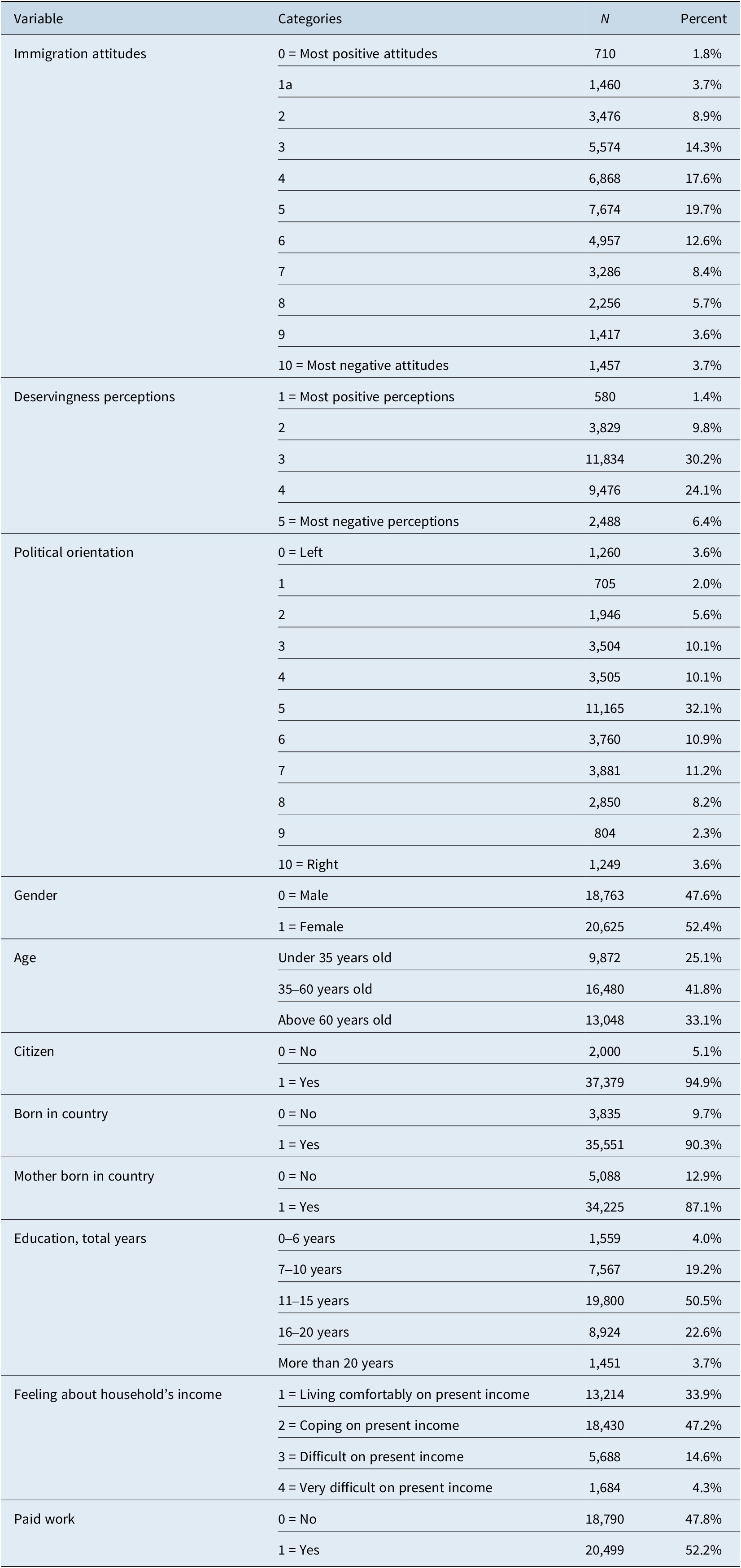
Descriptive information on all variables is given in Table 1. The distribution of some variables is quite normalized. Based on the skewness test, the age variable is very close to zero; hence, it is quite normally distributed, but a little bit right-skewed; that is, there are a few more middle-aged and older respondents. The variables of deservingness perceptions, political orientation, gender, and paid work are normally distributed, but their skewness value is still above 1, having a slightly left-skewed distribution. All other variables are not normally distributed. The variables of citizenship, born in country, and mother born in country have a left-skewed distribution; hence, there are more respondents with citizenship and native background. In addition, there are more respondents having an education period of around 13 years; hence, the variable has a right-skewed distribution. There are also more respondents feeling more positive about their household income based on the tests. Based on the Kurtosis test, all variables have their peak either above or below the peak of the normal distribution. More details about the frequency distributions and the categories of the variables are shown in Table A1.
Descriptives of variables. Unweighted frequencies.
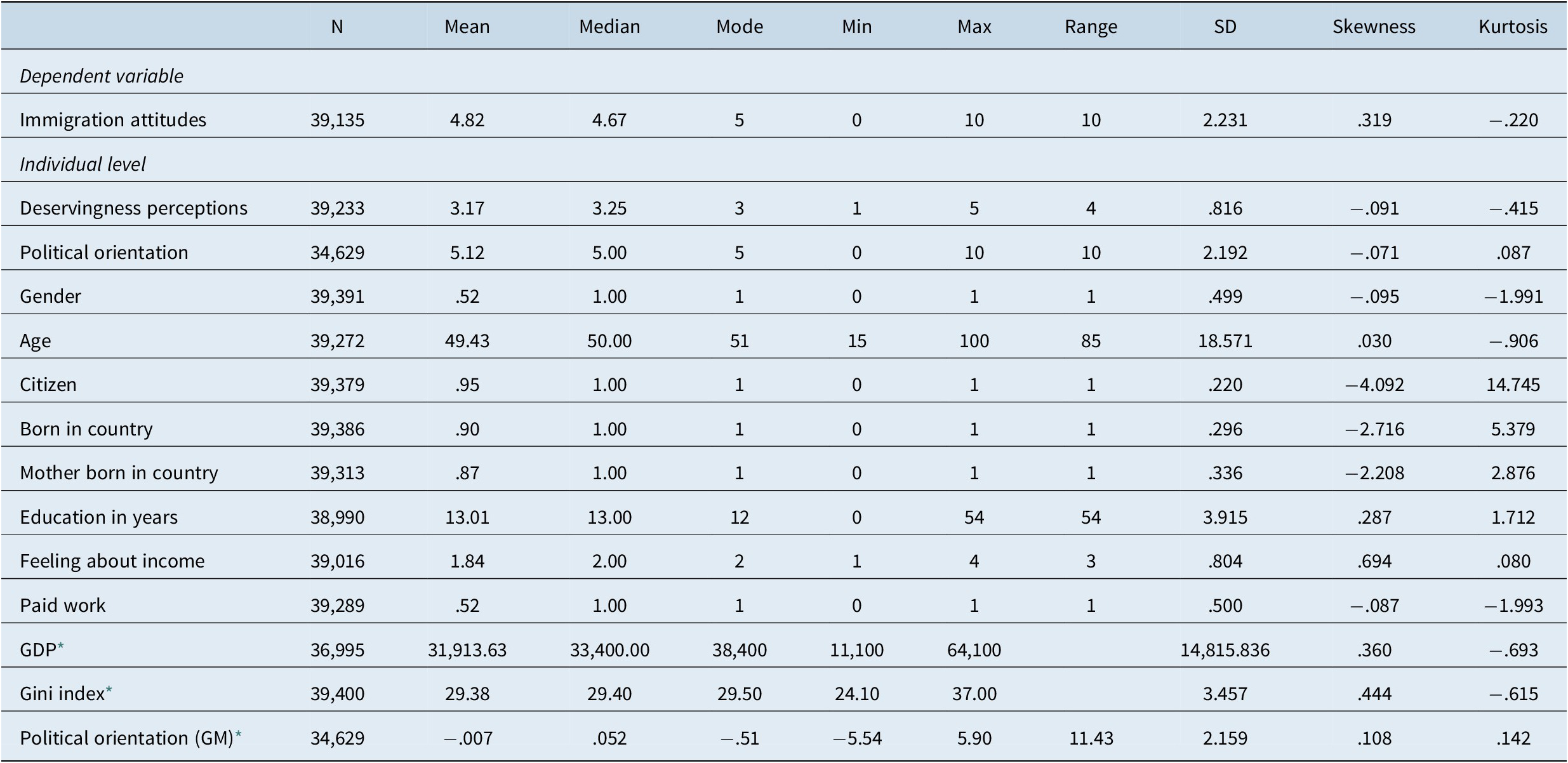
* Country-level variable.
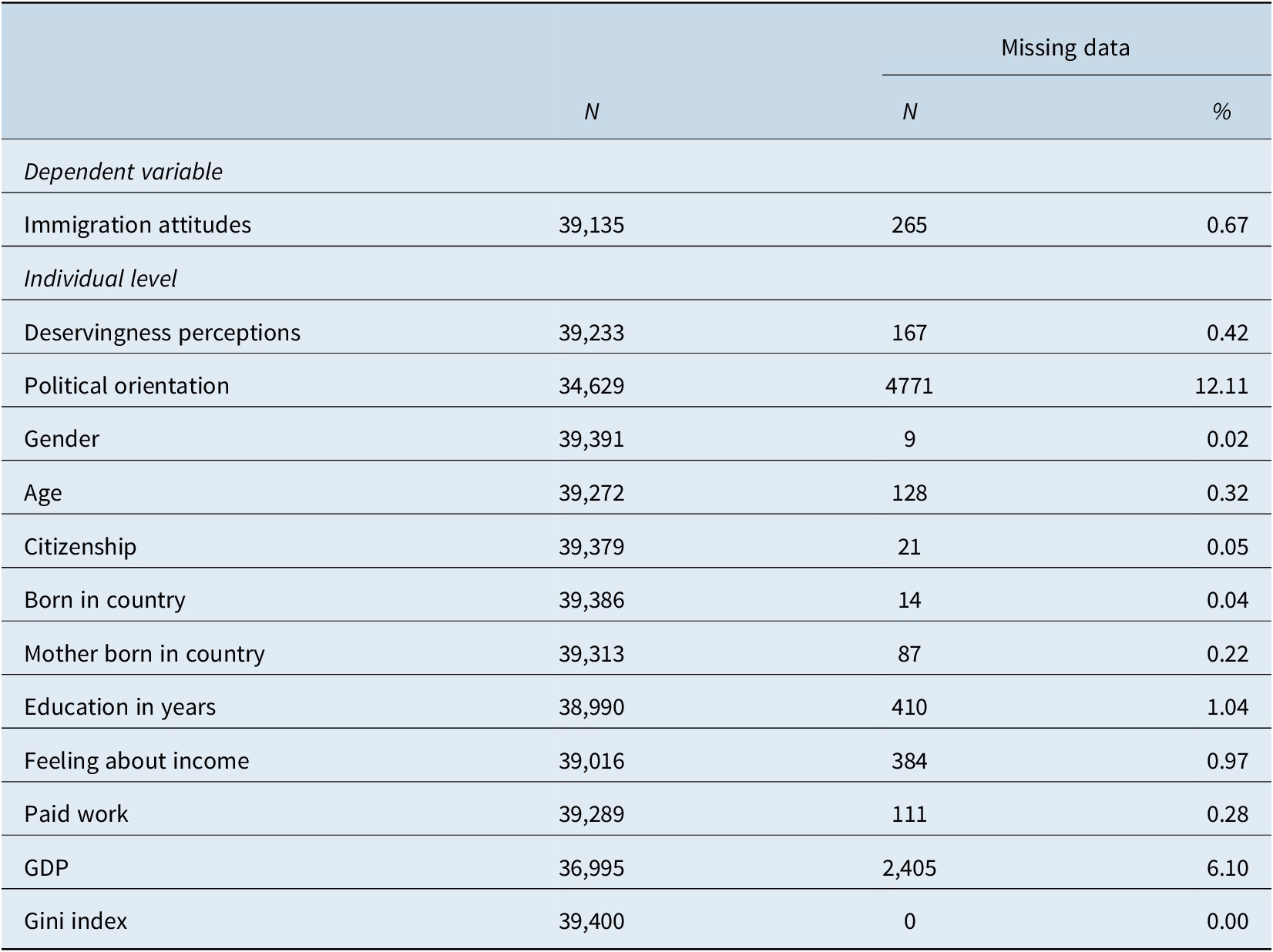
The share of missing values of the dependent variable was 0.67 percent, and the independent variables varied between 0.02 and 12.11 percent (see Table A2). Most of the missing data are in the variable of political orientation (12.11 percent). Iceland and Switzerland are missing from GDP. We did not impute missing values. According to the missing completely at random (MCAR) test of Little (Reference Little1988), the data were not observed to be MCAR (chi-square = 2234.497, Degree of Freedom = 134, Sig. = .000). We recognized that this decision caused an absence of cases in linear regression analyses, but it subsequently made the data more simple to study.
Results
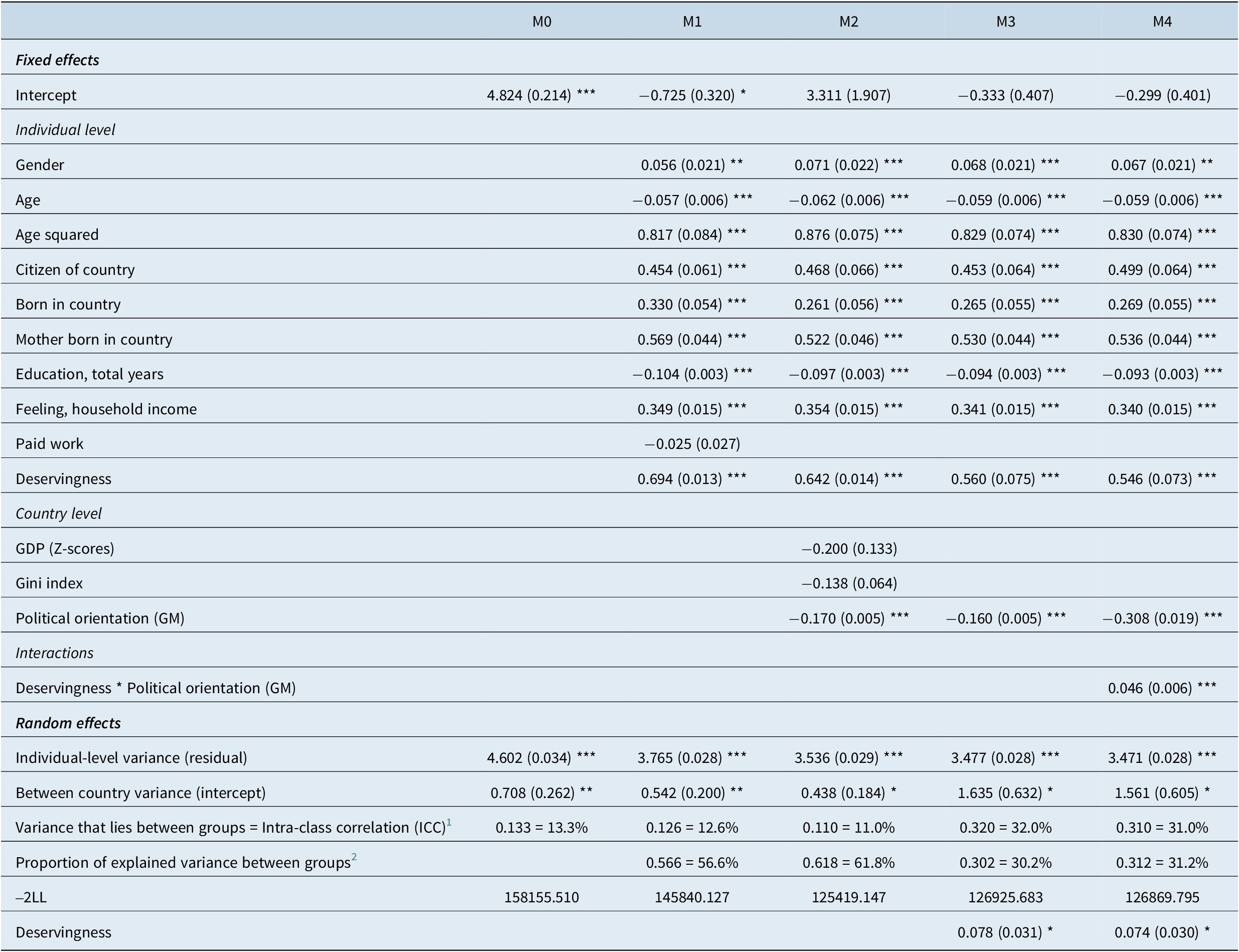
The results of multilevel linear regression analysis with the estimates of fixed and random effects are presented in Table 2. Model 0 gives us the basis for the following models. We can observe that the average level of immigration attitudes in 21 European countries is 4.824. The variance that lies between countries is 13.3%, which suggests that 13.3% of immigration attitudes can be explained at the country level. Model 1 introduces our individual-level control variables with deservingness perceptions. All variables, except labor market status, are statistically significant. Women, younger individuals, and natives have more likelihood of more negative immigration attitudes. The respondents who have fewer education years and feel uncomfortable about the present income situation have more likelihood of more negative immigration attitudes. And, lastly, the respondents who have more negative deservingness perceptions have more likelihood of more negative immigration attitudes.
Linear mixed models with fixed and random effects. Estimates and standard errors in parentheses
1 ICC: intercept / (intercept + residual).
2 Proportion of explained variance between groups: M0 intercept / (M0 intercept + MX intercept)
Weighted models using a weight (ESS).
*** p < 0.001; ** p < 0.01; * p < 0.05.
Model 2 introduces all individual- and country-level variables, except labor market status because it was statistically insignificant. All variables, except GDP and Gini index, are statistically significant. The interpretation of individual-level variables remains the same as in the previous model. Country-level political orientation is statistically significant, and the estimation is negative, meaning that the more right the political orientation is, the more likely the more negative immigration attitudes could be.
In Model 3, we have excluded the insignificant country-level variables, GDP and Gini index, and included a country-level intercept for deservingness perceptions, meaning that we allow deservingness perceptions to vary randomly. We can observe that when deservingness perceptions vary randomly between countries, the intra-class correlation becomes higher; that is, immigration attitudes can strongly be explained at the country level.
Our last model, Model 4, introduces an interaction between deservingness perceptions and country-level political orientation, which is statistically significant. Further, we performed a robustness analysis to check country fixed effects. Results are shown in Table A4 (see Appendix 4). Based on the robustness analysis, the results do not change with country fixed effects included in the individual-level analysis.
We visualized the interaction in Model 4 by using a two-step approach (e.g., Bryan and Jenkins, Reference Bryan and Jenkins2015a, Reference Bryan and Jenkins2015b), where the x-axis consists of country means of political orientation and the y-axis consists of the standardized β-coefficient from the individual-level regression model between immigration attitudes and deservingness perceptions (Figure 1).
Figure 1 shows a scatter plot with a regression line illustrating the interaction between country-level political orientation (x-axis) and the standardized β-coefficient from an individual-level regression model (y-axis). Lower values on the x-axis indicate a more left-leaning orientation, in a country, while higher values suggest a more right-leaning orientation. A higher β-coefficient indicates a stronger positive relationship between deservingness perceptions and attitudes toward immigration. Each point represents a country, showing where it falls in terms of its political orientation and the strength of the relationship between deservingness perceptions and immigration attitudes. For example, Germany shows a higher β-coefficient compared to countries like Hungary, suggesting a stronger relationship between negative deservingness perceptions and unfavorable immigration attitudes in Germany.
However, the interaction seems to be nonlinear. For instance, countries like Norway and Sweden, which are positioned in the political center in this description, also exhibit a strong association between deservingness perceptions and immigration attitudes. Hence, we continued the descriptive analysis by clustering the countries into three groups based on variables such as regression coefficient, country mean of political orientation, immigration attitudes, and deservingness perceptions, using Euclidean distance and the complete method. In Figure 2, the left-side dendrogram shows the clusters for countries, and the top-side dendrogram shows the cluster for variables.
Heat map, scaled data.
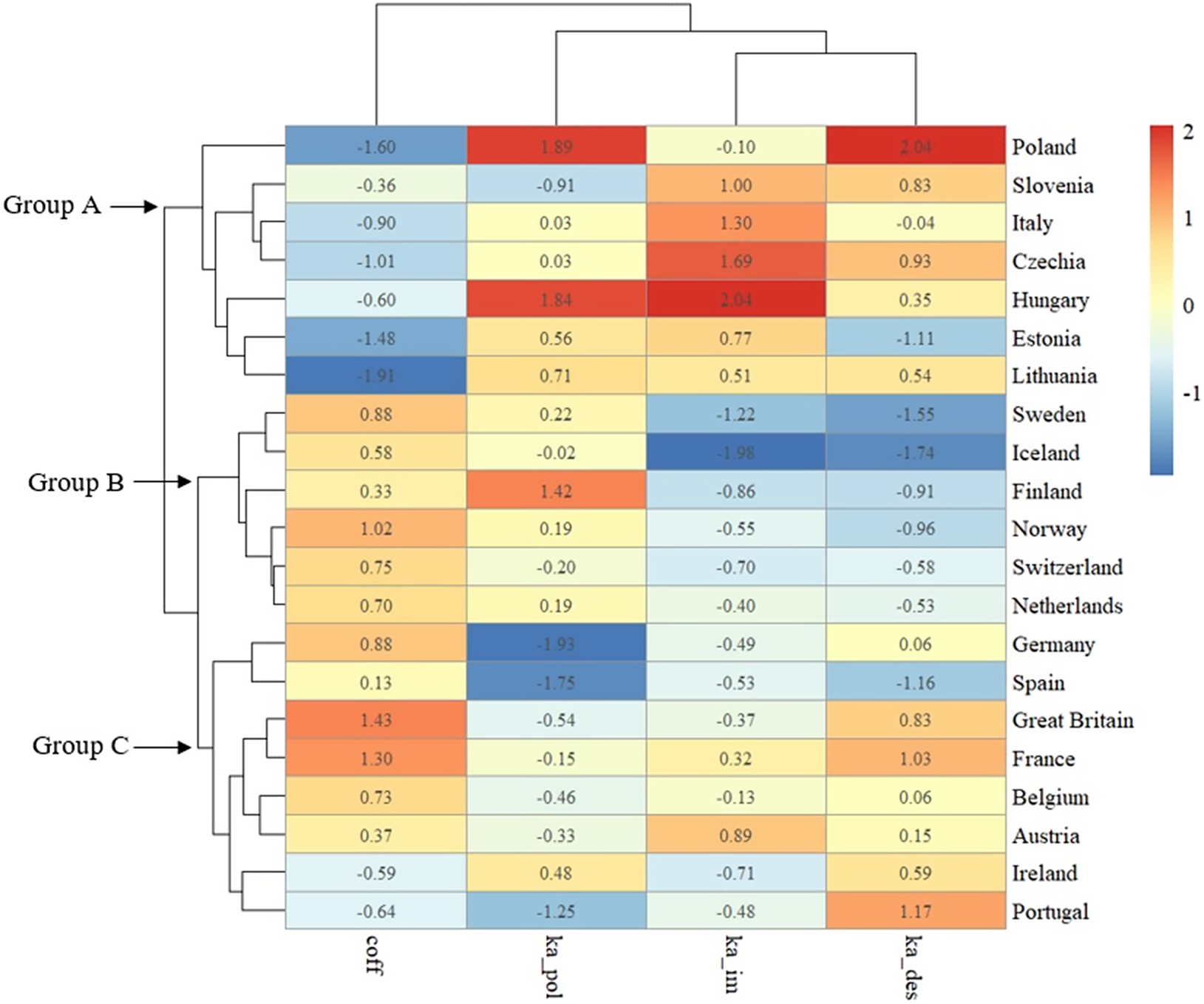
In the heat map (Figure 2), Group A has a low coefficient and a more right-wing political orientation, with more negative perceptions of deservingness and immigration attitudes compared to other groups. Group B has a medium–high coefficient and a centrist political orientation, with more positive perceptions of deservingness and immigration attitudes than other groups. Group C has a medium–high coefficient and left-wing political orientation, with moderate deservingness perceptions and positive attitude toward immigration. However, there are some exceptions, especially in Group C. For instance, Portugal’s coefficient does not align with other countries in Group C, but it does share political orientation, deservingness perceptions, and immigration attitudes more closely with Group C than with Groups A and B. Also, Ireland’s coefficient does not fit with the other countries in Group C.
Discussion
The purpose of this study was to examine the attitudinal basis of the relationship between immigration and deservingness and whether this relationship is shaped by the country-level political orientation. We contribute to the existing body of knowledge on immigration attitudes with the following remarks, particularly from the perspective of deservingness perceptions.
Firstly, we found that attitudes toward immigration are generally positive in Europe, which is in line with the results of previous studies (Meuleman et al., Reference Meuleman, Davidov and Billiet2009; Gugushvili et al., Reference Gugushvili, Ravazzini, Ochsner, Lukac, Lelkes, Fink, Grand and van Oorschot2021; Cooper and Burchardt, Reference Cooper and Burchardt2022). We contribute to the existing body of knowledge on immigration attitudes with the following two remarks, which are particularly from the perspective of deservingness perceptions. Additionally, younger age, native background, feeling uncomfortable about the present household income, and/or having fewer years of education could lead to more negative immigration attitudes. This suggests that native respondents, who are younger, have an uncertain financial situation, and have fewer education years, may feel negative about immigration in terms of self-interest (i.e., vulnerable socioeconomic status; e.g., Green, Reference Green2007; Deimantas, Reference Deimantas2021; Cooper and Burchardt, Reference Cooper and Burchardt2022; Seewann, Reference Seewann2022; Ziller, Reference Ziller2022).
Secondly, we demonstrate that deservingness perceptions and immigration attitudes are associated with European countries. Negative deservingness perceptions are more likely to lead to negative immigration attitudes. Combining the association of deservingness perceptions and immigration attitudes with other predictive factors, this study initially suggests that self-interest may lead to negative immigration attitudes. Europeans with lower socioeconomic status are more likely to think that immigration can lead to abuse and overuse of the welfare state (Crepaz and Damron, Reference Crepaz and Damron2009Martín-Artiles and Meardi, Reference Martín-Artiles and Meardi2014; Römer, Reference Römer2017; Goerres et al., Reference Goerres, Karlsen and Kumlin2020). Furthermore, natives seem to view immigration as a threat to their social insurance and benefits (cf. Huber and Oberdabernig, Reference Huber and Oberdabernig2015; Magni, Reference Magni2020).
Thirdly, we found that the more politically right leaning a nation is, the more likely it is to have negative attitudes toward immigration and deservingness. In this sense, country-level political orientation reflects a country’s policy on social issues, such as deservingness, and on social values, such as human rights and immigration. A right-wing country might focus on free-market policies and reduced government intervention (cf. Kreitzer et al., Reference Kreitzer, Maltby and Smith2022) and more strict policy on immigration issue (cf. Attewell, Reference Attewell2021). The result is consistent with previous studies (Mau and Burkhardt, Reference Mau and Burkhardt2009; Alonso abd Fonseca, Reference Alonso and Fonseca2012; Wulfgramm and Starke, Reference Wulfgramm and Starke2017; Thomsen and Rafiqi, Reference Thomsen and Rafiqi2019; Attewell, Reference Attewell2021; Deimantas, Reference Deimantas2021).
Fourthly, our main finding is that the individual-level relationship between immigration attitudes and deservingness perceptions is conditional on the country-level political orientation. The relationship is stronger in countries with a left-leaning political orientation, compared to those countries with a right-leaning orientation. Countries with left-leaning political orientation tend to have positive immigration attitudes and moderate deservingness perceptions. Conversely, countries with right-wing political orientation have negative deservingness perceptions and immigration attitudes. Between these extremes are the centrist political countries with more positive deservingness perceptions and immigration attitudes compared to other groups.
It is evident that the country-level political orientation affects individuals’ opinions, creating a kind of collective factor; that is, attitudes are formed within social and cultural environments and relationships, as posited by classic sociological theories (Bratman, Reference Bratman1999; Anderson, Reference Anderson2006; Bicchieri, Reference Bicchieri2006). In this context, the political environment is a justified reason for the varying importance of attitudes across different countries. Conversely, the collective nature of attitudes is not fully supported among researchers (e.g., Weber, Reference Weber1978; Ajzen and Fishbein, Reference Ajzen and Fishbein1980). It is possible that a complex mechanism of influence underlies the political context, which this research does not fully uncover. Thus, it is clear that other societal characteristics also play a crucial role in shaping public attitudes.
Further, we wish to highlight a few limitations in the present study. Firstly, we recognize the use of multilevel regression analyses instead of confirmatory factor analysis (CFA) or latent cluster analysis (LCA), which have been used to study latent phenomena (Sabbagh and Vanhuysse, Reference Sabbagh and Vanhuysse2006; van Oorschot and Meuleman, Reference van Oorschot and Meuleman2012; Roosma et al., Reference Roosma, Gelissen and Van Oorschot2013; Eger and Breznau, Reference Eger and Breznau2017). Ordinary least squares (OLS) regression analyses, as used in the present study, have been used in numerous previous studies about public opinion at the societal level (Crepaz and Damron, Reference Crepaz and Damron2009; Van der Waal et al., Reference Van der Waal, De Koster and Van Oorschot2013; Schumacher and Van Kersbergen, Reference Schumacher and Van Kersbergen2016; Burgoon and Rooduijn, Reference Burgoon and Rooduijn2021), and therefore, this provides a space in which to study attitudes using regression analyses. Secondly, one can argue that, in the present study, we have not taken into account essential factors such as liberal–conservative scale, other ideological patterns (e.g., egalitarianism, authoritarianism), and the origin of immigrants and their working skills, which have been used to explain immigration attitudes (Facchini and Mayda, Reference Facchini and Mayda2009; Mau and Burkhardt, Reference Mau and Burkhardt2009; Edo et al., Reference Edo, Giesing, Öztunc and Poutvaara2019; Kolbe and Kayran, Reference Kolbe and Kayran2019; Pardos-Prado and Xena, Reference Pardos-Prado and Xena2019; De Coninck and Matthijs, Reference De Coninck and Matthijs2020). We acknowledge this limitation and argue that we had to delimit our layout to some point by avoiding research that would be too extensive. Moreover, some researchers have made suggestions on how future studies should examine the deservingness of immigrants (e.g., Eger and Breznau, Reference Eger and Breznau2017; Nielsen et al., Reference Nielsen, Frederiksen and Larsen2020; Carmel and Sojka, Reference Carmel and Sojka2021; Saar et al., Reference Saar, Sojka and Runfors2022). For instance, many deservingness researchers have recommended to use specific target groups to study deservingness and immigrants’ deservingness (van Oorschot and Roosma, Reference van Oorschot, Roosma, van Oorschot, Roosma and Meuleman2017; Laenen, Reference Laenen and Laenen2020; Meuleman et al., Reference Meuleman, Roosma and Abts2020).We have not taken these suggestions into account because of the limitations of the ESS dataset.
Conclusions
Based on this study, we argue that the attitudes toward immigration and deservingness are related to political orientation. Generally, Europeans’ attitudes are quite positive and neutral toward deservingness and immigration. However, our study shows that it is still important to examine how immigration and deservingness are perceived in European welfare states, and what effect this has in terms of opposing or supporting immigration, from the perspective of division. Continuing the interpretation of Dražanová (Reference Dražanová2022), future research should aim to study more conditional processes of attitudes about the deservingness of immigration in order to find more complex mechanisms behind attitudes.
The public debate on immigration, from the point of view of deservingness, reveals what might be behind immigration attitudes, particularly in countries with a left-wing political orientation. It is possible that individuals who have a positive attitude toward deservingness consider immigration into their country of origin as a positive action that can enrich society, rather than burden their country’s economy. Conversely, those individuals who have a negative (or reluctant) attitude toward deservingness often consider social security to be too broad and social security dependency to be caused by individual factors. Consequently, those individuals are less likely to view immigration positively, seeing it as a potential burden on society.
In Europe, the rise to power of anti-immigration political parties has not slowed down during the 2020s, as has been observed in Austria, France, Germany, and Northern Europe. Moreover, anti-immigration parties have also been showing from the left side of politics, as has happened in Germany. While voters may not necessarily agree on party politics, parties are nevertheless voted on for certain reasons. For this reason, the views and voting behavior of individuals should not be forgotten, and rather should be more and better understood, in order to get to grips with what is happening within states or in general. Finally, the questions arise: If anti-immigration parties start to emerge from both sides, what will happen to immigrants’ social rights and earnings in the future?
Author contribution
Häkkilä conceptualized and designed the study, carried out the initial analyses, drafted the initial manuscript, and revised the manuscript. Kouvo conceptualized the data and involved in the development of methodology. Oinas improved the visualizing the interaction model. Pfeifer designed the methodology and supervised the data. Toikko supervised the data.
Funding statement
There is no external funding source.
Competing interest
The authors declare none
Frequency distributions of individual-level variables. Unweighted.
Missing data. Unweighted.
R code. Figure 1. Interaction figure, two-step method
Robustness analyses. Country fixed effects
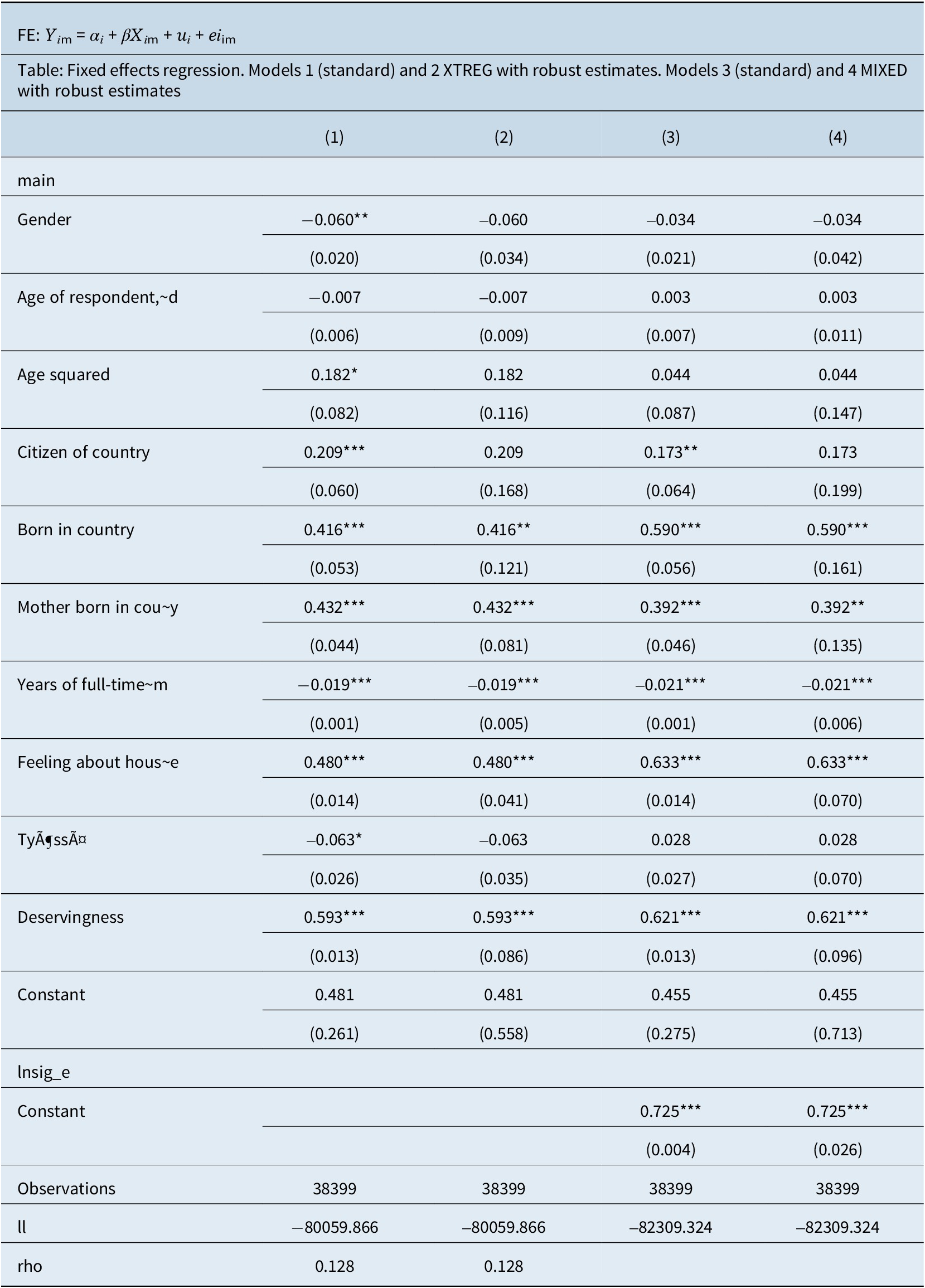
Standard errors in parentheses.
* p<0.05, ** p<0.01, *** p<0.001.


 Open access

