


1. Introduction
Terrorist attacks have been found to be consequential for elections of all kinds (Bove et al., Reference Bove, Efthyvoulou and Pickard2022). Research on the electoral repercussions of terrorism often talks about the so-called rally around the flag effect. External threats such as wars, terrorism, or global pandemics tend to produce a sudden albeit often short-lived spike in the popularity of the incumbent (Mueller, Reference Mueller1970). This is the case because such events tend to generate pleas to unity from political elites and a sense of vulnerability among voters, both of which favor unconditional support for those in power (Huddy et al., Reference Huddy, Feldman, Taber and Lahav2005; Chowanietz, Reference Chowanietz2011).
Even though this is a rather common finding in the literature on the electoral consequences of terrorism (Chanley, Reference Chanley2002; Hetherington and Nelson, Reference Hetherington and Nelson2003; Perrin and Smolek, Reference Perrin and Smolek2009; Dinesen and Jæ ger, Reference Dinesen and Jæger2013; Coupe, Reference Coupe2017; Muñoz et al., Reference Muñoz, Falcó-Gimeno and Hernández2020; Deglow and Sundberg, Reference Deglow and Sundberg2021), the rally around the flag is far from universal. In particular, previous studies have also provided evidence of a negative effect of terrorist attacks on support for the incumbent (Bali, Reference Bali2007; Gassebner et al., Reference Gassebner, Jong-A-Pin and Mierau2008; Montalvo, Reference Montalvo2011; Reference Montalvo2012), as well as instances of null effects (Balcells and Torrats-Espinosa, Reference Balcells and Torrats-Espinosa2018; Baccini et al., Reference Baccini, Brodeur, Nossek and Shor2021). While the rally effect finds its theoretical justification in the sense of threat generated by the attacks, the negative effect is attributed to the accountability mechanism: voters punish the incumbent for not being able to prevent the attacks or mitigate its consequences (Healy and Malhotra, Reference Healy and Malhotra2010; Reference Healy and Malhotra2013). A recent study by Falcó-Gimeno et al. Reference Falcó-Gimeno, Muñoz and Pannico(2023) shows that the predominance of one effect over the other depends on the timing of the attack: the strike is beneficial for the incumbent when it takes place shortly before the elections and detrimental when it occurs long before the polling day.
Against this background, in this paper, we provide micro-level, credible evidence of the short-term rally effects of terrorism. We exploit the recurring occurrence of terrorist attacks during public opinion surveys in Spain. This allows us to analyze, using individual data, the effect of terrorism on individual voters’ support for the incumbent and intention to vote. We find a sizable immediate rally around the flag, visible in the areas of the country targeted by the attacks, especially under conservative incumbency.
This paper makes two contributions to the literature. The first one is substantive: we test the rally around the flag effect in an arguably difficult case. Generally, the rally around the flag hypothesis is related to external threats (Oneal and Bryan, Reference Oneal and Bryan1995; Kuijpers, Reference Kuijpers2019). Consequently, research has focused on wars or on some extreme, large-scale, highly visible, rare attacks that are caused by international terrorism. Indeed, the most studied acts of violence in the literature on the consequences of terrorism are the 9/11, the Palestinian-Israel conflict, and the 2015 Paris attacks, while the majority of studies on the rally around the flag focuses on Islamist terrorism in Western countries.Footnote 1 This raises the doubt that “it might not be the threat of violence per se that is driving public reactions to terrorism, as is often assumed, but rather the threat of violence perpetrated by specific – often outgroup and low-status – actors” (Godefroidt, Reference Godefroidt2022, 13).
In this paper, we bring the hypothesis to a very different context: a sustained domestic terrorist campaign. This is arguably a harder case for the rally around the flag to occur. First, because the recurrence of the attacks may attenuate the sense of threat sparked by each single attack and, second, because the threat is not completely external, making terrorism a potentially contentious and dominant issue in domestic politics, as it happened in Spain over decades.
The second, and perhaps more important contribution of the paper is methodological. Existing research provides either correlational evidence across a number of cases or hinges on well-identified studies of a single case. This state of the art imposes a trade-off between internal and external validity. Correlational studies are subject to potential problems of unobserved heterogeneity, while studies based on a single event, even if they rely on a credible identification strategy, open questions about whether the effect is driven by the specific characteristics of the event and/or its surrounding circumstances.
In this paper, we use the “Unexpected Event during Survey Design” (UESD) as discussed in Muñoz et al. Reference Muñoz, Falcó-Gimeno and Hernández(2020). This approach allows us, with some assumptions, to provide credible estimates of exposure to terrorism on vote intention. However, here we incorporate one crucial difference with respect to the standard UESD design: instead of relying on a single—or a handful of—unexpected events, we systematically look for all possible matches of terrorist attacks perpetrated in Spanish soil between 1988 and 2005 and public opinion surveys from the main public opinion research institute in Spain (Centro de Investigaciones Sociológicas, CIS). The outcome of this effort is the identification of a large number of attack-survey pairs, from which 142 satisfy the requirements to be used in the analysis. This approach allows us to overcome the problems associated with the use of idiosyncratic attacks for generalizing the findings.
Moreover, the use of this strategy provides us with the opportunity to explore the heterogeneity in the effects across different incumbents—social-democratic and conservative—and different types of attacks, based on the type of victims (civilians, politicians, and military/police).
Finally, we complement this empirical strategy with evidence from a survey experiment based on priming respondents with the memory of the ETA terrorist campaign. The experiment provides additional support to the attitudinal mechanisms behind the observed patterns of increased incumbent support in the aftermath of an attack.
2. Theory: the rally around the flag in an unlikely context
The concept of the rally around the flag was originally developed to account for the reaction of the US public opinion to international events that involved the United States and, specifically, the president (Mueller, Reference Mueller1970). The concept was restricted, in these early academic use, to a specific country (the United States) and to a specific type of event (international crises).
There are reasons to think that the aftermath of international crises in the United States constitutes the most favorable context to find a boost in incumbent support following a crisis. First, because international events are more likely to generate the sense of unity around the country leadership than domestic events, that could perhaps exacerbate internal divisions. Second, because the United States is a country with high salience of foreign policy in internal politics, and a presidential system in which the identification of the flag with the president is rather straightforward.
However, since then the idea of rally round the flag has been applied to a wider set of contexts, well beyond its original use, such as Europe (Chowanietz, Reference Chowanietz2011), India (Hintson and Vaishnav, Reference Hintson and Vaishnav2021), Russia (Hale, Reference Hale2018), or Japan (Kobayashi and Katagiri, Reference Kobayashi and Katagiri2018), among others. The idea of a rally round the flag has been used to explain a surge in support for various institutions or political objects beyond the incumbent, the regime or the nation, following different types of crises; from wars (Norrander and Wilcox, Reference Norrander and Wilcox1993) and international crises (Feinstein, Reference Feinstein2022) to natural disasters (You et al., Reference You, Huang and Zhuang2020) or, more recently, pandemics (Yam et al., Reference Yam, Jackson, Barnes, Jenson Lau and Lee2020; Johansson et al., Reference Johansson, Hopmann and Shehata2021; Schraff, Reference Schraff2021). And, of course, as we discuss in detail below, also terrorist attacks, both from domestic and international origin.
Such an extension of the use of the concept constitutes a clear instance of what Sartori Reference Sartori(1970) defined as conceptual traveling. In order to avoid the problem of conceptual stretching, the concept needs to be redefined, climbing up the ladder of abstraction by reducing its connotation. Henceforth, in this wider use of the concept, the rally around the flag refers to surges in public support for the government and national institutions following situations of crisis.
The question on to what extent the rally around the flag can be useful to make sense of public opinion reactions in different contexts is necessarily linked to the understanding of the mechanisms that may drive it. The literature mostly refers to two groups of mechanisms to explain the phenomenon, the political and the psychological ones. The political mechanism is mostly linked to the reaction of the opposition: in situations of crisis, especially when they are caused by an external threat, parties and leaders from both the government and the opposition tend to make calls for unity in support of the incumbent to fight against the common enemy (Chowanietz, Reference Chowanietz2011). These pleas to unity would temporarily suspend the “politics as usual” and favor citizens’ support for the country leadership. Groeling and Baum Reference Groeling and Baum(2008) discuss a more complex mechanism that takes into account the interaction between the political elites, the public, and the media.
The psychological mechanisms are related to the sense of vulnerability spurred by the threat, which makes citizens turn to the sitting authorities to demand protection (Huddy et al., Reference Huddy, Feldman, Taber and Lahav2005). While the rally around the flag has often been linked to a sense of anxiety and threat as in the terror-management theory (Pyszczynski, Reference Pyszczynski2004) or to basic social identity mechanisms (Kuehnhanss et al., Reference Kuehnhanss, Holm and Mahieu2021), some authors have proposed a framework based on anger rather than fear as the driving psychological mechanism (Lambert et al., Reference Lambert, Scherer, Schott, Olson, Andrews, O’Brien and Zisser2010; Reference Lambert, Schott and Scherer2011).
2.1. Terrorism and the rally around the flag
Terrorism is a case in which the rally around the flag has been often used as a conceptual tool to study public opinion reactions. It has often been argued, and empirically shown, that terrorism increases incumbent popularity (Chanley, Reference Chanley2002; Hetherington and Nelson, Reference Hetherington and Nelson2003; Perrin and Smolek, Reference Perrin and Smolek2009; Dinesen and Jæ ger, Reference Dinesen and Jæger2013; Coupe, Reference Coupe2017; Muñoz et al., Reference Muñoz, Falcó-Gimeno and Hernández2020; Deglow and Sundberg, Reference Deglow and Sundberg2021). Research that identifies this rally around the flag effect in the context of terrorism often focuses on single, highly salient events—such as the 09/11 attacks of 2001 in the United States (Chanley, Reference Chanley2002; Hetherington and Nelson, Reference Hetherington and Nelson2003; Landau et al., Reference Landau, Solomon, Greenberg, Cohen, Pyszczynski, Arndt, Miller, Ogilvie and Cook2004; Bonanno and Jost, Reference Bonanno and Jost2006; Woods, Reference Woods2011), the 2004 Madrid train bombings in Spain (Dinesen and Jæ ger, Reference Dinesen and Jæger2013), the 2011 Utoya shootings in Norway (Wollebæ k et al., Reference Wollebæk, Enjolras, Steen-Johnsen and Ødegård2012), the November 2015 Paris terrorist attacks (Coupe, Reference Coupe2017), and the Charlie Hebdo shooting earlier that year (Muñoz et al., Reference Muñoz, Falcó-Gimeno and Hernández2020).
Moreover, the meta-analysis study by Godefroidt Reference Godefroidt(2022) has shown that the majority of previous studies on the rally around the flag focused on Islamist terrorism in Western countries. The overall effect seems to be driven by investigations that study the 9/11 attack in the United States, while studies conducted in different countries show a much lower impact of terrorist strikes. Studies that analyze non-Islamist terrorism, which are less numerous, show an average null effect. This situation raises the question of whether the detected rally effect depends on the outgroup status of the perpetrators of the attack, rather than on the attack itself (Godefroidt, Reference Godefroidt2022).
In fact, a closer look at the literature indicates that the rally around the flag is far from a universal consequence of terrorist attacks. Some studies have shown that the incumbent may actually suffer a decline in support in the aftermath of an attack (Bali, Reference Bali2007; Gassebner et al., Reference Gassebner, Jong-A-Pin and Mierau2008; Montalvo, Reference Montalvo2011; Reference Montalvo2012). Consistently with accountability models, the government gets punished for not being able to protect the country from terrorism and/or for its insufficient response to the attack (Healy and Malhotra, Reference Healy and Malhotra2010; Reference Healy and Malhotra2013).
Hintson and Vaishnav Reference Hintson and Vaishnav(2021) portray a nuanced picture of the rally effect in India 2019: while the Pulwama attack that killed 40 Indian paramilitary officers in Kashmir was followed by a swing in favor of the incumbent BJP, proximity to the villages of origin of the victims is related to lower, and not higher increase in incumbent support, suggesting a mechanism of punishment. A recent article from Falcó-Gimeno et al. Reference Falcó-Gimeno, Muñoz and Pannico(2023) has shown that the prominence of the negative (accountability) or the positive (rally) effect depends on the timing of the attack with respect to the election. When the election is held shortly after the strike, exposure to terrorism tends to benefit the incumbent; however, in elections held long past the attack, incumbents tend to suffer losses in those areas more exposed to terrorist activity.
Therefore, it is not clear to what extent the rally around the flag naturally applies to contexts that, a priori, make it less likely to find a surge in support for the incumbent than foreign policy crises in the United States. In parliamentary democracies, in which the head of government does not overlap with the more symbolic figure of the head of state, rallies around the flag may not automatically benefit the incumbent prime minister or her party. Moreover, as Mueller Reference Mueller(1970) already mentioned in his seminal paper, it is arguably more difficult to find a rally around the flag as a response to events that do not belong to the international arena.
The main alternative to the theory of the rally around the flag posits that political violence, and terrorism in particular, should benefit right-wing parties, which tend to adopt a harder stance and be less open to concessions and dialogue. Several papers have found this effect in the case of the Israeli-Palestinian conflict (Berrebi and Klor, Reference Berrebi and Klor2006; Reference Berrebi and Klor2008) and the Kurdish-Turkish conflict (Kibris, Reference Kibris2011). This theory is supported by a psychological mechanism linking fear and conservatism (Bonanno and Jost, Reference Bonanno and Jost2006; Jost et al., Reference Jost, Stern, Rule and Sterling2017; Vasilopoulos et al., Reference Vasilopoulos, Marcus, Valentino and Foucault2019) as well as a political mechanism rooted in the theories of issue ownership and salience.
In this paper, we study the rally around the flag effect in an unlikely case: Spain, a parliamentary democracy that suffered a long campaign of domestic terrorism, mainly from the Basque pro-independence group ETA. Although the main parties in Spain actively promoted unity to fight terrorism during certain periods (Chowanietz, Reference Chowanietz2011), the management of the terrorist threat was also often a source of partisan divisions. Moreover, as we discuss below, ETA represents an ambiguous case of a domestic group that was nonetheless often framed as an external threat due to its secessionist nature.
3. The case: terrorism in Spain
Spain is one of the Western democracies that has suffered more intensely from terrorist attacks. The most deadly attack was perpetrated by Al-Qaeda in 2004, when a group of suicide bombers targeted commuter trains in Madrid, killing around 200 people. However, Spain also experienced a sustained terrorist campaign by the Basque group ETA, which killed 820 people between 1968 and 2009. ETA’s activity began during the Francoist dictatorship, but it intensified alongside the transition to democracy and spanned well into the Spanish democracy (Sanchez-Cuenca, Reference Sanchez-Cuenca2007). ETA’s tactics combined selective killings of policemen, members of the armed forces or politicians, with some indiscriminate attacks, often using car bombings. While in its early years it focused mostly on members of the police and the military, over the years it moved toward killing more politicians and civilians. Although the lion’s share of ETA’s activity was based on selective attacks, the group also engaged in some limited categorical terrorism, targeting anonymous Spanish civilians (Goodwin, Reference Goodwin2006).
ETA was for decades one of the most salient political issues in Spain, if not the most salient. There was an intense debate among parties on how to address the question. Several strategies were tried: alongside police action against ETA, there were various unsuccessful attempts of seeking a negotiated peace deal, most famously in 1989, 1998, and 2008. During the 1980s, there were also paramilitary death squads illegally established by government officials. In the 1990s, the focus turned toward the sociopolitical movement that was allegedly close to ETA, including the banning of political parties, the closure of newspapers and radio stations, and the outlawing of youth and cultural associations. Finally, ETA decided to cease its activity and dissolve unilaterally in 2011. The changed international context after 9/11, the increased police efficacy, and the slow erosion of support among its bases are often cited as key factors that facilitated the end of ETA.
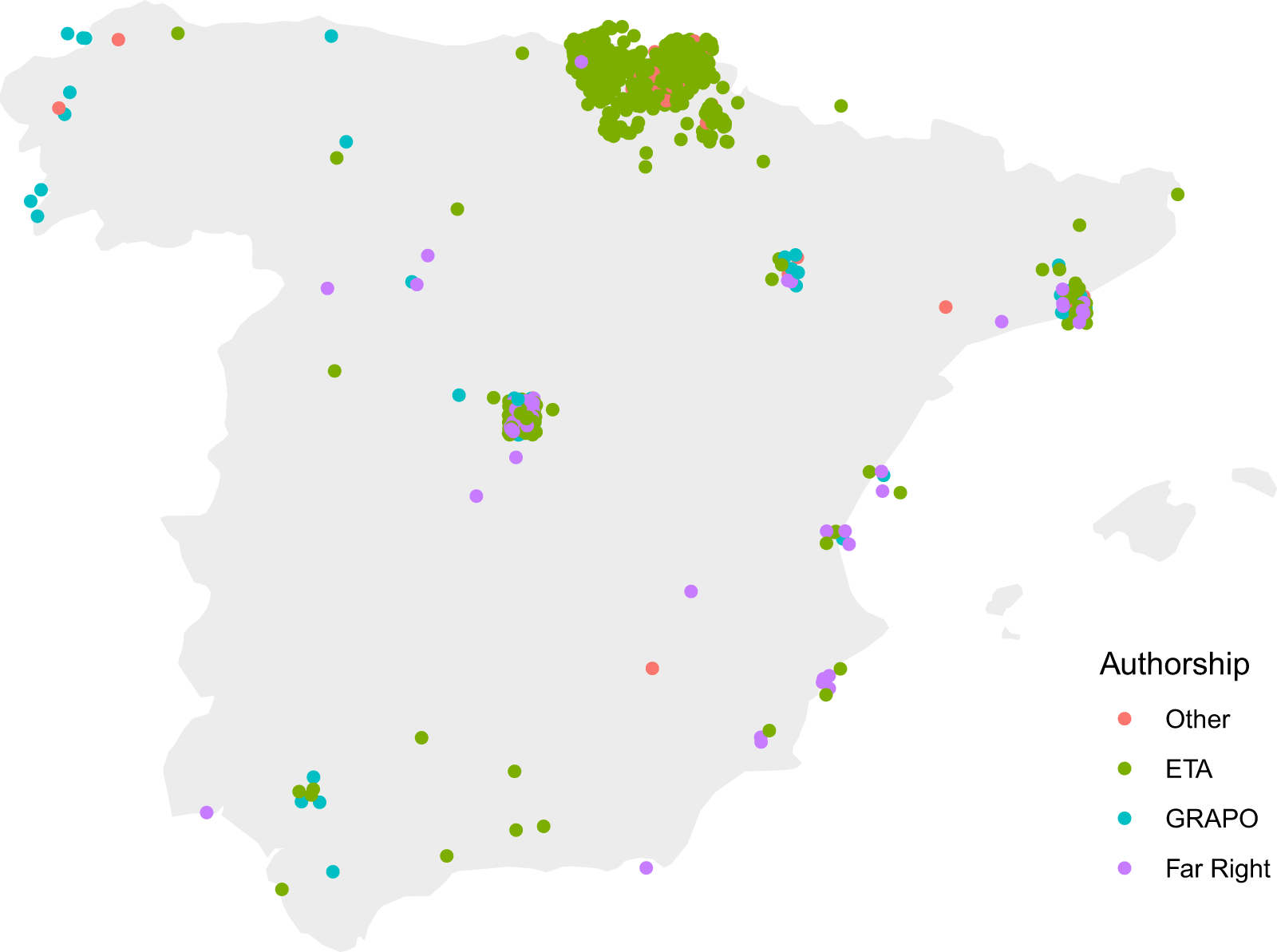
Although ETA was the most active and politically relevant, other domestic terrorist groups operated in Spain since the transition to democracy, such as the far-left, maoist-inspired GRAPO and various right-wing extremist and neo-Nazi groups (De la Calle and Sanchez Cuenca, Reference De la Calle and Sanchez Cuenca2011). Figure 1 shows the geographical distribution of terror attacks perpetrated in Spain between 1977 and 2008, by group.
Terrorist attacks in Spain, 1977–2008.
4. Empirical strategy
Our approach in this paper combines a large N of attacks with an arguably credible identification strategy. We go beyond the state of the art and provide evidence of the rally around the flag effect using a large number of attacks that occurred during the fieldwork of a large number of public opinion surveys.
4.1. Threats and assumptions in the UESD design
The core of our empirical exercise is the so-called UESD as discussed in Muñoz et al. Reference Muñoz, Falcó-Gimeno and Hernández(2020). This design, increasingly used to assess the effects of terrorist attacks, is based on exploiting the unexpected occurrence of some salient event during the fieldwork of a public opinion survey. This creates a situation in which respondents are exogenously assigned to the treatment and control groups depending on the day in which they were interviewed. Therefore, the causal effect of the unexpected event can be estimated by “comparing responses of the individuals interviewed before the event  $t_i \lt t_e$ (control group) to those of respondents interviewed after the event $t_i \gt t_e$ (treatment group)” (Muñoz et al., Reference Muñoz, Falcó-Gimeno and Hernández2020, 187). In the UESD, identification rests upon two assumptions: ignorability and excludability. The assumption of ignorability requires that those individuals that were interviewed before and after the event are equivalent in both observable and unobservable characteristics. The organization of the fieldwork or any changes subsequent to the event may threaten it. In other words, we need to assume that assignment to treatment and control groups is as good as random.
But this is not the only assumption. The exclusion restriction requires that the timing of the interview affects the outcome only through the event of interest. If other things happen during the fieldwork that affect the outcome, then they could confound the study. If the event is salient enough, and no other key events occurred at the time, then one can be fairly confident that the eventual differences between the pre and post groups will be related to the event.
One key element, that is not easy to overcome, is the so-called “collateral events.” Often, the highly salient political events that are used for UESD designs are followed by a series of chained reactions. After a terrorist attack, for example, the police may (or may not) arrest or kill the perpetrators. Mass media may decide to conceal (or expose) the bloody images. The opposition parties may decide to back (or criticize) the government for its handling of security affairs, etc. All these collateral events are likely to matter for the outcome of interest, and the alleged effect of terrorism may be actually explained by them.
This is the key limitation of the single-case UESDs: one cannot be sure if the estimated effects are produced by the event of interest itself, of by the collateral events. This problem, which could be seen as an instance of imprecise or compound treatment, is important for the interpretation of the results. The majority of papers using the UESD approach rely on a single event. While careful assessment of the assumptions can provide credibility to the causal estimates of the UESD design, the problem of collateral events remains.
In order to assess the potential threats to the excludability assumption related to the collateral events of a specific attack, researchers must rely on detailed knowledge of the context, understand what type of collateral events may affect the outcome, and which are the mechanisms through which the context may be a relevant mediator (Egami and Hartman, Reference Egami and Hartman2022).
However, the best strategy to address the question is arguably scaling up the design to include multiple events. This strategy may allow researchers to average out the idiosyncratic characteristics of each event, and the specific context in which it occurred. Some papers have made an effort of aggregating several events of the same type. Notable examples are Nussio et al. Reference Nussio, Bohmelt and Bove(2021), who leverage the occurrence of five attacks to investigate their impact on citizens’ attention to terrorism, or Giani Reference Giani(2021), that uses nine jihadist attacks in six countries to explore their effects on ethnic prejudice.
The closest work to our paper is Balcells and Torrats-Espinosa Reference Balcells and Torrats-Espinosa(2018), which analyzes eight different attacks by ETA in Spain to explore their effect on the intention to turn out to vote and, additionally, on incumbent support. Balcells and Torrats-Espinosa Reference Balcells and Torrats-Espinosa(2018) opened the way to the use of multiple attacks under the UESD identification strategy.Footnote 2
In this paper, we go in this direction but bring it one step further by systematizing the search for the co-occurrence of terrorist attacks and public opinion surveys over an extended period of time, rather than the unstructured selection of a limited number of attacks. This empirical strategy allows us to address concerns related to the idiosyncratic combination of collateral events that can occur in each instance of a terrorist attack. Hence, our empirical contribution is related to the increased number of attacks (from 8 to 93) and, especially, to the systematic sampling of the universe of attacks that coincided with suitable surveys. We use all the attacks that happened simultaneously with survey fieldwork and that satisfy the conditions for identification that we detail below.
4.2. Identification strategy: multiple UESD design
We use the universe of terrorist attacks in Spain and the universe of publicly available surveys by the Spanish public center for sociological research (CIS) to systematically look for matches in the fieldwork dates. This is, to the best of our knowledge, the first attempt at using this design on a large number of events.
In order to do it in a systematic way, we automatized the search for match between around 2,000 attacks from the Global Terrorism Dataset (GTD) (START, 2021) and 2,000 surveys form the CIS archive using web scraping techniques. Initially, we were able to identify around 400 matched surveys that had the micro-data available (or it was made available to us by the CIS) and included interview date information. Out of these 400 surveys, about 100 included the vote intention question, which was necessary for our purposes. However, in order to ensure the quality of the resulting dataset, we applied some further filters.
Given the heterogeneity in the type, salience, and severity of the attacks covered by the extensive GTD, and considering the importance of the salience of the event in the UESD design, we set as a criterion to retain a survey in our sample that the attack appeared in the front page of the main Spanish newspaper El País. This restricted our sample to 69 surveys (and 123 attacks). This is, however, important because a high salience of the attack is critical for the assumption that the treated individuals were, in fact, treated. After all, attracting public attention is typically one of the goals of terrorists (Nussio et al., Reference Nussio, Bohmelt and Bove2021).
Still, we further filter out the surveys, attacks, and respondents based on several additional criteria we deem important to guarantee the quality of the resulting dataset. First, we limit the interviews we use to a time frame of 30 days before and after the attack. In the empirical analyses, we also use, in some specifications, narrower bandwidths. Some survey fieldworks extend over months, but these long fieldworks increase the probability of confounding events and the likelihood that the respondents forget about the attacks.
An additional restriction we impose is on the pre-treatment. Given the intensity and persistence of terrorist campaigns in Spain during certain periods of time, it is possible to encounter situations in which the control group was, actually, exposed to some previous attack. This may bias our results. In order to control for this possibility, we exclude those respondents of the control groups that were interviewed less than 7 days after a salient previous attack.Footnote 3 Finally, having applied these restrictions, we check that the remaining samples have observations both in the treatment and control groups. Otherwise, they are removed.
As shown in Table 1, this complex process results in 142 valid attack-survey pairs that exploit the occurrence of 93 salient terrorist attacks perpetrated in Spanish soil during the fieldwork of 63 official publicly available opinion surveys.Footnote 4 This is a smaller number than the originally identified coincidences but nonetheless represents a significant improvement over the state of the art.
Construction of dataset: restrictions

4.3. Model
We analyze incumbent (and opposition) support for the individuals interviewed before and after the attacks. The comparison between these two groups should give us a measure of the treatment effect. We are interested in the effect of exposure to terrorism on incumbent support. Given our theory and previous findings, we expect a rally around the incumbent in the aftermath of an attack. Additionally, we explore the effect of these attacks on intention to vote/abstain following Balcells and Torrats-Espinosa Reference Balcells and Torrats-Espinosa(2018).
However, this simple UESD design incorporates an embedded questionable assumption: that all the individuals interviewed after the attack are equally exposed to the terrorist event. While the fact that we are dealing with attacks that appear in national media may make them relevant for everyone, it is also important to take into account that, in a context of a sustained terrorist campaign with frequent attacks, respondents may not pay the same attention and be equally affected by an attack occurring in another region than by an attack that occurs in their geographical vicinity (Falcó-Gimeno et al., Reference Falcó-Gimeno, Muñoz and Pannico2023).
In this context, therefore, we relax the assumption of geographically invariant exposure. Otherwise, the resulting estimate may be biased. Therefore, we interact exposure with region of residence, in order to estimate the effect of exposure to the attacks separately for those respondents living in the attacked region. This is important, given the prevalence of regional media markets in Spain, and the fact that attacks occurring closer tend to be perceived as more threatening (Fischhoff et al., Reference Fischhoff, Gonzalez, Small and Lerner2003; Braithwaite, Reference Braithwaite2013). Geographical proximity is in fact a commonly used proxy for exposure to terrorism (Huddy et al., Reference Huddy, Khatib and Capelos2002; Kibris, Reference Kibris2011; Getmansky and Zeitzoff, Reference Getmansky and Zeitzoff2014; Bove et al., Reference Bove, Efthyvoulou and Pickard2022; Falcó-Gimeno et al., Reference Falcó-Gimeno, Muñoz and Pannico2023), although Agerberg and Sohlberg Reference Agerberg and Sohlberg(2021) fail to find a proximity effect in Sweden. We, therefore, expect exposure to terrorism to produce a rally effect especially among those individuals that were more directly exposed to the attack (i.e. living in the attacked region).
Therefore, we adopt a modeling approach that incorporates a two-way interaction between timing of the survey vis-à-vis the attack (pre-post) and region of residence (attacked region-rest of the country). We specify the following baseline model:
 \begin{equation*} Y_{ti} = \beta_1 Post_{ti} + \beta_2 TargetRegion_{ti} + \beta_3 Post_{ti} \times TargetRegion_{ti} + \gamma_{c} X_i + \lambda_{t} + \zeta_{p} + u_{ti}. \end{equation*}
In this model, Yti is the vote intention of the individual. We study both the effect on the vote for the incumbent and the main opposition party, as well as intention to abstain, as we discuss below. Postti is an indicator that takes value 1 if the individual was interviewed after the attack and 0 otherwise.Footnote 5 TargetRegionti takes value 1 if the individual lives in the NUTS-2 region in which the attack occurred and 0 otherwise. Xi is a vector of the individual-level controls that were available across all surveys, and that are important to increase confidence in the assumption of (conditional) ignorability: gender, age, education, employment status, and size of municipality. In Table B1 in the Appendix, we show a balance table that illustrates the need of these controls. Given the geographic and socioeconomic heterogeneity across regions, we also interact the target region with the size of municipality and employment situation.Footnote 6
In the model, we also include a vector of attack fixed effects λt. This is crucial to our design, as it allows us to estimate the treatment effect net of the unobserved characteristics of each particular attack. Moreover, to account for time-invariant geographical differences, which is important given the heterogeneous political geography of Spain, we include ζp, that is a vector of region fixed effects. Finally, uti refers to the error term.
5. Results
5.1. Main results
We apply the model to our data, using various dependent variables. First, we look at incumbent support, as measured by vote intention. Then, we analyze the effect of exposure to attacks on support for the main opposition party, and finally we look at intention to abstain. In order to check for the robustness of our estimates, we present various specifications that include different bandwidths around the attack: 30, 20, 10, 5, and 3 days before and after the attack. The narrower bandwidths imply a loss of observations and cases but a gain in confidence in the key assumptions of the UESD: respondents are more likely to be comparable, and it is less likely that other events interfere with the estimation of the effect violating the assumption of excludability. Finally, we also show models with and without the vector of control variables. As evident in the tables below, our key findings do not hinge on any of these decisions.
In Table 2, we present the main results of the analysis that uses intention to vote for the incumbent as the dependent variable. The findings are very consistent across these different specifications: respondents interviewed after an attack are more likely to express support for the incumbent if they live in the targeted region. The attacks do not seem to have any effect whatsoever on respondents that live in other regions. For those that live in the same region, the boost in support for the incumbent ranges between 3 and 5 percentage points, depending on the specification. This is a very substantial effect considering that in our sample the average intention to vote for the incumbent in these regions is around 13%. These results are aligned with the rally around the flag theory, with an important qualification: they occur when the attacks take place in the same region in which the respondents live.
Effect of attacks on vote for the incumbent
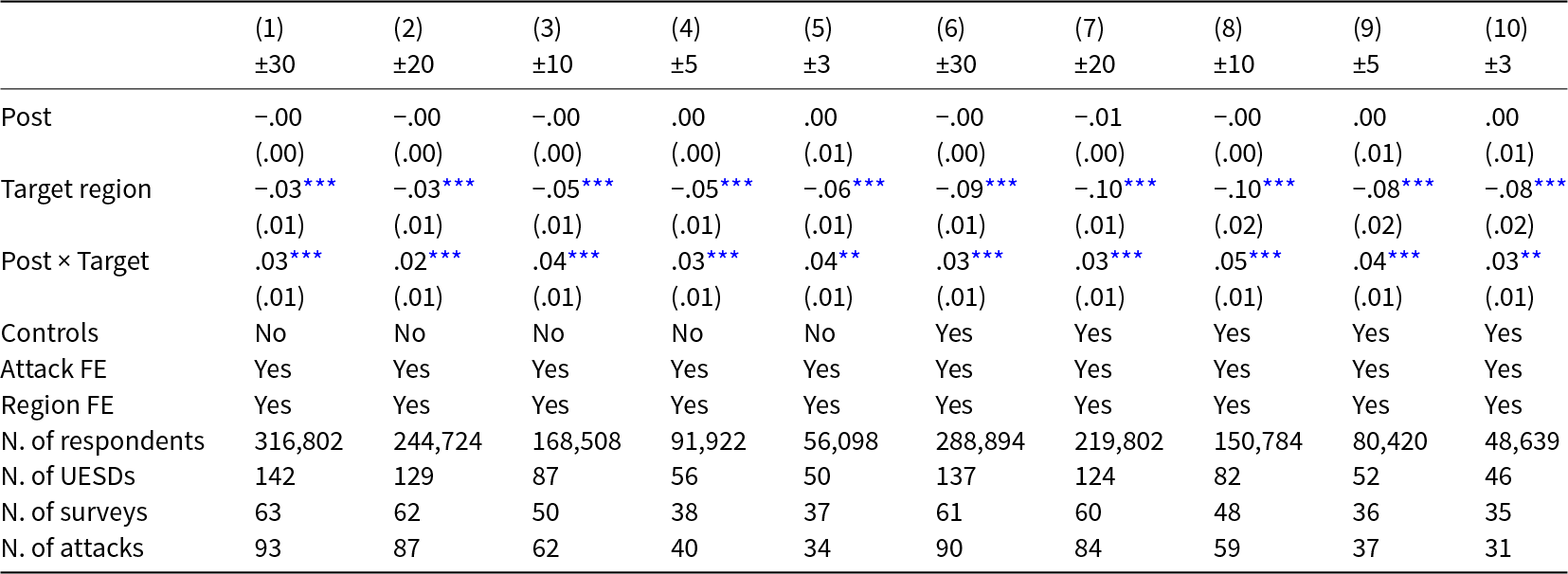
** Notes: OLS regression estimates. The outcome variable takes value “1” for respondents’ intention to vote for the incumbent party and “0” otherwise. Controls are Gender, Age, Age2, Education, Employment status, Size of municipality, Employment status × Target region, and Size of municipality × Target region. ±30, ±20, ±10, ±5, and ±3 refer to 30, 20, 10, 5, and 3 day bandwidths, respectively. Full model results including estimates for all covariates can be found in Table C1 in the Appendix. Standard errors in parentheses.  $p \lt .01$, *** $p \lt .001$.
Table 3 presents the same analyses but using opposition support as a dependent variable. We also present the full range of specifications, with varying bandwidths as well as with and without controls. This additional analysis is important to understand the mechanisms behind the increased incumbent support: the boost in popularity experienced by the incumbent in the aftermath of a terrorist attack may be the result of the activation of abstainers or undecided voters, or an outright transfer of support from the opposition to the government.
Effect of attacks on vote for the opposition
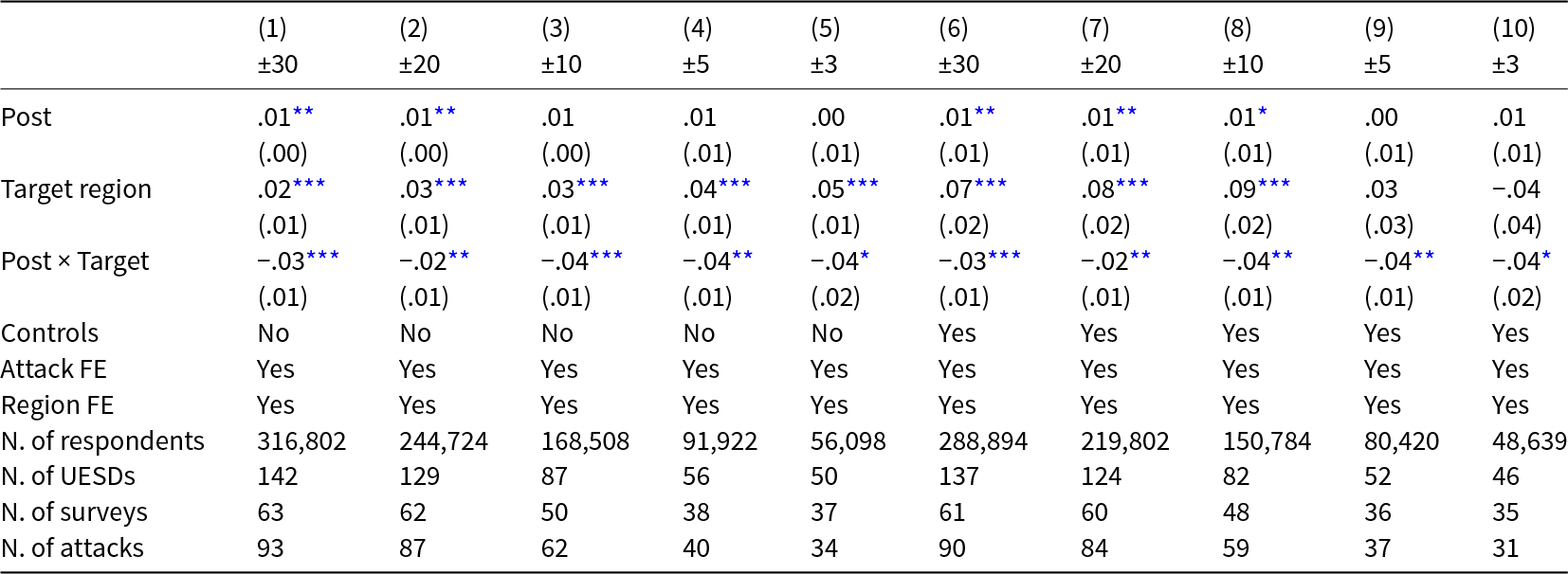
* Notes: OLS regression estimates. The outcome variable takes value “1” for respondents’ intention to vote for an opposition party and “0” otherwise. Controls are Gender, Age, Age2, Education, Employment status, Size of municipality, Employment status × Target region, and Size of municipality × Target region. ±30, ±20, ±10, ±5, and ±3 refer to 30, 20, 10, 5, and 3 day bandwidths, respectively. Full model results including estimates for all covariates can be found in Table C4 in the Appendix. Standard errors in parentheses.  $p \lt .05$, ** $p \lt .01$, *** $p \lt .001$.
According to our results, at least part of the effect is explained by a direct transfer from the opposition to the incumbent: following an attack, respondents living in attacked regions are between 1 and 4 percentage points less likely to support the opposition. Again, the effect in the rest of the country is hardly distinguishable from zero, although in some specifications it is slightly positive.
In order to facilitate interpretation, in Figure 2, we visually represent these findings for the incumbent and the opposition, side by side. On the left panel, we show the effects of being exposed to terrorism on vote for the incumbent at varying bandwidths, for those living in the attacked region and elsewhere. On the right hand side, we show the same results for the opposition. Results are consistent: on average, support for the incumbent increases in around 4 percentage points, while support for the opposition decreases in 3 percentage points after an attack, in the targeted region only. Therefore, the rally around the incumbent we observe seems to be for the most part related to a loss in support for the opposition.
Marginal effects of attacks on vote choice.

In the Appendix, we show that differences between the treatment and control groups are not driven by attrition, i.e. different likelihood of responding the question measuring the outcome after the event (Table D3) or by the existence of pre-trends in the outcome variable that are unrelated to the event of interest (Table D4). In Appendix D6, we use placebo tests to show that the results are not driven by the way the CIS organizes data collection, that is by the fact that specific population groups might systematically answer the survey at a later date of the field period. Also, in Figure E1, we present the predicted values of incumbent support on a daily basis around the attack date, for the attacked and non-attacked regions, which further bolster the absence of a different pre-trend and shows that exposure to terrorism does not shift incumbent support in the rest of the country, but it produces a remarkable bump in the targeted region, that lasts consistently for the entire week following the attack.
5.2. Heterogeneous effects, by type of attack
The main mechanism behind the rally around the flag effect is the sense of threat and fear. Citizens tend to cling to the incumbent seeking for protection from an external threat, that in this case comes in the form of terrorist attacks in the region of residence. An observable implication of this mechanism is that we shall observe a more pronounced rally the more threatening an attack is. Testing this mechanism is important, because it allows us to better understand how and under what circumstances a rally occurs, and provides additional credibility to our interpretation of the findings. Additionally, the possibility to test for heterogeneous effects is one of the strengths of our multiple-UESD design as opposed to previous works that focus on a single event.
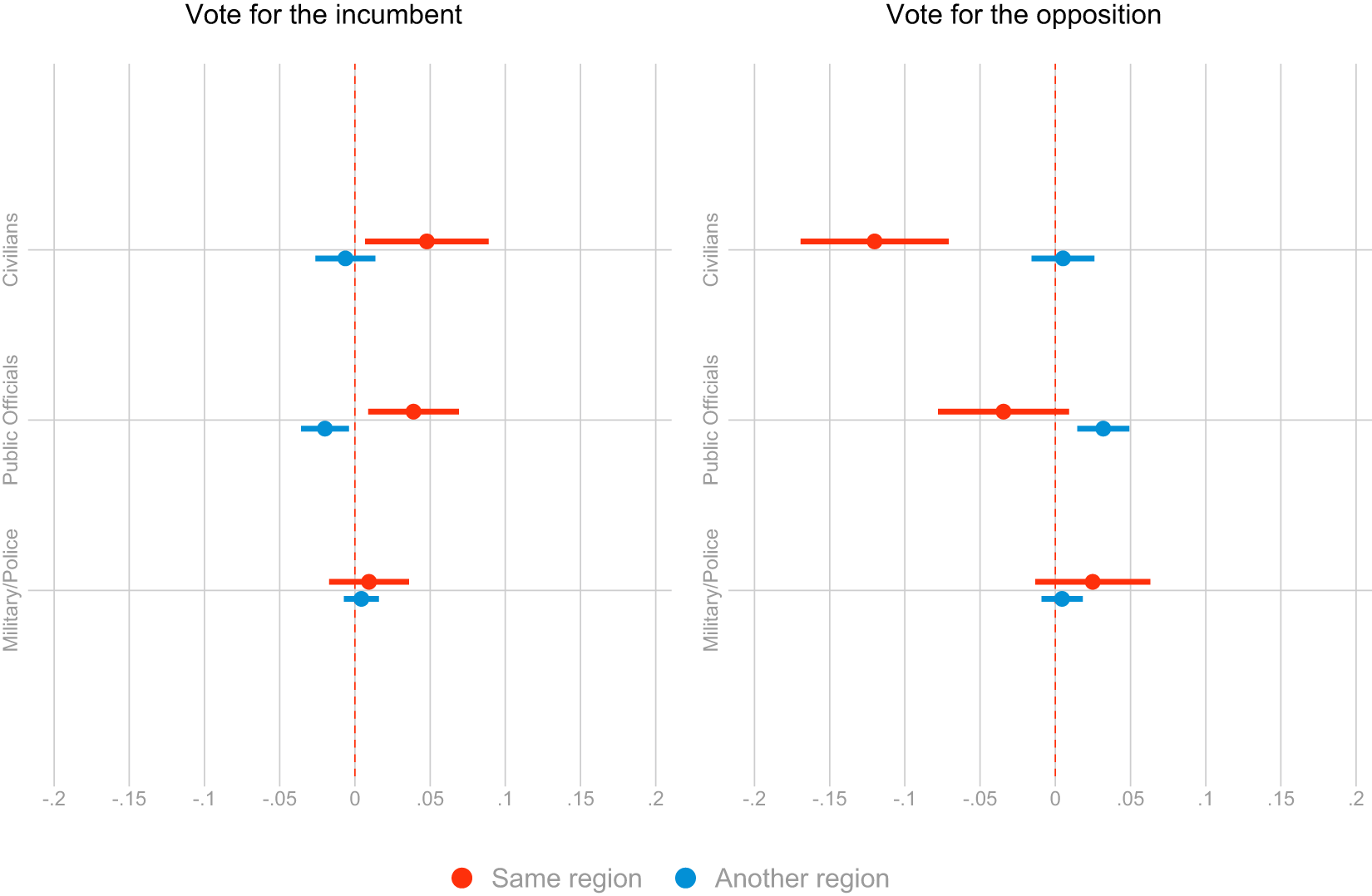
Figure 3 presents the marginal effects of exposure to the attacks, by the type of target identified in the GTD (START, 2021). For presentation purposes, we selected the ±10 days bandwidth, but the results are consistent across specifications. As the figure shows, the attacks that target civilians are the most consequential in the attacked regions, both in terms of increasing support for the incumbent and decreasing opposition support. The attacks on public officials have the same, but somewhat smaller effect. On the contrary, attacks on military/policemen are inconsequential in our data. Our interpretation of these results is that they express the different levels of threat for the ordinary citizens that the attacks pose: the more threatened citizens feel, the more they feel the need to support the incumbent. And attacks on civilians are those that induce a larger threat for the general public.Footnote 7
Marginal effects of attacks, by target (±10-day bandwidth).
5.3. Alternative story: incumbency vs ideology
As discussed, the main rival theory to the rally around the flag is the conservative shift. While the rally around the flag expects an incumbent boost in support after a terrorist attack, the conservative shift theory expects an increase in support for hard-line, right-wing parties.
In order to test this alternative theory, we assess whether terrorist attacks in our sample were associated with an increase in vote intention for the right-wing parties.Footnote 8 Figure 4 represents the marginal effects of attacks on the vote intention for right vs left-wing parties.Footnote 9 Results clearly indicate that there is no general shift toward the right in the aftermath of terrorist attacks during the period analyzed here.
Marginal effects of attacks on vote for right-wing vs left-wing state-wide parties.
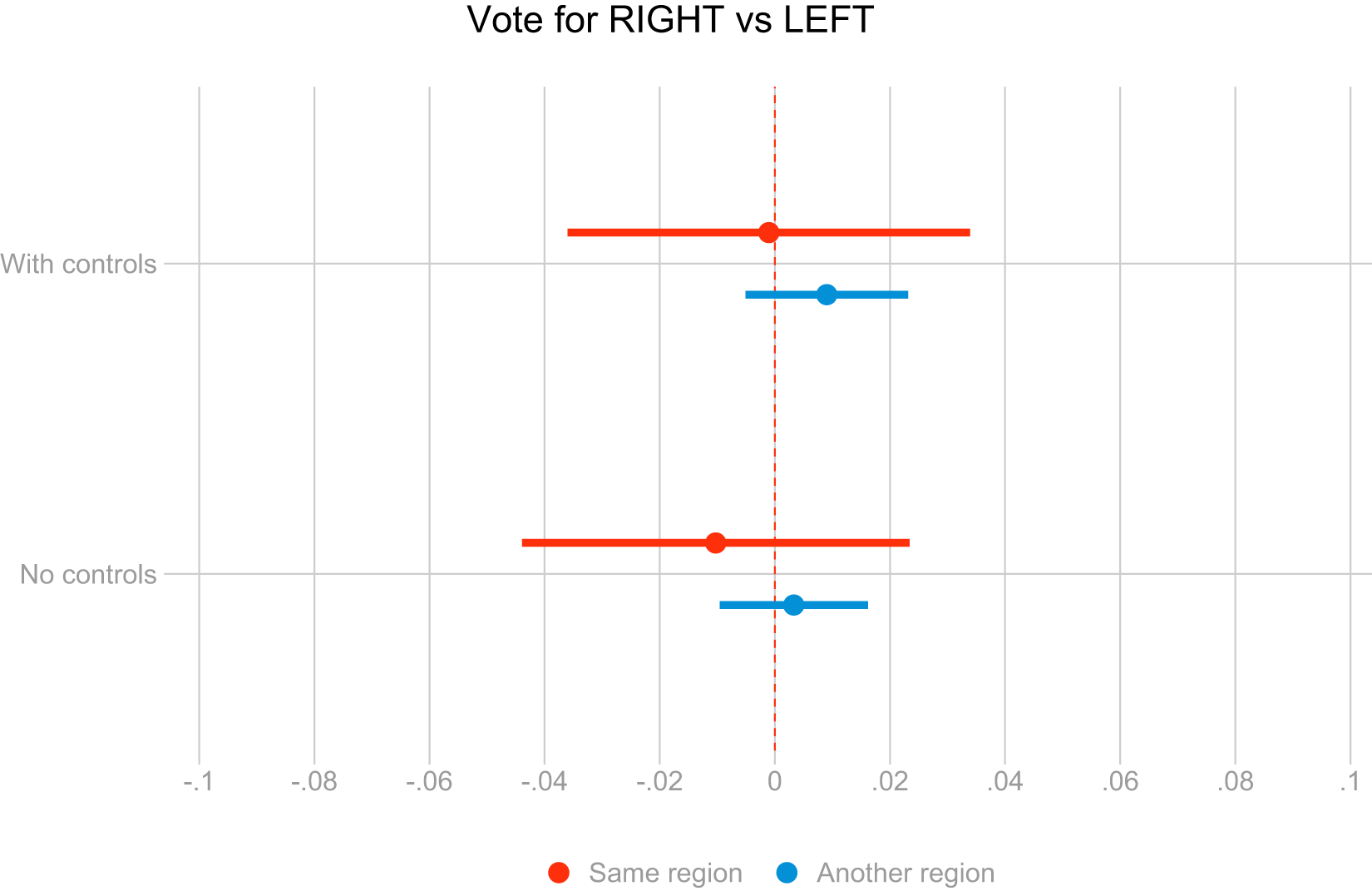
However, even in the absence of an average effect on the left-right dimension, one could expect an interaction between the two mechanisms. The pro-incumbent shift may be amplified in periods of conservative governments given that both issue ownership and incumbency co-occur. Given that in our sample we have cases that occurred during periods of social-democratic and conservative incumbencies, we can assess whether the average pro-incumbent effect that we documented varies between the left and the right, as found by Arce Reference Arce(2003) in the case of Perú.
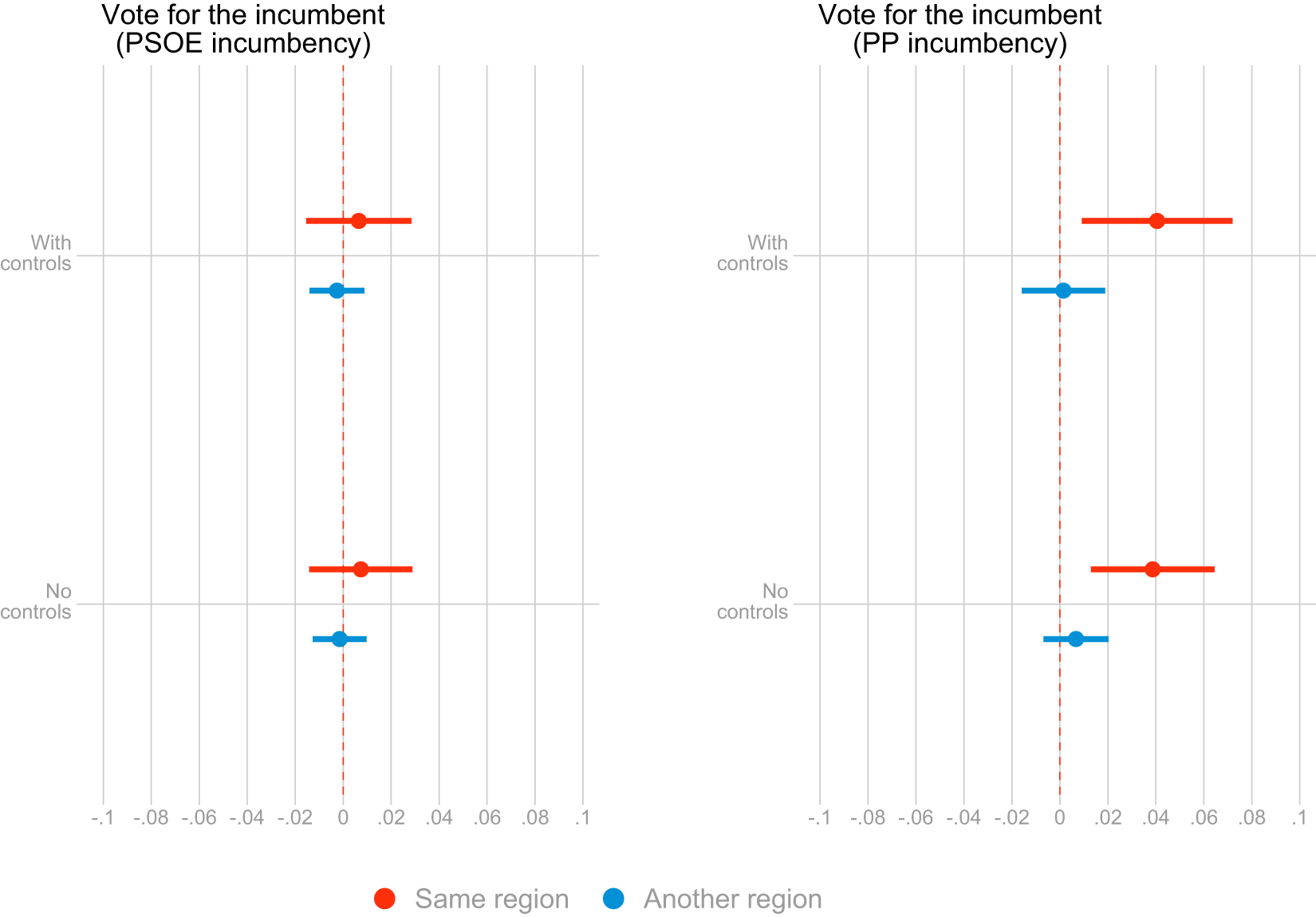
Figure 5 replicates our main analysis but separately for the Partido Socialista Obrero Español (PSOE) and Partido Popular (PP) incumbency. Results show clearly how the average effect we documented is especially strong for the conservative incumbent, while in those cases that occurred during the left-wing governments, the effect was close to null and non-significant. These results suggests an interaction between the two main stories: terrorism tends to benefit the incumbent but only—or mostly—when the incumbent is conservative.
Marginal effects of attacks on vote for the incumbent, by incumbent party.
5.4. Effect of attacks on abstention
In addition to our main analysis, that focuses at the rally around the flag effect, we also look at the effect of exposure to terrorist attacks on abstention (Balcells and Torrats-Espinosa, Reference Balcells and Torrats-Espinosa2018). This is important by itself, in order to test the hypothesis that terrorism and violence, in general, have a mobilizing effect, but it is also useful to dig deeper into the mechanisms behind the observed rally. We have seen that the incumbent receives a boost in support that is slightly larger than the weakening of the opposition. One possibility is that this difference comes from the activation of would-be abstainers to vote for the incumbent. Table 4 shows the estimates of the various model specifications, taking the intention to abstain as the outcome variable.
Effects on intention to abstain
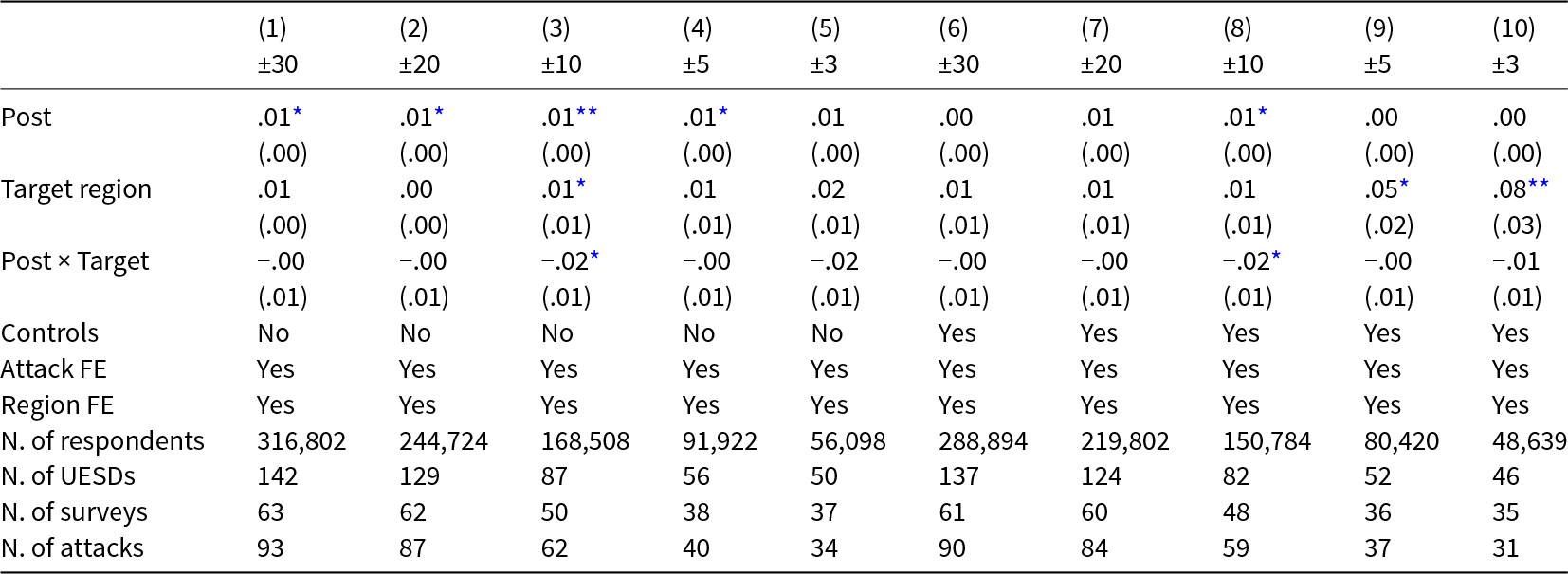
* Notes: OLS regression estimates. The outcome variable takes value “1” for respondents’ explicit intention not to vote and “0” otherwise. Controls are Gender, Age, Age2, Education, Employment status, Size of municipality, Employment status × Target region, and Size of municipality × Target region. ±30, ±20, ±10, ±5, and ±3 refer to 30, 20, 10, 5, and 3 day bandwidths, respectively. Full model results including estimates for all covariates can be found in Table C1 in the Appendix. Standard errors in parentheses.  $p \lt .05$, ** $p \lt .01$.
Balcells and Torrats-Espinosa Reference Balcells and Torrats-Espinosa(2018), analyzing eight different attacks, found a positive effect on intention to turn out for Spain at large. In our enlarged sample of cases, we find no effect on average for the whole country but a weak mobilizing effect in the exposed regions in line with previous findings, although largely inconsistent across specifications.
6. Mechanisms: survey experimental evidence
The evidence from the multiple UESD that we have discussed above allows us to credibly identify the effect of exposure to terrorist attacks on incumbent support. Following the literature, we interpret this surge in support as evidence of the rally around the flag in a difficult case.
However, in order to provide additional evidence to support our interpretation of the results, we designed a survey experiment to test the rally around the flag logic in the Spanish context. The experiment was fielded in an online survey in Spain. We run it on a sample of 1,200 respondents provided by the Netquest survey company, using age and education quotas. In Appendix G, we discuss how our research adheres to the Principles and Guidance for Human Subjects Research.
We primed half of the sample with a short vignette about the history of ETA terrorism, while the other half did not receive any prime at all. The experiment was conceived to test whether, when primed to think about domestic terrorism, our respondents were more inclined to support the logic of the rally around the flag. The wording of the vignette was as follows:
40 years, 800 victims. The bloody history of ETA
For over 40 years, Spain suffered the ETA terrorist violence. ETA caused more than 800 victims, including a large number of civilians and members of the state security forces. Some of their most notable attacks were the car bomb to Barcelona’s Hipercor, which in 1987 caused 15 deaths, or the attack on civilian workers of the Navy in Puente de Vallecas (Madrid) in 1995, with five dead. Other bloody attacks that are especially remembered are the one that caused the amputation of the legs to the young girl Irene Villa, or the kidnapping and murder of the young politician Miguel Ángel Blanco.
In order to measure the outcome, respondents were asked to express their level of agreement in a 5-point scale with the statement “In difficult times it is important that we all support the incumbent government, regardless of its political leaning, to face the threats that may affect the country.”
Figure 6 presents the results. The domestic terrorism priming increased the level of agreement with the rally around the flag statement in a substantively important and statistically significant way. Among those that received the prime, 43% expressed strong agreement with the statement, as compared with the 28% of those that were not primed: a difference of 15 percentage points. On the contrary, the priming reduced the numbers of those that expressed neutral or negative positions with respect to the rally around the flag statement.
Priming experiment results.
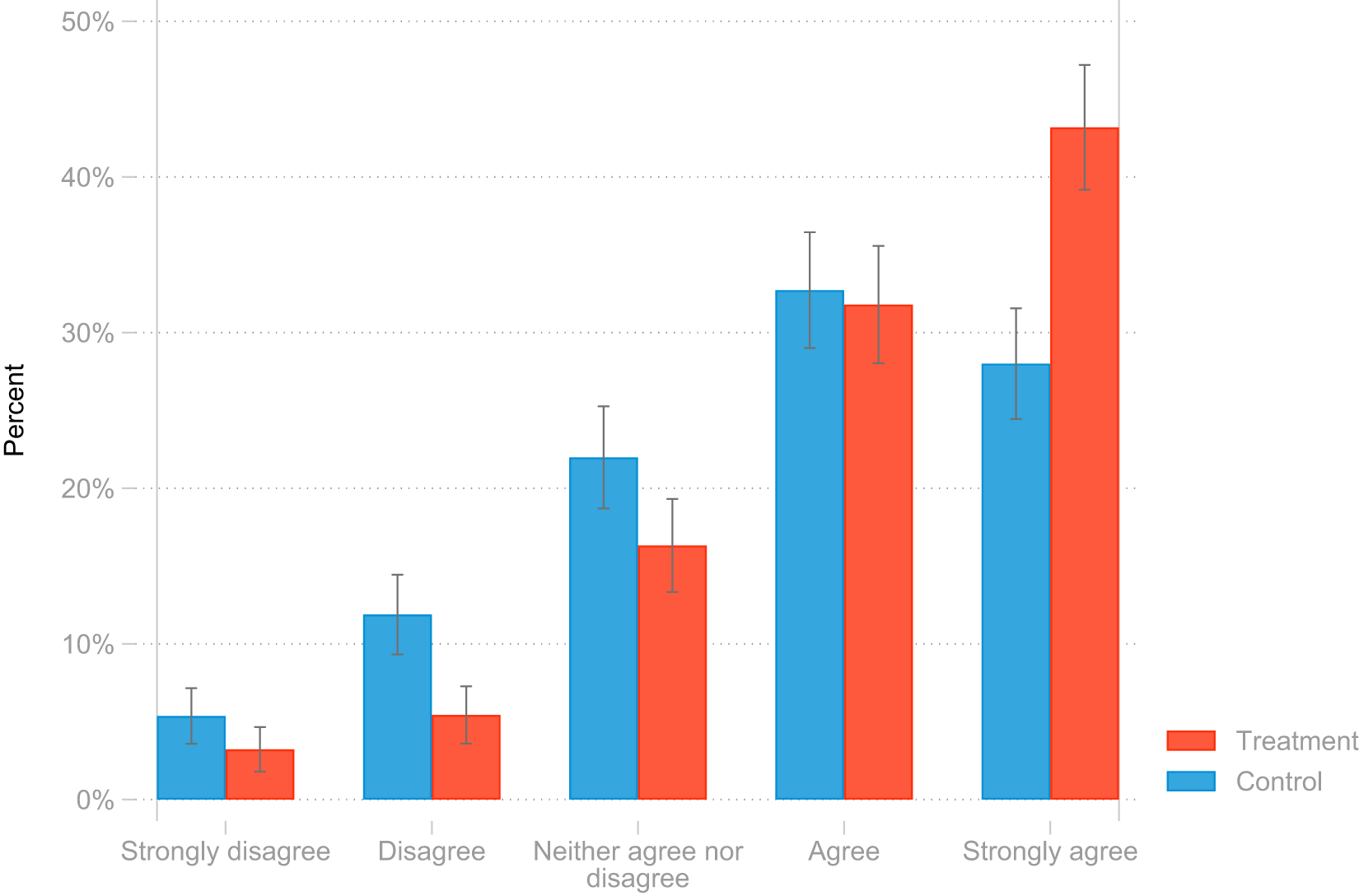
We interpret these results as additional evidence on the mechanism behind the surge in incumbent support we have documented in the attacked regions after each terrorist attack. Even several years after the end of ETA’s activity, the recall of its history still was able to increase Spanish respondents’ support for the rally around the flag logic. These findings provide further support to our interpretation of the main results of the paper presented above. The boost in incumbent support after a domestic attack among those that were more exposed to it appears to be related to the rally around the flag logic.
7. Conclusions
In this paper, we have presented the first attempt, to the best of our knowledge, at leveraging a large number of unexpected events during surveys to identify the effects of terrorism. Most importantly, we aimed at a systematic and not arbitrary selection of cases. Using web scraping, we matched all official public opinion surveys in Spain with the universe of terrorist attacks perpetrated in Spanish soil. Applying a set of data quality criteria, we retained 142 attack-survey pairs for the analysis. These attacks occurred over 15 years, across various different regions and under different incumbents. This effort constitutes a step forward with respect to the state of the art. It combines a well-identified, high internal validity research design, with a systematically selected and wide sample of events. This strategy alleviates concerns that collateral events specific to a single attack may be driving the effects, hence making the assumption of excludability more credible. Our design, we argue, represents an important enhancement of the standard UESD strategy. Moreover, it provides a rare opportunity to test for heterogeneous effects in the context of a robust identification strategy.
Of course, the cases we analyzed come from a single country in a specific period, so questions about external validity in the sense of cross-national and cross-temporal generalizability remain. However, the use of a large number of attacks allows us to average out the idiosyncrasies of any specific event and hence represents a step forward with respect to the prior research.
In substantive terms, we have been able to identify a clear and consistent rally around the incumbent in those regions that were directly targeted.Footnote 10 Terrorist attacks seem to temporarily boost the intention to vote for the incumbent in the attacked regions in around 4 percentage points and harm the opposition. This effect may be short lived but it is nonetheless important, as it could be very consequential for elections that are held shortly after terror attacks (Falcó-Gimeno et al., Reference Falcó-Gimeno, Muñoz and Pannico2023).
The effect is especially important for attacks that target civilians, that arguably are those that are perceived as more threatening. We have found, moreover, the effect to be concentrated during the periods of conservative governments. While our results do not support the alternative theory of a general shift to the right following exposure to terrorism, we do find that the pro-incumbent effect occurs mostly when the incumbent is conservative. This result may suggest that rather than two alternative theories, the rally around the flag and the conservative shift hypothesis should be considered in conjunction.
We have also provided experimental evidence on the mechanism behind the observed surge in incumbent support. Our survey experiment show that citizens tend to agree more with the logic of the rally around the flag when primed to think about ETA campaigns.
Our results regarding incumbent support stand in contrast with Balcells and Torrats-Espinosa Reference Balcells and Torrats-Espinosa(2018), who did not find an effect on incumbent support in their analysis of eight cases. Moreover, unlike Balcells and Torrats-Espinosa Reference Balcells and Torrats-Espinosa(2018), we did not find a consistent effect on the intention to abstain. Our study is based on a different, and much larger sample of cases.Footnote 11
These findings are important for the literature, because we have provided strong evidence for a rally around the flag in an unlikely case: a parliamentary democracy facing a sustained domestic terrorist campaign rather than isolated, massive attacks perpetrated by international terrorist groups. Such a context is arguably a least likely case for the rally to occur. If we translate the effect we have identified of a single attack in a targeted region into the Fisher’s Z correlation coefficient used by Godefroidt Reference Godefroidt(2022) in her meta-analysis, our effect size is about 0.49, which is a bit more than half the average rally effect found in the literature. This is unsurprising given that, according to the meta-analysis, the rally effects documented in previous studies, although consistent, appeared to be “primarily driven by a post-9/11 rally-‘round-the-U.S.-flag effect or by an even more idiosyncratic rally around the President Bush effect” (Godefroidt, Reference Godefroidt2022, 32). Overall, our results indicate that the short-term pro-incumbent reaction in the aftermath of a terrorist attack can occur even in unlikely contexts, especially when the incumbent is conservative and the attacks target civilians.
Supplementary material
To view supplementary material for this article, https://doi.org/10.1017/psrm.2025.10021. To obtain replication material for this article can be found at https://doi.org/10.7910/DVN/4I6QO4.
Data availability statement
All the data and replication materials used for this article will be made publicly available in the Dataverse upon publication.
Acknowledgements
We are grateful to participants at the EPSA 2021, MPSA 2021, PolMeth Europe 2022, and IC3JM-UC3M 2022 conferences, at the 2022 University of Warwick Workshop on Terrorism, Public Attitudes and Individual Well-Being, and at the CSIC-IPP 2023 seminar series for their useful comments. We would also like to thank the anonymous reviewers for their helpful feedback.
Funding
This research is part of the grant CSO2017-89085-P funded by MICIU/AEI/10.13039/501100011033 and by “ERDF A way of making Europe” and has received financial support from the Spanish Centro de Investigaciones Sociológicas (CIS).
Competing interests
The authors declare none.


 Open access

