

1. Introduction
Transition Design has gained recognition as a framework for addressing complex societal challenges, particularly in sustainability (Reference IrwinIrwin, 2015). However, its application to cultural transitions—especially in non-Islamic societies where minority religious practices are emerging—remains underexplored. This study proposes Transition Design for Cultural Inclusivity, positioning design as a mechanism to support cultural transitions toward more inclusive futures. It examines the halal ecosystem in Fukuoka, Japan, where the growing presence of Muslim residents, students, and tourists contrasts with fragmented institutional and service infrastructures. Using a systemic service design approach, the study maps current system conditions, envisions an inclusive 2045 scenario, and outlines transition pathways.
The research aims to extend Transition Design into the cultural domain by investigating how systemic service design can facilitate inclusivity in non-Islamic contexts. The guiding question is: How can design facilitate cultural transitions toward greater inclusivity in non-Islamic societies? Fukuoka provides a relevant case, reflecting Japan’s emerging multicultural realities and visible service and policy gaps in its halal ecosystem.
Methodologically, the study integrates systems thinking with service design to conceptualise the halal ecosystem as a service-societal system (Reference Bijl-Brouwer and MalcolmBijl-Brouwer & Malcolm, 2020). Through system mapping, future visioning, and transition pathway development, it identifies leverage points linking present conditions to long-term transformation. In doing so, the study extends Transition Design to cultural contexts, offers empirical insight into halal service design in non-Islamic urban settings, and demonstrates the integration of systemic and service design as an approach to cultural transition.
2. Theoretical background
2.1. Transition design and the need for worldview shifts in cultural contexts
Transition Design has emerged as a framework for long-term societal transformation, integrating futures thinking, systems thinking, and changes in everyday life (Reference IrwinIrwin, 2015). It argues that wicked problems demand multi-scalar transformations that reshape infrastructures, policies, and underlying worldviews (Reference IrwinKossoff, Tonkinwise, & Irwin, 2015). However, its applications have focused primarily on environmental and socio-technical transitions, closely aligned with sustainability transition research (Reference GeelsGeels, 2002; Reference Markard, Raven and TrufferMarkard et al., 2012). While this work confirms the relevance of Transition Design for ecological and infrastructural challenges, cultural dimensions—such as identities, rituals, meanings, and intergroup relations—remain comparatively underexplored. Similarly, Reference Ceschin and GaziulusoyCeschin and Gaziulusoy (2016) note that earlier sustainability-oriented design approaches were overly product- and service-centric, with limited attention to broader social and cultural dynamics.
Research in culturally diverse and Indigenous contexts further emphasises that design is relational and situated. Reference Akama, Hagen and Whaanga-SchollumAkama, Hagen, and Whaanga (2019) argue that meaningful transformation must be grounded in reciprocity, lived experience, and culturally embedded values, suggesting that societal transitions are inherently cultural. Yet such perspectives have rarely been integrated into Transition Design discourse.
Together, this paper reveals a theoretical gap: although Transition Design foregrounds shifts in worldview, it has seldom addressed cultural or religious contexts where these shifts are most visible. This study responds by examining how Transition Design can engage cultural transitions in a non-Islamic society, focusing on the emerging halal ecosystem in Japan.
2.2. Systemic service design: an approach for complex sociocultural systems
Systemic Service Design (SSD) integrates systems thinking with service design to understand and intervene in complex sociocultural and sociotechnical environments. It conceptualises services as parts of broader ecosystems shaped by institutional structures, cultural norms, and material infrastructures, aligning with work that frames value co-creation as inherently contextual (Reference Akaka, Vargo and SchauAkaka et al., 2015). SSD emphasises the need to work across multiple systemic layers and to coordinate short-term interventions with long-term change, a perspective advanced in contemporary systemic design research (Reference Bijl-Brouwer and Malcolmvan der Bijl-Brouwer & Malcolm, 2020; Reference Jones and KijimaJones & Kijima, 2018). Recent methodological developments in the field, such as those consolidated by Reference Jones and AelJones and Van Ael (2023) and Reference Suoheimo, Jones, Sevaldson and LeeSuoheimo et al. (2025), offer concrete approaches for mapping complexity and supporting collaborative sensemaking.
In this study, SSD provides the conceptual and methodological foundation for treating the halal ecosystem in Fukuoka as a multilayered sociotechnical and sociocultural system. It enables the use of system mapping, leverage-point identification, and future scenario development to articulate potential transition pathways toward cultural inclusivity.
2.3. Toward cultural inclusivity and cultural transitions
Cultural inclusivity has become an essential concern in design as societies diversify. While research has addressed culturally informed practices, design’s role in enabling cultural transitions—systemic shifts in meanings, practices, and relationships across cultural boundaries—remains underdeveloped. Prior studies show that design and service interactions are embedded in culturally situated ways of knowing and doing (Reference KimbellKimbell, 2011; Reference ManziniManzini, 2015), and that value co-creation is shaped by culturally mediated experience structures (Reference Akaka, Vargo and SchauAkaka, Vargo, & Schau, 2015). Research in multiculturalism further indicates that inclusion requires changes in institutional norms and shared public narratives, not merely functional accommodation (Reference VertovecVertovec, 2007; Modood, 2013).
Within design, relational and situated approaches emphasise attention to lived experience and community-defined values, particularly where cultural practices are marginalised (Reference Akama, Hagen and Whaanga-SchollumAkama et al., 2019). Reference EscobarEscobar (2018) further argues that designing for plural worlds entails recognising multiple ways of being and enabling them to co-shape collective futures.
Despite these insights, design lacks frameworks that address cultural transitions in societies where minority practices lack institutional support. This study defines cultural inclusivity as a systemic condition in which services and institutions adapt to diverse cultural needs, and cultural transitions as the processes through which such adaptation unfolds. This framing provides the conceptual basis for examining the halal ecosystem in Fukuoka as a culturally situated system in transformation.
3. Methodology
3.1. Research design
This study adopts a Research through Design (RtD) approach conducted within an eight-week Project-Based Learning (PBL) studio at Kyushu University (Reference Blumenfeld, Soloway, Marx, Krajcik, Guzdial and PalincsarBlumenfeld et al., 1991; Reference Koskinen, Zimmerman, Binder, Redstrom and WensveenKoskinen et al., 2013). The project unfolded in three phases: (1) system exploration, (2) future visioning, and (3) prototyping.
During weeks 1–2, students investigated the existing halal ecosystem in Fukuoka through preliminary research and stakeholder engagement. In weeks 3–4, they developed multilayered system maps and articulated 2045 future scenarios envisioning a more culturally inclusive ecosystem. In weeks 5–7, these scenarios were translated into preliminary service concepts—including the Halal Portal—and refined through iterative feedback. The final week concluded with presentations to stakeholders who had previously contributed as guest lecturers.
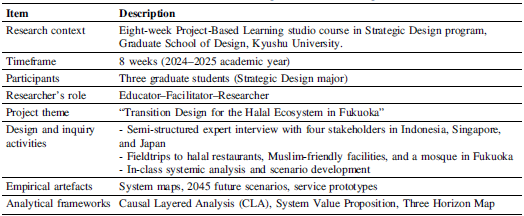
Table 1 summarises the educational and research setting, including institutional context, participants, project format, and duration. It also outlines the principal learning and research activities, such as expert interviews with stakeholders from Japan, Indonesia, Singapore, and Egypt, and field visits to Muslim-friendly facilities. In addition, it clarifies the researcher’s role as educator–facilitator–researcher and identifies the primary artefacts—system maps, future scenarios, and service prototypes—that formed the basis for analysis. Together, these elements define the empirical conditions under which the study was conducted.
Research design and studio setting

3.2. Data and analytical strategy
This study draws on design artefacts and observational materials generated during the eight-week studio. The dataset includes multilayered system maps capturing stakeholders, infrastructures, policies, and cultural practices; 2045 future scenarios outlining culturally inclusive visions for Fukuoka; and service prototypes proposing structural or service-level interventions within the halal ecosystem. Additional materials consist of in-class discussion records and researcher field notes documenting students’ reasoning, stakeholder insights from expert interviews, and observations from field visits to Muslim-friendly facilities. Together, these materials constitute the primary dataset.
The dataset was analysed through a structured, interpretive process informed by Systemic Service Design and Transition Design, guided by three analytical frameworks:
Causal Layered Analysis (CLA) (Reference InayatullahInayatullah, 1998), which examines systems across four layers—litany, systems, worldview, and myth—to identify transformative leverage points. Students used CLA to move from surface-level issues to deeper paradigm shifts.
System Value Proposition (SVP) (Reference Jones and AelJones & Ael, 2023), which maps value co-creation across stakeholders and system layers, reveals misalignments such as SME certification barriers that undermine Muslim consumer trust.
The Three Horizons model (Reference Sharpe, Hodgson, Leicester, Lyon and FazeySharpe et al., 2016), distinguishes present practices (H1), transition initiatives (H2), and long-term vision (H3). The Halal Portal was positioned as an H2 intervention toward 2045 inclusivity.
Analysis proceeded in three steps. First, system maps were examined to identify recurring patterns, including institutional fragmentation, gaps in cultural interpretation, infrastructural constraints, and leverage points. Second, future scenarios were compared to extract shared assumptions, emerging values, and indicators of cultural transition, particularly shifts in worldview and sociocultural practice. Third, these insights were synthesised to outline preliminary transition pathways from the current system toward more inclusive configurations. This process linked situated observations with long-term transformation while grounding findings in established design frameworks.
A limitation of this study is the small and mixed positionality of participants. The artefacts were produced by three students—two Muslim and one non-Muslim—which may have shaped interpretations of halal practices and system needs. While Muslim participation enhanced contextual sensitivity, the limited diversity constrains generalisability; findings should therefore be considered situated and exploratory.
All students provided informed consent for the use of their design outputs. No personal or evaluative data were collected, and analysis focused solely on shared artefacts and processes. The researcher’s dual role as educator and researcher was acknowledged, with pedagogical assessment kept separate from research analysis.
4. Results
4.1. Framing the system: listening to the system’s voice and understanding its dynamics
Analysis of the system maps, field observations, and stakeholder interviews revealed three interrelated patterns that characterise the current state of the halal ecosystem in Fukuoka. Figure 1 illustrates students constructing an Actor’s Map and Emerging Niche Initiatives, during Week 2, physically annotating policy gaps and stakeholder disconnects on large flipchart papers. These patterns reflect the underlying structures, value conflicts, and operational constraints that shape how halal practices are introduced, interpreted, and enacted within a predominantly non-Islamic society.
4.1.1. Policy and institutional fragmentation
Across the system maps and interviews, the result consistently identified the absence of a coherent policy framework as a foundational barrier. Government guidelines on halal food, dietary requirements, or Muslim-friendly services remain limited, leading to inconsistencies in implementation and limited institutional accountability. The coexistence of multiple certification bodies—each with different criteria, levels of transparency, and costs—further complicates the landscape, creating uncertainty for businesses and consumers alike. Small and medium-sized enterprises (SMEs) face high financial and administrative barriers to obtaining certification, resulting in a system that is fragmented, difficult to navigate, and reliant on individual initiative rather than systemic support. This fragmentation prevents the emergence of a shared strategic direction for the halal ecosystem.
An expert representative from the Fukuoka Mosque explained that halal certification “has become a business”. While halal certification from some mosques including Fukuoka Mosque, is free elsewhere, the prices go up and it becomes more challenging for smaller restaurants to obtain the certification. They also added said, “Japanese people weren’t used to being asked about their food,” making it difficult for Muslims to confirm ingredients and practices. Another expert stakeholder, who is a CEO for a Japan-based career platform that specialises in connecting Indonesian professionals with job opportunities in Japan, highlights that many businesses continue to treat Muslim guests as an “additional” market rather than part of their core customer base, limiting deeper inclusion.
Furthermore, a foresight expert who shared on futures perspective, explained that inclusive policy-making needs to be above from a “them system to a us system”, where minority needs are treated as integral rather than exceptional.
4.1.2. Cultural and cognitive barriers
The second pattern concerns the cultural and cognitive gaps that shape how halal is perceived and practised. Interviews with halal food experts, tourism expert and community members highlighted widespread misunderstandings regarding halal labels, symbols, and their underlying religious and ethical significance. These gaps contribute to resistance or indifference among non-Muslim stakeholders, who may view halal as either overly exclusive or irrelevant to their own lives. Such perceptions generate subtle forms of cultural friction and reduce the willingness of businesses and institutions to engage with halal initiatives.
A long-term Muslim Japanese resident recalled that in 1998, there was “almost nothing” halal in the Kyushu region. They were faced with only two choices: “eat whatever, or don’t eat at all”, underscoring how limited their options were and the need to compromise.
Simultaneously, the results show an increasing interest in ethical consumption, suggesting that improved cultural understanding and education could reposition halal as part of broader social values—rather than a niche or foreign practice. The co-existence of resistance and emerging openness indicates the early stages of a cultural transition.
4.1.3. Market and infrastructure constraints
The third pattern relates to the structural limitations of the market and the physical infrastructure supporting halal practices. Despite rising demand from international students, tourists, and residents, halal food options remain limited, unevenly distributed, and costly. Businesses face supply constraints, including limited availability of certified ingredients and high logistics costs. Infrastructure such as prayer rooms, multi-faith spaces, or halal-friendly facilities is scattered and inconsistently provided, placing the burden of navigation on Muslim individuals. Stakeholders have also pointed out emerging problems beyond halal, including Muslim graveyard arrangements, alluding to unmet infrastructural needs for the growing Muslim population in Japan.
These constraints highlight a misalignment between growing multicultural needs and the current capacity of urban systems and markets to respond. While long-term trends—such as halal tourism, diversified halal products, and cross-cultural engagement—signal potential growth, the present system lacks the foundational structures required to support this expansion.
Together, these three systemic patterns—policy fragmentation, cultural-cognitive barriers, and infrastructural-market constraints—constitute the “voice of the system.” They provide a grounded understanding of the structural and cultural forces that shape the current halal ecosystem and set the stage for envisioning how more inclusive futures might emerge.
Students constructing system maps and identifying policy fragmentation nodes

4.2. Future scenario themes: envisioning cultural inclusivity
The 2045 scenarios developed by the students present a layered and forward-looking vision of how cultural inclusivity within Fukuoka’s halal ecosystem may unfold over time. While each team explored the future through different emphases and narrative styles, a clear set of convergent themes emerged across their work. These themes span shifts in underlying values, systemic reconfigurations, and transformations in everyday experiences. Together, they articulate a coherent picture of cultural transition grounded in the analytical structures of Causal Layered Analysis (CLA), System Value Proposition, and long-term horizon map.
The future scenarios generated by the students articulate how Fukuoka’s halal ecosystem could evolve toward cultural inclusivity by 2045. Although presented through different narrative forms, the scenarios converge around three interconnected thematic layers—paradigm, system, and everyday experience—mirroring the structure of the CLA, the System Value Proposition, and the Three Horizons model used during the studio.
4.2.1. Paradigm shift toward cultural inclusivity
Across the scenarios, students envision a future in which cultural and religious differences are no longer treated as exceptional or burdensome but as a natural and valued part of collective life. Halal practices are reframed from being an “external cultural requirement” to being aligned with broader societal values such as hospitality, ethical consumption, care, reciprocity, and peaceful coexistence.
By 2045, Japanese society is described as maintaining its cultural identity while embracing pluralism—suggesting a deep shift in societal narratives. This theme reflects a transition at the worldview level, in which inclusivity becomes embedded in the cultural mythos and the moral orientation of everyday life.
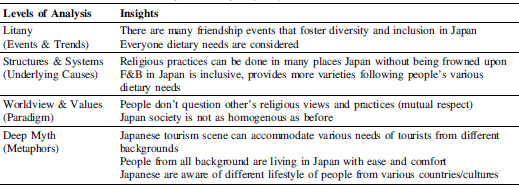
These insights were derived using the CLA framework, which enabled the exploration of trends from the surface level (litany) into the deepest level (deep myth). The synthesised results of this layered analysis are presented in Table 2, illustrating how students’ future imaginaries evolve across different analytical depths.
Causal Layered Analysis (CLA) summarised into a table format

4.2.2. System-level integration of halal infrastructure
A second theme concerns the structural transformation required within the ecosystem. Across the scenarios, students envision that the currently fragmented landscape—marked by multiple certification bodies with inconsistent standards, limited governmental guidance, and dispersed information channels—would evolve into a more coordinated and transparent system. To support this transition, the scenarios describe the emergence of a centralised halal information hub, clear and unified certification frameworks, and institutionalised diversity education that equips organisations with the knowledge needed to engage meaningfully with cultural differences. They further highlight the importance of collaborative governance structures linking government, industry, universities, and community groups, alongside policy mechanisms that foster halal tourism and Muslim-friendly urban environments. This vision of systemic integration is presented as a foundational condition for cultural transition, aligning closely with the System Value Proposition’s call for holistic value creation and with the longer-term developmental trajectory articulated in the Three Horizons framework.
4.2.3. Everyday inclusivity and enhanced user experience
The third theme focuses on the lived experience of Muslims in 2045. Students imagine a city where inclusive design is normalised through accessible and trustworthy halal labels, widely available halal food, well-distributed prayer rooms, and frictionless support throughout daily life. Notably, scenarios highlight psychological outcomes such as safety, dignity, trust, and a sense of belonging—indicating that cultural inclusivity depends not only on structural change but also on emotional and experiential quality.
Examples such as halal-certified wagyu, improved halal tourism services, and multilingual communication further illustrate how inclusion becomes integrated into everyday touchpoints.
Together, these three themes provide a multi-layered scenario of cultural transition—from deep shifts in societal narratives, to the systemic coordination of infrastructures, to enhanced everyday experiences. This layered vision, rooted in the analytical tools used in the studio, provides a coherent foundation for identifying leverage points and potential interventions.
4.3. Prototyped intervention: identifying leverage points for systemic transition
The prototypes developed in the studio functioned as concrete explorations of how the current halal ecosystem could transition toward the inclusive futures envisioned for 2045. The central output was the Halal Portal, as visualised in Figure 2, a conceptual platform designed to consolidate fragmented information, streamline certification, and provide multilingual guidance for residents, businesses, and visitors. By addressing current gaps in transparency, coordination, and cultural understanding, the portal illustrates a key leverage point: the integration of information and governance infrastructures across stakeholders.
Additional lightweight service concepts—such as unified halal labelling, improved prayer-space guidance, and enhanced user experiences for halal tourism—highlight everyday touchpoints that can reduce cultural friction and strengthen psychological safety. Although prototype fidelity was limited, these interventions clarify where targeted design actions may trigger broader systemic transitions. Collectively, the prototypes demonstrate that small, yet strategic design interventions can bridge the current fragmented system and the culturally inclusive futures described in the scenarios.
The prototype was then consulted and received feedback from the experts. “I think this Halal Portal has potential not just for inclusion but also strategic positioning. There’s a long-term market opportunity,” a non-Muslim expert who owns a halal food business commented. An expert who supports Indonesian Muslims seeking work in Japan, added that local governments “need more guests from outside Japan but don’t know how to welcome and give their hospitality,” acknowledging the need for tools like the Halal Portal to make cultural and religious requirements visible and actionable for Japanese institutions. However, both experts had reservations about the business model of the project.
The halal portal that enables multi-stakeholder navigation

In addition, at the end of the class project, each participant was asked about their opinion on participating in envisioning the future of halal ecosystem in Japan. Participant 1 noted, “At first, I had little hope that Japan would change for Muslim minorities given our small numbers and cultural differences. However, after examining the issue more systematically, I realised there are ways for better integration and easier living, even if the impact will take time.” Participant 2 added, “When it came to halal, or simply Muslim-friendly facilities, I always felt guilty for having these needs. I understood why Japan didn’t want to prioritise projects related to it since it does not necessarily benefit them. This class proved that there are ways to nurture mutual understanding. Slowly, I do hope, that future generations of Muslims in Japan would not have to go through the same struggles seen today.” Participant 3 gives quite a different perspective, “As a non-Muslim, I was surprised that my Muslim friends feel guilty about asking halal options. This makes me reflect on my role in this whole ecosystem because I’m not exactly a majority (non-Japanese). Overall, this project has given me new perspectives, and I’d like to be more supportive of my Muslim friends moving forward.”
5. Discussion
This study sought to expand the scope of Transition Design by examining how cultural transitions unfold in a non-Islamic society through the case of the halal ecosystem in Fukuoka, Japan. The findings demonstrate that cultural inclusivity does not emerge solely from infrastructural adjustments or the provision of minority-oriented services. Instead, it requires transformations across three interconnected layers: the reframing of societal narratives (paradigm), the restructuring of institutional and informational systems (structure), and the redesign of everyday interactions and experiences (practice). This layered configuration extends current discussions in Transition Design, which have traditionally focused on socio-technical and sustainability-oriented transitions, by foregrounding the importance of cultural and religious diversity as a site of systemic change.
From a theoretical perspective, the study contributes to an emerging conversation on how design can mediate cultural transitions in societies with increasing demographic complexity. While prior work in Transition Design has emphasised ecological imperatives and lifestyle change, the present research shows that cultural and religious practices also constitute infrastructures that must be redesigned to support equitable futures. The integration of Causal Layered Analysis, System Value Proposition, and long-term horizon mapping illustrates how systemic service design can operationalise cultural values, revealing leverage points that connect deep narratives with tangible service and policy interventions. This positions systemic service design as a complementary methodology to Transition Design, capable of translating cultural concerns into system-level strategies.
The empirical findings also underscore the specificity of the Fukuoka context. As a regional city undergoing internationalisation without a long history of Muslim presence, Fukuoka reflects the challenges faced by many non-Islamic societies: limited cultural literacy, fragmented administrative support, and service infrastructures not yet aligned with minority practices. The prototypes—particularly the Halal Portal—demonstrate how design interventions can help bridge these gaps by strengthening transparency of information, enabling coordinated governance, and enhancing psychological safety for users. These insights extend beyond the halal domain and offer a transferable model for supporting emerging minority communities in similar socio-cultural contexts.
Methodologically, the study demonstrates the value of PBL studios as legitimate sites for RtD. Through iterative cycles of system mapping, scenario development, and prototyping, the studio facilitated forms of designerly knowledge production—visualisation, materialisation, and narrative exploration—that enabled students to articulate system dynamics that are often difficult to access through traditional empirical methods. This supports recent arguments that RtD can generate situated insights into complex socio-cultural systems, especially when embedded within real educational environments.
However, the study also has limitations. The sample size was small, and the prototypes remained conceptual rather than fully validated through field implementation. Moreover, the analysis did not incorporate extensive ethnographic engagement with Muslim residents, business owners, or policy makers, which would be valuable for triangulating and deepening the findings. Future research should examine how the proposed interventions can be implemented and evaluated in practice, especially in collaboration with municipal actors and Muslim communities, and explore how cultural transitions unfold in other minority ecosystems beyond the halal context.
6. Conclusion
In conclusion, this study argues that designing for cultural inclusivity requires attending to values, systems, and everyday practices simultaneously. By examining the halal ecosystem in Fukuoka, it demonstrates how Transition Design can be extended to cultural domains and how systemic service design can facilitate more just and inclusive futures. As societies worldwide become increasingly diverse, design will play a crucial role not only in improving services, but in shaping the cultural infrastructures through which people live together.
Acknowledgement
We thank the Strategic Design students and all interview participants for their valuable contributions to this study. Their insights and collaboration made this research possible.



 Open access

