




Introduction
Survival among individuals with congenital heart disease (CHD) has improved markedly over recent decades. Reference Moons, Bovijn, Budts, Belmans and Gewillig1–Reference Mandalenakis, Giang and Eriksson3 However, the life-expectancy in patients with complex CHD, such as Fontan circulation, remains reduced, with heart failure being the leading causes of mortality. Reference Diller, Kempny and Alonso-Gonzalez4 In addition to cardiovascular complications, morbidities such as impaired muscle function Reference Sandberg, Crenshaw and Elçadi5–Reference Kröönström, Johansson, Zetterström, Dellborg, Eriksson and Cider11 and reduced aerobic exercise capacity Reference Tran, D’Ambrosio and Verrall8,Reference Kempny, Dimopoulos and Uebing12 are common, especially in those with Fontan circulation. These impairments are associated with poor prognosis in patients with acquired heart failure, Reference Liu, Su, Lei, Tian, Zhang and Xu13,Reference Mancini, Eisen, Kussmaul, Mull, Edmunds and Wilson14 and similar associations regarding exercise capacity and prognosis have been confirmed in CHD patients. Reference Diller, Dimopoulos and Okonko15–Reference Wikner, Sandström and Rinnström18 Notably, these deteriorations are often present at a young age in Fontan patients. Reference Ritmeester, Veger and van der Ven9
Previous research indicates that adults with CHD are as physically active as healthy controls. Reference Sandberg, Pomeroy, Thilén, Gradmark, Wadell and Johansson19 Therefore, physical activity levels cannot be the only reason for the impaired muscle function. While several studies have demonstrated that aerobic training improves cardiorespiratory fitness in CHD populations, the effects of strength training, particularly on dynamic muscle function, remain underexplored. Reference Scheffers, Berg, Ismailova, Dulfer, Takkenberg and Helbing20–Reference Tran, Maiorana and Ayer22
A small study in adults with Fontan circulation reported improvements in aerobic exercise capacity, cardiac output, and muscle mass following strength training. Reference Cordina, O’Meagher and Karmali23 Similarly, a randomised controlled trial in children with Fontan circulation reported increased aerobic exercise capacity, ventricular stroke volume, and isometric muscle strength. Reference Scheffers, Helbing and Pereira24 However, current evidence on the effects of strength training on dynamic muscle function in this population is limited. Furthermore, it is unclear whether adults with Fontan circulation experience similar benefits from strength training as healthy controls. Reference Scheffers, Berg, Ismailova, Dulfer, Takkenberg and Helbing20,Reference Tran, Maiorana and Ayer22
A recent study reported on a high prevalence of fatigue, i.e., a perceived feeling of sustained tiredness and exhaustion, among adults with complex CHD, particularly those with Fontan circulation. Reference Ternrud, Hlebowicz, Sandberg, Johansson and Sparv25 Strength training has been shown to reduce perceived fatigue in other patient groups, such as fibromyalgia, Reference Ericsson, Palstam and Larsson26 but no studies have investigated the impact of strength training on fatigue in patients with Fontan circulation.
Against this background, the primary aim of this study was to compare the effects of strength training on dynamic muscle endurance in adults with Fontan circulation and matched healthy controls. Secondary aims included evaluation of the effects of strength training on (i) dynamic muscle function, (ii) aerobic exercise capacity, and (iii) perceived fatigue.
Materials and methods
Study population
This pilot study was designed as a non-randomised controlled trial consisting of a 10-week strength training intervention aiming to improve dynamic muscle function. Adult patients with Fontan circulation were recruited between August 1, 2022, and August 31, 2023, from the Northern health care region, Sweden. Inclusion criteria were age ≥18 years and patients with Fontan circulation in a clinically stable situation. Exclusion criteria were regular strength training ≥2 times per week, diseases that could affect physical activity levels, such as rheumatoid arthritis, cognitive or neurological disabilities, or other situations, such as pregnancy, limiting the ability to participate. In addition, age- (±5 years but ≥18 years old) and sex-matched controls were recruited by convenience sampling, i.e., from the population near the study centre, during the same period. The same exclusion criteria as mentioned above also applied to the controls, with the additional criterion that no CHD was known. All participants who completed the intervention were included in the analysis. An illustration of the inclusion process and study design is shown in Figure 1. Prior to participation, written informed consent was obtained. The study was approved by the Swedish Ethical Review Authority (Dnr: 2022-00058-01, 2022-04769-02).
Illustration of the inclusion process and study design. Overview of the inclusion process and study design. *Participants were included if they were aged ≥18 years, had a Fontan circulation and were clinically stable. Exclusion criteria were regular strength training ≥2 times/week, conditions limiting exercise training (e.g., rheumatoid arthritis, cognitive or neurological disabilities, pregnancy), and, for controls, a known CHD.

Participant characteristics
Data on diagnosis and surgical interventions were retrieved from the Swedish registry of CHD (SWEDCON). In addition, data on height, weight, waist and hip circumference, oxygen saturation, and pharmacological treatment were obtained at baseline testing.
Dynamic muscle function
The dynamic muscle endurance of the shoulder flexors was assessed. Participants were instructed to hold a dumbbell (women: 2 kg, men: 3 kg) in their dominant hand, elevate the arm from 0° to 90° flexion, and keep the elbow extended throughout the movement. Participants sat comfortably with their backs against the wall, and the frequency was guided by a metronome (KORG Solometronome MA-30, KORG Inc. Japan), set at 40 beats per minute.
The dynamic muscle endurance of the calf muscles was assessed using unilateral heel raises. Participants stood on a 10° wedge with their dominant foot, rested the non-dominant foot slightly above the floor, and touched the wall with their fingertips for balance. The maximum height of the heel rise was determined and marked with a board on the wall prior to the test. Participants were instructed to reach this height for each repetition, keeping the knee extended throughout the movement, with repetitions performed at 60 beats per minute.
Both of the above-described tests have been used in this population previously Reference Bergdahl, Crenshaw, Hedlund, Sjöberg, Rydberg and Sandberg7,Reference Kröönström, Johansson, Zetterström, Dellborg, Eriksson and Cider11,Reference Sandberg, Thilén, Wadell and Johansson27 and have been shown to exhibit high test–retest reliability in patients with other cardiovascular diagnoses. Reference Cider, Carlsson, Arvidsson, Andersson and Sunnerhagen28,Reference Hellmark and Bäck29
The dynamic muscle capacity in unilateral elbow flexion was assessed using a cable machine. Participants stood in front of the machine with their dominant arm extended, holding the handle. They were instructed to flex the elbow while keeping the shoulder fixed. The distance between the toes and the machine was noted and used consistently for retesting. Repetitions were performed at 30 beats per minute.
The dynamic muscle capacity in unilateral knee extensions was assessed using a seated leg extension machine. Participants extended the knee of the dominant side from 90 to 0° flexion while sitting comfortably with their back supported and holding the handles. Repetitions were performed at 30 beats per minute.
All exercises were repeated to exhaustion and performed on the dominant side. The test was terminated by the investigator if the participant was unable to maintain the frequency or complete the range of motion for each repetition. The maximum number of repetitions was registered. At retest, both participants and test leaders were blinded to pre-intervention performances.
Prior to assessing dynamic muscle function in elbow flexion and knee extension, peak isometric muscle strength was measured using a load cell (VZ101BH 500 kg, Anyload Weigh & Measure Inc., NJ, US). Participants performed maximal contractions in elbow flexion and knee extension for five seconds, repeated three times with a one-minute rest in between, and the highest value was registered. Fifty per cent of the peak isometric muscle strength was used to determine the resistance for the dynamic muscle function test in elbow flexion and knee extension. For example, if the peak isometric muscle strength was 14 kg, then 7 kg was lifted during the dynamic muscle test. The same resistance was used for retesting.
Aerobic exercise capacity
A cardiopulmonary exercise test was performed on an electronically braked cycle ergometer (Corival CPET, Lode BV, Groningen, NL) to assess the aerobic exercise capacity at baseline and post-intervention. A standardised protocol was used, with an individual increment of workload (10-25 W/min). Conventional criteria of test termination were applied. Reference Liguori, Feito, Fountaine and Roy30 At retest, the same individual settings were used. Both the test leaders and participants were blinded from pre-intervention performances. Outcome variables were peak oxygen uptake, peak workload, and respiratory exchange ratio. To compare achieved exercise capacity between patients and controls, per cent of predicted peak oxygen uptake Reference Gläser, Koch and Ittermann31 and per cent of predicted peak workload Reference Brudin, Jorfeldt and Pahlm32 were calculated.
Fatigue
Evaluation of fatigue was assessed using the questionnaire Multidimensional Fatigue Inventory (MFI-20) at baseline and post-intervention. The questionnaire has been shown to be reliable Reference Smets, Garssen, Bonke and De Haes33,Reference Hagelin, Wengström, Runesdotter and Fürst34 and has previously been used in patients with Fontan circulation. Reference Ternrud, Hlebowicz, Sandberg, Johansson and Sparv25 The total test score was summarised, and a higher value indicates a higher degree of perceived fatigue. The questionnaire consists of the following five subcategories: general fatigue; physical fatigue; reduced motivation; reduced activation; and mental fatigue. Reference Smets, Garssen, Bonke and De Haes33
Intervention protocol
The intervention consisted of 10 weeks of strength training, performed three times per week at a gym chosen by the participant. The workout session began with a five- to ten-minute warm-up, i.e., cycling on an exercise bike or walking on a treadmill. The strength training protocol included elbow flexion, elbow extension, shoulder flexion, rowing, knee extension, knee flexion, heel raises, and deep squats. Also, grip exercise was performed using an adjustable hand grip. The workload was individually adjusted, and the training followed a progressive overload model targeting 10-12 repetitions per set across three sets. All participants were instructed to exhale during the concentric phase of each exercise to avoid the Valsalva manoeuvre that may decrease the venous return. The workout session ended with five to ten minutes of stretching.
The first workout session was guided by a test leader, and the introduction took place at the gym chosen by the participant. All participants were given access to a digital application, Exorlive (ExorLive AS, Oslo, NO), containing the workout protocol with individual settings. After each session, the participants completed a workout form and reported the date of workout, change of workload, repetitions, and/or sets. In addition, it was possible to communicate with the study leaders through the application. Moreover, participants were contacted regularly via telephone to help with adjustments to the protocol, to increase workload and to have their questions answered. If absence ≥ 7 days due to illness or other reason, one week was added to the intervention.
Statistical analysis
Statistical analyses were performed using IBM SPSS Statistics 28.0.1.1 (IBM, Armonk, NY, USA). Data are presented as median with interquartile range (IQR). Frequencies were presented as numbers with percentages. For comparison, the chi-square test was used for categorical variables, and the Mann–Whitney U test was used for analysis of continuous variables. The Wilcoxon signed rank test was used for within-group comparison. In all analyses, the null hypothesis was rejected on p values < 0.05.
Results
Study population
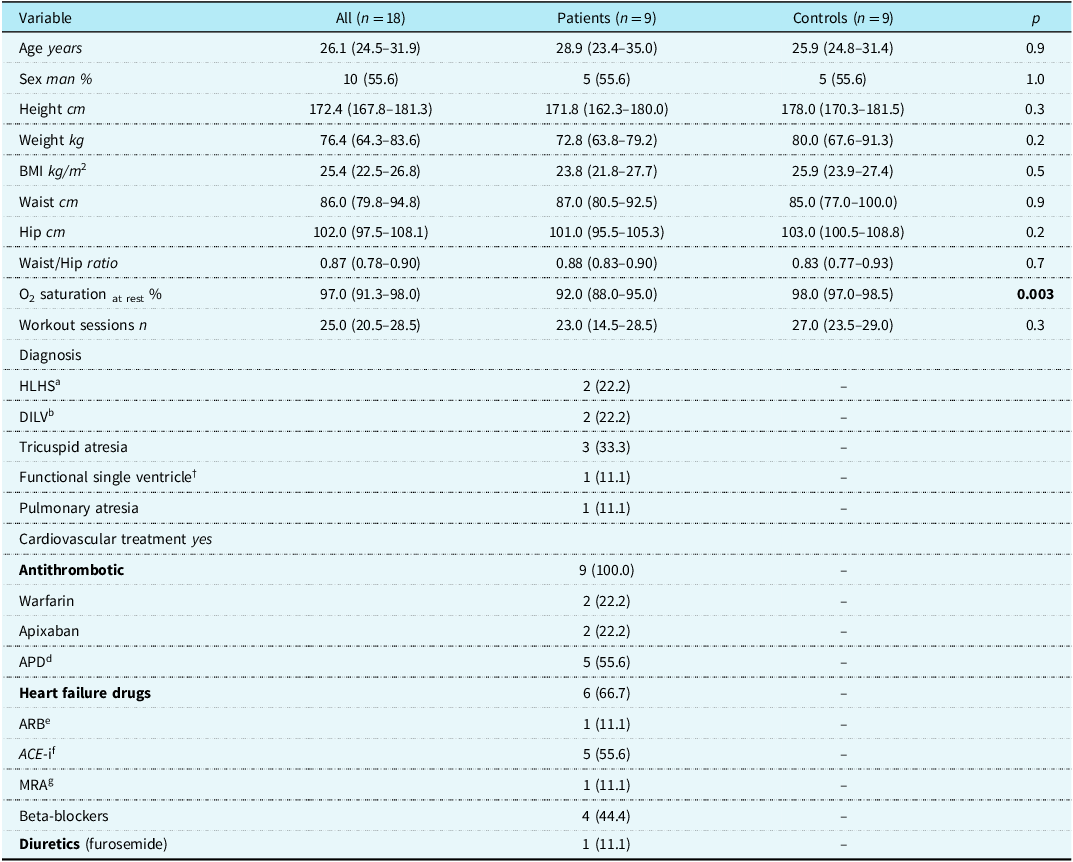
Nine patients (28.9 [23.4–35.0] years, four women) and nine age- and sex-matched controls were included in analysis (Figure 1). There were no differences in the distribution of age, sex, or body composition between patients and controls (Table 1). Only patients had cardiovascular pharmacological treatment. Among the patients, tricuspid atresia was most common (Table 1). Total cavopulmonary connection had been completed at a median age of 3.8 (IQR: 1.8–10.4) years.
Background characteristics

Values are presented as n (%) and median (25th–75th quartile). Bold values denote p<0.05 between patients and controls.
† Unspecified.
a HLHS: hypoplastic left heart syndrome.
b DILV: double inlet left ventricle.
c VSD: ventricular septal defect.
d APD: antiplatelet drugs.
e ARBs: angiotensin II receptor blockers.
f ACE-i: angiotensin-converting enzyme inhibitors.
g MRA: Mineralocorticoid receptor antagonist.
The intervention protocol was introduced at a median time of 9 (IQR: 8–12) days after baseline and the retests were performed after a median time of 13 (IQR: 12–14) weeks from baseline. There were no differences in the number of performed training sessions between the groups (Table 1). One patient reported on post-exertional exhaustion, and one patient reported difficulties in scheduling the training sessions. No severe adverse events were reported.
Dynamic muscle function
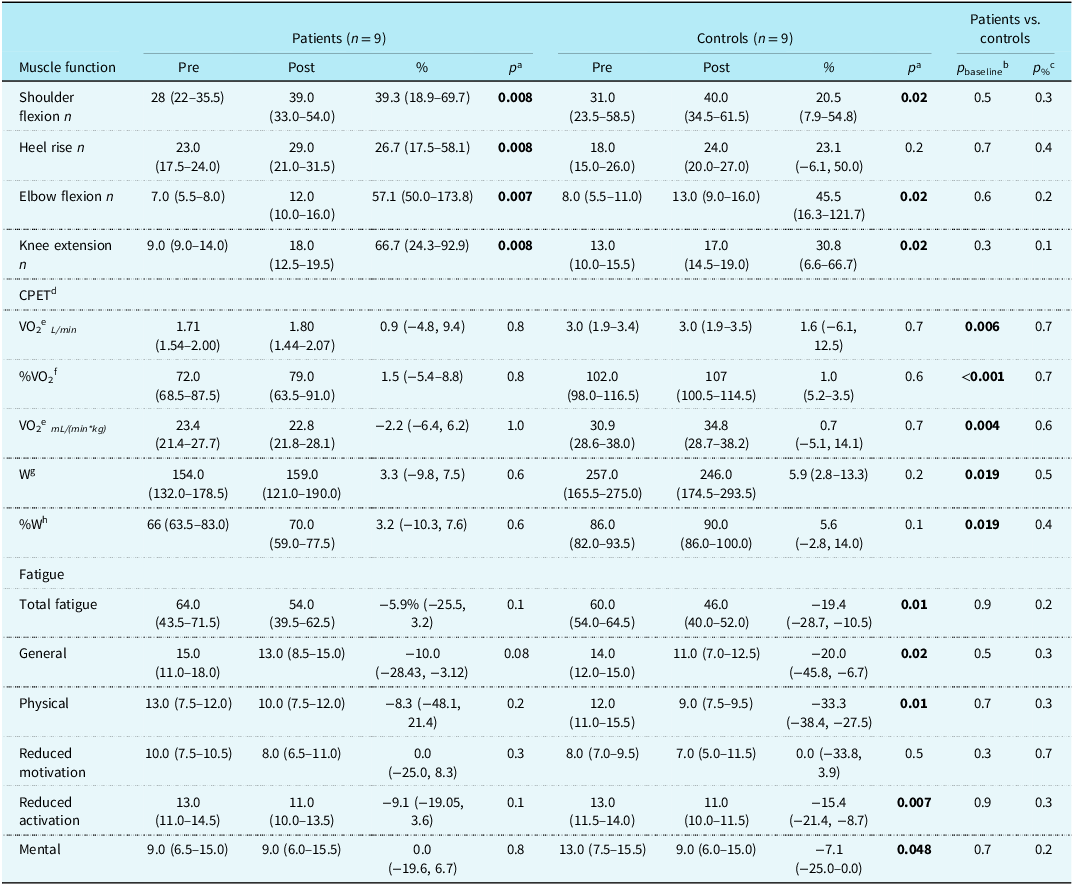
At baseline, no differences were found in the number of performed dynamic shoulder flexions, heel raises, elbow flexions, or knee extensions between patients and controls (Table 2).
Muscle function, aerobic capacity, and fatigue pre- and post-intervention

Values are presented as the median (25th–75th quartile). %: Change in percent following the training intervention. Fatigue is presented as a total score and as five subcategories; general-, physical-, reduced motivation-, reduced activation -, and mental fatigue based on the questionnaire Multidimensional Fatigue Inventory (MFI-20). Bold values denote p < 0.05.
a p: denotes p-value derived from within-group analysis (Wilcoxon signed rank test).
b pbaseline: denotes p-value derived from between-group analysis (Mann–Whitney U test).
c p%: denotes p-value derived from between-group analysis (Mann–Whitney U test), comparing the change expressed in percentages.
d CPET: cardiopulmonary exercise test.
e VO2: Peak oxygen uptake.
f %VO2: Per cent of predicted peak oxygen uptake.
g W: Peak Watt.
h %Watt: Per cent of predicted peak Watt.
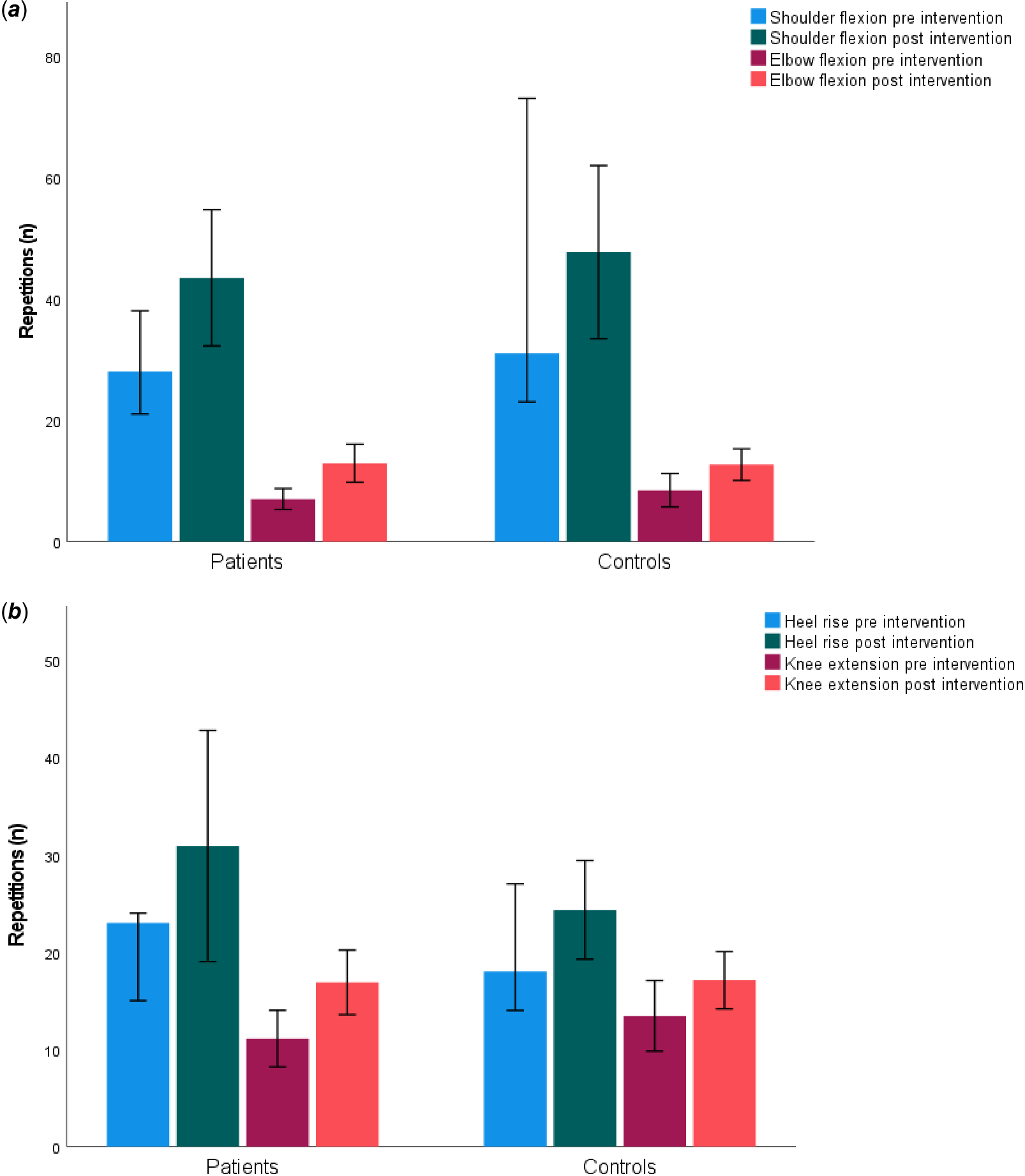
Following the intervention, within-group analyses showed that both patients and controls increased repetitions in dynamic shoulder flexions, elbow flexions, and knee extensions (Table 2, Figure 2a-b). Only patients improved in heel raises (Table 2, Figure 2b). Between-group comparisons revealed no differences in the magnitude of muscle function improvements (Table 2).
Illustration of muscle function performances. Median values of dynamic muscle tests of (a) upper extremity and (b) lower extremity pre- and post-intervention. Error bars represent 95% confidence intervals.

Aerobic exercise capacity
At baseline, patients had a lower aerobic exercise capacity, measured as peak oxygen uptake and peak workload, compared to controls. Following the intervention, neither patients nor controls showed improvements in aerobic exercise capacity (Table 2). The median respiratory exchange ratio at baseline and at retest was 1.13 (IQR: 1.06–1.20) and 1.15 (IQR: 1.10–1.23) for patients and 1.17 (IQR: 1.14–1.23) and 1.23 (IQR:1.18–1.27) for controls, indicating that sufficient effort was reached during the tests.
Fatigue
At baseline, no differences were found in fatigue scoring between patients and controls. In contrast to the patients, the control group reduced their total fatigue score post-intervention. Also, they lowered their score in the subcategories of general-, physical-, reduced activation, and mental fatigue. However, between-group analyses revealed no difference in the size of fatigue reduction between the groups (Table 2).
Discussion
This pilot study is the first to compare the effects of strength training on dynamic muscle function between adult patients with Fontan circulation and healthy controls. We demonstrate that strength training is safe and effective in improving dynamic muscle function in this population, with improvements comparable to those observed in healthy individuals.
Study population
No differences in body measures were found between patients and controls at baseline. Previous research has shown that adults with complex CHD are generally shorter, and that men tend to have a lower body mass index. Reference Sandberg, Johansson, Christersson, Hlebowicz, Thilén and Johansson35 The small sample size in the present study may explain why no differences in body compositions were observed.
Patient adherence to the training protocol was moderate (77%). Their adherence level may be due to challenges faced by patients with Fontan circulation, such as post-exertional exhaustion, which may affect the ability to maintain planned workout sessions. Post-exertional exhaustion was reported in one case, while another patient reported difficulties in scheduling the training sessions. A potential solution to improve adherence could be to provide prolonged supervision during the initial phase of exercise training. However, similar adherence (76%) was reported in a previous study, despite supervised training, Reference Cordina, O’Meagher and Karmali23 indicating that supervision alone may not substantially improve compliance. Importantly, all patients improved their dynamic muscle function post-intervention despite lower adherence to the protocol, and no severe adverse events occurred during the intervention period. Future studies should explore strategies to optimise adherence and assess whether supervised training yields superior outcomes.
Dynamic muscle function
At baseline, patients performed shoulder flexions at levels comparable to patients with complex CHD in an earlier study. Reference Sandberg, Thilén, Wadell and Johansson27 Furthermore, patients improved their dynamic muscle function in elbow flexion and knee extension by 57 and 67%, which were at comparable levels to the controls. In addition, a previous study reported a 43% increase in a combined measure of muscle strength in adults with Fontan circulation. Reference Cordina, O’Meagher and Karmali23 Although direct comparisons cannot be made, the magnitude of muscle function improvements was at comparable levels in both studies, despite a shorter intervention period in the present study.
We demonstrate that strength training improves dynamic muscle function in patients with Fontan circulation at levels comparable to controls, suggesting that strength training could be recommended in this population. However, future studies with larger populations are needed to confirm these findings.
Aerobic exercise capacity
At baseline, patients exhibited a lower peak oxygen uptake and peak Watt compared to controls, consistent with previous reports. Reference Kempny, Dimopoulos and Uebing12,Reference Wikner, Sandström and Rinnström18 The lack of improvements in aerobic exercise capacity may be attributed to the relatively short intervention (10 weeks). An extended training intervention may promote more pronounced peripheral adaptations, which could, in turn, improve peak oxygen uptake and overall aerobic exercise capacity. Yet, in a younger population, peak oxygen uptake increased after 10 weeks of strength training. Reference Scheffers, Helbing and Pereira24 This younger population, consisting of children, represents an intensive growth phase, making direct comparisons to adults difficult. Nonetheless, patient’s oxygen uptake, in terms of percentage of predicted, shifted towards the lower threshold of normal Reference Kempny, Dimopoulos and Uebing12 (from 72.0% [68.5–87.5] to 79.0% [63.5–91.0]), which may be valuable on an individual level, when undertaking daily activities. Furthermore, improved aerobic capacity may, although speculative, have prognostic relevance. Reference Wikner, Sandström and Rinnström18 Future studies should involve longer interventions with larger populations to better understand the effects of strength training on aerobic exercise capacity and prognosis in this population.
Fatigue
A high prevalence of perceived fatigue was observed in both patients and controls. Interestingly, only controls reported reduced fatigue following the intervention. Given the limited evidence on strength training and fatigue in Fontan patients, future research is needed to determine the training dose and modality required to reduce fatigue in this population.
Strengths and limitations
The cause of reduced muscle mass and impaired muscle function in patients with Fontan circulation remains unclear, but it may be attributed to their unique circulation physiology. Current knowledge about the effects of strength training on muscle function in this population is limited, and it is possible that adults with Fontan circulation exhibit a reduced response compared to healthy individuals. Therefore, the inclusion of age- and sex-matched controls is a strength of this study.
However, the small sample size limits between-group analyses and sex stratified comparisons. It also affects the generalisability of the findings. Additionally, a small sample size increases the risk of type II errors, which may explain the absence of observed improvements in aerobic capacity and fatigue among patients. Yet, the control group reported reduced fatigue, which indicates that the sample size may not be the only contributing factor.
Despite these limitations, this pilot study offers valuable insights into the effects of strength training on muscle function in this rare patient population.
Conclusion
Strength training is safe and improves dynamic muscle function in patients with Fontan circulation, at levels comparable to healthy controls. In contrast to the controls, patients did not reduce their fatigue score post-intervention. Future studies are essential to further evaluate the short- and long-term effects of strength training and to determine the optimal training protocol, i.e., intensity, duration, and frequency, for patients with Fontan circulation.
Acknowledgements
The authors thank the personnel at the department of clinical physiology, Umea University Hospital, Sweden, for cardiopulmonary testing, Helena Cronesten is acknowledged for muscle testing. Last, but not least, the authors acknowledge all study participants.
Financial support
This work was supported by the Swedish Heart Lung Foundation (20230593), the Swedish Heartchild Foundation (3/21 Fo, Fo 14/22), the Swedish Heart and Lung Association (Fa 2021-14), and the Heart Foundation of Northern Sweden.
Competing interests
The authors declare no conflicts of interests.
Ethical standards
The authors assert that all procedures contributing to this work comply with the Helsinki Declaration of 1975, as revised in 2008, and have been approved by the Swedish Ethical Review Authority (Dnr: 2022-00058-01, 2022-04769-02).


 Open access

