




Introduction
In 1932, local shepherds stumbled across a strange piece of paper while roaming the ruins of a fortress on Mount Mugh to the east of Panjikent. The script on the paper was deemed to be Arabic (it was Sogdian, in fact) and rumors spread that the mysterious document was a map to a hidden treasure. When competent authorities heard of this curious recovery, proper archaeological excavations were organized at the site. The excavations led to the discovery of an entire archive of some 90 documents, mostly written in Sogdian on paper, with one in Arabic and another in Turkic runic script written on parchment.Footnote 1 It was soon recognized that the texts had belonged to the archive of Dēwāshtīch, the ruler of Panjikent and self-proclaimed king of Samarkand and Sogdia, who had taken refuge in the fortress in 722 with fellow Sogdian nobles before being besieged and eventually executed by Arab governor Saʿīd b. ʿAmr al-Ḥarashī.Footnote 2
The archive of Mount Mugh marked the first discovery of original documents from the early Islamic period in the easternmost regions of the Umayyad and early Abbasid empires. From the 1940s to the present day, a handful of further Sogdian and Arabic texts from the same period have continued to surface sporadically in the region. These include a dozen mid-8th-century Arabic and Sogdian ostraca and ink-inscriptions found at several administrative centers in the region, as well as three Arabic letters discovered at the fortress of Sanjar Shāh datable to the 720s–780s.Footnote 3
The evidence from early Islamic Sogdia has only partially been the subject of historians' and Arabists’ booming interest in documents from the early Islamic period. The number of documentary texts from 7th and 8th-century Central Asia pales in comparison with the thousands of Arabic, Greek, and Coptic papyri surviving from contemporary Egypt or even the hundreds of Arabic, Greek, Aramaic, and Middle Persian texts from coeval Syria-Palestine and Iran. This, along with the comparative peripherality of Transoxiana in the field of Late Antique studies, has severely limited the scope of research focused on this source. While some of these discoveries (notably, the Sanjar Shāh letters and the Mount Mugh documents) have been examined by specialists of the early Islamic period (Marina Rustow's Reference Rustow2020 The Lost Archive most notably), others (especially ostracta) have been thoroughly ignored by Arabists.Footnote 4
In this article, I argue that these understudied texts, while not providing a detailed picture of administrative routines, can nonetheless give us a sense of the “intensity” of the Arab presence in the Central Asian theater while also shedding light on the historical development of Arabic clerical practices more generally.Footnote 5 More specifically, I explore the contribution of these documentary materials to current debates on the contact between Arabic and Middle Iranian scribal traditions and the question of the so-called “Pahlavi diplomatic substrate.”
The Pahlavi substrate
Documentary discoveries of the last three decades have spiked new interest in the interrelation between Middle Iranian and Arabic scribal worlds. In the early 1990s, a large cache of 180 Bactrian and Arabic documents emerged in the Pakistani antiquities market to be subsequently acquired by the Khalili Collection. The documents were reportedly discovered in Afghanistan during the Soviet invasion of the country.
Upon closer examination, it could be determined that about 40 of the documents in this corpus – 33 in Arabic dated between 755 and 777 and seven in Bactrian dated between 700 and 771 – belonged to the archive of the descendent of one Bēk, whose family was located in Bamiyān.Footnote 6 In the field of Arabic studies, the significance of the discovery related to not only what administrative information the texts could provide but also their formal peculiarities. In his edition of the texts and a series of subsequent articles, Khan noted that the Arabic documents exhibited peculiar scriptic features and technical terminology when compared to their counterparts from the coeval Islamic West. In particular, the Arabic documents exhibited a comparatively cursive writing style that finds comparison in documents from Iraq and Egypt only from the 9th century onward.Footnote 7 Khan proposed that tendencies towards cursiveness in Arabic texts from 8th-century Khurasan were the result of close contact between the Arabic writing milieu and the scribal traditions of the highly cursive Pahlavi script of the Persianate world, which he dubbed a “Pahlavi paleographic substrate.”Footnote 8 In other words, he argued that the integration of Iranian scribes familiar with Pahlavi scribal conventions and literate in Arabic led them to transplant paleographic idiosyncrasies of the highly cursive Pahlavi script into Arabic, thus giving rise to cursive style scripts that later came to influence scribal practices in the western provinces. According to Khan's model, the spread of Persianized scriptic features should be traced back to the Abbasid central administration's reliance on officials of Iranian origin.Footnote 9 This supposition finds confirmation in onomastic, formulaic, and lexical evidence. The onomasticon of the tax officials in the Bēk family archive, in particular, shows that the families of former Sasanian clerks were among the recruiting pools for administrative personnel in early Abbasid Khurasan.Footnote 10 At the opposite end of the early Islamic world, the prosopography of 9th-century administration in Egypt likewise registers an increase in clerks of Iranian and Turkic descent, some of whom can be identified as the descendants of post-Sassanian administrator families, such as that of Abū ʿAmr al-Qahramān (< MP kārframān, ‘superintendent') mentioned in a late-8th-century official letter (P.YounesGovernors 3).Footnote 11 This coincides with an increasing use of technical loanwords from Middle Persian and Eastern Middle Aramaic dialects in 9th and 10th-century papyri.Footnote 12 To further cement his argument, Khan also pointed at originally Middle Iranian documentary practices appearing in the western provinces of the Abbasid empire from the late 8th century onward – such as the use of astral symbols of Iranian ascendancy in documents from Egypt.Footnote 13
More generally, Arabic epistolary formulae and etiquette undergo substantial changes throughout the 9th century, which, while not being specifically Iranian-coded, certainly point to the influence of the Abbasid court in Baghdad and Sāmarrāʾ as a setter of bureaucratic fashions. In particular, the epistolary prescript characteristic of Umayyad-period letters gradually disappears from the record. In its stead, letters from the early 9th century onward begin in medias res and simulate a dialogue between the sender and addressee.Footnote 14 Characteristic of this new style is the use of a benediction for the addressee. Khan convincingly argued that these expressions of reverence – and the benediction aṭāla allāh baqāʾaka in particular – were adapted from Abbasid court ceremonies, specifically from benedictions used in official addresses during caliphal audiences. According to Khan's model, the formula subsequently became part of Abbasid official epistolary politesse and trickled down into the epistolary templates of progressively broader strata of the Arabic writing population.Footnote 15
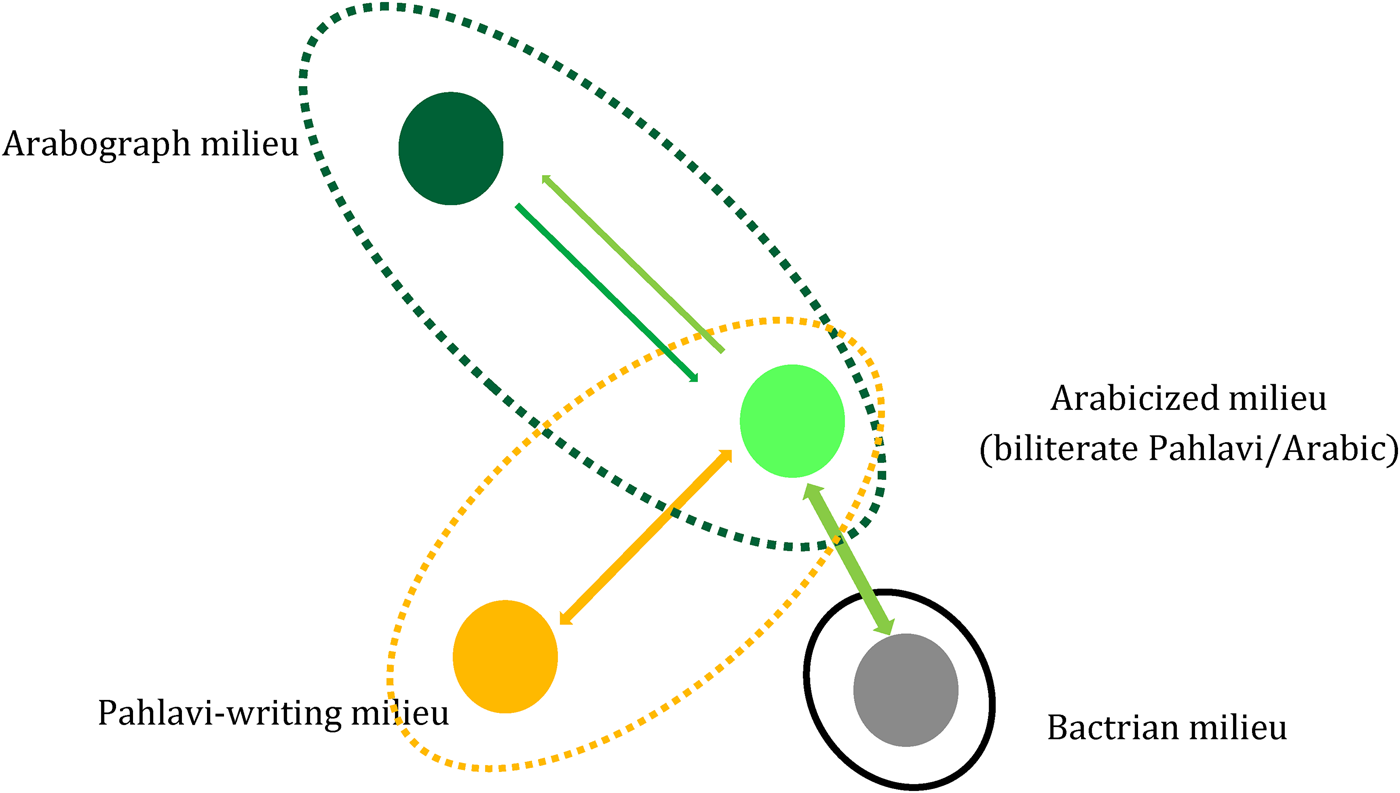
Throughout the years, Khan's “Pahlavi substrate” theory has gained wide recognition among Arabic papyrologists. While there is hardly any doubt that Khan's argument is compelling, the limited evidence at Khan's disposal left argumentative gaps in his model. The first and most evident of these is that the central piece of evidence from early Islamic Khurasan originated in a region in which the language of everyday writing prior and immediately following the Arab conquest was not Middle Persian in Pahlavi script, but rather Bactrian written in the Greek alphabet. Khan, in fact, hypothesized that the rise of cursive Arabic scripts in Khurasan was the result of the Abbasid administration employing bureaucratic personnel trained in Iran (see Figure 1).Footnote 16 The second missing link is that the theory presupposes the agency of biliterate scribes familiar with writing documents in both Pahlavi and Arabic. Yet, to the best of my knowledge, there is no direct evidence for a biliterate scribe in the Mīr b. Bēk family archive or among the caches of Middle Persian documents surviving from early Islamic Iran referenced by Khan.Footnote 17 Finally, the third gap in Khan's model of a so-to-speak Persia capta ferum victorem coepit is that it fails to provide any detail on the intermediary steps of the diffusion of the eastern writing style to the west of the Abbasid Empire. I argue that the comparatively understudied texts from 8th-century Sogdia are in fact instrumental to expanding the scope of Khan's model and filling some of its gaps.
Language contact situation in early Islamic Bactria (according to Khan).
Arabic-Sogdian bigraphism
The first piece that ostraca findings from Central Asia add to our knowledge of Arabic-Middle Iranian contacts is direct evidence of scribes skilled in both Arabic and Sogdian.
Several ostraca in both languages have been excavated in the citadel and lower city of Panjikent. The city and its ruler Dēwāshtīch played a key role in the revolt of the Sogdian aristocracy, which, with the assistance of the Turkic Türgesh, shook Transoxiana in the early 720s and was only completely quelled by the end of the following decade. Archaeological evidence shows that Panjikent was devastated by the Arabs in the summer 722, in the wake of Dēwāshtīch's defeat and eventual execution.Footnote 18 Thereafter, the area of the citadel was repurposed to house army barracks to quarter Arab troopers while the city appears to have been largely deserted.Footnote 19 Several areas of the city were restored throughout the 740s. This restoration was likely a result of the policy of appeasement pursued by the governor Naṣr b. Sayyār (in office 738–48) and the treaty of 741, which allowed Sogdians who had fled to the Türgesh to return to their homes.Footnote 20 From the middle of the century onwards, the archaeological record once more shows signs of gradual urban decline. This is possibly connected to Abū Muslim's purges of Sogdian aristocracy in the early 750s, in the wake of the affirmation of Abbasid authority in the region. By the late 770s/early 780s, the city was permanently deserted.Footnote 21 The establishment of an Arab garrison in Panjikent and the city's eventual abandonment a few generations later thus offer an exceptionally precise chronological framework for the Arabic textual evidence found at the site.Footnote 22
An ink-inscribed shard, found in a dwelling close to the eastern wall of the city, opens with the invocation bi-sm allāh al-raḥm[ān al-raḥīm] (In the name of God the Merciful the Compassionate; basmala) in Arabic before the scribe turns to Sogdian for the main body of the text.Footnote 23 The text is phrased as a report addressed to a person of obvious high standing.Footnote 24 If the latter was an Arab official, the inclusion of the basmala was probably intended as a sign of respect.Footnote 25 The house in which the bilingual shard was found, as well as an adjacent one, also yielded several other ostraca with writing exercises in Sogdian, possibly hinting at a scribal school.Footnote 26 Regardless of the specific situation, the use of Arabic for the formulaic part of the text indicates not only the scribe's Arabic literacy but also his awareness of Arabic documentary conventions, whereby Arabic was clearly perceived as the more formal language.
Further evidence for the progressive assimilation of local clerical personnel into the Arab administration is prosopographical. Another 8th-century Arabic ostracon discovered in the courtyard of the Panjikent citadel, likely connected with the administration of the military units stationed there, contains a list of names. In particular, the shard features one [ʿAbd] ar-Raḥmān b. ad-Dibīr (< MP dbyr = Sog. δpyr, “scribe”), suggesting that the person – much like some of the tax officials of the Mīr b. Bēk archive – was descended from a family of local bureaucrats, more specifically a family with a scribal background.Footnote 27 Three other persons mentioned in the same list all carry the title mawlā and one might speculate that these individuals were also locals who joined the ranks of the Arabs – though this is by no means a foregone conclusion.Footnote 28
The appearance of administrative documents in Arabic and the evidence for multilingual scribal practices in 8th-century Panjikent suggests an increase in the Arab presence around the 740s.Footnote 29 Archaeological finds across Sogdia provide corroborating evidence that scribes were being trained bilingually at different administrative centers by the mid to late 8th century and document increasing investments in scribal infrastructure. Already during the governorate of Naṣr b. Sayyār, a Dār al-imāra was erected in Afrasiab/Samarkand and later expanded in the early Abbasid period.Footnote 30 Two of the several Arabic inscriptions found at the site were scribal exercises, suggesting that the building hosted a scribal school.Footnote 31 The earlier of the two – archaeologically datable to the third quarter of the 8th century and written in a blocky hand – is rather elementary, featuring only an Arabic alphabet preceded by a basmala.Footnote 32 Conversely, the later one – datable to the early 9th century – shows an Arabic epistolographic exercise executed in a well-versed chancery hand, flanked by a Sogdian exercise penned in a similar ductus and using a pen of similar thickness.Footnote 33 This strongly suggests that the Arabic and Sogdian texts were written by the same person, who was quite proficient in both languages. Evidence for advanced Arabic scribal training also comes from an ostracon from 790 found in a complex situated between the first and second shahristān in Paykend. The text on the shard shows the well-known official dating formula wa-kutiba (“it was written” + date) being practiced.Footnote 34 While none of these texts are demonstrably bilingual in the same vein as the Panjikent ostracon, they clearly show that Arabic was practiced in close contact with Sogdian at several urban centers in the region. Finally, some additional contextual evidence for Arabic-Sogdian connections comes in the form of local bilingual Arabic-Sogdian coinage of Arab tributaries, such as the ikhshīds of Ishtikhān and the dehqāns of Keshsh in the second half of the 8th century.Footnote 35
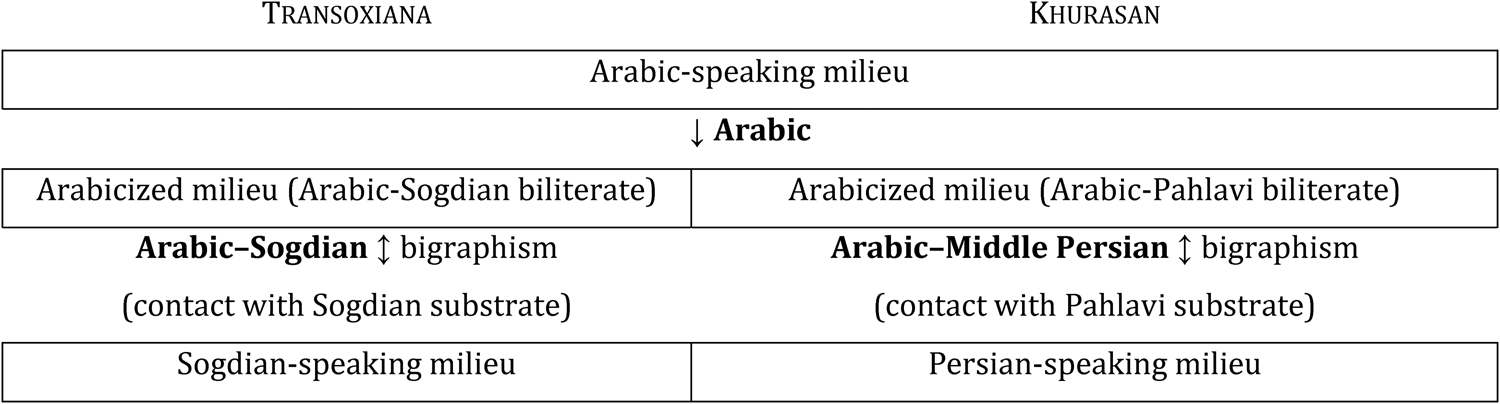
In other terms, evidence of Arabic and Sogdian co-occurrences suggests a relative high-intensity contact compared to the Bactrian context examined by Khan – where direct contact between the Arabic and Bactrian scribal milieus appears to have been mediated by a (possibly) Pahlavi buffer zone.Footnote 36 In short, when looking at Sogdia, we do have our smoking gun: a class of biliterate (Middle Iranian-Arabic) scribes did arise in the region around the time of the Abbasid revolution (something only postulated by Khan for the evidence from Bactria). Furthermore, it appears that, at least in mid-8th-century Transoxiana, the mediation between Arabic and Iranian scribal milieus relied on bilingual clerks drawn from the local population, without necessarily presupposing a Pahlavi intermediary – i.e., unlike what Khan hypothesized for coeval Bactria (see Figure 2).
Language contact situation in early Islamic Central Asia.
The language contact situation in mid to late 8th-century Sogdia appears to be roughly comparable with that of coeval Egypt. Here, as well, documentary records from the mid-8th century onward attest to the progressive blurring of previously well-established boundaries between the Arabic, Greek, and Coptic scribal worlds, as indicated by the emergence of Arabicized Christians within the ranks of the Arabs (and Arabic writing administration) and the appearance of multilingual exercises penned by the same person.Footnote 37
The interplay between Arabic and local languages was highly dependent on the region, as suggested by evidence from Khurasan. Pahlavi as well as Arabic and Sogdian ostraca paleographically or archaeologically datable to the late Sasanian and early Islamic period have surfaced at several locations on the western side of the Amū Darya. The excavations in “Old Merv,” in particular, have yielded a handful of scribal exercises on ostraca in Sogdian, Arabic, and Middle Persian datable to the late 7th/early 8th century, which are possibly the remnants of the archive of a scribal school (dabīristān).Footnote 38 Thus, it appears that, at least in the provincial capital of Merv, all three languages were practiced in contact with each other – though not necessarily at the same level. Two Arabic ostraca from this archive are simple alphabets, suggesting the trainee was taking their first steps towards learning to write in Arabic.Footnote 39 By contrast, the Sogdian scribal exercises are practices of epistolary formulae and numerals, indicating a type of training not directed at learning the language/script per se, but rather mastering a chancery skillset.Footnote 40 This possibly indicates that Sogdian was the mother tongue of local bureaucrats and the more “utilitarian” language of local administration, with Arabic being used in a supplementary function – a picture that resonates well with the language dynamics of the bilingual ostracon from Panjikent. It is unfortunate that Pahlavi material from the same archive remains unpublished. Regardless of the local differences, ostraca on both sides of the Amū Darya clearly point to the progressive intensification of the Arabic administrative presence in the region through the assimilation of local clerks into the Arabic writing bureaucracy.
From Samarkand to Sāmarrāʾ
This brings us to the last leap in Khan's model: the westward dissemination of eastern script features through the agency of the Abbasid administration. The task of filling this gap has been hitherto aggravated by the fact that virtually no documents from the late 8th and 9th centuries survive in the central Islamic lands. There is, however, one particularly significant exception.
In 1913, German excavations directed by Ernst Herzfeld in Sāmarrāʾ discovered a handful of Arabic administrative texts on papyrus and paper in the complex known as Dār al-khilāfa.Footnote 41 These documents were subsequently only partially edited by Herzfeld in his posthumous 1948 Geschichte der Stadt Samarra.Footnote 42 It is there that anther half-forgotten piece of evidence comes to the surface: Document 5 (=P.HerzfeldSamarra 6), a small paper fragment preserving traces of writing on both sides.Footnote 43 In his partial edition, Herzfeld read only the indication of “10 mithqals” appearing on the last line on the reverse side of the document, deeming the rest illegible.
After examining the document, I was able not only to make progress on Herzfeld's reading of the Arabic text, but was also able to determine that the front side is in fact not Arabic, as Herzfeld had assumed.Footnote 44 As kindly confirmed by Desmond Durkin Meisterernst and Michael Shenkar, the side opposite the Arabic text contains the remains of three words in Sogdian.Footnote 45 By the first quarter of the 9th century, members of the Transoxiana nobility and their retainers were a cornerstone of the Abbasid military in Sāmarrāʾ.Footnote 46 I have argued elsewhere that Document 5 was likely connected to the milieu of the Sogdian regiments stationed in the Abbasid capital and possibly entered the palace as scrap paper.Footnote 47
As for the point at hand, the identification of Sogdian writing in Sāmarrāʾ is relevant in several regards. Firstly, it provides proof that direct interaction between Sogdian and Arabic was not limited to the eastern frontier. Secondly, unlike earlier attestations of Middle Iranian languages in the early Islamic Empire, which typically stem from frontier zones (such as Mount Mugh) or from rural contexts (such as the sc. “Pahlavi archive”), Document 5 places actual Iranian scribes at the Abbasid court. This suggests that as late as the mid-9th century, Middle Iranian cursive scripts were to some degree not just a vestigial substrate but a living tradition practiced in the vicinity or even within the halls of Abbasid central power.Footnote 48
These considerations raise the question of whether we should continue to view the emergence of Arabic curvilinear scripts to be the result of contact with a Pahlavi paleographic substrate par excellence or, rather, should we view the intertwining of Arabic and Middle Iranian scribal worlds as emerging from different sources spanning several languages and scripts – Sogdian included. Like Pahlavi, Sogdian cursive script is a distant derivate of Official Achemenidian Aramaic chancery script. Much like their Pahlavi counterparts, early Islamic Sogdian documentary texts are characterized by strong cursiveness. Some influences of Central Asian (and specifically Sogdian) origin on Arabic scribal practices are in fact attested. In her previously mentioned monograph The Lost Archive, Marina Rustow embarks on a detailed examination of the introduction of paper into the Islamic world.Footnote 49 Expanding on Jonathan Bloom's work, she concludes that Sogdian mercantile networks functioned as a conduit for paper (rag-paper in particular) to enter wider use in the early Islamic world.Footnote 50 Refuting the “Chinese etiology” of Islamic paper, Rustow points out that Arab officials along the Transoxiana border zone knew of and actively used paper decades before the battle of Talas, as is attested by the Arabic-Sogdian-Turkic archive of Dēwāshtīch (rg. 706–722), and the Arabic paper fragments from Sanjar Shah – a fact familiar to Arabic papyrologists but still fairly unknown beyond these circles.Footnote 51 In addition, Rustow further points out how the type of paper most widely spread in the Islamic world (rag-paper) corresponded to Sogdian rather than Chinese (typically mulberry paper) formulas. Documentary proof that Sogdian was, even if to a marginal extent, a language practiced in writing in the general vicinity of the Abbasid chancery substantiates Rustow's reconstruction. Furthermore, the active use of Sogdian in the Sāmarrāʾn environment opens the possibility that Middle Iranian scribes’ role in fostering the Abbasid chancery's adoption of the use of (rag) paper might have been more direct than previously assumed.Footnote 52
Now, does this mean we should do away with the notion of a Pahlavi substrate in favor of a Sogdian one? Once again, it is more prudent to avoid generalization. Firstly, the evidence from the dabīristān discussed above suggests that Khurasan possibly functioned as a relay zone between Sogdian and Pahlavi within Islamic chanceries. Furthermore, there is at least one (yet again, forgotten) documented instance of Arabic and Pahlavi appearing together in an 8th-century archival context from the central Iranian lands. In 1936, the excavations conducted by the so-called Rayy expedition in Chāl Tarkhān Eshqaband near Rayy discovered two late Sasanian palatial complexes that had been heavily renovated and expanded in the early Islamic period.Footnote 53 The site is most famous for its lavish stucco decorations, which were published in detail by Deborah Thompson.Footnote 54 Since then, Arabists have been completely oblivious to the fact that Thompson's book also included pictures of a group of Pahlavi and Arabic ostraca found at the site and datable archaeologically to before ca. 820.Footnote 55 While further conclusions on the archive will have to await the edition of the entire archive, a preliminary examination by myself and Thomas Benfey revealed consistencies between the content of Arabic and Middle Persian texts, suggesting potential chronological overlap (or close proximity at least) between them.Footnote 56 This would be the first instance of direct documentary evidence for Arabic and Pahlavi being practiced side by side in the same archival context and time framework. In other words, these texts offer us a window – however small – into the truly bilingual (or even biliterate) scribal routines conducive to the very assimilation of Pahlavi scribal features into Arabic documentary scripts that lies at the core of the Pahlavi substrate theory.Footnote 57
To reiterate, evidence of Arabic-Middle Iranian contacts from the early 8th to the mid-9th century offers hard proof of biliterate actors active in several social settings, ranging from the frontier of the Islamic empire in Transoxiana to the imperial capital of Sāmarrāʾ, passing through rural Iran. In view of the evidence discussed, we can prudently assume that the intertwining of Arabic and Middle Iranian scribal worlds had various sources spanning several languages and scripts. Pahlavi was certainly one, but not necessarily always the only (or, depending on the context, the main), vehicle of such connections.
Conclusion
To summarize, I have argued that, in the absence of larger corpora of documentary evidence, documentary diplomatics can serve as a window into the increasing density of Arab imperial presence in late Umayyad and early Abbasid Sogdia. Multilingual documents from the mid to late 8th century, in particular, show not just the deepening social reach of the Arabic language in local society, but also offer proof that biliterate (not just bilingual) clerks drawn from the ranks of local administrators came to embody a point of synthesis between Arabic and substratal scribal milieus in the region. Finally, the evidence presented in this brief overview both confirms and recalibrates Khan's theory of a Pahlavi substrate: it confirms the theory insofar as it provides hard evidence for the existence of biliterate Iranian scribes both in Central Asia and at the very heart of Abbasid imperial power in Sāmarrāʾ. At the very least, this indicates that Middle Iranian scribal practices not only constituted a formative substrate of Arabic ones, but continued to be actively practiced in close contact with Arabic in the imperial chancery as late as the mid-9th century. At the same time, the little-known ostraca from early Islamic Central Asia indicate that, at least in Transoxiana, Sogdian rather than Pahlavi appears to have functioned as the primary interface between the Middle Iranian and Arabic scribal traditions.


 Open access

