


Introduction
Grasslands are one of the most threatened ecosystems on Earth today, a condition they share with other open natural ecosystems (ONEs) (Madhusudan and Vanak Reference Madhusudan and Vanak2023). Their favourable topographical features and fertile soils have made grassland habitats the most extensively modified ecosystem by human activity (Henwood Reference Henwood1998). These modifications and the resulting fragmentation have led to increased habitat heterogeneity which can severely threaten native grassland species (Punjabi et al. Reference Punjabi, Chellam and Vanak2013).
Local bird communities are good indicators of ecosystem health and functioning (Gregory and van Strien Reference Gregory and van Strien2010). Therefore, the study of bird communities can be useful in habitat assessment and conservation planning of a region. Grassland birds are often specialised to (or have a preference for) open habitats. Many grassland specialist birds are either ground-nesting or build small nests, which are camouflaged in grasses and reeds to avoid nest predation (Fogarty et al. Reference Fogarty, Elmore, Fuhlendorf and Loss2017). Specialised species, such as the Red-necked Falcon Falco chicquera, show a high degree of physiological and behavioural adaptation to the grassland habitat (Ali Reference Ali1990). Consequently, these species are highly sensitive to habitat features, such as vegetation type, making them vulnerable to land-use changes (such as the intensity of livestock grazing; Kher and Dutta Reference Kher and Dutta2021).
Grassland bird communities face a multitude of threats from anthropogenic change today. Despite this, there is inadequate funding, research, and conservation effort focused on grasslands (Madhusudan and Vanak Reference Madhusudan and Vanak2023). Although many grassland birds are known to be negatively affected by disturbances, low-intensity agro-pastoral lands can, in some cases, supplement protected areas in conserving grassland species and bird communities (Dutta and Jhala Reference Dutta and Jhala2014; Kher and Dutta Reference Kher and Dutta2021).
Here, we used a simple checklist method to study long-term trends in bird communities within the grasslands of Nannaj, Maharashtra, India, a region with a complex interplay between biodiversity conservation and economic interests (Narwade and Rahmani Reference Narwade and Rahmani2020). Our long-term study revealed several interesting trends in reporting rates of the regional bird community. We also highlight differences in local species trends at Nannaj with their national trends. Lastly, we explore the real-world utility of a simple checklist methodology performed by an individual, committed observer consistently over a long time.
We documented birds within a study area bounded by the five villages of Vadala, Akolekati, Karamba, Mardi, and Narotewadi, and centred around Nannaj village (17.836°N, 75.851°E) in the Solapur district of Maharashtra (Figure 1). The annual precipitation in the region is less than 750 mm, and the semi-arid climate has a distinct seasonality: long, intense summers (March–June) are followed by a rainy season (monsoon; July–October), after which the winter season (November–February) leads back into the summer (Krishna et al. Reference Krishna, Kumar and Isvaran2016).
(inset) The location of the study area within a larger map of the Indian subcontinent. The study area (shaded darker) is roughly a polygon with its vertices at adjoining villages. Lighter shades of brown (in the centre) show grassland habitats within the Great Indian Bustard Sanctuary, while the darker and greener patches show agricultural lands.

The study area, much like the larger landscape, is an evolving mosaic of protected native grasslands, afforested woodland plots, communal and private grazing lands, urban settlements, and agricultural land (Krishna et al. Reference Krishna, Kumar and Isvaran2016; Narwade and Rahmani Reference Narwade and Rahmani2020; Punjabi et al. Reference Punjabi, Chellam and Vanak2013). Among the main crops grown in the region are jowar (millets) and groundnut. Most farmers also own cattle, which are often allowed to graze freely in the grasslands. Our study area encompasses parts of the Great Indian Bustard Sanctuary, a protected area created to conserve the region’s native grasslands and, especially, the critically-endangered Great Indian Bustard Ardeotis nigriceps, locally known as ‘maldhok’.
Methods
All field data from 2009 to 2021 were collected by SM, a seasoned birdwatcher who is familiar with all the bird species in his landscape. SM maintained a daily bird attendance register containing commonly seen and easily identifiable species found in the study area (Table 1). There are 199 bird species recorded in Nannaj on the eBird database (eBird 2021; Sullivan et al. Reference Sullivan, Wood, Iliff, Bonney, Fink and Kelling2009). Of these, we began by monitoring 40 bird species in 2009, and added a further seven species in 2013. For each of the species on the master list, SM used a physical register to mark those seen through the course of a day, while going about his usual fieldwork routine, with no fixed route being followed. The study area depicted in Figure 1 shows the region SM typically covered as part of his daily activities. Only birds observed within the study area were included in the data set.
Species-level changes in reporting rates over time, habitat guilds, local species trends, and national species trends (SoIB 2020) of commonly seen bird species at Nannaj. Species in red are winter migrants at Nannaj. An asterisk (*) indicates those species that have been monitored only since 2013.

* All our study species are classified as “Least Concern” under the International Union for Conservation of Nature (IUCN) Red List, except the Great Indian Bustard (“Critically Endangered”), Pallid Harrier (“Near Threatened”), and Red-necked Falcon (“Near Threatened”).
The bird attendance register was filled in at the end of each day by putting a tick mark against all species that were seen or heard during the course of that day. Species that were not seen or heard were marked with an “X” mark, representing a non-detection. If the identification was uncertain, the species was recorded as undetected for the day. This routine was repeated whenever SM conducted fieldwork within the area; therefore, it mostly excluded Sundays and public holidays.
Analysis
A schematic representation of the analysis pipeline is shown in Figure 2. We used the R programming language (R Development Core Team 2013) for data analysis. We rectified any erroneous data entries and performed preliminary data transformation (such as calculating monthly reporting rates) using the dplyR package (Wickham et al. Reference Wickham, Averick, Bryan, Chang, McGowan and François2019). To analyse date-time formatted columns, we utilised the lubridate package (Grolemund and Wickham Reference Grolemund and Wickham2011). We fitted Generalised Linear Mixed Models (GLMMs) in each bootstrapping iteration for each species using the “lmer()” function in the lme4 package (Bates et al. Reference Bates, Mächler, Bolker and Walker2015). To calculate confidence intervals (CIs) for each month in the seasonality analysis, we used the DescTools package (Signorell et al. Reference Signorell, Aho, Alfons, Anderegg, Aragon and Arachchige2023). Finally, we used the ggplot2 for plotting (Wickham Reference Wickham2016), followed by the cowplot package (Wilke Reference Wilke2020) to combine multiple ggplot2 plots into a single figure.
A schematic representation of the analysis pipeline.

We did not have information on the number of individuals that were seen by SM. Rather, we had data on presence and absence (more accurately, detection and non-detection). Assuming that the probability of detection rises asymptotically with population density (Altwegg and Nichols Reference Altwegg and Nichols2019), we calculated and used the “reporting rate” (the fraction of checklists containing a species in a given time period) as a relative index of population density over time. Importantly, we could do this because we did not compare absolute reporting rates between species. Rather, we are only interested in studying how the reporting rates of each species change over time, in other words, we examine the trends in reporting rate for individual species. Further, because of the asymptotic nature of the relationship between reporting rate and absolute population density, reporting rate is expected to be a particularly sensitive index at low and medium densities; at high densities, reporting rate is likely to underestimate underlying population change.
For resident species, we calculated monthly reporting rates, i.e. the fraction of days in the month when a particular species was observed. Winter migrants are absent during the summer at Nannaj, and therefore for these species, we used only those months in each year with reporting rate above 0.05, thereby excluding months where the species was largely or completely absent. The Black Redstart Phoenicurus ochruros was recorded only sporadically and hence removed from any further analyses. For visualisation purposes alone (in Figure 3), we calculated the annual reporting rates, which were the average of all monthly reporting rates for the species in each year.
Examples of different species showing declining, indistinguishable from stable, and increasing trends in their annual reporting rates over time. The shaded regions represent 95% confidence interval around the mean.

To quantify and examine trends over years, we used the lme4 package (Bates et al. Reference Bates, Mächler, Bolker and Walker2015) in R to fit a binomial GLMM for each species with the month of the year as the random effect. The reason we did this was that the same month (for instance, January) is expected to have similar characteristics in terms of species occurrence across years in comparison with another month (for instance, May). A key assumption we make is that while the detection probability of a species may vary between months, it does not change across the years of the study period. In brief, this method calculates an average month-specific trend for a species across years, taking into account that different months might have different baseline reporting rates.
The slope estimates from the GLMMs for each species were tabulated along with 95% confidence intervals, calculated through robust non-parametric bootstrapping within months across years (i.e. with replacement). This allowed us to visualise broad trends (increasing, indistinguishable from stable, or declining; examples shown in Figure 3) in the reporting rate and a CI around a slope estimate (shown in Figure 4). Any species whose CI overlapped zero was categorised as “indistinguishable from stable”, while those with CIs fully above and fully below zero were categorised as “increasing” and “declining”, respectively. The model fitted to each species was as follows:
 $$ {\displaystyle \begin{array}{l}{\mathrm{presence}}_i\sim \mathrm{Binomial}\left(n=1,{\mathrm{prob}}_{\mathrm{presence}}=\hat{P}\right)\\ {}\hskip-0.5em \log \left[\frac{\hat{P}}{1-\hat{P}}\right]={\alpha}_{j\left[i\right]}+{\beta}_1\left(\mathrm{year}\right)\\ {}\hskip6em {\alpha}_j\sim N\left({\mu}_{\alpha j},{\sigma}_{\alpha j}^2\right),\mathrm{for}\ \mathrm{month}\;\mathrm{j}=1,\dots, \mathrm{J}\end{array}} $$
In addition to examining annual trends, we also investigated seasonal changes in bird reporting rates for select species by calculating reporting rates for each month, averaged across years. 95% CIs for the month estimates were calculated using the Agresti–Coull method (Brown et al. Reference Brown, Cai and DasGupta2001).
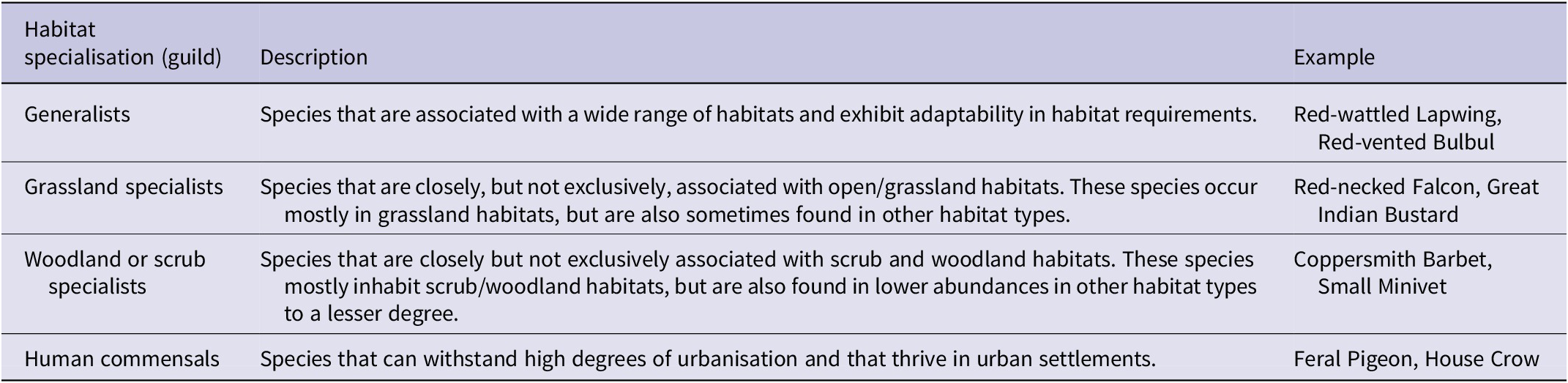
To understand how trends might differ among different kinds of species, we also classified species into different habitat specialisation guilds. This classification was based largely on the State of India’s Birds report (SoIB 2020), supplemented with information from The Book of Indian Birds (Ali Reference Ali1990) and the Birds of the World database (Billerman et al. Reference Billerman, Keeney, Rodewald and Schulenberg2022). Definitions for each habitat guild are in Table 2. To visualise temporal changes in reporting rates for a guild as a whole (Figure 5), we first calculated the reporting rate of each species in each year (as shown above). For each year, we then calculated the mean reporting rates and 95% CIs across all the species in that guild.
Description and example species of each guild in the study.
With this information in hand, we asked three broad questions:
-
1. How did the reporting rates of habitat guilds change over the study period?
-
2. How did the species-level reporting rates change over time?
-
3. Within a single species, can we observe seasonal changes/patterns in reporting rates?
Results
We monitored 45 bird species, including seven migratory species, in 4,324 days of survey over 13 years. The slope estimates and bootstrapped confidence intervals of the trends of each species (examples shown in Figure 3) across the study period are shown in Figure 4, where the species are ordered by their overall mean reporting rates.
(A) Estimates of the slopes of reporting rate over time (across the study period), as derived from Generalised Linear Mixed Model (GLMM) analysis. Error bars are 95% confidence intervals. Colours reflect the magnitude of the estimated slope, as described in the accompanying key. (B) Overall mean reporting rate of each species across all years.

Table 1 shows a summary of species-wise classifications and results. All species common names used are from the India list published by Indian Birds (Praveen et al. Reference Praveen, Jayapal and Pittie2016).
Guild-wise trends across the study period indicated that reporting rates of various habitat guilds in the region have been largely stable (Figure 5).
Guild-wise trends in reporting rates across the study period (2009–2020). The shaded region represents the 95% confidence interval around the mean.

Among grassland species, smaller-bodied and more diet-generalist species (such as the Ashy-crowned Sparrow-Lark Eremopterix griseus) showed minor increases in reporting rates. Meanwhile, larger-bodied specialist species (such as the Great Indian Bustard and Red-necked Falcon) showed strong, consistent declines throughout the study period (Figure 4).
Generalist species, on the whole, had indistinguishable from stable or increasing trends over time (Figure 4). However, some species with a preference for more open habitats (such as the Western Marsh Harrier Circus aeruginosus; Kitowski Reference Kitowski2007) showed considerable declines over time.
Woodland/scrub species (such as the Small Minivet Pericrocotus cinnamomeus) showed increasing reporting rates over time, except for the Painted Sandgrouse Pterocles indicus, a relatively rare species of scrub habitat, which appears to have experienced a considerable decline (Figure 4).
Interestingly, some human commensals, which often inhabit urban and human-modified landscapes (such as the Common Myna Acridotheres tristis and House Crow Corvus splendens), have witnessed moderate declines in reporting rates, while another commensal, the Feral Pigeon Columba livia, has increased considerably (Figure 4).
Studying seasonal trends in bird populations
To investigate what can be learnt from this data set about seasonal trends using our methodology, we examined two species: Western Marsh Harrier, a migratory raptor that travels over long distances between central Asia and the Indian subcontinent and Great Indian Bustard, a grassland specialist and flagship species that shows seasonal local movements.
India is one of the largest wintering grounds for harriers in the world. As the only raptors in the world that nest on the ground, harriers are adapted to living in open landscapes such as grassland–marsh mosaics. Furthermore, as one of the top predators in the grassland food chain, harriers can serve as an indicator of ecosystem health (Verma Reference Verma1996).
The Western Marsh Harrier is a common, widespread winter visitor to India. It is often found in a mosaic of marshland, agricultural fields, and grassy plains. Throughout our study, we see a steady decline in winter reporting rates for this species (Figure 6). This trend is consistent with other long-term studies of roost counts of harriers in India (Ganesh and Prashanth Reference Ganesh and Prashanth2018).
Monthly trends in reporting rates of the Western Marsh Harrier Circus aeruginosus throughout the study period, with every four years grouped together for clearer visualisation. This is a species with a preference for open habitats. There is an evident decline in winter reporting rates in each consecutive four-year period.

In the early years of this study, the Great Indian Bustard showed a distinct seasonality, with reporting rates being highest from July to October. Overall reporting rates have declined steadily, and in recent years the reporting rate is so low that no seasonality is apparent any more (Figure 7).
Monthly trends in reporting rates of the Great Indian Bustard Ardeotis nigriceps throughout the study period, with every four years grouped together for clarity in visualisation. There is a clear seasonality in bustard activity within the study area. In recent years, reports of the species have fallen to near zero.

Discussion
Our study used a simple checklist-based method to monitor species trends over 13 years. This method can be implemented by anyone with a basic knowledge of bird identification without the need for intensive training in more sophisticated protocols. While quick and easy, such a method is not suited for monitoring population densities taking into account detectability. In other words, we cannot compare the reporting rates across different species (because they will often differ in detectability), rather we focus on looking at within-species trends. For inter-species comparisons, more detailed protocols like distance sampling-based transects or point counts are needed. Its simplicity, however, makes the checklist method a widely implementable procedure to examine general trends.
Despite changes in land use within the study area including increasing urbanisation and extensive agricultural expansion in the region (Narwade and Rahmani Reference Narwade and Rahmani2020), many species show no discernible increases or decreases in reporting rates over the study period. This suggests that the region continues to support a large fraction of its common species.
A handful of sensitive species, however, mostly large-bodied grassland specialists, show steady declines (Figure 4), possibly due to the loss of native grassland habitat (Madhusudan and Vanak Reference Madhusudan and Vanak2023). Among human commensal species, Feral Pigeon shows a tremendous increase, while Common Myna and House Crow show a decreasing local trend (Figure 3). Below, we take a closer look at trends in selected groups and species.
Grassland species
Grassland species varied in their trends over time. Small-bodied grassland generalists such as the Ashy-crowned Sparrow-Lark showed an increase in reporting rates over time (Figure 4). The Yellow-wattled Lapwing Vanellus malabaricus, a species with a high affinity for grassland habitats (Sethi et al. Reference Sethi, Bhatt and Kumar2010), also showed a moderate increase in reporting rate (Figure 4). This is in contrast to its steadily declining national population trends (SoIB 2020), and indicates the potential of the Nannaj grasslands in conserving this increasingly threatened species. Similarly, the Indian Courser Cursorius coromandelicus showed increases in its reporting rates (Figure 5), contrasting with its strong declines at the national scale (SoIB 2020). Most alarmingly, some grassland specialists, such as the enigmatic Great Indian Bustard and the Red-necked Falcon, experienced drastic reductions in their reporting rates (Figure 5).
Great Indian Bustard
Once widely distributed across Indian semi-arid grasslands, the Great Indian Bustard is now restricted to fragmented pockets of open habitats, with a steadily decreasing population (Dutta et al. Reference Dutta, Rahmani and Jhala2011). Our results, consistent with previous studies from different parts of the country (Dutta et al. Reference Dutta, Rahmani and Jhala2011; Narwade and Rahmani Reference Narwade and Rahmani2020; Varghese et al. Reference Varghese, Sawarkar, Rao and Joshi2016) and national population trends, show that bustard presence in the region has declined during the study period (Figure 5). Their numbers have reached historic lows, and the species is nearing local extinction. Remote sensing and GIS studies have revealed that the suitable habitat for bustards in the Nannaj–Mardi region is extremely fragmented, with relatively small patches of grasslands remaining (Varghese et al. Reference Varghese, Sawarkar, Rao and Joshi2016).
Until 2016, the Great Indian Bustard showed distinct seasonality in the study area, being more frequently observed between June/July and October/November (Figure 4). Subsequently, its detection has been too low to discern seasonality. It is likely that the seasonal appearance of the bird at the study site reflects seasonality in the abundance of its prey: locusts, grasshoppers, beetles, frogs, bird eggs, small snakes, and mice (Bhushan and Rahmani Reference Bhushan and Rahmani1992; Hume and Marshall Reference Hume and Marshall1879; Patil et al. Reference Patil, Rahmani and Hallager2013), although this has not been examined specifically in our study area. SM notes that the breeding season for the bustard at Nannaj lasts from July/August to December each year, as evidenced by the presence of active nests and chicks during these months.
Generalists
On the whole, generalist species showed increasing or indistinguishable from stable trends in their reporting rates (Figure 4). Most species showed trends indistinguishable from stable, albeit some with considerable fluctuation, over our 13-year study period. Generalists, by virtue of their ability to survive in varied environments, are likely to be less sensitive to changes in the landscape (Bowler et al. Reference Bowler, Heldbjerg, Fox, de Jong and Böhning-Gaese2019; Callaghan et al. Reference Callaghan, Major, Wilshire, Martin, Kingsford and Cornwell2019).
A few species, such as the Short-eared Owl Asio flammeus and Western Marsh Harrier (Figure 4), however, witnessed declines over time. These species, although generalists, are known to have a preference for more open habitats (Ali Reference Ali1990), which are shrinking and increasingly fragmented at Nannaj (Varghese et al. Reference Varghese, Sawarkar, Rao and Joshi2016).
Indian Peafowl
The Indian Peafowl Pavo cristatus is a generalist species that has undergone considerable increases in our study period, consistent with trends from other places across the country (Figure 4). This is a species known to feed within agricultural lands and regularly causes crop loss (Paranjpe and Dange Reference Paranjpe and Dange2020), and is likely benefiting from recent agricultural expansions within the study region. However, peafowl increases at Nannaj are less dramatic than at the national level (Jose V and Nameer Reference Jose and Nameer2020; SoIB 2020).
Human commensals
Our expectation was that increased urbanisation in recent years would result in an increase of all human commensal species over time, similar to their national trends (SoIB 2020). However, over the course of our whole study period, it is only the Feral Pigeon that shows considerable increases in its reporting rate. The other human commensal species (House Crow and Common Myna) show moderate long-term declines in the study region, while the House Sparrow Passer domesticus is indistinguishable from stable.
Feral Pigeon
The Feral Pigeon has undergone a dramatic increase in abundance worldwide, closely correlated with increasing human density and urbanisation (Jokimäki and Suhonen Reference Jokimäki and Suhonen1998). Much of its recent increase can be attributed to the increase in human population and activity, the ability of the species to exploit diverse food sources in an urban setting, and reduced predation pressures within urban environments (Stukenholtz et al. Reference Stukenholtz, Hailu, Childers, Leatherwood, Evans, Roulain and Ferretti2019). Consistent with national and worldwide trends (SoIB 2020; Stukenholtz et al. Reference Stukenholtz, Hailu, Childers, Leatherwood, Evans, Roulain and Ferretti2019), our data show rising reporting rates for the Feral Pigeon within the study area (Figure 4).
Conclusions
Our study uses a simple checklist method to understand changes in bird communities at a local scale. We reiterate that reporting rates are not synonymous with population densities. As shown by Altwegg and Nichols (Reference Altwegg and Nichols2019), reporting rate tends to increase with population density but at a diminishing rate. This means that changes in reporting rate are likely to underestimate changes in population density, especially for abundant species. For this reason, trends in reporting rates must be viewed in light of the mean reporting rate of the species across the study period, namely, how rare or common a species is.
Despite not estimating absolute population densities (which would require taking into account variation in detectability among species), checklist-based methods can provide important information on broad trends and provide early warnings of changes in populations, especially if one can assume constant within-species detectability over time. Of course, monitoring alone cannot diagnose causes of changes in abundance, but its results can trigger more detailed work towards that end.
The power of this method increases as the community of people in the practice of ecological monitoring grows. This includes birdwatchers (or other enthusiasts), Forest Department staff, nature guides, ecotourism outfits, college students, and many more. Daily bird lists (or lists of specific duration in a consistent location) can enable citizen scientists to understand their neighbourhood ecosystems (e.g. the observations by Quader Reference Quader2021) and Protected Area managers to monitor their lands. Online platforms, such as eBird, make it easy to record, store, and visualise the collected data. Simple online tools for summarising and visualising the information collected would enable a more diverse set of people to take up this activity.
Our study demonstrates that even one dedicated individual, recording checklists consistently over a long time, can help our understanding of shifts in the local bird community. We look forward to a day when thousands of individuals across India keep track of the birds of their localities using simple, repeatable protocols such as that described here.
Acknowledgements
We are grateful to Ashwin Viswanathan for comments, criticisms, and discussions throughout the writing process. Our thanks to Abinand Reddy for assistance and inputs during data cleaning. We thank the Maharashtra Forest Department for their encouragement and support. We would like to thank Sunil Limaye IFS, R. N. Nale, R. N. Kulkarni, B. C. Yele, K. N. Sabale, S. K. Jawale, Bharat Chedda, Shivakumar More, Aditya Kshirsagar, Pankaj Chindarkar, Balasaheb Lambture, Abhishek Deshpande, Sushant Kulkarni, and the staff of Range Forest Office (Great Indian Bustard Sanctuary). Financial support for this work came from the Ministry of Environment, Forests and Climate Change, Government of India.
Supplementary material
The supplementary material for this article can be found at http://doi.org/10.1017/S0959270923000357.


 Open access

