


1. Introduction
Knowledge-intensive ecosystems, such as corporate R&D departments and academic institutions, derive competitive advantage from their ability to create, share, and apply knowledge (Reference Gaviria-Marin, Merigó and Baier-FuentesGaviria-Marin et al., 2019). Yet despite five decades of knowledge management (KM) research and practice, fundamental challenges persist. Traditional methods struggle with information volume and, critically, fail to capture tacit knowledge, the experience-based expertise of expert innovators (Reference Pai, Shetty, Shetty, Bhandary, Shetty, Nayak, Dinesh and D’souzaPai et al., 2022). Three decades of research clearly show some persistent barriers: tacit knowledge resists codification (Reference Ochieng, Ovbagbedia, Zuofa, Abdulai, Matipa, Ruan and OledinmaOchieng et al., 2018), information overload undermines system effectiveness (Reference Wu and HuWu & Hu, 2018), and knowledge hiding and trust issues dominate actual practice (Reference Liu, Lu and WangLiu et al., 2020).
Recent years present a distinctive context. Patent filings and scientific publications now double every decade (Reference Douglas and VerstyukDouglas & Verstyuk, 2025), with gene editing alone exceeding 60,000 patents (Reference Geissler, Gorodkin and SeemannGeissler et al., 2024). Universities and industry increasingly collaborate through funded programs, with 117,590 academic papers (2014-2023) now cited in industrial patents, documenting robust academic-industrial knowledge flows (Reference Dorta-González, Rodríguez-Caro and Dorta-GonzálezDorta-González et al., 2025). Yet despite this information explosion and cross-sectoral collaboration emphasis, knowledge about expertise, capabilities, and collaborators remains fragmented.
Concurrent with these challenges, artificial intelligence, particularly large language models (LLMs) and knowledge graphs offer a promise for new technical possibilities. LLMs can extract knowledge from unstructured technical documents (Reference Bakhtiari, Bashiri, Khalilipour, Nasiripour and ChallengerBakhtiari et al., 2024), translate domain-specific information across sectors (Reference Serrado, Argôlo, Barbosa, Nóbrega, Martinez, Xexéo and De SouzaSerrado et al., 2025), integrate heterogeneous data sources (Reference Boscariol, Meschini and TagliabueBoscariol et al., 2024), and maintain dynamic, continuously updated knowledge representations (Reference Pan, Luo, Wang, Chen, Wang and WuPan et al., 2024). Yet a critical gap remains: while technical capabilities address identified KM challenges, organizational implementation and practitioner adoption, particularly in cross-sectoral contexts, remain unclear (Reference Brachman, El-Ashry, Dugan and GeyerBrachman et al., 2025). Do practitioners actually adopt these systems? What organizational and interpersonal factors influence trust and effectiveness? While cross-sectoral R&D encompasses various partnership models, this study primarily draws empirical evidence from University-Industry (HEI-Industry) collaborations. As a dominant form of knowledge transfer, this context serves as a critical proxy for broader cross-sectoral challenges.
This research addresses this gap through two phases: (1) systematic analysis of research trends in KM based on artificial intelligence (AI), and (2) qualitative interviews with academic and industrial R&D practitioners to identify actual knowledge management challenges, barriers to cross-sectoral collaboration, and perceptions of AI-augmented KM systems. These research questions proposed:
RQ1: What are dominant themes in current AI-KM research?
RQ2: What core KM problems do practitioners experience in 2025 across HEI-Industry R&D?
RQ3: What gaps exist between current technical solutions and practitioners’ needs, and what factors beyond technology influence system adoption?
2. Literature review
2.1. Km research landscape and sectoral limitation
Bibliometric analysis reveals that KM research has grown substantially, with over 7,628 papers published across decades (Reference Wang, Zhu, Song, Hou and ZhangWang et al., 2018), establishing KM as a mature discipline (Reference FarooqFarooq, 2024). The USA and China lead in publication volume (Reference FarooqFarooq, 2024), and themes like artificial intelligence and machine learning are now foundational (Reference Pai, Shetty, Shetty, Bhandary, Shetty, Nayak, Dinesh and D’souzaPai et al., 2022). However, literature concentrates on single-sector contexts, either academic institutions or industrial organizations examined in isolation (Reference Ayinde, Orekoya, Adepeju and ShomoyeAyinde et al., 2021). This focus creates a gap: challenges specific to cross-sectoral collaboration, where terminology, timelines, and institutional logics differ fundamentally, remain underexamined. While university-industry collaboration receives funding emphasis, KM literature examining barriers at this interface is limited, particularly research examining mutual challenges when practitioners from both sectors work as integrated teams.
2.2. Core persistent challenges
Despite decades of research, three fundamental barriers persist across contexts. First, tacit knowledge, subconscious, experience-based expertise, resists codification (Reference Nordin, Mohamed, Uchihira, Pedro García Márquez, Segovia Ramirez, Bányai and TamásNordin et al., 2020). Early KM systems imposed an “unnecessary strain of externalization on people” (Reference Ochieng, Ovbagbedia, Zuofa, Abdulai, Matipa, Ruan and OledinmaOchieng et al., 2018; Reference Pai, Shetty, Shetty, Bhandary, Shetty, Nayak, Dinesh and D’souzaPai et al., 2022), producing incomplete repositories. Research shows that tacit knowledge depends on reflective dialogue and social interaction (Reference Mitchell, Harvey and WoodMitchell et al., 2022), mechanisms difficult to embed in formal systems. Second, information overload persists; while organizations generate enormous data volumes (Reference Wu and HuWu & Hu, 2018), traditional KM systems fail because search functions merely retrieve information rather than facilitate knowledge sharing, lacking workflow integration and leadership support (Reference Khazieva, Pauliková and ChovanováKhazieva et al., 2024). Third, knowledge hiding and interpersonal distrust dominate actual practice (Reference Liu, Lu and WangLiu et al., 2020). Knowledge hiding is influenced by interpersonal relationships and organizational culture, not system design alone (Reference Liu, Lu and WangLiu et al., 2020), suggesting technical sophistication alone cannot overcome social barriers (Reference Jacobs and IJsselsteijn.Jacobs & Wijnand IJsselsteijn, 2021).
2.3. Information explosion and technical opportunities
Two concurrent developments create a distinctive moment. First, information acceleration: publications and patents double every decade, while emerging specializations create vast knowledge repositories. Gene editing (60,000+ patents) and biotechnology (33,000+ patents) exemplify rapid growth (Reference Geissler, Gorodkin and SeemannGeissler et al., 2024). Second, AI advances: LLMs combined with knowledge graphs enable capabilities previously unavailable. LLMs can extract knowledge from technical repositories and automatically generate structured knowledge representations (Reference Bakhtiari, Bashiri, Khalilipour, Nasiripour and ChallengerBakhtiari et al., 2024; Reference FarooqFarooq, 2024), translate information across domains (Reference Serrado, Argôlo, Barbosa, Nóbrega, Martinez, Xexéo and De SouzaSerrado et al., 2025), enable discovery through natural language queries (Reference Jiang, Qin, Yao, Fang, Zhuang, Zhu and XiongJiang et al., 2024), and maintain continuously updated knowledge as new documents, patents, and expertise emerge (Reference Pan, Luo, Wang, Chen, Wang and WuPan et al., 2024). Recent surveys show practitioners shifting toward natural language interactions with knowledge systems (Reference Brachman, El-Ashry, Dugan and GeyerBrachman et al., 2025).
2.4. Research gap: implementation and context
Yet a paradox persists: research shows persistent challenges; recent AI appears to directly address them; yet organizational adoption remains limited and understudied, particularly in cross-sectoral contexts. The critical gap is not technological but organizational and social: Do practitioners actually need and adopt these systems? What barriers prevent implementation? How do cross-sectoral differences influence knowledge management effectiveness? Understanding practitioners’ experience in cross-sectoral R&D examining which challenges emerge when academic and industrial researchers collaborate, addresses this gap. This research bridges three typically separate literatures: (1) KM research on persistent challenges (Reference Pai, Shetty, Shetty, Bhandary, Shetty, Nayak, Dinesh and D’souzaPai et al., 2022; Reference Ochieng, Ovbagbedia, Zuofa, Abdulai, Matipa, Ruan and OledinmaOchieng et al., 2018; Reference Wu and HuWu & Hu, 2018), (2) university-industry collaboration studies (Reference Dorta-González, Rodríguez-Caro and Dorta-GonzálezDorta-González et al., 2025), and (3) emerging AI-KM applications (Reference Brachman, El-Ashry, Dugan and GeyerBrachman et al., 2025; Reference Lee, Jung and BaekLee et al., 2024).
3. Methodology
This study employed a qualitative methodology to explore the challenges and processes related to R&D and knowledge management within academic and industrial settings. The research design and reporting are guided by the Consolidated Criteria for Reporting Qualitative Research (COREQ; Reference Tong, Sainsbury and CraigTong et al., 2007) checklist to ensure transparency and rigor.
3.1. Research team and reflexivity
The study was conducted by a single researcher (a female PhD candidate in Engineering Systems) who also held a role as a Senior Industry Relations Specialist at the same institution. This positionality, informed by a quantitative background (physics, computer science), facilitated participant recruitment but necessitated rigorous reflexivity.
A multi-pronged recruitment strategy was employed to ensure a diverse cohort. Participants were drawn from (a) internal university colleagues, (b) external contacts in government and industry, (c) researcher’s professional network and (d) supplemented by snowball sampling. Participants were informed that the interviews were for a doctoral thesis project. To ensure responses were grounded in their own experiences and not biased towards a potential solution, the specific aim of using the findings to design a system was not disclosed during the initial data collection phase.
A primary reflexive consideration was the researcher’s pre-existing hypothesis that an AI-augmented knowledge management system could solve R&D challenges. To mitigate confirmation bias, this assumption was consciously bracketed throughout data collection and analysis, ensuring an inductive approach focused on participants’ lived experiences rather than the validation of a pre-conceived solution.
3.2. Study design
This study employed a qualitative design, utilizing thematic analysis as outlined by Reference Braun and ClarkeBraun and Clarke (2006). This approach was selected for its suitability in inductively identifying and analyzing patterns (themes) within the rich narrative data from participant interviews. It allowed for a data-driven exploration of R&D and knowledge management challenges, ensuring that themes emerged directly from participant experiences rather than from a priori theoretical constructs.
3.3. Participant selection and recruitment
A combination of purposive and snowball sampling was employed to recruit participants with significant experience in the R&D field (for both industry and academic participants) and demonstrated multidisciplinary experience (for academic participants). To ensure a breadth of perspectives, we targeted individuals across various roles, including active Researchers, Heads of Centers/Labs, R&D Managers, and Business Development specialists responsible for university-industry liaison. Participants were selected based on their role as “intermediaries”, facilitating interaction between scientific discoveries and commercial applications. They were also selected based on their scientific roles involving interaction with other fields of science.
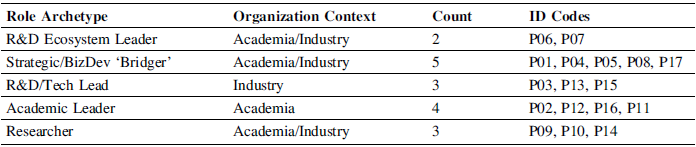
The final sample comprised 17 participants (N=17). The participant cohort is detailed in Table 1.
Summary of study participants by role archetype and organizational context

3.4. Data collection
Data were collected between August 2025 and October 2025 via semi-structured interviews. Each interview, lasting 45-60 minutes, was conducted privately (either in-person or remotely via secure online video calls) and audio-recorded with participant consent. A semi-structured protocol was developed and used to guide discussions on key topics including daily workflows, collaboration challenges, and knowledge sharing practices, while allowing flexibility to explore emergent themes. The semi-structured guide included open-ended questions such as: “How do you currently identify experts outside your organization?”, “What are the main friction points when sharing technical data with external partners?”, and “If you could design an ideal assistant for knowledge discovery, what functions would it perform?”. Thematic saturation, the point at which new interviews ceased to generate significant new insights, was largely achieved for the academic cohort of participants.
3.5. Data analysis and reporting
The analysis followed the six-phase thematic analysis framework of Reference Braun and ClarkeBraun and Clarke (2006), conducted by the primary researcher. After a thorough data familiarization phase, a primarily inductive coding process was employed to generate codes directly from participant narratives. This was supplemented by a small set of deductive codes for demographic data (role, sector). All the codes were then iteratively collated into candidate themes, which were systematically reviewed and refined to ensure each was coherent, distinct, and accurately represented patterns in the data. The iterative process of collating codes and refining them into coherent, data-grounded themes was managed using Microsoft Word and Excel to facilitate direct engagement with the text.
To enhance trustworthiness, the final themes are substantiated with illustrative quotations from participants. Each quotation is attributed using a unique, non-identifiable code (e.g., “P01”) to protect participant anonymity while providing context for the evidence.
4. Results and discussions
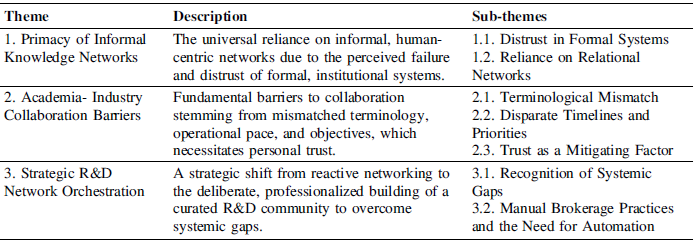
The thematic analysis of interviews with R&D community members from both academia and industry revealed three primary, interconnected themes, which are summarized in Table 2 and each theme is elaborated upon in the subsequent sections, supported by direct evidence from participant interviews.
4.1. Theme 1. primacy of informal knowledge networks
This foundational theme describes the central, universal challenge faced by all participants. A significant disconnect exists between formal, institutional knowledge systems (such as websites, databases, and official repositories) and the informal, human-centric networks that are essential for accomplishing work. While formal systems are the intended path for knowledge discovery, they are consistently perceived as inadequate, outdated, and untrustworthy. Consequently, the entire R&D community defaults to a parallel system built on personal relationships, reputation, and direct inquiry. This duality defines the day-to-day reality of knowledge work.
Summary of thematic analysis findings

This theme is characterized by two distinct sub-themes: the failure of formal systems and the subsequent reliance on informal ones.
4.1.1. Sub-theme 1.1: distrust in formal systems
Participants across the board expressed deep skepticism towards their organizations’ formal knowledge systems. These tools were frequently described as incomplete, difficult to navigate, and unreliable, rendering them ineffective for practical use. An industry R&D strategist lamented the state of his university partners’ external-facing information, calling their official presence a “horrible website” (P13). This sentiment was echoed by an industry manager trying to find academic partners, who noted the “Incomplete information on university websites” (P07). This distrust leads to an outright rejection of these tools. As one manager stated, he does not use formal systems like “employee lists/databases” (P13), viewing them as inefficient. The core issue is a lack of currency and utility, leading to a consensus that “Formal systems (websites, platforms) are unreliable for finding expertise” (P01).
4.1.2. Sub-theme 1.2: reliance on relational networks
In response to the failure of formal systems, participants universally rely on informal, personal networks to find expertise and resources. This ad-hoc system is seen as more efficient, trustworthy, and effective. The search for knowledge is consistently described as a person-to-person process. As one researcher explained, discovery happens “Purely through people” (P10), with the first step often being to simply ask a direct supervisor. This reliance on personal connections was described by one manager as “100% networking” (P13). The most common and trusted method is what one participant called “word-of-mouth” (P16), which another described as relying on “legendary reputations for expertise” (P03). This informal system, while effective, is also fragile, person-dependent, and perpetuates the very knowledge silos it is meant to overcome, creating significant project risks and inefficiencies.
An Overall simplified process of choosing systems is shown in Figure 1. This model depicts the process by which R&D practitioners, faced with untrustworthy and outdated formal systems, abandon them in favor of informal, personal networks. This workaround, while ultimately effective for a specific discovery task, introduces its own systemic challenges, including inefficiency and the reinforcement of organizational silos.
The cycle of formal system failure and reliance on informal networks

4.2. Theme 2: academia-industry collaboration barriers
This theme captures the fundamental barriers that hinder effective collaboration, particularly between academic and industrial R&D entities. This friction is multi-sub-themed, stemming from deep-seated differences in language, operational tempo, and core objectives. This creates a “translation crisis” where the same words carry different meanings, a “pace crisis” from conflicting timelines, and a resulting “trust crisis” that complicates partnership. This theme directly addresses the research question regarding the different challenges faced by university and industry representatives.
4.2.1. Sub-theme 2.1: terminological mismatch
Participants from both sides repeatedly highlighted the “Mismatch between scientific and industrial terminology” (P08). This is more than a simple vocabulary issue; it reflects a fundamental difference in worldview. An academic BizDev manager described it as acknowledging the “translation problem between academia and industry” (P04), while an industry manager noted that these “Terminological differences are universal” (P13) and something one must simply learn to manage. This gap necessitates individuals who can act as intermediaries, with participants stressing the “Need for a ‘translator’ role in collaborations” (P16) to bridge the semantic divide.
4.2.2. Sub-theme 2.2: disparate timelines and priorities
A major source of friction is the profound “Mismatch in timelines. Academic (long-term) vs. Industry (immediate)” (P12). Industry operates under immense time pressure, with one professor aptly quoting their partners’ perspective: “we need the answer yesterday” (P12). This contrasts sharply with the academic research cycle. For industry, the “constraint on time delivery” (P03) is a non-negotiable reality, and their priorities are pragmatic: “Client priorities to be cheap, fast, low-effort” (P14). For academics, these demands can conflict with the pace required for rigorous research and publication, a primary KPI in their environment.
4.2.3. Sub-theme 2.3: trust as a mitigating factor
Given the friction from translation and pace, the data shows that successful collaboration is predicated not on better systems, but on the painstaking construction of personal trust. A university leader emphasized that “Knowledge sharing is built on relationships, not just systems” (P01) and that “Trust as a core principle” is paramount. This is critical for overcoming the legacy of skepticism, including a KM barrier “Widespread mistrust among colleagues” (P13) observed in some industrial settings. Building this trust is the essential part that allows disparate teams to work through the inherent friction at the institutional interface.
Additionally Figure 2 illustrates the key KM challenges identified, delineating between those unique to academia and industry and those shared across both sectors. The central overlap highlights common hurdles, such as a reliance on informal networks, distrust of formal systems, and the critical role of personal trust. Academic-specific challenges are dominated by internal fragmentation, including knowledge silos and poor intra-institutional awareness (P02, P10, P11). In contrast, industry-specific challenges are characterized by a pragmatic focus on efficiency, risk management, and “expertise hunting” for problem-solving, coupled with formal vetting processes (P13, P05; P14).
Sector-specific and shared knowledge management challenges in academia and industry

4.3. Theme 3. strategic R&D network orchestration
Emerging from the challenges described in the first two themes, this final theme articulates a strategic evolution. It describes a shift away from reactive, individual networking towards the proactive and deliberate orchestration of an R&D ecosystem. This work is performed by experienced individuals in roles like Open Innovation Managers, Consortium CEOs, and University BizDev Liaisons. They do not seek to replace the human-centric network but to professionalize and scale it. Their goal is to move beyond finding a single expert for a single task and instead build a sustainable, pre-vetted community of trusted partners, thereby creating a more reliable and proactive flow of collaboration.
This theme also directly addresses the research questions regarding the potential for AI and who needs such a system. The manual, time-consuming work of the “Ecosystem Orchestrator” highlights the precise areas where automation is most needed.
4.3.1. Sub-theme 3.1: recognition of systemic gaps
Experienced participants recognize that reliance on informal networks is unsustainable. They identify a “systemic gap” (P08) and a “functional gap” (P06) in their organizations. The core problem is the “Lack of a ‘single point of entry’ for external partners” (P02), which forces both internal and external stakeholders into an inefficient discovery process. The solution, therefore, is to create dedicated bridging functions, such as a “Technology Leadership Office” (P02) or an “open innovation department” (P07).
4.3.2. Sub-theme 3.2: manual brokerage practices and the need for automation
The work of these orchestrators involves systematically building community and trust through mechanisms like “organized, structured brokerage events” (P06) and acting as a “matchmaker” (P06) between problem owners and solution providers. However, this is incredibly labor-intensive. Participants expressed a clear desire for an intelligent tool to support this work. Their vision is not for a simple search engine, but for an active “assistant.”
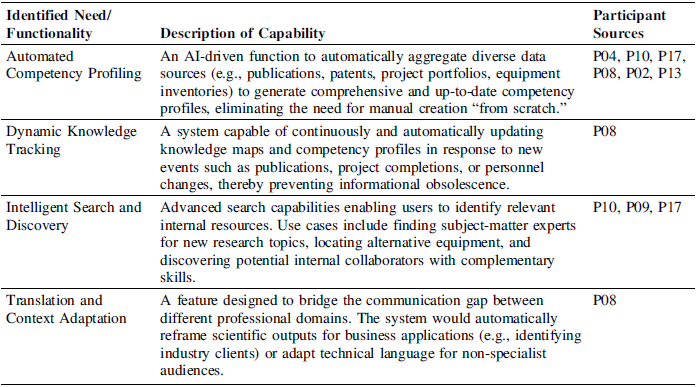
This assistant would automate the most painful tasks, such as generating competency profiles and tracking expertise. The ideal solution was described as an “AI-powered competency mapping system” (P16) that could “Capture competencies in real-time and track their evolution” (P08). For those bridging the academia-industry gap, there is a clear “Need for automated ‘translation’ from science to market” (P08). For managers, a key feature is the “Automated tracking of employee publications” (P01) and tracking a dynamic “‘trail of competencies’ for each employee” (P17). The preliminary functional needs for potential formal KM systems based on AI are listed in Table 3.
Identified potential functional needs for an AI-based knowledge management system

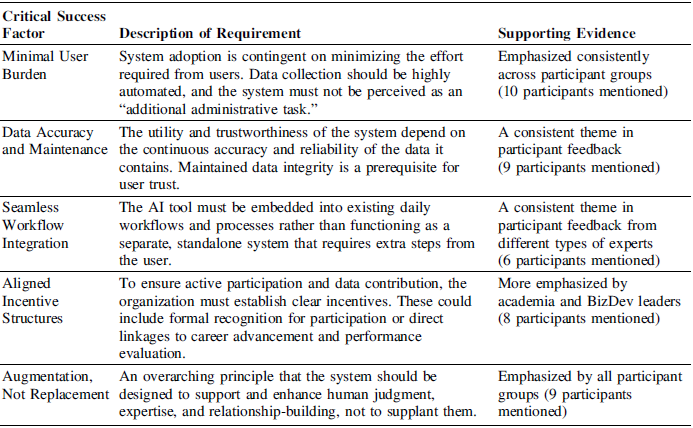
Table 4 outlines the necessary conditions, as stated by participants, that would influence the successful adoption and integration of such an AI system within the organization
Critical success factors for system adoption

4.4. Implications for design and limitations of the study
These findings hold specific implications for the design research community. The identified role of the “Knowledge Orchestrator” suggests that future KM tools should not be designed merely as static repositories, but as active “boundary objects” that facilitate trust between disparate organizational cultures. For design researchers, this shifts the challenge from information retrieval to interactive design specifically, designing interfaces that provide “social proof” of expertise to mitigate the system distrust identified in Theme 1.
Finally, these results must be interpreted within the limitations of the study. With a sample size of N=17, the findings provide a rich qualitative understanding of the “why” and “how” of resistance, but cannot be statistically generalized across all R&D sectors.
5. Conclusion
Our qualitative analysis reveals a fundamental tension in modern R&D ecosystems: respondents rely on informal, human-centric networks, while simultaneously desiring an intelligent tool to manage overwhelming data volumes and navigate the difficult collaborations between academia and industry.
A solution for the revealed problem is proposed in the form of dynamic, AI-based “knowledge orchestrators” that automatically map R&D expertise and suggest connections for collaboration. The requirements for designing such a system were developed, including automated competency profiling from diverse sources, dynamic knowledge tracking to prevent obsolescence, and intelligent search to discover internal resources. Additionally, this system must also act as a ‘digital bridger,’ translating the different languages and priorities of science and business to build trust.
The critical success factors for system adoption were identified, emphasizing the need for minimal user burden, seamless workflow integration, and data accuracy. This approach is uniquely achievable in the scientific domain, where the vast public data of publications and patents provides the necessary material for an AI to effectively map the R&D landscape.
6. Future work
The insights from this study define two clear trajectories for future research, addressing both the socio-organizational and the technical challenges of next-generation KM systems.
First, to address the critical gap in practitioner adoption, the empirical base must be broadened. While our qualitative data is insightful, the next step is to conduct a large-scale, structured survey across diverse academic and industrial roles. This will allow for a systematic mapping of needs and barriers, providing the robust, evidence-based foundation required for designing a truly user-centric system that aligns with existing workflows and incentive structures.
Second, to address the technical challenge of creating a sustainable “knowledge orchestrator,” research must focus on automation. The manual burden of system maintenance is a critical failure point for traditional KM. Therefore, future work must prioritize developing intelligent agents capable of autonomously creating and dynamically updating the underlying knowledge graph as new information is generated.



 Open access

