


In 2003, the UK ECT Review Group published a systematic review and meta-analysis reviewing the evidence on a number of variables relating to electroconvulsive therapy (ECT). In this review, bilateral ECT was found to be moderately more effective than unilateral ECT, and the latter produced fewer adverse cognitive effects. However, all stimulus intensities were combined when comparing bilateral with unilateral ECT including suboptimal dosages of unilateral ECT, which makes the evidence for advantage of bilateral over unilateral ECT dubious. The authors of the review noted with interest that several investigators had reported that high-dose unilateral ECT was as effective as bilateral ECT while retaining an advantage over bilateral ECT in terms of severity of impairment on measures of both anterograde and retrograde amnesia. One such trial was reported by Sackeim et al (Reference Sackeim, Prudic and Devanand2000), where unilateral ECT produced identical response rate at high dose to bilateral ECT and a remission rate was not statistically significantly different (60% v. 65%).
Bilateral ECT is recommended in life-threatening situations and unilateral ECT in less urgent cases (Reference ScottScott, 2005). However, it is possible that further definitive research would lead to unilateral ECT being recommended as treatment of choice in the first instance in all cases.
Given this uncertainty in the evidence, there is a need for further investigation. To determine what the important questions are, it is necessary to discover the prevailing attitudes towards ECT among the prescribers. Investigating the difference in effectiveness between treatments that consultants considered clinically significant would allow future investigators to perform power calculations to determine the size of study required to decide whether unilateral or bilateral ECT is a preferable first-line treatment.
Method
I conducted a postal survey by sending, once only, a questionnaire to the 375 consultant psychiatrists in Scotland, currently members of the Royal College of Psychiatrists. Ethical approval was obtained from the local research ethics committee in Glasgow. The questionnaire used a series of Likert scales to elicit attitudes and practices of Scottish consultant psychiatrists. The first question asked whether the person prescribed the ECT, and only those who did were asked further questions. They had to indicate whether they preferred bilateral, non-dominant unilateral or other electrode placement in most circumstances. They were then asked their opinion (strongly disagree, disagree, neutral, agree, strongly agree) on the seven statements concerned with various aspects of the two types of ECT (Tables 1 & 2). Finally, respondents were asked to indicate the minimum difference in effectiveness (in terms of improvement on Montgomery-Åsberg Depression Rating Scale (MADRS; www.crazymeds.us/MADRS.pdf), response rate and remission rate between the two treatments that they would consider clinically significant. The MADRS, rather than the Hamilton scale (which is more often used in antidepressant medication research) was chosen as it is used by the Scottish ECT Audit Network (www.sean.org.uk/AuditReport/Phase1) to measure response to ECT and so it was assumed that Scottish ECT prescribers would be familiar with it.
Opinions of those Scottish consultants who preferred bilateral electroconvulsive therapy (ECT) (n=113)

| Questionnaire statement | Strongly disagree, % | Disagree, % | Neutral, % | Agree, % | Strongly agree, % |
|---|---|---|---|---|---|
| 1. Bilateral ECT is more effective than unilateral ECT | 0 | 2 | 5 | 68 | 24 |
| 2. Unilateral ECT produces fewer adverse cognitive effects than bilateral ECT | 1 | 4 | 12 | 70 | 13 |
| 3. Adverse cognitive effects are the most important form of morbidity arising from ECT | 0 | 9 | 17 | 61 | 12 |
| 4. Patient-related factors (such as pre-existing cognitive impairment) influence my choice of electrode placement | 0 | 10 | 20 | 59 | 12 |
| 5. The emergence of unacceptable cognitive effects is a valid reason for switching from bilateral to unilateral ECT | 0 | 5 | 13 | 65 | 17 |
| 6. Poor or delayed response is a valid reason for switching from unilateral to bilateral ECT | 1 | 5 | 24 | 56 | 15 |
| 7. Seizure threshold, as determined by dose titration, should guide the dose of ECT to be prescribed | 0 | 2 | 5 | 61 | 33 |
Opinions of those Scottish consultants who preferred unilateral electroconvulsive therapy (ECT) (n=25)
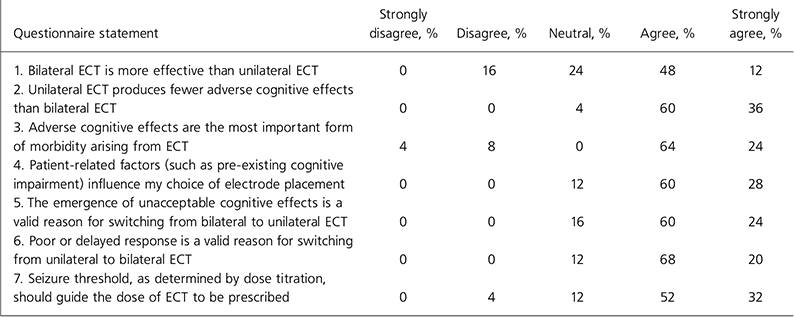
| Questionnaire statement | Strongly disagree, % | Disagree, % | Neutral, % | Agree, % | Strongly agree, % |
|---|---|---|---|---|---|
| 1. Bilateral ECT is more effective than unilateral ECT | 0 | 16 | 24 | 48 | 12 |
| 2. Unilateral ECT produces fewer adverse cognitive effects than bilateral ECT | 0 | 0 | 4 | 60 | 36 |
| 3. Adverse cognitive effects are the most important form of morbidity arising from ECT | 4 | 8 | 0 | 64 | 24 |
| 4. Patient-related factors (such as pre-existing cognitive impairment) influence my choice of electrode placement | 0 | 0 | 12 | 60 | 28 |
| 5. The emergence of unacceptable cognitive effects is a valid reason for switching from bilateral to unilateral ECT | 0 | 0 | 16 | 60 | 24 |
| 6. Poor or delayed response is a valid reason for switching from unilateral to bilateral ECT | 0 | 0 | 12 | 68 | 20 |
| 7. Seizure threshold, as determined by dose titration, should guide the dose of ECT to be prescribed | 0 | 4 | 12 | 52 | 32 |
Results
Of the 375 consultants who were sent a copy of the questionnaire, 230 (61%) responded. Percentages have been calculated to the nearest whole number so rounding errors will occasionally mean column totals are not exactly 100.
Of those who responded, 143 (62%) were prescribers of ECT and 87 (38%) were not. Most non-prescribers were child and adolescent psychiatrists, although some were liaison psychiatrists or addiction psychiatrists with no in-patient remit.
The majority of prescribers (79%) preferred bilateral electrode placement under most circumstances, but a significant minority (18%) preferred unilateral ECT. Only five prescribers (3%) had another preference, no preference or did not know. Interestingly, although additional comment was not specifically invited, one respondent wrote that they would discuss the relative merits and risks with the patient, if possible.
There were differences in opinions on various aspects of the two types of ECT between those consultants who preferred bilateral ECT under most circumstances and those who preferred unilateral ECT (Tables 1 & 2).
Half of the respondents thought that only a difference (between the two types of treatment) of 5 or greater than 5 points’ improvement on the MADRS would be clinically significant, whereas only 27% thought that a smaller difference would be significant. Only 4% of prescribers would find an absolute difference in response rate of less than 5.1% to be clinically significant and only 3% would find an absolute difference in remission rate of less than 5.1% to be significant (Table 3).
Percentage of all respondents who found differences to be clinically significant (n=143)

| Responders, % | |
|---|---|
| Absolute difference on MADRS | |
| 1 | 0 |
| 2 | 1 |
| 3 | 11 |
| 4 | 15 |
| 5 | 25 |
| >5 | 25 |
| NA | 22 |
| Absolute difference in response rate, % | |
| 0.1–5.0 | 4 |
| 5.1–10 | 26 |
| 10.1–15 | 30 |
| 15.1–20 | 7 |
| 20.1–25 | 11 |
| >25 | 3 |
| NA | 19 |
| Absolute difference in remission rate, % | |
| 0.1–5.0 | 3 |
| 5.1–10 | 31 |
| 10.1–15 | 27 |
| 15.1–20 | 8 |
| 20.1–25 | 6 |
| >25 | 2 |
| NA | 22 |
Discussion
The differences in consultants’ opinions are much what one would expect; for example, a smaller proportion of those preferring unilateral ECT believe that bilateral placement is more effective than those preferring bilateral placement, and a greater proportion of those preferring unilateral placement believe that unilateral placement has fewer adverse cognitive effects than those preferring bilateral placement. This, if nothing else, suggests that there is a logical relationship between prescribers’ attitudes and their prescribing practices.
A surprising finding is that, in those preferring bilateral ECT, a smaller proportion of respondents thought that poor or delayed response was a valid reason for switching from unilateral to bilateral ECT than those who thought that the emergence of adverse cognitive effects was a valid reason to switch from bilateral to unilateral ECT (71% v. 82%). This perhaps reflects the special function of unilateral ECT in treating severe depression, where bilateral ECT has produced adverse cognitive effects.
It is also surprising that a greater proportion of unilateral ECT prescribers than bilateral prescribers felt that switching from unilateral to bilateral ECT was valid in the case of poor or delayed response (88% v.71%). This may reflect a greater willingness to revise the management plan among those prescribers who routinely believe they are sacrificing effectiveness to avoid adverse effects in the first instance.
It seems clear that on the whole those consultants who prefer unilateral ECT do so because they believe it has fewer adverse effects than bilateral ECT rather than because they doubt the superior effectiveness of bilateral ECT. It also seems apparent that the majority of consultants who prefer bilateral ECT do so because they believe in its superior effectiveness rather than because they doubt that unilateral ECT produces fewer adverse effects.
If it is indeed the case that unilateral ECT at an optimum dose is as effective as bilateral ECT while retaining superior adverse effect profile (as suggested by the authors of several trials included in the systematic review (UK ECT Review Group, 2003) and queried by the reviewers themselves), then future studies would influence prescribing practice more by concentrating on efficacy rather than adverse effects. This is because prescribers, whichever ECT they prefer, are more convinced by the difference in adverse effects than by equivalence of effectiveness. It would certainly still be desirable to demonstrate both parts of the hypothesis in the same study, however.
There is much useful information to guide the choice of outcome and size of future studies.
Power calculations
In terms of power, respondents seemed to find response and remission rates to be more meaningful than points on the MADRS (Table 3). A study which would have 80% power to ascertain that the difference in remission rate between the two types of ECT was no greater than 5% would convince 97% (100 – 3) of prescribers that the difference between the two treatments was not clinically significant.
However, if the study only had power to ascertain that the difference in absolute remission rate was no greater than 10%, it would only convince 66% (100 – (3 + 31)) of the prescribers. The advantage of accepting this trade off is that for power to detect a difference of 10% (e.g. between 70 and 80%), a sample size of only 294 in each group would be required.
An example power calculation for 80% power to detect a difference between 65 and 70% remission rates between the two types of ECT with alpha 5% would be a sample size of 1377 in each group. If we were more optimistic and speculated 80% and 85% remission rates, a sample size of 906 in each group would be required.
No existing single trial has this sort of power (Sackeim et al (2003) randomised 80 patients, equivalent to 7% power to detect 5% difference). Although the systematic review by the ECT review group (2003) presented data on 5592 patients when comparing unilateral with bilateral ECT, all stimulus intensities were combined in the meta-analysis and few included studies which utilised optimum dose unilateral ECT.
Approximately 1000 courses of ECT are given in Scotland every year, about 80% with informed consent (www.sean.org.uk/AuditReport/ExecutiveSummary). Potentially, a high proportion of 800 patients per annum could be randomised to unilateral or bilateral ECT. It would be feasible to use the data collection system from the Scottish ECT Audit Network (SEAN) to perform a large multicentred trial of an appropriate magnitude over the course of the next few years in order to ground any change in practice securely upon an evidence base.
Conclusions
It is premature to recommend a change to existing prescribing practices based on current evidence.
If future investigators wished to produce a definitively negative comparison of the difference in remission rates between the two types of ECT, then 80% power to detect an absolute difference of 5% in remission rate would be needed. Optimal dose unilateral ECT should be used.
Declaration of interest
None.
Acknowledgements
I thank those Scottish consultant psychiatrists who responded to my questionnaire and Dr A. V. Mark Hughson, my research supervisor, for his kind support, guidance and encouragement.


 Open access


eLetters
No eLetters have been published for this article.