





Introduction
Rising inequalities all over the globe have been described as a fertile ground for the rise of populist parties (Gerbaudo Reference Gerbaudo2022). Most democratic societies have experienced an increase in inequalities over the last decades. Among other things, there has been a rise in income, earnings, and wage inequality, as well as a rise in already high levels of wealth inequality (Balestra and Tonkin Reference Balestra and Tonkin2018; OECD 2011). In the same period, populists have been on the rise. In Europe, for example, populist parties only received around 12% of the vote in democracies around the turn of the century; in 2018, their vote share was as high as 28% (Rooduijn et al. Reference Rooduijn, Van Kessel, Froio, Pirro, De Lange, Halikiopoulou, Lewis, Mudde and Taggart2019).
Previous research has suggested that increasing inequalities may be a contributing factor to the rise of populist parties around the world (Coffé et al. Reference Coffé, Heyndels and Vermeir2007; Jesuit et al. Reference Jesuit, Paradowski and Mahler2009; Han Reference Han2016; Rooduijn and Burgoon Reference Rooduijn and Burgoon2018; Engler and Weisstanner Reference Engler and Weisstanner2020; Stoetzer et al. Reference Stoetzer, Giesecke and Klüver2021a). However, the specific mechanisms through which inequalities lead to support for populism are not well understood. Existing arguments propose that objective inequality levels lead to structural changes that influence specific attitudes that can increase demand for populist parties in general elections. In contrast, recent work by Stoetzer et al. (Reference Stoetzer, Giesecke and Klüver2021a) suggests that these existing attitudinal explanations cannot account for the observed relationship between objective income inequality and support for populist parties.
In this article, we investigate whether perception of the overall level of inequality accounts for the formation of populist attitudes and explains the electoral support for populism. It is important to acknowledge that objective levels of inequality do not necessarily affect attitudes and voting behavior of citizens, but that citizens need to process the information they are exposed to. We argue that perceived inequality could therefore be a central factor to explain populist attitudes and the rise of populist parties. In general, the perception of the unequal distribution of goods in a society could trigger beliefs that representation by established mainstream parties is biased toward social and economic elites. This would concern key dimensions of populist attitudes: anti-elitism, Manichaeism in perceiving a struggle between good and bad, and calls for people’s sovereignty. It could, in turn, make populist parties a more attractive electoral choice, as they promote the unconditional implementation of the majority will for nativist, authoritarian (on the far right), or strong redistribution (on the far left) platforms. Thus, perceived inequality might be an important missing piece in the puzzle to explain why inequality and the rise of populism are related.
We investigate the link between perceived inequality and populism in two different research designs: A comparative observational survey study and an information-provision experiment (Haaland et al. Reference Haaland, Roth and Wohlfart2023) in three different countries. The observational study uses the International Social Survey Programme’s (ISSP) inequality modules of 2009 and 2019 to estimate the effect of perceived inequalities on the support for populist parties (ISSP Research Group 2017, 2022). The results show that perceived inequality is related to the support for populist parties. Voters who perceive strong inequalities in society are about 2.7 percentage points more likely to support populist parties, compared to respondents who perceive society as more equal. The effects are particularly strong for prominent and large right-wing populist parties such as the Progress Party in Norway, the Danish People’s Party, and the Freedom Party of Austria.
We complement the ISSP findings with the results of an information-provision experiment conducted in Germany, Denmark, and Italy to strengthen a possible causal interpretation of the finding. The information-provision experiment manipulates respondents’ perception of societal inequality using factual information about wealth distribution and examines the immediate impact on populist attitudes and support for populist parties. The results show that perceived inequality can increase populist attitudes, particularly in Denmark, a context in which respondents strongly underestimate the extent of wealth inequality. Although we do not estimate an immediate effect on voting decisions in our experiment, it reveals that corrections of inequality (mis-)perception can trigger populist attitudes that are one of the mobilization factors for populist parties.
Our study contributes to a number of important debates in comparative politics on the rise of populism. It focuses on the unequal allocation of economic resources in society as one precondition for the populist turn. Contrary to previous research with a focus on objective levels of inequality, our work proposes that the perception of inequality matters. It aligns with recent publications in psychology (Willis et al. Reference Willis, García-Sánchez, Sánchez-Rodríguez, García-Castro and Rodríguez-Bailón2022) and economics (Hauser and Norton, Reference Hauser and Norton2017) that accentuate the (mis-)perception of inequality as a central driver of behavior more generally. We show that perceived inequality is a potential explanation for the formation of populist attitudes and electoral support for populist parties. Our experimental results, however, indicate that changes in populist attitudes do not directly translate into support for populist parties. This raises the question of how populist parties mobilize voters with populist attitudes on election day. The study also speaks to recent work that analyses the misrepresentation by mainstream politicians as the explanation why people turn toward populist platforms (Silva and Wratil Reference Silva and Wratil2021). Our findings suggest that unequal economic outcomes alone can be perceived as poor political representation by political elites, leading voters to develop populist attitudes toward politics.
Perceived inequality and support for populism
Does economic inequality influence the rise of populist parties? This is a challenging theoretical question for several reasons. The primary difficulty lies in explaining the relationship between two macro-level phenomena: the unequal distribution of economic resources and the growing general support for populist parties. To address this, we build on previous research (Coffé et al. Reference Coffé, Heyndels and Vermeir2007; Jesuit et al. Reference Jesuit, Paradowski and Mahler2009; Han Reference Han2016; Rooduijn and Burgoon Reference Rooduijn and Burgoon2018; Engler and Weisstanner Reference Engler and Weisstanner2020; Stoetzer et al. Reference Stoetzer, Giesecke and Klüver2021a) and, in the following sections, develop a micro-level foundation to understand how increasing inequality influences voting decisions for populist parties through changes in attitudes and perceptions.
Inequality and support for populist parties
We rely on the ‘ideational’ definition of populism as an ideology. Populism includes a perception of a society of two homogeneous and opposed groups, the people and the elite, and it contends that politics should be an expression of the general will of the people (Mudde Reference Mudde2004). While the meaning of ‘the people’ and ‘the elite’ depends on the political context, ‘the elite’ is generally portrayed as ‘arrogant, greedy, lazy, corrupt, unresponsive to ordinary people and absorbed by self-interest’ (Bakker et al. Reference Bakker, Rooduijn and Schumacher2016, p. 2). In the ideational approach, populist parties can hold different ‘host ideologies’ that are frequently seen at the extreme ends of the political spectrum (Rooduijn Reference Rooduijn2018; Loew and Faas Reference Loew and Faas2019).
Recent analyses suggest that economic inequality can be a potential source for the support of populist parties. Stoetzer et al. (Reference Stoetzer, Giesecke and Klüver2021a) describe a positive correlation between income inequality and support for populist parties using data from the European Social Survey between 2002 and 2017 in 14 West-European countries. Covering a wider period, Engler and Weisstanner (Reference Engler and Weisstanner2020) reveal that long-run changes in income inequality increase the support for populist radical right parties, particularly among individuals with high subjective social status and lower-middle incomes. Similarly, Han (Reference Han2016) shows that the relationship between objective inequality levels and voting for extreme populist right parties is moderated by individual-level status and income. While inequality increases support for the radical populist right among manual laborers and regular nonmanual employees, it has the reverse effect among professionals. Earlier studies find similar conditional patterns (Coffé et al. Reference Coffé, Heyndels and Vermeir2007; Jesuit et al. Reference Jesuit, Paradowski and Mahler2009).Footnote 1
The existing literature proposes explanations of how inequality is related to populist support. Arguments most often assume that inequality changes structural factors in the distribution of social resources, such as the status of occupational groups and income deprivation. These gradual changes lead to attitudinal changes, which can then be related to support for populist parties. The attitudinal consequences broadly categorize into four main channels: Economic insecurities and deprivations, social integration, trust in political elites, and social (national) identity. Footnote 2
First, one prominent mechanism is economic insecurities and deprivations, building on theories of ‘relative deprivation’ (Runciman and Runciman Reference Runciman and Runciman1966; Betz Reference Betz1994), or on ‘risk theories’ (Moene and Wallerstein Reference Moene and Wallerstein2001; Rehm Reference Rehm2016). Inequality either increases the risks or the income deprivation relative to others in society, which results in economic insecurities and makes people more likely to vote for populist parties. Second, the social integration argumentation proposes that the socially marginalized ‘are more likely to be alienated from mainstream politics and […] support radical parties’ (Gidron and Hall Reference Gidron and Hall2020, p. 2). Inequality and social stratification result in a larger share of voters who feel socially marginalized and turn their back on mainstream politics and toward populist challengers. Third, social (national) identity can play a role in understanding the link between inequality and support for populist right-wing parties. Income inequality increases the value of national identity over class for low-income segments, making populist nativist parties more appealing (Shayo Reference Shayo2009; Han Reference Han2016). Fourth, trust in political elites could be a direct consequence of going through economic deprivation. Reduced trust in the actors responsible for the policies could make populists more appealing.
Existing studies suggest that the proposed mechanisms are not sufficient to understand the inequality-populism nexus. Stoetzer et al. (Reference Stoetzer, Giesecke and Klüver2021a) use mediation analysis to show that the attitudinal mechanisms do not fully explain the relationship between income inequality and support for populists. Income inequality links to the attitudes as expected: making people more economically insecure, less trusting in elites, less socially integrated, and more nationalistic. The attitudes also relate to voting for populist parties as predicted. But the results show that none of the suggested mechanisms can explain the positive relationship between income inequality and electoral support for populist parties. This finding raises questions about whether existing theories are able to explain how inequality influences the rise of populist parties.
One reason for the lack of clear evidence could be that the perception of inequality plays a subordinate role in prior research. Most arguments suppose a change in structural factors as the main driver, even though integrating perception can present a direct path from inequality on the macro level to attitudes and the populist support. Argumentation and tests thereof might miss important variation that is behaviorally relevant. A current review promotes this idea in suggesting that ‘psychological effects of economic inequality are driven by perceived — rather than objective — inequality’ (Willis et al. Reference Willis, García-Sánchez, Sánchez-Rodríguez, García-Castro and Rodríguez-Bailón2022, p. 1).
Some strands of the economic insecurities and deprivation literature follow this focus on inequality perceptions. Researchers argue that the relative perceived social and economic comparison (e.g., compared to other income groups (Burgoon et al. Reference Burgoon, van Noort, Rooduijn and Underhill2019) or status discordance relative to parents (Kurer and Van Staalduinen Reference Kurer and Van Staalduinen2022)) or the subjectively perceived economic situation (Steenvoorden and Harteveld Reference Steenvoorden and Harteveld2018; Gidron and Hall Reference Gidron and Hall2020) is more important than objective levels of inequality to explain support for populist radical right parties. In this view, economic changes lead to changes in perceptions of inequality, which then influence attitudes and can affect voting. Our argument shifts its focus away from social or economic comparison and toward the perception of the overall societal inequality.
The perception of inequality
The actual levels of inequality in a society influence perceived inequality, but it can still deviate substantially between individuals. For example, Kuhn (Reference Kuhn2020) shows a clear positive correlation between perceived and objective income inequality on the aggregate (see also Loveless and Whitefield Reference Loveless and Whitefield2011; Gimpelson and Treisman Reference Gimpelson and Treisman2018). There is also substantial individual variation, with large discrepancies between the actual inequality in income and perception (see also Chambers et al. Reference Chambers, Swan and Heesacker2014). In general, people tend to underestimate inequality (Xu and Garand Reference Xu and Garand2010; Engelhardt and Wagener Reference Engelhardt and Wagener2018; Gimpelson and Treisman Reference Gimpelson and Treisman2018; Bellani et al. Reference Bellani, Bledow, Busemeyer and Schwerdt2021). This implies that exposure to real levels of inequality could alter perceptions of inequality on average.
The perception of inequality is not limited to the unequal distribution of income in a society. Although most economic research focuses on economic sources of inequality, in terms of wealth and income, researchers have long argued for a broader definition that includes status inequality as an important aspect (Ridgeway Reference Ridgeway2014), and inequality in opportunity (Sewell Reference Sewell1971). Perceptions of inequality can encompass this broader conceptualization, as individuals can perceive a society as unequal for differences in economic factors, opportunities, or status (Irwin Reference Irwin2018). In this regard, the tendency that most people perceive themselves as part of the middle class (Kelley and Evans Reference Kelley and Evans1995; Evans and Kelley Reference Evans and Kelley2004) can also lead to an underestimation of the extent of inequality in a society.
The perception of inequality in a society can affect attitudes, and is relevant (next to actual inequality) for political behavior. This is well documented when establishing the link between income inequality and redistribution preferences (see e.g. Niehues Reference Niehues2014; Hauser and Norton Reference Hauser and Norton2017; Engelhardt and Wagener, Reference Engelhardt and Wagener2018 ; Choi Reference Choi2019). Kuziemko et al. (Reference Kuziemko, Norton, Saez and Stantcheva2015), for example, use randomized survey experiments to manipulate the perception of inequality. Changes in the perception also make people more likely to support redistributive policies, like an estate tax, and increase the share of respondents who would sign a petition. For our argumentation, this underlines that the perception of inequality matters when explaining attitudes and behavior.
Inequality perception, populist attitudes, and support for populist parties
Perceptions of unequal allocation of economic resources can influence beliefs about biased political representation. Politicians inaccurately assess public opinion on policy issues (Walgrave et al. Reference Walgrave, Jansen, Sevenans, Soontjens, Pilet, Brack, Varone, Helfer, Vliegenthart, van der Meer, Breunig, Bailer, Sheffer and Loewen2022), leaving room for bias. Current research reveals that party elites have a biased perception of the opinion of their constituents (Broockman and Skovron Reference Broockman and Skovron2018; Pereira Reference Pereira2021). One reason for this bias is that wealthy and organized groups are more likely to make their voices heard (Gallego Reference Gallego2007; Gilens Reference Gilens2012; Schlozman et al. Reference Schlozman, Verba and Brady2012), making politicians and mainstream parties more responsive to the rich than to poorer segments of the electorate (Giger et al. Reference Giger, Rosset and Bernauer2012). These biased perceptions are not observable by the electorate, but voters can rely on alternative signals to inform their perception of accurate representation by mainstream parties.
We propose that observing actual unequal economic outcomes can be one source that informs beliefs that representation by the mainstream parties and politicians is biased. Evidence comes from experimental studies. For example, the survey experiment in Kuziemko et al. (Reference Kuziemko, Norton, Saez and Stantcheva2015) reveals a ‘decrease in the share of treatment respondents agreeing that the government can be trusted’ (Kuziemko et al. Reference Kuziemko, Norton, Saez and Stantcheva2015, p. 1491) when presenting respondents with information about income inequality. While the effect is only short-lived, it shows that perception can trigger voters’ beliefs about political elites. Salvador et al.’s (Reference Salvador, Suitner and Jetten2022) experiments draw a direct link between the inequality perception and conspiracy beliefs, confirming the observational correlation from survey analysis. Both findings indicate that observing unequal economic outcomes is associated with the electorate’s disbelief that elites represent the masses; rather, elites are seen as representing the preferences of the rich.
Biased representation by political parties and politicians can further trigger populist attitudes. Silva and Wratil (Reference Silva and Wratil2021) argue that ‘the more parties appear as unrepresentative elites in voters’ eyes, the more heightened should populist sentiment become’ (Silva and Wratil Reference Silva and Wratil2021, p. 2), a claim confirmed by their survey experiment. This argument is rooted in the understanding of populism as a critique of representative democracy (Caramani Reference Caramani2017). Democracy embodies the public’s will and ensures sovereignty through elected representatives. However, representatives also mediate and potentially distort this will, creating a tension that populist rhetoric seeks to exploit. The key appeal of populism comes from the public belief that elites misrepresent their interests (Canovan Reference Canovan2002).
The perception of inequality can intensify this tension by highlighting discrepancies in resource distribution and political influence. Inequality serves as a visible marker of the failure of elites to represent the interests of the ‘poor’ people (Giger et al. Reference Giger, Rosset and Bernauer2012). When individuals perceive economic inequality, they may conclude that elites have acted out of self-interest or in ways that betray democratic principles of fairness and equal representation. This reinforces anti-elitist attitudes, portraying elites as ‘rich, wealthy’, and disconnected from the needs of the ‘poor.’
Beyond anti-elitism, perceived inequality can also foster Manichaean thinking, which views society in a stark moral binary: the corrupt elite versus the virtuous masses. Economic inequality provides a concrete and emotionally charged basis for this moral polarization, where the disparity between ‘rich’ and ‘poor’ becomes symbolic of deeper societal injustice. Recent research supports this view, showing that income inequality is linked to heightened moralization (Elbæk et al. Reference Elbæk, Mitkidis, Aarøe and Otterbring2023; Kirkland et al., Reference Kirkland, Van Lange, Gorenz, Blake, Amiot, Ausmees, Baguma, Barry, Becker and Bilewicz2024). This binary aligns with populist narratives that frame political conflict as a struggle between good (the people) and evil (the elite), reinforcing the notion that these two groups are fundamentally opposed.
Similarly, perceived inequality strengthens people-centrism, the belief that ultimate authority should rest solely with the majority, unmediated by elites. As inequality undermines trust in representative institutions, voters may increasingly demand direct implementation of the majority’s will as the only way to rectify economic injustice. Research in psychology, for example, suggests that economic inequality can lead to demands for a ‘strong leader’ (Sprong et al. Reference Sprong, Jetten, Wang, Peters, Mols, Verkuyten, Bastian, Ariyanto, Autin and Ayub2019), which is central to populism and its focus on sovereignty (Taggart Reference Taggart2000; Laclau Reference Laclau2005; Osuna and Javier Reference Osuna and Javier2021). The belief in the sovereignty of the people via a strong leader is not only a rejection of elite mediation but also a call to dismantle institutions seen as perpetuating inequality.
The perception of inequality can foster populist attitudes through these key dimensions: anti-elitism, Manichaeism, and the sovereignty of the people (Akkerman et al. Reference Akkerman, Mudde and Zaslove2014). It amplifies anti-elitism, reinforces a moral and political worldview that legitimizes Manichaean divisions, and strengthens demands for unmediated people’s sovereignty through strong leaders. This leads to our first hypothesis:
Hypothesis 1: Perceived economic inequality increases populist attitudes.
Such populist attitudes increase the likelihood that people vote for populist parties. As ‘a thin-centred ideology’ populism can be located at the radical ends of the political spectrum (Rooduijn and Akkerman Reference Rooduijn and Akkerman2017). Right-wing populist parties have programs based on nationalism, authoritarianism, and cultural conflicts (Mudde, Reference Mudde2007). Left populists focus on issues of economic allocations and inequalities as a source of their radicalization (March and Mudde Reference March and Mudde2005). Regardless of the host ideology, voters with populist attitudes are more likely to vote for populist parties (Akkerman et al. Reference Akkerman, Mudde and Zaslove2014; Van Hauwaert and Van Kessel Reference Van Hauwaert and Van Kessel2018; Loew and Faas Reference Loew and Faas2019; Hawkins et al. Reference Hawkins, Kaltwasser and Andreadis2020; Marcos-Marne et al. Reference Marcos-Marne, Plaza-Colodro and Freyburg2020). Some studies find these effects to be minor, for populists in power (Jungkunz et al. Reference Jungkunz, Fahey and Hino2021; Silva et al. Reference Silva, Fuks and Tamaki2022), but generally confirm that populist attitudes influence voting (but see Neuner and Wratil Reference Neuner and Wratil2020). For our argumentation, this means that changes in perceived inequality can transmit to the vote for populist parties via changes in populist attitudes, leading to our second hypothesis.
Hypothesis 2: Perceived economic inequality increases the support for populist parties.
In this process, elites and political parties can play a central role and can potentially amplify the connection between perceptions of inequality and support for populism. The argument above focuses on the demand generated by the perception of inequalities, which fosters the creation of populist attitudes. However, political parties and elites’ communication and behavior may supply a critical element that strengthens this connection. Conceptually, it is helpful to differentiate between two types of political parties and elite actors: populist actors who seek to profit from this demand and mainstream actors who aim to counter it.
Populist actors can use communicative strategies to reinforce the link between perceptions of inequality and populist attitudes. They may emphasize the misrepresentation of economic interests and portray elites as biased, sowing the seeds for strengthening populist attitudes. Hameleers et al. (Reference Hameleers, Bos and De Vreese2017), for example, demonstrate that emotionalized blame attribution in populist communication can amplify perceptions of the failed representation of ordinary people (see also Busby et al. Reference Busby, Gubler and Hawkins2019). Furthermore, the existence of a populist party is a necessary condition for voters to translate their populist attitudes into political support. Without a populist party, voters lack a viable political option that explicitly aligns with their perceptions of inequality and dissatisfaction with the elite. Once such a party is present, it can leverage these populist attitudes by campaigning on populist platforms, presenting itself as an outsider to the elite and as a champion of restoring popular sovereignty.
Mainstream actors, on the other hand, may attempt to counter these efforts through communication, but this can prove challenging. While Geißler et al. (Reference Geißler, Hartmann, Giesecke, Klüver, Schleiter and Stoetzer2024) demonstrate that a negative campaign portraying populist parties as self-serving might reduce the appeal of populism, it remains unclear to what extent these communication frames can effectively counter populist messaging. Mainstream actors could also focus on reducing inequalities through policy interventions, aiming to lower perceptions of inequality and directly address economic disparities – a point we revisit in the discussion.
In sum, the argument proposes that perceived inequality can foster the belief that political elites are unrepresentative of the interest of a vast share of the electorate, which triggers populist attitudes. Populist attitudes then influence support for populist parties that offer to represent the general will against the corrupt elite.
Empirical analysis
We test the hypotheses using two complementary research designs to allow for external validity while at the same time providing a causally identified analysis. The first research design provides comparative and observational evidence from the International Social Survey Programme (ISSP) to evaluate our hypothesis in a variety of countries to maximize external validity. As a second research design, we conducted an information provision experiment in three countries. The evidence from the experiment complements the causal interpretation of the results and allows us to evaluate the second hypothesis about the effect on populist attitudes.
Observational evidence
Data and methods
We use survey data from the ISSP 2009 and 2019 social inequality module. The social inequality modules contain a battery of questions on perceived inequalities in society. Our ideational definition of populist parties aligns with the PopuList (Rooduijn et al. Reference Rooduijn, Van Kessel, Froio, Pirro, De Lange, Halikiopoulou, Lewis, Mudde and Taggart2019), which identifies populist, far-right, and far-left parties in Europe. We include ISSP countries with at least one party classified as populist. As argued in the theory section, the presence of a populist party is a necessary condition for both the hypothesized effects of populist perceptions on voting behavior to materialize and for Hypothesis 2 to be tested. This case selection leads to twenty European countries included in the 2009 analysis and eleven European countries included in the 2019 analysis.Footnote 3 Most populist parties in our sample are far-right populist (26) or populist parties with no extreme ideology (12). Only three parties are classified as far left and populist. An overview of the countries and populist parties in our sample is provided in Table A.1.1 in the online supplementary material (SM). The size of the country study samples varies from 947 to 3042 respondents, totaling 39284 respondents for the entire analysis.
The dependent variable of our analysis is the support for a populist party. We construct this measure based on responses to questions about support for particular parties.Footnote 4 We code if a respondent supports any populist party according to the PopuList. The support for populist parties in our sample varies in the different countries (see SM A.2.4). The mean support for populist parties in the selected countries from the ISSP is 21% in 2009 and 26% in 2019. Because the ISSP does not include measures of populist attitudes, the evaluation of the second hypothesis is conducted using the experimental research design described later.
Perceived inequalities – the independent variable – are measured based on a question that asks respondents to choose between five diagrams that ‘show different types of society’ (see Figure 1). The diagrams present a pyramid of the distribution of people in a society with a short description. Type A represents a society with ‘a small elite at the top, very few people in the middle and a great mass of people at the bottom’. We interpret this as a perception of a highly unequal distribution of resources in a society. The ISSP pyramid question has been used in multiple publications (Niehues Reference Niehues2014; Gimpelson and Treisman Reference Gimpelson and Treisman2018; Knell and Stix Reference Knell and Stix2020).Footnote 5 The key advantage of using the pyramid question as a measure of perceived inequality is that it does not refer to the source of unequal distribution, such as income, wealth, status, or opportunity. It represents a broader measure of perceived inequality compared to alternative survey questions about income levels or wealth. Hence, it more closely resembles the multifaceted nature of laypeople’s perceptions of inequality (Irwin Reference Irwin2018). The first part of the analysis reports the difference between the respondents who perceive society as Type A versus all other types, coded as a binary variable Perceived Inequality Type A (0/1). The second part of the analysis compares populist support across all levels of inequality perceptions as a categorical variable.

The average perception of inequality varies between countries in our sample (see SM A.2.2). In some countries, such as Bulgaria, Latvia, Hungary, and Croatia, Type A is the category with the highest responses (above 65%). In other contexts, like Denmark and Norway, only a small share of respondents perceive society to be of Type A (below 5%). In these countries, it is often Type D (‘a society with most people in the middle’), which is the mode. In our complete sample, 24% perceive society to be of Type A. Moreover, at the country level, we find a strong correlation between the perceived inequality measures and the Gini of the disposable income (see SM A.2.3), which underlines the high degree of validity of these measures.
Because our first research design uses observational data, it is crucial to identify variables that influence both the perception of inequality and the support for populist parties to control for variables that potentially confound the expected relationship. We conducted a thorough literature review of articles that relate a set of variables to the support for populist parties (Pauwels Reference Pauwels2014; Norris and Inglehart Reference Norris and Inglehart2016; Akkerman et al. Reference Akkerman, Zaslove and Spruyt2017; Gidron and Hall Reference Gidron and Hall2017; Rooduijn Reference Rooduijn2018; Allen and Goodman, 2021; Hawkins et al. Reference Hawkins, Kaltwasser and Andreadis2020), and to perceived inequality (Xu and Garand Reference Xu and Garand2010; Gimpelson and Treisman Reference Gimpelson and Treisman2018; Bavetta et al. Reference Bavetta, Donni and Marino2019; Bobzien Reference Bobzien2020; Knell and Stix Reference Knell and Stix2020). The SM A.1.2 has an overview and discussion of correlates from these studies. Following this, we use a set of control variables that the literature review identifies as potential confounders: gender, age, education (university degree), income categorized into quartiles, and unemployment. Summary statistics of the variables included in the analysis are in SM A.2.1.
We employ two modeling strategies. First, we estimate the pooled effect estimates using linear regression models with control variables and fixed effects from the country study. Additionally, to be less dependent on functional form assumptions of the control specification, we report estimates generated by exact matching based on country, year, and the control variables. Exact matching is feasible without a strong decrease in precision, as the control variables are categorical. The exact matching is performed using the MatchIt package (Stuart et al. Reference Stuart, King, Imai and Ho2011).Footnote 6 Both model specifications control for macro-level, time-constant aspects (via country-study fixed effects or exact matching), including, for example, welfare state types, cultural differences, etc. Second, we report separately on the results for each of the populist parties in our sample. In this analysis, we distinguish the effects on the far right, far left, and other populist parties and take into account the peculiarities of the parties.
Results
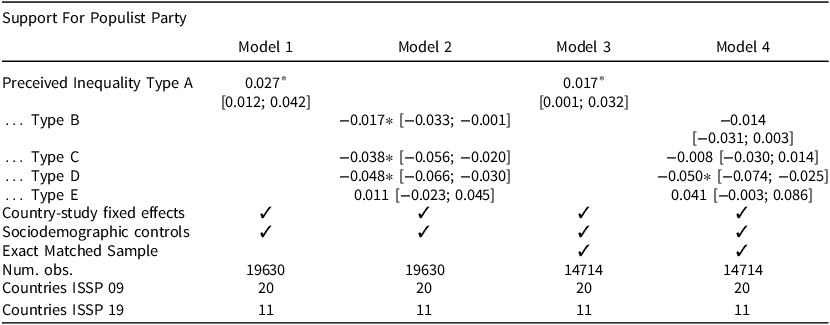
The ISSP results indicate that people who perceive society as unequal are more likely to support populist parties. The results of the different model specifications are reported in Table 1. The point estimate from model 1 indicates a 2.7%-pts. higher share of support for populist parties among respondents who perceive society as Type A, compared to the rest of the respondents. The 95% confidence intervals range from 1.2%-pts. to 4.2%-pts., indicating that the estimated effect differs statistically significantly from zero. Comparing the different perceptions of society further reveals that the share of support for populist parties is higher compared to respondents with more egalitarian perceptions of society. Model 2 estimates that respondents who see a society ‘with most people in the middle’ (Type D) are 4.8%-pts (CI [–6.6%; –3%]) less likely to support populist parties. There is 3.8%-pts. (CI [–5.6%; –2%]) lower support for populist parties for respondents who perceive ‘a pyramid with few people at the bottom’ (Type C) and 1.7%-pts. (CI [–3.3%; –0.1%]) for respondents who perceive a perfect pyramid (Type B). However, there is no clear difference compared to respondents who perceive a society with many people near the top and only a few people at the bottom (Type E). The results on the matched sample in Models 3 and 4 mirror the findings. Model 3 indicates that respondents who perceive society as Type A are 1.7%-pts. (CI [0.1%; 3.2%]) more likely to support any populist party. In the matched sample, this difference is mostly driven by Type D respondents, who hold the most egalitarian perception of society. They are 5%-pts. (CI [–7.4%; –2.5%]) less likely to support populist parties, compared to respondents with an unequal perspective of society.
Statistical models to estimate the effect of perceived inequality on support for populist parties

∗Null hypothesis value outside the 95% confidence interval.
Note: Models 1 and 2 report on linear regression models with sociodemographic control variables (gender, age, education, income, and unemployment) and country-study fixed effects. Models 3 and 4 use pre-processing based on exact matching with the same controls with 95% confidence intervals in parentheses.
The results when analyzing the support for populist parties separately indicate some strong effects. Figure 2 shows the party-specific estimates from a linear regression model. The dark-colored estimates are significantly different from zero at the 5% level. In some cases, we find strong effects of perceived inequality on support for right-wing populist parties. For example, for the Progress Party in Norway, the respondents who perceive the society to be unequal are around 20%-pts. more likely to support the right-wing populist party. The effects are similarly high for other prominent right-wing populist parties like the Danish People’s Party, the Finns Party in 2019, the Swiss People’s Party in 2019, and the Freedom Party of Austria in 2009. For other right-wing populist parties, the effect estimates are positive, smaller, and not significantly different from zero. The effects tend to be small for left-wing populist parties. For Linke in Germany and the Left in Slovenia, we find positive effects of around 6%-pts. We also find some positive effects for populist parties that are not positioned on the extremes of the ideological spectrum, like the Labour Party in Lithuania or the National Movement for Stability and Progress in Bulgaria. The patterns are comparable when estimating these effects on matched samples (see SM A.3.2). For a majority of cases, we cannot reject the null hypothesis, which suggests that these effects may be context-dependent. To better understand what these contextual factors might be, we explore the variation between the effect estimates for separate populist parties in SM A.4.3. Our analysis reveals that effects are particularly pronounced among large, far-right populist parties in countries with medium and high levels of income inequality. This suggests that specific far-right populist parties may be able to mobilize perceptions of inequality in contexts where inequality is evident.
The effect of perceived inequality on support for populist parties in different countries.
Note: The figure shows point estimates along with the 90% confidence intervals. Estimates are from a linear regression model with controls (gender, age, education, income, and unemployment).

Overall, the results support the hypothesis that perceived inequalities are related to the support for populist parties. Respondents who perceive society to be unequal show, on average, higher support for populist parties. This is particularly true for some prominent far-right parties, but a few left-wing and non-extreme populist parties also benefit from perceived inequality.
Additional analysis
We perform additional analyses to evaluate the robustness of our main findings. First, we estimate linear and logit multilevel models with random intercepts to account for the fact that respondents are clustered within countries and because our outcome is binary. SM A.4.1 reports results that are comparable to the main analysis. Second, we rely on tools for sensitivity analysis to study the effect of unobserved confounders (Cinelli and Hazlett Reference Cinelli and Hazlett2020). As section A.4.2 in the SM shows, the findings are robust to unobserved confounding that would be induced by a confounder whose effect is five times that of education.
Experimental evidence
We conducted information-provision experiments (Haaland et al. Reference Haaland, Roth and Wohlfart2023), to allow for a causal identification of the effect of perceived inequality, which importantly complements the observational evidence from the ISSP. The observational analysis shows that the support for populist parties and the perception of inequality coincide. One shortcoming of the observational analysis is the selection on observables assumption. Although we carefully select measurements of potential confounders based on prior work, we cannot be sure if there exist unobserved factors that confound the relationship.Footnote 7 The argumentation further proposes that the perceived inequalities can lead to populist attitudes, a hypothesis that we are not able to evaluate in the ISSP.
Experiment design
The information-provision experiment and the analysis were pre-registered (Stoetzer et al. Reference Stoetzer, Klüver and Giesecke2021b).Footnote 8 We conducted the experiment in Italy, Denmark, and Germany. The case selection includes countries with different populist parties and the countries exhibit important variation in objective inequality measures and welfare state institutions. In the observational analysis, we find strong effects of inequality perception on support for the Danish People’s Party in 2009. In Germany, we find a positive, but non-significant effect on support for the AfD and a positive effect for the left-wing Die Linke. We also include Italy and reinvestigate the results for the right-wing League and the centrist Five-Star Movement. The selected countries also vary in inequality and welfare state regimes that might influence the relationship. With respect to the distribution of wealth, inequality is highest in Germany, followed by Denmark and lowest in Italy. The countries also vary based on their welfare state regimes, with Denmark holding a Scandinavian welfare state, Germany a conservative welfare state, and Italy a southern welfare state (Castles and Obinger Reference Castles and Obinger2008).
The design randomly presents respondents with factual information. The treatment group received an information treatment about the percentage of net wealth that is owned by the lowest 50% and the top 10% of the distribution. The control group received no information treatment and proceeded directly with answering the outcome measures.Footnote 9 All respondents answer expectation questions about the percentage of wealth owned by the two groups.Footnote 10 Afterwards, we randomized exposure to the news headline ‘He who has, has’ in the respective languages. The information describes the wealth inequality in the lowest 50% and the top 10%. For example: ‘In Germany, the richest 10% own more than half of the wealth’. This is followed by an info graph with barplots of the percentages, which are 1.6% for the bottom half and 57.8% for the top 10% in Germany (for all graphs of the info treatments, see SM). The values are from the Luxembourg Wealth Study Database (2020).Footnote 11 Figure SM11 shows the translated information treatments for Germany (for the originals, see SM B.1.2).Footnote 12 After the infographic, an attention check asks about the wealth share of the bottom 50% with four answering categories. On average, 60% of the treatment group give the correct answer. After this block, all respondents answer the perceived inequality question with the same pyramids as in the ISSP (see SM11b). Indicating Type A is again our main measure of perceived inequality, and we expect that the infographic to increases the share of respondents who describe society in this way.
The survey contains a set of outcome measures to estimate the effect on support for populism, with the first outcome measure being a propensity to vote (PTV) question about the parties in the electoral system. Of particular interest is the changing support of the populist parties in our sample. In Germany, there is Die Linke on the far-left, and the AfD on the far-right. In Denmark, the Danish People’s Party and the New Right are both on the far right. In Italy, there are four populist parties: Forza Italy, Brothers of Italy, Lega, and the Five-Star Movement. A second measure is based on a common populism item battery with eight items (Akkerman et al. Reference Akkerman, Mudde and Zaslove2014), for which we estimate an underlying populism score using a one-dimensional factor model.Footnote 13 Finally, to abstract from the specific context, we include an additional measure of support for populist parties using outcomes from a conjoint experiment. The conjoint experiment provides an additional outcome measure for the information-provision experiment, offering a broader perspective on the observed effects. As part of it, respondents choose between two candidates who hold positions on Taxation, Immigration, and European integration and have a political slogan. One of the two potential slogans is populist (‘For the people, against the elites’) and the other is neutral (‘Vote for me for the [country parliament]’). The levels on the position attributes are randomized and only play a controlling function. The candidates always hold opposing slogans, allowing us to measure how often a respondent supports the candidate with the populist slogan, irrespective of the positions, as an additional outcome. Respondents answer three repetitions of the conjoint experiment. The use of the conjoint experiment to generate additional measured outcomes follows the recent application as a measure of behavioral outcome in survey experiments (see e.g. Peterson and Simonovits Reference Peterson and Simonovits2018).
As alternative mechanisms, we estimate the effects on redistribution attitudes, trust in political elites, social integration, national identity, and economic insecurity. We measure redistribution attitudes using six items. The items include attitude questions about wealth differences, the responsibility of the government to reduce income differences, benefit for the poor, adequate standard of living for unemployed, progressive taxation, and taxation of wealth. The six items are combined using a one-dimensional factor model. For trust in political elites, we rely on a question battery from the European Social Survey (2020) about trust in the parliament, politicians, and parties. A top-bottom question in which respondents place themselves on a scale from 0 to 10 is our measure of social integration (see Girdon and Hall 2020). Finally, we rely on a question about national identity that asks respondents if they are emotionally attached to their country. The survey experiment is conducted with a total of 9,014 respondents (3,003 in Germany, 3,000 in Denmark, and 3,011 in Italy). The respondents are recruited from an online-access panel provided by the survey company Bilendi, with quotas on age, gender, and region. On the marginal distributions of these three sociodemographic categories, the survey can be considered representative of the respective population (See SM B.1.3). The field time took place between 23 November 2021 and 9 December 2021. The median completion time was 11 minutes, for which respondents were compensated with small amounts by Bilendi. We discuss ethical considerations of the design in more detail in SM B.1.1.
Results
The respondents in our survey samples underestimate the wealth ratio. The median perception of the share of the wealth of the top 10% is quite close to the ‘true’ value in Denmark and Germany, whereas in Italy, respondents overestimate this share.Footnote 14 At the same time, respondents strongly overestimate the wealth that the bottom 50% have.Footnote 15 There is variation in these perceptions, but almost all respondents (97% in Germany, 92% in Denmark, and 72% in Italy) have a lower perceived ratio between the two shares than the actual value. The infographic, hence, mostly corrects perception upwards for almost all respondents in Germany and Denmark. In Italy, the treatment corrects perceptions downward for 25% of the sample. For the later analysis, it is important to compare the effects among respondents with perceptions of lower and higher ratios than presented by the infographics, mostly in Italy.
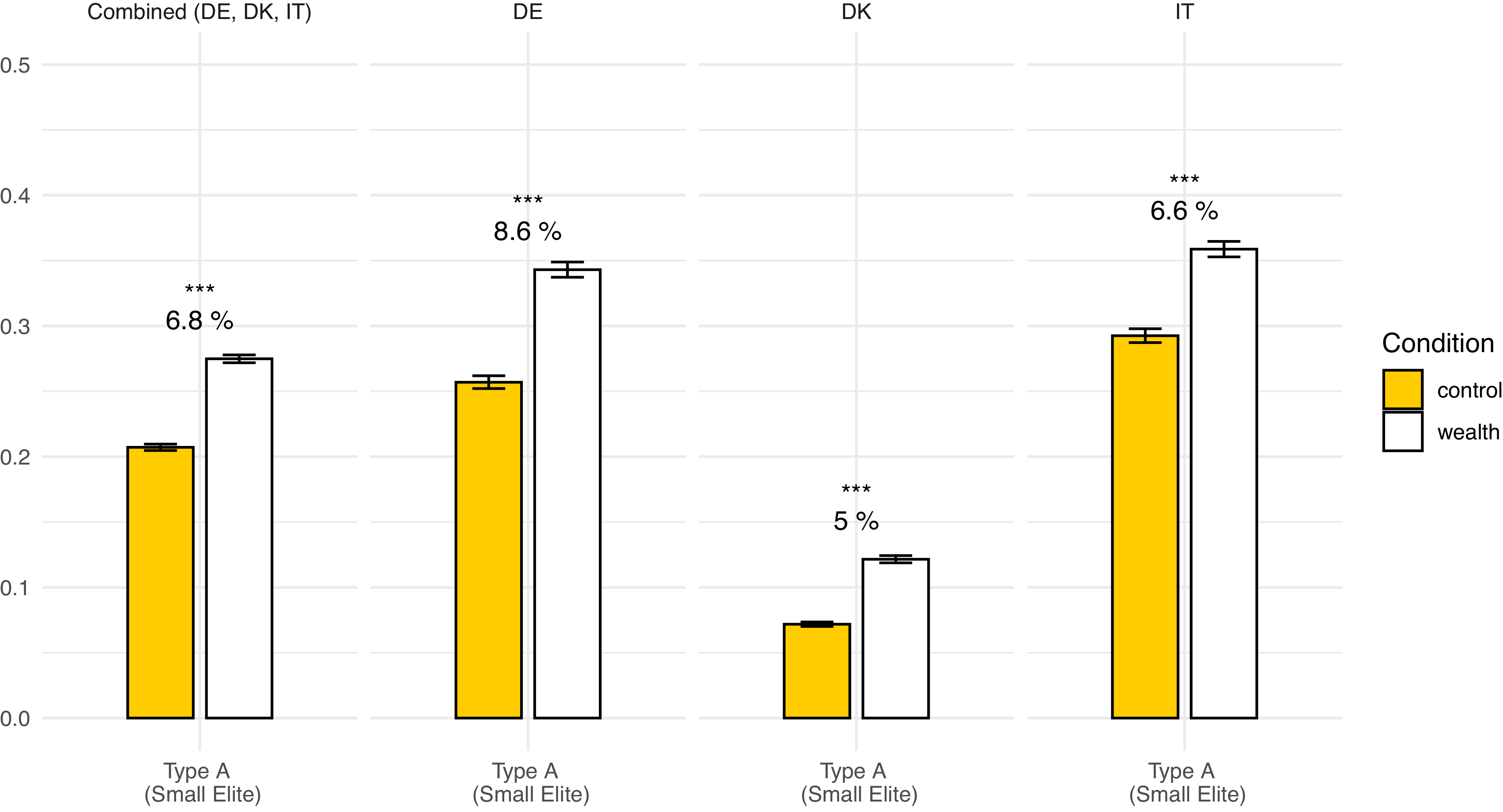
We first evaluate the perception of inequality between the control and treatment groups. Figure 4 shows that the information about the distribution of net wealth changes the perception of inequality in a society. Respondents in the treatment group are more likely to indicate that society is of Type A. In the combined sample, 21% perceive society to be of Type A in the control group. The countries differ with respect to this baseline value. In Italy, it is 29%, 26% in Germany, but only 7% in Denmark. We estimate that this value increases by 6.8%-pts in the combined sample when showing respondents the wealth inequality treatment. We estimate similar statistically significant increases in all three countries. In Germany, the increase is highest, at 8.6%-pts., followed by Italy with 6.6%-pts., and 5%-pts in Denmark. The changes in the distribution over all pyramid types show that the increase in Type A mostly come from respondents in the treatment group who are less likely to describe society as Type C (‘just a few people are at the bottom’) and Type D (‘most people in the middle’) (See B.4.1). This coincides with the estimates from the observational data, where we estimate that these two types are less likely to support populists parties compared to Type A respondents. However, the patterns vary by country. For example, in Denmark, we observe a small increase in respondents who indicate that society is of Type B (‘Pyramid’).
Information treatment. (a) News-story. (b) Information graph
Note: Translated German version of the factual information treatment about the distribution of net wealth between the lowest 50% and the top 10%.

The effect of the wealth inequality info treatment on the perception of inequality in a society.
Note: The inequality measure uses the same pyramid question as the ISSP. Type A refers to a pyramid with a small elite at the top, very few people in the middle, and a great mass of people at the bottom.

As a first step, we evaluate the intention-to-treat effect (ITT) on the central outcomes. Figure 5 presents the estimates for the effects on the PTV, attitudes, and decisions in the conjoint task. For the combined sample, we find that populist attitudes increase significantly by 0.04 standard deviations when providing respondents with information about the unequal distribution of wealth. However, these changes in populist attitudes do not translate into changes in voting behavior: neither the PTV for the largest populist party increases significantly, nor does the likelihood of supporting a hypothetical candidate with a populist slogan in the conjoint experiment. The country-wise analysis reveals that the main effect on populist attitudes is due to Denmark. In Germany and Italy, we observe smaller effects that are not statistically significant. The estimates coincide with the observation that the gap between actual and perceived wealth inequality is largest in Denmark, which may explain why the effects are more pronounced there. Following the argumentation that populist actors could strengthen this link, it is also possible that populist narratives are more accessible in Denmark compared to the other countries. However, none of the country estimates provide evidence that the wealth treatment increases support for populists. So, overall, while we find some effects on populist attitudes, we do not find effects on support for populists.
The intention-to-treat effect of the information treatment on the central outcomes.
Note: The figure shows point estimates along with the 95% confidence intervals.

In a second step, we estimate the effect of perception of inequality on the outcomes. This analysis closely resembles the results from the observational analysis, by relating perceived inequality to the PTV for populist parties. To identify causal effects, we instrument the perceived inequality in society of Type A using the experimental intervention. The instrumental variable approach estimates the complier average causal effect (CACE) using two-stage least squares, which is the causal effect among respondents who change their perception of a very unequal society as a result of the information treatment.Footnote 16 For comparison, we present results from a linear regression model that controls for pre-treatment confounders.Footnote 17
Figure 6 reports on the estimates and shows some evidence that inequality perception can influence populism. The linear regression model indicates a clear positive correlation between perceiving society as Type A and populist attitudes. In the combined sample, the Type A responses have 0.32 standard deviations higher populist attitudes. The values are comparable in the country samples, 0.31 in Germany, 0.3 in Denmark, and 0.35 in Italy. The CACE estimates also estimate a positive relationship. The combined sample estimates a 0.64 CACE, indicating that respondents who changed their perception of an unequal society of Type A exhibit strong changes in populist attitudes. The estimates are large enough to reject the null-hypothesis. However, this effect is attenuated when exogenous controls are sequentially included in the two-stage least squares estimation. With pre-treatment controls, the effect estimate is 0.46, but the estimate is not precise enough to reject the null.Footnote 18 The combined effect is again mostly driven by the Danish sample, where we also find the strongest intention to treat effect. In Denmark, the estimate is, with 1.81 (no controls) and 1.61 (pre-treatment controls), particularly large. In both Germany and Italy, we find no clear evidence of changes in the perception of inequality on populist attitudes. There is again no systematic evidence of effects on voting. Neither do we find effects on the conjoint voting decision in the combined sample, nor clear effect estimates on the PTV for the left- and right-populist parties in the countries. Even the correlations that we estimate using the linear model in our samples are weak and unexpected. We only find a significant increase in the PTV for the AfD in Germany. In Italy, we often find negative relationships. The CACE estimates are too imprecise to suggest that inequality perceptions directly influence voting for populist parties and candidates.
Effects of perceived inequality on different outcomes.
Note: Results report on instrumental variable model (IV) estimated using two-stage least square and different set of controls and based on linear regression model (OLS) with pre-treatment controls.

Alternative paths and mechanisms beyond inequality perception find no support. We report on the intention-to-treat the effect on redistribution attitudes, trust in political elites, social integration, national identity, and economic insecurity (see SM B.4.3). Although in the combined sample, we estimate some reduction in trust in elites and social integration, these effect estimates are not statistically significant and are also not mirrored in the single country studies. The only clear and significant effect we find is in Denmark on national identity that, in contrast to the hypothesis, is reduced by around 0.08 SD. This is an interesting finding, potentially suggesting that Danish identity is coupled with perceptions of equality. It counters our expectations, as it probably does not help the far-right Danish populist parties to gain support.
Overall, our research design reveals that an information treatment about the wealth distribution can affect populist attitudes, but these short-term changes do not directly affect support for populist candidates or parties.
Additional analysis
We perform robustness checks to confirm the main findings that the information treatment influences perception of inequality and, in some cases, populist attitudes, but has no immediate effect on voting. Please see SM B.5 for a detailed description of the additional analysis.
As mentioned, only 60% of participants in the treatment group correctly repeated the statistics after treatment exposure. As part of the pre-registered robustness checks, we estimate the effect among treatment participants who correctly answered the attention check using a complier framework (see SM B.5.1). The results again confirm a positive effect on populist attitudes but no immediate effect on voting. Furthermore, we subset the sample to respondents for whom the treatment corrected their perception of the wealth distribution upward to address concerns about unequal treatment effects. The results of this show the robustness of the main findings (see SM B.5.2).
We also investigate the effects on populist attitudes separately, revealing pronounced ITT effects on three anti-elite and Manichaeanism items in Denmark. Overall, the results show clearer ITT effects on the subscales Anti-Elitism and Manichaeanism compared to People Sovereignty (see SM B.5.5).
Finally, we explore heterogeneity in the effect estimates using causal forest (Athey et al. Reference Athey, Tibshirani and Wager2019) based on pre-treatment covariates. The analysis shows few signs of heterogeneity. The unequal wealth distribution treatment can lead to populist attitudes for all respondents, and the null effects on voting decisions do not hide meaningful heterogeneity.
Discussion
Do increasing inequalities pave the way for populism? One potential condition for this association is that people who perceive a society as unequal develop populist attitudes and support populist parties. We evaluated this argumentation using observational and experimental studies. Our findings provide inital evidence that the perception of inequality can indeed matter. The observational study indicates an association between the two, showing that voters who describe society as a pyramid with a small elite and masses at the bottom are more likely to support populist parties. The experimental evidence reveals that the perception of wealth inequalities can trigger populist attitudes in some situations. We do not find immediate effects on voting intention in the experiment, leaving room for further investigations of the role of perception on support for populist parties.
The findings presented in this paper have important policy implications. We proposed that the rising levels of inequality and the electoral success of populist parties could be importantly related via the perception of inequality. Our study informs the debate on how to address the populist turn. A key instrument that policy-makers can use to fight against the rise of populists potentially is actively promoting policies to reduce inequality in a society. Policy-makers could adopt policies that reduce citizens’ perception of the society as unequal and do not push them toward developing populist attitudes. By more equally distributing resources among the people, governments can thereby make it harder for populists to mobilize electoral support.
Our study opens up a number of follow-up questions that could be addressed by future research. Building on our work, further research could investigate if populists indeed target the unequal distribution of economic resources, and to what extent this matters. This would introduce a supply-side perspective to complement the existing demand-side-focused explanations (Rydgren Reference Rydgren2007; Muis and Immerzeel Reference Muis and Immerzeel2017). From our perspective, it is perplexing that highly successful right-wing populists often lack strongly redistributive platforms. The proposed mechanism suggests that support for these right-wing populist parties is not driven by a demand for redistribution caused by increasing inequality. Instead, these parties are successful because inequality leads to populist discontent, which they can mobilize.
Furthermore, we discussed how party communication efforts could moderate or modify the relationship between perceived inequality and support for populism. However, within the scope of this article, we only provide exploratory analysis in the observational study (see SM A.4.3) and do not present a detailed evaluation of this argument. We are confident that future research can empirically investigate this further, potentially using experimental approaches similar to ours. For instance, researchers could employ factorial designs that manipulate both perceptions of inequality and communication efforts of populist and mainstream parties. Such designs could evaluate how party communication strengthens or counters these connections and explore the moderating role of party communication in greater depth.
Finally, our argument focuses on the unequal distribution of economic resources in general. Other perspectives suggest that inequality ‘affects behavior through subjective comparisons’ (Nagel Reference Nagel1974, p. 454). Our work can build the basis for an integration of subjective comparisons of inequality and overall levels of inequality to study the effects of inequality on support for populists. The same holds for general inequality aversion. Our argument differs from the idea that all people dislike inequality in general and as a result turn their back to mainstream parties and toward populists who can ‘fix inequality’ (see e.g. Pástor and Veronesi Reference Pástor and Veronesi2021). It instead proposes that perceived inequality triggers populist beliefs that elites are biased representatives, and that this makes populist party platforms more attractive. Including both – general inequality aversion and trigger of populist beliefs – might prove fruitful to understand the success of populist parties that propose strong redistributive platforms.
Supplementary material
The supplementary material for this article can be found at https://doi.org/10.1017/S1475676525100078.
Data availability statement
Data and replication code supporting this study are openly available from Harvard Dataverse at https://doi.org/10.7910/DVN/VDJR6G.
Acknowledgments
We would like to thank Claudia Landwehr, Nathalie Giger, Sarah Engler, and Thomas Kurer for valuable comments on the paper and Felix Heimburger and Violetta Hass for excellent research assistance. Earlier versions of this paper have been presented at the European Political Science Association (EPSA) online conference 2021 and the inequality conference 2022 in Konstanz. Research for this contribution is part of the Cluster of Excellence ‘Contestations of the Liberal Script’ (EXC 2055, Project-ID: 390715649), funded by the Deutsche Forschungsgemeinschaft (DFG, German Research Foundation) under Germany’s Excellence Strategy.





 Open access

