

Leo stands and invites the rest of us to do the same.Footnote 1 We push back our small, plastic chairs. About forty of us rise in the circle, acknowledge each other with small nods, and join hands. Witness Against Torture has gathered at Saint Stephen's Episcopal Church in Washington DC. It is the first week of January 2014. People are now entering the fifth day of their fast. Many have bundled themselves with scarves and hats. Those wearing orange jumpsuits have packed layers of wool and down under the iconic outerwear, preparing to stand for hours in front of the White House in what is certain to be a freezing drizzle.
The room is necessarily large for all that it must accommodate. Rectangles of butcher paper scribbled with colorful notes line the back wall. There are lists of team members and their requisite tasks, words, and shapes from direct action planning. A ten-foot plastic folding table is set up for letter writing – letters for the Guantánamo detainees to be delivered through attorneys, letters for various politicians demanding due process for the prisoners. Against another wall there are props for street theater: an assortment of cardboard signs, two sets of folded military fatigues, other cardboard props. A queen-size bed sheet with a large portrait of detainee Shaker Aamer painted in black acrylics has been rolled up carefully. Against another wall are more plastic folding tables holding laptops, various electronic chargers, a camera case, and detachable lens. This is “media headquarters,” where appointed photographers and those who compile the daily email to the listserv sit late into the night, quietly editing and uploading photos and video, corresponding with allied organizations and journalists, collecting relevant media coverage. A tall stack of books constitutes the lending library. Titles range from classical tomes of the activist left to theology and political theory, as well as books written by friends of the group. The prospect of reading such dense and despairing content about US militarism, torture, Guantánamo, or the prison industrial complex without having had a proper meal in days astounds me.
Where the room snakes around toward the bathrooms and small kitchen, more folding tables have been set up with all manner of liquid nourishment: fruit and vegetable juice, a continually brewing electric coffee pot, an assortment of teas and hot cocoa, and bouillon packets. As it is now early morning, sleeping rolls and personal belongings have been locked in a storage room while the group leaves for the day.
We hold hands, a shared warmth. Leo needs no microphone; his confident Bronx accent always offers structure to the space, its tenor calm, the words clear. He issues a rallying cry before the group leaves the church and makes its way out into the city. This recitation is less rehearsed than Leo's spoken word performances, but it still reverberates as poetry.
I'm not free while racism and militarism do what they do. I'm not free to be completely human. That makes me linked to crazy oppression … I feel really strongly that I am fighting for liberation. John Brown was not just fighting on behalf of slaves. Our liberation is bound up in each others’.
Leo brings the circle to a close with the famous words of Lilla Watson, an Australian aboriginal activist and artist who became well known in the 1970s: “If you have come to help me, you are wasting your time. But if you have come because your liberation is bound up with mine, then let us work together.”
When Leo asks the group to stand together, he speaks to the vision of solidarity that Witness Against Torture adopts. Like the other groups in this study, Witness Against Torture holds foremost a commitment to make injustice visible and to testify to the conditions of the aggrieved. These activists engage in this practice, what I term solidarity witness, not solely because they oppose the state-mandated suffering of others but because they believe their own fates are intertwined with the targets of state violence. For some, this is a theological principle. For most, it is a moral commitment, a practice to produce the kind of world they wish to create.
WAT Protester
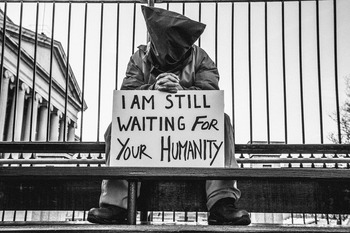
Introduction
This study explores what it means to engage in a practice of ethical witness as an expression and instantiation of solidarity across cavernous divides of wealth and power. At the onset of the twenty-first century, global inequality and militarized social control are both targets of protest and practical challenges for social movements seeking to enact solidarity across borders (Kurasawa Reference Kurasawa2007; Robinson & Barrera Reference Robinson and Barrera2011). More specifically, contemporary US security policies have become an important focus of resistance even as they present significant obstacles to transnational solidarity (Butler Reference Butler2009; Pease Reference Pease2009). In the face of these daunting realities, US residents like the members of Witness Against Torture engage in collective resistance to the US security state by imagining and enacting solidarity with some of those who are tortured, detained, murdered, and exposed to life-imperiling conditions at the behest of the US government. This study proceeds through an ethnography of three distinct but similar protest groups: (1) School of the Americas Watch, which seeks to close the military training facility at Fort Benning, Georgia; (2) the Migrant Trail Walk, part of the US–Mexico border justice movement; and (3) Witness Against Torture, a grassroots effort to close the Guantánamo Bay Detention Center. Often rooted in theologically informed cosmologies, those involved in these campaigns understand “bearing witness” as their foremost means of standing up to state violence and forging solidarity with those who lack the practical freedoms to advocate for themselves. For the activists in these groups, this practice of solidarity witness is also a means to disavow and disinvest in the systems of dominance that show up in their own lives in complex and damaging ways.
In the face of structural violence and injustice, aggrieved communities have long generated alternative epistemologies and decolonial practices. Among these are what Paula Ioanide Reference Ioanide(2015) terms “epistemologies of ethical witness” – ways of seeing, feeling, and being that expose the contradictions, injustices, and violence of the neoliberal state. Examples of ethical witness include the Black Radical Tradition (Robinson Reference Robinson1983), Borderlands epistemologies (Anzaldúa Reference Anzaldúa1987), the self-determination of Palestinians in exile (Said Reference Said1992), and the Chicana/o Movement (Blackwell Reference 190Blackwell2011). This project builds on this idea of witnessing as an important form of resistance, exploring how it is used to contest the US security state.Footnote 2 Distinct from previous scholarship, however, this study identifies the emergence of a political practice among relatively privileged groups acting in solidarity with the aggrieved, rather than among those conventionally thought to be the most acutely violated by US security policies. Through this practice of “solidarity witness” social movement participants utilize resistant modes of seeing and being seen to respond to political injustices that do not most immediately impact them.
Avery Gordon Reference Gordon(1997) suggests that the impact of “Capitalism and State Terror” might be understood as a “haunting,” in which “structures that appear removed from us make their impact felt in everyday life” (19). This manner of haunting shows up in complex, riddling, and sometimes counterintuitive ways. It is destructive not only to the most directly violated but also to those who are asked not to see or feel the degradations of this system. Through engaging in solidarity witness, those who are generally thought to enjoy certain privileges along with a socially structured ignorance – white, middle-class social groups from the Global North – refuse to ignore or offer consent to conduct they deem unacceptable and indecent. Rather, they make an effort to recognize and respond to the US security state by making its violence and injustice visible and undesirable to themselves and others. Through this study, I address two central and intertwined questions. First, I ask how these movement groups imagine and enact solidarity across the divisions of power and reverberations of violence that organize today's global society. Second, I seek to better understand the political avenues available for those seeking to disrupt the status quo of the US security state.
This chapter begins by explaining how I arrived at this topic of study and briefly describes its case studies and the methodology. Next, it elaborates on the neoliberal US security state as the impetus for these campaigns and narrates a brief history of the radical pacifist lineage from which these groups emerge. It then turns to some basic parameters of solidarity witness and situates this political practice within more traditional approaches to social movement studies before previewing the chapters to come.
Coming to the Research
The seeds of this research project were planted during the five years I spent involved in immigrant rights activism in Poughkeepsie, New York; Zacatecas, Mexico; and Denver, Colorado between 2005 and 2010. During this time, I began to think through what it means to be in solidarity with those who are under the thumb of the state in a way that I have not directly experienced. Through my organizing experience with those who shared similar concerns and commitments, I realized that many came to their work as solidarity activists for reasons of faith or religion. Because my own orientation was decidedly secular, I was at first surprised by this. Yet I quickly found that the kinds of practices that these predominately Christian activists pursued, including pilgrimages through the desert, solemn ritual, and creative civil disobedience, were emotionally evocative and meaningful in a way that more traditional protest and policy work did not feel to me. I wanted to understand why that was. Why were these somewhat unusual forms of political expression so much more appealing, transformative really, at least by my own barometer?
My first real exposure to this kind of activism was when I joined the Migrant Trail walk in 2007. I lived in Colorado at the time and was part of a group of US citizens advocating for the rights of unauthorized immigrants. This group was loosely affiliated with Quaker traditions and had supported the Migrant Trail since its inception. I had never been to the US–Mexico border and believed the walk, as daunting as it sounded, would be an important way for me to learn more about migration policy while allowing me to connect with activists who had been doing this work for longer than I had. My first time on the Migrant Trail walk was one of the most transformative experiences I had had as an activist. In subsequent years, as I established myself in Colorado as a full-time employee of a nonprofit organization committed to immigrant rights, I returned to the Migrant Trail every May to remember and mourn the dead, reconnect with the border justice movement, and nourish myself for the social justice struggles ahead. There was something particularly sustaining about this week of action. I had completed the Migrant Trail three times when I chose to take it up as a topic of research during my first year of graduate school.
The research itself proved somewhat grueling; administering surveys and conducting multiple interviews with exhausted activists, their clothes caked with desert dirt and dust, added a level of challenge to the already difficult walk. What I was able to document and assess was well worth the effort, however, allowing me to begin to consider the importance of embodied witness to the work of solidarity activism (Russo Reference Russo2014). I had stumbled upon a kind of political practice and a target of activism – which I term the US security state – to which I wanted to give more attention. In the end, I decided I would choose two more group events that were similar to the Migrant Trail in three important ways. First, the activists involved across the three groups are predominantly white, middle-class, faith-driven practitioners of nonviolence. Second, each group engages in similar tactics, including fasting, pilgrimages, civil disobedience, and ritual protest. Third, the iterations of state violence that each group contests are tied to the neoliberal US security state and its military-carceral expansions from the end of the Cold War through early Free Trade Agreements and concomitant border enforcement and into the “War on Terror” following September 11, 2001.
This project, then, proceeds through an ethnography of three activist communities, broadly from the Christian Left, that protest the racialized violence of the US security state against Latino migrants, Muslim detainees, and communities and social movements throughout Central and South America. Part of what unites these groups is their loose connection to a common lineage of radical pacifism, though this is something I discovered through the research process and not why I initially selected each case. My data collection, elaborated in the methodological appendix, has included days and sometimes weeks of participant observation with each group, forty-nine semistructured interviews with activists, fifty-four surveys, and an archive of hundreds of courtroom statements from the trials for those who have committed civil disobedience. Here is a brief overview of each case.
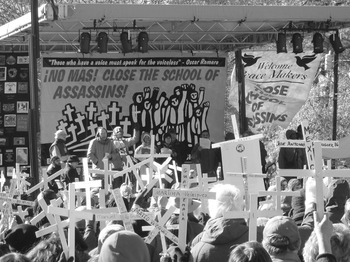
School of the Americas Watch
Between the early 1990s and 2015, School of the Americas (SOA) Watch activists convened every November to participate in workshops, marches, and planned civil disobedience in an effort to close the SOA, a US military training school for soldiers from South and Central America.Footnote 3 Formed in 1990, SOA Watch has linked SOA graduates to nearly every coup and major human rights violation in Latin America since the school's inception (Nepstad Reference Nepstad2004). The SOA was renamed the Western Hemisphere Institute for Security Cooperation (WHISC, or WHINSEC) in 2001 after grassroots pressure and public outrage about these practices led Congress to nearly defund the school. Iconic of the US security state's transnational militarism, the SOA/WHISC continues to be a site where US and Latin American elites collaborate to suppress dissent against neoliberal policies that impoverish and structurally abandon the majority of the world's populations. Lesley Gill Reference Gill(2004) argues that central to the SOA/WHISC's operations are pedagogies that indoctrinate Latin American soldiers in the logics of the US security state and the interests of a transnational capitalist class.
Migrant Trail Walk
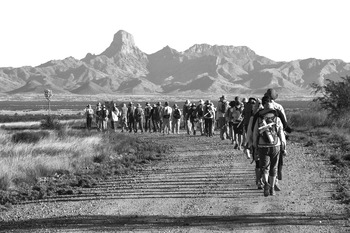
During the annual Migrant Trail, approximately fifty activists spend a week walking seventy-five miles through the US–Mexico borderlands to oppose migrant deaths and the growing militarization of the border. The Migrant Trail began in 2004 to respond to ever more draconian border enforcement measures initiated by the United States in the mid-1990s that have spurred a wave of migrant fatalities that number well into the thousands. Scholars contend that the public obsession and mass investment in preventing unauthorized migration points to “a global immobility regime” wherein “surveillance and control over migrants” is undergirded by cultural politics in which affect figures centrally – “a new xenophobia as part of a modern culture of fear [and] the paradigm of suspicion” (Turner Reference Turner2007: 290). Leo Chavez Reference Chavez(2008) explains that by the logics of today's US security state, Latino immigrants, particularly those from Mexico, are treated through the frame of supposed “illegality,” as if they are already criminal, illegitimate, and undeserving of social supports. David Hernandez Reference Hernandez(2005) describes this condition as “lesser citizenship” in which race and immigration status combine to render immigrant communities doubly vulnerable to incursions from the state and vigilantes.
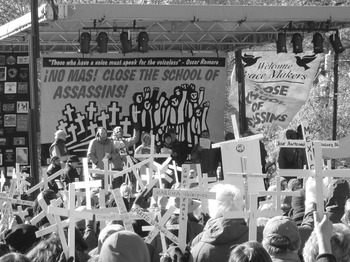
In 2013, a few thousand SOA Watch participants gathered at the gates of Fort Benning
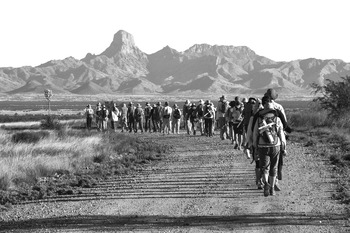
In 2015, fifty-nine Migrant Trail participants completed the walk, here pictured in the Buenos Aires Refuge with Baboquivari Peak in the background
Witness Against Torture
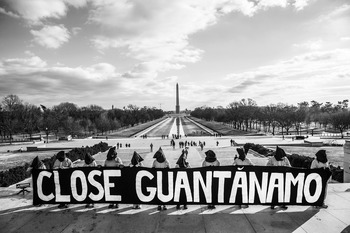
Witness Against Torture (WAT) formed in 2005 when twenty-five activists decided to travel to Cuba in response to the first major publicized hunger strike being undertaken by the detainees at the Guantánamo Prison. Since their return, Witness Against Torture participants convene every January in Washington DC for a week of protest, fasting, and communal living to oppose the indefinite detention and torture of the Guantánamo prisoners. Guantánamo took its current form in 2002 as a detention center for so-called enemy combatants captured in Afghanistan as part of the “War on Terror,” a far-reaching foreign and domestic policy response to the attacks of September 11, 2001. Amy Kaplan Reference Kaplan(2005) argues that Guantánamo traces a long and sordid history that positions it at “the heart of the American Empire” (832; see too: Paik Reference Paik2010). At this US naval base in Cuba, the earlier territorial conquests that marked US imperialism in the twentieth century have been consolidated into a key military-carceral apparatus of the current US security state. The military prison is situated in a US-occupied space in Cuba, with a history of quarantining Haitian migrants, and is now an infamous location for the indefinite detention and torture of racialized Muslim and Arab bodies.
A Brief Note on Terms
The groups in this study use different terms to explain what they perceive as their distinct roles in the social movement landscape. SOA Watch and Witness Against Torture, for instance, call their groups movements. The Migrant Trail, by contrast, understands itself as part of a larger movement, which I term border justice. An accompanying feature to this distinction is that whereas SOA Watch and Witness Against Torture each organizes multiple actions, gatherings, and strategies to advocate for their issue, the Migrant Trail is the most patterned and constrained, conducting one week of action, once a year. The Migrant Trail and WAT, however, are similar in that they resist the label and form of “organization,” which some SOA Watch participants more readily adopt. SOA Watch, as distinct from the other two groups, has been around for more than twice as long, has hemispheric reach, and does at this time have paid staff, office spaces, and other resources.
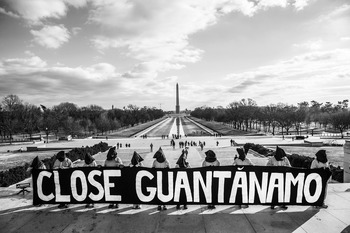
In 2014, Witness Against Torture participants wear the iconic clothing of Guantánamo detainees and protest in front of the National Mall in Washington DC
The vast literature on movements and organizations defines these concepts in ways that do not always accord with the language used by activists. The term movement continues to be ill-defined, and scholars have defined a social movement organization as everything from a very formal group arrangement with written rules and paid staff (McCarthy & Zald Reference McCarthy and Zald1977; Kriesi Reference Kriesi, McAdam, McCarthy and Zald1996) to a very loose association of people with common ideals about how society should be organized (Lofland Reference Lofland1996).Footnote 4 When SOA Watch and Witness Against Torture use the term movement, it is as a descriptor indicating political resistance with clear objectives linked to a history of similar struggles, which these groups understand to also be social movements. I suspect all three groups understand the term organization by the most formal definition, including paid staff, written rules, and even a particular tax status. Many seem reticent to use this designation because of its often-negative connotations in the global justice activist subculture with which these groups are often aligned.Footnote 5
Network may be the most appropriate scholarly term to explain these groups’ structures, and their networked dimensions are especially evident when considering their shared lineage of radical pacifism. Borrowing from Diani and McAdam Reference Diani and McAdam(2003), I conceptualize networks as individuals and groups that are connected by relationships of mutual trust and solidarity, forged through histories of collective action, participation in activist subcultures, and membership in other organizations.Footnote 6 To illustrate how this networked quality operates among the groups in this study, it is noteworthy that a number of those involved with the Migrant Trail and with WAT reflect on SOA Watch as the protest space in which they were first politicized, suggesting this experience propelled them to become involved in subsequent movement activities.Footnote 7 However, the activists in this book never use the term network to describe themselves or their movement relationships, and imposing such a term on them seems to distract from rather than illuminate the central aims of exploring the practice of solidarity witness. I therefore refer to these cases as movement groups (or just groups) or campaigns, suggesting a series of coordinated activities aimed at achieving a particular outcome.
Methodology
I situate this work in a tradition of social movement ethnographers who are politically aligned with, and often themselves active within, the movements they document and analyze (Butigan Reference Butigan2003; Rupp & Taylor Reference Rupp and Taylor2003; Gould Reference Gould2009; Taft Reference Taft2011; Van Ham Reference Van Ham2011). While various decolonial, feminist, and post-structuralist interventions in the research enterprise suggest that scholars are always embedded in the social relations under study, with important implications for ethics, representation, and knowledge production (Luff Reference Luff1999; Smith Reference Smith1999; Hale Reference 194Hale2008), my position in relation to my object of research is explicitly quite close. My relationship with these groups ranges from central and continued involvement (the Migrant Trail), to ongoing relationships (WAT), to more sporadic but continued contact with activists (School of the Americas Watch). This impacts my stance as a researcher and the data to which I have access within each group. It is also bound to show up in the way I represent each case, though I do my best to document and analyze these movement groups as evenly as possible. I do not avoid critique of the groups under study and believe their modes of internal contention to be instructive (Chapter 6). Yet at the root of their activism, these activists do espouse basic premises with which I agree. Part of the motivation for this project, then, is that akin to my research participants, I too am invested in shifting those dynamics of the US security state that I understand to be egregiously unjust as well as collectively deleterious.
It is no coincidence that in proposing a “politically committed and morally engaged” social science, Nancy Scheper-Hughes Reference Scheper-Hughes(1995) understands engaged research to be itself a form of “witness.” For the scholar to be a witness, as opposed to a mere spectator, means that she must be involved, take sides, and be accountable for what she sees and fails to see. Of course, all research takes a position; the pursuit of supposed objectivity is also a political and epistemological commitment. As a witness to these witnesses and in solidarity with these solidarity activists, I commit to a certain understanding of our sociohistorical moment and use the role of scholar to expose in some small way what I perceive to be the stakes of apathy and ignorance as well as the possibilities for action.
In pursuing ethnographic methods from the stance of a witness, I appreciate João Costa Vargas's (2006) formulation of “observant participation.” Distinct from the “participant observation” central to most ethnographic endeavors (Emerson, Fretz, & Shaw Reference Emerson, Fretz and Shaw1995), observant participation emphasizes participation as the central method by which the social world is interpreted. Observant participation is not just an ethical or political move, but centrally an epistemological one as well. There is more to be gleaned from active participation in the social world than from merely watching others do what they do. This dovetails well with my understanding of social movements as knowledge projects, an idea I adopt from Ron Eyerman and Andrew Jamison (1991) that is also taken up by Dylan Rodriguez Reference Rodriguez(2006). The idea here is that social movements might be understood as spaces of knowledge production first and foremost. Those who refuse the status quo must create an alternative common sense. What we identify as social movement is itself the generation, modification, articulation, indeed movement, of these new ideas, identities, and modes of praxis within groups and across society. What this means for scholars, as Rodriguez Reference Rodriguez(2006) aptly observes, is that social movements can be learned from and with; they are not mere social units to be empirically assessed or taken as objects of scholarly knowledge. Much of what I have to say in this book I have learned from and with these movement groups. These are ways of seeing, feeling, and knowing that centrally shape this project. I now turn to some of the central theoretical anchors for this research, beginning with the political context in which I situate the practice of solidarity witness.
The Neoliberal US Security State
This book explores how three social movement groups seek to resist US state violence and enact solidarity with the state's targets. Group participants describe the state violence they contest using a variety of terms, including “neoliberalism,” (United States) “empire and imperialism.” “militarism, militarization and the military industrial complex,” “systemic oppression,” and “structural injustice.” While this study is centrally concerned with how these groups understand and respond to state violence, I here offer a brief overview of the scholarly basis for understanding what these groups resist as aspects of a unified whole. To this end, I refer to the impetus for these group's actions as “the US security state,” an amalgamation of domestic and foreign military, carceral and policing priorities that coincide with the global transition to neoliberalism. Identifying some of the main features and links between the issues that these groups contest helps to better situate their resistance.
While the state violence that the groups in this study resist begins in the aftermath of the Cold War, the US security state is a continuation as well as qualitative amplification of the military expansions that commenced several decades earlier. The end of World War II saw the rise of a new US militarism, justified by the looming threat of the Soviet Union and its transnational allies (Mills Reference Mills1956; Cobb Reference Cobb1976). Indeed, during his final address in office in 1961, President Eisenhower famously warned that the United States was headed toward a “military-industrial complex,” the rise of a permanent war economy underwritten by the state. In a world no longer organized between capitalism and communism, the US security state's militarism along with new modes of border enforcement, prison expansion, and extralegal detention are best understood within the rise of a new global order: neoliberalism. Though often understood as a shrinking of the state to enhance market efficiency, neoliberal policies do not so much reduce as redirect the nation-state's investments. Within the United States, such redirection has been in large part toward contemporary security policies.Footnote 8
Ruth Wilson Gilmore Reference Gilmore(1998) points to the late 1960s as a particularly auspicious moment in the transition toward the neoliberal US security state. If the 1950s are often regarded as America's “Golden Age” of wealth and prosperity, the 1960s pierced any illusion of social, political, and economic equanimity. New forms of organized resistance to social mores and political priorities coincided with looming economic crisis.Footnote 9 A burgeoning conservative effort, represented by Richard Nixon's 1968 “law and order” campaign for president, won mass support by promising to address political upheaval and economic decline, while shoring up the racial anxieties of a broad swathe of American voters (Gilmore Reference Gilmore1998; Alexander Reference Alexander2010). Throughout the 1970s and 1980s, enhanced “security” meant greater investments in the policing and incarceration of communities of color and immigrants along with continued military expansion abroad (Wacquant Reference Wacquant2009; Ioanide Reference Ioanide2015). By the 1990s and into the present, the War on Drugs, increased enforcement at the US–Mexico border, and military intervention against a nebulous Muslim/Arab enemy became de facto policy priorities, reinstantiated and amplified by each successive US administration. While the neoliberal US security state may have been inaugurated under an ascendant Right, both major US political parties have supported the ongoing transition toward militarism and mass incarceration as the foundations of a new political and economic status quo (Giroux Reference Giroux2008; Hall Reference Hall2011).
The “security” assured by the state is of course a chimera – a set of discourses, policies, and practices that erode the well-being of the vast majority of the global populace while promising just the opposite. Ample evidence suggests that the United States continues to become less equal, less responsive to traditional political channels, and less democratic (Duggan Reference Duggan2004), while engaging in ever more illiberal practices, including preemptive war, indefinite detention, and torture (Margulies Reference Margulies2013). Yet the discourse of security is a necessary social and political force for garnering provisional consent from the public. Imogen Tyler Reference Tyler(2013) argues that in order for neoliberal policies to be linked to the supposed enhanced security of the many requires the cultural production of a “state of insecurity … continuously fueled and orchestrated through the proliferation of fears about border controls and terror threats, as well as economic insecurity and labour precariousness” (9). Within these narratives of insecurity, the racialized figures of the illegal immigrant, the terrorist, and the criminal are mobilized to encourage a sense of defensive patriotism and implicit consent for violence against populations both at home and abroad. Interrupting such narratives is a key means by which the groups in this study seek to make their impact.
I do not wish to overstate the case for consent to neoliberalism and concomitant shifts in US policy. Certainly “security” and “law and order” rhetoric have won major political gains, and racialized fears continue to saturate punditry and popular culture. At the same time, the twenty-first century has seen wave after wave of mass rejection for the key features of neoliberal security doctrine, with protests against US military interventions abroad, anti-immigrant policies at home, the state's growing subservience to the capitalist elite, and racist policing practices. For instance, when the United States and its allies prepared for the military invasion of Iraq in 2003, millions of protesters took to the streets in what was regarded as the largest political demonstrations in human history up until that time (Tharoor Reference Tharoor2003; Walgrave & Rucht Reference Walgrave and Rucht2010). Three years later, similarly unprecedented mobilizations took place throughout the United States as hundreds of thousands of immigrants and their allies responded to anti-immigrant policy and sentiments (Voss & Bloemraad Reference Voss and Bloemraad2011).Footnote 10 By 2011, Occupy Movements across the United States, inspired by anti-austerity and anti-authoritarian resistance efforts the world over, popularized a critique of neoliberal practices and their impact on wealth inequality with statements such as “the banks got bailed out, we got sold out” and slogans of the “99 and 1%” (Hardt & Negri Reference Hardt and Negri2011; Calhoun Reference Calhoun2013). The subsequent explosive rise of the Black Lives Matter movement in 2013, albeit a continuation of a centuries-long black liberation struggle in the United States, demonstrates new levels of organized mass opposition to racist police violence (Taylor Reference Taylor2016).
These efforts, however, have seen limited gains. The invasion of Iraq was hardly slowed, anti-immigrant policies and rhetoric continue to gain support throughout the United States, the growing wealth gap has not been stymied, and law enforcement and civilian vigilantes continue to be acquitted for perpetuating racist violence. Part of this is the nature of social movement impacts – they are hard to measure, often diffuse, and may take years or even generations to come to fruition. Moreover, scholars convincingly suggest that neoliberalism itself is a key part of the equation. We are today in a different era than the one that saw clear, if partial, victories for collective well-being, heightened justice, and greater equality. There is mounting evidence of a continued deterioration of democratic political avenues in the neoliberal state (Duggan Reference Duggan2004; Harvey Reference Harvey2005; Giroux Reference Giroux2008; Wacquant Reference Wacquant2009; Brown Reference Brown2015). Earning majority consent is no longer even a pretense for this state to govern. This poses real concerns about the potential for impacting social change through traditional democratic political channels.
The groups in this study emerge from an activist tradition that has never held much faith in politics as usual. This common lineage of radical pacifism is prominent in shaping the shared tactical repertoires, political understandings, and central issues each group pursues. While a more specific account of each groups’ origins follows in Chapter 2, an overview of the history and key features of radical pacifism helps to situate the practice of solidarity witness that this book explores.
Radical Pacifism in the United States
The groups in this study are part of a centuries-long tradition characterized by the pursuit of nonviolence at all levels of society; a cynicism toward the state, established political institutions and reformist agendas; an emphasis on direct action and civil disobedience; and a commitment to moral right above and beyond political calculus. This radical pacifist lineage originates with the Historic Peace Churches, including the Mennonites, Quakers, and Church of the Brethren. Members of these churches have long opposed military service, understanding participation in war as a violation of Christ's teaching to love one's enemies. These faith traditions adopted somewhat different strands of pacifism as nineteenth-century Mennonites and Brethren opted for passive and individualized objection to war while the Quakers pursued more active and organized resistance. The mandated US draft policies of World War I, however, pushed all three Historic Peace Churches toward a more assertive and public opposition (Nepstad Reference Nepstad2008).
The modern US peace movement was arguably forged during the interwar years as activist groups coalesced for long-term involvement in anti-war and anti-militarism efforts. The earliest organizations, such as the faith-based Fellowship of Reconciliation (1914) and the more secular War Resisters League (1923), were predominately white, middle class, and Protestant, though levels of religiosity varied across organizations. American popular opinion during this time largely regarded involvement in World War I as a mistake, allowing the peace movement to gain influence and support. Hitler's rise to power in the 1930s, however, fundamentally troubled the pacifist, noninterventionist, and sometimes isolationist stance that had become mainstream in secular society and among mainline Protestants (Danielson Reference Danielson2014). The US public came to see involvement in World War II as the only adequate response to Nazi Germany. When in 1940 the highly influential Protestant leader and theologian Reinhold Neibuhr described the option of US nonintervention as equivalent to “moral perversity,” he dealt a serious blow to radical pacifists, rendering anti-war sentiments highly unpopular across Protestant congregations (Kosek Reference Kosek2011; Appelbaum Reference Appelbaum2014).
With the end of World War II and the onset of the Cold War, radical pacifists took part in antinuclear efforts and played key roles in the US Civil Rights Movement and subsequent anti-war efforts. Through these campaigns, they further honed and demonstrated their unique convictions. For instance, most American peace advocates pushed for the development of international institutions, such as the United Nations, as a foremost means to assure international peace and to secure against the threat of nuclear war. Radical pacifists, however, were distrustful of such organizations, believing them to be instruments of the most powerful nation-states in bolstering regimes of imperialism and exploitation (Wittner Reference Wittner1984). With their skepticism toward lobbying and other more traditional political channels, radical pacifists instead pursued a range of direct actions in opposition to what they perceived as unjust laws. These included refusing to pay taxes that allow the United States to maintain a military, physical disobedience to state-mandated nuclear defense drills, and military draft resistance.
During the Civil Rights Movement, radical pacifists helped to support leaders, form organizations, and pursue nonviolent tactics. Bayard Rustin of the War Resisters League and Glenn Smiley of the Fellowship for Reconciliation worked closely with Martin Luther King Jr. to build the Southern Christian Leadership Conference. The Congress of Racial Equality, founded by radical pacifists in 1942, offered a good deal of support to the Montgomery Bus boycott of 1955 and the sit-in movement of 1960 (Branch Reference Branch1989; Polletta Reference Polletta2002). By the mid-1960s, the relationship of pacifists with many Civil Rights activists became more fraught. Those in the Black Power movement saw armed self-defense as an important part of a larger liberation strategy. Radical pacifists on the other hand believed relinquishing nonviolent tactics for reasons of political strategy to be a betrayal of their deep moral and theological convictions (Joseph Reference 195Joseph2007).
The 1960s opened up new opportunities for radical pacifists to exert significant influence on allied activists as well as US politics more broadly. Foremost among these was Vietnam War opposition. Anti-war protests mobilized some of the largest numbers in US history, and growing public consensus against US involvement in Vietnam gave activists a sense of their political power and moral authority. A particularly important tactic in this movement was organized resistance to the military draft. While initiated by a select few radical pacifists, thousands of young men ultimately participated in organized draft resistance, risking arrest and jail time. Many would publicly burn their draft cards in church-based rituals, the symbolism of fire, blood, and biblical testimony lending moral weight to these dramatic spectacles (Foley Reference Foley2003). Akin to the core features of the solidarity witness I explore in this book, the tactic of draft resistance was often animated by religious symbolism, public spectacle, and personal sacrifice.
Another early harbinger of the social movement activities this book explores was the daring anti-war activism carried out by A Quaker Action Group (AQAG) in their 1967 voyage to North Vietnam aboard the boat Phoenix. As it was against US law to offer any form of aid to the Vietnamese, the Quaker activists knew their journey would be swiftly halted if they advertised their intentions. In fact, Quakers’ previous efforts to sail to Bikini Atoll in 1958 to protest nuclear weapons testing was halted twice, and the crew sentenced to two months in prison after the second attempt. AQAG thus planned their Vietnam trip covertly, distinguishing this action from the public civil disobedience more typical of radical pacifism. Facing opposition from many, including North Vietnamese officials and even many in the Quaker community, AQAG ultimately made a successful arrival in Haiphong with needed medical supplies. Once there, they produced a documentary film, highlighting the war-torn landscape and daily sense of terror wrought by US military actions. Akin to many practices of the solidarity witness the groups in this book pursue, the Phoenix voyage was an act of bodily, material, and spiritual solidarity with the Vietnamese people as well as an important witness. Quaker activists offered direct aid to the targets of warfare while exposing to themselves and others the devastating impacts of US foreign policy (Pasulka Reference Pasulka2016; Grudzinski Reference Grudzinski2017).Footnote 11
Other intrepid Vietnam War resisters included Catholic peace activists who, like the Quakers, are quite closely linked to the three groups in this study. For instance, Catholic priest Daniel Berrigan and his brother Philip, whose daughter Frida is a founding leader in Witness Against Torture, were the principal architects of a 1968 raid on a draft board office in Catonsville, Maryland. The Berrigan brothers along with seven others, now known as the Catonsville Nine, publicly burned six hundred draft files with napalm and were each sentenced to three years in prison for their acts of civil disobedience. The Catonsville raid was only the beginning of the Berrigan brothers’ lives of daring activism. Both brothers, along with hundreds of other Catholic pacifists, would become instrumental in forging the faith-based center of 1980s antinuclear activism in the United States as well as the Central American Solidarity Movement, the latter of which receives more attention in Chapter 2 (Nepstad Reference Nepstad2004; 2008).
I end this selective history of radical pacifism shortly before the groups in this study emerge, as it points to a few key features of an activist practice also at play in the solidarity witness repertoire. First, radical pacifists can be classified as a small and largely marginal cadre of highly committed individuals who have nevertheless been instrumental in mobilizing broad-based opposition when the political moment has been right. Second, most of the activists who come out of this lineage adopt a moral stance above and beyond political calculus, though this is not to discount their serious commitment to this-worldly engagement. Francesca Polletta Reference Polletta(2002) well describes twentieth-century radical pacifists as adopting “a utopianism that refused to withdraw from the political world” (38). Third, in their cynicism toward the state, established political institutions and reformist agendas, radical pacifists have long prioritized direct action and civil disobedience as opposed to more traditional political activities like lobbying and voting. Their high-risk tactics are often undertaken as quasi-religious ritual inflected by powerful moral symbolism. Fourth, radical pacifists have honed an expansive and intersectional analysis, in part through deep, if not always seamless, involvement with various movements for historically marginalized groups, such as engagement in the US Civil Rights Movement. They have come to understand issues such as racism, sexism, poverty, and environmental degradation as both cause and outcome of war and militarism. In line with this, they have prioritized acts of solidarity and direct witness, seeking to get physically, socially, and spiritually closer to the direct targets of the state violence they contest as well as expose these experiences to wider publics.
The activists in this study emerge from this lineage. Like those that came before them, they are a relatively small, deeply committed core who, if not always religiously inclined, pursue their moral convictions even when these appear to be unlikely to win policy change in the short term. The activists engaged in solidarity witness also maintain an expansive and complex assessment of the US security state. They link war-making and state violence to poverty and structural abandonment, understanding these as the twinned dynamics that maintain despotic forms of power. For each of the groups in this book, the issue they contest evinces the necessity of militarized social control as an instrument of corporate greed. They share an understanding of the United States as a nation-state that abuses its power on the global stage to secure the interests of a small elite while neglecting the basic material, social, and spiritual needs of everyone else. These activists understand the issue they contest as a particularly draconian node in this system and see those with whom they wish to enact solidarity as one of the most egregiously targeted populations.
Solidarity Witness
What does that mean, to witness torture? That is terrible. We have seen the Abu Ghraib photographs. We have all witnessed torture. The question is, what does that mean? … For us, what we have made it mean is fighting to end torture by forcing other people to witness torture by the spectacle of people in jumpsuits, by penetrating symbolically important space, by identifying and marking and testifying to the existence of the crime … We tried to understand Witness Against Torture not as an organization, but … as a practice and as something that nobody owns but anybody can do.
In this excerpt, Witness Against Torture organizer Jeremy Varon reflects on the idea of witnessing as a contest to state violence. Varon explains witnessing as a practice. By positing evidence of the state's atrocities – making others see the horror of torture – WAT compels the public to see what the state obscures. This is in line with Lane Van Ham Reference Van Ham(2011), who notes that for activists contesting state violence at the US–Mexico border, witness is a “seeing, encouraging others to see, and acting in certain ways because of what one sees” (128). Examining the residues of trauma from the Dirty Wars in Argentina, Diana Taylor Reference Taylor(1997) also describes witnessing as “an involved, informed, caring, yet critical form of spectatorship” (25). These understandings of witness align with the cases in this study – indefinite detention and torture at Guantánamo, violence and abandonment at the US–Mexico border, and militarism in Latin American. In all three instances, witnessing is a means of seeing, knowing, and coming to act that aims to contest the otherwise radically limited forms of visibility, knowing, and imagination that constitute the current sociopolitical order.
The political practice that this book seeks to explore and explain is something I term solidarity witness. This concept emerged from participants’ explanations of their aims and methods as well as what I observed and experienced during research. Many of the participants in these groups explained bearing witness as a foremost means of enacting solidarity with the state's targets by standing up to state violence. For some of the faith-driven participants in this study, to witness means to see and testify to God's will, which would be that the least among us be treated with dignity and justice. Others alluded to the legal meaning of the word witness. To be on the witness stand means to see and testify to the truth of a crime.
One reason to append the term solidarity to this practice of witnessing is due to these activists’ social position. These activists are what some have termed solidarity activists (Sundberg Reference Sundberg2007) in the sense that they are not directly targeted by the injustices they contest.Footnote 12 In this way, the activists in this study inhabit a movement position that is shared across issues and histories. Social movements nearly always count among their ranks those who are not directly impacted by the injustice being contested. Some examples include the participation of whites in the US Civil Rights Movement (McAdam Reference McAdam1988), men in feminist movements (Schacht & Ewing Reference Schacht, Ewing, Schacht and Bystydzienki2001), US citizens in the struggles of Central Americans (Smith Reference Smith1996), and caste Hindus allied with Untouchables in India (Marx & Useem Reference Marx and Useem1971). Because solidarity activists are not directly violated by the injustice they contest, they are generally thought to be distinct from movement beneficiaries in the fact that they enjoy a set of privileges and protections that movement beneficiaries do not (Kraemer Reference Kraemer2007). This locates such activists in a liminal position, rife with opportunities as well as challenges. In the most instrumental sense, solidarity activists may be able to help disenfranchised and stigmatized groups gain access to greater material and political resources and may have an easier time appealing to mainstream audiences (McCarthy & Zald Reference McCarthy and Zald1977; McAdam Reference McAdam1988). At the same time, the presence of activists who enjoy such privileges has generated a host of considerations regarding internal movement conflicts and the hijacking of agendas, disputes about tactical and strategic aims, and debate over ultimate political goals (McAdam Reference McAdam1988; Myers Reference 197Myers, Reger, Myers and Einwohner2008). The solidarity activists in this study avoid some of the most obvious instances of these dilemmas in that they have limited direct contact with the state's targets. At the same time, these activists still navigate serious ethical and political challenges in seeking to act with those whom they must in many instances act for.
In the somewhat limited research on solidarity activists, scholars have often sought to explain why such activists mobilize on behalf of the aggrieved.Footnote 13 In this book, I add to our understanding of what motivates solidarity activists but also examine how they navigate the ethical and political challenges of their movement involvement. I borrow from Judith Butler Reference Butler(1993) in suggesting that the practice of solidarity witness is rooted in the acknowledgment that “there can be no pure opposition to power, only a redrafting of its terms from resources invariably impure” (39). All forms of power and sites of resistance are stained with histories of violence and injustice. In this sense, no facile maneuver is available to anyone, regardless of social position, as they seek to combat structural injustice and systemic violence. Moreover, the ways that privilege and oppression operate in efforts at social change are always complex as the vectors that privilege some and oppress others are diverse and vast (Cocks Reference 191Cocks1989). In some sense, the very categorization of solidarity activist might obscure as much as it illuminates (Sundberg Reference Sundberg2007). For example, to presume all solidarity activists are identically positioned because of shared privilege vastly oversimplifies the ways in which experience and identity work. Such an observation is especially important for empirically examining what solidarity witness accomplishes as a form of subject work for the groups in this study.
In choosing the term solidarity, I wish to speak to more than just the position of not being directly targeted by the state. Solidarity is a sociologically rich concept that fundamentally motivates the origins of the discipline. Most sociological thinking emerged in considering the possibilities for solidarity in the face of the dramatic economic, political, and social upheavals of modern industrial capitalism and urbanization. As Fuyuki Kurasawa Reference Kurasawa(2007) asks:
How could bonds of mutual responsibility and communal belonging, as well as shared ways of thinking and acting, be sustained in light of accelerating and seemingly irreversible processes of role differentiation, formalization and complexification of social life, individuation and normative pluralization?
Today, global neoliberalism and the US security state present novel, if not wholly dissimilar, considerations. Technological advances and the time-space compressions they engender make unprecedented forms of solidarity both newly imaginable and practicable. At the same time, the social organization of neoliberalism and concomitant security societies, rife with inequality and impoverished of meaningful democracy, does a good deal to prevent such solidarities from being realized.
Of course, multiple intellectual traditions are associated with the study of solidarity, each with its own set of definitions and assumptions. In this way, the very features by which solidarity is defined and the mechanisms by which it is achieved are not settled matters. For Marx, especially in his later writings, solidarity was rooted in the material conditions that organized society. An individual's class, in the form of his relationship to the capitalist system, was the impetus for cultivating solidarity with other similarly positioned members of society. Durkheim Reference Durkheim(1893) approached solidarity quite differently, understanding it as a psychic and cultural force and tracing the evolution of solidarity from premodern to industrial societies. Durkheim suggested that while the “mechanical solidarity” of old had been rooted in sameness, kinship ties, and tradition, “organic solidarity” would be rooted in the kinds of interdependence required by new and developing social, economic, and cultural differentiation. Scholars suggest that today the kind of fearful nativism upon which the US security state depends constitutes its own mode of solidarity, a unifying force by which people come to share common beliefs and goals, even if these are predicated on exclusion, damage, and violence to entire populations (Pease Reference Pease2009; Ioanide Reference Ioanide2015).
The solidarity that the activists in this study intend and enact might be best articulated as what liberation theologists term acompañamiento or accompaniment. Nepstad Reference Nepstad(2004) explains that the idea of solidarity was transmuted from a more orthodox Marxist notion of class solidarity to that of accompaniment by social movements active in Central America during the 1980s. Today, the notion of accompaniment as a kind of solidarity across differentials of power and access has been taken up by a number of activists, scholars, and theologians (Farmer Reference Farmer2013; Watkins Reference Watkins2015). The term accompaniment is often associated with Archbishop Oscar Romero, who called on Salvadorans to accompany the poor. Solidarity in the sense of accompaniment means meeting the needs and supporting the agency of the most powerless and oppressed, what Archbishop Romero termed “the preferential option for the poor” (Tomlinson & Lipsitz Reference Tomlinson and Lipsitz2013). Yet as a form of solidarity, accompaniment goes further. It requires long-term commitment, a willingness to be changed, and a fundamental epistemological reorientation. A group of Catholic activists, scholars, and priests active with the movement lineage in which the groups in this study are located, define accompaniment as follows:
To deviate from other pathways for a while (and then forever), to walk with those on the margins, to be with them, to let go. Accompaniment is an idea so radical and difficult for us to comprehend that its power and significance reveal themselves to our Western and Northern minds only slowly and with great difficulty
The activists in this study understand themselves as solidarity activists in this sense of being those that accompany. They are not directly targeted by the injustices they contest but seek to stand up for the targets of state violence because they are those most marginalized and degraded by a system that ultimately harms everyone.
The way these activists understand and enact being a witness is fundamentally about solidarity in this sense of accompaniment. To witness includes a reaching out and drawing close to the state's targets against the structures that socially divide while damaging, sequestering, and disappearing entire groups of people. While the closeness that that these activists seek must often be affective, cultural, and spiritual, as opposed to literal and material – as Chapters 3–5 develop at length – through witnessing these activists forge an important notion of what solidarity can mean.
Situating Solidarity Witness in More Traditional Movement Approaches
The central assertion I make in this study is that, through the practice of solidarity witness, these activists expand the sphere of politics while incubating alternative ways of feeling, knowing, and being.Footnote 14 The practice of solidarity witness provides these activists with the means to resist state violence with ever greater care, commitment, and conviction. In turn, their modes of resistance challenge our traditional assumptions and categories of political activity.
The political process and contentious politics approaches to studying social movements have long been dominant to the field and invaluable for helping us to better understand protest and politics (Tilly Reference Tilly1978; McAdam Reference McAdam1982; McAdam, Tarrow, & Tilly Reference McAdam, Tarrow and Tilly2001; Tilly Reference Tilly2004). In recent decades, however, scholars have challenged these frameworks as overly narrow in their understanding of politics, society, and power (Armstrong & Bernstein Reference Armstrong and Bernstein2008). The political process and contentious politics approaches have tended to understand power as being centralized in political and economic structures, valuing those movement campaigns involved in claims making on governments for clear policy change, what might be understood as “instrumental” activism.Footnote 15 This, in turn, means that campaigns not engaged in obvious claims making, such as movement efforts to change culture – to impact on shared meanings and norms, values and beliefs, emotions and subjectivities – are seen as secondary to tactics seeking “real” political outcomes. Moreover, traditional approaches to social movement analysis presume that social change efforts will be carried forth by the directly aggrieved to advance their own self-interest. This series of assumptions make the practice of solidarity witness largely unintelligible.
The activists in this study engage in practices that are frankly illogical if measured by instrumental political goals. Their pursuit of solidarity makes little sense by narrow understandings of self-interest. The practice of solidarity witness, I would nevertheless argue, evinces a deeply considered political analysis developed and honed through years of struggle. These groups have come to assess that they are situated within a systemic behemoth in which claims making on a nation-state for a given policy change no longer makes sense. Their practice of solidarity witness resists the US security state as a nexus of political and economic forces that does bodily violence to many, but they pursue these ends by seeking to upend what movement scholars might term the cultural dynamics by which this state is anchored – dominant epistemologies, solidarities, and subjectivities. When these activists imagine and enact solidarity with the most degraded, they contest the narrow notion of self-interest that not only informs traditional approaches to the study of social movements but which these groups understand as a key cultural pillar to the neoliberal order.
This is not to argue that the groups in this study intend only symbolic gesture, personal and collective transformation, and the development of internal solidarity, movement dimensions that have often been defined (or denigrated) as “expressive” (Jenkins Reference Jenkins1983). Certainly, these groups emerge from a lineage that has chosen targets of struggle for reasons of morality and faith over and above the likelihood of political success. Yet each of the groups in this study came into being to pursue a policy change that they presumed would surely be won, and rather quickly. Activists in all three groups believed that the specific institutional injustice that they chose to contest was so egregious that even the most apathetic or conservative audiences would be appalled. They felt relatively assured that a shift in government policy would necessarily follow. While this has not been the case, it is still true that each group at first pursued a fairly instrumental approach to policy change.
SOA Watch has arguably had the greatest number of traditional political victories, which is partly due to the group's endurance and ability to mobilize a mass base of support at different moments over the years. Witness Against Torture seemed to have almost won the concessions they demanded when Guantánamo's closure appeared imminent during President Obama's first year in office. This promise was never realized. The Migrant Trail has had no obvious policy successes regarding migrant deaths at the border.
Because of these limited institutional and policy successes, some accuse these campaigns as being merely gestural as opposed to being political in any real sense. It is true that many of these activists share a disdain for traditional politics. They continue with similar strategies in the face of political stalemate. I too am centrally interested in what these activists accomplish in a broad sense. To focus on these groups’ capacity to directly impact upon policies and institutions, however, may arbitrarily narrow the criteria by which their efforts are assessed. In so doing, I would suggest that the important social function they play is occluded.
The scholarly common sense, and a preoccupation widely shared by activists, is to try to understand how, when, and why social movements succeed. On the face of it, this seems like an obvious goal for social movement studies. Scholars and activists benefit when we can better understand the power levers in a society, as well as the social conditions and strategic decisions that make movements more or less able to accomplish their stated aims. We also know that questions of success can have ramifications for activists and movement sustainability. Those who perceive themselves to be politically effective are more likely to feel empowered, a dynamic that is important for sustaining commitment and hence movement longevity (Jasper Reference Jasper1997). When movements feel themselves to be ineffectual in the face of rampant injustice, human suffering, and acute need, it is exhausting and demoralizing and can lead to activist despair and defection (Summers Effler Reference Summers Effler2010; Ioanide Reference Ioanide2015).
Nevertheless, it is quite hard to measure movements’ public impacts since, as David Meyer Reference Meyer(2003) wisely assesses, “the forces that propel people to mobilize are often the same forces responsible for social change” (31). To isolate the effects of protest from a multitude of concurrent economic, social, and political shifts is a formidable task. Moreover, decision makers are understandably hesitant to admit that their change of heart or vote was impacted by movement activity. While “power may concede nothing without a demand,” as Frederick Douglass famously posited, power is not so likely to admit that such a demand inspired that concession.
A second and likely more important observation for the groups in this study is that social movements must endure regardless of the state's concessions. Political process approaches, in particular, suggest that there are more and less opportune moments for movements to win victories, and this certainly stands to reason. Such opportunities are, however, all but impossible to predict ahead of time, and activists cannot afford to wait. They must continuously try to create new openings at every juncture. This is not idealism but necessity. History shows that every campaign win can become a movement setback. Movement losses can in turn become the very instances that galvanize a mass base to shift the balance of power. This is something that we see in the history of radical pacifism in this country. It is also empirically borne out in the trajectory of countless other movements. As Howard Winant characterizes the endless volley between racial justice movements and the state, “Winning is losing. But losing is also winning” (2004: 217).
There is also an important argument made by activists and supported by research to suggest that an overemphasis on short-term, instrumental victories may actually undercut the long-term political power of social movements. Some of the dangers of an overemphasis on efficacy in claims making include the consolidation of power among a few leaders, which can lead to movement schisms, or a shift into a service-provision model that coheres with the very social structure that activists originally intended to contest. By developing leadership among disenfranchised and devalued people over and above prioritizing more traditional notions of victory, movements can redefine what success means and build the long-term capacity necessary for enduring social impact (Payne Reference Payne1995; Polletta Reference Polletta2002; Chun, Lipsitz, & Shin Reference Chun, Lipsitz and Shin2010).
We should also ask what it would mean for the groups in this study to “win.” These activists confront some of the most entrenched social dynamics of the early twenty-first century, targeting both the symbolic and institutional pillars of global inequality and militarized social control. Even if WAT can close Guantánamo, it is unlikely to be able to eliminate all CIA black sites and extrajudicial military prisons, or the military imperialism that produces them. Even if the Migrant Trail can demilitarize the border, the dynamics of poverty and forced migration will not so soon be overcome. Even if SOA Watch can shut down one army training school, US foreign policy will still be dictated by the interests of the corporate elite at the expense of poor communities in Latin America.
The activists in this study understand this, as do some of the preeminent thinkers of our time. Immanuel Wallerstein, a leading global sociologist, has suggested that when it comes to effecting transnational justice, the practicalities and institutional arrangements might in fact be of secondary importance. He observes:
I do not think that we can define in advance the institutional structures that would result in a more democratic, more egalitarian world … The most we can probably do is push in certain directions that we think might be helpful.
This “push” is not just the means but also the ends. It is the ongoing, relentless struggle for new ways of imagining, seeing, feeling, and existing.
When the groups in this study choose to enact solidarity with the targets of the US security state's most draconian policies, they put a human face on structures of injustice beyond the scope of any feasible effort at policy change. They give a tangible and commonsense goal to a trajectory of violence that exceeds what any movement can realistically confront. They translate the dynamics of empowerment and a sense of efficacy into new realms. In some sense, the reformist demands that these groups pursue, their claims on the US government to shift policies of intervention, enforcement, torture, and detention, are a stalking horse. By pursuing tangible, transitional goals, these activists expose much larger, more intractable social structures. In this sense, the question of their ability to achieve their policy goals becomes secondary.
This is not to say that these campaigns do not have real human stakes. Every one of these activists would most likely do things differently if they knew they could be more successful in closing a prison, or an army school, or a border patrol station. They did not set out to do their work circuitously. I do not believe that they themselves believe their stated goals to be secondary insofar as lives and communities are held in the balance. Nevertheless, what I see as being primary in these groups is a political practice. Solidarity witness is a way of being and acting against global dynamics of injustice and impossible divides of power. It is a way of reckoning with legacies of privilege tied to the oppression of others while also seeking to disinvest in this privilege in meaningful ways. There is no pure or best way to be in solidarity with the targets of state violence. However, by elaborating and enacting a sense of self- and collective interest that contests the potentially apocalyptic, and certainly myopic, dominant subjectivity of US consumer capitalism and the fear-laden logics of the security state, these witnesses “push” themselves and the culture in a proactive and, I argue, important direction.
Chapter Overview
Having outlined the overarching dimensions to this study in this chapter, Chapter 2 introduces the three groups involved in solidarity witness in greater detail. I focus on each group's origin story, touching on key distinctions between the groups and some of the demographic complexities that emerge in seeking to categorize these solidarity activists. Chapter 3 then turns to ritual protest, which plays a formative role in the practice of solidarity witness, serving as a kind of testimony to the witness. These activists see the violence of the US security state and then stage visual events that contest dominant forms of visibility and knowledge, making the state's targets more morally proximate. Chapter 4 assesses another fundamental aspect of solidarity witness – the physicality of witness. Each of the groups under study engage in the physical demands of fasting, pilgrimage, civil disobedience, and jail time. These embodied tactics allow witnesses to see, feel, and share the realities of state violence in ways that they could not without putting their bodies into their activism in this way. Chapter 5 draws on the discussions of ritual and embodiment to argue that the subject-work of solidarity witness has an important ascetic dimension rooted in practices of physical renunciation and sociopolitical withdrawal. Through a political asceticism, these activists prepare themselves to resist the state with enhanced conviction and fortitude while forging communities that help them stay politically committed in the face of dire odds. Chapter 6 offers a capstone to the examination of solidarity witness by turning to some of the stickier questions that these activists consider in their efforts to effect social change and enact solidarity. Conflict does arise in these communities, as it does in all social groups. I have decided to show these activists in their best practices in Chapters 3–5, without cluttering this discussion with every relevant disagreement. In Chapter 6, I turn to some of the central complications that these groups face, not to tell a tale of acrimony but to enrich the intellectual and political lessons that we can draw from solidarity witness. When the participants in these groups reflect, sometimes with skepticism and frustration, on movement decisions and experiences, they raise important questions about the meaning of solidarity and the prospects for enacting resistance under the US security state.