


1. Introduction
By the year 2030 it is expected that globally 82 billion kg of e-waste will be generated. Unmanaged e-waste, containing toxic substances such as flame retardants, adversely affects the environment and human health, with incineration and landfilling leading to pollution of soil, water, and air. By recycling, valuable materials such as copper, iron and gold can be recovered. However, in 2022, only 22.3% of e-waste was formally collected and recycled, increasing reliance on virgin material extraction and associated resource depletion. Recycling alone is therefore insufficient, and strategies such as repair and refurbishment are needed to extend product lifetimes and prioritise the prevention of e-waste generation (Reference Baldé, Kuehr, Yamamoto, McDonald, D’Angelo, Althaf, Bel, Deubzer, Fernandez-Cubillo, Forti, Gray, Herat, Honda, Iattoni, Khetriwal, Luda Di Cortemiglia, Lobuntsova, Nnorom and PralatBaldé et al., 2024).Repair is a circular strategy that has gained consumer awareness in recent years and refers to the ease with which a product can be restored to a functional state after damage or failure (Reference ŠajnŠajn, 2022; Reference Blanco-Espeleta, Pérez-Belis and BoveaBlanco-Espeleta et al., 2024).
Design plays a crucial role in determining products’ reparability; not only does it allow for technical accessibility, but it also addresses the availability of spare parts and user engagement (Reference Balkenende, Bakker, Blondel and HenneberryBalkenende et al., 2024). Although design for repair can extend the lifetime of electronic products in the event of a technical failure, it does not prevent products from being disposed of. Over 50% of vacuum cleaners and espresso machines are discarded while still in working order (Reference Pialot, Millet and BisiauxPialot et al., 2017). Consumers often desire technologically advanced products, so repair may not be the best option when these appear on the market. If users perceive a product as outdated or obsolete, they may therefore dispose of it despite its repairability (Reference Roskladka, Bressanelli, Saccani and MiragliottaRoskladka et al., 2025).
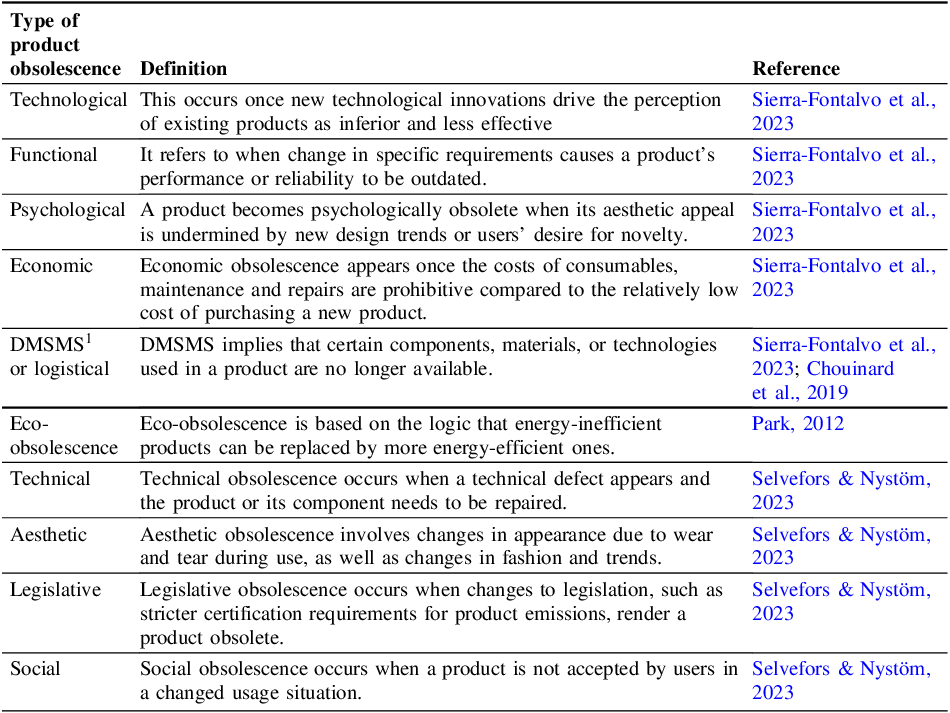
Product obsolescence is the inevitable process by which a product becomes outdated and is discarded and/or replaced by a new one. This is challenged by the Ecodesign for Sustainable Products Regulation (ESPR), as it includes specific product-oriented rules to extend product lifespans and support the transition to a circular economy (European Commission, 2024). The ESPR is regulated through the Ecodesign standards and provides requirements for energy-related products, such as minimum energy efficiency standards and other environmental criteria (Reference Maitre-Ekern and DalhammarMaitre-Ekern & Dalhammer, 2016; Reference Blanco-Espeleta, Pérez-Belis and BoveaBlanco-Espeleta et al., 2024). Product obsolescence has recently, again received attention in academia, with a particular focus on classifying existing types and how it can be mitigated through design. Table 1 provides an overview of the distinct types and definitions of product obsolescence as described in the literature.
Types of product obsolescence and their definitions (1DMSMS: diminishing manufacturing sources and material shortages)

Different types of obsolescence can occur at once and there might be some overlap between the various types: for instance, eco-obsolescence is related to economic obsolescence, as declining energy-efficiency also increases usage costs (Reference ParkPark, 2012). Design plays an essential role in mitigating the negative effects of product obsolescence (Reference den Hollander, Bakker and Hultinkden Hollander et al., 2017). Specific design attributes, extracted from literature on Design for X (DfX) approaches, which cover assembly and disassembly, remanufacture, multiple lifecycles and modularity, can be assigned to types of obsolescence. This shows that software upgradability, compatibility, performance, reliability and flexibility play a crucial role in adapting a product to changing needs and uses over time, thereby extending its useful lifetime (Reference Sierra-Fontalvo, Ruiz-Pastor, Gonzalez-Quiroga and MesaSierra-Fontalvo et al., 2024). Consequently, this study explores how products can be designed to adapt to changing needs over time by distinguishing between design strategies as overarching concepts or goals, design methods and tools as operationalised design practice, and design guidelines as applied design rules or product properties. We examine design strategies that mitigate product obsolescence, such as adaptability, upgradability and flexibility, focusing on product applicability; design methods, tools and corresponding guidelines will therefore be discussed. Building on this distinction, this paper presents a state-of-the-art overview of adaptable product design based on academic literature, legislation, and selected industrial applications. In this study, we focus on three design strategies (i.e. adaptability, upgradability, and flexibility) by clarifying their definitions and role in mitigating premature product obsolescence. A synthesis framework is then proposed that represents a common design process for adaptable products, linking design phases to relevant design methods and tools to support industrial design practice. Corresponding design guidelines are derived as actionable design rules informing product properties. Together, these elements clarify and operationalise adaptable design through a coherent framework aimed at supporting designers in addressing product obsolescence. The study is primarily based on an exploratory scoping review, complemented by industrial examples and a workshop with design students.
2. Methodology
2.1. Exploratory review
The goal of this preliminary review is to explore the state of the art on product design strategies, aimed at mitigating obsolescence risks and identify possible research gaps. We examine design methods and guidelines in academic, legislative and industrial contexts (Reference Arksey and O’MalleyArksey & O’Malley, 2005). An initial collection of publications and documents is compiled based on expert recommendations. This is expanded through a literature search, conducted in the Web of Science (WoS) Core Collection to identify review and research papers related to adaptability, upgradability, and flexibility in product design. For each thematic focus, a dedicated title-based query is formulated. Since adaptability is an overarching concept, the query TI = (adapt* AND product AND design AND review) was aimed specifically at review papers. Results are refined using citation topic meso classifications 4.224, 6.115, and 8.124, which group publications by shared citation patterns and were selected for their relevance to product design, sustainability, and product lifecycles. For upgradability, the query TI = (upgrad* AND product AND design) is used, with refinement through citation topic micro categories 4.224.715 and 6.3.2135. For flexibility, the query TI = (flexib* AND product AND design) is employed, filtering by citation topic meso classifications 4.224 and 5.122. Across all three searches, title and abstract screening and snowball referencing is performed to retain only articles directly addressing adaptability, upgradability, or flexibility in product design contexts. Papers were included if they explicitly addressed adaptability, upgradability, or flexibility as design strategies, methods, or guidelines in a product design context, resulting in a final sample of 101 publications.
2.2. Workshop
In addition to the scoping review, a workshop is conducted as a complement to contextualise the literature findings and to explore how design students (i.e. future design professionals) intuitively approach adaptable design. The workshop is not intended to produce generalisable results, but to qualitatively reflect on and complement the literature-based framework.
Workshop description: The two-hour workshop addressed product obsolescence and product adaptability through brief theoretical introductions followed by hands-on exercises using the Future Adaptive Design (FAD) toolkit (Reference Selvefors and NyströmSelvefors & Nyström, 2023). Students worked in subgroups on pre-disassembled electronic household appliances, analysing product functionality, components, and architecture. Obsolescence risks were identified using the FAD Drivers of Product Obsolescence canvas to explore plausible causes and timing of product replacement. A retrospective approach was applied by comparing older products with contemporary counterparts to reveal evolutionary design changes and identify critical components susceptible to obsolescence, as analysing past product replacement has been shown to uncover opportunities for future adaptability (Reference Pialot and MilletPialot & Millet, 2016). Based on these insights, students iteratively redesigned the products from both retrospective and prospective perspectives to explore adaptability to past and anticipated future changes. Reflective feedback was collected throughout the workshop using short Mentimeter questionnaires.
Participant description: This workshop is part of an educational program with the aim of developing their hard and soft skills for which students can freely register. The group participating in the workshop totalled 16 design students from the Bachelor of Science (BSc) Product Development programme at the University of Antwerp (1 first-year student, 13 second-year students and 2 third-year students). They were divided into five smaller, mixed subgroups, consisting of three to four students.
3. Results
3.1. Design strategies: adaptability, upgradability and flexibility
The three design strategies discussed in this section (i.e. adaptability, upgradability, and flexibility) were identified through the exploratory literature review as recurring and interrelated approaches to mitigating product obsolescence, treated as distinct yet complementary strategies that address change over time through different design mechanisms. In legislation, adaptability is defined as the ability (of a product) to be changed or modified to make suitable for a particular purpose (ISO 21931-1:2022). In literature, adaptability is presented as an overarching concept for mitigating premature product obsolescence by enabling changes to a product’s capabilities and functions after production, and is commonly associated with flexibility, upgradability, and modularity as key design approaches. However, while reliability and robustness support longevity, they do not necessarily imply adaptability. (Reference Nyström, Whalen, Diener, den Hollander and BoyerNyström et al., 2021; Reference Bocken, De Pauw, Bakker and Van Der GrintenBocken et al., 2016; Reference Khan, Mittal, West and WuestKhan et al., 2018). Adaptability can be approached in a specific or general manner, depending on whether future changes can be anticipated at the time of design or must remain open-ended, respectively. (Reference Nyström, Whalen, Diener, den Hollander and BoyerNyström et al., 2021; Reference Gu, Hashemian and NeeGu et al., 2004; Reference Gu, Xue and NeeGu et al., 2009).
Within the EN 45554 (2020) standard, an upgrade is defined as the process of enhancing the functionality, performance, capacity, or aesthetics of a product. Upgrading is a design strategy that postpones obsolescence and extends a product’s lifetime. In contrast, remanufacturing (along with related concepts such as recontextualising and refurbishing) aims to reverse product obsolescence. Components from obsolete products are therefore recovered and combined with new parts to create a product with a similar level of functionality to a new one (Reference den Hollander, Bakker and Hultinkden Hollander et al., 2017). Design for repair is also considered a strategy for reversing obsolescence. Since a product cannot be repaired unless its faulty components can be accessed and removed for replacement, disassembly is its key enabler.
The EN 45554 (2020) standard covers the assessment of a product’s ability to remove certain parts for repair, reuse and upgrade purposes. It is an example of how legislation supports the implementation of Ecodesign, within the ESPR (Reference Blanco-Espeleta, Pérez-Belis and BoveaBlanco-Espeleta et al., 2024). Various aspects required to perform a replacement, such as disassembly depth, fasteners and connectors, tools, working environment and skill level are covered. Corresponding product- and support-related criteria are listed. For example, a product-related criteria states that a (priority) part must be dismantlable, without damaging the product in as less disassembly steps as possible. A support-related criteria, for instance is when a fault or issue occurs, causing the user to upgrade the product, there must be an intuitive interface, meaning that the fault can be diagnosed and understood without the need for any supporting documentation or software. Furthermore, in literature, tools are developed to help designers optimise a product’s disassembly. The Disassembly Map, for instance visualises the disassembly process by representing a product’s internal architecture and identifying features that hinder or support repair. It shows the disassembly sequence, the time and tools needed, and whether fasteners can be reused during reassembly (Reference De Fazio, Bakker, Flipsen and BalkenendeDe Fazio et al., 2021). When using the map to redesign a product for easier disassembly, certain specific guidelines arise. For example, parts that are most likely to fail should be positioned close to the surface, since this reduces the number of steps needed to reach them. This process is known as surfacing. Additionally, clumping parts together merges non-essential components into modules that are easy to remove. To reduce disassembly time, it is best to reduce the number of fasteners. This strategy is called trimming (Reference Balkenende, Bakker, Blondel and HenneberryBalkenende et al., 2024). ‘Design for upgradability’ refers to the tool to facilitate the enhancement of a product’s functional as well as physical fitness for ease of upgrade (Reference Khan, Mittal, West and WuestKhan et al., 2018). An upgrading operation can be classified into two types: parametric or performance upgrading, indicating performance changes of a product and functional upgrading, meaning to add or remove a function of a product (Reference Umeda, Kondoh, Shimomura and TomiyamaUmeda et al., 2005). Both types of upgrades involve an upgrade plan. This plan aims to ensure that the upgradable products are functionally capable, for a specified period, to satisfy consumer’s evolving requirements. It entails the timing of when several generations of a product will come to market, how the performance will be upgraded between neighbouring generations and the design solution for each product.
In legislation, flexibility refers to the ability to accommodate distinct functions with minor system changes (ISO 21931-1:2022). In addition to modularity, literature identifies product variety, particularly generational variety, as an important enabler of flexibility. This refers to the variation between future product generations in response to changes caused by external factors, which are similar to the different types of obsolescence.
Furthermore, other concepts related to adaptability but not yet identical in meaning are discussed. Mass customisation design aims at creating products to fit individual needs with a mass production efficiency; however, these products are usually not adaptable. Reconfigurable products are created to replace multiple products with one, but extension of functionality or upgrade are not considered. Multi-purpose products refer to products that serve various functions, but this does not imply that these are designed to adapt to changes over time (Reference Gu, Xue and NeeGu et al., 2009).
3.2. General framework
Even though various design methods on adaptable products are proposed in the literature, there is still no commonly accepted design framework available today. Furthermore, validity of frameworks which do exist, are questioned, since application of adaptable products, using these methods are still lacking (Reference Khan, Mittal, West and WuestKhan et al., 2018).
3.2.1. Common design process
The design processes for adaptability, upgradability and flexibility are derived from the literature. The corresponding steps and methods or tools used, if applicable, are listed in Figure 1.
General overview of design processes for adaptability, upgradability and flexibility, including supporting methods or tools reveal similarities

Figure 1 Long description
A table with nine rows and four columns. The columns are labeled Design process, Design strategies, Method or Tool, and Reference. The Design process column is further divided into Clusters and Action. The Design strategies column includes Adaptability, Upgradability, and Flexibility. The table lists various design processes such as Check Obsolescence/Disposal, Identify User Needs, Derive Functionality, Structure Functionality & Components, Target Critical Components, Prospect of Adaptations, Adaptable (Re)Design, Evaluate Design Solutions, and Iterate Process. Each row details specific actions, design strategies marked with 'x', methods or tools, and references. For example, the first row under Check Obsolescence/Disposal includes actions like Determining obsolescence risks, Customer dissatisfaction, and Estimate external drivers of change, with corresponding design strategies and methods like FAD Drivers of Product Obsolescence and Disposal Cause Analysis Matrix.
The process is descriptive in origin, as it is derived from the scoping review, while its synthesis and structuring aim to make recurring design activities more accessible and actionable for design practice. The reviewed design processes commonly start with analysing disposal causes, expected drivers of change, or obsolescence risks. User needs are then identified and, where relevant, grouped per segment. Reference Watanabe, Shimomura, Matsuda, Kondoh and UmedaWatanabe et al. (2007) also opt for the examination of technological trends as they assume that these influence user demand. Next, these identified user needs are translated into functional requirements and/or quantified into engineering metrics. A product’s physical structure is represented using tools, such as function-behaviour-state (FBS) modelling or layer-based architecture (Reference Umeda, Ishii, Yoshioka, Shimomura and TomiyamaUmeda et al., 1996; Reference Selvefors and NyströmSelvefors & Nyström, 2023). Where this step occurs in the process varies and depends on the used tool. As adaptability anticipates changes over time, it is essential to prospect by projecting the target values of engineering metrics or plan lifecycle activities, whether using an upgrade plan (Reference Selvefors and NyströmSelvefors & Nyström, 2023; Reference Watanabe, Shimomura, Matsuda, Kondoh and UmedaWatanabe et al., 2007). Now, designers can create a product accordingly and generate multiple adaptable design solutions. Finally, these design solutions are evaluated after each design process based on parameters such as costs and environmental impact. Specifically, the design method for variety design involves two indexes, namely the generational variety index and the coupling index. It is important to note that evaluation parameters such as costs are already included in the calculation of these indexes (Reference Martin and IshiiMartin & Ishii, 2002). Two additional steps are retrieved from the general overview, that are not addressed by all three strategies. The first one involves identifying and addressing critical components that are sensitive to change and could therefore lead to the product being discarded (Reference Umeda, Hijihara, Oono, Ogawa, Kobayashi, Hattori, Masui and FukanoUmeda et al., 2003; Reference Greve, Fuchs, Hamraz, Windheim and KrauseGreve et al., 2021). The second refers to the iterative and dynamic nature of the design process. Future uncertainty can lead to unexpected events, or ‘disturbances’. For example, production may stop, requiring the adapted product to be altered accordingly (Reference Matsuda, Shimomura, Kondoh and UmedaMatsuda et al., 2003; Reference Watanabe, Shimomura, Matsuda, Kondoh and UmedaWatanabe et al., 2007).
3.2.2. Design guidelines
In addition to the design processes, design guidelines across adaptability, upgradability, and flexibility are derived from literature and subsequently clustered (and de-duplicated) by the authors to communicate actionable and inspirational design guidance. To increase the general adaptability of a product, there are two main product design strategies that can be applied: independence and insensitivity.
Independence refers to the degree of structural change caused to surrounding components when a function is added, removed, or replaced. The higher the extent of independence, the less components are affected by change and therefore the more adaptable a product is. Structural independence can be increased through the following guidelines.
-
• Interfaces can be decoupled by reducing communications between modules and enabling a product to function regardless of the orientation, location and arrangement of its individual components.
-
• Modularising components based on their similarity in parameters, such as functionality, obsolescence risks or energy use (Reference Umemori, Kondoh, Umeda, Shimomura and YoshiokaUmemori et al., 2001; Reference Shimomura, Umeda and TomiyamaShimomura et al., 1999; Reference Keese, Tilstra, Seepersad and WoodKeese et al., 2007; Reference Umeda, Kondoh, Shimomura and TomiyamaUmeda et al., 2005).
Insensitivity means that the difference between adaptations in functionality or performance is absorbed through adding margins by design at forehand (Reference Umemori, Kondoh, Umeda, Shimomura and YoshiokaUmemori et al., 2001; Reference Shimomura, Umeda and TomiyamaShimomura et al., 1999). The more insensitive components and functionality are to change, the more adaptable the products. Insensitivity can be increased through the following design guidelines.
-
• Controlling the tuning of design parameter (Reference Keese, Tilstra, Seepersad and WoodKeese et al., 2007): for example, Tesla reduced their acceleration time and performed this parametric upgrade via an over-the-air software upgrade. No structural, hardware intervention was required (Reference Khan, Mittal, West and WuestKhan et al., 2018).
-
• Oversizing a specification of an engineering metric (Reference Martin and IshiiMartin and Ishii, 2002; Reference Greve, Fuchs, Hamraz, Windheim and KrauseGreve et al., 2021): For example, the chassis of a watercooler can be structurally reinforced, so it can hold expected future reservoirs.
-
• Creating room on the exterior surfaces of a product, around interior modules and around interfacing components (Reference Martin and IshiiMartin and Ishii, 2002; Reference Keese, Tilstra, Seepersad and WoodKeese et al., 2007).
-
• Locating parts, which are expected to change over time, near the exterior of the product (Reference Keese, Tilstra, Seepersad and WoodKeese et al., 2007). This is similar to surfacing, a design-for-repair guideline, as disassembly steps are reduced to reach and replace it (Reference Balkenende, Bakker, Blondel and HenneberryBalkenende et al., 2024).
-
• Providing free interfaces or expansive surfaces for future ones (Reference Keese, Tilstra, Seepersad and WoodKeese et al., 2007).
-
• Reducing nesting of components or modules, i.e. avoiding a tight fit with surrounding parts (Reference Keese, Tilstra, Seepersad and WoodKeese et al., 2007).
3.3. Industrial landscape
The industrial examples discussed in this section serve a dual purpose: to illustrate the limited success and challenges of adaptable product concepts to date, while also highlighting ongoing industrial interest and the relevance of further investigation. The Fairphone 2 exemplifies the benefits of modular design in smartphones, enabling upgrades such as an improved camera module. Alternatives, though merely conceptual, such as Phonebloks, PuzzlePhone, and the Google ARA project also propose modularity. Prior work highlights rebound effects such as increased material use, system complexity and excessive hardware consumption, as illustrated by conceptual projects like Google ARA phone (Reference Schischke, Proske, Nissen and Schneider-RamelowSchischke et al., 2019). In addition to smart mobile devices, vacuum cleaners are notably featured in literature as products for regulation and case studies. Deglace, for instance has introduced the Fraction vacuum cleaner, emphasizing adaptability through upgradable modular design, allowing users to swap motors for enhanced performance (2025). Furthermore, FairVacuum, a Belgian start-up, has redesigned a vacuum cleaner, inspired by the open-source project called Tenok by Tim Krahmer (2019). This is a platform design, as they strive to reuse functional parts from discarded vacuum cleaners and integrate them into a universal housing (i.e. the platform). Although their aim is to implement Ecodesign guidelines, such as remanufacturing, disassembly and repairability, some guidelines for adaptability can also be recognised. For instance, by choosing an open box as the vacuum cleaner’s body, compatibility with a range of motors and hoses of different sizes is guaranteed (Reference JehaesJehaes, 2025). This is an example of oversizing a design specification to increase a product’s insensitivity (Reference Martin and IshiiMartin and Ishii, 2002).
3.4. Workshop
Given the limited industrial applications of adaptable products, this exploratory workshop examines the extent to which design students (i.e. future professionals) are familiar with and apply adaptable design. While examples are discussed in relation to adaptability, upgradability, and flexibility, several design interventions address multiple strategies simultaneously, reflecting their conceptual proximity. Therefore, a hands-on workshop was held, the results of which are discussed in this section. Similar obsolescence risks were identified for various electronic devices. The most prominent risk was the change from a USB-A port to a USB-C port, which can be classified as a technological or regulatory type of obsolescence. Other evolutionary design changes included operating a product via a display rather than physical buttons, increased battery performance, and product assembly. Technological, technical and functional obsolescence were the most prevalent. The battery, wiring, buttons or controls and the charging port were considered as critical components. Modularity is a key enabler of adaptable product design as it facilitates easy removal, addition or replacement of modules. This is clearly applied in the students’ redesigns. It is particularly reflected as dismountable connections between components, in this case using snap-fit systems, magnetic connections, Velcro or screw connections. The critical components consist of separate modules.
Retrospective redesign of an electric toothbrush from the past, adaptable to its modern counterpart (left) and its prospective redesign, adaptable to future changes (right)

The quick design illustrates with an exploded view how the modules are connected to the main body, though technically simplified. The survey revealed that students encountered future uncertainty as a recurring barrier. Nevertheless, some students managed to demonstrate the design guidelines identified in the literature that support a product’s adaptability. The toothbrush, as seen in Figure 2 (right) for example, now has a similar product architecture, featuring a housing with an OLED display instead of buttons, as well as a different brush. It is not a true platform design, as the platform (i.e. a recurring component) cannot be clearly derived from the drawing, but it shows potential.
4. Discussion
Product obsolescence contributes significantly to premature product disposal, while repair and recycling alone remain insufficient to address the resulting e-waste. This study therefore consolidates and structures existing literature, legislation, and illustrative cases on adaptable, upgradable, and flexible products, rather than empirically validating specific design outcomes. While legislation considers disassembly for repair and upgrade, it lacks guidance on corresponding design practices. The proposed framework synthesises design processes, methods, and corresponding guidelines for adaptability, upgradability, and flexibility, suggesting that nine common steps recur across the reviewed literature. Although industrial applications remain limited or merely conceptual, the reviewed literature identifies three recurring rebound effects associated with adaptable design: increased material use due to modularity, expanded PCB footprints, and overconsumption driven by fragmented functionality. Additionally, the workshop suggests a skills gap among design students in creating adaptable products, with modularisation emerging as the most readily applied enabler. These findings should be interpreted as indicative rather than representative, given the exploratory nature and limited scope of the workshop. This indicates the need for a systematic review to further verify, refine, and potentially operationalise the proposed framework for adaptable design. The rarity of industrial applications and the limited design intuition observed during the workshop indicate the value of complementary empirical product studies, to further unravel how independence and insensitivity of functionality and components can be practically enhanced by design (Reference Keese, Tilstra, Seepersad and WoodKeese et al., 2007). Furthermore, four key barriers to adaptable design, which are besides the scope of this study require further research (Reference Khan, Mittal, West and WuestKhan et al., 2018). First, methodologies for adaptable design only deal with functions known at the time of design (Reference Umeda, Kondoh, Shimomura and TomiyamaUmeda et al., 2005). Therefore, a remaining barrier is the future uncertainty of technological trends, market dynamics and consumer demands. Secondly, still little is known about the consumers’ perception on adaptable products, willingness to buy, forms of contract and installation modes of adaptations are yet to be examined. Third, business models for upgradable products face challenges due to their novelty and associated risks. The ‘Upgradable Product Service System’ (Up-PSS) is considered a promising strategy to improve client appeal and create new opportunities for manufacturers by facilitating service-oriented economic models and new partnerships in the value chain (Reference Khan, Mittal, West and WuestKhan et al., 2018; Reference Pialot, Millet and BisiauxPialot et al., 2017; Reference Nyström, Whalen, Diener, den Hollander and BoyerNyström et al., 2021; Reference Marzolla and ZanculMarzolla & Zancul, 2024). Finally, adaptable product design entails increased complexity, considering the structural challenges from modular design and decision-making when selecting solutions that meet numerous requirements (Reference Nyström, Whalen, Diener, den Hollander and BoyerNyström et al., 2021; Reference Gu, Hashemian and NeeGu et al., 2004). To aid designers and manufacturers in identifying optimal adaptable designs, modelling and optimization techniques such as fuzzy logic and genetic algorithms are recommended, with fuzzy logic effectively managing ambiguous design criteria and genetic algorithms identifying optimal design solutions (Reference Aziz, Wahab, Ramli and AzhariAziz et al., 2016).
5. Conclusion
Repair and recycling contribute to reducing electronic waste, but they do not prevent premature product disposal driven by broader forms of product obsolescence. Various other types of changes, including technological, functional and legislative, cause products to become obsolete prematurely. The designated Ecodesign standard only deals with assessing a product’s disassembly for repair and upgrade purposes. However, it does not address the question of whether to upgrade or how to design products accordingly (EN 45554). In the literature, adaptability, upgradability, and flexibility are identified as distinct yet related design strategies for mitigating product obsolescence by extending product lifetimes. As it focuses on adapting functionality rather than recovering individual parts or materials, adaptability is often considered environmentally advantageous compared to recycling, repair, and remanufacturing, depending on use-phase and material trade-offs. (Reference Gu, Hashemian and NeeGu et al., 2004). According to literature, adaptability, upgradability and flexibility exhibit similarity in their design processes and associated methods. Therefore, the framework synthesises recurring design activities reported in the literature into nine common steps, aiming to support and inspire design practice rather than prescribe a fixed process. While several steps are supported by existing methods or tools, the adaptable (re)design and evaluation phase remain comparatively underdeveloped. Products are most adaptable when their functionality and components are independent of and insensitive to change. Accordingly, this paper compiles a structured set of design guidelines, derived from literature and synthesised by the authors, to accumulate process-level insights into actionable product-level considerations. While promising examples such as the Fairphone 2 exist, successful industrial applications of adaptable products remain limited. Additionally, the exploratory workshop suggests limited design intuition among students when addressing adaptable product design. Although, the redesigned concepts have some potential, besides the modularisation of critical components, no other particular enabler for adaptability is observed. Future research should prioritise (1) systematic reviews to further validate and refine the proposed framework, (2) empirical studies involving industrial designers and real-world constraints, and (3) the development and testing of design methods that specifically support the evaluation and (re)design of adaptable products. Together, these directions are essential to move adaptable product design from a largely conceptual strategy towards operationalizable industrial design practice.
Acknowledgements
We would like to thank the workshop participants for their contributions to this paper, in particular Titus Pauwels for his quick designs of the electronic toothbrush.


 Open access

