

Introduction
Archaeological scholarship too often tacitly equates cultural continuity with inertia or active resistance to change; however, we argue that continuities facilitate meaningful social transformations. Innovations gain meaning only when rendered legible within established epistemic frames (Ur Reference Ur2014). Lack of any familiar frame of reference renders novel forms meaningless, and thus resistant to adoption. We therefore interrogate the possibility of simply adopting new ontologies as catalyst for radical transformation. Drawing on Deleuze and Guattari’s (Reference Deleuze and Guattari1994) concept of thought as a ‘play of forms’, we suggest that people interpret, adapt and reinscribe new material forms within recognizable discursive and material traditions. This process marks neither straightforward appropriation nor, necessarily, resistance—it is the work of sense-making and a form of thought unfolding through materiality. We further suggest that societies do not adopt new forms at random, but rather those that they may successfully recode in ways advancing their social projects (Sinopoli Reference Sinopoli2003). Ontological change thus follows from materialist politics.
Illustrating this, we examine two case studies: the emergence of compound coresidential enclosures (CCEs) in the Central Andes and the spread of vihara in Angkorian Cambodia. By ‘compound coresidential enclosure’, we denote communal domestic complexes comprising multi-story residential galleries organized around a central patio. ‘Vihara’ (Khmer: preah vihear) designates a consecrated congregational hall centred on venerated images of the Buddha. Although rooted in distinct cultural contexts, both architectural traditions eventually played a central role in transformative social formations—Andean ayllus Footnote 1 and Khmer Theravada Buddhism, respectively. Both eventually achieved hegemony: the Inka Empire built its administrative framework on ayllus (Berquist Reference Berquist2022), while present-day Cambodia remains overwhelmingly Theravada Buddhist. Scholars have long debated whether the spread of Theravada Buddhism and the institutionalization of ayllus represented sharp ruptures, interpreting them as rejection or replacement of older orders (Harris Reference Harris2005; Spiro Reference Spiro1971; Thompson Reference Thompson and Thompson2022). We concur that these architectural forms actively restructured social relations by reshaping encounters, patterns of visibility, and bodily habitus (Berquist Reference Berquist2022; Harris et al. Reference Harris, Tin and Soeng2022; Reference Harris, Vitou, Chhay and Tin2023).
Neither case, however, constitutes a straightforward rupture. Both architectural forms, during their initial adoption, drew upon charged elements of earlier religious and political traditions. Rather than displacing what came before, exogenous or emergent architectures often mirrored familiar structures and absorbed many of their functions. In this sense, what might appear as radical ruptures were in practice processes of translation, rendering novel ideas legible in reference to older material traditions. Over time, however, Andean CCEs and Cambodian vihara restructured the basis of social life and reshaped relations within their respective societies. Gradual acceptance enabled transformations that can be read in the archaeological record as ontological rupture. Yet our evidence suggests more prosaic desires and pragmatic strategies conditioned their initial adoption.
We follow Crellin (Reference Crellin2020) in critiquing binaries of ‘change’ and ‘continuity’ produced by teleological, deterministic and linear paradigms. Both terms function primarily as heuristic devices whose utility depends on temporal scale. Like Crellin, we draw on the post-humanist ontology of Deleuze and Guattari, which frames the universe as always already in flux. Yet, while Crellin privileges Jane Bennett’s (Reference Bennett2010) concept of ‘vibrant matter’ as a primary driver of social change, we contend that emergent, stochastic processes cannot sufficiently explain human action. We return instead to Deleuze’s treatment of ‘thought’ as a non-anthropocentric mode entailing processes of connection and recombination while generating new forms and novel affects. Thinking, in this active sense, arises when problems compel us to question, test and experiment with solutions. We therefore approach patterns of ‘continuity’ and ‘change’ in the archaeological record as traces of thought-in-action. By interpreting material continuities through the lens of reflective practice, we aim to advance a more robust account of social change, one situating human thought, rather than metaphysical abstraction, at the core of historical transformation.
Assemblage versus assembly
Rachel Crellin (Reference Crellin2020, 3) argues that ‘change lies at the heart of archaeology’, yet archaeologists ‘often fail to theorise [this] approach’ (Reference Crellin2020, 2). Nineteenth- and early twentieth-century paradigms tended to conceive of cultures as bounded, stable entities advancing along continuous, linear trajectories (Lucas Reference Lucas2024). Explanations for gradual change were typically located within privileged domains—economic, environmental, or, more romantically, through permutations of cultural geist or genius (Zimmerman Reference Zimmerman2001). Anthropologists attributed significant deviations from cultural trajectories to ruptures produced by external shocks, whether environmental, economic, or militaristic. Such perspectives adhered to a conservative, Burkean understanding of cultural tradition as an inherited framework securing stability through maintenance of established institutions, discourses and practices (Paden Reference Paden1988), binding society together by privileging continuity over rupture and gradual adaptation over radical change.
As post-processual archaeologists turned away from grand narratives and unilinear evolutionism, they developed a general reluctance to retheorize long-term change (Crellin Reference Crellin2017; Reference Crellin2020; Lucas Reference Lucas2005; Reference Lucas2012). As Robb and Pauketat (Reference Robb, Pauketat, Robb and Pauketat2013) argue, post-processualism defined itself in opposition to earlier approaches, rejecting overarching historical explanations as reductive and problematic metanarratives. In their place, post-processual theorists foregrounded human agency and emphasized short-term, context-specific interpretations, inspired by ethnographic analogies. Lucas (Reference Lucas2024) suggests that by failing to replace unilinear evolutionary models with coherent alternatives, post-processualism allowed many socio-evolutionary assumptions about change and continuity to persist unchallenged. Thus, archaeologists frequently continue to conceptualize gradual change and continuity as natural while explaining sudden change primarily in reference to catastrophic shocks.
Recent scholarship challenges this tendency, drawing from strands of process philosophy, new materialisms and various models of assemblage theory positing a world in constant flux (Lucas Reference Lucas2017). Inspired by Deleuze and Guattari (Reference Deleuze, Guattari and Massumi1987), these latter ontologies render social change as an ontological property of the world. However, multiple variants on assemblage theory exist, with distinct ontological mechanisms driving change and differentiation (Hamilakis & Jones Reference Hamilakis and Jones2017). Archaeologists have largely left these differences unexplored, treating ‘assemblage theory’ as a coherent theoretical corpus and an ‘assemblage’ as a stable concept resembling its classic archaeological sense: an ‘an aggregation of diverse objects united by a distinctive and clearly defined context of variable scale’ (Hamilakis & Jones Reference Hamilakis and Jones2017, 77).
In particular, Jane Bennett’s notion of ‘vibrant matter’ as ontogenetic principle has attracted archaeological theorists in its paralleling of archaeological discourse (Hamilakis & Jones Reference Hamilakis and Jones2017), apparent affinity with Indigenous ontologies (Cipolla Reference Cipolla2018), compatibility with other strands of New Materialism (Crellin Reference Crellin2020), and explicit romanticism (Perry Reference Perry2019). Describing formation of assemblages, Bennett (Reference Bennett2010: 18) theorizes:
bodies falling in a void, bodies that are not lifeless stuff but matter on the go, entering and leaving assemblages … according to which political events are born from chance meetings of atoms. A primordial swerve says that the world is not determined, that an element of chanciness resides at the heart of things, but it also affirms that so-called inanimate things have … an inexplicable vitality or energy …
Drawing from DeLanda (Reference DeLanda2012), Crellin (Reference Crellin2020, 174) build from Bennett to suggest that sudden changes in the social world mark phase transitions, where the ‘build-up of numerous smaller interrelated processes’ at a microscopic level eventually produces what appears as a sudden, radical transformation. Bennett, a political theorist, explicitly formulates such arguments as the basis for activating new collectives of humans and non-humans. Her description of assemblages as autonomous and self-organizing systems, unfolding through chance encounter, marks a vision meant to extend into human realms and open lines of flight.
Yet critics have suggested that Bennett largely fails to explain why some encounters between ‘vital forces’ come to matter and why others do not (Lemke Reference Lemke2018). As Badiou (Reference Badiou2006) argues, by focusing on infinitely complex interactions producing a given identity or event, we are left unable to make strong claims as to which interactions matter more than others. We can describe a process but we cannot explain a given outcome of interest or its significance to human societies. We cannot adequately conceptualize what draws people to the ayllu or to Theravada Buddhism; to fascism or the French Revolution. Further, Bennett’s essentially libertarian framework offers few insights into the political work of building intentional relations and organizing lasting institutions. Understanding social worlds requires us to think through what moves humans and what draws them into, or away from, specific organizational patterns. Analytically assuming the perspective of a specific human—or human society—should push us to ask what matters to them and why, without assuming that this question implies anthropocentrism.
In contrast to Bennett’s emphasis on chance encounter, Deleuze and Guattari argue that assemblages persist because experimentation and recombination open new modes of action or enhance old ones. Assemblage as a productive movement drives people to build differently, to mark space, to experiment with forms and concepts, thus activating novel forms of sociality, materiality, perception, or power (Colebrook Reference Colebrook2002; Dovey Reference Dovey2010). The concept of territorialization helps clarify this: assemblages stabilize through repetition and boundary-making, but boundaries do not merely constrain. They shape new possibilities for interaction, generating a space where divergent elements can cohere temporarily and extend themselves into the world.
Deleuze frames this creative recombination of forms and forces as thought. Rather than an esoteric property of human consciousness, thought thus marks a material process that unfolds through engagement with the world. The human mind may condense thought in a unique way but thought itself extends throughout the universe. Architecture, then, functions not just a backdrop to change but as an active participant in it: a medium through which communities think collectively. As Malafouris (Reference Malafouris2013) concurs, tools, materialities, and built environments do not just reflect thought—they shape it, constrain it, and make it possible.
This emphasis on assembly as thought allows us to reconsider how historical actors mediated dramatic change. Deleuze (Reference Deleuze and Tomlinson1983, 105) provocatively states that ‘Stupidity is the structure of thought as such’. By this, he refers to something like babble, unfolding through cliché, convention and doxa. Stupidity, for Deleuze, marks the perpetual (re)production of a given form as it passes through infinite minor variations. Nevertheless, Deleuze argues that we can think. Deleuze proposes that thought takes a more directed form when confronted with a problem that necessitates experimentation with solutions.
Rather than seeing new institutions or architectures as ruptures, we thus approach them as responses to lived concerns, i.e. experimentations and negotiations re-embedding novel solutions within legible forms. This necessitates preservation of familiar signs amid social transformation—whether in roof tiles or in mortuary traditions. In this framework, tradition functions not as a static inheritance (as in Burke’s conservatism), but as a repertoire of epistemic practices—ways of perceiving, relating, and interpreting the world.
Hamilakis and Jones (Reference Hamilakis and Jones2017) suggest that Bennett and Delanda (e.g. Reference DeLanda2012) have offered archaeologists solutions to problems that have long troubled the discipline. The assemblage theory of Deleuze and Guattari, in contrast, may allow us to ask new sorts of questions. Rather than grounding social transformation in abstract ontologies or stochastic processes, we foreground how communities organize material worlds in ways that both resonate with inherited forms and open paths toward new realities. In doing so, we question the notion that adopting new ontologies constitutes an effective politics. Rather, we suggest, new ontologies take shape through materialist politics.
House societies in the Central Andes
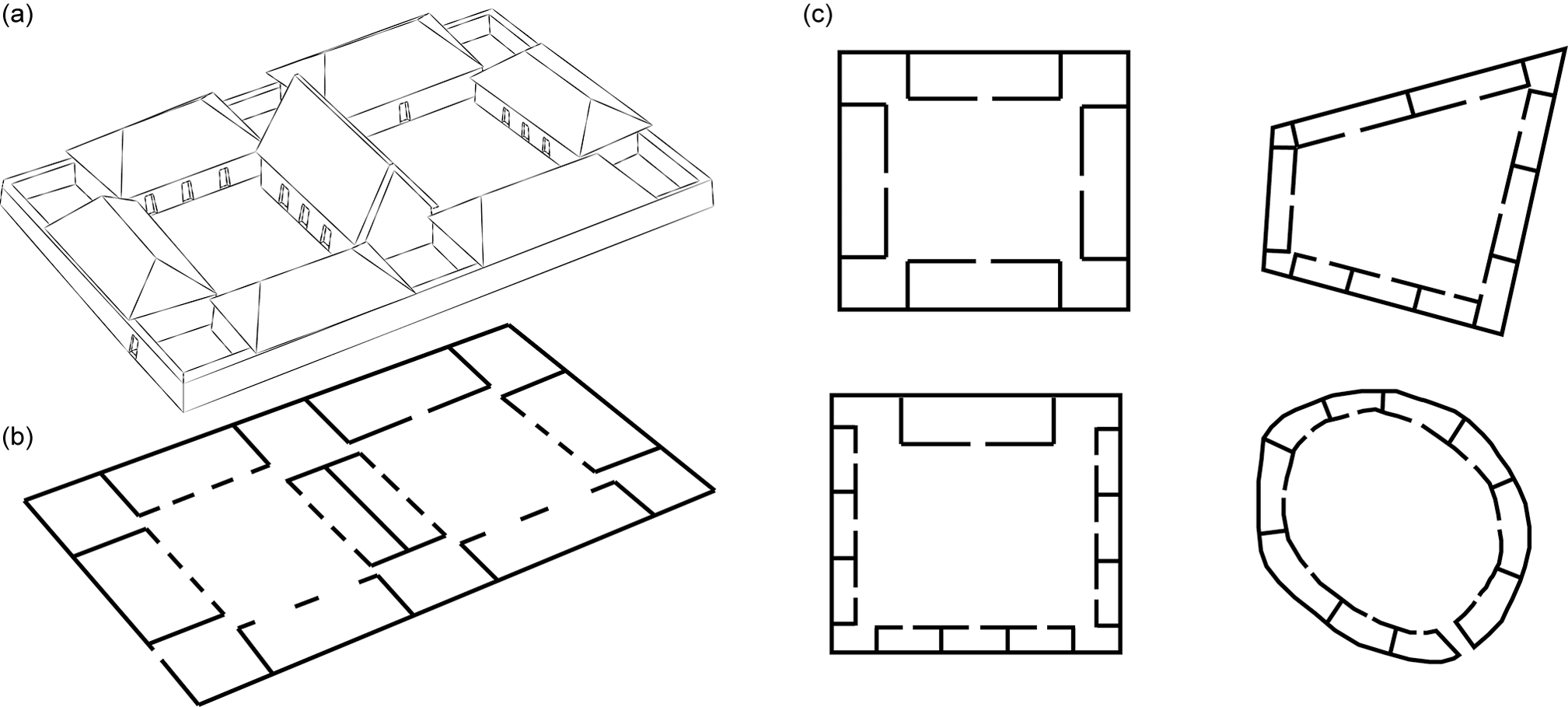
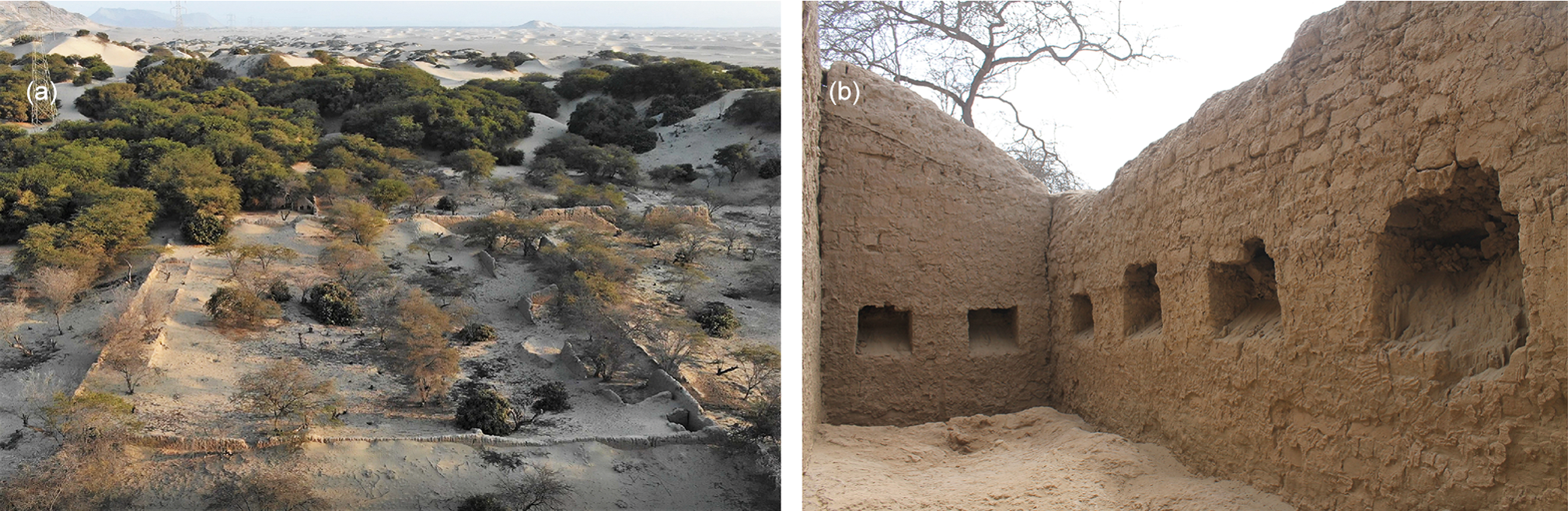
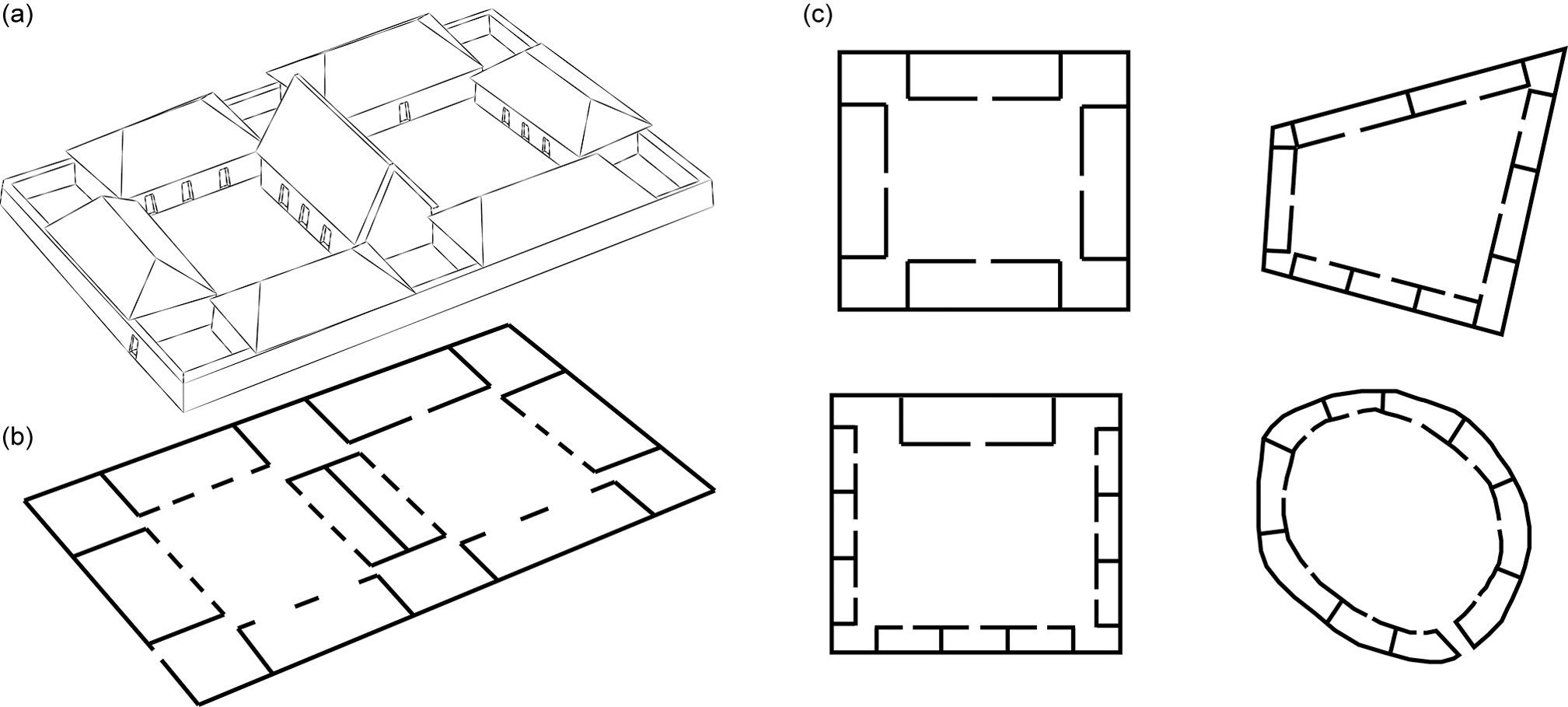
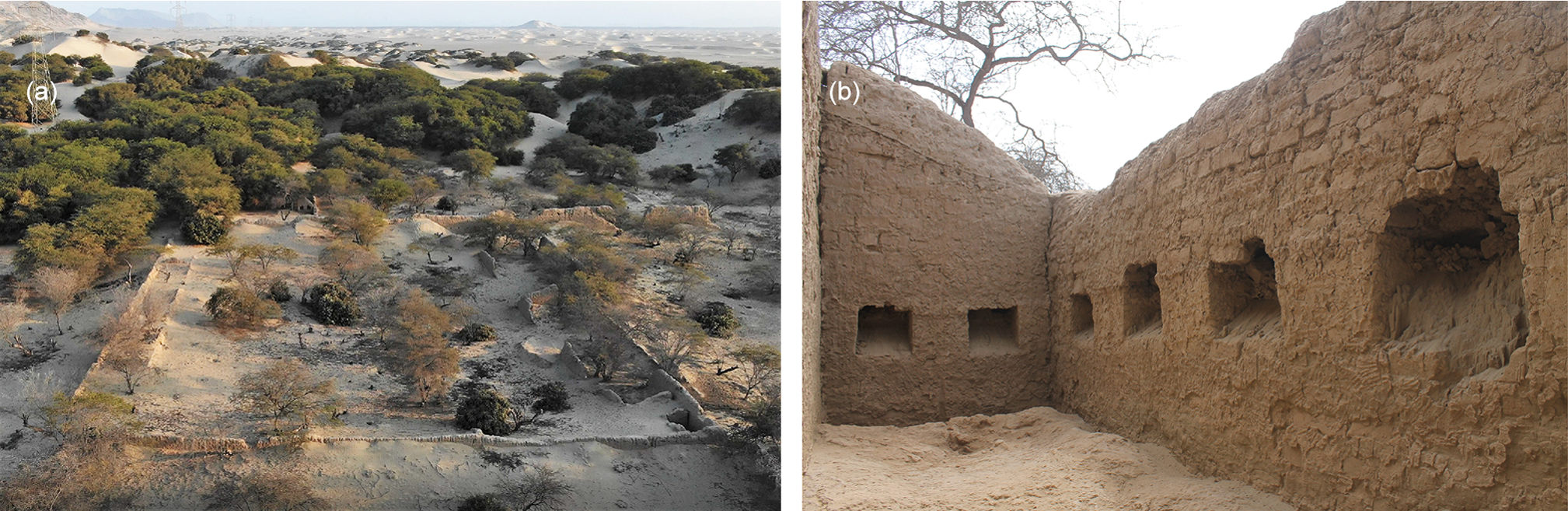
During the Andean Middle Horizon (600–1000 ce, defined by widespread adoption of polychrome ceramics, sporadic sites across a wide swathe of the Central Andes adopted a specific model of large patio group that we designate as Compound Coresidential Enclosures (Fig. 1). These architectural complexes included a high perimeter wall affixed to long galleries. A central door opens from each gallery on to an interior patio. Gallery rooms rarely, if ever, communicate with each other and rarely contain internal partitions. Frequently, galleries include large rectangular niches with regular dimensions, spaced evenly along the interior walls (Fig. 2). Variations on this basic form exist—for example, some patio groups include larger ‘niched halls’ at one end, and galleries reach multiple stories in select cases.
(a) Idealized architectural rendering; (b) corresponding footprint of two conjoined compound coresidential enclosures; (c) morphological variants.
(a) CCE at the Middle Horizon site of Tecapa; (b) niched gallery at Tecapa.
Lack of evidence for primary production or dedicated storage structures, accompanied by informal hearths and light domestic scatters (Berquist Reference Berquist2022), have led excavators to interpret these structures as primarily residential in nature (Anders Reference Anders1986; Edwards Reference Edwards2013; Glowacki Reference Glowacki, Isbell and Silverman2002; Green & Goldstein Reference Green, Goldstein and Jennings2010; Isbell et al. Reference Isbell, Brewster-Wray, Spickard, Isbell and McEwan1991; Jennings Reference Jennings, Jennings, Yépez Álvarez and Bautista2021; Nash Reference Nash, Halperin and Schwartz2017; Nigra et al. Reference Nigra, Cardona Rosas, Lozada and Barnard2017; Pineda Quevedo Reference Pineda Quevedo1989; Reid Reference Reid2023; Sánchez Reference Sánchez and Orefici2009; Schreiber Reference Schreiber1992), with some scholars suggesting seasonal habitation (Anders Reference Anders1986; Topic & Topic Reference Topic, Topic, Kaulicke and Isbell2001; Reference Topic, Topic and Jennings2010). Construction method and aesthetic vary widely (Young-Wolfe Reference Young-Wolfe2023), as do stylistic attributes of diagnostic artifacts recovered from associated middens (e.g. Green & Goldstein Reference Green, Goldstein and Jennings2010; Isbell et al. Reference Isbell, Brewster-Wray, Spickard, Isbell and McEwan1991; Swenson & Seoane Reference Swenson and Seoane2023). Contiguous spatio-temporal distribution, similar spatial organization and consistent activity patterns allow us to interpret this architecture as a class of related structures adopted sporadically across different groups (Berquist Reference Berquist2022).
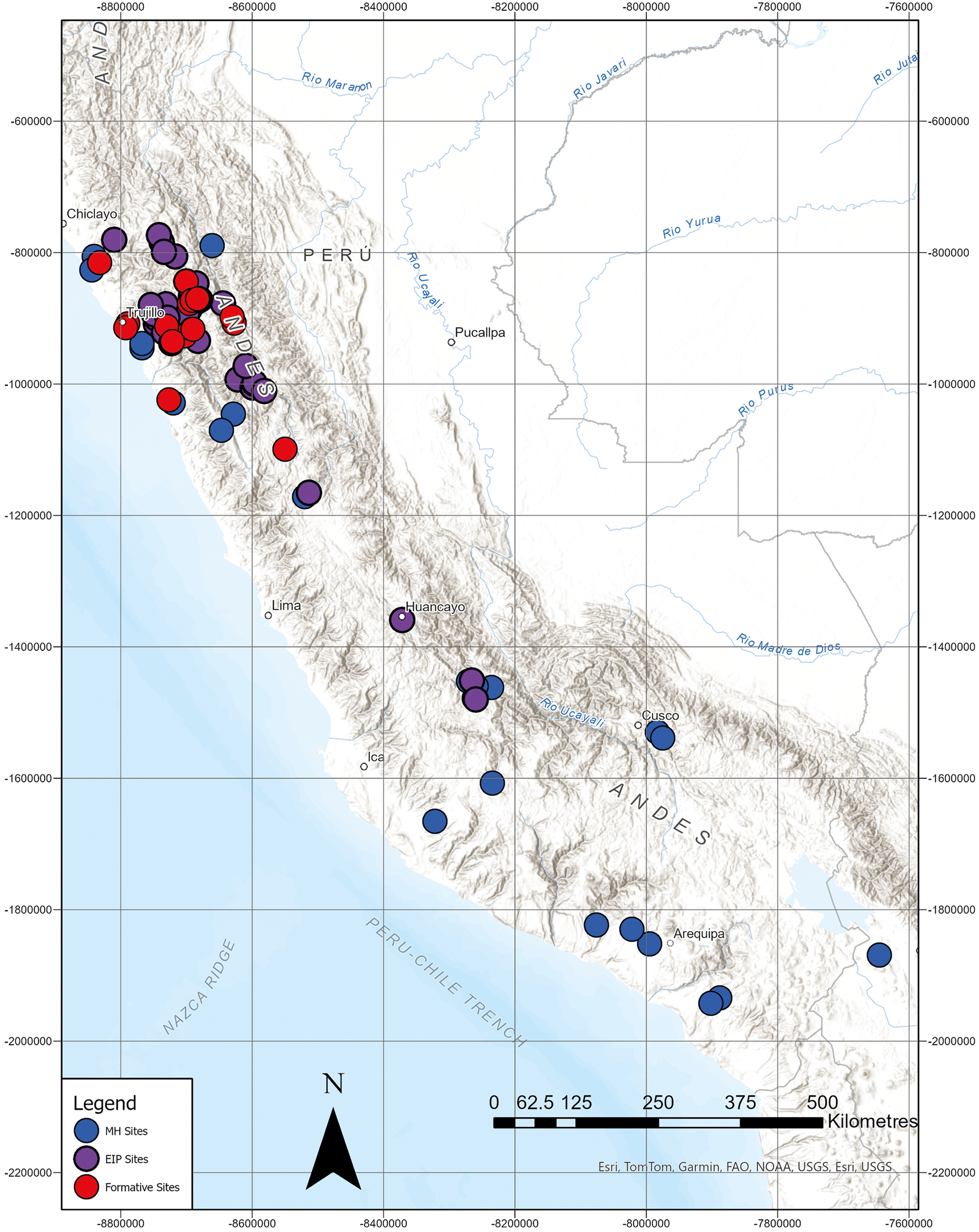
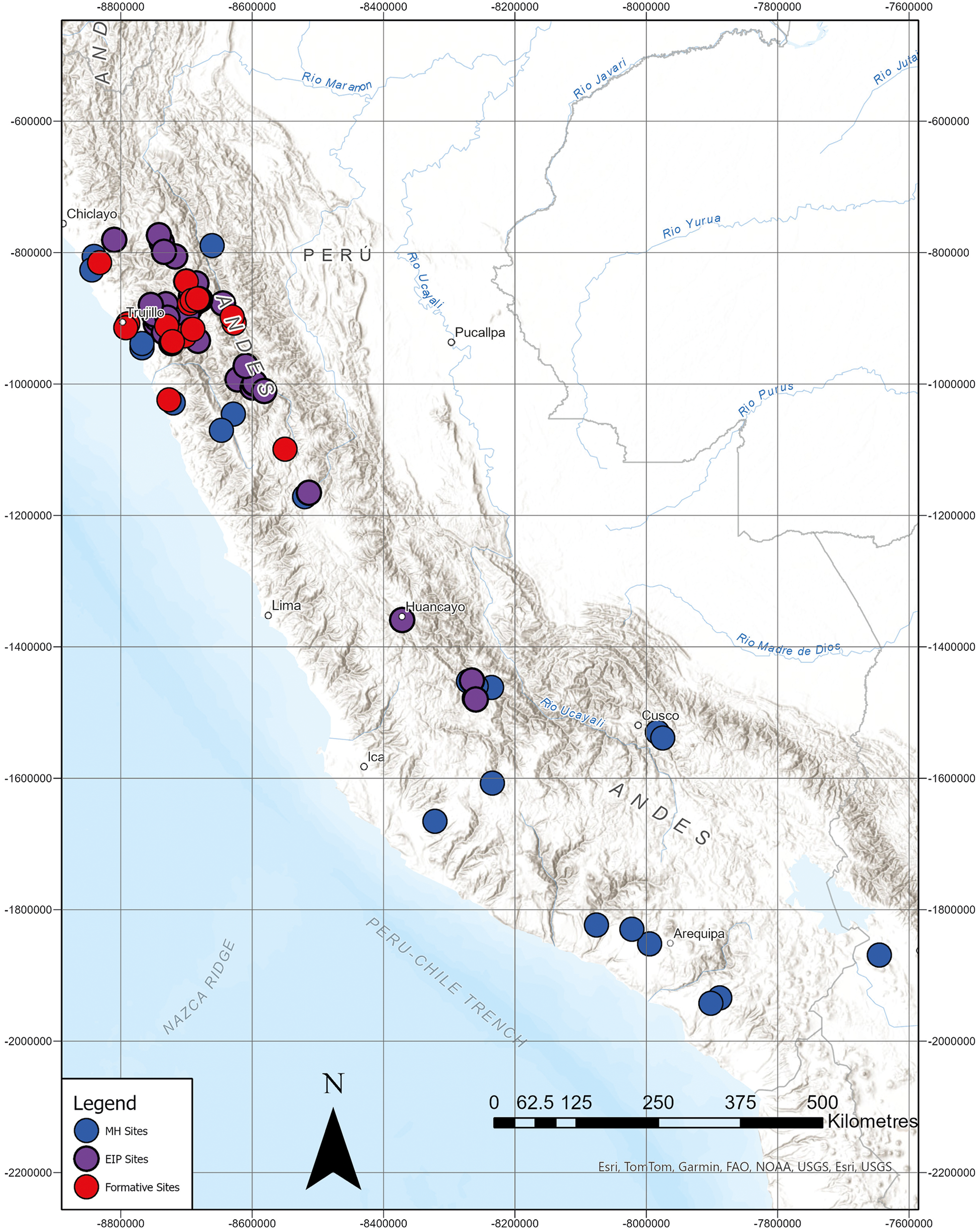
CCE architecture frequently has served as a key diagnostic of sites constructed by the Wari Empire, centred on the city of Huari, in the Ayacucho region of Peru. Indeed, Schreiber (Reference Schreiber1992, 96) cites the ‘Wari patio group’ as ‘the single most diagnostic feature of a Wari site’. However, recent work shows that Wari patio groups—as broadly defined by Schreiber—predate Wari expansion in many regions (Nash Reference Nash, Halperin and Schwartz2017 offers a more precise and limited definition of Wari structures). Excavations consistently suggest that these structures functioned as co-residential architecture in both Ayacucho (Anders Reference Anders1986; Jennings & Berquist Reference Jennings and Berquist2023; Leoni Reference Leoni2004) and regions to the north during the Early Intermediate Period (200 bce– ce 600) (Ibarra Reference Ibarra2021; Lau Reference Lau2010; Lau et al. Reference Lau, Luján Dávila, Bongers and Chicoine2023; Lopez Aldave & Brown Reference Lopez Aldave and Brown2018; Shea Reference Shea1969; Topic & Topic Reference Topic, Topic, Kaulicke and Isbell2001; Reference Topic, Topic and Jennings2010). Colonists from Ayacucho likely brought this architecture to colonies in Nazca, Moquegua and Cusco during the early Middle Horizon (Green & Goldstein Reference Green, Goldstein and Jennings2010; McEwan Reference McEwan2005; Nash Reference Nash, Halperin and Schwartz2017; Sánchez Reference Sánchez and Orefici2009) (Fig. 3).
Proliferation of CCE architecture across the Central Andes.
Proliferation of CCE architecture during the Early Intermediate Period (200 bce– ce 600) likely accompanied circulation of new notions of sociality. High perimeter walls and central gathering spaces suggest cohesive, circumscribed social units with clearly delineated interior and exterior. Undifferentiated gallery rooms opening onto central enclosures may have hosted branching lineages. Further, CCE architecture dating to both the Early Intermediate Period and the Middle Horizon frequently incorporate mortuary contexts and architectonic references to mortuary architecture to construct common—and perhaps self-consciously fictive (Allen Reference Allen1988; Ramón Joffre Reference Ramón Joffre and Scarcella2011; Urton Reference Urton and Thiercelin1991)—ancestry. CCE architecture likely served as loci of what Lévi-Strauss (Reference Lévi-Strauss1982) defined as ‘house societies’, in which communal residence subsumes the importance of kinship as the primary organizing principle. Such organizational models typically coalesce during periods of increasing hierarchy and inequality, concordant with evidence from this period (e.g. Isbell Reference Isbell1997; Lau et al. Reference Lau, Luján Dávila, Bongers and Chicoine2023).
The earliest examples of similar architecture lack clear associations with ancestor veneration. Examples date to the Formative Period (1800-200 bce) and fall within Ancash (Helmer et al. Reference Helmer, Chicoine, Ikehara and Shibata2018) and La Libertad (Millaire Reference Millaire2020) in northern Peru, with the highest density in the highlands of Huamachuco (Topic Reference Topic, Marcus and Williams2009). Frequently labelled as ‘elite’ or ‘communal’ residences, these complexes sometimes lack the high perimeter walls and large niches characterizing later enclosures. Otherwise, the layout appears identical. Lack of perimeter walls likely indicates less formal and restricted notions of communal identity. However, the earliest walled CCE structures date to the same period and Huamachuco continued to boast the highest density of such structures into the Colonial Period (Castro de Trelles Reference Castro de Trelles1992, 11; Topic Reference Topic, Marcus and Williams2009).
Only as CCE architecture began to proliferate did it incorporate clear references to ancestral identity. The most striking practice unfolded in the Huamachuco Region of La Libertad, where ‘wall burials’ embed human remains within the architecture itself. High numbers of individuals lead Topic and Topic (Reference Topic, Topic and Jennings2010, 193) to suggest ‘inclusiveness and a willingness to incorporate many into the cohort of venerated ancestors’. They differentiate wall burials from clear-cut cases of foundation sacrifice identified at the same sites. In Huamachuco, where CCE architecture seemingly originates, architecture itself thus becomes ancestral.
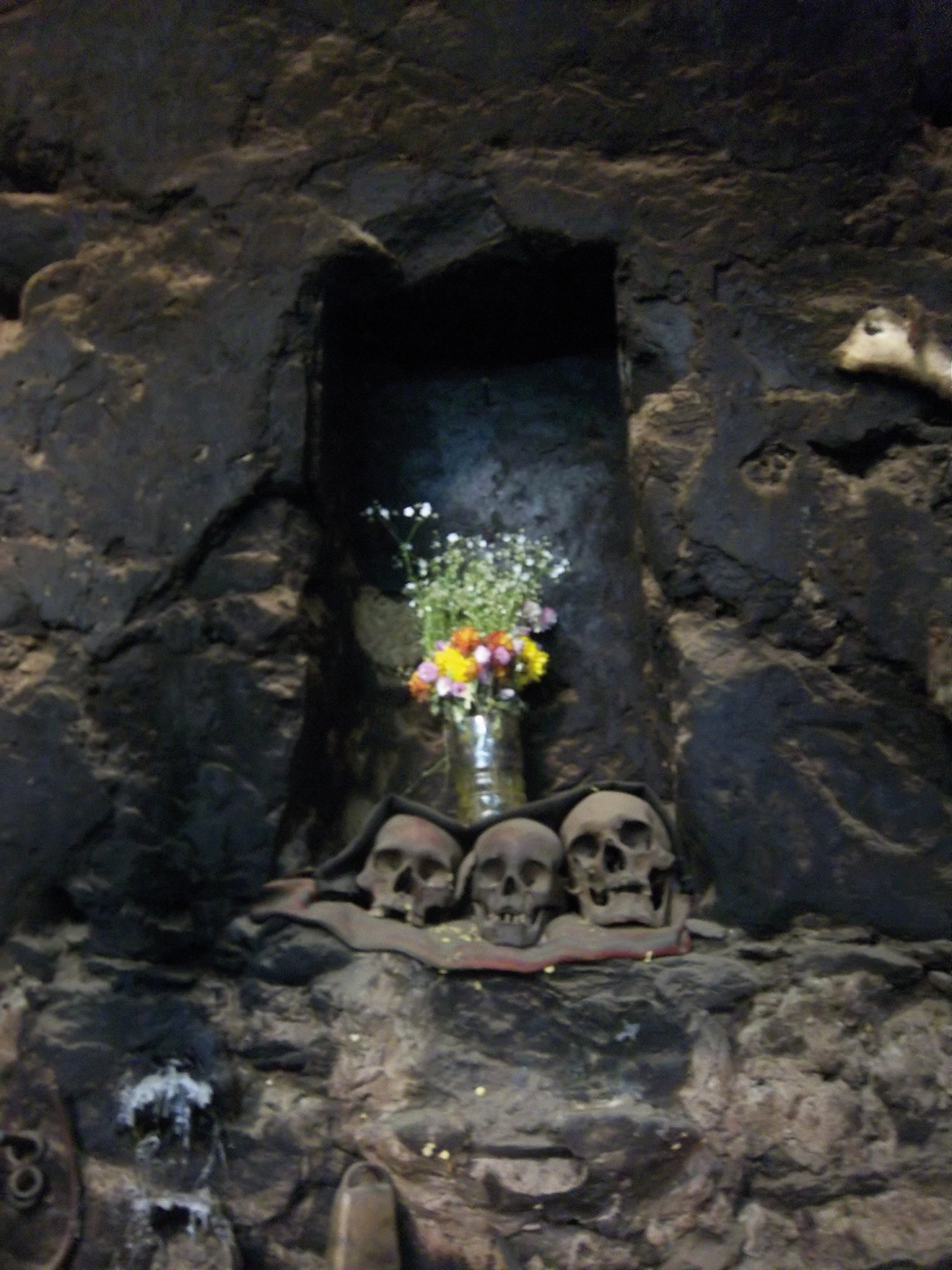
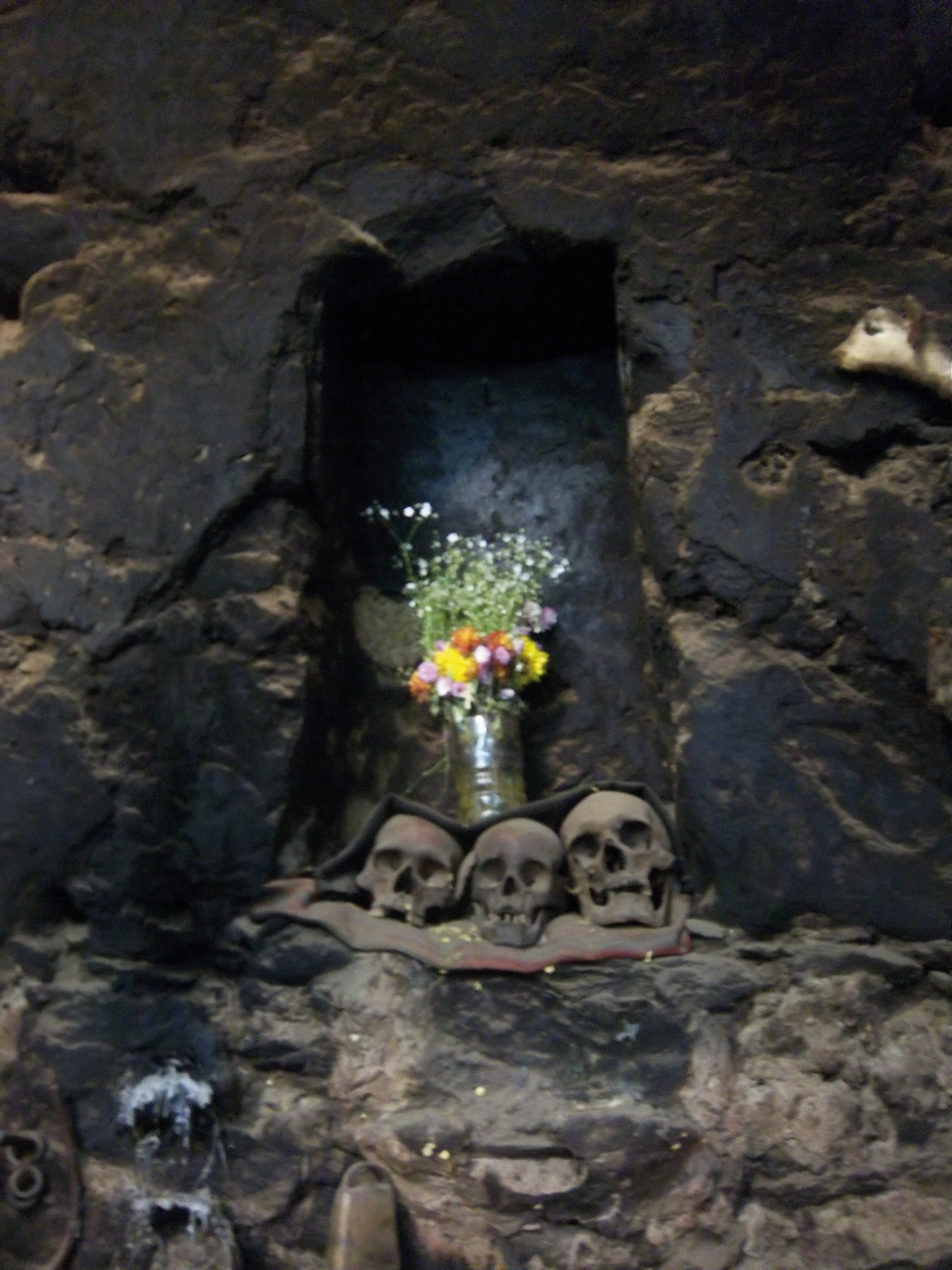
Infrequent examples of wall burials occur beyond the Huamachuco Region (McEwan Reference McEwan2005, 52–3). However, CCE architecture in Ayacucho and Cusco incorporated stone-lined pit tombs, or ‘cyst’ tombs (Anders Reference Anders1986; Isbell et al. Reference Isbell, Brewster-Wray, Spickard, Isbell and McEwan1991; MacNeish et al. Reference MacNeish, Cook, Lumbreras, Vierra and Nelken-Turner1981; McEwan Reference McEwan2005; Schreiber Reference Schreiber1992). In these regions, this mortuary tradition predates arrival of CCE architecture (Cavero Palomino & Huamaní Díaz Reference Cavero Palomino and Huamaní Díaz2015; Huacac Quispe & Maracho Contreras Reference Huacac Quispe and Maracho Contreras2018; Pérez Calderón Reference Pérez Calderón2021; Zapata Rodriguez Reference Zapata Rodriguez1998), as does interment of human remains in house floors (Leoni Reference Leoni2004; MacNeish et al. Reference MacNeish, Cook, Lumbreras, Vierra and Nelken-Turner1981). Further, CCE architecture at the site of Jincamocco has yielded crania rather than full skeletons (Schreiber Reference Schreiber1992). The incorporation of disarticulated and anonymous remains into domestic spaces as ancestral guardians persists in southern Peru into the present (Montibeller Reference Montibeller2021) (Fig. 4). Finally, CCE architecture in Middle Horizon Cajamarca includes stone-lined chamber tombs (Watanabe Reference Watanabe2011) similar to those found at early sites from the same region (Silva Santisteban Reference Silva Santisteban and Narvaez2007; Toohey Reference Toohey2016). In each case, local groups adopted new social institutions, organized as house societies centred on CCE architecture; however, construction of common place-based ‘ancestry’ in each case proceeded through adaptation of local mortuary customs.
Niche in a contemporaneously occupied CCE.
During the Early Intermediate Period and thereafter, gallery rooms of CCE architecture also began to feature large rectangular wall niches. These features first appeared in northern Peru, where similar niches had long characterized mortuary architecture of both coast and highlands. Elite Moche burial chambers included symmetrically arrayed niches with extensive offerings deposited within (e.g. Castillo Reference Castillo and Makowski2000; Goepfert et al. Reference Goepfert, Bailon, Lefèvre and Gutiérrez2013). Chullpa tower-tombs of the highlands incorporated similar wall niches (Isbell Reference Isbell1997), as did mid-valley chamber tombs (Watanabe & Ruiz Barcellos Reference Watanabe and Ruiz Barcellos2023).
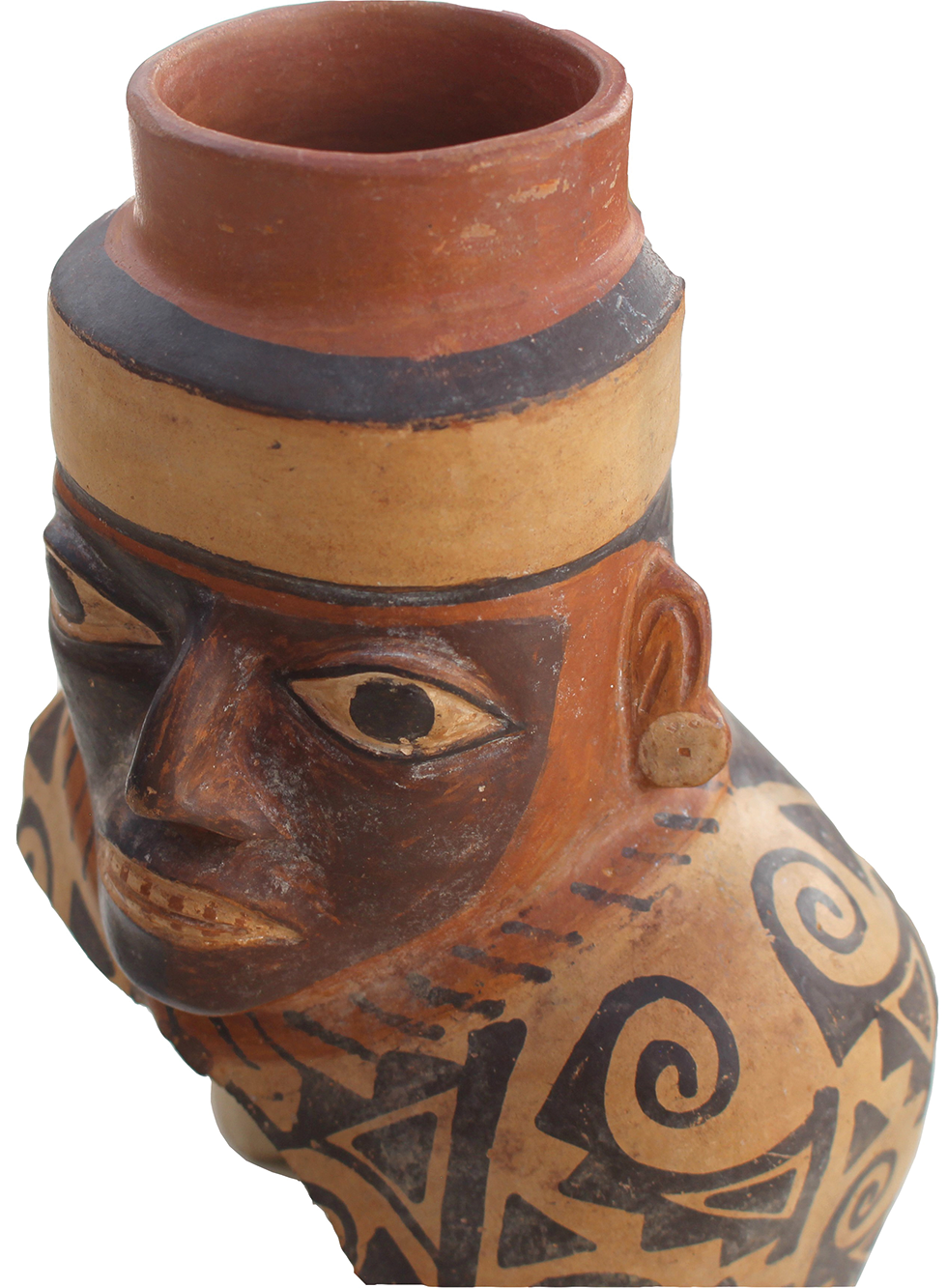
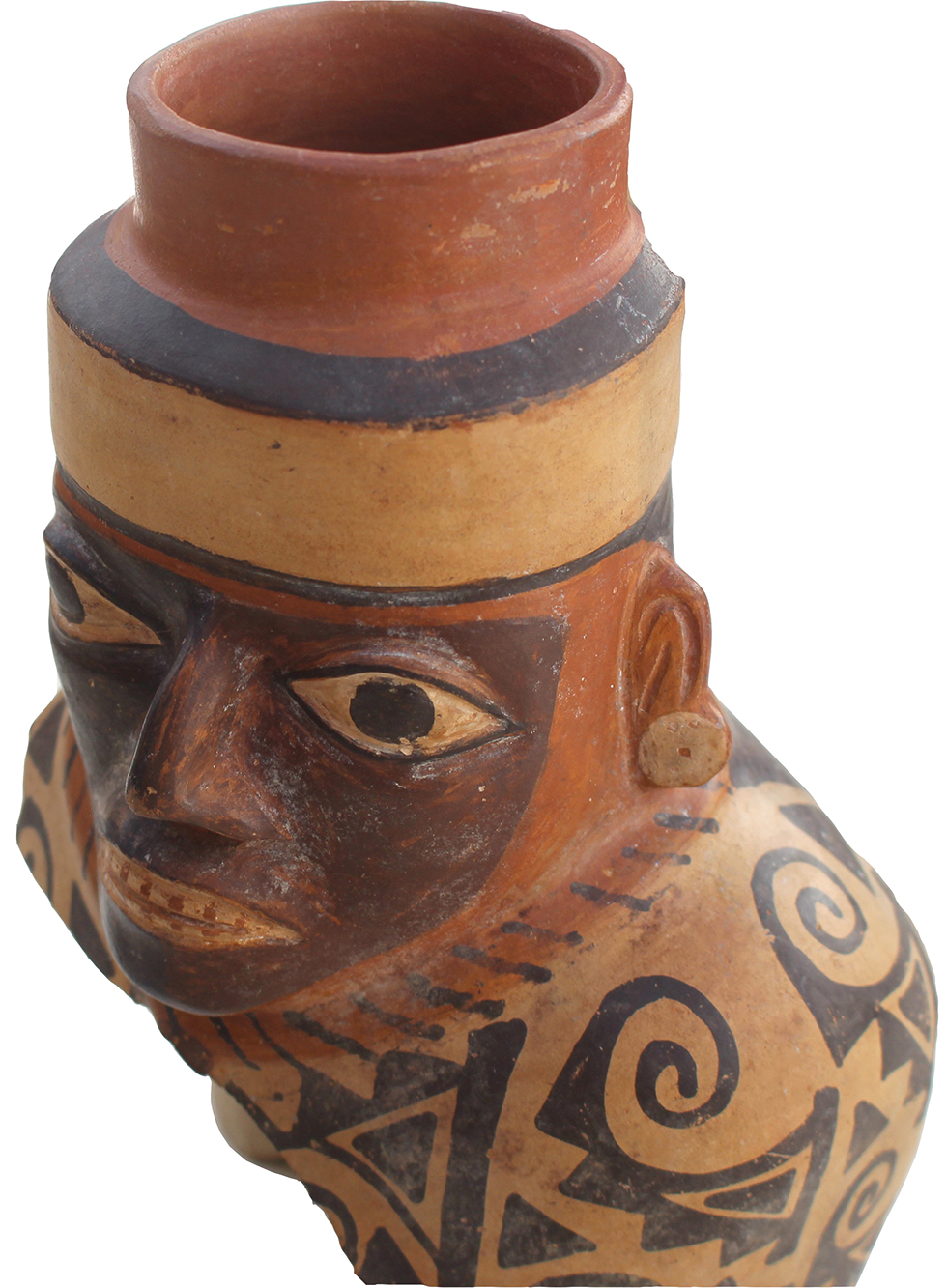
We analogize the niches to Christian altars, which in some Spanish Colonial Period houses continued to incorporate typical offerings to ancestral entities (Berquist & Wernke Reference Berquist and Wernke2017). Corroborating this analogy, the mestizo chronicler Garcilaso de la Vega describes Inka niches as ‘tabernacles’ or altars (Reference Garcilaso de la Vega1688, 91). However, associated ‘offerings’ vary. Isbell et al. (Reference Isbell, Pérez Calderón and Wolff2018) document an effigy vessel associated with a large wall niche in the Patipampa sector of Huari, in Ayacucho (Fig. 5). A single reference to a similar practice exists in Spanish chronicles, with an anthropomorphic vessel embodying a female progenitor (Martínez Cereceda Reference Martínez Cereceda1995, 42). Vazquez de Arthur (Reference Vazquez de Arthur, Tiesler and Lozada2018) suggests that such vessels condensed ancestral vitality into liquid form. Comparable logic persists in rural areas of contemporary Cusco. Communities leave stone amulets called illas in wall niches (Bayona Pozo Reference Bayona Pozo2016), condensing the essence of their agricultural products (Allen Reference Allen2016) into offerings to their founding ancestor. In the north, Berquist (Reference Berquist2022) notes frequent association between camelid limbs and niches at the site of Tecapa ( ce 800–1000). The Augustinian Relation of Huamachuco, describing neighbouring regions, reports similar rituals: ‘in the walls were many niches where they put the remains of [camelids]’ (Castro de Trelles Reference Castro de Trelles1992, 11, author’s trans.). We can thus differentiate different patterns of offerings deposited into morphologically similar architectural features.
Wari faceneck vessel from the site of Quilcapampa, in southern Peru.
Transposition of wall niches from mortuary architecture to residential architecture established a referential linkage. Similarly, several Early Intermediate Period tombs in the Ancash region mimic the layout of CCE architecture, notably at the Recuay site of Ichik Wilkawain (Paredes Reference Paredes and Ibarra Asencios2016). Here, multiple smaller mortuary chambers open onto a larger central chamber. A similar configuration characterizes mortuary architecture at the coastal Wari site of Castillo de Huarmey, which lies downriver from Recuay (Knudson et al. Reference Knudson, Giersz, Więckowski and Tomczyk2017). Similarly, a perimeter wall links a series of apparent tower-tombs at the site of Chawin Punta, in Pasco (Berquist Reference Berquist2022). All structures contain niches and open onto a central patio. Such sites established a continuum between residential and mortuary architecture, linking spaces of the living and the dead through notions of ritualized dwelling.
In some cases, architecture emphasized places of founding rather than human progenitors. In the Andes, places must be understood as people in their own right, requiring the same forms of sustenance and reciprocity afforded to human ancestors (Salas Carreño Reference Salas Carreño2016). Anthropologists, influenced by European notions of kinship and Inka cosmogonic narratives, have sometimes interpreted paqarinas as mythical ‘birthplaces’ of Andean ‘lineages’ (Bray Reference Bray2015). However, the ayllus of the late pre-Hispanic and early Spanish Colonial Periods did not necessarily comprise biological kin (Urton Reference Urton and Thiercelin1991), and general usage of ‘paqarina’ often denoted locations where founding ‘ancestors’ emerged from the earth after migrating from another region. The site of Wariwillka, constructed in Early Intermediate Period Huancayo, around ce 400 (Shea Reference Shea1969), encloses a spring, a natural feature often referenced as a paqarina. Indeed, the Wanka nation cited Wariwillka as their paqarina over a thousand years after its construction (Shea Reference Shea1969). Glowacki (Reference Glowacki, Isbell and Silverman2002, 273–4) documents a CCE in the Qoripata sector of Huaro, in Cusco, enclosing a similar fountain. At Moraduchayuq in Ayacucho, CCE architecture stands over an earlier ritual structure which itself sits over a cave, another feature commonly understood as a paqarina (Isbell et al. Reference Isbell, Brewster-Wray, Spickard, Isbell and McEwan1991). Several other CCE structures either incorporate or convert earlier ritual structures (Berquist Reference Berquist2022; Lopez Aldave & Brown Reference Lopez Aldave and Brown2018; Schreiber Reference Schreiber1992), though these do not necessarily include springs or caves. Paqarinas may mark mythicized moments of founding, when diffuse groups coalesced into self-conscious ‘kin’ with cohesive—and exclusive—identities. CCE architecture memorialized—and monumentalized—such moments.
CCE architecture did not serve as the primary locus of ‘ancestor cults’; nor was it unique in its incorporation of mortuary contexts. Ancestors play important roles across many Andean societies and domestic interments characterize many sites. Moreover, not all CCE architecture directly incorporates human remains or obvious paqarinas. Notable exceptions include examples in Ancash. Here, Lau (Reference Lau2010) notes ceramic representations of CCE architecture centring chiefly figures or perhaps divine rulers who derived authority from association with CCE architecture (Lau et al. Reference Lau, Luján Dávila, Bongers and Chicoine2023). In such cases, the living ruler perhaps became the founding ancestor by maintaining the communal ‘house’.
Rather than treat ‘ancestor veneration’ as a monolithic practice, we emphasize the variety of mortuary practices associated with a specific architectural form as it proliferated across multiple regions. This architecture shaped emergent notions of communal residency and social identity in the Early Intermediate Period and Middle Horizon. Different idioms of ancestry and kinship rendered this organizational model legible through locally available concepts. Widespread reorganization into house societies thus required preservation and prioritization of local meaning.
The adoption of Theravada Buddhism at Angkor
The Angkorian (Khmer) Empire (ninth–fifteenth centuries) dominated Southeast Asia from its capital Angkor in northwestern Cambodia. The extensive urban landscape of temple-settlements interspersed with canals, ponds, walls, roads and earthen mounds supported a population of approximately 700,000–900,000 (Klassen et al. Reference Klassen, Carter and Evans2021a). The empire was ruled by a succession of universal monarchs (chakravartin), whose authority was articulated through socio-political hierarchies centred on state temple complexes (Thompson Reference Thompson2016, 24–6). Khmer temples (prasat), constructed from brick, sandstone and laterite, were conceived as terrestrial representations of Mount Meru (Stuart-Fox & Reeve Reference Stuart-Fox and Reeve2011, 109). Inscriptions in Sanskrit and Old Khmer indicate that rulers were ritually assimilated to Śiva through consecration rites and the installation of cult images (Kulke Reference Kulke and Kulke1978, xvi). Although kings at times assumed the forms of other deities, including Viṣṇu or the Buddha, Śaivism remained the dominant ideological framework underpinning the social order and legitimizing monarchical governance (Estève Reference Estève, Hendrickson, Stark and Evans2023, 429). Aristocratic Brahmanism maintained this order within a diverse pantheon of Brahmano-Buddhist deities and local cults (Pollock Reference Pollock2006), though recent scholarship challenges sharp dichotomies often drawn between Brahmanical elites and ancestral veneration in Angkorian state structures (Mus Reference Mus1933; Thompson Reference Thompson2016, 11–12; Work Reference Work2019). Nonetheless, most scholars agree that Angkorian authority rested on control over metaphysical forces embedded in both natural and cultural landscapes, including chthonic entities.
Within this multifaceted Angkorian politico-religious system of mortal and chthonic sovereignty, equally important were village shrines and regional temples, thought to have served as powerbases for regional elites who sought dominion over local landscapes. These nodes ‘reinforced the political and social linkages within the network’ of the Angkorian state (Evans Reference Evans2007, 20–21), and roles relegated to temple-complexes of any size included economic regulation, settlement hierarchy, resource redistribution, land organization, agricultural oversight and organization of religious festivals (Hall Reference Hall and Tarling1992, 239–40). Although the surviving corpus of Angkorian temples illustrates visible structural evolution over time (Dumarçay & Royère Reference Dumarçay and Royère2001), these edifices remained essential pivots of Angkorian society well into the thirteenth century; the Mahayana Buddhist king Jayavarman VII (1181–1218 ce), for example, undertook an expansive religious and infrastructural building campaign to propagate his religion across the empire, but the structure and role of physical temples changed little despite his shift in faith (Chandler Reference Chandler2008, 58).
The varying roles held by Angkorian religious spaces prove critical when assessing the archaeology of Angkor’s early Theravada (Sinhalese) Buddhist monuments, complexes and landscapes. Theravada Buddhism is believed to have been practised in Cambodia by the thirteenth century, originally transmitted through regional interactions with Dvaravati and later Thai polities on Angkor’s westernmost border (Thompson Reference Thompson and Thompson2022; Woodward Reference Woodward and Thompson2022). Chinese diplomat Zhou Daguan’s 1296 ce accounts provide the first evidence of Theravada’s prominence, describing a large monastic order (sangha) and an active religious community at Angkor Thom during the reign of Indravarman III (r. 1296–1308 ce), a fervent Buddhist. The pious acts of Indravarman III (including his abdication for monastic life—bhikkhu) are documented by his successors (see Coedès Reference Coedès1936, 14–21).
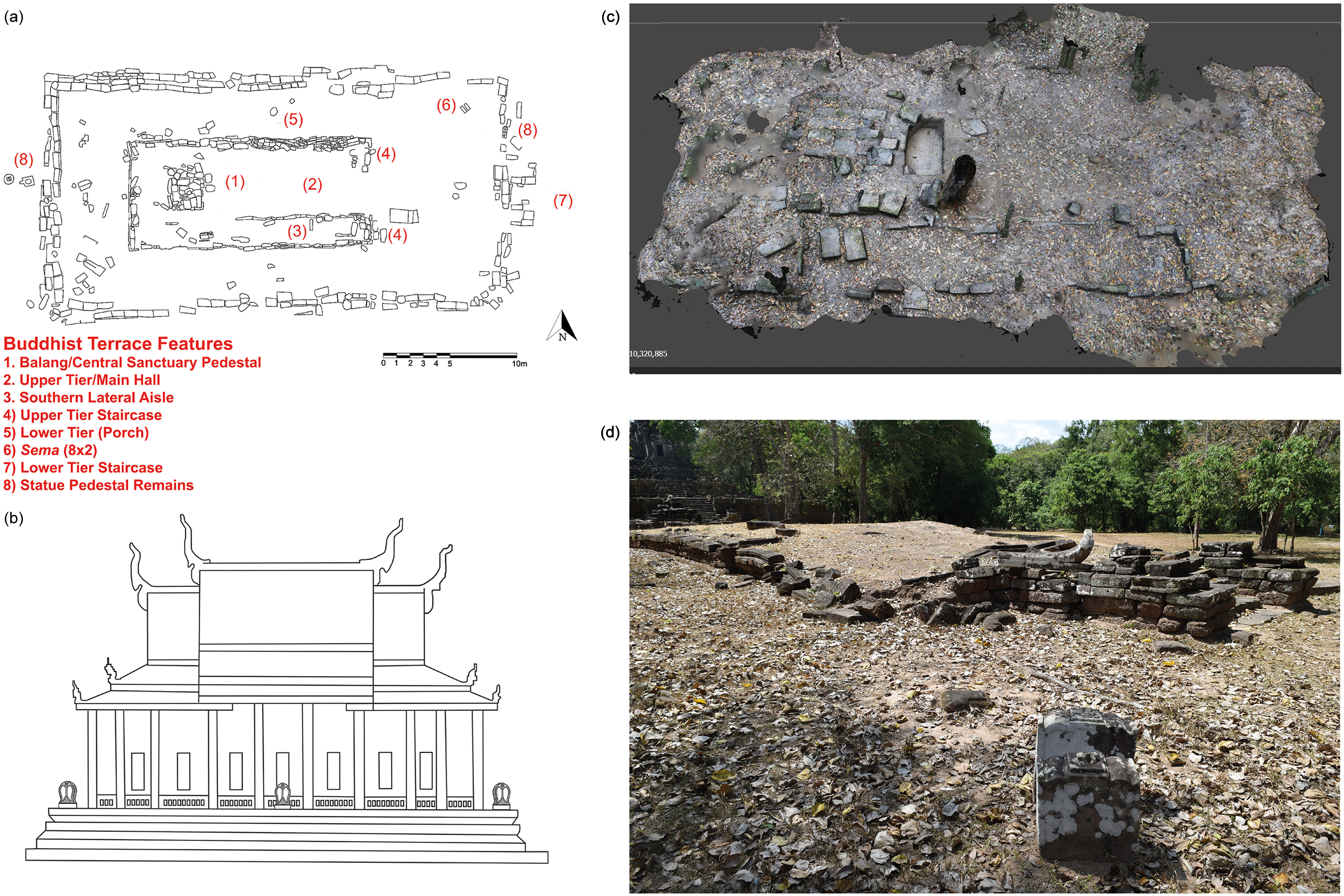
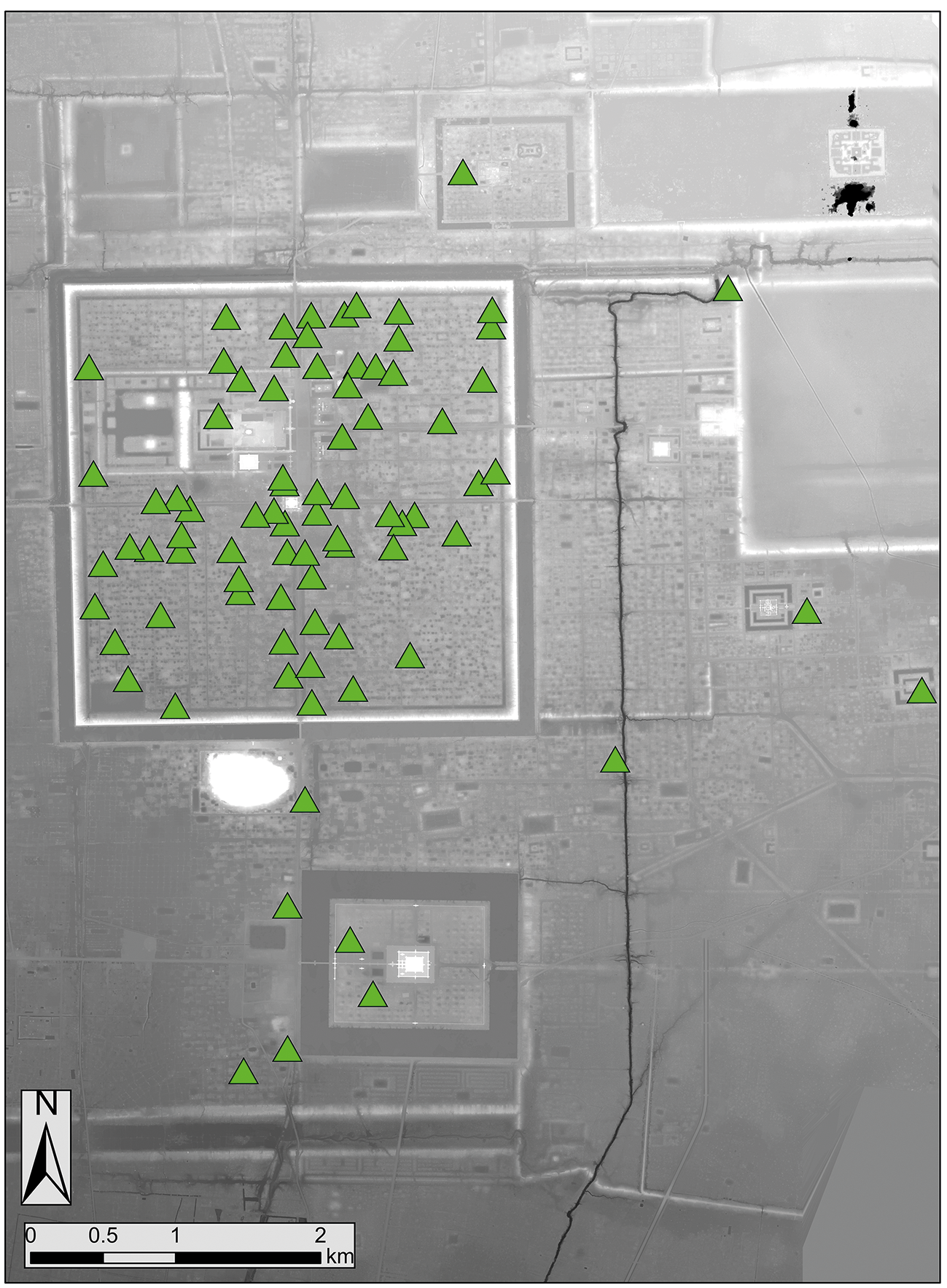
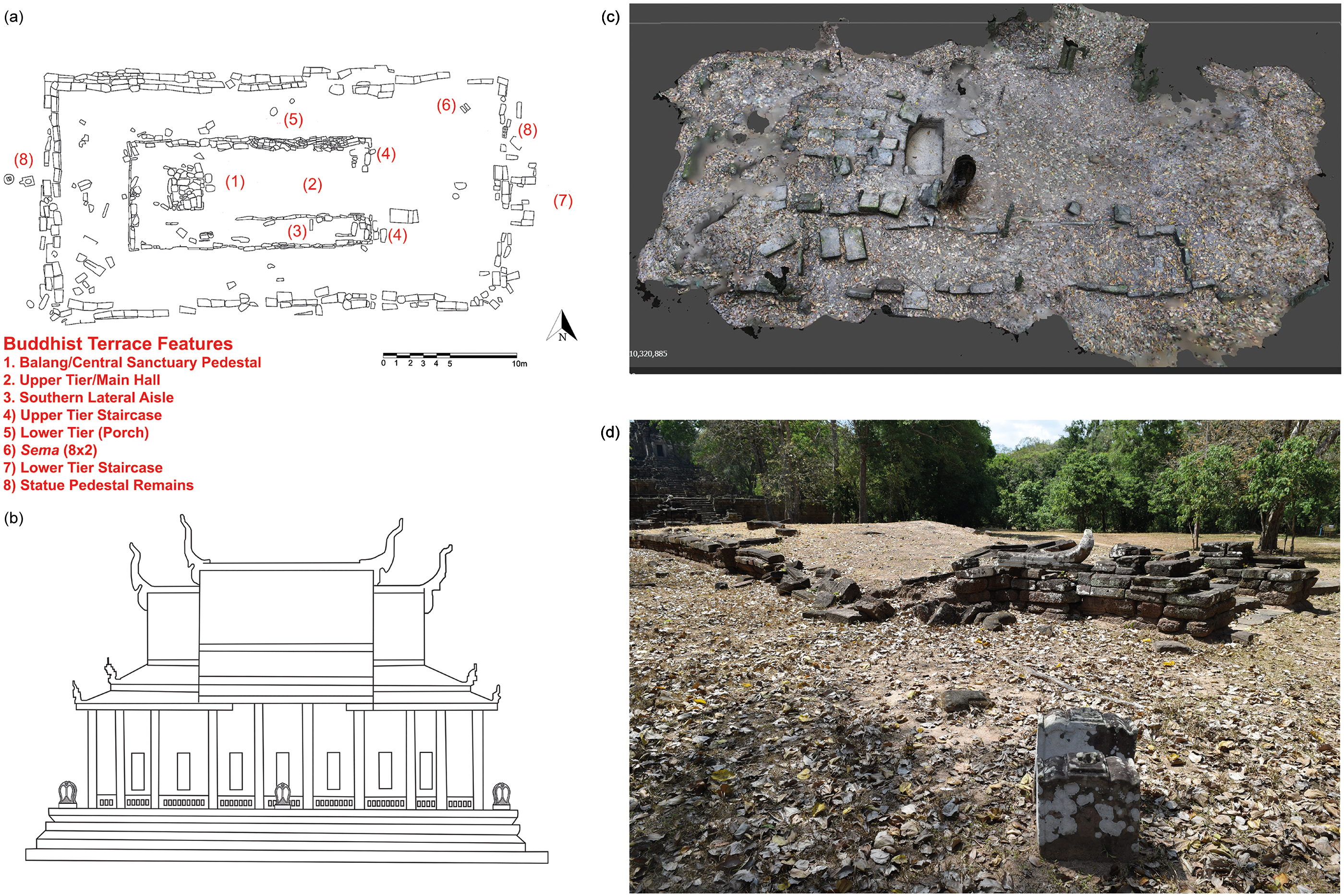
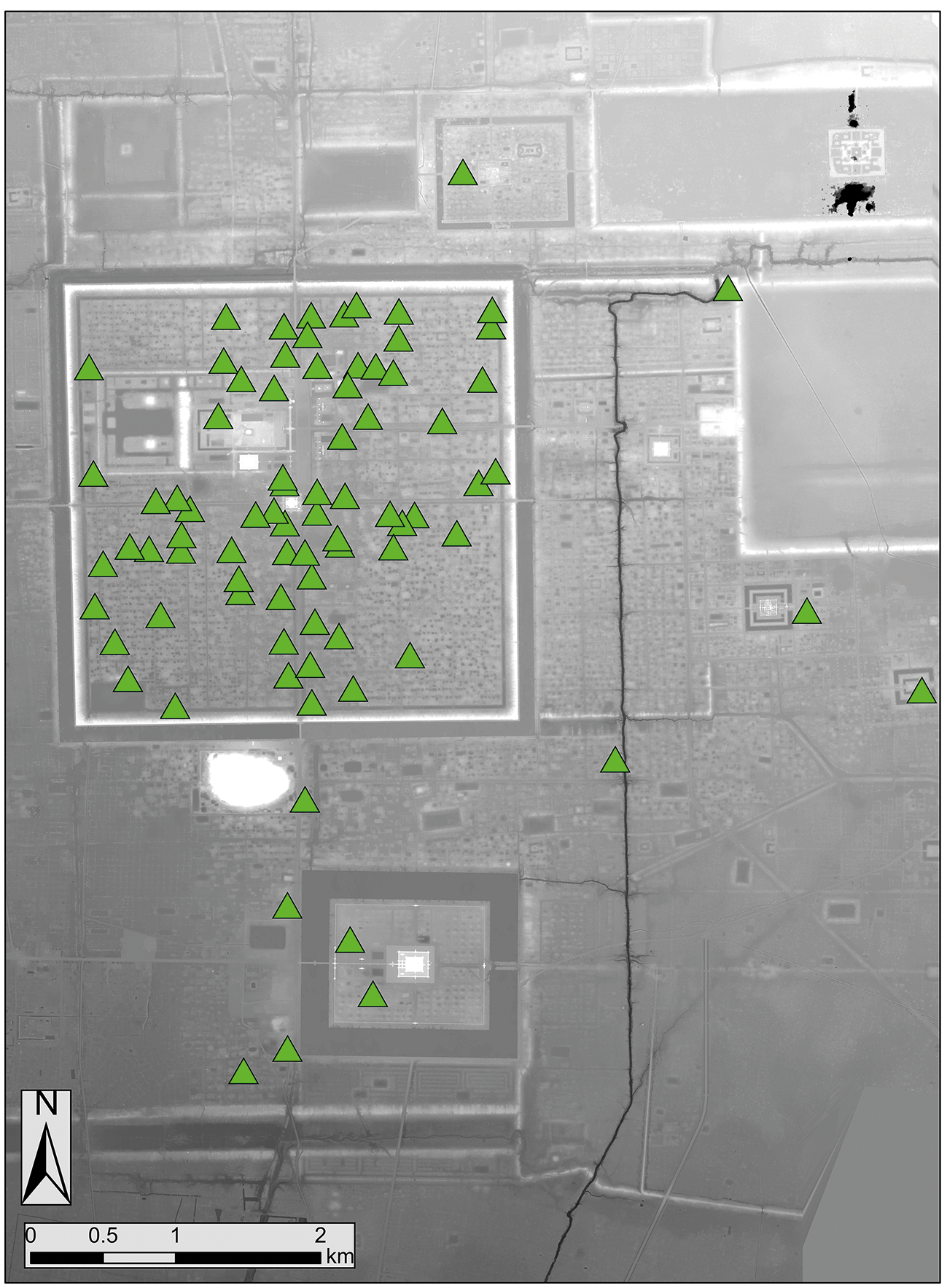
Zhou’s account is the first to acknowledge vihara/preah vihear as important centres of religious rites and congregation. Almost identical in form and function to Cambodia’s modern wat complexes, preah vihear do not represent an organic evolution of ritual space within Angkor’s architectural history. In contrast to Jayavarman VII’s Mahayana Buddhist complexes, preah vihear likely replicated structures in contemporary polities to the west (see Woodward Reference Woodward and Thompson2022). Angkorian archaeologists refer to the substructural remains of these long-lost wooden sanctuaries as ‘Buddhist Terraces’. Constructed in sandstone and laterite, they face east in homage to Shiva, Indra, or the rising sun, while their western ends serve as focal points for monumental block-pedestal Buddhas (Zhou Reference Zhou[1296] 2007, 52–3, 220–23; Marchal Reference Marchal1918, 9-10) (Fig. 6). ‘Buddhist Terraces’ are distinguished from other stone substructures at Angkor by sema, blessed stone deposits marked at the surface by nimitta. Paired sema (buddhasima) at cardinal and subcardinal points (8×2) define the boundaries within which ordination rites (uposatha) may be performed (Harris et al. Reference Harris, Tin and Soeng2022, 172). Although originating from Dvaravati material contexts (c. sixth–eleventh centuries ce) (Murphy Reference Murphy2013), Angkorian sema forms drew upon pre-existing Khmer artistic traditions, including inscription stelae and the carved landing stones of temple staircases, as well as parallel traditions from contemporaneous polities in Thailand (Harris Reference Harris2022). Seventy-two vihara have thus far been identified within Angkor Thom alone (Harris et al. Reference Harris, Tin and Soeng2022, 173), with an additional 13 found at satellite civic-ceremonial centres such as Banteay Kdei and Ta Prohm, representing a period of intensive building (Fig. 7). Although no foundation inscriptions have thus far been found directly associated with preah vihear, radiometric evidence from several structures throughout the citadel points to construction peaking during the fourteenth century (Harris et al. Reference Harris, Tin and Soeng2022, 175–8; Sato Reference Sato and Thompson2022).
(a) Buddhist Terrace floorplan, ATV007 (TB.03) (Harris et al. Reference Harris, Tin and Soeng2022, 170); (b) Imagining of preah vihear superstructure (after Giteau Reference Giteau1975, 144); (c) digital rendering of Buddhist Terrace site ATV018/Terrace T; (d) Preah Pithu Buddhist Terrace substructure (ATV016).
Buddhist Terrace survey map, Central Angkor (Harris et al. Reference Harris, Tin and Soeng2022, 172).
Adoption and spread of Theravada Buddhism marked the gradual decline of Brahmano-Buddhist shrines (prasat) as focal points of Cambodian society. Angkor Thom’s ‘Mangalartha’ temple, dedicated in 1295 ce (K.567), stands as the last known Angkorian monument built in honour of a Hindu deity (Finot Reference Finot1925, 393). The sharp decline in epigraphy following the death of Jayavarman VII nearly a century earlier offers little clarity on socio-political dynamics accompanying this religious transition. Moreover, the rise of Theravada Buddhism during this period is often overshadowed by research focused on Angkor’s broader ‘decline’ (thirteenth–fifteenth centuries ce) and the shift to royal capitals in the Quatre-Bras region of the Mekong (see Carter et al. Reference Carter, Stark and Quintus2019; Klassen et al. Reference Klassen, Attore and Brotherson2021b; Penny et al. Reference Penny, Hall, Evans and Polkinghorne2019).
Early historical narratives, now regarded as dated and circumstantial, casted Theravada Buddhism as a principal cause of Angkor’s collapse, arguing that it severed the king’s connection to Brahmano-Buddhist institutions sanctifying his authority and control over local elites (Coedès Reference Coedès1968). Yet the contemporaneous rise of the Thai Buddhist kingdom of Ayutthaya (c. 1350–1767 ce) illustrates the weakness of this view (Polkinghorne et al. Reference Polkinghorne, Pottier and Fischer2018; Thompson Reference Thompson and Thompson2022; Vickery Reference Vickery1977; Reference Vickery2004). Even alternative accounts, such as those of Melford Spiro, reinforced stark cultural-temporal divisions between the two traditions, portraying Theravadin Cambodia as a more inclusive order contrasting with the rigid hierarchies of Brahmano-Buddhism and ostensibly ‘opening up’ restricted temple spaces (Harris Reference Harris2005, 36; Spiro Reference Spiro1971, 10–11). Such idealized narratives, however, leave little room to assess continuities bridging Brahmano-Buddhist and Theravada Buddhist religious cultures.
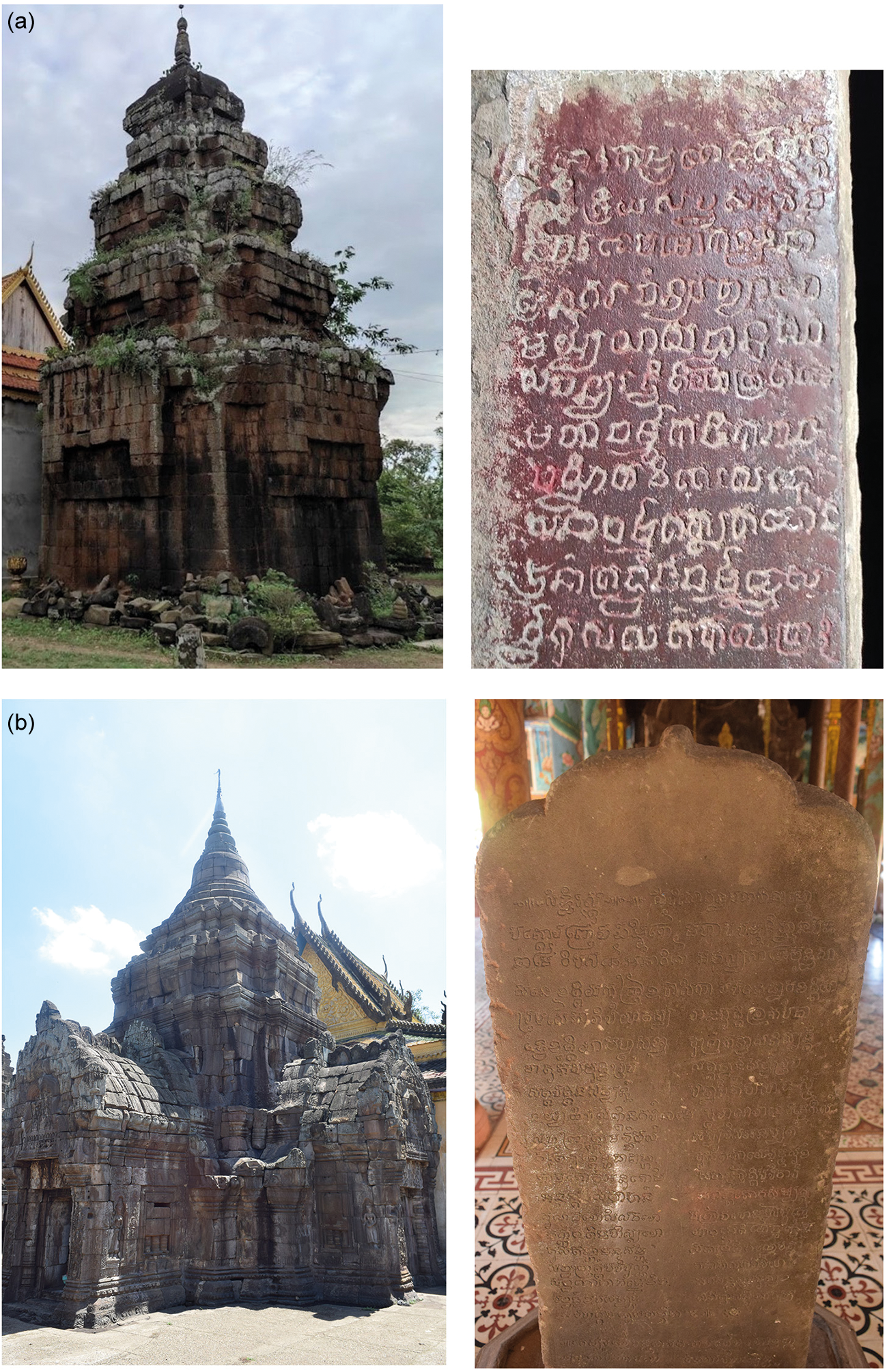
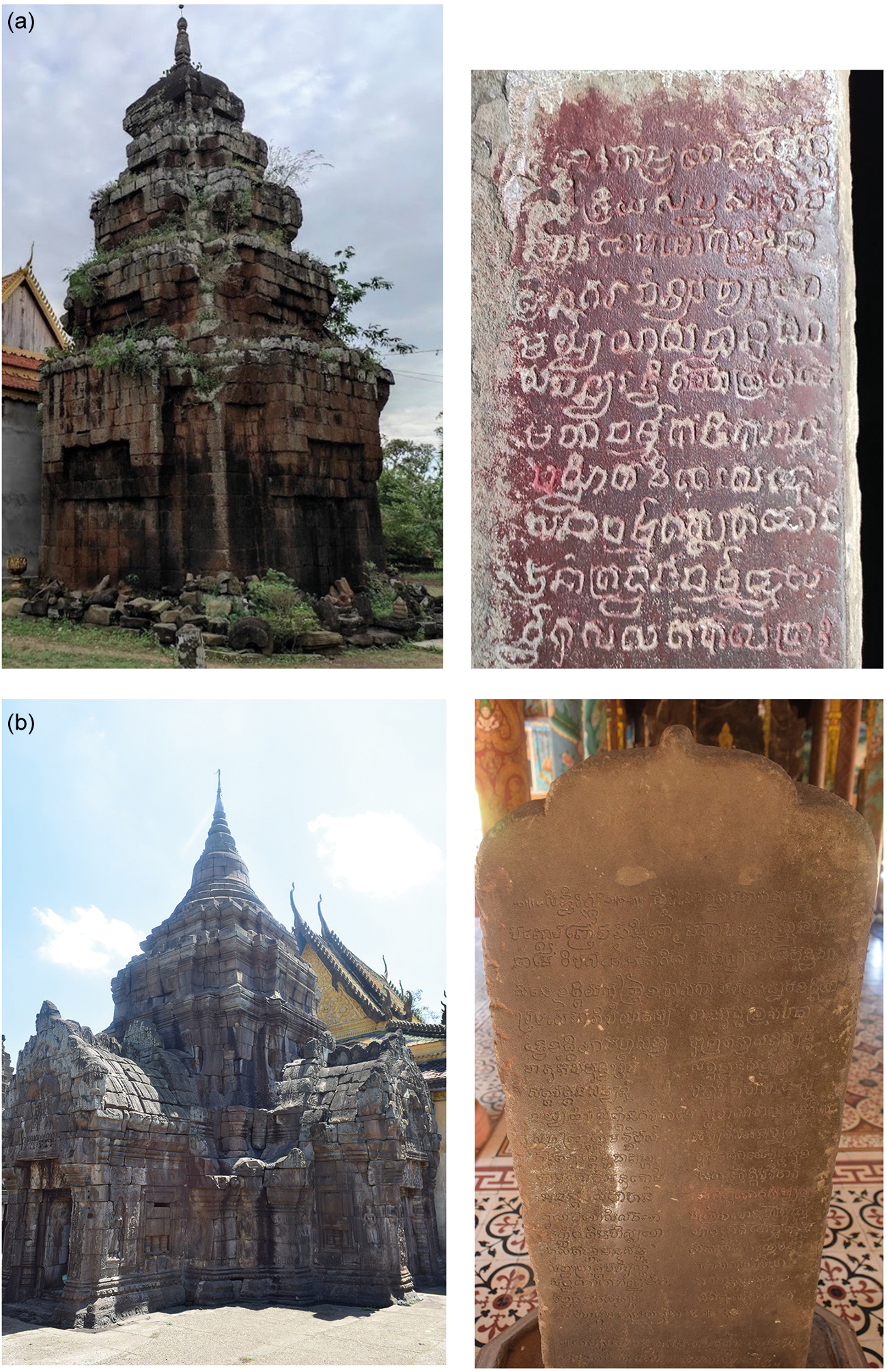
Until recently, Angkorian scholarship, with its heavy reliance on epigraphy, framed conversion of Brahmano-Buddhist temples into ‘reliquaries’ (preah theat) as the defining act in establishing the early Theravadin Cambodian geobody (Nhim Reference Nhim2019; Thompson Reference Thompson, Klokke and de Bruijn1998). Reliquaries, conceptually and architecturally equivalent to spired Buddhist stupas (chedi), functioned (and continue to function) as open repositories for cremated corporeal remains (dhatu/sarikadhatu), figural images and other perishable alms. Over the past century, linguistic and architectural studies by Marchal (Reference Marchal1918; Reference Marchal1951), Giteau (Reference Giteau1969; Reference Giteau1975) and Thompson (Reference Thompson, Klokke and de Bruijn1998; Reference Thompson2016; Reference Thompson and Thompson2022) have illuminated ritual and spatial dynamics of reliquaries, highlighting their relationship with preah vihear within Theravadin complexes as mediators between Buddhism and chthonic sovereignty of the animistic landscape. These architectural transformations were accompanied by acts of merit, most clearly documented in the corpus of sixteenth- to nineteenth-century satyapranidhana (vows of truth) written in Khmer and Pali (Fig. 8), often on behalf of elites and government officials (Pou Reference Pou1970; Thompson Reference Thompson1999). Such inscriptions recording donations of statuary and other offerings (Polkinghorne Reference Polkinghorne and Thompson2022; Thompson Reference Thompson, Klokke and de Bruijn1998, 278–87) appear most prominently within the Cruciform Gallery of Angkor Wat, the great twelfth-century Vaiṣṇava temple later repurposed as a Buddhist sanctuary (Polkinghorne Reference Polkinghorne and Thompson2022). While invaluable for tracing the cumulative palimpsest of transformed prasat and preah vihear across Angkor Thom, this body of scholarship situates much of Theravada innovation within the so-called post-Angkorian or Middle Period (c. fifteenth–nineteenth centuries), casting earlier developments as aftermath rather than as moments when politico-religious processes securing Theravada’s ascendancy were first taking shape.
(a) Converted Brahmano-Buddhist prasat and dedicatory inscriptions at Preah Theat Khvav; (b) Siem Reap Province and K.177/fifteenth–sixteenth century and Wat Nokor, Kampong Cham Province and K.82/1566 ce.
Radiometric and historical evidence situates these social and religious transformations within the final centuries of Angkor rather than after its decline (Castillo et al. Reference Castillo, Polkinghorne and Fuller2018; Harris et al. 2022; Reference Harris, Vitou, Chhay and Tin2023; Leroy et al. Reference Leroy, Hendrickson, Delqué-Kolic, Vega and Dillmann2015; Sato Reference Sato and Thompson2022). This evidence has prompted debate over notions of abrupt cultural shifts linked to changes in religious practice, reshaping interpretations of this transitional period (Thompson Reference Thompson and Thompson2022, 20–25). Zhou Daguan, for instance, situates Theravada congregants alongside devotees of multiple religious traditions in the Khmer capital, including those making offerings ‘to a block of stone’ (likely a Shivalingam) and nondescript ‘brahmins’ occupying high governmental positions (Zhou Reference Zhou[1296] 2007, 52–3). Similarly, the appearance of Pali inscriptions should not be taken as evidence that they fully supplanted prevailing practices or Sanskrit epigraphy (Thompson Reference Thompson and Thompson2022, 20–37; 2023, 584–5), and dedication of the Mangalartha temple in 1295 ce should indeed not mark a definitive end to relevance of prasat, Brahmano-Buddhist or otherwise, for societal organization.
Institutionalization of preah vihear as Angkorian politico-religious focal points can be understood as a continuation of earlier practices. Architectural and excavated evidence across Angkor demonstrates deliberate design choices aligning these spaces with established religious norms in role, form and function. In doing so, preah vihear became central media for disseminating Theravada Buddhism while codifying social norms and political hierarchies, much as prasat had done previously.
Each preah vihear also functioned as a standardized centre of community. Unlike the more esoteric elite culture of Brahmano-Buddhism, Theravada allowed lay participation in localized congregations and ordination as bhikkhu (Jacobsen & Fox Reference Jacobsen and Fox2013, 10–11; de Bernon Reference de Bernon, Pichard and Lagirarde2003; Pou Reference Pou2012, 238–40). This inclusivity is reflected in the architecture: central congregational halls are larger than the smaller, exclusive prasat spaces, and standardized ritual sequences guided by Theravadin clergy materialized and reinforced both celestial and social orders. Additionally, Olivier de Bernon highlights specific roles embedded within this space through his comparisons with modern Cambodian monasteries, surmising that ancient vihara/preah vihear were multifunctional complexes, concurrently serving as community prayer-halls, centres of monastic ordination, repositories of elite merit-making, sites of interconnected funerary interment and ancestral worship, and may have administered villages of farmers, indentured labourers, or even slaves (de Bernon Reference de Bernon, Pichard and Lagirarde2003, 211; Giteau Reference Giteau1969, 108; see Zhou Reference Zhou[1296] 2007, 58–9). These roles are little different than those ascribed to Buddhist vihara in other regional contexts yet are not typically awarded to Angkor’s monastic complexes. Fogelin’s study of early monasteries in India, for example, highlights the role of monastic populations in economic activities by the second century ce, with monasteries serving as nodes of long-distance trade networks, areas of agricultural oversight and centres of redistribution and donorship in areas of centralized and peripheral administration (Fogelin Reference Fogelin2012, 282).
The few surviving historical and epigraphical sources from the late and post Angkorian periods verify that royal authority remained an essential characteristic of Cambodian religion, patronage systems and place-making. The Pali text K.754/1309 CE from Kok Svay Chek temple in northwestern Cambodia, for example, denotes allotment of land for foundation of a vihara by the retired king Indravarman III (r. 1295–1308 ce), as well as ritual delineation of the area and donation of images of the Buddha by the king himself (Coedès Reference Coedès1936, 14–21). Additionally, a minor note by Zhou Daguan describes usage of roof-tiles in construction of Buddhist monasteries (Zhou Reference Zhou[1296] 2007, 49–50); usage of these, abundant as surface finds at many sites (Harris et al. Reference Harris, Tin and Soeng2022), reflected Angkorian sumptuary laws whereby tile was exclusive to royally patronized constructions. Each preah vihear can thus be argued to serve as a satellite of politico-religious authority.
While explicit documentation on relationships between Angkor’s rulers, brahmins and sangha during this period is limited (see Pollock’s theory of ‘sanskritization’: Reference Pollock2006, 530–31), it is plausible that creation of Theravadin elite culture and corresponding patrimonial networks facilitated successful spread of Theravada Buddhism. As noted, satyapranidhana inscriptions found in numerous converted temples illustrate successful ‘buy-in’ of elites into the new Theravadin religious power structure over time. However, archaeological evidence from preah vihear sites further confirms this engagement, even during early phases of Theravada Buddhist place-making in Cambodia. For instance, collections of statue pedestals have been found in situ near the sanctuary’s balang—Central Buddha pedestal (Harris et al. Reference Harris, Vitou, Chhay and Tin2023, 172–3), suggesting elite donation. Additionally, excavations at preah vihear within Angkor Thom conducted by the authors reveal proportions of Chinese export ware—known luxury goods during the Angkorian Period—nearly identical to those uncovered at Angkor Thom’s Royal Palace (Cremin Reference Cremin2006; Harris et al. Reference Harris, Tin and Soeng2022, supplementary information). This similarity indicates that these religious sites functioned as hubs of substantial wealth during their occupation.
Archaeological investigations of ‘Buddhist Terraces’ also illuminate concerted efforts to establish preah vihear as structurally, spatially and spiritually similar to prasat within existing traditions of Angkorian architecture. This is important, as preah vihear were an imported architecture, and thus consistencies extend beyond mere standardization to reflect deeper integration. For instance, excavations under a pair of sema stones at Buddhist Terrace site ATV027 in 2019 revealed a layer of yellowish sand (Harris et al. Reference Harris, Tin and Soeng2022, supplementary information), which Dumarçay and Royère (Reference Dumarçay and Royère2001, 34) note was an essential foundation rite (building on ‘pure soil’) in establishment of any Angkorian temple. Use of durable materials such as stone, laterite and fired brick in substructural architecture of each terrace highlights their importance, typically reserved for royal or religious buildings (Pottier Reference Pottier, Pichard and Lagirarde2003, 199). Both traditions illustrate that these structures were physically and spiritually anchored into the ground, and several surveyed ‘Buddhist Terraces’ feature temple-style architectural mouldings, suggesting a deliberate effort to replicate prasat designs. Finally, centralized placement of sema stones found around almost every Buddhist Terrace, is atypical in Southeast Asian Theravada practice, where multi-structure complexes at contemporary Buddhist polities such as Ayutthaya feature edifices with distinct ritual functions such as assembly halls (vihara/wihan) and ordination halls (uposathagara/ubosot). This reflects localized continuation of Angkorian Brahmano-Buddhist spatial practices (Harris et al. Reference Harris, Tin and Soeng2022, 172–3; Thompson Reference Thompson1999, 402–3).
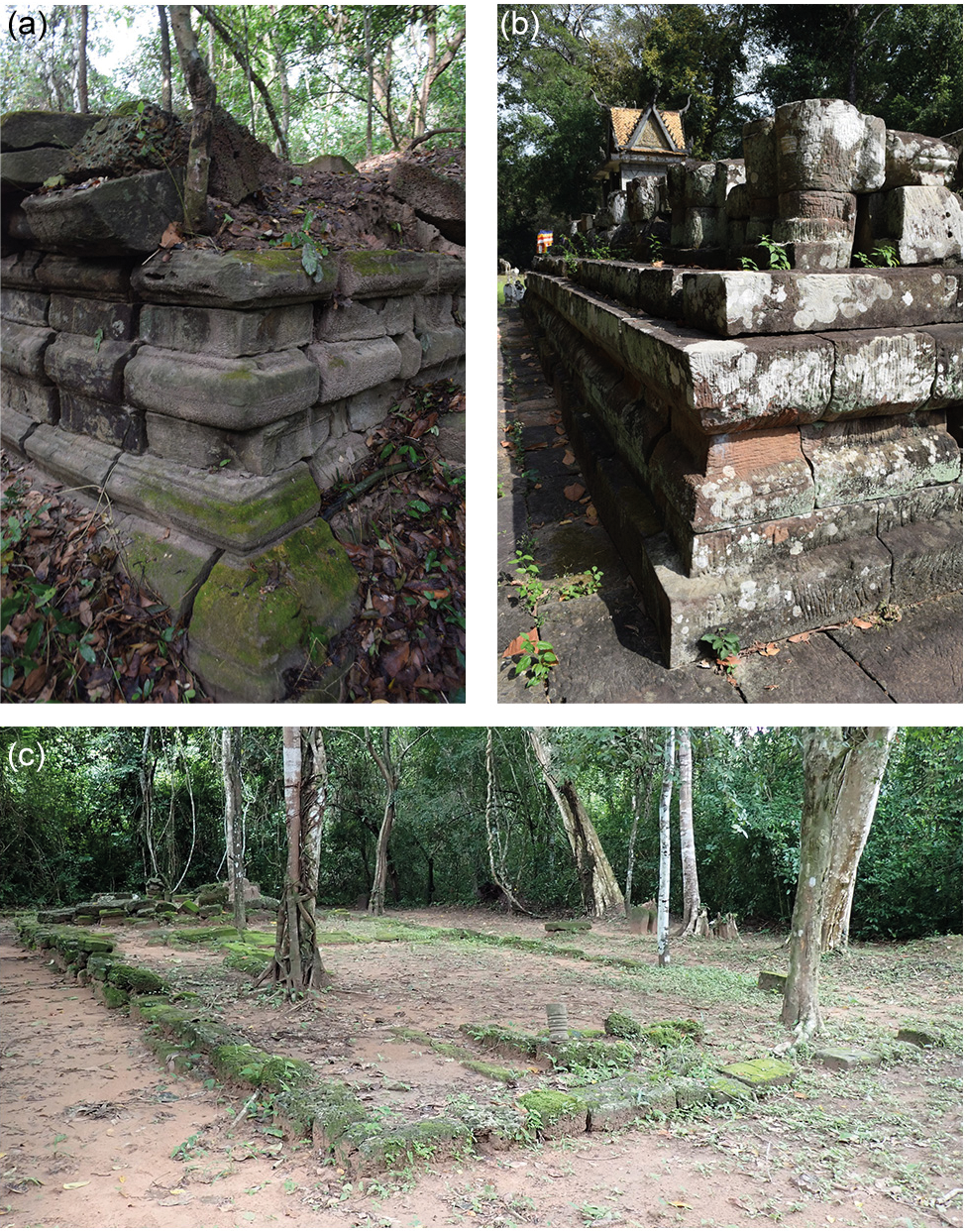
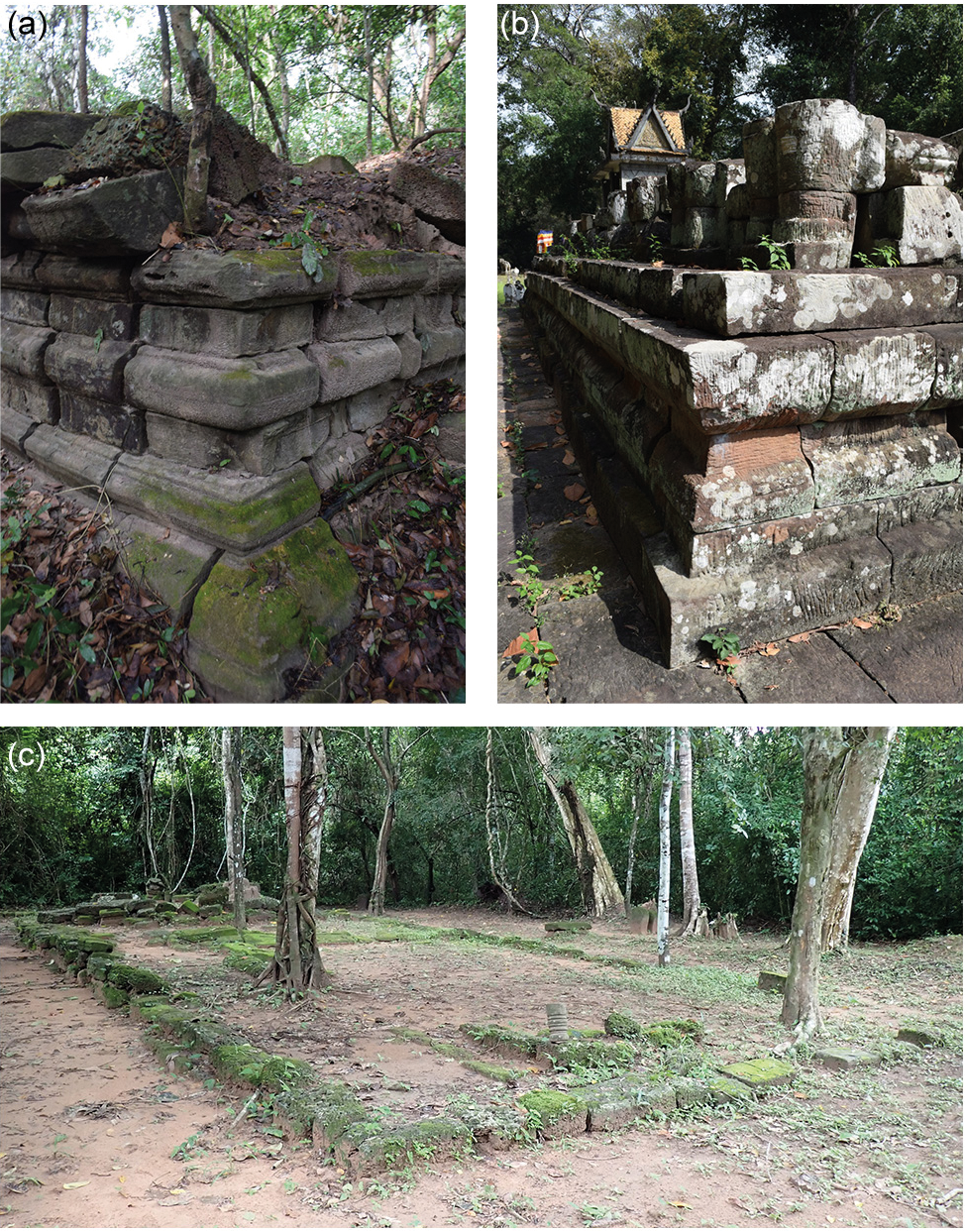
A brief consideration of architectural quality and landscape patterns of preah vihear construction is also essential for understanding the social organization of Angkor’s early Theravadin communities. Harris (et al. Reference Harris, Tin and Soeng2022, 180) notes a slight correlation between preah vihear size (sq. m) and centrality within Angkor Thom, reflecting continued significance of the citadel’s ceremonial core; correlation is far clearer between complexes inside and outside the citadel. While chronological confirmation remains pending, distinctions between preah vihear built with moulded sandstone and those using recycled blocks further suggest disparities in elite patronage, indicating unequal access to resources, skilled labour, and wealth among monastic communities following the decentralization of Angkorian craft production in the thirteenth century (Castillo et al. Reference Castillo, Polkinghorne and Fuller2018; Polkinghorne et al. Reference Polkinghorne, Vincent, Nicolas and David2014) (Fig. 9).
(a) Moulded masonry, Buddhist Terrace ATV009 (TB.04) and (b) ATV005 (TB.04); (c) recycled block substructure, Wat Preah Khan, Angkor.
Ultimately, the architectural evolution from prasat to preah vihear mapped at Angkor illustrates adaptive capacity of religious spaces to accommodate new spiritual frameworks while preserving essential socio-political functions. This transformation was gradual, often ‘experimental’, and integrated within the Angkorian landscape, reflecting continuity in the sacred utilization of space. Adaptation of architectural forms, such as the prasat into the preah vihear complex through conversion into ‘reliquaries’, facilitated integration of Theravada Buddhism without drastically undermining existing socio-political structures. Preah vihear construction introduced new religious practices while maintaining traditional roles of sacred spaces within the community. Moreover, continued use of sacred spaces, repurposed to fit new religious contexts, indicates persistent reverence for the landscape itself, which ensured that even as religious frameworks shifted, the spiritual and communal significance of these spaces remained intact.
Discussion
The Early Intermediate Period Andes and early Theravadin Angkor offer examples of shifts in dominant modes of spatial organization eventually culminating in profound social and religious reorganization. Yet within these transitions, we observe striking continuities: non-spatial elements of CCE architecture and the vihara reveal aesthetic, semeiotic and ritual links with earlier traditions. To understand these continuities, we reframe construction, renovation and abandonment of structures not as an expression of a static ‘ideology’ or ‘ontology’, but rather as a key element of the process by which humans actively make sense out of our worlds and negotiate social concerns.
In both the Andes and Angkor, archaeologists have commonly read material continuity as resistance to change. Schreiber (Reference Schreiber, Alcock, D’Altroy, Morrison and Sinopoli2001) argues that the Wari empire adopted CCE architecture as a ‘conciliatory’ gesture towards conquered peoples. Following her argument, we would approach semeiotic and aesthetic continuities as subaltern resistance to Wari mandates. By a similar logic, twentieth-century Angkorian scholars initially interpreted introduction of vihara as evidence of Siamese influence, displacing what were considered ‘purer’ Khmer Hindu forms (Giteau Reference Giteau1975; see Polkinghorne et al. Reference Polkinghorne, Pottier and Fischer2018). From this perspective, the retention of Angkorian aesthetics and rituals within the vihara was read as resistance to external influence. Consequently, interpretations of Theravada Buddhism as a supposedly egalitarian religion framed this continuity as culturally and politically conservative (Harris Reference Harris2005).
In neither case do we do dismiss these readings out of hand. Empires certainly seek to impose specific forms of material culture, and imperial encounters frequently require adaptation and negotiation (Crossland Reference Crossland2006; Estenssoro Reference Estenssoro2003). Empires may even adopt discourses of hybridity to enforce social categories (Hale Reference Hale1999; VanValkenburgh Reference VanValkenburgh2013). Subaltern peoples may likewise manipulate symbols and aesthetics of an elite to express their worldviews (de la Cadena Reference de la Cadena2000; Malkin Reference Malkin, Lyons and Papadopoulos2002) or construct their own hierarchies (Hodos Reference Hodos2006). Symbols and trapping of elite authority may persist through social transformations, particularly if a movement cannot reach consensus on a new model of governance (Mendelberg Reference Mendelberg2022). Different groups resist change under a range of circumstances. However, our data present a variety of reasons to doubt these interpretations in the case studies that we have presented above.
CCE architecture predates Wari expansion not only across the north central Andes, but also within what eventually became the Wari heartland. Moreover, distribution remains sporadic throughout this period and for many centuries thereafter. Some communities adopted CCE architecture while their neighbours did not. In fact, the tendency to interpret CCE architecture as an index of Wari presence has likely exaggerated the number of identified Wari sites in the north. Several supposed ‘Wari’ sites include no indicators of Wari occupation besides the architecture itself (Shea Reference Shea1969; Topic & Topic Reference Topic, Topic, Kaulicke and Isbell2001; Reference Topic, Topic and Jennings2010). Thus, we question the likelihood that Wari adopted CCE architecture as an imperial strategy and imposed it on local peoples prior. Likewise, our research suggests that vihara began to proliferate at Angkor Thom even as the city retained its status as capital of Cambodia at the peak of Angkorian power. We thus have little reason to suppose that initial adoption of vihara or Theravada Buddhism more broadly manifests external political influence. Moreover, recent findings complicate the narrative of Theravada Buddhism as primarily an ‘egalitarian’ phenomenon, while the contemporary persistence of Mahayana Buddhism and Brahmanism/Shaivism force us to reject any hypothesis involving the external imposition of Theravada forms by regional powers. These findings lead us to similar conclusions in each case: selective Andean and Angkorian communities willingly chose to adopt CCE architecture and Theravadin vihara, likely for variable reasons. This choice may have coalesced through hierarchical or contested internal politics, but it did not result from imperial pressure, colonial influence, or ontological rupture.
The (nominally) voluntary and communal adoption of CCE and vihara pushes us to rethink the play of semeiotic references incorporated into these architectural forms. Archaeologist have identified CCE and vihara as hybrid forms, but we doubt that their adopters would have considered them as such. In our case studies, material continuities constitute neither subaltern nor elite resistance to change; thus, reading hybridity as either ‘subversive’ or as a ‘vehicle of dominant political interests’ (VanValkenburgh Reference VanValkenburgh2013, 303) proves difficult. Following VanValkenburgh (Reference VanValkenburgh2013), we suggest that distinctions between emic and etic constituting ‘hybridity’ emerge strategically, through discourses continually redefining difference and identity through synthesis, conjunction and disjunction. The ‘hybridity’ of CCE and vihara emerged less as emic discourses and more as archaeological discourses substantiating notions of bounded cultures and imperial dominance.
Rather than treating roof tiles, niches, boundary stones, or wall burials as symbolic markers of fixed identity or passive residues of monolithic ideology, we understand them as elements of discursive formations: constellations of practices, images and materials shaping how people perceive and act within their worlds. Architecture, in this sense, does not merely reflect abstract thought—it is thought, externalized and enacted. As Malafouris (Reference Malafouris2013) argues, forms do not just signify but participate in production of meaning. This insight allows us to approach architecture not as an inert backdrop or ideological veneer, but as a site of collective experimentation. Both vihara and CCE introduced new ways of organizing social relations—redefining access, visibility, and participation in the social collective—through forms made legible within existing cosmologies and social expectations. Vihara and CCE architecture were not merely adopted from the outside; they were transformed, embedded and extended through local discursive logics.
Jason Ur (Reference Ur2014) notes that changes seeming radical to archaeologists may, from within a society, emerge as reconfigurations of familiar principles. We suggest that material continuities during periods of social transformation should not be read as simple resistance to new orders, but as ‘sense-making’ practices through which communities render novel institutions intelligible by embedding them within established material and epistemic frameworks. Tradition, in this view, is not preservation of fixed content but a repertoire of epistemic practices guiding how people interpret, adapt and legitimize change. Aristotle’s distinction between paradosis (repetition) and epidosis (productive elaboration) is helpful here. Paradosis conserves, while epidosis innovates through familiar forms (Aristotle Reference Forster and Furley1955; Sentesy Reference Sentesy2020). We suggest that both Andean and Khmer communities engaged in epidosis: they recontextualized new architecture, and the corresponding social institutions, within existing symbolic and spatial grammars, allowing these forms to take root.
Conclusions
Our comparative cases in the Andes and Angkor highlight how continuity provided the grounds for transformation. Compound coresidential enclosures (CCE) and Theravada Buddhist vihara were not radical breaks with the past but new forms rendered legible through older traditions of ancestry, ritual and sacred landscape. In the north-central Andes, house societies required construction of a founding ancestor, but methods of constructing ‘ancestry’ varied by local traditions. In Angkor, dissemination of vihara required new religious infrastructures to be seen as ‘temples’ within existing sacred landscapes inhabited by chthonic deities and governed by elite patronage networks. Adoption of these architectural forms depended on continuity with familiar practices, even as these architectures eventually reorganized the very fabric of social and religious life.
In both regions, continuities have often been read as resistance to externally imposed change—whether as subaltern negotiation of imperial demands in the Andes or as reaction against Siamese influence in Angkor. Our evidence, however, suggests a different dynamic. Local communities, with their own variable political dynamics, selectively adopted and recontextualized new forms within their existing symbolic grammars. CCE and vihara became meaningful not because they erased the past, but because they extended it, embedding novelty within recognizable practices.
We argue that these processes exemplify how societies make sense of change. Architecture here is not merely the reflection of abstract ideology, but an active medium of thought—sites where communities negotiated problems, experimented with solutions and reshaped collective life. Continuity, in this view, is not inertia, but an epistemic resource allowing novelty to be assimilated, stabilized and amplified. We suggest that reflexively identifying continuity as resistance obscures its potential for understanding how past societies thought about the world and how they actively sought to reshape it. By foregrounding continuity as sense-making rather than resistance, we move beyond the binary of rupture versus persistence. We contend that archaeological evidence shows transformation arises not from abandoning the past, but from creatively reworking it. If archaeologists wish to contribute to broader theories of social change, we must allow our material records to reshape our concepts—showing how communities, across time and place, have generated new social worlds by thinking through tradition.
Acknowledgements
We thank APSARA National Authority (HE DG Dr. Hang Peou, Dr. Tin Tina, Vitou Phirom, Chhay Rachna, and Chhun Sambor) for the permission and privilege to conduct fieldwork at Angkor. We would also like to thank Edward Swenson for his guidance in developing these projects, and the Proyecto Huaca Colorada-Tecapa team for their collaboration. The work was supported by the Explorer’s Club; University of Toronto School of Graduate Studies; Robert H. N. Ho Family Foundation Program in Buddhist Studies Dissertation Fellowship (ACLS); and William John Wintemberg Family Foundation. This work was written under National University of Singapore Grant MOET2EP40121-0021.

 Open access

