

Workplace violence in the hospital setting is a serious and growing concern in the emergency department (ED). Recently, a significant concern for health care workers is the threat of an active shooter event and gunfire in the ED.
In 1 study concerning hospital-based shootings between 2000 and 2011, 154 hospital-related shootings were identified with 59% occurring inside the hospital and 29% occurring within the ED environment. Reference Kelen, Catlett, Kubit and Hsieh1 In these shootings, 91% of suspects were men across all age groups with the most common motive being a grudge or revenge. Reference Kelen, Catlett, Kubit and Hsieh1 The ED, in particular, involved younger shooters often in custody without personal connections to the victim. Reference Kelen, Catlett, Kubit and Hsieh1 About 20% of victims are hospital employees, the minority being physicians (3%) and nurses (5%). Reference Kelen, Catlett, Kubit and Hsieh1 The ED is particularly vulnerable to workplace violence due to its closed-in design and continuous influx of people. Furthermore, reporting processes regarding violence are often inconsistent. Lack of knowledge provided to health care workers combined with this inconsistent process consequently leads to underreported cases of violence and insufficient resources for ED staff. Reference Kowalenko, Gates and Gillespie2,Reference Stene3 Violence in hospital settings continues to be an area of grave concern. However, it is also an area that may be considered ineffectually regulated. While active shooter incidents are inherently unpredictable by nature, it is still prudent to be prepared for these scenarios in the hospital to decrease fatalities. Thus, the objective of this study is to assess the level of familiarity of ED staff with hospital policy and response protocol in regard to a potential active shooter incident (ASI) at several affiliated hospitals in Florida.
Methods
Study Design
A survey of ED employees was distributed using the Qualtrics® platform via an electronic link. This was an anonymous survey that was sent to approximately 2300 members. The electronic link was sent over a 3-month period, with reminder emails sent out every 2 weeks. The secure link allowed for the participant to complete the survey once only. The survey questions, as well as all of the data obtained, were housed within the secure Qualtrics® platform. The survey was confidential and free of coercion.
Participants
Respondents comprised 60 ED health workers, including attending physicians, Advanced Practice Registered Nurse (APRN), physician assistants, emergency medicine (EM) residents, nurses, and paramedics affiliated with Hospital Corporation of America (HCA) medical centers in Florida. There was no selection bias, as the survey was sent to all of the hospitals in the HCA Florida Network. The study was approved by the University of Central Florida, College of Medicine’s Institutional Review Board (STUDY00001686). The hospital policy can be accessed via intranet under procedures and policies relevant to HCA hospitals to which the aforementioned ED staff are privy. However, each HCA hospital in Florida has different training managers and therefore does not have a standardized training protocol on ASI. The active shooter response protocol is based on American College of Emergency Physicians’ expert opinion 4 and continued medical education on safety in the emergency department.
Data Analysis
Results were downloaded directly from Qualtrics® platform, and statistical analyses were performed using JMP 14.0 for the Mac.
Results
Occupational Characteristics
Fifty-eight percent of the respondents were EM attending physicians, 27% were residents, 13% were nurses, and 2% were physician assistants (PAs); 84% of respondents had worked at their facilities for 1-5 years. A majority were either affiliated with the Osceola Regional Medical Center (42%) or another unlisted facility (42%); 3% were with the Aventura Hospital and Medical Center, 12% were reached through the Council of Residency Directors in Emergency Medicine Listserv, and 2% were affiliated with the North Florida Regional Medical Center in Gainesville.
Current ASI Training and Protocol Awareness
Only 10% self-reported that they had participated in an ASI drill in the past year and one-third (33%) of the respondents felt unprepared in ASI protocols. Eighteen percent of respondents reported feeling unprepared. About a quarter (23%) did feel prepared and another 23% reported feeling neither prepared nor unprepared. Only 2% of participants reported being prepared.
Past ASI Preparedness Training Experiences
Seventy-two percent of respondents were familiar with the methods of “Run, Hide, Fight.” However, 85% were not familiar with the methods of “Avoid, Deny, Defend.” Reference MAcKenzie, Wishner and Sexton5 Half of the respondents had received training for a hospital-based emergency action plan. Of that half, 33% received the training through an online module. Personnel who answered “no” to the question, To your knowledge, is there a hospital-based emergency action plan for which ED employees know to execute in the event of an active shooter incident (ASI)?, were significantly more likely to feel unprepared for an ASI (39% vs 61%). Those who stated that they did not receive training for a hospital-based emergency action plan in any form such as lectures, reading-based modules, quizzes, workplace drills, seminars, and workshops were also less likely to feel prepared (P = 0.0002). Partaking in a drill was reported to be significantly associated with feeling less unprepared (10% vs 90%).
Discussion
A vast majority (90%) of participants had self-reported not receiving any form of ASI or emergency action plan training at their current facilities, consequently leading ED health providers to feel unprepared or very unprepared regarding protocols for ASIs. Although The U.S. Department of Homeland Security, Federal Emergency Management Agency, and Florida Department of Health all provide resources and guidance on active shooter protocols, there is no standardized training on ASI in the affiliated HCA Florida hospitals. From the survey responses, only 2% of ED health workers feel very prepared regarding ASIs. This highlights a lack of effective resources and ASI preparation within the ED, a prime location for hospital shootings.
While a minority (13%) of ED staff reported that they received training in the form of drills, the positive association with preparedness suggests more drills should be implemented. This was further confirmed by a few participants who commented that they would like more drills/training. Thirty-three percent had received online training, but several commented that these remote modules were “not enough,” likely because they were not “hands on.” Three of the respondents had received multiple forms of training, including combinations of ED preparedness class and Alert, Lockdown, Inform, Counter, Evacuate (ALICE) 4 training with drill, an online PowerPoint presentation and in-person lectures, and emails and a drill. Several pointed out that live simulations were more helpful and that having more protocols and drills would make them feel more comfortable in these situations. Furthermore, 1 respondent commented having “never heard a single word” and that the overhead codes to alert health care workers to such incidents called were inconsistent between different hospitals. Another respondent stated feeling more comfortable if the respondent were allowed to carry firearms in the hospital. Taken together, more effective ASI preparation might consist of hands-on and live simulation trainings, such as ASI drills, administered regularly.
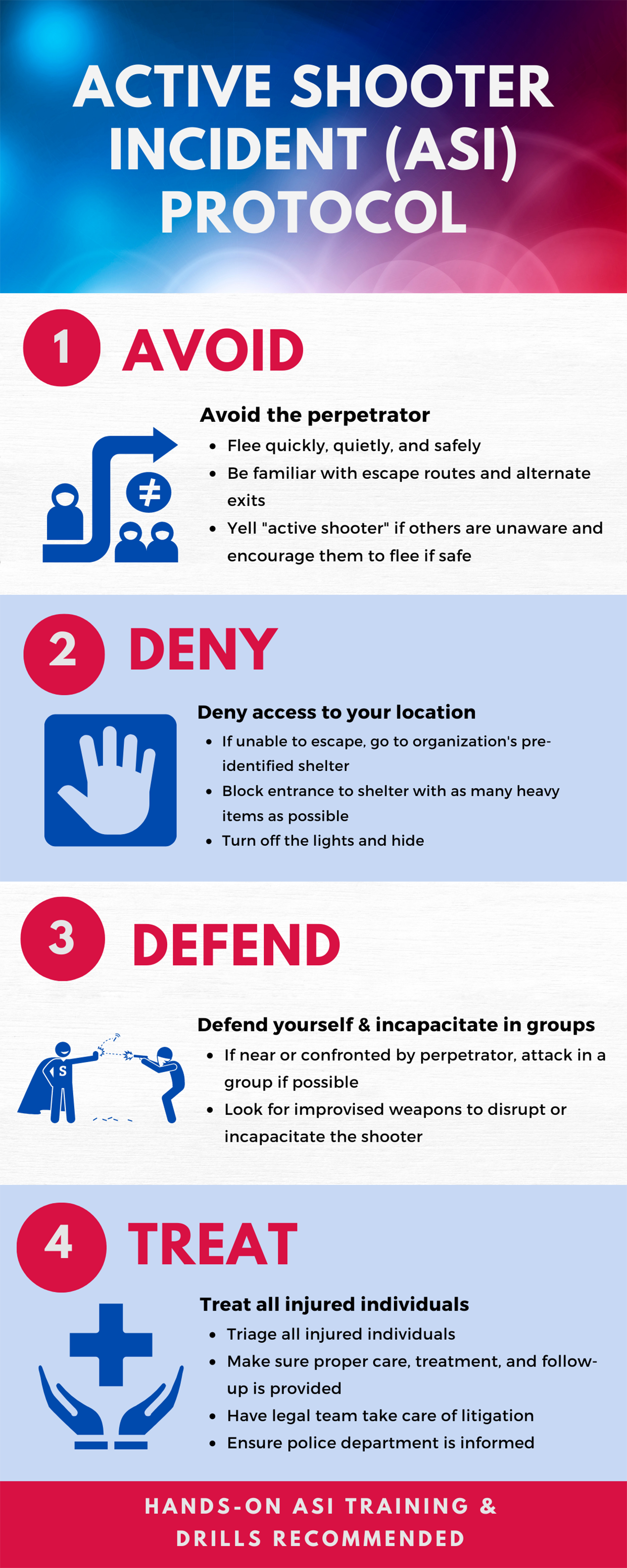
Interestingly, a majority (72%) of ED health workers were familiar with the methods of “Run, Hide, Fight,” Reference MAcKenzie, Wishner and Sexton5 whereas a majority (85%) were unfamiliar with “Avoid, Deny, Defend, Treat.” Both methods are synonymous with one another, and the lack of familiarity with the latter is likely because it is a more recent mnemonic. The method was updated in order to incorporate more inclusive language consistent with human resources departments and educational standards. 6 “Run” refers to evacuating to a safe location, “Hide” refers to hiding in a safe location if circumstances (ie, unsafe vicinity, mobility issues) do not allow escape, and “Fight” refers to a last resort strategy to disrupt or incapacitate the shooter. 7 Given the ED setting, the addition of “Treat” refers to tending to all injured victims and individuals. With more consistent and regular training, familiarity with the methods of “Avoid, Deny, Defend, Treat” can be increased along with ASI emergency preparedness among ED providers (Figure 1).
Infographic depicting the Active Shooter Incident (ASI) protocol. Designed by Jenny Lee, BA.
In regard to treating, bleeding is the most common preventable cause of death from injuries likely to be encountered in an ASI. The American College of Surgeons Committee on Trauma Bleeding Control Course (www.bleeding.control.org) is an effective program to aid in this purpose. The Hartford consensus is a call to action that no one should die from uncontrolled hemorrhage, especially in the setting of an ASI. The group consisted of representatives from law enforcement, fire, prehospital care, trauma care, and the military who convened in Hartford, CT, in 2013 to develop consensus regarding strategies to increase survivability in mass casualty shootings. This consensus document includes an acronym to describe the needed response to active shooter and intentional mass casual events. The acronym is THREAT: T, threat suppression; H, hemorrhage control; RE, rapid extrication to safety; A, assessment by medical providers; T, transport to definitive care. Reference Jacobs, Eastman, Mcswain, Butler, Rotondo, Sinclair, Wade and Fabbri8
Limitations
This study was administered via a remote survey; only the 60 individuals reached were able to contribute their perspectives. All ED health providers were affiliated with hospitals and medical facilities in Florida and specific ED emergency preparedness training policies may vary by hospital as well as by state. There is no authority that mandates an active shooter protocol, which is a limitation to comparing readiness in the different hospitals. Another limitation includes non-response bias from the nursing staff. The majority of respondents in this sample were physicians, which made it difficult to determine whether there was more preparedness and training for the nursing staff. Finally, an overall survey response rate of just 2.6% was a major limitation.
Conclusion
Most emergency department health care workers in this survey sample reported feeling unprepared to handle an ASI in their ED. Combined with the already high risk and susceptibility to ASIs in the ED, this study underscores the need to implement regular training on ASIs for ED staff. In the Florida HCA network, hospital policies on ASI exist, but standardized training does not. Implementing regular standardized ASI protocol training among not only HCA facilities, but also all hospitals, may reduce the stress and fear of feeling unprepared. Many participants provided valuable and descriptive feedback based on their individual experiences and concern for their lack of preparedness. This information was given to hospital administration, and there are current plans of developing an ASI protocol in the institution. Once the protocol is finalized, the goal is to disseminate across the HCA Florida Hospital Network. Preparedness with ASI training and employing “Avoid, Deny, Defend, and Treat” allow health care providers to appropriately respond to the situation and to “treat,” which is our purpose as health care professionals.
Acknowledgments
This research was supported (in whole or in part) by HCA Healthcare and/or an HCA Healthcare affiliated entity. The views expressed in this publication represent those of the author(s) and do not necessarily represent the official views of HCA Healthcare or any of its affiliated entities.
Funding Statement
None.


 Open access

