





1. Introduction
Hate speech is any kind of communication, writing or behaviour, that attacks a person or a group based on their identity factors, for example, religion, race and gender (UN 2020). The rise in popularity of social media has, unintentionally, promoted the spread of hate. People have the ability to freely publish hate speech on blogs and social media and through their words influence or harm millions of people all over the world. Even if the site is moderated, some damage may have already been done by the time the hateful content is removed. A study has revealed that posts from hateful users spread faster than those from normal users (Mathew et al. Reference Mathew, Dutt, Goyal and Mukherjee2019). Research also showed that online hate speech leads to hate crime in the physical world. For instance, Williams et al. (Reference Williams, Burnap, Javed, Liu and Ozalp2020) reported a positive correlation between Twitter hate speech and offline crimes in London.
Given the importance of the problem, tackling hate speech has become the main target of many studies. Various studies have focused on introducing datasets (Waseem and Hovy Reference Waseem and Hovy2016; Basile et al. Reference Basile, Bosco, Fersini, Nozza, Patti, Rangel Pardo, Rosso and Sanguinetti2019) and automatically detecting hateful content. The latter relies on machine learning techniques that range from logistic regression (Davidson et al. Reference Davidson, Warmsley, Macy and Weber2017), support vector machines (de Gibert et al. Reference de Gibert, Perez, García-Pablos and Cuadros2018), naive Bayes (Kwok and Wang Reference Kwok and Wang2013) to deep neural networks (Badjatiya et al. Reference Badjatiya, Gupta, Gupta and Varma2017). The majority of the work investigated hate speech on mainstream social media, such as Twitter (Davidson et al. Reference Davidson, Warmsley, Macy and Weber2017; Basile et al. Reference Basile, Bosco, Fersini, Nozza, Patti, Rangel Pardo, Rosso and Sanguinetti2019) and Facebook (Mandl et al. Reference Mandl, Modha, Majumder, Patel, Dave, Mandlia and Patel2019; Vu et al. Reference Vu, Vu, Tran, Le-Cong and Nguyen2020), whereas little has so far been done for underground and extremist forums.
Underground hacking forums enable cybercriminals to share their cybercriminal interest and knowledge and trade illicit materials (Pastrana et al. Reference Pastrana, Thomas, Hutchings and Clayton2018a). Extremist forums serve as a place for people to spread hateful and extremist ideologies with little hindrance to the general public (Schafer Reference Schafer2002). Despite the communities of the two types of forums have different characteristics, we believe they are interesting communities with commonalities (e.g., relatively light moderation by administrators Caines et al. Reference Caines, Pastrana, Hutchings and Buttery2018a; Jaki et al. Reference Jaki, De Smedt, Gwóźdź, Panchal, Rossa and De Pauw2019) and differences (a focus on hacking vs. a focus on political-social issues) for the study of hate speech.
Some members of these forums are associated with criminal activity. An active member of an underground forum called HackForums was arrested for being the alleged author of malware designed to steal online banking credentials (Krebs Reference Krebs2017). In addition to hacking-related activities, there is online aggressive behaviour among underground forum members (Caines et al. Reference Caines, Pastrana, Hutchings and Buttery2018a). In contrast, members of extremist forums are more likely to be involved in real-world violence (Holpuch Reference Holpuch2014; Jasser, Kelly, and Rothermel Reference Jasser, Kelly and Rothermel2020) that may be driven by the potential prevalence of hate speech in the forums. Because of this, understanding the content of hate speech in these forums and automatically detecting them would help to design early intervention techniques.
Despite a large number of studies on automatic hate speech detection, there are still many limitations. Classifiers do not generalise well on unseen data (Bruwaene, Huang, and Inkpen Reference Bruwaene, Huang and Inkpen2020) and may exhibit bias. For instance, tweets written in African-American English are likely to be classified as more abusive compared to those written in standard American English (Davidson, Bhattacharya, and Weber Reference Davidson, Bhattacharya and Weber2019). Because of these, real-world applications (e.g., Twitter) rely on human moderators to review posts (Harrison Reference Harrison2019). Identifying the hateful text span (i.e., the text fragment containing hate speech) would be a crucial step towards semi-automated moderation because it can assist human moderators who deal with lengthy texts. Moreover, it would benefit researchers who want to analyse certain aspects of hate speech (e.g., target analysis) and are less interested in other parts of the text. To the best of our knowledge, there has not yet been any research focusing on hate speech span extraction (SE).
1.1 Contributions
Our research mainly focuses on understanding hate speech in underground and extremist forums and two tasks, namely hate speech detection and SE. Our contributions are as follows.
-
(1) Release of hate speech annotations for a sample of posts from underground and extremist forums composed of posts from underground and extremist forums.
The paper describes hate speech annotations for posts extracted from HackForums, an underground forum and Stormfront and Incels.co, two extremist forums. These posts come from the pre-existing CrimeBB and ExtremeBB databases (Pastrana et al. Reference Pastrana, Thomas, Hutchings and Clayton2018a; Vu et al. Reference Vu, Wilson, Chua, Shumailov and Anderson2021). Based on the sampled data, the paper also analyses the frequency and the content of hate speech across these forums. The results show a lower occurrence of hate speech in underground forums compared to the two extremist forums. While Hackforums users do not have a specific target group, the main targets on Stormfront and Incels.co, respectively, are Jews and women.
-
(2) Exploration of multi-platform classifiers trained on the combined data from the underground, extremist forums and Twitter.
We experimented with different classifiers, including CNN-GRU, BERT (Bidirectional Encoder Representations from Transformers), support vector classifier (SVC), trained on the combined data from the underground, extremist forums and Twitter. The multi-platform classifiers are evaluated against the classifiers trained on the Twitter dataset only. The results showed that training classifiers on multiple sources of data may not always outperform mono-platform classifiers.
-
(3) Extraction of hate speech spans from longer texts.
A novel contribution of this work is to attempt to automatically extract hateful spans. We propose to fine-tune BERT and adopt two approaches. One is based on span prediction and the other on sequence labelling. The first predicts the start and end indices of the hateful spans and the second identifies whether each word token is part of the hateful spans. Both models achieve an F1-score of at least 69%.
1.2 Outline
This paper is organised as follows. In the next section, we review prior works related to this area of research. Section 3 provides an overview of the datasets that we use. Section 4 describes the annotation process and analyses the frequency and the content of hate speech in underground and extremist forums. Section 5 focuses on the design choice of the models for hate speech detection and SE. We evaluate the performance of the systems in Section 6 and perform a qualitative analysis and discuss the broader implications of the systems in Section 7. In our conclusion, we outline ideas for future work.
2. Related work
2.1 Hate speech
According to the UN (2020), hate speech is ‘any kind of communication in speech, writing or behaviour, that attacks or uses pejorative or discriminatory language with reference to a person or a group on the basis of who they are, in other words, based on their religion, ethnicity, nationality, race, colour, descent, gender or other identity factor’. However, this is not a universal legal definition for hate speech (UN 2020).
Previous work used a similar definition to annotated datasets for automated hate speech detection. However, because the characterisation of what is hateful is still fairly generic and definitions vary, there may be inconsistencies among the annotated datasets in terms of how labels are applied to texts (Waseem et al. Reference Waseem, Davidson, Warmsley and Weber2017). One of the key controversies is the confusion between hate speech and offensive language (e.g., disparaging terms and racial epithets). Waseem and Hovy (Reference Waseem and Hovy2016) considered offensive language as a subset of hate speech because they believed the speakers intentionally insult a (member of a) minority group. Contrarily, Assimakopoulos et al. (Reference Assimakopoulos, Vella Muskat, van der Plas and Gatt2020) stated: ‘online hate speech might often contain offensive language, but not all offensive language can be considered hate speech’.
Mandl et al. (Reference Mandl, Modha, Majumder, Patel, Dave, Mandlia and Patel2019) distinguished offensive language and hate speech based on the target. Texts targeting individuals are offensive, whereas those targeting a group of people are hate speech. However, this contradicts many hate speech definitions that consider both individuals and groups to be targets of hate speech (Waseem and Hovy Reference Waseem and Hovy2016; Basile et al. Reference Basile, Bosco, Fersini, Nozza, Patti, Rangel Pardo, Rosso and Sanguinetti2019; UN 2020). In contrast, Vu et al. (Reference Vu, Vu, Tran, Le-Cong and Nguyen2020) claimed that texts are offensive rather than hate speech if they do not target individuals or groups based on their identity factors. Nonetheless, this is not sufficient for drawing a boundary between offensive language and hate speech because one can hardly separate pejorative words from the identity factors, for example, ‘bitch’ is a female-referent slur, ‘negro’ refers to Black people (Kleinman, Ezzell, and Frost Kleinman et al. Reference Kleinman, Ezzell and Frost2009). Other scholars, instead, took into account the context in which the pejorative words are used (Warner and Hirschberg Reference Warner and Hirschberg2012; Davidson et al. Reference Davidson, Warmsley, Macy and Weber2017; de Gibert et al. Reference de Gibert, Perez, García-Pablos and Cuadros2018). They considered the following cases to be not hateful: (1) the speaker belongs to the target group (Warner and Hirschberg Reference Warner and Hirschberg2012; Davidson et al. Reference Davidson, Warmsley, Macy and Weber2017), and (2) the offensive word does not contain a deliberate attack (de Gibert et al. Reference de Gibert, Perez, García-Pablos and Cuadros2018).
Other matters of debate include whether to consider hate speech the praise of an organisation associated with hate crimes, the support of hateful hashtags (Warner and Hirschberg Reference Warner and Hirschberg2012; Waseem and Hovy Reference Waseem and Hovy2016; Basile et al. Reference Basile, Bosco, Fersini, Nozza, Patti, Rangel Pardo, Rosso and Sanguinetti2019) and the expression of excessive pride in the speaker’s own race or group (Warner and Hirschberg Reference Warner and Hirschberg2012; Basile et al. Reference Basile, Bosco, Fersini, Nozza, Patti, Rangel Pardo, Rosso and Sanguinetti2019).
Hate speech has been positioned as a subtype of online toxicity more generally (Salminen et al. Reference Salminen, Hopf, Chowdhury, Jung, Almerekhi and Jansen2020), where other types can include offensive language such as swearwords, or arguments which contain neither hate speech or offensive language. Therefore, we are interested in detecting a kind of internet toxicity, which overlaps with offensive language but is not exactly the same as it.
The problem of hate speech annotation has been shown to be a highly demanding task due to the lack of a universal detailed definition for hate speech. For this work, we adopt the UN definition that is enriched with the following details that some researchers have used to clarify what constitutes hate speech:
-
The association of stereotypes to a race or ethnicity (Warner and Hirschberg Reference Warner and Hirschberg2012; Waseem and Hovy Reference Waseem and Hovy2016; Basile et al. Reference Basile, Bosco, Fersini, Nozza, Patti, Rangel Pardo, Rosso and Sanguinetti2019).
-
Language that seeks to silence a minority (Waseem and Hovy Reference Waseem and Hovy2016).
-
Language that dehumanises and degrades an individual based on their belonging to a group (Davidson et al. Reference Davidson, Warmsley, Macy and Weber2017).
-
Language that incites or promotes hate or violence (Davidson et al. Reference Davidson, Warmsley, Macy and Weber2017).
-
Defence of hateful content, for instance, xenophobia or sexism (Waseem and Hovy Reference Waseem and Hovy2016).
2.2 Hate speech detection
The automatic detection of hate speech has been addressed in many different ways. Studies have attempted to identify hate speech by proposing a binary classification problem which is an approach we also adopt. The task aims at detecting whether a given text is hateful (de Gibert et al. Reference de Gibert, Perez, García-Pablos and Cuadros2018; Jaki et al. Reference Jaki, De Smedt, Gwóźdź, Panchal, Rossa and De Pauw2019). Some studies focused on subtypes of hate speech, for example, Waseem and Hovy (Reference Waseem and Hovy2016) studied the classification of racist and sexist tweets. Others, instead, proposed a multi-label classification task: for instance, Davidson et al. (Reference Davidson, Warmsley, Macy and Weber2017) detected hate speech, offensive language and non-hateful posts.
To automatically classify hate speech, previous research focused on traditional machine learning classifiers, such as logistic regression (Davidson et al. Reference Davidson, Warmsley, Macy and Weber2017), support vector machines (de Gibert et al. Reference de Gibert, Perez, García-Pablos and Cuadros2018) and naive Bayes (Kwok and Wang Reference Kwok and Wang2013). The input features of these classifiers are lexical and syntactic features, including bag-of-words (BoW) and term frequency-inverted document frequency (TF-IDF) (Sparck Jones Reference Sparck Jones1972). Both calculate the occurrence of word or character n-grams (i.e., contiguous sequence of n items) in the text, but TF-IDF assigns higher weights to more informative words. Kwok and Wang (Reference Kwok and Wang2013) examined the effect of BoW features as input and showed the ineffectiveness of a single linguistic feature due to insufficient information of the text. More sophisticated work includes combining multiple features. This is the case of Davidson et al. (Reference Davidson, Warmsley, Macy and Weber2017) who achieved an F1-score of 90% in their proposed dataset. They used n-grams that range from 1 to 3 weighted by their TF-IDF. They added part-of-speech tags that are categories of the words (e.g., noun and verb) to capture some morpho-syntactic information and used Twitter metadata, such as tweet sentiment score and quality.
Recent work showed deep neural networks to outperform traditional machine learning systems in many cases because they better capture the complex relationships of the data. The most frequently used deep neural networks include CNNs (Badjatiya et al. Reference Badjatiya, Gupta, Gupta and Varma2017), recurrent neural networks (RNNs) and its variants – long short-term memory (LSTM) (Badjatiya et al. Reference Badjatiya, Gupta, Gupta and Varma2017) and gated recurrent unit (GRU) (Alshalan and Al-Khalifa Reference Alshalan and Al-Khalifa2020) – and transformers, such as BERT (Devlin et al. Reference Devlin, Chang, Lee and Toutanova2019). CNN captures the local features of the text, RNN extracts sequence information and transformers adopt an attention mechanism that learns the relationship among all the words of the input text based on their importance (Vaswani et al. Reference Vaswani, Shazeer, Parmar, Uszkoreit, Jones and Gomez2017).
Some researchers have explored the combination of these deep neural networks. Zhang, Robinson, and Tepper (Reference Zhang, Robinson and Tepper2018) proposed a CNN-GRU model that improved the F1-score of a single CNN by 1% on multiple hate speech datasets. Mozafari, Farahbakhsh and Noël (Reference Mozafari, Farahbakhsh and Noël2019) fine-tuned pre-trained BERT learned on the BookCorpus (Zhu et al. Reference Zhu, Kiros, Zemel, Salakhutdinov, Urtasun, Torralba and Fidler2015) and English Wikipedia. They examined the effect of different layers on top of BERT including a CNN and a bidirectional LSTM. Both models outperformed traditional machine learning classifiers on the datasets introduced by Waseem and Hovy (Reference Waseem and Hovy2016) and Davidson et al. (Reference Davidson, Warmsley, Macy and Weber2017). The majority of these classifiers use word embeddings as input features. Word embeddings are real-valued word representations such that words with similar semantics are closer in the vector space Bengio et al. (Reference Bengio, Ducharme, Vincent and Janvin2003). The most commonly used pre-trained word embeddings are Global Word Vectors (GloVe) (Pennington, Socher, and Manning Reference Pennington, Socher and Manning2014), FastText (Bojanowski et al. Reference Bojanowski, Grave, Joulin and Mikolov2017) and Word2Vec (Mikolov et al. Reference Mikolov, Chen, Corrado and Dean2013).
Despite the improvement in classifier performance, it is unclear how the systems generalise because they are trained and tested on a single dataset representing a single data source, such as Twitter (Davidson et al. Reference Davidson, Warmsley, Macy and Weber2017). One way to achieve generalisability is to train a classifier with data from multiple platforms (Bruwaene et al. Reference Bruwaene, Huang and Inkpen2020). Recent studies investigated multi-platform classifiers for cyberbullying (Bruwaene et al. Reference Bruwaene, Huang and Inkpen2020) and hate speech detection (Corazza et al. Reference Corazza, Menini, Cabrio, Tonelli and Villata2019) and showed their effectiveness compared to mono-platform classifiers. While they combined data from mainstream social media (e.g., Twitter, Facebook, WhatsApp and Instagram), we aim at investigating multi-platform classifiers trained on Twitter, underground hacking and extremist forums that have more diverse discussion topics (e.g., cybercrime and white supremacy).
2.3 Span extraction
SE aims at identifying the fragment of the text of interest. Previous work have focused on two shared tasks from SemEval-2020 (Task 11) (Da San Martino et al. Reference Da San Martino, Barrón-Cedeño, Wachsmuth, Petrov and Nakov2020) and SemEval-2021 (Task 5).Footnote a The first involves extracting the propaganda (i.e., expression that influences other people’s opinion or actions) spans, and the second toxic or abusive spans from a text. Table 1 shows an example of propaganda and toxic spans.
Examples of texts where propaganda (Da San Martino et al. Reference Da San Martino, Barrón-Cedeño, Wachsmuth, Petrov and Nakov2020) and toxic spansa are highlighted in bold

The solutions for the two tasks can be categorised into span prediction and sequence labelling. Span prediction identifies the start and end offsets of the span (Chhablani et al. Reference Chhablani, Bhartia, Sharma, Pandey and Suthaharan2021). Sequence labelling classifies each member of a sequence, for example, identify whether each token is toxic (Chhablani et al. Reference Chhablani, Bhartia, Sharma, Pandey and Suthaharan2021) or use BIO encoding (i.e., mark the token as (B) if it is at the beginning, (I) if it is inside or (O) if it is outside of the span) (Morio et al. Reference Morio, Morishita, Ozaki and Miyoshi2020).
Since SE tasks require highly nuanced semantic understanding, most solutions leveraged large language models pre-trained using transformers, including BERT (Devlin et al. Reference Devlin, Chang, Lee and Toutanova2019) and other types of transformers (Morio et al. Reference Morio, Morishita, Ozaki and Miyoshi2020; Chhablani et al. Reference Chhablani, Bhartia, Sharma, Pandey and Suthaharan2021). These models are pre-trained on billions of words of English text data and can be easily fine-tuned to adapt to new tasks.
For the propaganda SE task, Jurkiewicz et al. (Reference Jurkiewicz, Borchmann, Kosmala and Graliński2020) treated it as a sequence labelling problem and used a conditional random field (CRF) (Lafferty, McCallum, and Pereira Reference Lafferty, McCallum and Pereira2001) which is a conditional probabilistic graphical model for labelling or parsing sequential data. The authors inserted a CRF layer on top of RoBERTa (Liu et al. Reference Liu, Ott, Goyal, Du, Joshi, Chen, Levy, Lewis, Zettlemoyer and Stoyanov2019), a variant of BERT. They experimented with an ensemble of a model trained on the shared task dataset and one on the combined dataset of the original and silver data produced using self-learning. Though they achieved promising results, their performance was poorer compared to the solution of Morio et al. (Reference Morio, Morishita, Ozaki and Miyoshi2020). Although they also used an ensemble of pre-trained transformers, their success relied on a complex heterogeneous multi-layer neural network. The network uses the representation for each input token generated by the pre-trained language models, part-of-speech and named entity embeddings. These are fed into three bidirectional LSTMs, each of them is responsible for a different task: namely BIO sequence tagging, token-level and sentence-level classification. Their system achieved an F1-score of 51.5% ranking in first place for SemEval-2020 task 11.
For the toxic SE, Chhablani et al. (Reference Chhablani, Bhartia, Sharma, Pandey and Suthaharan2021) experimented with span prediction, binary sequence labelling and a hybrid of the two approaches. Their best performing model was the second approach achieving an F1-score of 68.5%.
The performance of these systems may reflect the difficulty of the two tasks. Extracting toxic spans is easier than the propaganda spans, because toxic spans are often characterised by the use of offensive words which might be repeated and easier to recognise. The propaganda spans, instead, tend to be more heterogeneous with 14 different styles identified by Da San Martino et al. (Reference Da San Martino, Barrón-Cedeño, Wachsmuth, Petrov and Nakov2020). Therefore, the system must better capture the meaning of the text.
In terms of hate speech spans, the most relevant work is from Binny et al. (Reference Binny, Saha, Yimam, Biemann, Goyal and Mukherjee2021) who introduced a hate speech dataset called HateXplain. Each instance of HateXplain contains the class (i.e., hate speech and offensive or normal), the target community and the rationales which are parts or spans of the texts that annotators justify the labelling decision for being hate speech of offensive post. The rationales would be generated by the machine learning models to explain their classification results. For the rationales, Binny et al. (Reference Binny, Saha, Yimam, Biemann, Goyal and Mukherjee2021) generated a ground truth attention vector where they assigned 1 to each token in the rationale and normalised the attention vector so that the sum of the tokens equals 1. In addition, they normalised the attention vector using a softmax function with a temperature parameter to prevent the difference between the values of rationale and non-rationale tokens from being low. They tuned the parameter using a validation set. They experimented with Bi-RNN with an attention layer and BERT that need to output an attention vector that should assign higher weights to tokens in the rationale. They achieved an F1 score of 50.6% and 41.1% respectively.
Although Binny et al. (Reference Binny, Saha, Yimam, Biemann, Goyal and Mukherjee2021) provided the data containing hate speech rationales, we will not use their dataset because their rationales are mainly part of the text that are often disconnected. In contrast, our objective is to extract connected spans from the text such that by only reading at them, it is sufficient to assist human annotators to understand the text and make the classification. Therefore, we will be creating a specific data corpus for the hate speech SE task.
Among the three approaches that we described, we decided to explore span prediction and sequence labelling approaches to automatically extract hateful spans. The latter approach was not considered due to the unavailability of a large data corpus to tune the temperature parameter in the softmax function.
We believe that the difficulty of the hate speech SE task falls in between these two tasks. It is likely to be more straightforward than the propaganda SE because a hateful span may contain offensive words which make it easier to identify. But similarly, it also requires rich semantic understanding because a hateful span should contain the target and the attribute that makes the text hateful. This makes it more challenging than the SE of toxicity alone.
2.4 Hateful and aggressive content in underground and extremist forums
Most of the work in underground hacking forums has so far focused on understanding discussion topics (Caines et al. Reference Caines, Pastrana, Hutchings and Buttery2018b) or the cybercrime marketplace, for example, identifying key actors (Pastrana et al. Reference Pastrana, Hutchings, Caines and Buttery2018b) or supply chains (Bhalerao et al. Reference Bhalerao, Aliapoulios, Shumailov, Afroz, Mccoy, Levchenko and Paxson2018). In terms of hateful and aggressive content, the most relevant work is from Caines et al. (Reference Caines, Pastrana, Hutchings and Buttery2018a). They reported a lower level of aggressive language on HackForums, the largest English hacking forum (Pastrana et al. Reference Pastrana, Thomas, Hutchings and Clayton2018a), compared to the Wiki Comments Corpus (Wulczyn, Thain, and Dixon Reference Wulczyn, Thain and Dixon2016), a dataset that consists of 115,864 comments about Wikipedia page edits. They found that the interaction among HackForums members tends to be more positive as many posts are mainly instructive and educational.
In contrast, there has been more research relating to hateful content on extremist forums. Gerstenfeld, Grant, and Chiang (Reference Gerstenfeld, Grant and Chiang2003) analysed 157 extremist websites and observed racist content in almost half of these websites. Although the findings suggest a high proportion of hateful content, it is unknown how hate speech is distributed across individual websites. de Gibert et al. (Reference de Gibert, Perez, García-Pablos and Cuadros2018) investigated the frequency on Stormfront, one of the longest-running white supremacist platforms (Bowman-Grieve Reference Bowman-Grieve2009). They randomly sampled content from several subforums and split them into sentences. They manually labelled 9916 sentences among which 11% were hateful. However, because they analysed hate speech at the sentence level, the actual distribution of hate speech over texts is unclear.
Besides white supremacist forums, extremist forums include ‘incel’ forums. Involuntary celibates or incels are single men who adhere to an extreme misogynistic, anti-feminist ideology (Jaki et al. Reference Jaki, De Smedt, Gwóźdź, Panchal, Rossa and De Pauw2019). Previous work analysed the content on Incels.me (Jaki et al. Reference Jaki, De Smedt, Gwóźdź, Panchal, Rossa and De Pauw2019) and in an incel Reddit subforum (Tranchese and Sugiura Reference Tranchese and Sugiura2021). According to their findings, these forums are full of abusive language. Incels express their hate towards women because they attribute their lack of sexual activity and their misfortunes in life to women (Jaki et al. Reference Jaki, De Smedt, Gwóźdź, Panchal, Rossa and De Pauw2019; Tranchese and Sugiura Reference Tranchese and Sugiura2021). They objectify and dehumanise women and encourage violence by providing instructions to rape or murder women (Jaki et al. Reference Jaki, De Smedt, Gwóźdź, Panchal, Rossa and De Pauw2019). Jaki et al. (Reference Jaki, De Smedt, Gwóźdź, Panchal, Rossa and De Pauw2019) also used a deep neural network to detect hate speech on Incels.me. They defined hate speech as posts containing offensive words. They, initially, chose 10 offensive words related to misogyny, homophobia and racism. They reported a distribution of 5% of hate speech in 50,000 posts. This is likely an underestimate given they only selected 10 offensive words and three subsets of hate speech. Moreover, as Assimakopoulos et al. (Reference Assimakopoulos, Vella Muskat, van der Plas and Gatt2020) stated that not all hate speech contains offensive words. Therefore, the picture of hate speech in incel forums is incomplete.
3. Data
This section provides an overview of the data that we extracted from the HatEval, CrimeBB and ExtremeBB corpora. The latter two contain hacking- and extremist-related posts, respectively. The first corpus includes posts from Twitter and helps to augment the dataset for the training of the multi-platform classifiers. We also discuss the ethical considerations that play an important role in this work.
3.1 HatEval
The HatEval dataset was introduced by Basile et al. (Reference Basile, Bosco, Fersini, Nozza, Patti, Rangel Pardo, Rosso and Sanguinetti2019) for the SemEval-2019 hate speech detection shared task. The dataset was extracted from Twitter by identifying potential victims of hate speech and hate accounts and using the keyword approach (i.e., selecting potentially hateful posts based on offensive words). The dataset contains tweets targeting women and immigrants in English and Spanish. The data were labelled by two expert annotators who are experienced in the annotation of this task and also using crowdsourcing. Because only 10% of the labelled data contained hate speech, Basile et al. (Reference Basile, Bosco, Fersini, Nozza, Patti, Rangel Pardo, Rosso and Sanguinetti2019) altered the natural distribution to have a more balanced distribution of hateful and non-hateful tweets.
We used the English portion of the dataset that consists of 9000 training and 3000 test data instances. Each dataset contains 42% hateful and 58% non-hateful tweets.
3.2 CrimeBB and ExtremeBB
We used existing datasets called CrimeBB (Pastrana et al. Reference Pastrana, Thomas, Hutchings and Clayton2018a) and ExtremeBB (Vu et al. Reference Vu, Wilson, Chua, Shumailov and Anderson2021) that contain posts from underground and extremist forums, respectively. CrimeBB and ExtremeBB are collected and maintained by the Cambridge Cybercrime Centre.Footnote b Both datasets continue to expand, but at the time of writing CrimeBB contained more than 90 million posts from underground forums and ExtremeBB contained more than 38 million posts from extremist forums. We extracted a sample of posts from HackForums, the largest forum in CrimeBB and Stormfront and Incels.co from ExtremeBB to analyse.
HackForums is the most well-known hacking community that gained recent attention in 2017 due to the arrest of a suspicious author of banking malware (Krebs Reference Krebs2017). While members of HackForums might be engaged in cybercriminal activities, people driven by extreme ideologies such as those expressed on Stormfront and incel forums have been involved in serious offline illegal harms. Many crimes committed by murderers have self-identified as incels, including the Hanau shooter who killed nine people in 2020 (Jasser et al. Reference Jasser, Kelly and Rothermel2020). Furthermore, many massacres are associated with Stormfront including the mass murder of 77 people in Norway in 2011 (Holpuch Reference Holpuch2014).
We worked with posts extracted from HackForums that were posted by users between 2007 and 2020 and from the two extremist forums that were posted between 2001 and 2021.
Initially, we randomly selected 500 posts from two subforums of HackForums, called religion-philosophy-science and news and happenings, that are likely to contain hate speech because they are not technical- or game-related. We also randomly sampled data from the two extremist forums. Many posts from Stormfront were non-English and contained news articles related to non-white people committing a crime. We filtered out these as we were seeking user-generated texts in English leaving 500 posts from the two forums. We further extracted 2200 posts, half of which come from the entire HackForums and the other half from the two extremist forums, using a keyword approach in case of a low frequency of hate speech.
Because this work considers hate speech in general, we used the keywords listed in Table 2 from seven categories defined by Hatebase Inc. (2020), the world’s largest online repository of multilingual hate speech, that can cover a broad amount of communities. These categories are gender, religion, nationality, sexual orientation, race, class and disability.
List of keywords for the search of potential hate speech

3.3 Ethical issues
This work uses and analyses data that may contain harmful content from CrimeBB and ExtremeBB. Because of this, this research has undergone ethical review to consider potential harms, ensure safeguards to protect the researchers and participants and report potential criminal materials, such as terrorist and child sexual abuse material, to the authorities. We received ethics approval from the Department of Computer Science’s ethics committee and complied with the Cambridge Cybercrime Centre’s data-sharing agreements. Researchers and annotators were warned about the hateful content before they read the data, and they were made aware of the counselling services available to them. Finally, we took care in storing data securely, not revealing user identities (e.g., usernames) and reporting the results objectively.
4. Data annotation
Data annotation is an integral part of supervised and semi-supervised machine learning tasks. It is required when the labelled data for the specific task is not available or to augment existing datasets, since machine learning systems require a large amount of data to learn patterns and make accurate predictions. This work requires the annotation of the unlabelled data that we extracted from HackForums, Stormfront and Incels.co for training hate speech detection and SE models. The annotators for both hate speech detection and SE tasks are three researchers from the Department of Computer Science of the University of Cambridge.
4.1 Annotation for hate speech classification
We randomly sampled the extracted dataset and divided it into training and test sets. The first consists of 2200 posts and was annotated using active learning as described below, whereas the test set contains 1000 posts that were manually labelled by 3 annotators.
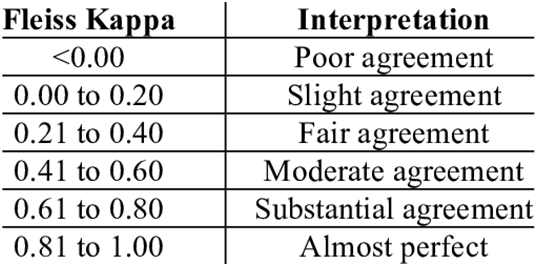
The task consists of labelling 1 if the post is hateful, otherwise, 0. It is based on the definition provided by the UN (2020) that is enriched with other aspects of hate speech that we listed in Section 2.1. The annotation process is evaluated using Fleiss’ kappa (Fleiss Reference Fleiss1971) inter-annotator agreement, and we used the framework from Landis and Koch (Reference Landis and Koch1977) as shown in Figure 1.
Framework for interpreting Fleiss’ kappa.
4.1.1 Active learning
Active learning is a machine learning algorithm that interactively queries the user to label the data that the system is uncertain (Cohn Reference Cohn2010). We used this algorithm because training a multi-platform classifier requires a large amount of training data from the hacking and extremist forums, and manual annotation is time-consuming. Algorithm 1 outlines our procedure for active learning.
Active learning (Uncertainty sampling strategy) algorithm.

We used SGDClassifier, more specifically a SVC, with smoothed hinge loss, from Python ScikitLearn (Pedregosa et al. Reference Pedregosa, Varoquaux, Gramfort, Michel, Thirion, Grisel, Blondel, Prettenhofer, Weiss, Dubourg, Vanderplas, Passos, Cournapeau, Brucher, Perrot and Duchesnay2011) which supports incremental learning – a method of machine learning in which the model’s knowledge is continuously updated with new data without being retrained from scratch (Geng and Smith-Miles Reference Geng and Smith-Miles2009). We used text embeddings as input features. To generate these, we used the Universal Sentence Encoder from Tensorflow Hub (Abadi et al. Reference Abadi, Agarwal, Barham, Chen, Chen, Davis, Dean, Devin, Ghemawat, Irving, Isard, Kudlur, Levenberg, Monga, Moore, Murray, Steiner, Tucker, Vasudevan, Warden, Wicke, Yu and Zheng2016) because it shows strength in capturing the semantics of and the similarities among texts (Cer et al. Reference Cer, Yang, Kong, Hua and Limtiaco2018). Because the Universal Sentence Encoder was trained for greater-than-word length text (e.g., sentences, phrases and short paragraphs), the English input text can be of variable length, but the output is a fixed 512-dimensional vector (Cer et al. Reference Cer, Yang, Kong, Hua and Limtiaco2018).
The confidence threshold that we set was initially 0.9 for both hateful and non-hateful predictions. Texts for which model predictions had a confidence lower than the threshold were passed to the human annotators for labelling. However, the classifier ended up being confident in predicting the latter and not so much in predicting hate speech. Therefore, we lowered the threshold to 0.5 for potential hate speech.
We started by training the classifier on the HatEval training data. The initial performance tested on the HatEval test set achieved an F1-score and an accuracy of 58% and 59%, respectively. We used this classifier to label posts from CrimeBB and ExtremeBB some of which could not be assigned a label because the human annotator was unable to confidently determine whether the post is hateful or not. There were 400 discarded posts leaving 1800 labelled data instances. Among these, there were 306 hateful and 1494 non-hateful posts. These data were combined with the HatEval training data to construct a single multi-platform training dataset. Table 3 shows the distribution of the data.
Distribution of posts over categories in the multi-platform training data

4.1.2 Manual annotation
The annotators were asked to manually label the test sets from ExtremeBB and CrimeBB. After removing 29 posts that could not be clearly labelled, the final set consisted of 971 posts. We assigned the final label for each instance based on the majority voting from the three annotators. We divided the data into two test sets, one from HackForums and one from the two extremist forums. Table 4 shows the distribution of the hateful and non-hateful posts across test sets from HatEval, underground and extremist forums.
Distribution of posts over categories in the test sets from HatEval, HackForums and the two extremist forums

To measure inter-rater agreement, we again turned to Fleiss’ kappa and obtained a score of 0.73, indicating that there was substantial agreement among the three annotators.
4.1.3 Discussion
Despite the available hate speech definition, the labelling process was admittedly challenging. The main source of disagreements was due to the difficulty of determining the dividing line between offensive language and hate speech. Besides, due to the unavailability of demographic information of the speaker and the addressee, annotators were unable to determine whether the offensive word is referring to the addressee or whether the speaker belongs to the target group.
Other disagreements include the expression of excessive pride of a particular race, for example, the claim of white power on Stormfront, and sarcastic posts because contextual information to make an informed decision about the real intention behind the posts was not available.
Furthermore, as mentioned in Section 4.1.2, we discarded 29 posts because at least one annotator could not provide a label. They are, probably, part of a dialogue or discussion thread that cannot be understood without considering the wider context.
Finally, we noticed that in active learning annotation, the machine was mainly confident in predicting non-hateful posts resulting in these being the majority even though the initial model was trained on the approximately balanced two-class HatEval training set. For hate speech, the classifier correctly classified hateful posts against women. This is probably because the initial training data for the active learning classifier was from HatEval that only contains posts related to women and immigrants. Therefore, the system may be biased towards the two targets and not recognise hate speech against other targets which were present in the unlabelled data.
4.2 Annotation for hate speech SE
For hate speech SE, we randomly extracted 700 posts labelled as hateful from HatEval, HackForums and Extremist forums. Table 5 shows the distribution of the data instances across different platforms.
Distribution of the data instances for span extraction across different platforms

The purpose of hate speech SE is to determine which section(s) of a text are the source of hateful content. A possible application for such a system is to enable moderators to quickly review potentially harmful texts by bringing key sections to their attention quickly. The span must contain the fragment that incites hate as we described in Section 2.1. The annotators were asked to extract the hateful span from the posts.
The annotation process is evaluated in terms of $\gamma$
agreement (Mathet et al. Reference Mathet, Widlöcher and Métivier2015) that measures the overlap of the spans that the annotators extracted. Normally,
$\gamma$
agreement (Mathet et al. Reference Mathet, Widlöcher and Métivier2015) that measures the overlap of the spans that the annotators extracted. Normally, $\gamma$
is a score between 0 and 1, where 1 means the annotators extracted the same spans. When the annotated spans are completely different from each other,
$\gamma$
is a score between 0 and 1, where 1 means the annotators extracted the same spans. When the annotated spans are completely different from each other, $\gamma$
can be less than 0 (Mathet et al. Reference Mathet, Widlöcher and Métivier2015).
$\gamma$
can be less than 0 (Mathet et al. Reference Mathet, Widlöcher and Métivier2015).
All the data were labelled by only one annotator, except for 50 instances that were labelled by 3 annotators to calculate the inter-annotator agreement. The average $\gamma$
agreement was 0.87.
$\gamma$
agreement was 0.87.
The annotated spans are all longer than a few words as may be found in, for example, toxic spans. This is expected because hate speech needs to include a target and the attribute that makes the post hateful.
We also observed some posts containing multiple disconnected spans. We updated the annotations to include these, and there are in total 44 posts with multiple spans.
4.3 Findings
4.3.1 Hate speech frequency
We combined the test and training data of each platform. Table 6 shows the hate speech frequency on different platforms. The statistics only act as an indicator and do not reflect the real-life distribution because hate speech may be over-sampled as they have been extracted in a targeted fashion using the keyword approach.
Hate speech frequency across different platforms

HackForums has the lowest occurrence of hate speech. This is in line with the findings of Caines et al. (Reference Caines, Pastrana, Hutchings and Buttery2018a) who reported a relatively low level of abusive and aggressive behaviour. The positive behaviour of HackForums members is probably due to the strict rules imposed on the website. According to Caines et al. (Reference Caines, Pastrana, Hutchings and Buttery2018a), there are administrators and a reputation scoring system that constrain user behaviour.
The hate speech frequency of the two extremist forums, Stormfront and Incels.co, reaches 29% and 35%, respectively. This is not surprising because these forums are driven by extreme ideologies, such as anti-Semitism (de Gibert et al. Reference de Gibert, Perez, García-Pablos and Cuadros2018) and misogyny (Jaki et al. Reference Jaki, De Smedt, Gwóźdź, Panchal, Rossa and De Pauw2019). Besides, unlike HackForums which constrains users behaviour, in these extremist forums, it is unlikely to enforce restrictions on hate speech because it would deviate from the ideologies of these forums. Most of the rules are probably concerned with cyberbullying as Jaki et al. (Reference Jaki, De Smedt, Gwóźdź, Panchal, Rossa and De Pauw2019) found on Incels.me.
Twitter has the largest amount of hate speech. However, as we described in Section 3.1, the HatEval dataset distribution of hateful and non-hateful content was updated to have a more balanced distribution of the two categories. The original data only contained 10% of hate speech which was less than the two extremist forums. This is probably due to site moderators who actively ban illegal content (Harrison Reference Harrison2019). Despite the lower frequency, the total number of texts containing hate speech would be greater than other platforms (Stricker Reference Stricker2014) because Twitter users post 500 million tweets per day (Stricker Reference Stricker2014), whereas HackForums, Stormfront and Incels.co contain in total around 42 million, 10 million and 6 million (counted from CrimeBB and ExtremeBB) posts, respectively.
4.3.2 Analysis of forums content
We inspected the data to better understand the content on HackForums, Stormfront and Incels.co. The use of derogatory terms is frequent in all these forums. In line with previous findings (Pastrana et al. Reference Pastrana, Thomas, Hutchings and Clayton2018a; Caines et al. Reference Caines, Pastrana, Hutchings and Buttery2018a), we found that the primary content on HackForums is technical and commercial. Forum members share hacking knowledge and focus on earning fast money from selling illicit materials. In terms of the few hateful posts that we found, some involved conflict among forum members, where members insult individuals using discriminatory words related to certain group identity factors. HackForums members do not tend to have a particular group they attack.
In contrast, the target of the two extremist forums is more evident. On Stormfront, users show hatred against a particular group, Jews. This can take the form of demonising the group, denying the Holocaust and spreading the conspiracy that the Jews created COVID-19. Stormfront also contains racist content, for example, demonstrated by white nationalists who claim the supremacy of white power. These forum members attribute social problems, such as high crime rates and poverty, to non-white groups. Other hateful posts include expressions of disgrace and hate towards women who date non-white people by calling them race traitors. Nonetheless, the discussion in Stormfront is not always hateful. They also discuss topics such as politics and use the forum as a place to socialise. We found posts in which they introduce themselves and invite other members to meet offline.
Unlike HackForums and Stormfront, incels use specific vocabulary, from which we list a few examples in Table 7. The primary targets on Incels.co are women who are portrayed as being immoral, corrupted, promiscuous and superficial. Although we found incels incite violence towards this target group, we did not observe any detailed instructions on how to rape and kill women that Jaki et al. (Reference Jaki, De Smedt, Gwóźdź, Panchal, Rossa and De Pauw2019) found on Incels.me. In addition to women, incels also hate chads because they believe chads raised women’s standards in finding a partner and, thus, women would not ‘date down’ with incels. But, at the same time, they admire chads for their physical appearance. Other hateful posts include racist posts. Some of them are related to women, for example, they discuss women of which ethnicity are the easiest to date and compare women’s physical appearance of different races. Most of these hateful topics are consistent with previous findings (Jaki et al. Reference Jaki, De Smedt, Gwóźdź, Panchal, Rossa and De Pauw2019; Tranchese and Sugiura Reference Tranchese and Sugiura2021) suggesting that the discussion of incels is similar across different platforms.
Examples of vocabulary that members on Incels.co use

In terms of non-hateful content, similar to what Jaki et al. (Reference Jaki, De Smedt, Gwóźdź, Panchal, Rossa and De Pauw2019) found, incels suggest ideas to become attractive and to date women. Furthermore, we observed that on Incels.co, there are many complaints. Incels complain about their physical appearance, being maltreated or bullied. Some of them even considered suicide because of their miserable life and fellow incels comforted them to prevent the tragedy from happening.
5. Methods
5.1 Hate speech detection
This work defines hate speech detection as a binary classification problem, where the classifier outputs 1 if hate speech is detected and outputs 0 if the post does not contain hateful content.
5.1.1 Data pre-processing
We lowercased each post to avoid word types such as ‘Hello’ and ‘hello’ being treated differently (Pradha, Halgamuge, and Tran Quoc Vinh Reference Pradha, Halgamuge and Tran Quoc Vinh2019). We also removed punctuation, URLs, @ mentions and hashtags because they may not provide much information to the text and may be noisy (Gurusamy and Kannan Reference Gurusamy and Kannan2015). Finally, we used text embeddings as input features which are generated using the Universal Sentence Encoder (Cer et al. Reference Cer, Yang, Kong, Hua and Limtiaco2018).
5.1.2 Models
We explored different machine learning models. Each model has two versions, one where the models are trained using only the HatEval training data and the other where the models are trained on a dataset from multiple sources (i.e., HatEval, Hackforums and Extremist forums).
Support Vector Classifier (SVC) A SVC is a linear model that works for classification problems (Boser, Guyon, and Vapnik Reference Boser, Guyon and Vapnik1992). It separates the data into classes by finding the optimal hyperplane that maximises the margin – the distance between the hyperplane and the support vectors, which are the points closest to the hyperplane. The maximisation reduces the generalisation error of the system (Boser et al. Reference Boser, Guyon and Vapnik1992).
We used the model from Indurthi et al. (Reference Indurthi, Syed, Shrivastava, Chakravartula, Gupta and Varma2019) that ranked first in the SemEval-2019 hate speech detection subtask. It is an SVC with Radial basis function kernel, which maps data to a higher-dimensional space and Universal Sentence Encoder sentence embeddings.
CNN-GRU We also experimented with CNN-GRU that Zhang et al. (Reference Zhang, Robinson and Tepper2018) used to achieve better performance on multiple hate speech datasets compared to a single CNN. The first layer of the model is an embedding layer that loads weights of pre-trained word embeddings. We use word embeddings with 300 dimensions pre-trained on 3 billion words from Google News (Mikolov et al. Reference Mikolov, Chen, Corrado and Dean2013). The output feeds into a dropout layer with a rate of 0.2 to avoid overfitting (Hinton et al. Reference Hinton, Srivastava, Krizhevsky, Sutskever and Salakhutdinov2012). Then, the output feeds into a convolutional neural network (CNN) that consists of a 1D convolutional layer (Conv1D) and a max-pooling layer (Max Pooling 1D). The first uses 100 filters, a window size of 4 and a rectified linear unit as activation function. Max Pooling 1D with a pool size of 4 down-samples the input feature by taking the maximum value, which can be considered as the most salient information in the text (Goldberg Reference Goldberg2015). The information is then fed into the GRU layer, which captures the sequence information, that is flattened out after being passed to a global max-pooling layer. Finally, we used a fully connected layer to output a prediction.
BERT BERT stands for Bidirectional Encoder from Transformers and was introduced by Google in 2019 (Devlin et al. Reference Devlin, Chang, Lee and Toutanova2019). As the name suggests, it adds bidirectionality to the standard transformer which is a network architecture solely based on attention mechanisms (Vaswani et al. Reference Vaswani, Shazeer, Parmar, Uszkoreit, Jones and Gomez2017). The bidirectionality allows the machine to read the entire text at once and is achieved by using the Masked Language Model (MLM). MLM randomly masks some input tokens and aims at predicting the masked words by considering the left and right contexts. In addition to the MLM, BERT is trained on another unsupervised task, namely Next Sentence Prediction (NSP) which learns sentence relationships. It predicts whether a sentence is subsequent to the first input sentence.
BERT is pre-trained on 800 million words from the BookCorpus and 2500 million words from English Wikipedia. We decided to fine-tune pre-trained BERT models from HuggingFace (Wolf et al. Reference Wolf, Debut, Sanh, Chaumond, Delangue, Moi, Cistac, Rault, Louf, Funtowicz, Davison, Shleifer, von Platen, Ma, Jernite, Plu, Xu, Le Scao, Gugger, Drame, Lhoest and Rush2020) because training BERT from scratch is computationally expensive. Fine-tuning updates the parameters of pre-trained BERT based on our dataset and task.
We used $\mathrm{BERT}_{\mathrm{base\_uncased}}$
from HuggingFace’s (Wolf et al. Reference Wolf, Debut, Sanh, Chaumond, Delangue, Moi, Cistac, Rault, Louf, Funtowicz, Davison, Shleifer, von Platen, Ma, Jernite, Plu, Xu, Le Scao, Gugger, Drame, Lhoest and Rush2020) transformers. On top of BERT, we added a fully connected layer. We used a batch size of 32 and the Adam optimiser (Kingma and Ba Reference Kingma and Ba2015) with a learning rate of 1e-6.
$\mathrm{BERT}_{\mathrm{base\_uncased}}$
from HuggingFace’s (Wolf et al. Reference Wolf, Debut, Sanh, Chaumond, Delangue, Moi, Cistac, Rault, Louf, Funtowicz, Davison, Shleifer, von Platen, Ma, Jernite, Plu, Xu, Le Scao, Gugger, Drame, Lhoest and Rush2020) transformers. On top of BERT, we added a fully connected layer. We used a batch size of 32 and the Adam optimiser (Kingma and Ba Reference Kingma and Ba2015) with a learning rate of 1e-6.
5.2 Hate speech SE
To extract hateful spans from posts, we fine-tuned BERT and performed span prediction and sequence labelling. Both of these models are token-level based. Tokens are small units (e.g., words, phrases, symbols or other meaningful elements Gurusamy and Kannan Reference Gurusamy and Kannan2015) into which a text is split.
5.2.1 Models
We implemented two models to extract hate speech spans.
BERT+span is based on span prediction and outputs a single span. It predicts the start and end indices of the first and last token of the ground truth spans. Figure 2 shows the architecture of BERT+span. On top of the BERT model, we inserted two fully connected dense layers to predict the start and end indices. The softmax activation function generates a probability distribution over the indices being the start or end indices. The index with the highest probability from each prediction is selected.
Architecture of BERT+span.

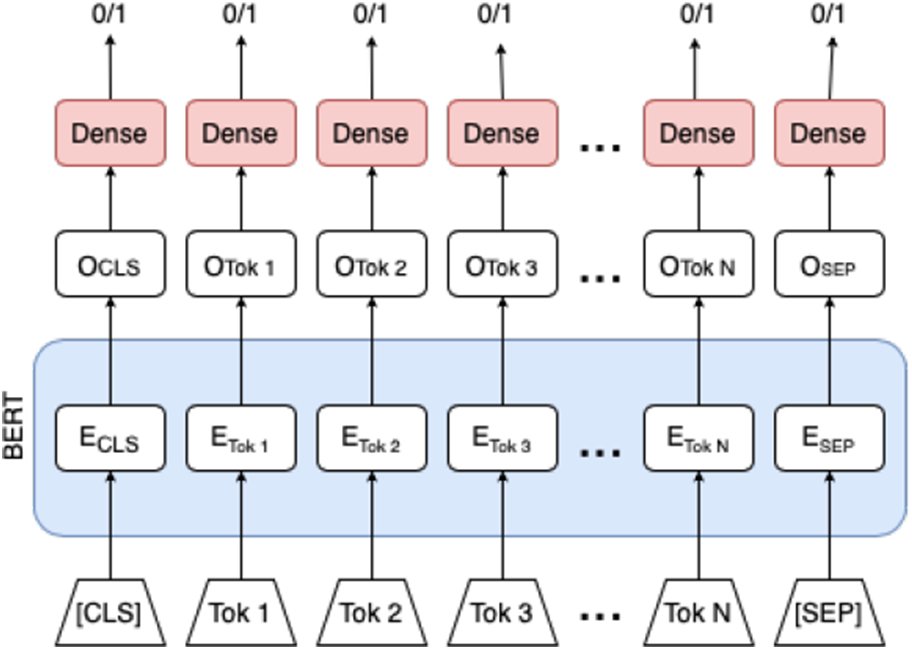
BERT+token relies on sequence labelling. It labels each token to be either hateful (1) or not hateful (0). Figure 3 shows the architecture of BERT+token. On top of the BERT model, there is a fully connected dense layer for each token.
Architecture of BERT+token.
Both models fine-tuned $\mathrm{BERT}_{\mathrm{base\_uncased}}$
. We used a batch size of 32 and the Adam optimiser with a learning rate of 3e-4.
$\mathrm{BERT}_{\mathrm{base\_uncased}}$
. We used a batch size of 32 and the Adam optimiser with a learning rate of 3e-4.
5.2.2 Data pre-processing
We used BERT WordPiece tokenizer (Wolf et al. Reference Wolf, Debut, Sanh, Chaumond, Delangue, Moi, Cistac, Rault, Louf, Funtowicz, Davison, Shleifer, von Platen, Ma, Jernite, Plu, Xu, Le Scao, Gugger, Drame, Lhoest and Rush2020) that lowercases and splits the text into a list of tokens. It always inserts two special tokens. These are [CLS] which is at the beginning and [SEP] which separates sentence pairs. The tokenizer handles out-of-vocabulary (OOV) by breaking down unseen words into subwords (Wolf et al. Reference Wolf, Debut, Sanh, Chaumond, Delangue, Moi, Cistac, Rault, Louf, Funtowicz, Davison, Shleifer, von Platen, Ma, Jernite, Plu, Xu, Le Scao, Gugger, Drame, Lhoest and Rush2020).
The input of the models is the original text and is pre-processed in the same way for the two models. The input consists of two vectors, called input ids and attention mask. The input ids are numerical representations of tokens of the original text. The attention mask sets all tokens of the original text to 1 to which the model should pay attention.
Contrarily, the ground truth spans are pre-processed differently for the two models. Figures 4 and 5 show how a single hateful span and multiple spans, respectively, are processed for BERT+span and BERT+token.
Example of how single ground truth spans are pre-processed for BERT+span and BERT+token. The original text has been encoded into sub-tokens with Bert WordPiece tokenizer.

Example of how multiple ground truth spans are pre-processed for BERT+span and BERT+token. The original text has been encoded into sub-tokens with Bert WordPiece tokenizer.

For BERT+span, we created two vectors of zeros, called start and end where the start and end offsets of the output span are set to 1. When the text has a single hateful span, the start and end offsets are the indices of the first and last tokens of the ground truth span. When there are multiple spans, the system should connect all the spans to not lose any information. In this case, the start offset is the index of the first token of the first ground truth span and the end index is the last index of the last span token. For BERT+token, instead, we created one zeroed vector and marked as 1 the indices of all the tokens belonging to the spans.
Finally, all the input and the ground truth vectors have their first and last indices set to zero for the [CLS] and [SEP] tokens. They were padded by zeros to have the same length. We set a maximum sequence length of 168 tokens.
5.2.3 Post-processing
We performed post-processing for the predictions of the two models. In terms of BERT+span, we connected all the tokens of the original text starting and ending at the predicted indices.
For BERT+token, because it relies on sequence labelling, the system may not consider some tokens to be hateful and disconnect a hateful span. These tokens are the subwords generated by BERT WordPiece tokenizer and English stop words. We, first, connected all the subwords to avoid the case in which subwords of the same word are classified differently. Then, we kept merging two spans if the tokens between them are stop words.
6. Evaluation
6.1 Hate speech detection results
The models, described in Section 5.1.2, are evaluated on the HatEval, HackForums and Extremist forums test sets using accuracy and F1-score. The results are reported in Table 8.
Performance of the classifiers, where [Mono] and [Multi] mean mono- and multi-platform classifier, in percentage in terms of accuracy, precision, recall and F1-score. Values in bold are the best scores

The SVC[Multi] outperformed other models in terms of accuracy on the three test sets, whereas achieved the best F1-score only on the HatEval test set. BERT[Mono] and BERT[Multi] achieved the best F1-score on the Extremist forums and Hackforums test sets.
We also observed that all the multi-platform classifiers outperformed mono-platform classifiers on HackForums test sets and SVC[Multi] outperformed SVC[Mono] in terms of accuracy and F1-score on all three test sets. This was not the case for CNN-GRU and BERT. CNN-GRU[Mono] achieved higher accuracy than CNN-GRU[Multi] on HatEval and HackForums, and BERT[Mono] accuracy on HatEval was slightly higher than BERT[Multi] and achieved a better F1-score on HatEval and Extremist forums. This suggests that multi-platform classifiers may not always outperform mono-platform classifiers which was shown by Corazza et al. (Reference Corazza, Menini, Cabrio, Tonelli and Villata2019).
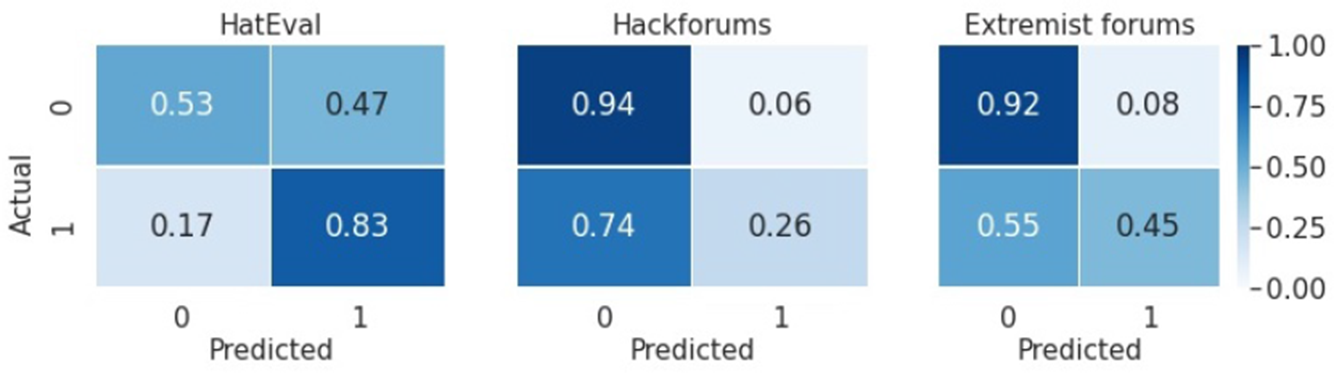
We inspected the confusion matrix, shown in Figure 6, of the SVC[Multi] because it has overall the best performance, and we analyse the performance of the SVC[Multi] across different test sets.
Confusion matrix for the SVC[Multi].
6.1.1 Performance across different test sets
The SVC[Multi] achieved the highest F1-score in HatEval. This is probably due to the HatEval training data being the largest of the multi-platform training data. However, the system achieved a false positive rate of 50%, which is the highest across all the test sets (Figure 6). A possible explanation would be the system being unable to differentiate offensive language and hate speech and classifying non-hateful posts containing pejorative words as hateful.
In terms of HackForums, the SVC[Multi] achieved a poor F1-score of 33.6%, but a high accuracy of 82.6%. The confusion matrix in Figure 6 shows that the system is slightly skewed towards non-hateful predictions. This explains the high accuracy in HackForums because, as Section 4.1.2 reports, it does not contain much hate speech. Though the system scored a low false positive rate (6%), it misclassified 74% of hate speech. This is probably the same problem that we encountered during active learning in which the system scarcely recognised hate speech categories that were not present in the HatEval training data. The HatEval training data only contain posts related to women and immigrants and account for the majority of the multi-platform training data. The unbalanced distribution of hate speech categories may affect the performance of the SVC[Multi].
In comparison, the SVC[Multi] performed better in Extremist forums because there are many misogynistic and racist posts on Stormfront and Incels.co that match the majority of hate speech in the training data. However, similar to the case of HackForums, the system scored a false negative rate of 55% (Figure 6) due to the presence of other hate speech categories.
6.2 Hate speech SE results
We evaluated our SE models described in Section 5.2.1 against two baseline models, namely Entire and Random. The first predicts the entire input text as the hateful span and the second randomly assigns 0 or 1 at the index of each token and outputs a vector. The predictions are post-processed in the same way as BERT+token, as described in Section 5.2.2. Due to the limited data, we performed fivefold cross-validation to estimate how BERT+span and BERT+token generalise on unseen data.
We evaluated the performance of SE models with four metrics. These are exact match, precision, recall and F1-score introduced by Rajpurkar et al. (Reference Rajpurkar, Zhang, Lopyrev and Liang2016) to evaluate the models for the question answering (QA) task. The QA task extracts the answer from a reading passage given a question. Similarly, the hate speech SE task extracts the span from a hateful post except that it does not have a question as input. All the metrics are token-level based and ignore punctuation.
Exact match (EM) counts how many predicted spans exactly match the ground truth spans. It is calculated using Equation (1):
 \begin{equation} EM = \frac{\sum_{i=0}^{N} Match(pred_i, gold_i)} {N}\end{equation}
where pred is the predicted spans, gold is the ground truth spans, N is the data size and Match(pred, gold) is
 \begin{equation}Match(pred, target) =\begin{cases} 1 & \text{if $pred = gold$}, \\ 0 & \text{otherwise} \end{cases}\end{equation}
Precision, recall and F1-score measure the percentage of overlap between the predicted and ground truth spans and are the same standard metrics used in classification with some differences in the notion of true positive (TP), false negative (FN) and false positive (FP).
In SE:
-
TP is the number of tokens that are in both predicted and ground truth spans.
-
FN is the number of tokens that are in the ground truth but not in the predicted spans.
-
FP is the number of tokens that are in the predicted spans but not in the ground truth.
6.2.1 Results
For all models, except for Entire, we calculated the mean, standard deviation and maximum values for exact match, precision, recall and F1-score across five runs. The results are reported in Table 9.
Performance of the span extraction models in percentage in terms of exact match, precision, recall and F1-score. Mean, standard deviation and maximum values across five runs are reported. Values in bold are the best scores

Random has overall the worst performance. It failed at predicting spans exactly matching the ground truth due to its random behaviour and disconnected predictions. Entire, instead, achieved an EM score of 13.4%. However, this only indicates that there are 13.4% of instances in which the entire post is hateful. Entire also scored the highest recall (100%). This score is expected as recall is the ratio of the total number of overlapping tokens and the number of the ground truth spans. Because the prediction is the entire post, the two numbers would always be the same.
Compared to Entire, the two BERT-based models outperformed it except for recall. The performance of BERT+token in terms of precision and F1-score was better than BERT+span. One of the reasons is that BERT+token which is token-level based would be more precise, whereas BERT+span which outputs a single connected span may include many unwanted tokens.
Nevertheless, because BERT+span always outputs a continuous span, it achieved a higher EM score compared to BERT+token that may disconnect the spans. A pitfall of EM of BERT+span is that it relies on the number of posts in which there is a single hateful span. If all the training data consist of multiple disconnected spans, BERT+span that should connect the ground truth spans would achieve an EM of 0%.
6.2.2 Comparison with other works
To the best of our knowledge, this is the first work on extracting hate speech spans. In Section 2.3, we described the propaganda (Da San Martino et al. Reference Da San Martino, Barrón-Cedeño, Wachsmuth, Petrov and Nakov2020) and toxic (Chhablani et al. Reference Chhablani, Bhartia, Sharma, Pandey and Suthaharan2021) SE tasks.
Because other solutions evaluated their models with F1-score, we compare BERT+token which achieved a maximum F1-score of 70.4%. Compared to our solution, the best performing system for the propaganda SE task has a more complex architecture achieving an F1-score of 51.5%. It is an ensemble of BERT and many types of transformers each of which is trained for three tasks: BIO sequence tagging, token-level and sentence-level classification. Similar to the hate speech SE, the propaganda SE shared task had limited data (446 news articles). The higher F1-score of our solution suggests that hateful spans are easier to identify because they are often similar to each other, since they express hate towards or attack individuals or groups.
Turning to toxic SE, the best system achieved an F1-score of 68.5% among the solutions proposed by Chhablani et al. (Reference Chhablani, Bhartia, Sharma, Pandey and Suthaharan2021). Similar to BERT+token, it is based on sequence labelling except it fine-tunes SpanBERT (Joshi et al. Reference Joshi, Chen, Liu, Weld, Zettlemoyer and Levy2019). In contrast, while BERT+token was trained on the data consisting of only hateful posts, they trained their model on 10,000 Civil Comments texts which do not always contain a toxic span. This may have increased the difficulty of their task and explain the better performance of BERT+token in identifying hateful spans.
7. Discussion
In this section, we perform an error analysis to get a deep understanding of the performance of the hate speech classifiers and SE models. The example posts that we present have been changed, while keeping the same meaning, for privacy reasons. Finally, we discuss the broader implications of the systems.
7.1 Hate speech detection
7.1.1 Classifier error analysis
We analysed the posts that were misclassified by the SVC[Multi], the best performing classifier. We considered how the system behaved, in terms of the problems that human annotators encountered during the annotation process. For example, the following post:
-
(1) XXX - welcome. I wish you enjoy living in such a culturally rich, diverse, vibrant, cosmopolitan area. Aren’t those Muslims lovely, hardworking and peaceful people? (Extremist forums)
raised some debates among human annotators because some believed it is a sarcastic post whose real intention is the opposite. The majority of human annotators considered it to be hateful, but the machine classified it as non-hateful. This is not surprising because the post, literally, is not hateful, and it would be hard for the machine to detect any sarcastic intent on the part of the author.
The other source of disagreement was the distinction between offensive language and hate speech. We selected some false positives and false negatives. Some of them contain pejorative words. The following two posts give an example of the most common posts that the system misclassified as hateful:
-
(2) I love you…bitch. I’ll never stop loving you…bitch. You’re my best friend […] and I can’t wait to hug you (HatEval)
-
(3) Just get them legitly, don’t whore post. (HackForums)
Posts (2) and (3) are probably labelled as hate speech due to the presence of the offensive words bitch and whore. These posts show that the machine still cannot understand the meaning of the text and may be biased towards the use of offensive words even if they are used in a way that is offensive but arguably not hateful (oddly in the case of (2) the author is trying to express affection; in (3) ‘whore posting’ is a type of forum behaviour by attention-seeking ‘newbies’).
In terms of false negatives, the following posts show three examples:
-
(4) Nigga you are going to die (Extremist forums)
-
(5) They are gay and useless. (HackForums)
-
(6) It’s not the Chinese virus. It’s the Jew virus (Extremist forums)
Post (4) contains the offensive word nigga, but the system did not consider it to be hateful even if it is telling someone to die perhaps because of the non-standard orthography. In post (5), the author indicates that being gay is on a par with being useless. This may indicate that the machine struggled to understand hateful posts against other targets that constitute the minority in the training data because HatEval contains hateful posts against women and immigrants. The active learning annotation process brought in other types of hate speech, but we recognise that the initial seed set for training focused on a subset of hate speech, and therefore we emphasise that additional annotations should be collected specifically targeting other hate speech types such as ableism, homophobia and trans-exclusionary texts.
Example (6) is an interesting case. It shows a further difficulty of the hate speech detection task. Hate speech does not only manifest with sole words, but also it is often accompanied by social phenomena. This post is considered to be hateful because it is related to COVID-19. The slur ‘Chinese virus’ appeared in 2020 to refer to the coronavirus, which was first detected in the city of Wuhan in China, incited hate towards Asians (Reja Reference Reja2021). This post claimed that the Jews created the virus trying to incite hate towards this group. Although this post would be identified as hateful by a human, it may not be by the machine because it has no knowledge about the relevant social phenomena.
Finally, most of the errors in HatEval are tweets that use hashtags as subject, verb, and object. For example:
-
(7) #Bulgaria doing it the way it should be done. #illegalaliens try to enter, #IllegalAliens are put in a #pinebox (HatEval)
These kinds of tweets lost some information because we opted to remove hashtags during text pre-processing. However, the removal resulted in higher performance as some non-hateful posts also use the same hashtags. How to handle hashtags requires further investigation.
7.1.2 Summary
From the evaluation in Section 6.1, we observe that the SVC[Multi] has overall better performance than the other classifiers despite worse F1-score in the Hackforums and Extremist forums compared to BERT[Multi] and BERT[Mono], respectively. However, the overall performance is still far from perfect. The error analysis shows many limitations of the system.
It is biased towards posts related to women and cannot always recognise hateful posts against other targets. This shows the importance of having a similar distribution of hate speech categories in the training data. Because of this, there are many false negatives on HackForums and Extremist forums test sets that contain other categories that Table 2 lists. The false negatives may also be affected by the multi-platform training data in which non-hateful posts are the majority. A large amount of data with a balanced class distribution is ideal to train any classifier to achieve desirable performance. However, this is challenging because, as we analysed in Section 4.3.1, hate speech is not frequent across all the platforms.
Hate speech detection is a demanding task. One significant issue is the problem of defining hate speech and its boundary with language which is ‘only’ offensive. As reviewed in Section 2.1, the lack of a universal detailed hate speech definition raised many disputes. It was revealed to be a difficult task for humans during the annotation process since judging what is hateful and what is offensive, or not, is a highly subjective task based heavily on people’s background, experiences and personal views. Then, it is even harder for the machine that might still suffer from a poor level of natural language understanding as indicated by some of our error analyses above.
Researchers have struggled to define the boundary between offensive language and hate speech. It is likely for a classifier to use pejorative words, that are frequent and repeated, as an indicator of hate speech. Kwok and Wang (Reference Kwok and Wang2013) found 86% of tweets are classified as hate speech due to the presence of an offensive word. Classifiers biased towards offensive language would cause many issues. In real-life applications (e.g., Twitter), the machine would ban most of the posts because the use of pejorative words has become a social norm (Kleinman et al. Reference Kleinman, Ezzell and Frost2009). This would raise debate related to topics such as free speech, tolerance and civics (de Gibert et al. Reference de Gibert, Perez, García-Pablos and Cuadros2018). A suggestion to the problem would be the incorporation of some contextual information (e.g., authors’ demographics characteristics) in the classifiers because some offensive words that refer to the authors’ target group would not be considered as hateful (Warner and Hirschberg Reference Warner and Hirschberg2012; Davidson et al. Reference Davidson, Warmsley, Macy and Weber2017), for instance. However, this would not solve the problem of the classifiers being scarcely able to recognise hate speech not containing any pejorative terms.
Finally, we found two factors that increased the difficulty of the task. As we reported in Section 4.1.3, some posts were discarded as their intention could not be understood due to the lack of context of the conversation. The reconstruction of the dialogue would help the annotation process and the training of a more robust classifier. However, it would require a large amount of data. Second, hate speech does not manifest with sole words. There are sarcastic posts in which the system does not comprehend the real intention and social phenomena (e.g., COVID-19) that remain unknown to the system. While sarcasm detection has been revealed to be a difficult task that requires further study (Parmar, Limbasiya and Dhamecha Reference Parmar, Limbasiya and Dhamecha2018), it is possible to incorporate the social phenomena by applying domain adaptation that allows classifiers to generalise to a specific target domain (Daumé III 2009).
Although hate speech classifiers may be used in real-life applications, their predictions would still need to be reviewed by human moderators, which was our motivation for exploring hate speech SE so that moderators may review the texts more closely. In semi-automated moderation, the classifier should aim for a low false negative rate and not depend only on the use of offensive language because there are many instances of hate speech not containing disparaging terms.
7.2 Hate speech SE error analysis
We conducted an error analysis to understand how BERT+span and BERT+token performed on the hate speech SE task. We selected the fold on which the two models had the best performance. The spans in bold are the ground truth spans.
7.2.1 BERT+span
We looked at the predicted posts that exactly match the ground truth spans. For example:
-
(1) what a fucking cheating whore (HackForums)
-
(2) LOL you […]. Can be but I hate gays. (HackForums)
Post 1 is an example in which the ground truth is the entire post and the machine correctly extracted it. Example 2 shows that the system was trying to understand the post and successfully found the hateful span leaving out other parts of the text.
We also looked at other predictions that partly overlap the ground truth spans. These predictions either add more words or remove some words without losing their hateful intention. However, there are also a few in which the removal of some parts resulted in a non-hateful span. For example, the following is a hateful post against women in which the entire post should be extracted:
-
(3) My country was one of the first to allow women to vote. I fucking hate my ancestors. (Extremist forums)
The predicted span is I fucking hate my ancestors which makes the span not hateful anymore because the identity of their ancestors or the reason the speaker hates them is unknown. The latter can be found in the first sentence which has been removed. The removal of the first sentence is not surprising as it is not hateful. This example shows that the system failed at understanding the relationship among sentences.
Finally, we analysed posts that have multiple spans. Although some predictions show the ideal behaviour of the system (i.e., connecting all the spans), there are many cases similar to the following example:
-
(4) Good post. Women are the devil’s children tbh. The Bible warned us about this. […]. Women are corrupt/easy to corrupt. (Extremist forums)
in which the system output Women are corrupt/easy to corrupt, only one of the ground truth spans.
7.2.2 BERT+token
BERT+token is better for multi-span predictions. In the following example:
-
(5) Omfg this bitch is so annoying always talking shit […] you damn attention whore. (HatEval)
the system correctly predicted the two hateful spans. However, there are only a few predictions that exactly match the ground truth spans.
Although we performed post-processing to avoid disconnected hateful spans, the problem persists. For this post:
-
(6) Exactly. This mentality is why Christians are superior. They do not try to be above or better than anybody. Yet atheists & Muslims do. Which is an inferior way of acting. (HackForums)
BERT+token extracted three spans: anybody, atheists and do. which is an inferior way of acting. The disconnected spans have become incomprehensible and cannot assist human moderators to determine whether the post is hateful.
7.2.3 Summary
Although BERT+span and BERT+token achieved prominent performance and correctly extracted hate speech, both systems have limitations.
BERT+span is better for extracting a single span because it outputs a continuous span. In terms of multiple spans, it would either correctly connect all the spans or omit some spans. The first case may deviate from the initial purpose – extract short spans to save human moderators time from reading lengthy posts. Although the second case would not be a problem for human moderators because it correctly outputs a hateful span that helps their classification, it would be an issue for researchers who want to analyse some aspect of hate speech (e.g., target analysis) because there is missing information. For multi-span extraction, BERT+token would be more prominent, but the crucial problem is the discontinuous predictions that often become incomprehensible.
In general, hate speech SE systems are likely to be used in practice. Most companies, such as Twitter, rely on human moderators to review potential harmful posts (Harrison Reference Harrison2019). The proposed hate speech SE models that successfully extracted hateful spans could save moderators time in reading lengthy posts and enable them to focus on accurate classification.
8. Conclusion
This work aimed at understanding hate speech in underground and extremist forums where cybercriminals and extremists communicate with each other and potentially incite crime and abuse against specific social groups. It also explored automated hate speech detection and SE systems.
We introduced a manually labelled hate speech dataset, obtained from HackForums, Stormfront and Incels.co, based on which we analysed the distribution of hate speech and the content in these forums. We found that ideologies and the restrictions of user behaviour affect the amount of hate speech. Hate speech is not prevalent on Hackforums because users focus on monetising their skills and gaining hacking knowledge. In contrast, Stormfront and Incels.co contain more than double the amount of hate speech posts compared to Hackforums. This is expected due to them being driven by hateful ideologies and having little to no content moderation.
This work provided a better understanding of hate speech in these forums. However, the problem of hate speech, in general, remains a challenging task due to the lack of a universal legal definition. This was also reflected in the data annotation. Due to the unavailability of labelled data from the three forums, the data were labelled by three human annotators, and the labelling process was complemented by active learning. The annotation process brought up a number of challenges, including differentiating between offensive language and hate speech. Additionally, the system used in active learning was unable to recognise hate speech against targets that were not present in the training data. This problem also appeared in the multi-platform hate speech classifier due to the imbalanced distribution of hate speech categories in the training data. Future work should ensure a similar distribution of hate speech categories in the training data.
We explored different classifiers trained on a combined dataset from Twitter, HackForums, Stormfront and Incels.co. The performance results have shown that hate speech classifiers would not always benefit from combining data from different platforms. However, we do note that it would benefit the research community if additional training data could be collected and released, focused on hate speech as broadly as possible rather than the subtypes of misogyny and anti-immigrant sentiment contained in HatEval, which was the seed set for our training data.
Finally, this research laid the groundwork for hate speech SE, we fine-tuned BERT and adopted two solutions, namely span prediction and sequence labelling. Both models achieved good results achieving an F1-score of at least 69%. We propose a number of improvements as further research avenues. First, it would be beneficial to create a larger dataset to train the model. Second, because we experimented with basic BERT models, future work could investigate other types of transformers that achieved state of the art in many natural language processing tasks.


 Open access

