


Background
Family medicine – FM (in some countries described as General Practice – GP, or Family Practice) is the cornerstone of many health care systems in various countries worldwide. Nevertheless, the standards of clinical care for family and primary care physicians (PCPs) are specialty-derived recommendations which neither seem to be the best way to practice primary care, nor serve as an effective way to develop the discipline of FM/GP (Weiss, Reference Weiss2000; Mant et al., Reference Mant, Del Mar, Glasziou, Knottnerus, Wallace and van Weel2004; Harrison, Reference Harrison2005). Mant and colleagues consider that ‘the strength of primary care research in any country is probably a good indicator of the strength of primary care in that country’ (Mant et al., Reference Mant, Del Mar, Glasziou, Knottnerus, Wallace and van Weel2004). Likewise, the guiding conference discussions held by the World Organization of Family Doctors (Wonca) in 2003 emphasized the importance of strengthening FM/GP research not only with regards to enhancing the role of FM/GP in health care systems, but also for realizing the optimal functioning of those health care systems. This would eventually serve toward achieving better population health outcomes (van Weel and Rosser, Reference van Weel and Rosser2004) since FM/GP research investigates questions related to the most common health problems. The amount of research conducted by FM/GP practitioners is scant when compared to that carried out in other specialties. This trivial participation of PCPs in research is a possible source of bias for practice-based research studies, which may in turn render the validity of research results questionable (Wetzel et al., Reference Wetzel, Himmel, Heidenreich, Hummers-Pradier, Kochen, Rogausch, Sigle, Boeckmann, Kuehnel, Niebling and Scheidt-Nave2005). Furthermore, the majority of studies on FM/GP are in fact conducted by a minute number of academicians in developed countries (Mendis and Solangaarachchi, Reference Mendis and Solangaarachchi2005), most of which have active FM/GP research networks (van Weel et al., Reference van Weel, Smith and Beasley2000; Pimlott, Reference Pimlott2010; van Royen et al., Reference van Royen, Beyer, Chevallier, Eilat-Tsanani, Lionis, Peremans, Petek, Rurik, Soler, Stoffers, Topsever, Ungan and Hummers-Pradier2010) that have rendered FM/GP into an academic discipline with its own curriculum, research base, and peer-reviewed journals.
There are 22 member countries within the League of Arab States, 12 of which host 31 family medicine residency programs that graduate ~182 family physicians annually (Osman et al., Reference Osman, Romani and Hlais2011). The latter residency programs are all accredited by the Arab Board of Health Specializations. The Wonca – Eastern Mediterranean Region was ratified as a regular regional group during the Wonca World Conference in Cancun in May 2010, and its current member countries are Bahrain, Egypt, Iraq, Jordan, Lebanon, Oman, Saudi Arabia, Syria and the United Arab Emirates. Qatar, Kuwait, and Libya are expected to join soon.
Wonca’s International Federation of Primary Care Research Networks welcomes collaborations with any FM/GP research network in the world, and is particularly trying to extend to networks in developing countries (Wonca, 2013).
Objectives
The main objective of this study is to explore the current status of research conducted by academic family physicians in member Arab countries of the Wonca – Eastern Mediterranean Region, as well as to investigate the opportunities and barriers to the adequate implementation of FM research.
Research design and methods
Participants
This is a cross sectional study conducted between August and November 2012, and that targeted all graduate fully trained academic family physicians working in Arab member countries of the Wonca – Eastern Mediterranean Region whose email addresses were available with their corresponding FM societies.
Procedure
The aforementioned target population was primarily invited via email to fill out an anonymous online web-based questionnaire in English, and later received two additional reminder emails, four weeks apart. The email script, along with the informed consent text and the link to the survey, were forwarded on behalf of the researchers by the heads, directors, and administrators of FM societies in Arab member countries of the Wonca-EMR, to all physicians enrolled in the corresponding society, as not all physicians are listed on Wonca Register.
The approval of the Institutional Review Board (IRB) at American University of Beirut-Medical Center was secured prior to the initiation of the study.
Questionnaire
The questionnaire encompassed items inquiring about demographic characteristics, research interests, personal interest in participating in a research team, perceived barriers to conducting research, and the support needed, in addition to any personal research experience.
Data analysis
Data analysis was conducted using SPSS-17, and was mainly descriptive. Bivariate analyses were performed using Fisher’s exact test to find factors statistically significantly associated with ‘lack of interest/motivation’.
Results
Seventy-six out of 139 academic family physicians from eight different Arab countries completed the online survey, with a response rate of 54.7%. The number of participants from each country was as follows: Bahrain (2), Egypt (15), Iraq (18), Jordan (10), Lebanon (16), Oman (2), Saudi Arabia (6), Syria (7) and the United Arab Emirates (2). 37% of these participants held a key/influential position in their countries of residence. Around 75% reported that they are required to conduct research studies, mainly for academic promotions and sometimes for the preservation of their academic affiliation or position. In all, 46% contributed to at least one publication in national or international medical journals (median: 4.0; range: 1–44), and 64.5% reported being currently involved in research activities (median: 2.5). The majority (75%) expressed their interest in participating in a research team, yet reported research skills limitations mainly in fund raising followed by data analysis and study design/methodology (Table 1). Furthermore, 52.6% of the participants disclosed interest in leading a research team.
Research skills of the family physicians interested in participating in a research team (n=57)

Sixty-six surveyed physicians (56%) had attended a research ethics course, among whom 70% cited the course(s)’ name. The presence of a local Research Ethic Committee (REC) and that of a human subject’s protection program was reported by 33 out of the 56 family physicians who answered this question, and only 31 family physicians stated that they are required to report to a local REC before the initiation of research. A REC was only reported to be available in Egypt, Jordan, Lebanon, Oman and Saudi Arabia, with few contradictory answers within some countries, namely Egypt and Iraq. The main challenges encountered with the REC were the delay in processing and the inadequacy of information about the required changes or improvements to reconsider the research proposal, as well as the rigidity in interpreting identity protection, and consent form requirements.
Around 71% of the physicians (n=31), who reported to be aware of financial resources for research, cited at least one resource, and 74% mentioned that they have already tried to secure financial support for research activities. The main financial resources reported included national councils for scientific research, institutional funds, private research foundations, pharmaceutical companies, international organizations like the World Health Organization (WHO), United Nations agencies like United Nations Population Fund (UNFPA) and United Nations Children’s Fund (UNICEF), United States Agency for International Development (USAID), Population Council’s International, Ford Foundation, DAAD German Studies Research Grant, and Biomedical Informatics Research Group (BIRG). Other resources were the Iraqi Ministry of Health, the Iraqi Ministry of Higher Education and Scientific Research, and the Sultan Qaboos Fund in Oman. The reported challenges associated with asking for financial support were writing the proposal, proper timing and submission, the donors’ lack of interest in FM research topics, as well as budgeting, which is a time-consuming task that requires too many forms to fill and too many correspondences to do. The different national/institutional and personal barriers to the adequate implementation of family practice research are reported in Table 2.
Perceived barriers to the adequate implementation of Family Practice research
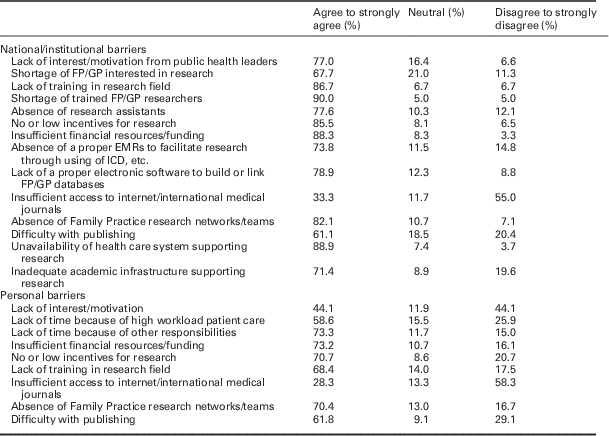
FP=Family Physicians; GP=General Practitioners; EMR=electronic medical record; ICD=International Classification of Diseases.
According to the responses obtained, ‘lack of interest/motivation’ was significantly positively associated with ‘absent or low incentives for research’ (Fisher’s exact test, P<0.00, OR: 9.70 (1.85, 50.20)), and to a lesser extent with ‘lack of training in the field of research’ (Fisher’s exact test, P<0.05, OR: 4.10 (1.08, 18.70)).
In order to go forward in research activities, the following supporting resources were perceived as necessary by some of the surveyed physicians (open-ended qualitative question): governmental/organizational/institutional support, availability of electronic medical records (EMRs), training in research methods (at both undergraduate and postgraduate level), allocation of a protected paid time for research with moral motivation and financial incentives, development of regional/national/institutional research networks/research advisory teams, training in fund raising (financial and human resources), collaboration with regional/national/institutional RECs, development of a regional family and community medicine scientific research councils that can play the role of an ethical review board, and finally securing support for fund raising and publishing.
Finally, three quarters of the participants reported that research is a cornerstone to developing and improving the quality of primary health care services.
Discussion
In this study, FM academicians in the Arab countries highlighted different barriers to the adequate implementation of FM research in their countries. The lack of training in the field of research, the unavailability of a health care system that is supportive of research, insufficient financial resources and funding and lack of incentives were among the top ranked barriers. These barriers were similarly recognized in many studies conducted in western countries (Lionis et al., Reference Lionis, Stoffers, Hummers-Pradier, Griffiths, Rotar-Pavlic and Rethans2004; Mant et al., Reference Mant, Del Mar, Glasziou, Knottnerus, Wallace and van Weel2004; van Weel and Rosser, Reference van Weel and Rosser2004; Glazier, Reference Glazier2008; Lionis et al., Reference Lionis, Symvoulakis and Vardavas2010). Lionis et al. (Reference Lionis, Stoffers, Hummers-Pradier, Griffiths, Rotar-Pavlic and Rethans2004) and Glazier (Reference Glazier2008) noted that insufficient funding opportunities were perceived to be a major barrier in Canada and some European countries. According to Kekki (Reference Kekki2005), this issue requires governmental level strategic planning in order to incorporate research as an indispensable part of the healthcare system, and to secure the resources needed by GP/FM departments.
Most of our study’s participants were also aware that the lack of EMRs is an important barrier to research. An EMR with proper disease coding allows the easy access to electronic patient data and can serve as a prime research tool (Lusignan and van Weel, Reference Lusignan and van Weel2006). The barrier was also reported by Lionis and colleagues in 2004 in the European General Practice Research Workshop and in 2010 (Lionis et al., Reference Lionis, Stoffers, Hummers-Pradier, Griffiths, Rotar-Pavlic and Rethans2004; Reference Lionis, Symvoulakis and Vardavas2010).
Three quarters of the family physicians surveyed in this study have expressed their interest in participating in a research team, and in joining a research network for further research support and advancement. Building practice-based research networks nationally, regionally, and internationally has also been well recognized in the literature as an important step toward successfully building family medicine research capacities. This has been the case in different western countries including the United Kingdom (Van Weel and Rosser, Reference van Weel and Rosser2004; Lionis et al., Reference Lionis, Symvoulakis and Vardavas2010, van Weel, Reference van Weel2011). This interest contrasts with the surveyed physicians’ report of the lack of time as a main perceived personal barrier for being involved in research; similar to what has been reported by physicians in western countries (Hummers-Pradier et al., Reference Hummers-Pradier, Scheidt-Nave, Martin, Heinemann, Kochen and Himmel2008). Therefore, financial incentives for research activities are required; otherwise, family physicians would rather prefer to spend their working time in income-generating activities such as clinical work.
Although the surveyed physicians have made different research efforts, not all of them culminated in published work. In addition, while it is a requirement for 81% of the participants to publish articles in peer-reviewed journals; only 46% of the surveyed physicians successfully achieved this. This may be related to the absence of RECs, problems in the design and methodology, biased data, or localized data that is of no interest to international publishers. In addition, investigating a locally relevant topic may not be of interest to overseas readers, editors, or publishers and thus may further hinder the publishing process (Jabbour, Reference Jabbour2004).
In addition to the above mentioned barriers, it is worthwhile to note that family physicians in our study reported lack skills in medical statistics and lack training in the field of research. Therefore, interventions to build research capacities in FM are highly needed.
FM in the Arab world is struggling to establish its image as a desirable academic specialty (Osman et al., Reference Osman, Romani and Hlais2011). Clinical research education is believed to be crucial for establishing high credibility (Mant et al., Reference Mant, Del Mar, Glasziou, Knottnerus, Wallace and van Weel2004; Kekki, Reference Kekki2005). In spite of the progress that has been made in the research structuring process in Western developed countries during the past decade (Lionis et al., Reference Lionis, Symvoulakis and Vardavas2010; van Weel, Reference van Weel2011), worldwide scientific and medical FM/GP research is still limited, underappreciated, and underfunded (van Weel and Rosser, Reference van Weel and Rosser2004; Harrison, Reference Harrison2005; Glazier, Reference Glazier2008; Lionis et al., Reference Lionis, Symvoulakis and Vardavas2010; Van Weel, Reference van Weel2011), and Arab countries are no exception.
Despite all the listed barriers, primary care physicians need not only to do research but also to use it. The various guidelines FM/GP physicians follow in daily clinical practice are in fact based on research, yet customizing one’s practice to the true national needs and characteristics renders research outcomes more applied and realistic. This is why family physicians should have a role in the generation of population-based research, and this is also why applied research does have an important application in primary care.
Despite the challenges of establishing research as an element of primary care practice, family physicians are capable of such endeavor. This capacity is similar to their ability to attend to their patients’ needs in spite of limited resources (van Weel and Rosser, Reference van Weel and Rosser2004).
Implementing research in FM in the Arab World necessitates the availability of a supportive climate, motivated researchers, and adequate funding. The responsibility for such interventions lies primarily within both the governments and the institutions that provide medical education. Suggested actions include incorporating research skills development as part of FM professional training programs, strengthening the research academic base, creating and promoting primary care practice-based research networks (academic and non-academic physicians), and finally ensuring the well-planned distribution of primary care research funds. National governmental policies are also needed to establish and promote a national research agenda with set priorities, funding allocation, and research-conduct control in collaboration with academic institutions. Wonca – Eastern Mediterranean Region can also play an active role in FM research development like Wonca-Europe through building of research networks. It can also make use of the recommendations issued during the 2003 conference on ‘Improving Health Globally: The Necessity of FM Research’ (van Weel and Rosser, Reference van Weel and Rosser2004), as well as of the stepwise model developed by Lionis et al. (Reference Lionis, Symvoulakis and Vardavas2010) for implementing family practice research in countries with limited resources.
Limitations
The results of this survey are useful as a starting point for further inquiry and a more comprehensive investigation of the problems facing FM/GP research in the Arab world. However, in-depth qualitative research is needed to further study this issue. Nevertheless, our findings cannot be generalized to all family physicians in all Arab countries because of the following limitations: (1) the exclusion of family physicians not affiliated with academic institutions; (2) limiting the dissemination of participation invitations and the survey administration process to only physicians with internet access; (3) restricting the survey to member Arab countries of the Wonca EMR; (4) the relatively small sample size which did not allow for did not allow for comparing findings in between countries.
Conculsion and recommendations
This survey confirmed the existence of a weak FM research infrastructure in most Arab countries. However, many physicians in academic institutions expressed enthusiasm to generate ideas and to conduct research projects. This further entails the need for serious efforts in order to establish evidence-based care at the local or regional level. The FM departments in Arab countries, which ought to be present in all medical schools, should become fully involved in research and research training. It is well understood that research activities is an essential component of academic work, but high level research cannot be achieved without sufficient financial support (national research funds, research grants, and funding research support staff).
Different parties (governments, academic institutions, funding agencies and institutions, FM societies, academic and non-academic family physicians, Wonca – Eastern Mediterranean Region, etc.) are invited to coordinate their efforts to promote FM research capacities in the Arab world. Further work is needed to evaluate the possible contribution of different parties.
Acknowledgments
The authors report no financial or other conflict of interest. The authors alone are responsible for the content and writing of the paper. The manuscript has neither been published elsewhere nor is considered for publication in another journal.



