

Photographs, much less comic books, are not often seen to be focal sources of legal-historical research. This is so despite the growing momentum in the humanities and social sciences to take the visuality of culture, history, and law seriously.Footnote 1 Notwithstanding the “visual turn”Footnote 2 in law and humanities and socio-legal studies, it remains quite rare for legal history journals to carry images for the close reading of their pertinent implications. For the most part, legal scholarship has continued to exclude much of the optical media that arrange and compose the history of law, including the textual documents whose visuality produces, even contests, foundational legal concepts.Footnote 3 This omission calls for intervention, not because legal history has failed to engage critically with dominant histories and the legal orders that they sustain, but rather because archived photographs and their (re)entry into visual modes of storytelling expand the range of historical sources that facilitate such critical projects.Footnote 4 More fundamentally, the remediated photograph discloses the technological and theoretical assumptions of history-writing, prompting reflection on how far legal history should evolve to accommodate insights from its neighboring fields.Footnote 5
This article centers upon the photographic medium, particularly the graphically remediated photograph, in legal history. I contend that photographs and graphic novels bear the potential not only to supplement critical legal history but also to disclose the constitutive conditions of such practice. When photographs of real referents—Roland Barthes’ “that-has-been”Footnote 6 —enter the fictional domain of the graphic novel through artistic remediation, the medial-material conditions under which legal histories are written become visible as foundational objects of study. In Barthesian terms, the spectrality of photographs reveals and partakes in the making of spectral histories.Footnote 7 To understand the medial operations that (re)constitute the histories of nations and other legal phenomena, legal history should attend closely to such visual-narrative forms as material records for analysis. I advance this methodological-theoretical claim by staging a conversation between Ariella Aïsha Azoulay’s account of potential history in Potential History: Unlearning Imperialism (2019) and Sonny Liew’s Singapore-based graphic novel The Art of Charlie Chan Hock Chye (2015).Footnote 8 Though differing in genre and geopolitical interests, both texts coincide in their concern with the imperial histories of nations and in their critical dealings with archived photographs. Read in tandem, Azoulay’s and Liew’s masterful treatments of photography, history, and law—the former adapting Walter Benjamin’s media theory and philosophy of history, and the latter disclosing the archival basis of Singapore’s rule of law—offer key insights into the potential contributions of photographs and comics to legal history.
In what follows, I first reconstitute Azoulay’s method of potential history, positioning it alongside Walter Benjamin’s writings on photography, history, and law, so as to specify its contribution to legal history. Where helpful, comparisons are made with Christopher Tomlins’ speculative mode of legal history, which is likewise indebted to Benjamin’s works. Thereafter, I turn to Liew’s graphic novel as both an expression and interlocutor of Azoulay’s potential history, focusing on Liew’s remediation of archived photographs of Singapore’s former politicians and contestation of official accounts of the nation’s pre-independence history. To clarify the unique contribution of Liew’s comic art, references are made to both established and critical accounts of Singapore history. The methodological-theoretical perspective to be forged alongside Azoulay’s critical theory and Liew’s artistic practice, which may guide future inquiries in law and history, is what I call “potential legal history.”
The Photographic A Priori
In media theory, analog photography has been apprehended within histories of communicative media for its profound effects on Western society, culture, and aesthetics. For Marshall McLuhan, the photograph’s capability of “isolat[ing] single moments in time”Footnote 9 through the camera shutter and photochemical process precipitated Western humanity’s entry from the typographic to graphic age, one readily observable phenomenon being the proliferation of pictorial advertisements that were exactly repeatable and automatically producible. Likewise, recognizing the camera’s unprecedented technological competence of storing images and its enabling of image transmission across space and time, Friedrich Kittler understood the mid-nineteenth-century invention of photography to be the emergence of a mass optical medium that rivalled, even surpassed, Gutenberg’s printing press.Footnote 10 In step with McLuhan’s prior observations about the inward psychical and creative-processual turn in the visual and literary arts prompted by photographic automation, Kittler observed the technical medium’s transformation of nineteenth-century culture and aesthetics, including Honoré de Balzac’s and Edgar Allan Poe’s depictions of photographs as substitutive threats to their referents.Footnote 11
Anticipating McLuhan’s and Kittler’s post-war interventions, Walter Benjamin already affirmed photography to be at the technical core of reality in early-twentieth-century Europe, prescribing the possibility of his own theorization of art, history, and law. Readers of Das Kunstwerk im Zeitalter seiner technischen Reproduzierbarkeit (1936) (“The Work of Art in the Age of Mechanical Reproduction”)Footnote 12 will be familiar with Benjamin’s claim that the category of authenticity had increasingly become obsolete in regard to technically reproducible art, one key reason being that the emergent copying techniques (photography and, later, film) had superseded the optical competence of their manual predecessors (painting and other fine arts). On photography, Benjamin observed that not only could the camera lens register aspects of the original work that elude natural vision, but the portable photograph also spatially extended the original work by transposing it to new settings.Footnote 13 If the photograph transmits more data than manual modes of perception and facilitates the object’s entry into new contexts of meaning, then the authenticity qua historical presence of the object diminishes in significance. The unique object’s spatiotemporal index, or “aura,” is that which “withers in the age of mechanical reproduction,”Footnote 14 making room for new encounters between politics and artistic (re)production, particularly in the context of communist resistance to fascism.Footnote 15 Analog photography was the pivotal mid-nineteenth- to early-twentieth-century technology that afforded, even prompted, Benjamin’s thinking about the substitution of politics for authenticity as the central evaluative category of art, including photography.Footnote 16
Though not expressly discussed in Über den Begriff der Geschichte (1939) (“Theses on the Philosophy of History”), photography suggestively informed Benjamin’s theorization of history.Footnote 17 Traces of the medium, as Azoulay has sharply observed, may be found in the resonant idioms deployed therein, as if Benjamin’s thinking of history had proceeded alongside that of the camera.Footnote 18 Consider, for instance, Benjamin’s striking depiction of the past in terms of the image and its ancillary flash: “The past can be seized only as an image which flashes up at the instant when it can be recognized and is never seen again.”Footnote 19 Is the near-blinding moment of illumination not quite reminiscent of the camera flash that has enabled the arrest of scenes under otherwise dim conditions since its invention in the late nineteenth century?Footnote 20 We may be hard-pressed to count the many overdetermined sights in our own lives that have withdrawn from memory, perhaps “irretrievably,”Footnote 21 for lack of a camera or other storage technique at hand. The camera not only afforded Benjamin’s theorization of historical truth as an imaginal slice of time but also enabled Benjamin’s famous remediation of Paul Klee’s painting Angelus Novus (1920) into a series of photographs, that is, a motion picture of the angel of history looking helplessly upon the accumulating wreckage before its feet.Footnote 22 History apprehended not as linear progress, but rather as catastrophic repetitions to be interrupted by images of truth taken with the aid of the camera flash, is a distinctly photographic model of history. The angel’s gaping mouth is the very image of the mute(d) event whose speech has yet to arrive, demanding then that historians like Azoulay undertake their projects of articulating the event’s potential significance.Footnote 23
Taking guidance from Azoulay’s medial reading of Benjamin’s final work, let us add that the photograph as an optical medium with the potential of voice-ascription might well have underpinned his prior account of law as mythic violence in Zur Kritik der Gewalt (1921) (“Critique of Violence”).Footnote 24 It was in reference to the Greek myth of Niobe’s punitive transformation into a boundary stone, “an eternally mute bearer of guilt,”Footnote 25 separating the realms of mortals and gods that Benjamin distinguished profane law from divine justice. For Benjamin, positive lawmaking was interested not so much in justice as in the cruel (re)constitution of power: “Justice is the principle of all divine endmaking, power the principle of all mythic lawmaking.”Footnote 26 Apprehended from within the Judaic tradition where Benjamin stood, Apollo and Artemis’s condemnation of Niobe for taking boundless pride in her children was but an instance of mythic violence that reinstated the rule of the Greek gods. Indeed, if their law consisted in the literal petrification of their subject in time, then the law might be seen to have operated as a camera that isolated, then printed onto film, a single slice of time. Both oppression and the means of redressing it, as depicted in Benjamin’s text and demonstrated in his rereading of the Greek myth, could be thought of alongside the camera. In so belatedly ascribing to Niobe the silenced voice of the oppressed, Benjamin treated her boundary stone as if it were a photograph that prompted its own ethical unmuting. Such an anachronistic remediation of Homer’s figure into a visual image with aural potential was technically indebted to photography.
As a novel method of history that references and credits Benjamin’s writings, Azoulay’s potential history is articulated alongside the same photographic apparatus that poses the dual possibilities of imposing and undoing imperial violence. It is no accident that the camera shutter becomes Azoulay’s figure for presenting the imperial enterprise of displacing and dispossessing colonial subjects.Footnote 27 In regulating the fall of light upon the film, the shutter allows for the capture of a visible and defined image. Expressed in more political terms, the shutter is that technical element that permits items to be included in or excluded from the camera’s eye. In “The Work of Art in the Age of Mechanical Reproduction,” Benjamin denounced “the horrible features of imperialistic warfare”Footnote 28 over against Filippo Tommaso Marinetti’s fascist aestheticization of the Second Italo-Ethiopian War (1935–1937). In so doing, Benjamin raised the possibility of seeing photography as a technology of (re)production that contributed to European imperialist projects. As if responding to Benjamin’s invitation, Azoulay rethinks imperial violence alongside, and in terms of, the camera shutter: “The camera’s shutter is not [merely] a metaphor for the operation of imperial power, but it is a later materialization of an imperial technology. Photography developed with imperialism; the camera made visible and acceptable imperial world destruction and legitimated the world’s reconstruction on the empire’s terms.”Footnote 29 More specifically, she calls attention to three axes along which the shutter operates to configure and legitimate colonial scenes: one, the temporal axis (that is, the shutter’s division “between a before and an after”Footnote 30 ); two, the spatial axis (ie. its differentiation ‘between who/what is in front of the camera and who/what is behind it’Footnote 31 ); and three, the constitution of the body politic itself (as being split “between those who possess and operate such devices and appropriate and accumulate their product and those whose countenance, resources, or labor are extracted”Footnote 32 ). The shutter’s non-neutral closures and (re)openings are the power-laden operations that segment, dissect, and turn peoples and worlds into exploitable imperial resources. To resist imperialism is to suspend the shutter’s operation: to recognize the camera’s role in sanctioning imperial violence and to restore visibility to what has been ousted from the photographic gaze.
The legal implications of Azoulay’s photographic model of imperial history may be clarified by revisiting her study of the rape of German women by the Allied forces at the end of the Second World War, which doubly addresses the question of citizenship and the (re)constructive role of the archive.Footnote 33 Whilst acknowledged in the historical records studied by Azoulay, the mass rape of German women by the Allied soldiers still lacked a visual account. It is this archival gap that Azoulay proceeds to fill from the perspective of potential history. Instead of simply accepting that only oral testimonies and other non-visual historical sources of the sexual violence remain, Azoulay generates four categories of photographs that attest to it by closely reviewing a series of existing photographs and related historical texts. From a photograph of two male soldiers standing before Berlin’s Brandenburg Gate (one carrying a camera and the other taking a picture of the one), which Azoulay reads as indexing the presence of photographers in the city rife with rape, Azoulay proposes “the untaken photograph of rape.”Footnote 34 As she encounters historical passages that reference or allude to rape, she inserts blank squares and draft captions as placeholders for those other photographs that had not been taken. Because the photographed soldiers could have captured images of rape even if those images did not eventually reach the archive or were not fully recognized, Azoulay posits other possible categories: “the inaccessible photograph of rape, the undeveloped photograph, the not-yet-coded photograph of rape or the as-yet-unacknowledged photograph of rape.”Footnote 35 Azoulay’s belief in these potential photographs is not fanciful: the co-presence of cameras and other historical testimonies of rape suggests that these photographs could have been taken and may now be admitted as such into the archive pursuant to the method of potential history. Confronting a photograph of well-dressed women walking in the public streets of Berlin adjacent to a damaged building dated to around three months after the entry of the Allies into the city, Azoulay redescribes the photograph from one of mere architectural ruin to one indexing the only very recent suspension of “the omnipresent threat of rape”Footnote 36 that had sent those women into hiding. Other related battered-city images are, potentially, images of “an arena of rape,”Footnote 37 even if these have yet to be recognized as such. During the last moments of the war, German women were forcibly turned into “rubble-women”:Footnote 38 embodied lives degraded alongside the cityscape.
Demonstrated in Azoulay’s speculative retrieval of unseen photographs of rape is her model of “cocitizenship,”Footnote 39 a collaborative idea of citizenship that opposes and corrects the imperialist model that now prevails in legal discourse. In public law and international law, citizenship is conventionally understood to be a form of legal-political belonging centered upon the nation. Under this nationalist model of citizenship, Azoulay is an Israeli citizen as removed from her German subjects of study as she is from the Palestinians, Mexicans, and other border-crossing marginals across the past five hundred years of imperial history (1492–2019). Against the nation-based designation of citizenship, Azoulay advances and demonstrates a counter-model that affirms her own status as a co-citizen, a compatriot of her disenfranchized peers with both the capacity and responsibility to respond to their conditions of oppression under the imperialist global order. The prefix “co-” foregrounds the sense of “partnership”Footnote 40 that Azoulay advances and demonstrates in her approach to the archive and its photographs. In Azoulay’s attentive readership, the deprivation of rights to bodily autonomy and integrity suffered by German women is shown to be an effect of the Second World War that the international legal order has yet to acknowledge fully. To redress this complicity in screening the perpetrated violence, she recodes the existing photographs and other corroborating archival sources to transmit an untold visual story of rape. Co-citizenship consists in scrupulously exploiting the potential of the archive to tell a different history of oppressed subjects legally classified as belonging to a separate community from one’s own. Potential history’s pertinence to law and legal discourse extends to its disclosure of the law’s failure to accommodate imaginings of citizenship where an Israeli subject may rightly fulfill their ethical responsibility for persons other than their countrymen.
For the field of legal history, potential history illuminates the archive’s dual role of propagating legal constructs such as nationalist citizenship and of potentially displacing their limits through its recodeable materials. Nation-based distinctions between persons are contingent categories produced by an “archival regime,”Footnote 41 that is, a set of documentary or file-based practices that sustain the authority of institutions comprising the sovereign states of international law.Footnote 42 Without the state-centered archive, there would be no “undocumented persons,” “asylum seekers,” “refugees,” nor “citizens.”Footnote 43 In so critiquing the archive, Azoulay calls attention to the material basis of legal categories and authority, a fact that legal historians may well be cognisant of but nonetheless tend to elide in favor of the significatory content of their sources. Azoulay goes further to demonstrate the possibility of returning to the archive, privileging its photographic sources, and fabricating hitherto suppressed visual narratives that restore visibility to the present significance of records relegated to the past. In respect of the rape of more than one million German women by the Allied soldiers during the spring of 1945, Azoulay presents the episode and its suppression as part of the ongoing violent process of perpetuating the patriarchal world order. “I propose to see the imprint of patriarchal order on women’s bodies during the final stages of World War II and the implementation of a ‘new world order’ after its end as inseparable from the archival process of categorizing imperial governance with the neutral political language of unqualified terms—sovereignty, citizenship, democracy, peace, instead of curfews, raids, body searches, arrests, rapes.”Footnote 44 Mass rape and its archival dissimulation are, at once, the violent effects and constitutive practices of the international legal order. Whilst legal historians might simply accept the scarcity of photographs of rape to be an explanation for the absence of such visual history, the potential historian suggests that this visual history could well emerge from the existing archival records and that the acceptance of its impossibility is but a product of the archival regime that sustains the imperial world order.
Azoulay’s theoretical contribution may be sharpened in comparison with Christopher Tomlins’ own Benjaminian approach (recently reformulated as “speculative history”Footnote 45 ). Tomlins’ approach to legal history is consciously advanced in opposition to what he perceives to be the new orthodoxy of legal-historical scholarship in the United States: critical legal history.Footnote 46 Whereas critical legal history takes aim at the liberalist account of law as progressively evolving to fulfill its societal functions and instead stresses the contingent and plural co-constitution of law and society,Footnote 47 Tomlins joins Azoulay in citing Benjamin’s philosophy of history as a call to recognize the pressing relevance of the past to the present. For Benjamin and his two intellectual children, truth is not the subject of demystification (which tends to be the aim of critical legal history), but rather is to be apprehended in the very act of connecting or “constellating” a past event with the present as being one of our pressing concerns. “[The historian] grasps the constellation which his own era has formed with a definite earlier one. Thus, he establishes a conception of the present as the ‘time of the now’ which is shot through with chips of Messianic time.”Footnote 48 Citing this same passage from Benjamin, Tomlins highlights the potential for the present unfolding of the prior event’s significance, rather than merely underscoring the contextual dependence of any event’s meaning. “Out of the fragments of meaning amassed from the subjection of past phenomena to the critical process, the critic/historian constructs constellations—that is, new historical objects or dialectical images that join together what may be quite distinct phenomena, whose significance can emerge only posthumously or retrospectively, in a relationship with the now that has apprehended their significance.”Footnote 49 The “time of the now” is that overriding temporality in which the so-called past is recognized to be one of the present’s immediate concerns. Azoulay affirms this as much in her apprehension of wartime sexual violence as being traceable and foundational to the imperial world order.
In line with his prior remarks on a Benjaminian model of history, Tomlins has more recently composed a “speculative history,”Footnote 50 that is, a reimagined history of the famous African American slave Nat Turner, who led a four-day rebellion in Southampton County, Virginia, in 1831, that is framed in filmic terms. Speculative history for Tomlins, as potential history is for Azoulay, is not made up of baseless conjectures but rather consists in an imaginative art of mapping out the significance of the historical phenomenon at hand based on the archive’s limited records.Footnote 51 The chapter narratives of In the Matter of Nat Turner: A Speculative History (2020) are understood to be enfolded layers of a composite whole or “montage”Footnote 52 constructed from Tomlins’ present view of past records. Benjamin’s “constellation” is Tomlins’ choice figure for the activity of connecting the “what-has-been” with the “here-and-now”; which he not only undertakes, but also invites the reader to do anew as they presently (re)constitute the book’s significance. This montage may be briefly reprised in regard to its key references, some of whose genres the field of history has traditionally disregarded on the grounds of bias and inaccuracy. In Part I, for instance, Tomlins attends to the testimony of Nat Turner in a twenty-four-page pamphlet published by a Southampton County lawyer shortly after Turner’s execution, considering how the publication’s paratexts shaped and revealed its textual significance. Part II relies upon philosophical, sociological, and anthropological texts, including Benjamin’s “divine violence,”Footnote 53 as guides to clarify Turner’s recorded way of thinking, or mentalité. Part III then unpacks the implications of Turner’s rebellion on the polity of Virginia. Rather than accepting Turner’s rebellion to be irredeemably past or absolutely known, Tomlins seeks to recover the alterities of the event and its unexhausted textual records by positioning the latter alongside selected works as diverse as Max Weber’s Wissenschaft als Beruf (1917) (“Science as a Vocation”) and Walter Benjamin’s Kapitalismus als Religion (1921) (“Capitalism as Religion”).Footnote 54 For the reader, Tomlins’ book becomes one of the textual sources to be put in dialectical relation with other fragments in order to produce a composite image presenting its historical truth.
Despite their strong intellectual and ethical kinship, Azoulay and Tomlins’ histories tellingly differ in their treatments of photographs as historical sources. Whereas Tomlins only takes visuality and optical media to be figures of speculative history, Azoulay recognizes photographs and photography to be the very material techniques that sustain and disrupt the orders of law and history. The images appearing in Tomlins’ work are mostly of texts—the front cover of the original print edition of Styron’s The Confessions of Nat Turner (1967), the title page of Gray’s 1831 pamphlet, Nat Turner’s weathered copy of the Bible, and so forth. Where others, such as a book illustration of Turner’s “horrid massacre”Footnote 55 and an 1831 engraving of the Virginia State Capitol, appear, these are but ornamental inclusions. Tomlins taps on images to enrich our reading experience but does not recognize these to be the medial-material basis for (re)constituting and contesting oppressive regimes. Conversely, Azoulay demonstrates the photographic medium’s function of screening acts of violence perpetrated on marginalized persons and communities and the medium’s immanent potential to expose such oppression. The camera shutter is not just an evocative metaphor for imperialism in Azoulay’s work but rather is recognized to be a material technology that divides and renders appropriate slices of time and space. Azoulay goes further to make manifest the value of photographs in fabricating potential histories that withhold assent to the prevailing regimes of authority and intelligibility. Her recognition of photographs as potential historical sources points the way to legal history’s displacement of its own textual bias.
Potentializing Singapore
The Art of Charlie Chan Hock Chye is a legal-historically significant work that, when read alongside Azoulay, gives us a sense of the plural forms in which potential histories of law may take. Liew’s work not only discloses the archival basis of Singapore law but also points to photographs, comics, and other visual narratives as potential sources of legal-historical research. Recognized to be both an expression and interlocutor of Azoulay’s method of potential history, Liew’s masterful remediation of archived photographs of Singapore’s former politicians is demonstrably instructive for the field of legal history.
The legal significance of Liew’s graphic novel is doubly registered in its paratextual history and thematic content. Looking first at the book’s epitextual background (particularly the contextual materials that present it to the public),Footnote 56 we learn that its production has been historically implicated in governmental review. To support the making of this work, Liew had been awarded a publishing grant of S$8,000 from the National Arts Council of Singapore (“NAC”), a statutory board overseen by the Ministry of Culture, Community and Youth that was established “to promote conditions conducive to the advancement of artistic activities in Singapore.”Footnote 57 However, within two months of its first publication, and ahead of its launch in Singapore on 30 May 2015, the grant was withdrawn for the book’s radical politics. As publicly explained by a senior director of the NAC: “The retelling of Singapore’s history in the work potentially undermines the authority or legitimacy of the government and its public institutions, and thus breaches our funding guidelines, which are published online and are well known in the arts community.”Footnote 58 Liew’s visual storytelling was perceived by the government to be threatening in its potential to destabilize its operations and delegitimize its rule, which the terms for financial support had sought to preclude. The material effects of this withdrawal included not only the local publisher Epigram Books’ return of an already-dispensed $6,400 but also the publisher’s use of opaque stickers to conceal the NAC logo printed in the first books.Footnote 59 Peritextually, these first printings registered both the Singapore government’s initial support for the work and subsequent disavowal of it. At present, The Art of Charlie Chan Hock Chye continues to pass the scrutiny of the Infocomm Media Development Authority, another statutory board that regulates the production and distribution of publications and audio materials in Singapore.Footnote 60 This suggests some degree of governmental openness to politically engaged media.Footnote 61 On top of securing the highest international awards, Liew’s graphic novel won the Singapore Literature Prize of 2016, the nation’s top literary prize awarded in a competition run by an NAC-supported independent charity.Footnote 62 As an ambiguous event in the history of literary and artistic production in Singapore, the book’s encounter with authority raises the key question of how far the public funding of the arts, in Singapore as well as in other jurisdictions, should be bound to the interests and views of the day’s government.
In respect of the work’s contents, The Art of Charlie Chan Hock Chye politicizes the graphic novel form by depicting, even reimagining, Singapore’s pre-independence history. As theorized by Thierry Groensteen, comics are a form of visual storytelling, or “storytelling with images”.Footnote 63 In the semiotic system of comics, the traditional priority granted to the word in textual narratives is inverted. It is rather the placement of images as panels on the page that acts as the basis for constructing meaning, with letters playing a visibly subordinate role. Liew’s innovation consists in inventing a Singaporean comics artist, the eponymous Charlie Chan Hock Chye (1938–), who has lived through and graphically narrativized the decades leading up to Singapore’s independence and beyond. These include the uncertain years of Singapore’s anti-colonial protests (1954–1959); the People’s Action Party’s (“PAP”) landslide victory in the 1959 General Elections and appointment of Lee Kuan Yew as Singapore’s first Prime Minister; the 1961 splitting of leftist, anti-colonial members from the PAP to form the competing party Barisan Sosialis; the arrest and detention without trial of Lim Chin Siong and other left-wing leaders of the Barisan Sosialis in the February 1963 Operation Coldstore, an anti-communist security operation jointly launched by the Singaporean, Malayan, and British governments pursuant to the colonial law of preventive detention; Singapore’s 1963 merger with other former British colonies to form the Federation of Malaya, then separation to become a sovereign nation on 9 August 1965; and, lastly, post-independence Singapore (1965–), whose much-admired economic success continues to be haunted by Western-liberal critiques of the nation’s laws and policies.Footnote 64 The Art of Charlie Chan Hock Chye reads as a compilation of selected comics authored by Charlie Chan, published and unpublished, introduced and presented by Sonny Liew, himself drawn as a character who occasionally comments on Chan’s works and the influences behind them.Footnote 65 Varying in style and content across the decades, Chan’s comics often represent key events in Singapore history while also rehearsing contemporary critiques of Lee’s government and the nation’s rule of law.Footnote 66 In so dealing with matters of history, politics, and law through visual storytelling, The Art of Charlie Chan Hock Chye brings to light the nation’s conflictual past and the alleged failure of Lee’s government to recognize it.
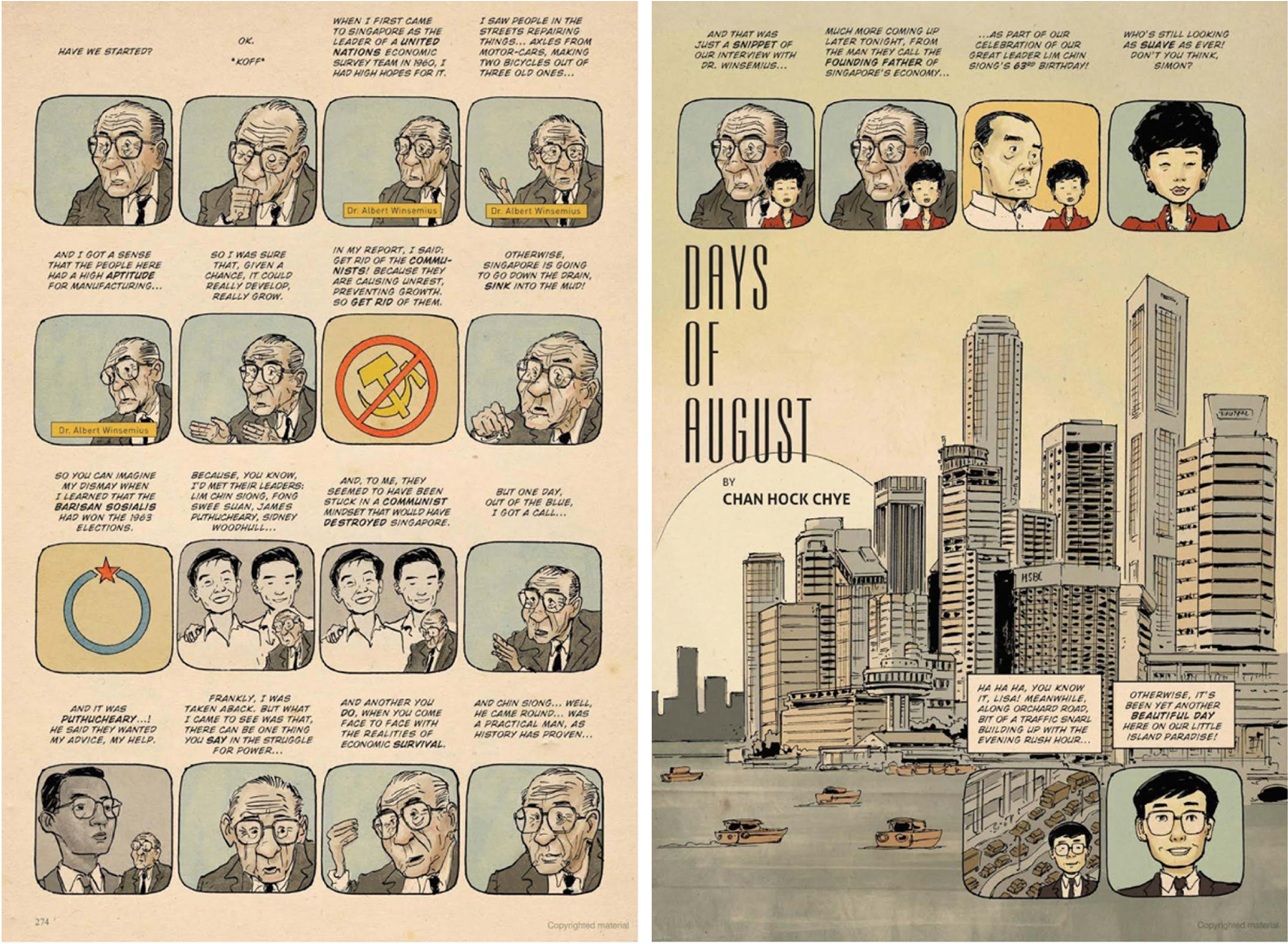
In what might be Chan’s most imaginative comic, we find an alternative version of Singapore in 1996 premised upon the non-occurrence of the legal event that destroyed the left-wing Barisan Sosialis, namely, Operation Coldstore.Footnote 67 On the recto of the opening pages bearing the comic’s title (“Days of August”) and author’s name (“Chan Hock Chye”), we find a portrait of modern Singapore’s skyscrapers and, in a small panel, a snapshot of the congested Orchard Road, Singapore’s luxury shopping street (see Figure 1). These familiar visual markers of the nation’s economic success are, however, accompanied by a radical historical substitution: instead of Lee Kuan Yew, it is Lim Chin Siong whom the comic’s news anchor introduces as the “founding father of Singapore’s economy”Footnote 68 and the nation’s “great leader.”Footnote 69 As Chan’s story goes, the non-occurrence of Operation Coldstore allowed the Barisan Sosialis to win the 1963 General Elections and Lim to become the second Prime Minister of Singapore.Footnote 70 According to the interviewed Dutch economist Dr Albert Winsemius (an historical figure who had in fact assisted the government),Footnote 71 Lim and his fellow Barisan Sosialis leaders revised their former communist inclinations to ensure the nation’s economic survival.Footnote 72 Instead of being detained without trial, released on account of his lapse into clinical depression, then displaced to live in London for a decade before returning and succumbing to a heart attack in February 1996 (these being the recorded facts of Lim’s life), Lim was presented as being capable of steering the nation towards success. This imagined regime, for reasons that I will discuss later, does not last. But what matters as an index of the threat the work poses to the government, and of what the latter depends upon to sustain its legitimate rule, is the comic’s contestation of the official claim that the 1963 preventive detentions were necessary.Footnote 73 Chan/Liew graphically suggests that the non-use of preventive detention powers in February 1963 might not have been detrimental to the nation in the long run. Desisting from their use on Lim and other Barisan Sosialis leaders, thereby allowing them to compete in the general elections of September 1963, would have upheld the constitutional values of due process and democracy.Footnote 74
The opening pages of Chan’s “Days of August.” Reproduced with the permission of Epigram Books and Sonny Liew.

Because “Days of August” presents an alternative history of Singapore, it is tempting to view Liew’s work as instantiating a critical-revisionist mode of legal history that has emerged in response to perceived limits of the official account. As noted in Singapore historians Hong Lysa and Huang Jianli’s genealogy of Singapore’s state-sanctioned history, one of the material forms that this account first took was a revised syllabus for secondary school students that doubly centered upon the nation’s British colonial history and multiracial immigrant beginnings.Footnote 75 Turning to a 1982 newspaper article on this curriculum reform that had been announced by the Minister of State for Education, we shall learn that, instead of the prior world history course dating back to 500 BC, the new history course took the British colonial officer Sir Stamford Raffles’ founding of Singapore as a British trading post in 1819 to be the nation’s pre-independence point of origin; while further identifying the nation’s “forefathers” as “mostly poor immigrants from China, India, and neighboring countries [who had sunk] their stakes in a young port and trading center and built it up, literally, from nothing.”Footnote 76 As the rhetoric of invested labor and national development indicates, this official history (then already called “the Singapore Story”) followed a simple linear trajectory that saw the totality of Singapore’s past as paving the way for the developed present. The nation’s achievement of independence on 9 August 1965, and more importantly the following accomplishments of the “modern and dynamic city-state”Footnote 77 led by the PAP government, were recognized to be the hard-won outcomes of historical struggles within the field of modernization opened up by the British Empire. Alternative imaginings of the nation—of what it could have been and of what it could still be if those pasts were to be revitalized—were of little if any relevance to the official history.
Another classic contribution to this official history, to which Chan alludes in one of his other comics,Footnote 78 are Lee Kuan Yew’s memoirs, the two volumes of which were originally published in 1998 and 2000.Footnote 79 Despite Lee’s prefatory presentation of his memoirs as his personal account of the nation’s history rather than the government’s,Footnote 80 it has been largely accepted in local historical scholarship, both critical and apologetic forms, to cohere with and represent the establishment’s account.Footnote 81 This conflation is perhaps partly encouraged by the first volume’s title adoption of the definite article: Lee’s memoir was entitled “The Singapore Story” rather than “A Singapore Story,” as if purporting to be more authoritative than other histories that had come before or had yet to be written. In Lee’s account of pre-independence Singapore, Lim and other leftists who had broken away from the PAP to form the Barisan Sosialis were rabble-rousing “communists” or “pro-communists,”Footnote 82 whose support for the outlawed Malayan Communist Party threatened to ruin Singapore. Their repeated public denials of having communist ties, including Lim’s letter to the national newspaper averring that he was “not a Communist or a Communist front-man or, for that matter, anybody’s front-man,”Footnote 83 were dismissed as being part of an elaborate ruse to ruin the PAP and Singapore. Consistently, in Lee’s account of Lim after the latter’s detention under Operation Coldstore, Lim was depicted as the fallen leader of the “communist united front.”Footnote 84 Entitled “The Communists Self-Destruct,” the eighth chapter of the second volume foregrounded Lim’s attempted suicide by hanging from a pajamas tied to a cistern while receiving treatment at the prison hospital (in November 1965).Footnote 85 We later read of Lim’s personal request to Lee for leave to travel to London and his desire to withdraw permanently from politics (in July 1969).Footnote 86 The closing image of Lim was one of abjection, disillusionment, and defeat. Further, Lee stressed the necessity of using the law of preventive detention against Lim and his fellow communist-converts: “Could we have defeated them if we had allowed them habeas corpus and abjured the powers of detention without trial? I doubt it.”Footnote 87 In thus depicting the Barisan Sosialis as a threat that had to be neutralized, Lee propagated the official account that justified the legal violence and rejected claims of “political opportunism”Footnote 88 on the part of Lee and other Anglophone PAP members who had stayed put.
In response to Lee’s memoirs and other promoters of the Singapore Story, Hong, Huang, and other historians have advanced their critically revised histories of the nation, which instead call attention to contradicting, but no less valuable, senses of the past that the official account fails to suppress completely. In respect of Lim’s legacy specifically, the essay collection Comet in Our Sky: Lim Chin Siong in History (2001) stands out as a counter-historical source that has sought to restore visibility to Lim’s effaced contributions to pre-independence Singapore.Footnote 89 Over against the official history’s casting of Lim as a successfully neutralized communist threat, the editors understood Lim to be “a remarkable and charismatic leader who represented the principal alternative in the late fifties and early sixties”Footnote 90 and projected “a noble and sincere, if somewhat innocent vision of a united, democratic and multiethnic Malaya rid of British imperial domination.”Footnote 91 Southeast Asian historian Tim Harper, who authored the opening essay based on the British imperial archive,Footnote 92 used the language of “alternative pasts”Footnote 93 to describe that which his study attempted to disclose, anticipating Liew’s comic. For Harper, Lim occupied a “a marginal and deeply problematic place”Footnote 94 in the “dominant national narrative.”Footnote 95 Whereas the Singapore Story viewed Lim as having been “led astray by the false god of…Marxism and radical democracy,”Footnote 96 Harper recalled Lim’s oratorial enthralment of the vast majority of the Chinese-educated electorate before, perhaps even after, his first preventive detention (1956–1959), which had “eclipsed Lee Kuan Yew and other leaders”Footnote 97 and shaped the culture of nationalism in Singapore. Lim’s unique contributions to Singapore nationalism included his appeal to the youths (given his deep connections with the students’ movement), his politics of internationalism (his local speeches frequently drew upon foreign liberation movements and anticolonial struggles), and the formidable alliances he helped forge between trade unions, student groups, and cultural bodies (the Hock Lee Bus Company Strike of April 1955 being one such rallying event).Footnote 98 Lim’s public appeal tended to be muted in the official history, which reduced Lim to a communist mouthpiece. By reviewing the British imperial archive consisting of “a mass of intelligence reports, Special Branch position papers and official hearsay”Footnote 99 from the 1950s and 1960s, Harper argued that there was at best a discourse of alleged conspiracy between Lim and the Malayan Communist Party, rather than any conclusive evidence of Lim’s communist involvements.Footnote 100 It was against the state’s erasure of Lim’s articulation of a no-less-viable political position, one that “pitted the popular will against colonial power,”Footnote 101 that Harper performed an archivally grounded retelling of Lim’s political life. Effectively, Harper’s account of Lim pluralized the Singapore Story: “The life and career of Lim Chin Siong reminds us of other pasts, other ‘Singapore stories,’ perhaps waiting to be re-told, other lives waiting to be recovered.”Footnote 102 Inasmuch as Liew’s graphic novel presents possible pasts and futures that center upon Lim’s public contributions, it joins Harper’s study and revisionist histories that detract from the official account.
Despite their affinities, grouping The Art of Charlie Chan Hock Chye with prior critical legal histories risks eliding Liew’s unique dealings with photographs as a medium with tremendous legal-historical potential. Whereas the critical-revisionist histories of Singapore have focused on textual documents (such as the British archival records relied upon by Harper), Liew’s contribution to Singapore legal history goes further to recognize photographs as potential-historical sources whose artistic remediation could enrich our understanding of the medial-material conditions under which national histories are (re)written. Liew joins Azoulay in taking photographs seriously not only as the means of exposing the archive’s role in conserving law qua legitimate authority, but also as the potential means of redressing legal violence through imaginative acts of storytelling.
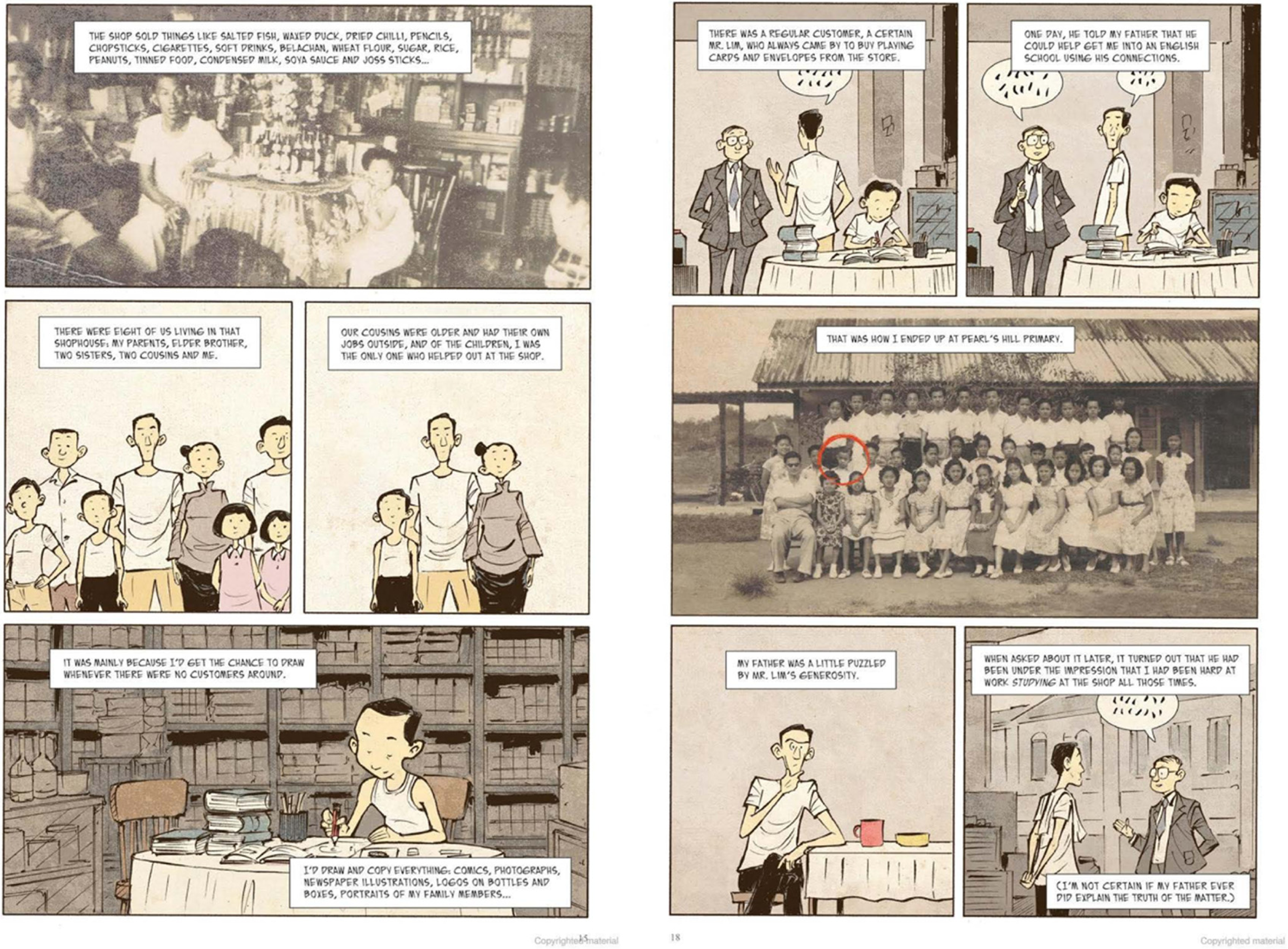
Analog photographs, or more precisely their digital scans stored in the National Archives of Singapore and circulating through the digital public sphere, are the privileged medium with which Liew graphically (re)imagines the entangled lives of the comics artist and the postcolonial nation.Footnote 103 To fabricate Chan as a largely forgotten Singaporean comics artist whose works engaged with the legal-political realities of pre- and post-independence Singapore, Liew drew upon the authority of photographs of actual places and persons in Singapore, thereby disclosing the role of such communicative media in (re)constituting historical truth. The opening chapter, for instance, introduces a ten-year-old Chan with photographs purportedly of his childhood. These include a faded photograph of the interior of a provision shop centered upon a man and a child seated around a table filled with drink and food items, and a class photograph of primary school students with their form teacher arranged in three rows (see Figure 2).Footnote 104 On each reproduced photograph, we find the marked means of their transposition into the imaginary of Chan’s past, which is premised upon their potential to acquire meaning that exceeds their original contexts of reference.Footnote 105 In addition to the photographs’ placement within the sequence of panels depicting Chan’s past, the device of a narrative or caption box is commonly used to bind these real images with the fictional character, which gives the latter verisimilitude. The technology of a list, specifically a list of commodities sold at the provision shop,Footnote 106 is deployed to sharpen the blurry image. That Chan could recite the long list gave the impression of his keen familiarity with the photographed space, as if it were indeed the shop owned by his father, above which he and his family resided. On top of textually identifying the setting to be “Pearl’s Hill Primary,” Liew drew a red circle around the third boy from the left in the middle row, as if that boy were the “I” (that is, the narrator Chan) recounting his childhood. Such devices of comics drawing are used to exploit the potential of actual photographs to be brought into new visual narratives that speak of a past spent in Singapore. The photograph’s evidential function of authenticating identities, actions, places, and events is not unknown to lawyers and historians.Footnote 107 But Liew goes further to demonstrate the possibility of strategically remediating photographs to generate semblances of historical truth, which at once illuminates and throws into question the role of photographs as sources in history and law.
Two photographs of Chan’s childhood. Reproduced with the permission of Epigram Books and Sonny Liew.

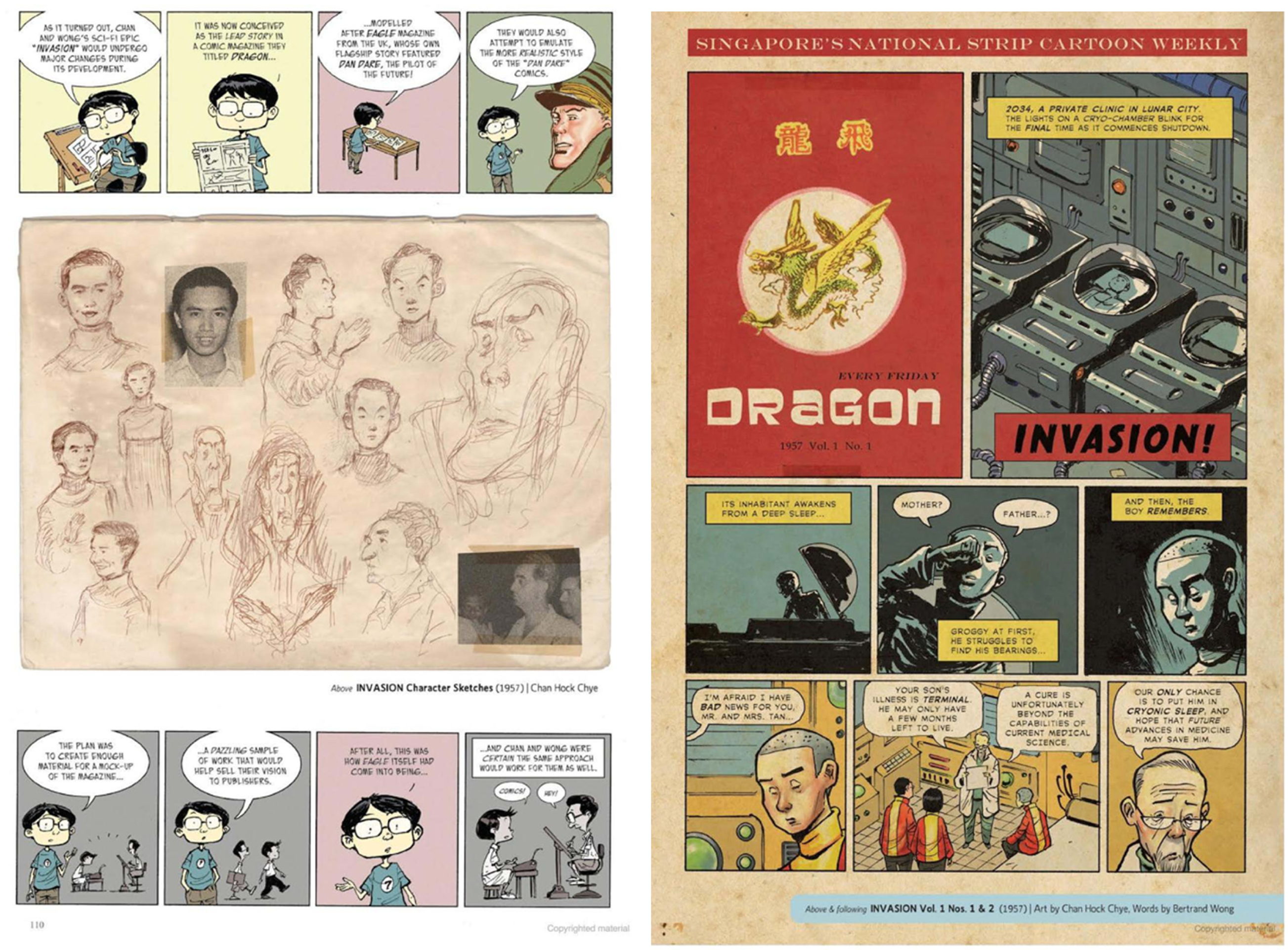
As a work of potential legal history, Liew further incorporates into his visual retelling of Singapore history photographs of Lim, Lee, and other local politicians, the doing of which discloses the archive’s dual role in perpetuating and potentially contesting the official national history that legitimates the prevailing legal order.Footnote 108 Before arriving at the climactic “Days of August,” readers of Liew’s work will have encountered reproductions of iconic photographs of these politicians, which range from minimally edited cropped images to pencil sketches and, further, refurbished fictional clones. To cite two indicative examples: in the verso facing Chan’s Invasion (1957–1958) (a science fiction comic featuring Lee and Lim as allies against their homeworld’s occupation by an alien race standing in for the British colonialists), we see pencil sketches of some of its characters, alongside cropped photographs of Lim and the first Chief Minister David Marshall (see Figure 3). The two photographs are shown to be taped on two sides, as if pasted on the drawing block as the original basis for the sketches of Lim and Marshall (which eventually turn into the vividly colored versions in Invasion). This parallel positioning of photograph and pencil sketch represents the authorial process of generating comics characters from archived images of actual political figures, which enable the latter’s transposition to alternative visual narratives where they could acquire new shades of meaning. In Invasion, the episodes of national history stressed are not those of the schism between the PAP and the left-wing Barisan Sosialis, but instead the anti-colonial partnership between Lee, Lim, Marshall, and their associates that well preceded Operation Coldstore.Footnote 109 Singapore’s struggle for independence from British colonial rule is shown to be a product of collaboration between Anglophone and Sinophone orator-visionaries, namely, Lee and Lim respectively, who “join[ed] forces in their quest to overthrow the Hegemons [ie. the alien colonizers] and help Lunar City [ie. the fictional analog to Singapore] regain its independence.”Footnote 110 In her work on Jewish and Palestinian history, Azoulay had sought to recall the historical friendships or shared “civil life”Footnote 111 between Jews and Arabs through archived photographs that preceded the polemical opposition imposed by Israeli public discourse.Footnote 112 Liew does the same for Lee, Lim and their respective supporters, by remediating photographs into a comic that allegorizes their partnership and alliance against the British colonial rulers.
The character sketches, and accompanying photographs, of Chan’s “Invasion.” Reproduced with the permission of Epigram Books and Sonny Liew.

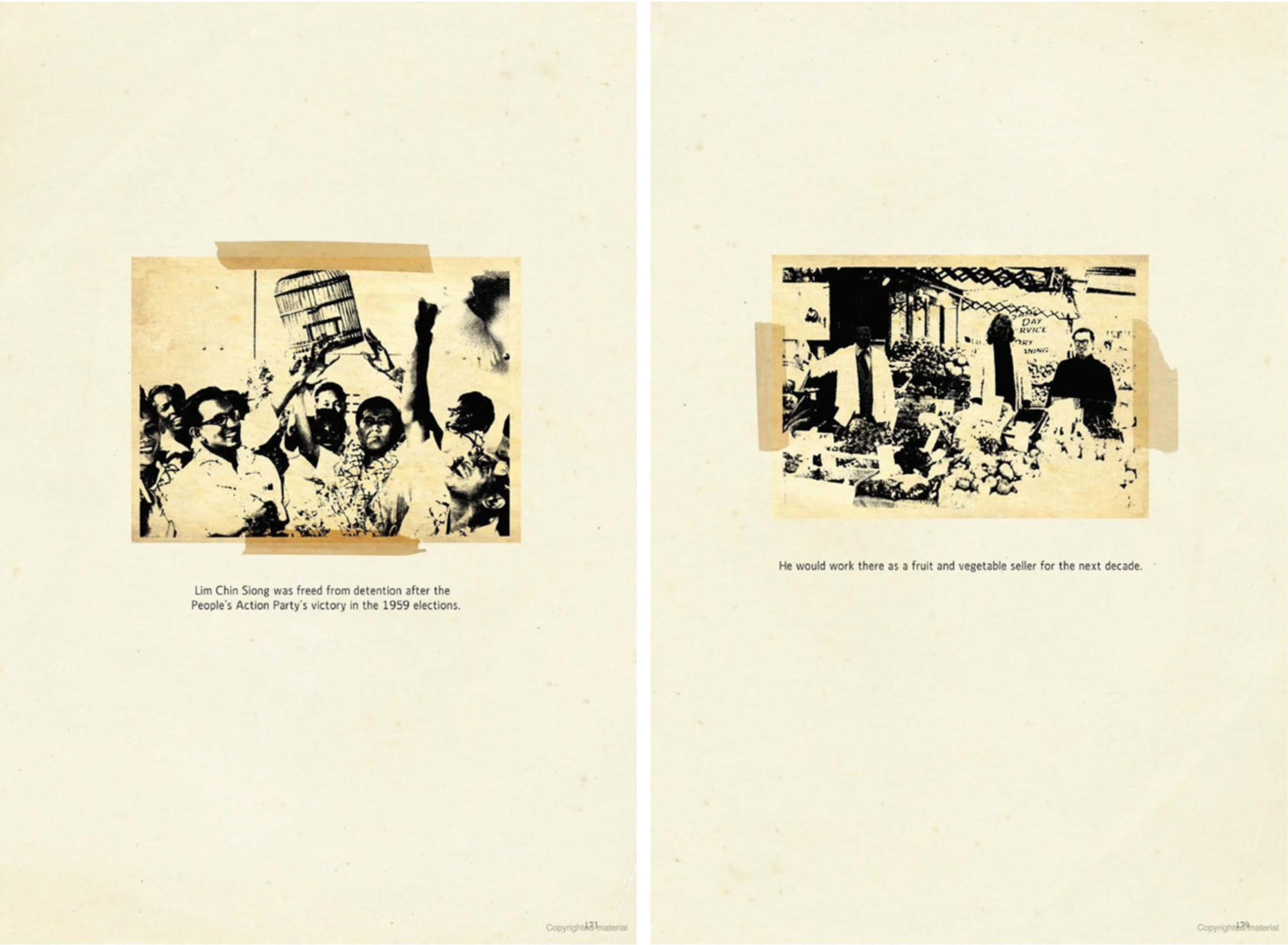
The second key example involves the insertion of two iconic, and likewise publicly archived, photographs of Lim before and after Operation Coldstore between panel excerpts from a superhero-vigilante serial comic, Roachman (1960–1962), whose title hero is based on Lim.Footnote 113 The first photograph is of Lim holding up a cage from which pigeons have been freed, symbolizing his own release from his first detention without trial after the 1959 General Elections; the second is of Lim selling fruits and vegetables in Bayswater, London, in the 1970s, some years after his release from detention for the second time under Operation Coldstore (see Figure 4). Liew’s strategy is to juxtapose these entire photographs of Lim, the first retrieved from the state archive and the second from Comet in Our Sky,Footnote 114 with panels from Roachman; the doing of which presents an affective story of Lim’s well-intentioned contributions to Singapore politics, but eventual exit compelled by the state’s use of the preventive detention law. A former “night soil man,”Footnote 115 Roachman deploys his newfound superhero powers “to help the downtrodden fight for a better life,”Footnote 116 but is eventually outwitted by a coalition formed by his erstwhile ally Orang Minyak (standing in for Lee and, collectively, the Singaporean, Malayan, and British governments).Footnote 117 Between the two photographs of Lim as a bearer of legal violence are excerpted panels of Roachman’s severed alliance with Orang Minyak; of the latter’s resolve to defeat Roachman; of other unnamed villains plotting against him and their expert minions cowering over his abject body; and of a disheartened Roachman on the verge of renouncing his vigilante identity; each of which is captioned with a commentary on the pertinent historical event remediated in the panel.Footnote 118 Materially, each of Lim’s photographs and the panel excerpts appears to be taped onto blank pages, as if forming part of a scrapbook shown to the reader.
Two photographs of Lim inserted between excerpts from Chan’s “Roachman.” Reproduced with the permission of Epigram Books and Sonny Liew.

In this multimedial sequence of Chan/Liew’s political allegory, the reader witnesses a sympathetic portrayal of Lim’s subjection to the prevailing legal regime and the premature termination of his promising political career. Whereas the state archive, in its description of the first photograph, glorifies the PAP as having successfully negotiated with the British for the release of Lim and his other “pro-communist” detainees, Chan/Liew suggests this to be a short-lived scene of liberation destined to be crushed by political maneuvers. The same law of preventive detention, a relic of the British colonial government’s legal response to communist insurgents during the Malayan Emergency of 1948,Footnote 119 shall decimate Lim’s public-serving spirit. By virtue of Liew’s multimedial juxtaposition, present readers are able to learn of the profound loss suffered by Lim, even by Singapore, in Operation Coldstore. The archive is thus shown to be capable of not only legitimating the official history condemning Lim as a politician whose communist inclinations led to his own downfall, but also contesting it by affording its photographs’ movement into new contexts that elicit sympathy for his sacrifices and attribute responsibility for this loss to the nation’s rule of law.
Recognizing the centrality of photographs in Liew’s visual retelling of Singapore history further enriches our understanding of the mechanics and focal thematic of “Days of August.” Chan/Liew’s imagining of Lim as the Second Prime Minister of Singapore is not done ab nihilo, but is rather a product of archival remediation. On the same verso depicting the televised interview with Dr Winsemius, there are two panels featuring Lim with his arm around his associate Fong Swee Suan’s shoulder as the still-image backdrop against which Dr Winsemius is speaking. This image is based on an actual photograph of the two close friends, presently shown in a kiosk exhibition of the Singapore History Gallery, a permanent exhibition of the National Museum of Singapore. Whereas one might think Chan/Liew’s alternative history to be centered around the political rivalry between Lee and Liew, the comic turns on the friendship between Lim and Fong as politically engaged citizens. The remediated image is accompanied by Dr Winsemius’ discussion of the perilous “communist mindset”Footnote 120 shared by the two, but subsequently relinquished during their political leadership in the nation’s interests. Remediated and transposed to “Days of August,” the photograph sheds its symbolism of failed communism in Singapore to reflect a vital partnership capable of evolving to meet the demands of national survival. The potential-legal-historical significance, here, is precisely the potential of this photograph of Singapore’s former political leaders to be remediated to show their capacity to alter, even mature, in their political perspectives, rather than stagnate in the forms assigned by official historical sources.
The comic’s denouement refocuses on this alternative reading of Lim’s and Fong’s photograph as an image of deep political friendship that transcends ideological affiliations. Readers of “Days of August” soon discover that the alternative reality and history of Singapore is but an unsustainable fiction within the diegetic world.Footnote 121 A spectral figure in white, a fictional version of Lee Kuan Yew, haunts this regime, committing acts of vigilantism that disrupt its peace and processes. Despite valiant attempts by detectives, Prime Minister Lim, and a fictional version of Chan himself (albeit considerably more successful in his comics career) to oppose the forces of reality represented by Lee, the imagined world of Singapore collapses, throwing Lim and Chan both back to 12 May 1955. Graphically, this spatiotemporal regress is indicated by a stylistic shift from a vividly colored four-by-four panel grid to looser monochromatic configurations.Footnote 122 Crucially, upon confirming the date to be that of the Hock Lee Bus Strike, Lim proceeds to join his associate Fong at the protest, notwithstanding Chan’s reminder of their prospective political defeat by Lee and his party.Footnote 123 Above the foreseen costs of his actions, Lim prioritizes his friendship with Fong and their shared interests in the nation. As Lim puts it: “I suppose…I should go see if Swee Suan needs any help…it all fails in the end…but these things that we’re fighting for…the welfare of the workers, our freedom, our dignity…whatever the costs, they’re still worth the while, are they not?”Footnote 124 Lim redirects Chan’s attention from his own disappearance into the lacuna of history as one of its ignominious losers to his militant advocacy for the emancipation of the Singapore working class from colonial rule alongside Fong and his other political associates. It is in recognition of Lim’s friendship and ethico-political commitments that Chan likewise opts to (re)pursue his vocation as a politically engaged comics artist, despite knowing that the career would not bring him fame, wealth, or familial comforts.
Potentializing Legal History
Liew’s graphic-fictional remediation of archived photographs of Singapore’s former politicians instructively bears upon Azoulay’s method, Singapore history, and the field of legal history. First, in regard to Azoulay, Liew demonstrates that potential history may well be performed in genres other than critical scholarship. As an art of visual storytelling, the graphic novel is no less capable of exploiting the potential of photographs to retell histories of politics, law, and nations. Indeed, the material operation of remediating photographs into comics enacts the very suspension of the imperial shutters that Azoulay has affirmed to be at the heart of her decolonial praxis. In the art of Sonny Liew, publicly archived images of Singapore’s former politicians may be unfrozen and have their dynamic mobility restored so as to present alternative pasts, and also futures, that doubly attest to legal violence and the possibility of redressing them. Liew simultaneously offers an Azoulayan expression of potential history in respect of Singapore and extends it to the graphic-fictional field.
Further and relatedly, as a contribution to Singapore history, Liew’s graphic novel reveals a fundamental basis on which law qua legitimate authority is sustained in Singapore. The state archive, which stores and ascribes meaning to historical records such as the photographs of its former politicians, enables the relay of national histories that value politicians such as Lee and Lim differently. Whilst the archive might participate in propagating the official national history that sustains Singapore’s rule of law, it also carries in it the medial-material potential to prompt the writing of alternative histories that call for the nation’s recognition of the legal violence that its former leadership might have enforced. As strongly worded in Comet in Our Sky, Lim’s “cruel extinguishment from Singapore’s public life”Footnote 125 remains to be acknowledged. By remediating Lim’s photographs to depict his honorable commitments in politics and friendship, Liew presents the possibility of undoing the alleged historical suppressions that haunt the living citizenry.
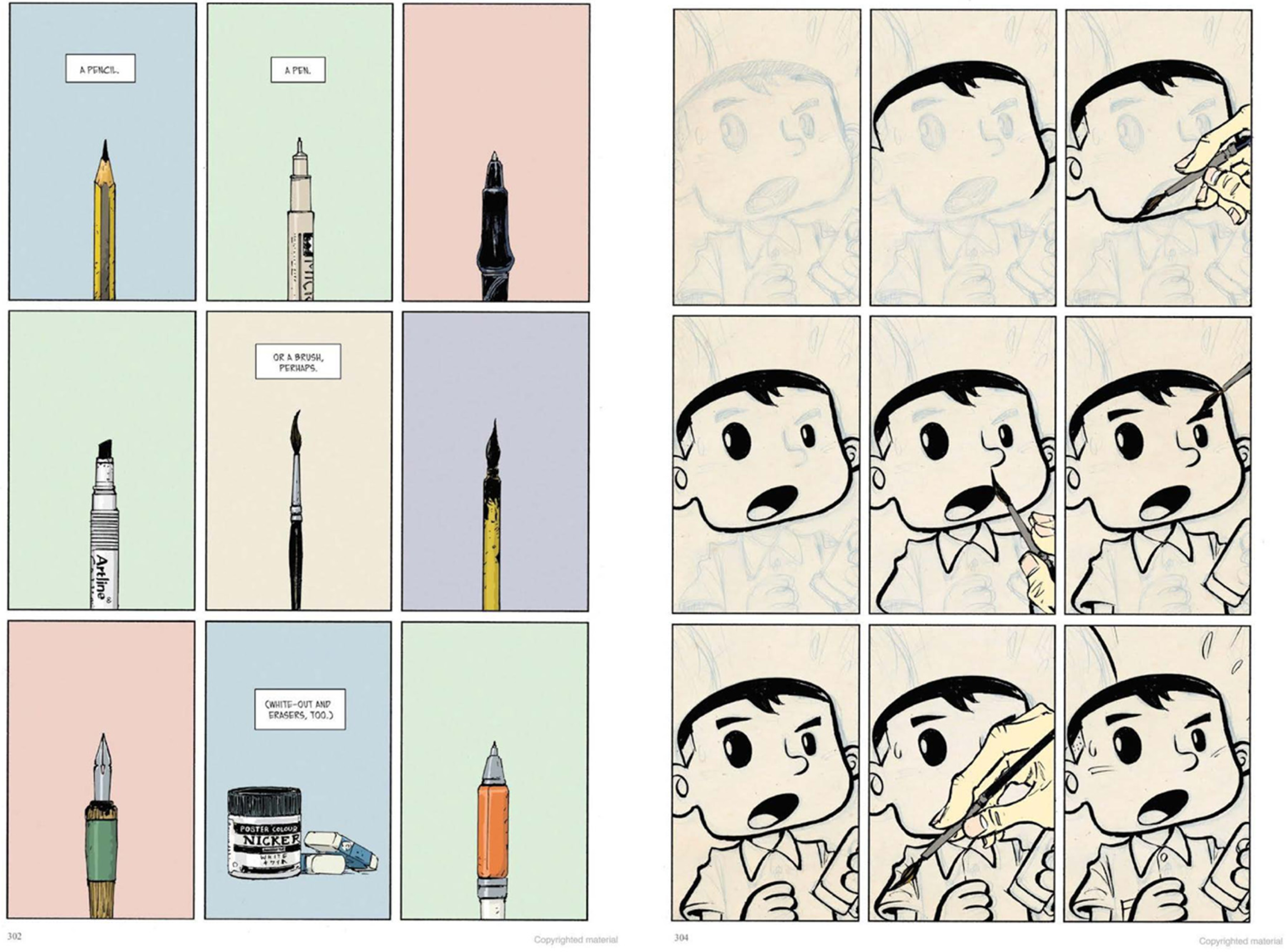
Third, and for this article most importantly, Liew demonstrates the importance of taking photographs and comics seriously as matters of potential legal-historical significance. If images and their regulation are important to Singapore’s history and law, so too might they be to other jurisdictions. Comics work with and disclose the imaginal basis on which constitutional orders reinstitute themselves. For the (re)writing of legal histories, be they conservative or critical in ethos, photographs and comics could act as valuable historical sources that afford visual retellings attentive to the field’s medial-material conditions of possibility. Liew’s graphic novel concludes with panels of Chan’s art equipment (including a Faber-Castell HB Pencil, a ballpoint pen of unknown brand, and a Winsor & Newton Series 7 Size 1 Sable Brush)Footnote 126 and his drawing of the graphic novel’s cover image (see Figure 5). Such a representation of the medial-material process out of which the graphic novel arises prompts our reflection on Chan/Liew’s use of photographs and other archival materials in his potential history of Singapore. It further directs us to consider the medial forms with which we, as scholars, engage to produce legal histories. If historical fictions and images are as deeply involved in the art of recounting national history as Liew’s graphic novel suggests, then it is vital for legal scholars to attend to these and other similarly understudied genres and medial forms for their potential legal-historical significance. Whereas literary and comics studies have long recognized history to be one of their fundamental concerns,Footnote 127 legal history may owe a debt to fiction and images that it has yet to acknowledge.
Chan’s equipment and drawing of the cover image. Reproduced with the permission of Epigram Books and Sonny Liew.

Potential legal history adapts Azoulay’s visual mode of history to the field of legal history. My interpolation of “law” into Azoulay’s theoretical perspective clarifies its potential to address pressing legal questions surrounding citizenship, nation-building, and colonial legal transmissions. As exemplified in Liew’s art, photographs and comic books afford the visual retelling of national histories that illuminate forms of legal violence, including the lawful suspension of due process rights and the archival propagation of authorized histories that underplay the contributions of the politically vanquished. As a Jewish literary critic persecuted by Nazism, Benjamin understood the politicization of art to be the critical means of working with the tradition of the oppressed to resist fascism and other totalitarian forces of history.Footnote 128 Legal history could similarly be enlisted to instruct contemporary regimes that have yet to affirm the demands of their dead. Visual-narrative forms may well be the vital materials with which to retell national histories that enact our responsibilities as co-citizens. In the wake of prior and ongoing catastrophes—the tragic irony of the Gaza genocide, to name but one—it is increasingly clear that nationalist citizenship fails to affirm our ties with common humanity and other planetary cohabitants. Archived photographs and their remediated forms enable our displacement of the limits of the nationalist model and honoring of civil partnerships with the dead whose memories await collective restoration. Already in The Civil Contract of Photography (2008), Azoulay understood that the civil political space afforded by the camera escaped total determination by the prevalent top-down, exclusionary logic of the sovereign nation-state.Footnote 129 In the instance of Liew’s graphic novel, rather than the spectator, photographer, and photographic referent, it is the historian-reader, comics artist, and politically vanquished who jointly reanimate the suppressed pasts and futures of the postcolonial nation. Premised on attentive readership across images and other medial forms, an Azoulayan model of co-citizenship stands at the threshold of law and history.
Acknowledgements
I am grateful to the host and fellow guests of the “Legal Imaginaries Across the Asia-Pacific” workshop at ANU for inspiring the work. I would also like to thank the editor and reviewers of this journal for their kind support, and Sonny Liew and Epigram Books for their generous permissions.
Funding statement
This research is supported by the Ministry of Education, Singapore, under the Academic Research Fund Tier 1 (FY2023): T1/C-2/FY23.
Competing interests
The author(s) declare none.

 Open access

