

Introduction
The age of Bradshaw rock art (also called gwion gwion) is uncertain but estimated by indirect methods at between 46 000 years ago, based on the time of extinction of depicted live megafauna (Reference RobertsRoberts & Brook 2010), and 70 000 years ago, which is the age of the boab tree in Australia. In view of this antiquity, it is remarkable that Bradshaw paintings, often exposed to sun and rain, can be vivid and with high contrast, even though they have never been repainted. Conversely, other rock art in the same region, such as the Wandjina paintings, fades at a rate measured in hundreds of years and is often repainted. Here we report on cases where the original paint is no longer present in Bradshaw art, but has been replaced by a biofilm of living, pigmented micro-organisms whose natural replenishment may account for the longevity and vividness of these ancient paintings.
We surveyed 80 figures in 49 panels of Bradshaw art from 16 different locations in the Kimberley region, on a rough transect from its East to West Coast at around 14-15°S, using portable, digital and measuring microscopes. We concentrated on Tassel and Sash styles of Bradshaw figures because they are easily recognised, there is little controversy about their classification, and because it is widely accepted that they are derived from the oldest epoch of Bradshaw art (Reference WalshWalsh 2000). As expected for a living biofilm, we were able to obtain DNA from 80 per cent of the paintings non-invasively using a cotton swab. The DNA will be used for later microbial identification and metagenomic sequencing.
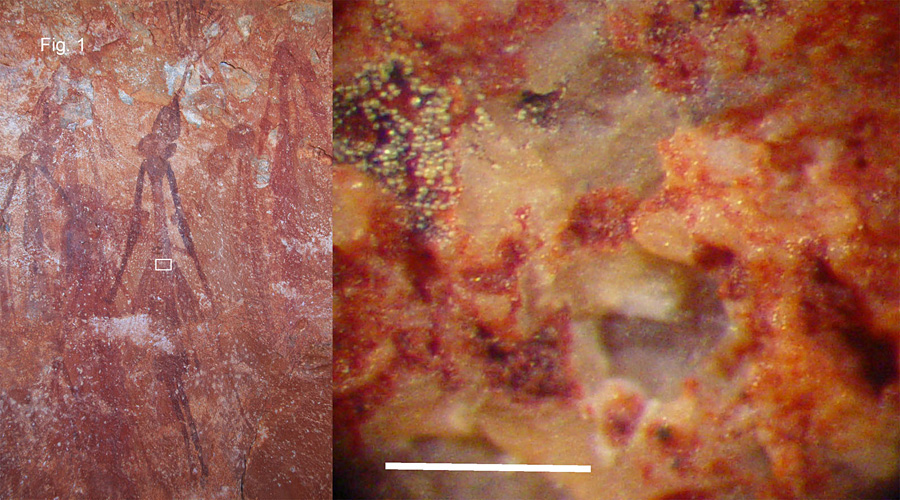
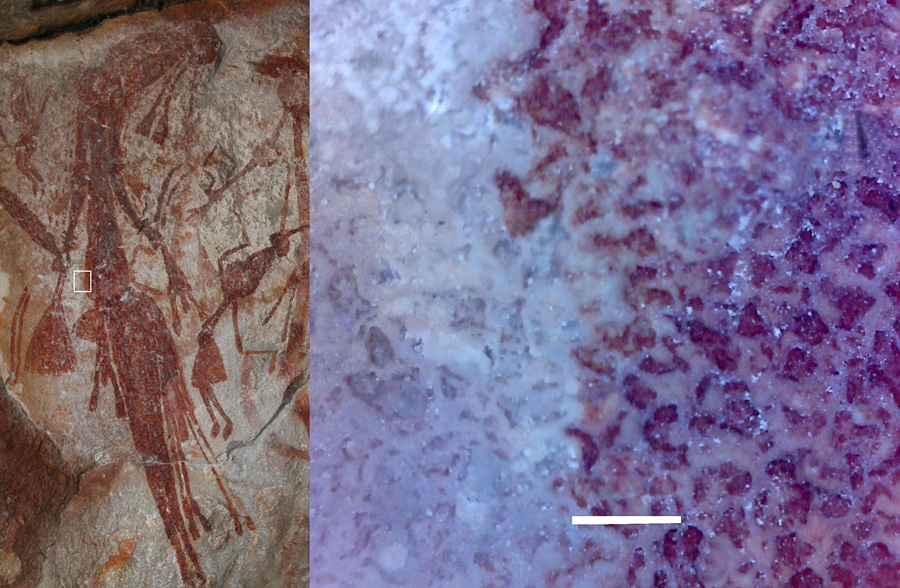
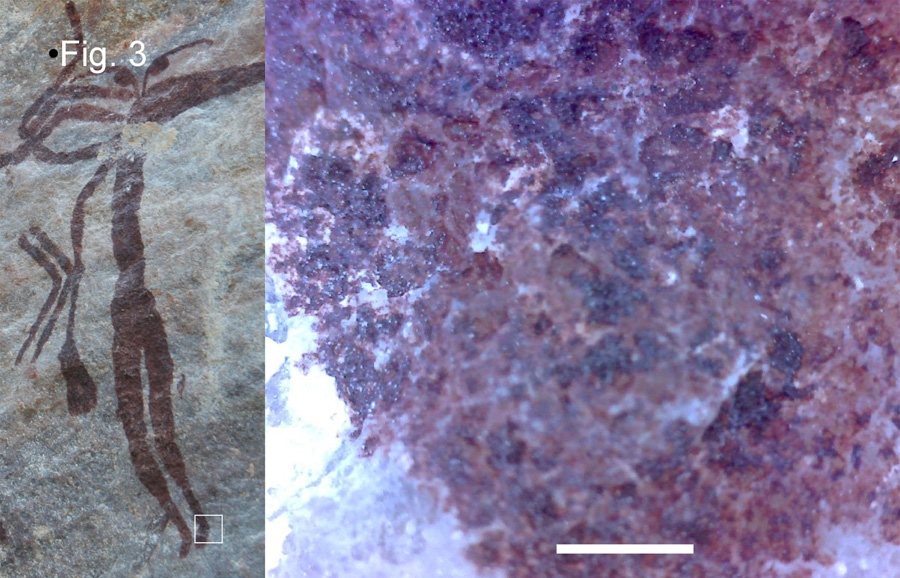
The vast majority of paintings, independent of location and overall colour, was occupied by colonies of micro-organisms, with no sign of paint (Figures 1-3). There appeared to be a great variety of micro-organisms when all samples were considered, but a black pigmented fungus, identified as such by yellow fruiting bodies (Figure 1), was prominent. Its black pigment made a major contribution to the famous 'mulberry' coloured paintings. A reddish organism that could not be resolved into single cells in the field with our portable microscopes, probably a species of Cynaobacteria, was usually found along with the black fungi. When the black fungi had a minor presence and the red 'cyanobacteria' dominated a particular painting, the overall colour was the well-recognised 'cherry' (or 'terracotta') shade (Figure 2) rather than the 'mulberry' shade (Figure 3).
(Scale bar = 1mm. Rectangle left shows approximate location of digital micrograph illustrated right). High magnification view of biofilm in the centre of a Bradshaw painting. Three features are prominent:
-
a. Cavities, pores and channels etched into the sandstone that would act as microniches for micro-organisms.
-
b. Black pigmented fungi with yellow fruiting bodies (upper left). The absence of hyphae is consistent with the strangely conservative, rock-adapted Chaetothyriales.
-
c. Reddish cyanobacteria that may have a mutualistic relationship with the fungi by providing carbohydrate via photosynthesis in return for water.

(Scale bar = 1mm. Rectangle left shows approximate location of digital micrograph illustrated right). 'Cherry' figure. Note that red organisms predominate, but black fungus is also present.

(Scale bar = 1mm. Rectangle left shows approximate location of digital micrograph illustrated right). 'Mulberry' figure. Both red and black organisms are present, but the black fungus predominates compared with Figure 2.

The black fungi probably belong to the Chaetothyriales, an extremely conservative group of rock-adapted fungi that replicate without hyphae by cannibalising their predecessors in situ (Gorbushina et al. 2005). Their suite of conservative traits could explain why the sharp contours of Bradshaw art have not been corrupted by fungi growing beyond the edges of the image. We saw rare examples where 'rogue' fungi appeared to have destroyed most of a painting, but in 98 per cent of cases the fungi stayed strictly within the art's boundaries. The possible mechanisms by which the micro-organisms are confined within the edges of the painting are testable, and include:
-
1. The etched cavities and pores providing microenvironments will exactly follow the shape of the painting if the original paint contained silica-dissolving microbes or acid capable of dissolving the cement between the silica grains. (Some paintings were etched as much as 1mm below the level of surrounding rock).
-
2. Rock-adapted fungi are extremely conservative and would remain at the same location, once inoculated by spores or cell bodies in the paint.
-
3. There may have been nutrients within the original paint that kick-started a subsequently stable mutualism of fungi (water-providing) and Cyanobacteria (carbohydrate-providing).
Biofilms ('patina' or 'desert varnish') are thought to be contributing to the deterioration of other Australian rock art, the petroglyphs of the Burrup peninsula in Western Australia (Reference BednarikBednarik 2002). This is just the opposite of the case reported here, where the tolerance of the biofilm organisms for extremes of temperature, radiation and osmotic pressure (Gorbushina et al. 2005) would permit indefinite survival and replenishment of the paintings. DNA sequence studies of the organisms could reveal their phylogenetic history and so yield more information on the age of the enigmatic paintings that they delineate with 'living pigments'.
Acknowledgements
We are grateful to Steve Macintosh, who showed us his rock art discoveries at Faraway Bay, to Joc Schmiechen, who shared with us many sites he had discovered in Drysdale River National Park. Access to Drysdale River National Park was under a permit from the Kimberley Land Council, and we acknowledge the Wanjina Wunggurr Wilinggi traditional owners.