





Bipolar disorder is an episodic mental illness affecting up to 40 million people globally, 1 with an estimated 0.8% prevalence in the UK. Reference Simon, Pari, Wolstenholme, Berger, Goodwin and Geddes2 It is characterised by alternating or mixed-mood episodes of mania or hypomania and depression. Current nosologies 3,4 distinguish subtypes, including the following: type I (at least one manic episode) and type II (at least one hypomanic and one depressive episode). Bipolar disorder is associated with substantial economic and illness burden, including premature mortality, elevated suicide rates and lengthy diagnostic delay. Reference Simon, Pari, Wolstenholme, Berger, Goodwin and Geddes2,Reference Keramatian, Pinto, Tsang, Chakrabarty and Yatham5,Reference Hayes, Marston, Walters, King and Osborn6 Treatment typically involves pharmacotherapy with antipsychotics, mood stabilisers and/or, in some cases, antidepressants.
Despite treatment recommendations (National Institute for Health and Care Excellence (NICE) guidelines are summarised in Supplementary Figs 1 and 2), 7,8 aspects of real-world prescribing for bipolar disorder remain controversial, particularly regarding antidepressant monotherapy and lithium. Antidepressant monotherapy may precipitate mania or hypomania and is associated with increased risk of mania-related hospitalisation, whereas regimens comprising antipsychotics and mood stabilisers alone or in combination (including with antidepressants) reduce risk. Reference Ermis, Taipale, Tanskanen, Vieta, Correll and Mittendorfer-Rutz9 Furthermore, evidence for antidepressant efficacy in bipolar depression is limited. Reference Gottlieb and Young10,Reference Yildiz, Siafis, Mavridis, Vieta and Leucht11 Guidelines 7 recommend prescribing antidepressants only alongside an antipsychotic or mood stabiliser, yet pharmacoepidemiology studies show that monotherapy remains common, Reference Rhee, Olfson, Nierenberg and Wilkinson12,Reference Jain, Kong, Gillard and Harrington13 and it was the most common monotherapy in the UK from 2001 to 2018. Reference Ng, Man, Gao, Chan, Lee and Hayes14,Reference Lyall, Penades and Smith15 Lithium demonstrates robust efficacy for maintenance treatment, manic episodes and suicide prevention Reference Cipriani, Hawton, Stockton and Geddes16,Reference Fountoulakis, Tohen and Zarate17 but, due to its narrow therapeutic range and toxicity risk, requires regular blood monitoring. Lithium prescribing has declined internationally Reference Rhee, Olfson, Nierenberg and Wilkinson12 and, in the UK, almost halved between 2001 and 2018 (from 30.6% of patients to 16.0%). Reference Ng, Man, Gao, Chan, Lee and Hayes14 How these prescribing trends have evolved in the UK since 2018 remains unknown. International studies also suggest prescribing disparities: Reference Steger, Birckhead, Raghunath, Straub, Sthapit and Albert18–Reference Johnson and Johnson20 in US tertiary care, older patients and those in socioeconomically deprived areas were more likely to receive antidepressant monotherapy, whereas Black patients and residents in deprived areas were less likely to receive lithium. Reference Steger, Birckhead, Raghunath, Straub, Sthapit and Albert18 Investigating whether such findings generalise to the UK is an important step for ensuring equity of care.
Given the potential for disparities in receipt of safe and effective treatment, robust pharmacoepidemiology studies are needed to build on previous work Reference Ng, Man, Gao, Chan, Lee and Hayes14,Reference Richards-Belle, Launders, Hardoon, Man, Bramon and Osborn21,Reference Hayes, Prah, Nazareth, King, Walters and Petersen22 and capture evolving trends. We leveraged a large UK primary care database to characterise psychiatric prescribing for patients first diagnosed with bipolar disorder between 2000 and 2022. Our objectives were to:
-
(a) describe patterns of antidepressant, antipsychotic and mood stabiliser prescribing in the 12-month periods before and after first-recorded bipolar diagnosis in primary care;
-
(b) describe treatment trajectories in the year after first-recorded bipolar diagnosis, examined (i) by medication class and (ii) with an emphasis on lithium prescribing;
-
(c) investigate associations between sociodemographic and treatment-related characteristics (i.e. age at diagnosis, gender, ethnicity, area-level social deprivation, diagnosis year) and (i) antidepressant monotherapy and (ii) lithium prescription, in the year after first-recorded bipolar diagnosis.
Method
Study design
A longitudinal cohort study characterising contemporary psychiatric prescribing trends among patients first diagnosed with bipolar disorder between 2000 and 2022.
Data source
We used Clinical Practice Research Datalink (CPRD) data, comprising two databases (Aurum Reference Wolf, Dedman, Campbell, Booth, Lunn and Chapman23 and GOLD) Reference Sanchez-Santos, Axson, Dedman and Delmestri24 of pseudonymised primary care records for over 62 million current and historic patients from National Health Service (NHS) practices. The databases are broadly representative of the UK population, with current population coverage of almost 25%. They contain data on diagnoses, prescriptions, immunisations, tests and referrals, coded using SNOMED CT, EMIS Web®, Read Version 2 or Dictionary of Medicines and Devices codes. We used the May 2022 Aurum and April 2023 GOLD builds.
Ethical standards
All procedures contributing to this work comply with the ethical standards of the relevant national and institutional committees on human experimentation, and with the Helsinki Declaration of 1975 as revised in 2008. Procedures involving patients were approved by the East Midlands–Derby Research Ethics Committee (reference no. 21/EM/0265). This study was reviewed by CPRD’s Independent Scientific Advisory Committee (protocol no. 21_000729). All data sent to CPRD are anonymised; individual consent was not required.
Participants
We included patients with a first-recorded diagnosis of bipolar disorder between 1 January 2000 and 31 December 2022. These diagnoses, typically made by psychiatrists in secondary care mental health services and communicated to primary care, were identified using a publicly available, clinician-verified code list. Reference Launders, Richards-Belle, Hardoon, Osborn and Hayes25 Case capture is enhanced by the Quality and Outcomes Framework, through which practices annually validate registers of severe mental illness (including bipolar disorder). At first-recorded diagnosis, patients were required to be aged 18–99 years and registered at the practice for at least 1 year. Patients with less than 1-year post-diagnosis follow-up were excluded, except those who died within 1 year, whose data were retained to avoid survival bias.
Outcomes
We investigated the prescribing of three medication classes: antipsychotics, antidepressants and mood stabilisers. Prescriptions could have been initiated by either a general practitioner or a specialist (e.g. psychiatrist) but must have been issued through primary care (standard practice for UK community prescribing). 26 We reviewed reference sources 27,28 to identify/classify relevant medications.
Our outcomes were as follows: in the 12-month periods before and after first-recorded diagnosis: prescription of each medication class, alone or in combination; within 1 year post-diagnosis: and treatment persistence or switching between medication classes, antidepressant monotherapy and lithium prescription.
Covariates
We included the following variables: age at first-recorded diagnosis, gender, ethnicity, geographic region, area-level deprivation, year of diagnosis, moderate/severe depression and other comorbidities (alcohol/substance misuse, diabetes, hypertension, liver disease, renal disease).
If a patient had multiple ethnicity categories coded we used the most frequent, or most recent if frequencies were equal. If not recorded in primary care, ethnicity was sourced, where available, from linked Hospital Episode Statistics data for patients registered in England. Geographic region referred to location of the patient’s primary care practice. For patients registered in England, relative deprivation was defined using the 2019 English Index of Multiple Deprivation (IMD) Reference Appel29 stratified into quintiles (1, least deprived; 5, most deprived) and assigned by residential postcode or, if missing, practice postcode. Comorbidities were considered present if coded in primary care prior to the index date.
Statistical analyses
Objective 1: prescribing in the 12-month periods before and after diagnosis
We defined ‘a month’ as a 30-day period, with the first month after diagnosis beginning on the diagnosis date and all additional months indexed to this date. We identified prescriptions for all relevant medications in the 12-month periods prior to and after the first-recorded diagnosis (Supplementary Fig. 3). Medications were considered concurrent if prescribed in the same month. We defined ‘monotherapy’ as the prescription of a single medication class (antidepressants, antipsychotics or mood stabilisers) during a given month, including more than one of the same class (e.g. two antipsychotics). We assessed sensitivity to this definition by examining the proportion of patients prescribed multiple medications within the same medication class.
When calculating prescribing prevalence for each month, the denominator was all patients with a first-recorded bipolar disorder diagnosis between 2000 and 2022 and alive at the start of that month. Prevalence was represented by line graphs and a stacked area plot (additionally displaying the proportion censored due to death). As an exploratory analysis, we stratified the line graph by time period (diagnosed on or after 23 March 2020) to examine whether prescribing differed during the COVID-19 pandemic.
Objective 2: treatment trajectories
We investigated treatment trajectories – persistence and switching between different medication classes – within 1 year post-diagnosis among patients with at least one prescription post-diagnosis. We characterised up to three treatment switches per patient, evaluating prescriptions in monthly intervals beginning from first prescription date post-diagnosis, with the first regime considered ‘first-line’. We included complete intervals to ensure that categories were consistently defined across the year. Trajectories with counts fewer than five patients were suppressed for confidentiality.
For the second and third switches, we included an ‘Interruption/discontinuation’ category for patients with at least three consecutive months Reference Richards-Belle, Launders, Hardoon, Richards, Man and Davies30 of no prescriptions, and a ‘No switch’ category for patients that did not switch medication classes. In sensitivity analyses, we amended the 30-day window to 1 and 60 days, where medications were considered concurrent if prescribed on the same day or within the same 60-day window, respectively. This was done to assess sensitivity to potential misclassification of co-prescribing, with the shorter window expected to yield more monotherapy classifications and the longer window more combination therapy classifications. We also analysed regimes involving lithium, considering categories defined in relation to lithium, as well as a non-lithium category that included switching to a different non-lithium combination.
Patterns were represented using Sankey diagrams and heatmaps. To support flexible exploration of trajectories we created an R Shiny dashboard (https://dop-mhds.shinyapps.io/bpd-prescribing-uk-shiny/), which provides interactive Sankey diagrams, initial treatment state highlighting and filtering, lithium-specific prescribing and heatmaps displaying treatment change frequencies.
Objective 3: antidepressant monotherapy and lithium prescription
We report odds ratios with 95% confidence intervals estimated from logistic regression models describing associations between age at diagnosis, gender, ethnicity, IMD quintile and diagnosis time period (exposures) and the outcomes: prescription of (a) antidepressant monotherapy and (b) lithium, within 1 year post-diagnosis. We analysed each exposure and outcome in separate univariate models. Except for models investigating time periods as exposure, analyses were adjusted for diagnosis year (including a quadratic term to allow for non-linearity) to account for temporal trends (e.g. availability of new medications). We handled missing data using multiple imputation by chained equations, where we generated 25 data-sets and pooled estimates according to Rubin’s rules. Sensitivity analyses included (a) complete-case and unadjusted analysis, (b) a model that included all exposures simultaneously and (c) a post hoc model with outcome of prescription of any relevant medication within 1 year post-diagnosis.
Analyses were conducted in R (version 4.5.1) using RStudio for macOS (R Foundation for Statistical Computing, Vienna, Austria; https://www.r-project.org/).
Results
Sample
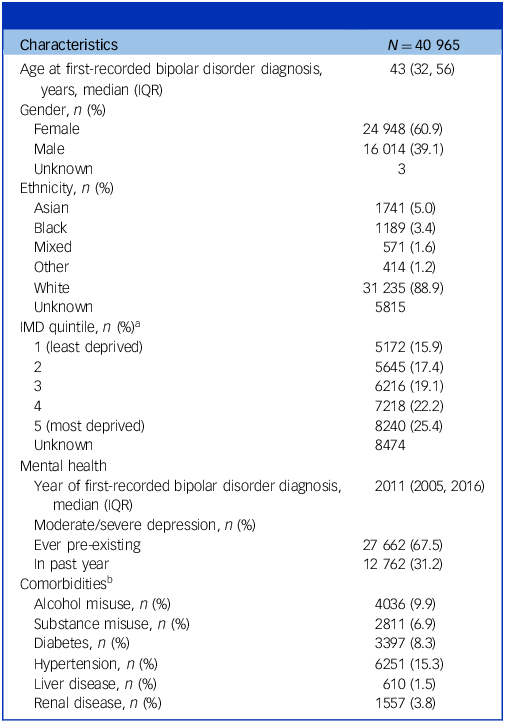
We identified 40 965 eligible patients with a first-recorded bipolar disorder diagnosis between 2000 and 2022 (Supplementary Fig. 4). Over half (60.9%) were female, the majority (88.9%) White, one in four (25.4%) were in the most deprived quintile and median (interquartile range) age at first diagnosis was 43 years (32–56) (Table 1). Most (66.6%) episode types at first diagnosis were not classifiable (Supplementary Table 1). Almost a third (31.2%) had a record of moderate/severe depression in the year prior to first-recorded bipolar disorder diagnosis. By 1 year post-diagnosis, 912 (2.2%) patients had died.
Demographic and baseline characteristics of the cohort

Table 1 Long description
The table presents demographic and baseline characteristics of a cohort of 40965 patients with a first-recorded bipolar disorder diagnosis between 2000 and 2022. The table includes 12 rows and 2 columns. The first column lists various characteristics such as age at first-recorded bipolar disorder diagnosis, gender, ethnicity, IMD quintile, mental health, and comorbidities. The second column provides the corresponding values or percentages for each characteristic. Notable trends include a higher percentage of females (60.9%), a majority of White ethnicity (88.9%), and a significant portion of patients in the most deprived quintile (25.4%). The median age at first diagnosis is 43 years. Additionally, almost a third of the patients (31.2%) had a record of moderate/severe depression in the year prior to the first-recorded bipolar disorder diagnosis. The table also highlights that by 1 year post-diagnosis, 912 (2.2%) patients had died.
IQR, interquartile range; IMD, 2019 English Index of Multiple Deprivation.
a. Quintile of the 2019 English IMD – for patients in England only, this was defined according to the patient’s postcode or, where this was missing (n = 837), the primary care practice postcode.
b. Comorbidities determined at any point in the patient’s medical history prior to the index date.
Objective 1: prescribing in the 12-month periods before and after diagnosis
A total of 32 460 (79.2%) patients were prescribed at least one relevant medication at any point in the year prior to diagnosis, compared with 37 208 (90.8%) at any point in the year after, whereas 3757 (9.2%) patients were not prescribed any relevant medication within 1 year post-diagnosis. The treatment most frequently prescribed throughout the year prior to diagnosis was antidepressant monotherapy – prescribed to 19 807 (48.4%) patients overall. Mood stabilisers (monotherapy or in combination), prescribed to 15 545 (38.0%) patients in the 12 months pre-diagnosis, represented the most prevalent treatment during this period (16.0%) (Fig. 1, Supplementary Table 2 and Supplementary Fig. 5).
Proportion of patients prescribed each medication class in the 12 months before and after first-recorded bipolar disorder diagnosis. AD, antidepressants; AP, antipsychotics; MS, mood stabilisers. The shaded area marks the time from the month immediately preceding diagnosis to the month beginning on the diagnosis date.

Fig. 1 Long description
The line graph illustrates the proportion of patients prescribed various medication classes in the 12 months before and after their first-recorded bipolar disorder diagnosis. The x-axis represents the months relative to diagnosis, ranging from month negative 12 to month 12. The y-axis indicates the percentage of patients, ranging from 0 to 60. The graph includes multiple data lines representing different drug combinations: No A D, A P or M S; A D; A P; M S; A D, A P; A D, M S; A P, M S; and A D, A P, M S. The shaded area marks the time from the month immediately preceding diagnosis to the month beginning on the diagnosis date. The data shows a notable decrease in the percentage of patients prescribed No A D, A P or M S around the time of diagnosis, with corresponding increases in the prescription of other drug combinations, particularly A D and A P. All values are approximated.
The most frequently prescribed treatment in the year post-diagnosis was antipsychotic monotherapy – prescribed to 14 713 (36.0%) patients overall, with a prevalence of 16.4% in month 1 and 10.8% in month 12 (Fig. 1, Supplementary Table 3 and Supplementary Fig. 5). This was followed by antidepressants + antipsychotics – prescribed to 10.4% in month 1 and remaining relatively constant until month 12 (10.6%). Antidepressant monotherapy had dropped to 10.1% by month 1, also remaining relatively constant until month 12 (9.8%). By month 12, the most common (antipsychotic monotherapy) and least common (antipsychotics + antidepressants + mood stabilisers) treatments differed in prevalence by only 4.1%. Trends remained similar during the COVID-19 pandemic period (Supplementary Fig. 6). Among those prescribed monotherapy, over 90% were prescribed only a single agent within that class (Supplementary Tables 6 and 7).
The most frequently prescribed medications in the year pre-diagnosis were citalopram (10.8% of patients), quetiapine (10.5%) and olanzapine (9.2%); and, post-diagnosis, quetiapine (24.1%), olanzapine (22.1%) and valproate (21.1%) (Supplementary Tables 4 and 5).
Objective 2: treatment trajectories
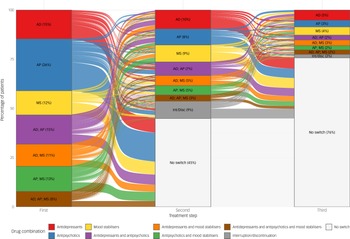
After consideration of complete intervals and suppression of small numbers, treatment trajectories were analysed in 36 910 of the 37 208 patients (99.2%) with a prescription 1 year post-diagnosis. We observed high variability in treatment trajectories (Fig. 2 and Supplementary Figs 7 and 8). The most frequent first-line treatments were antipsychotic monotherapy (26.1%), antidepressants + antipsychotics (14.9%) and antidepressant monotherapy (14.7%). Among those initially prescribed antipsychotic monotherapy, 55.5% remained prescribed that monotherapy until either death or the end of 1 year post-diagnosis – representing the most common trajectory overall (14.6% of patients). The proportions starting and remaining prescribed antidepressant + antipsychotic and antidepressant monotherapy were 34.8 and 50.8%, respectively. The least common first-line treatment was antidepressants + antipsychotics + mood stabilisers (7.8%), of which 37.5% remained prescribed that combination throughout the year.
Patterns of treatment persistence and medication class switching within 1 year of first-recorded bipolar disorder diagnosis. Patterns represented with a Sankey diagram that visualises paths (arcs) between related events (nodes); the thickness of each arc corresponds to its magnitude (i.e. the number of patients who took the path).

Fig. 2 Long description
A Sankey diagram visualizes treatment patterns for bipolar disorder over three steps, showing the percentage of patients using different drug combinations. The diagram is divided into three sections: First, Second, and Third Treatment Step. Each section displays the percentage of patients using various drug combinations, including antidepressants, antipsychotics, mood stabilizers, and their combinations. The arcs between the sections represent the paths patients take between different treatment steps, with the thickness of each arc indicating the number of patients following that path. The First Treatment Step shows the initial distribution of patients across different drug combinations, with antidepressants (AD) at 15 percent, antipsychotics (AP) at 26 percent, mood stabilizers (MS) at 12 percent, and various combinations. The Second Treatment Step shows the distribution after the first switch, with a significant portion of patients not switching treatments (45 percent). The Third Treatment Step shows the final distribution, with 76 percent of patients not switching treatments. The diagram highlights the dynamic nature of treatment patterns and the frequency of medication class switching within the first year of diagnosis.
Almost half of patients (46.0%) switched treatment at least once in the year post-diagnosis, with 22.5% switching at least twice. The most frequent second-line treatment switches were antidepressant (21.4% of those that switched at least once), mood stabiliser (19.1%) and antipsychotic (18.2%) monotherapies. These monotherapies were also the most frequent third-line treatment switches. Few patients receiving combination treatments as first-line continued the same combinations throughout.
After consideration of complete intervals and suppression of small numbers, lithium treatment trajectories were analysed in 36 955 (99.3%) patients – 18.6% were prescribed lithium as either monotherapy or in combination as first-line treatment (Supplementary Fig. 9). Few (4.0%) were prescribed lithium monotherapy as first-line treatment, but 53.7% of these remained prescribed it throughout the year. The most frequent combination first-line treatment involving lithium was lithium + antidepressants (4.0%), and least was lithium + other mood stabilisers (0.2%). For patients not initially prescribed lithium (n = 31 155), few (3.2%) were prescribed lithium (alone or in combination) as a second-line treatment and, of those also not receiving lithium as second-line (n = 13 190), few (1.8%) received it third-line (Supplementary Figs 10 and 11).
High levels of treatment change and variability in prescribing patterns persisted in sensitivity analyses varying the treatment window from 30 days to 1 (Supplementary Fig. 12) and 60 days (Supplementary Fig. 13). Reducing this window yielded lower percentages of combination regimens and non-switching, whereas expanding it showed higher values for both. Initial prescribing of antidepressant monotherapy post-diagnosis showed modest differences by treatment window length, varying from 12.5% (60-day) to 14.7% (30-day) to 19.7% (1-day). Initial prescribing of a lithium-containing regimen post-diagnosis varied from 16.7% (60-day) to 15.7% (30-day) to 13.4% (1-day) (Supplementary Figs 14 and 15).
Objective 3: antidepressant monotherapy and lithium prescription
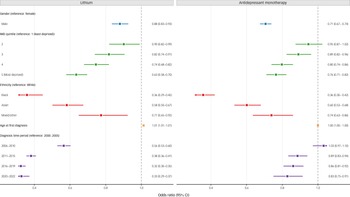
Adjusting for diagnosis year, males had lower odds of lithium prescription within 1 year post-diagnosis versus females (odds ratio 0.88; 95%CI: 0.83 to 0.93) (Fig. 3 and Supplementary Table 8). Odds were lower for those of Black (odds ratio 0.36; 95% CI: 0.29–0.45), Asian (odds ratio 0.58; 95% CI: 0.50–0.67) and mixed/other (odds ratio 0.77; 95% CI: 0.65–0.92) ethnicities compared with White patients. There was an exposure–response relationship with deprivation, with increasing deprivation reducing the odds of lithium prescription (odds ratio for most versus least deprived quintile, 0.63; 95% CI: 0.58–0.70). Odds increased with age at diagnosis (odds ratio 1.01 per 1-year increase in age; 95% CI: 1.01–1.01), such that patients diagnosed at the 75th percentile age (56 years) versus the 25th (32 years) had approximately 27% greater odds. Lithium prescription decreased over time (odds ratio for 2020–2022 versus 2000–2005, 0.33; 95% CI: 0.29–0.37) (Supplementary Fig. 16).
Associations between characteristics and the odds of lithium and antidepressant monotherapy prescription within 1 year of first-recorded diagnosis. IMD, 2019 English Index of Multiple Deprivation. All estimates are adjusted for diagnosis year and year2, except for time period (unadjusted due to collinearity). Missing values were handled via multiple imputation.

Fig. 3 Long description
The image contains two side-by-side bar graphs comparing the odds ratios for lithium and antidepressant monotherapy prescriptions within one year of a first-recorded diagnosis. The graphs analyze associations by gender, deprivation quintile, ethnicity, age at first diagnosis, and diagnosis time period. The lithium graph shows lower odds ratios for males, higher deprivation quintiles, and non-white ethnicities, with significant decreases over time. The antidepressant monotherapy graph shows similar trends but with different odds ratios. Each bar represents an odds ratio with a 95 percent confidence interval, adjusted for diagnosis year and year squared, except for time period which is unadjusted due to collinearity. Missing values were handled via multiple imputation.
In regard to antidepressant monotherapy, males had lower odds than females (odds ratio 0.71; 95% CI: 0.67–0.74) (Fig. 3 and Supplementary Table 9). Compared with White patients, Black (odds ratio 0.36; 95% CI: 0.30–0.42), Asian (odds ratio 0.60; 95% CI: 0.53–0.68) and mixed/other (odds ratio 0.74; 95% CI: 0.63–0.86) patients also had lower odds. Antidepressant monotherapy prescription tended to decrease with increasing deprivation (odds ratio for most- versus least-deprived quintile, 0.76; 95% CI: 0.71–0.82). We did not observe a difference in odds according to age of diagnosis. Antidepressant monotherapy decreased slightly over time (odds ratio for 2020–2022 versus 2000–2005, 0.83; 95% CI: 0.75–0.91) (Supplementary Fig. 17).
Complete-case, unadjusted and simultaneously adjusted analyses yielded odds ratios that were similar to, and directionally consistent with, those from the primary analyses (Supplementary Tables 8–10). In post hoc analyses with the outcome of any relevant medication class, lower odds were observed for males and Black and Asian patients compared with White patients, and for patients in the two most deprived IMD quintiles compared with the least deprived (Supplementary Table 10).
Discussion
Among a cohort of 40 965 patients drawn from UK practice between 2000 and 2022, we studied real-world psychiatric prescribing in the 12-month periods before and after first-recorded diagnosis of bipolar disorder. We found the following: (a) almost half of patients switched treatments at least once within 1 year post-diagnosis, with high levels of variability in switching trajectories; (b) antidepressant monotherapy was common; (c) lithium was rarely prescribed in the 12 months following diagnosis; and (d) males, ethnic minorities and patients residing in the most deprived areas had lower odds of receiving both lithium and antidepressant monotherapy.
Almost half of patients (46.0%) switched medication class (or combination) at least once in the year post-diagnosis, with 22.5% switching at least twice. Although some switching is expected given that guidelines recommend tailoring treatment to episode type and switching if first-line agents are ineffective or poorly tolerated, the extent observed here probably reflects non-response and/or adverse effects. 7 This is consistent with a US study reporting that 80% of newly diagnosed patients switched at least once within 2 years; the higher proportion probably reflects the longer follow-up, shorter treatment period definition (7 v. 30 days) and inclusion of additional drug classes (e.g. benzodiazepines, stimulants). Reference Jain, Kong, Gillard and Harrington13
When examining specific treatment regimes, we observed high variability in the medication classes that patients received as first-, second- and third-line treatments. No dominant treatment switching patterns emerged, with the most common post-diagnosis trajectory (antipsychotic monotherapy throughout) accounting for only 14.6% of patients. Such variability might reflect the large number of medications recommended in guidelines: NICE guidelines 7,8 list ten medications as potential treatments. Although showing broad convergence with NICE, other guidelines in use during the study period (e.g. Canadian Network for Mood and Anxiety Treatments, International Society for Bipolar Disorders) Reference Yatham, Kennedy, Parikh, Schaffer, Bond and Frey31 recommend an even larger number. Whereas variability is not inherently a cause for concern and may reflect factors – such as patients exercising greater choice over their medication or clinicians tailoring treatment to patients’ requirements or episode type – it may also indicate that some are not receiving optimal choices (especially lithium), prolonging the time to effective treatment.
A large proportion of patients were prescribed antidepressant monotherapy during at least 1 month in the 12-month periods before (48.4%) and after (28.9%) first-recorded diagnosis. Bipolar disorder is often initially misdiagnosed as a depressive disorder, Reference Bradford, Meyer, Khan, Giardina and Singh32 which might explain the large proportion receiving antidepressant monotherapy – recommended as a first-line depression treatment 33 – prior to diagnosis. This hypothesis is supported by the sharp decrease in antidepressant monotherapy observed following first-recorded bipolar disorder diagnosis. However, antidepressant monotherapy continued to represent a common treatment throughout the year post-diagnosis (received by 28.9% of patients). This is despite controversy around the use of antidepressants for bipolar disorder which, when prescribed without a concurrent mood stabiliser or antipsychotic, may precipitate mania symptoms. Reference Barbuti, Menculini, Verdolini, Pacchiarotti, Kotzalidis and Tortorella34 There is also a lack of evidence that antidepressants are effective in bipolar depression. Reference Gottlieb and Young10,Reference Yildiz, Siafis, Mavridis, Vieta and Leucht11 Our findings accord with previous studies, Reference Ng, Man, Gao, Chan, Lee and Hayes14,Reference Lyall, Penades and Smith15 adding to a growing body of evidence showing that, despite guidelines, antidepressant monotherapy remains commonly prescribed following bipolar disorder diagnosis. However, some argue for a more targeted approach to antidepressant prescribing whereby clinicians assess suitability on a case-by-case basis. Reference Fico and Vieta35 In addition, due to the limitations of primary care data in capturing bipolar subtype, episode polarity, prescribing indication, patient preference and secondary care prescribing, recorded antidepressant monotherapy may not represent uniformly guideline-discordant care. Antidepressant use may reflect treatment for comorbid indications (e.g. anxiety, pain, insomnia) rather than for bipolar disorder. Nevertheless, further research is needed to understand why antidepressant monotherapy remains common (e.g. clinician education, monitoring requirements of other medications).
Patients who were female, of White ethnicity and residing in less deprived areas had greater odds of antidepressant monotherapy prescription within 1 year post-diagnosis. Because antidepressants are more commonly prescribed in bipolar type II than type I, Reference Shinozaki, Yasui-Furukori, Adachi, Ueda, Hongo and Azekawa36 and females are more likely to be diagnosed with type II, Reference Dell’Osso, Cafaro and Ketter37 this might explain the gender difference. Nevertheless, given the potential severe consequences of mania – reducing risks is crucial and our study identifies groups potentially at greater risk of manic-switch and under-treatment of bipolar depression.
Despite a wealth of evidence as to its effectiveness, Reference Kessing38 and recommendations from NICE for its use in acute mania and as first-line, long-term maintenance treatment, 7 our study contributes further data suggesting that lithium is under-utilised. Reference Ng, Man, Gao, Chan, Lee and Hayes14,Reference Lyall, Penades and Smith15 Relative to its prominence in guidelines, lithium was infrequently prescribed, with fewer than 1 in 5 (18.6%) patients prescribed it within 1 year post-diagnosis and only 4.0% as first-line monotherapy after diagnosis. Lithium’s narrow therapeutic window, adverse effect profile (tremor, sedation, hypothyroidism, chronic kidney disease) Reference Nierenberg, Agustini, Köhler-Forsberg, Cusin, Katz and Sylvia39 and monitoring requirements may deter both clinicians and patients, although alternative agents also carry risks and monitoring burdens. The mechanisms underlying lithium under-utilisation warrant further investigation.
Patients who were male, from more deprived areas, of Black, Asian or mixed/other ethnicity and younger at first diagnosis had lower odds of lithium prescription. This might suggest that certain patient groups are afforded greater access to effective treatments. This is not a UK-specific finding: one recent study Reference Steger, Birckhead, Raghunath, Straub, Sthapit and Albert18 of prescribing trends in six US tertiary care hospitals found that Black patients and those in socially deprived areas had reduced odds of lithium treatment. Another US study Reference Tchikrizov, Ladner, Caples, Morris, Spillers and Jordan19 also found that, compared with White patients, Black patients were less likely to be prescribed both lithium and lamotrigine, whereas another Reference Johnson and Johnson20 found under-utilisation of mood stabilisers in general among Black versus White patients. Reduced odds of lithium prescription with increasing deprivation might reflect stretched healthcare systems where lithium’s monitoring requirements may be particularly burdensome. Increased odds of females being prescribed lithium might relate to Medicines and Healthcare products Regulatory Agency warnings against valproate 7 for women of childbearing potential due to teratogenic risks, Reference Nierenberg, Agustini, Köhler-Forsberg, Cusin, Katz and Sylvia39 providing clinicians with fewer mood stabiliser options. Nevertheless, identifying groups with lower odds can inform targeted efforts to increase utilisation or explore barriers to prescription.
Strengths and limitations
A major strength of this study is the large cohort of patients diagnosed with bipolar disorder derived from a primary care database broadly representative of the UK population. We included all prescriptions issued in primary care, enabling a comprehensive characterisation of prescribing. We are the first study to examine treatment trajectories in this context. We also explored more liberal versus conservative definitions of co-prescribing (1-, 30- and 60-day periods), given varying sensitivity for detecting treatment changes.
This study also has several limitations. Bipolar disorder is characterised by distinct episodes, and contemporary nosology defines subtypes, Reference Nierenberg, Agustini, Köhler-Forsberg, Cusin, Katz and Sylvia39 but these were not systematically coded in primary care during the study period, partly because ICD-10, 40 in use for most of the period, does not distinguish subtypes. UK ICD-11 adoption in 2022 paves the way for future studies with subtype stratification Reference Jain, Kong, Gillard and Harrington13,Reference Shinozaki, Yasui-Furukori, Adachi, Ueda, Hongo and Azekawa36 as data accumulate. We relied on the first-recorded diagnosis in primary care, which may not correspond precisely to the true clinical date of diagnosis. For patients diagnosed elsewhere (e.g. secondary care), this date may represent either the date of communication to primary care, the diagnosis date documented in correspondence or an incidental recording. However, relative accuracy of diagnosis timing is suggested by our observation of treatment changes around the identified diagnosis month. Even so, patients often experience symptoms prior to diagnosis, and bipolar disorder is associated with significant diagnostic delay. Reference Keramatian, Pinto, Tsang, Chakrabarty and Yatham5 Prior to diagnosis, patients may be prescribed pharmacotherapy for undiagnosed, misdiagnosed or unrecorded bipolar disorder. A strength is, therefore, our consideration of prescribing in the year before first-recorded diagnosis. Relatedly, although it is standard practice for all community prescribing to be issued through primary care, we would have missed a smaller proportion issued directly in secondary care (e.g. for in-patients). We also did not have data on dispensation or adherence. We focused on the 12-month periods before and after diagnosis and so cannot comment on prescribing beyond this window. Although we included 1- and 60-day sensitivity analyses alongside our primary 30-day prescribing window, it remains possible that prescriptions of 2 or more medications within these periods represented cross-titration rather than intentional combination treatment. We included patients registered with one primary care practice for the 2 years surrounding diagnosis (except if they died); therefore, more transiently registered patients were excluded. Finally, because our regression analyses were intended to describe overall associations between sociodemographic characteristics and prescribing outcomes, rather than to estimate causal effects, we did not examine an exhaustive list of potential determinants of prescribing. Future studies should investigate factors such as comorbidities, contraindications and other clinical characteristics that may influence prescribing decisions.
In conclusion, prescribing patterns for bipolar disorder in the UK are highly variable, with persistent antidepressant monotherapy and potential under-utilisation of lithium, indicating a gap between guidelines and clinical practice.
Supplementary material
The supplementary material is available online at https://doi.org/10.1192/bjp.2026.10709
Data availability
Data underlying this study were accessed via CPRD under approved protocol no. 21_000729. Although the authors are unable to share the data directly, these can be accessed directly from CPRD following approval and licensing (see https://cprd.com/ for further details).
Acknowledgements
This study is based in part on data from CPRD obtained under licence from the UK Medicines and Healthcare products Regulatory Agency. The data are provided by patients and collected by the National Health Service (NHS) as part of their care and support. The interpretation and conclusions contained in this study are those of the authors alone. For the purpose of open access, the author has applied a CC BY public copyright licence to any Author Accepted Manuscript version arising from this submission.
Author contributions
J.F.B., D.P.O., J.F.H. and A.R.-B. formulated the research questions and designed the study. J.F.B., S.M.W. and A.R.-B. analysed the data and wrote the first draft of the manuscript. N.L., E.B., D.P.O. and J.F.H. critically reviewed the manuscript for important intellectual content. All authors approved the final version to be published and agree to be accountable for all aspects of the work in ensuring that questions related to the accuracy or integrity of any part of the work are appropriately investigated and resolved.
Funding
J.F.B. is funded by a Marie Curie research grant (no. MC-22-506). S.M.W. is funded by the United Kingdom and Republic of Ireland (UKRI) Pharmacoinformatics for outcome improvement in Severe Mental illness programme (no. MR/V023373/1) and the UCLH NIHR BRC Mental Health Theme (no. BRC1052/MH/DO/110360). N.L. is supported by a Health Data Research UK personal fellowship. This work is affiliated to Health Data Research UK (Big Data for Complex Disease, no. HDR-23012), which is funded by the Medical Research Council (UKRI), the National Institute for Health Research, the British Heart Foundation, Cancer Research UK, the Economic and Social Research Council (UKRI), the Engineering and Physical Sciences Research Council (UKRI), Health and Care Research Wales, Chief Scientist Office of the Scottish Government Health and Social Care Directorates and Health and Social Care Research and Development Division (Public Health Agency, Northern Ireland). E.B. acknowledges the support of the following: Medical Research Council (nos G1100583, MR/W020238/1, MR/Z504816/1), National Institute for Health and Care Research (NIHR) (no. NIHR200756), Mental Health Research UK – John Grace QC Scholarship 2018 & Economic Social Research Council’s Co-funded doctoral award (no. ES/P000592/1), the British Medical Association’s Margaret Temple Fellowship 2016, Medical Research Council New Investigator and Centenary Awards (nos G0901310, G1100583) and the University College London Hospitals NIHR Biomedical Research Centre. D.P.O. is supported by the University College London Hospitals NIHR Biomedical Research Centre and the NIHR North Thames Applied Research Collaboration. This funder had no role in study design, data collection, data analysis, data interpretation or writing of the report. The views expressed in this article are those of the authors and not necessarily those of the NHS, the NIHR or the Department of Health and Social Care. J.F.H. is supported by UKRI grant no. MR/V023373/1, the University College London Hospitals NIHR Biomedical Research Centre and NIHR ARC North Thames. A.R.-B. was funded by the Wellcome Trust through a PhD Fellowship in Mental Health Science (no. 218497/Z/19/Z). This research was funded in whole or in part by the Wellcome Trust.
Declaration of interest
J.F.H. has received consultancy fees from Wellcome Trust, Swiss Re and juli Inc., and is an associate editor on the editorial board for the British Journal of Psychiatry. All other authors declare no potential competing interests.
Transparency declaration
The corresponding author and manuscript guarantor affirm that the manuscript is an honest, accurate and transparent account of the study being reported; that no important aspects of the study have been omitted; and that any discrepancies from the study as planned (and, if relevant, registered) have been explained.
Analytic code availability
The analytic code supporting the findings is available in the online repository (https://github.com/smwu/bpd-prescribing-patterns-uk).
Research material availability
Materials supporting the findings are available in the online repository (https://github.com/smwu/bpd-prescribing-patterns-uk) and in the interactive R Shiny dashboard (https://dop-mhds.shinyapps.io/bpd-prescribing-uk-shiny/).



 Open access


eLetters
No eLetters have been published for this article.