

Introduction
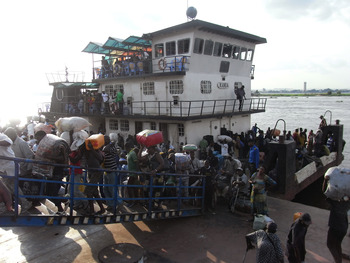
Near Kinshasa's commercial centre, a long walled road leads to the Gare Fluviale ferry port. The street ends abruptly at an imposing building, housing departure and arrivals halls, and a customs inspection depot (see Figure 1). Through the building and past rows of police officers, impressive, wide views of the Congo River and the skyline of Brazzaville open out on the other side, where a ferry filled with people and goods might be heading out (see Figure 2). The Congo River serves as the international border between the two ‘mirror cities’ (Gondola Reference Gondola1997), the closest capitals in the world, and the ferry, when it runs, is the main economic link across it.
The arch marks the entrance to the departure and arrivals halls, the large building to its left is the customs inspection depot. In the left foreground is a trolley with a few juttes loaded onto it, pulled by an aide-handicapé at the front and accompanied by three handicapés: two people sitting on the goods and a third person in the wheelchair to the right.

The Ikanda ferry offloads in Kinshasa and prepares to make the return trip to Brazzaville.
The port border zone is commonly referred to as the Beach, an English name in a Francophone country recalling the bygone colonial times of Henry Morton Stanley's ‘exploration’. When I first became familiar with the border zone, it was known throughout the city as an aggressive place.Footnote 1 But many people made a living there, especially physically disabled people, who dominated most border activities thanks to informal concessions on the ferry passage. They, by contrast, found it amusing to introduce me to the border zone through other nicknames, with all the enjoyment of an inside joke. If not the Beach, it was nzamba, ‘the forest’, a wilderness set against the capital and civilization, or Syrie, a tongue-in-cheek invocation of the Syrian civil war. But the one nickname that had stuck over time was Rome. ‘Welcome to Rome!’ people loved to shout with smiles and laughter: ‘This is Rome in Kinshasa!’
During one of my first visits, I walked towards the port with Aimé and Joules, two men who had been designated to show me around. Joules, suppressing a smile, leaned in towards me and confided, mock seriously, ‘I'm going to tell you something very important now … Like Rome, the Beach is like a country within a country … People act very differently here, ordinary norms are discarded and rudeness is accepted as normal.’ It was like a twisted Vatican, in his eyes. ‘Those who are responsible parents elsewhere in the city act very differently at the Beach; you can hear the worst curse in Lingala at all times, and people say it to policemen.’ His gestures implied confidentiality, but he spoke loudly, making several people look our way and laugh. Others told me, again with laughter, that ‘Rome’ linked border activities to the life of gladiators or the Italian mafia. ‘Everything is possible … there are no fathers, mothers, bosses, everyone is equal, everything is possible.’ There was no control, but also no protection: ‘There is no state here … if there was a problem between people at the Beach, they have to solve it between the two of them; the police will not intervene to help,’ they laughed.
Written down, second-hand, the names and descriptions appear to be serious expressions of possibility and danger. But, in person, people made it clear that the nicknames were, among other things, funny: the wilderness of the forest, the war zone of Syria, or the combative nature of life in Rome invoked a heroic imagination that was self-complimentary but also self-deprecating. It pointed to a hard environment where Romains, people who made a daily living here by acting as porters, smuggling goods and people, or just hawking snacks, had to be tough enough to endure chaos and violence. But the glorious imagination of Rome, for my interlocutors, was also a laughable comparison with the dilapidated port infrastructure and the poverty of marginalized people (including themselves) who made a precarious living there. ‘This is Rome,’ Joules told me with mock pride as he showed me around colonial buildings with peeling paint and leaky roofs, outdoor spaces where the stench of urine and garbage filled our nostrils, and rusty ferries that regularly broke down mid-river due to a lack of maintenance. The nicknames made sincere references to aspirations and imaginations, but they provoked smiles when their exaggerated imagery was compared with the drab reality of the things and people they were referring to.
Decrepit and precarious, Rome was therefore a space of ironic humour that turned equally on the people themselves. Humour shaped a community of Romains and created space for a sharp note of criticism between them. To make money in such a place was believed to require a transformation of wider ethical norms in a hard and competitive atmosphere, where the hierarchical authority of ‘fathers, mothers, bosses’ or policemen fell away, and where it was every individual for him- or herself. Free from responsibilities, one could pursue the value of intelligently exploiting opportunities for individual needs. Yet while laughter excused irresponsible behaviour, it also made a pointed comment on it: discarded norms of responsibility left one without entitlement to the protection of others, or the possibility of fulfilling the social value of being responsible for others oneself. ‘One key to interpretation is the recognition that one's informants are capable of ironic, even theoretical, reflection on their own predicaments,’ Herzfeld (Reference Herzfeld, Fernandez and Huber2001: 65) observes. At the Beach, irony and joking were intertwined modes of discerning and reflecting, but also of criticizing and shaping the discrepancies of relationships and values in a context of uncertainty. Romains constantly oscillated between valuing the individual in a ‘wilderness’ without social norms and turning to communitarian values of interpersonal responsibility.
Following contextualization of the Beach, its actors and its place in approaches to humour in Africa, this article therefore examines the ways in which irony and joking create or challenge a sense of community in an environment marked by constant changes. It then considers how physically disabled people make further distinctions between themselves and other people by humorously playing with hierarchical social relationships in which disabled people are expected to be subordinate. Finally, it ends by considering how interpersonal joking between people who are more socially equal exposes the cracks and contradictions in local ideals of urbanity that valorize predatory behaviour. The Beach was a hard place, but as ‘a local resource of insight into local life ways’ (Fernandez and Huber Reference Fernandez, Huber, Fernandez and Huber2001: 26), humour was a way to shape and navigate the clash between different values and moral expectations.
Putting humour in its place
This article focuses especially on the humour used at the Beach by physically disabled people, (ba)handicapés, largely but not exclusively polio survivors.Footnote 2 With their crutches, walking sticks, wheelchairs, tricycles, three-wheeled motorcycles and various other mobility aids, they were part of the extravagant imagery of difference commonly associated with this part of the city. Informal discounts on import taxes and ferry passage, with an allowance for one able-bodied assistant or aide-handicapé, are rumoured to have started in the 1970s under President Mobutu. The border then formed a true ‘theatre of opportunity’ (Nugent and Asiwaju Reference Nugent, Asiwaju, Nugent and Asiwaju1996: 11) for disabled people, my interlocutors emphasized, as they took advantage of these privileges to engage in the hugely lucrative trade in soap, sugar, soft drinks and fabrics with Brazzaville.
Times had been harder since the early 1990s, and instead of being traders themselves, most had shifted to work as intermediaries for others. They used their informal advantages to declare the goods of able-bodied traders at their own cut-price rate, or smuggle across clients who wished to travel to Brazzaville but lacked expensive documentation, under the guise of being their aides. What was originally intended as a mode of self-help in the absence of social security progressed into a specialized economy where disabled people served as brokers in systems of illegal migration and customs fraud; the Beach became viewed by local authorities and many others as a site of criminality and disorder. Far from virtuous and needy, Romains and handicapés in particular were frequently considered aggressive and unruly, quasi-criminals at best and dangerous at worst.
Nor did Romains entirely reject this image. The opportunity to earn an income had challenged common ideas about disability, to an extent (de Coster Reference de Coster2012). Families no longer viewed a disabled relative as ‘useless’, and an income provided possibilities of sexual relations, marriage and children that were previously considered unthinkable for disabled people. But to claim these opportunities they presented themselves as the ultimate yankees, a Kinshasa archetype of ‘tough guys’ with the cunning ‘intelligence’ (mayele) to discern and take advantage of any opportunity (Gondola Reference Gondola2016: 7, 200). Rome, in turn, was imagined as the place par excellence to be a yankee: an ultimate market of débrouillez-vous (‘fend-for-yourself’) possibilities (cf. MacGaffey Reference MacGaffey and Nzongola-Ntalaja1986; Reference MacGaffey1991); a liminal space where ordinary conventions of conduct were suspended and where all people, including state representatives, were out for themselves. Border figures elsewhere are sometimes described as ambiguous and trickster-like (Donnan and Wilson Reference Donnan and Wilson1999: 134–5) for their ability to navigate the ‘wild’ margins between state orders. But they may not necessarily become this through their activities, but rather are attracted to the border because of their existing exceptionality within society; the margins are often ‘seen to form natural containers for people considered insufficiently socialised into the law’ (Das and Poole Reference Das, Poole, Das and Poole2004: 9).
Rome was not, however, a purely ‘liminal’ place. ‘All roads lead to Rome,’ I was told on other occasions: the border was also a centre, a destination rather than just a margin or crossing-point, bringing people from every corner of the DRC and goods from across the globe. In this, it concentrates many attitudes of Kinois towards the city itself as both a ‘wilderness’ and a world centre (De Boeck and Plissart Reference De Boeck and Plissart2004: 41; Trapido Reference Trapido2011).Footnote 3 Furthermore, what was constructed as ‘exceptional’ yankee behaviour was far from restricted to Rome. In recent years, scholars have increasingly observed that such ‘tough guy’ figures are new models of success in Africa (see, for example, Pype Reference Pype2007; Reference Pype2015; Gondola Reference Gondola2016; Banégas and Warnier Reference Banégas and Warnier2001; Ndjio Reference Ndjio, Geschiere, Meyer and Pels2008), suggesting that the predatory nature of ‘fend for yourself’ has seen communitarian norms of responsibility fade away in favour of individualism (for example, Devisch Reference Devisch1995; de Villers et al. Reference de Villers, Jewsiewicki and Monnier2002; Trefon Reference Trefon and Trefon2004; Nzeza Bilakila Reference Nzeza Bilakila and Trefon2004). One thing often overlooked in these insightful discussions, however, is how ironic humour within these practices may offer a mode of expressing critical commentary on the conflicting values of individual aspiration and those of interpersonal responsibility. For Romains, the tough imagery, the call to ‘fend for yourself’ and the positive image of the yankee were at least partly a joke. Laughing in a space where many felt that there was nothing to laugh about was common in Kinshasa; it provided a ‘running commentary’ (Goldstein Reference Goldstein2003: 2) on the need to behave like a yankee, but was also a way of actively shaping and creating interpersonal relationships.Footnote 4 Researchers ‘have found [irony] descriptively as elusive as the sense of smell’ (Herzfeld Reference Herzfeld, Fernandez and Huber2001: 65), perhaps since ‘a joke plucked out of the nuanced social context of its emergence often seems crude, nonsensical or, worse, just plain unfunny’ (Carty and Musharbash Reference Carty and Musharbash2008: 211). The nature of Rome, however, cannot entirely be understood without this elusive laughter.
There is a longstanding tradition of analysing the ambiguous nature of humour (Bakhtin Reference Bakhtin, Holquist, Emerson and Holquist1981) in Africa as a way of interpreting social inequalities. Radcliffe-Brown (Reference Radcliffe-Brown1940; Reference Radcliffe-Brown1949) famously analysed formal joking relationships that permitted disrespect as enabling the control of potentially tense social interaction. Mitchell (Reference Mitchell1956) demonstrated how the Kalela dance transformed such joking relationships between kin into relationships between strangers in an urban environment where erstwhile enemies had to unite against their European employers. More recent literature has expanded these observations to analyse humour as a way of examining outsider–insider relationships (for example, Rasmussen Reference Rasmussen1993; Hernann Reference Hernann2016) and as a way of deflating social tensions and managing conflicts (for example, de Jong Reference de Jong2005; Davidheiser Reference Davidheiser2006). Humour has also been analysed as a manner of confronting tensions around sensitive subjects such as gender (Wiley Reference Wiley2014; Crawford Reference Crawford2003), death and generational conflict (Drucker-Brown Reference Drucker-Brown1982) or illness and sexuality (Black Reference Black2012), or as enabling ‘resistance’ to power (for example, MacGaffey and Bazenguissa-Ganga Reference MacGaffey and Bazenguissa-Ganga2000: 160; Wrong Reference Wrong2002: 134; Comaroff Reference Comaroff1985; Scott Reference Scott1985). So prevalent are observations of humour that Achille Mbembe defines the (African) postcolonial subject as ‘homo ludens par excellence’ (Reference Mbembe2001: 104), one who plays with power by mocking its obscene and vulgar characteristics, but simultaneously taking it at face value and endorsing it. Recently, Obadare (Reference Obadare2009; Reference Obadare2010; cf. Pratten Reference Pratten, Ahluwalia, Bethleham and Ginio2007) has replied to these observations to counter that humour is a matter of making meaning; as a ‘double assault’ it forms a way through which people critique the existing social order as well as themselves.
This article builds on these observations by taking different forms of humour together, showing how the combination can provide an insight into the instability of hierarchical social relationships and shifting ideas about social values. I aim to continue the conversation on humour made in recent contributions to this journal, where humour has been analysed as a way of challenging and/or confirming social hierarchy and of expressing ideas about values among market women in Mauritania (Wiley Reference Wiley2014) and by stand-up comedians who perform at the funerals of the wealthy in Kinshasa (Pype Reference Pype2015). In the latter case, disabled people are often the butt of jokes, confirming the social hierarchy in place between rich and poor. In the context I consider, it is they who make the jokes, and in a more spontaneous rather than an orchestrated manner; while hierarchy here is certainly confirmed, joking about anti-valeurs also takes on a more critical tone.
The Lingala and French terms used at the Beach both make distinctions between forms of humour and blur them. Impersonal nicknames and terminology were described explicitly as ironie, but this word was also used interchangeably with kotiyola, a particularly negative verb translated in one dictionary as ‘to disregard, scorn, mock in taking the opposite of what is done or said, taunt, ridicule’ a person (Kawata Reference Kawata2003: 257). In this personal mode, gentler words such as kosakana, ‘have a good time, engage in banter, play’ (ibid.: 241), or koseka, ‘joke, laugh’ or ‘ridicule, gloat, mock, taunt, lampoon’ (ibid.: 244), equally saw ambiguous use, alternately or simultaneously sharing a joke with someone and laughing at them.
As a useful caricature, therefore, my interlocutors used two genres of humour in their daily lives: verbal irony about their general situation, expressed in nicknames and terminology; and interpersonal joking, expressed in playful teasing. ‘Irony’, as employed here, was impersonal yet often powerful, expressing an indirect challenge to the status quo of social inequalities. Interpersonal ‘joking’, on the other hand, was a more direct form of playful criticism between people who had more equal social positions. This connotes more the ‘banter’ than the ‘ridicule’ or ‘scorn’ of the Lingala words above, yet the blurred line between them is impossible to ignore and remains significant. Each form could break down or combine into many alternative definitions; the distinction is artificial, yet necessary.
However, while I characterize irony as more ‘indirect’ while joking is more ‘direct’, it is the intersection of diverse aspects of a speech act – including the role of the audience (Wiley Reference Wiley2014; Pype Reference Pype2015; Hernann Reference Hernann2016) – that results in an evaluation that deems it either a direct or an indirect challenge, either as an insult or a joke (Irvine Reference Irvine, Hill and Irvine1992: 129). The metacommunicative signals between participants that carry the message ‘this is play’ denote a separate dimension of reality whose logic is different from the conventional logic of being earnest in what Gregory Bateson (Reference Bateson1987 [1972]) referred to as the ‘play’ frame. For my interlocutors, insults and jokes were more ‘setting-specific’ than ‘category-routinized’, in Handelman and Kapferer's terms (Reference Handelman and Kapferer1972): fragile and uncertain, contingent on the immediate setting and participants, jokes were improvisationally co-constructed and constantly negotiated (Irvine Reference Irvine, Hill and Irvine1992; Launay Reference Launay2006; Black Reference Black2012). Whether or not one was in ‘play’ could often remain ambiguous (de Vienne Reference de Vienne2012).
I had a role in this construction too, with my presence as an audience undoubtedly accentuating and provoking some of the laughter (cf. Rasmussen Reference Rasmussen1993; Wiley Reference Wiley2014); my companions laughed at a white Belgian, who represented an imagination of the wealthy North and a relationship with the ex-colonizer, who now found herself in the deplorable circumstances in which they had to live and work and surrounded by the glorified ruins of a ‘state that had been’. Ridicule is often a means through which ordinary people make meaning out of a reality that has become surreal or absurd (Obadare Reference Obadare2009; Goldstein Reference Goldstein2003). Pointing to the contradictions between Rome and reality served as a tongue-in-cheek implicit criticism of their environment and the state that left them exposed within it. References and imaginations of other times and places are not uncommon in times of uncertainty (Ferguson Reference Ferguson1999; Weiss Reference Weiss2002; De Boeck and Plissart Reference De Boeck and Plissart2004: 45–50; Trapido Reference Trapido2011 on Kinshasa), but it is necessary to recognize actors’ capacity to reflect on the irony involved in doing so.
Setting is therefore crucial. Language and social life inherently invite irony (Friedrich Reference Friedrich, Fernandez and Huber2001), but irony tends to flourish in particular historical conditions (Marcus Reference Marcus, Fernandez and Huber2001), when the ‘parallels between the role of indeterminacy in social life and the play of irony in the semantic domain’ are particularly salient (Herzfeld Reference Herzfeld, Fernandez and Huber2001: 64). The humour of the border drew on the backdrop of uncertain times in which Romains lived, and the ironies of their own opportunities. The frontier was seen as a ‘wild’ space, but its heavily securitized state presence framed it as a sensitive (and centrally situated) border in a capital city. Joking that ‘there is no state here’, and justifying the need to behave as a yankee in a state-less space, depended on the immediate presence of police and customs officers. Just as Das and Poole (Reference Das, Poole, Das and Poole2004: 7) remark how ‘the state is imagined as an always incomplete project that must constantly be spoken of – and imagined – through an invocation of wilderness, lawlessness, and savagery that not only lies outside its jurisdiction but also threatens it from within’, those on the margins can imagine the same opposition. Laughter at breaking rules was enhanced because the police were so close and critiqued the conditions that required one to do so. The border, as a space that ultimately represented the authority of the state, provided a space and context that explained why subversive yankee references were funny.
Fundamentally, humour that elided the presence of the state drew attention to the fact that the opportunities of the border were extremely fragile, subject to sudden removal by this ‘absent’ state at any time. The Kinshasa government has regularly launched ‘chocs’ (‘shocks’ or ‘raids’) to ‘clean up’ the border, removing the Romains or temporarily suspending their activities.Footnote 5 Most disastrously, towards the end of my fieldwork in April 2014, Brazzaville launched Opération Mbata ya Bakolo (Operation Punch/Slap from the Elders) to expel undocumented foreigners, especially people from the DRC. The ferries were used non-stop to transport those expelled to Kinshasa, thus effectively shutting down ordinary ferry activity and wiping out the border traffic upon which livelihoods depended. At the time of writing, large-scale ferry trade remains infrequent, with mainly small speedboats and private barges still crossing the river, which means that much smaller quantities of goods can be conveyed.
This article's focus is on border life before this dramatic event. But even then, Romains consistently described their activities as ‘temporary’, underlining that there was no future or security in this way of life, and people expected things to turn out for the worse (or perhaps the better) at any moment. The uncertainty of the border situation functioned like the discursive unpredictability that de Vienne (Reference de Vienne2012: 165) notes as the ‘core of the social productivity of joking’, pointing to the ‘tension … between certainty and uncertainty, prediction and surprise’. In sub-Saharan Africa, Obadare (Reference Obadare2010: 109) observes that ‘humour is integral to a reality which compels the postcolonial subject to endless improvising’. Very few had the luxury of having a fixed plan for the day. They came to the border each morning in hope, trying to catch a client for themselves, or hooking up with a friend to share a job and make a profit. The atmosphere of the border was that of short explosions of activity amidst long hours of waiting, when boredom was countered with humour.
Irony and joking in uncertain times: difference, belonging and ambivalent laughter on the border
When in Rome …
To be successful in Rome, Romains depended on the reputation of the Beach as a marginal space where one had to be strong enough to adapt to a tense and competitive atmosphere (cf. Donnan and Wilson Reference Donnan and Wilson1999: 131). ‘I'm a Romain!’ young men laughed while flexing their muscles with amusement, showing me different substances they were drinking or smoking to create and maintain the superhuman strength and suppleness considered necessary to work at the border. The term ‘Romain’ was believed to have originally denoted an able-bodied young man hired to circumvent the wait at customs by jumping off the ferry with a small package and swimming into port, but in recent years it had been extended further to include anyone who kept a regular presence at the border.Footnote 6 Anique, a prominent and popular disabled woman, often referred to the border as ‘the world of darkness’ (monde des ténèbres): ‘People act differently there than elsewhere … you have to become savage in order to get your work done. [So] I'm impolite, rude, I insult people … People know me as very savage, so they don't touch me anymore.’ Identifying with and claiming the ‘wild’ distinction of Rome was therefore a professional requirement, and the impersonal irony of the Beach nicknames was echoed by personal nicknames the Romains gave themselves and their friends.
There was Hulk, a handicapé, Ninja, a policeman, and Champion, a young man who was ‘like a boxer’; the names replicated common models of masculinity that emphasize violence, bodily strength and fearlessness (Pype Reference Pype2007). ‘Diaboleuse’ and ‘Kabila’ or ‘Raïs’, after the President's Swahili soubriquet, were subversive and bold statements recalling the ‘apocalyptic’ imagination in Kinshasa (De Boeck Reference De Boeck2005), or ironizing the anti-Kabila environment. Romains might give their nickname while laughing through performances of bravado that blended boasting with self-deprecation, and they were generally used among friends who shared in the laughter rather than with strangers. Anique liked telling people that they called her Maman Liwa, or ‘the mother/woman of death’, ‘because I'm savage’, supporting her claim to know the ‘world of darkness’. ‘You know how women who sell food are called mamans malewa [mother street restaurant]?’ she explained once with a grin. ‘They call me Maman Liwa, because [if you mess with me] you get death.’ But one day she affectionately put her arm around the shoulders of an elderly friend, telling me they called her Maman Liwa too, provoking smiles at the discrepancy between the tough nickname and the frail appearance of her friend.
The ironic laughter surrounding nicknames created a sense of public intimacy, but interpersonal joking played an even more direct role in mediating the dynamics of ‘community’ at the Beach. Handicapés often laughed about disabilities, playfully poking fun at each other for not conforming to the models of masculinity their nicknames proclaimed. During the twenty-minute ferry trip between Kinshasa and Brazzaville, one handicapé named Ben frequently joked with a blind man who parodied ‘tough guy’ yankee-style nicknames by calling out ‘Ben with the flimsy/broken legs [makolo elemba or makolo ebukana]!’ Ben would reply with his own teasing insults for the blind man: ‘You haven't yet seen the face of your wife!’ Such subversive joking about disability could be a way to confront stigmatization (cf. Black Reference Black2012), both acknowledging the disability and displaying the ability to claim Beach opportunities with the best of them. There was, however, a clear understanding that the ‘licence to joke’ (Handelman and Kapferer Reference Handelman and Kapferer1972) about disability in a more direct, interpersonal way was only able to be claimed by those who were themselves disabled. Able-bodied people laughed at the exchange, but they were aware that if they were to express the same words these would be interpreted as insulting. Interpersonal teasing between disabled people trod a thin line between insult and joke, but the cues of laughter, smiles and gestures framed them as games (jeux) to create ‘ambiance’. Whereas joking relationships are classically studied as relationships between (real or fictive) kin, in this urban environment humour helped to establish relationships across ethnic and other divisions (cf. Mitchell Reference Mitchell1956).
One day, a rapid exchange between three disabled men set this in context. Vincent, a man in his forties who had lost his leg a few years previously in a motorcycle accident, walked with metal crutches; Junior, or Six Toes, a broad man in his thirties born with an extra finger and toe on each foot and hand, and with a limp leg caused by polio, moved by levering himself around a thick wooden stick; Koffi, named for his love of the superstar Congolese musician, walked with huge wooden under-arm crutches. We were part of a large group, and the humorous tone had been set. Junior had just laughingly told me that his extra fingers and toes had been a surplus gift (matabis) from God, like market women who added such ‘extras’ to their sales. Vincent touched my arm to draw my attention and indicated the start of his joke with a laugh. He pointed at Junior's stick and declared that the reason Junior did not use crutches was because he had no money, that he had just taken a branch somewhere or cut a tree down, and that he walked like ‘people in the forest’. Junior laughed at the tease, and Vincent proceeded gleefully to imitate and exaggerate Junior's hop, to the hilarity of everyone around. Junior's riposte elicited just as many laughs, as he replied that Vincent's hand-held crutches had been brought in by the colonizers to help the weak. Flexing his imposing muscles, he poked fun at Vincent's unfit middle-aged body, boasting with bravado that one had to be very strong to walk around with a stick. Vincent countered again, briefly showing his own muscles but accepting defeat. He pointed at Koffi and his under-arm crutches with amused triumph; those were for people who were really weak, he declared.
Provoking people for laughs was one of Vincent's pastimes, and many referred to him as a ‘comedian’ or an aventurier, someone who is not to be taken seriously. Notably, both he and Ben ‘with the flimsy legs’ were regularly, jokingly accused of not being a ‘real’ handicapé: humour helped integrate them into the community. A broad consensus defined those able to claim the informal Beach discounts by visible disabilities, but disabled Romains frequently made further distinctions: the more ‘legitimate’ handicapés were those who were wheelchair-bound and who had survived childhood polio. Neither Ben nor Vincent conformed to this model. As the recent survivor of an accident, Vincent was a newcomer and an outsider to the environment of handicapés. Ben, by contrast, had survived polio, but unlike many others he could stand with the use of one leg. Ben was teased for walking ‘as if he had a nail in his shoe’ or ‘as if his leg was a sheet’; Vincent was teased for having a stump rather than a leg. Teasing drew attention to their anomalous disability, but included them in the handicapé play frame.
This teasing was largely light-hearted, but the tone could turn sour when it was implied that someone was exploiting the border advantages to the detriment of the more deserving; laughing about disability could have a stronger critical edge than the partially ironic performances of masculinity. As a successful broker, Ben was frequently criticized for being greedy and selfish in refusing to distribute his earnings more generously. Vincent's teasing reflected this ambivalence, managing a relationship with those who could potentially exclude him from the advantages of border work, while combining the ‘legitimacy’ of disability with the strength and successes of masculinity. Both included themselves in the group of handicapés by explicitly joking about something that only they were permitted to laugh about. Jokes fail when they are made by the wrong person; by combining both friendliness and antagonism (Radcliffe-Brown Reference Radcliffe-Brown1940: 196), they strengthened the in/out group dynamics of the disabled Romains (cf. Hernann Reference Hernann2016).
The combination of seriousness and subversive humour in nicknames laid claim to the right to belong on the border and own its possibilities (cf. Brambilla Reference Brambilla2007; Flynn Reference Flynn1997), while related interpersonal jokes moderated and defined this inclusion. Both forms of humour created communitas (Carty and Musharbash Reference Carty and Musharbash2008: 212; Turner Reference Turner1969), a way of including and excluding people as a social group (cf. Apte Reference Apte1985; Basso Reference Basso1979; Hernann Reference Hernann2016). The ironic references turned an essentially public space into one belonging uniquely to those in the know, jibing jokes turned strangers into people with a shared understanding – a community of disabled Romains – so long as the laughter was shared.
Playing with power and making meaning: roquetteurs and mbakasologie
Ironic wordplay and teasing between individuals also mediated the ambivalent social status of disabled people as a group, most expressively so when it came to what they were actually doing at the border. Most handicapés made a living as brokers for able-bodied people: either getting goods through customs using their unregulated discounts, or using the discount they received to travel with a ‘helper’ to transport people who lacked the necessary documentation, exploiting their border contacts and knowledge to navigate the formal and informal regulations. The humorous terminology handicapés used to refer to their role in customs fraud and illegal migration reflected and shaped the meaning of controversy.
When trying to elicit respect in their semi-legal work, those handicapés who declared the goods of others as their own would prefer to be known as a déclarant. When they wished to be funny and subversive, on the other hand, most referred to their activity as kobeta roquette, ‘to hit/do a rocket’. The term evoked a comical image that compared the large white packages within which goods were shipped (juttes) to rockets (roquettes), and disabled people to spacemen or pilots (roquetteurs). When goods arrived from Brazzaville they were loaded off the ferry onto trolleys that were pushed through the border zone by hired porters; disabled people sat on top of the stacked packages and directed their porters (see Figures 3 and 4). On this imaginary rocket they shot past the helpless police, having negotiated (or chosen not to negotiate) their duties in the customs inspection hall.
People wait outside the customs inspection hall for the ferry to arrive. The trollies are empty at the moment, and a policeman stands guard with his back to the large iron gate (not pictured) separating the loading zone from the road in front of the buildings (see Figure 1).

With trollies loaded up with juttes, and the empty ferry in the background, border workers wait for the large iron gate separating the loading zone from the road to be opened.

A client who was smuggled across the border as a fake ‘helper’, on the other hand, was routinely termed an mbakasa. While it was standard terminology at the border, mbakasa was a serious insult anywhere else: a coward, someone who was fearful of others and easily dominated. People-smuggling was often phrased as ‘doing’ (kosala), ‘hitting’ (kobeta) or ‘throwing’ (kobwaka) an mbakasa, the latter verb used synonymously for ejaculation. The phrase ‘throwing/ejaculating a coward’ (kobwaka mbakasa) caused amused smirks in outsiders to the border, who enjoyed the sexual innuendo and disparity of the disabled person ‘throwing’ or ‘ejaculating’ an able-bodied ‘coward’ of a client across the border. One interlocutor took the term to the next level when he described his work as mbakasologie, a ‘science’ or ‘-ology’ of transporting undocumented people.
In contrast to terms such as Rome, Romains or nicknames that ironized border workers themselves, these terms reflected and shaped relationships between disabled people and customs officers or clients. Both sets of terms were considered amusing because they challenged the expected power dynamics in these relationships. Where disabled people were commonly expected to be subordinate, weak and helpless in comparison to able-bodied people, these terms depicted customs officers as powerless to stop disabled people's ‘rockets’, poking fun at the authority of the state by suggesting that it was officials who were powerless to impose customs duties. These officials were not usually included in the laughter, which created a sense of an in-group. Able-bodied travellers, in turn, ironically posing as a disabled person's ‘helper’, were presented as the ‘cowardly’ ones in need of help. Since the capacity for humour may be regarded as part of the body language of power (for example, cf. Obadare Reference Obadare2010: 101; Mbembe Reference Mbembe2001), linguistic play is a means through which to establish not only belonging, but also social hierarchy (cf. Basso Reference Basso1979). Such joking terminology thus questioned the low social status of disabled people in society as well as the authority of the state. Disabled people are frequently mocked in public spaces (Pype Reference Pype2015), but joking at the border enabled handicapés to laugh back, in a Bakhtinian style of subversion amidst restrictions (cf. White Reference White1999; Scott Reference Scott1990).
‘Cowards’ and ‘rockets’ were common terminology, and familiarity could rob them of humour; people who heard the terms for the first time might laugh, but for those more accustomed to them, it took strong intonation to make people smile upon remembering the subversive content. As I pushed Anique's wheelchair to the border hall for a shared trip to Brazzaville, she gleefully shouted out for everyone to hear: ‘I've got a white mbakasa! Things have changed!’ Every time she repeated her triumphant remark, heads turned and laughter followed. Some stared in amazed disbelief, while others joined in the joke, shouting: ‘Clara! You've become Anique's mbakasa?!’ When it came to most able-bodied ‘targets’ of this ironic humour, the challenge to power dynamics was indirect: such terminology was not always used in the presence of the customs officers or the to-be-smuggled clients with whom disabled people collaborated. The terms were more likely to be overheard than used directly, or, as in this case, raised with someone they assumed could appreciate a joke, when they evoked amused and indignant laughs at the insult implied.Footnote 7 Anique was not the only one who found it funny to suggest that I, an able-bodied Belgian who embodied established power dynamics, was in a subordinate position to a Congolese handicapé. The joke that I was someone's mbakasa (or, in the case of a male companion, someone's wife) came up regularly whenever I travelled. My occasional attempts at a funny defence by declaring that my companion was, instead, my mbakasa, elicited smiles at the suggestion that I was acting as a smuggler, but they just weren't as funny: despite my gender, my skin colour and nationality carried expectations that I was in the more powerful position, and so the joke fell a little flat.
The use of ‘conventional’ terminology at the Beach could allow my interlocutors to get away with insults in such unequal situations without exposing them to retribution. A customs officer or travelling client such as myself could not directly attribute the insulting implications of the terms because they were expressed in the metacommunicative frame of ‘play’ (Bateson Reference Bateson1987 [1972]), or because the terms were understood to be common terminology in this specific place. The speaker could not be held responsible for offence taken, even when it might derive from words such as mbakasa, ‘coward’, that were unequivocally offensive elsewhere.
The space of the border was thus a significant place for this wordplay to take place, particular yet public; joking in a public space gives words weight through the presence of an audience, which is what makes jokes sting even when they are expressed in a playful manner (Wiley Reference Wiley2014; Hernann Reference Hernann2016). For the handicapés, the border as a setting that accommodated their ‘otherness’ (Schmidt Reference Schmidt, Nugent and Asiwaju1996) gave them a place to joke as well as intensified the performativity of the speech act of doing so. Humorous terms such as kobeta roquette, or referring to myself as an mbakasa, thus not only played with established power relationships but also shaped them: in Rome, it was I who was the ‘coward’, whereas in most other places I was expected to have the upper hand, and laughter made both the normal state of affairs and its inversion clear. For handicapés who had grown up stigmatized as weak and helpless, the humour and excitement of jokes lay in the suggestion that ‘any particular ordering of experience may be arbitrary and subjective’ (Douglas Reference Douglas1968: 365), that they could be strong and dominating, albeit only in the specific context of the Beach.
In such terms, this ‘indirect’ joking resembled Mbembe's homo ludens in a social context, playing with power relations yet doing little to change them beyond the circumstances of play, and so reinforcing hierarchies of power (cf. Pype Reference Pype2015). But while humour was a way of playing with and confirming power, it was also a sincere manner through which people commented on, shaped and made meaning out of reality. ‘Humour is often its own end,’ remarks Obadare (Reference Obadare2009: 248–9): ‘The very process of “letting off steam” is deeply symbolic and counter-discursive.’ Ironic terminology, deployed as indirect mockery, was funny because of its ambivalent nature, a ‘wall of ambiguity’ (Develtere Reference Develtere2009) over social hierarchy, its deviances and absurdities, wrapped up in the possibilities and uncertainties of informal Beach activities. But when applied more directly, jokes could have a far more pointed role in interrogating and shaping the controversies of these behaviours, when playfulness stopped and pointedness began.
Laughter and value conflict
On one of my first visits to the Beach, my disabled guide and I walked up to a long row of relatively young men at the entrance of the border hall, most of them shabbily dressed and dirty, many smoking and drinking. He pointed at them, laughing, and told me that they were all thieves. Turning to me, he added with an ironic air of pride, ‘everyone at the Beach steals from the state’. It was a characteristic valorization of deviance at the border, but with another group, he took a more ambivalent tack, one with a sharper edge to his humour. ‘These are the parents of street children,’ he remarked, laughing. ‘Children without parents are created by these people.’ Identifying evaluative statements such as jokes or insults depends on specific cultural systems of moral judgement (Irvine Reference Irvine, Hill and Irvine1992: 109). The value of being a responsible parent (responsable) was a principal preoccupation for many, one of the greatest achievements that border work could provide; the irresponsibility of fathering ‘children without parents’ could certainly be a slur. Jokes and insults are ‘constructed in interaction’ (Irvine Reference Irvine, Hill and Irvine1992: 110; Launay Reference Launay2006; Black Reference Black2012); each time he jokingly insulted them, the young men laughed and smirked in reply.
The humour of the border thus played its most complex role as it not only reflected the situation of disabled workers, their ability to claim belonging in Rome or the absurdities of their relationship with others, but formed the ethics of their own actions. It is Obadare's ‘double assault’ (Reference Obadare2009: 254, 250), evoking Pratten's (Reference Pratten, Ahluwalia, Bethleham and Ginio2007: 93–9) description of songs about ‘rugged life’ that boast of ideal masculinity while expressing personal insecurities and a surprisingly frank self-critique. Anique, ‘the mother of death’, once gave me and a few friends an elaborate explanation of how she tricked a client ‘coward’ (mbakasa) into giving her all his money on the pretence that he would get searched at the border, and she had stolen some of the money by hiding it in her wheelchair. A consummate performer, Anique had us roaring with laughter about her outrageous antisocial behaviour, but when she saw me noting it down, she laughingly told me not to write down her sins (masumu). Without prompting, she explained why betraying her client was justified: ‘the mbakasa had so much money he didn't know what money was’ and ‘the man was paying her very little for her services’. In telling us her ‘sins’, Anique created a sense of intimacy between us (Pype Reference Pype2015), demonstrating that she had the ‘intelligence’ (mayele) to discern opportunities and take advantage of a fool (yuma), fulfilling the values of an opportunistic Romain. But such values conflicted with her social position as ‘responsible’ for me as my elder, my guardian, and my guide to understanding the lives of disabled people, and in such a position Anique was often criticized when she acted in ways that people considered unpraiseworthy. ‘She's ruining you!’ people often laughingly commented when she told such stories, remarking on Anique's bad influence. There was humour in taking advantage of a rich fool, but an image of responsibility conflicted with such antisocial opportunism.
More pointed were jokes that involved the responsibility of Romains to each other, and the propriety of their behaviour. When ‘the comedian’ Vincent provoked people for laughs, his jokes often stung as he made fun of irresponsible men who could not provide for their many children or drunk men looking for handouts, or he implied that certain women increased their income by supplying sexual favours. Anique was frequently the butt of such gender-related jokes. Our friend the self-proclaimed ‘scientist’ of mbakasologie told us one day with bravado that he had come for kuludimba, a shady job. I feigned ignorance to jokingly provoke him, asking him if kuludimba was the same as a similar sounding word, kindumba, or illegitimate sexual relations. He burst out laughing and waved a finger at me, then declared that kindumba was Anique's area of expertise. Anique laughingly countered that she was instead a queen of koshina, promising men sexual relations for material gifts without going through with it (often seen as a type of scam or theft), and jokingly bemoaned that she could earn so much beer money if only I would be willing to do the same. The comparative unacceptability for each gender of a ‘shady job’, deviant sex and not quite selling sexual favours was implicitly acknowledged and explicitly challenged in the joking exchange.
Jokes can have a continuing social life, and those who were the butt of Vincent's teasing enjoyed it when he was put in his place. One day he pointed to a man who was a currency changer, telling me in front of our audience that the man was his ‘helper’, and that he would have to carry him on his back when Vincent told him to. Pretending to initiate me, an outsider, was one of Vincent's frequent joking techniques. He would often single someone out and tell me a degrading ‘fact’ about them, to much amusement. The image he now provoked triggered laughter: carrying someone on your back was a humiliating task whatever the relationship, and Vincent was significantly larger than the man he had targeted. One aide humorously rejected Vincent's challenge to a helper's dignity. He made an exaggerated show of standing up for the targeted man, telling Vincent and everyone else that aides would soon go on strike and disabled people would then be unable to work. After this humorous riposte, however, he stopped smiling and became serious: ‘You're dependent on us and we're dependent on you.’ He then turned to me to correct Vincent's faulty pedagogy. ‘If I don't work, he won't eat. If he doesn't work, I won't eat. I'm a handicapé, we're one person.’
Pype's stand-up comedians celebrate ‘tough guy’ yankees and mock ‘fools’ (yumas) and thus reinforce anti-valeurs (Reference Pype2015: 472), but the more spontaneous humour at the border was frequently more ambivalent. In their subversive statements, Anique defended herself while Vincent was corrected. For Anique, there was pride in the exploit, and an excuse for the deed, but laughter identified an awareness of transgression that acknowledged the censure of theft, even from a yuma. In responding to Vincent's jokes, Patrick pointed to the interdependence and material contingencies of keeping up good relationships at the border (cf. Englund Reference Englund2008). ‘Switching frames back and forth between joking and seriousness effectively causes reflection upon the structure of interpersonal relationships,’ Rasmussen (Reference Rasmussen1993: 214) observes. In both situations, laughter exposed a moral imagination of what behaviour ‘ought’ to be, if it were to be represented positively to someone who was both younger and an outsider. While Romains were aware that their controversial behaviour and unregulated economic activities were ways of taking part in prevailing economic life (Roitman Reference Roitman, Comaroff and Comaroff2006: 250), legal or not, they did not necessarily find antisocial actions good or justifiable.
Yankee imagery may have become ‘the yardstick against which all men [and women] in Kinshasa are measured’ (Gondola Reference Gondola2016: 198) and by which Romains claimed their space at the border, but the practice of taking advantage of people was at the centre of debates on the legitimacy of opportunistic behaviour to the detriment of others. This was a context where access to resources could depend on social networks to the extent that people come to serve as infrastructure (Simone Reference Simone2004). Laughter therefore rested on an underbelly of more serious discourse on ethical practice, providing a space to reconcile and cope with the contradictions it raised. ‘Rome is a category of people: thieves (miyibi), thugs (voyou) … those people are Romains,’ Anique told me on another, more earnest, occasion. ‘We're all thieves (miyibi).’ As she explained, any person could turn out to be an occasional thief, the circumstances dictating the acceptability or not of stealing. But far from confirming that antisocial behaviour was licit, laughter at social transgression worked to maintain the tension over ethical controversies, preserving the ethical values that jokes suggest are being transgressed. Joking in Rome drew attention to anti-valeurs but also to valeurs, providing a sharp note of criticism that moulded relations and expectations.
Disabled people-smugglers had the negative reputation of being prone to abandoning their clients part way on the journey between Kinshasa and Brazzaville; the jokes about ‘throwing a coward’ (kobeta mbakasa) dwelt on such irresponsibility. Blind people, perceived to be unable to carry out such trickery, were thought to be taking over the smuggling market precisely for this reason, and many people were glad to see this happen. One day a furious young woman with a baby stormed into one of the border police offices, her handicapé guide pleading behind her. It seemed that he had agreed to take her on as a client while knowing that she had proposed an insufficient amount of money to cover the costs of bribery. When they were stopped, they ended up in the police station, and the woman objected to his failure to ensure her crossing. Apparently, it was not the first time that a client of this man had complained, and the policeman took the woman's side, criticizing him for being irresponsible. He scolded him for his substandard work: ‘If you want to cross someone over, you have to take care of them for everything.’ Indeed, ‘nobody is above the law’, the policeman said, apparently without irony, to criticize the man for his unprofessional smuggling. This was not meant to be funny. What was at stake was the man's engagement to take on the woman and his failure to do so despite their agreement. While Ayimpam (Reference Ayimpam2013) has observed a ‘social construction of illegality’ on this border, with people turning a blind eye to smuggling as an act of ‘respect’, in this dispute it was not legality as such but social responsibility that was being critiqued. Where humour created a boundedness that divided handicapés and able-bodied people or state authorities and border workers, the policeman emphasized that, in this situation, the line between different groups of people was artificial: the reference to a shared law underlined a shared understanding that the man had been irresponsible. Being respected and valued meant being tied to other people in relationships, dependent upon them and subject to their moral judgement and evaluation (Englund Reference Englund2008). Thieving, swindling or smuggling was not necessarily criticized because it was illegal, but because it included the possibility of damaging interpersonal relationships.
These were the critiques and injunctions that lay behind laughter at the excesses of débrouillez-vous and the yankee model at the border. Commentators frequently celebrate the inventive ‘survival strategy’ of débrouillez-vous activity, or view it as moral degradation that is a consequence of economic crisis, responsible for anomie, amoral ‘anything goes’ tactics and opportunistic predatory behaviour (see, for example, Biaya Reference Biaya, Hérault and Adesanmi1997; Devisch Reference Devisch1995; Nzeza Bilakila Reference Nzeza Bilakila and Trefon2004; Trefon Reference Trefon2002). Jokes about the propensity to thieve and swindle on the border, however, reflected not the absence of ethical thought but its abundance, shaping a sentiment that shared values of mutual support were not dead, but rather were not always being carried out to their fullest, ultimately desirable, extent. The laughter with which the border workers spoke of ‘fend for yourself’ created a space for the ethical norms of social responsibility to be maintained alongside, and in dialogue with, the contradictions of individualistic necessity.
Conclusion
Irony and joking allow one to have a ‘layered’ mind, ‘capable of entertaining several perspectives at the same time’ (Pedersen Reference Pedersen2011: 196). The uncertainty over a joker's intentions in endorsing or critiquing behaviour reflected and fuelled the uncertainty of relationships between people, playing on the ambivalence of the social situation. A thin line between trust and suspicion characterized many relationships between Romains and with their clients; there was a ‘widespread sense that disadvantage and unpredictability permeate not only the economy but also social and personal relationships’ (Johnson-Hanks Reference Johnson-Hanks2005: 366). The familiarity and distance (Douglas Reference Douglas2001 [1971]: 168), friendliness and antagonism (Radcliffe-Brown Reference Radcliffe-Brown1940) that were characteristic of jokes were also characteristic of social experience on a wider scale. Discourses of morality in interpersonal relationships thus reflected ideas of how things should be, just as irony and humour often serve as an expression of a moral imagination of better times and places (Fernandez and Huber Reference Fernandez, Huber, Fernandez and Huber2001: 15).
The integration of impersonal irony and gradations of interpersonal joking thus provided a space for reflexivity over controversial activities, and so provided a space to shape, manage and navigate the contradictions and inconsistencies of social border life. Laughter aided in moderating community, where self-complimentary and self-deprecating ironic nicknames moulded the membership of a community of Romains and smoothed potentially tense relationships. Jokes also shaped relationships by playing with hierarchy, making handicapés members of a group of border people while separating them from outsiders. Ultimately, in creating community, humour was both social and reflexive, exposing value conflicts between yankee ideals of individual opportunity and valorizations of interpersonal responsibility in acting as a responsable. When seizing opportunities, antisocial behaviour was presented as controversial yet (partially, debatably) acceptable, especially given the temporary and insecure nature of border work and life itself. In a situation where few came to the border with an arranged plan, and most border livelihoods could be – and were – easily wiped out by the collateral impact of state action on either side of the border, acting as a yankee was deemed necessary and desirable. This was constantly contrasted, however, with the necessary social values of honouring relationships. While the yankee is an important recent model of success in Kinshasa, humour at the border put such models in perspective: jokes reminded people of the moral discrepancies in their lives, allowing them to rationalize controversial individualistic behaviour to the detriment of others while maintaining ideals of interpersonal responsibility.
Acknowledgements
I would like to thank the Romains for including me in their jokes and in their lives. My warmest thanks also to those who read previous drafts of this article and provided insightful suggestions: Harri Englund, Susan Bayly, Katrien Pype, Aidan Russell and the two anonymous reviewers of Africa. This research was supported by grants from the Economic and Social Research Council, the Cambridge Home and EU Scholarship Scheme, and Trinity College, Cambridge.



