


Introduction
Suicide is a significant world health problem, with more than 700,000 people dying by suicide each year, equating to one person every 40 seconds (World Health Organization, 2021). Furthermore, the World Health Organization (n.d.) reports that for every suicide death, there are more than 20 suicide attempts. It is essential to understand the psychological processes involved in suicide to optimise the psychological assessment and treatment of suicide risk.
Suicidal mental imagery and suicidality
Suicide is frequently conceptualised as developing along a continuum, progressing from suicidal ideation to suicidal planning to suicidal behaviour (Sveticic and De Leo, Reference Sveticic and De Leo2012). Suicidal ideation is a broad term used to describe a range of ideas, wishes and pre-occupations with death and killing oneself (Harmer et al., Reference Harmer, Lee, Duong and Saadabadi2022). Suicide risk assessment commonly focuses on the experience of suicide ideation in the form of verbal thought (Andreotti et al., Reference Andreotti, Ipuchima, Cazella, Beria, Boroncello, Silveira and Ferrão2020). However, there is emerging evidence for the influence of a different type of cognition on suicide risk, that is the experience of mental images of suicide – thinking about suicide visually rather than thinking about suicide verbally. Importantly, research has indicted that general mental imagery evokes a stronger emotional reaction than verbal cognition (Holmes et al., Reference Holmes, Mathews, Mackintosh and Dalgleish2008), hence the importance of needing to understand suicidal mental imagery with suicidal ideation/behaviour. In a sample of formerly suicidal patients, Holmes et al. (Reference Holmes, Crane, Fennell and Williams2007) found that all reported experiencing detailed suicide-related mental imagery (SuiMI) when at their most despairing. This study was not designed to look for specific types of imagery (e.g. involuntary versus voluntary imagery) but they identified a type of intrusive suicidal image that they described as a ‘flash-forward’. These ‘flash-forward’ images appear to echo flashbacks seen in post-traumatic stress disorder (PTSD) due to their intrusive and repetitive nature. The experience of SuiMI and its association with increased suicidality has been replicated in a range of populations (Crane et al., Reference Crane, Shah, Barnhofer and Holmes2012), including in adults with a diagnosis of bipolar disorder (Hales et al., Reference Hales, Deeprose, Goodwin and Holmes2011). Interestingly, like Holmes et al. (Reference Holmes, Crane, Fennell and Williams2007), none of these studies planned to investigate different types of imagery but they all identified ‘flash-forward’ imagery.
Other studies have identified suicidal imagery within college students (Holaday and Brausch, Reference Holaday and Brausch2015), but they did not identify differences in the type of images. Lawrence et al. (Reference Lawrence, Nesi and Schwartz-Mette2021b) attempted to further understand the relationship between SuiMI and suicidal behaviours in a sample of undergraduate students; they found that SuiMI predicted a higher likelihood of having made a suicide plan and a higher likelihood of having made a suicide attempt over and above suicidal verbal thoughts. The experience of SuiMI has been reported to be both distressing and comforting (Crane et al., Reference Crane, Shah, Barnhofer and Holmes2012; Hales et al., Reference Hales, Deeprose, Goodwin and Holmes2011; Holmes et al., Reference Holmes, Crane, Fennell and Williams2007), with Hales et al. (Reference Hales, Deeprose, Goodwin and Holmes2011) describing some images being associated with both fear and relief.
In response to recent research, the integrated motivational volitional (IMV) model of suicide (O’Connor and Kirtley, Reference O’Connor and Kirtley2018) has included SuiMI as a volitional moderator in the relationship between suicidal ideation and suicidal behaviours, indicating that someone experiencing SuiMI is more likely to engage in suicidal actions. An understanding of how SuiMI might increase suicide risk is largely informed by evidence exploring the influence of mental imagery in determining future behaviour. Although not related to suicide related events, previous research has found that when individuals are asked to imagine themselves engaging in a future event, the likelihood of them doing this action increases (Libby et al., Reference Libby, Shaeffer, Eibach and Slemmer2007). Furthermore, imagining an event has also been found to increase the perceived probability that the event will happen (Pham and Taylor, Reference Pham and Taylor1999). It is suggested that SuiMI forms part of a rehearsal process that precedes a suicidal act, whereby the process of an individual imagining a suicidal act increases both the perception that the event will occur and the likelihood of them engaging in this act (Holmes et al., Reference Holmes, Crane, Fennell and Williams2007). Other ideas of how SuiMI increases suicidality can be considered in the context of the IMV model, where SuiMI represents the desired goal of escape from entrapment and thus suicidal intent is amplified (Crane et al., Reference Crane, Shah, Barnhofer and Holmes2012). Given the growing body of literature suggesting that SuiMI confers significant risk beyond verbal thoughts of suicide, there is a need for further research on SuiMI to better understand its influence on suicidality.
Experiential avoidance and suicidality
Recent research has been interested in the role of experiential avoidance (EA) in suicidality. EA pertains to behaviours which attempt to suppress, control, or eliminate internal experiences (i.e. thoughts, emotions, memories, sensations) that are distressing or are expected to be distressing (Hayes et al., Reference Hayes, Strosahl and Wilson2012). The attempt to suppress, control or eliminate unwanted internal experiences paradoxically can lead to an increase in the frequency and intensity of these experiences and maintains emotional distress (Wenzlaff and Wegner, Reference Wenzlaff and Wegner2000). EA is proposed to take many forms, such as thought suppression, avoidance of reminders of stressful events, emotional avoidance, and avoidant coping strategies (Gamez et al., Reference Gamez, Chmielewski, Kotov, Ruggero and Watson2011).
Suicide can be considered an extreme form of EA, with suicidal behaviours providing a way to escape from overwhelming negative internal experiences (Hayes et al., Reference Hayes, Pistorello and Biglan2008). When individuals believe they have exhausted all other options to escape from unbearable pain, suicide can provide the ultimate escape. This point is very much in keeping with one of the main theories of suicidality, namely escape theory (Baumeister, Reference Baumeister1990). Within this theory, it is proposed that suicide is regarded as an extreme way to escape overwhelming emotional pain. Greater EA has been found to be associated with higher suicidal ideation in psychiatric in-patient samples (Ellis and Rufino, Reference Ellis and Rufino2016; Roush et al., Reference Roush, Brown, Mitchell and Cukrowicz2019). Furthermore, it has been found that patients whose EA decreased more over treatment had a greater change in suicidality, independent of changes in depression severity and hopelessness (Ellis and Rufino, Reference Ellis and Rufino2016). A relationship between EA and suicidality has also been found in non-clinical populations, with Chou et al. (Reference Chou, Yen and Liu2018) showing EA to be a robust predictor of suicidal ideation in a sample of college students. A recent systematic review of 19 independent studies found moderate to strong associations between EA and suicide ideation and behaviours (Angelakis and Gooding, Reference Angelakis and Gooding2021). The process of how EA relates to suicidality continues to be explored, with recent research suggesting that EA is important in the formation of suicide ideation as it moderates the relationship between defeat and entrapment, identified as essential in the development of suicidal ideation according to the IMV model of suicide (Ordóñez-Carrasco et al., Reference Ordóñez-Carrasco, Cuadrado-Guirado and Rojas-Tejada2020). A key part of EA is that avoidance often leads to a rebound effect, where the frequency of the unwanted thought increases following deliberate suppression. This rebound effect has been found to occur in a variety of clinical populations characterised by the experience of intrusive thoughts, such as depression (Wenzlaff et al., Reference Wenzlaff, Wegner and Roper1988), obsessive-compulsive disorder (Tolin et al., Reference Tolin, Abramowitz, Przeworksi and Foa2002) and PTSD (Beck et al., Beck et al., Reference Beck, Gudmundsdottir, Palyo, Miller and Grant2006).
Relationship between suicidal mental imagery and experiential avoidance
As mental imagery is considered an internal experience, it is important to consider the existence of a relationship between EA and SuiMI. Given the potential for EA to exacerbate intrusions (Wenzlaff and Wegner, Reference Wenzlaff and Wegner2000), this may have implications for SuiMI and suicidality. Pettit et al. (Reference Pettit, Temple, Norton, Yaroslavsky, Grover, Morgan and Schatte2009) found that participants who engaged in suppression of suicidal thoughts displayed an increase in the severity of suicidal ideation over a 4-week period. Research reports that responses to SuiMI can be varied, including taking/not taking actions towards the image, but also avoidance strategies, including distraction and suppression (Hales et al., Reference Hales, Deeprose, Goodwin and Holmes2011). Whilst there is little empirical research looking specifically at the effect of avoiding mental images of suicide (rather than verbal thoughts), comparisons can be drawn from other intrusive experiences. For example, Steil and Ehlers (Reference Steil and Ehlers2000) found positive correlations between thought suppression and the frequency of, and distress caused by PTSD symptoms (which include intrusive recollections and flashbacks). Similarly, Williams and Moulds (Reference Williams and Moulds2008) found that greater distress from intrusive memories was associated with greater cognitive avoidance in depression.
EA may exert a similar influence on SuiMI. It is possible that the relationship between SuiMI and suicidality might be stronger at greater levels of EA due to the rebound effect seen in other intrusive experiences. The paradoxical consequence of EA may lead to greater experiences of SuiMI and thus the observed relationship between SuiMI and suicidality becomes stronger. Alternatively, the relationship between SuiMI and suicidality might be stronger for those with a greater tendency to engage in EA as they endorse avoidant approaches to dealing with distress, with SuiMI providing a visual representation of the ultimate form of avoidance.
Research aims and hypotheses
This is the first known study to explore the potential relationship between SuiMI and EA, and how these constructs might interact to increase suicidality. For the purposes of this study, suicidality has been defined as including thoughts about suicide and behaviours (including suicide attempts). The aims of this study were as follows:
-
To explore the relationship between SuiMI and EA – it was hypothesised that SuiMI and EA would be positively correlated and that levels of SuiMI would predict EA (Hypothesis 1).
-
To confirm previous findings that levels of SuiMI and EA predict suicidality – based on previous literature, we expected to find that suicide risk would increase with greater levels of SuiMI and EA (Hypothesis 2).
-
To identify whether EA influences the relationship between SuiMI and suicidality – it was hypothesised that EA would have a moderating influence on the relationship between SuiMI and suicidality (Hypothesis 3). A moderating influence where greater levels of EA increase the relationship between SuiMI and suicidality might be expected due to a greater frequency of SuiMI because of the rebound effect, or potentially due to an endorsement of avoidant coping responses in individuals who engage in EA.
Method
Participants
The inclusion criteria for this study stated that all the participants needed to be aged 18 years or older and a student at the host university. Participants were recruited via posters and a study credit system and the host university was used for recruitment as it allowed clear messaging for support services to be given to each participant. The main exclusion criteria were that they were not studying for a degree at the host university or if they were under 18 years old.
In total, 207 individuals took part in the study. Ten participants were excluded due to incompletion of key measures related to the study variables, resulting in a sample of 197. GPower 3.1.9.4 (Faul et al., Reference Faul, Erdfelder, Lang and Buchner2007) was used to conduct a priori power calculations. To detect a medium effect size (α=.05, power=.80) a minimum sample size of 68 was required to test whether SuiMI and experiential avoidance predicted suicidality; and a minimum sample size of 55 was needed to test whether experiential avoidance moderated any relationship between SuiMI and suicidality.
Procedure
Data collection took place online using Qualtrics©. Following the provision of informed consent, participants provided demographic information and completed the study questionnaires; the order of these was randomised to reduce any order effects. Following completion, all participants were debriefed. Participants were compensated for their time either through the award of participation credits or with the opportunity to enter a raffle to win a shopping voucher. All procedures were approved by the Cardiff University’s School of Psychology ethics committee (EC.22.04.26.6553R).
Given the nature of this study, signposting information was provided during consent and debriefing that included contact details of various organisations such as The Samaritans, National Suicide Prevention Helpline, Papyrus, Community Advice and Listening Line and Befrienders Worldwide. Many of these organisations are able to be contacted 24/7, 365 days a year and allow contact via variety of mediums (e.g. telephone call, email, text message). A link to mental health support available from the host university was also included on the debrief form. Due to the anonymous nature of the online study it was not possible to offer clinical follow-up. The participant information sheet and consent form made potential participants aware of this prior to deciding to take part.
Measures
Demographic information
Participants reported on their demographic characteristics (i.e. age, gender identity, and student status) and completed the following measures.
Suicidal Imagery Questionnaire (SIQ; Ko and You, Reference Ko and You2020)
The SIQ is a 10-item measure that explores experiences of suicidal mental imagery over the past six months. This measure was originally published in Korean and was translated to English (translated version provided by SIQ authors) and the participants recruited into this study were from a range of cultural backgrounds. Items are scored from 0 to 4 on a Likert scale, with higher total scores indicating greater experience of suicidal mental imagery. It also comprises two subscales: Spontaneous Suicidal Imagery and Intrusive Suicidal Imagery. The Spontaneous Suicidal Imagery subscale seeks to measure the experience of intentionally thinking about death, which is based upon research of violent daydreaming that involves voluntary imagining of actions and resulting suicide (see Joiner, Reference Joiner2005; Selby et al., Reference Selby, Anestis and Joiner2007). Examples of items from this subscale are: ‘I have imagined what it would be like to commit suicide’ and ‘I have imagined what the easiest way would be for me to commit suicide’. The Intrusive Suicidal Imagery subscale seeks to measure the experience of involuntary, sudden and repetitive imagery related to suicide (see Holmes et al., Reference Holmes, Crane, Fennell and Williams2007; Hales et al., Reference Hales, Deeprose, Goodwin and Holmes2011). Examples of items from this subscale are: ‘A scene related to suicide abruptly came to mind’ and ‘An image related to suicide unexpectedly came to mind when I did not want to think about suicide’. The SIQ has previously demonstrated good internal consistency and test–retest reliability after a 2-week interval (α=.94; r=.88). The scale showed excellent internal consistency in the present study (α=.97).
Multidimensional Experiential Avoidance Questionnaire (MEAQ; Gamez et al., Reference Gamez, Chmielewski, Kotov, Ruggero and Watson2011)
The Multidimensional Experiential Avoidance Questionnaire is a 62-item measure with six subscales assessing dimensions of experiential avoidance. Items are rated on a 1 (strongly disagree) to 6 (strongly agree) Likert-type scale. The six subscales are Behavioural Avoidance, Distress Aversion, Distraction/Suppression, Repression/Denial, Procrastination, and Distress Endurance. The questionnaire provides scores for each subscale, as well as a total score. Higher total scores indicate greater experiential avoidance, with possible scores ranging from 62 to 372. The MEAQ has previously shown excellent internal consistency for total MEAQ score (α=.91–.92) and good internal consistency for subscales (ranging from α=.79 to .90). The scale showed excellent internal consistency in the present study (α=.92).
Suicide Behaviors Questionnaire-Revised (SBQ-R; Osman et al., Reference Osman, Bagge, Gutierrez, Konick, Kopper and Barrios.2001 )
Suicidality was measured by the Suicide Behaviors Questionnaire-Revised. The SBQ-R is a 4-item measure that explores both current and lifetime suicide ideation and suicidal behaviour. Items explore lifetime suicide ideation and attempts, frequency of ideation over the last 12 months, threat of suicide attempt, and self-reported likelihood of future suicidal behaviour. Questions are scored from 0 to 6 points, depending on the item, with total scores ranging from 3 to 18. Higher total scores indicate greater suicidality. The questionnaire has previously shown acceptable to good internal consistency (α=.76 to .87), in addition to excellent test–retest reliability (r=.95) over a 2-week period (Osman et al., Reference Osman, Bagge, Gutierrez, Konick, Kopper and Barrios.2001). The SBQ-R has previously been recommended as a validated suicidality assessment tool for use in general population research (Batterham et al., Batterham et al., Reference Batterham, Ftanou, Pirkis, Brewer, Mackinnon, Beautrais, Fairweather-Schmidt and Christensen2015) and has been described as a valid and reliable tool in screening for suicide risk (Osman et al., Reference Osman, Bagge, Gutierrez, Konick, Kopper and Barrios.2001). The scale showed good internal consistency in the present study (α=.81).
Data analysis strategy
SPSS version 27 was used for the data entry and analysis. Descriptive analysis procedures were performed to describe the demographic information. Next the data were examined for normality. MEAQ score was found to be normally distributed, whereas both the SIQ and SBQ-R were highly skewed. Suicidality scores are often not normally distributed due to frequent scores of zero within a non-clinical population. Transformations were applied to normalise the distributions but were found to be unsuccessful. Given the large sample size it was concluded that the assumption of normality can be relaxed because of the Central Limit Theorem (Pek et al., Reference Pek, Wong and Wong2018). All other tests assumptions were met. A multiple linear regression was conducted to explore whether SuiMI and EA predicted suicidality, with a simple linear regression conducted to test whether SuiMI predicted EA. Exploratory analysis included a series of simple and multiple linear regressions to explore the predictive relationships between study variables in low- and high-risk samples. Lastly, a t-test was conducted during exploratory analysis to identify whether there was a significant difference in the type of SuiMI experienced by participants, whilst a multiple linear regression was conducted to identify whether different types of SuiMI explained greater variance in suicidality. A moderation analysis (model 1) was carried out using SPSS Process Macro version 4.2 to test the influence of EA on the relationship between SuiMI and suicidality.
Results
Sample characteristics
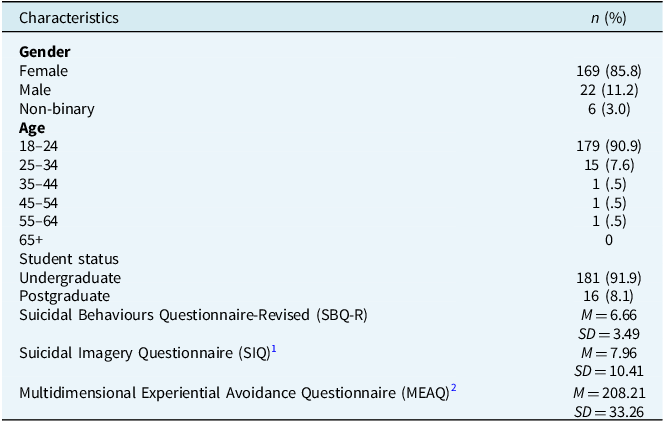
The 197 participants identified as predominantly female (85.8%) and most (90.9%) were within a 18–24 years age range; the majority (91.9%) of the sample were undergraduate students. Within the sample, 42% (n=83) exceeded the clinical cut-off of ≥7 for suicide risk in a general adult, non-in-patient population on the SBQ-R. Mean SBQ-R scores were higher in the sample than the non-suicidal undergraduate sample found in Osman et al. (Reference Osman, Bagge, Gutierrez, Konick, Kopper and Barrios.2001) (M=5.01, SD=2.97). Further sociodemographic and clinical characteristics are shown in Table 1.
Sociodemographic and clinical characteristics of participants
Hypothesis 1: Verifying the relationship between SuiMI and EA
A Pearson correlation coefficient was computed to assess the relationships between the study variables and to test whether individuals who reported greater experiences of SuiMI would report higher levels of EA (Table 2). As hypothesised, SIQ scores were positively correlated with MEAQ scores, although the effect size was small. Positive correlations were also found between MEAQ and SBQ-R scores. It was also found that SIQ scores were positively correlated with SBQ-R scores, with this noted to be a large effect. These results were confirmed by a Spearman’s rank order correlation.
Bivariate correlations among primary study variables, as measured by Pearson’s r

a SBQ-R scores,
b SIQ scores,
c MEAQ scores.
**p<.01.
A simple linear regression was conducted to test whether SuiMI predicted levels of EA. The model was statistically significant (R 2=.057, F 1,195=11.871, p<.001). SuiMI scores were found to significantly predict suicidality (β=.240, p<.001), although the effect size was small.
Hypothesis 2: SuiMI and EA as predictors of suicidality
A multiple linear regression was used to test whether SuiMI and EA would significantly predict suicidality. The overall regression was statistically significant (R 2=.663, F 2,194=190.471, p<.001), explaining 66.2% of the variance in suicidality. However, only SuiMI was found to significantly predict suicidality (β=.809, p<.001); EA did not significantly predict suicidality as hypothesised (β=.020, p=.639).
Hypothesis 3: Moderating role of EA
A moderation analysis using PROCESS Macro No. 1 tested whether the size of the relationship between SuiMI and suicidality changed depending on any moderating influence of EA. As shown in Table 3, SuiMI was significantly related to suicidality, but EA did not moderate the relationship. The hypothesis of EA moderating the relationship between SuiMI and suicidality was not supported.
Suicidality predicted from SuiMI and EA

b SIQ scores,
c MEAQ scores. b, estimate of the regression coefficient; SE, standard error of estimate; t, t-test value; p, significance probability; 95% CI, 95% confidence interval; LLCI, low-limit confidence interval; ULCI, upper-limit confidence interval.
Exploring predictive relationships between study variables in low- and high-risk subsamples
To understand whether the finding that EA did not predict suicidality may have been attributable to the sample including participants at low risk of suicide (as defined as scoring below clinical cut-off of ≥7 on SBQ-R for suicidality), an exploratory analysis was performed on the high suicide risk participants only (clinical cut-off ≥7 for being at high risk of suicide as measured by the SBQ-R; n=83). Descriptive statistics identified that for the low-risk group, the mean on the SBR-R was 4.18 (SD=1.08) and for the high-risk the mean on the SBQ-R was 10.7 (SD=2.65).
Multiple linear regression was used to test if SuiMI and EA significantly predicted suicidality in this high-risk sample. This overall regression was statistically significant (R 2=.608, F 2,80=62.042, p<.001) and replicated the previous results, finding that only SuiMI significantly predicted suicidality (β=.780, p<.001) and EA did not (β=–.003, p=.966). However, when exploring the predictive relationship of SuiMI on EA, a simple linear regression found that SuiMI no longer predicted EA in the high-risk sample (R 2=.030, F 1,81=2.470, p=.120; β=.172, p=.120). This analysis was re-run in a low-risk subsample (i.e. scored below the clinical cut-off on the SBQ-R; n=114). These results replicated the initial analysis, where SuiMI predicted both EA and suicidality, and EA did not predict suicidality (Table 4).
Suicidality predicted by SuiMI and EA in low-risk subsample and SuiMI as a predictor of EA

a SBQ-R scores,
b SIQ scores,
c MEAQ scores. b estimate of the regression coefficient; SE, standard error of estimate; t, t-test value; p, significance probability; R 2, explanatory power; F, F-test value.
Exploring spontaneous suicidal mental imagery (SuiMI) and intrusive SuiMI as individual predictors of suicidality
Lastly, exploratory analysis of whether the type of SuiMI predicted levels of SuiMI was conducted. Bivariate correlations indicated large correlations between the subscales of the SIQ according to both non-parametric (r=.675, p<.001) and parametric (r=.806, p<.001) tests, indicating potential concern for multi-collinearity between predictors. Variance inflation factors (VIF) were examined. VIF values were 3.5 and therefore regression analyses were deemed appropriate as the values did not exceed 10.
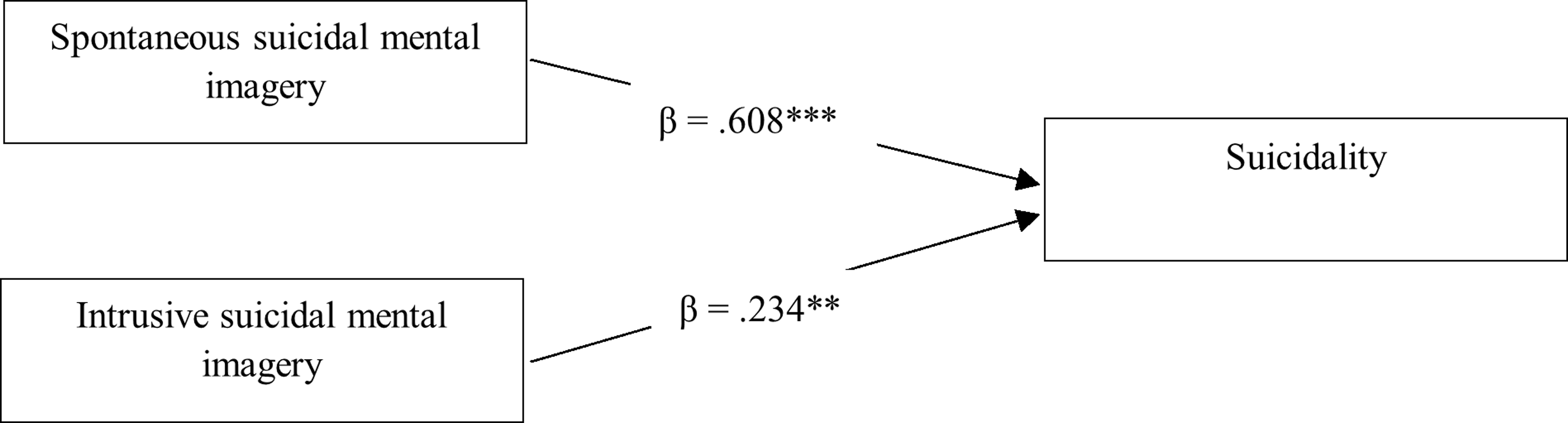
A multiple linear regression model was used to test the predictive ability of the SIQ subscales on SBQ-R scores, using the whole dataset. The overall regression was statistically significant (R 2=.665, F 2,194=192.733, p<.001; Fig. 1). Of the 66.5% variance in suicidality explained by SuiMI, spontaneous SuiMI made the largest unique contribution, explaining 10.6% of the variance in suicidality (β=.608, p<.001). Intrusive SuiMI made a small statistically significant contribution (β=.234, p=.003), explaining 1.6% of the variance in suicidality, over and above that explained by spontaneous SuiMI. A paired-samples t-test was conducted to examine for differences in the frequency of spontaneous SuiMI and intrusive SuiMI. Participants reported significantly greater spontaneous SuiMI (M=4.87, SD=6.537) than intrusive SuiMI (M=3.10, SD=4.283), t 196=–6.706, p<.001 (two-tailed).
Suicidality as predicted by types of suicidal mental imagery. **p<.01; ***p<.001.
Discussion
The aim of this study was to gain a greater understanding of potential processes involved in the relationship between suicide-related mental imagery (SuiMI) and suicidality. It aimed to identify whether there is a relationship between SuiMI and experiential avoidance (EA), and whether EA has an influence on the relationship between SuiMI and suicidality. As hypothesised, SuiMI predicted levels of suicidality, with exploratory analysis indicating that the experience of ‘spontaneous’ SuiMI (i.e. voluntarily generated) explained greater variance in suicidality than intrusive SuiMI. Furthermore, a positive relationship between SuiMI and EA was found, supporting the hypothesis that those with greater levels of SuiMI will also have a greater tendency to engage in EA. However, EA was not found to have any significant influence on suicidality and the hypothesis of EA as a potential moderator of SuiMI and suicidality was not supported. EA was not found to predict levels of suicidality in either low or high suicide risk samples. Exploratory analyses showed an association between SuiMI and EA in the low-suicidality risk sample but not in the higher risk sample; and that voluntary SuiMI show a stronger relationship with suicidality than involuntary, intrusive SuiMI.
This study replicates previous findings of SuiMI being associated with increased suicide risk in both clinical and non-clinical populations (Crane et al., Reference Crane, Shah, Barnhofer and Holmes2012; Hales et al., Reference Hales, Deeprose, Goodwin and Holmes2011; Holaday and Brausch, Reference Holaday and Brausch2015; Lawrence et al., Reference Lawrence, Nesi and Schwartz-Mette2021b), finding that a greater frequency of SuiMI predicted greater suicidality. Mental imagery can be important in guiding behaviour relevant to achieving goals (Conway et al., Reference Conway, Meares and Standart2004). Yet when the goal is to kill oneself, the experience of SuiMI may serve to increase the probability of transitioning from just thinking about suicide to engaging in suicidal behaviours (O’Connor and Kirtley, Reference O’Connor and Kirtley2018). This is consistent with prior research in non-suicidal imagery finding that imagining an event increases the likelihood of the person enacting said event (Libby et al., Reference Libby, Shaeffer, Eibach and Slemmer2007; Pham and Taylor, Reference Pham and Taylor1999). In the IMV model of suicide, suicidal behaviour is seen as the salient solution to unbearable life circumstances when no other solutions can be generated, with SuiMI potentially providing a visual representation of this goal.
The finding that EA was not associated with suicidality contrasts with research findings showing EA to be a predictor of suicidality in both clinical and non-clinical populations (Chou et al., Reference Chou, Yen and Liu2018; Ellis and Ruffino, Reference Ellis and Rufino2016; Roush et al., Reference Roush, Brown, Mitchell and Cukrowicz2019). This may be attributable to methodological differences in the measurement of EA. Prior studies exploring EA and suicidality have primarily used the Acceptance and Action Questionnaire-II (AAQ-II; Bond et al., Reference Bond, Hayes, Baer, Carpenter, Guenole, Orcutt, Waltz and Zettle2011). However, the AAQ-II has been shown to demonstrate suboptimal discriminant validity with measures including neuroticism and negative affect, and recommendations have been made to instead use the MEAQ as a measure of EA (Lewis and Naugle, Reference Lewis and Naugle2017; Rochefort et al., Reference Rochefort, Baldwin and Chmielewski2018). If the AAQ-II functions as a measure of negative affect, it is unsurprising that previous research has identified strong relationships between EA and suicidality and when studies have used an alternative measure of EA with greater construct validity, such as the MEAQ, the effects of EA as a predictor of suicidality are not found (Rogers and Joiner, Reference Rogers and Joiner2018; Zvolensky et al., Reference Zvolensky, Jardin, Garey, Robles and Sharp2016), which is consistent with the present findings. These methodological issues do raise the possibility that EA may not have a relationship with suicide and this certainly warrants further research.
In contrast, a positive association between SuiMI and EA was found. This relationship was expected given prior literature on the rebound effect, where the avoidance of intrusive experiences is associated with greater frequency of these experiences. This fits with ideas of SuiMI being a distressing, aversive internal experience (Crane et al., Reference Crane, Shah, Barnhofer and Holmes2012; Hales et al., Reference Hales, Deeprose, Goodwin and Holmes2011; Holmes et al., Reference Holmes, Crane, Fennell and Williams2007) and are consequently something that individuals can attempt to avoid. However, it is not possible to draw conclusions on this as the measure of EA used in this study is a general avoidance measure and is not able to identify the specific internal experiences that the individual is avoiding. Furthermore, there was no evidence to suggest that EA moderated the relationship between SuiMI and suicidality, which suggests that EA was not functioning as an amplifier of the relationship between SuiMI and suicidality. This makes sense when considered in the context of the results indicating that voluntary SuiMI was more strongly associated with suicidality than involuntary SuiMI. That is, if people are predominantly engaging in deliberate SuiMI then, by definition, a non-avoidant cognitive process is being enacted.
However, it is interesting that when the relationships between SuiMI and EA were investigated, no relationship was found in the higher suicidality group. It could be possible that SuiMI serves a function for individuals at greater risk of suicide. Conway et al. (Reference Conway, Meares and Standart2004) has suggested that mental imagery reflects specific goals and that when an image comes to mind, important goal information becomes available. For those who are already suicidal, SuiMI might represent a goal and thus it is engaged with, rather than avoided. This is supported by work found in addiction literature. The elaborated intrusion (EI) theory of craving suggests that the creation of mental images of substance use by cravers is pleasurable, conveying some of the reward or relief of the real thing (May et al., Reference May, Andrade, Panabokke and Kavanagh2004). However, ultimately it draws awareness to a separation between the current state and desired state (Andrade et al., Reference Andrade, May and Kavanagh2012). For suicidal individuals, SuiMI might be a comforting and reinforcing experience, with previous research finding similar levels of distress and comfort reported by suicidal participants in response to SuiMI (Crane et al., Reference Crane, Shah, Barnhofer and Holmes2012; Hales et al., Reference Hales, Deeprose, Goodwin and Holmes2011; Holmes et al., Reference Holmes, Crane, Fennell and Williams2007). Individuals who are suicidal might achieve reward or relief from SuiMI and therefore not want to avoid the experience, whilst for those who are not suicidal, SuiMI might be viewed as a distressing and aversive experience and something to be avoided. The exploratory analysis indicating that participants had greater experiences of spontaneous SuiMI than intrusive SuiMI adds weight to the idea that individuals might be choosing to engage in SuiMI. Spontaneous SuiMI is representative of suicidal daydreaming where individuals voluntarily conjure images of action leading to their death by suicide (Selby et al., Reference Selby, Anestis and Joiner2007), whilst intrusive SuiMI are conceptualised as involuntary ‘snapshots’ of suicidal acts (Holmes et al., Reference Holmes, Crane, Fennell and Williams2007). It is possible that the type of SuiMI experience, that is voluntary versus involuntary, may be related to how the imagery is responded to, with previous research finding that response strategies can include both engagement and avoidance strategies (Hales et al., Reference Hales, Deeprose, Goodwin and Holmes2011).
Given the strong relationship found between SuiMI and suicide risk, this study supports the need for clinicians to assess for the presence of mental images of suicide, and not verbal thoughts alone, when exploring suicide risk. It would also be prudent for clinicians to explore the type of SuiMI their clients are experiencing, and how they engage with the content, with voluntary SuiMI appearing to have a greater influence on suicide risk. It is key within these assessments of suicidal risk that a more nuanced assessment of risk is undertaken by clinicians that include looking at the emotions and meanings attached to specific images. This would allow clinicians to elicit specific emotional, cognitive and behavioural responses to suicidal imagery (see Hales et al., Reference Hales, Deeprose, Goodwin and Holmes2011) and thus allow for a clearer identification of potential risk. There are also potential treatment implications in response to SuiMI that have been proposed, such as eye movement dual task (EMDT) (van Bentum et al., Reference van Bentum, Sijbrandij, Huibers, Huisman, Arntz, Holmes and Kerkhof2017) and imagery rescripting (see Paulik et al., Reference Paulik, Van Velzen, Lee, Markulev, Jackson Simpson, Davies and Schmaal2023).
Several study limitations should be noted. This is the first study to use a translated version of the Suicidal Imagery Questionnaire (Ko and You, Reference Ko and You2020) and although the measure has been assessed to have good psychometric properties (see Baek et al., Reference Baek, Jo, Kim, Lee, Lee and Jeon2021), further research is required to determine the psychometric properties of the questionnaire when used with participants with English as a first language. The study’s sample was largely female and future work could evaluate the generalisability of the findings with samples involving a larger percentage of males. Data on ethnicity were not collected but it would be important for future work to consider this so that conclusions on generalisability can be drawn. Additionally, the results were based upon a sample recruited from a student population and therefore need further investigation in clinical populations.
Due to the cross-sectional nature of these data, it is not possible to make causal statements regarding the investigated constructs. Future research would benefit from longitudinal studies to explore the similarities and differences in the experience of SuiMI in both actively suicidal and non-suicidal participants, as well as distinguishing between SuiMI and suicidal verbal cognitions, with only the former being measured in the present study. Furthermore, utilising ecological momentary assessment of SuiMI and EA, rather than retrospective self-reported measures, may provide insight into the circumstances of when different types of SuiMI are experienced, how individuals respond to these, and the simultaneous investigation of other factors that have also been reported to be important in relation to SuiMI, such as vividness and controllability (see Lawrence et al., Reference Lawrence, Balkind, Ji, Burke and Liu2023).
Conclusion
In conclusion, this study has found that the experience of suicidal mental imagery is an important predictor of suicidality in a university sample, with suicidal daydreaming appearing to have a greater explanatory role than intrusive suicidal ‘flash-forwards’. SuiMI has been found to have a small effect on the tendency to engage in experiential avoidance, although exploratory analysis indicates this relationship only exists in individuals at low risk of suicide. Using a robust measure of EA, EA was not found to predict levels of suicidality as research has previously indicated.
Data availability statement
The data that support the findings of this study are available from the corresponding author upon reasonable request.
Acknowledgements
None.
Author contributions
Hannah Maynard: Conceptualization (supporting), Data curation (lead), Formal analysis (lead), Investigation (lead), Methodology (equal), Project administration (lead), Writing - original draft (lead), Writing - review & editing (equal); James Gregory: Conceptualization (supporting), Formal analysis (supporting), Investigation (supporting), Methodology (supporting), Project administration (supporting), Supervision (equal), Writing - original draft (supporting), Writing - review & editing (equal); Andrea Davies: Conceptualization (equal), Formal analysis (supporting), Investigation (supporting), Methodology (supporting), Supervision (supporting), Writing - original draft (supporting), Writing - review & editing (supporting); John Fox: Conceptualization (equal), Formal analysis (supporting), Investigation (supporting), Methodology (supporting), Project administration (supporting), Supervision (lead), Writing - original draft (supporting), Writing - review & editing (supporting).
Financial support
This research received no specific grant from any funding agency, commercial or not-for-profit sectors.
Competing interests
Dr James Gregory is an associate editor with the journal. He was not involved in the review or editorial process for this paper, on which he is listed as an author. The other authors have no declarations.
Ethical standards
This study was approved by Cardiff University ethics committee (EC.22.04.26.6553R); the study abided by the Ethical Principles of Psychologists and Code of Conduct as set out by the BABCP and BPS, and consent was received from participants regarding the publication of results.


 Open access


Comments
No Comments have been published for this article.