

When Christianity was adopted by law in Iceland (around 1000 A.D.) Grim of Mosfell was baptized and built a church there. . . . When a church was built at Mosfell, the one Grim built at Hrísbrú was demolished and a new graveyard was laid out. Under the altar some human bones were found, much bigger than ordinary human bones, and people are confident that these were Egil's because of stories told by old men.
Egil's Saga, Chapter 86.Introduction
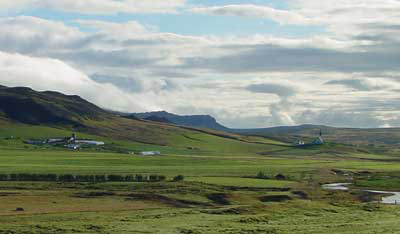
The farm at Hrísbrú (centre left), with Kirkjuhóll at far left and the modern church at Mosfell (right).
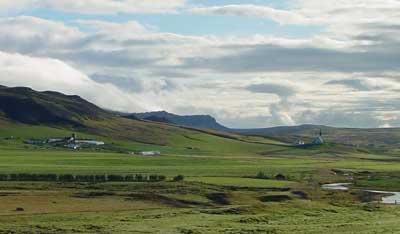
Vikings first settled Iceland about AD 870, building a unique farming and fishing society in the volcanic and glacial landscapes of this large North Atlantic island. Icelandic sagas written in the 1200s contain a wealth of information on social relations and cultural practices during the Viking Age, but scholars have long debated whether individuals, events and places described in the sagas are primarily historical or fictional. Caution is warranted in their interpretation, but archaeological research is providing exciting new evidence for the historical foundations of the sagas. Here we briefly describe our recent excavations at Kirkjuhóll (Church Knoll) at Hrísbrú (Figure 1). Located in the Mosfell Valley c. 30 km north of Reykjavik, Hrísbrú is a place associated with the prominent saga figures Egil and Grim (Reference ByockByock 1995).
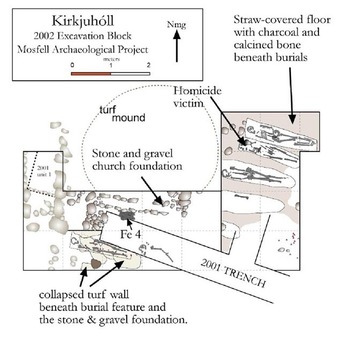
Detail of Kirkjuhóll Excavations, 2001-02.
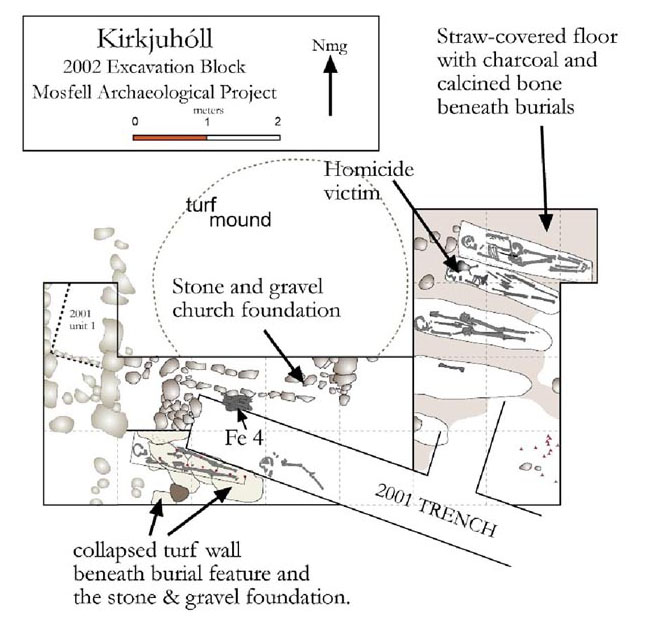
Our research explores the history, archaeology, biological anthropology and ecology of Mosfell Valley in Viking times. Test excavations suggested that remnants of old turf structures and occupational debris were present at Kirkjuhóll (Earle et al. 1997; Steinberg and Byock 2000). In 2001-02, we began major excavations around a turf mound at Kirkjuhóll (Figure 2). This work revealed 26 Viking Age features associated with two major components: residential debris and features (turf wall remnants, a straw-covered floor, charcoal and calcined bone middens) from a farm dating to the AD 900s; and overlying stone foundations of a small conversion-era church with an associated cemetery dating to c. AD 1000. The deposits at Kirkjuhóll are complex, but 14C dates, stratigraphic relationships, tephrochronology and burial associations all support this general sequence.
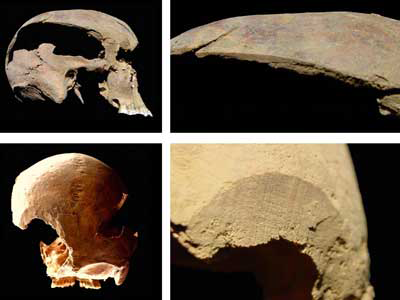
Detail of Burial 2 cranial trauma.
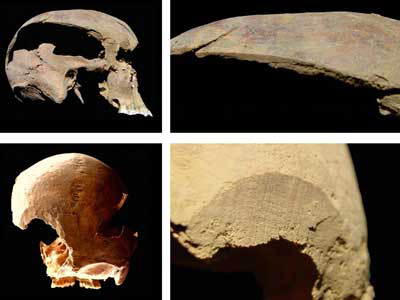
The Kirkjuhóll cemetery contains a wealth of information about the health and hazards of life in Viking Age Iceland. Nine burials have been excavated around the south and east walls of the church. Their preservation, orientation, and treatment vary, but eight are adults (six males, one female, one undetermined), with one poorly preserved infant. At least seven were buried in coffins with their heads to the west. Other than coffin traces, nails, and rivets, burial associations are rare. Feature 4 is a disarticulated skeleton reburied just outside the south wall, along with a carved whalebone - probably a pagan interment moved to the churchyard after conversion. Feature 25 is an isolated humerus, possibly from a burial moved to another location after the church at Kirkjuhóll was abandoned. Pathological conditions are common among the skeletons, including evidence for degenerative conditions related to occupational (e.g. osteoarthritis) and nutritional stress (enamel hypoplasia), dental problems, and infections. Burial 2, an apparent homicide victim, shows massive cranial trauma with a gaping wound in the right parietal and a slice of bone removed from the occipital (Figure 3).
Our excavations at Hrísbrú document a complex occupational history spanning the pagan and early conversion eras, c. AD 900-1100. The remnants of this small church, possibly abandoned owing to a mudslide, may well be the conversion-era church at Hrísbrú mentioned in Egil's Saga, as well as some of the earliest well-documented archaeological evidence for church construction in Iceland (see Vesteinsson 2000). The church and cemetery at Kirkjuhóll are consistent with Viking Age geography, place-names, and mortuary behavior (including reburials and the movement of bones) recorded in the Icelandic sagas and other historical records.
Acknowledgements
Our work was supported by the town of Mosfellsbær, the National Science Foundation, the UCLA Academic Senate, and a Petrone Fellowship from the University of Oregon. Olafur Ingimundarson and his family graciously supported our work on their farm. Gudmundur Olafsson, Agnes Stefánsdóttir, Bjarki Bjarnson, Magnus Gudmundsson, and Helgi Thorlaksson assisted in interpreting the archaeological and historical records of the Mosfell Valley. Figure 2 was drafted by M. Tveskov.