

A deviant case in a tradition of instability
In his monumental work, the British historian Denis Mack Smith identified government instability as the primary source of dysfunction in Italian politics (Mack Smith, Reference Mack Smith2014, vi), both in the post-Risorgimento liberal era and in contemporary republican Italy. Government instability has thus become proverbial: this distinctive feature has joined other identifiers, with Italy often portrayed as the country of renowned gastronomy, artistic heritage, and unstable governments. Since the establishment of the Republic, frequent cabinet turnovers, limited government duration, recurrent inter- and intra-party conflicts, and fragile coalition governments have characterized Italy as one of the least stable parliamentary systems in Europe (King et al., Reference King, Alt, Burns and Laver1990; Schofield, Reference Schofield1995). Against this background, the current government led by Giorgia Meloni, formed in October 2022, constitutes an exceptional case. Circa 3 years into its mandate, it displays a level of continuity and longevity (Figure 1)Footnote 1 that sharply contrasts with Italy's instability tradition (Bull and Polverari, Reference Bull and Polverari2025).
Meloni's exceptional longevity.

In this study, I seek to investigate the exceptional longevity of the Meloni government through established comparative theories of cabinet survival. I specifically build on the coalition life-cycle framework (Müller and Strøm, Reference Müller and Strøm2000; Strøm et al., Reference Strøm, Müller and Bergman2008; Müller et al., Reference Müller, Bäck and Hellström2024) and on the analytical traditions developed by King et al. (Reference King, Alt, Burns and Laver1990), Warwick (Reference Warwick1994), and Strøm et al. (Reference Strøm, Browne, Frendreis and Glieber1988), i.e. structural attributes and critical events schools.Footnote 2 My goal is not to offer a single causal explanation but to make sense of this deviant case as the outcome of a rare combination of mechanisms that classic theories already identify but that have seldom converged simultaneously in the Italian context.
The remainder of this study proceeds as follows. In the next section, I situate the Meloni government within Italy's long tradition of government instability. I then outline the analytical perspective through which this deviant case is examined. The following sections trace the sources of stability across the three stages of the coalition's trajectory. I specifically highlight how crucial stability-friendly mechanisms identified by the comparative literature have intersected in this case. In the final section, I discuss the implications of this government experience for the current debate on institutional reform (premierato) in Italy.
Italy's enduring instability
Italian governments have historically been short-lived by comparative standards. Between 1948 and 2022, the average cabinet duration barely exceeded 1 year (e.g. Improta, Reference Improta2025c). As indicated in Improta (Reference Improta2025c), instability in Italy primarily stems from the limited capacity of parties to manage the adverse implications of power-sharing in highly fragmented coalitions, a structural vulnerability already underscored by Lijphart in his discussion of consensual democracy (Lijphart, Reference Lijphart1999). The 1948 Constitution deliberately dispersed power across multiple veto players, an institutional design choice justified by the “tyrant syndrome” that emerged during post-authoritarian democratization (Adams and Barile, Reference Adams and Barile1953). The effort to prevent executive dominance led to the adoption of consensus-oriented mechanisms, such as a proportional electoral system, which in turn fostered fragmentation and made the formation of cohesive governing majorities structurally difficult (Karvonen and Quenter, Reference Karvonen and Quenter2002).
From the immediate post-war years to the early 1990s, Italian politics was however defined by the paradox of continuity through instability (Zucchini and Pedrazzani, Reference Zucchini and Pedrazzani2021). Cabinets changed frequently, yet the underlying balance of power (centrist coalitions dominated by the Democrazia Cristiana, DC), remained remarkably constant.Footnote 3 The transitionFootnote 4 to the so-called Second Republic promised to overcome this pattern through a mixed electoral system and a greater emphasis on leadership personalization, but the subjacent logic of fragmentation endured (e.g. Katz, Reference Katz2001). Even in the 2010s, frequent alternation at the head of government revealed the persistence of what Sartori (Reference Sartori1976) famously termed the “blackmail potential” of (even small) coalition partners,Footnote 5 whose strategic behavior exploited the permissive institutional environment. As demonstrated in a recent study on this topic (Improta, Reference Improta2025c), instability in those decades was not simply the product of structural design but the expression of recurring coordination failures among actors lacking the incentives or capacity to sustain cohesive governance. In other words, both inter- and intra-party dissent heightened the risk of premature cabinet termination.
Against this background, the longevity of the Meloni government stands out not merely as an exception but as a reversal of the dominant pattern. What is more, this relevant modification is occurring in the absence of any formal institutional change, in a country of “obsessions” for (electoral) reformsFootnote 6 (Chiaramonte, Reference Chiaramonte2020).
Making sense of Meloni's stability
In order to understand the exceptional longevity of the Meloni government, I draw on the coalition life-cycle framework developed in the comparative literature on coalition governments (the most recent refinement can be found in Müller et al., Reference Müller, Bäck and Hellström2024). This approach conceives government's life as a process unfolding through three sequential stages after elections: formation, governance, and termination (Figure 2). Each stage exposes the executive to distinct risks and opportunities.
Coalition life-cycle. Based on Müller et al. (Reference Müller, Bäck and Hellström2024), p. 6.

Building on this dynamic perspective, I analyze the Meloni government as a case in which, unlike in most recent Italian experiences, stabilizing mechanisms have operated coherently and, crucially, jointly across the three stages of the coalition life-cycle. At the formation stage, stability stemmed from the interaction between a pre-electoral configuration, a minimal winning majority, and comparatively high ideological compatibility. During the governance phase, favorable contextual conditions, notably the economy and sustained public support, reduced incentives for intra-coalition conflict and facilitated pragmatic coordination within European constraints, consistent with the responsibility dimension of democratic governance (Mair, Reference Mair2009). At the termination stage, government longevity has been reinforced by a fragmented opposition, together with the limited availability of alternative governing formulas (of both partisan and non-partisan nature). In what follows, I examine these three stages in turn.
Tracing the sources of stability
First stage: government formation
The 2022 general election created an unusually favorable environment for government stability. At this stage, a combination of three structural factors materialized: a minimal winning coalition, a pre-electoral configuration, and ideological compatibility in comparative terms.
First, the center-right bloc fulfilled the basic condition of a minimal winning coalition (Table 1). A minimal winning coalition is one that controls just enough parliamentary seats to maintain a majority, any partner's defection would bring it below that threshold. For a coalition partner, withdrawing support means losing executive responsibility (Riker, Reference Riker1962; Müller and Strøm, Reference Müller and Strøm2000). Minimal winning coalitions make defection costlier even for dissatisfied partners, since leaving the cabinet implies abandoning office benefits and ministerial positions (Müller et al., Reference Müller, Bergman and Strom2008). Given the current parliamentary arithmetic, the withdrawal of support by even one of the junior coalition partners, Lega and Forza Italia, FI, would severely weaken the government's parliamentary position and could jeopardize its ability to sustain a stable majority.
Parliamentary balance (XIX legislative term)

Note: Current seats are recorded as of December 2025. FdI = Fratelli d'Italia; LSP = Lega per Salvini Premier; FI-BP-PPE = Forza Italia–Berlusconi Presidente–Partito Popolare Europeo; NM-MAIE = Noi Moderati–Movimento Associativo Italiani all'Estero; PD-IDP = Partito Democratico–Italia Democratica e Progressista; M5S = Movimento 5 Stelle; A-IV-RE = Azione–Italia Viva– + Europa; AVS = Alleanza Verdi e Sinistra; Aut. = Autonomie (SVP-Patt-Cb-SCN). Source: Chamber of Deputies; Senate of the Republic.
The structural attributes literature identifies minimal winning coalitions as generally more durable than governments emerging from oversized or undersized configurations (see Riker, Reference Riker1962; Warwick, Reference Warwick1994; Strøm et al., Reference Strøm, Müller and Bergman2008; Improta, Reference Improta2025b). In such settings, coalition partners tend to enter office with clearer expectations and a more clearly defined hierarchy, reducing the uncertainty that typically accompanies government formation in multiparty parliamentary systems (see Golder, Reference Golder2010; Falcó-gimeno and Indridason, Reference Falcó-gimeno and Indridason2013). Minimal winning coalitions are not uncommon in Italy; however, they have often been formed in the absence of formal coalition agreements and have frequently lacked strong ideological cohesion (Mershon, Reference Mershon1996).Footnote 7
Second, unlike many of its predecessors, the government was not the product of post-electoral negotiations among deeply ideologically heterogeneous actors, but of a pre-electoral alliance that had presented a shared manifesto during the campaign.Footnote 8 Existing comparative research provides mixed evidence on the effect of pre-electoral coalitions on government duration. However, Chiru (Reference Chiru2015), examining also Italy, shows that “early marriages last longer,” pointing to a positive association between the formation of pre-electoral coalitions and subsequent survival in office.Footnote 9
Third, the coalition's relative ideological compatibility, documented by convergence scores measuring programmatic convergence among coalition partners (see Borghetto et al., Reference Borghetto, Improta and Marangoni2025, Figure 1, p. 94), combined with the electoral predominance of Fratelli d'Italia (FDI), limited potential negotiation frictions over the coalition leadership at the beginning. In this sense, Meloni's party might have been perceived as the main vehicle of political change after a prolonged cycle of ideologically heterogeneous or technocratic executives (Conte I, Conte II, and Draghi), a perception of rupture that could have reinforced the sense of electoral mandate and, in turn, discouraged early centrifugal pressures within the coalition.
Second stage: governance
During the governance phase, stability appears to have been facilitated primarily by favorable critical events. According to the literature on critical events, economic performance and public support constitute two key contextual factors that influence the survival of the government (Browne et al., Reference Browne, Frendreis and Gleiber1986; Diermeier and Stevenson, Reference Diermeier and Stevenson1999).
First, the Meloni government is ruling under relatively favorable macroeconomic conditions. As shown in Figure 3, both GDP growth and unemployment indicatorsFootnote 10 compare quite positively with those observed under several previous Italian governments (especially for the latter). From a critical events perspective, such conditions reduce, inter alia, the incentives for coalition partners to engage in destabilizing behavior (Warwick, Reference Warwick1992).
Meloni government and the economy.

The economy also plays an important role in mediating relations with supranational actors (Mair, Reference Mair2009). While European Union intervention played a role in past cabinet breakdowns, most notably during the Berlusconi IV government, its impact operated largely through deteriorating economic conditions and mounting public debt pressures (Jones, Reference Jones2012). By contrast, the current EU contribution has primarily functioned through the inflow of financial resources and their expansionary effects on the domestic economy, reinforcing rather than constraining government stability.Footnote 11
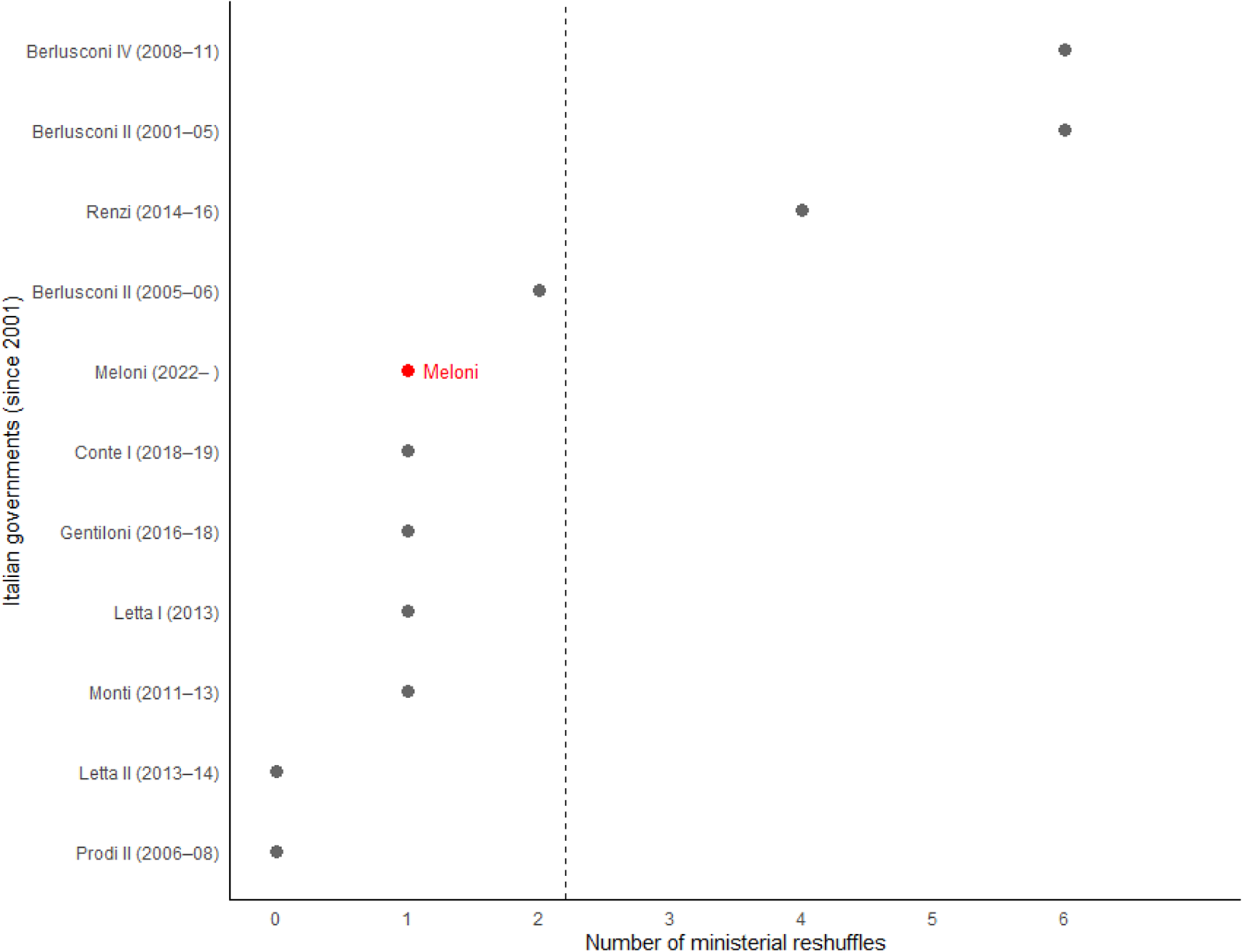
Second, sustained support in opinion polls (Figure 4) may account to a significant extent for the limited incentives for party out-switching (McMenamin and Gwiazda, Reference McMenamin and Gwiazda2011) and the low levels of ministerial reshuffles (Figure 5) (see also Borghetto et al., Reference Borghetto, Improta and Marangoni2025, p. 95, regarding the low levels of conflict). Indeed, FDI has remained consistently the largest party even after the “honeymoon phase,” while the junior partners lack an electoral buffer to leverage.
Opinion poll trends for governing and opposition parties.

Number of ministerial reshuffles in Italy since 2001.

Third stage: government termination
Finally, structural attributes theory emphasizes that stability might also depend on the availability of credible alternatives and on the perceived costs of government breakdown, in particular electoral ones. In other words, governments tend to endure when no feasible parliamentary configuration can replace them without substantial ideological or numerical reconfiguration (e.g. Warwick, Reference Warwick1994). For this reason, even the Lega, despite its decline in the polls (Figure 4), may find little incentive to trigger a government crisis. After all, FDI remains the pivotal actor in any right-leaning conceivable configuration.
At present, the Meloni government seems to operate in precisely such an environment, where potential substitutes appear weak or excessively fragmented (Figure 6). The opposition remains divided along both ideological and strategic lines (De Giorgi, Reference De Giorgi2024; Newell, Reference Newell2025). This fragmentation may have reduced the incentives for parliamentary defection and increased the opportunity costs of destabilization. Additionally, as noted by Ko Maeda, “if the opposition camp is fragmented into multiple parties that compete with one another, discontented voters may not see any of them as a realistic and credible alternative to the incumbent government” (Reference Maeda2010, p. 422).
Opposition fragmentation in Italy.

What is more, when it comes to the alternative solutions to the current government, the traditional fallback option of technocratic cabinets, long a defining feature of Italian crisis management (Valbruzzi, Reference Valbruzzi2018), appears to have lost much of its political appeal. The experience of the technocratic governments arguably reshaped public expectations by associating such solutions with diminished electoral accountability (Giannone and Cozzolino, Reference Giannone and Cozzolino2024). As a result, presidential discretion in engineering alternative majorities may have become more constrained, at least under current conditions. Under these circumstances, the government's longevity could reflect not only the absence of strong internal tension but also the absence of viable exits.
Lessons and puzzles
The exceptional longevity of the Meloni government challenges one of the most entrenched assumptions in Italian politics: that instability is inevitable. For decades, short-lived cabinets have been viewed as part of the country's political DNA. Yet this government has broken the rule without changing the rules and this is a development that invites reflection precisely because it coincides with the executive's own push for the premierato reform, officially intended to enhance government stability (Improta and Marzi, Reference Improta and Marzi2024; Cozzi Fucile and Ferretti, Reference Cozzi Fucile and Ferretti2025; Lupo, Reference Lupo2025; Pedrazzani and Zucchini, Reference Pedrazzani and Zucchini2025).
No causal claim is advanced here, however the experience of the Meloni government suggests that stability may emerge from the joint operation of mechanisms long identified in the cabinet survival literature.Footnote 12 What makes this case particularly intriguing is that Italy's most durable executive in a generation has not resulted from constitutional engineering, but from the ordinary “coalition politics.” As the government itself argues for the direct election of the prime minister, its own tenure demonstrates that cohesion and discipline can, at least for a time, substitute for institutional redesign.
This invites a restatement of a point repeatedly emphasized in the literature on cabinet survival and, more broadly, on coalition politics (Müller and Strøm, Reference Müller and Strøm2000): the “long-life elixir” of coalition governments may not ultimately lie in forms of government or electoral laws, which can certainly facilitate the emergence of stability-friendly conditions (for example, majority bonuses allocated to the electorally largest coalition), but rather in the culture of cooperation among coalition partners. Indeed, conflict among coalition partners has historically been the most frequent cause of premature government termination in Italy (Improta, Reference Improta2025c, p. 39).
Nonetheless, this stability remains contingent. Concentrating power around a dominant leaderFootnote 13 and a tightly controlled coalition may resolve coordination problems in the short term but risks generating new vulnerabilities over time, especially if economic conditions deteriorate or coalition partners begin to challenge their subordinate roles in light of shifts in public opinion.
What this case teaches us is both encouraging and cautionary. It shows that “Italian situations,” once shorthand for endemic instability, are now being invoked to describe crises elsewhere, including in France's recent executive turmoil (Gougou, Reference Gougou2025). Whether the longevity of the Meloni government represents a structural shift or merely a fortuitous conjunction of factors will define the next chapter in Italian politics.
Funding
This research received no specific grant from any public or private funding agency.
Data
The replication dataset is available at http://thedata.harvard.edu/dvn/dv/ipsr-risp. The dataset and related project can also be found at https://osf.io/56my4/overview.
Competing interests
The author declares none.




 Open access

