

Introduction
Critical race theory (CRT) has become a political flashpoint with “Critical Race Theory”Footnote 1 being used as a dog whistle as part of successful political campaigns to restrict teachers, ban books, elect right-wing politicians, attack LGBTQ rights, and roll back Diversity, Equity, and Inclusion (DEI) initiatives (Goldberg Reference Goldberg2023).Footnote 2 The attack on CRT is unfortunate, but for political science, failing to engage CRT and its related critical theories (racial capitalism and post/anti-colonial theory) means ignoring approaches needed to theorize and study systemic racism. These are needed in the subfield of American Political Economy (APE), which names “deep racial cleavages” as a central concern (Hacker, Hertel-Fernandez, Pierson, and Thelen Reference Hacker, Hertel-Fernandez, Pierson and Thelen2021, 13), but could be more expansive in its attention to race. In this paper, I demonstrate how critical race theories can be incorporated into a toolkit for theorizing and studying the political economy of systemic racism. Using the examples of the foreclosure noncrisis of the 1990s and coercive sterilization in California prisons in the early 2000s, I show that attending to intersectionality, feudal-colonial roots, and racial capitalist logics allows APE scholars to study the political economy of systemic racism across a wide variety of topics with more robust tools. Table 1 outlines the key takeaways from these two cases and the article’s empirical scope.
Empirical overview

This paper proceeds as follows: First, I define systemic racism. Next, I introduce the two cases. Then, I demonstrate how a critical theory of systemic racism elucidates both cases. Finally, I conclude, reflecting on current politics.
Defining Systemic Racism
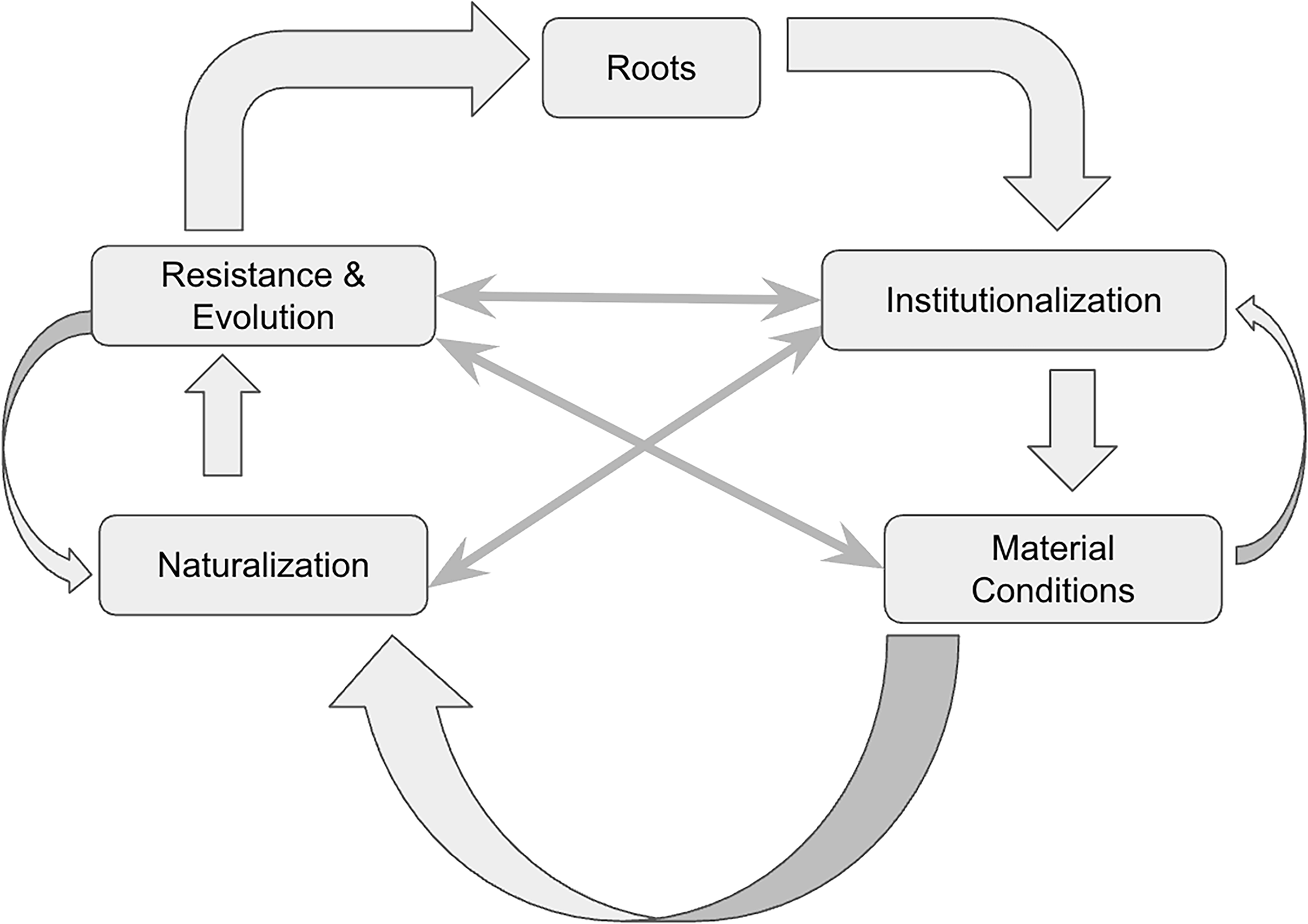
I define systemic racism as a recursive, nonuniform, sociohistorical process that (re)constructs racial privilege and disadvantage across institutional and behavioral arenas, structured by power and the way these arenas interact. Figure 1 shows, at a macro-level, how systemic racism is being conceptualized in this paper. Systemic racism is an ideal concept for APE because it aligns with the field’s desire to surpass behavioral-institutional divisions. Studying systemic racism advances not only APE’s understanding of deep racial cleavages, but political science’s core task of explaining how political authority is socially constructed across structures and behavior (Almond Reference Almond1966). In the aftermath of George Floyd’s murder and the uprisings of the summer of 2020, several political science departments released statements attributing Floyd’s death to systemic or structural racism (Brown, Tormos-Aponte, and Wong Reference Brown, Tormos-Aponte and Wong2024). Despite invoking systemic racism, there have been few attempts to define this concept in a political science context.
Conceptualizing systemic racism.

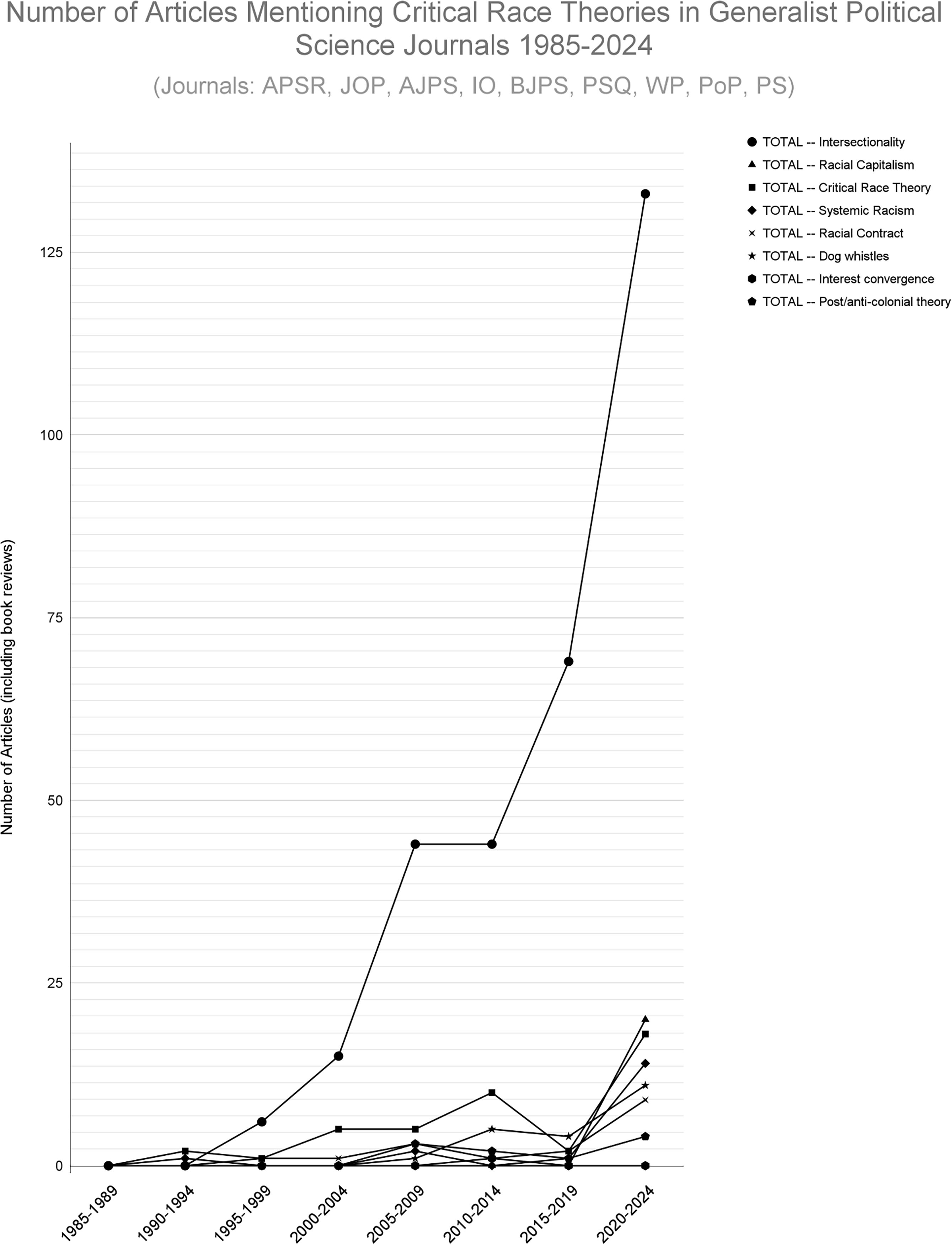
My definition of systemic racism is informed by both political science and CRT approaches. From political science, I use racialized policy feedback and recursion (Michener Reference Michener2019), understanding racism as a sociohistorical process that shapes institutions (King and Smith Reference King and Smith2005; Thurston Reference Thurston2018; Soss, Fording and Schram Reference Soss, Fording and Schram2011), opinions (Gilens Reference Gilens2009; Acharya, Blackwell, and Sen Reference Acharya, Blackwell and Sen2018), behavior (Hall, Huff, and Kuriwaki Reference Hall, Huff and Kuriwaki2019; Dawson Reference Dawson1995; Stephens-Dougan Reference Stephens-Dougan2020), and is structured by power (Soss and Weaver Reference Soss and Weaver2017; Lerman and Weaver Reference Lerman and Weaver2014). Political scientists are increasingly integrating critical race theories into their work (see Michener, SoRelle, and Thurston Reference Michener, SoRelle and Thurston2022, Reference Thurston2025; Michener Reference Michener2020; Wong Reference Wong2022; Strolovitch Reference Strolovitch2023; Shilliam Reference Shilliam2020, Reference Shilliam2021; Ince Reference Ince2022, Reference Ince2023; Fortner Reference Fortner2023; Posey Reference Posey2026). A keyword survey of eight generalist journals (Figure 2) finds critical approaches remain largely marginalized. Still, engagement—especially with intersectionality—is growing, reflected in concepts like Soss and Weaver (Reference Soss and Weaver2017)’s “race-class-subjugated communities.”
Use of critical race theories in eight political science journals.

CRT, racial capitalism, and post/anti-colonial theory add to this article’s proposed definition of systemic racism. They provide insights into how systemic racism (re)constructs racial privilege and disadvantage and interactions between institutional and behavioral arenas. Specifically, CRT clarifies that we should assume that racism is the norm and to be expected, rather than being aberrational or irrational (Delgado and Stefancic Reference Delgado and Stefancic2023). Racial capitalism and post/anti-colonial theory emphasize that racism is (re)produced by markets and other institutions that developed in feudal-colonial contexts (Robinson 2020 [Reference Robinson1983], Hall Reference Hall1980, Reference Hall2020; Fanon 2004 [Reference Fanon and Philcox1961], Lowe Reference Lowe2015). Intersectionality and recent debates around the use of racial capitalism underscore that institutions operate in nonuniform and historically specific ways (Crenshaw Reference Crenshaw1988, Reference Crenshaw1991; Go Reference Go2021; Thurston Reference Thurston2025), and that organizing from the margins to the center makes resistance and anti-racist policy more effective (Crenshaw Reference Crenshaw1991; Strolovitch Reference Strolovitch2008; Michener Reference Michener2020). Finally, racial capitalism also provides insight into the logics that underlie systemic racism, even when they may seem neutral or technocratic, such as risk or cost-benefit analysis (Katzenstein Reference Katzenstein2024; Pulido Reference Pulido2016).
Cases: Foreclosure Noncrisis and Coercive Sterilizations
This article uses two cases to illustrate what a critical theory of systemic racism elucidates and why APE would benefit from such an approach. The foreclosure noncrisis in the 1990s and coercive sterilization in California prisons in the 2000s illustrate the breadth of cases that can be examined with such an approach and should empower APE scholars to explore racialized political economy across more domains.
Foreclosure refers to the legal process by which a lender takes back a piece of real property (land and/or buildings) after a borrower fails to make payments. Foreclosure policy dictates the terms under which foreclosure occurs. Throughout U.S. history, variation in foreclosure policy determined whose struggles were addressed by protective policies and whose dispossession was deemed unremarkable or even desirable (Zackin and Thurston Reference Zackin and Thurston2024; Strolovitch Reference Strolovitch2023; Taylor Reference Taylor2019; Wise Reference Wise2024).
Strolovitch (Reference Strolovitch, Jacob and Horowitz2021) identifies a “foreclosure noncrisis” of the 1990s in which subprime lending was “proliferating, and foreclosure rates were higher among people of color and unmarried women…than they would be among whites and male-breadwinner households during what would come to be labeled a crisis a decade later” (54). The foreclosure noncrisis of the 1990s was caused by deregulation of mortgage markets in the 1980s to allow for high interest rates and products such as subprime loans and adjustable-rate mortgages whose rates changed with market forces after a set number of years, making their payment terms less predictable (Strolovitch Reference Strolovitch2023). Although I examine the foreclosure noncrisis of the 1990s in this article, this crisis is ongoing. In 2020, the Federal Reserve Bank of New York reported that foreclosure rates in Black and Latino-majority zip codes were still higher than in majority White zip codes (Haughwout et al. Reference Haughwout, Lee, Scally and van der Klaauw2020).Footnote 3
Despite California repealing its eugenics law in 1979, a 2013 California State Audit found that out of 144 cases of tubal ligation, at least 39 inmates were “sterilized following deficiencies in the informed consent process” (Howle Reference Howle2014, 1). The majority of the victims were women of color, targeted because they were perceived as likely to have more children (Jindia Reference Jindia2020; Johnson Reference Johnson2013). In 2014, after years of organizing, investigative reporting, victims suing the state, and the auditor’s report, California banned the coercive sterilization of inmates as a form of birth control, and a program providing reparations to victims ran from 2021 to 2025. To achieve these victories, resistance brought to light counterstories and had to overcome a racial capitalist “cost-benefit” logic, in which violating the bodies of incarcerated women of color was justified as cost-saving.
Although the 2014 bill banning coerced inmate sterilization passed, it treated harms as isolated, allowing the state “to escape further responsibility’ (Jindia Reference Jindia2020), and a late reparations program rejected most applicants (Luthra Reference Luthra2023). Across the United States, grassroots organizations report that the coercive sterilization of inmates continues to be a problem (Project South: We All Count 2020). In 2024, the U.S. Department of Homeland Security’s Inspector General released a report showing that U.S. Immigration and Customs Enforcement (ICE) did not follow proper procedures on hundreds of surgeries between fiscal years 2019 and 2021, including hysterectomies (Levine Reference Levine2024). With the number of people being held by ICE breaking records and reaching over 50,000 people in June 2025 (TRACreports.org 2025), the likelihood of continued abuses is high.
Intersectionality
Attending to intersectionality is a foundational step for APE scholars aiming to study the political economy of systemic racism. Coming from CRT and feminist theory (Crenshaw Reference Crenshaw1988, Reference Crenshaw1991; Collins Reference Collins1990), intersectionality posits that racism, sexism, and other oppressions and privileges are not simply additive, such that, for instance, Black women are affected by a linear combination of racism (against Black people) and sexism (against women). Instead, it highlights how Black women are affected by factors that relate to their specific intersectional identity as Black women. Consider domestic-violence interventions: often designed around White women’s experiences, they overlook barriers faced by women of color. As Crenshaw (Reference Crenshaw1991) shows, strategies that aid White women can heighten risks for Black women via poverty, policing, and hostile legal systems.
Intersectionality is the most integrated CRT concept in mainstream political science. An intersectionality-informed approach to systemic racism yields three key insights: (1) systemic racism is nonuniform because race always intersects with other identities under structures of power; (2) systemic racism can be an unintended consequence of progressive policy; and (3) margins-to-center resistance is most effective. I demonstrate these points using the two cases.
Nonuniformity
Race is socially constructed, but scholars debate its boundaries and historical specificity—including tensions such as returning land to Indigenous peoples versus redistribution to other marginalized groups (Reed Reference Reed2002; Go Reference Go2021; Thurston Reference Thurston2025; Tuck, and Yang Reference Tuck and Yang2012). Conceptualizing race in intersectional terms offers a pathway for resolving these tensions and simultaneously highlights the structuring effects of power. For intersectionality scholars, power should not be understood abstractly, but instead requires a “finely-tuned analysis of saliency” (Collins, Reference Collins, Hankivsky and Jordan-Zachery2019, 206). Attending to power helps us decide how to position race relative to other axes of difference, navigate comparisons, and predict nonuniformities. For instance, Patricia Posey (Reference Posey2023) points out how race interacts with financial access to structure the information needs of communities, particularly when they are dealing with the world of fringe finance. Michael J. Fortner (Reference Fortner2023) uses a racial capitalist approach to show how the intersection of racial and class categories in the context of Atlanta’s urban politics leads White supremacy and class differences to “interact to push both middle-class Whites and Blacks away from the interests of the urban Black poor” (645).
Because power structures intersectional identity, it structures the nonuniformity of systemic racism. Collins (Reference Collins, Hankivsky and Jordan-Zachery2019) argues that we should be sensitive to power across structural, disciplinary, cultural, and interpersonal domains (207-208). Within the structural domain, in particular, political science has much to offer, and there are clear synergies with theories of pluralism (Dahl Reference Dahl1957, Reference Dahl1978) and theories of “dimensions of power,” such as those proposed by Stephen Lukes (Reference Lukes1986) and John Gaventa Reference Gaventa(1980). Fortner (Reference Fortner2023) reminds us that we should consider both “power over” and “power to” frameworks, that is, both the distribution of influence and the ability to form coalitions to enact shared goals (638).
Nonuniformity and the Foreclosure Noncrisis
Systemic racism in the foreclosure noncrisis of the 1990s played out in a way that was nonuniform, corresponding to the intersections of race and gender. Chloe Thurston (Reference Thurston2018) examined the political development of mortgage lending to previously excluded groups, highlighting how women and people of color fought for access to credit because these groups, regardless of their class status, were initially excluded from mainstream credit markets. Political victories achieved by these groups, such as the Equal Credit Opportunity Act (ECOA) of 1974, occurred just before the loosening of mortgage regulations in the 1980s, which led to the expansion of subprime lending. Subprime lending was strongly correlated with an increase in foreclosures, and scholars have examined patterns of subprime lending to reveal the power relations at play.
For instance, a 2000 report issued by HUD and the US Department of the Treasury showed that subprime loans accounted for 51 percent of refinance loans in majority—Black neighborhoods, but only 9 percent of refinance mortgages in predominantly White ones (Strolovitch Reference Strolovitch2023). Notably, the study showed that race took precedence over income. Borrowers living in upper-income Black neighborhoods were six times more likely than borrowers living in upper-income White neighborhoods to refinance their houses with a subprime mortgage. In terms of the intersectional politics of subprime lending, income was far less important than race in predicting who would be affected.
Gender, however, was also an important intersecting characteristic. There were “disproportionate shares of subprime mortgages sold to women, particularly to women who were sole borrowers, and especially to sole-borrower women of color” (Strolovitch Reference Strolovitch2023, 140). A 2006 study from the Consumer Federation used data on more than 4 million home loans and found that that women were 32 percent more likely than men to receive subprime mortgages and 41 percent more likely to receive “high cost” subprime loans (defined as “loans that were made more than 5 percentage points above comparable Treasury notes”) (Strolovitch Reference Strolovitch2023, 140). Lenders intentionally targeted Black, Latina, elderly, and sole-borrower women through “subprime steering” such that, despite having higher credit scores than their sole-borrower male counterparts, sole-borrower women homeowners were overrepresented among subprime mortgage holders by 30 percent (Strolovitch Reference Strolovitch2023, 140).
The intersection of race and gender is thus a salient category when it comes to subprime lending. Examining that intersection specifically, the Consumer Federation found in 2006 that Black women were 256 percent more likely to have a subprime mortgage than White men “with identical geographic and financial profiles” (Strolovitch Reference Strolovitch2023, 140). Even compared to Black men, Black women were 5.7 percent more likely to receive subprime loans, and Latinas were 12.7 percent more likely to receive subprime loans than Latino men (Strolovitch Reference Strolovitch2023, 141). By contrast, White women were half as likely as Latinas and three times less likely than Black women to receive subprime loans, but were still 25.8 percent more likely to receive them compared to White men (Strolovitch Reference Strolovitch2023, 141). This was not a story of income; disparities continued to exist after controlling for income and actually widened as women’s incomes rose (Strolovitch Reference Strolovitch2023). Thus, the power-informed history of subprime mortgage lending helps us see why the intersection of race and gender was the most salient in the context of the foreclosure noncrisis of the 1990s.
Nonuniformity and Coercive Sterilizations
By contrast, the systemic racism of coercive sterilizations in California prisons in the 2000s operated most strongly at the intersection of race, gender, and class, with poverty as a key intersectional category. Analyzing with an eye toward power, the relationship between poverty and imprisonment explains why class is a salient intersectional factor in this case.
Poverty is a persistent background to the politics of imprisonment, and examining the power relations behind imprisonment shows why we would expect class to be a salient factor in this case. Using education as a proxy for class, Christopher Muller and Alexander Roehrkasse (Reference Muller and Roehrkasse2022) find that “in the late 1980s and early 1990s, white people with no college education were admitted to prison at rates comparable to those of college-educated Black people. By 2015, the prison admission rate of white people with no college education had grown to more than ten times that of Black people with any college education” (805). Unlike subprime lending, in which women and people of color were affected independently of their class status, imprisonment during the early 2000s was increasingly defined by class and race. Nonprofits like the Prison Policy Initiative (Rabuy and Kopf Reference Rabuy and Kopf2015) found that in 2014 dollars, incarcerated people had a median annual income 41% less than non-incarcerated people of similar ages, creating a vicious cycle in poor communities and particularly poor communities of color. Joe Soss and Vesla Weaver (Reference Soss and Weaver2017) use the term “race-class subjugated communities” to draw attention to the intersection of race and class in relation to police surveillance and incarceration. We thus have a strong sense that the intersection of race and class is likely to be salient in the context of imprisonment.
Analyzing coerced sterilization also foregrounds gender. In the United States, although men have been sterilized under eugenics logic (Stern Reference Stern2016), forced and coerced sterilization has disproportionately been enacted against women of color and poor White women. As the next section will discuss, the control of women’s bodies—especially women of color, but also poor White women—has deep feudal-colonial roots that continue to shape experiences in the present. Race was a clear factor in determining who was targeted for sterilization, but poor White women were not excluded from this harm. Drawing on data from the 2013 California State Audit reference above, Jess Whatcott (Reference Whatcott2018) emphasizes that while women of color were disproportionately affected, poor White women were also subject to coercive sterilization at rates only slightly lower than their overall presence in the Californian prison population.
Examining race through an intersectional lens reveals different patterns in the two cases. In both, attending to gender and race is shown to be crucial. However, while race and gender mattered independently of class in the foreclosure noncrisis of the 1990s, coercive sterilization in California prisons in the early 2000s depended on race, gender, and class. APE scholars studying racial cleavages should consider race in intersectional terms. This means attending to power to decide which intersectional categories are salient and expecting nonuniformity.
Unintended Consequences of Progressive Policy
A second central insight from intersectionality scholarship is that systemic racism can be an unintended consequence of progressive policy. As Kimberlé Crenshaw (Reference Crenshaw1991) explains, when laws fail to account for the experiences of multiply-marginalized groups such as women of color, anti-sexist laws may reinforce racism, and anti-racist laws may reinforce sexism. This happens because laws and policies are generally enacted in response to demands from relatively privileged groups (Achen and Bartels Reference Achen and Bartels2016). Even when marginalized groups advocate for policy changes, advocates often represent the interests of relatively privileged groups within disadvantaged populations (Strolovitch Reference Strolovitch2008). Laws and policies that prioritize the needs of relatively privileged populations frequently fail to consider consequences for the multiply-marginalized. The foreclosure noncrisis of the 1990s and coercive sterilization in California prisons in the early 2000s were the result of progressive policies—expanding homeownership and giving women birth control options—that were also systemic racism. Taking an intersectional approach leads us to expect this possibility.
Expanding Access to Credit, Enabling Predatory Inclusion
Predatory inclusion “refers to a process whereby members of a marginalized group are provided with access to a good, service, or opportunity from which they have historically been excluded but under conditions that jeopardize the benefits of access” (Seamster and Charron-Chénier Reference Seamster and Charron-Chénier2017, 200). Predatory inclusion is known to be an unintended consequence of financial inclusion, with Seamster and Charron-Chénier (Reference Seamster and Charron-Chénier2017) noting that “processes of predatory inclusion are often presented as providing marginalized individuals with opportunities for social and economic progress. In the long term, however, predatory inclusion reproduces inequality and insecurity for some while allowing already dominant social actors to derive significant profits” (200).
By the end of the 1990s, dominant political actors were well aware that sole-borrower women and people of color were being targeted by predatory mortgage lending (Strolovitch Reference Strolovitch2023). However, because of the identities of these borrowers, their foreclosures were framed as a natural consequence of extending credit to “risky” groups (Strolovitch Reference Strolovitch2023). Dominant political actors accepted banks’ and mortgage lenders’ assurances that these populations required special treatment, a belief that existed alongside “faith in mortgage Keynesianism and the democratization of credit as a route to equality” (Strolovitch Reference Strolovitch2023, 172). Expanding access without taking intersectional discrimination into account undermined rather than enhanced equality.
Providing Birth Control, Enabling Coercive Sterilization
While it is difficult to view sterilization policy as progressive from our modern vantage point, the landmark Supreme Court decision Buck versus Bell (1927), which upheld the eugenics programs of California and other states, was widely regarded as progressive at the time. As Corrina Barrett Lain (Reference Lain2016) explains, sterilization, though physically invasive, was framed as a way to give “the feebleminded their freedom,” reducing reliance on institutionalization, a then-pervasive practice targeting “feebleminded” women of childbearing age to prevent them from reproducing (1041). Institutionalization, however, was both expensive and isolating. Supporters of sterilization argued that it was “vastly more humane to relieve these individuals of a function which they cannot properly use and allow them to return to their homes or society than to keep them confined in an institution for the greater part of their young lives” (Lain Reference Lain2016, 1041). Moreover, access to sterilization for women who wanted it was part of the broader fight for birth control that found an ally in the eugenics movement. Margaret Sanger, a leader of the early 20th-century Birth Control Movement and the founder of Planned Parenthood, sought support from the eugenics and “Neo-Malthusian” movements that were active at that time (Lain Reference Lain2016).
By the early 2000s, medical studies found that sterilizations were often desired procedures, but women who wanted them were frequently unable to get them because of required 30-day waiting periods, the need for Medicaid consent forms, and a lack of available funding or operating rooms (Potter et al. Reference Potter, White, Hopkins, McKinnon, Shedlin, Amastae and Grossman2012; Borrero, Zite, and Creinin Reference Borrero, Zite and Creinin2012). Providing sterilizations to women in California prisons was likely introduced as a progressive option, desired by at least some women. However, as with the foreclosure noncrisis that the lack of attention to intersectional politics created a situation in which “progressive” policy became a tool of systemic racism.
Margins-to-Center Responses
The final intersectionality insight is a corollary of the first two, adding a “power to” dimension alongside “power over.” It posits that since policies devised without the multiply-marginalized often have nonuniform, unintended effects, the most effective responses originate at the margins and move to the center. Scholars have called for margin-to-center approaches in welfare policy (Michener, SoRelle, and Thurston Reference Michener, SoRelle and Thurston2022), shown that neglecting the multiply-marginalized weakens social movement advocacy (Strolovitch Reference Strolovitch2008), and found that margin-led movements can secure major victories (e.g., expanding the right to counsel; Michener Reference Michener2020). Likewise, examining margin-to-center responses in the foreclosure noncrisis and the prison sterilization cases shows that attending to intersectional concerns is crucial for effective resistance to systemic racism.
Education for Organizing and Housing Justice
The movement for financial inclusion has been criticized for not adequately addressing its relationship to systemic racism (Baradaran Reference Baradaran2017; Friedline Reference Friedline2021). Multiply-marginalized people at the intersections of race, gender, class, and other identities are often excluded from leadership and decision-making roles in the financial sector and financial policy (Russell and Villiers Reference Russell, Villiers and Herzog2017). As a result, policies and interventions tend to reflect the perspectives of more privileged voices, overlooking layered barriers and potential for predatory inclusion. This leads to ineffective policies, such as the emphasis on financial education as a response to predatory inclusion (Friedline Reference Friedline2021; SoRelle Reference SoRelle2020).
Such policies, however, can be re-imagined from a margins-to-center perspective. Friedline (Reference Friedline2021) argues that when financial education is centered on those at the margins, it can serve a radical and transformative purpose. She envisions an approach rooted in a pedagogy of the oppressed that teaches practical skills such as budgeting, understanding opportunity costs, and navigating credit scores, but encourages critical analysis of financial and economic systems. This kind of financial education directly challenges what Friedline (Reference Friedline2021) describes as “financialized racial neoliberal capitalism” (164) and is designed to prepare students to become community-focused activists and organizers, not just financially literate individuals.
In the area of housing justice, grassroots-driven solutions proposed by the multiply-marginalized have included community land trusts (Williams Reference Williams2018; Schneider, Lennon, and Saegert Reference Schneider, Lennon and Saegert2023) and housing cooperatives (Lubik and Kosatsky Reference Lubik and Kosatsky2019). Jamila Michener and Mallory SoRelle (Reference Michener and SoRelle2023) draw on qualitative evidence from participant observation and in-depth interviews with tenant organizations to show how these organizations center multiply-marginalized voices and “cultivate radically different ways of conceptualizing political economy, carve out a distinctive political focus on race-class subjugated communities, and create critical opportunities for otherwise marginalized actors to develop and exercise political power” (209).
Reproductive Justice and the Power of Counterstory
Margins-to-center resistance brings counterstories to light. Counterstories are narratives coming from outgroups that challenge the received wisdom and “aim to subvert” ingroup reality (Delgado Reference Delgado1989, 2413). Counterstories have two central goals for outgroups: psychic self-preservation for outgroup members and to lessen their own subordination (Delgado Reference Delgado1989, 2436). Counterstories are central to consciousness-raising for outgroups that challenge “third-dimensional” power (Gaventa Reference Gaventa1980) by resisting accepted narratives that support oppression. Counterstory was codified as part of the CRT tradition through the writings of Derrick Bell (Reference Bell1985, Reference Bell1987, Reference Bell1992), Patricia Williams (Reference Williams1991, Reference Williams1995, Reference Williams1997), and Richard Delgado (Reference Delgado1995). It made inroads outside of the legal field in the area of education (Martinez Reference Martinez2014, Reference Martinez2020) and has recently made inroads into political science (Wong Reference Wong2022).
The coerced sterilizations of inmates in California prisons in the early 2000s came to light because grassroots organizing through groups such as Justice Now Oakland, California Latinas for Reproductive Justice, and investigative reporting by the Center for Investigative Reporting (CIR) allowed counterstories to emerge. The successes they achieved held race-class-gender concerns collectively, often through intersectional counterstories. In the case of coerced sterilizations in California prisons in the early 2000s, counterstories came to light as part of a lawsuit and became the basis for a feature-length documentary, Belly of the Beast (Cohn Reference Cohn2020), in which survivor Kelli Dillon argued that she was targeted because she was Black, poor, and in prison. Even though the state won the lawsuit, the stories that emerged changed the narrative and were seen as crucial in achieving a ban on the coercive sterilization of inmates in 2014, and the program providing reparations to victims that ran from 2021 to 2025.
This case provides an interesting contrast with the foreclosure noncrisis of the 1990s, in which dominant reporting had a notable absence of counterstories (Strolovitch Reference Strolovitch2023). Without counterstories, bad things may happen to marginalized groups, but can be naturalized as “inevitable, immune to, outside the scope or, unlikely to be remedied by, and not warranting government intervention and resources” (Strolovitch Reference Strolovitch2023, 39). The downside of counterstory as a social movement tactic is that stories alone are often necessary but not sufficient. For instance, despite counterstories and some policy victories, coercive sterilizations have proven persistent. In an interview, Belly of the Beast filmmaker Erika Cohn reflected on the news that sterilizations were occurring at ICE detention facilities, saying, “When the news about the sterilizations in ICE detention facilities came out, the complaints were so eerily similar to the illegal sterilizations that we uncovered…Because there has not been accountability for the sterilizations that have been performed, both historically and in recent times, modern-day sterilizations like what you see in California’s women’s prisons or in ICE detention facilities will continue to happen” (Independent Lens 2020).
Lessons from Attending to Intersectionality
Attending to intersectionality in the cases of the foreclosure noncrisis of the 1990s and coercive sterilization in California prisons in the early 2000s reveals three important lessons: First, intersectionality helps resolve tensions around the boundaries of race by emphasizing nonuniformity structured by power. This allows scholars to see why a race-gender analysis is appropriate when studying the foreclosure noncrisis of the 1990s, but a race-gender-class analysis is appropriate when studying coercive sterilizations in California prisons in the early 2000s. Second, intersectionality reminds scholars that systemic racism can be an unintended consequence of “progressive” policies such as financial inclusion or increasing access to birth control when these policies are made without centering the multiply-marginalized. Third, successful resistance to systemic racism entails marginal-to-center organizing.
Feudal-Colonial Roots and Institutionalization
Intersectionality is a valuable framework for anyone seeking to study the political economy of systemic racism. When it comes to understanding how and why systemic racism (re)constructs racial privilege and disadvantage through institutionalization, critical race theories, particularly racial capitalism and post/anti-colonial theory, provide another set of insights. This work suggests that systemic racism is animated by feudal-colonial roots that persist far beyond their initial context by becoming embedded in institutions (e.g., law) and social norms (Robinson 2020 [Reference Robinson1983]; Lowe Reference Lowe2015; Park Reference Park2016, Reference Park, Leroy and Jenkins2021a, Reference Park2021b; Federici Reference Federici2004; Agathangelou Reference Agathangelou2020, Reference Agathangelou2021, Reference Agathangelou2024; Agathangelou and Ahmed Reference Agathangelou and Ahmed2020; Siddhant Issar Reference Issar2021a, Reference Issar2021b). Attending to feudal-colonial roots is thus a second structuring principle, particularly to APE scholars who come out of the tradition of American political development (APD) and other fields informed by historical institutionalism (Steinmo, Thelen, and Longstreth Reference Steinmo, Thelen and Longstreth1992; Hall Reference Hall2016; Thelen Reference Thelen1999, Reference Thelen2000, Reference Thelen2009).
To see what attending to feudal-colonial roots adds to political science, consider The American Political Economy (Hacker et al. Reference Hacker, Hertel-Fernandez, Pierson and Thelen2021). The volume’s “Race, Space, and Governance” section foregrounds the centrality of race and racism in market inequality (Thurston Reference Thurston, Hacker, Pierson, Thelen and Hertel-Fernandez2021), urban land use (Trounstine Reference Trounstine, Hacker, Hertel-Fernandez, Pierson and Thelen2021), urban knowledge economies (Ogorzalek Reference Ogorzalek, Hacker, Hertel-Fernandez, Pierson and Thelen2021), and “red-state” political economies (Grumbach, Hacker, and Pierson Reference Grumbach, Hacker, Pierson, Hacker, Hertel-Fernandez, Pierson and Thelen2021). Yet subsequent chapters on patents (Schwartz Reference Schwartz, Jacob, Hertel-Fernandez, Pierson and Thelen2021) and asset management (Braun Reference Braun, Hacker, Hertel-Fernandez, Pierson and Thelen2021) treat these arenas as race-neutral. Acknowledging that these concepts have feudal-colonial roots that link them to White supremacy (see Vats Reference Vats2020 on patents; Greer Reference Greer2024 on assets) would significantly expand the scope of what is considered race-related in APE and would caution APE scholars against taking “race-neutral” policy at face value.
Second, recognizing feudal-colonial roots advances a growing literature that applies racial capitalism to the APD, comparative-historical analysis, and historical-institutionalist traditions that inform the field of APE (Thurston Reference Thurston2025). For example, the dominant APD approach invokes racial orders to examine how competing “White supremacist” and “egalitarian transformative” orders inform particular policies (King and Smith Reference King and Smith2005). Specifying the feudal-colonial roots of the White-supremacist order would strengthen this framework by directing attention to institutions—e.g., credit scoring, mortgage markets—that do not explicitly avow White supremacy yet encode its logic.
Both foreclosure and coercive sterilization have feudal-colonial roots that made their way into the U.S. legal code. For foreclosure, these roots were a combination of medieval English law and U.S. colonial dynamics, informing the Supreme Court case of Home Building and Loan Association versus Blaisdell (1934), which would enshrine foreclosure prevention in U.S. law with implicit context about who such protections are for and when they can be applied. For coerced sterilization, the feudal-colonial roots skew strongly toward the colonial with the development of scientific racism (to better distinguish between the civilized and savage and exterminate the savage) and subsequently eugenics. These roots were enshrined in U.S. law through Buck versus Bell, a Supreme Court case decided in 1927 that upheld the legality of a Virginia law allowing for the sexual sterilization of inmates of institutions to promote the “health of the patient and the welfare of society” (Oyez.org). These two Supreme Court cases are only suggestive, illustrative examples. There are many different ways that such policies become embedded, including norms, administrative practices, and professional standards.
Foreclosure’s Feudal-Colonial Roots
Under medieval English law, the property of the landed class was protected from creditor claims in multiple ways, including restrictions on creditors’ access to land unless it had been explicitly used as collateral. Even then, creditors were required to navigate extensive bureaucratic procedures (Priest Reference Priest2006). When foreclosures were used in colonial America, however, they became a key mechanism for dispossessing rather than preserving Native land (Park Reference Park2016). In 1615, “John Rolfe, eventual husband of the famed Pocahontas, observed that a number of minor chiefs mortgaged all their lands to the colony in exchange for wheat” (Park Reference Park2016, 1012). When Indigenous mortgagees faced hard times, their land was taken through foreclosure. We do not know precisely how much land was lost in this manner, but some parcels mortgaged in this manner were “nearly the size of an English shire” (Vaughan Reference Vaughan1978, 74).
By contrast, when White settler landowners faced financial hardship, the feudal aspects of land protection for elites came to the fore, and supposedly sacrosanct economic contracts underlying mortgages were frequently breached, modified, made flexible, or disregarded to preserve White land claims (Holton Reference Holton2018). Thus, although laws protecting property from creditors in the colonies were weaker than English laws (Priest Reference Priest2006), they retained some of the feudal characteristics of English law to protect landowners while integrating features of the “emerging colonial economy,” in which identity as settler, native, or slave defined how one was treated legally (Park Reference Park2016, 1014). The feudal-colonial roots of American foreclosure policy thus combined feudal landlord protections with the (re)creation of colonial racial categories through land dispossession for indigenous peoples.
Institutionalization: Home Building and Loan Association versus Blaisdell
Decades later, this feudal-colonial context informed a Supreme Court case that would institutionalize foreclosure protections, explicitly for everyone, but in a way that, in practice, most benefited White landowners. John and Rosella Blaisdell, a White middle-class couple in Minneapolis, purchased a home in 1928. With their three children, they lived in three rooms and rented out eleven as a boardinghouse. During the depression, rental income dropped, and the Blaisdells got several years behind on their property taxes. Their mortgage holder, the Home Building and Loan Association, initiated foreclosure proceedings in 1932. The Blaisdells looked sure to lose their home. Then, on April 18, 1932, Minnesota enacted a foreclosure moratorium at the behest of angry farmers who organized under the banner of the “Farmers’ Holiday Association.” This group boycotted, withheld goods, and even threatened violence if foreclosures were carried out (Fliter and Hoff Reference Fliter and Hoff2012).
Under Minnesota’s new foreclosure moratorium, the Blaisdells petitioned their district court for additional time to raise the funds to save their home. The mortgage holder, the Home Building and Loan Association, took the case to trial, claiming that Minnesota’s moratorium conflicted with the Contract Clause of the U.S. Constitution. The local court found in favor of the mortgage holder. Still, upon appeal, and then again, upon appeal to the U.S. Supreme Court, the Court upheld the constitutionality of Minnesota’s foreclosure moratorium because a large number of (White) families losing homes and (White) farmers losing land (and threatening violence) constituted an emergency (crisis) necessitating a government response. Explicitly, the law applied to everyone; however, because only the sufferings of elites are ever truly considered a crisis (Strolovitch Reference Strolovitch2023), the practical effect has been to disproportionately protect White property from dispossession, while failing to act when marginalized people suffer, because their suffering is not seen as constituting an emergency.
Foreclosure Noncrisis of the 1990s
These feudal-colonial roots and their institutionalization through legal precedent elucidate the systemic racism of the foreclosure noncrisis of the 1990s by situating it as part of the pattern of foreclosure as dispossession for communities of color. By 1999, Strolovitch (Reference Strolovitch, Jacob and Horowitz2021) notes that racial justice, antipoverty, and consumer advocates were “decrying a practice they called ‘reverse redlining’” (57). Margot Saunders, counsel with the National Consumer Law Center, testified before Congress several times between 1995 and 2006 about what she and her organization repeatedly called a “mortgage crisis for low-income homeowners” (Strolovitch Reference Strolovitch, Jacob and Horowitz2021, 61).
Why was this crisis not addressed with policies or even foreclosure moratoria, as in the 1930s? The feudal-colonial roots of foreclosure prevention and their institutionalization in Blaisdell give us important clues. First, they show that the dispossession of marginalized people through foreclosure was normalized because this is how foreclosure had functioned throughout American history. Second, they show that foreclosure moratoria, such as the Minnesota law upheld by Blaisdell, were only considered appropriate when dominant groups were struggling or even threatening violence. Since the foreclosure noncrisis of the 1990s involved the struggle of marginalized groups, a political response was less likely. Attending to the feudal-colonial roots helps us see this episode as part of institutionalized systemic racism.
Forced and Coerced Sterilization’s Feudal-Colonial Roots
Forced and coerced sterilizations are common occurrences in U.S. history. Although they peaked with the U.S. eugenics movement in the late 1930s, the feudal-colonial roots of forced and coerced sterilization in feudal patriarchy and colonial nation-building coalesced into scientific racism and were consolidated in U.S. law through court rulings such as Buck versus Bell (1927). Attending the feudal-colonial roots elucidates how forced and coerced sterilization is both racist and sexist, why this phenomenon endures, and why coerced sterilizations disproportionately affected women of color in California state prisons during the early 2000s.
Critical feminist and anti-colonial theorists have critiqued traditional Marxist analyses to argue that patriarchy is an important throughline between feudalism and capitalism (Murray Reference Murray2005; Mies Reference Mies2014 [1986]). Mies (Reference Mies2014), in particular, argues that the “counterpart of the slave raids in Africa was the witch hunt in Europe” (109) in which “millions of women, mostly of poor peasant or poor urban origin, were for centuries persecuted, tortured and finally burnt as witches because they tried to retain a certain autonomy over their bodies” (110). Mies (Reference Mies2014) notes that such attacks against witches were “aimed not only at the subordination of female sexuality as such…but against their practices as abortionists and midwives” (110).
The throughline of patriarchy that these critical feminist scholars see between feudalism and capitalism parallels the one that racial capitalist scholars evoke for race (Robinson 2020 [Reference Robinson1983]).Footnote 4 However, we must not equate White women’s treatment under feudal-colonialism with that of women of color. The latter included enslavement, which “required the destruction of kinship structures, maternal rights, and the autonomous ‘self-governing’ subject entirely” (Agathangelou, and Ahmed Reference Agathangelou and Ahmed2020, 52). All women were subjected to feudal-colonial patriarchy, but women of color experienced a qualitatively different level of violence.
As with foreclosure, the feudal roots of forced and coerced sterilization had colonial politics specific to the American context superimposed upon them. Colonial politics have always been entangled with reproductive politics (Theobald Reference Theobald2019). For enslaved women, rape and forced reproduction combined with the one-drop rule had the objective of growing the enslaved population (Feinstein Reference Feinstein2018). For Native women, while rape was common, they also faced mass slaughter because of their connection to land claims impeding manifest destiny. During “the Indian Wars” of the mid-1800s, there were several documented instances in which “U.S. soldiers and militiamen eagerly killed Native women and children alongside men” (Theobald Reference Theobald2019, 5). The logic for this extermination was not hidden. When the commanding general of the U.S. Cavalry at Sand Creek was confronted as to why cavalrymen killed so many Cheyenne and Arapaho women and children in the early 1860s, he responded, “nits make lice” (Theobald Reference Theobald2019, 5).
White women, particularly the poor and/or indentured, had their reproduction controlled to uphold and perpetuate White supremacy (Solinger Reference Solinger2005; Newman Reference Newman1999). Poor White women “were excluded from the category of white nation-building mother, despite their racial identity” and “continued to earn punishment for sex-and-pregnancy-related behaviors, even though white women who were married to, or the daughters or, property owning men no longer faced punishments by the end of the eighteenth century” (Solinger Reference Solinger2005, 49). However, controlling some White women’s reproduction is qualitatively different from the genocidal destruction of kinship ties inflicted on women of color (Agathangelou, and Ahmed Reference Agathangelou and Ahmed2020).
By the 1800s, these feudal-colonial patterns coalesced into scientific racism, anchored in theories like Social Darwinism that applied the concept of “natural selection” to humans, supporting the idea that racial and class inequalities were rooted in biological differences rather than social inequities. This logic gave rise to the American eugenics movement, justifying sterilizations (Diogo Reference Diogo2024). While many are familiar with the eugenics agenda of Nazi Germany, fewer know that the Nazi regime looked to American sterilization practices for inspiration (Kühl Reference Kühl1994).
White male doctors came to dominate women’s health, setting up a power dynamic in which White male “experts” make medical decisions, including coerced sterilizations. In the United States, Dr. J. Marion Sims, the “father of American gynecology,” developed early surgical gynecological techniques by experimenting on enslaved women in Alabama from 1844 to 1849, whose bodies and reproductive capacities were of significant financial interest in the context of the plantation economy (Owens Reference Owens2017). In California prisons in the 2000s, Dr. James Heinrich pressured women of color into sterilizations based on his perception that they were costing the state money through their pregnancies (Whatcott Reference Whatcott2018; Johnson Reference Johnson2013).
Institutionalization: Buck versus Bell
Even though Carrie Buck, the plaintiff in Buck versus Bell, was a White woman, the case institutionalized a sterilization practice with racist feudal-colonial roots. In the aftermath of Buck versus Bell, more than 60,000 people across the United States were forcibly sterilized by state-run programs during the 20th century, including more than 20,000 people over seven decades in California, under a eugenics law enacted in 1909, rendered safe from federal challenges by the Supreme Court’s ruling in Buck versus Bell.
Buck versus Bell structured an institutional context in which people being held in state care, whether institutionalized or imprisoned, became targets for forced or coerced sterilization. When the feudal-colonial context of sterilization is taken into account, it is much more evident how this ruling enabled systemic racism and how it came to disproportionately target women of color. It also goes further, helping make sense of why, following the Civil Rights Act of 1964, “access to federal programs and services such as welfare, public housing, and occupational training,” brought Black women in particular “into intimate contact with social workers, physicians, lawyers, welfare workers, and judges who provided family planning services, some of whom who took it upon themselves to sterilize ‘defective’ women to reduce their dependence on welfare” (Kluchin Reference Kluchin2020, 74).
Coerced Sterilizations in California Prisons in the 2000s
An approach informed by critical race theories pushes us to see feudal-colonial roots of patriarchy, elimination of indigenous populations, and control of Black women’s bodies, that radiate into the present because they are institutionalized in policy, norms, and seemingly race-neutral law. When applied to the sterilizations of women of color in California prisons in the 2000s, the feudal-colonial roots embedded in law and social norms created a context in which “protections,” such as informed consent, became what prison abolitionists call “reformist reforms” that reinforced the status quo (Gilmore Reference Gilmore2007, see also Davis Reference Davis2003).
As Gilmore (Reference Gilmore2007) puts it, reformist reforms “get caught in the logic of the system itself, such that a reform strengthens, rather than loosens, prison’s hold” (Gilmore Reference Gilmore2007, 242). In 1979, California repealed its eugenics law in response to a class action lawsuit (Madrigal versus Quillian) in which women of color, particularly Latinas, argued that doctors were targeting them for sterilization. In Madrigal, the courts sided with the doctors and found no wrongdoing. Still, it raised awareness and coincided with a time when federal regulations began to require stricter informed consent procedures for sterilization, including waiting periods (Whatcott Reference Whatcott2018). After 1979, states could still perform sterilizations on prisoners as long as they did not use federal funds or justify it with eugenics. In 1994, California added protections allowing state-funded sterilizations only when the patient’s life was at risk and with prior approval from top medical officials (Whatcott Reference Whatcott2018). Informed consent and oversight, however, ended up being “reformist reforms” that did not undo the racist-sexist-classist status quo of coerced sterilizations.
In California prisons in the 2000s, male state-appointed doctors coerced sterilizations, pressuring pregnant women of color into post-birth tubal ligations and endometrial ablation (Johnson Reference Johnson2014). Women of color who already had children reported being targeted and urged to undergo sterilization procedures that were not medically necessary (Johnson Reference Johnson2014). Eventually, activist pressure and the quantity of sterilization procedures led administrators to take note. While some news coverage has focused on individual doctors who have yet to face punishment (see Johnson, Reference Johnson2014), it is essential to note that these decisions were made under explicit state oversight and within a broader institutional context that supported them despite laws on the books intended to prevent coerced sterilizations. Attending to the feudal-colonial roots of sterilization policy helps elucidate this pattern as a consequence of the institutionalization of systemic racism through cases like Buck versus Bell.
Lessons from Attending to Feudal-Colonial Roots
The political economy of systemic racism in the foreclosure noncrisis of the 1990s and the coerced sterilization of women of color in California prisons in the 2000s can be elucidated by considering the feudal-colonial roots of these practices and tracing how these roots became embedded in legal precedent, supporting systemic racism. Feudal-colonial roots of foreclosure as dispossessive for marginalized groups explain why foreclosure moratoria were not invoked to protect an increasingly diverse group of homeowners in the 1990s. Feudal-colonial roots of scientific racism explain why poor women of color were disproportionately subjected to coerced sterilization in California prisons in the 2000s, despite laws designed to prevent this outcome. Attending to feudal-colonial roots is an insight from critical race theories that is particularly important for scholars working at the intersection of APE and political development, providing a critical expansion of the relevant antecedents of current U.S. policy.
Racial Capitalist Logics
Attending to racial capitalist logics within market contexts constitutes a final lesson from critical race theories that supports the study of the political economy of systemic racism. Racial differences can be leveraged for profit, but this process is naturalized, or rendered unremarkable through racial capitalist logics that present these outcomes as the result of technocratic, impersonal, and race-neutral processes (Jenkins, and Leroy Reference Jenkins, Leroy, Leroy and Jenkins2021; Taylor Reference Taylor2019).
In the APE tradition, there is a recognition that institutions and policies are racialized in their outcomes and logics of operation (Hacker et al. Reference Hacker, Hertel-Fernandez, Pierson and Thelen2021; Thurston Reference Thurston, Hacker, Pierson, Thelen and Hertel-Fernandez2021), but the field is in the early stages of integrating racial capitalism. Thurston (Reference Thurston2025) carefully examines how APE scholars might use racial capitalism, arguing that while “the field of APE should proceed cautiously when porting an ambiguous and contested concept…there are important payoffs to careful engagement,” particularly, “racial capitalism lenses refocus attention on the role of political, technological, and social processes underlying how market value is created and understood” (27.2).
Thurston (Reference Thurston2025)’s call is explicitly a reaction to the dominant approaches in fields that feed into APE—such as APD and Comparative Political Economy (CPE)—that typically treat market value as exogenous to racial politics. When scholars do not make value-creation endogenous, they often conclude that race is downstream (a control or context), and they may reach race-neutral prescriptions—improve competition, reduce information asymmetries, sharpen incentives, optimize efficiency—rooted in public choice, principal–agent, median-voter, and interest-group models and imported economic concepts (Berman Reference Berman2022). For instance, in APD, Desmond King and Rogers Smith’s (Reference King and Smith2005) racial orders framework includes the economic domain, but presents racial orders primarily as political coalitions and governing institutions; in their own words, “our approach analyzes the ‘political economy’ of American racial systems by stressing the ‘political,’ not the ‘economy’” (75). A racial capitalist lens insists that racial orders are coproduced through market-making practices. Without specifying how racial ordering is reproduced inside markets, we slide back to describing coalitions around race rather than tracing the techniques that render dispossession “rational.” In CPE, varieties-of-capitalism and welfare-state literatures assume outcomes reflect institutional configurations while abstracting from ongoing racialized processes (see discussion in Williams Reference Williams2001); their inherited understandings of capitalism from classical liberal, Marxist, and nationalist political economy models do not treat race and capitalism as co-constitutive (Clift Reference Clift2021).
A political economy of systemic racism that includes embedded racial capitalist logics asks how “value” is built through law, measurement technologies, and organizational routines, and how those projects are themselves racialized. Across the foreclosure and sterilization cases, two such logics stand out: risk and cost-benefit analysis. These logics obscure the racialized construction of value and allow for the reproduction of racial privilege and disadvantage through technical, apolitical processes. Note that other mechanisms could be considered, and risk and cost-benefit analysis are suggestive and illustrative examples, not an exhaustive set of mechanisms.
Risk in the Foreclosure Noncrisis
In the case of the foreclosure noncrisis of the 1990s, risk was the dominant logic used to justify predatory inclusion. Sole-borrower women, especially Black and Latina women, were disproportionately steered into subprime mortgages not because they were riskier borrowers, but because the financial system, supported by the state, treated their identities as proxies for risk (Strolovitch Reference Strolovitch2023). As Katzenstein (Reference Katzenstein2024) notes, when risk is treated as a moral characteristic of individuals, its historical and structural production disappears from view, and a “racialized distribution of economic risks consequently appears as ‘fact’ without author or history” (4).
Under this racial capitalist logic, Black and Brown homeownership, particularly by sole-borrower women of color, is rendered both financially precarious and profitably extractive. Lenders profited from high interest and fees on subprime mortgages. When foreclosure inevitably followed, the same homes were resold to new borrowers under similarly predatory terms (Taylor Reference Taylor2019). Economic value was created through the processes of racialized dispossession masked as natural or necessary.
The foreclosure noncrisis of the 1990s exemplifies how racial capitalist logics of risk operate as modern plantation technologies. Risk justifies dispossession. Race determines who is at risk. Profit flows through these assessments, consolidating racial inequality even in the absence of overtly racist intent. Understanding risk as a racialized, historically sedimented technology of governance reveals how systemic racism is reproduced through market “neutrality.”
Forced Sterilizations and Cost-Benefit Analysis
Whereas racial capitalist logics in the foreclosure noncrisis operated through risk, the coerced sterilizations of incarcerated women in California in the 2000s were justified through a cost-benefit logic that framed reproductive control as a form of fiscal responsibility. Here, racial capitalism worked through the valuation and devaluation of reproductive futures. The state and the medical professionals it employed cast the pregnancies of incarcerated women of color as public costs and their sterilization as a savings. As with risk, the cost-benefit logic obscured structural and racial inequalities by transforming systemic racism into a calculable administrative solution.
As was highlighted in the section on coerced sterilization’s feudal-colonial roots, this logic was central to the U.S. eugenics movement, where sterilization was framed not just as a medical intervention, but as a means of preserving the welfare of the state. In the 1927 Buck versus Bell decision, Justice Oliver Wendell Holmes famously declared “three generations of imbeciles are enough,” arguing the sterilization of the “unfit” would relieve the state of future burdens. This decision institutionalized eugenic ideology within the American legal system, and it persisted long after formal eugenics laws were repealed.
The cost-benefit logic behind the coerced sterilizations in California prisons in the early 2000s was not hypothetical, but was explicitly stated. Dr. James Heinrich, a contract physician for the California Department of Corrections and Rehabilitation, defended the procedures on economic grounds, telling reporters the cost of sterilizations, roughly $150,000, was negligible “compared to what you save in welfare” (Johnson Reference Johnson2013). Such statements reflect a racial capitalist cost-benefit logic in which the lives of future children born to incarcerated women of color were preemptively treated as burdens on the state, justifying the permanent alteration of women’s bodies without proper consent.
Even in the wake of exposure and public outrage, the cost-benefit logic continued to shape the state’s response. In 2014, California passed a law banning the coercive sterilization of inmates as a form of birth control, a political victory made possible by years of grassroots organizing. Yet this law was “carefully negotiated,” as advocates noted, and allowed the state to escape deeper accountability. The reparations program of 2021–2025 was similarly structured by cost-containment: it came too late for many victims who had already died, and the application process was so opaque and restrictive that most applicants were rejected (Luthra Reference Luthra2023). The structures enabling and normalizing coerced sterilization remained largely untouched, evidenced by reports of coerced sterilizations in ICE detention centers in 2020 (Levine Reference Levine2024).
Cost-benefit analysis as a logic of racial capitalism extends beyond the case of coercive sterilizations to other domains. Critical geographer Laura Pulido (Reference Pulido2016) used the case of Flint’s water poisoning to examine how racial capitalism operates through cost-benefit logics. Pulido (Reference Pulido2016) argues racial capitalist governance proceeds through “race-neutral discourses of cost-benefit,” enabling racialized harm while disavowing racial intent (3). Pulido demonstrates that the decision to switch Flint’s water supply, despite the evidence of toxicity, was rooted in a logic of fiscal constraint and technocratic governance. As she writes, Flint residents were “not simply neglected; they were actively administered through a calculative regime that prioritized fiscal cost over human life” (3).
This same calculative regime was at work in California prisons. The women sterilized were not just ignored or mishandled; they were governed through an institutional logic that viewed their potential future children as negative externalities. Like Flint residents, they were treated as a surplus population, to be managed not through care but through economization. As Pulido puts it, “the structural location of Flint within a racially uneven landscape of capital accumulation rendered its residents vulnerable to decisions that, though not explicitly racist, had devastating racial consequences” (5). In both cases, cost-benefit logic produced racialized outcomes: the destruction of Black reproductive and environmental futures.
Lessons from Attending to Racial Capitalist Logics
Attending to racial capitalist logics helps clarify how policies appearing technocratic or race-neutral, like financial risk assessment or reproductive health choices for incarcerated women, are in fact structured by long-standing systems of racialized valuation. Rather than treating racial disparities as unintended outcomes or implementation failures, this approach reframes race as integral to how markets and states define value, manage populations, and justify harm. Risk and cost-benefit analysis, when deployed through institutions shaped by systemic racism, render racialized dispossession legible as rational governance.
Chloe Thurston (Reference Thurston2025) argues that racial capitalism is not simply another variable for policy scholars to incorporate into existing models, but a challenge to the epistemological foundations of how we understand political economy. Her work calls on scholars to reject frameworks that treat racial inequality as epiphenomenal or correctable within existing institutional logics. Instead, she urges us to recognize how the American state has historically coproduced markets and racial orders together. The foreclosure and sterilization cases exemplify this coproduction: financial markets and carceral medicine each made use of race to sort, price, and discipline marginalized subjects under the guise of efficiency and good governance.
In line with Thurston’s argument, attending to racial capitalist logics demands more than descriptive attention to racialized outcomes. It requires an analytical shift foregrounding how race structures institutional purpose and policy design. For scholars of APE who wish to study systemic racism, being aware of how racial capitalist logics emerge and persist is a crucial tool, particularly when combined with the other tools developed in this paper.
Conclusion
Applying critical race theories to the foreclosure noncrisis of the 1990s and coercive sterilization in California prisons in the early 2000s strengthens our understanding of the political economy of systemic racism. While there are many ways to apply critical race theories to study the political economy of systemic racism, this article recommends focusing on 1) how intersectionality implies nonuniformity, unintended policy consequences, and margins-to-center resistance, 2) how feudal-colonial roots influence institutionalization, and 3) how racial capitalist logics support the (re)creation of the material conditions of racial privilege and disadvantage. With these tools, APE scholars should feel emboldened to study the political economy of systemic racism in more domains.
The 2020 Black Lives Matter uprisings brought the concept of systemic racism to a broader audience in the United States and around the world (Bonilla-Silva Reference Bonilla-Silva2021; Goldberg Reference Goldberg2023). Fighting systemic racism was briefly an explicit federal priority under EO 13985 (January 2021), rescinded in January 2025. Early in his second term, President Trump also issued executive orders rolling back DEI, restricting K–12 discussions of race and gender, and even targeting institutions for stating race is a social construct.
Rejecting race/ism as a social construct goes against the dominant perspective from across the natural and social sciences emerging after the discrediting of scientific racism and its associated paradigm of eugenics (Omi and Winant Reference Omi and Winant2014). Using the example of coerced sterilization, I showed how the feudal-colonial roots of eugenics and their institutionalization in the American legal code mean biological understandings of race supported by scientific racism lurk just below the surface of even seemingly race-neutral law. Critical race theories remind us that it is not surprising to see racism (re)produced in this way. America was never post-racial, and the days of pretending it is should be well and truly over. Embracing a broader theoretical framework for studying systemic racism reveals more about how systemic racism works and is crucial for supporting ongoing anti-racist resistance.
Acknowledgements
I thank the two anonymous reviewers for their generous and incisive feedback. I am grateful to Aidan Oliss and Betsy Lake for excellent research assistance and to the Consumer Finance Working Group (Patricia Posey, Rhea Myerscough, Meg Bea) for academic discussion and support. The author used OpenAI’s ChatGPT (Thinking; web interface, Oct–Nov 2025) for copy-editing suggestions and style checks only. All content was reviewed and revised by the author. No AI was used for analysis or figures.
Funding statement
This research was not supported by any specific grants.
Competing interests
The author declares none.


 Open access

