


1. Introduction
The energetic protons generated in short, intense laser interactions with foil targets have received much attention in recent years and have been widely studied both experimentally and theoretically [Reference Clark, Krushelnick and Davies1–Reference Daido, Nishiuchi and Pirozhkov5]. The protons accelerated by the electric field at the rear side of the target via the target normal sheath acceleration (TNSA) mechanism have properties including short pulse duration and high brightness [Reference Wilks, Langdon and Cowan6]. The protons have many potential applications, such as probing the fast dynamics of electric or magnetic fields in the laser produced plasmas [Reference Cecchetti, Borghesi and Fuchs7–Reference Aktan, Ahmed and Aurand10], as a fast ignitor beam for laser-driven fusion [Reference Roth, Cowan and Key11], proton radiobiology [Reference Malka, Fritzler and Lefebvre12–Reference Hanton, Chaudhary and Doria16], material science [Reference Barberio, Giusepponi, Vallières, Scisció, Celino and Antici17], and neutron production [Reference Kleinschmidt, Bagnoud and Deppert18]. The characteristics of the laser-driven protons such as energy spectrum, divergence angle, and source size are essential for these applications.
The energetic protons accelerated through TNSA are from the water or hydrocarbon contaminant layers on the target rear surface and can be accelerated to tens of MeV. Usually, in the point-projection imaging experiments, the size of the source decides the best resolution [Reference Borghesi, Campbell and Schiavi19]. However, the transverse size of the proton source was measured to be much larger than the imaging resolution [Reference Borghesi, Mackinnon and Campbell20]. It was, therefore, considered that the protons were emitted in a quasilaminar fashion from a virtual source with a small size [Reference Roth, Cowan and Key11, Reference Cowan, Fuchs and Ruhl21].
ShenGuang-II UP laser facility at the National Laboratory on High-Power Laser and Physics is a multifunctional experimental platform, which includes eight kilojoule-class nanosecond laser beams and one picosecond petawatt laser beam (called the SG-II UP petawatt laser, i.e., the SG-II UP PW laser) [Reference Zhu, Zhu and Li22]. The SG-II UP PW laser is usually used for fast heating of an imploded dense core plasma or generating energetic protons as a backlight source to investigate the plasmas produced by the nanosecond lasers. In this article, the characterization of energetic protons generated in the SG-II UP PW laser interactions with foil targets was systematically presented. The proton point-projection imaging with Cu meshes in combination with a radiochromic film (RCF) stack was used to characterize the protons. The proton energy spectra, angular distribution, and the virtual source size and location were obtained. The spatial resolution of the proton imaging was also analysed and compared to the virtual source size. These results and findings will be important for the potential users to know the laser status and to understand the properties of the protons so as to design their experiments.
2. Experimental Setup
The experiment was conducted on the SG-II UP PW laser. The laser uses a hybrid technology combining optical parametric chirped-pulse amplifier and Nd:glass chirped-pulse amplifier to generate short pulse (1–10 ps) and large energy (up to 1000 J) at 1053 nm [Reference Zhu, Zhu and Li22]. The experimental setup is shown in Figure 1. The laser was focused with an f/2.5 off-axis parabolic mirror to the 10 μm thickness Au foil targets, at an incidence angle of 21°. In some shots, a Cu mesh was put behind the foil target at a distance d = 2 mm, as the object in the proton point-projection imaging to judge the quality of the proton imaging. The meshes (AG 200, Gilder Grids) were formed by 36 μm lines with 90 μm spacing. The protons emitting from the rear surface of the target passed through the mesh and were detected with RCF (HD-V2, GafChromic) stacks [Reference Chen, Gauthier and Bazalova-Carter23]. The front surface of the RCF stack was located L = 32 mm behind the Cu mesh.
Experimental setup.
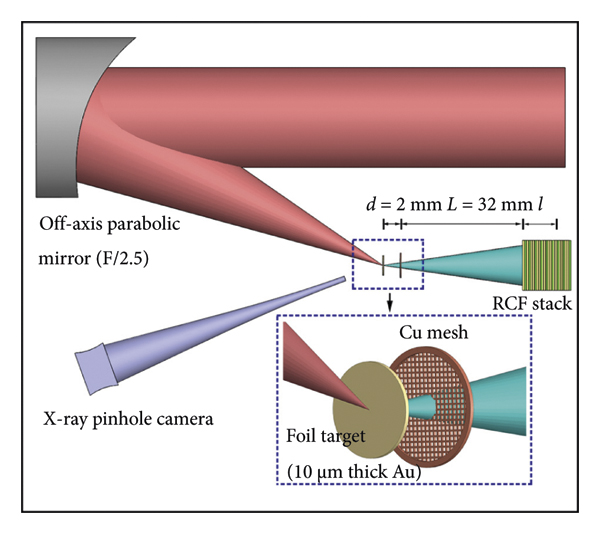
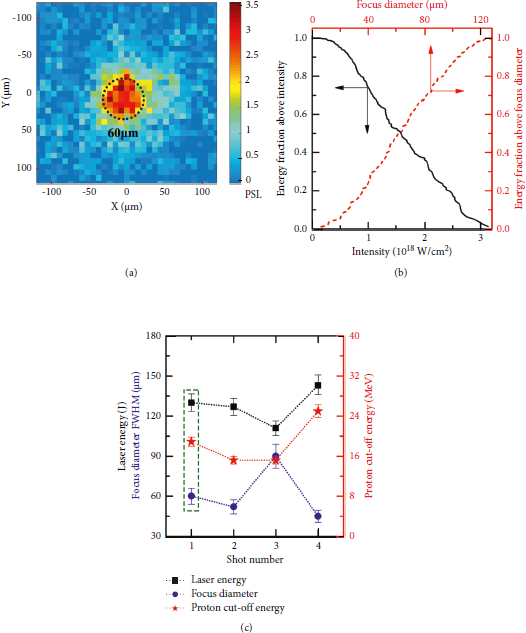
An X-ray pinhole camera (XPHC) with the theoretical resolution of about 13 μm was used to monitor the laser focus spot [Reference Wang, An and Xiong24, Reference Theobald, Sorce and Donaldson25]. An imaging plate (BAS-SR, Fuji Film) was used as the X-ray detector. In the experiment, the incident laser energy and pulse duration were set at 130 J and 1 ps, respectively, which represents a routine status of the laser as a proton backlighter. Figure 2(a) shows a typical XPHC image of the laser focus. Because a lot of physical processes are involved in the X-ray emission, such as fast electron reflux, recirculation, and transport inside the target (collision, Ohmic heating, etc.), scientifically scaling the measured emitted X-ray profile with the real laser focus intensity on the target is difficult. In this article, we assume that the X-ray intensity obtained by XPHC scales linearly with the laser intensity. The cumulative laser energy fraction as functions of intensity and focus diameter can be obtained, as shown in Figure 2(b). It shows that about 50% of the laser energy is contained within a 60 μm diameter, resulting in laser intensity over 1.5 × 10¹⁸ W/cm2. The experimental results measured in each shot are shown in Figure 2(c), and the shot number 1 is chosen as a typical shot. The incident laser energies are stable at 130 J ± 15%, and the proton cutoff energies measured with the RCF stacks are all higher than 15 MeV.
(a) A typical laser focus image recorded by an X-ray pinhole camera. PSL is the unit of the signal intensity on the imaging plate. (b) Curves of the cumulative laser energy fraction as functions of laser intensity and focus diameter obtained from (a). (c) Experimental results measured in each shot. The shot number 1 is chosen as the typical shot (data in the green box).
3. Experimental Results and Analysis
3.1. Proton Energy Spectra and Angular Distribution
The generated protons pass through the RCF layers, depositing their kinetic energy in the RCFs [Reference Nürnberg, Schollmeier and Brambrink26]. Typical proton images recorded on the RCFs scanned by using the EPSON V750 scanner for the same shot as in Figure 2(a) are shown in Figure 3(a). It is obvious that the lower-energy protons have higher intensity and larger angular divergence angle. The maximum proton energy reaches up to 18.9 MeV.
(a) Proton images on RCF layers for the same shot as in Figure 2(a). (b) Proton energy spectrum derived from (a), which was fitted with Boltzmann distribution. (c) Divergence angle of the protons. The results from VULCAN and 100TW-LULI lasers by Nürnberg et al. [Reference Nürnberg, Schollmeier and Brambrink26] are used for comparison.
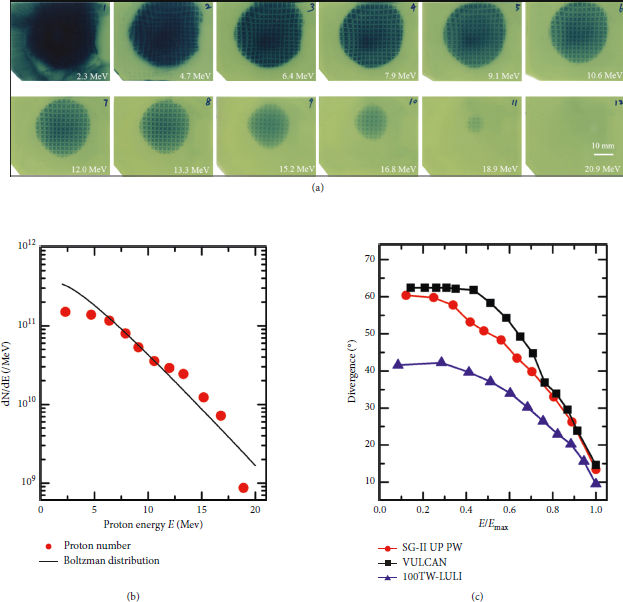
The energy spectrum of the protons can be obtained from the RCF images. Based on the calibration of the HD-V2-type RCF for protons with different doses in [Reference Chen, Gauthier and Bazalova-Carter23, Reference Nürnberg, Schollmeier and Brambrink26, Reference Hey, Key and Mackinnon27], the optical density of the RCFs can be converted into the deposited proton energy. The spatially integrated proton number on each RCF layer can, thus, be obtained from the deposited energy with SRIM simulations and the spectrum unfolding calculation [Reference Ziegler, Ziegler and Biersack28, Reference Schollmeier, Geissel, Sefkow and Flippo29], as shown in Figure 3(b). The proton energy spectrum shows an exponential profile. We fit the spectrum with the Boltzmann distribution. The fitted energy spectrum is shown in Figure 3(b), with total proton number and the temperature kBT of about 1.2 × 10¹² and 2.8 MeV, respectively. As we can see from the Figure 3(b), because of the saturation of the lowest-energy RCF layers, the measured proton numbers at low proton energies are less than the fitted result. Based on the fitting result, the conversion efficiency of laser energy to the proton beam can be calculated to be about 0.62%.
With the given distances between the target and the RCF layers and sizes of the proton images, the divergence angles (referring the full beam aperture in this article) of the energy-resolved protons can be calculated, as shown in Figure 3(c). The results from VULCAN and 100TW-LULI lasers by Nürnberg et al. [Reference Nürnberg, Schollmeier and Brambrink26] are also shown for comparison. In Figure 3(c), the proton energy E is scaled to the maximum proton energy E max, here E max = 18.9 MeV, 29.7 MeV, and 16.2 MeV for the SG-II UP PW, VULCAN, and 100TW-LULI lasers, respectively. The divergence angles of protons in our experiment are from 10° to 60°, dependent on the proton energy, with the divergence angle decreasing with the increase in the proton energy. The divergence angles of energy-resolved protons generated by the SG-II UP PW laser and VULCAN laser are similar but relatively differ from the 100TW-LULI laser. Note that the laser energy for the SG-II UP PW and VULCAN shot is about 130 J and that for the 100TW-LULI shot is about 15 J. That may be the reason why their divergences of protons are different.
3.2. Proton Source Location and Size
It has been shown that the laser-driven protons are emitted from a virtual source in a quasilaminar fashion [Reference Borghesi, Mackinnon and Campbell20]. The location of the virtual source can be obtained through calculating the magnification rate M of the Cu mesh in the proton image. The magnification rate M of the point-projection imaging in our experiment is the ratio of the virtual source-to-RCF layer distance to the virtual source-to-mesh distance.
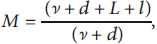
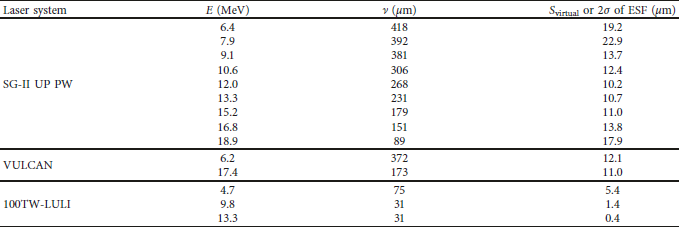
where ν is the distance from the virtual source to the foil target and l is the distance from the front surface of the RCF stack to a RCF layer with specific proton energy. In the experiment, the magnification rate M can be measured as M = d RCF/d mesh, where d RCF is the period of the mesh in the proton image and d mesh is the real period of the mesh. For the image of protons with energy of 16.8 MeV shown in Figure 3(a), d RCF = 2.131 mm, d mesh = 0.126 mm, l = 2.2 mm, d = 2 mm, and L = 32 mm, we can then obtain ν = 0.151 mm. Using the same method, the positions of the virtual sources for protons with different energies in front of the target are obtained with the uncertainty of about 7%–15%, as listed in Table 1.
To estimate the size of the virtual source, a series of Monte Carlo simulations based on Geant4 were carried out for the protons with various source sizes [Reference Roth, Cowan and Key11, Reference Incerti, Baldacchino and Bernal30]. In the simulations, spatial Gaussian density distribution in the proton source was used.
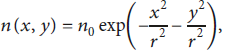
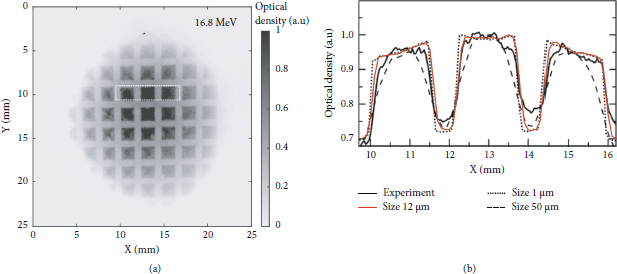
where n 0 and r are the total proton number and the 1/e is the radius of the proton source, respectively. The spatially resolved optical density distribution in the RCF layer is calculated, as shown in Figure 4. By comparing the experimental optical density profile with the simulated ones, we find that the protons with a virtual source size of about 12 μm in 1/e diameter can well match the experimental optical density profile.
(a) The optical density distribution of 16.8 MeV protons in Figure 3(a). (b) The experimental optical density profile of 16.8 MeV protons in the white box region in (a), and the simulated optical density profile of 16.8 MeV protons with source sizes of 1 μm, 12 μm, and 50 μm in 1/e diameter, respectively.
3.3. Spatial Resolution of the Proton Imaging
The spatial resolution of the proton imaging reflects the size of the proton virtual source. We, therefore, analysed the mesh images on RCFs to obtain the point spread function (PSF) so as to quantify the proton imaging spatial resolution. We first fitted the edge of the experimental optical density profile in Figure 4(b) for X from 11 mm to 14 mm with an edge spread function (ESF) [Reference Park, Maddox and Giraldez31], which is

where
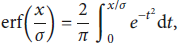
and I 0, σ, a 0, and a 1 are fitting coefficients. The fitted ESF is shown in Figure 5(a), which gives σ = 6.9 μm. Considering that the ESF is the integral response function of a Gaussian-type PSF, the PSF can be obtained as
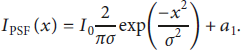
(a) The experimental optical density profile in Figure 4(b) for X from 11 mm to 14 mm was fitted by an edge spread function (ESF) with the coefficient 2σ = 13.8. M = d RCF/d mesh = 16.9M = (d RCF)/(d mesh) = 16.9 is the magnification rate of the imaging for the protons with energy of 16.8 MeV. (b) The MTF for the protons with different energies; the shaded area represents the range of the possible MTF.
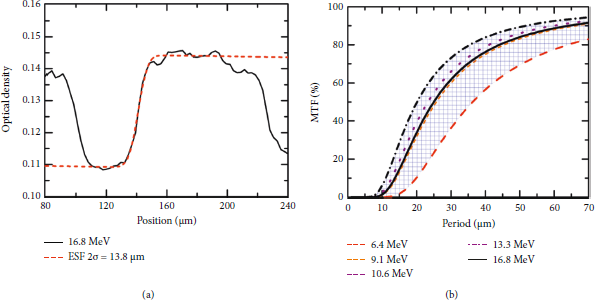
So the full width at 1/e maximum of spatial resolution of proton imaging is 2σ = 13.8 μm. This is consistent with the size of the proton virtual source of about 12 μm obtained through Monte Carlo simulations. The energy-resolved 2σ of ESF values are listed in Table 1 and are compared with the virtual source sizes from VULCAN and 100TW-LULI lasers by Nürnberg et al. [Reference Nürnberg, Schollmeier and Brambrink26].
In addition, the normalized Fourier transform of the PSF represents the modulation transfer function (MTF), which is
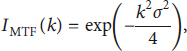
where
 and λ is the period of the modulation. Figure 5(b) shows the MTF for the protons with different energies. One sees that the spatial resolution of the 16.8 MeV proton imaging at 20% MTF is about 15 μm and that for other protons ranges from 12 to 25 μm.
4. Conclusions
In summary, the characteristics of the energetic protons accelerated from the SG-II UP PW laser interactions with foil targets were investigated. The maximum proton energy obtained in the experiment was 18.9 MeV with a laser pulse of 130 J and 1 ps. The energy spectrum of protons measured by the RCF stack is fitted with the Boltzmann distribution with the temperature of about 2.8 MeV. The emission of the protons showed a decreasing divergence angle from 60° to 10° with the increase in the proton energy. Based on the proton point-projection mesh imaging, the proton virtual sources for protons with different energies were found to locate tens to hundreds of microns in front of the target, and the size was estimated with a Monte Carlo simulation, to be about 12 μm in 1/e diameter for the protons with energy of 16.8 MeV. This size is consistent with the proton imaging spatial resolution of about 15 μm obtained from the point spread function. These results are of importance for experiments using the protons as a backlighting source on the SG-II UP PW laser.
Data Availability
Data can be made available upon request.
Conflicts of Interest
The authors declare no conflicts of interest.
Acknowledgments
The authors gratefully acknowledge the support from the technical team of the ShenGuang-II laser facility. This work was supported by the National Science and Technology Innovation Foundation of the Chinese Academy of Sciences (Grant No. CXJJ-20S015) and the Strategic Priority Research Program of the Chinese Academy of Sciences (Grant No. XDA 25020204).


 Open access

