



1 Introduction
The aim of this paper is to study the existence, uniqueness and stability of nontrivial solutions to the following quasilinear problem:
 $$ \begin{align} & (\phi(x'(t)))'=f(t, x), \quad t\geq t_0, \end{align} $$
 $$ \begin{align} & \lim_{t\to\infty}x(t)=\psi_0,\quad \lim_{t\to\infty}x'(t)e^t=0, \end{align} $$
where $\phi (s)=({s}/\!{\sqrt {1-s^2}})$
for any
$\phi (s)=({s}/\!{\sqrt {1-s^2}})$
for any $s\in \mathbb {R}$
with
$s\in \mathbb {R}$
with $|s|<1$
,
$|s|<1$
, $f:\ [t_0, \infty )\times \mathbb {R}\rightarrow \mathbb {R}$
is continuous and satisfies the variation of Nagumo conditions, and
$f:\ [t_0, \infty )\times \mathbb {R}\rightarrow \mathbb {R}$
is continuous and satisfies the variation of Nagumo conditions, and $t_0>0$
and
$t_0>0$
and $\psi _0\in \mathbb {R}$
are given constants. We point out that the specific form of asymptotic conditions (1-2) is a recently derived model for arctic gyres with a vanishing azimuthal velocity, and it is semi-infinite because gyres never cross the equator, and also (1-2) expresses the fact that the centre of the gyre is a stagnant point; see the detailed discussions in [Reference Chu10, Reference Constantin and Johnson13, Reference Constantin and Monismith14] and the references within. Equation (1-1) is related to the mean curvature equation in the Minkowski space. These kinds of problems originate from differential geometry or classical relativity [Reference Bartnik and Simon3, Reference Cheng and Yau9, Reference Dai16, Reference Gerhardt21] and have been deeply studied; see [Reference Bereanu, Jebelean and Torres4, Reference Chen, Ma and Liang6, Reference Chen and Zhao8, Reference Dai15, Reference Ma, Gao and Lu24] and the references within. Most of these results were obtained on bounded domains.
$\psi _0\in \mathbb {R}$
are given constants. We point out that the specific form of asymptotic conditions (1-2) is a recently derived model for arctic gyres with a vanishing azimuthal velocity, and it is semi-infinite because gyres never cross the equator, and also (1-2) expresses the fact that the centre of the gyre is a stagnant point; see the detailed discussions in [Reference Chu10, Reference Constantin and Johnson13, Reference Constantin and Monismith14] and the references within. Equation (1-1) is related to the mean curvature equation in the Minkowski space. These kinds of problems originate from differential geometry or classical relativity [Reference Bartnik and Simon3, Reference Cheng and Yau9, Reference Dai16, Reference Gerhardt21] and have been deeply studied; see [Reference Bereanu, Jebelean and Torres4, Reference Chen, Ma and Liang6, Reference Chen and Zhao8, Reference Dai15, Reference Ma, Gao and Lu24] and the references within. Most of these results were obtained on bounded domains.
Let $f:\ \mathbb {R}\to [0, \infty )$
satisfy a local Lipschitz condition. Azzollini [Reference Azzollini1] applied the critical point theory and shooting method to show the existence of a positive ground state solution for the Minkowski-curvature problem
$f:\ \mathbb {R}\to [0, \infty )$
satisfy a local Lipschitz condition. Azzollini [Reference Azzollini1] applied the critical point theory and shooting method to show the existence of a positive ground state solution for the Minkowski-curvature problem
 $$ \begin{align} &- (t^{N-1}\phi(x'))'=t^{N-1}f(x),\quad t\in(R, \infty), \end{align} $$
 $$ \begin{align} & x(R)=0,\quad x\to0\ \text{as}\ t\to\infty. \end{align} $$
Recently, Cao and Dai [Reference Dai17] used bifurcation theory to investigate the nonexistence, existence and multiplicity of one-sign or sign-changing solutions to problems (1-3)–(1-4) if f is replaced with $\lambda a(t)f(x)$
, and
$\lambda a(t)f(x)$
, and $a(t)\geq 0$
with
$a(t)\geq 0$
with $a\not \equiv 0$
satisfies
$a\not \equiv 0$
satisfies
 $$ \begin{align*} \int_R^{\infty}t^{N-1}a(t)<\infty. \end{align*} $$
They also proved the asymptotic behaviours of solutions:
 $$ \begin{align*} \lim_{t\to\infty}t^{N-2-\alpha}x=0,\quad \lim_{t\to\infty}t^{N-1-\alpha}x'=0 \end{align*} $$
for any positive constant $\alpha $
. In [Reference Chen5, Reference Chen and Wu7], the first author of the present paper used bifurcation theory to construct the bifurcation of the interval of positive radial solutions from the trivial solution of (1-3) and (1-4) as well as establishing the existence of positive solutions to (1-3) and (1-4) for R sufficiently small. We refer to [Reference Franchi and Lanconelli19, Reference Yang and Lee26, Reference Yang, Lee and Sim27] for a discussion of the existence of solutions of the mean curvature problem in Minkowski spacetime on an unbounded domain.
$\alpha $
. In [Reference Chen5, Reference Chen and Wu7], the first author of the present paper used bifurcation theory to construct the bifurcation of the interval of positive radial solutions from the trivial solution of (1-3) and (1-4) as well as establishing the existence of positive solutions to (1-3) and (1-4) for R sufficiently small. We refer to [Reference Franchi and Lanconelli19, Reference Yang and Lee26, Reference Yang, Lee and Sim27] for a discussion of the existence of solutions of the mean curvature problem in Minkowski spacetime on an unbounded domain.
Moreover, one of our great motivations comes also from Chu and Wang [Reference Chu and Wang11], who studied the uniqueness and stability of the nonlinear second-order differential equation
 $$ \begin{align*} x"(t)=f(t, x),\quad t\geq t_0 \end{align*} $$
subject to (1-2) provided that f satisfies a Nagumo-type condition
 $$ \begin{align} |f(t, x)-f(t, y)|\leq-\frac{\mu'(t)}{\mu(t)}w(|x-y|) \end{align} $$
and
 $$ \begin{align} \lim_{t\to0}\frac{f(t, x)-f(t, y)}{\mu"(t)}=0, \end{align} $$
where $\mu \in \mathcal {L}_1$
,
$\mu \in \mathcal {L}_1$
,
 $$ \begin{align*} \mathcal{L}_1=\bigg\{\mu\in C^2([t_0, \infty), (0, \infty)): \mu'(t)\leq0, \lim_{t\to\infty}\mu(t)=\alpha_0\in(0, 1],-\!\int\!_{t_0}^{\infty}t\frac{\mu'(t)}{\mu(t)}\,dt<\infty\bigg\}, \end{align*} $$
and $w\in \mathcal {F}$
,
$w\in \mathcal {F}$
,
 $$ \begin{align*} \mathcal{F} &=\bigg\{w\in C ([0, \infty), [0, \infty)): w(0)=0, w\ \text{is a strictly increasing function and}\\& \qquad \times \int_0^r\frac{w(s)}{s}\,ds\leq r\ \text{for}\ r>0\bigg\}. \end{align*} $$
Note that any strictly increasing continuous function $w:\ [0, \infty )\to [0, \infty )$
with
$w:\ [0, \infty )\to [0, \infty )$
with ${w(s)\leq s}$
belongs to the class
${w(s)\leq s}$
belongs to the class $\mathcal {F}$
; see [Reference Constantin12].
$\mathcal {F}$
; see [Reference Constantin12].
Nagumo-type conditions (1-5) and (1-6) are the generalized Lipschitz condition; they turned out to be very useful in studies of fluid flows [Reference Bahouri, Chemin and Danchin2]. Equations (1-5) and (1-6) were introduced originally by Constantin in [Reference Constantin12] for the first-order differential equation
 $$ \begin{align} x'(t)=f(t, x),\quad t\in[0, a]. \end{align} $$
Constantin [Reference Constantin12] showed that a convex combination of the Nagumo and Osgood growth conditions ensured the uniqueness of the solution of (1-7) with the initial value $x(0)=x_0$
. For other results on Nagumo-type uniqueness of the nonlinear differential problems, see [Reference Ferreira18, Reference Gard20, Reference Ma23, Reference Ma and Thompson25]. However, to the best of our knowledge, Nagumo-type uniqueness for Minkowski-curvature problems (1-1) and (1-2) have never been studied. To wit, we introduce the class of functions
$x(0)=x_0$
. For other results on Nagumo-type uniqueness of the nonlinear differential problems, see [Reference Ferreira18, Reference Gard20, Reference Ma23, Reference Ma and Thompson25]. However, to the best of our knowledge, Nagumo-type uniqueness for Minkowski-curvature problems (1-1) and (1-2) have never been studied. To wit, we introduce the class of functions
 $$ \begin{align} \mathcal{L}=\bigg\{\mu\in C^2([t_0, \infty), (0, \infty)): \mu'(t)>0, \mu"(t)\leq0\ \text{and}\ \int_{t_0}^{\infty}t\ \bigg(\frac{\mu'(t)}{\mu(t)}\bigg)^2\,dt<\infty\bigg\}. \end{align} $$
Let $T_0\geq t_0$
. Define
$T_0\geq t_0$
. Define $X= C^1[T_0, \infty )$
to be the Banach space endowed with the norm
$X= C^1[T_0, \infty )$
to be the Banach space endowed with the norm
 $$ \begin{align} \|x\|=\max\bigg\{\sup_{t\ge T_0}|x(t)|, \sup_{t\ge T_0}|x'(t)|\bigg\}. \end{align} $$
Assume throughout that f satisfies the following conditions.
(H1) We have $f:\ [t_0, \infty )\times \mathbb {R}\to \mathbb {R}$
is continuous and satisfies
$f:\ [t_0, \infty )\times \mathbb {R}\to \mathbb {R}$
is continuous and satisfies
 $$ \begin{align} \lim_{t\to\infty}e^tf(t, x)=0 \quad \text{uniformly in}\ x \end{align} $$
and
 $$ \begin{align} \int_{t_0}^{\infty}t|f(t, x)|\,dt<\infty\quad \text{uniformly in}\ x. \end{align} $$
(H2) There exists $\mu \in \mathcal {L}$
and
$\mu \in \mathcal {L}$
and $w\in \mathcal {F}$
such that
$w\in \mathcal {F}$
such that
 $$ \begin{align} |f(t, x)-f(t, y)|\leq \bigg(\frac{\mu'(t)}{\mu(t)}\bigg)^2w(|x-y|),\quad t\geq t_0, x, y\in\mathbb{R} \end{align} $$
and
 $$ \begin{align} \lim_{(t, x, y)\to(\infty, \psi_0, \psi_0)}\frac{f(t, x)-f(t, y)}{({1}/{\mu})"(t)}=0, \end{align} $$
where
 $$ \begin{align*} \bigg(\frac{1}{\mu}\bigg)"(t)=\frac{2\mu^{\prime2}-\mu"\mu}{\mu^3}\not=0. \end{align*} $$
Observe that (1-12) is a variation of the Nagume-type condition (1-6). We make use of (1-12) because (1-5) is not suitable for Problems (1-1) and (1-2). We use the class of functions $\mathcal {L}$
instead of
$\mathcal {L}$
instead of $\mathcal {L}_1$
, especially,
$\mathcal {L}_1$
, especially, $ \mu '(t)>0$
for
$ \mu '(t)>0$
for $t\in [t_0, \infty )$
; we refer to [Reference Constantin12] for examples of such functions.
$t\in [t_0, \infty )$
; we refer to [Reference Constantin12] for examples of such functions.
Our main results are the following theorems.
Theorem 1.1. Assume that Conditions (H1) and (H2) hold. Then, for every $\psi _0\in \mathbb {R}$
, there exists
$\psi _0\in \mathbb {R}$
, there exists $T_0\geq t_0$
such that (1-1) and (1-2) admit a bounded unique solution
$T_0\geq t_0$
such that (1-1) and (1-2) admit a bounded unique solution $x\in X$
.
$x\in X$
.
Theorem 1.2. Assume that Conditions (H1) and (H2) hold. The solution obtained in Theorem 1.1 is stable with respect to $\psi _0$
in the norm (1-9).
$\psi _0$
in the norm (1-9).
Remark 1.3. Equations (1-10) and (1-3) imply that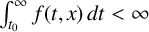 $\int _{t_0}^\infty f(t, x)\,dt<\infty $
uniformly in x and, hence,
$\int _{t_0}^\infty f(t, x)\,dt<\infty $
uniformly in x and, hence,
 $$ \begin{align} \lim\limits_{t\to\infty}\int_t^{\infty}f(s, x)\,ds=0 \quad \text{uniformly in}\ x. \end{align} $$
Thus, we can obtain that
 $$ \begin{align*} \lim_{t\to\infty}\frac{\int_t^{\infty}f(s, x)\,ds}{\sqrt{1+(\int_t^{\infty}f(s, x)\,ds)^2}}=\lim\limits_{t\to\infty}\int_t^{\infty}f(s, x)\,ds=0 \end{align*} $$
uniformly in x.
The remainder of this paper is arranged as follows. In Section 2, we give some preliminaries. Sections 3 and 4 are devoted to proving Theorems 1.1 and 1.2, respectively. In Section 5, we construct the sequence of successive approximations which converge uniformly to the unique solution obtained in Theorem 1.1.
2 Preliminaries
Now, we introduce the following property for the functions in the class $\mathcal {F}$
.
$\mathcal {F}$
.
Lemma 2.1. Let $w\in \mathcal {F}$
. Then,
$w\in \mathcal {F}$
. Then, $w(s)\leq es$
for
$w(s)\leq es$
for $s\geq 0$
.
$s\geq 0$
.
Note that Problems (1-1) and (1-2) can be rewritten as an equivalent integral equation.
Lemma 2.2. Assume that Condition (H1) holds. Then, $x\in C^1[t_0, \infty )$
is a solution of (1-1) and (1-2) if and only if
$x\in C^1[t_0, \infty )$
is a solution of (1-1) and (1-2) if and only if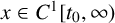 $x\in C^1[t_0, \infty )$
is a solution of the integral equation
$x\in C^1[t_0, \infty )$
is a solution of the integral equation
 $$ \begin{align} x(t)=\psi_0+\int_t^{\infty}\phi^{-1}\bigg(\!\int_\tau^{\infty}f(s, x)\,ds\bigg)\,d\tau, \end{align} $$
where $\phi ^{-1}$
denotes the inverse function of
$\phi ^{-1}$
denotes the inverse function of $\phi $
and
$\phi $
and $\phi ^{-1}(s)=({s}/\!{\sqrt {1+s^2}})$
for any
$\phi ^{-1}(s)=({s}/\!{\sqrt {1+s^2}})$
for any $s\in \mathbb {R}$
.
$s\in \mathbb {R}$
.
Proof. Let x be a solution of (1-1) and (1-2). Integrate (1-1) from t to $\infty $
; according to the second condition of (1-2), we can get
$\infty $
; according to the second condition of (1-2), we can get
 $$ \begin{align} x'(t)=-\phi^{-1}\bigg(\!\int_t^{\infty}f(s, x)\,ds\bigg). \end{align} $$
Integrate (2-2) from t to $\infty $
again; by the first condition of (1-2), it follows that (2-1) is valid.
$\infty $
again; by the first condition of (1-2), it follows that (2-1) is valid.
Alternatively, let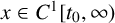 $x\in C^1[t_0, \infty )$
be a solution of the integral equation (2-1). Take the derivative on both sides of (2-1); then x satisfies (2-2). Since
$x\in C^1[t_0, \infty )$
be a solution of the integral equation (2-1). Take the derivative on both sides of (2-1); then x satisfies (2-2). Since $\phi $
is odd, it follows from (2-2) that
$\phi $
is odd, it follows from (2-2) that
 $$ \begin{align*} -\phi(x'(t))=\phi(-x'(t))=\int_t^{\infty}f(s, x)\,ds. \end{align*} $$
Then, it is not difficult to prove that x satisfies (1-1). In addition, by the definition of $\phi ^{-1}$
, L’Hôpital’s rule, (1-10) and (1-14), we deduce that
$\phi ^{-1}$
, L’Hôpital’s rule, (1-10) and (1-14), we deduce that
 $$ \begin{align*} \begin{aligned} \lim_{t\to\infty}e^t\phi^{-1}\bigg(\!\int_t^{\infty}f(s, x)\,ds\bigg) &=\lim_{t\to\infty}e^t\frac{\int_t^{\infty}f(s, x)\,ds}{\sqrt{1+(\int_t^{\infty}f(s, x)\,ds)^2}}\\ &=\lim_{t\to\infty}\frac{1}{\sqrt{1+(\int_t^{\infty}f(s, x)\,ds)^2}}\cdot\lim\limits_{t\to\infty}e^t\int_t^{\infty}f(s, x)\,ds\\ &=\lim\limits_{t\to\infty}e^t\int_t^{\infty}f(s, x)\,ds\\ &=\lim\limits_{t\to\infty}\frac{\int_t^{\infty}f(s, x)\,ds}{e^{-t}}\\ &=\lim_{t\to\infty}e^tf(t, x)\\ &=0. \end{aligned} \end{align*} $$
This, together with (2-2), implies that $\lim \limits _{t\to \infty } e^t x'(t)=0$
and, hence, the second boundary condition of (1-2) is valid. Moreover, by virtue of changing the order of integration and the definition of
$\lim \limits _{t\to \infty } e^t x'(t)=0$
and, hence, the second boundary condition of (1-2) is valid. Moreover, by virtue of changing the order of integration and the definition of $\phi ^{-1}$
, we deduce that
$\phi ^{-1}$
, we deduce that
 $$ \begin{align*} |x(t)-\psi_0|&=\bigg|\!\int_t^{\infty}\phi^{-1}\bigg(\!\int_\tau^{\infty}f(s, x)\,ds\bigg)\,d\tau\bigg|\\&\leq\int_t^{\infty}\frac{\int_\tau^{\infty}|f(s, x)|\,ds}{\sqrt{1+(\int_\tau^{\infty}f(s, x)\,ds)^2}}\\&\leq\int_t^{\infty}\int_\tau^{\infty}|f(s, x)|\,ds\,d\tau\\&=\int_t^{\infty}\int_t^s|f(s, x)|\,d\tau \,ds\\&=\int_t^{\infty} (s-t)|f(s, x)|\,ds\\&\leq \int_t^{\infty} s|f(s, x)|\,ds. \end{align*} $$
Then, combining this with (1-11) in Condition (H1), we infer that $\lim _{t\to \infty }x(t)=\psi _0.$
Thus, (1-2) holds.
$\lim _{t\to \infty }x(t)=\psi _0.$
Thus, (1-2) holds.
Remark 2.3. In the proof of Lemma 2.2, we have used that $\phi ^{-1}(-s)=-\phi ^{-1}(s)$
and
$\phi ^{-1}(-s)=-\phi ^{-1}(s)$
and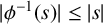 $|\phi ^{-1}(s)|\leq |s|$
for any
$|\phi ^{-1}(s)|\leq |s|$
for any $s\in \mathbb {R}$
. For the convenience of use in the following, we have also found
$s\in \mathbb {R}$
. For the convenience of use in the following, we have also found $(\phi ^{-1})'(s)=(1+s^2)^{-3/2}\leq 1$
for any
$(\phi ^{-1})'(s)=(1+s^2)^{-3/2}\leq 1$
for any $s\in \mathbb {R}$
.
$s\in \mathbb {R}$
.
3 Proof of Theorem 1.1
We give the proof of existence and Nagumo-type uniqueness of nontrivial solutions of (1-1) and (1-2).
Proof of Theorem 1.1.
For any given $0<\delta <1$
, it follows from (1-11) and
$0<\delta <1$
, it follows from (1-11) and
 $$ \begin{align*} \int_{t_0}^{\infty}t\ \bigg(\frac{\mu'(t)}{\mu(t)}\bigg)^2\,dt<\infty \end{align*} $$
that we can choose $T_0\geq \max \{t_0, 1\}$
large enough such that
$T_0\geq \max \{t_0, 1\}$
large enough such that
 $$ \begin{align} w(|\psi_0|+\delta)\int_{T_0}^{\infty}t\ \bigg(\frac{\mu'(t)}{\mu(t)}\bigg)^2\,dt\leq\frac{\delta}{2},\quad \int_{T_0}^{\infty}tf(t, 0)\,dt\leq\frac{\delta}{2}. \end{align} $$
Set
 $$ \begin{align} \Omega=\{x\in X: \|x-\psi_0\|\leq\delta\}. \end{align} $$
Define the operator $F:\ \Omega \to X$
,
$F:\ \Omega \to X$
,
 $$ \begin{align*} [F(x)](t)=\psi_0+\int_t^{\infty}\phi^{-1}\bigg(\!\int_\tau^{\infty}f(s, x)\,ds\bigg)\,d\tau,\quad t\geq T_0. \end{align*} $$
According to the proof of Lemma 2.2, we have $\lim _{t\to \infty }[F(x)](t)=\psi _0$
and
$\lim _{t\to \infty }[F(x)](t)=\psi _0$
and $\lim _{t\to \infty } e^t [F(x)]'(t)=0$
. Then, (1-12), (3-1), Remark 2.3 and the monotonicity property of w imply that for each
$\lim _{t\to \infty } e^t [F(x)]'(t)=0$
. Then, (1-12), (3-1), Remark 2.3 and the monotonicity property of w imply that for each $x\in \Omega $
and
$x\in \Omega $
and $t\ge T_0$
, we have that
$t\ge T_0$
, we have that
 $$ \begin{align} |[F(x)](t)-\psi_0|&=\bigg|\!\int_t^{\infty}\phi^{-1}\bigg(\!\int_\tau^{\infty}f(s, x)\,ds\bigg)\,d\tau\bigg| \nonumber \\&\leq\int_t^{\infty}\frac{\int_\tau^{\infty}|f(s, x)|\,ds}{\sqrt{1+(\int_\tau^{\infty}f(s, x)\,ds)^2}} \nonumber \\&\leq\int_t^{\infty}\int_\tau^{\infty}|f(s, x)|\,ds\,d\tau \nonumber \\&=\int_t^{\infty}\int_t^s|f(s, x)|\,d\tau \,ds \nonumber \\&\leq\int_t^{\infty} (s-t)|f(s, x)|\,ds\\&\leq \int_t^{\infty} (s-t)|f(s, x)-f(s,\ 0)|\,ds+\int_t^{\infty} (s-t)|f(s,\ 0)|\,ds \nonumber \\&\leq \int_t^{\infty} s \bigg(\frac{\mu'(s)}{\mu(s)}\bigg)^2w(|x(s)|)\,ds+\int_t^{\infty} s|f(s,\ 0)|\,ds \nonumber \\&\leq w(|\psi_0|+\delta)\int_{T_0}^{\infty} s \bigg(\frac{\mu'(s)}{\mu(s)}\bigg)^2\,ds+\int_{T_0}^{\infty} s|f(s,\ 0)|\,ds \nonumber \\&\leq\delta. \nonumber \end{align} $$
Using similar processing methods to (3-3) and (1-14) in Remark 2.3 for any $x\in \Omega $
and
$x\in \Omega $
and $t\geq T_0$
, we can also get
$t\geq T_0$
, we can also get
 $$ \begin{align} \begin{aligned} |([F(x)](t)-\psi_0)'|&=\bigg|\phi^{-1}\bigg(\!\int_t^{\infty}f(s, x)\,ds\bigg)\bigg|\\ &\leq\int_t^{\infty} |f(s, x)|\,ds\\ &\leq\delta. \end{aligned} \end{align} $$
Then, $F:\ \Omega \to \Omega $
is well defined.
$F:\ \Omega \to \Omega $
is well defined.
Let $\{x_n\}\subset \Omega $
be an arbitrary sequence. By applying the Lagrange mean value theorem and (3-4), we obtain
$\{x_n\}\subset \Omega $
be an arbitrary sequence. By applying the Lagrange mean value theorem and (3-4), we obtain
 $$ \begin{align} |[{F}(x_{n})](t_{1})-[{F}(x_{n})](t_{2})|\leq\delta|t_{1}-t_{2}|,\quad t_{1}, t_{2}\geq T_{0},\ n\geq1. \end{align} $$
For any $t_{1}, t_{2}\geq T_{0}$
, without loss of generality, assuming that
$t_{1}, t_{2}\geq T_{0}$
, without loss of generality, assuming that $t_1\le t_2$
, we have
$t_1\le t_2$
, we have
 $$ \begin{align} \begin{aligned} |[{F}(x_{n})]'(t_{1})-[{F}(x_{n})]'(t_{2})|&\leq\bigg|\phi^{-1}\bigg(\!\int_{t_{1}}^{\infty}f(s, x_{n})\,ds\bigg)- \phi^{-1}\bigg(\!\int_{t_{2}}^{\infty}f(s, x_{n})\,ds\bigg)\bigg|\\ &\leq\frac{1}{(1+\xi^{2})^{{3}/{2}}}\bigg|\!\int_{t_{1}}^{\infty}f(s, x_{n})\,ds-\int_{t_{2}}^{\infty}f(s, x_{n})\,ds\bigg|\\ &\leq\int_{t_{1}}^{t_{2}}|f(s, x_{n})|\,ds\\ &\leq M(t_{2}-t_{1}), \end{aligned} \end{align} $$
where $\xi $
lives between
$\xi $
lives between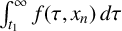 $\int _{t_1}^{\infty }f(\tau , x_n)\,d\tau $
and
$\int _{t_1}^{\infty }f(\tau , x_n)\,d\tau $
and $\int _{t_2}^{\infty }f(\tau , x_n)\,d\tau .$
Here, M is the supremum of f in
$\int _{t_2}^{\infty }f(\tau , x_n)\,d\tau .$
Here, M is the supremum of f in $[t_0, \infty )\times \Omega $
in view of Condition (H1) and Remark 1.3. Thus, (3-5)–(3-6) show that
$[t_0, \infty )\times \Omega $
in view of Condition (H1) and Remark 1.3. Thus, (3-5)–(3-6) show that $\{{F}(x_{n})\}$
is equicontinuous in
$\{{F}(x_{n})\}$
is equicontinuous in $\Omega $
. Clearly,
$\Omega $
. Clearly, $\{{F}(x_{n})\}$
is uniformly bounded in
$\{{F}(x_{n})\}$
is uniformly bounded in $\Omega $
. Furthermore, it follows from the penultimate inequality of (3-3) that
$\Omega $
. Furthermore, it follows from the penultimate inequality of (3-3) that
 $$ \begin{align} |[{F}(x_{n})](t)-\psi_{0}|\leq w(|\psi_0|+\delta)\int_t^{\infty} s \bigg(\frac{\mu'(s)}{\mu(s)}\bigg)^2\,ds+\int_t^{\infty} s|f(s, 0)|\,ds. \end{align} $$
Then, according to (1-8) and (1-11), for any $\varepsilon>0$
, there exists
$\varepsilon>0$
, there exists $T_1>T_{0}$
such that, for any
$T_1>T_{0}$
such that, for any $t\geq T_1$
,
$t\geq T_1$
,
 $$ \begin{align} \int_t^{\infty} s \bigg(\frac{\mu'(s)}{\mu(s)}\bigg)^2\,ds<\frac{\varepsilon}{2w(|\psi_0|+\delta)},\quad \int_t^{\infty} s|f(s, x)|\,ds<\frac{\varepsilon}{2}\ \text{uniformly in}\ x. \end{align} $$
Combining this with (3-7), it follows that
 $$ \begin{align*} |[{F}(x_{n})](t)-\psi_{0}|<\varepsilon,\quad t\geq T_1, \ n\geq1. \end{align*} $$
Similar to (3-4), together with (1-11) and (3-8),
 $$ \begin{align*} |[{F}(x_{n})]'(t)|\leq \int_t^{\infty} s|f(s, x_n)|\,ds<\varepsilon,\quad t\geq T_1, \ n\geq1. \end{align*} $$
Then, $\{{F}(x_{n})\}$
is equiconvergent in
$\{{F}(x_{n})\}$
is equiconvergent in $\Omega $
. Thus, via the Arzela–Ascoli theorem [Reference Zeidler28], we obtain that
$\Omega $
. Thus, via the Arzela–Ascoli theorem [Reference Zeidler28], we obtain that $\{{F}(x_{n})\}$
is relatively compact in
$\{{F}(x_{n})\}$
is relatively compact in $\Omega $
.
$\Omega $
.
Now, we just need to prove that ${F}:\ \Omega \rightarrow \Omega $
is continuous. From (1-8), for any fixed
${F}:\ \Omega \rightarrow \Omega $
is continuous. From (1-8), for any fixed $\varepsilon>0$
, there exists
$\varepsilon>0$
, there exists $T_2\geq \max \{2, T_{0}\}$
such that
$T_2\geq \max \{2, T_{0}\}$
such that
 $$ \begin{align} w(2\delta)\int_{T_2}^{\infty} s \bigg(\frac{\mu'(s)}{\mu(s)}\bigg)^2\,ds<\frac{\varepsilon}{2}. \end{align} $$
It follows from Condition (H1) that $f:\ [t_{0}, T_2]\times [|\psi _{0}|-\delta , |\psi _{0}|+\delta ]\rightarrow \mathbb {R}$
is uniformly continuous. Then, there exists a constant
$f:\ [t_{0}, T_2]\times [|\psi _{0}|-\delta , |\psi _{0}|+\delta ]\rightarrow \mathbb {R}$
is uniformly continuous. Then, there exists a constant $\gamma{\kern-1pt}>{\kern-1pt}0$
such that for any
$\gamma{\kern-1pt}>{\kern-1pt}0$
such that for any ${x, y{\kern-1pt}\in{\kern-1pt} [|\psi _{0}|{\kern-1pt}-{\kern-1pt}\delta , |\psi _{0}|{\kern-1pt}+{\kern-1pt}\delta ]}$
with
${x, y{\kern-1pt}\in{\kern-1pt} [|\psi _{0}|{\kern-1pt}-{\kern-1pt}\delta , |\psi _{0}|{\kern-1pt}+{\kern-1pt}\delta ]}$
with $|x-y|<\gamma $
,
$|x-y|<\gamma $
,
 $$ \begin{align} |f(t, x)-f(t, y)|<\frac{\varepsilon}{T_2^{2}},\quad t\in[t_{0}, T_2]. \end{align} $$
Therefore, for any $t\geq T_0$
,
$t\geq T_0$
, $x_{1}, x_{2}\in \Omega $
with
$x_{1}, x_{2}\in \Omega $
with $\|x_{1}-x_{2}\|<\gamma $
, using a similar method to treat (3-6), we deduce from (3-9) and (3-10) that
$\|x_{1}-x_{2}\|<\gamma $
, using a similar method to treat (3-6), we deduce from (3-9) and (3-10) that
 $$ \begin{align*} &|[{F}(x_{1})](t)-[{F}(x_{2})](t)|\\& \quad =\bigg|\!\int_{t}^{\infty} \phi^{-1}\bigg(\!\int_{s}^{\infty}f(\tau, x_{1})\,d\tau\bigg)\,ds- \int_{t}^{\infty} \phi^{-1}\bigg(\!\int_{s}^{\infty}f(\tau, x_{2})\,d\tau\bigg)\,ds\bigg|\\& \quad \leq\int_{t}^{\infty} \bigg|\phi^{-1}\bigg(\!\int_{s}^{\infty}f(\tau, x_{1})\,d\tau\bigg)- \phi^{-1}\bigg(\!\int_{s}^{\infty}f(\tau, x_{2})\,d\tau\bigg)\bigg|ds\\& \quad \leq\int_{t}^{\infty}\int_{s}^{\infty}|f(\tau, x_{1})-f(\tau, x_{2})|\,d\tau\, ds\\& \quad =\int_t^{\infty}\int_t^\tau|f(\tau, x_{1})-f(\tau, x_{2})|\,ds \,d\tau \\& \quad =\int_{t}^{\infty}(\tau-t)|f(\tau, x_{1})-f(\tau, x_{2})|\,d\tau\\& \quad =\int_{t}^{\infty}(s-t)|f(s, x_{1})-f(s, x_{2})|\,ds\\& \quad \leq\int_{T_{0}}^{T_{2}}(s-T_0)|f(s, x_{1})-f(s, x_{2})|\,ds+\int_{T_2}^{\infty}(s-T_2)|f(s, x_{1})-f(s, x_{2})|\,ds\\& \quad \leq\frac{\varepsilon(T_{2}-T_{0})^{2}}{2T_2^{2}}+\int_{T_2}^{\infty} s \bigg(\frac{\mu'(s)}{\mu(s)}\bigg)^2w(|x_1-x_2|)\,ds\\& \quad <\frac{\varepsilon}{2}+w(\gamma)\int_{T_2}^{\infty} s \bigg(\frac{\mu'(s)}{\mu(s)}\bigg)^2\,ds\\& \quad <\varepsilon. \end{align*} $$
Then,
 $$ \begin{align} |[{F}(x_{1})](t)-[{F}(x_{2})](t)|<\varepsilon. \end{align} $$
Similarly, we can get
 $$ \begin{align} \begin{aligned} |[{F}(x_{1})]'(t)-[{F}(x_{2})]'(t)|&=\bigg|\phi^{-1}\bigg(\!\int_{t}^{\infty}f(s, x_{1})\,ds\bigg)-\phi^{-1}\bigg(\!\int_{t}^{\infty}f(s, x_{2})\,ds\bigg)\bigg|\\ &\leq\int_{t}^{\infty}|f(s, x_{1})-f(s, x_{2})|\,ds\\ &\leq\int_{T_{0}}^{T_{2}}|f(s, x_{1})-f(s, x_{2})|\,ds+\int_{T_{2}}^{\infty}s|f(s, x_{1})-f(s, x_{2})|\,ds\\ &\leq\frac{\varepsilon}{T_{2}^{2}}(T_{2}-T_{0})+\int_{T_2}^{\infty} s \bigg(\frac{\mu'(s)}{\mu(s)}\bigg)^2w(|x_1-x_2|)\,ds\\ &\leq\frac{\varepsilon}{T_{2}}+\frac{\varepsilon}{2}\\ &<\varepsilon. \end{aligned} \end{align} $$
Thus, it follows from (3-11) and (3-12) that ${F}:\Omega \rightarrow \Omega $
is a continuous operator.
${F}:\Omega \rightarrow \Omega $
is a continuous operator.
Consequently, it follows from Schauder fixed-point theorem that F admits a fixed point $x\in \Omega $
, so x is an abounded solution of (2-1). Indeed, by Lemma 2.2, x is also a solution of (1-1) and (1-2).
$x\in \Omega $
, so x is an abounded solution of (2-1). Indeed, by Lemma 2.2, x is also a solution of (1-1) and (1-2).
Next, we prove the uniqueness. Let $x, y\in \Omega $
be two solutions of (2-1). Then,
$x, y\in \Omega $
be two solutions of (2-1). Then,
 $$ \begin{align} (x(t)-y(t))'=-\bigg[\phi^{-1}\bigg(\!\int_t^{\infty}f(s, x)\,ds\bigg)-\phi^{-1}\bigg(\!\int_t^{\infty}f(s, y)\,ds\bigg)\bigg], \end{align} $$
and, hence,
 $$ \begin{align*} (x(t)-y(t))"=\bigg(1+\bigg(\!\int_t^{\infty}f(s, x)\,ds\bigg)^2\bigg)^{-{3}/{2}}f(t, x)-\bigg(1+\bigg(\!\int_t^{\infty}f(s, y)\,ds\bigg)^2\bigg)^{-{3}/{2}}f(t, y), \end{align*} $$
as well as
 $$ \begin{align*} \lim_{t\to\infty}(x(t)-y(t))=0,\quad \lim_{t\to\infty}(x(t)-y(t))'e^t=0. \end{align*} $$
By virtue of the change of variables
 $$ \begin{align*} \tau=\ln\mu(t),\quad t\in[t_0, \infty), \end{align*} $$
it follows that $\tau \in [\ln \mu (t_0), \infty )$
. Let
$\tau \in [\ln \mu (t_0), \infty )$
. Let $X(\tau )=x(t),\ Y(\tau )=y(t)$
. Then,
$X(\tau )=x(t),\ Y(\tau )=y(t)$
. Then,
 $$ \begin{align} (X(\tau)-Y(\tau))'=\frac{\mu(t)}{\mu'(t)}(x(t)-y(t))'. \end{align} $$
Observe that ${\mu (t)}/{\mu '(t)}$
is a nondecreasing function since
${\mu (t)}/{\mu '(t)}$
is a nondecreasing function since $\mu "(t)\leq 0$
. Combining this with (1-12), (3-13)–(3-14) and Remark 2.3, we obtain
$\mu "(t)\leq 0$
. Combining this with (1-12), (3-13)–(3-14) and Remark 2.3, we obtain
 $$ \begin{align} \begin{aligned} |(X(\tau)-Y(\tau))'|&=\bigg|\frac{\mu(t)}{\mu'(t)}\bigg[\phi^{-1}\bigg(\!\int_t^{\infty}f(s, x)\,ds\bigg)-\phi^{-1}\bigg(\!\int_t^{\infty}f(s, y)\,ds\bigg)\bigg]\bigg|\\ &\leq |(\phi^{-1})'(\zeta)|\bigg(\frac{\mu(t)}{\mu'(t)}\bigg)\int_t^\infty|f(s, x)-f(s, y)|\,ds\\ &\leq\int_\tau^\infty\bigg(\frac{\mu(s)}{\mu'(s)}\bigg)^2|f(s, x)-f(s, y)|\,d\xi\ (\text{here}\ \xi=\ln\mu(s))\\ &\leq \int_\tau^\infty w(|X(\xi)- Y(\xi)|)\,d\xi, \end{aligned} \end{align} $$
where $\zeta $
is between
$\zeta $
is between $\int _t^{\infty }f(s, x)\,ds$
and
$\int _t^{\infty }f(s, x)\,ds$
and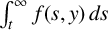 $\int _t^{\infty }f(s, y)\,ds$
.
$\int _t^{\infty }f(s, y)\,ds$
.
However, it follows from the continuity of f, L’Hôpital’s rule, (1-13), (3-13) and Remark 1.3 that
 $$ \begin{align*} &\lim_{\tau\to\infty}(e^\tau(X(\tau)-Y(\tau)))\\ & \quad =\lim_{t\to\infty}\frac{x(t)-y(t)}{{1}/{\mu(t)}}\\ & \quad =\lim_{t\to\infty}\frac{-\bigg[\phi^{-1}\bigg(\!\int_t^{\infty}f(s, x)\,ds\bigg)-\phi^{-1}\bigg(\!\int_t^{\infty}f(s, y)\,ds\bigg)\bigg]}{({1}/{\mu(t)})'(t)}\\ & \quad =\lim_{t\to\infty}-(\phi^{-1})'(\zeta)\frac{\int_t^{\infty}f(s, x)\,ds-\int_t^{\infty}f(s, y)\,ds}{({1}/{\mu(t)})'(t)}\\& \quad =\lim_{t\to\infty}-(\phi^{-1})'(\zeta)\lim_{t\to\infty}\frac{\int_t^{\infty}f(s, x)\,ds-\int_t^{\infty}f(s, y)\,ds}{({1}/{\mu(t)})'(t)}\\ & \quad =\lim_{t\to\infty}\frac{f(t, x(t))-f(t, y(t))}{({1}/{\mu(t)})"(t)}=0, \end{align*} $$
where $\zeta $
is introduced in (3-15), so
$\zeta $
is introduced in (3-15), so
 $$ \begin{align} \lim_{\tau\to\infty}e^\tau|X(\tau)-Y(\tau)|=0, \end{align} $$
which implies that
 $$ \begin{align*} \lim\limits_{\tau\to\infty}|X(\tau)-Y(\tau)|=0. \end{align*} $$
Set $\Phi (\tau )=|X(\tau )-Y(\tau )|$
. In view of (3-16), define the normed space
$\Phi (\tau )=|X(\tau )-Y(\tau )|$
. In view of (3-16), define the normed space
 $$ \begin{align*} Y=\bigg\{\Phi\in C[\tau_0, \infty): \Phi(\tau)\geq0\ \text{on}\ \tau\geq\tau_0,\ \sup_{\tau\geq\tau_0}\{\Phi(\tau)e^\tau\}<\infty\bigg\} \end{align*} $$
endowed with the norm
 $$ \begin{align*} \|\Phi\|_\infty=\sup_{\tau\geq\tau_0}\{\Phi(\tau)e^\tau\}, \end{align*} $$
where $\tau _0=\ln \mu (t_0)$
. Then, it follows from (3-16) that there exists
$\tau _0=\ln \mu (t_0)$
. Then, it follows from (3-16) that there exists $\tau _1\geq \tau _0$
such that
$\tau _1\geq \tau _0$
such that
 $$ \begin{align} \|\Phi\|_\infty=\Phi(\tau_1)e^{\tau_1}>\Phi(\tau)e^{\tau},\quad \Phi\in Y,\ \tau>\tau_1. \end{align} $$
Assume that $\|\Phi \|_\infty>0$
(if
$\|\Phi \|_\infty>0$
(if $\|\Phi \|_\infty =0$
, then the uniqueness is proved). Together with (3-15),
$\|\Phi \|_\infty =0$
, then the uniqueness is proved). Together with (3-15),
 $$ \begin{align} \begin{aligned} \Phi(\tau)&=|X(\tau)-Y(\tau)|\leq\int_\tau^\infty|X'(\xi)-Y'(\xi)|\,d\xi\\ &\leq\int_\tau^\infty\int_\xi^\infty w(|X(\zeta)-Y(\zeta)|)\,d\zeta\, d\xi\\ &=\int_\tau^\infty\int_\xi^\infty w(\Phi(\zeta))\,d\zeta\, d\xi. \end{aligned} \end{align} $$
By (3-17), (3-18), the definition of $\mathcal {F}$
and
$\mathcal {F}$
and $\|\Phi \|_\infty $
, we deduce that
$\|\Phi \|_\infty $
, we deduce that
 $$ \begin{align*} \|\Phi\|_\infty e^{-\tau_1}=\Phi(\tau_1)&\leq\int_{\tau_1}^\infty\int_\xi^\infty w(\Phi(\zeta))\,d\zeta \,d\xi\\&=\int_{\tau_1}^\infty\int_\xi^\infty w(\Phi(\zeta)e^{-\zeta}e^{\zeta})\,d\zeta \,d\xi\\&<\int_{\tau_1}^\infty\int_\xi^\infty w(\|\Phi\|e^{-\zeta})\,d\zeta \,d\xi\\&\leq\int_{\tau_1}^\infty\int_0^{\|\Phi\|_\infty e^{-\xi}} \frac{w(r)}{r}\,dr \,d\xi\\&\leq\int_{\tau_1}^\infty\|\Phi\|_\infty e^{-\xi}\,d\xi\\&=\|\Phi\|_\infty e^{-\tau_1}, \end{align*} $$
which is a contradiction. Thus, $\|\Phi \|=0$
. Thus, there exists a unique fixed point x of F in
$\|\Phi \|=0$
. Thus, there exists a unique fixed point x of F in $\Omega $
. Consequently, (1-1) and (1-2) admit a unique bounded solution x.
$\Omega $
. Consequently, (1-1) and (1-2) admit a unique bounded solution x.
Remark 3.1. Note that the solution x showed by Theorem 1.1 is a bounded solution. Moreover, $T_0$
in Theorem 1.1 is chosen uniformly for
$T_0$
in Theorem 1.1 is chosen uniformly for $\psi _0$
in a bounded set. The value of
$\psi _0$
in a bounded set. The value of $T_0$
depends on
$T_0$
depends on $\psi _0$
, that is,
$\psi _0$
, that is, $T_0$
satisfies (3-1).
$T_0$
satisfies (3-1).
In this section, we conclude with an example to illustrate the application of Theorem 1.1.
Example 3.2. Set $t_0>0$
. Let
$t_0>0$
. Let $w(x)=x$
,
$w(x)=x$
, $\mu (t)=\text {arc}\!\tan t$
and
$\mu (t)=\text {arc}\!\tan t$
and
 $$ \begin{align} f(t, x)=\frac{xe^{-2x}}{e^{3t}(1+t^2)^2(\text{arc}\!\tan t)^2}; \end{align} $$
by a series of calculations, we can get that
 $$ \begin{align*} \mu'(t)=\frac{1}{1+t^2}>0,\quad \mu"(t)=\frac{-2t}{(1+t^2)^2}\leq0 \quad \text{on}\ t\geq t_0,\ \int_{t_0}^{\infty}s\bigg(\frac{\mu'(s)}{\mu(s)}\bigg)^2\,ds<\infty, \end{align*} $$
and then $\mu \in \mathcal {L}$
. Moreover,
$\mu \in \mathcal {L}$
. Moreover,
 $$ \begin{align*} \bigg(\frac{1}{\mu}\bigg)"(t)=\frac{2(1+t\text{arc}\!\tan t)}{(1+t^2)^2(\text{arc}\!\tan t)^3},\quad \bigg(\frac{\mu'(t)}{\mu(t)}\bigg)^2=\frac{1}{(1+t^2)^2(\text{arc}\!\tan t)^2}, \end{align*} $$
so (1-12) and (1-13) holds. It is not difficult to show that (1-10) and (1-11) are valid. Therefore, (1-1) and (1-2) admit a unique bounded solution x according to Theorem 1.1 when f satisfies (3-19).
4 Proof of Theorem 1.2
In this section, we establish that the unique solution obtained in Theorem 1.1 is stable.
Proof of Theorem 1.2.
Let x and $\tilde {x}$
be two solutions of the integral equation (2-1) with
$\tilde {x}$
be two solutions of the integral equation (2-1) with
 $$ \begin{align*} \lim_{t\to\infty}x(t)=\psi_0, \quad \lim_{t\to\infty} \tilde{x}(t)=\tilde{\psi}_0. \end{align*} $$
Since $\mu \in \mathcal {L}$
, we may choose
$\mu \in \mathcal {L}$
, we may choose $T_1\geq 1$
large enough such that
$T_1\geq 1$
large enough such that
 $$ \begin{align*} \alpha_1=\int_{T_1}^\infty s\bigg(\frac{\mu'(s)}{\mu(s)}\bigg)^2<\dfrac{1}{e}. \end{align*} $$
For any $t\geq T_1$
, it follows from (1-12), Lemma 2.1 and the mean value theorem that
$t\geq T_1$
, it follows from (1-12), Lemma 2.1 and the mean value theorem that
 $$ \begin{align*} |x(t)-\tilde{x}(t)|&\leq|\psi_0-\tilde{\psi}_0|+ \bigg|\!\int_t^{\infty}\phi^{-1}\bigg(\!\int_\tau^{\infty}f(s, x)\,ds\bigg)\,d\tau-\int_t^{\infty}\phi^{-1}\bigg(\!\int_\tau^{\infty}f(s, \tilde{x})\,ds\bigg)\,d\tau\bigg|\\ &\leq|\psi_0-\tilde{\psi}_0|+\int_t^{\infty}|(\phi^{-1})'(\xi)|\int_\tau^{\infty}|f(s, x)-f(s, \tilde{x})|\,ds\,d\tau\\ &\leq|\psi_0-\tilde{\psi}_0|+\int_t^{\infty}\int_\tau^{\infty}|f(s, x)-f(s, \tilde{x})|\,ds\,d\tau\\ &\leq|\psi_0-\tilde{\psi}_0|+\int_t^{\infty}\int_t^{s}|f(s, x)-f(s, \tilde{x})|\,d\tau \,ds\\ &=|\psi_0-\tilde{\psi}_0|+\int_t^{\infty}(s-t)|f(s, x)-f(s, \tilde{x})|\,ds\\ &\leq |\psi_0-\tilde{\psi}_0|+\int_t^{\infty}s\bigg(\frac{\mu'(s)}{\mu(s)}\bigg)^2w(|x(s)-\tilde{x}(s)|)\,ds\\ &\leq |\psi_0-\tilde{\psi}_0|+e\|x-\tilde{x}\|_\infty\int_t^{\infty}s\bigg(\frac{\mu'(s)}{\mu(s)}\bigg)^2\,ds\\ &\leq |\psi_0-\tilde{\psi}_0|+e\alpha_1\|x-\tilde{x}\|_\infty \end{align*} $$
(here, $\xi $
is between
$\xi $
is between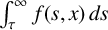 $\int _\tau ^{\infty }f(s, x)\,ds$
and
$\int _\tau ^{\infty }f(s, x)\,ds$
and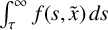 $\int _\tau ^{\infty }f(s, \tilde {x})\,ds$
). Then,
$\int _\tau ^{\infty }f(s, \tilde {x})\,ds$
). Then,
 $$ \begin{align} |x(t)-\tilde{x}(t)|\leq\|x-\tilde{x}\|_\infty\leq\frac{|\psi_0-\tilde{\psi}_0|}{1-e\alpha_1},\quad t\geq T_1, \end{align} $$
since
 $$ \begin{align*} \alpha_1=\int_{T_1}^\infty s\bigg(\frac{\mu'(s)}{\mu(s)}\bigg)^2\geq\int_{T_1}^\infty\bigg(\frac{\mu'(s)}{\mu(s)}\bigg)^2. \end{align*} $$
Then, by (2-1) and (4-1), for any $t\geq T_1$
, it follows that
$t\geq T_1$
, it follows that
 $$ \begin{align} \begin{aligned} |x'(t)-\tilde{x}'(t)|&=\bigg|\bigg[\phi^{-1}\bigg(\!\int_t^{\infty}f(s, x(s))\,ds\bigg)-\phi^{-1}\bigg(\!\int_t^{\infty}f(s, \tilde{x}(s))\,ds\bigg)\bigg]\bigg|\\ &\leq |(\phi^{-1})'(\zeta)|\int_t^\infty|f(s, x)-f(s, \tilde{x})|\,ds\\ &\leq \int_t^\infty \bigg(\frac{\mu'(s)}{\mu(s)}\bigg)^2w(|x(s)- \tilde{x}(s)|)\,ds\\ &\leq \int_t^\infty e\bigg(\frac{\mu'(s)}{\mu(s)}\bigg)^2|x(s)- \tilde{x}(s)|\,ds\\ &\leq \frac{e\alpha_1}{1-e\alpha_1} |\psi_0-\tilde{\psi}_0|; \end{aligned} \end{align} $$
here, $\zeta $
is between
$\zeta $
is between $\int _t^{\infty }f(s, x)\,ds$
and
$\int _t^{\infty }f(s, x)\,ds$
and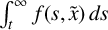 $\int _t^{\infty }f(s, \tilde {x})\,ds$
. Thus, we can also get
$\int _t^{\infty }f(s, \tilde {x})\,ds$
. Thus, we can also get
 $$ \begin{align} |x(T_1)-\tilde{x}(T_1)|+|x'(T_1)-\tilde{x}'(T_1)|\leq\frac{1+e\alpha_1}{1-e\alpha_1} |\psi_0-\tilde{\psi}_0|. \end{align} $$
If $t_0=T_1$
, then the proof is complete via (4-1) and (4-2). If
$t_0=T_1$
, then the proof is complete via (4-1) and (4-2). If $T_1>t_0$
, set
$T_1>t_0$
, set
 $$ \begin{align*} s=T_{1}-t,~y(s)=x(T_{1}-s),~z(s)=y'(s),\quad 0\leq s\leq T_{1}-t_{0}. \end{align*} $$
Observe that a solution of (1-1) satisfies
 $$ \begin{align*} x"=(1-(x')^{2})^{{3}/{2}}f(t, x),\quad t\geq t_0; \end{align*} $$
then y satisfies
 $$ \begin{align} \begin{aligned} y"(s)=x"(T_{1}-s)&=(1-(x'(T_{1}-s))^{2})^{{3}/{2}}f(T_{1}-s, x(T_{1}-s))\\ &=(1-(z(s))^{2})^{{3}/{2}}f(T_{1}-s, y(s)) \end{aligned} \end{align} $$
with the initial condition
 $$ \begin{align} y(0)=x(T_{1}), \quad y'(0)=-x'(T_{1}). \end{align} $$
Consider the linear system
 $$ \begin{align} \begin{pmatrix} y'(s)\\z'(s) \end{pmatrix} = \begin{pmatrix} 0&1\\ -\bigg(\dfrac{\mu'(T_1-s)}{\mu(T_1-s)}\bigg)^2&0 \end{pmatrix} \begin{pmatrix} y(s)\\z(s) \end{pmatrix}, \quad 0\leq s\leq T_{1}-t_{0}. \end{align} $$
Denote by
 $$ \begin{align*} A(s)= \begin{pmatrix} a_{11}(s)&a_{12}(s)\\ a_{21}(s)&a_{22}(s) \end{pmatrix} \end{align*} $$
the fundamental matrix solution of the system (4-6). Then, (4-4)–(4-5) can be written as
 $$ \begin{align*} \begin{pmatrix} y'(s)\\ z'(s) \end{pmatrix} & = \begin{pmatrix} 0&1\\ -\bigg(\dfrac{\mu'(T_1-s)}{\mu(T_1-s)}\bigg)^2&0 \end{pmatrix} \begin{pmatrix} y(s)\\ z(s) \end{pmatrix}\\ &\quad + \begin{pmatrix} 0\\ (1-(z(s))^{2})^{{3}/{2}}f(T_{1}-s, y(s))+\bigg(\dfrac{\mu'(T_1-s)}{\mu(T_1-s)}\bigg)^2y(s) \end{pmatrix} \end{align*} $$
with
 $$ \begin{align*} \begin{pmatrix} y(0)\\ z(0) \end{pmatrix}= \begin{pmatrix} x(T_{1})\\ -x'(T_{1}) \end{pmatrix}.\\ \end{align*} $$
It follows from the variation of constants formula that
 $$ \begin{align*} \begin{pmatrix} y(s)\\ z(s) \end{pmatrix} &=A(s) \begin{pmatrix} x(T_{1})\\ -x'(T_{1}) \end{pmatrix}\\ &\quad +\int_{0}^{s}A(s-\tau) \begin{pmatrix} 0\\ (1-(z(\tau))^{2})^{{3}/{2}}f(T_{1}-\tau, y(\tau))+\bigg(\frac{\mu'(T_1-\tau)}{\mu(T_1-\tau)}\bigg)^2y(\tau)\end{pmatrix} \,d\tau. \end{align*} $$
Then, for any $0\leq s\leq T_{1}-t_{0}$
,
$0\leq s\leq T_{1}-t_{0}$
,
 $$ \begin{align*} \begin{aligned} y(s)&=a_{11}(s)x(T_{1})-a_{12}(s)x'(T_{1})\\ &\quad+\int_{0}^{s}a_{12}(s-\tau)(1-(z(\tau))^{2})^{{3}/{2}}f(T_{1}-\tau, y(\tau))\,d\tau.\\ &\quad+\int_{0}^{s}a_{12}(s-\tau)\bigg(\frac{\mu'(T_1-\tau)}{\mu(T_1-\tau)}\bigg)^2y(\tau)\,d\tau.\\ \end{aligned} \end{align*} $$
Similarly, set
 $$ \begin{align*} \tilde{y}(s)=\tilde{x}(T_{1}-s), \quad \tilde{z}(s)=\tilde{y}'(s),\quad 0\leq s\leq T_{1}-t_{0}. \end{align*} $$
Thus, for any $0\leq s\leq T_{1}-t_{0}$
,
$0\leq s\leq T_{1}-t_{0}$
,
 $$ \begin{align} &y(s)-\tilde{y}(s) =a_{11}(s)[x(T_{1})-\tilde{x}(T_{1})]-a_{12}(s)[x'(T_{1})-\tilde{x}'(T_1)] \nonumber\\& \quad +\int_{0}^{s}\!\!a_{12}(s-\tau)[(1-(z(\tau))^{2})^{{3}/{2}}f(T_{1}-\tau, y(\tau))- (1-(\tilde{z}(\tau))^{2})^{{3}/{2}}f(T_{1}-\tau, \tilde{y}(\tau))]\,d\tau\nonumber\\& \quad + \int_{0}^{s}a_{12}(s-\tau)[y(\tau)-\tilde{y}(\tau)]\bigg(\frac{\mu'(T_1-\tau)}{\mu(T_1-\tau)}\bigg)^2\,d\tau. \end{align} $$
Set
 $$ \begin{align*} a_{11}^{*}=\max\limits_{s\in[0,T_{1}-t_{0}]}|a_{11}(s)|,\quad a_{12}^{*}=\max\limits_{s\in[0,T_{1}-t_{0}]}|a_{12}(s)|,\quad a_{1}^{*}=\max\{a_{11}^{*}, a_{12}^{*}\}. \end{align*} $$
Then, (4-7) becomes
 $$ \begin{align} &|y(s)-\tilde{y}(s)|\nonumber\\ &\quad\leq a_{11}^{*}|x(T_{1})-\tilde{x}(T_{1})|+a_{12}^{*}|x'(T_{1})-\tilde{x}'(T_{1})|\nonumber\\ & \qquad+\int_{0}^{s}a_{12}^{*}|(1-(z(\tau))^{2})^{{3}/{2}}f(T_{1}-\tau, y(\tau)) -(1-(\tilde{z}(\tau))^{2})^{{3}/{2}}f(T_{1}-\tau, \tilde{y}(\tau))|\,d\tau \nonumber\\ & \qquad+\int_{0}^{s}a_{12}^{*} |y(\tau)-\tilde{y}(\tau)|\bigg(\frac{\mu'(T_1-\tau)}{\mu(T_1-\tau)}\bigg)^2\,d\tau. \end{align} $$
For any fixed $\tau \in [0,\ T_{1}-t_{0}]$
, note that it follows from the mean value theorem that there exists
$\tau \in [0,\ T_{1}-t_{0}]$
, note that it follows from the mean value theorem that there exists $z^\ast $
between
$z^\ast $
between $z(\tau )$
and
$z(\tau )$
and $\widetilde {z}(\tau )$
such that
$\widetilde {z}(\tau )$
such that
 $$ \begin{align} \begin{aligned} |(1-(z(\tau))^{2})^{{3}/{2}}-(1-(\tilde{z}(\tau))^{2})^{{3}/{2}}|&=|-3z^\ast(1-z^{\ast2})^{1}/{2}(z(\tau)-\tilde{z}(\tau))|\\ & \leq 3|z(\tau)-\tilde{z}(\tau)|. \end{aligned} \end{align} $$
Then, from (1-12), (4-9) and Lemma 2.1,
 $$ \begin{align} &|(1-(z(\tau))^{2})^{{3}/{2}}f(T_{1}-\tau, y(\tau))-(1-(\tilde{z}(\tau))^{2})^{{3}/{2}}f(T_{1}-\tau, \tilde{y}(\tau))| \nonumber \\ & \quad =|(1-(z(\tau))^{2})^{{3}/{2}}f(T_{1}-\tau, y(\tau))-(1-(z(\tau))^{2})^{{3}/{2}}f(T_{1}-\tau, \tilde{y}(\tau)) \nonumber \\ & \qquad +(1-(z(\tau))^{2})^{{3}/{2}}f(T_{1}-\tau, \tilde{y}(\tau))-(1-(\tilde{z}(\tau))^{2})^{{3}/{2}}f(T_{1}-\tau, \tilde{y}(\tau))| \nonumber \\ & \quad \leq(1-(z(\tau))^{2})^{{3}/{2}}|f(T_{1}-\tau, y(\tau))-f(T_{1}-\tau, \tilde{y}(\tau))| \\ & \qquad +|(1-(z(\tau))^{2})^{{3}/{2}}-(1-(\tilde{z}(\tau))^{2})^{{3}/{2}}|\cdot|f(T_{1}-\tau, \tilde{y}(\tau))| \nonumber \\ & \quad \leq|f(T_{1}-\tau, y(\tau))-f(T_{1}-\tau, \tilde{y}(\tau))|+3|f(T_{1}-\tau, \tilde{y}(\tau))|\cdot|z(\tau)-\tilde{z}(\tau)| \nonumber \\ & \quad \leq e\bigg(\frac{\mu'(T_1-\tau)}{\mu(T_1-\tau)}\bigg)^2|y(\tau)-\tilde{y}(\tau)|+3M|z(\tau)-\tilde{z}(\tau)|. \nonumber \end{align} $$
In fact, by Condition (H1), for any $\tau \in [0, T_{1}-t_{0}]$
, there exists some constant
$\tau \in [0, T_{1}-t_{0}]$
, there exists some constant $M>0$
such that
$M>0$
such that
 $$ \begin{align*} |f(T_{1}-\tau, \tilde{y}(\tau))|\leq M. \end{align*} $$
Then, by (4-2), (4-8) and (4-10),
 $$ \begin{align} \begin{aligned} |y(s)-\tilde{y}(s)|&\leq a_{11}^{*}|x(T_{1})-\tilde{x}(T_{1})|+a_{12}^{*}|x'(T_{1})-\tilde{x}'(T_{1})|\\ &\quad +\int_{0}^{s}(1+e)a_{12}^{*}\bigg(\frac{\mu'(T_1-\tau)}{\mu(T_1-\tau)}\bigg)^2|y(\tau)-\tilde{y}(\tau)|\,d\tau\\ &\quad +(T_{1}-t_{0})3a_{12}^{*}M\frac{e\alpha_1}{1-e\alpha_1} |\psi_0-\tilde{\psi}_0|. \end{aligned} \end{align} $$
By virtue of (4-3), Inequality (4-11) becomes
 $$ \begin{align*} \begin{aligned} |y(s)-\tilde{y}(s)|&\leq\frac{a_{1}^{*}(1+e\alpha_1)}{1-e\alpha_1}|\psi_0-\tilde{\psi}_0|+\frac{3(T_{1}-t_{0})a_{12}^{*}Me\alpha_1}{1-e\alpha_1} |\psi_0-\tilde{\psi}_0|\\ &\quad +\int_{0}^{s}(1+e)a_{12}^{*}\bigg(\frac{\mu'(T_1-\tau)}{\mu(T_1-\tau)}\bigg)^2 |y(\tau)-\tilde{y}(\tau)|\,d\tau, \end{aligned} \end{align*} $$
which, on account of the Bellman–Gronwall inequality, implies that
 $$ \begin{align*} \begin{aligned} |y(s)-\tilde{y}(s)| &\leq\bigg[\frac{a_{1}^{*}(1+e\alpha_1)}{1-e\alpha_1}+\frac{3a_{12}^{*}M(T_{1}-t_{0})e\alpha_1}{1-e\alpha_1}\bigg]|\psi_{0}-\tilde{\psi_{0}}| e^{(\int_{0}^{T_1-t_0}(1+e)a_{12}^{*}({\mu'(T_1-\tau)}/{\mu(T_1-\tau)})^2\,d\tau)}\\ &\leq\bigg[\frac{a_{1}^{*}(1+e\alpha_1)}{1-e\alpha_1}+\frac{3a_{12}^{*}M(T_{1}-t_{0})e\alpha_1}{1-e\alpha_1}\bigg]|\psi_{0}-\tilde{\psi_{0}}|e^{(\int_{t_{0}}^{T_{1}}(1+e)a_{12}^{*} ({\mu'(s)}/{\mu(s)})^2\,ds)}. \end{aligned} \end{align*} $$
Then, we equivalently have
 $$ \begin{align} |x(t)-\tilde{x}(t)|\leq\bigg[\frac{a_{1}^{*}(1+e\alpha_1)}{1-e\alpha_1}+\frac{3a_{12}^{*}M(T_{1}-t_{0})e\alpha_1}{1-e\alpha_1}\bigg] |\psi_{0}-\tilde{\psi_{0}}|e^{(\int_{t_{0}}^{T_{1}}(1+e)a_{12}^{*}({\mu'(s)}/{\mu(s)})^2\,ds)}. \end{align} $$
Similarly, we can also deduce that
 $$ \begin{align} |x'(t)-\tilde{x}'(t)|\leq\bigg[\frac{a_{2}^{*}(1+e\alpha_1)}{1-e\alpha_1}+\frac{3a_{22}^{*}M(T_{1}-t_{0})e\alpha_1}{1-e\alpha_1}\bigg] |\psi_{0}-\tilde{\psi_{0}}|e^{(\int_{t_{0}}^{T_{1}} (1+e)a_{22}^{*}({\mu'(s)}/{\mu(s)})^2\,ds)}, \end{align} $$
where
 $$ \begin{align*} a_{21}^{*}=\max\limits_{s\in[0,T_{1}-t_{0}]}|a_{21}(s)|,\quad a_{22}^{*}=\max\limits_{s\in[0,T_{1}-t_{0}]}|a_{22}(s)|, \quad a_{2}^{*}=\max\{a_{21}^{*}, a_{22}^{*}\}. \end{align*} $$
Consequently, it follows from (4-1), (4-2), (4-12) and (4-13) that the solution obtained in Theorem 1.1 is stable in the norm (1-9) with respect to the values of $\psi _{0}$
.
$\psi _{0}$
.
5 Approximate solution
For any integer $n\geq 0$
. Let us define the sequence of successive approximations
$n\geq 0$
. Let us define the sequence of successive approximations
 $$ \begin{align} x_{n+1}(t)=\psi_0+\int_t^{\infty}\phi^{-1}\bigg(\!\int_\tau^{\infty}f(s, x_n)\,ds\bigg)\,d\tau,\quad t\geq t_0, \end{align} $$
where $x_0\in X$
satisfies
$x_0\in X$
satisfies
 $$ \begin{align*} \lim_{t\to\infty}x_0(t)=\psi_0,\quad \lim_{t\to\infty}x_0'(t)e^t=0. \end{align*} $$
We prove that the sequence of successive approximations (5-1) converges uniformly to the solution obtained in Theorem 1.1 on $[T_0, \infty )$
.
$[T_0, \infty )$
.
Theorem 5.1. Assume that Conditions (H1) and (H2) hold. Then, the sequence of successive approximations (5-1) converges uniformly to the unique solution of (1-1) and (1-2) on $[T_0, \infty )$
.
$[T_0, \infty )$
.
Proof. We first show that $\{x_n(t)\}\subset \Omega $
, where
$\{x_n(t)\}\subset \Omega $
, where $\Omega $
is defined as in (3-2). It is not difficult to see that
$\Omega $
is defined as in (3-2). It is not difficult to see that $\{x_n\}\subset X.$
Since
$\{x_n\}\subset X.$
Since $T_0$
satisfies (3-1), now, we proceed as in (3-3). It follows that
$T_0$
satisfies (3-1), now, we proceed as in (3-3). It follows that
 $$ \begin{align} \begin{aligned} |x_1(t)-\psi_0|&=\bigg|\!\int_t^{\infty}\phi^{-1}\bigg(\!\int_\tau^{\infty}f(s, x_0)\,ds\bigg)\,d\tau\bigg|\\ &\leq\int_t^{\infty} (s-t)|f(s, x_0)|\,ds\\ &\leq \int_t^{\infty} (s-t)|f(s, x_0)-f(s,\ 0)|\,ds+\int_t^{\infty} (s-t)|f(s,\ 0)|\,ds\\ &\leq \int_t^{\infty} s \bigg(\frac{\mu'(s)}{\mu(s)}\bigg)^2w(|x_0(s)|)\,ds+\int_t^{\infty} s|f(s,\ 0)|\,ds\\ &\leq w(|\psi_0|+\delta)\int_{T_0}^{\infty} s \bigg(\frac{\mu'(s)}{\mu(s)}\bigg)^2\,ds+\int_{T_0}^{\infty} s|f(s,\ 0)|\,ds\\ &\leq\delta. \end{aligned} \end{align} $$
For any $n\geq 1$
, now suppose that
$n\geq 1$
, now suppose that $x_{n-1}(t)\in \Omega $
. Repeating the arguments in (5-2), we can also get
$x_{n-1}(t)\in \Omega $
. Repeating the arguments in (5-2), we can also get
 $$ \begin{align} |x_{n}(t)-\psi_0|\leq\delta,\quad t\geq T_0. \end{align} $$
Thus, $\{x_n(t)\}\subset \Omega $
.
$\{x_n(t)\}\subset \Omega $
.
In addition, it follows from (5-3) that $\{x_n(t)\}$
is uniformly bounded. However, by virtue of (5-1), for any
$\{x_n(t)\}$
is uniformly bounded. However, by virtue of (5-1), for any $t\geq T_0$
, using methods similar to (3-3),
$t\geq T_0$
, using methods similar to (3-3),
 $$ \begin{align*} |x_{n+1}'(t)|&=\bigg|\phi^{-1}\bigg(\!\int_t^{\infty}f(s, x_n)\,ds\bigg)\bigg|\\ &\leq\int_t^{\infty} |f(s, x_n)|\,ds\\ &\leq \int_t^{\infty} s|f(s, x_n)|\,ds\\ &\leq\delta. \end{align*} $$
Combining the preceding inequality with the mean value theorem, we obtain that
 $$ \begin{align} |x_{n+1}(t_1)-x_{n+1}(t_2)|\leq\delta|t_1-t_2|,\quad t_1, t_2\geq T_0,\ n\geq0. \end{align} $$
Let $\zeta $
be between
$\zeta $
be between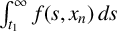 $\int _{t_1}^{\infty }f(s, x_n)\,ds$
and
$\int _{t_1}^{\infty }f(s, x_n)\,ds$
and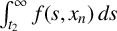 $\int _{t_2}^{\infty }f(s, x_{n})\,ds$
. Then, it follows from (5-1) that
$\int _{t_2}^{\infty }f(s, x_{n})\,ds$
. Then, it follows from (5-1) that
 $$ \begin{align} \begin{aligned} |x_{n+1}'(t_1)-x_{n+1}'(t_2)|&=\bigg|\phi^{-1}\bigg(\!\int_{t_1}^{\infty}f(s, x_n)\,ds\bigg)-\phi^{-1}\bigg(\!\int_{t_2}^{\infty}f(s, x_{n})\,ds\bigg)\bigg|\\ &\leq |(\phi^{-1})'(\zeta)|\cdot\bigg|\!\int_{t_1}^{t_2}|f(s, x_{n}(s))|\,ds\bigg|\\ &\leq M|t_1-t_2|, \end{aligned} \end{align} $$
where $|f(s, x)|\leq M$
for some constant
$|f(s, x)|\leq M$
for some constant $M>0$
when s belongs to either
$M>0$
when s belongs to either $[t_1,\ t_2]$
or
$[t_1,\ t_2]$
or $[t_2,\ t_1]$
. Then, it follows from (5-4) and (5-5) that
$[t_2,\ t_1]$
. Then, it follows from (5-4) and (5-5) that $\{x_n(t)\}$
is equicontinuous in X. Moreover, similar to (3-3), it is not difficult to prove that
$\{x_n(t)\}$
is equicontinuous in X. Moreover, similar to (3-3), it is not difficult to prove that $\{x_n(t)\}$
is equiconvergent. By applying the Arzela–Ascoli theorem, we obtain that there exists a subsequence
$\{x_n(t)\}$
is equiconvergent. By applying the Arzela–Ascoli theorem, we obtain that there exists a subsequence $\{x_{n_k}(t)\}$
that converges uniformly to a continuous function
$\{x_{n_k}(t)\}$
that converges uniformly to a continuous function $h(t)$
on
$h(t)$
on $[T_0, \infty )$
as
$[T_0, \infty )$
as $k\to \infty $
. Since
$k\to \infty $
. Since
 $$ \begin{align*} x_{n_{k}+1}(t)=\psi_0+\int_t^{\infty}\phi^{-1}\bigg(\!\int_\tau^{\infty}f(s, x_{n_k})\,ds\bigg)\,d\tau, \end{align*} $$
by the continuity of f and $\phi ^{-1}$
, the sequence
$\phi ^{-1}$
, the sequence $\{x_{n_k+1}(t)\}$
converges uniformly to
$\{x_{n_k+1}(t)\}$
converges uniformly to
 $$ \begin{align*} \tilde{h}(t)=\psi_0+\int_t^{\infty}\phi^{-1}\bigg(\!\int_\tau^{\infty}f(s,\ h(s))\,ds\bigg)\,d\tau. \end{align*} $$
In the following, we prove that $\tilde {h}(t)=h(t)$
on
$\tilde {h}(t)=h(t)$
on $[T_0, \infty )$
. Now, we proceed as in [Reference Chu and Wang11], repeating the arguments for completeness. We only need to show that
$[T_0, \infty )$
. Now, we proceed as in [Reference Chu and Wang11], repeating the arguments for completeness. We only need to show that
 $$ \begin{align*} \lim_{n\to\infty}\|x_{n+1}(t)-x_{n}(t)\|_\infty=0 \quad \text{uniformly on}\ [T_0, \infty). \end{align*} $$
By (5-1),
 $$ \begin{align} \begin{aligned} |x_{n+1}'(t)-x_{n}'(t)|&=\bigg|\phi^{-1}\bigg(\!\int_t^{\infty}f(s, x_n)\,ds\bigg)-\phi^{-1}\bigg(\!\int_t^{\infty}f(s, x_{n-1})\,ds\bigg)\bigg|\\ &\leq |(\phi^{-1})'(\zeta)|\int_t^\infty|f(s, x_{n}(s))-f(s, x_{n-1}(s))|\,ds\\ &\leq \int_t^\infty \bigg(\frac{\mu'(s)}{\mu(s)}\bigg)^2w(|x_{n}(s)- x_{n-1}(s)|)\,ds, \end{aligned} \end{align} $$
where $\zeta $
is between
$\zeta $
is between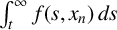 $\int _t^{\infty }f(s, x_{n})\,ds$
and
$\int _t^{\infty }f(s, x_{n})\,ds$
and $\int _t^{\infty }f(s, x_{n-1})\,ds$
. Set
$\int _t^{\infty }f(s, x_{n-1})\,ds$
. Set
 $$ \begin{align*} \tau=\ln\mu(t),\quad X_n(\tau)=x_n(t). \end{align*} $$
Similar to (3-15), according to (5-6), it becomes
 $$ \begin{align*} |X_{n+1}'(\tau)-X_{n}'(\tau)|\leq\int_\tau^\infty w(|X_{n}(s)- X_{n-1}(s)|)\,ds,\quad \tau\geq\ln\mu(T_0), \end{align*} $$
and, thus,
 $$ \begin{align*} \begin{aligned} |X_{n+1}(\tau)-X_{n}(\tau)|&\leq \int_\tau^\infty|X_{n}'(s)-X_{n-1}'(s)|\,ds\\ &\leq\int_\tau^\infty\int_\xi^\infty w(|X_{n}(s)- X_{n-1}(s)|)\,ds\,d\xi. \end{aligned} \end{align*} $$
Let $y_n(\tau )=|X_{n+1}(\tau )-X_{n}(\tau )|$
. Then,
$y_n(\tau )=|X_{n+1}(\tau )-X_{n}(\tau )|$
. Then,
 $$ \begin{align} y_n(\tau)\leq\int_\tau^\infty\int_\xi^\infty w(y_{n-1}(s))\,ds\,d\xi. \end{align} $$
Set
 $$ \begin{align*} Y_n(\tau)=\sup_{k\geq n}\{y_k(\tau)\}. \end{align*} $$
It is easy to see that the sequence $\{Y_n(\tau )\}$
is nonincreasing. From (5-7),
$\{Y_n(\tau )\}$
is nonincreasing. From (5-7),
 $$ \begin{align*} Y_{n+1}(\tau)\leq \int_\tau^\infty\int_\xi^\infty w(Y_n(s))\,ds\,d\xi. \end{align*} $$
The same type of argument shows that the sequence $\{Y_n\}$
is equicontinuous and equiconvergent on
$\{Y_n\}$
is equicontinuous and equiconvergent on $[\ln \mu (T_0), \infty )$
, as well as that
$[\ln \mu (T_0), \infty )$
, as well as that
 $$ \begin{align*} Y(\tau)=\sup_{n\geq1}\{Y_n(\tau)\} \end{align*} $$
is continuous on $[\ln \mu (T_0), \infty )$
.
$[\ln \mu (T_0), \infty )$
.
Since the pointwise convergence of the function sequence $\{Y_n(\tau )\}$
to the continuous
$\{Y_n(\tau )\}$
to the continuous $Y(\tau )$
is monotonic on
$Y(\tau )$
is monotonic on $[\ln \mu (T_0), \infty )$
, Dini’s theorem (see [Reference Hewitt and Stromberg22]) shows that this convergence is uniform on
$[\ln \mu (T_0), \infty )$
, Dini’s theorem (see [Reference Hewitt and Stromberg22]) shows that this convergence is uniform on $[\ln \mu (T_0), \infty )$
. It follows from the Lebesgue dominated convergence theorem that
$[\ln \mu (T_0), \infty )$
. It follows from the Lebesgue dominated convergence theorem that
 $$ \begin{align*} Y(\tau)\leq \int_\tau^\infty\int_\xi^\infty w(Y(s))\,ds\,d\xi,\quad \tau\geq\ln\mu(T_0), \end{align*} $$
together with $Y(0)=0$
as
$Y(0)=0$
as $Y_n(0)=0$
. Reasoning in a manner analogous to the uniqueness part of the proof shows
$Y_n(0)=0$
. Reasoning in a manner analogous to the uniqueness part of the proof shows $Y(\tau )\equiv 0$
for all
$Y(\tau )\equiv 0$
for all $\tau \in [\ln \mu (T_0), \infty )$
. Thus,
$\tau \in [\ln \mu (T_0), \infty )$
. Thus,
 $$ \begin{align*} \lim_{n\to\infty}Y_n(\tau)=0\quad \text{uniformly on}\ [\ln\mu(T_0), \infty), \end{align*} $$
and hence,
 $$ \begin{align*} \lim_{n\to\infty}\|x_{n+1}(\tau)-x_n(\tau)\|_\infty=0\quad \text{uniformly on}\ [T_0, \infty). \end{align*} $$
The proof is complete.
Availability of data and materials
Data sharing is not applicable to this paper as no datasets were generated or analysed during the current study.
Acknowledgements
This work was finished while Tianlan Chen was visiting the Department of Mathematics at the University of New South Wales. She would like to express her thanks to all people there for their kind hospitality. Moreover, the authors are very grateful to the anonymous reviewers and editors for their valuable comments and professional suggestions that improved the original manuscript.



